Showing posts with label dwarf spheroidal galaxy. Show all posts

Thursday, January 31, 2019

Hubble fortuitously discovers a new galaxy in the cosmic neighbourhood

The accidentally discovered galaxy Bedin I

Bedin 1 in NGC 6752

Globular cluster NGC 6752

Wide-field view of NGC 6752 (ground-based view)


Videos 
Zooming in on NGC 6752 and Bedin 1
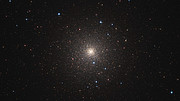

Flight to Bedin 1
Flight to Bedin 1


Astronomers using the NASA/ESA Hubble Space Telescope to study some of the oldest and faintest stars in the globular cluster NGC 6752 have made an unexpected finding. They discovered a dwarf galaxy in our cosmic backyard, only 30 million light-years away. The finding is reported in the journal Monthly Notices of the Royal Astronomical Society: Letters.

An international team of astronomers recently used the NASA/ESA Hubble Space Telescope to study white dwarf stars within the globular cluster NGC 6752. The aim of their observations was to use these stars to measure the age of the globular cluster, but in the process they made an unexpected discovery.
In the outer fringes of the area observed with Hubble’s Advanced Camera for Surveys a compact collection of stars was visible. After a careful analysis of their brightnesses and temperatures, the astronomers concluded that these stars did not belong to the cluster — which is part of the Milky Way — but rather they are millions of light-years more distant.

Our newly discovered cosmic neighbour, nicknamed Bedin 1 by the astronomers, is a modestly sized, elongated galaxy. It measures only around 3000 light-years at its greatest extent — a fraction of the size of the Milky Way. Not only is it tiny, but it is also incredibly faint. These properties led astronomers to classify it as a dwarf spheroidal galaxy.

Dwarf spheroidal galaxies are defined by their small size, low-luminosity, lack of dust and old stellar populations [1]. 36 galaxies of this type are already known to exist in the Local Group of Galaxies, 22 of which are satellite galaxies of the Milky Way.

While dwarf spheroidal galaxies are not uncommon, Bedin 1 has some notable features. Not only is it one of just a few dwarf spheroidals that have a well established distance but it is also extremely isolated. It lies about 30 million light-years from the Milky Way and 2 million light-years from the nearest plausible large galaxy host, NGC 6744. This makes it possibly the most isolated small dwarf galaxy discovered to date.

From the properties of its stars, astronomers were able to infer that the galaxy is around 13 billion years old — nearly as old as the Universe itself. Because of its isolation — which resulted in hardly any interaction with other galaxies — and its age, Bedin 1 is the astronomical equivalent of a living fossil from the early Universe.

The discovery of Bedin 1 was a truly serendipitous find. Very few Hubble images allow such faint objects to be seen, and they cover only a small area of the sky. Future telescopes with a large field of view, such as the WFIRST telescope, will have cameras covering a much larger area of the sky and may find many more of these galactic neighbours.


Notes

[1] While similar to dwarf elliptical galaxies in appearance and properties, dwarf spheroidal galaxies are in general approximately spherical in shape and have a lower luminosity.


More Information

The Hubble Space Telescope is a project of international cooperation between ESA and NASA.

The results were presented in the letter The HST Large Programme on NGC 6752. I. Serendipitous discovery of a dwarf galaxy in background, published in the journal Monthly Notices of the Royal Astronomical Society: Letters.

The international team of astronomers that carried out this study consists of L. R. Bedin (INAF-Osservatorio Astronomico di Padova, Italy), M. Salaris (Liverpool John Moores University, UK), R. M. Rich (University of California Los Angeles, USA), H. Richer (University of British Columbia), J. Anderson (Space Telescope Science Institute, USA), B. Bettoni (INAF-Osservatorio Astronomico di Padova, Italy), D. Nardiello (Università di Padova, Italy), A. P. Milone (Università di Padova, Italy), A. F. Marino (Università di Padova, Italy), M. Libralato (Space Telescope Science Institute, USA), A. Bellini (Space Telescope Science Institute, USA), A. Dieball (University of Bonn, Germany), P. Bergeron (Université de Montréal, Canada), A. J. Burgasser (University of California San Diego, USA), D. Apai (University of Arizona, USA).

Image credit: NASA, ESA, Bedin et al.


Links


Contact

L. R. Bedin
INAF-Osservatorio Astronomico di Padova
Padua, Italy
Tel: +49 8293 413

Email: luigi.bedin@oapd.inaf.it

Mathias Jäger
ESA/Hubble, Public Information Officer
Garching, Germany
Tel: +49 176 62397500
Email:
mjaeger@partner.eso.org


Wednesday, November 29, 2017

Hubble and Gaia team up to measure 3D stellar motion with record-breaking precision

Hubble’s view of the Sculptor Dwarf Galaxy (pointing 1)

PR Image heic1719b
Hubble’s view of the Sculptor Dwarf Galaxy (pointing 2)

PR Image heic1719c
Sculptor Dwarf Galaxy (ground-based view)

PR Image heic1719d
Wide-field image of the sky around the Sculptor Dwarf Galaxy

PR Image heic1719e
Hubble observing the Sculptor Dwarf Galaxy

PR Image heic1719f
ESA’s Gaia satellite


Videos
 
Zoom on a a part of the Sculptor Dwarf Galaxy


A team of astronomers used data from both the NASA/ESA Hubble Space Telescope and ESA’s Gaia satellite to directly measure the 3D motions of individual stars in a nearby galaxy. The achieved accuracy is better than anything previously measured for a galaxy beyond the Milky Way. The motions provide a field test of the currently-accepted cosmological model and also measure the trajectory of the galaxy through space. The results are published in Nature Astronomy.

Astronomers from the Kapteyn Astronomical Institute and Leiden Observatory, both in the Netherlands, used data from the NASA/ESA Hubble Space Telescope and ESA’s Gaia space observatory to measure the motions of stars in the Sculptor Dwarf Galaxy. The Sculptor Dwarf is a satellite galaxy orbiting the Milky Way, 300 000 light-years away from Earth.

Only by combining the datasets from these two successful ESA missions — produced more than 12 years apart — could the scientists directly measure the exact 3D motions of stars within the Sculptor Dwarf Galaxy [1]. The is the first time this has been achieved with such accuracy for a galaxy other than the Milky Way [2].

Davide Massari, lead author of the study, describes the precision of the research: “With the precision achieved we can measure the yearly motion of a star on the sky which corresponds to less than the size of a pinhead on the Moon as seen from Earth.” This kind of precision was only possible due to the extraordinary resolution and accuracy of both instruments. Also the study would not have been possible without the large interval of time between the two datasets which makes it easier to determine the movement of the stars.

The Sculptor Dwarf Galaxy is a dwarf spheroidal galaxy, which are among the most dark matter dominated objects in the Universe. This makes them ideal targets for investigating the properties of dark matter. In particular, understanding how dark matter is distributed in these dwarf galaxies allows astronomers to test the validity of the currently-accepted cosmological model. However, dark matter cannot be studied directly.

“One of the best ways to infer the presence of dark matter is to examine how objects move within it,” explains Amina Helmi, co-author of the paper. “In the case of dwarf spheroidals, these objects are stars.”

The information gathered about the 3D motion of stars in the Sculptor Dwarf Galaxy can be translated directly into knowledge of how its total mass — including dark matter — is distributed.

The new results show that stars in the Sculptor Dwarf Galaxy move preferentially on elongated radial orbits. This indicates that the density of dark matter increases towards the centre instead of flattening out. These findings are in agreement with the established cosmological model and our current understanding of dark matter, taking into account the complexity of Sculptor’s stellar populations.

As a side effect of the study, the team also presented a more accurate trajectory of the Sculptor Dwarf Galaxy as a whole as it orbits the Milky Way. Their results show that it is moving around the Milky Way in a high-inclination elongated orbit that takes it much further away than previously thought.

Currently, it is nearly at its closest point to the Milky Way, but its orbit can take it as far as 725 000 light-years away.

“With these pioneering measurements, we enter an era where measuring 3D motions of stars in other galaxies will become routine and will be possible for larger star samples. This will mostly be thanks to ESA’s Gaia mission,” concludes Massari.


Notes

[1] The team measured the proper motions of roughly a hundred stars in the Sculptor Dwarf Galaxy. 

For a smaller subset of ten stars, chosen among those with the smallest errors, the astronomers could also retrieve from the literature an estimate of the radial velocity, which quantifies the stellar motion along the line of sight. Using the proper motion and radial velocity measurements, they were able to reconstruct how these stars move in three dimensions.

[2] The data used contain images taken with Hubble’s Advanced Camera for Surveys in 2002. Newer positions of individual stars were taken from the Gaia, which was observed between 2014 and 2015.


More Informatiom


The Hubble Space Telescope is a project of international cooperation between ESA and NASA.

Gaia is an ESA mission to survey one billion stars in our Galaxy and local galactic neighbourhood in order to build the most precise 3D map of the Milky Way and answer questions about its structure, origin and evolution. A large pan-European team of expert scientists and software developers, the Data Processing and Analysis Consortium (DPAC), located in and funded by many ESA member states, is responsible for the processing and validation of Gaia's data, with the final objective of producing the Gaia Catalogue.

The international team of astronomers in this study consists of D. Massari (University of Groningen, The Netherlands), M. A. Breddels (University of Groningen, The Netherlands), A. Helmi (University of Groningen, The Netherlands), L. Posti (University of Groningen, The Netherlands), A. G. A. Brown (Leiden University, The Netherlands) and E. Tolstoy (University of Groningen, The Netherlands).

Image credit: ESA/Hubble & NASA, ESA/ATG medialab, Digitized Sky Survey 2


Links


Contacts

Davide Massari
Kapteyn Astronomical Institute
Groningen, The Netherlands
Tel: +31 50363 4094
Email: massari@astro.rug.nl

Amina Helmi
Kapteyn Astronomical Institute
Groningen, The Netherlands
Tel: +31 50363 4045
Email: ahelmi@astro.rug.nl

Mathias Jäger
ESA/Hubble, Public Information Officer
Garching bei München, Germany
Cell: +49 176 62397500
Email: mjaeger@partner.eso.org


Source: ESA/Hubble/News

Wednesday, September 16, 2015

A Shy Galactic Neighbour

Sculptor Dwarf Galaxy

Location of the Sculptor Dwarf Galaxy 

Wide-field image of the sky around the Sculptor Dwarf Galaxy


Videos
 
A close-up look at the Sculptor Dwarf Galaxy


The Sculptor Dwarf Galaxy, pictured in this new image from the Wide Field Imager camera, installed on the 2.2-metre MPG/ESO telescope at ESO’s La Silla Observatory, is a close neighbour of our galaxy, the Milky Way. Despite their close proximity, both galaxies have very distinct histories and characters. This galaxy is much smaller and older than the Milky Way, making it a valuable subject for studying both star and galaxy formation in the early Universe. However, due to its faintness, studying this object is no easy task.

The Sculptor Dwarf Galaxy — also known as the Sculptor Dwarf Elliptical or the Sculptor Dwarf Spheroidal — is a dwarf spheroidal galaxy, and is one of the fourteen known satellite galaxies orbiting the Milky Way [1]. These galactic hitchhikers are located close by in the Milky Way’s extensive halo, a spherical region extending far beyond our galaxy’s spiral arms. As indicated by its name, this galaxy is located in the southern constellation of Sculptor and lies about 280 000 light-years away from Earth. Despite its proximity, the galaxy was only discovered in 1937, as its stars are faint and spread thinly across the sky.

Although difficult to pick out, the Sculptor Dwarf Galaxy was among the first faint dwarf galaxies found orbiting the Milky Way. The tiny galaxy’s shape intrigued astronomers at the time of its discovery, but nowadays dwarf spheroidal galaxies play a more important role in allowing astronomers to dig deeply into the Universe’s past.

The Milky Way, like all large galaxies, is thought to have formed from the build-up of smaller galaxies during the early days of the Universe. If some of these small galaxies still remain today, they should now contain many extremely old stars. The Sculptor Dwarf Galaxy fits the bill as a primordial galaxy, thanks to a large number of ancient stars, visible in this image.

Astronomers can determine the age of stars in the galaxy because their light carries the signatures of only a small quantity of heavy chemical elements. These heavy elements accumulate in galaxies with successive generations of stars. A low level of heavy elements thus indicates that the average age of the stars in the Sculptor Dwarf Galaxy is high.

This quantity of old stars makes the Sculptor Dwarf Galaxy a prime target for studying the earliest periods of star formation. In a recent study, astronomers combined all the data available for the galaxy to create the most accurate star formation history ever determined for a dwarf spheroidal galaxy. This analysis revealed two distinct groups of stars in the galaxy. The first, predominant group is the older population, which is lacking in heavier elements. The second, smaller population, in contrast, is rich with heavy elements. Like young people crowding into city centres, this youthful stellar population is concentrated toward the galaxy’s core.

The stars within dwarf galaxies like the Sculptor Dwarf Galaxy can exhibit complex star formation histories. But as most of these dwarf galaxies’ stars have been isolated from each other and have not interacted for billions of years, each collection of stars has charted its own evolutionary course. Studying the similarities in dwarf galaxies’ histories, and explaining the occasional outliers, will help to explain the development of all galaxies, from the most unassuming dwarf to the grandest spirals. There is indeed much for astronomers to learn from the Milky Way’s shy neighbours.


Notes 

[1] This faint galaxy should not be confused with the much brighter Sculptor Galaxy (NGC 253) in the same constellation.


More Information

ESO is the foremost intergovernmental astronomy organisation in Europe and the world’s most productive ground-based astronomical observatory by far. It is supported by 16 countries: Austria, Belgium, Brazil, the Czech Republic, Denmark, France, Finland, Germany, Italy, the Netherlands, Poland, Portugal, Spain, Sweden, Switzerland and the United Kingdom, along with the host state of Chile. ESO carries out an ambitious programme focused on the design, construction and operation of powerful ground-based observing facilities enabling astronomers to make important scientific discoveries. ESO also plays a leading role in promoting and organising cooperation in astronomical research. ESO operates three unique world-class observing sites in Chile: La Silla, Paranal and Chajnantor. At Paranal, ESO operates the Very Large Telescope, the world’s most advanced visible-light astronomical observatory and two survey telescopes. VISTA works in the infrared and is the world’s largest survey telescope and the VLT Survey Telescope is the largest telescope designed to exclusively survey the skies in visible light. ESO is a major partner in ALMA, the largest astronomical project in existence. And on Cerro Armazones, close to Paranal, ESO is building the 39-metre European Extremely Large Telescope, the E-ELT, which will become “the world’s biggest eye on the sky”.


Links

Contacts

Richard Hook
ESO education and Public Outreach Department
Garching bei München, Germany
Tel: +49 89 3200 6655
Cell: +49 151 1537 3591
Email:
rhook@eso.org

Source: ESO

Tuesday, April 03, 2012

Fermi Observations of Dwarf Galaxies Provide New Insights on Dark Matter

There's more to the cosmos than meets the eye. About 80 percent of the matter in the universe is invisible to telescopes, yet its gravitational influence is manifest in the orbital speeds of stars around galaxies and in the motions of clusters of galaxies. Yet, despite decades of effort, no one knows what this "dark matter" really is. Many scientists think it's likely that the mystery will be solved with the discovery of new kinds of subatomic particles, types necessarily different from those composing atoms of the ordinary matter all around us. The search to detect and identify these particles is underway in experiments both around the globe and above it.

Scientists working with data from NASA's Fermi Gamma-ray Space Telescope have looked for signals from some of these hypothetical particles by zeroing in on 10 small, faint galaxies that orbit our own. Although no signals have been detected, a novel analysis technique applied to two years of data from the observatory's Large Area Telescope (LAT) has essentially eliminated these particle candidates for the first time.


No one knows what dark matter is, but it constitutes 80 percent of the matter in our universe. By studying numerous dwarf galaxies -- satellite systems that orbit our own Milky Way galaxy -- NASA's Fermi Gamma-ray Space Telescope has produced some of the strongest limits yet on the nature of the hypothetical particles suspected of making up dark matter. (Credit: NASA's Goddard Space Flight Center).
Download this video in broadcast quality formats from NASA Goddard's Scientific Visualization Studio

"In effect, the Fermi LAT analysis compresses the theoretical box where these particles can hide," said Jennifer Siegal-Gaskins, a physicist at the California Institute of Technology in Pasadena, Calif., and a member of the Fermi LAT Collaboration. Earlier today, she discussed the latest results of space-based dark matter searches in an invited talk at a meeting of the American Physical Society (APS) in Atlanta, Ga.

WIMPs, or Weakly Interacting Massive Particles, represent a favored class of dark matter candidates. Some WIMPs may mutually annihilate when pairs of them interact, a process expected to produce gamma rays -- the most energetic form of light -- that the LAT is designed to detect.

"One of the best places to look for these faint gamma-ray signals is in dwarf spheroidal galaxies, small satellites of our own Milky Way galaxy that we know possess large amounts of dark matter," Siegal-Gaskins explained. "From an astrophysical perspective, these are downright boring systems, with little gas or star formation and no objects like pulsars or supernova remnants that emit gamma rays."

In addition, many dwarfs lie far away from the plane of our galaxy, which produces a broad band of diffuse gamma-ray emission that stretches all around the sky. Selecting only dwarf galaxies at great distances from this plane helps minimize interference from the Milky Way.

This dwarf spheroidal galaxy in the constellation Fornax is a satellite of our Milky Way and is one of 10 used in Fermi's dark matter search. The motions of the galaxy's stars indicate that it is embedded in a massive halo of matter that cannot be seen. (Credit: ESO/Digital Sky Survey 2).
Larger image

The team examined two years of LAT-detected gamma rays with energies in the range from 200 million to 100 billion electron volts (GeV) from 10 of the roughly two dozen dwarf galaxies known to orbit the Milky Way. Instead of analyzing the results for each galaxy separately, the scientists developed a statistical technique -- they call it a "joint likelihood analysis" -- that evaluates all of the galaxies at once without merging the data together. No gamma-ray signal consistent with the annihilations expected from four different types of commonly considered WIMP particles was found.

For the first time, the results show that WIMP candidates within a specific range of masses and interaction rates cannot be dark matter. A paper detailing these results appeared in the Dec. 9, 2011, issue of Physical Review Letters.

"The fact that we look at 10 dwarf galaxies jointly not only increases the statistics, but it also makes the analysis much less sensitive to fluctuations in the gamma-ray background and to uncertainties in the way the dark matter may be distributed around the dwarfs," said Maja Llena Garde, a graduate student at Stockholm University in Sweden and a co-author of the study.

For any given properties of a dark matter particle, the distribution of the particles has a significant impact on the expected gamma-ray signal, a wrinkle that often is handled inadequately, if at all, in previous studies.

The motions of a dwarf galaxy's stars trace out the profile of the massive dark matter halo in which they're embedded, but these tiny galaxies often have very few stars to track. The result is uncertainty in the way dark matter is distributed along the line of sight to the dwarf, which affects the expected flux of gamma rays detected by the LAT. By addressing uncertainties in the dwarfs' dark matter profiles, the LAT team's results are among the most accurate.

"An important element of this work is that we were able to take the statistical uncertainties from an updated study of the dwarf stellar motions and factor it into the LAT data analysis," said Johann Cohen-Tanugi, a physicist at the Laboratory of the Universe and Particles at the University of Montpellier 2 in France and a member of the research team.

"This treatment constitutes a significant step forward, and we hope that future studies will follow our example," noted co-author Jan Conrad, a physics professor at Stockholm University.


Fermi’s Large Area Telescope (LAT) is the spacecraft’s main scientific instrument. This animation shows a gamma ray (purple) entering the LAT, where it is converted into an electron (red) and a positron (blue). The paths of the particles point back to the gamma-ray source. The LAT maps the whole sky every three hours. (Credit: NASA's Goddard Space Flight Center).
Download this video in broadcast quality formats from NASA Goddard's Scientific Visualization Studio


The team is in the process of following up the two-year analysis with new ones that will incorporate additional Fermi observing time, improvements made to the LAT's sensitivity and the inclusion of higher-energy gamma rays. Additionally, sky surveys now ramping up may discover new dwarf galaxies that can be included in future studies.

Other members of the LAT Collaboration presenting APS talks on Fermi's dark matter work include Alex Drlica-Wagner and Elliott Bloom, both from the Kavli Institute for Particle Astrophysics and Cosmology (KIPAC), jointly located at SLAC National Accelerator Laboratory and Stanford University, Calif.

On Tuesday, April 3, William Atwood, a physicist at the Santa Cruz Institute for Particle Physics at the University of California Santa Cruz, will deliver his APS prize lecture on the development of Fermi. Atwood was the originator and principal architect of Fermi's LAT. He also played a role in shaping the alliance of physicists from the U.S., Europe, and Japan that forms the LAT Collaboration. For his leading work on the design, construction and use of Fermi's Large Area Telescope, the society awarded him its 2012 W. K. H. Panofsky Prize in Experimental Particle Physics.

Related Links

Gamma Rays Carry No Trace of Dark Matter
Physicist Bill Atwood Awarded Panofsky Prize in Experimental Particle Physics


Francis Reddy
NASA's Goddard Space Flight Center, Greenbelt, Md.