Showing posts with label Beta Pictoris b. Show all posts

Sunday, July 19, 2026

Young Giant Gas Planet Beta Pic b Refuses to Reveal its Origin

Young Giant Gas Planet Beta Pic b Refuses to Reveal its Origin
© ESO/L. Calçada

The GRAVITY instrument of the Very Large Telescope Interferometer (VLTI) at the European Southern Observatory’s (ESO) Paranal Observatory. © G. Rojas/ESO


To the point

  • Beta Pictoris b, atmosphere, origin: Researchers used the upgraded GRAVITY instrument (GRAVITY+) to study the atmosphere of Beta Pictoris b, a young giant gas planet, to understand its origin and atmospheric variability.

  • Improved data, new findings: The updated GRAVITY data show a higher 12CO/13CO ratio than previous results, aligning with other studies and suggesting a lack of variance in the abundance ratio in the disc during planet formation.

  • Atmospheric variability, rotation: There are tentative signs of atmospheric changes linked to Beta Pic b’s rotation period, possibly indicating clouds or chemical processes, but further observations are needed.

  • Diagnostic tool doubts, isotope ratio limits: The consistent isotope ratios across many young gas giants and the interstellar medium challenge the use of carbon isotope ratios as reliable indicators of planet formation location.


Results cast doubt on a seemingly reliable tool for inferring the origins of gas planets

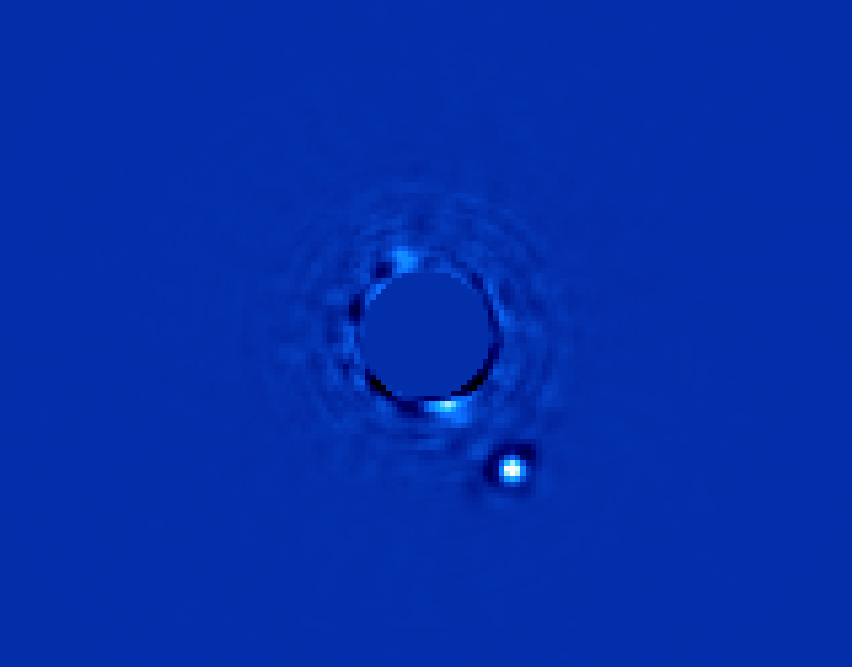
The young and evolving planetary system of the 23-million-year-old star Beta Pictoris (short: Beta Pic) is regarded as an iconic circumstellar dust disc, which hosts at least three giant gas planets. Discovered already in 2008 by direct imaging, Beta Pic b is the most massive of those planets, measuring approximately 11 Jupiter masses. It orbits its host star on a wide trajectory, taking about 23 years for one revolution.

Astronomers from the Max Planck Institute for Astronomy (MPIA) in Heidelberg, Germany, the Observatoire de la Côte d’Azur (OCA), Nice, France and others observed Beta Pic b to investigate the planet’s origin and potential atmospheric variability with the recently upgraded GRAVITY+ instrument. It is mounted to the Very Large Telescope Interferometer (VLTI), operated by the European Southern Observatory (ESO) at the Paranal Site in Chile. MPIA’s PhD student Antonia von Stauffenberg is the main author of the study published as a letter in the journal Astronomy & Astrophysics.

“The GRAVITY+ interferometric instrument is highly stable [...], making it uniquely capable of high-fidelity characterization of directly imaged exoplanets”, says co-author and MPIA scientist Jonas Sauter. GRAVITY+ is an upgrade of the original GRAVITY instrument, equipped with improved adaptive optics. What can we learn about Beta Pic b’s atmosphere and origin?

The team applied a method proposed a few years ago to identify a planet’s birthplace inside its planet-forming disc. By measuring the relative abundance ratio between two different versions of carbon (C) locked inside carbon monoxide (CO) gas in Beta Pic b’s atmosphere, it should be possible to infer whether the planet formed outside or inside a region in the disc where carbon monoxide was present as ice. Considering the irradiation by the host star heating the disc from its centre, this would directly translate to the distance from the star at which the planet formed. The radius at which the temperature is low enough to turn gas into ice is commonly referred to as the snowline.

The technical term for the different forms of an element, such as carbon, is an isotope. Isotopes exhibit the same number of positively charged protons in the nucleus of an atom, but differ in the number of neutral neutrons, like in the two carbon isotopes 12C and 13C. As a consequence, they have slightly different masses but exhibit similar chemical properties. In space, carbon is often found in association with oxygen, forming 12CO and 13CO molecules.

Exciting tentative scenario

Interestingly, in an earlier attempt to assess the diagnostic ratio between 12CO and the somewhat heavier 13CO, MPIA scientist Matthieu Ravet utilised the original GRAVITY instrument before its upgrade, yielding a comparatively low ratio. The authors already suspected that GRAVITY may have been inadequate to properly resolve the key signals in this dataset and advised caution in interpreting the results. Still, following the rationale of the scenario mentioned above, this face value suggests that Beta Pic b might have grown in the outer disc beyond the snowline by accumulating CO ice rather than CO gas.

However, at a range of about 10 au (astronomical unit = the mean distance between the Sun and the Earth; 1 au = 149.6 million km) from the host star, Beta Pic b currently circles the disc clearly between the star and the snowline, where CO should have been present predominantly as a gas. Assuming the result was correct, this finding would indicate Beta Pic b may have migrated through the disc.

New and better outcomes with GRAVITY

Using GRAVITY+, von Stauffenberg and her collaborators now derived an updated and more precise 12CO/13CO abundance ratio in Beta Pic b’s atmosphere, which is significantly higher than the earlier value. While 12CO is clearly detected and its content is straightforward to determine, measuring 13CO requires a more sophisticated approach. Interestingly, the ratio is consistent with the value reported in the companion paper by González Picos et al. (2026), who employed a different instrument. This demonstrates the improved data quality GRAVITY+ delivers compared to its original design. The previous GRAVITY result was clearly affected by systematic uncertainties.

In addition, the astronomers also found subtle hints that the observed levels of flux coming from the planet vary over time. Despite its low significance, the dominating variations seem to be linked to the planet’s rotation period of approximately 8.7 hours. If true, this may hint at clouds or chemical processes in Beta Pic b’s atmosphere. However, more sensitive observations are required to confirm the result.

Antonia von Stauffenberg says: “The ability to accurately constrain both isotopologues and potential rotational variability using ground-based observations of a bona fide planet such as Beta Pictoris b demonstrates the exceptional data quality achieved with the updated GRAVITY+ instrument.”

Doubting the significance of abundance ratios

In the proposed scheme to recover a gas giant’s birthplace, the new, more precise 12CO/13CO abundance ratio clearly shifts Beta Pic b into the warmer, inner range of the natal planet-forming disc, consistent with the planet’s current location. In addition, the ratio broadly matches values commonly found in the Solar System and the interstellar medium (ISM), which pervades the space between the stars in the Milky Way. The overwhelming majority of about a dozen young giant gas planets probed for the CO ratio show similar values.

This consistency may actually be bad news, because the carbon isotope abundance ratio doesn’t seem to be that diagnostic after all, when used as a probe to identify a planet’s distance from its host star. The most likely explanation is that any potential variance during planet formation is too small to be caught by the proposed method. This means that the 12CO/13CO ratio currently fails to be sufficiently decisive to tell us anything specific about individual planet-forming environments.
 
"It is still difficult to utilise 13CO as a formation tracer of giant planets, due to the uncertainties that still persist in the models and measurements."  Antonia von Stauffenberg, MPIA

Therefore, it is very likely astronomers are missing some crucial physics that govern CO ice chemistry in planet-forming discs. Thus, the 12CO/13CO ratio may not tell us much about the differences between the milder gaseous environments and the cold, CO-ice-laden realm after all. For now, it seems the wide-orbit giant gas planets refuse to reveal their origins. New tools that can distinguish between planet formation scenarios are needed, and GRAVITY+ may play a vital role in finding and evaluating them.

Additional information

The results are based on data obtained as part of the GRAVTY+ Guarantee Time Programme (GTO) 114.27JS (PI: Laura Kreidberg). The GRAVITY+ consortium includes the following institutes: MPE, INSU/CNRS, University of Cologne, MPIA, CENTRA, University of Southampton, and the associated partners KU Leuven, University College Dublin, and Universidad Autónoma de México, in close collaboration with ESO and supported by the Max Planck Foundation.

MPIA astronomers involved in this study were Antonia von Stauffenberg, Jonas Sauter, Paul Mollière, Matthieu Ravet (also at Observatoire de la Côte d’Azur, Nice, France [OCA] and Université Grenoble Alpes, Grenoble, France), David Trevascus, Wolfgang Brandner, Gaël Chauvin (also at OCA), Laura Kreidberg, and Elisabeth Matthews.

Other researchers were:

A. Berdeu (Observatoire de Paris, Meudon, France), M. Bonnefoy (Institut de Planétologie et d’Astrophysique de Grenoble, France), G. Bourdarot (Max-Planck-Institut für extraterrestrische Physik, Garching bei München, Germany [MPE]), J.-B Le Bouquin (Université Grenoble Alpes: Saint-Martin-d’Hères, Auvergne-RhôneAlpes, France [UGA]), F. Eisenhauer (MPE), M. Houllé (UGA), F. Millour (OCA), J. Scigliuto (OCA), J. Wang (Center for Interdisciplinary Exploration and Research in Astrophysics (CIERA) and Department of Physics and Astronomy, Northwestern University, Evanston, USA), J. W. Xuan (Department of Astronomy, California Institute of Technology, Pasadena, USA [Caltech] and Department of Earth, Planetary, and Space Sciences, University of California, Los Angeles, USA), Y. Zhang (Caltech), and the GRAVITY+ Collaboration.

The Very Large Telescope Interferometer (VLTI), operated by the European Southern Observatory (ESO), is an infrared interferometer that combines light collected by the four Very Large Telescope (VLT) 8.2-metre Unit Telescopes (UTs) or the four movable 1.8-metre Auxiliary Telescopes (ATs). The VLTI is located at ESO’s Paranal Observatory in Chile.

GRAVITY+ is an upgrade to the VLTI and its original GRAVITY instrument. It enables imaging of fainter and more distant astronomical objects than previously possible, while also improving high-contrast precision on bright objects. Its consortium consists of 15 research institutes from seven European countries, including MPIA and ESO.


Contacts:

Dr. Markus Nielbock
Press and outreach officer
Tel:
+49 6221 528-134
Email: pr@mpia.de
MPIA press team
Max Planck Institute for Astronomy, Heidelberg, Germany

Antonia von Stauffenberg
Email:
a-stauffenberg@mpia.de
Max Planck Institute for Astronomy, Heidelberg


Original publication

A. von Stauffenberg et al.
13CO and potential variability in β Pictoris b with GRAVITY+
Astronomy & Astrophysics (2026)

Source | DOI


Links

GRAVITY+ at ESO
GRAVITY+ at Max Planck Institute for Extraterrestrial Physics (MPE)
GRAVITY at ESO
GRAVITY at Max Planck Institute for Extraterrestrial Physics (MPE)


Tuesday, August 21, 2018

Infant exoplanet weighed by Hipparcos and Gaia

Copyright ESO/A-M. Lagrange et al.

The mass of a very young exoplanet has been revealed for the first time using data from ESA’s star mapping spacecraft Gaia and its predecessor, the quarter-century retired Hipparcos satellite. 

Astronomers Ignas Snellen and Anthony Brown from Leiden University, the Netherlands, deduced the mass of the planet Beta Pictoris b from the motion of its host star over a long period of time as captured by both Gaia and Hipparcos.

The planet is a gas giant similar to Jupiter but, according to the new estimate, is 9 to 13 times more massive. It orbits the star Beta Pictoris, the second brightest star in the constellation Pictor.

The planet was only discovered in 2008 in images captured by the Very Large Telescope at the European Southern Observatory in Chile. Both the planet and the star are only about 20 million years old – roughly 225 times younger than the Solar System. Its young age makes the system intriguing but also difficult to study using conventional methods.

“In the Beta Pictoris system, the planet has essentially just formed,” says Ignas. “Therefore we can get a picture of how planets form and how they behave in the early stages of their evolution. On the other hand, the star is very hot, rotates fast, and it pulsates.”

This behaviour makes it difficult for astronomers to accurately measure the star’s radial velocity – the speed at which it appears to periodically move towards and away from the Earth. Tiny changes in the radial velocity of a star, caused by the gravitational pull of planets in its vicinity, are commonly used to estimate masses of exoplanets. But this method mainly works for systems that have already gone through the fiery early stages of their evolution.

In the case of Beta Pictoris b, upper limits of the planet’s mass range had been arrived at before using the radial velocity method. To obtain a better estimate, the astronomers used a different method, taking advantage of Hipparcos’ and Gaia’s measurements that reveal the precise position and motion of the planet’s host star in the sky over time.

Copyright ESA 

“The star moves for different reasons,” says Ignas. “First, the star circles around the centre of the Milky Way, just as the Sun does. That appears from the Earth as a linear motion projected on the sky. 

We call it proper motion. And then there is the parallax effect, which is caused by the Earth orbiting around the Sun. Because of this, over the year, we see the star from slightly different angles.” 

And then there is something that the astronomers describe as ‘tiny wobbles’ in the trajectory of the star across the sky – minuscule deviations from the expected course caused by the gravitational pull of the planet in the star’s orbit. This is the same wobble that can be measured via changes in the radial velocity, but along a different direction – on the plane of the sky, rather than along the line of sight.

“We are looking at the deviation from what you expect if there was no planet and then we measure the mass of the planet from the significance of this deviation,” says Anthony. “The more massive the planet, the more significant the deviation.”

To be able to make such an assessment, astronomers need to observe the trajectory of the star for a long period of time to properly understand the proper motion and the parallax effect.

The Gaia mission, designed to observe more than one billion stars in our Galaxy, will eventually be able to provide information about a large amount of exoplanets. In the 22 months of observations included in Gaia’s second data release, published in April, the satellite has recorded the star Beta Pictoris about thirty times. That, however, is not enough.

“Gaia will find thousands of exoplanets, that’s still on our to-do list,” says Timo Prusti, ESA’s Gaia project scientist. “The reason that the exoplanets can be expected only late in the mission is the fact that to measure the tiny wobble that the exoplanets are causing, we need to trace the position of stars for several years.”

Combining the Gaia measurements with those from ESA’s Hipparcos mission, which observed Beta Pictoris 111 times between 1990 and 1993, enabled Ignas and Anthony to get their result much faster. This led to the first successful estimate of a young planet’s mass using astrometric measurements.

“By combining data from Hipparcos and Gaia, which have a time difference of about 25 years, you get a very long term proper motion,” says Anthony.

“This proper motion also contains the component caused by the orbiting planet. Hipparcos on its own would not have been able to find this planet because it would look like a perfectly normal single star unless we had measured it for a much longer time.

“Now, by combining Gaia and Hipparcos and looking at the difference in the long term and the short term proper motion, we can see the effect of the planet on the star.”

The result represents an important step towards better understanding the processes involved in planet formation, and anticipates the exciting exoplanet discoveries that will be unleashed by Gaia’s future data releases.

 Note for Editors

“The mass of the young planet Beta Pictoris b through the astrometric motion of its host star,” by I. Snellen and A. Brown is published in Nature Astronomy, 20 August 2018.  

Source: ESA/GAIA


Tuesday, July 17, 2018

Astronomers Find a Famous Exoplanet’s Doppelgänger

Direct Wircam image of 2MASS 0249 system taken wiht CFHT's infrared camera WIRCam. 2MASS 0249c is located 2000 astronomical units from the host brown dwarfs that are unresolved in this image. Credits: T. Dupuy, M. Liu

The infrared spectra of 2MASS 0249c and beta Pictoris b are similar, as expected for two objects of comparable mass that formed in the same stellar nursery. Unlike 2MASS 0249c, beta Pictoris b orbits much closer to its massive host star and is imbedded in a bright circumstellar disk. Credits: T. Dupuy, ESO/A.-M. Lagrange et al.

When it comes to extrasolar planets, appearances can be deceiving. Astronomers have imaged a new planet, and it appears nearly identical to one of the best studied gas-giant planets. But this doppelgänger differs in one very important way: its origin. “We have found a gas-giant planet that is a virtual twin of a previously known planet, but it looks like the two objects formed in different ways,” said Trent Dupuy, astronomer at the Gemini Observatory and leader of the study.

Emerging from stellar nurseries of gas and dust, stars are born like kittens in a litter, in bunches and inevitably wandering away from their birthplace. These litters comprise stars that vary greatly, ranging from tiny runts incapable of generating their own energy (called brown dwarfs) to massive stars that end their lives with supernova explosions. In the midst of this turmoil, planets form around these new stars. And once the stellar nursery exhausts its gas, the stars (with their planets) leave their birthplace and freely wander the Galaxy. Because of this exodus, astronomers believe there should be planets born at the same time from the same stellar nursery, but orbiting stars that have moved far away from each other over the eons, like long-lost siblings.

“To date, exoplanets found by direct imaging have basically been individuals, each distinct from the other in their appearance and age. Finding two exoplanets with almost identical appearances and yet having formed so differently opens a new window for understanding these objects,” said Michael Liu, astronomer at the University of Hawai`i Institute for Astronomy, and a collaborator on this work.

Dupuy, Liu, and their collaborators have identified the first case of such a planetary doppelgänger. One object has long been known: the 13-Jupiter-mass planet beta Pictoris b, one of the first planets discovered by direct imaging, back in 2009. The new object, dubbed 2MASS 0249 c, has the same mass, brightness, and spectrum as beta Pictoris b.

After discovering this object with the Canada-France-Hawaii Telescope (CFHT), Dupuy and collaborators then determined that 2MASS 0249 c and beta Pictoris b were born in the same stellar nursery. On the surface, this makes the two objects not just look-alikes but genuine siblings.

However, the planets have vastly different living situations, namely the types of stars they orbit. The host for beta Pictoris b is a star 10 times brighter than the Sun, while 2MASS 0249 c orbits a pair of brown dwarfs that are 2000 times fainter than the Sun. Furthermore, beta Pictoris b is relatively close to its host, about 9 astronomical units (AU, the distance from the Earth to the Sun), while 2MASS 0249 c is 2000 AU from its binary host.

These drastically different arrangements suggest that the planets’ upbringings were not at all alike. The traditional picture of gas-giant formation, where planets start as small rocky cores around their host star and grow by accumulating gas from the star’s disk, likely created beta Pictoris b. In contrast, the host of 2MASS 0249 c did not have enough of a disk to make a gas giant, so the planet likely formed by directly accumulating gas from the original stellar nursery.

“2MASS 0249 c and beta Pictoris b show us that nature has more than one way to make very similar looking exoplanets,” says Kaitlin Kratter, astronomer at the University of Arizona and a collaborator on this work. "beta Pictoris b probably formed like we think most gas giants do, starting from tiny dust grains. In contrast, 2MASS 0249 c looks like an underweight brown dwarf that formed from the collapse of a gas cloud. They’re both considered exoplanets, but 2MASS 0249 c illustrates that such a simple classification can obscure a complicated reality.”

The team first identified 2MASS 0249 c using images from CFHT, and their repeated observations revealed this object is orbiting at a large distance from its host. The system belongs to the beta Pictoris moving group, a widely dispersed set of stars named for its famous planet-hosting star. The team’s observations with the W. M. Keck Telescope determined that the host is actually a closely separated pair of brown dwarfs. So altogether, the 2MASS 0249 system comprises two brown dwarfs and one gas-giant planet. Follow-up spectroscopy of 2MASS 0249 c with the NASA Infrared Telescope Facility and the Astrophysical Research Consortium 3.5-meter Telescope at Apache Point Telescope demonstrated that it shares a remarkable resemblance to beta Pictoris b.

The 2MASS 0249 system is an appealing target for future studies. Most directly imaged planets are very close to their host stars, inhibiting detailed studies of the planets due to the bright light from the stars. In contrast, the very wide separation of 2MASS 0249 c from its host binary will make measurements of properties like its surface weather and composition much easier, leading to a better understanding of the characteristics and origins of gas-giant planets.

This work is accepted for publication in the Astronomical Journal.

This work has been supported by the National Science Foundation under Grant No. AST-1518339. Any opinions, findings, and conclusions or recommendations expressed in this material are those of the authors and do not necessarily reflect the views of the National Science Foundation.


Additional information : arXiv link to the Paper


Contact Information:

Media contacts

Mary Beth Laychak, Outreach manager
Canada-France-Hawaii Telescope
mary@cfht.hawaii.edu

Science contacts

Trent Dupuy
Gemini Observatory
tdupuy@gemini.edu

Michael Liu
UH Institute for Astronomy
mliu@ifa.hawaii.edu


Thursday, March 30, 2017

β Pictoris b: An Exoplanet With the Atmosphere of a Brown Dwarf

Using advanced imaging techniques and the special capabilities of the Gemini Planet Imager (GPI) the light from β Pictoris has been suppressed in these images using GPI’s Y, J, H, K1 and K2 filters. The arrow indicates the location of the exoplanet β Pictoris b in all but the left image.


Using the Gemini Planet Imager (GPI), a team of astronomers led by J. Chilcote (University of Toronto) found that the low mass stellar companion β Pictoris b is about 13 times more massive than Jupiter with a surface temperature of about 1720 K. While these parameters are in good agreement with earlier observations, they allow better comparisons with planetary evolution models. The Gemini data indicate that β Pictoris b best matches an exoplanet with an atmosphere like that of a low-surface gravity (L21) brown dwarf. 

Observations at the Gemini South telescope in Chile, using the Gemini Planet Imager (GPI), are refining our understanding of the β Pictoris system. The system contains the ~ 13 Jupiter mass companion β Pictoris b which is at the mass boundary sometimes used to distinguish between an exoplanet and a brown dwarf. Brown dwarfs are objects that are not massive enough for sustained nuclear reactions. Brown dwarfs less massive than 13 Jupiters cannot even start a nuclear reaction.

Based on the GPI data, combined with planetary evolution and atmospheric models, Chilcote suggests a “hot-start” planet formation scenario for β Pictoris b. He adds, “This is consistent with the disk instability formation mechanism for wide-orbit giant exoplanets.” However, the characteristics for the atmosphere of β Pictoris b found in this work best match those of low-surface gravity brown dwarfs, not planets. 

The team studied β Pictoris b during the verification and commissioning of the Gemini Planet Imager and as part of an astrometric (position) monitoring program designed to constrain the orbit of the exoplanet. This work is also part of a Gemini Large and Long Program. 

“With GPI the Gemini Observatory is at the forefront of exoplanet exploration,” said Chilcote. He adds, “Direct imaging allows for the discovery of planets on solar systems-scale orbits, provides new insight into the formation and characteristics of extrasolar systems, and enable direct spectroscopic observations of their atmospheres.” 

Since the first detection of an exoplanet in 1995 (51 Pegasi b) the discovery and characterization of extrasolar planets has changed the understanding of planetary systems and their formation. Over the past two decades, more than 3400 of planetary systems with stars of various masses and at different stages of evolution have been detected. Some of these planetary systems present features very similar to our solar system. The current challenge for astronomers is to better characterize these planets, especially the exoplanet atmospheres which can give us information about the history of formation of the planets.

The full results are accepted for publication in The Astrophysical Journal Letters. A preprint is available here. 

Abstract:
 
Using the Gemini Planet Imager (GPI) located at Gemini South, we measured the near-infrared (1.0– 2.4 µm) spectrum of the planetary companion to the nearby, young star β Pictoris. We compare the spectrum obtained with currently published model grids and with known substellar objects and present the best matching models as well as the best matching observed objects. Comparing the empirical measurement of the bolometric luminosity to evolutionary models, we find a mass of 12.9 ± 0.2MJup, an effective temperature of 1724 ± 15 K, a radius of 1.46 ± 0.01 RJup, and a surface gravity of log g = 4.18 ± 0.01 [dex] (cgs). The stated uncertainties are statistical errors only, and do not incorporate any uncertainty on the evolutionary models. Using atmospheric models, we find an effective temperature of 1700 − 1800 K and a surface gravity of log g = 3.5–4.0 [dex] depending upon model. These values agree well with other publications and with “hot-start” predictions from planetary evolution models. Further, we find that the spectrum of β Pic b best matches a low-surface gravity L2 ± 1 brown dwarf. Finally comparing the spectrum to field brown dwarfs we find the the spectrum best matches 2MASS J04062677–381210 and 2MASS J03552337+1133437.


Wednesday, September 23, 2015

Watching an Exoplanet in Motion Around a Distant Star


A series of images taken between November 2013 to April 2015 with the Gemini Planet Imager (GPI) on the Gemini South telescope in Chile shows the exoplanet β Pic b orbiting the star β Pictoris, which lies over 60 light-years from Earth. In the images, the star is at the centre of the left-hand edge of the frame; it is hidden by the Gemini Planet Imager’s coronagraph. We are looking at the planet’s orbit almost edge-on; the planet is closer to the Earth than the star. The images are based on observations described in a paper published in the Astrophysical Journal, 16 September 2015 and whose lead author is Maxwell Millar-Blanchaer. GPI is a groundbreaking instrument that was developed by an international team led by Stanford University’s Prof. Bruce Macintosh (a U of T alumnus) and the University of California Berkeley’s Prof. James Graham (former director of the Dunlap Institute for Astronomy & Astrophysics, U of T). Image credit: M. Millar-Blanchaer, University of Toronto; F. Marchis, SETI Institute. Vimeo

GIF version of animation.  
Image credit: M. Millar-Blanchaer, University of Toronto; R. Marchis (SETI Institute)


A team of astronomers has given us our best view yet of an exoplanet moving in its orbit around a distant star. A series of images captured between November 2013 to April 2015 shows the exoplanet β Pic b as it moves through 1 ½ years of its 22-year orbital period.

First discovered in 2008, β Pic b is a gas giant planet ten to twelve times the mass of Jupiter, with an orbit roughly the diameter of Saturn’s. It is part of a dynamic and complex system that includes comets, orbiting gas clouds, and an enormous debris disk that in our Solar System would extend from Neptune’s orbit to nearly two thousand times the Sun/Earth distance. Because the planet and debris disk interact gravitationally, the system provides astronomers with an ideal laboratory to test theories on the formation of planetary systems beyond ours.

Maxwell Millar-Blanchaer, a PhD-candidate in the Department of Astronomy & Astrophysics, University of Toronto, is lead author of a paper to be published September 16th in the Astrophysical Journal. The paper describes observations of the β Pictoris system made with the Gemini Planet Imager (GPI) instrument on the Gemini South telescope in Chile.

"The images in the series represent the most accurate measurements of the planet’s position ever made," says Millar-Blanchaer. "In addition, with GPI, we're able to see both the disk and the planet at the exact same time. With our combined knowledge of the disk and the planet we’re really able to get a sense of the planetary system’s architecture and how everything interacts."

The paper includes refinements to measurements of the exoplanet’s orbit and the ring of material circling the star which shed light on the dynamic relationship between the two. It also includes the most accurate measurement of the mass of β Pictoris to date and shows it is very unlikely that β Pic b will pass directly between us and its parent star.

"It’s remarkable that Gemini is not only able to directly image exoplanets but is also capable of effectively making movies of them orbiting their parent star," said Chris Davis, astronomy division program director at the National Science Foundation, which is one of five international partners that funds the Gemini twin telescopes’ operation and maintenance. "Beta Pic is a special target. The disk of gas and dust from which planets are currently forming was one of the first to be observed and is a fabulous laboratory for the study of young solar systems.”

Astronomers have discovered nearly two thousand exoplanets in the past two decades but most have been detected with instruments – like the Kepler space telescope – that use the transit method of detection: astronomers detect a faint drop in a star’s brightness as an exoplanet transits or passes between us and the star, but do not see the exoplanet itself.

With GPI, astronomers image the actual planet – a remarkable feat given that an orbiting world typically appears a million times fainter than its parent star. This is possible because GPI's adaptive optics sharpen the image of the target star by cancelling out the distortion caused by the Earth’s atmosphere; it then blocks the bright image of the star with a device called a coronagraph, revealing the exoplanet.

Laurent Pueyo is with the Space Telescope Science Institute and a co-author on the paper. "It’s fortunate that we caught β Pic b just as it was heading back – as seen from our vantage point – toward β Pictoris," says Pueyo. "This means we can make more observations before it gets too close to its parent star and that will allow us to measure its orbit even more precisely."

GPI is a groundbreaking instrument that was developed by an international team led by Stanford University’s Prof. Bruce Macintosh (a U of T alumnus) and the University of California Berkeley’s Prof. James Graham (former director of the Dunlap Institute for Astronomy & Astrophysics, University of Toronto). In August 2015, the team announced its first exoplanet discovery: a young Jupiter-like exoplanet designated 51 Eri b. It is the first exoplanet to be discovered as part of the GPI Exoplanet Survey (GPIES) which will target 600 stars over the next three years. 


Contact:


Media Contact:

Peter Michaud 
Public Information and Outreach ManagerGemini Observatory, Hilo, HI
Email: pmichaud@gemini.edu
Cell: (808) 936-6643
Desk: (808) 974-2510

Chris Sasaki
Communications Coordinator
Dunlap Institute for Astronomy & Astrophysics
University of Toronto
Email: media@dunlap.utoronto.ca
Phone: 416-978-6613


Science Contacts:

Max Millar-Blanchaer
Department of Astronomy and Astrophysics
University of Toronto
Email: maxmb@astro.utoronto.ca
Phone: (416) 978-3146

Fredrik Rantakyro
Gemini Observatory, La Serena, Chile
Email: frantaky@gemini.edu
Cell: 9 - 995097802
Desk: 56-51- 2205665

Joint University of Toronto and Gemini Observatory Press Release
See the Dunlop Observatory/University of Toronto version of this release here.


Friday, June 26, 2015

New NASA Supercomputer Model Shows Planet Making Waves in Nearby Debris Disk

Erika Nesvold and Marc Kuchner discuss how their new supercomputer simulation helps astronomers understand Beta Pictoris.
Credits: NASA's Goddard Space Flight Center
 Download this video in HD formats from NASA Goddard's Scientific Visualization Studio


A new NASA supercomputer simulation of the planet and debris disk around the nearby star Beta Pictoris reveals that the planet's motion drives spiral waves throughout the disk, a phenomenon that causes collisions among the orbiting debris. Patterns in the collisions and the resulting dust appear to account for many observed features that previous research has been unable to fully explain.

"We essentially created a virtual Beta Pictoris in the computer and watched it evolve over millions of years," said Erika Nesvold, an astrophysicist at the University of Maryland, Baltimore County, who co-developed the simulation. "This is the first full 3-D model of a debris disk where we can watch the development of asymmetric features formed by planets, like warps and eccentric rings, and also track collisions among the particles at the same time."

In 1984, Beta Pictoris became the second star known to be surrounded by a bright disk of dust and debris. Located only 63 light-years away, Beta Pictoris is an estimated 21 million years old, or less than 1 percent the age of our solar system. It offers astronomers a front-row seat to the evolution of a young planetary system and it remains one of the closest, youngest and best-studied examples today. The disk, which we see edge on, contains rock and ice fragments ranging in size from objects larger than houses to grains as small as smoke particles. It's a younger version of the Kuiper belt at the fringes of our own planetary system.

Nesvold and her colleague Marc Kuchner, an astrophysicist at NASA's Goddard Space Flight Center in Greenbelt, Maryland, presented the findings Thursday during the "In the Spirit of Lyot 2015" conference in Montreal, which focuses on the direct detection of planets and disks around distant stars. A paper describing the research has been submitted to The Astrophysical Journal.

In 2009, astronomers confirmed the existence of Beta Pictoris b, a planet with an estimated mass of about nine times Jupiter's, in the debris disk around Beta Pictoris. Traveling along a tilted and slightly elongated 20-year orbit, the planet stays about as far away from its star as Saturn does from our sun.

Astronomers have struggled to explain various features seen in the disk, including a warp apparent at submillimeter wavelengths, an X-shaped pattern visible in scattered light, and vast clumps of carbon monoxide gas. A common ingredient in comets, carbon monoxide molecules are destroyed by ultraviolet starlight in a few hundred years. To explain why the gas is clumped, previous researchers suggested the clumps could be evidence of icy debris being corralled by a second as-yet-unseen planet, resulting in an unusually high number of collisions that produce carbon monoxide. Or perhaps the gas was the aftermath of an extraordinary crash of icy worlds as large as Mars.

"Our simulation suggests many of these features can be readily explained by a pair of colliding spiral waves excited in the disk by the motion and gravity of Beta Pictoris b," Kuchner said. "Much like someone doing a cannonball in a swimming pool, the planet drove huge changes in the debris disk once it reached its present orbit."

Keeping tabs on thousands of fragmenting particles over millions of years is a computationally difficult task. Existing models either weren't stable over a sufficiently long time or contained approximations that could mask some of the structure Nesvold and Kuchner were looking for.

Working with Margaret Pan and Hanno Rein, both now at the University of Toronto, they developed a method where each particle in the simulation represents a cluster of bodies with a range of sizes and similar motions. By tracking how these "superparticles" interact, they could see how collisions among trillions of fragments produce dust and, combined with other forces in the disk, shape it into the kinds of patterns seen by telescopes. The technique, called the Superparticle-Method Algorithm for Collisions in Kuiper belts (SMACK), also greatly reduces the time required to run such a complex computation.

Using the Discover supercomputer operated by the NASA Center for Climate Simulation at Goddard, the SMACK-driven Beta Pictoris model ran for 11 days and tracked the evolution of 100,000 superparticles over the lifetime of the disk.

As the planet moves along its tilted path, it passes vertically through the disk twice each orbit. Its gravity excites a vertical spiral wave in the disk. Debris concentrates in the crests and troughs of the waves and collides most often there, which explains the X-shaped pattern seen in the dust and may help explain the carbon monoxide clumps. The planet's orbit also is slightly eccentric, which means its distance from the star varies a little every orbit. This motion stirs up the debris and drives a second spiral wave across the face of the disk. This wave increases collisions in the inner regions of the disk, which removes larger fragments by grinding them away. In the real disk, astronomers report a similar clearing out of large debris close to the star.

"One of the nagging questions about Beta Pictoris is how the planet ended up in such an odd orbit," Nesvold explained. "Our simulation suggests it arrived there about 10 million years ago, possibly after interacting with other planets orbiting the star that we haven't detected yet."


Related Links


Francis Reddy
NASA's Goddard Space Flight Center, Greenbelt, Md.


Thursday, October 23, 2014

Two Families of Comets Found Around Nearby Star

Artist’s impression of exocomets around Beta Pictoris

Beta Pictoris as Seen in Infrared Light

Exoplanet caught on the move

Around Beta Pictoris 

*************************************************

 Videos


Artist’s impression of exocomets around Beta Pictoris
Artist’s impression of exocomets around Beta Pictoris 


Biggest census ever of exocomets around Beta Pictoris

The HARPS instrument at ESO’s La Silla Observatory in Chile has been used to make the most complete census of comets around another star ever created. A French team of astronomers has studied nearly 500 individual comets orbiting the star Beta Pictoris and has discovered that they belong to two distinct families of exocomets: old exocomets that have made multiple passages near the star, and younger exocomets that probably came from the recent breakup of one or more larger objects. The new results will appear in the journal Nature on 23 October 2014.

Beta Pictoris is a young star located about 63 light-years from the Sun. It is only about 20 million years old and is surrounded by a huge disc of material — a very active young planetary system where gas and dust are produced by the evaporation of comets and the collisions of asteroids.

Flavien Kiefer (IAP/CNRS/UPMC), lead author of the new study sets the scene: “Beta Pictoris is a very exciting target! The detailed observations of its exocomets give us clues to help understand what processes occur in this kind of young planetary system.”

For almost 30 years astronomers have seen subtle changes in the light from Beta Pictoris that were thought to be caused by the passage of comets in front of the star itself. Comets are small bodies of a few kilometres in size, but they are rich in ices, which evaporate when they approach their star, producing gigantic tails of gas and dust that can absorb some of the light passing through them. The dim light from the exocomets is swamped by the light of the brilliant star so they cannot be imaged directly from Earth.

To study the Beta Pictoris exocomets, the team analysed more than 1000 observations obtained between 2003 and 2011 with the HARPS instrument on the ESO 3.6-metre telescope at the La Silla Observatory in Chile.

The researchers selected a sample of 493 different exocomets. Some exocomets were observed several times and for a few hours. Careful analysis provided measurements of the speed and the size of the gas clouds. Some of the orbital properties of each of these exocomets, such as the shape and the orientation of the orbit and the distance to the star, could also be deduced.

This analysis of several hundreds of exocomets in a single exo-planetary system is unique. It revealed the presence of two distinct families of exocomets: one family of old exocomets whose orbits are controlled by a massive planet [1], and another family, probably arising from the recent breakdown of one or a few bigger objects. Different families of comets also exist in the Solar System.

The exocomets of the first family have a variety of orbits and show a rather weak activity with low production rates of gas and dust. This suggests that these comets have exhausted their supplies of ices during their multiple passages close to Beta Pictoris [2].

The exocomets of the second family are much more active and are also on nearly identical orbits [3]. This suggests that the members of the second family all arise from the same origin: probably the breakdown of a larger object whose fragments are on an orbit grazing the star Beta Pictoris.

Flavien Kiefer concludes: “For the first time a statistical study has determined the physics and orbits for a large number of exocomets. This work provides a remarkable look at the mechanisms that were at work in the Solar System just after its formation 4.5 billion years ago.”


Notes


[1] A giant planet, Beta Pictoris b, has also been discovered in orbit at about a billion kilometres from the star and studied using high resolution images obtained with adaptive optics.

[2] Moreover, the orbits of these comets (eccentricity and orientation) are exactly as predicted for comets trapped in orbital resonance with a massive planet. The properties of the comets of the first family show that this planet in resonance must be at about 700 million kilometres from the star  — close to where the planet Beta Pictoris b was discovered.

[3] This makes them similar to the comets of the Kreutz family in the Solar System, or the fragments of Comet Shoemaker-Levy 9, which impacted Jupiter in July 1994.


More information


This research was presented in a paper entitled "Two families of exocomets in the Beta Pictoris system" which will be published in the journal Nature on 23 October 2014.


The team is composed of F. Kiefer (Institut d’astrophysique de Paris [IAP], CNRS, Université Pierre & Marie Curie-Paris 6, Paris, France), A. Lecavelier des Etangs (IAP), J. Boissier (Institut de radioastronomie millimétrique, Saint Martin d’Hères, France), A. Vidal-Madjar (IAP), H. Beust (Institut de planétologie et d'astrophysique de Grenoble [IPAG], CNRS, Université Joseph Fourier-Grenoble 1, Grenoble, France), A.-M. Lagrange (IPAG), G. Hébrard (IAP) and R. Ferlet (IAP).

ESO is the foremost intergovernmental astronomy organisation in Europe and the world’s most productive ground-based astronomical observatory by far. It is supported by 15 countries: Austria, Belgium, Brazil, the Czech Republic, Denmark, France, Finland, Germany, Italy, the Netherlands, Portugal, Spain, Sweden, Switzerland and the United Kingdom. ESO carries out an ambitious programme focused on the design, construction and operation of powerful ground-based observing facilities enabling astronomers to make important scientific discoveries. ESO also plays a leading role in promoting and organising cooperation in astronomical research. ESO operates three unique world-class observing sites in Chile: La Silla, Paranal and Chajnantor. At Paranal, ESO operates the Very Large Telescope, the world’s most advanced visible-light astronomical observatory and two survey telescopes. VISTA works in the infrared and is the world’s largest survey telescope and the VLT Survey Telescope is the largest telescope designed to exclusively survey the skies in visible light. ESO is the European partner of a revolutionary astronomical telescope ALMA, the largest astronomical project in existence. ESO is currently planning the 39-metre European Extremely Large optical/near-infrared Telescope, the E-ELT, which will become “the world’s biggest eye on the sky”.


Links


Contacts

 
Alain Lecavelier des Etangs
Institut d'astrophysique de Paris (IAP)/CNRS/UPMC
France
Tel: +33-1-44-32-80-77
Cell: +33 6 21 75 12 03
Email:
lecaveli@iap.fr

Flavien Kiefer
Institut d'astrophysique de Paris (IAP)/CNRS/UPMC and School of Physics and Astronomy, Tel Aviv University
France / Israel
Tel: +972-502-838-163
Email:
kiefer@iap.fr

Richard Hook
ESO education and Public Outreach Department
Garching bei München, Germany
Tel: +49 89 3200 6655
Cell: +49 151 1537 3591
Email:
rhook@eso.org

Source: ESO

Wednesday, April 30, 2014

Length of Exoplanet Day Measured for First Time

Artist’s impression of the planet Beta Pictoris b
 
The universal relation between mass and rotation speed of planets
 
Map of the sky around Beta Pictoris
Around Beta Pictoris

*******************************

Videos

Zooming in on Beta Pictoris

VLT measures the spin of Beta Pictoris b

Observations from ESO’s Very Large Telescope (VLT) have, for the first time, determined the rotation rate of an exoplanet. Beta Pictoris b has been found to have a day that lasts only eight hours. This is much quicker than any planet in the Solar System — its equator is moving at almost 100 000 kilometres per hour. This new result extends the relation between mass and rotation seen in the Solar System to exoplanets. Similar techniques will allow astronomers to map exoplanets in detail in the future with the European Extremely Large Telescope (E-ELT).

Exoplanet Beta Pictoris b orbits the naked-eye star Beta Pictoris [1], [2], which lies about 63 light-years from Earth in the southern constellation of Pictor (The Painter’s Easel). This planet was discovered nearly six years ago and was one of the first exoplanets to be directly imaged. It orbits its host star at a distance of only eight times the Earth-Sun distance (eso1024) — making it the closest exoplanet to its star ever to be directly imaged [3].

Using the CRIRES instrument on the VLT, a team of Dutch astronomers from Leiden University and the Netherlands Institute for Space Research (SRON) have now found that the equatorial rotation velocity of exoplanet Beta Pictoris b is almost 100 000 kilometres per hour. By comparison, Jupiter’s equator has a velocity of about 47 000 km per hour [4], while the Earth’s travels at only 1700 km per hour [5]. Beta Pictoris b is more than 16 times larger and 3000 times more massive than the Earth, yet a day on the planet only lasts 8 hours.

“It is not known why some planets spin fast and others more slowly,” says co-author Remco de Kok, “but this first measurement of an exoplanet’s rotation shows that the trend seen in the Solar System, where the more massive planets spin faster, also holds true for exoplanets. This must be some universal consequence of the way planets form.”

Beta Pictoris b is a very young planet, only about 20 million years old (compared to 4.5 billion years for the Earth) [6]. Over time, the exoplanet is expected to cool and shrink, which will make it spin even faster [7]. On the other hand, other processes might be at play that change the spin of the planet. For instance, the spin of the Earth is slowing down over time due to the tidal interactions with our Moon.

The astronomers made use of a precise technique called high-dispersion spectroscopy to split light into its constituent colours — different wavelengths in the spectrum. The principle of the Doppler effect (or Doppler shift) allowed them to use the change in wavelength to detect that different parts of the planet were moving at different speeds and in opposite directions relative to the observer. By very carefully removing the effects of the much brighter parent star they were able to extract the rotation signal from the planet.

“We have measured the wavelengths of radiation emitted by the planet to a precision of one part in a hundred thousand, which makes the measurements sensitive to the Doppler effects that can reveal the velocity of emitting objects,” says lead author Ignas Snellen. “Using this technique we find that different parts of the planet’s surface are moving towards or away from us at different speeds, which can only mean that the planet is rotating around its axis“.

This technique is closely related to Doppler imaging, which has been used for several decades to map the surfaces of stars, and recently that of a brown dwarf [8] — Luhman 16B (eso1404). The fast spin of Beta Pictoris b means that in the future it will be possible to make a global map of the planet, showing possible cloud patterns and large storms.

“This technique can be used on a much larger sample of exoplanets with the superb resolution and sensitivity of the E-ELT and an imaging high-dispersion spectrograph. With the planned  Mid-infrared E-ELT Imager and Spectrograph (METIS) we will be able to make global maps of exoplanets and characterise much smaller planets than Beta Pictoris b with this technique”, says METIS principal investigator and co-author of the new paper, Bernhard Brandl.

Notes

[1] Beta Pictoris has many other names, e.g. HD 39060, SAO 234134 and HIP 27321.

[2] Beta Pictoris is one of the best-known examples of a star surrounded by a dusty debris disc. This disc is now known to extend out to about 1000 times the distance between the Earth and the Sun. Earlier observations of Beta Pictoris’s planet were reported in eso0842, eso1024 and eso1408.

[3] The observations made use of the adaptive optics technique compensating for the Earth’s atmospheric turbulence which can distort images obtained at even the best sites in the world for astronomy. It allows astronomers to create super-sharp images, almost as good as those that could be seen from space.

[4] Since Jupiter has no solid surface from which to determine the planet’s rotation rate, we take the rotation speed of its equatorial atmosphere, which is 47 000 km per hour.

[5] The Earth’s rotation speed at the equator is 1674.4 km per hour.

[6] Earlier measurements suggested that the system was younger.

[7] This is a consequence of the conservation of angular momentum and is the same effect that makes a spinning ice skater turn more rapidly when they bring their arms closer to their body.

[8] Brown dwarfs are often dubbed “failed stars” as, unlike stars such as the Sun, they are not massive enough to sustain nuclear fusion reactions.

More information

This research was presented in a paper “Fast spin of a young extrasolar planet”, by I. Snellen et al., to appear in the to appear in the journal Nature on 1 May 2014.

The team is composed of Ignas A. G. Snellen (Leiden Observatory, Leiden University, Leiden, the Netherlands), Bernhard Brandl (Leiden Observatory), Remco J. de Kok (Leiden Observatory, SRON Netherlands Institute for Space Research, Utrecht, the Netherlands), Matteo Brogi (Leiden Observatory), Jayne Birkby (Leiden Observatory) and Henriette Schwarz (Leiden Observatory).


ESO is the foremost intergovernmental astronomy organisation in Europe and the world’s most productive ground-based astronomical observatory by far. It is supported by 15 countries: Austria, Belgium, Brazil, the Czech Republic, Denmark, France, Finland, Germany, Italy, the Netherlands, Portugal, Spain, Sweden, Switzerland and the United Kingdom. ESO carries out an ambitious programme focused on the design, construction and operation of powerful ground-based observing facilities enabling astronomers to make important scientific discoveries. ESO also plays a leading role in promoting and organising cooperation in astronomical research. ESO operates three unique world-class observing sites in Chile: La Silla, Paranal and Chajnantor. At Paranal, ESO operates the Very Large Telescope, the world’s most advanced visible-light astronomical observatory and two survey telescopes. VISTA works in the infrared and is the world’s largest survey telescope and the VLT Survey Telescope is the largest telescope designed to exclusively survey the skies in visible light. ESO is the European partner of a revolutionary astronomical telescope ALMA, the largest astronomical project in existence. ESO is currently planning the 39-metre European Extremely Large optical/near-infrared Telescope, the E-ELT, which will become “the world’s biggest eye on the sky”.

Links

Contacts

Ignas Snellen
Leiden Observatory
Leiden, The Netherlands
Tel: +31 71 52 75 838
Cell: +31 63 00 31 983
Email:
snellen@strw.leidenuniv.nl

Richard Hook
ESO Public Information Officer
Garching bei München, Germany
Tel: +49 89 3200 6655
Cell: +49 151 1537 3591
Email:
rhook@eso.org

 Source: ESO 


Wednesday, January 08, 2014

Gemini Planet Imager First Light!

Figure 1: Gemini Planet Imager’s first light image of Beta Pictoris b, a planet orbiting the star Beta Pictoris. The star, Beta Pictoris, is blocked in this image by a mask so its light doesn’t interfere with the light of the planet. In addition to the image, GPI obtains a spectrum from every pixel element in the field of view to allow scientists to study the planet in great detail. 


Beta Pictoris b is a giant planet – several times larger than Jupiter – and is approximately ten million years old. These near-infrared images (1.5-1.8 microns) show the planet glowing in infrared light from the heat released in its formation. The bright star Beta Pictoris is hidden behind a mask in the center of the image. Image credit: Processing by Christian Marois, NRC Canada. High Resolution TIF | Full Resolution JPG 

Figure 2: Gemini Planet Imager’s first light image of the light scattered by a disk of dust orbiting the young star HR4796A. This narrow ring is thought to be dust from asteroids or comets left behind by planet formation; some scientists have theorized that the sharp edge of the ring is defined by an unseen planet. The left image (1.9-2.1 microns) shows normal light, including both the dust ring and the residual light from the central star scattered by turbulence in the Earth’s atmosphere. The right image shows only polarized light. 

Leftover starlight is unpolarized and hence removed from this image. The light from the back edge of the disk is strongly polarized as it scatters towards us. Image credit: Processing by Marshall Perrin, Space Telescope Science Institute. Full Resolution JPG

Figure 3: Comparison of Europa observed with Gemini Planet Imager in K1 band on the right and visible albedo visualization based on a composite map made from Galileo SSI and Voyager 1 and 2 data (from USGS) on the left. While GPI is not designed for ‘extended’ objects like this, its observations could help in following surface alterations on icy satellites of Jupiter or atmospheric phenomena (e.g. clouds, haze) on Saturn’s moon Titan. The GPI near-infrared color image is a combination of 3 wavelength channels. Image credit: Processing by Marshall Perrin, Space Telescope.  Science Institute and Franck Marchis SETI Institute.  High Resolution TIF | Full Resolution JPG

 World's most powerful exoplanet camera turns its eye to the sky
 
GPI facility and team photos can be found here. 

After nearly a decade of development, construction, and testing, the world’s most advanced instrument for directly imaging and analyzing planets around other stars is pointing skyward and collecting light from distant worlds. 

The instrument, called the Gemini Planet Imager (GPI), was designed, built, and optimized for imaging faint planets next to bright stars and probing their atmospheres. It will also be a powerful tool for studying dusty, planet-forming disks around young stars. It is the most advanced such instrument to be deployed on one of the world’s biggest telescopes – the 8-meter Gemini South telescope in Chile. 

“Even these early first-light images are almost a factor of 10 better than the previous generation of instruments. In one minute, we are seeing planets that used to take us an hour to detect,” says Bruce Macintosh of the Lawrence Livermore National Laboratory who led the team that built the instrument. 

GPI detects infrared (heat) radiation from young Jupiter-like planets in wide orbits around other stars, those equivalent to the giant planets in our own Solar System not long after their formation. Every planet GPI sees can be studied in detail. 

“Most planets that we know about to date are only known because of indirect methods that tell us a planet is there, a bit about its orbit and mass, but not much else,” says Macintosh. “With GPI we directly image planets around stars – it’s a bit like being able to dissect the system and really dive into the planet’s atmospheric makeup and characteristics.” 

GPI carried out its first observations last November – during an extremely trouble-free debut for an extraordinarily complex astronomical instrument the size of a small car. “This was one of the smoothest first-light runs Gemini has ever seen” says Stephen Goodsell, who manages the project for the observatory.
For GPI’s first observations, the team targeted previously known planetary systems, including the well-known Beta Pictoris system; in it GPI obtained the first-ever spectrum of the very young planet Beta Pictoris b. The first-light team also used the instrument’s polarization mode – which can detect starlight scattered by tiny particles – to study a faint ring of dust orbiting the very young star HR4796A. With previous instruments, only the edges of this dust ring, (which may be the debris remaining from planet formation), could be seen, but with GPI astronomers can follow the entire circumference of the ring. 

Although GPI was designed to look at distant planets, it can also observe objects in our Solar System. The accompanying test images of Jupiter’s moon Europa, for example, can allow scientists to map changes in the satellite’s surface composition. The images were released today (January 7, 2014) at the 223rd meeting of the American Astronomical Society in Washington DC. 

“Seeing a planet close to a star after just one minute, was a thrill, and we saw this on only the first week after the instrument was put on the telescope!” says Fredrik Rantakyro a Gemini staff scientist working on the instrument. “Imagine what it will be able to do once we tweak and completely tune its performance.” 

“Exoplanets are extraordinarily faint and difficult to see next to a bright star,” notes GPI chief scientist Professor James R. Graham of the University of California who has worked with Macintosh on the project since its inception. GPI can see planets a million times fainter than their parent stars. Often described, ‘like trying to see a firefly circling a streetlight thousands of kilometers away,’ instruments used to image exoplanets must be designed and built to “excruciating tolerances,” points out Leslie Saddlemyer of NRC Herzberg (part of the National Research Council of Canada), who served as GPI’s systems engineer. “Each individual mirror inside GPI has to be smooth to within a few times the size of an atom,” Saddlemyer adds. 

“GPI represents an amazing technical achievement for the international team of scientists who conceived, designed, and constructed the instrument, as well as a hallmark of the capabilities of the Gemini telescopes. It is a highly-anticipated and well-deserved step into the limelight for the Observatory”, says Dr. Gary Schmidt, program officer at the National Science Foundation (NSF), which funded the project along with the other countries of the Gemini Observatory partnership. 

“After years of development and simulations and testing, it’s incredibly exciting now to be seeing real images and spectra of exoplanets observed with GPI. It’s just gorgeous data,” says Marshall Perrin of the Space Telescope Science Institute. 

“The entire exoplanet community is excited for GPI to usher in a whole new era of planet finding,” says physicist and exoplanet expert Sara Seager of the Massachusetts Institute of Technology. Seager, who is not affiliated with the project adds, “Each exoplanet detection technique has its heyday. First it was the radial velocity technique (ground-based planet searches that started the whole field). Second it was the transit technique (namely Kepler). Now,” she says, “it is the ‘direct imaging’ planet-finding technique’s turn to make waves.” 

In 2014, the GPI team will begin a large-scale survey, looking at 600 young stars to see what giant planets orbit them. GPI will also be available to the whole Gemini community for other projects, ranging from studies of planet-forming disks to outflows of dust from massive, dying stars. 

Looking through Earth’s turbulent atmosphere, even with advanced adaptive optics, GPI will only be able to see Jupiter-sized planets. But similar technology is being proposed for future space telescopes. 

“Some day, there will be an instrument that will look a lot like GPI, on a telescope in space,” Macintosh projects. “And the images and spectra that will come out of that instrument will show a little blue dot that is another Earth.” 

GPI is an international project led by the Lawrence Livermore National Laboratory (LLNL) under Gemini’s supervision, with Macintosh as Principal Investigator and LLNL engineer David Palmer as project manager. LLNL also produced the advanced adaptive optics system that measures and corrects for atmospheric turbulence a thousand times per second. Early research and development that led to the GPI project were supported by the National Science Foundation's Center for Adaptive Optics. Key technologies such as the deformable mirror were tested at the UC Observatories' Laboratory for Adaptive Optics, led by Donald Gavel. Scientists at the American Museum of Natural History, led by Ben Oppenheimer (who also led a project demonstrating some of the same technologies used in GPI on the 5-meter Palomar project) designed special masks that are part of the instrument’s coronagraph which blocks the bright starlight that can obscure faint planets. Engineer Kent Wallace and a team from NASA’s Jet Propulsion Laboratory constructed an ultra-precise infrared wavefront sensor to measure small distortions in starlight that might mask a planet. A team at the University of California Los Angeles’ Infrared Laboratory, under the supervision of Professor James Larkin, together with Rene Doyon at the University of Montreal, assembled the infrared spectrograph that dissects the light from planets. Data analysis software written at University of Montreal and the Space Telescope Science Institute assembles the raw spectrograph data into three-dimensional cubes. NRC Herzberg in British Columbia Canada, built the mechanical structure and software that knits all the pieces together. James R. Graham, as project scientist, led the definition of the instrument’s capabilities. The instrument underwent extensive testing in a laboratory at the University of California Santa Cruz before shipping to Chile in August. Franck Marchis at the SETI institute in California manages GPI’s data and communications. 

Media Contacts:


  • Peter Michaud
    Gemini Observatory, Hilo, HI
    Email:
    pmichaud@gemini.edu
    Cell: (808) 936-6643
    Desk: (808) 974-2510

Science Contacts:


  • Bruce Macintosh
    Lawrence Livermore National Laboratory
    Email:
    macintosh1@llnl.gov
    Desk: (925) 423-8129


  • James R. Graham
    University of California Berkeley
    Email:
    jrg@berkeley.edu
    Cell: (510) 926-9820


  • Marshall Perrin
    Space Telescope Science Institute
    Email:
    mperrin@stsci.edu
    Cell: (410) 507-5483
    Desk: (410) 338-4789