Showing posts with label merging galaxies. Show all posts

Saturday, January 31, 2026

AI Unlocks Hundreds of Cosmic Anomalies in Hubble Archive

Six previously undiscovered, weird and fascinating astrophysical objects are displayed in this new image from NASA’s Hubble Space Telescope. They include three lenses with arcs distorted by gravity, one galactic merger, one ring galaxy, and one galaxy that defied classification.


A team of astronomers has employed a cutting-edge, artificial intelligence-assisted technique to uncover rare astronomical phenomena within archived data from NASA’s Hubble Space Telescope. The team analyzed nearly 100 million image cutouts from the Hubble Legacy Archive, each measuring just a few dozen pixels (7 to 8 arcseconds) on a side. They identified more than 1,300 objects with an odd appearance in just two and a half days — more than 800 of which had never been documented in scientific literature.

Most of the anomalies were galaxies undergoing mergers or interactions, which exhibit unusual morphologies or trailing, elongated streams of stars and gas. Others were gravitational lenses, where the gravity of a foreground galaxy distorts spacetime and bends light from a background galaxy into arcs or rings. Additional discoveries included galaxies with massive star-forming clumps, jellyfish-looking galaxies with gaseous “tentacles,” and edge-on planet-forming disks in our own galaxy resembling hamburgers. Remarkably, several dozen objects defied existing classification schemes entirely.

Identifying such a diverse array of rare objects within the vast and growing repository of Hubble and other telescope data presents a formidable challenge. Never in the history of astronomy has such a volume of observational data been available for analysis.

To address this challenge, researchers David O’Ryan and Pablo Gómez of ESA (the European Space Agency) developed an AI tool capable of inspecting millions of astronomical images in a fraction of the time required by human experts. Their neural network, named AnomalyMatch, was trained to detect rare and unusual objects by recognizing patterns in data — mimicking the way the human brain processes visual information.

“Archival observations from the Hubble Space Telescope now span 35 years, offering a rich dataset in which astrophysical anomalies may be hidden,” said David O’Ryan, lead author of the study published in Astronomy & Astrophysics.

Traditionally, anomalous images are discovered through manual inspection or serendipitous observation. While expert astronomers excel at identifying unusual features, the sheer volume of Hubble data makes comprehensive manual review impractical. Citizen science initiatives have helped expand the scope of data analysis, but even these efforts fall short when faced with archives as extensive as Hubble’s or those from wide-field survey telescopes like Euclid, an ESA mission with NASA contributions.

The work by O’Ryan and Gómez represents a significant advancement. By applying AnomalyMatch to the Hubble Legacy Archive, they conducted the first systematic search for astrophysical anomalies across the entire dataset. After the algorithm flagged likely candidates, the researchers manually reviewed the top-rated sources and confirmed more than 1,300 as true anomalies.

“This is a powerful demonstration of how AI can enhance the scientific return of archival datasets,” Gómez said. “The discovery of so many previously undocumented anomalies in Hubble data underscores the tool’s potential for future surveys.”

Hubble is just one of many astronomical archives poised to benefit from AI-driven analysis. Facilities such as NASA’s upcoming Nancy Grace Roman Space Telescope, a well as ESA’s Euclid and the National Science Foundation and Department of Energy’s Vera C. Rubin Observatory, will generate unprecedented volumes of data. Tools like AnomalyMatch will be essential for navigating this data deluge, enabling astronomers to uncover new and unexpected phenomena — and perhaps even objects never before seen in the universe.

The Hubble Space Telescope has been operating for over three decades and continues to make ground-breaking discoveries that shape our fundamental understanding of the universe. Hubble is a project of international cooperation between NASA and ESA. NASA’s Goddard Space Flight Center in Greenbelt, Maryland, manages the telescope and mission operations. Lockheed Martin Space, based in Denver, also supports mission operations at Goddard. The Space Telescope Science Institute in Baltimore, which is operated by the Association of Universities for Research in Astronomy, conducts Hubble science operations for NASA.


Editor: Andrea Gianopoulos

Location: NASA Goddard Space Flight Center

Contact Media:

Claire Andreoli
NASA’s Goddard Space Flight Center
Greenbelt, Maryland

claire.andreoli@nasa.gov

Bethany Downer
ESA/Hubble
Baltimore, Maryland


Ann Jenkins and Christine Pulliam
Space Telescope Science Institute
Baltimore, Maryland


Related Links and Documents


Friday, January 24, 2025

Interacting Galaxies That Create Familiar Shapes Found with Citizen Astronomers

Credit: NAOJ; Image provided by Masayuki Tanaka


Detail: The shapes of interacting and merging galaxies are incredibly diverse; some look like animals and everyday objects. In the Subaru Gallery, you can see galaxies captured by Hyper Suprime-Cam (HSC) that look like a tadpole , a jellyfish , a penguin holding an egg , a whale, and a hockey stick.

The four galaxies that look like an anchor (top left), a doorknob (top right), a “clione” (pelagic sea slug, bottom left), and a shrimp (bottom right) were discovered by HSC staff members, Citizen Astronomers participating in the GALAXY CRUISE citizen science project, and GALAXY CRUISE staff members.
You can "visit" these galaxies at the hscMap website , where you can freely explore the vast cosmic images captured by HSC. From the menu bar, select "View"> "Go To Coordinate Location" and then enter the following coordinates:

Anchor: 12:04:19.0883 -00:18:55.7877
Doorknob: 14:21:59.0399 -00:35:28.9801
Clione: 09:43:34.0003 +01:07:00.0001
Shrimp: 23:24:23.1778 -00:06:19.8637

The coordinates 12:04:19.0883 -00:18:55.7877 mean right ascension (RA) of 12h 04m 19.0883s and declination (Dec) of -00˚ 35' 28.9801".
Zoom in and out with the mouse or trackpad as needed. You can also zoom in and out by selecting from the menu bar > "View"> "Zoom."

Instrument: Hyper Suprime-Cam (HSC)


Tuesday, October 10, 2023

Growth of "baby galaxies" witnessed with James Webb Space Telescope


The merging galaxy was taken by JWST. Einstein's gravitational lensing effect produces the two images A and B of the same system. This phenomenon is caused by the bending of light around the mass concentration of the galaxy cluster MACS 0417 between the observers and the merging galaxy pair. Light from the distant galaxy pair takes two separate pathways to reach JWST. This results in two images of the merging galaxy system. The purple hue of the light coming from the merging galaxies is due to the hydrogen gas within them that's made to glow by the large numbers of hot young stars forming within the young galaxies.  Credit: KyotoU/Yoshi Asada Japan -- Scientists have theorized how galaxies evolve, but details in their early phase of formation remained shrouded in celestial clouds of mystery.

An international team, including Kyoto University and Saint Mary's University, has now discovered a baby galaxy made possible through the lens of the James Webb Space Telescope or JWST.

This baby galaxy shows evidence that its intensive growth is resulting from a merging event of two smaller galaxies assembled early in the history of our Universe.

These two smaller galaxies, dubbed as ELG1 and ELG2, can also be seen in the JWST images, helping the team better understand how galaxies form.

"Because of Einstein's gravitational lensing or warping effect applied through the JWST, we can see the galaxy twice, like a desert mirage, because light reaches us from two slightly different directions," says Marcin Sawicki at Saint Mary's University in Nova Scotia.

"From studying the newly born galaxy, we learned that when smaller sub-components, such as the ELG1 and ELG2, collide and merge, galaxies can undergo intense growth spurts of star formation," explains Kyoto U's lead author Yoshi Asada.

The JWST data, obtained by the international team, revealed two images of the merging galaxies, produced by the bending of light around the mass concentration of the galaxy cluster MACS 0417 that lies between the observers and the merging galaxy pair.

Evidence of the formation of hot young stars within the young galaxies is the glow caught in the images caused by the ionized hydrogen gas.

Asada has worked on JWST data with other astronomy scientists in Canada, including Professor Sawicki. Both are members of the Canadian NIRISS Unbiased Cluster Survey, or CANUCS collaboration, which studies the evolution of galaxies.


Publication information

【DOI】

https://doi.org/10.1093/mnrasl/slad054

Yoshihisa Asada, Marcin Sawicki, Guillaume Desprez, Roberto Abraham, Maruša Bradač, Gabriel Brammer, Anishya Harshan, Kartheik Iyer, Nicholas S Martis, Lamiya Mowla, Adam Muzzin, Gaël Noirot, Swara Ravindranath, Ghassan T E Sarrouh, Victoria Strait, Chris J Willott, Johannes Zabl (2023). JWST catches the assembly of a z ∼ 5 ultra-low-mass galaxy. Monthly Notices of the Royal Astronomical Society: Letters, 523(1), L40–L45.


Related departments & centers


Tuesday, September 19, 2023

A peculiar proceeding

A pair of merging galaxies. The galaxy on the left has a large, single spiral arm curving out from the core and around to below it, with very visible glowing dust and gas. The right galaxy has a bright core but only a bit of very faint material. A broad curtain of gas connects the two galaxies’ cores and hangs beneath them. A few small stars and galaxies are scattered around the black background. Credit: ESA/Hubble & NASA, J. Dalcanton

This Hubble Picture of the Week — taken using NASA/ESA Hubble Space Telescope’s Advanced Camera for Surveys (ACS) — shows Arp 107, a celestial object that comprises a pair of galaxies in the midst of a collision. The larger galaxy (in the left of this image) is an extremely energetic galaxy type known as a Seyfert galaxy, which house active galactic nuclei at their cores. Seyfert galaxies are notable because despite the immense brightness of the active core, radiation from the entire galaxy can be observed. This is evident in this image, where the spiraling whorls of the whole galaxy are readily visible. The smaller companion is connected to the larger by a tenuous-seeming ‘bridge’, composed of dust and gas. The colliding galactic duo lie about 465 million light-years from Earth.

Arp 107 is part of a catalogue of 338 galaxies known as the Atlas of Peculiar Galaxies, which was compiled in 1966 by Halton Arp. It was observed by Hubble as part of an observing programme that specifically sought to fill in an observational ‘gap’, by taking limited observations of members of the Arp catalogue. Part of the intention of the observing programme was to provide the public with images of these spectacular and not-easily-defined galaxies, and as such, it has provided a rich source for Hubble Pictures of the Week. In fact, several recent releases, including this one and this one, have made use of observations from the same observing programme.


Monday, April 10, 2023

Dual Quasars Blaze Bright at the Center of Merging Galaxies


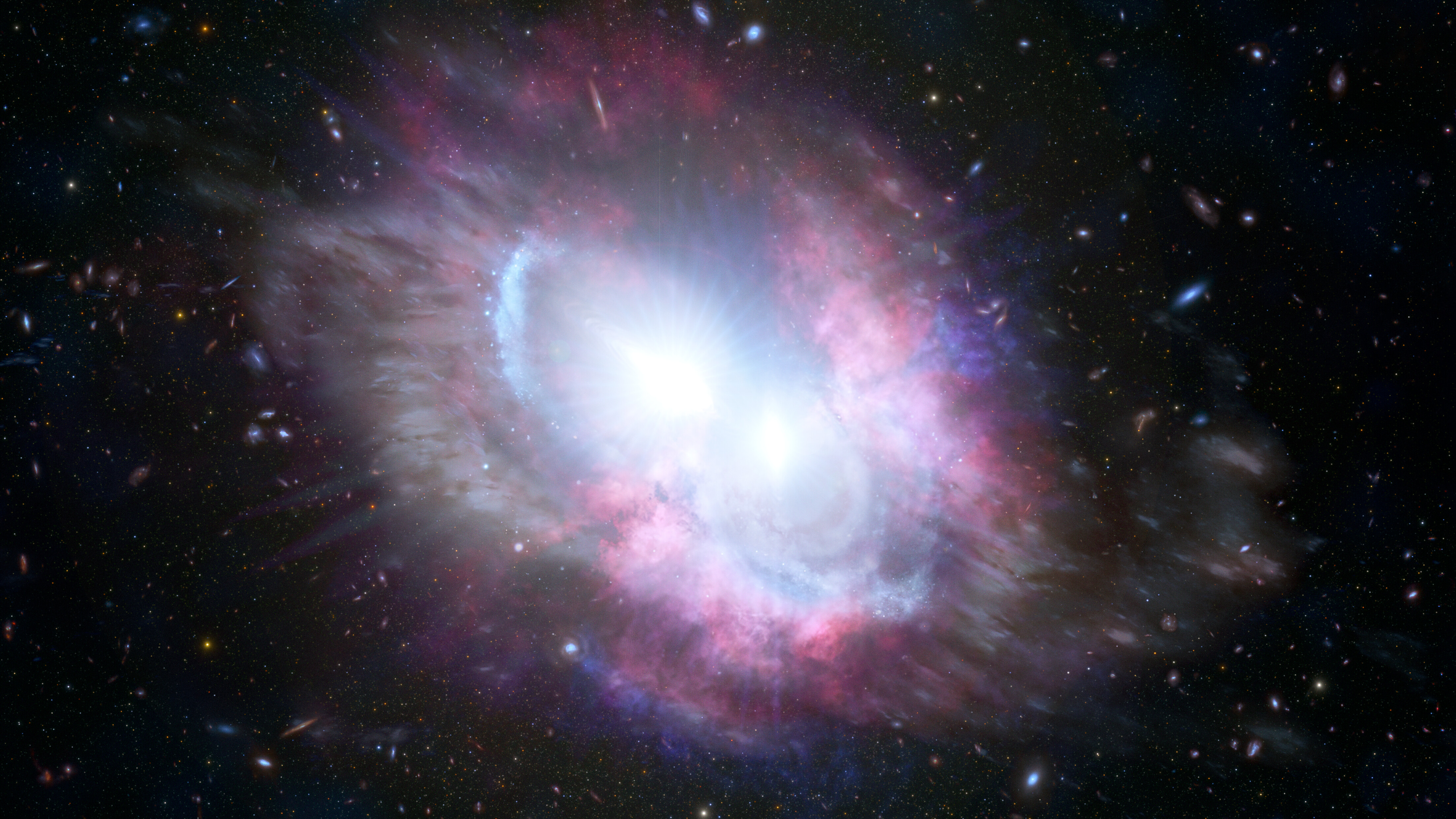
This artist's impression illustrates that astronomers using an array of ground- and space-based telescopes, including Gemini North on Hawai‘i, have uncovered a closely bound duo of energetic quasars — the hallmark of a pair of merging galaxies — seen when the Universe was only three billion years old. This discovery sheds light on the evolution of galaxies at “cosmic noon,” a period in the history of the Universe when galaxies underwent bursts of furious star formation. This merger also represents a system on the verge of becoming a giant elliptical galaxy.Credit: International Gemini Observatory/NOIRLab/NSF/AURA/M. Zamani, J. da Silva. download: Large JPEG

Gemini North helps confirm nature of cosmic system on the verge of becoming a giant elliptical galaxy 

Astronomers using an array of ground- and space-based telescopes, including Gemini North on Hawai‘i, have uncovered a closely bound duo of energetic quasars — the hallmark of a pair of merging galaxies — seen when the Universe was only three billion years old. This discovery sheds light on the evolution of galaxies at “cosmic noon,” a period in the history of the Universe when galaxies underwent bursts of furious star formation. This merger also represents a system on the verge of becoming a giant elliptical galaxy. 

Galaxies grow and evolve by merging with other galaxies, blending their billions of stars, triggering bursts of vigorous star formation, and often fueling their central supermassive black holes to produce luminous quasars that outshine the entire galaxy. Some of these mergers eventually go on to become massive elliptical galaxies that contain black holes that are many billions of times the mass of our Sun. Although astronomers have observed a veritable menagerie of merging galaxies with more than one quasar in our own cosmic neighborhood, more distant examples, seen when the Universe was only a quarter of its current age, are quite rare and extremely challenging to find.

By harnessing a bevy of ground- and space-based observatories — including Gemini North, one half of the International Gemini Observatory, operated by NSF’s NOIRLab — a team of astronomers has discovered a closely bound pair of actively feeding supermassive black holes — quasars. This discovery is the first confirmed detection of a pair of supermassive black holes in the same galactic real estate at ‘cosmic noon’ — a period of frenetic star formation at a time when the Universe was only three billion years old. 

Previous observations have identified similar systems in the early stages of merging, when the two galaxies could still be considered clearly separate entities. But these new results show a pair of quasars blazing away in such close proximity, a mere 10,000 light-years apart, that their original host galaxies are likely well on their way to becoming a single giant elliptical galaxy. 

Searching for pairs of supermassive black holes so close to each other during this early epoch is like trying to find the proverbial needle in a haystack. The challenge is that most black-hole pairs are too close to distinguish individually. To definitively detect such a system, the two supermassive black holes need to be actively accreting and shining as quasars simultaneously, conditions that are extremely rare. Statistically, for every 100 supermassive black holes only one should be actively accreting at a given time. 

Astronomers know, however, that the distant Universe should be brimming with pairs of supermassive black holes embedded within merging galaxies. The first hints of such a system were found in data from the NASA/ESA Hubble Space Telescope, which revealed two closely aligned pinpoints of light in the distant Universe. 

To verify the true nature of this system, the team searched through ESA’s Gaia observatory’s vast database and found that this system had an apparent “jiggle,” which could be the result of sporadic changes in a black hole's feeding activity. 

The team then used the Gemini Multi-Object Spectrograph (GMOS) and GNIRS on Gemini North, which provided the team with independent measurements of the distance to the quasars and confirmed that the two objects were both quasars rather than a chance alignment of a single quasar with a foreground star. Further studies with the W.M. Keck Observatory, NSF’s Karl G. Jansky Very Large Array, and NASA’s Chandra X-ray Observatory also helped to confirm these observations. 

The confirmation process wasn’t easy and we needed an array of telescopes covering the spectrum from X-rays to the radio to finally confirm that this system is indeed a pair of quasars, instead of, say, two images of a gravitationally lensed quasar,” said co-author Yue Shen, an astronomer at the University of Illinois. 

We don't see a lot of double quasars at this early time. And that's why this discovery is so exciting. Knowing about the progenitor population of black holes will eventually tell us about the emergence of supermassive black holes in the early Universe, and how frequent those mergers could be,” said graduate student Yu-Ching Chen of the University of Illinois at Urbana-Champaign, lead author of this study, which is published in the journal Nature.


More information 

NSF’s NOIRLab, the US center for ground-based optical-infrared astronomy, operates the International Gemini Observatory (a facility of NSF, NRC–Canada, ANID–Chile, MCTIC–Brazil, MINCyT–Argentina, and KASI–Republic of Korea), Kitt Peak National Observatory (KPNO), Cerro Tololo Inter-American Observatory (CTIO), the Community Science and Data Center (CSDC), and Vera C. Rubin Observatory (operated in cooperation with the Department of Energy’s SLAC National Accelerator Laboratory). It is managed by the Association of Universities for Research in Astronomy (AURA) under a cooperative agreement with NSF and is headquartered in Tucson, Arizona. The astronomical community is honored to have the opportunity to conduct astronomical research on Iolkam Du’ag (Kitt Peak) in Arizona, on Maunakea in Hawai‘i, and on Cerro Tololo and Cerro Pachón in Chile. We recognize and acknowledge the very significant cultural role and reverence that these sites have to the Tohono O’odham Nation, to the Native Hawaiian community, and to the local communities in Chile, respectively.


Links:


Contacts:

Xin Liu
University of Illinois at Urbana-Champaign 
Email:
xinliuxl@illinois.edu

Yu-Ching Chen, 
University of Illinois at Urbana-Champaign
Email:
ycchen@illinois.edu

Yue Shen 
University of Illinois at Urbana-Champaign
Email:
shenyue@illinois.edu

;Charles Blue
Public Information Officer
NSF’s NOIRLab
T: +1 202 236 6324
Email: charles.blue@noirlab.edu

Wednesday, September 23, 2020

NASA's Webb Will Explore the Cores of Merging Galaxies

Although the two galaxies in NGC 3256 appear merged when viewed in visible light, a second, bright nucleus is found hiding among the tangle of dust lanes in the central region. By using a range of telescopes on the ground and in space, the GOALS (Great Observatories All-sky LIRG Survey) research team has been analyzing galaxies like NGC 3256 from X-ray through radio wavelengths. NGC 3256 has a buried active nucleus, large-scale shocks from two powerful outflows, and a huge number of compact, bright star clusters. Upcoming research with the James Webb Space Telescope will help researchers learn more about the outflows, which will allow them to better model the hot and cold gas, and determine what implications that has for how and where stars form in rapidly evolving galaxies.Credits: NASA, ESA, the Hubble Heritage (STScI/AURA)-ESA/Hubble Collaboration, and A. Evans (University of Virginia, Charlottesville/NRAO/Stony Brook University).
Hi-res image

When galaxies collide, it's as if all the players in a symphony have begun a furious crescendo: As their stars and gas fall toward the center, star formation escalates. At the same time, the galaxies' black holes engorge themselves and light up, releasing energy and material into the surrounding gas. These "overtures," which continue for hundreds of millions of years, are brightest where the centers of galaxies – called nuclei – merge, and those areas are also filled with dust. Until now, high-resolution infrared observations from space that can pierce through the dust weren't possible. NASA's James Webb Space Telescope's observations will return both infrared imagery and spectra that will allow researchers to add incredible detail to our understanding of the precise mechanics at work.

A research team led by Lee Armus of the California Institute of Technology/IPAC in Pasadena and Aaron Evans of the University of Virginia and the National Radio Astronomy Observatory in Charlottesville will study the centers of a class of interacting galaxies known as merging luminous infrared galaxies. "Webb's instruments will provide huge leaps in our abilities to resolve what is happening in these galaxies," explained Armus. "The images and spectra will not only be 50 to 100 times more sensitive than previous infrared data, but also significantly sharper."

These merging galaxies are often gas-rich spiral galaxies, which means they are still forming stars before colliding. As they approach one another and conduct a delicate "dance," gas in the galaxies loses angular momentum and funnels toward the center. This triggers additional star formation at an accelerated rate, up to hundreds of solar masses per year compared to one or two per year observed in normal star-forming galaxies like our own. While stars are forming, they heat the surrounding dust, generating enormous amounts of energy in infrared light.

Since the galaxies that make up NGC 7469 are both almost face-on when viewed from Earth, it's easier to identify the areas where a black hole may exist. A powerful accreting supermassive black hole, surrounded by a ring of young stars, lives at the heart of the galaxy in the upper right. High-resolution infrared imagery from the James Webb Space Telescope is required to determine if the stars form differently around a central supermassive black hole compared to star formation farther out in the galaxy's arms. Webb will also help researchers trace the gas outflows, which will help pinpoint where and how the interstellar medium is affected, which subsequently drives or quenches star formation. Credits: NASA, ESA, the Hubble Heritage (STScI/AURA)-ESA/Hubble Collaboration, and A. Evans (University of Virginia, Charlottesville/NRAO/Stony Brook University).
Hi-res image

Webb's high-resolution, infrared instruments will allow researchers to resolve the central star-forming regions for the first time. "We are aiming to observe areas as small as 150 to 300 light-years across," said Evans. "For context, these galaxies span hundreds of millions of light-years across. Webb will strip away all the dust and see the activity that’s at their cores."

Pulling back the "Dusty" Curtain

Each of the team's targets is part of a much larger, multi-decade program known as GOALS, the Great Observatories All-sky LIRG Survey. The research team has studied more than 200 merging luminous infrared galaxies across the electromagnetic spectrum, from radio and ultraviolet light to visible and X-ray light, building robust data sets for each.

These merging galaxies, known as II Zw 096, are the site of a spectacular burst of star formation that is hinted at in the red speckles near the middle of the image. This dust-shrouded area conceals a brilliant burst of star formation that becomes more apparent at longer wavelengths of infrared light. The image above combines near-infrared, visible, and far-ultraviolet observations from the Hubble Space Telescope. Researchers using infrared data from NASA's Spitzer Space Telescope estimated the starburst, which lives in a small red region at the center of this image, is cranking out stars at the breakneck pace of around 100 solar masses per year. The upcoming James Webb Space Telescope will allow researchers to penetrate the dust and search for a buried, rapidly growing supermassive black hole. Credits: NASA/JPL-Caltech/STScI/H. Inami (SSC/Caltech).
Hi-res image

The researchers carefully selected four targets – each made up of two galaxies – to produce a far more complete view of the activity that's occurring in these merging galaxies by adding high-resolution infrared data. They have a range of characteristics, though all are marked by intense star formation or an actively feeding supermassive black hole:

  • Two nuclei are at the center of NGC 3256, but one is largely hidden by dark bands of dust, making infrared observations essential to fully understand where stars are forming and where black holes may lie – as well as how they influence one another. Strong galactic winds emerge from both nuclei, but their properties are largely unknown.
  • NGC 7469 has a starburst ring, and a central bright active galactic nucleus with a jet. Webb's observations will help the researchers determine how the central, active nucleus is influencing star formation in the center of the galaxy.
  • Dust also shrouds one of the pair of galaxies making up VV 114. Though it is known that widespread star formation is occurring throughout both interacting galaxies, one shines brightly in the infrared and the other in ultraviolet light. Webb will give us the clearest view yet of this fascinating and complex merging pair.
  • II Zw 096 is unique among GOALS galaxies since the source of its immense infrared power comes from a very compact region not associated with the nuclei of either of the merging galaxies. This object is producing stars nearly 100 times faster than the Milky Way, but in a region less than one ten-thousandth the area. Webb will follow up on observations of these galaxies by NASA’s retired Spitzer Space Telescope, allowing researchers to penetrate the dust and search for a buried, rapidly growing supermassive black hole.

To uncover the processes that cause these conditions, it's essential to pinpoint where and how fast stars are forming, and to measure how much gas the central black holes are accreting with Webb's infrared observations. "All of these objects, including stars and black holes, are competing for resources," Armus explained. "Black holes need gas to grow, and as they grow they become energetic and drive outflows. In turn, those outflows affect how stars form by heating and pushing away the gas. With Webb, we will have the ability to understand what the interplay is between all of these processes."

Discover how telescopes make it possible to look back in time and study the history of the universe, and how NASA’s James Webb Space Telescope will fill in new details on galaxy evolution over time. The earliest pages of cosmic history are blank, but Webb will allow us to look back farther in time than ever before, helping to fill in the lost pages of the universe’s story. Credits: NASA, ESA, CSA, and L. Hustak and D. Player (STScI). 

In addition to images, Webb will gather spectra from the centers of these four merging galaxies. "The images will tell us where things are, but spectra provide the really rich information: They tell you what is there and how it may be moving," said co-investigator Vivian U of the University of California, Irvine.

To understand what's happening at the centers of these merging galaxies, the team needs both imagery and highly detailed spectral maps of the active regions around the nuclei – far better than spectra that deliver an average of the entire area observed. Webb's Near Infrared Spectrograph (NIRSpec) and its Mid-Infrared Instrument (MIRI) can do exactly this, which will allow researchers to measure not only what is there, but also the physical conditions within the star-forming regions at the nucleus for the first time.

"Dust lanes are beautiful until you try to find out what's happening behind them," U continued. "In near- and mid-infrared, we will start seeing through the dust. And by observing what's happening at small scales for the first time, we will learn how gas and dust are affecting star formation and the interstellar medium in these environments."

Far-reaching Research Implications

Although theoretical models of merging galaxies demonstrate how stars form, they currently do not precisely account for how supermassive black holes and lots of hot young stars impact their surrounding environments, or how gas moves within galaxy mergers. The Webb data should give researchers a clear look at the centers of merging galaxies and inform a new generation of models that will describe how galaxies interact and merge.

As part of this study, the team will update and deliver software, first written for Spitzer Space Telescope data, to fit the Webb spectra and generate maps of the galaxies in different emission lines and colors. The team will also use this software to map the dynamics of the gas around the nuclei and study how outflows shape their evolution.

In addition to benefiting scientists who research these or similar objects, this program will also demonstrate Webb's capabilities in a wide range of scientific applications, helping other scientists effectively and efficiently use the observatory to meet their own science goals and provide a detailed look at nearby galaxies that may resemble young systems in the early universe.

This research is being conducted as part of a Webb Director’s Discretionary-Early Release Science (ERS) program. This program provides time to selected projects early in the telescope's mission, allowing researchers to quickly learn how best to use Webb's capabilities, while also yielding robust science.

The James Webb Space Telescope will be the world's premier space science observatory when it launches in 2021. Webb will solve mysteries in our solar system, look beyond to distant worlds around other stars, and probe the mysterious structures and origins of our universe and our place in it. Webb is an international program led by NASA with its partners, ESA (European Space Agency) and the Canadian Space Agency.

By Claire Blome  
Space Telescope Science Institute, Baltimore, Md.  

cBlome@stsci.edu

Editor: Lynn Jenner


Thursday, January 10, 2019

Don’t judge a galaxy by its cover: Astronomers develop new tool to find merging galaxies

Three galaxies observed by the SDSS MaNGA survey
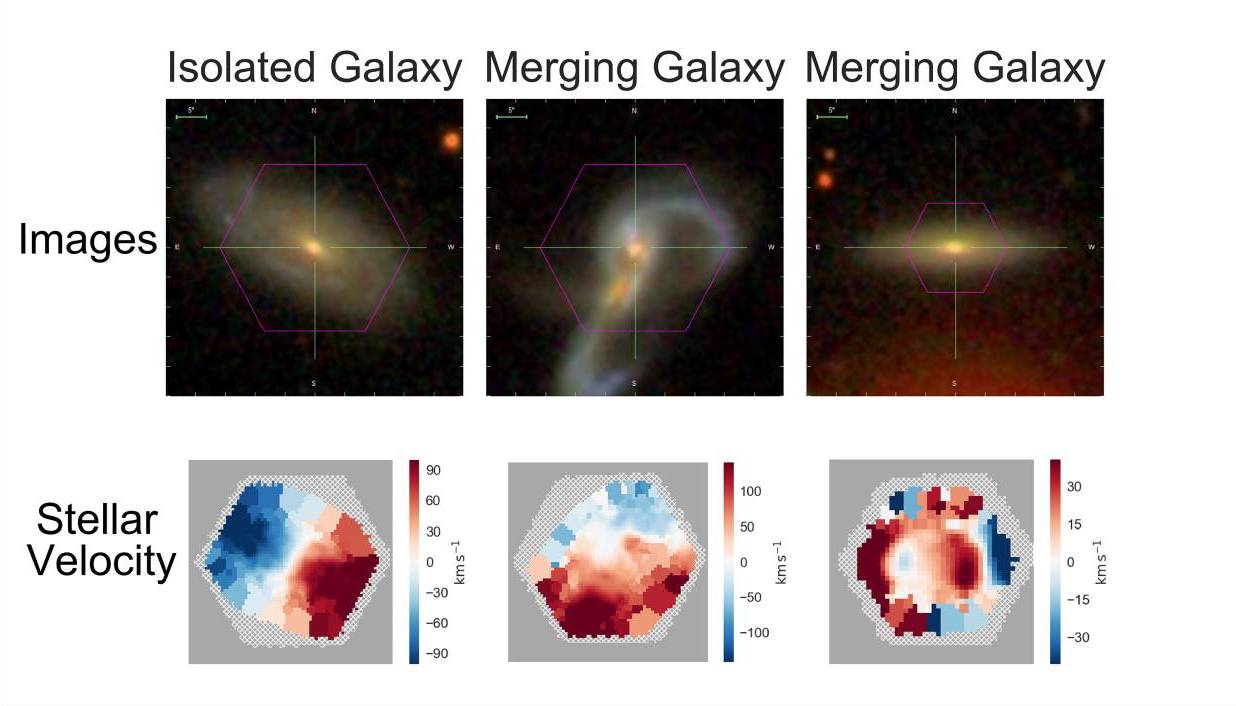
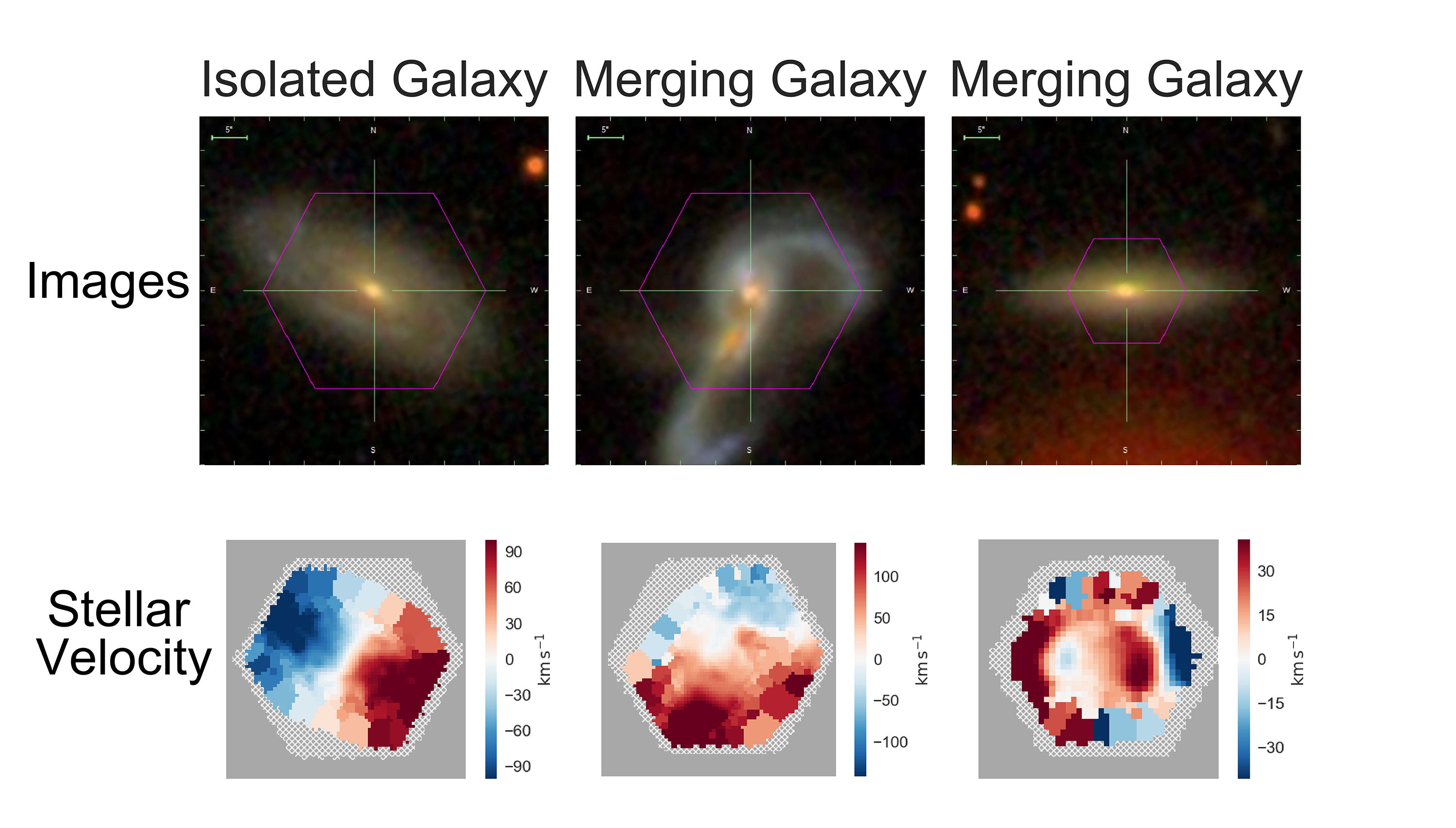
The top row shows the galaxies’ images, while the bottom row shows the velocity of the stars within the galaxies; red means the stars are moving away from us and blue means towards us. The panel on the left shows an isolated spiral galaxy, not undergoing a merger. The middle panels show a spectacular pair of merging galaxies, obvious in both the image and the velocity map. The right panels show what appears in the image to be a single galaxy – but the velocity map reveals that it is actually a galaxy that has just merged. This is evident in the disturbed (counter-rotating) features in the velocity map. This example demonstrates the power of the team’s new method, which will identify merging galaxies using both imaging and kinematics. Image credit: Rebecca Nevin (University of Colorado Boulder) and the SDSS collaboration. Hi-res image

Don’t judge a book by its cover, and don’t judge a galaxy by its image alone.

Today, at the 233rd AAS meeting in Seattle, astronomers from the Sloan Digital Sky Survey (SDSS) announce that they have developed a new tool to find otherwise-hidden galaxy mergers in data from the Mapping Nearby Galaxies at Apache Point Observatory (MaNGA) survey of SDSS. These results show that by going beyond simple searches for merging galaxies based just on how they look, astronomers will now be able find more galaxy mergers than ever before.

“Merging galaxies are key to understanding galaxy evolution, but finding them can be tricky,” says Rebecca Nevin of the University of Colorado, the lead author of the study. Nevin is presenting this work this week as a Dissertation talk, as it formed the basis of her PhD thesis at Colorado with Professor Julie Comerford.

A pair of merging galaxies is one of the most beautiful sights in astronomy, with giant tidal streams of stars and unusual shapes sometimes resembling animals (e.g. the Antennae, Mice, Tadpole, or Penguin galaxies). However, these beautiful visible features are visible are only found in a small fraction of merging galaxies – and even then only for a small part of the billions of years it takes for two galaxies to fully merge into one. Some galaxies that otherwise look “normal” may still be in the process of merging.

Astronomers have developed a way to find these hidden mergers. They created a method that uses simulations of merging galaxies to predict both how the mergers would look and how the stars in the galaxies would move. By comparing their results with observations of galaxies from the SDSS’s Mapping Nearby Galaxies at Apache Point Observatory (MaNGA) survey, astronomers will be able to do much better at identifying merging galaxies in the wild.

“These simulations allow us to predict the more subtle signs of merging galaxies, so we can find mergers in SDSS data that were previously hidden,” explains Laura Blecha (University of Florida), another key member of the team.

This montage of six images from the Hubble Space Telescope shows six real galaxies in different stages of the merger process. For more information about these galaxies, see the image description at the Hubble Space Telescope website.  Image credit: NASA, ESA, the Hubble Heritage Team (STScI/AURA)-ESA/Hubble Collaboration and A. Evans (University of Virginia, Charlottesville/NRAO/Stony Brook University), K. Noll (STScI), and J. Westphal (Caltech)

What the team is presenting today is the part of their method that analyzes galaxy images. They have essentially made a galactic photo album, including pictures of galaxies in all stages of merging. In the past, astronomers’ “photo albums” of galaxy mergers were sparse, including only galaxies in the stage of merging where they looked like spectacular mergers. 

“Nowadays, it would be totally unthinkable to take only one or two selfies every year,” said Nevin. “We have modernized the galaxy merger photo album – now it’s like taking one galaxy merger selfie a day for years.”

The astronomers plan to make these extensive photo albums publicly available to everyone. Astronomers will use them to study how galaxies change as they undergo mergers.

The team’s work so far is already a giant step forward in merger identification, but they are already taking the next step. They have already begun to incorporate data on how the stars move in the galaxies from the SDSS MaNGA survey. This will allow the team to identify even more mergers – those where the galaxy looks completely “normal.”

The key to this new analysis is to incorporate data from MaNGA on how stars within galaxies are moving. “By going beyond images alone and incorporating stellar kinematics, we will find many more merging galaxies,” says Karen Masters of Haverford College, the Spokesperson for SDSS. “We’ll be able to learn how the merger process impacts how galaxies in our Universe evolve.”

These stellar kinematics are revealed in the maps created by the SDSS’s MaNGA survey. Because the spectra that MaNGA observes come from the light of all the stars in a particular part of a galaxy, stars, the spectra are slightly shifted by the Doppler Effect – blueshifted for the parts of a galaxy that are moving toward Earth and redshifted for the parts moving away from Earth. These subtle shifts reveal how the stars are moving around the galaxy.

When galaxies merge, the stars in them almost never collide, but they are thrown all around, creating dramatic distortions in the pattern of how stars move around the galaxy – patterns that astronomers refer to as “stellar kinematics.” In a typical, non-merging spiral galaxy, the stars rotate in a simple, predictable pattern. But if such a galaxy is undergoing a merger, that simple pattern becomes chaotic, creating wild (but predictable) arrangements of stellar motion. When a galaxy’s patterns of stellar motion have become distorted by a merger, the stellar kinematics data from MaNGA provides direct evidence of the merger. Nevin’s team, which includes astronomers from the University of Colorado Boulder, the University of Florida, and Princeton University, is beginning to add stellar kinematics data into their work.

This animation shows one of the galaxy merger simulations the team created. The first 38 seconds shows the simulation running, covering 2.5 billion years of history. From each step of the simulation, the team figures out what the galaxy would look like when viewed from Earth by the Sloan Digital Sky Survey (shown from 0:39 to 1:06). The last part of the video (1:06-1:30) shows a collection of simulated images and how they are used to create a classification method that can then be applied to real SDSS images. Image credit: Rebecca Nevin (University of Colorado), Laura Blecha (University of Florida), and the SDSS collaboration. 

“As we improve our machine learning algorithms to incorporate the stellar kinematics of merging galaxies, we are able to identify different stages of the merger. The disturbances in the stars can last longer than imaging signatures of a merger like faint tidal tails, which fade much quicker. This means we can identify later stages in the merger, when in the imaging the galaxies look just like normal galaxies. This is a powerful new technique in the study of merging galaxies.”

Understanding mergers is not only important to astronomers like Nevin’s team; this understanding can help us predict the future of our own Galaxy. The Milky Way will merge with the Large and Small Magellanic Clouds in about 2.5 billion years – and is then predicted to merge with the much more massive Andromeda galaxy in five billion years, combining to form a single super-galaxy, which some dub “Milkdromeda.” This event might throw the Sun out of the galaxy, but it won’t matter to future inhabitants of Earth, which will have been swallowed by the Sun as it turns into a red giant star at around the same time. But maybe our descendants will see this for themselves as they travel among the stars.


Wednesday, May 10, 2017

Merging Galaxies Have Enshrouded Black Holes

This illustration compares growing supermassive black holes in two different kinds of galaxies. A growing supermassive black hole in a normal galaxy would have a donut-shaped structure of gas and dust around it (left). In a merging galaxy, a sphere of material obscures the black hole (right). Credit: National Astronomical Observatory of Japan.  › Larger view


Black holes get a bad rap in popular culture for swallowing everything in their environments. In reality, stars, gas and dust can orbit black holes for long periods of time, until a major disruption pushes the material in.

A merger of two galaxies is one such disruption. As the galaxies combine and their central black holes approach each other, gas and dust in the vicinity are pushed onto their respective black holes. An enormous amount of high-energy radiation is released as material spirals rapidly toward the hungry black hole, which becomes what astronomers call an active galactic nucleus (AGN).

A study using NASA's NuSTAR telescope shows that in the late stages of galaxy mergers, so much gas and dust falls toward a black hole that the extremely bright AGN is enshrouded. The combined effect of the gravity of the two galaxies slows the rotational speeds of gas and dust that would otherwise be orbiting freely. This loss of energy makes the material fall onto the black hole.

"The further along the merger is, the more enshrouded the AGN will be," said Claudio Ricci, lead author of the study published in the Monthly Notices Royal Astronomical Society. "Galaxies that are far along in the merging process are completely covered in a cocoon of gas and dust."

Ricci and colleagues observed the penetrating high-energy X-ray emission from 52 galaxies. About half of them were in the later stages of merging. Because NuSTAR is very sensitive to detecting the highest-energy X-rays, it was critical in establishing how much light escapes the sphere of gas and dust covering an AGN.

The study was published in the Monthly Notices of the Royal Astronomical Society. Researchers compared NuSTAR observations of the galaxies with data from NASA's Swift and Chandra and ESA's XMM-Newton observatories, which look at lower energy components of the X-ray spectrum. If high-energy X-rays are detected from a galaxy, but low-energy X-rays are not, that is a sign that an AGN is heavily obscured.

The study helps confirm the longstanding idea that an AGN's black hole does most of its eating while enshrouded during the late stages of a merger.

"A supermassive black hole grows rapidly during these mergers," Ricci said. "The results further our understanding of the mysterious origins of the relationship between a black hole and its host galaxy."

NuSTAR is a Small Explorer mission led by Caltech and managed by NASA's Jet Propulsion Laboratory for NASA's Science Mission Directorate in Washington. NuSTAR was developed in partnership with the Danish Technical University and the Italian Space Agency (ASI). The spacecraft was built by Orbital Sciences Corp., Dulles, Virginia. NuSTAR's mission operations center is at UC Berkeley, and the official data archive is at NASA's High Energy Astrophysics Science Archive Research Center. ASI provides the mission's ground station and a mirror archive. JPL is managed by Caltech for NASA.

For more information on NuSTAR, visit:  http://www.nasa.gov/nustar  -  http://www.nustar.caltech.edu


News Media Contact

Elizabeth Landau
Jet Propulsion Laboratory, Pasadena, Calif.
818-354-6425

elizabeth.landau@jpl.nasa.gov


Monday, October 17, 2016

Discovering the Treasures in Chandra’s Archives

Each year, NASA’s Chandra X-ray Observatory helps celebrate American Archive Month by releasing a collection of images using X-ray data in its archive.

The Chandra Data Archive is a sophisticated digital system that ultimately contains all of the data obtained by the telescope since its launch into space in 1999. Chandra’s archive is a resource that makes these data available to the scientific community and the general public for years after they were originally obtained.

Each of these six new images also includes data from telescopes covering other parts of the electromagnetic spectrum, such as visible and infrared light. This collection of images represents just a small fraction of the treasures that reside in Chandra’s unique X-ray archive.
From left to right, starting on the top row, the objects are:

 Westerlund 2, 3C31, PSR J1509-5850, Abell 665, RX J0603.3+4214 and CTB 37A


Westerlund 2: A cluster of young stars – about one to two million years old – located about 20,000 light years from Earth.  Data in visible light from the Hubble Space Telescope (green and blue) reveal thick clouds where the stars are forming. High-energy radiation in the form of X-rays, however, can penetrate this cosmic haze, and are detected by Chandra (purple).

3C31: X-rays from the radio galaxy 3C31 (blue), located 240 million light years from Earth, allow astronomers to probe the density, temperature, and pressure of this galaxy, long known to be a powerful emitter of radio waves. The Chandra data also reveal a jet blasting away from one side of the central galaxy, which also is known as NGC 383.  Here, the Chandra X-ray image has been combined with Hubble’s visible light data (yellow).

PSR J1509-5850: Pulsars were first discovered in 1967 and today astronomers know of over a thousand such objects. The pulsar, PSR J1509-5850, located about 12,000 light years from Earth and appearing as the bright white spot in the center of this image, has generated a long tail of X-ray emission trailing behind it, as seen in the lower part of the image. This pulsar has also generated an outflow of particles in approximately the opposite direction. In this image, X-rays detected by Chandra (blue) and radio emission (pink) have been overlaid on a visible light image from the Digitized Sky Survey of the field of view.

Abell 665: Merging galaxy clusters can generate enormous shock waves, similar to cold fronts in weather on Earth. This system, known as Abell 665, has an extremely powerful shockwave, second only to the famous Bullet Cluster. Here, X-rays from Chandra (blue) show hot gas in the cluster. The bow wave shape of the shock is shown by the large white region near the center of the image. The Chandra image has been added to radio emission (purple) and visible light data from the Sloan Digital Sky Survey showing galaxies and stars (white).

RX J0603.3+4214: The phenomenon of pareidolia is when people see familiar shapes in images. This galaxy cluster has invoked the nickname of the “Toothbrush Cluster” because of its resemblance to the dental tool. In fact, the stem of the brush is due to radio waves (green) while the diffuse emission where the toothpaste would go is produced by X-rays observed by Chandra (purple). Visible light data from the Subaru telescope show galaxies and stars (white) and a map from gravitational lensing (blue) shows the concentration of the mass, which is mostly (about 80%) dark matter.

CTB 37A: Astronomers estimate that a supernova explosion should occur about every 50 years on average in the Milky Way galaxy. The object known as CTB 37A is a supernova remnant located in our Galaxy about 20,000 light years from Earth. This image shows that the debris field glowing in X-rays (blue) and radio waves (pink) may be expanding into a cooler cloud of gas and dust seen in infrared light (orange).

NASA's Marshall Space Flight Center in Huntsville, Alabama, manages the Chandra program for NASA's Science Mission Directorate in Washington. The Smithsonian Astrophysical Observatory in Cambridge, Massachusetts, controls Chandra's science and flight operations. 


Read More from NASA's Chandra X-ray Observatory.


For more Chandra images, multimedia and related materials, visit: http://www.nasa.gov/chandra


Molly Porter
Marshall Space Flight Center, Huntsville, Ala.
256-544-0034

molly.a.porter@nasa.gov

Megan Watzke
Chandra X-ray Center, Cambridge, Mass.
617-496-7998

mwatzke@cfa.harvard.edu

Editor: Lee Mohon

Friday, September 18, 2015

Evolution in slow motion

Credit: ESA/Hubble & NASA
Acknowledgement: Judy Schmidt (geckzilla.com)


It is known today that merging galaxies play a large role in the evolution of galaxies and the formation of elliptical galaxies in particular. However there are only a few merging systems close enough to be observed in depth. The pair of interacting galaxies picture seen here — known as NGC 3921 — is one of these systems.

NGC 3921 — found in the constellation of Ursa Major (The Great Bear) — is an interacting pair of disc galaxies in the late stages of its merger. Observations show that both of the galaxies involved were about the same mass and collided about 700 million years ago. You can see clearly in this image the disturbed morphology, tails and loops characteristic of a post-merger.

The clash of galaxies caused a rush of star formation and previous Hubble observations showed over 1000 bright, young star clusters bursting to life at the heart of the galaxy pair.