Showing posts with label Gemini Planet Imager (GPI). Show all posts

Thursday, June 13, 2019

The Formative Years: Giant Planets vs. Brown Dwarfs


GPI Survey from Franck Marchis on Vimeo.


Animation showing the 617 observations conducted during GPIES from November 2014 to April 2019 (right) and the location of the stars in the southern sky (left). Open circles indicate system (like 51 Eri at 2 o’clock) which have been visited multiple times. Stars indicated by a red dot have a disk of material. Blue dots are planetary systems (with one planet at least). Brown dot are binary systems with a brown dwarf. Credits: P. Kalas, D. Savransky, R. De Rosa and GPIES.

Based on preliminary results from a new Gemini Observatory survey of 531 stars with the Gemini Planet Imager (GPI), it appears more and more likely that large planets and brown dwarfs have very different roots.

The GPI Exoplanet Survey (GPIES), one of the largest and most sensitive direct imaging exoplanet surveys to date, is still ongoing at the Gemini South telescope in Chile. “From our analysis of the first 300 stars observed, we are already seeing strong trends,” said Eric L. Nielsen of Stanford University, who is the lead author of the study, published in The Astronomical Journal.

In November 2014, GPI Principal Investigator Bruce Macintosh of Stanford University and his international team set out to observe almost 600 young nearby stars with the newly commissioned instrument. GPI was funded with support from the Gemini Observatory partnership, with the largest portion from the US National Science Foundation (NSF). The NSF, and the Canadian National Research Council (NRC; also a Gemini partner), funded researchers participating in GPIES.

Imaging a planet around another star is a difficult technical challenge possible with only a few instruments. Exoplanets are small, faint, and very close to their host star — distinguishing an orbiting planet from its star is like resolving the width of a dime from several miles away. Even the brightest planets are ten thousand times fainter than their parent star. GPI can see planets up to a million times fainter, much more sensitive than previous planet-imaging instruments. “GPI is a great tool for studying planets, and the Gemini Observatory gave us time to do a careful, systematic survey,” said Macintosh.

GPIES is now coming to an end. From the first 300 stars, GPIES has detected six giant planets and three brown dwarfs. “This analysis of the first 300 stars observed by GPIES represents the largest, most sensitive direct imaging survey for giant planets published to date,” added Macintosh.
Brown dwarfs are more massive than planets, but not massive enough to fuse hydrogen like stars. “Our analysis of this Gemini survey suggests that wide-separation giant planets may have formed differently from their brown dwarf cousins,” Nielsen said.

The team’s paper advances the idea that massive planets form due to the slow accumulation of material surrounding a young star, while brown dwarfs come about due to rapid gravitational collapse. “It’s a bit like the difference between a gentle light rain and a thunderstorm,” said Macintosh.

“With six detected planets and three detected brown dwarfs from our survey, along with unprecedented sensitivity to planets a few times the mass of Jupiter at orbital distances well beyond Jupiter’s, we can now answer some key questions, especially about where and how these objects form,” Nielsen said.

This discovery may answer a longstanding question as to whether brown dwarfs — intermediate-mass objects — are born more like stars or planets. Stars form from the top down by the gravitational collapse of large primordial clouds of gas and dust, while planets are thought — but have not been confirmed — to form from the bottom up by the assembly of small rocky bodies that then grow into larger ones, a process also termed “core accretion.”

“What the GPIES team’s analysis shows is that the properties of brown dwarfs and giant planets run completely counter to each other,” said Eugene Chiang, professor of astronomy at the University of California Berkeley and a co-author of the paper. “Whereas more massive brown dwarfs outnumber less massive brown dwarfs, for giant planets the trend is reversed: less massive planets outnumber more massive ones. Moreover, brown dwarfs tend to be found far from their host stars, while giant planets concentrate closer in. These opposing trends point to brown dwarfs forming top-down, and giant planets forming bottom-up.”

More Surprises

Of the 300 stars surveyed thus far, 123 are at least 1.5 times more massive than our Sun. One of the most striking results of the GPI survey is that all hosts of detected planets are among these higher-mass stars — even though it is easier to see a giant planet orbiting a fainter, more Sun-like star. Astronomers have suspected this relationship for years, but the GPIES survey has unambiguously confirmed it. This finding also supports the bottom-up formation scenario for planets.

One of the study’s greatest surprises has been how different other planetary systems are from our own. Our Solar System has small rocky planets in the inner parts and giant gas planets in the outer parts. But the very first exoplanets discovered reversed this trend, with giant planets skimming closer to their stars than does moon-sized Mercury. Furthermore, radial-velocity studies — which rely on the fact that a star experiences a gravitationally induced “wobble” when it is orbited by a planet — have shown that the number of giant planets increases with distance from the star out to about Jupiter’s orbit. But the GPIES team’s preliminary results, which probe still larger distances, has shown that giant planets become less numerous farther out.

“The region in the middle could be where you're most likely to find planets larger than Jupiter around other stars," added Nielsen, “which is very interesting since this is where we see Jupiter and Saturn in our own Solar System.” In this regard, the location of Jupiter in our own Solar System may fit the overall exoplanet trend.

But a surprise from all exoplanet surveys is how intrinsically rare giant planets seem to be around Sun-like stars, and how different other solar systems are. The Kepler mission discovered far more small and close-in planets — two or more “super-Earth” planets per Sun-like star, densely packed into inner solar systems much more crowded than our own. Extrapolation of simple models suggested GPI would find a dozen giant planets or more, but it only saw six. Putting it all together, giant planets may be present around only a minority of stars like our own.

In January 2019, GPIES observed its 531st, and final, new star, and the team is currently following up the remaining candidates to determine which are truly planets and which are distant background stars impersonating giant planets.

The next-generation telescopes — such as NASA’s James Webb Space Telescope and WFIRST mission, the Giant Magellan Telescope, Thirty Meter Telescope, and Extremely Large Telescope — should be able to push the boundaries of study, imaging planets much closer to their star and overlapping with other techniques, producing a full accounting of giant planet and brown dwarf populations from 1 to 1,000 AU.

“Further observations of additional higher mass stars can test whether this trend is real,” said Macintosh, “especially as our survey is limited by the number of bright, young nearby stars available for study by direct imagers like GPI.”


Science Contacts:

Media Contact:
  • Peter Michaud
    Gemini Observatory, PIO Manager
    Email:
    pmichaud@gemini.edu
    Desk phone: 808-974-2510
    Cell phone: 808-936-6643


Background:

GPI is specifically designed to search for planets and brown dwarfs around other stars, using a mask known as a coronagraph to partially block a star’s light. Together with adaptive optics correcting for turbulence in the Earth’s atmosphere and advanced image processing, researchers can search the star’s neighborhood for Jupiter-like exoplanets and brown dwarfs up to a million times fainter than the host star.

In our Solar System, Jupiter is the largest planet, being about 318 times as massive as the Earth and lying about five times farther from the Sun than does the Earth. Brown dwarfs range from 13 to 90 times the mass of Jupiter; and while they can be up to a tenth the mass of the Sun, they lack the nuclear fusion in their core to burn as a star — so they lie somewhere between a diminutive star and a super-planet.

An early success of GPIES was the discovery of 51 Eridani b in December 2014, a planet about two-and-a-half times more massive than Jupiter, that orbits its star beyond the distance that Saturn orbits our own Sun. The host star, 51 Eridani, is just 97 light-years away, and is only 26 million years old (nearby and young, by astronomy standards). The star had been observed by multiple planet-imaging surveys with a variety of telescopes and instruments, but its planet was not detected until GPI’s superior instrumentation was able to suppress the starlight enough for the planet to be visible.

GPIES also discovered the brown dwarf HR 2562 B, which is at a separation similar to that between the Sun and Uranus, and is 30 times more massive than Jupiter.

Most exoplanets discovered thus far, including those found by NASA’s Kepler spacecraft, are found via indirect methods, such as observing a dimming in the star’s light as the orbiting planet eclipses its parent star, or by observing the star’s wobble as the planet’s gravity tugs on the star. These methods have been very successful, but they only probe the central regions of planetary systems. Those regions outside the orbit of Jupiter, where the giant planets are in our Solar System, are usually out of their reach. GPI, however, endeavors to directly detect planets in this parameter space by taking a picture of them alongside their parent stars.

The Gemini results support those from these other techniques, including a recent study of exoplanets discovered by the radial velocity method that found the most likely separation for a giant planet around Sun-like stars is about 3 AU. The finding that brown dwarfs occur with a frequency of only about 1%, independent of stellar mass, is also consistent with previous results from direct imaging surveys.


Tuesday, June 13, 2017

Gemini Discovered world is most like Jupiter

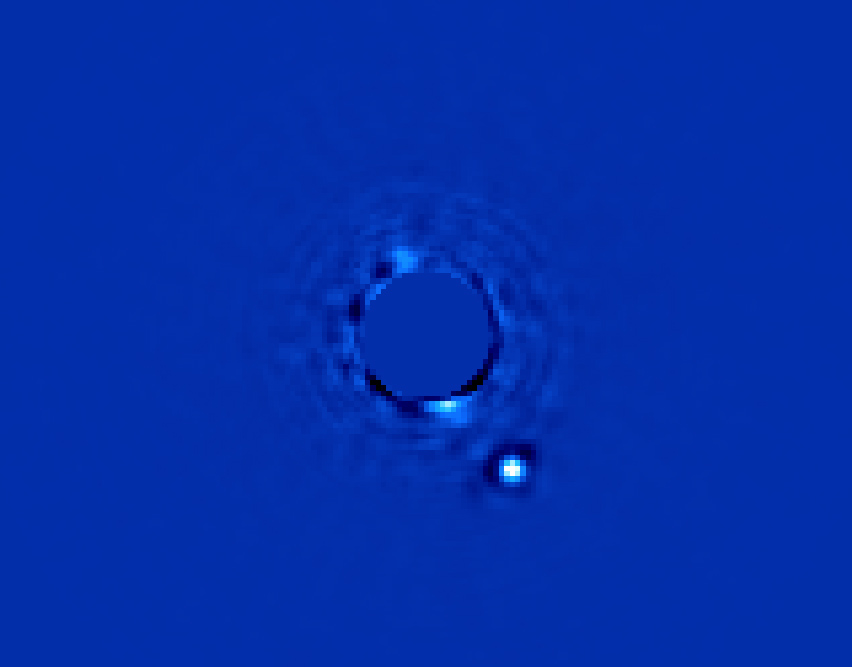
Figure 1. Discovery image of 51 Eri b with the Gemini Planet Imager taken in the near-infrared light on December 18, 2014. The bright central star has been mostly removed by a hardware and software mask to enable the detection of the exoplanet one million times fainter. Credits: J. Rameau (UdeM) and C. Marois (NRC Herzberg).  Full Resolution JPEG

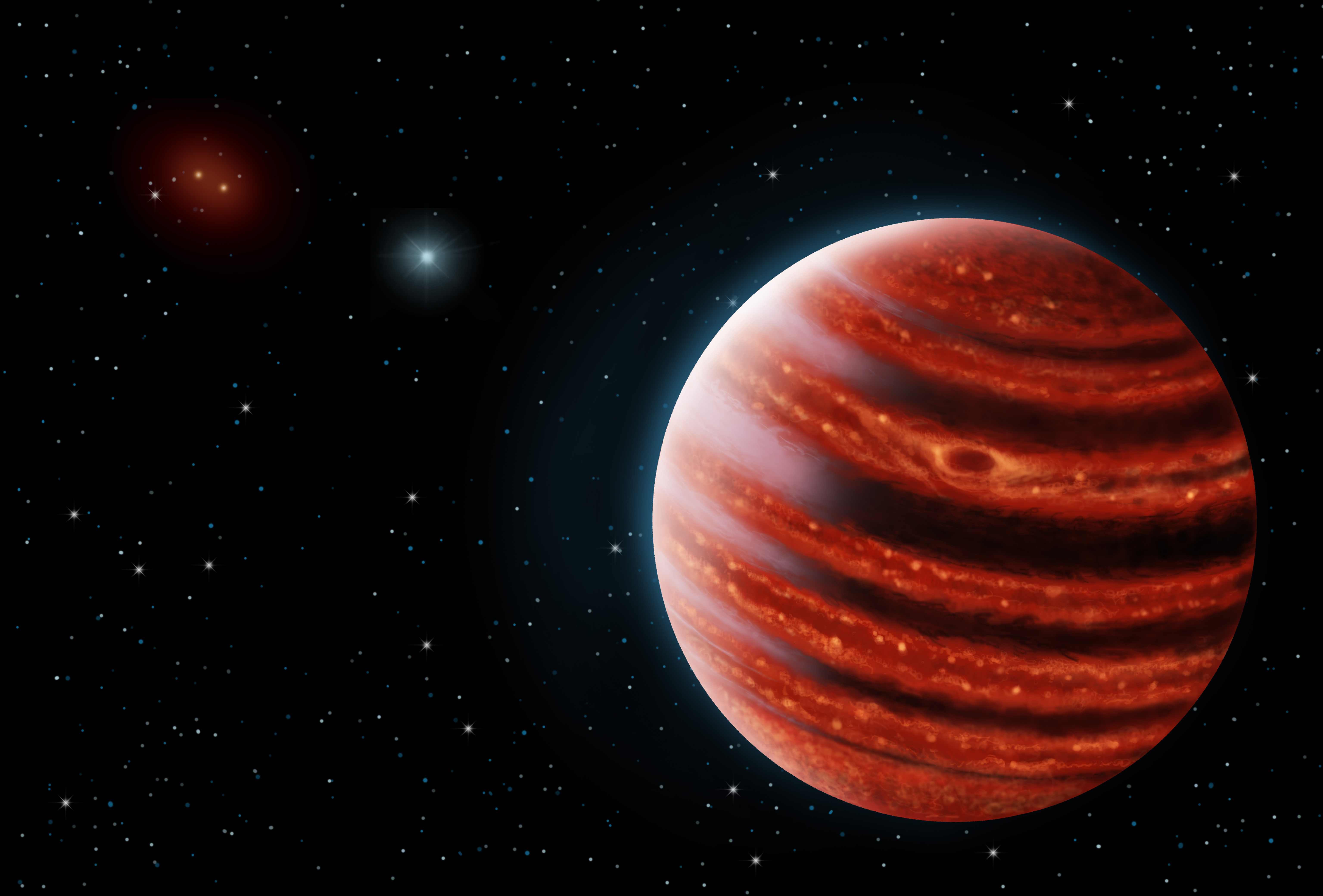
Figure 2. An artistic conception of the Jupiter-like exoplanet, 51 Eri b, seen in the near-infrared light that shows the hot layers deep in its atmosphere glowing through clouds. Because of its young age, this young cousin of our own Jupiter is still hot and carries information on the way it was formed 20 million years ago. Credits: Danielle Futselaar & Franck Marchis, SETI Institute.  Full Resolution JPEG

The Gemini Planet Imager utilizes an integral field spectrograph, an instrument capable of taking images at multiple wavelengths – or colors – of infrared light simultaneously, in order to search for young self-luminous planets around nearby stars. The left side of the animation shows the GPI images of the nearby star 51 Eridani in order of increasing wavelength from 1.5 to 1.8 microns. The images have been processed to suppress the light from 51 Eridani, revealing the exoplanet 51 Eridani b (indicated) which is approximately a million times fainter than the parent star. The bright regions to the left and right of the masked star are artifacts from the image processing algorithm, and can be distinguished from real astrophysical signals based on their brightness and position as a function of wavelength. The spectrum of 51 Eridani b, on the right side of the animation, shows how the brightness of the planet varies as a function of wavelength. If the atmosphere was entirely transmissive, the brightness would be approximately constant as a function of wavelength. This is not the case for 51 Eridani b, the atmosphere of which contains both water (H2O) and methane (CH4). Over the spectral range of this GPI dataset, water absorbs photons between 1.5 and 1.6 microns, and methane absorbs between 1.6 and 1.8 microns. This leads to a strong peak in the brightness of the exoplanet at 1.6 microns, the wavelength at which absorption by both water and methane is weakest.Robert De Rosa (UC Berkeley), Christian Marois (NRC Herzberg, University of Victoria).


Gemini-Discovered world is most like Jupiter
The simulated fly-by of the 51 Eridani star and planet system begins with the view of the sky showing the location of the star near the constellation Orion visible in the northern hemisphere winter. The young star 51 Eridani is 100 light-years from the Sun and a Jupiter-like planet is directly imaged in the infrared in an orbit similar in size to the Sun-Saturn distance. The star also has indirect evidence of belts of rocky debris orbiting closer and farther to the the star than the new planet. The fly-by ends with a view back toward the Sun from the newly discovered planet. Credits: J. Patience & J. Cornelison (ASU).   Fly-by video in AVI (600MB)


Going beyond the discovery and imaging of a young Jupiter, astronomers using the Gemini Observatory's new Planet Imager (GPI) have probed a newly discovered world in unprecedented detail. What they found is a planet about two times the mass of Jupiter, and the most Solar System-like planet ever directly imaged around another star.

The planet, known as 51 Eridani b, orbits its host star at about 13 times the Earth-Sun distance (equivalent to being between Saturn and Uranus in our Solar System). The system is located about 100 light years away. The Gemini data also provide scientists with the strongest-ever spectroscopic detection of methane in the atmosphere of a planet outside of our Solar System, adding to its similarities to giant planets in our Solar System.

"Many of the exoplanets astronomers have imaged before have atmospheres that look like very cool stars" said Bruce Macintosh, of Stanford University who led the construction of GPI and now leads the planet-hunting survey. "This one looks like a planet."

The research is published in the August 13, 2015 issue of the journal Science.

"This superb result is a clear demonstration of the remarkable imaging and spectroscopic capabilities of GPI," said Chris Davis, the US National Science Foundation (NSF) Astronomy Division program officer who oversees Gemini Observatory funding. "The exoplanet surveys now possible with Gemini will undoubtedly lead to a far better understanding of the numbers of gas giants orbiting neighboring stars, the characteristics of their atmospheres, and ultimately the way in which giant planets like Jupiter and Saturn are formed."

The discovery is part of the team's broader effort to find and characterize new planets called the GPI Exoplanet Survey (GPIES). The survey expects to explore over 600 stars that could host planetary systems; so far they've looked at almost a hundred stars. "This is exactly the kind of system we envisioned discovering when we designed GPI", says James Graham, professor at UC Berkeley and Project Scientist for GPI.

"GPI is capable of dissecting the light of exoplanets in unprecedented detail so we can now characterize other worlds like never before," says Christian Marois of the National Research Council of Canada (NRC). Marois, one of almost 90 researchers on the team, pioneered many of the observation strategies and data reduction techniques that played a critical role in the detection and analysis of the new planet. The light from the planet is very faint – a million times fainter than the star – but GPI can see it clearly. "The planet is so faint and located so close to its star, that it is also the first directly imaged exoplanet to be fully consistent with Solar System-like planet formation models," adds Marois.

The Gemini observations were also followed up by the W.M. Keck Observatory on Maunakea in Hawaii to verify the discovery.

GPI Instrument Scientist, Fredrik Rantakyro, added, "Since I was a child, I dreamed about planets around other stars and the possible lives that could be out there. As an astronomer, it's common to work with state-of-the-art telescopes but not to make your heart beat faster. This is exactly what happened with this dream-come-true discovery of this brother to Jupiter!"

51 Eridani is young – only 20 million years old – and this is exactly what made the direct detection of the planet possible. When planets coalesce, material falling into the planet releases energy and heats it up. Over the next hundred million years they radiate that energy away, mostly as infrared light, and gradually cool.

In addition to being what is likely the lowest-mass planet ever imaged, its atmosphere is also very cool – 430 degrees C (800 degrees Fahrenheit). It also features the strongest spectroscopic atmospheric methane signal, similar to the heavy methane dominated atmospheres of the gas giant planets in our Solar System.

GPI Exoplanet Survey (GPIES) is currently less than 20% through the 600 targets slated for observations during the 3-year campaign. The targets were selected because of their youth and relatively close proximity to our Solar System (within about 300 light years). The results of this survey will be remarkable, as it is probing a regime of exoplanet mass and separation that have never been properly surveyed before. It is expected to provide the first detailed census and demography of gas giant exoplanets, to find several multi-planet systems, and to perform detailed spectral characterization of many new exoplanets.

GPI was made possible with funding by the US National Science Foundation and Gemini partnership to support the work of an international team from the US and Canada. Lawrence Livermore National Laboratory constructed GPI's adaptive optics system and worked to match it to the Gemini telescope. Engineers with the National Research Council of Canada (NRC) designed and built GPI's optical-mechanical structure, and wrote the top level and mechanical control software. UCLA produced GPI's infrared spectrograph. The American Museum of Natural History developed starlight-blocking masks. JPL was responsible for a precision wavefront sensor. University of Montreal, the Space Telescope Science Institute, and other members of the GPI team produced the data analysis software.


Media Contact:

Peter Michaud Public Information and Outreach Manager
Gemini Observatory, Hilo, HI
Email: pmichaud@gemini.edu
Cell: (808) 936-6643
Desk: (808) 974-2510

Antonieta Garcia
Gemini Observatory, La Serena, Chile
Email: agarcia@gemini.edu
Cell: 9 - 69198294
Desk: +56 (51) 205628


Science Contacts:

Bruce Macintosh
Department of Physics, Stanford University
Email: bmacintosh@stanford.edu
Desk: (650) 725-4116

Franck Marchis
SETI Institute
Email: fmarchis@seti.edu
Desk: (650) 960-4236

Fredrik Rantakyro 
Gemini Observatory, La Serena, Chile
Email: frantaky@gemini.edu
Cell: 9 - 995097802 
Desk: 56-51- 2205665


Thursday, March 30, 2017

β Pictoris b: An Exoplanet With the Atmosphere of a Brown Dwarf

Using advanced imaging techniques and the special capabilities of the Gemini Planet Imager (GPI) the light from β Pictoris has been suppressed in these images using GPI’s Y, J, H, K1 and K2 filters. The arrow indicates the location of the exoplanet β Pictoris b in all but the left image.


Using the Gemini Planet Imager (GPI), a team of astronomers led by J. Chilcote (University of Toronto) found that the low mass stellar companion β Pictoris b is about 13 times more massive than Jupiter with a surface temperature of about 1720 K. While these parameters are in good agreement with earlier observations, they allow better comparisons with planetary evolution models. The Gemini data indicate that β Pictoris b best matches an exoplanet with an atmosphere like that of a low-surface gravity (L21) brown dwarf. 

Observations at the Gemini South telescope in Chile, using the Gemini Planet Imager (GPI), are refining our understanding of the β Pictoris system. The system contains the ~ 13 Jupiter mass companion β Pictoris b which is at the mass boundary sometimes used to distinguish between an exoplanet and a brown dwarf. Brown dwarfs are objects that are not massive enough for sustained nuclear reactions. Brown dwarfs less massive than 13 Jupiters cannot even start a nuclear reaction.

Based on the GPI data, combined with planetary evolution and atmospheric models, Chilcote suggests a “hot-start” planet formation scenario for β Pictoris b. He adds, “This is consistent with the disk instability formation mechanism for wide-orbit giant exoplanets.” However, the characteristics for the atmosphere of β Pictoris b found in this work best match those of low-surface gravity brown dwarfs, not planets. 

The team studied β Pictoris b during the verification and commissioning of the Gemini Planet Imager and as part of an astrometric (position) monitoring program designed to constrain the orbit of the exoplanet. This work is also part of a Gemini Large and Long Program. 

“With GPI the Gemini Observatory is at the forefront of exoplanet exploration,” said Chilcote. He adds, “Direct imaging allows for the discovery of planets on solar systems-scale orbits, provides new insight into the formation and characteristics of extrasolar systems, and enable direct spectroscopic observations of their atmospheres.” 

Since the first detection of an exoplanet in 1995 (51 Pegasi b) the discovery and characterization of extrasolar planets has changed the understanding of planetary systems and their formation. Over the past two decades, more than 3400 of planetary systems with stars of various masses and at different stages of evolution have been detected. Some of these planetary systems present features very similar to our solar system. The current challenge for astronomers is to better characterize these planets, especially the exoplanet atmospheres which can give us information about the history of formation of the planets.

The full results are accepted for publication in The Astrophysical Journal Letters. A preprint is available here. 

Abstract:
 
Using the Gemini Planet Imager (GPI) located at Gemini South, we measured the near-infrared (1.0– 2.4 µm) spectrum of the planetary companion to the nearby, young star β Pictoris. We compare the spectrum obtained with currently published model grids and with known substellar objects and present the best matching models as well as the best matching observed objects. Comparing the empirical measurement of the bolometric luminosity to evolutionary models, we find a mass of 12.9 ± 0.2MJup, an effective temperature of 1724 ± 15 K, a radius of 1.46 ± 0.01 RJup, and a surface gravity of log g = 4.18 ± 0.01 [dex] (cgs). The stated uncertainties are statistical errors only, and do not incorporate any uncertainty on the evolutionary models. Using atmospheric models, we find an effective temperature of 1700 − 1800 K and a surface gravity of log g = 3.5–4.0 [dex] depending upon model. These values agree well with other publications and with “hot-start” predictions from planetary evolution models. Further, we find that the spectrum of β Pic b best matches a low-surface gravity L2 ± 1 brown dwarf. Finally comparing the spectrum to field brown dwarfs we find the the spectrum best matches 2MASS J04062677–381210 and 2MASS J03552337+1133437.


Friday, November 13, 2015

Gemini Planet Imager Exoplanet Survey – One Year into the Survey

Orbital motion of 51 Eri b detected between two H-band observations taken with the Gemini Planet Imager in December 2014 and September 2015. From this motion, and additional observations of the system, the team of astronomers confirmed that this point of light below the star is indeed a planet orbiting 51 Eri and not a brown dwarf passing along our line of sight. Credit: Christian Marois & the GPIES team


GPI detection of dust-scattered star light around HD 131835 in H-band linearly polarized intensity. The focal plane mask (filled black circle) was used to block the light from the star (white x). The stronger forward scattering makes the front (NW) side of the disk more apparent. A weaker brightness asymmetry is detected along the major axis with the NE side being brighter than the SW side. By studying resolved images of debris disks, we hope to better understand the giant planet formation and evolution environment. Credit: Christian Marois & the GPIES team


What is GPI? A video describing the GPI project and recent results obtained with the instrument 
Credit: F. Marchis, D. Futselaar, H. Marchis. Download Video


The Gemini Planet Imager Exoplanet Survey (GPIES) is an ambitious three-year study dedicated to imaging young Jupiters and debris disks around nearby stars using the GPI instrument installed on the Gemini South telescope in Chile. On November 12, at the 47th annual meeting of the AAS’s Division for Planetary Sciences in Washington DC, Franck Marchis, Chair of the Exoplanet Research Thrust of the SETI Institute and a scientist involved in the project since 2004, will report on the status of the survey, emphasizing some discoveries made in its first year.

Led by Bruce Macintosh from Stanford University, the survey began a year ago and has already been highly successful, with several findings already published in peer-reviewed journals.

“This very large survey is observing 600 young stars to look for two things: giant planets orbiting them and debris disks. In our first year, we have already found what GPI was designed to discover — a young Jupiter in orbit around a nearby star,” said Marchis. This discovery was announced in an article published in Science on Oct. 28 2015 with an impressive list of eighty-eight co-authors from thirty-nine institutions located in North and South America. “This is modern astronomy at its best,” said Marchis. “These large projects gather energy and creativity from many groups of researchers at various institution, enabling them to consider different strategies to improve the on-sky efficiency of the instrument and its scientific output.”

The survey was officially launched in November 2014. Eight observing runs allowed the study of approximately 160 targets, or a quarter of the sample. Other parts of the survey are more frustrating, though. Due to the incipient El Nino, weather in Chile is worse than expected, with clouds, rain, snow, and atmospheric turbulence too severe even for GPI to fix. Since late June, out of the last 20 nights that team members have spent at the telescope, they’ve only gotten a few hours of good quality data. Despite this loss, over which the team of course had no control, they have already published ten peer-reviewed papers in the last year. Two of the findings are described below.

GPI data has revealed that 51 Eri b, the recently discovered Jupiter-like exoplanet around the nearby star 51 Eridani, indeed has an atmosphere of methane and water, and likely has a mass twice that of Jupiter. The team has continued to observe this planetary system, and observations recorded on Sept. 1, 2015 are most consistent with a planet orbiting 51 Eri and not a brown dwarf passing along our line of sight.

“Thanks to GPI's incredible precision, we can demonstrate that the odds are vanishingly small that 51 Eri b is actually a brown dwarf that has a chance alignment with this star. In fact it's five times more likely that I'll be struck by lightning this year than future data will show this is not a planet orbiting 51 Eri” said Eric Nielsen, a postdoctoral scholar at the SETI Institute and one of the authors of the paper recently accepted for publication in The Astrophysical Journal Letters. Another author of this study, SETI Research Experience for Undergrads student Sarah Blunt, analyzed the motion of 51 Eri b and found it to be completely consistent with a planet on an approximately 40-year orbit around its host star.

The team has also discovered and imaged disks of dusty debris around several stars. Astronomers believe that these are planetary systems that are still forming their planets. Some have complex structures because they host planets and fragments of the asteroidal and cometary materials that formed those planets. One such system is HD 131835: a massive 15 Myr-old star located 400 light-years from Earth. Using GPI’s high-contrast capability, the team imaged this disk for the first time in near-infrared light in May 2015.

“The disk shows different morphology when observed in different wavelengths. Unlike the extended disk previously imaged in thermal emission, our GPI observations show a disk that has a ring-like structure, indicating that the large grains are distributed differently from the small ones. In addition, we discovered an asymmetry in the disk along its major axis. What causes this disk to be asymmetric is the subject of ongoing investigation, “ said Li-Wei Hung, a graduate student in the UCLA Department of Physics and Astronomy and lead author of the article submitted to The Astrophysical Journal Letters. As asymmetries like the one seen in the system may be due to the gravitational influence of an unseen planet, more detailed observational study could one day confirm its existence.

As the GPIES survey enters in its second year, we are collaborating with the Gemini Observatory to continue to improve the instrument. The Gemini South telescope primary mirror was recently re-coated with silver to improve reflectivity, and the GPI instrument was equipped with a new cooling system to optimize performance.

“Continued collaboration between the Gemini Observatory and the GPIES collaboration has worked really well - we’re learning a lot about how it performs in the field and interacts with the atmosphere, and are working to make GPI an even a better instrument to see even fainter and closer planets,” said Bruce Macintosh, principal investigator of the project and professor at Stanford University.


Media Contacts:
 
  • Peter Michaud
    Public Information and Outreach
    Gemini Observatory, Hilo, HI
    Email:
    pmichaud@gemini.edu
    Cell: (808) 936-6643

Science Contacts:
 

Wednesday, September 23, 2015

Watching an Exoplanet in Motion Around a Distant Star


A series of images taken between November 2013 to April 2015 with the Gemini Planet Imager (GPI) on the Gemini South telescope in Chile shows the exoplanet β Pic b orbiting the star β Pictoris, which lies over 60 light-years from Earth. In the images, the star is at the centre of the left-hand edge of the frame; it is hidden by the Gemini Planet Imager’s coronagraph. We are looking at the planet’s orbit almost edge-on; the planet is closer to the Earth than the star. The images are based on observations described in a paper published in the Astrophysical Journal, 16 September 2015 and whose lead author is Maxwell Millar-Blanchaer. GPI is a groundbreaking instrument that was developed by an international team led by Stanford University’s Prof. Bruce Macintosh (a U of T alumnus) and the University of California Berkeley’s Prof. James Graham (former director of the Dunlap Institute for Astronomy & Astrophysics, U of T). Image credit: M. Millar-Blanchaer, University of Toronto; F. Marchis, SETI Institute. Vimeo

GIF version of animation.  
Image credit: M. Millar-Blanchaer, University of Toronto; R. Marchis (SETI Institute)


A team of astronomers has given us our best view yet of an exoplanet moving in its orbit around a distant star. A series of images captured between November 2013 to April 2015 shows the exoplanet β Pic b as it moves through 1 ½ years of its 22-year orbital period.

First discovered in 2008, β Pic b is a gas giant planet ten to twelve times the mass of Jupiter, with an orbit roughly the diameter of Saturn’s. It is part of a dynamic and complex system that includes comets, orbiting gas clouds, and an enormous debris disk that in our Solar System would extend from Neptune’s orbit to nearly two thousand times the Sun/Earth distance. Because the planet and debris disk interact gravitationally, the system provides astronomers with an ideal laboratory to test theories on the formation of planetary systems beyond ours.

Maxwell Millar-Blanchaer, a PhD-candidate in the Department of Astronomy & Astrophysics, University of Toronto, is lead author of a paper to be published September 16th in the Astrophysical Journal. The paper describes observations of the β Pictoris system made with the Gemini Planet Imager (GPI) instrument on the Gemini South telescope in Chile.

"The images in the series represent the most accurate measurements of the planet’s position ever made," says Millar-Blanchaer. "In addition, with GPI, we're able to see both the disk and the planet at the exact same time. With our combined knowledge of the disk and the planet we’re really able to get a sense of the planetary system’s architecture and how everything interacts."

The paper includes refinements to measurements of the exoplanet’s orbit and the ring of material circling the star which shed light on the dynamic relationship between the two. It also includes the most accurate measurement of the mass of β Pictoris to date and shows it is very unlikely that β Pic b will pass directly between us and its parent star.

"It’s remarkable that Gemini is not only able to directly image exoplanets but is also capable of effectively making movies of them orbiting their parent star," said Chris Davis, astronomy division program director at the National Science Foundation, which is one of five international partners that funds the Gemini twin telescopes’ operation and maintenance. "Beta Pic is a special target. The disk of gas and dust from which planets are currently forming was one of the first to be observed and is a fabulous laboratory for the study of young solar systems.”

Astronomers have discovered nearly two thousand exoplanets in the past two decades but most have been detected with instruments – like the Kepler space telescope – that use the transit method of detection: astronomers detect a faint drop in a star’s brightness as an exoplanet transits or passes between us and the star, but do not see the exoplanet itself.

With GPI, astronomers image the actual planet – a remarkable feat given that an orbiting world typically appears a million times fainter than its parent star. This is possible because GPI's adaptive optics sharpen the image of the target star by cancelling out the distortion caused by the Earth’s atmosphere; it then blocks the bright image of the star with a device called a coronagraph, revealing the exoplanet.

Laurent Pueyo is with the Space Telescope Science Institute and a co-author on the paper. "It’s fortunate that we caught β Pic b just as it was heading back – as seen from our vantage point – toward β Pictoris," says Pueyo. "This means we can make more observations before it gets too close to its parent star and that will allow us to measure its orbit even more precisely."

GPI is a groundbreaking instrument that was developed by an international team led by Stanford University’s Prof. Bruce Macintosh (a U of T alumnus) and the University of California Berkeley’s Prof. James Graham (former director of the Dunlap Institute for Astronomy & Astrophysics, University of Toronto). In August 2015, the team announced its first exoplanet discovery: a young Jupiter-like exoplanet designated 51 Eri b. It is the first exoplanet to be discovered as part of the GPI Exoplanet Survey (GPIES) which will target 600 stars over the next three years. 


Contact:


Media Contact:

Peter Michaud 
Public Information and Outreach ManagerGemini Observatory, Hilo, HI
Email: pmichaud@gemini.edu
Cell: (808) 936-6643
Desk: (808) 974-2510

Chris Sasaki
Communications Coordinator
Dunlap Institute for Astronomy & Astrophysics
University of Toronto
Email: media@dunlap.utoronto.ca
Phone: 416-978-6613


Science Contacts:

Max Millar-Blanchaer
Department of Astronomy and Astrophysics
University of Toronto
Email: maxmb@astro.utoronto.ca
Phone: (416) 978-3146

Fredrik Rantakyro
Gemini Observatory, La Serena, Chile
Email: frantaky@gemini.edu
Cell: 9 - 995097802
Desk: 56-51- 2205665

Joint University of Toronto and Gemini Observatory Press Release
See the Dunlop Observatory/University of Toronto version of this release here.


Monday, June 01, 2015

Astronomers Discover a Young Solar System Around a Nearby Star

Figure 1: Image of HD 115600 showing a bright debris ring viewed nearly edge-on and located just beyond a Pluto-like distance to its star.  One or more unseen solar system-like planets are causing the disk center to be offset from the star's position (cross). Figure without labels is here. (Credit: Thayne Currie/NAOJ)

An international team led by Thayne Currie of the Subaru Telescope and using the Gemini South telescope, has discovered a young planetary system that shares remarkable similarities to our own early solar system. Their images reveal a ring-like disk of debris surrounding a Sun-like star, in a birth environment similar to the Sun’s. The disk appears to be sculpted by at least one unseen solar system-like planet, is roughly the same size as our solar system’s Edgeworth-Kuiper Belt (commonly called the Kuiper Belt), and may contain dust and icy particles. This work provides a valuable key to understanding the early formation of the Sun and planets.

The discovery of the bright ring of orbiting the star HD 115600 changes everything, said Currie, a Subaru Project Fellow research astronomer. “It’s kind of like looking at outer solar system when it was a toddler.”

Remarkably, the ring is almost exactly the same distance from its host star as the Kuiper Belt is from the Sun (Figure 1), and it receives about the same amount of light. The star itself is just slightly more massive than the Sun and is a member of a massive grouping of 10- to 20-million-year-old stars called the Scorpius-Centaurus OB association. Its birth cloud is very similar to the nebula in which the Sun formed some 4.5 billion years ago.

There are strong indications that the ring around HD 115600 is being shaped by interactions with an unseen solar system-like planet. The team measured the position of the ring with respect to the star and found that the ring was significantly offset and has an eccentric shape (meaning that it’s not very circular). This is likely due to the gravitational effect of a massive planet. The calculated eccentricity of the disk is among the largest known thus far, possibly more than the ring around the planet-hosting star Fomalhaut (which has at least one planet).

By using models that predict how planets of different masses and orbital separations shape a debris disk, the team calculated what kind of planet might be distorting HD 115600’s ring. They found that eccentric versions of planets much like Jupiter, Saturn, Uranus, or Neptune could explain the shape and other properties of the ring.

Other clues suggest that the ring may have a composition similar to the Kuiper Belt. Its spectrum implies some types of dust, as well as major Kuiper Belt constituents such as ice and silicates. When compared with other debris disks, this one is much more efficient at scattering starlight, which implies it has a higher-reflecting, ice-like composition.

The discovery of the ring was made using the Gemini Planet Imager (GPI), an instrument dedicated to detecting planets and Kuiper Belt-like disks at never-before-seen scales. It is similar to the Subaru Coronagraphic Extreme Adaptive Optics (SCExAO) instrument currently being commissioned on the Subaru Telescope.

The results are very promising. “Even in just one of our many 50-second exposures, we could see what previous instruments failed to see in more than 50 minutes,” Currie said. “Given this success with GPI, I’m very optimistic that Subaru’s own, state-of-the-art planet-hunting instrument, SCExAO, will soon discover many Kuiper belt-like disks and young planets and will put us well on our way towards seeing another Earth.”


Comparing the Kuiper Belt to HD 115600’s Disk

Located just beyond Neptune’s orbit, the Kuiper Belt contains numerous icy dwarf planets such as Pluto, Haumea, and Makemake. It is also home to thousands of remnants from the earliest stages of icy planet formation, and thus provides a key to understanding the early solar system.

The study of cold, Kuiper belt-like debris rings around nearby young Sun-like stars provides the best picture of what our own early, outer solar system might have been like. However, the few such rings that have been imaged so far haven’t always been similar to ours. They usually surround stars much more massive than the Sun, or lie at greater distances than the Kuiper Belt, or are located in sparse star-forming regions unlike the massive and populous region in which the Sun was born. Until now, studies of these disks lacked the scattered-light spectra needed to explore them. Such studies can tell give information about the structure of the ring, as well as its motions.

The paper reporting these results is accepted for publication in The Astrophysical Journal Letters with a title “Direct Imaging and Spectroscopy of a Young Extrasolar Kuiper Belt in the Nearest OB Association” and can be found here.

Authors:

  • Thayne Currie (Subaru Telescope, National Astronomical Observatory of Japan, USA)
  • Carey M. Lisse (The Johns Hopkins University, USA)
  • Marc Kuchner (NASA-Goddard Space Flight Center, USA)
  • Nikku Madhusudhan (University of Cambridge, UK)
  • Scott J. Kenyon (Harvard-Smithsonian Center for Astrophysics, USA)
  • Christian Thalmann (ETH-Zurich, Switzerland)
  • Joseph Carson (The College of Charleston, USA)
  • John Debes (Space Telescope Science Institute, USA)


Links:
  • SCExAO Project website is here.
  • Press release from Gemini Observatory is here.
  • Press release from the Cambridge University, UK is here.


Source:  Subaru Telescope

Wednesday, January 07, 2015

The Gemini Planet Imager Produces Stunning Observations in Its First Year

Figure 1. GPI imaging of the planetary system HR 8799 in K band, showing 3 of the 4 planets. (Planet b is outside the field of view shown here, off to the left.) These data were obtained on November 17, 2013 during the first week of operation of GPI and in relatively challenging weather conditions, but with GPI’s advanced adaptive optics system and coronagraph the planets can still be clearly seen and their spectra measured (see Figure 2). Image credit: Christian Marois (NRC Canada), Patrick Ingraham (Stanford University) and the GPI Team.  Full-resolution image

Figure 2. GPI spectroscopy of planets c and d in the HR 8799 system. While earlier work showed that the planets have similar overall brightness and colors, these newly-measured spectra show surprisingly large differences. The spectrum of planet d increases smoothly from 1.9-2.2 microns while planet c’s spectrum shows a sharper kink upwards just beyond 2 microns. These new GPI results indicate that these similar-mass and equal-age planets nonetheless have significant differences in atmospheric properties, for in-stance more open spaces between patchy cloud cover on planet c versus uniform cloud cover on planet d, or perhaps differences in atmospheric chemistry. These data are helping refine and improve a new generation of atmospheric models to explain these effects. Image credit: Patrick Ingraham (Stanford University), Mark Marley (NASA Ames), Didier Saumon (Los Alamos National Laboratory) and the GPI Team.  Full-resolution image

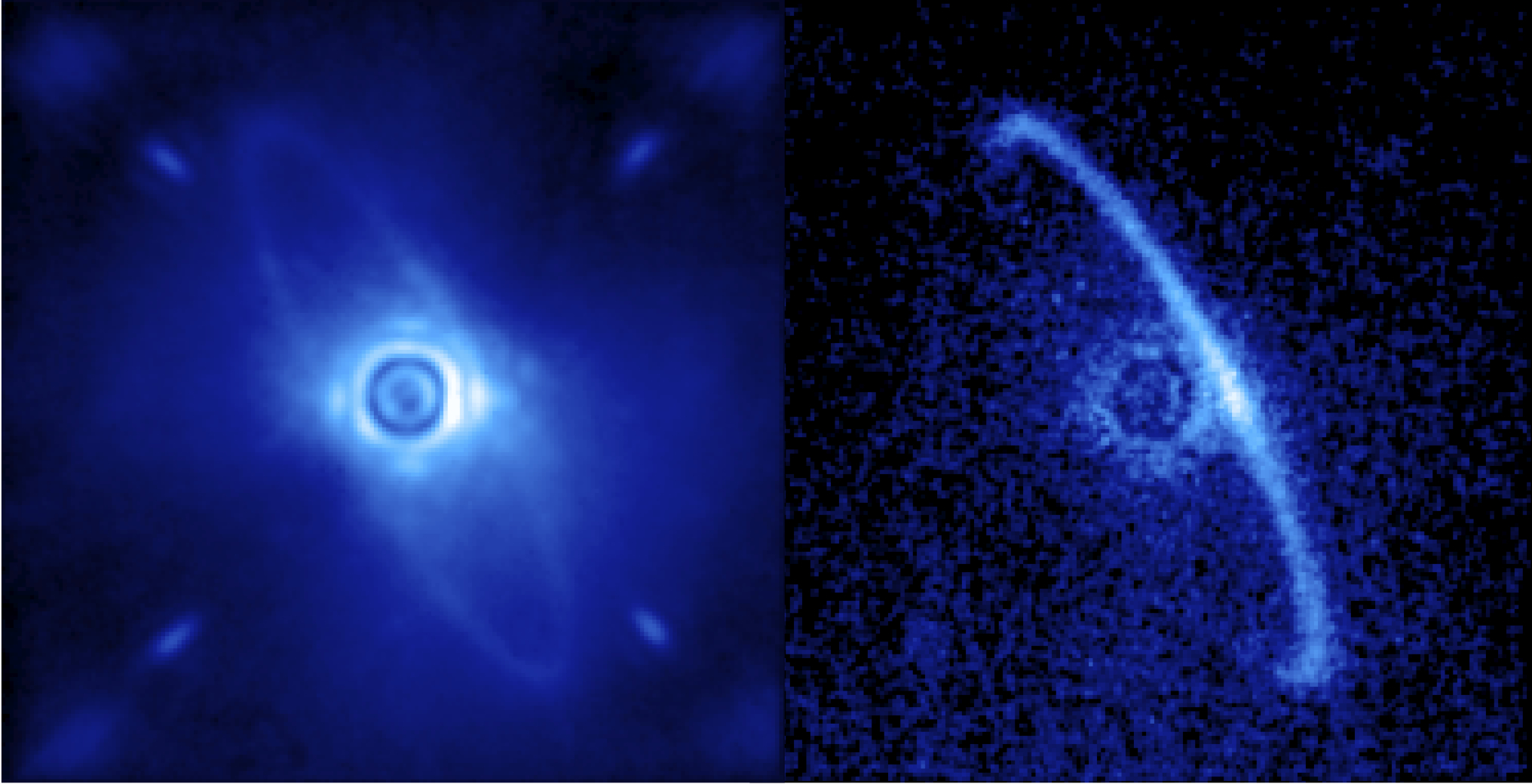
Figure 3. GPI imaging polarimetry of the circumstellar disk around HR 4796A, a ring of dust and planetesimals similar in some ways to a scaled up version of the solar system’s Kuiper Belt. These GPI observations reveal a complex pattern of variations in brightness and polarization around the HR 4796A disk. The western side (tilted closer to the Earth) appears brighter in polarized light, while in total intensity the eastern side appears slightly brighter, particularly just to the east of the widest apparent separation points of the disk. Reconciling this complex and apparently-contradictory pattern of brighter and darker regions required a major overhaul of our understanding of this circumstellar disk. Image credit: Marshall Perrin (Space Telescope Science Institute), Gaspard Duchene (UC Berkeley), Max Millar-Blanchaer (University of Toronto), and the GPI Team.  Full-resolution image

Figure 4. Diagram depicting the GPI team's revised model for the orientation and composition of the HR 4796A ring. To explain the observed polarization levels, the disk must consist of relatively large (> 5 µm) silicate dust particles, which scatter light most strongly and polarize it more for forward scattering. To explain the relative faintness of the east side in total intensity, the disk must be dense enough to be slightly opaque, comparable to Saturn’s optically thick rings, such that on the near side of the disk our view of its brightly illuminated inner portion is partially obscured. This revised model requires the disk to be much narrower and flatter than expected, and poses a new challenge for theories of disk dynamics to explain. GPI’s high contrast imaging and polarimetry capabilities together were essential for this new synthesis. Image credit: Marshall Perrin (Space Telescope Science Institute).  Full-resolution image


Stunning exoplanet images and spectra from the first year of science operations with the Gemini Planet Imager (GPI) were featured today in a press conference at the 225th meeting of the American Astronomical Society (AAS) in Seattle, Washington. The Gemini Planet Imager GPI is an advanced instrument designed to observe the environments close to bright stars to detect and study Jupiter-like exoplanets (planets around other stars) and see protostellar material (disk, rings) that might be lurking next to the star. 

Marshall Perrin (Space Telescope Science Institute), one of the instrument’s team leaders, presented a pair of recent and promising results at the press conference. He revealed some of the most detailed images and spectra ever of the multiple planet system HR 8799. His presentation also included never-seen details in the dusty ring of the young star HR 4796A. “GPI’s advanced imaging capabilities have delivered exquisite images and data,” said Perrin. “These improved views are helping us piece together what’s going on around these stars, yet also posing many new questions.” 

The GPI spectra obtained for two of the planetary members of the HR 8799 system presents a challenge for astronomers. GPI team member Patrick Ingraham (Stanford University), lead the paper on HR 8799. Ingraham reports that the shape of the spectra for the two planets differ more profoundly than expected based on their similar colors, indicating significant differences between the companions. “Current atmospheric models of exoplanets cannot fully explain the subtle differences in color that GPI has revealed. We infer that it may be differences in the coverage of the clouds or their composition.” Ingraham adds, "The fact that GPI was able to extract new knowledge from these planets on the first commissioning run in such a short amount of time, and in conditions that it was not even designed to work, is a real testament to how revolutionary GPI will be to the field of exoplanets." 

Perrin, who is working to understand the dusty ring around the young star HR 4796A, said that the new GPI data present an unprecedented level of detail in studies of the ring’s polarized light. “GPI not only sees the disk more clearly than previous instruments, it can also measure how polarized its light appears, which has proven crucial in under-standing its physical properties.” Specifically, the GPI measurements of the ring show it must be partially opaque, implying it is far denser and more tightly compressed than similar dust found in the outskirts of our own Solar System, which is more diffuse. The ring circling HR 4796A is about twice the diameter of the planetary orbits in our Solar System and its star about twice our Sun’s mass. “These data taken during GPI commissioning show how exquisitely well its polarization mode works for studying disks. Such observations are critical in advancing our understanding of all types and sizes of planetary systems – and ultimately how unique our own solar system might be,” said Perrin. 

During the commissioning phase, the GPI team observed a variety of targets, ranging from asteroids in our solar system, to an old star near its death. Other teams of scientists have been using GPI as well and already astronomers around the world have published eight papers in peer-reviewed journals using GPI data. “This might be the most productive new instrument Gemini has ever had,” said Professor James Graham of the University of California, who leads the GPI science team and who will describe the GPI exoplanet survey (see below) in a talk scheduled at the AAS meeting on Thursday, January 8th. 

The Gemini Observatory staff integrated the complex instrument into the telescope’s software and helped to characterize GPI’s performance. “Even though it’s so complicated, GPI now operates almost automatically,” said Gemini’s instrument scientist for GPI Fredrik Rantakyro. “This allows us to start routine science operations.” The instrument is now available to astronomers and their proposals are scheduled to start ob-serving in early 2015. In addition, “shared risk” observations are already underway, starting in November 2014. 

The one thing GPI hasn’t done yet is discovered a new planet. “For the early tests, we concentrated on known planets or disks” said GPI PI Bruce Macintosh. Now that GPI is fully operational, the search for new planets has begun. In addition to observations by astronomers world-wide, the Gemini Planet Imager Exoplanet Survey (GPIES) will look at 600 carefully selected stars over the next few years. GPI ‘sees’ planets through the infrared light they emit when they’re young, so the GPIES team has assembled a list of the youngest and closest stars. So far the team has observed 50 stars, and analysis of the data is ongoing. Discovering a planet requires confirmation observations to distinguish a true planet orbiting the target star from a distant star that happens to sneak into GPI’s field of view - a process that could take years with previous instruments. The GPIES team found one such object in their first survey run, but GPI observations were sensitive enough to almost immediately rule it out. Macintosh said, “With GPI, we can tell almost instantly that something isn’t a planet – rather than months of uncertainty, we can get over our disappointment almost immediately. Now it’s time to find some real planets!” 


About GPI/GPIES
 
The Gemini Planet Imager (GPI) instrument was constructed by an international collaboration led by Lawrence Livermore National Laboratory under Gemini’s supervision. The GPI Exoplanet Survey (GPIES) is the core science program to be carried out with it. GPIES is led by Bruce Macintosh, now a professor at Stanford University and James Graham, professor at the University of California at Berkeley and is designed to find young, Jupiter-like exoplanets. They survey will observe 600 young nearby stars in 890 hours over three years. Targets have been carefully selected by team members at Arizona State University, the University of Georgia, and UCLA. The core of the data processing architecture is led by Marshall Perrin of the Space Telescope Science Institute, with the core software originally written by University of Montreal, data management infrastructure from UC Berkeley and Cornell University, and contributions from all the other team institutions. The SETI institute located in California manages GPIES’s communications and public out-reach. Several teams located at the Dunlap Institute, the University of Western Ontario, the University of Chicago, the Lowell Observatory, NASA Ames, the American Museum of Natural History, University of Arizona and the University of California at San Diego and at Santa Cruz also contribute to the survey. The GPI Exoplanet Survey is supported by the NASA Origins Program NNX14AG80, the NSF AAG pro-gram, and grants from other institutions including the University of California Office of the President. Dropbox Inc. has generously provided storage space for the entire survey's archive. 


Media Contacts:


  • Peter Michaud
    Public Information and Outreach Manager
    Gemini Observatory, Hilo, HI
    Email:
    pmichaud@gemini.edu
    Cell: (808) 936-6643
    Desk: (808) 974-2510


Science Contacts:


  • James R. Graham
    University of California Berkeley
    Email
    : jrg@berkeley.edu
    Cell: (510) 926-9820


Wednesday, January 08, 2014

Gemini Planet Imager First Light!

Figure 1: Gemini Planet Imager’s first light image of Beta Pictoris b, a planet orbiting the star Beta Pictoris. The star, Beta Pictoris, is blocked in this image by a mask so its light doesn’t interfere with the light of the planet. In addition to the image, GPI obtains a spectrum from every pixel element in the field of view to allow scientists to study the planet in great detail. 


Beta Pictoris b is a giant planet – several times larger than Jupiter – and is approximately ten million years old. These near-infrared images (1.5-1.8 microns) show the planet glowing in infrared light from the heat released in its formation. The bright star Beta Pictoris is hidden behind a mask in the center of the image. Image credit: Processing by Christian Marois, NRC Canada. High Resolution TIF | Full Resolution JPG 

Figure 2: Gemini Planet Imager’s first light image of the light scattered by a disk of dust orbiting the young star HR4796A. This narrow ring is thought to be dust from asteroids or comets left behind by planet formation; some scientists have theorized that the sharp edge of the ring is defined by an unseen planet. The left image (1.9-2.1 microns) shows normal light, including both the dust ring and the residual light from the central star scattered by turbulence in the Earth’s atmosphere. The right image shows only polarized light. 

Leftover starlight is unpolarized and hence removed from this image. The light from the back edge of the disk is strongly polarized as it scatters towards us. Image credit: Processing by Marshall Perrin, Space Telescope Science Institute. Full Resolution JPG

Figure 3: Comparison of Europa observed with Gemini Planet Imager in K1 band on the right and visible albedo visualization based on a composite map made from Galileo SSI and Voyager 1 and 2 data (from USGS) on the left. While GPI is not designed for ‘extended’ objects like this, its observations could help in following surface alterations on icy satellites of Jupiter or atmospheric phenomena (e.g. clouds, haze) on Saturn’s moon Titan. The GPI near-infrared color image is a combination of 3 wavelength channels. Image credit: Processing by Marshall Perrin, Space Telescope.  Science Institute and Franck Marchis SETI Institute.  High Resolution TIF | Full Resolution JPG

 World's most powerful exoplanet camera turns its eye to the sky
 
GPI facility and team photos can be found here. 

After nearly a decade of development, construction, and testing, the world’s most advanced instrument for directly imaging and analyzing planets around other stars is pointing skyward and collecting light from distant worlds. 

The instrument, called the Gemini Planet Imager (GPI), was designed, built, and optimized for imaging faint planets next to bright stars and probing their atmospheres. It will also be a powerful tool for studying dusty, planet-forming disks around young stars. It is the most advanced such instrument to be deployed on one of the world’s biggest telescopes – the 8-meter Gemini South telescope in Chile. 

“Even these early first-light images are almost a factor of 10 better than the previous generation of instruments. In one minute, we are seeing planets that used to take us an hour to detect,” says Bruce Macintosh of the Lawrence Livermore National Laboratory who led the team that built the instrument. 

GPI detects infrared (heat) radiation from young Jupiter-like planets in wide orbits around other stars, those equivalent to the giant planets in our own Solar System not long after their formation. Every planet GPI sees can be studied in detail. 

“Most planets that we know about to date are only known because of indirect methods that tell us a planet is there, a bit about its orbit and mass, but not much else,” says Macintosh. “With GPI we directly image planets around stars – it’s a bit like being able to dissect the system and really dive into the planet’s atmospheric makeup and characteristics.” 

GPI carried out its first observations last November – during an extremely trouble-free debut for an extraordinarily complex astronomical instrument the size of a small car. “This was one of the smoothest first-light runs Gemini has ever seen” says Stephen Goodsell, who manages the project for the observatory.
For GPI’s first observations, the team targeted previously known planetary systems, including the well-known Beta Pictoris system; in it GPI obtained the first-ever spectrum of the very young planet Beta Pictoris b. The first-light team also used the instrument’s polarization mode – which can detect starlight scattered by tiny particles – to study a faint ring of dust orbiting the very young star HR4796A. With previous instruments, only the edges of this dust ring, (which may be the debris remaining from planet formation), could be seen, but with GPI astronomers can follow the entire circumference of the ring. 

Although GPI was designed to look at distant planets, it can also observe objects in our Solar System. The accompanying test images of Jupiter’s moon Europa, for example, can allow scientists to map changes in the satellite’s surface composition. The images were released today (January 7, 2014) at the 223rd meeting of the American Astronomical Society in Washington DC. 

“Seeing a planet close to a star after just one minute, was a thrill, and we saw this on only the first week after the instrument was put on the telescope!” says Fredrik Rantakyro a Gemini staff scientist working on the instrument. “Imagine what it will be able to do once we tweak and completely tune its performance.” 

“Exoplanets are extraordinarily faint and difficult to see next to a bright star,” notes GPI chief scientist Professor James R. Graham of the University of California who has worked with Macintosh on the project since its inception. GPI can see planets a million times fainter than their parent stars. Often described, ‘like trying to see a firefly circling a streetlight thousands of kilometers away,’ instruments used to image exoplanets must be designed and built to “excruciating tolerances,” points out Leslie Saddlemyer of NRC Herzberg (part of the National Research Council of Canada), who served as GPI’s systems engineer. “Each individual mirror inside GPI has to be smooth to within a few times the size of an atom,” Saddlemyer adds. 

“GPI represents an amazing technical achievement for the international team of scientists who conceived, designed, and constructed the instrument, as well as a hallmark of the capabilities of the Gemini telescopes. It is a highly-anticipated and well-deserved step into the limelight for the Observatory”, says Dr. Gary Schmidt, program officer at the National Science Foundation (NSF), which funded the project along with the other countries of the Gemini Observatory partnership. 

“After years of development and simulations and testing, it’s incredibly exciting now to be seeing real images and spectra of exoplanets observed with GPI. It’s just gorgeous data,” says Marshall Perrin of the Space Telescope Science Institute. 

“The entire exoplanet community is excited for GPI to usher in a whole new era of planet finding,” says physicist and exoplanet expert Sara Seager of the Massachusetts Institute of Technology. Seager, who is not affiliated with the project adds, “Each exoplanet detection technique has its heyday. First it was the radial velocity technique (ground-based planet searches that started the whole field). Second it was the transit technique (namely Kepler). Now,” she says, “it is the ‘direct imaging’ planet-finding technique’s turn to make waves.” 

In 2014, the GPI team will begin a large-scale survey, looking at 600 young stars to see what giant planets orbit them. GPI will also be available to the whole Gemini community for other projects, ranging from studies of planet-forming disks to outflows of dust from massive, dying stars. 

Looking through Earth’s turbulent atmosphere, even with advanced adaptive optics, GPI will only be able to see Jupiter-sized planets. But similar technology is being proposed for future space telescopes. 

“Some day, there will be an instrument that will look a lot like GPI, on a telescope in space,” Macintosh projects. “And the images and spectra that will come out of that instrument will show a little blue dot that is another Earth.” 

GPI is an international project led by the Lawrence Livermore National Laboratory (LLNL) under Gemini’s supervision, with Macintosh as Principal Investigator and LLNL engineer David Palmer as project manager. LLNL also produced the advanced adaptive optics system that measures and corrects for atmospheric turbulence a thousand times per second. Early research and development that led to the GPI project were supported by the National Science Foundation's Center for Adaptive Optics. Key technologies such as the deformable mirror were tested at the UC Observatories' Laboratory for Adaptive Optics, led by Donald Gavel. Scientists at the American Museum of Natural History, led by Ben Oppenheimer (who also led a project demonstrating some of the same technologies used in GPI on the 5-meter Palomar project) designed special masks that are part of the instrument’s coronagraph which blocks the bright starlight that can obscure faint planets. Engineer Kent Wallace and a team from NASA’s Jet Propulsion Laboratory constructed an ultra-precise infrared wavefront sensor to measure small distortions in starlight that might mask a planet. A team at the University of California Los Angeles’ Infrared Laboratory, under the supervision of Professor James Larkin, together with Rene Doyon at the University of Montreal, assembled the infrared spectrograph that dissects the light from planets. Data analysis software written at University of Montreal and the Space Telescope Science Institute assembles the raw spectrograph data into three-dimensional cubes. NRC Herzberg in British Columbia Canada, built the mechanical structure and software that knits all the pieces together. James R. Graham, as project scientist, led the definition of the instrument’s capabilities. The instrument underwent extensive testing in a laboratory at the University of California Santa Cruz before shipping to Chile in August. Franck Marchis at the SETI institute in California manages GPI’s data and communications. 

Media Contacts:


  • Peter Michaud
    Gemini Observatory, Hilo, HI
    Email:
    pmichaud@gemini.edu
    Cell: (808) 936-6643
    Desk: (808) 974-2510

Science Contacts:


  • Bruce Macintosh
    Lawrence Livermore National Laboratory
    Email:
    macintosh1@llnl.gov
    Desk: (925) 423-8129


  • James R. Graham
    University of California Berkeley
    Email:
    jrg@berkeley.edu
    Cell: (510) 926-9820


  • Marshall Perrin
    Space Telescope Science Institute
    Email:
    mperrin@stsci.edu
    Cell: (410) 507-5483
    Desk: (410) 338-4789