Showing posts with label M17. Show all posts

Wednesday, September 23, 2015

A Cosmic Rose With Many Names


The star formation region Messier 17

The star-forming region Messier 17 in the constellation of Sagittarius

Digitized Sky Survey Image of the Omega Nebula (M 17)


Videos

Zooming in on the star formation region Messier 17

A close looks at the star formation region Messier 17


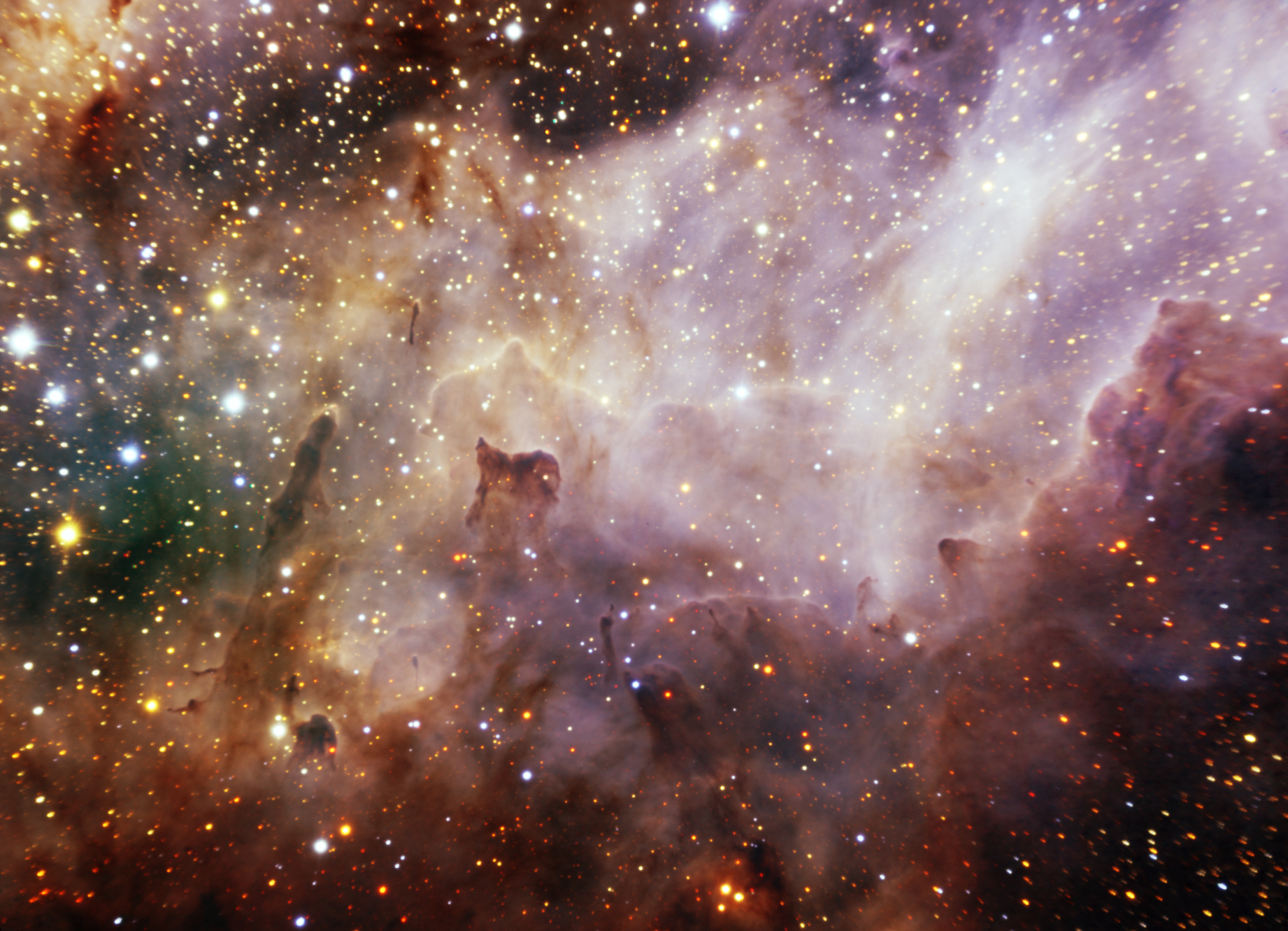
This new image of the rose-coloured star forming region Messier 17 was captured by the Wide Field Imager on the MPG/ESO 2.2-metre telescope at ESO’s La Silla Observatory in Chile. It is one of the sharpest images showing the entire nebula and not only reveals its full size but also retains fine detail throughout the cosmic landscape of gas clouds, dust and newborn stars.

The nebula pictured here may have had more names bestowed upon it over the ages than any other object of its kind. Although officially known as Messier 17, its nicknames include: the Omega Nebula, the Swan Nebula, the Checkmark Nebula, the Horseshoe Nebula and — lest those with more of a more marine bent miss out — the Lobster Nebula.

Messier 17 is located about 5500 light-years from Earth near the plane of the Milky Way and in the constellation of Sagittarius (The Archer). The object spans a big section of the sky — its gas and dust clouds measure about 15 light-years across. This material is fueling the birth of new stars and the wide field of view of the new picture reveals many stars in front of, in, or behind Messier 17.

The nebula appears as a complex red structure with some graduation to pink. Its colouring is a signature of glowing hydrogen gas. The short-lived blue stars that recently formed in Messier 17 emit enough ultraviolet light to heat up surrounding gas to the extent that it begins to glow brightly. In the central region the colours are lighter, and some parts appear white. This white colour is real — it arises as a result of mixing the light from the hottest gas with the starlight reflected by dust.

The gas in the nebula is estimated to have more than 30 000 times the mass of the Sun. Messier 17 also contains an open star cluster of 35 stars, which is known as NGC 6618 [1]. The total number of stars in the nebula, however, is much higher — there are almost 800 stars in the centre with even more forming in its outer regions.

Throughout this rosy glow, the nebula shows a web of darker regions of dust that obscure the light. This obscuring material is also glowing and — although these areas are dark in this visible-light image — they look bright when observed using infrared cameras.

The nebula owes its official name to the French comet hunter Charles Messier who included the nebula as the seventeenth object in his famous astronomical catalogue in 1764 [2]. But even with a name as bland as Messier 17, this flowery nebula still looks dazzling.

This picture comes from the ESO Cosmic Gems programme [3].


Notes

[1] This designation is also sometimes used for the entire star formation region.

[2] The astronomer Jean Philippe de Chéseaux discovered the object in 1745, but his discovery did not receive widespread attention. Thus, Messier independently rediscovered and catalogued it almost 20 years later.

[3] The ESO Cosmic Gems programme is an outreach initiative to produce images of interesting, intriguing or visually attractive objects using ESO telescopes, for the purposes of education and public outreach. The programme makes use of telescope time that cannot be used for science observations. All data collected may also be suitable for scientific purposes, and are made available to astronomers through ESO’s science archive.

More Information

ESO is the foremost intergovernmental astronomy organisation in Europe and the world’s most productive ground-based astronomical observatory by far. It is supported by 16 countries: Austria, Belgium, Brazil, the Czech Republic, Denmark, France, Finland, Germany, Italy, the Netherlands, Poland, Portugal, Spain, Sweden, Switzerland and the United Kingdom, along with the host state of Chile. ESO carries out an ambitious programme focused on the design, construction and operation of powerful ground-based observing facilities enabling astronomers to make important scientific discoveries. ESO also plays a leading role in promoting and organising cooperation in astronomical research. ESO operates three unique world-class observing sites in Chile: La Silla, Paranal and Chajnantor. At Paranal, ESO operates the Very Large Telescope, the world’s most advanced visible-light astronomical observatory and two survey telescopes. VISTA works in the infrared and is the world’s largest survey telescope and the VLT Survey Telescope is the largest telescope designed to exclusively survey the skies in visible light. ESO is a major partner in ALMA, the largest astronomical project in existence. And on Cerro Armazones, close to Paranal, ESO is building the 39-metre European Extremely Large Telescope, the E-ELT, which will become “the world’s biggest eye on the sky”.

Links

Contacts

Richard Hook
ESO Public Information Officer
Garching bei München, Germany
Tel: +49 89 3200 6655
Cell: +49 151 1537 3591
Email:
rhook@eso.org


Source: ESO

Monday, August 12, 2013

Poised for Discovery: Gemini’s Much-anticipated Infrared Instrument Goes On-sky

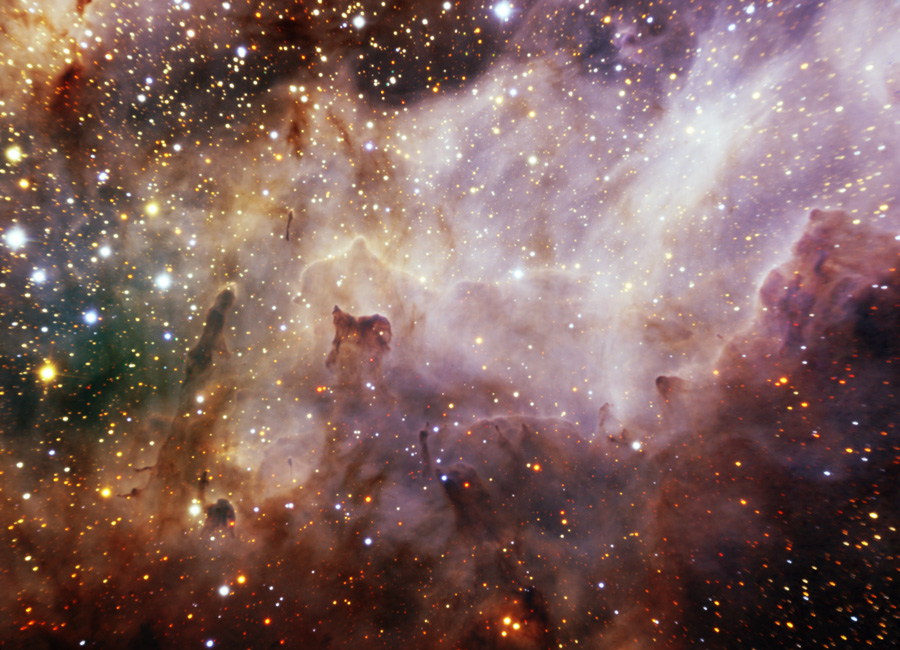
This FLAMINGOS-2 near-infrared image details part of the magnificent Swan Nebula (M17), where ultraviolet radiation streaming from young hot stars sculpts a dense region of dust and gas into myriad fanciful forms. M17 lies some 5,200 light-years distant in the constellation Sagittarius and is one of the most massive and luminous star-forming region's in our Galaxy. It is also one of the most studied. Field of view: 5.5 x 4.0 arcmin. Credit: Gemini Observatory/AURA.  Full Resolution TIF (4MB) | Full Resolution JPG (2MB) | Med Resolution JPG (280KB) 

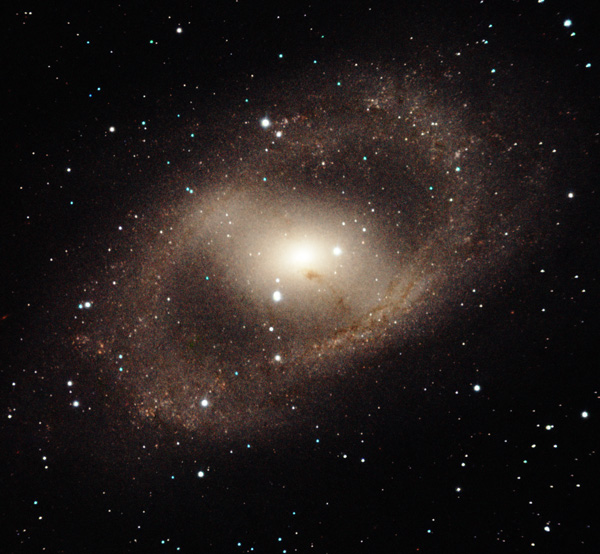
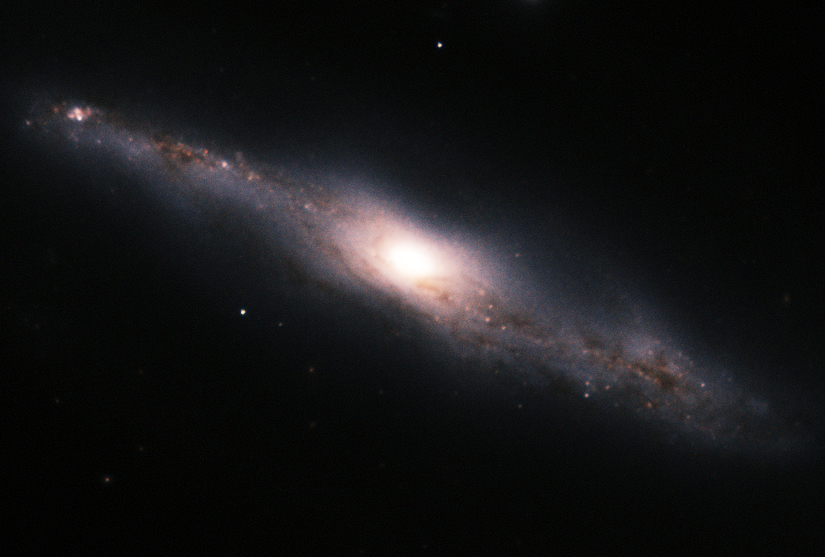
NGC 6300 is an intriguing barred spiral galaxy in the constellation of Ara. This near-infrared image with FLAMINGOS-2 shows the galaxy’s complex arm structure forming a spectacular ring of star formation. The galaxy’s bar also has a strong vein of dust that almost obscures its bright active nucleus –– whose prodigious energy is the result of matter accreting onto a black hole with an estimated mass of 280,000 Suns. Field of view: 3.1 x 2.9 arcmin. Credit: Gemini Observatory/AURA. Full Resolution TIF (2.3MB) | Full Resolution JPG (1.2MB) | Med Resolution JPG (153KB) 

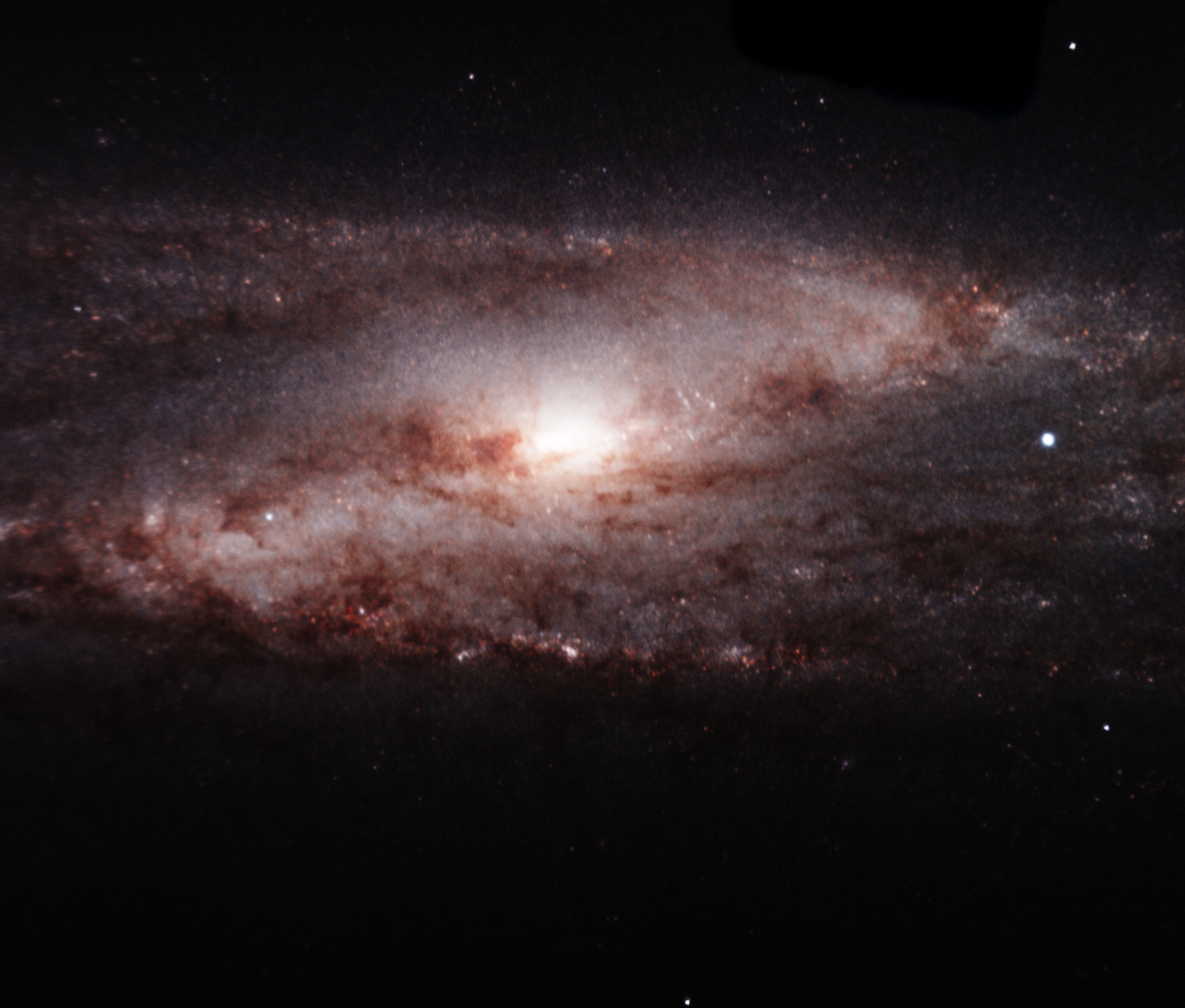
In this near-infrared image, FLAMINGOS-2 peered deep into the heart of spiral galaxy NGC 253, which lies about 11.5 million light-years nearby in the constellation of Sculptor. The new instrument captured an intricate whirlpool of dust spiraling in to a diffuse nuclear region, where violent star formation may be occurring around a supermassive black hole. The instrument also imaged a dusting of star forming sites in its spiral arms. Field of view: 4.8 x 4.1 arcmin. Credit: Gemini Observatory/AURA.   Full Resolution TIF (4MB) | Full Resolution JPG (2MB) | Med Resolution JPG (141KB) 

Spiral galaxy NGC 7582 is the brightest member of the Grus Quartet of galaxies, some 60 million light-years distant traveling together through space. In this near-infrared image, FLAMINGOS-2 resolved its high quantity of dust that line NGC 7582’s arms as well as regions rich in star formation. Field of view: 2.5 x 1.7 arcmin. Credit: Gemini Observatory/AURA.  Full Resolution TIF (836KB) | Med Resolution JPG (425KB)

Gemini Observatory’s latest instrument, a powerful infrared camera and spectrograph at Gemini South, reveals its potential in a series of striking on-sky commissioning images released today. 
 
Gemini Observatory’s latest tool for astronomers, a second-generation infrared instrument called FLAMINGOS-2, has “traveled a long road” to begin science observations for the Gemini scientific community. Recent images taken by FLAMINGOS-2 during its last commissioning phase dramatically illustrate that the instrument was worth the wait for astronomers around the world who are anxious to begin using it. 

“It’s already one of our most requested instruments at the Gemini telescopes,” remarks Nancy Levenson, Gemini’s Deputy Director and Head of Science. “We see a long and productive life ahead for FLAMINGOS-2 once astronomers really start using it later this year.” 

“It has not been an easy journey,” says Percy Gomez Gemini’s FLAMINGOS-2 Instrument Scientist, “but thanks to the dedicated work of Gemini engineers and scientists very soon astronomers will be able to use a reliable and robust instrument.” After significant redesign and rebuilds for optimal performance on the Gemini South telescope, FLAMINGOS-2 has proven that it will provide astronomers with a powerful mix of capabilities. These include extreme sensitivity to infrared (heat) radiation from the universe, high-resolution wide-field imaging, and a combination of spectroscopic capabilities that will allow cutting-edge research in topics spanning from the exploration of our Solar System, to the most distant and energetic explosions in our universe. 

While work still remains on some of its spectroscopic features, as well as refining imaging at the edge of its large field of view, Gemini’s team of engineers and scientists has mitigated its most severe risk – potential damage to a large collimator lens that catastrophically cracked during a planned final commissioning in early 2012 (it was later replaced). The thermal environment surrounding this lens – located where the temperature changes periodically for routine switching of masks for multi-object spectroscopy - creates special challenges. It was these temperature changes that initially caused the crack, but a year later procedures and design modifications are now in place to significantly reduce risks to the lens’s integrity and functionality. 

“The Gemini team has done a remarkable job in optimizing this instrument for Gemini and it will soon be everything, and more, that we had envisioned years ago when the project began,” says Steve Eikenberry, who led the team who built FLAMINGOS-2 at the University of Florida. “Like a lot of scientists, I’m anxious to use FLAMINGOS-2 to collect data – specifically, I want to look toward the center of our Galaxy and study binary black holes as well as the mass evolution of the super-massive black hole that lurks at the heart of our Galaxy.” Eikenberry and collaborators are eager to make the most of FLAMINGOS-2’s power as soon as the instrument’s multi-object spectroscopy capability is fully functional. “With most of the challenges behind us, now the fun begins!” Eikenberry said. 

Kevin Stevenson of the University of Chicago already has plans to use FLAMINGOS-2 later this year to study the intriguing exoplanet WASP-18b. This well-known exoplanet is being strongly heated by its ultra-nearby host star and according to Stevenson, “It's even hotter than some of the coolest, low-mass stars known.” Stevenson and his team hope to determine the abundances of water vapor and methane when the planet is eclipsed by its host star. “Our plan is to compare the system's light immediately before and during an eclipse to measure the contribution from the planet. When we do this over several parts of the infrared part of the light spectrum, we can piece together the planet's spectrum and learn about its temperature and composition.” 

The quality and usefulness of FLAMINGOS-2 for these and future projects is reflected in the images released today. They cover a wide range of targets which are representative of the types of science in which FLAMINGOS-2 is expected to excel. In addition, the instrument may later accept an adaptive optics (AO) feed for extremely high-resolution imaging from GeMS (Gemini Multi-conjugate adaptive optics System). 

It is expected that most of these systems, including multi-object spectroscopy, will be fully integrated in 2014 with imaging and long-slit spectroscopy available now. The next round of observations with FLAMINGOS-2 are slated to begin on September 1st.

Contacts:

  • Percy Gomez
    Gemini Observatory, La Serena, Chile
    Phone (Desk): 56-51-2-205696
    Email:
    pgomez@gemini.edu

  • Peter Michaud
    Gemini Observatory, Hilo, Hawai‘i
    Office: +1 (808) 974-2510
    Cell: +1 (808) 936-6643

    pmichaud@gemini.edu

  • Antonieta Garcia
    Gemini Observatory, La Serena, Chile
    Phone (Desk): 56-51-2-205628
    Cell: 09-69198294
    Email:
    agarcia@gemini.edu

Wednesday, July 07, 2010

Puff, the Magic Dragon?

A dragon-shaped cloud of dust seems to fly out from a bright explosion in this infrared light image (bottom) from NASA's Spitzer Space Telescope, a creature that is entirely cloaked in shadow when viewed in visible part of the spectrum (top). Image credit: NASA/JPL-Caltech/Penn State/DSS. Full image and caption

A dragon-shaped cloud of dust seems to fly with the stars in a new image from NASA's Spitzer Space Telescope (bottom). In visible light (top), the creature disappears into the clouds -- perhaps it's "frolicking in the autumn mist" like Puff, the Magic Dragon, from the famous Peter, Paul and Mary song.

The infrared image has revealed that this creature, a dark cloud called M17 SWex, is forming stars at a furious rate but has not yet spawned the most massive type of stars, known as O stars. Such stellar behemoths, however, light up the M17 nebula at the image's center and have also blown a huge "bubble" in the gas and dust that forms M17's luminous left edge.

The stars and gas in this region are now passing though the Sagittarius spiral arm of the Milky Way (moving from right to left), touching off a galactic "domino effect." The youngest episode of star formation is playing out inside the dusty dragon as it enters the spiral arm. Over time, this area will flare up like the bright M17 nebula, glowing in the light of young massive stars. An older burst of star formation blew the bubble seen in the region to the far left, called M17 EB.

The visible-light view of the area clearly shows the bright M17 nebula, as well as the glowing hot gas filling the "bubble" to its left. However the M17 SWex "dragon" is hidden within dust clouds that are opaque to visible light. It takes an infrared view to catch the light from these shrouded regions and reveal the earliest stages of star formation.

The bottom image is a three-color composite that shows infrared observations from two Spitzer instruments. Blue represents 3.6-micron light and green shows light of 8 microns, both captured by Spitzer's infrared array camera. Red is 24-micron light detected by Spitzer's multiband imaging photometer. The bottom visible-light image is a composite of visible-light data from the Digitized Sky Survey (DSS) from the UK Schmidt telescope. The image combines two observations that represent the blue and red light from the region.

For a more detailed feature story about the science in this image, visit http://www.spitzer.caltech.edu/news/1143.

This image was taken before Spitzer ran out of its liquid coolant in May 2009, beginning its warm mission.

NASA's Jet Propulsion Laboratory, Pasadena, Calif., manages the Spitzer Space Telescope for NASA's Science Mission Directorate, Washington. Science operations are conducted at the Spitzer Science Center at the California Institute of Technology, also in Pasadena. Caltech manages JPL for NASA.

Whitney Clavin 818-354-4673
Jet Propulsion Laboratory, Pasadena, Calif.

whitney.clavin@jpl.nasa.gov