Showing posts with label G2. Show all posts

Thursday, September 24, 2015

Sagittarius A*: Milky Way's Black Hole Shows Signs of Increased Chatter

Sagittarius A*
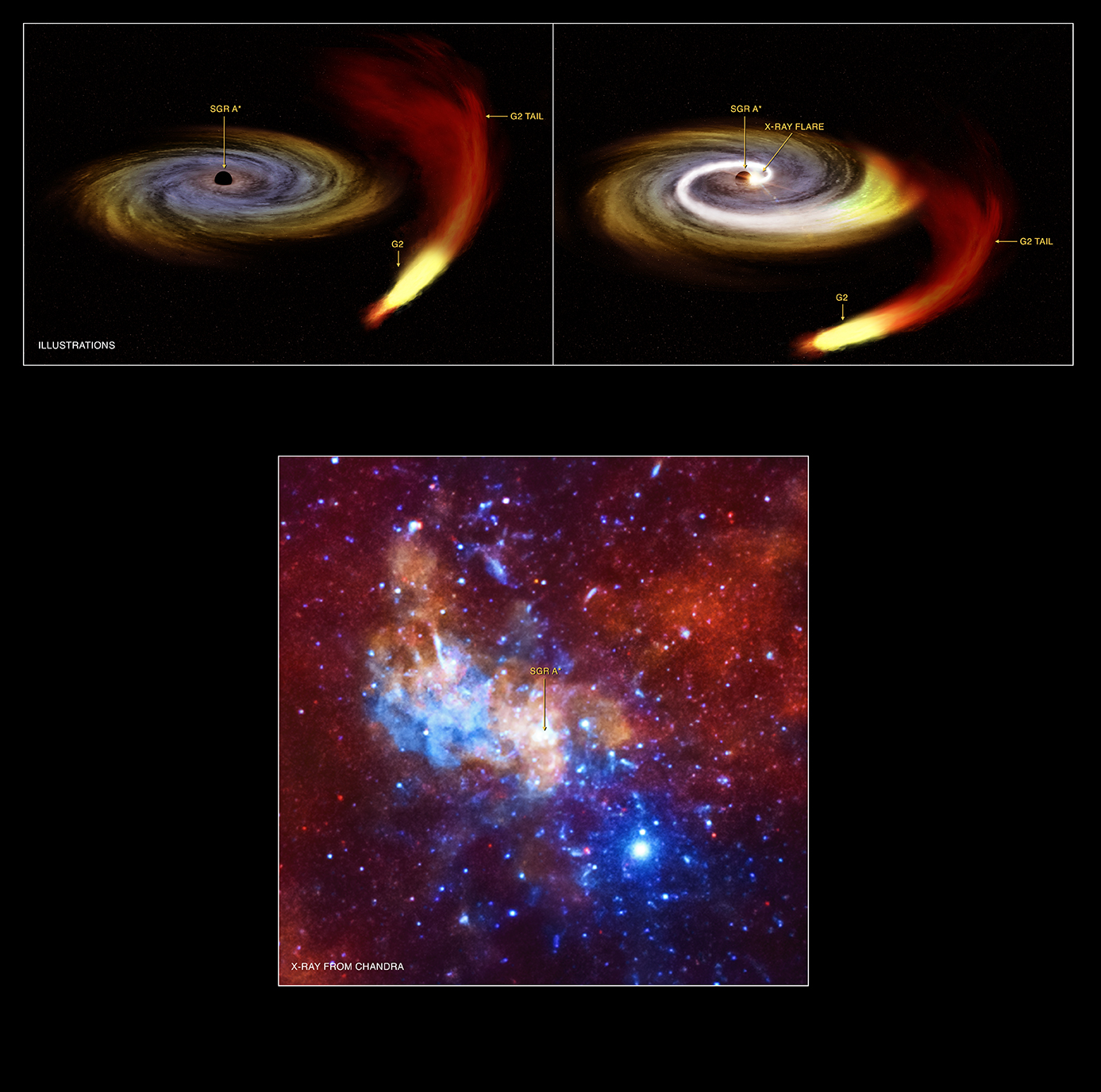
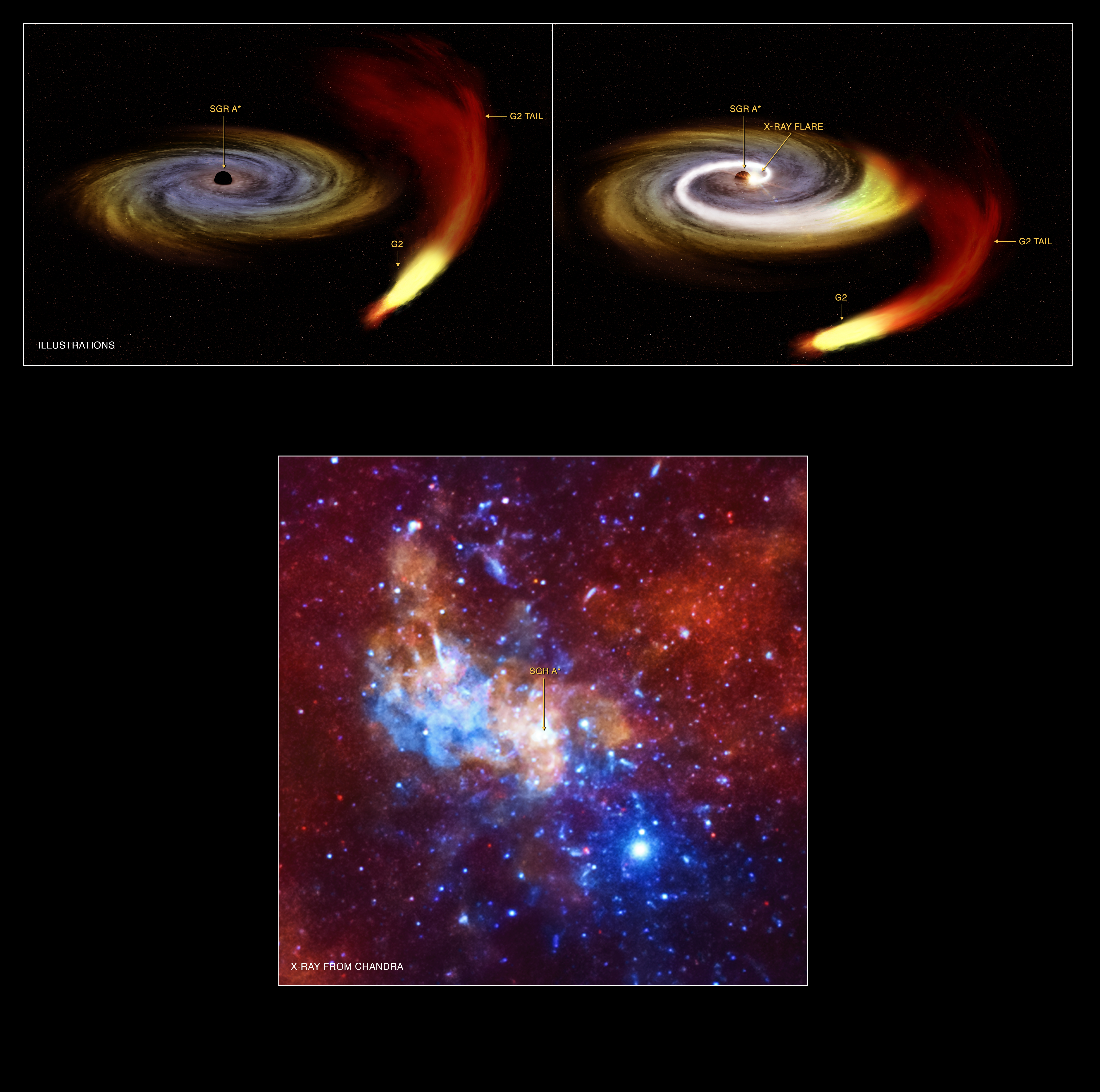
Credit NASA/CXC/MPE/G.Ponti et al; Illustration: NASA/CXC/M.Weiss


Three orbiting X-ray telescopes have been monitoring the supermassive black hole at the center of the Milky Way galaxy for the last decade and a half to observe its behavior, as explained in our latest press release. This long monitoring campaign has revealed some new changes in the patterns of this 4-million-solar-mass black hole known as Sagittarius A* (Sgr A*).

The bottom panel of this graphic is a view of the region around Sgr A* where red, green, and blue represent low, medium, and high-energy X-rays detected by NASA's Chandra X-ray Observatory. Sgr A* itself is not visible in this image, but is embedded in the white dot at the end of the arrow. The other two telescopes involved in the 15 years of X-ray observations were ESA's XMM-Newton and NASA's Swift Gamma Ray Burst Explorer, but their data are not included in this image.

Within the past year, the usually quiet black hole has shown an increased level of X-ray flares over its typical rate. This surge in X-ray flares coincides with the passage close to Sgr A* of a mysterious object called G2. Astronomers have been tracking G2 for years, originally thinking it was an extended cloud of gas and dust. However, after passing close to Sgr A* in late 2013 its appearance did not change much, apart from being slightly stretched by the gravity of the black hole. This led to new theories that G2 was not a gas cloud, but instead a star or pair of stars within an extended dusty cocoon.

If the G2 explanation does explain the recent rise in X-ray flares, it would be the first sign of excess material falling onto the black hole because of the cloud's close passage. Some gas would likely have been stripped off the cloud, and captured by the gravity of Sgr A*. It then could have started interacting with hot material flowing towards the black hole, resulting in an enhanced feeding rate and the production of X-ray flares. This scenario is depicted in the artist's illustrations found in the upper two panels of the graphic.

While the timing of G2's passage with the surge in X-rays from Sgr A* is intriguing, it is not yet an open-and-shut case. That is because astronomers see other black holes that appear to have behavior similar to the most recent increase of activity from Sgr A*. Therefore, it's possible this increased chatter from Sgr A* may be a common trait among supermassive black holes and unrelated to G2. Instead, it could represent, for example, a change in the strength of winds from nearby massive stars that are feeding the black hole.

The analysis included 150 Chandra and XMM-Newton observations pointed at the center of the Milky Way over the last 15 years, extending from September 1999 to November 2014. An increase in the rate and brightness of bright flares from Sgr A* occurred after mid-2014, several months after the closest approach of G2 to the huge black hole. The newest set of Chandra, XMM and Swift observations, obtained between August 30 and October 2014, revealed six bright flares within about three days, while an average of only 0.8 bright flares was expected.

A paper on these findings has been accepted by the Monthly Notices of the Royal Astronomical Society and a preprint is available online. The authors of this study were Gabriele Ponti (Max Planck Institute for Extraterrestrial Physics), Barbara De Marco (Max Planck), Mark Morris (University of California, Los Angeles), Andrea Merloni (Max Planck), Teo Muñoz-Darias (University of La Laguna, Spain), Maica Clavel (CEA Saclay, France), Darryl Haggard (Amherst College), Shuo Zhang (Columbia University), Kirpal Nandra (Max Planck), Stefan Gillassen (Max Planck), Kenji Mori (Columbia), Joseph Nielsen (Massachusetts Institute of Technology), Nanda Rea (University of Amsterdam), Natalie Degenaar (University of Cambridge), Regis Terrier (University of Paris), and Andrea Goldwurm (CEA Saclay).

NASA's Marshall Space Flight Center in Huntsville, Alabama, manages the Chandra program for NASA's Science Mission Directorate in Washington. The Smithsonian Astrophysical Observatory in Cambridge, Massachusetts, controls Chandra's science and flight operations.


Fast Facts for Sagittarius A*:

Scale: Image is 5 by 5 arcmin (about 38 light years)
Category: Black Holes, Milky Way Galaxy
Coordinates (J2000): RA 17h 45m 40s | Dec -29° 00' 28.00"
Constellation: Sagittarius
Observation Date: 43 pointings from September 21, 1999 to May 18, 2009
Observation Time: 278 hours (11 days 14 hours).
Obs. ID: 242, 1561, 2943, 2951-2954, 3392, 3393, 3549, 3663, 3665, 4683, 4684, 5360, 5950-5954, 6113, 6363, 6639, 6640-6646, 7554-7759, 9169-9174, 10556
Instrument: ACIS
Also Known As: Galactic Center
References: Ponti, G et al, 2015, MNRAS (accepted); arXiv:1407.2243
Color Code: Energy: Red (2-3.3 keV), Green (3.3-4.7 keV), Blue (4.7-8 keV)
Distance Estimate: About 26,000 light years


Thursday, March 26, 2015

Best View Yet of Dusty Cloud Passing Galactic Centre Black Hole

The dusty cloud G2 passes the supermassive black hole at the centre of the Milky Way

The dusty cloud G2 passes the supermassive black hole at the centre of the Milky Way (annotated)


 # # # # # # # # # # # # # # #  # # # # # # # # # # # # # # # # # # # # # # # # # # # # # # # # # # # # # # # # # # # # #


Videos

The dusty cloud G2 passes the supermassive black hole at the centre of the Milky Way


VLT observations confirm that G2 survived close approach and is a compact object

The best observations so far of the dusty gas cloud G2 confirm that it made its closest approach to the supermassive black hole at the centre of the Milky Way in May 2014 and has survived the experience. The new result from ESO’s Very Large Telescope shows that the object appears not to have been significantly stretched and that it is very compact. It is most likely to be a young star with a massive core that is still accreting material. The black hole itself has not yet shown any increase in activity.

A supermassive black hole with a mass four million times that of the Sun lies at the heart of the Milky Way galaxy. It is orbited by a small group of bright stars and, in addition, an enigmatic dusty cloud, known as G2, has been tracked on its fall towards the black hole over the last few years. Closest approach, known as peribothron, was predicted to be in May 2014.

The great tidal forces in this region of very strong gravity were expected to tear the cloud apart and disperse it along its orbit. Some of this material would feed the black hole and lead to sudden flaring and other evidence of the monster enjoying a rare meal. To study these unique events, the region at the galactic centre has been very carefully observed over the last few years by many teams using large telescopes around the world.

A team led by Andreas Eckart (University of Cologne, Germany) has observed the region using ESO’s Very Large Telescope (VLT) [1] over many years, including new observations during the critical period from February to September 2014, just before and after the peribothron event in May 2014. These new observations are consistent with earlier ones made using the Keck Telescope on Hawaii [2].
The images of infrared light coming from glowing hydrogen show that the cloud was compact both before and after its closest approach, as it swung around the black hole.

As well as providing very sharp images, the SINFONI instrument on the VLT also splits the light into its component infrared colours and hence allows the velocity of the cloud to be estimated [3]. Before closest approach, the cloud was found to be travelling away from the Earth at about ten million kilometres/hour and, after swinging around the black hole, it was measured to be approaching the Earth at about twelve million kilometres/hour.

Florian Peissker, a PhD student at the University of Cologne in Germany, who did much of the observing, says: “Being at the telescope and seeing the data arriving in real time was a fascinating experience,” and Monica Valencia-S., a post-doctoral researcher also at the University of Cologne, who then worked on the challenging data processing adds: “It was amazing to see that the glow from the dusty cloud stayed compact before and after the close approach to the black hole.”

Although earlier observations had suggested that the G2 object was being stretched, the new observations did not show evidence that the cloud had become significantly smeared out, either by becoming visibly extended, or by showing a larger spread of velocities.

In addition to the observations with the SINFONI instrument the team has also made a long series of measurements of the polarisation of the light coming from the supermassive black hole region using the NACO instrument on the VLT. These, the best such observations so far, reveal that the behaviour of the material being accreted onto the black hole is very stable, and — so far — has not been disrupted by the arrival of material from the G2 cloud.

The resilience of the dusty cloud to the extreme gravitational tidal effects so close to the black hole strongly suggest that it surrounds a dense object with a massive core, rather than being a free-floating cloud. This is also supported by the lack, so far, of evidence that the central monster is being fed with material, which would lead to flaring and increased activity.

Andreas Eckart sums up the new results: “We looked at all the recent data and in particular the period in 2014 when the closest approach to the black hole took place. We cannot confirm any significant stretching of the source. It certainly does not behave like a coreless dust cloud. We think it must be a dust-shrouded young star.”


Notes
[1] These are very difficult observations as the region is hidden behind thick dust clouds, requiring observations in infrared light. And, in addition, the events occur very close to the black hole, requiring adaptive optics to get sharp enough images. The team used the SINFONI instrument on ESO’s Very Large Telescope and also monitored the behaviour of the central black hole region in polarised light using the NACO instrument.

[2] The VLT observations are both sharper (because they are made at shorter wavelengths) and also have additional measurements of velocity from SINFONI and polarisation measurement using the NACO instrument.

[3] Because the dusty cloud is moving relative to Earth — away from Earth before closest approach to the black hole and towards Earth afterwards — the Doppler shift changes the observed wavelength of light. These changes in wavelength can be measured using a sensitive spectrograph such as the SINFONI instrument on the VLT. It can also be used to measure the spread of velocities of the material, which would be expected if the cloud was extended along its orbit to a significant extent, as had previously been reported.


More Information

This research was presented in a paper “Monitoring the Dusty S-Cluster Object (DSO/G2) on its Orbit towards the Galactic Center Black Hole” by M. Valencia-S. et al. in the journal Astrophysical Journal Letters.

The team is composed of M. Valencia-S. (Physikalisches Institut der Universität zu Köln, Germany), A. Eckart (Universität zu Köln; Max-Planck-Institut für Radioastronomie, Bonn, Germany [MPIfR]), M. Zajacek (Universität zu Köln; MPIfR; Astronomical Institute of the Academy of Sciences Prague, Czech Republic), F. Peissker (Universität zu Köln), M. Parsa (Universität zu Köln), N. Grosso (Observatoire Astronomique de Strasbourg, France), E. Mossoux (Observatoire Astronomique de Strasbourg), D. Porquet (Observatoire Astronomique de Strasbourg), B. Jalali (Universität zu Köln), V. Karas (Astronomical Institute of the Academy of Sciences Prague), S. Yazici (Universität zu Köln), B. Shahzamanian (Universität zu Köln), N. Sabha (Universität zu Köln), R. Saalfeld (Universität zu Köln), S. Smajic (Universität zu Köln), R. Grellmann (Universität zu Köln), L. Moser (Universität zu Köln), M. Horrobin (Universität zu Köln), A. Borkar (Universität zu Köln), M. García-Marín (Universität zu Köln), M. Dovciak (Astronomical Institute of the Academy of Sciences Prague), D. Kunneriath (Astronomical Institute of the Academy of Sciences Prague), G. D. Karssen (Universität zu Köln), M. Bursa (Astronomical Institute of the Academy of Sciences Prague), C. Straubmeier (Universität zu Köln) and H. Bushouse (Space Telescope Science Institute, Baltimore, Maryland, USA).

ESO is the foremost intergovernmental astronomy organisation in Europe and the world’s most productive ground-based astronomical observatory by far. It is supported by 16 countries: Austria, Belgium, Brazil, the Czech Republic, Denmark, France, Finland, Germany, Italy, the Netherlands, Poland, Portugal, Spain, Sweden, Switzerland and the United Kingdom, along with the host state of Chile. ESO carries out an ambitious programme focused on the design, construction and operation of powerful ground-based observing facilities enabling astronomers to make important scientific discoveries. ESO also plays a leading role in promoting and organising cooperation in astronomical research. ESO operates three unique world-class observing sites in Chile: La Silla, Paranal and Chajnantor. At Paranal, ESO operates the Very Large Telescope, the world’s most advanced visible-light astronomical observatory and two survey telescopes. VISTA works in the infrared and is the world’s largest survey telescope and the VLT Survey Telescope is the largest telescope designed to exclusively survey the skies in visible light. ESO is a major partner in ALMA, the largest astronomical project in existence. And on Cerro Armazones, close to Paranal, ESO is building the 39-metre European Extremely Large Telescope, the E-ELT, which will become “the world’s biggest eye on the sky”.


Links


Contacts

Andreas Eckart
University of Cologne
Cologne, Germany
Email:
eckart@ph1.uni-koeln.de

Monica Valencia-S.
University of Cologne
Cologne, Germany
Email:
mvalencias@ph1.uni-koeln.de 

Richard Hook
ESO, Public Information Officer
Garching bei München, Germany
Tel: +49 89 3200 6655
Cell: +49 151 1537 3591
Email:
rhook@eso.org

Source: ESO

Wednesday, November 05, 2014

Mysterious G2 Cloud Near Black Hole Identified

An image from W. M. Keck Observatory near infrared data shows that G2 survived its closest approach to the black hole and continues happily on its orbit. The green circle just to its right depicts the location of the invisible supermassive black hole. Credit: Andrea Ghez, Gunther Witzel/UCLA Galactic Center Group/W. M. Keck Observatory


Telescopes from Hawaii’s W.M. Keck Observatory use a powerful technology called adaptive optics, which enabled UCLA astronomers to discover that G2 is a pair of binary stars that merged together, cloaked in gas and dust. Credit: Ethan Tweedie Photography

MAUNA KEA, Hawaii – The mystery about a thin, bizarre object in the center of the Milky Way headed toward our galaxy’s enormous black hole has been solved by UCLA astronomers using the W. M. Keck Observatory, home of the two largest telescopes on Earth. The scientists studied the object, known as G2, during its closest approach to the black hole this summer, and found the black hole did not dine on it. The research is published today in the journal Astrophysical Journal Letters.

While some scientists believed the object was a cloud of hydrogen gas that would be torn apart in a fiery show, Ghez and her team proved it was much more interesting. 

“G2 survived and continues happily on its orbit; a gas cloud would not do that,” said Andrea Ghez, UCLA professor of physics and astronomy who holds the Lauren B. Leichtman and Arthur E. Levine Chair in Astrophysics, and directs the UCLA Galactic Center Group. “G2 was completely unaffected by the black hole; no fireworks.”

Instead, the team has demonstrated it is a pair of binary stars that had been orbiting the black hole in tandem and merged together into an extremely large star, cloaked in gas and dust, and choreographed by the black hole’s powerful gravitational field. 

“G2 is not alone,” said Ghez, who uses Keck Observatory to study thousands of stars in the neighborhood of the supermassive black hole. “We’re seeing a new class of stars near the black hole, and as a consequence of the black hole.” 

Ghez and her colleagues — who include lead author Gunther Witzel, a UCLA postdoctoral scholar in Ghez’s research group, and Mark Morris, a UCLA professor of physics and astronomy — studied the event with both of the 10-meter telescopes at Keck Observatory.

Keck Observatory employs a powerful technology called adaptive optics, which Ghez helped to pioneer, to correct the distorting effects of the Earth's atmosphere in real time, and to reveal the region of space around the black hole. With adaptive optics, Ghez and her colleagues have revealed many surprises about the environments surrounding supermassive black holes, discovering, for example, young stars where none were expected and seeing a lack of old stars where many were anticipated.

“The Keck Observatory has been the leader in adaptive optics for more than a decade and has enabled us to achieve tremendous progress in correcting the distorting effects of the Earth’s atmosphere using high–angular resolution imaging techniques,” Ghez said.

The researchers wouldn’t have been able to arrive at their conclusions without the Keck’s advanced technology. “It is a result that in its precision was possible only with these incredible tools, the Keck Observatory’s 10-meter telescopes,” Witzel said.

“We are seeing phenomena about black holes that you can’t watch anywhere else in the universe,” Ghez added. “We are starting to understand the physics of black holes in a way that has never been possible before, and is possible only at the center of the galaxy.”

Massive stars in our galaxy, she noted, primarily come in pairs. When the two stars merge into one, the star expands for more than one million years “before it settles back down,” Ghez said. “This may be happening more than we thought; the stars at the center of the galaxy are massive and mostly binaries. It’s possible that many of the stars we’ve been watching and not understanding may be the end product of a merger that are calm now.”

G2, in that explosive stage now, has been an object of fascination. “Its closest approach to the black hole was one of the most watched events in astronomy in my career,” Ghez said.

G2 makes an unusual, 300-year elliptical orbit around the black hole and Ghez’s group calculated its closest approach occurred this summer — later than other astronomers believed —and they were in place at Keck Observatory to gather the data. 

Black holes, which form out of the collapse of matter, have such high density that nothing can escape their gravitational pull, not even light. They cannot be seen directly, but their influence on nearby stars is visible and provides a signature, said Ghez, a 2008 MacArthur Fellow.

The W. M. Keck Observatory operates the largest, most scientifically productive telescopes on Earth. The two, 10-meter optical/infrared telescopes near the summit of Mauna Kea on the Island of Hawaii feature a suite of advanced instruments including imagers, multi-object spectrographs, high-resolution spectrographs, integral-field spectographs and world-leading laser guide star adaptive optics systems. 

NIRC2 (the Near-Infrared Camera, second generation) works in combination with the Keck II adaptive optics system to obtain very sharp images at near-infrared wavelengths, achieving spatial resolutions comparable to or better than those achieved by the Hubble Space Telescope at optical wavelengths. NIRC2 is probably best known for helping to provide definitive proof of a central massive black hole at the center of our galaxy. Astronomers also use NIRC2 to map surface features of solar system bodies, detect planets orbiting other stars, and study detailed morphology of distant galaxies.

Keck Observatory is a private 501(c) 3 non-profit organization and a scientific partnership of the California Institute of Technology, the University of California and NASA.


Media Contact

Steve Jefferson
Communications Officer
W. M. Keck Observatory
808.881.3827

sjefferson@keck.hawaii.edu