Showing posts with label Canada-France-Hawaii Telescope (CFHT). Show all posts

Friday, October 16, 2020

New M92 Stellar Stream Discovered

Residual map of the number of stars per pixel along the M92 stream. The residual was obtained by applying the matched-filter technics to the CFIS/PS1 data. The cyan line represents the center of the M92 stellar stream path. Image credits: CFIS team

A team of astronomers using the Canada-France-Hawaii Telescope discovered a new stellar stream emanating from the M92 globular cluster. This new stream suggests that M92 is actively being disrupted by tidal forces caused by our Milky Way Galaxy. This discovery utilized high quality data obtained as part of the Canada-France-Imaging-Survey (CFIS) using MegaCam at CFHT and from the Pan-STARRS 1 (PS1) survey on Haleakalā, Maui. The discovery of a stellar stream around M92 raises the question of the cluster's origin and could be used in the future to probe the innermost region of our Galaxy. The team estimates that stellar stream has a mass equivalent to ~10% of the mass of the entire M92 cluster.

Stellar streams are long thin streams of stars formed as globular clusters or dwarf galaxies are ripped apart by the immense gravity of the Milky Way. The structures formed by these tidal forces are stable over many billions of years. Their longevity allows astronomers to use their presence to better understand the formation of galaxies like the Milky Way as a guide to determine the role of galactic cannibalism in galaxy formation. Additionally, stellar streams are excellent tools to probe the gravitational potential of our Galaxy and study the distribution of dark matter around it.

“Our simulations of the M92 stellar stream indicated that the stream was likely formed recently, in the last 500 million years,” said Guillaume Thomas, lead author of the paper published in The Astrophysical Journal. “The cluster’s age is around 11 billion years, which indicates that the cluster was not always in its current orbit and makes us wonder where M92 originally orbited.”

The team identified the 17° long stellar stream from the M92 globular cluster stream using an improved matched-filter method. This method aims to highlight a specific known signal in a noisy dataset and proves to be an extremely efficient tool to detect stellar streams around the Milky Way Galaxy.

Despite previous observations in this region, the newly discovered M92 stellar stream was hidden by the high number of foreground stars from the Milky Way disk. It was discovered because of the combination of high quality images from both CFIS and Pan-STARRS. The team also used proper motions obtained by the European space mission Gaia to confirm the existence of the stream.

The Canada-France Imaging Survey is an ongoing large program at CFHT using MegaCam. Allocated 271 nights, CFIS aims to address some of the most fundamental questions in astronomy including the assembly of the Milky Way, properties of dark matter and dark energy, and the growth of structure in the Universe from galaxies to clusters.

"The discovery of the M92 stellar stream is a testament to the power of the CFIS/PS1 collaboration and the unique capabilities of MegaCam," says Todd Burdullis, queue observing specialist at the Canada-France-Hawaii Telesope. "The CFIS program is not complete and already the data are enhancing our understanding of the Milky Way. We expect more discoveries like this from the CFIS team in the coming years."

Link to the paper 
 
 
Contacts

Guillaume Thomas
Juan de la Cierva fellow
Instituto de Astrofísica de Canarias (IAC)  
 
Media Contact

Mary Beth Laychak
Canada-France-Hawaii Telescope

laychak@cfht.hawaii.edu


Friday, September 11, 2020

Galactic Census Reveals Origin of Most "Extreme" Galaxies

A wide field view of the central region of the Virgo Cluster, measuring 4.4 million light years on each side, from the Sloan Digital Sky Survey. Some of Virgo's brightest member galaxies are labeled, including Messier 87, or M87, which is located close to the cluster center. Insets show deep images of two structurally extreme galaxies, taken with the MegaCam instrument on CFHT as part of the Next Generation Virgo Cluster Survey. An ultra-compact dwarf is within the crosshairs in the lower inset, while an ultra-diffuse galaxy is featured in the upper inset. These galaxies are nearly a thousand times fainter than the bright galaxies visible on this image. Although the compact and diffuse galaxies contain roughly the same number of stars, and their total brightness is similar, they differ in area by a factor of more than 20,000. The scale bars in each inset represent a distance of 10,000 light years. Image credits: Sloan Digital Sky Survey, Canada-France-Hawaii Telescope and the NGVS team.

Astronomers have found that the key to understanding galaxies with "extreme" sizes, either small or large, may lie in their surroundings. In two related studies, an international team found that galaxies that are either "ultra-compact" or "ultra-diffuse" relative to normal galaxies of comparable brightness appear to reside in dense environments, i.e., regions that contain large numbers of galaxies. This has led the team to speculate that these "extreme" objects could have started out resembling normal galaxies, but then evolved to have unusual sizes through interactions with other galaxies.

The team identified both ultra-compact and ultra-diffuse galaxies as part of an unprecedented census of galaxies residing in the nearby Virgo cluster. The investigation used data from the Next Generation Virgo Cluster Survey (NGVS) obtained at the Canada-France-Hawaii Telescope (CFHT) using MegaCam, a wide-field, optical camera. At a distance of 50 million light years, Virgo is the galaxy cluster nearest to the Milky Way, and contains several thousand member galaxies, the majority of which are revealed, for the first time, in the NGVS data.

Astronomers discovered ultra-compact dwarf galaxies (UCDs) a quarter century ago, and they are the densest known galaxies in the Universe. Competing theories describe UCDs as either large star clusters, or as the remnants of larger galaxies that have been stripped of their stellar envelopes.

"We found hundreds of UCDs in the nearby Virgo galaxy cluster, and at least some of them appear to have started their lives as larger galaxies," said Dr. Chengze Liu of Shanghai Jiao Tong University, lead author of the first study.

While UCDs are similar in appearance to a large star cluster, a number of UCDs in this study were found with faint stellar envelopes surrounding the central, compact core. These envelopes could be the last remnants of a galaxy that has gradually been stripped away by gravitational tidal forces from neighboring galaxies. Additionally, UCDs were found to inhabit preferentially the regions of the Virgo cluster with the highest galaxy densities. Together, these pieces of evidence point to an environmentally-induced transformation as being responsible for producing some UCDs.

Ultra-diffuse galaxies (UDGs) are a mystery at the other end of the size spectrum. They are much larger, and more diffuse, than typical galaxies with similar brightness. Some theories suggest that UDGs are massive galaxies whose gas --- the fuel for their star formation --- was removed before many stars could form. Others suggest that they were once normal galaxies that have been made more diffuse through mergers and interactions.

"We found that the ultra-diffuse galaxies in the Virgo cluster are more concentrated toward the dense cluster core, indicating that a dense environment may be important for their formation," said Dr. Sungsoon Lim of the University of Tampa, and the lead author of the second study. "The diversity in their properties indicate that while no single process has given rise to all objects within the UDG class, at least some UDGs have appearances suggesting their diffuse nature is due to tidal interactions or to the merger of low-mass galaxies."

Another mystery is that some ultra-diffuse galaxies were found to contain significant populations of globular star clusters. "The intense star-forming events needed to make globular clusters generally make a galaxy less, rather than more diffuse, so understanding how we get globular clusters in ultra-diffuse galaxies is an interesting challenge," said Prof. Eric Peng of Peking University's Kavli Institute for Astronomy and Astrophysics, and co-author on both studies.

"To find galaxies that are truly unusual, you first need to understand the properties of so-called normal galaxies," said Dr. Patrick Côté of the National Research Council of Canada’s Herzberg Astronomy and Astrophysics Research Center, and an author on both studies. "NGVS provides the deepest, most complete look at the entirety of the Virgo cluster galaxy population, allowing us to find the most compact and most diffuse galaxies, advancing our understanding of how they fit into the general picture of galaxy formation."

These research results have been presented in two papers that were published recently in the Astrophysical Journal ( Lim et al. 2020; Liu et al. 2020).

NGVS is based on observations obtained with MegaPrime/MegaCam, a joint project of the Canada-France-Hawaii Telescope and CEA/DAPNIA, and on data produced and hosted at the Canadian Astronomy Data Centre. CFHT is operated by the National Research Council of Canada, the Institute National des Sciences de l'Universe of the Centre National de la Recherche Scientifique of France, and the University of Hawai’i.laychak@cfht.hawaii.edu


Contacts

Dr. Eric Peng
Department of Astronomy
Kavli Institute for Astronomy and Astrophysics
Peking University, Beijing, China
peng@pku.edu.cn

Dr. Patrick Côté
Herzberg Astronomy and Astrophysics Research Center
National Research Council of Canada
Victoria, BC, Canada
patrick.cote@nrc-cnrc.gc.ca

Dr. Chengze Liu
Department of Astronomy
School of Physics and Astronomy
Shanghai Jiao Tong University
Shanghai, China
czliu@sjtu.edu.cn

Dr. Sungsoon Lim
University of Tampa
Tampa, FL, USA
slim@ut.edu

Media Contact

Mary Beth Laychak
Canada-France-Hawaii Telescope
laychak@cfht.hawaii.edu


Monday, March 16, 2020

Cannibalistic Andromeda

PAndAS map showing the stellar halo of Andromeda, traced using red giant stars. A wide variety of stellar streams and over-densities are apparent, representing the shredded remains of cannibalised galaxies. Overplotted are the positions of 77 globular clusters, discovered in PAndAS, and observed spectroscopically for the present paper. Clusters with motions towards us are coloured blue, and away from us are coloured red. Credit: Mackey and PAndAS team

The Violent History of the Big Galaxy Next Door

Astronomers have pieced together the cannibalistic past of the neighbouring large galaxy Andromeda, which has set its sights on our Milky Way as the main course.

The galactic detective work found that Andromeda has eaten several smaller galaxies, likely within the last few billion years, with left-overs found in large streams of stars.

Australian National University (ANU) researcher Dr Dougal Mackey, who co-led the study with Professor Geraint Lewis from the University of Sydney, said the international research team also found very faint traces of more small galaxies that Andromeda gobbled up even earlier, perhaps as far back as during its first phases of formation about 10 billion years ago.

“The Milky Way is on a collision course with Andromeda in about four billion years, so knowing what kind of a monster our galaxy is up against is useful in finding out its ultimate fate,” said Dr Mackey from the ANU Research School of Astronomy and Astrophysics.

“Andromeda has a much bigger and more complex stellar halo than the Milky Way, which indicates that it has cannibalised many more galaxies, possibly larger ones.”

The signs of ancient feasting are written in the stars orbiting Andromeda, with the team studying dense groups of stars, known as globular clusters, to reveal the ancient mealtimes.

“By tracing the faint remains of these smaller galaxies with embedded star clusters, we’ve been able to recreate the way Andromeda drew them in and ultimately enveloped them at the different times,” Dr Mackey said.

The discovery presents several new mysteries, with the two bouts of galactic feeding coming from completely different directions.

“This is very weird and suggests that the extragalactic meals are fed from what’s known as the ‘cosmic web’ of matter that threads the universe,” said Professor Lewis from the Sydney Institute for Astronomy and University of Sydney School of Physics.

“More surprising is the discovery that the direction of the ancient feeding is the same as the bizarre ‘plane of satellites’, an unexpected alignment of dwarf galaxies orbiting Andromeda.”

Dr Mackey and Professor Lewis were part of a team that previously discovered such planes were fragile and rapidly destroyed by Andromeda’s gravity within a few billion years.

“This deepens the mystery as the plane must be young, but it appears to be aligned with ancient feeding of dwarf galaxies. Maybe this is because of the cosmic web, but really, this is only speculation,” Professor Lewis said.

“We’re going to have to think quite hard to unravel what this is telling us,” he said.

Dr Mackey said studying Andromeda also informed understanding about the way our galaxy has grown and evolved over many billions of years. “One of our main motivations in studying astronomy is to understand our place in the Universe. A way of learning about our galaxy is to study others that are similar to it, and try to understand how these systems formed and evolved. Sometimes this can actually be easier than looking at the Milky Way, because we live inside it and that can make certain types of observations quite difficult.”

The study, published in Nature, analysed data from the Pan-Andromeda Archaeological Survey, known as PAndAS. The Canada-France-Hawaii Telescope (CFHT) observed the PAndAS program from 2008-2010 as part of CFHT's large program observations. PAndAS used CFHT's wide field optical imager MegaCam for 226 hours spread over the two year period. The goal of the program was to provide the deepest and most complete panorama of galactic halos for the Milky Way's nearest neighbors, M33, the Triangulum galaxy, and M31, the Andromeda galaxy. The PAndAS team intended to create the primary reference dataset for all subsequent studies of the stellar populations of M31 and M33.

"CFHT and the PAndAS team spent considerable time crafting the observing strategy for the program with the hope that the survey would lead to discoveries like those made by Dr. Mackey's team," said Todd Burdullis, queue observations specialist at CFHT. "We are incredibly proud of the dataset and its continuing impact on astronomy's understanding of the histories of our nearest neighbors."

“We are cosmic archaeologists, except we are digging through the fossils of long-dead galaxies rather than human history,” said Professor Lewis, who is a leading member of the survey.

The team involved institutions from Australia, New Zealand, the United Kingdom, Netherlands, Canada, France and Germany.


Additional information

Link to the paper

arXiv.org link to paper


Hawaii Media Contact:

Mary Beth Laychak
Canada-France-Hawaii Telescope
808-885-3121
laychak@cfht.hawaii.edu

Will Wright
the ANU media hotline
Telephone: +612 6125 7979 or +61 2 6100 3486
media@anu.edu.au

Marcus Strom
University of Sydney
Telephone: +61 2 8627 6433 or +61 423 982 485
marcus.strom@sydney.edu.au

Science Contact

Dr. Dougal Mackey
Research School of Astronomy and Astrophysics
ANU College of Science
Telephone: +61 2 6125 0214
dougal.mackey@anu.edu.au

Professor Geraint Lewis
Sydney Institute for Astronomy
School of Physics, University of Sydney
Telephone: +61 424 254 551
geraint.lewis@sydney.edu.au


Tuesday, April 23, 2019

Omega Centauri’s lost stars

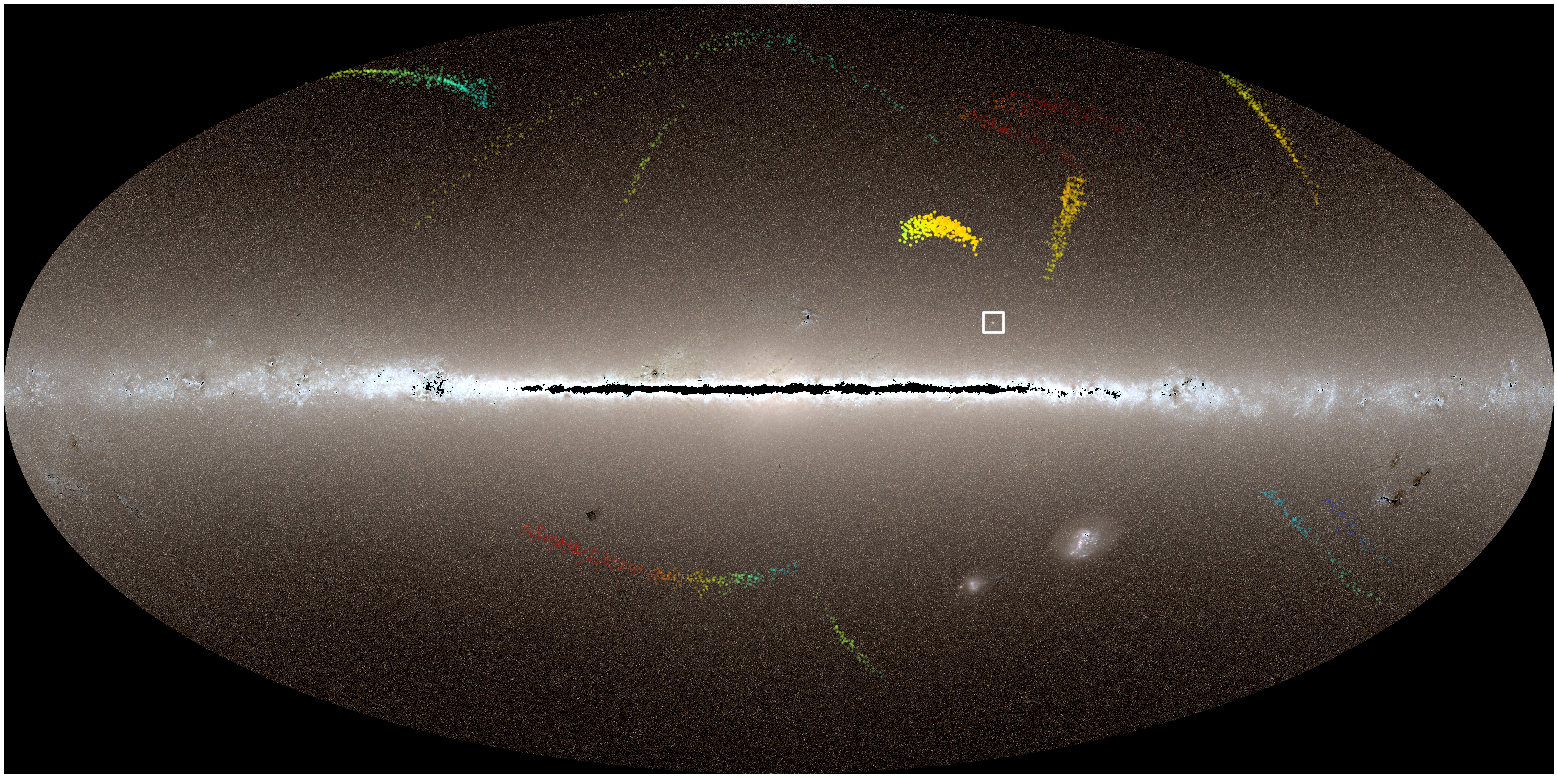
The Milky Way, as seen by the Gaia satellite. Streams of co-moving stars are shown colored according to their motions as measured by Gaia. The “Fimbulthul” stream which is due to stars lost from the omega Centauri globular cluster (white box) has been highlighted. Credit R. Ibata. Hi-res image

A team of researchers from the Strasbourg Astronomical Observatory, Bologna Observatory and the University of Stockholm has identified a stream of stars that was torn off the globular cluster Omega Centauri. Searching through the 1.7 billion stars observed by the ESA Gaia mission, they have identified 309 stars that suggest that this globular cluster may actually be the remnant of a dwarf galaxy that is being torn apart by the gravitational forces of our Galaxy.

In 1677, Edmond Halley gave the name “Omega Centauri” (ω Cen) to what he thought was a star in the Centaurus constellation. Later in 1830 John Herschel realized that it was in fact a globular cluster that could be resolved into individual stars. We now know that Omega Centauri is the most massive globular cluster in the Milky Way: it is about 18,000 light years from us and contains several million stars that are about 12 billion years old. The nature of this object has been the subject of much debate: is it really a globular cluster, or could it be the heart of a dwarf galaxy whose periphery has been dispersed by the Milky Way?

This last hypothesis is based on the fact that ω Cen contains several stellar populations, with a large range of metallicities (i.e. heavy element content) that betray a formation over an extended period of time. An additional argument in favor of this hypothesis would be to find debris from the cluster scattered along its orbit in the Milky Way. Indeed, when a dwarf galaxy interacts with a massive galaxy like our own, stars are torn off by gravitational tidal forces, and these stars remain visible for a time as stellar streams, before becoming dispersed in the vast volumes of interstellar space surrounding the massive galaxy.

By analyzing the motions of stars measured by the Gaia satellite with an algorithm called STREAMFINDER developed by the team, the researchers identified several star streams. One of them, named “Fimbulthul” (after one of the rivers in Norse mythology that existed at the beginning of the world), contains 309 stars stretching over 18° in the sky. By modeling the trajectories of the stars, the team showed that the Fimbulthul structure is a stellar tidal stream torn off ω Cen, extending up to 28° from the cluster. Spectroscopic observations of 5 stars of this stream with the Canada-France Hawaii Telescope show that their velocities are very similar, and that they have metallicities comparable to the stars of ω Cen itself, which reinforces the idea that the tidal stream is linked to ω Cen.

“The stars that the team observed were quite faint for the instrument we were using,” says Dr. Nadine Manset, instrument scientist for Espadons and CFHT’s astronomy group manager. “It is great to see such challenging observations reinforce the Fimbulthul structure’s link to ω Cen.”

The researchers were then able to show that the stream is also present in the very crowded area of sky in the immediate vicinity of the cluster. Further modeling of the tidal stream will constrain the dynamical history of the dwarf galaxy that was the progenitor of ω Cen, and allow us to find even more stars lost by this system into the halo of the Milky Way.

The team’s paper appeared in the April 22nd edition of Nature.


Additional information:

Nature paper (Subscription required.)
arXiv preprint (no login required)


Contact Information:


Media contact:

Mary Beth Laychak, Outreach manager
Canada-France-Hawaii Telescope
 

laychak@cfht.hawaii.edu

Science contacts:  

Rodrigo Ibata, +33 3 68 85 23 91
Michele Bellazzini, +39 051 635 73 26  
Khyati Malhan, +46 72 085 22 05  
Nicolas Martin, +33 3 68 85 24 67  
Paolo Bianchini, +33 3 68 85 24 02


Tuesday, October 09, 2018

A Pristine Star

Pristine_221.8781+9.7844 and its surroundings
Credits: N. Martin and the Pristine collaboration, DECam Legacy Survey, Aladin Sky Atlas."

The spectrum observed with the William Herschel Telescope on La Palma for Pristine_221.8781+9.7844, compared to the spectrum of the Sun. As can be seen, the spectrum of Pristine_221.8781+9.7844 contains far fewer feature. Only hydrogen (the large dips) and a small amount of Calcium (the small dip) can be seen in the spectrum of Pristine_221.8781+9.7844. This tells us that the star is ultra metal-poor, it has an unusual lack of heavy elements in its atmosphere, which means that it belongs to an early generation of stars formed in the Galaxy. Credits: E. Starkenburg and the Pristine collaboration.


An international team of researchers using Megacam at the Canada-France-Hawaii Telescope discovered a star that is among the least polluted by heavy elements. Such stars are extremely rare survivors of the early ages of the universe, when the gas stars are formed from hadn't yet been contaminated by the remnants of successive generations of dead stars. This new discovery opens a window onto star formation at the beginning of our universe.

For the study of the early universe, astronomers have different methods at their disposal. One is to look far into the Universe and back in time, to see the first stars and galaxies growing. Another option is to examine the oldest surviving stars of our home galaxy, the Milky Way, for information from the early universe. The "Pristine" survey, led by Nicolas Martin (CNRS/INSU, University of Strasbourg) and Else Starkenburg (Leibniz Institute for Astrophysics, Potsdam) is looking for exactly these pristine stars.

The early universe contained almost exclusively hydrogen and helium. Throughout the life of any star, the thermonuclear reactions takes place at their core create elements heavier than helium (carbon, oxygen, calcium, iron, etc.) from the hydrogen and helium making up the vast majority of their gas. When these stars explode at the end of their lifetime, they enrich the surrounding gas of with these “heavy” elements. This newly enriched gas serves as the birthplace for the next generation of stars. Each subsequent generation becomes more and more enriched with heavy elements created by their ancestors. Our sun, for example, is made up of about 2% of these heavy elements. On the contrary, very old stars contain very small quantities of heavy elements. They are however extremely rare and extremely difficult to find in our cosmic neighborhood.

The discovery of the star unveiled by the "Pristine" team was made possible thanks to a new mapping of the night sky conducted at the Canada-France-Hawaii Telescope, located in Hawaii. The Pristine team uses Megacam at CFHT to observea small part of the ultra-violet light that is very sensitive to the abundance in heavy elements and enables a discrimination of the rare, pristine stars from the much more common stars polluted in heavy elements. The team estimates that less than one star in a million is as pristine as the newly discovered star. Follow up observations with spectrographs of the Isaac Newton Group, located in Spain, and the European Southern Observatory, located in Chile, confirmed that star Pristine_221.8781+9.7844 is almost void of heavy elements, with the concentration of heavy elements being 10,000 to 100,000 times lower than those found in the atmosphere of our sun.

This star, whose discovery is presented in a publication of the Monthly Notices of the Royal Astronomical Society, Oxford University Press, brings strongly needed constraints on star formation models of the very first stars and opens a window onto an epoch that is still poorly understood. The discovery of Pristine_221.8781+9.7844 at the start of the "Pristine" project bodes well for the discovery of many such stars in the years to come.


Additional information

Link to the Paper

Contact Information:

Media contacts

Mary Beth Laychak, Outreach manager
Canada-France-Hawaii Telescope
mary@cfht.hawaii.edu

Science contacts

Else Starkenburg
Leibniz-Institut fur Astrophysik Potsdam
estarkenburg@aip.de

Nicolas Martin
Observatory Astrononomy de Strasbourg
nicolas.martin@astro.unistra.fr


Tuesday, July 17, 2018

Astronomers Find a Famous Exoplanet’s Doppelgänger

Direct Wircam image of 2MASS 0249 system taken wiht CFHT's infrared camera WIRCam. 2MASS 0249c is located 2000 astronomical units from the host brown dwarfs that are unresolved in this image. Credits: T. Dupuy, M. Liu

The infrared spectra of 2MASS 0249c and beta Pictoris b are similar, as expected for two objects of comparable mass that formed in the same stellar nursery. Unlike 2MASS 0249c, beta Pictoris b orbits much closer to its massive host star and is imbedded in a bright circumstellar disk. Credits: T. Dupuy, ESO/A.-M. Lagrange et al.

When it comes to extrasolar planets, appearances can be deceiving. Astronomers have imaged a new planet, and it appears nearly identical to one of the best studied gas-giant planets. But this doppelgänger differs in one very important way: its origin. “We have found a gas-giant planet that is a virtual twin of a previously known planet, but it looks like the two objects formed in different ways,” said Trent Dupuy, astronomer at the Gemini Observatory and leader of the study.

Emerging from stellar nurseries of gas and dust, stars are born like kittens in a litter, in bunches and inevitably wandering away from their birthplace. These litters comprise stars that vary greatly, ranging from tiny runts incapable of generating their own energy (called brown dwarfs) to massive stars that end their lives with supernova explosions. In the midst of this turmoil, planets form around these new stars. And once the stellar nursery exhausts its gas, the stars (with their planets) leave their birthplace and freely wander the Galaxy. Because of this exodus, astronomers believe there should be planets born at the same time from the same stellar nursery, but orbiting stars that have moved far away from each other over the eons, like long-lost siblings.

“To date, exoplanets found by direct imaging have basically been individuals, each distinct from the other in their appearance and age. Finding two exoplanets with almost identical appearances and yet having formed so differently opens a new window for understanding these objects,” said Michael Liu, astronomer at the University of Hawai`i Institute for Astronomy, and a collaborator on this work.

Dupuy, Liu, and their collaborators have identified the first case of such a planetary doppelgänger. One object has long been known: the 13-Jupiter-mass planet beta Pictoris b, one of the first planets discovered by direct imaging, back in 2009. The new object, dubbed 2MASS 0249 c, has the same mass, brightness, and spectrum as beta Pictoris b.

After discovering this object with the Canada-France-Hawaii Telescope (CFHT), Dupuy and collaborators then determined that 2MASS 0249 c and beta Pictoris b were born in the same stellar nursery. On the surface, this makes the two objects not just look-alikes but genuine siblings.

However, the planets have vastly different living situations, namely the types of stars they orbit. The host for beta Pictoris b is a star 10 times brighter than the Sun, while 2MASS 0249 c orbits a pair of brown dwarfs that are 2000 times fainter than the Sun. Furthermore, beta Pictoris b is relatively close to its host, about 9 astronomical units (AU, the distance from the Earth to the Sun), while 2MASS 0249 c is 2000 AU from its binary host.

These drastically different arrangements suggest that the planets’ upbringings were not at all alike. The traditional picture of gas-giant formation, where planets start as small rocky cores around their host star and grow by accumulating gas from the star’s disk, likely created beta Pictoris b. In contrast, the host of 2MASS 0249 c did not have enough of a disk to make a gas giant, so the planet likely formed by directly accumulating gas from the original stellar nursery.

“2MASS 0249 c and beta Pictoris b show us that nature has more than one way to make very similar looking exoplanets,” says Kaitlin Kratter, astronomer at the University of Arizona and a collaborator on this work. "beta Pictoris b probably formed like we think most gas giants do, starting from tiny dust grains. In contrast, 2MASS 0249 c looks like an underweight brown dwarf that formed from the collapse of a gas cloud. They’re both considered exoplanets, but 2MASS 0249 c illustrates that such a simple classification can obscure a complicated reality.”

The team first identified 2MASS 0249 c using images from CFHT, and their repeated observations revealed this object is orbiting at a large distance from its host. The system belongs to the beta Pictoris moving group, a widely dispersed set of stars named for its famous planet-hosting star. The team’s observations with the W. M. Keck Telescope determined that the host is actually a closely separated pair of brown dwarfs. So altogether, the 2MASS 0249 system comprises two brown dwarfs and one gas-giant planet. Follow-up spectroscopy of 2MASS 0249 c with the NASA Infrared Telescope Facility and the Astrophysical Research Consortium 3.5-meter Telescope at Apache Point Telescope demonstrated that it shares a remarkable resemblance to beta Pictoris b.

The 2MASS 0249 system is an appealing target for future studies. Most directly imaged planets are very close to their host stars, inhibiting detailed studies of the planets due to the bright light from the stars. In contrast, the very wide separation of 2MASS 0249 c from its host binary will make measurements of properties like its surface weather and composition much easier, leading to a better understanding of the characteristics and origins of gas-giant planets.

This work is accepted for publication in the Astronomical Journal.

This work has been supported by the National Science Foundation under Grant No. AST-1518339. Any opinions, findings, and conclusions or recommendations expressed in this material are those of the authors and do not necessarily reflect the views of the National Science Foundation.


Additional information : arXiv link to the Paper


Contact Information:

Media contacts

Mary Beth Laychak, Outreach manager
Canada-France-Hawaii Telescope
mary@cfht.hawaii.edu

Science contacts

Trent Dupuy
Gemini Observatory
tdupuy@gemini.edu

Michael Liu
UH Institute for Astronomy
mliu@ifa.hawaii.edu


Tuesday, May 15, 2018

Revealing the complexity of the nebula in NGC 1275 with SITELLE

Hα filamentary structure around NGC 1275.
Credits: Marie-Lou Gendron-Marsolais, Julie Hlavacek-Larrondo, Laurent Drissen and Maxime Pivin-Lapointe.  
Hi-res image

Movie showing how the filamentary structure of NGC 1275 varies with wavelength. 
Credits: Marie-Lou Gendron-Marsolais, Julie Hlavacek-Larrondo, Laurent Drissen and Maxime Pivin-Lapointe.

Ph.D. student Marie-Lou Gendron-Marsolais and professor Julie Hlavacek-Larrondo, from the Centre for Research in Astrophysics of Québec (CRAQ) and Université de Montréal, have joined the developers of SITELLE, Laurent Drissen and Thomas Martin from Université Laval, an instrument recently installed at the Canada-France-Hawaii telescope (CFHT), to reveal for the first time the intricate dynamic around the galaxy NGC 1275. 

Located 250 million light-years from earth, NGC 1275 is not an ordinary galaxy. It sits in the middle of the Perseus galaxy cluster, a gigantic cluster harboring thousands of galaxies in the constellation of the same name. NGC 1275 rests at the center of a hot and diffuse intracluster gas with an average temperature of tens of millions of degrees. This complex gas constitutes a large part of the luminous mass of galaxy clusters: the hot gas tends to cool and fall toward the galaxy while the central supermassive black hole releases powerful jets of energetic particles. These particles blow gigantic bubbles in the hot gas, preventing it from cooling. Astronomers generally dectect these bubbles by using radio radio telescopes. However, a spectacular network of thin intricate filaments surrounding the galaxy NGC 1275 is visible at specific optical wavelengths. "These types of filaments are often visible around galaxies that lie in similar environments... but their origin is a real mystery", declares Marie-Lou Gendron-Marsolais, lead author on the paper.

Extending over 250 000 light-years, two to three times the size of our own galaxy, the link between this large network of filaments and its environment is still unclear. Two theories are in conflict: the filaments could be condensing from the hot intracluster gas and sinking toward the center of the galaxy or being lifted by the bubbles created by the central supermassive black hole jets and dragged outward of the galaxy.

In order to unravel the mystery of these filaments, the international team of researchers have used SITELLE, an instrument at the Canada-France-Hawaii Telescope that enables the imaging of the galaxy at several different wavelengths at the same time. "This way we obtain a spectrum for each pixel of the image" declares Julie Hlavacek-Larrondo, a coauthor on the paper. "But what is unique about SITELLE is its incredibly large field of view, covering NGC 1275 in its entirety for the first time since the discovery of the nebula, 60 years ago", she adds.

Installed at the top of Maunakea on the Big Island in 2015, SITELLE is the product of the expertise of a team led by the astrophysicist Laurent Drissen as well as the optical design specialist Simon Thibault, both professors at the Faculté des sciences et de génie of Université Laval, as well as the knowledge of CFHT and the high-performance technology business ABB.

With a spectra for each pixel, it is now possible to obtain the radial velocity of each filament, revealing their dynamics at an unprecedented level. "The motion of this network of filaments seems to be very complex. It does not seem to be from a uniform motion, rather it is extremely chaotic", declares Marie-Lou Gendron-Marsolais. The team is convinced that such observations will help illuminate the mysteries of these structures. Understanding the filaments' dynamics aids astronmers in the understanding the processes of heating and cooling of the gas feeding the central black hole. Unlocking this process constitutes a key element in the study of galaxy evolution and, at larger scale, of environment such as clusters of galaxies.

The results from the work led by Marie-Lou Gendron-Marsolais, Julie Hlavacek-Larrondo, Laurent Drissen, Thomas Martin and their international collaborators are published in a letter of the latest issue of the Monthly Notices of the Royal Astronomical Society.


Additional information:

Preprint (No login required)


Contact Information:

Media contacts

Mary Beth Laychak
Outreach manager
Canada-France-Hawaii Telescope
mary@cfht.hawaii.edu

Robert Lamontagne
Public Outreach
Centre de recherche en astrophysique du Québec
Phone : (438) 495-3482
lamont@astro.umontreal.ca


Science contacts:

Marie-Lou Gendron-Marsolais
Centre de recherche en astrophysique du Québec
Université de Montréal
marie-lou@astro.umontreal.ca

Professor Julie Hlavacek-Larrondo
Centre de recherche en astrophysique du Québec
Université de Montréal
juliehl@astro.umontreal.ca

Professor Laurent Drissen
Centre recherche en astrophysique du Québec
Université Laval
ldrissen@phy.ulaval.ca


Wednesday, September 13, 2017

Rocky Planet Engulfment Explains Stellar Odd Couple

Artist representation of a rocky planet engulfed by a star


Astronomers using the Gemini Observatory and the spectrograph GRACES at the Canada-France-Hawaii Telescope have discovered remarkable differences in the abundance of heavier elements, and the Lithium content, in a binary star pair. The research team speculates that this difference is caused by the engulfment of rocky planets early in the system’s evolution which enriched one of the stars. The work also hints at a formation scenario resulting in gas giant planets forming relatively far from their host star.

A team of astronomers led by Carlos Saffe (Instituto de Ciencias Astronómicas, de la Tierra y el Espacio, Argentina) observed the peculiar binary system called HAT-P-4, which includes a confirmed exoplanet orbiting one of the stars in the pair. The team used the 8-meter Gemini North Telescope and the Gemini Remote Access to CFHT ESPaDOnS Spectrograph (GRACES) located at the Canada-France-Hawaii Telescope to perform high-resolution spectroscopy of the two stars. GRACES is a unique instrument that uses more than 250 meters of optical fiber to link Gemini to CFHT's high resolution spectropolarimeter ESPaDOnS. These spectra revealed that the star pair have markedly different quantities of heavy elements or what astronomers call “metallicity.”

According to Saffe, “Both stars are believed to have formed together with the same chemical composition, which makes the difference in metallicity found in this binary system remarkable.” In particular, says Saffe, the different refractory (rocky) content points toward a history of a rocky planet or planets in the system. “We speculate that these observations can be explained by the engulfment of a rocky planet sometime during the system’s evolution. This presents us with an exciting glimpse into the system’s violent planet formation history.”

One star in the pair, HAT-P-4 A, also hosts a gas giant planet orbiting at only 0.04 AU from the star. This same star also displays a higher Lithium abundance than its stellar companion, which is another unexpected feature in this type of binary system. The authors use the data collected with GRACES to exclude other possible explanations, such as a peculiar composition of the stars or different rotational velocities. The team concludes that HAT-P-4-A formed the known gas giant planet while rocky (refractory) material accreted closer to the star, possibly due to migration of the gas giant. Saffe adds, “This scenario explains the higher metallicity of HAT-P-4-A, the higher refractory abundance, and the higher Lithium content.”


Additional information


Contact Information:

Media contacts

Mary Beth Laychak
Outreach Manager, Canada-France-Hawaii Telescope
(808) 885-3121
mary@cfht.hawaii.edu


Thursday, August 17, 2017

The little star that survived a Supernova

The progenitor of LP40-365 could be a binary star system like the one shown in this animation. Here, an ultra-massive and compact dead star called a white dwarf (shown as a small white star) is accreting matter from its giant companion (the larger red star). The material escapes from the giant and forms an accretion disk around the white dwarf. Once enough material is accreted onto the white dwarf, a violent thermonuclear runaway tears it apart and destroys the entire system. The giant star and the surviving fragment of the white dwarf are flung into space at tremendous speeds. The surviving white dwarf shrapnel hurtles towards our region of the Galaxy, where its radiation is detected by ground based telescopes. Copyright Russell Kightley (http://scientific.pictures), used with permission.


An international team of astronomers led by Stephane Vennes at the Astronomical Institute in the Czech Republic have identified a white dwarf moving faster than the escape velocity of the Milky Way. This high velocity star is thought to be shrapnel thrown away millions of years ago from the site of an ancient, peculiar Type Ia supernova explosion. The team used telescopes located in Arizona, the Canary Islands and Maunakea’s GRACES, a high resolution spectrograph that combines the large aperture of the Gemini North telescope with Espadons, the high resolution spectropolarimeter at CFHT, via a 250m optical fiber link.

Type Ia supernovae play an important role important in our understanding of the Universe. They act as standard candles, astronomical objects for which astronomers have a decent estimate of their intrinsic brightness or luminosity. Astronomers can estimate the true total luminosity of a Type Ia supernovae and use that information to determine the distance. Despite astronomers’ understanding of the luminosity and distance relationship for Type Ia supernovae, very little is known about the explosions themselves. Astronomers build models aimed at a deeper understanding of the engine powering these explosions.

One of these models suggest that at the heart of a Type Ia supernova is a compact star known as a white dwarf. If the white dwarf has a close companion star, over time the gravity of the white dwarf may attract gas from the other star. This continuous feeding compresses the white dwarf to such a high density and temperature that the white dwarf is engulfed in a thermonuclear explosion. It is thought that nothing survives this kind of explosion. However, a new class of models called "subluminous type 1a supernova also known as a Type Iax” can leave a partially burnt remnant that is instantly ejected at high velocity.

"Such a cataclysmic binary star has never been caught feeding and getting just ready for the explosion," commented Stephane Vennes, leading author of the Science article. "All we ever witness is the aftermath of the explosion, that is the bright flash in the distant Universe that even outshines the galaxy hosting that event. But now, with the discovery of a surviving remnant of the white dwarf itself, we have direct clues to the nature of the most important actor involved in these events."

The team studied the white dwarf star LP40-365 for two-years with telescopes located in Arizona, the Canary Islands, and Hawaii. The new star was first identified with the National Science Foundation's (NSF) Mayall four-meter telescope at Kitt Peak National Observatory in Arizona. "We selected this object for observation with the spectrograph at the four-meter telescope because of its large apparent motion across the celestial sphere. Thousands of objects like this one are known, but the sky was partly cloudy on that night and we had to go for the brightest star available which turned out to be LP40-365," said team member Adela Kawka, underpinning the importance of serendipity in astronomy. "We alerted team members J.R. Thorstensen and E. Alper at Dartmouth College, and P. Nemeth at the Karl Remeis Observatory for urgent follow-up observations."

A final, crowning data set was obtained with the help of team member Viktor Khalack at the Université de Moncton using a unique instrument, GRACES on Maunakea. GRACES is a collaboration between the Canada-France-Hawaii Telescope and the NSF Gemini Observatory. When GRACES is in use, CFHT’s spectropolarimeter Espadons receives light fed by an optical fiber hooked to its neighbor on the summit, the eight-meter Gemini North telescope. “GRACES provides astronomers the best of both worlds, the light collecting power of the Gemini observatory combined with a state of the art instrument like Espadons. The combination packs a powerful punch and creates opportunities for discoveries like this one” says Nadine Manset, the GRACES instrument scientist at CFHT.

After collecting the data, the team used state of the art computer codes for analysis. The analysis proved the compact nature of the star and its exotic chemical composition. "The extreme peculiarity of the atmosphere required a lengthy and complex model atmosphere analysis which crunched several weeks of computing time. But the results proved very exciting. Such a peculiar atmosphere devoid of hydrogen and helium is rare indeed," commented team member Peter Nemeth. The analysis also revealed an extraordinary Galactic trajectory. "The extremely high velocity of this star puts it on a path out of the Milky Way with no return ever," said team member Lilia Ferrario.

Supernova models and simulations did entertain the possibility of observing surviving stellar remnants in the aftermath of a supernova explosion. The unique object LP40-365 is the first observational evidence for surviving bound remnants of failed supernovae and therefore it is an invaluable object to improve our understanding of these cosmological standard candles.

Many more of these objects are lurking in the Milky Way and awaiting discovery. The recent ESA/Gaia mission may well help us discover many more of these objects and help us understand how a little white dwarf star can survive supernova explosions. 


Additional information

Official press release
Paper


Contact Information:

Mary Beth Laychak
Outreach Program Manager
Canada-France-Hawaii Telescope
65-1238 Mamalahoa Hwy
Kamuela, HI 96743
808-885-3121
laychak@cfht.hawaii.edu

Science contact

Stephane Vennes
Astronomical Institute
The Czech Academy of Sciences
Fricova 298
251 65 Ondrejov
Czech Republic
+420 323620217
vennes@asu.cas.cz


Sunday, October 09, 2016

A new look at the largest known disk galaxy

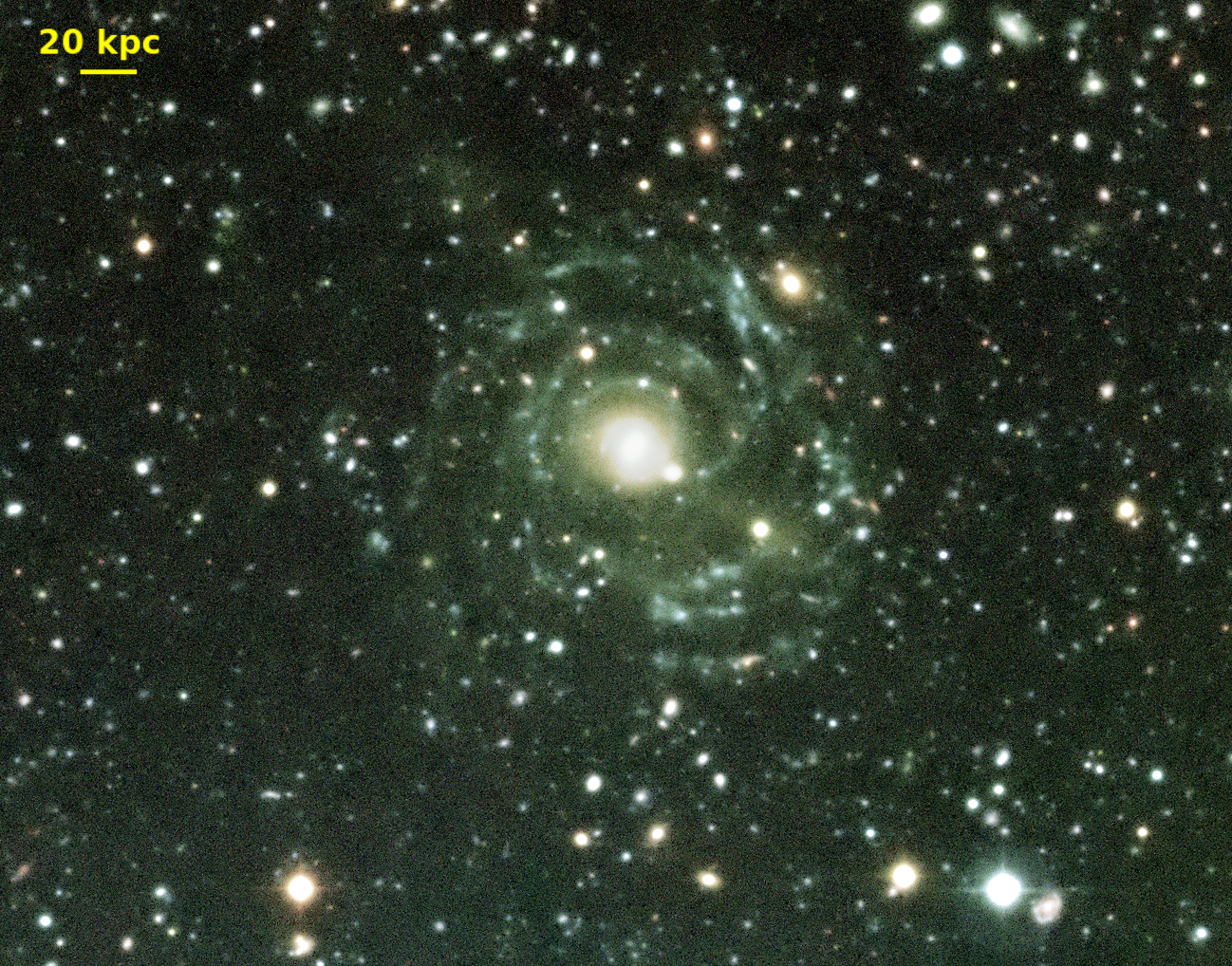
Combination of 4 NGVS images of Malin 1, obtained with MegaCam camera on CFHT. An indication of the size is given in the figure to show the amazing size of the disk of the galaxy (in comparison, the Milky Way has only a diameter around 30 kpc). Image Credit: Boissier/A&A/ESO/CFHT. Hi-res image

Left: The curve with the errorbars shows the variation with radius of the color between 2 GALEX bands (FUV and NUV). A blue colour indicates the presence of young stellar populations. The blue and red curve shows the model used in the paper. It is in agreement with the observation. On the other hand, the yellow line show the color of stars that would have been formed during a interaction 1.4 billions year ago, or a star formation event that would have expanded from the center in the distant past to the outer regions in the more recent period (stars). The expected colors for this model do not fit the data. 
Right: History of the star formation rate (SFR) in the the giant disk of Malin 1 according to the model that reproduces correctly the stellar surface density and the colors of the galaxy. This history suggests that star formation proceeded at a regular rate for several billion years (the error-bar indicates an estimate of the recent SFR published in another study). Figures adapted from Boissier et al. 2016. Hi-res image


In a publication recently accepted in Astronomy and Astrophysics, an international team involving French researchers from the Laboratoire d’Astrophysique de Marseille and Canadian researchers from NRC Herzberg and Queens University have studied Malin 1, a nearby galaxy that has been known only since the eighty's and that shows an extremely large disk of gas and stars. The new observations of Malin 1, a prototype of the class of "giant low surface brightness galaxies" allowed the team to obtain new results in contradiction with one of the hypotheses concerning the formation of this type of galaxies.

Because they are very diffuse and of low surface brightness, giant low surface brightness galaxies, yet massive, are difficult to observe and are still poorly known. They could represent a significant percentage of the galaxies in the universe, especially because we could have missed such objects in our galaxy surveys. It is thus important do study them and understand their formation and evolution. This is now possible owing to the new generation of telescopes and modern detectors, with higher sensitivity to low surface brightness than in the past.

This paper presents for the first time deep images obtained at 6 different wavelengths, from the UV of the GUViCS project to the optical and near-infrared obtained in the context of the Next Generation Virgo Survey with MegaCam on CFHT. Originally, these large observational campaigns were planned to study the Virgo cluster, but they also allow us to study background objects like Malin 1. The images offer us a new view of this spectacular galaxy, the largest galactic disk known, with a diameter above 250 kilo-parsec (in comparison, our Milky Way is only about 30 kpc wide).

The team of researchers extracted from these data the variation of the luminosity with the distance to the center of the galaxy, as well as the variation of the colors (corresponding to the ratios between the luminosity at various wavelengths). These colors strongly depends on the star formation history. The comparison of the observations with predictions of various numerical models allowed the team to estimate for the first time what must have been the history of star formation in the giant disk of Malin 1. It suggests that the giant disk has been in place for several Gyr, and that star formation proceed at a regular long-term rhythm despite the very low density.

This result is important as it clearly contradicts a scenario proposed a few years ago predicting that these giant galaxies are formed during violent interactions. Moreover, in the context of the cosmological formation of galaxies, numerous fusions and interaction should have perturbed the disk of Malin 1. The formation of such a structure and its survival for very long time offers then a challenge for cosmological simulations of the formation of galaxies.

What is the future of Malin 1? The giant disk contains a large quantity of gas in which star formation will keep proceeding at a low rate for billions of years, increasing progressively the stellar mass of the galaxy. Unless another galaxy comes in the picture to interact with Malin 1 and totally change its destiny. Few galaxies, however, may play this role as Malin 1 is a relatively isolated galaxy.


Additional information


Contact

Dr. Samuel Boissier
Laboratoire d'Astrophysique de Marseille (AMU, CNRS).
Phone number: +33 4 91 05 59 37
samuel.boissier@lam.fr


Tuesday, July 12, 2016

New Distant Dwarf Planet Beyond Neptune

Discovery images of RR245. The images show RR245's slow motion across the sky over three hours (.gif file)
Credit OSSOS team.

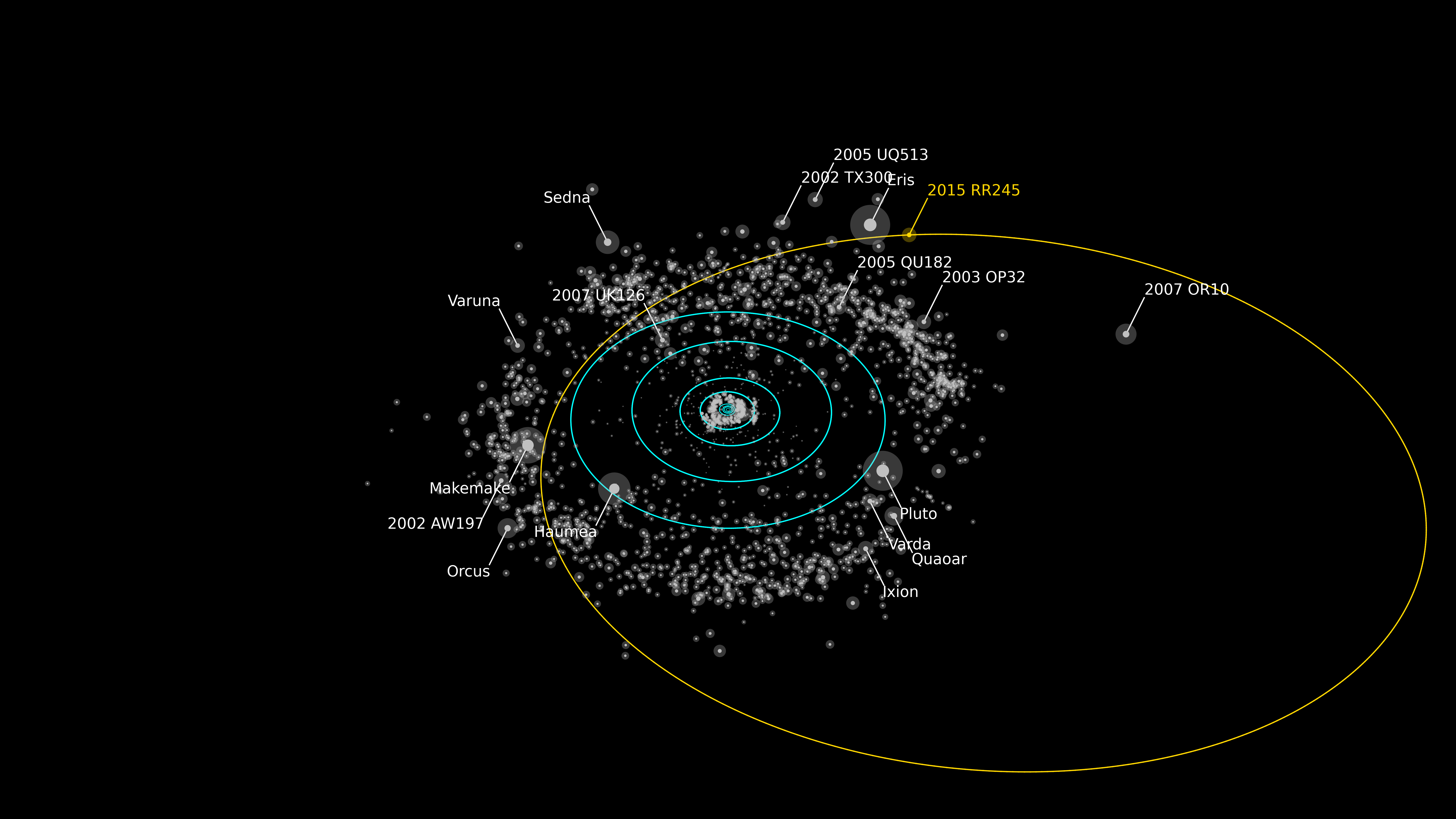
Rendering of the orbit of RR245 (orange line). Objects as bright or brighter than RR245 are labeled. The Minor Planet Center describes the object as the 18th largest in the Kuiper Belt. Credit: Alex Parker OSSOS team. Hi-res image (PNG)


An international team of astronomers have discovered a new dwarf planet orbiting in the disk of small icy worlds beyond Neptune. The new object is roughly 700 kilometers in size and has one of the largest orbits for a dwarf planet. Designated 2015 RR245 by the International Astronomical Union's Minor Planet Center, it was found using the Canada-France-Hawaii Telescope on Maunakea, Hawaii, as part of the ongoing Outer Solar System Origins Survey (OSSOS).

"The icy worlds beyond Neptune trace how the giant planets formed and then moved out from the Sun. They let us piece together the history of our Solar System. But almost all of these icy worlds are painfully small and faint: it's really exciting to find one that's large and bright enough that we can study it in detail." said Dr Michele Bannister of the University of Victoria in British Columbia, who is a postdoctoral fellow with the Survey.

National Research Council of Canada’s Dr JJ Kavelaars first sighted RR245 in February 2016 in the OSSOS images from September 2015."There it was on the screen— this dot of light moving so slowly that it had to be at least twice as far as Neptune from the Sun.” said Bannister.

The team became even more excited when they realized that the object’s orbit takes it more than 120 times further from the Sun than Earth. The size of RR245 is not yet exactly known, as its surface properties need further measurement. "It's either small and shiny, or large and dull." said Bannister.

The vast majority of the dwarf planets like RR245 were destroyed or thrown from the Solar System in the chaos that ensued as the giant planets moved out to their present positions: RR245 is one of the few dwarf planets that has survived to the present day — along with Pluto and Eris, the largest known dwarf planets. RR245 now circles the Sun among the remnant population of tens of thousands of much smaller trans-Neptunian worlds, most of which orbit's is unseen.

Worlds that journey far from the Sun have exotic geology with landscapes made of many different frozen materials, as the recent flyby of Pluto by the New Horizons spacecraft showed.

After hundreds of years further than 12 billion km (80 astronomical units, AU) from the Sun, RR245 is travelling towards its closest approach at 5 billion km (34 AU), which it will reach around 2096. RR245 has been on its highly elliptical orbit for at least the last 100 million years.

As RR245 has only been observed for one of the seven hundred years it takes to orbit the Sun, where it came from and how its orbit will slowly evolve in the far future is still unknown; its precise orbit will be refined over the coming years, after which RR245 will be given a name. As discoverers, the OSSOS team can submit their preferred name for RR245 to the International Astronomical Union for consideration.

"OSSOS was designed to map the orbital structure of the outer Solar System to decipher its history." said Prof. Brett Gladman of the University of British Columbia in Vancouver. "While not designed to efficiently detect dwarf planets, we're delighted to have found one on such an interesting orbit".

RR245 is the largest discovery and the only dwarf planet found by OSSOS, which has discovered more than five hundred new trans-Neptunian objects. "OSSOS is only possible due to the exceptional observing capabilities of the Canada-France-Hawaii Telescope. CFHT is located at one of the best optical observing locations on Earth, is equipped with an enormous wide-field imager, and can quickly adapt its observing each night to new discoveries we make. This facility is truly world leading." said Gladman.

Previous surveys have mapped almost all the brighter dwarf planets. 2015 RR245 may be one of the last large worlds beyond Neptune to be found until larger telescopes, such as LSST, come online in the mid 2020s.

OSSOS involves a collaboration of fifty scientists at institutes and universities from around the world.

OSSOS is based on observations obtained with MegaPrime/MegaCam, a joint project of the Canada-France-Hawaii Telescope (CFHT) and CEA/DAPNIA, and on data produced and hosted at the Canadian Astronomy Data Centre. CFHT is operated by the National Research Council of Canada, the Institute National des Sciences de l'Universe of the Centre National de la Recherche Scientifique of France, and the University of Hawaii, with OSSOS receiving additional access due to contributions from the Institute of Astronomy and Astrophysics, Academia Sinica, Taiwan. 


Additional information


Media Contacts:
Mary Beth Laychak
Canada-France-Hawaii Telescope
(808) 885-3121
mary@cfht.hawaii.edu

Thandi Fletcher
The University of British Columbia
(604) 822-2234
thandi.fletcher@ubc.ca


Science Contacts:
 
Dr. Michele Bannister
Postdoctoral Fellow with the Outer Solar System Origins Survey
Department of Physics and Astronomy
University of Victoria, Victoria BC

micheleb@uvic.ca
tel: +1 250 580 3085

Dr. Jean-Marc Petit
Institut UTINAM - UMR CNRS 6213
Observatoire de Besancon
41 bis Avenue de l’Observatoire BP 1615

Jean-Marc.Petit@normalesup.org
tel: (33) [0]695 207 174

Dr Ying-Tung (Charles) Chen 陳英同, IAA
Academia Sinica, Taipei

ytchen@asiaa.sinica.edu.tw
tel: +886-2-2366-5356


Tuesday, June 28, 2016

Innovative Gemini/CHFT Partnership Explores a Hot Jupiter

Artistʻs view of a newborn giant planet like the one newly discovered at the immediate vicinity of the very active infant star V830 Tau, as might be seen by an observer located close to the giant planet.  Download image | (Credit: Mark A. Garlick markgarlick.com)


Brightness and magnetic spots at the surfaces of V830 Tau induce spectral perturbations much larger than those caused by the reflex motion of the detected giant planet. Activity perturbations are shown in the top panel, with the blue arrow depicting the spectral velocity shift (scaled up by 20x) that activity generates. The bottom panel illustrates the combined effects of activity and of the detected planet on the spectrum of V830 Tau, with the blue / green / red arrows respectively showing the velocity shifts induced by activity, by the giant planet, and by both (scaled up by 20x). Click on the links for animations of the profile distortions induced by the spotted star, and by the spotted star plus the planet. (Credit: Jean-François Donati)


For the last 20 years the giant planets known as hot Jupiters have presented astronomers with a puzzle. How did they settle into orbits 100 times closer to their host stars than our own Jupiter is to the Sun? An international team of astronomers has announced this week1 the discovery of a newborn hot Jupiter, orbiting an infant sun — only 2 million years old, the stellar equivalent of a week-old human baby. The discovery that hot Jupiters can already be present at such an early stage of star-planet formation represents a major step forward in our understanding of how planetary systems form and evolve. 

For this discovery, the team monitored a 2 million-year-old infant star called V830 Tau, located in the Taurus stellar nursery, some 430 light-years away. Over the 1.5 months of the campaign, a regular 4.9-day “wobble” in the velocity of the host star revealed a giant planet almost as massive as Jupiter, orbiting its host star at a distance of only one-twentieth that of the Sun to the Earth distance. “Our discovery demonstrates for the first time that such bodies can be generated at very early stages of planetary formation, and likely play a central role in shaping the overall architecture of planetary systems” explains Jean-François Donati, CNRS astronomer at IRAP / OMP2 and lead author of a new paper in the current issue of the journal Nature.

The team used the twin spectropolarimeters ESPaDOnS and Narval to monitor V830 Tau for a total of 47 hours.  ESPaDOnS is mounted at the 3.6-m Canada-France-Hawaii Telescope3 (CFHT) on Maunakea and can be fiber-fed from either CFHT itself, or via GRACES, a 300-m optical-fiber link from the nearby 8 meter Gemini North telescope.  The team used ESPaDOnS in both modes, providing the opportunity to monitor the star using light from the Gemini North telescope when the instrument was unavailable at CFHT.

The team also used Narval, mounted at the 2-meter Télescope Bernard Lyot4 (TBL) atop Pic du Midi in the French Pyrénées.  “Using all three telescopes was essential for monitoring regularly V830 Tau throughout our campaign and for detecting its giant planet” stresses Lison Malo, CFHT astronomer, a coauthor of the study and leader in coordinating the observations.

In our Solar System, small rocky planets like the Earth are found near the Sun, whereas gas giants like Jupiter and Saturn orbit much further out.  “The discovery in 1995 of a giant planet flying very close to its host star took us by surprise and revolutionized the field” recalls Claire Moutou, CNRS astronomer at CFHT and a coauthor of this new study. Theoretical work indicates that such planets can only form in the cold and icy outer regions of the protoplanetary disc in which both the central star and surrounding planets are born. Some, however, migrate inwards without falling into their host star, thus becoming hot Jupiters.

“Planet formation models offer two competing explanations of how and when this migration of hot Jupiters occurred. Either it happened early while these planets were still forming, or much later, with some planets being kicked closer to their stars due to the interaction of multiple planets, or both” explains Clément Baruteau, CNRS astronomer at IRAP / OMP and a coauthor of this study. “Our discovery demonstrates that the first, earlier option is taking place; it revives the long-running debate about how and when this migration occurs, and brings us one step forward in our understanding of how planetary systems form”.

Among the known hot Jupiters, some feature strongly-tilted or even upside-down orbits, suggesting they were knocked into close orbits by interactions with other planets or neighboring stars. Others orbit above the host star’s equator, hinting at a more gentle formation process in the form of an inward drift through the disc.

“The young hot Jupiter we just detected comes as the first evidence that early disc migration is also happening” says Andrew Collier Cameron of the University of St Andrews, a coauthor of the study.


Contacts:

Claire Moutou
CFHT, Hawaii
Phone: +1-8088857944
moutou@cfht.hawaii.edu

Jean-François Donati
IRAP / OMP, Fr
Phone: +33-561332917
jean-francois.donati@irap.omp.eu


View CFHT release.

The novel collaboration between the Gemini Observatory and Canada-France-Hawai‘i Telescope (CFHT) called GRACES (Gemini Remote Access to CFHT ESPaDOnS Spectrograph), helped to characterize a “hot Jupiter” around the T-Tauri star V830 Tau. The work appears in the current advanced online issue of the journal Nature

GRACES uses an innovative 270-meter fiber cable to transport light from the Gemini 8-meter telescope to the ESPaDOnS Spectrograph at CFHT. The system began operating in late 2015 and now is a popular option allowing Gemini and CFHT users to perform high-resolution optical spectroscopy with Gemini North’s larger mirror.

The Nature paper is available online (subscription required) and is summarized in the press release from Observatoire Midi Pyrenees in Toulouse, France and CFHT that follows (release is reproduced verbatim from original): Newborn Giant Planet Grazes its Sun


“SPIRou and SPIP, the twin new-generation instruments built for CFHT and TBL by our team and scheduled for first light in 2017 and 2019 respectively, will offer vastly superior performances for such programs, and will soon allow us to explore the formation of new worlds with unprecedented sensitivity”, adds Louise Yu, a coauthor of the study and PhD student in observational exoplanet science at IRAP / OMP.

1 The paper describing the discovery, published in Nature, is available here

2 IRAP (Institut de Recherche en Astrophysique et Planétologie) is a research lab part of OMP (Observatoire Midi-Pyrénées) located in Toulouse (France), and under dual supervision from CNRS / INSU (Centre National de la Recherche Scientifique / Institut National des Sciences de l’Univers) and UFTMiP / UPS (Université Fédérale Toulouse Midi-Pyrénées / Université Paul Sabatier)


3 CFHT is operated by the National Research Council of Canada, CNRS/INSU in France and the University of Hawaii

4 TBL is operated by IRAP / OMP, CNRS / INSU and UFTMiP / UPS