Showing posts with label binary systems. Show all posts

Saturday, January 03, 2026

Explosive endpoints of a life next to a black hole

Binary systems composed of a black hole and a massive stellar companion can maintain stable mass transfer if the orbit is not too tight. The plot shows the orbital separation at the end of mass transfer (in units of solar radii) as a function of the initial mass of the star (in units of solar masses). The blue-shaded region marks all systems that remain stable and survive the interaction. The newly identified separation limit is indicated by the dashed red line, corresponding to approximately ten solar radii. All binaries in which the orbit shrinks below this limit are found to be dynamically unstable: the black hole plunges into the star and destroys the system. In surviving systems, the star continues its evolution until it collapses to form a second black hole. Because of the critical separation limit and the exclusion of very tight orbits, the resulting binary black hole systems take a very long time – billions of years – to merge as gravitational-wave sources detectable by LIGO/Virgo/KAGRA. © MPA/Klencki

Sequence of events leading to the black hole destroying its companion star. Phase 1: A long-lasting (~1000 years) phase of stable mass transfer from the massive star onto the black hole. Most of the mass lost by the star is not accreted by the black hole but is instead ejected from the system at low velocities (~30 km/s). Over time, this outflow forms an extended dusty cocoon that enshrouds the central binary, reaching nearly one trillion kilometers in size. © MPA/Klencki/Metzger

Phase 2: Once the orbit tightens sufficiently and approaches the stability threshold (Figure 1), the interaction becomes unstable and the black hole plunges into the star. Over the course of several days, the black hole spirals inward until it reaches the compact helium core. Energy released during this phase causes hot gas from the inner layers of the star to expand at thousands of kilometers per second, creating a nearby hot bubble roughly one billion kilometers in size. © MPA/Klencki/Metzger

Phase 3: The black hole spirals into the stellar core and tidally rips it apart, forming a dense, thick accretion disk. Over just a few hours, the black hole accretes a fraction of a solar mass, releasing energy equivalent to ten million years of solar output. A powerful jet is launched near the black hole: a relativistic outflow of ionized matter and particles traveling at tens of percent of the speed of light (~100,000 km/s). The jet rapidly breaks out and shocks the nearby hot bubble (blue), powering a superluminous transient whose peak brightness is reached after several days, as observed in LFBOTs. Over the following months, the jet continues to propagate through and interact with the extended dusty cocoon (red), producing the strong radio emission observed in LFBOTs. © MPA/Klencki/Metzger


More and more black holes are found orbiting a luminous massive stellar companion. The future of these systems holds a fundamental puzzle: once the companion star expands and begins to lose mass onto the black hole, will the interaction remain stable or will the black hole plunge into the star and destroy it from within? Using state-of-the-art computational models, a team led at MPA has identified a surprisingly simple rule: the interaction is stable as long as the distance between the black hole and the star remains larger than about ten times the radius of the Sun. The newly found separation threshold will play a key role in determining which systems survive to form gravitational-wave sources and will help interpret the growing population of LIGO/Virgo/Kagra detections. Binaries that fail to remain stable, however, are no less remarkable. Such black hole-star mergers could be the explanation for luminous fast blue optical transients, linking these rare and powerful explosions to the violent end states of binary evolution.

Black holes are invisible by nature, but some of them reveal their presence by orbiting a luminous companion star. Over the last few years, astronomers have discovered several black holes in binaries with a massive stellar companion – at least ten times heavier than the Sun – by carefully tracking the motion of the visible star. These systems are likely just the tip of the iceberg: population studies suggest that hundreds more may be hidden in our Milky Way.

Massive stars do not stay compact forever. Within a few million years, the stars we see today will expand by factors of tens to a hundred, until the black hole’s gravity pulled their outer layers away. This process, known as mass transfer, lights up the system as an X-ray binary, with hot gas spiralling into the black hole via an accretion disk. Crucially, this mass exchange does not only transform the star itself, but also reshapes the entire binary: depending on how mass and angular momentum are redistributed, the orbit can widen or tighten dramatically, in some cases by orders of magnitude.

A long-standing mystery is whether this interaction remains stable or ends catastrophically. In some cases, the black hole may accrete matter peacefully for millions of years, gradually stripping away the hydrogen envelope of its companion and revealing the helium core beneath. In others, the binary becomes dynamically unstable and the black hole plunges deep into the star, destroying it from the inside. In a recent study, a research team led by an MPA fellow used detailed computer simulations with the state-of-the-art stellar evolution code MESA to show that, despite the complex gas dynamics in systems with black hole accretors, the outcome is governed by a surprisingly simple rule: how close the binary orbit becomes.

The team found that stable mass transfer has a hard limit. If the orbit tightens below about ten solar radii – roughly one-twentieth of the Earth-Sun distance – the massive star reacts by rapidly expanding. The black hole then plunges into its stellar companion, spirals through it, and ultimately merges with the helium core, destroying the star and thus the binary. This separation limit is not set by the uncertain details of how mass is exchanged, but by how massive stars respond to mass loss when forced into very tight orbits. Different stars have different “comfort zones”: some trigger instability at slightly wider separations than others do. In every case, however, the threshold can be traced back to the star’s internal structure, in particular to deep layers near the core that are normally hidden from our view.

This orbital size limit has important consequences for gravitational-wave astronomy. Compact orbits are required to form pairs of black holes or neutron stars that later spiral together and merge, producing detectable gravitational waves. The newly identified separation threshold therefore shapes which binaries can become gravitational-wave sources and which cannot, helping to clarify the origins of the growing population of mergers observed across the Universe.

But systems that cross the stability threshold may give rise to something even more dramatic. In a follow-up study, researchers from MPA and Columbia University propose that these “failed” gravitational-wave sources power one of the most mysterious explosions in the Universe: luminous fast blue optical transients, or LFBOTs.

LFBOTs are among the most extreme stellar explosions known. They can shine as brightly as the most luminous supernovae (up to a hundred times brighter than typical stellar explosions) while rising and fading on timescales of just a few days. They launch powerful outflows at tens of percent of the speed of light and emit X-rays that can persist for years after the initial flash. Radio observations add another puzzling clue: these explosions occur inside an enormous cloud of dense gas, extending to distances nearly a hundred times larger than Pluto’s orbit. Such extreme environments have posed a major challenge for models attempting to explain LFBOTs. These events are also exceedingly rare, occurring roughly a thousand times less frequently than ordinary supernovae. Illustration of a black hole absorbing a stellar core, causing radiation in radio, IR, optical/UV, and X-rays.

The new model naturally brings all these pieces together. When a black hole plunges into the star following a dynamical instability, it spirals into the compact helium core, tidally rips it apart, and accretes a fraction of a solar mass in just a few hours. This rapid accretion releases an enormous amount of energy and drives powerful, asymmetric outflows that propagate through what remains of the star, producing the observed brightness, colors, and rapid evolution of LFBOTs..

Crucially, such a merger does not happen overnight. The study shows that before the orbit tightens below the critical separation and a delayed dynamical instability is triggered, the black hole will strip mass from its companion for thousands of years in a long-lived, stable phase. Only a small fraction of this material is accreted; most of it is expelled into space, naturally building the vast and dense circumstellar medium inferred from radio observations. When the final explosion occurs, it does so inside this cocoon – explaining one of the most puzzling features of LFBOTs..

Taken ; together, the new studies led at MPA draw a direct line from the quiet lives of black hole binaries to both gravitational-wave sources and some of the most powerful stellar explosions known. Get too close to a black hole, it seems, and the result is fireworks.


Author:

Dr. Jakub Klencki
Postdoc
2282

jklencki@mpa-garching.mpg.de

Original publication

1. Klencki, Jakub; Podsiadlowski, Philipp; Langer, Norbert; Olejak, Aleksandra; Justham, Stephen; Vigna-Gómez, Alejandro; de Mink, Selma E.
A fundamental limit to how close binary systems can get via stable mass transfer shapes the properties of binary black hole mergers Accepted by A&A

2. Klencki, Jakub; Metzger, Brian D.
Luminous Fast Blue Optical Transients as "Failed" Gravitational Wave Sources: Helium Core− Black Hole Mergers Following Delayed Dynamical Instability
Submitted to ApJ

Source


Wednesday, November 05, 2025

The Hidden Efficiency of Stellar Interactions

Artist’s impression of the evolution of a binary system with mass transfer. The left panel represents the initial state, where two regular, main-sequence stars orbit each other. The middle panel shows the mass transfer process, where the more massive star evolves faster and expands, thereby throwing mass onto the other. The right panel shows the present-day configuration consisting of a stripped star and a rapidly rotating star. Credit: Navid Marvi, courtesy of the Carnegie Institution for Science

The observational constraints on the mass transfer efficiency are in conflict with theoretical models. The main panel shows the available constraints for each of the 16 binary star systems, which shows a preference for stars to accrete 30-90% of the transferred mass. The top panel shows histograms of the predictions of theoretical models. The rotationally limited model (in red) predicts very little mass accretion, namely below 10% of the transferred mass. The thermally limited model (in orange) predicts a bimodal distribution with an accretion efficiency of either below 20% or 100%. Both of these models, which are the main ones used in a larg.e number of theoretical studies and predictions for stellar populations, are therefore in conflict with the observations. © MPA


When two stars orbit close together, one star can transfer material to its companion, dramatically changing both stars' evolution. However, how much of this transferred material actually stays with the receiving star has remained one of the biggest mysteries in binary star physics. Using a new sample of 16 carefully studied binary systems, MPA scientists have now discovered that binary stars are much more efficient at keeping transferred material than previously thought, with many systems retaining more than half of the mass that was donated. This finding challenges decades of theoretical assumptions and has profound implications for our understanding of stellar evolution, affecting everything from the types of supernovae we observe to the formation of gravitational wave sources, X-ray binaries, and exotic stellar objects like blue stragglers.

Most stars in the Universe are born in binary or multiple star systems, where two or more stars orbit around their common center of mass. When these stars orbit close enough together, over the course of their lifetimes, they can interact gravitationally and exchange material. This can dramatically alter the evolution of both stars, leading to exotic stellar objects, different types of supernovae, and the formation of compact objects like neutron stars and black holes. Therefore, binary interactions play a key role in shaping the stellar populations we observe.

The research team focused on a special type of binary system called Be+sdOB binaries, which consist of a "stripped" star that has lost its outer layers, and a rapidly rotating star that was spun up by accreting these outer layers (see Figure 1). These systems are particularly valuable for studying mass transfer because they represent clear examples of past binary interaction. The stripped star reveals how much mass was originally donated, while the other star shows how much was actually retained.

Previous studies have successfully measured the masses of both stars in 16 such systems using a combination of state-of-the-art observational techniques. Namely, high-resolution interferometry from the CHARA Array and VLTI/GRAVITY instruments creates a powerful virtual telescope by combining light from multiple telescopes, allowing them to measure the tiny separations and orbital motions of close binary stars. These interferometric measurements, combined with detailed spectroscopic observations, enabled precise mass determinations. By comparing these present-day masses with stellar evolution models, the team at MPA could determine how much mass must have been transferred and retained during the binary interaction.

The results are striking: half of the systems require that more than 50% of the transferred mass was retained by the receiving star. This is in stark contrast to theoretical models that assume only a few percent of transferred material can be kept, based on the idea that rapidly rotating stars cannot accept much additional mass due to centrifugal forces (see Figure 2).

The most likely explanation for this efficient mass transfer is that accretion disks around the receiving star can carry away angular momentum while allowing matter to fall onto the star. This process, well-known in other astrophysical contexts, appears to be much more important in binary star evolution than previously recognized.

These findings will force a major revision of binary evolution models and have wide-ranging implications. Many high-profile theoretical predictions about stellar evolution rely on the assumption that mass transfer is highly non-conservative, which these findings are in strong tension with. The results suggest that mass-gaining stars will be much more massive than currently predicted, leading to different populations of supernovae, white dwarfs, and gravitational wave sources. The orbital properties of post-interaction binaries will also be affected, which provides important constraints for understanding the formation of exotic stellar objects.


Contacts:

Thibault Lechien
PhD student
Tel:
2001
lechien@mpa-garching.mpg.de

Selma E. de Mink
Director
Tel:
2041
sedemink@mpa-garching.mpg.de

Original publication

Thibault Lechien, Selma E. de Mink, Ruggero Valli, Amanda C. Rubio, Lieke A. C. van Son, Robert Klement, Harim Jin, and Onno Pols
Binary Stars Take What They Get: Evidence for Efficient Mass Transfer from Stripped Stars with Rapidly Rotating Companions
ApJL 990 L51

Source | DOI


Thursday, August 15, 2024

Primordial Black Holes Could Kick Out Stars and Replace Them.

This artist's illustration shows what primordial black holes might look like. In reality, the black holes would struggle to form accretion disks, as shown. Image Credit: NASA’s Goddard Space Flight Center

Primordial black holes formed during the earliest stages of the evolution of the universe. Their immense gravity may be playing havoc in stellar systems. They can transfer energy into wide binary systems disrupting their orbits. Like celestial bullies their disruption might lead to extreme outcomes though like the ejection of a star, only to be replaced by the black hole itself! A new paper studies the interactions of systems like these and looks at ways we might be able to detect them.

It’s been theorised that during the earliest moments after the Big Bang, black holes may have formed. They are not the result of supermassive stars having collapsed but instead have formed out of fluctuations in the density of matter. Regions with great density would simply collapse under their own gravitational influence forming what have been dubbed primordial black holes (PBHs). They are thought to vary in size from subatomic to some that are more massive than the Sun.

Whether primordial black holes really do account for dark matter in the universe is still up for debate. Among the astronomical community it is generally accepted that they cannot account for all dark matter but probably account for up to 10% of dark matter in the planetary mass range (10-7 to 10-3 solar masses.) Whether this is PBHs account for any of the dark matter in the universe requires further analysis.

Researchers are making progress mapping dark matter, but they don’t know what it is. This is a 3D density map of dark matter in the local universe, with the Milky Way marked by an X. Dots are galaxies, and the arrows indicate the directions of motion derived from the reconstructed gravitational potential of dark matter. Image Credit: Hong et al., doi: 10.3847/1538-4357/abf040.

If large scale is taken into account then PBHs are indistinguishable from a background of particle dark matter. At small scales the distribution of PBHs is not uniform across the universe relative to the background of particle dark matter and so we are forced to look for a unique and new theory. Observing PBHs to understand how close the model is to reality is difficult but it is possible to study their interactions with star systems.

In a paper published by Badal Bhalla from the University of Oklahoma and a team of astronomers they explore the way PBHs can lose energy when interacting with stellar binary systems. These interactions can result in any one of 5 possible outcomes;

1: Hardening – the two bound objects lose energy to the third free object causing their separation to decrease;

2: Softening – the free body transfers energy to the bound system causing their separation to increase but remain bound;

3: Disruption – the free body transfers enough energy to the bound system that the components become unbound and all objects continue unbound;

4: Capture – the bound objects capture the free object;

5: Exchange – the free object transfers enough energy to unbind one of the bound objects and in doing so loses sufficient energy to become bound to the remaining one.

Previous studies have explored softening and disruption in PBH and binary interactions as has the capture model. The team propose that hardening is also unlikely and so explore the possibility of the exchange model. They find that the exchange model should lead to a population of PBH binaries in the Milky Way and indeed some observations hint that they may exist. The team also suggest it may be possible to detect PBHs in binary systems with a sub-solar mass PBH by the properties of the system. Observations are now needed to validate the model. The discovery of black holes in a binary system may be detectable and go some way to support the findings.
 
 
Posted  by Mark Thompson


Friday, July 15, 2022

Citizen Scientist Leads Discovery of 34 Ultracool Dwarf Binaries Using Archive at NSF’s NOIRLab

Illustration of an ultracool dwarf with a companion white dwarf


Videos

Cosmoview Episode 47: Citizen Scientist Leads Discovery of 34 Ultracool Dwarf Binaries Using Archive at NSF’s NOIRLab
Cosmoview Episode 47: Citizen Scientist Leads Discovery of 34 Ultracool Dwarf Binaries Using Archive at NSF’s NOIRLab 
 
CosmoView Episodio 47: Científico ciudadano lidera descubrimiento de 34 sistemas solares binarios enanos


Amateur astronomer delves into archival data at the Community Science and Data Center to discover 34 ultracool dwarfs accompanying low-mass stars or white dwarfs

How often do stars live alone? For brown dwarfs — objects that straddle the boundary between the most massive planets and the smallest stars — astronomers need to uncover more examples of their companions to find out. Ace citizen scientist Frank Kiwy has done just that by using the Astro Data Lab science platform at NSF’s NOIRLab to discover 34 new ultracool dwarf binary systems in the Sun's neighborhood, nearly doubling the number of such systems known.

A citizen scientist has searched NSF's NOIRLab’s catalog of 4 billion celestial objects, known as NOIRLab Source Catalog DR2, to reveal brown dwarfs with companions. His intensive investigation led to the discovery of 34 ultracool dwarf binary systems, nearly doubling previously known samples [1].

Brown dwarfs lie somewhere between the most massive planets and the smallest stars. Lacking the mass needed to sustain nuclear reactions in their core, brown dwarfs loosely resemble cooling embers on a huge scale. Their faintness and relatively small sizes make them difficult to identify. Data from sensitive telescopes have enabled the discovery of several thousand objects but just a small subset have been identified as binaries. The difficulty in observing these faint embers also means that astronomers are still unsure how often brown dwarfs have companions.

To help find brown dwarfs, the astronomers of the Backyard Worlds: Planet 9 citizen science project have previously turned to a worldwide network of more than 100,000 volunteer citizen scientists who scrutinized telescope images to identify the subtle motion of brown dwarfs against background stars. Despite the abilities of machine learning and supercomputers, the human eye is still a unique resource when it comes to scouring telescope images for moving objects.

The Backyard Worlds project has fostered a diverse community of talented volunteers,” commented Aaron Meisner, an astronomer at NSF’s NOIRLab and co-founder of Backyard Worlds. “150,000 volunteers across the globe have participated in Backyard Worlds, among which a few hundred ‘super users’ perform ambitious self-directed research projects.

One such ‘super sleuth — citizen scientist Frank Kiwy — embarked on a research project involving the NOIRLab Source Catalog DR2, a catalog of nearly 4 billion unique celestial objects that contains all of the public imaging data in NOIRLab's Astro Data Archive. By searching the data for objects with the color of brown dwarfs, Kiwy was able to find more than 2500 potential ultracool dwarfs lurking in the archive. These were then scrutinized for hints of comoving companions, yielding a total of 34 systems comprising a white dwarf or low-mass star with an ultracool dwarf companion [2]. Kiwy then led a team of professional astrophysicists in publishing these discoveries in a scientific paper.

I love the Backyard Worlds: Planet 9 project! Once you master the regular workflow you can dive much deeper into the subject,” commented Kiwy. “If you're a person who is curious and not afraid to learn something new, this might be the right thing for you.” “This amazing result clearly demonstrates that NOIRLab’s data archive has a reach far beyond that of professional astronomers,” notes Chris Davis, NSF’s Program Director for NOIRLab. “Keen members of the public can also participate in cutting-edge research and directly share in the joy of cosmic discovery!

As well as being an inspiring story of citizen science, these discoveries could help astronomers determine if brown dwarfs are more akin to oversized planets or undersized stars, as well as providing insights into how star systems evolve over time. It also demonstrates the continued exceptional contribution to astronomy made by scientists using astronomical archives and science platforms such as NOIRLab’s Astro Data Archive and Astro Data Lab at the Community Science and Data Center (CSDC).

These discoveries were made by an amateur astronomer who conquered astronomical big data,” concluded Aaron Meisner. “Modern astronomy archives contain an immense treasure trove of data and often harbor major discoveries just waiting to be noticed.


Notes

[1] Previous samples include white dwarf plus ultracool dwarf (L dwarf) pairs separated by more than 150 astronomical units (au), and red dwarf plus L dwarf pairs with separations between 700 and 1800 au. An astronomical unit (au) is a unit used by astronomers that was originally chosen to represent the average distance between the Earth and the Sun: roughly 150 million kilometers or 93 million miles.

[2] The closest-together pair of dwarfs had a physical separation of only ~170 au, and the furthest apart were about 8500 au from one another.


More Information

This research was presented in the paper “Discovery of 34 low-mass comoving systems using NOIRLab Source Catalog DR2” to appear in The Astronomical Journal.

The team is composed of Frank Kiwy (Backyard Worlds: Planet 9), Jacqueline K. Faherty (Department of Astrophysics, American Museum of Natural History), Aaron Meisner (NSF’s NOIRLab), Adam C. Schneider, (United States Naval Observatory and Department of Physics and Astronomy, George Mason University), J. Davy Kirkpatrick (IPAC, Caltech), Marc J. Kuchner (NASA Goddard Space Flight Center, Exoplanets and Stellar Astrophysics Laboratory), Adam J. Burgasser (Center for Astrophysics and Space Science, University of California San Diego), Sarah Casewell (School of Physics and Astronomy, University of Leicester), Rocio Kiman (Kavli Institute for Theoretical Physics, University of California Santa Barbara), Emily Calamari (Department of Physics, Barnard College, Columbia University), Christian Aganze (Department of Physics, University of California San Diego), Chih-Chun Hsu (Department of Physics, University of California San Diego), Arttu Sainio (Backyard Worlds: Planet 9), Vinod Thakur (Backyard Worlds: Planet 9), and The Backyard Worlds: Planet 9 Collaboration.

NSF’s NOIRLab (National Optical-Infrared Astronomy Research Laboratory), the US center for ground-based optical-infrared astronomy, operates the international Gemini Observatory (a facility of NSF, NRC–Canada, ANID–Chile, MCTIC–Brazil, MINCyT–Argentina, and KASI–Republic of Korea), Kitt Peak National Observatory (KPNO), Cerro Tololo Inter-American Observatory (CTIO), the Community Science and Data Center (CSDC), and Vera C. Rubin Observatory (operated in cooperation with the Department of Energy’s SLAC National Accelerator Laboratory). It is managed by the Association of Universities for Research in Astronomy (AURA) under a cooperative agreement with NSF and is headquartered in Tucson, Arizona. The astronomical community is honored to have the opportunity to conduct astronomical research on Iolkam Du’ag (Kitt Peak) in Arizona, on Maunakea in Hawai‘i, and on Cerro Tololo and Cerro Pachón in Chile. We recognize and acknowledge the very significant cultural role and reverence that these sites have to the Tohono O'odham Nation, to the Native Hawaiian community, and to the local communities in Chile, respectively.


Contacts:

Aaron Meisner
Astronomer
NSF’s NOIRLab
Cell: +1 650 714 8643
Email:
aaron.meisner@noirlab.edu

Amanda Kocz
Communications Manager
NSF’s NOIRLab
Tel: +1 520 318 8591
Email:
amanda.kocz@noirlab.edu

Tuesday, February 01, 2022

Even dying stars can still give birth to planets

Artistic impression
Credit: N. Stecki

Planets are usually not much older than the stars around which they revolve. Take the Sun: it was born 4.6 billion years ago, and not long after that, Earth came into the world. But KU Leuven astronomers have discovered that a completely different scenario is also possible. Even if they are near death, some types of stars can possibly still form planets. If this is confirmed, theories on planet formation will need to be adjusted.

Planets such as Earth, and all other planets in our solar system, were formed not long after the Sun. Our Sun started to burn 4.6 billion years ago, and in the next million years, the matter around it clumped into protoplanets. The birth of the planets in that protoplanetary disc, a gigantic pancake made of dust and gas, so to speak, with the Sun in the middle, explains why they all orbit in the same plane.

But such discs of dust and gas needn’t necessarily only surround newborn stars. They can also develop independently from star formation, for example around binary stars of which one is dying (binary stars are two stars that orbit each other, also called a binary system). When the end approaches for a medium-sized star (like the Sun), it catapults the outer part of its atmosphere into space, after which it slowly dies out as a so-called white dwarf. However, in the case of binary stars, the gravitational pull of the second star causes the matter ejected by the dying star to form a flat, rotating disc. Moreover, this disc strongly resembles the protoplanetary discs that astronomers observe around young stars elsewhere in the Milky Way.

This we already knew. However, what is new is that the discs surrounding so-called evolved binary stars not uncommonly show signs that could point to planet formation, as discovered by an international team of astronomers led by KU Leuven researchers. What’s more, their observations show that this is the case for one in ten of these binary stars. “In ten per cent of the evolved binary stars with discs we studied, we see a large cavity (a void/opening, ed.) in the disc”, says KU Leuven astronomer Jacques Kluska, first author of the article in the journal Astronomy & Astrophysics in which the discovery is described. “This is an indication that something is floating around there that has collected all matter in the area of the cavity.”

Second-generation planets

The clean-up of the matter could be the work of a planet. That planet might not have formed at the very beginning of one of the binary stars’ life, but at the very end. The astronomers moreover found further strong indications for the presence of such planets. “In the evolved binary stars with a large cavity in the disc, we saw that heavy elements such as iron were very scarce on the surface of the dying star”, says Kluska. “This observation leads one to suspect that dust particles rich in these elements were trapped by a planet.” By the way, the Leuven astronomer doesn’t rule out the possibility that in this way, several planets can be formed around these binary stars.

The discovery was made when the astronomers were drawing up an inventory of evolved binary stars in our Milky Way. They did that based on existing, publicly available observations. Kluska and his colleagues counted 85 of such binary star pairs. In ten pairs, the researchers came across a disc with a large cavity on the infrared images.

Current theories put to the test

If new observations confirm the existence of planets around evolved binary stars, and if it turns out the planets were only formed after one of the stars had reached the end of its life, the theories on planet formation will need to be adjusted. “The confirmation or refutation of this extraordinary way of planet formation will be an unprecedented test for the current theories”, according to Professor Hans Van Winckel, head of the KU Leuven Institute of Astronomy.

The KU Leuven astronomers soon want to verify their hypothesis themselves. To this end, they will use the big telescopes of the European Southern Observatory in Chile to take a closer look at the ten pairs of binary stars whose discs show a large cavity.

More information


translated by Miriel Vandeperre


Tuesday, December 04, 2018

Double Trouble: A White Dwarf Surprises Astronomers

ASASSN-16oh
Illustration Credit NASA/CXC/M.Weiss


Astronomers have detected a bright X-ray outburst from a star in the Small Magellanic Cloud, a nearby galaxy almost 200,000 light years from Earth. A combination of X-ray and optical data indicate that the source of this radiation is a white dwarf star that may be the fastest-growing white dwarf ever observed.

In several billion years, our Sun will run out of most of its nuclear fuel and shrink down to a much smaller, fainter "white dwarf" star about the size of Earth. Because a mass equivalent to that of the Sun is packed into such a small volume, the gravity on the surface of a white dwarf is several hundred thousand times that of Earth.

Unlike our Sun, most stars including white dwarfs, do not exist in isolation, but instead are part of pairs called "binary systems." If the stars are close enough, the gravity of the white dwarf can pull matter away from its companion. 

A new study based on observations with NASA's Chandra X-ray Observatory and Neil Gehrels Swift Observatory has reported the discovery of distinctive X-ray emission from a binary system containing a white dwarf called ASASSN-16oh. The discovery involves the detection of low-energy — what astronomers refer to as "soft" — X-rays, produced by gas at temperatures of several hundred thousand degrees. In contrast, higher-energy X-rays reveal phenomena at temperatures of tens of millions of degrees. The X-ray emission from ASASSN-16oh is much brighter than the soft X-rays produced by the atmospheres of normal stars, placing it in the special category of a supersoft X-ray source. 

For years, astronomers have thought that supersoft X-ray emission from white dwarf stars is produced by nuclear fusion in a hot, dense layer of hydrogen and helium nuclei. This volatile material accumulated from the infall of matter from the companion star onto the surface of the white dwarf, and led to a nuclear fusion explosion much like a hydrogen bomb. 

However, ASASSN-16oh shows there is more to the story. This binary was first discovered by the All-Sky Automated Survey for Supernovae (ASASSN), a collection of about 20 optical telescopes distributed around the globe to automatically survey the entire sky every night for supernovas and other transient events. Astronomers then used Chandra and Swift to detect the supersoft X-ray emission. 

"In the past, the supersoft sources have all been associated with nuclear fusion on the surface of white dwarfs," said lead author Tom Maccarone, a professor in the Texas Tech Department of Physics & Astronomy who led the new paper that appears in the December 3rd issue of Nature Astronomy.

If nuclear fusion is the cause of the supersoft X-rays from ASASSN-16oh then it should begin with an explosion and the emission should come from the entire surface of the white dwarf. However, the optical light does not increase quickly enough to be caused by an explosion and the Chandra data show that the emission is coming from a region smaller than the surface of the white dwarf. The source is also a hundred times fainter in optical light than white dwarfs known to be undergoing fusion on their surface. These observations, plus the lack of evidence for gas flowing away from the white dwarf, provide strong arguments against fusion having taken place on the white dwarf.

Because none of the signs of nuclear fusion are present, the authors present a different scenario. As with the fusion explanation the white dwarf is pulling gas away from a companion star, a red giant. In a process called accretion, the gas is pulled onto a large disk surrounding the white dwarf and becomes hotter as it spirals toward the white dwarf, as shown in our illustration. The gas then falls onto the white dwarf, producing X-rays along a belt where the disk meets the star. The rate of inflow of matter through the disk varies by a large amount. When the material starts flowing more quickly, the X-ray brightness of the system becomes much higher.

"The transfer of mass is happening at a higher rate than in any system we've caught in the past," added Maccarone.

If the white dwarf keeps gaining mass it may reach a mass limit and destroy itself in a Type Ia supernova explosion, a type of event used to discover that the expansion of the universe is accelerating. The team's analysis suggests that the white dwarf is already unusually massive so ASASSN-16oh may be relatively close — in astronomical terms — to exploding as a supernova.

"Our result contradicts a decades-long consensus about how supersoft X-ray emission from white dwarfs is produced," said co-author Thomas Nelson from the University of Pittsburgh. "We now know that the X-ray emission can be made in two different ways: by nuclear fusion or by the accretion of matter from a companion."

Also involved in the study were scientists from Texas A&M University, NASA Goddard Space Flight Center, University of Southampton, University of the Free State in the Republic of South Africa, the South African Astronomical Observatory, Michigan State University, State University of New Jersey, Warsaw University Observatory, Ohio State University and the University of Warwick.

NASA's Marshall Space Flight Center in Huntsville, Alabama, manages the Chandra program for NASA's Science Mission Directorate in Washington. The Smithsonian Astrophysical Observatory in Cambridge, Massachusetts, controls Chandra's science and flight operations.


Fast Facts for ASASSN-16oh:

Category: White Dwarfs & Planetary Nebulas
Coordinates (J2000): RA 1h 57m 43s | Dec -73° 37´ 32.5"
Constellation: Tucana
Observation Date: December 28, 2016
Observation Time: 13 hours 36 minutes
Obs. ID: 19983
Instrument: HRC
References: Maccarone, T et al, 2018, Nature Astronomy (published Dec 3rd)
Distance Estimate: About 200,000 light years


Tuesday, March 07, 2017

First evidence of rocky planet formation in Tatooine system

A disc of rocky debris from a disrupted planetesimal surrounds white dwarf plus brown dwarf binary star. The white dwarf is the burn-out core of a star that was probably similar to the Sun, the brown dwarf is only ~60 times heavier than Jupiter, and the two stars go around each other in only a bit over two hours. Credit: Mark Garlick, UCL, University of Warwick and University of Sheffield. Full resolution JPEG

 
Using the Gemini Multi-Object Spectrograph (GMOS) on Gemini South, a team led by Jay Farihi (University College London) found, for the first time, a dust and debris disk surrounding a binary star with a white dwarf as a substellar companion. To date, almost all of the known planetary systems which include a white dwarf are single stars. Using GMOS spectra Farihi et al. identified critical metal features in the spectrum as well as the higher Balmer lines. From the Gemini data the team estimated a surface temperature of 21,800 Kelvin (about 3.5 times hotter than the Sun) and a mass of ~0.4 solar masses for the white dwarf star and a mass of ~0.063 solar masses for the companion. 

The research is published in the February 27th online issue of Nature Astronomy

The following text is provided verbatim from the University College London press release:


Evidence of planetary debris surrounding a double sun, ‘Tatooine-like’ system has been found for the first time by a UCL-led team of researchers.

Published today in Nature Astronomy and funded by the Science and Technology Facilities Council and the European Research Council, the study finds the remains of shattered asteroids orbiting a double sun consisting of a white dwarf and a brown dwarf roughly 1000 light-years away in a system called SDSS 1557.

The discovery is remarkable because the debris appears to be rocky and suggests that terrestrial planets like Tatooine – Luke Skywalker’s home world in Star Wars – might exist in the system. To date, all exoplanets discovered in orbit around double stars are gas giants, similar to Jupiter, and are thought to form in the icy regions of their systems.

In contrast to the carbon-rich icy material found in other double star systems, the planetary material identified in the SDSS 1557 system has a high metal content, including silicon and magnesium. These elements were identified as the debris flowed from its orbit onto the surface of the star, polluting it temporarily with at least 1017 g (or 1.1 trillion US tons) of matter, equating it to an asteroid at least 4 km in size.

Lead author, Dr Jay Farihi (UCL Physics & Astronomy), said: “Building rocky planets around two suns is a challenge because the gravity of both stars can push and pull tremendously, preventing bits of rock and dust from sticking together and growing into full-fledged planets. With the discovery of asteroid debris in the SDSS 1557 system, we see clear signatures of rocky planet assembly via large asteroids that formed, helping us understand how rocky exoplanets are made in double star systems."
In the Solar System, the asteroid belt contains the leftover building blocks for the terrestrial planets Mercury, Venus, Earth, and Mars, so planetary scientists study the asteroids to gain a better understanding of how rocky, and potentially habitable planets are formed. The same approach was used by the team to study the SDSS 1557 system as any planets within it cannot yet be detected directly but the debris is spread in a large belt around the double stars, which is a much larger target for analysis.

The discovery came as a complete surprise, as the team assumed the dusty white dwarf was a single star but co-author Dr Steven Parsons (University of Valparaíso and University of Sheffield), an expert in double star (or binary) systems noticed the tell-tale signs. "We know of thousands of binaries similar to SDSS 1557 but this is the first time we've seen asteroid debris and pollution. The brown dwarf was effectively hidden by the dust until we looked with the right instrument", added Parsons, "but when we observed SDSS 1557 in detail we recognised the brown dwarf's subtle gravitational pull on the white dwarf."

The team studied the binary system and the chemical composition of the debris by measuring the absorption of different wavelengths of light or ‘spectra’, using the Gemini Observatory South telescope and the European Southern Observatory Very Large Telescope, both located in Chile. 

Co-author Professor Boris Gänsicke (University of Warwick) analysed these data and found they all told a consistent and compelling story. "Any metals we see in the white dwarf will disappear within a few weeks, and sink down into the interior, unless the debris is continuously flowing onto the star. We'll be looking at SDSS 1557 next with Hubble, to conclusively show the dust is made of rock rather than ice."

Notes to Editors
 
For more information or to speak to the researchers involved, please contact Dr Rebecca Caygill, UCL press office. T: +44 (0)20 3108 3846 / +44 (0)7733 307 596, E: r.caygill@ucl.ac.uk
J. Farihi, S. G. Parsons, B. T. Gansicke, ‘A circumbinary debris disk in a polluted white dwarf system’ will be published by Nature Astronomy at 1600 London time / 1100 US Eastern Time on 27 February 2017 and is under a strict embargo until then. DOI: 10.1038/s41550-016-0032.

About UCL (University College London)
 
UCL was founded in 1826. We were the first English university established after Oxford and Cambridge, the first to open up university education to those previously excluded from it, and the first to provide systematic teaching of law, architecture and medicine. We are among the world's top universities, as reflected by performance in a range of international rankings and tables. UCL currently has over 38,000 students from 150 countries and over 12,000 staff. Our annual income is more than £1 billion.

www.ucl.ac.uk | Follow us on Twitter @uclnews | Watch our YouTube channel YouTube.com/UCLTV
 
About the University of Warwick
 
The University of Warwick is consistently ranked in the top 10 universities in the UK and top 100 in the world. It is one of the UK's leading universities, with an acknowledged reputation for excellence in research, teaching and innovation, alongside pioneering links with business and industry.

About the University of Sheffield
 
With almost 27,000 of the brightest students from over 140 countries, learning alongside over 1,200 of the best academics from across the globe, the University of Sheffield is one of the world’s leading universities.

A member of the UK’s prestigious Russell Group of leading research-led institutions, Sheffield offers world-class teaching and research excellence across a wide range of disciplines.

Unified by the power of discovery and understanding, staff and students at the university are committed to finding new ways to transform the world we live in.

Sheffield is the only university to feature in The Sunday Times 100 Best Not-For-Profit Organisations to Work For 2016 and was voted number one university in the UK for Student Satisfaction by Times Higher Education in 2014. In the last decade it has won four Queen’s Anniversary Prizes in recognition of the outstanding contribution to the United Kingdom’s intellectual, economic, cultural and social life.

Sheffield has six Nobel Prize winners among former staff and students and its alumni go on to hold positions of great responsibility and influence all over the world, making significant contributions in their chosen fields.

Global research partners and clients include Boeing, Rolls-Royce, Unilever, AstraZeneca, Glaxo SmithKline, Siemens and Airbus, as well as many UK and overseas government agencies and charitable foundations.

About the Science and Technology Facilities Council (STFC)
 
The Science and Technology Facilities Council is keeping the UK at the forefront of international science and tackling some of the most significant challenges facing society such as meeting our future energy needs, monitoring and understanding climate change, and global security. The Council has a broad science portfolio including supporting UK work in space and ground-based astronomy technologies and research.   http://www.stfc.ac.uk/


Tuesday, October 25, 2016

'Heartbeat Stars' Unlocked in New Study


Editor: Tony Greicius


Monday, September 21, 2015

Mysterious, Massive, Magnetic Stars

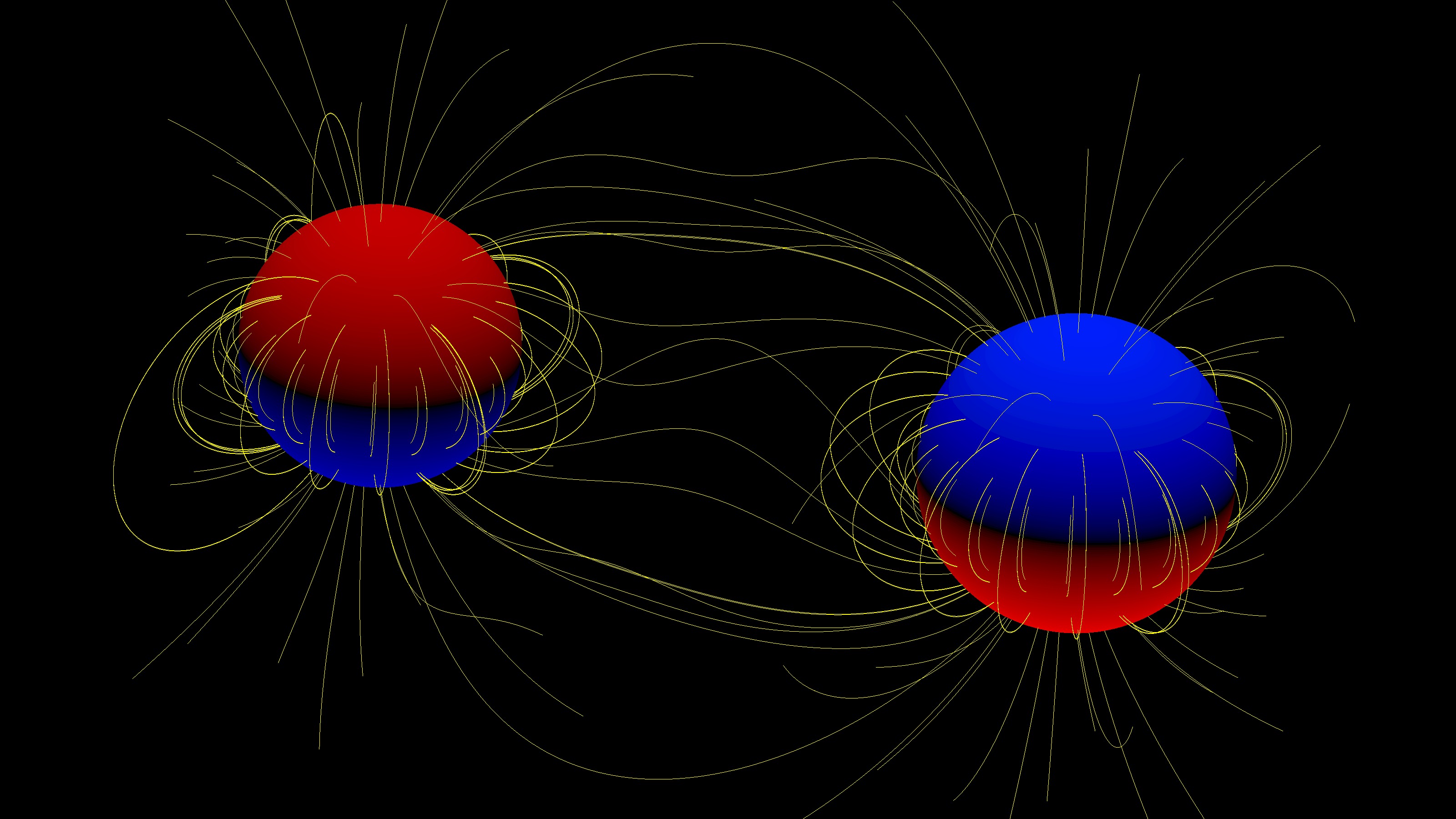
Caption: The polarity of the star's surface magnetic field, north or south, is indicated by red and blue respectively. Yellow lines indicate the magnetic field lines running from the stellar surfaces. Credit: Visualisation courtesy of Volkmar Holzwarth, KIS, Freiburg. Hi-res image


A Canadian PhD student has discovered a unique object – two massive stars with magnetic fields in a binary system. Matt Shultz of Queen’s University, Ontario, Canada found the system – Epsilon Lupi – and publishes the new result in Monthly Notices of the Royal Astronomical Society.

Around 1/3 of stars in our Galaxy are thought to be in binary systems, where two or more stars orbit around a common centre. They are invaluable for astronomers, as watching how they behave lets astronomers measure their mass and connect this with their brightness – a key way in which we understand how stars evolve.

Mr Shultz is a member of the Binarity and Magnetic Interactions in various classes of Stars - BinaMIcS - consortium led by Dr Evelyne Alecian of the University of Grenoble in France. The collaboration is studying the magnetic properties of close binary stars, and Mr Shultz made the discovery using CFHT.

Epsilon Lupi is the fourth brightest star system in the southern constellation of Lupus. The pair of stars is about 500 light years away, are both blue in colour, each have between 7 and 8 times the mass of the Sun, and combined together the pair is around 6000 times as luminous as the Sun. Astronomers have known for many years that Epsilon Lupi is a binary system, but had no idea that the two giant stars had magnetic fields.

Shultz comments: “The origin of magnetism amongst massive stars is something of a mystery and this discovery may help to shed some light on the question of why any of these stars have magnetic fields.”

In cool stars, such as the Sun, magnetic fields are generated by “dynamos” powered by strong convection in the outer layers of the star, where hot material rises, cools and falls back. But there is essentially no convection in the envelopes of massive stars, so there is no support for a magnetic dynamo. Nevertheless, approximately 10% of massive stars have strong magnetic fields.

Two explanations have been proposed for their origin, both variants on the idea of a so-called “fossil” magnetic field, a field generated at some point in the star's past and then locked into the star's surface.

The first hypothesis is that the magnetic field is generated while the star is being formed; a second is that the magnetic field originates in dynamos driven by the violent mixing of material when two already-formed stars in a close binary merge.

“This discovery allows us to rule out the binary merger scenario,” says Mr. Shultz, “However, it doesn't change the basic finding of the BinaMIcS collaboration: fewer than 2% of massive stars in close binaries have magnetic fields, and we still don't know why that is.”

The research shows the strengths of the magnetic fields are similar in the two stars, however their magnetic axes are anti-aligned, with the south magnetic pole of one star pointing in approximately the same direction as the north pole of the other. It may even be that the two stars share a single magnetic field.

“We're not sure why yet, but it probably points to something significant about how the stars are interacting with one another”, adds Shultz.

The stars are close enough that their magnetospheres are likely to be interacting during the whole of their orbit around each other. This means that their magnetic fields may act as a giant brake, slowing down the stars. As a result, in the long term, the two stars could even be spiralling in towards each other.


Additional information 


Media contacts:

Robert Massey
Royal Astronomical Society
Tel: +44 (0)20 7734 3307 x113
Mob: +44 (0)7802 877 699
Email: rm@ras.org.uk

Anne Craig
Queen's University
Tel: +1(1)613-533-2877
Email: anne.craig@queensu.ca


Science contact

Matt Shultz
Queen’s University
Tel: +1(1)613-387-3773
Email: matt.shultz@gmail.com