Showing posts with label Jellyfish galaxies. Show all posts

Friday, November 22, 2024

New Species of Dwarf Galaxy in the Galaxy Cluster Ecosystem?

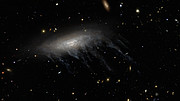
This Hubble Space Telescope image shows the spiral galaxy ESO 137-001, which has been transformed into a "jellyfish galaxy" trailing gaseous tentacles. Credit:
NASA, ESA; Acknowledgements: Ming Sun (UAH), and Serge Meunier

Title: Dark-Matter-Free Dwarf Galaxy Formation at the Tips of the Tentacles of Jellyfish Galaxies
Authors: V. Lora et al.
First Author’s Institution: Institute of Nuclear Sciences, Mexico (UNAM)
Status: Published in ApJL

When Jellyfish Fly

Most galaxies are part of a galaxy cluster, which is exactly what it sounds like — a large collection of galaxies that are gravitationally bound to the larger cluster, much like how stars are gravitationally bound to a larger galaxy. In addition to the galaxies themselves, there is also gas between the galaxies in the cluster, referred to as the intracluster medium. When a disk-like galaxy moves through the intracluster medium in a galaxy cluster, some of the gas within the galaxy (the interstellar medium) gets stripped away from the galaxy. This creates long gaseous tails (or, if you will, tentacles), giving the galaxy an uncanny resemblance to a jellyfish!

Jellyfish galaxies, and their tentacles in particular, have been studied for decades. Astronomers have investigated how much of the gas in the tentacles comes from the intracluster medium versus the interstellar medium, as well as where and how star formation occurs within the tentacles. Interestingly, astronomers have found star-forming regions in the tentacles that have similar masses and sizes to ultra-compact dwarf galaxies. Today’s authors look to reproduce those results computationally and better understand how this dwarf galaxy formation channel works.

Hanging On by a Tentacle

The authors use data from the IllustrisTNG50 simulation, a cosmological simulation large enough to form dozens of galaxy clusters with enough resolution to accurately model features such as the arms of spiral galaxies. The authors identify a set of jellyfish galaxies within this simulation, then make additional cuts to:
  • ensure the galaxies have obvious tentacles;
  • find locations of star formation within the tentacles; and
  • eliminate galaxies where tentacle-like features could be due to interactions with other galaxies.
These cuts leave only one galaxy with a mass of ~400 billion solar masses; compare this to the mass of the Milky Way, which is typically reported as ~1 trillion solar masses. (However, a 2023 study found that the Milky Way mass was closer to ~200 billion solar masses.)

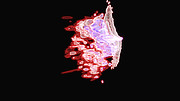
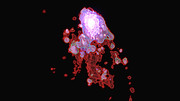
The authors identify a star-forming site within one of the tentacles of this galaxy, highlighted in Figure 1. This both supports the observational evidence and suggests that this may be a new type of dwarf galaxy (more on this in a moment). Additionally, by tracking the galaxy’s history prior to the infall, they determine that the galaxy loses gas but not stars. This means that the gas in the tentacle came from the galaxy, but the stars are forming in the tentacle rather than being relocated from the galaxy. This is a consequence of ram-pressure stripping, the primary physical phenomenon that creates the tails of jellyfish galaxies. Another important finding about the dwarf galaxy candidate is that it lies well outside the dark-matter halo of the jellyfish galaxy, which has important ramifications for its status as a dwarf galaxy candidate.

Figure 1: Different visualizations of the selected galaxy. The top panel shows neutral gas (green), dark matter (white), and star formation (rainbow). The bottom panel shows the dark matter (white) and stellar mass (rainbow). The dwarf candidate is circled in magenta in both panels. Credit: Lora et al. 2024


Figure 2: Star formation rate (top panel) and oxygen abundance (proxy for metal concentration, bottom panel) of the ram-pressure-stripped candidate (magenta). Credit: Lora et al. 2024


Dark-Matter-Deficient Dwarfs

The authors perform additional analysis on the dwarf galaxy candidate. First, they determine that the gas and stars are gravitationally bound, meaning that they can be thought of as a single system much like how a galaxy is thought of as a single system. They also look at the dark-matter content of the dwarf galaxy candidate and find that none of it is gravitationally bound, making this a dark-matter-free dwarf galaxy. Furthermore, they estimate the mass and size of the dwarf galaxy candidate to be ~200 million solar masses and ~1–1.5 kiloparsecs. Based on these findings, the authors conclude that this system represents a new kind of dwarf galaxy, which they dub a ram-pressure-stripped dwarf galaxy; additionally, ram-pressure-stripped dwarf galaxies are unique among dwarf galaxies because they lack a dark-matter halo due to their creation via ram pressure stripping.

The authors also analyze the star formation and metallicity of the ram-pressure-stripped dwarf, shown in Figure 2. They find a high star formation rate compared to other star-forming regions created via ram pressure stripping. They also find that the ram-pressure-stripped dwarf is very metal rich compared to other dwarf galaxies of similar size and mass; this is because the jellyfish galaxy is also rich in metals, so the gas stripped into the tentacle to form stars has a higher concentration of metals.

Today’s authors have found evidence of a new type of dwarf galaxy, which they call a ram-pressure-stripped dwarf galaxy. These dwarf galaxies form via ram pressure stripping in the tentacles of jellyfish galaxies and are characterized as being gravitationally self-bound, hosting star formation, and lacking a dark-matter halo. The authors hope to continue studies of ram-pressure-stripped dwarf galaxies, noting that other cosmological simulations that can resolve smaller amounts of mass may lead to more discoveries of ram-pressure-stripped dwarfs with lower masses.

Original astrobite edited by Amaya Sinha


About the author, Brandon Pries:

I am a graduate student in physics at Georgia Institute of Technology (Georgia Tech). I do research in computational astrophysics with John Wise, using machine learning to study the formation and evolution of supermassive black holes in the early universe. I’ve also done extensive research with the IceCube Collaboration as an undergraduate at Michigan State University, studying applications of neural networks to event reconstructions and searching for signals of neutrinos from dark matter annihilation.


Editor’s Note: Astrobites is a graduate-student-run organization that digests astrophysical literature for undergraduate students. As part of the partnership between the AAS and astrobites, we occasionally repost astrobites content here at AAS Nova. We hope you enjoy this post from astrobites; the original can be viewed at astrobites.org.


Sunday, September 15, 2024

Jellyfish Galaxies: NGC 3312 & NGC 3314

Jellyfish Galaxies: NGC 3312 & NGC 3314

Detail : Low Res. (198 KB) / Mid. Res. (2.5 MB) / High Res. (10.6 MB)

NGC 3312 (above center) and NGC 3314 (below center) are jellyfish galaxies in the Hydra Galaxy Cluster. Both galaxies have filamentary structures toward the lower right that resemble jellyfish’s tentacles. These structures were formed while the disk gas of the galaxies was stripped away by the intense gas pressure of the intergalactic gas as they moved. There may not be any other images like this, featuring two rare jellyfish galaxies in a single field of view.

NGC 3314 is a pair of galaxies (NGC 3314a and NGC 3314b) located at different distances. They overlap in the same line of sight from Earth and do not gravitationally interact. The foreground face-on galaxy (NGC 3314a) is the jellyfish galaxy, and the background inclined galaxy (NGC 3314b) does not have a tentacle-like structure.

Distance from Earth: About 194 million light-years (NGC 3312), 117 million light-years (NGC 3314a), 140 million light-years (NGC 3314b)
Instrument: Hyper Suprime-Cam (HSC)


Tuesday, June 01, 2021

Help astronomers find rare cosmic jellyfish galaxies in this new Zooniverse citizen science project!


Eight examples for jellyfish galaxies. Images like these are presented to the participants of the new Zooniverse project for classification. IllustrisTNG collaboration

A rare kind of galaxy is at the heart of a new citizen science project that is being unveiled today: "Cosmological Jellyfish" is part of the Zooniverse platform, where volunteers can contribute to genuine scientific research projects. In the new project, participants look at the results of a cosmological simulation and identify galaxies that look somewhat like jellyfish. The jellyfish-like appearance is an indicator that the galaxy in question has interacted with gas in a galaxy cluster – which is what the creators of the project, the group of Annalisa Pillepich at the Max Planck Institute for Astronomy, want to study further.

Galaxies like our own Milky Way galaxy, consisting of millions, billions or even hundreds of billions of stars, are large-scale building blocks of our universe. While astronomers are confident they now have a reliable overall picture of how galaxies have formed over the past 13.8 billion years, after the hot Big Bang phase of the universe, many details are still in need of further research – and whenever new observations and powerful simulations become available, there are opportunities of adding pieces to the puzzle.

One region of the puzzle that is badly in need of more pieces is the case of so-called jellyfish galaxies. Such galaxies can be found in galaxy clusters, alongside with thousands of other galaxies. Such clusters not only contain the galaxies themselves, but also thin, hot intergalactic gas. As thin as that gas is, it is enough to make galaxies that are moving at high velocities through the cluster feel a "headwind".

The missing details of jellyfish formation

Imagine someone on a motor bike, with their hair, or maybe their shawl, streaming behind as they move through the surrounding air. Galaxies moving quickly through a cluster feel a similar headwind, or "ram pressure". The stars in such a galaxy are virtually unaffected, but in extreme cases, the gas that is contained in the galaxy can be driven out, streaming behind the galaxy. The result is a galaxy that looks similar to a jellyfish: a body (made up of the galaxy's stars) with tentacles (gas) streaming behind.

We have yet to understand how this works in detail, though: Do such jellyfish galaxies form only in the most massive clusters, or can they form even around our own Milky Way? Where and how quickly do the tails form and how long do they last? What happens to the gas in these tails? How does the stripping process affect the galaxies themselves?

Computer simulations to the rescue

Since the processes in question occur over hundreds of millions or even billions of years, it is impossible for us to observe them happening in the Universe in real time. But we can turn to computer simulations to find out more! Cosmological simulations create a virtual universe following the same laws of physics as our own cosmos. In that model universe, virtual stars and galaxies form, interact, and evolve – and for each galaxy, one can reconstruct its history!

A key problem here are the hugely disparate scales. The physics of how stars evolve takes place on scales of thousands of kilometers. A half-way representative volume of cosmic space is hundreds of millions of light-years across, a factor of one quintillion (one with 18 zeros) larger! No computer simulation has yet managed to simulate individual stars in such a cosmological volume. But for a few years now, there have been simulations that manage to model galaxies in sufficient detail for the simulation to capture ram-pressure in clusters, and the way it can turn galaxies into jellyfish galaxies.

Tracking jellyfish in IllustrisTNG

The first simulations that have managed to capture jellyfish creation are part of a suite called IllustrisTNG. There are three different versions of the IllustrisTNG simulation, each with a different size of the cosmic volume, a different resolution, and containing thousands to hundreds of thousands of galaxies. The two higher-resolution versions of the simulation, known as TNG50 and TNG100, are sufficiently detailed to allow for the formation of jellyfish galaxies.

But in order to study those simulated jellyfish galaxies, the researchers need to determine which of the tens of thousands of galaxies in their virtual universe are jellyfish galaxies in the first place! This requires a process that is still very difficult for computers to do automatically – but comparatively simple for human brains, with their excellent pattern recognition skills. That is why, as a first step, the researchers set out to learn which of their simulated galaxies look like jellyfish to a human observer, with a body made of stars trailing a tail made of gas.

Crowdsourcing jellyfish-galaxy identification

In a pilot study, led by Kiyun Yun, one of the group's PhD students, the team members themselves identified by eye 800 jellyfish galaxies among 2600 pre-selected candidates. But that is only a fraction of the available data – and looking at all the data in this fashion is more than a small team of scientists can handle.

This is where the Zooniverse comes in: the world’s largest and most popular platform for people-powered research, which specializes in exactly this kind of citizen science: projects where human volunteers and their pattern-recognition-savvy brains can contribute to cutting-edge scientific research. Parsing through 38,000 images in search of rare galaxies is a considerable task, but not that difficult if thousands of volunteers take it on.

Building on work by Yun and another group member Elad Zinger, now at the Hebrew University of Jerusalem, post-doctoral researcher Gandhali Joshi transformed the problem of jellyfish galaxy identification into the Zooniverse project that is now being revealed: Cosmological Jellyfish.

Kickstarting jellyfish galaxy research

In the project, participants study pictures, each of which shows a galaxy in the middle of the image. Each picture was created from the TNG50 and TNG100 simulations, and shows a particular galaxy viewed from a random angle, along with any other gas and galaxies contained in that region Participants then need to decide: Does that particular galaxy look like a jellyfish or not?

While the project provides a tutorial, as well as classification feedback for some of the images, nature is messy – even faithfully simulated nature. There will always be cases where it is difficult to decide whether or not a specific galaxy resembles a jellyfish. But in the end, it's OK to be uncertain: During the project, each galaxy will be classified by at least twenty different participants. In the end, researchers will be able to distinguish galaxies that clearly are, or are not, jellyfish galaxies from more ambiguous specimens (where some participants saw jellyfish, others not).

Once the jellyfish galaxies are identified, the researchers know which galaxies in their simulated universe they will need to look at more closely. The simulation provides the complete formation history for each galaxy, so at that stage, the scientists should be able to find out how these galaxies were formed, how they evolved to look like jellyfish in the first place – and what went differently for the galaxies that do not look like jellyfish!

Links The Cosmological Jellyfish project is available in English, in German and in Hebrew at https://www.zooniverse.org/projects/apillepich/cosmological-jellyfish

Contact

Markus Pössel
Head of press and public relations 

Wednesday, August 16, 2017

Supermassive Black Holes Feed on Cosmic Jellyfish

Example of a jellyfish galaxy

Example of a jellyfish galaxy

Visualisation of MUSE view of Jellyfish Galaxy

Example of a jellyfish galaxy


Videos 

ESOcast 122 Light: Supermassive Black Holes Feed on Cosmic Jellyfish (4K UHD)

Visualisation of galaxy undergoing ram pressure stripping

Artist's impression of ram pressure stripping

Visualisation of a galaxy undergoing ram pressure stripping


ESO’s MUSE instrument on the VLT discovers new way to fuel black holes


Observations of “Jellyfish galaxies” with ESO’s Very Large Telescope have revealed a previously unknown way to fuel supermassive black holes. It seems the mechanism that produces the tentacles of gas and newborn stars that give these galaxies their nickname also makes it possible for the gas to reach the central regions of the galaxies, feeding the black hole that lurks in each of them and causing it to shine brilliantly. The results appeared today in the journal Nature.

An Italian-led team of astronomers used the MUSE (Multi-Unit Spectroscopic Explorer) instrument on the Very Large Telescope (VLT) at ESO’s Paranal Observatory in Chile to study how gas can be stripped from galaxies. They focused on extreme examples of jellyfish galaxies in nearby galaxy clusters, named after the remarkable long “tentacles” of material that extend for tens of thousands of light-years beyond their galactic discs [1][2].

The tentacles of jellyfish galaxies are produced in galaxy clusters by a process called ram pressure stripping. Their mutual gravitational attraction causes galaxies to fall at high speed into galaxy clusters, where they encounter a hot, dense gas which acts like a powerful wind, forcing tails of gas out of the galaxy’s disc and triggering starbursts within it.

Six out of the seven jellyfish galaxies in the study were found to host a supermassive black hole at the centre, feeding on the surrounding gas [3]. This fraction is unexpectedly high — among galaxies in general the fraction is less than one in ten.

This strong link between ram pressure stripping and active black holes was not predicted and has never been reported before,” said team leader Bianca Poggianti from the INAF-Astronomical Observatory of Padova in Italy. “It seems that the central black hole is being fed because some of the gas, rather than being removed, reaches the galaxy centre.” [4]

A long-standing question is why only a small fraction of supermassive black holes at the centres of galaxies are active. Supermassive black holes are present in almost all galaxies, so why are only a few accreting matter and shining brightly? These results reveal a previously unknown mechanism by which the black holes can be fed.

Yara Jaffé, an ESO fellow who contributed to the paper explains the significance: “These MUSE observations suggest a novel mechanism for gas to be funnelled towards the black hole’s neighbourhood. This result is important because it provides a new piece in the puzzle of the poorly understood connections between supermassive black holes and their host galaxies.

The current observations are part of a much more extensive study of many more jellyfish galaxies that is currently in progress.

This survey, when completed, will reveal how many, and which, gas-rich galaxies entering clusters go through a period of increased activity at their cores,” concludes Poggianti. “A long-standing puzzle in astronomy has been to understand how galaxies form and change in our expanding and evolving Universe. Jellyfish galaxies are a key to understanding galaxy evolution as they are galaxies caught in the middle of a dramatic transformation.


Notes

[1] To date, just over 400 candidate jellyfish galaxies have been found.


[2] The results were produced as part of the observational programme known as GASP (GAs Stripping Phenomena in galaxies with MUSE), which is an ESO Large Programme aimed at studying where, how and why gas can be removed from galaxies. GASP is obtaining deep, detailed MUSE data for 114 galaxies in various environments, specifically targeting jellyfish galaxies. Observations are currently in progress.

[3] It is well established that almost every, if not every, galaxy hosts a supermassive black hole at its centre, between a few million and a few billion times as massive as our Sun. When a black hole pulls in matter from its surroundings, it emits electromagnetic energy, giving rise to some of the most energetic of astrophysical phenomena: active galactic nuclei (AGN).

[4] The team also investigated the alternative explanation that the central AGN activity contributes to stripping gas from the galaxies, but considered it less likely. Inside the galaxy cluster, the jellyfish galaxies are located in a zone where the hot, dense gas of the intergalactic medium is particularly likely to create the galaxy’s long tentacles, reducing the possibility that they are created by AGN activity. There is therefore stronger evidence that ram pressure triggers the AGN and not vice versa.


More Information


This research was presented in a paper entitled “Ram Pressure Feeding Supermassive Black Holes” by B. Poggianti et al., to appear in the journal Nature on 17 August 2017.

The team is composed of B. Poggianti (INAF-Astronomical Observatory of Padova, Italy), Y. Jaffé (ESO, Chile), A. Moretti (INAF-Astronomical Observatory of Padova, Italy), M. Gullieuszik (INAF-Astronomical Observatory of Padova, Italy), M. Radovich (INAF-Astronomical Observatory of Padova, Italy), S. Tonnesen (Carnegie Observatory, USA), J. Fritz (Instituto de Radioastronomía y Astrofísica, Mexico), D. Bettoni (INAF-Astronomical Observatory of Padova, Italy), B. Vulcani (University of Melbourne, Australia; INAF-Astronomical Observatory of Padova, Italy), G. Fasano (INAF-Astronomical Observatory of Padova, Italy), C. Bellhouse (University of Birmingham, UK; ESO, Chile), G. Hau (ESO, Chile) and A. Omizzolo (Vatican Observatory, Vatican City State).

ESO is the foremost intergovernmental astronomy organisation in Europe and the world’s most productive ground-based astronomical observatory by far. It is supported by 16 countries: Austria, Belgium, Brazil, the Czech Republic, Denmark, France, Finland, Germany, Italy, the Netherlands, Poland, Portugal, Spain, Sweden, Switzerland and the United Kingdom, along with the host state of Chile. ESO carries out an ambitious programme focused on the design, construction and operation of powerful ground-based observing facilities enabling astronomers to make important scientific discoveries. ESO also plays a leading role in promoting and organising cooperation in astronomical research. ESO operates three unique world-class observing sites in Chile: La Silla, Paranal and Chajnantor. At Paranal, ESO operates the Very Large Telescope and its world-leading Very Large Telescope Interferometer as well as two survey telescopes, VISTA working in the infrared and the visible-light VLT Survey Telescope. ESO is also a major partner in two facilities on Chajnantor, APEX and ALMA, the largest astronomical project in existence. And on Cerro Armazones, close to Paranal, ESO is building the 39-metre Extremely Large Telescope, the ELT, which will become “the world’s biggest eye on the sky”.


Links


Contacts

Bianca Poggianti
INAF-Astronomical Observatory of Padova
Padova, Italy
Tel: +39 340 7448663
Email: bianca.poggianti@oapd.inaf.it

Richard Hook
ESO Public Information Officer
Garching bei München, Germany
Tel: +49 89 3200 6655
Cell: +49 151 1537 3591

Source: ESO/News