Astronomers studying galaxy evolution have
long struggled to understand what causes star formation to shut down in
massive galaxies. Although many theories have been proposed to explain
this process, known as “quenching,” there is still no consensus on a
satisfactory model.
Now, an international team led by Sandra Faber, professor emerita of
astronomy and astrophysics at UC Santa Cruz, has proposed a new model
that successfully explains a wide range of observations about galaxy
structure, supermassive black holes, and the quenching of star
formation. The researchers presented their findings in a paper published July 1 in the Astrophysical Journal.
The model supports one of the leading ideas about quenching which
attributes it to black hole “feedback,” the energy released into a
galaxy and its surroundings from a central supermassive black hole as
matter falls into the black hole and feeds its growth. This energetic
feedback heats, ejects, or otherwise disrupts the galaxy’s gas supply,
preventing the infall of gas from the galaxy’s halo to feed star
formation.
“The idea is that in star-forming galaxies, the central black hole is
like a parasite that ultimately grows and kills the host,” Faber
explained. “That’s been said before, but we haven’t had clear rules to
say when a black hole is big enough to shut down star formation in its
host galaxy, and now we have quantitative rules that actually work to
explain our observations.”
Size and mass
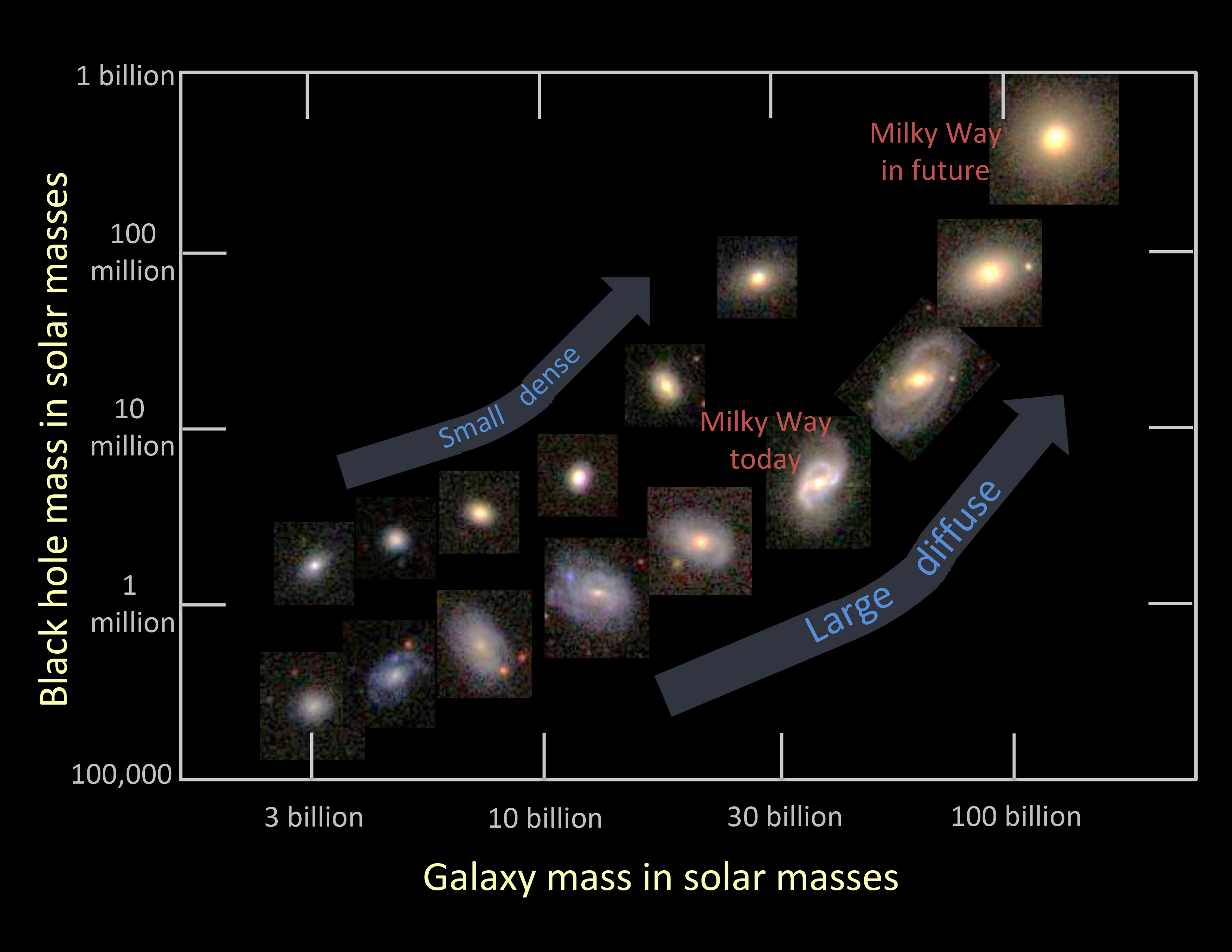
The basic idea involves the relationship between the mass of the
stars in a galaxy (stellar mass), how spread out those stars are (the
galaxy’s radius), and the mass of the central black hole. For
star-forming galaxies with a given stellar mass, the density of stars in
the center of the galaxy correlates with the radius of the galaxy so
that galaxies with bigger radii have lower central stellar densities.
Assuming that the mass of the central black hole scales with the central
stellar density, star-forming galaxies with larger radii (at a given
stellar mass) will have lower black-hole masses.
What that means, Faber explained, is that larger galaxies (those with
larger radii for a given stellar mass) have to evolve further and build
up a higher stellar mass before their central black holes can grow
large enough to quench star formation. Thus, small-radius galaxies
quench at lower masses than large-radius galaxies.
“That is the new insight, that if galaxies with large radii have
smaller black holes at a given stellar mass, and if black hole feedback
is important for quenching, then large-radius galaxies have to evolve
further,” she said. “If you put together all these assumptions,
amazingly, you can reproduce a large number of observed trends in the
structural properties of galaxies.”
This explains, for example, why more massive quenched galaxies have
higher central stellar densities, larger radii, and larger central black
holes.
Based on this model, the researchers concluded that quenching begins
when the total energy emitted from the black hole is approximately four
times the gravitational binding energy of the gas in the galactic halo.
The binding energy refers to the gravitational force that holds the gas
within the halo of dark matter enveloping the galaxy. Quenching is
complete when the total energy emitted from the black hole is twenty
times the binding energy of the gas in the galactic halo.
Physical processes
Faber emphasized that the model does not yet explain in detail the
physical mechanisms involved in the quenching of star formation. “The
key physical processes that this simple theory evokes are not yet
understood,” she said. “The virtue of this, though, is that having
simple rules for each step in the process challenges theorists to come
up with physical mechanisms that explain each step.”
Astronomers are accustomed to thinking in terms of diagrams that plot
the relations between different properties of galaxies and show how
they change over time. These diagrams reveal the dramatic differences in
structure between star-forming and quenched galaxies and the sharp
boundaries between them. Because star formation emits a lot of light at
the blue end of the color spectrum, astronomers refer to “blue”
star-forming galaxies, “red” quiescent galaxies, and the “green valley”
as the transition between them. Which stage a galaxy is in is revealed
by its star formation rate.
One of the study’s conclusions is that the growth rate of black holes
must change as galaxies evolve from one stage to the next. The
observational evidence suggests that most of the black hole growth
occurs in the green valley when galaxies are beginning to quench.
“The black hole seems to be unleashed just as star formation slows
down,” Faber said. “This was a revelation, because it explains why black
hole masses in star-forming galaxies follow one scaling law, while
black holes in quenched galaxies follow another scaling law. That makes
sense if black hole mass grows rapidly while in the green valley.”
CANDELS
Faber and her collaborators have been discussing these issues for
many years. Since 2010, Faber has co-led a major Hubble Space Telescope
galaxy survey program (CANDELS,
the Cosmic Assembly Near-infrared Deep Extragalactic Legacy Survey),
which produced the data used in this study. In analyzing the CANDELS
data, she has worked closely with a team led by Joel Primack, UCSC
professor emeritus of physics, which developed the Bolshoi cosmological simulation
of the evolution of the dark matter halos in which galaxies form. These
halos provide the scaffolding on which the theory builds the early
star-forming phase of galaxy evolution before quenching.
The central ideas in the paper emerged from analyses of CANDELS data
and first struck Faber about four years ago. “It suddenly leaped out at
me, and I realized if we put all these things together—if galaxies had a
simple trajectory in radius versus mass, and if black hole energy needs
to overcome halo binding energy—it can explain all these slanted
boundaries in the structural diagrams of galaxies,” she said.
At the time, Faber was making frequent trips to China, where she has
been involved in research collaborations and other activities. She was a
visiting professor at Shanghai Normal University, where she met first
author Zhu Chen. Chen came to UC Santa Cruz in 2017 as a visiting
researcher and began working with Faber to develop these ideas about
galaxy quenching.
“She is mathematically very good, better than me, and she did all of the calculations for this paper,” Faber said.
Faber also credited her longtime collaborator David Koo, UCSC
professor emeritus of astronomy and astrophysics, for first focusing
attention on the central densities of galaxies as a key to the growth of
central black holes.
Among the puzzles explained by this new model is a striking
difference between our Milky Way galaxy and its very similar neighbor
Andromeda. “The Milky Way and Andromeda have almost the same stellar
mass, but Andromeda’s black hole is almost 50 times bigger than the
Milky Way’s,” Faber said. “The idea that black holes grow a lot in the
green valley goes a long way toward explaining this mystery. The Milky
Way is just entering the green valley and its black hole is still small,
whereas Andromeda is just exiting so its black hole has grown much
bigger, and it is also more quenched than the Milky Way.”
In addition to Faber, Chen, Koo, and Primack, the coauthors of the
paper include researchers at some two dozen institutions in seven
countries. This work was funded by grants from NASA and the National
Science Foundation.
By Tim Stephens
Source: UC Santa Cruz