Showing posts with label asymptotic giant branch (AGB). Show all posts

Sunday, April 27, 2025

I’ve Got Some Oceanfront Property… Around a White Dwarf

Illustration of an exoplanet orbiting a white dwarf
Credit:
NASA / JPL-Caltech

Title: The Fate of Oceans on First-Generation Planets Orbiting White Dwarfs
Authors: Juliette Becker, Andrew Vanderburg, and Joseph R. Livesey
First Author’s Institution: University of Wisconsin–Madison
Status: Published in ApJ

Toward the ends of their lives, stars like the Sun are destined to expand into red giants, expel their outer layers, and leave behind their Earth-sized cores as white dwarfs. What happens to any planets during this stage of stellar evolution is far more uncertain. Planets sufficiently close to their host star are expected to be engulfed as the star expands into a red giant, including our very own Earth. However, some planets can survive or perhaps even form during white-dwarf formation, and we know of a handful of planets and planet candidates around white dwarfs from transits, direct imaging, and detection of mid-infrared excess.

Planets orbiting white dwarfs are particularly attractive targets for searches for biosignatures and, more speculatively, technosignatures, because their atmospheres are easier to detect due to their stars’ small sizes. We have yet to find a terrestrial planet orbiting a white dwarf, let alone one in the habitable zone, but searches are ongoing. Another important factor for habitability is the presence of water, and today’s article investigates whether a planet could retain an ocean through its star’s evolution and end up in the habitable zone, where life might exist.

Stellar Ocean Loss

To set the scene, let us imagine an ocean-bearing planet orbiting a Sun-like star evolving off the main sequence. Even if the planet survives engulfment, it could easily lose its water and become likely uninhabitable if the following steps occur: 1) high surface temperatures evaporate the ocean into the atmosphere, 2) high-energy photons dissociate the water molecules into hydrogen and oxygen, and 3) those atoms escape into space and do not re-condensate.

As the star leaves the main sequence, the planet responds to changes in the star’s size, brightness, and mass. The top four panels of Figure 1 show variations in stellar and planetary properties during this stage of stellar evolution. During the asymptotic giant branch phase, the star brightens considerably and expels ~30–80% of its mass, causing the planet’s orbit to expand. X-ray and extreme-ultraviolet flux from the star can cause the planet to lose atmospheric mass from photoevaporation (i.e., when high-energy photons deposit sufficient energy for particles to reach escape velocity). As the planet’s surface temperature increases, the ocean could evaporate, creating a predominantly water vapor atmosphere. If the extreme-ultraviolet flux is sufficiently high such that oxygen and/or hydrogen escape the atmosphere, the ocean is lost. The bottom panel of Figure 1 shows that water retention becomes more difficult if the planet’s initial orbital radius is small.

Figure 1: From top to bottom, stellar luminosity, stellar mass, planetary semi-major axis, and planetary temperature as a star becomes a red giant and subsequently a white dwarf. The bottom panel shows the fraction of the ocean retained for an Earth-like planet with various values of initial semi-major axis. Credit: Becker et al. 2025


Tidal Ocean Loss

Not only does the ocean have to survive the aforementioned complications, but the planet needs to end up in the habitable zone despite starting far away from the star. The planet must be perturbed to achieve high eccentricity and then tidally circularize its orbit in the white-dwarf habitable zone (~0.01 au). Planet–planet scattering (i.e., dynamical interactions between planets in a multi-planet system) is the most plausible mechanism to drive a planet inwards. These interactions could be delayed substantially after white-dwarf formation. Since white dwarfs cool and emit less extreme-ultraviolet flux over time, delaying inward scattering could enhance water retention.

Large eccentricity helps drive a planet inwards, but it also stokes tidal heating that could increase the surface temperature. The exact effects on ocean evaporation and atmospheric mass loss are highly sensitive to how energy is dissipated. In general, tidal heating can result in Jeans escape, in which atmospheric particles reach sufficient thermal motion to escape into space. The authors find that while tidal heating is effective at evaporating the ocean into the atmosphere, it is less effective than the extreme-ultraviolet-driven mechanism at driving atmospheric mass loss.

Figure 2: The effects of white-dwarf scattering temperature and final orbital radius on ocean survival. The authors use an Earth-like planet with an initial orbital radius of 5 au and varying eccentricity. Credit: Becker et al. 2025

Takeaways

There are a variety of factors that affect whether an ocean can be retained, including the planet’s initial orbital radius, the initial quantity of water, the stellar extreme-ultraviolet flux, the time at which the planet is scattered inwards, and the planet’s final orbital radius. To hold onto water, a planet must either start in a distant orbit (greater than 5–6 au for an Earth-sized ocean) or start with a massive quantity of water. Since large extreme-ultraviolet flux is required to drive water loss via photoevaporation, delaying inward scattering until the white dwarf cools aids ocean survival, as shown in Figure 2, which also shows that a larger final radius enhances water retention. If certain conditions are met, an ocean could be retained by a planet orbiting a white dwarf. This is an exciting finding for those searching for planets and signs of life around white dwarfs.

Original astrobite edited by William Smith


Editor’s Note: Astrobites is a graduate-student-run organization that digests astrophysical literature for undergraduate students. As part of the partnership between the AAS and astrobites, we occasionally repost astrobites content here at AAS Nova. We hope you enjoy this post from astrobites; the original can be viewed at astrobites.org.


About the author, Kylee Carden:

I am a second-year PhD student at The Ohio State University, where I am an observer of planets outside the solar system. I’m involved with the Roman Space Telescope, a small robotic telescope called DEMONEXT, and exoplanet atmospheres. I am a huge fan of my cat Piccadilly, cycling, and visiting underappreciated tourist sites.


Saturday, September 19, 2020

Astronomers Solve Mystery of How Planetary Nebulae Are Shaped

Gallery of stellar winds around cool aging stars, showing a variety of morphologies, including disks, cones, and spirals. The blue color represents material that is coming towards you, red ismaterial that is moving away from you. Image 8, in particular, shows the stellar wind of R Aquilae, which resembles the structure of rose petals. Credit: L. Decin, ESO/ALMA. High Resolution (jpg)- Low Resolution (jpg)

An international team of astronomers focused their observations on stellar winds—particle flows—around cool red giant stars, also known as asymptotic giant branch (AGB) stars. "AGB stars are cool luminous evolved stars that are in the last stages of evolution just before turning into a planetary nebula," said Carl Gottlieb, an astronomer at the Center for Astrophysics | Harvard & Smithsonian, and a co-author on the paper. "Through their winds, AGB stars contribute about 85% of the gas and 35% of the dust from stellar sources to the Galactic Interstellar Medium and are the dominant suppliers of pristine building blocks of interstellar material from which planets are ultimately formed."

Despite being of major interest to astronomers, a large, detailed collection of observational data for the stellar winds surrounding AGB stars—each made using the exact same method—was lacking prior to the study, which resulted in a long-standing scientific misconception: that stellar winds have an overall spherical symmetry. "The lack of such detailed observational data caused us to initially assume that the stellar winds have an overall spherical geometry, much like the stars they surround," said Gottlieb. "Our new observational data shapes a much different story of individual stars, how they live, and how they die. We now have an unprecedented view of how stars like our Sun will evolve during the last stages of their evolution."

Observations with the Atacama Large Millimeter/submillimeter Array (ALMA) in Chile revealed something strange: the shape of the stellar winds didn't conform with scientific consensus. "We noticed these winds are anything but round," said Professor Leen Decin of KU Leuven University in Belgium, and the lead author on the paper. "Some of them are actually quite similar to planetary nebulae." The new findings may have a significant impact on calculations of galactic and stellar evolution, most pointedly for the evolution of Sun-like stars. "Our findings change a lot,” said Decin. "Since the complexity of stellar winds was not accounted for in the past, any previous estimate of the mass-loss rate of old stars could be wrong by up to a factor of 10."

The observations revealed many different shapes, further connecting stellar wind formation to that of planetary nebulae. "The winds we observed exhibit various shapes that are similar to planetary nebulae,” said Gottlieb. "Some are disk-like, while others are shaped like eyes, spiral structures, and even arcs."

Astronomers quickly realized that the shapes weren’t formed randomly, and that companions—low-mass stars and heavy planets—in the vicinity of the AGB stars were influencing the shapes and patterns. "Just like a spoon that you stir in a cup of coffee with some milk can create a spiral pattern, the companion sucks material towards it as it revolves around the star and shapes the stellar wind,” said Decin. "All of our observations can be explained by the fact that the stars have a companion."

In addition, the study provides a strong foundation for understanding Sun-like stars and the future of the Sun itself. "In about five billion years, the Sun will become more luminous," said Gottlieb. "Its radius will expand to a length that is comparable to the current distance between the Sun and Earth, and it will enter the AGB phase." Decin added, "Jupiter or even Saturn—because they have such a big mass—are going to influence whether the Sun spends its last millennia at the heart of a spiral, a butterfly or any of the other entrancing shapes we see in planetary nebulae today. Our current simulations predict that Jupiter and Saturn will create a weak spiral structure in the wind of the Sun once it is an AGB star."

About Center for Astrophysics | Harvard & Smithsonian

Headquartered in Cambridge, Mass., the Center for Astrophysics | Harvard & Smithsonian (CfA) is a collaboration between the Smithsonian Astrophysical Observatory and the Harvard College Observatory. CfA scientists, organized into six research divisions, study the origin, evolution and ultimate fate of the universe.

For more information, contact:

Amy Oliver
Public Affairs
Center for Astrophysics | Harvard & Smithsonian
Fred Lawrence Whipple Observatory
520-879-4406

amy.oliver@cfa.harvard.edu


Source:  Harvard-Smithsonian Center for Astrophysics (CfA)


Monday, February 12, 2018

A red giant sheds its skin

Credit: ESO/M. Wittkowski (ESO)

This ghostly image features a distant and pulsating red giant star known as R Sculptoris. Situated 1200 light-years away in the constellation of Sculptor, R Sculptoris is something known as a carbon-rich asymptotic giant branch (AGB) star, meaning that it is nearing the end of its life. At this stage, low- and intermediate-mass stars cool off, create extended atmospheres, and lose a lot of their mass — they are on their way to becoming spectacular planetary nebulae.

While the basics of this mass-loss process are understood, astronomers are still investigating how it begins near the surface of the star. The amount of mass lost by a star actually has huge implications for its stellar evolution, altering its future, and leading to different types of planetary nebulae. As AGB stars end their lives as planetary nebulae, they produce a vast range of elements — including 50% of elements heavier than iron — which are then released into the Universe and used to make new stars, planets, moons, and eventually the building blocks of life.

One particularly intriguing feature of R Sculptoris is its dominant bright spot, which looks to be two or three times brighter than the other regions. The astronomers that captured this wonderful image, using ESO’s Very Large TelescopeInterferometer (VLTI), have concluded that R Sculptoris is surrounded by giant “clumps” of stellar dust that are peeling away from the shedding star. This bright spot is, in fact, a region around the star with little to no dust, allowing us to look deeper into the stellar surface.

This image captures an extremely small section of the sky: approximately 20x20 milliarcseconds. For comparison, Jupiter has an angular size of approximately 40 arcseconds.


Links


Source: ESO/Potw

Thursday, September 21, 2017

Ageing Star Blows Off Smoky Bubble

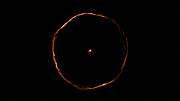
Delicate bubble of expelled material around the cool red star U Antliae

The star U Ant in the constellation of Antlia (The Air Pump)

Wide-field image of the sky around U Antliae

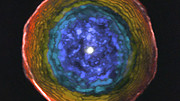
PR Image eso1730d
ALMA view of the motions of material in the shell around U Antliae


Videos

ESOcast 127 Light: Ageing Star Blows Off Smoky Bubble

Flying from the Earth to the star U Antliae

Tomography of a cosmic bubble


Astronomers have used ALMA to capture a strikingly beautiful view of a delicate bubble of expelled material around the exotic red star U Antliae. These observations will help astronomers to better understand how stars evolve during the later stages of their life-cycles.

In the faint southern constellation of Antlia (The Air Pump) the careful observer with binoculars will spot a very red star, which varies slightly in brightness from week to week. This very unusual star is called U Antliae and new observations with the Atacama Large Millimeter/submillimeter Array (ALMA) are revealing a remarkably thin spherical shell around it.

U Antliae [1] is a carbon star, an evolved, cool and luminous star of the asymptotic giant branch type. Around 2700 years ago, U Antliae went through a short period of rapid mass loss. During this period of only a few hundred years, the material making up the shell seen in the new ALMA data was ejected at high speed. Examination of this shell in further detail also shows some evidence of thin, wispy gas clouds known as filamentary substructures.

This spectacular view was only made possible by the unique ability to create sharp images at multiple wavelengths that is provided by the ALMA radio telescope, located on the Chajnantor Plateau in Chile’s Atacama Desert. ALMA can see much finer structure in the U Antliae shell than has previously been possible.

The new ALMA data are not just a single image; ALMA produces a three-dimensional dataset  (a data cube) with each slice being observed at a slightly different wavelength. Because of the Doppler Effect, this means that different slices of the data cube show images of gas moving at different speeds towards or away from the observer. This shell is also remarkable as it is very symmetrically round and also remarkably thin. By displaying the different velocities we can cut this cosmic bubble into virtual slices just as we do in computer tomography of a human body.

Understanding the chemical composition of the shells and atmospheres of these stars, and how these shells form by mass loss, is important to properly understand how stars evolve in the early Universe and also how galaxies evolved. Shells such as the one around U Antliae show a rich variety of chemical compounds based on carbon and other elements. They also help to recycle matter, and contribute up to 70% of the dust between stars.


Notes

[1] The name U Antliae reflects the fact that it is the fourth star that changes its brightness to be found in the constellation of Antlia (The Air Pump). The naming of such variable stars followed a complicated sequence as more and more were found and is explained here . 


More Information

This research was presented in a paper entitled “Rings and filaments. The remarkable detached CO shell of U Antliae”, by F. Kerschbaum et al., to appear in the journal Astronomy & Astrophysics.

The team is composed of F. Kerschbaum (University of Vienna, Austria), M. Maercker (Chalmers University of Technology, Onsala Space Observatory, Sweden), M. Brunner (University of Vienna, Austria), M. Lindqvist (Chalmers University of Technology, Onsala Space Observatory, Sweden), H. Olofsson (Chalmers University of Technology, Onsala Space Observatory, Sweden), M. Mecina (University of Vienna, Austria), E. De Beck (Chalmers University of Technology, Onsala Space Observatory, Sweden), M. A. T. Groenewegen (Koninklijke Sterrenwacht van België, Belgium), E. Lagadec (Observatoire de la Côte d’Azur, CNRS, France), S. Mohamed (University of Cape Town, South Africa), C. Paladini (Université Libre de Bruxelles, Belgium), S. Ramstedt (Uppsala University, Sweden), W. H. T. Vlemmings (Chalmers University of Technology, Onsala Space Observatory, Sweden), and M. Wittkowski (ESO)

The Atacama Large Millimeter/submillimeter Array (ALMA), an international astronomy facility, is a partnership of ESO, the U.S. National Science Foundation (NSF) and the National Institutes of Natural Sciences (NINS) of Japan in cooperation with the Republic of Chile. ALMA is funded by ESO on behalf of its Member States, by NSF in cooperation with the National Research Council of Canada (NRC) and the National Science Council of Taiwan (NSC) and by NINS in cooperation with the Academia Sinica (AS) in Taiwan and the Korea Astronomy and Space Science Institute (KASI).
ALMA construction and operations are led by ESO on behalf of its Member States; by the National Radio Astronomy Observatory (NRAO), managed by Associated Universities, Inc. (AUI), on behalf of North America; and by the National Astronomical Observatory of Japan (NAOJ) on behalf of East Asia. The Joint ALMA Observatory (JAO) provides the unified leadership and management of the construction, commissioning and operation of ALMA.

ESO is the foremost intergovernmental astronomy organisation in Europe and the world’s most productive ground-based astronomical observatory by far. It is supported by 16 countries: Austria, Belgium, Brazil, the Czech Republic, Denmark, France, Finland, Germany, Italy, the Netherlands, Poland, Portugal, Spain, Sweden, Switzerland and the United Kingdom, along with the host state of Chile. ESO carries out an ambitious programme focused on the design, construction and operation of powerful ground-based observing facilities enabling astronomers to make important scientific discoveries. ESO also plays a leading role in promoting and organising cooperation in astronomical research. ESO operates three unique world-class observing sites in Chile: La Silla, Paranal and Chajnantor. At Paranal, ESO operates the Very Large Telescope and its world-leading Very Large Telescope Interferometer as well as two survey telescopes, VISTA working in the infrared and the visible-light VLT Survey Telescope. ESO is also a major partner in two facilities on Chajnantor, APEX and ALMA, the largest astronomical project in existence. And on Cerro Armazones, close to Paranal, ESO is building the 39-metre Extremely Large Telescope, the ELT, which will become “the world’s biggest eye on the sky”.


Links


Contacts

Franz Kerschbaum
University of Vienna
Vienna, Austria
Tel: +43 1 4277-51856
Email:
franz.kerschbaum@univie.ac.at

Richard Hook
ESO Public Information Officer
Garching bei München, Germany
Tel: +49 89 3200 6655
Cell: +49 151 1537 3591
Email:
rhook@eso.org


Source: ESO/News