Showing posts with label first galaxies. Show all posts

Thursday, July 03, 2025

ALMA Reveals Hidden Structures in the First Galaxies of the Universe

A family portrait of galaxies from the CRISTAL survey. The image shows the gas traced by ALMA’s [CII] observations. Blue and green represent starlight captured by the Hubble and James Webb Space Telescopes. Credit: ALMA (ESO/NAOJ/NRAO) / HST / JWST / R. Herrera-Camus

A family portrait of galaxies from the CRISTAL survey. Red shows cold gas traced by ALMA’s [CII] observations. Blue and green represent starlight captured by the Hubble and James Webb Space Telescopes. Credit: ALMA (ESO/NAOJ/NRAO) / HST / JWST / R. Herrera-Camus

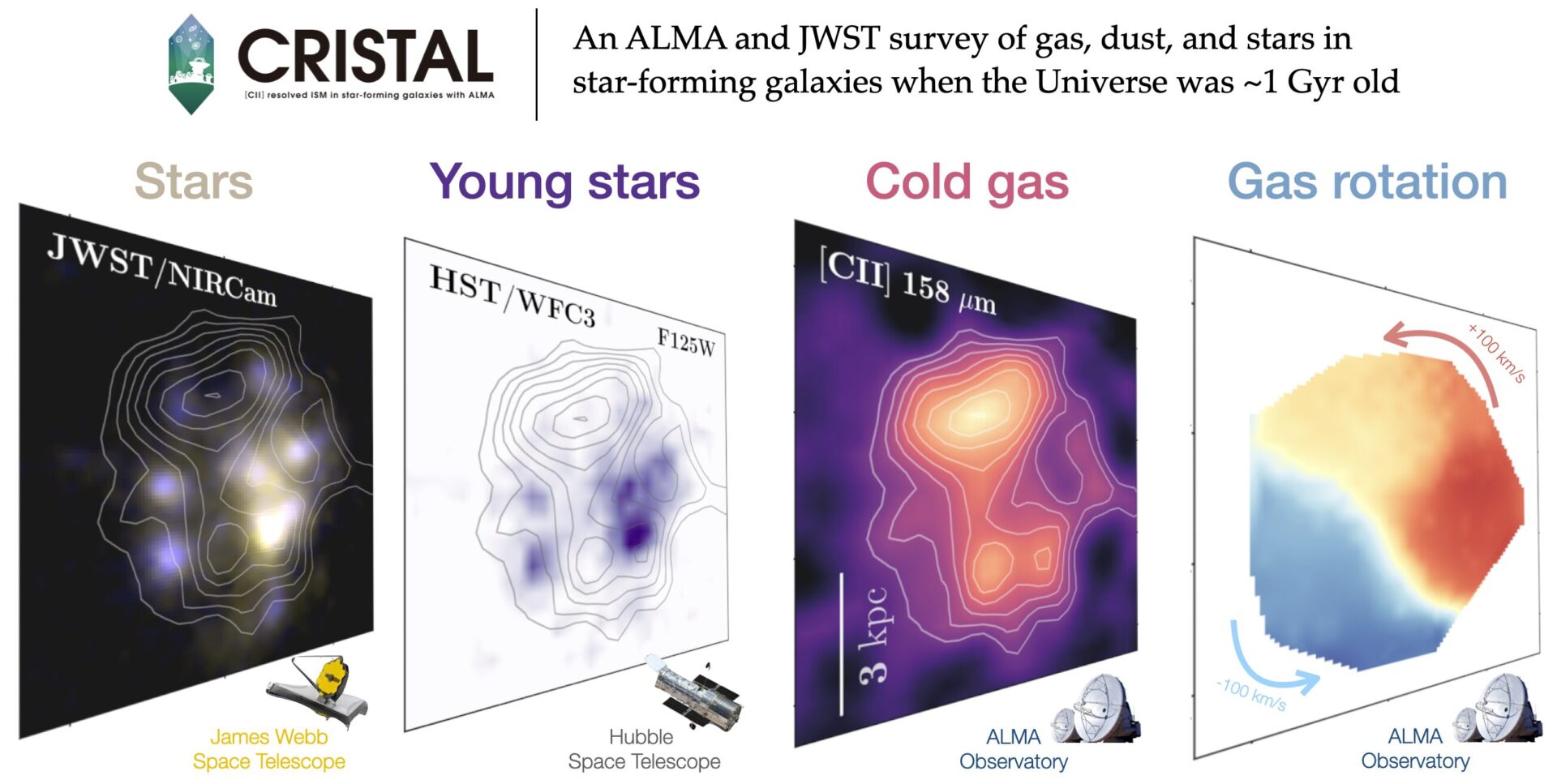
Zoom into the emission from an early galaxy observed in the CRISTAL survey. From left to right, the image shows stellar light captured by the James Webb and Hubble space telescopes, as well as the cold gas and rotation of the galaxy traced by ALMA through ionized carbon emission. Credit: ALMA / HST / JWST / R. Herrera-Camus

Artist’s illustration of CRISTAL-13. Dust-rich regions obscure newborn stars, whose energy is re-emitted at ALMA’s millimeter wavelengths. Right: young star clusters clear the dust and shine visibly in JWST and HST images. Credit: NSF/AUI/NRAO/B. Saxton


CRISTAL survey, led from Chile, traces cold gas, dust, and stellar light in 39 galaxies just 1 billion years after the Big Bang

Astronomers have used the Atacama Large Millimeter/submillimeter Array (ALMA) to peer into the early Universe and uncover the building blocks of galaxies during their formative years. The CRISTAL survey — short for [CII] Resolved ISM in STar-forming galaxies with ALMA — reveals cold gas, dust, and clumpy star formation in galaxies observed as they appeared just one billion years after the Big Bang.

“Thanks to ALMA’s unique sensitivity and resolution, we can resolve the internal structure of these early galaxies in ways never possible before,” said Rodrigo Herrera-Camus, principal investigator of the CRISTAL survey, professor at Universidad de Concepción, and Director of the Millennium Nucleus for Galaxy Formation (MINGAL) in Chile. “CRISTAL is showing us how the first galactic disks formed, how stars emerged in giant clumps, and how gas shaped the galaxies we see today.”

CRISTAL, an ALMA Large Program, observed 39 typical star-forming galaxies selected to represent the main population of galaxies in the early Universe. Using [CII] line emission, a specific type of light emitted by ionized carbon atoms in cold interstellar gas, as a tracer of cold gas and dust, and combining it with near-infrared images from the James Webb and Hubble Space Telescopes, researchers created a detailed map of the interstellar medium in each system. Among the key findings, most galaxies exhibited stellar birth in large clumps, each spanning several thousand light-years, revealing how star-forming regions assemble and evolve. A subset of galaxies showed signs of rotation, indicating the early formation of disk-like structures, which are precursors to modern spiral galaxies. The [CII] emission often extended far beyond the visible stars, indicating the presence of cold gas that may fuel future star formation or be expelled by stellar winds.

“What’s exciting about CRISTAL is that we are seeing early galaxies not just as points of light, but as complex ecosystems,” said Loreto Barcos-Muñoz, co-author of the study, astronomer at the U.S. National Radio Astronomy Observatory (NRAO), and ALMA point of contact for the survey. “This project shows how ALMA can resolve the internal structure of galaxies even in the distant Universe — revealing how they evolve, interact, and form stars.”

Two galaxies in the survey stood out. CRISTAL-13 features massive clouds of cosmic dust that block visible light from newborn stars. This light is reprocessed into millimeter wavelengths detectable by ALMA, revealing structures that are entirely hidden from telescopes observing in optical or infrared wavelengths. CRISTAL-10 presents a puzzling case: its ionized carbon emission is unusually faint relative to its infrared brightness, a trait only seen in rare, heavily obscured galaxies like Arp 220 in the nearby Universe. This suggests extreme physical conditions or an unusual power source in its interstellar medium.

“These observations highlight ALMA’s potential as a time machine, allowing us to peer into the early ages of the Universe,” said Sergio Martín, Head of the Department of Science Operations at ALMA. “Programs like CRISTAL demonstrate the power of ALMA’s Large Programs to drive high-impact science. They allow us to tackle the big questions of cosmic evolution with the unprecedented depth and resolution that only a world-class observatory like ALMA can provide.”

By conducting the first systematic survey of the cold gas in early galaxies and comparing it with their stars and dust, CRISTAL offers a new window into cosmic history. The survey sets the stage for future observations that may uncover how galaxies transition from turbulent early phases to the well-structured systems we see in the local Universe. “CRISTAL provides the kind of multi-wavelength data that allows us to test and refine our theories of galaxy evolution,” said Herrera-Camus. “This is a major step toward understanding how galaxies like our Milky Way came to be.


Additional Information

This research was published as "The ALMA-CRISTAL survey: Gas, dust, and stars in star-forming galaxies when the Universe was ∼1 Gyr old" by Herrera-Camus et al. in Astronomy & Astrophysics.

The Atacama Large Millimeter/submillimeter Array (ALMA), an international astronomy facility, is a partnership of the European Southern Observatory (ESO), the U.S. National Science Foundation (NSF), and the National Institutes of Natural Sciences (NINS) of Japan in cooperation with the Republic of Chile. ALMA is funded by ESO on behalf of its Member States, by NSF in cooperation with the National Research Council of Canada (NRC) and the National Science and Technology Council (NSTC) in Taiwan, and by NINS in cooperation with the Academia Sinica (AS) in Taiwan and the Korea Astronomy and Space Science Institute (KASI).

ALMA construction and operations are led by ESO on behalf of its Member States; by the National Radio Astronomy Observatory (NRAO), managed by Associated Universities, Inc. (AUI), on behalf of North America; and by the National Astronomical Observatory of Japan (NAOJ) on behalf of East Asia. The Joint ALMA Observatory (JAO) provides the unified leadership and management of ALMA's construction, commissioning, and operation.


Contacts:

Nicolás Lira
Education and Public Outreach Coordinator
Joint ALMA Observatory, Santiago - Chile
Phone:
+56 2 2467 6519
Cel: +56 9 9445 7726
Email: nicolas.lira@alma.cl

Jill Malusky
Public Information Officer
NRAO
Phone:
+1 304-456-2236
Email: jmalusky@nrao.edu

Bárbara Ferreira
ESO Media Manager
Garching bei München, Germany
Phone:
+49 89 3200 6670
Email: press@eso.org

Yuichi Matsuda
ALMA EA-ARC Staff Member
NAOJ
Email:
yuichi.matsuda@nao.ac.jp


Friday, March 28, 2025

NASA's Webb Sees Galaxy Mysteriously Clearing Fog of Early Universe

Credits/Image: NASA, ESA, CSA, Brant Robertson (UC Santa Cruz), Ben Johnson (CfA), Sandro Tacchella (Cambridge), Phill Cargile (CfA), Joris Witstok (Cambridge, University of Copenhagen), P. Jakobsen (University of Copenhagen), Alyssa Pagan (STScI), Mahdi Zamani (ESA/Webb), JADES Collaboration

Credits/Image: NASA, ESA, CSA, Brant Robertson (UC Santa Cruz), Ben Johnson (CfA), Sandro Tacchella (Cambridge), Phill Cargile (CfA), Joris Witstok (Cambridge, University of Copenhagen), P. Jakobsen (University of Copenhagen), Alyssa Pagan (STScI), Mahdi Zamani (ESA/Webb), JADES Collaboration

Credits/Illustration: NASA, ESA, CSA, S. Carniani (Scuola Normale Superiore), P. Jakobsen (University of Copenhagen), Joseph Olmsted (STScI)


Using the unique infrared sensitivity of NASA’s James Webb Space Telescope, researchers can examine ancient galaxies to probe secrets of the early universe. Now, an international team of astronomers has identified bright hydrogen emission from a galaxy in an unexpectedly early time in the universe’s history. The surprise finding is challenging researchers to explain how this light could have pierced the thick fog of neutral hydrogen that filled space at that time.

The Webb telescope discovered the incredibly distant galaxy JADES-GS-z13-1, observed to exist just 330 million years after the big bang, in images taken by Webb’s NIRCam (Near-Infrared Camera) as part of the James Webb Space Telescope Advanced Deep Extragalactic Survey (JADES). Researchers used the galaxy’s brightness in different infrared filters to estimate its redshift, which measures a galaxy’s distance from Earth based on how its light has been stretched out during its journey through expanding space.

The NIRCam imaging yielded an initial redshift estimate of 12.9. Seeking to confirm its extreme redshift, an international team lead by Joris Witstok of the University of Cambridge in the United Kingdom as well as the Cosmic Dawn Center and the University of Copenhagen in Denmark, then observed the galaxy using Webb’s NIRSpec (Near-Infrared Spectrograph) instrument. In the resulting spectrum the redshift was confirmed to be 13.0. This equates to a galaxy seen just 330 million years after the big bang, a small fraction of the universe’s present age of 13.8 billion years old. But an unexpected feature stood out as well: one specific, distinctly bright wavelength of light, known as Lyman-alpha emission radiated by hydrogen atoms. This emission was far stronger than astronomers thought possible at this early stage in the universe’s development.

“The early universe was bathed in a thick fog of neutral hydrogen," explained Roberto Maiolino, a team member from the University of Cambridge and University College London. "Most of this haze was lifted in a process called reionization, which was completed about one billion years after the big bang. GS-z13-1 is seen when the universe was only 330 million years old, yet it shows a surprisingly clear, telltale signature of Lyman-alpha emission that can only be seen once the surrounding fog has fully lifted. This result was totally unexpected by theories of early galaxy formation and has caught astronomers by surprise.”

Before and during the era of reionization, the immense amounts of neutral hydrogen fog surrounding galaxies blocked any energetic ultraviolet light they emitted, much like the filtering effect of colored glass. Until enough stars had formed and were able to ionize the hydrogen gas, no such light — including Lyman-alpha emission — could escape from these fledgling galaxies to reach Earth. The confirmation of Lyman-alpha radiation from this galaxy, therefore, has great implications for our understanding of the early universe.

“We really shouldn’t have found a galaxy like this, given our understanding of the way the universe has evolved," said Kevin Hainline, a team member from the University of Arizona. "We could think of the early universe as shrouded with a thick fog that would make it exceedingly difficult to find even powerful lighthouses peeking through, yet here we see the beam of light from this galaxy piercing the veil. This fascinating emission line has huge ramifications for how and when the universe reionized.”

The source of the Lyman-alpha radiation from this galaxy is not yet known, but may include the first light from the earliest generation of stars to form in the universe. “The large bubble of ionized hydrogen surrounding this galaxy might have been created by a peculiar population of stars — much more massive, hotter and more luminous than stars formed at later epochs, and possibly representative of the first generation of stars," said Witstok. A powerful active galactic nucleus, driven by one of the first supermassive black holes, is another possibility identified by the team.

This research was published Wednesday in the journal Nature.

The James Webb Space Telescope is the world’s premier space science observatory. Webb is solving mysteries in our solar system, looking beyond to distant worlds around other stars, and probing the mysterious structures and origins of our universe and our place in it. Webb is an international program led by NASA with its partners, ESA (European Space Agency) and CSA (Canadian Space Agency).


About This Release

Credits:

Media Contact:

Bethany Downer
ESA/Webb, Baltimore, Maryland

Christine Pulliam
Space Telescope Science Institute, Baltimore, Maryland

Permissions: Content Use Policy

Contact Us: Direct inquiries to the News Team.

Related Links and Documents


Friday, May 24, 2024

Galaxies Actively Forming in Early Universe Caught Feeding on Cold Gas

Galaxy Forming in the Early Universe (Artist’s Concept)
Credits: Illustration: NASA, ESA, CSA, Joseph Olmsted (STScI)


Researchers analyzing data from NASA’s James Webb Space Telescope have pinpointed three galaxies that may be actively forming when the universe was only 400 to 600 million years old. Webb’s data show these galaxies are surrounded by gas that the researchers suspect to be almost purely hydrogen and helium, the earliest elements to exist in the cosmos. Webb’s instruments are so sensitive that they were able to detect an unusual amount of dense gas surrounding these galaxies. This gas will likely end up fueling the formation of new stars in the galaxies.

“These galaxies are like sparkling islands in a sea of otherwise neutral, opaque gas,” explained Kasper Heintz, the lead author and an assistant professor of astrophysics at the Cosmic Dawn Center (DAWN) at the University of Copenhagen in Denmark. “Without Webb, we would not be able to observe these very early galaxies, let alone learn so much about their formation.”

“We’re moving away from a picture of galaxies as isolated ecosystems. At this stage in the history of the universe, galaxies are all intimately connected to the intergalactic medium with its filaments and structures of pristine gas,” added Simone Nielsen, a co-author and PhD student also based at DAWN.

In Webb’s images, the galaxies look like faint red smudges, which is why extra data, known as spectra, were critical for the team’s conclusions. Those spectra show that light from these galaxies is being absorbed by large amounts of neutral hydrogen gas. “The gas must be very widespread and cover a very large fraction of the galaxy,” said Darach Watson, a co-author who is a professor at DAWN. “This suggests that we are seeing the assembly of neutral hydrogen gas into galaxies. That gas will go on to cool, clump, and form new stars.”

The universe was a very different place several hundred million years after the big bang during a period known as the Era of Reionization. Gas between stars and galaxies was largely opaque. Gas throughout the universe only became fully transparent around 1 billion years after the big bang. Galaxies’ stars contributed to heating and ionizing the gas around them, causing the gas to eventually become completely transparent.

By matching Webb’s data to models of star formation, the researchers also found that these galaxies primarily have populations of young stars. “The fact that we are seeing large gas reservoirs also suggests that the galaxies have not had enough time to form most of their stars yet,” Watson added.

This Is Only the Start

Webb is not only meeting the mission goals that drove its development and launch – it is exceeding them. “Images and data of these distant galaxies were impossible to obtain before Webb,” explained Gabriel Brammer, a co-author and associate professor at DAWN. “Plus, we had a good sense of what we were going to find when we first glimpsed the data – we were almost making discoveries by eye.”

There remain many more questions to address. Where, specifically, is the gas? How much is located near the centers of the galaxies – or in their outskirts? Is the gas pristine or already populated by heavier elements? Significant research lies ahead. “The next step is to build large statistical samples of galaxies and quantify the prevalence and prominence of their features in detail,” Heintz said.

The researchers’ findings were possible thanks to Webb’s Cosmic Evolution Early Release Science (CEERS) Survey, which includes spectra of distant galaxies from the telescope’s NIRSpec (Near-Infrared Spectrograph), and was released immediately to support discoveries like this as part of Webb’s Early Release Science (ERS) program.

This work has been published in the May 24, 2024 issue of the journal Science.

The James Webb Space Telescope is the world’s premier space science observatory. Webb is solving mysteries in our solar system, looking beyond to distant worlds around other stars, and probing the mysterious structures and origins of our universe and our place in it. Webb is an international program led by NASA with its partners, ESA (European Space Agency) and CSA (Canadian Space Agency).


About This Release

Credits:

Media Contact:

Claire Blome
Space Telescope Science Institute, Baltimore, Maryland

Christine Pulliam
Space Telescope Science Institute, Baltimore, Maryland

Permissions: Content Use Policy

Contact Us: Direct inquiries to the News Team.

Related Links and Documents


Wednesday, March 06, 2024

Webb Unlocks Secrets of One of the Most Distant Galaxies Ever Seen

GOODS-North Field (NIRCam Image)
Credits: Image: NASA, ESA, CSA, STScI, Brant Robertson (UC Santa Cruz), Ben Johnson (CfA), Sandro Tacchella (Cambridge), Marcia Rieke (University of Arizona), Daniel Eisenstein (CfA)

Pristine Gas Clump Near GN-z11
Credits: Illustration: NASA, ESA, CSA, Ralf Crawford (STScI)


Looking deeply into space and time, two teams using NASA’s James Webb Space Telescope have studied the exceptionally luminous galaxy GN-z11, which existed when our 13.8 billion-year-old universe was only about 430 million years old.

Initially detected with NASA’s Hubble Space Telescope, this galaxy — one of the youngest and most distant ever observed — is so bright that it is challenging scientists to understand why. Now, GN-z11 is giving up some of its secrets.

Vigorous Black Hole Is Most Distant Ever Found

A team studying GN-z11 with Webb found the first clear evidence that the galaxy is hosting a central, supermassive black hole that is rapidly accreting matter. Their finding makes this the farthest active supermassive black hole spotted to date.

“We found extremely dense gas that is common in the vicinity of supermassive black holes accreting gas,” explained principal investigator Roberto Maiolino of the Cavendish Laboratory and the Kavli Institute of Cosmology at the University of Cambridge in the United Kingdom. “These were the first clear signatures that GN-z11 is hosting a black hole that is gobbling matter.”

Using Webb, the team also found indications of ionized chemical elements typically observed near accreting supermassive black holes. Additionally, they discovered a very powerful wind being expelled by the galaxy. Such high-velocity winds are typically driven by processes associated with vigorously accreting supermassive black holes.

“Webb’s NIRCam (Near-Infrared Camera) has revealed an extended component, tracing the host galaxy, and a central, compact source whose colors are consistent with those of an accretion disk surrounding a black hole,” said investigator Hannah Übler, also of the Cavendish Laboratory and the Kavli Institute.

Together, this evidence shows that GN-z11 hosts a 2-million-solar-mass, supermassive black hole in a very active phase of consuming matter, which is why it's so luminous.

Pristine Gas Clump in GN-z11’s Halo Intrigues Researchers

A second team, also led by Maiolino, used Webb’s NIRSpec (Near-Infrared Spectrograph) to find a gaseous clump of helium in the halo surrounding GN-z11.

“The fact that we don't see anything else beyond helium suggests that this clump must be fairly pristine,” said Maiolino. “This is something that was expected by theory and simulations in the vicinity of particularly massive galaxies from these epochs — that there should be pockets of pristine gas surviving in the halo, and these may collapse and form Population III star clusters.”

Finding the never-before-seen Population III stars — the first generation of stars formed almost entirely from hydrogen and helium — is one of the most important goals of modern astrophysics. These stars are anticipated to be very massive, very luminous, and very hot. Their expected signature is the presence of ionized helium and the absence of chemical elements heavier than helium.

The formation of the first stars and galaxies marks a fundamental shift in cosmic history, during which the universe evolved from a dark and relatively simple state into the highly structured and complex environment we see today.

In future Webb observations, Maiolino, Übler, and their team will explore GN-z11 in greater depth, and they hope to strengthen the case for the Population III stars that may be forming in its halo.

The research on the pristine gas clump in GN-z11’s halo has been accepted for publication by Astronomy & Astrophysics. The results of the study of GN-z11’s black hole were published in the journal Nature on January 17, 2024. The data was obtained as part of the JWST Advanced Deep Extragalactic Survey (JADES), a joint project between the NIRCam and NIRSpec teams.

The James Webb Space Telescope is the world’s premier space science observatory. Webb is solving mysteries in our solar system, looking beyond to distant worlds around other stars, and probing the mysterious structures and origins of our universe and our place in it. Webb is an international program led by NASA with its partners, ESA (European Space Agency) and the Canadian Space Agency.


About This Release

Credits:

Media Contact:

Ann Jenkins
Space Telescope Science Institute, Baltimore, Maryland

Christine Pulliam
Space Telescope Science Institute, Baltimore, Maryland

Permissions: Content Use Policy

Contact Us: Direct inquiries to the News Team.

Related Links and Documents