Showing posts with label emission nebula. Show all posts

Monday, December 01, 2025

Gemini South Celebrates 25th Anniversary With Stunning Snapshot of the Butterfly Nebula

PR Image noirlab2530a
Gemini South Images the Butterfly Nebula


Videos

Pan on the Butterfly Nebula
PR Video noirlab2530a
Pan on the Butterfly Nebula

Zooming into the Butterfly Nebula
PR Video noirlab2530b
Zooming into the Butterfly Nebula


NGC 6302 is captured in exquisite detail by the Gemini South telescope in Chile, revealing dynamic gaseous outflows driven by an extremely hot star

To celebrate 25 years since the completion of the International Gemini Observatory, students in Chile voted for the Gemini South telescope to image NGC 6302 — a billowing planetary nebula that resembles a cosmic butterfly. The International Gemini Observatory is partly funded by the U.S. National Science Foundation (NSF) and operated by NSF NOIRLab.

The glowing ‘wings’ of the Butterfly Nebula appear to be bursting out of the interstellar medium in this image captured by the Gemini South telescope, one half of the International Gemini Observatory, located on Cerro Pachón in Chile. This picturesque object was chosen as a target for the 8.1-meter telescope by students in Chile as part of the Gemini First Light Anniversary Image Contest. The contest engaged students in the host locations of the Gemini telescopes to celebrate the legacy that the International Gemini Observatory has built since its completion, marked by Gemini South’s First Light in November 2000.

NGC 6302 is a bipolar planetary nebula that lies between 2500 and 3800 light-years away in the constellation Scorpius. Sources report various dates of discovery, but credit typically goes to a 1907 study by American astronomer Edward E. Barnard, though Scottish astronomer James Dunlop may have discovered it in 1826. Its official name is NGC 6302, but it is also referred to as the Butterfly Nebula, Bug Nebula, or Caldwell 69.

A planetary nebula is a type of emission nebula consisting of a massive star near the end of its life that is expelling material, surrounded by an expanding, glowing shell of ionized gas. Typically, these mesmerizing structures have a planet-like round shape, which is why they were named ‘planetary nebulae’ by the early astronomers who observed them through their telescopes.

You may notice, though, that the Butterfly Nebula does not resemble a round planet, but instead a winged creature caught mid-flight. The formation of this unique structure is driven by a star at the nebula’s center that is casting off layers of gas and dust as it nears the end of its life.

In 2009, the Wide Field Camera 3 on board the Hubble Space Telescope (HST) identified the central star as a white dwarf — the dense remnant of a Sun-like star — that expelled its outer layers over 2000 years ago and is now around two-thirds the mass of our Sun. It is one of the hottest stars known, with a surface temperature in excess of 250,000 degrees Celsius (450,000 degrees Fahrenheit), implying the star from which it formed must have been very large.Sun-like star

Studies of NGC 6302 have revealed a dramatic formation history. Before becoming a white dwarf, the star was a red giant with a diameter about 1000 times that of the Sun. The massive star shed its outer layers of gas, which traveled outward from the equator at a relatively slow speed to form the dark, doughnut-shaped band still visible around the star. Other gas was expelled perpendicular to the band, which restricted the outflows and created the bipolar structure seen today.

As the star continued evolving, it unleashed a powerful gust of stellar wind that tore through the ‘wings’ at more than three million kilometers per hour (1.8 million miles per hour). Interactions between slow- and fast-moving gas further texturized the ‘wings’ into expansive landscapes of cloudy ridges and pillars.

Now, as a white dwarf, the star is emitting intense radiation that is heating the ‘wings’ of NGC 6302 to more than 20,000 degrees Celsius (around 35,000 degrees Fahrenheit) and causing the gas to glow. The rich red in the image traces areas of energized hydrogen gas, while the stark blue traces areas of energized oxygen gas. This material, in addition to the other elements scientists have found in NGC 6302, such as nitrogen, sulfur, and iron, will go on to help form the next generation of stars and planets.

This image was taken as part of the NOIRLab Legacy Imaging Program — a continuation of the program started at the International Gemini Observatory in 2002, called the Gemini Legacy Imaging Program. It aims to use observing time on NOIRLab telescopes that is dedicated to acquiring data specifically for color images to share with the public.


More information

NSF NOIRLab, the U.S. National Science Foundation center for ground-based optical-infrared astronomy, operates the International Gemini Observatory (a facility of NSF, NRC–Canada, ANID–Chile, MCTIC–Brazil, MINCyT–Argentina, and KASI–Republic of Korea), NSF Kitt Peak National Observatory (KPNO), NSF Cerro Tololo Inter-American Observatory (CTIO), the Community Science and Data Center (CSDC), and NSF–DOE Vera C. Rubin Observatory (in cooperation with DOE’s SLAC National Accelerator Laboratory). It is managed by the Association of Universities for Research in Astronomy (AURA) under a cooperative agreement with NSF and is headquartered in Tucson, Arizona.

The scientific community is honored to have the opportunity to conduct astronomical research on I’oligam Du’ag (Kitt Peak) in Arizona, on Maunakea in Hawai‘i, and on Cerro Tololo and Cerro Pachón in Chile. We recognize and acknowledge the very significant cultural role and reverence of I’oligam Du’ag to the Tohono O’odham Nation, and Maunakea to the Kanaka Maoli (Native Hawaiians) community.


Links


Contacts:

Josie Fenske
Public Information Office
NSF NOIRLab
Email:
josie.fenske@noirlab.edu


Friday, November 21, 2025

Students in Hawai‘i Name Mesmerizing Image Ua ʻŌhiʻa Lani for the International Gemini Observatory’s 25th Anniversary

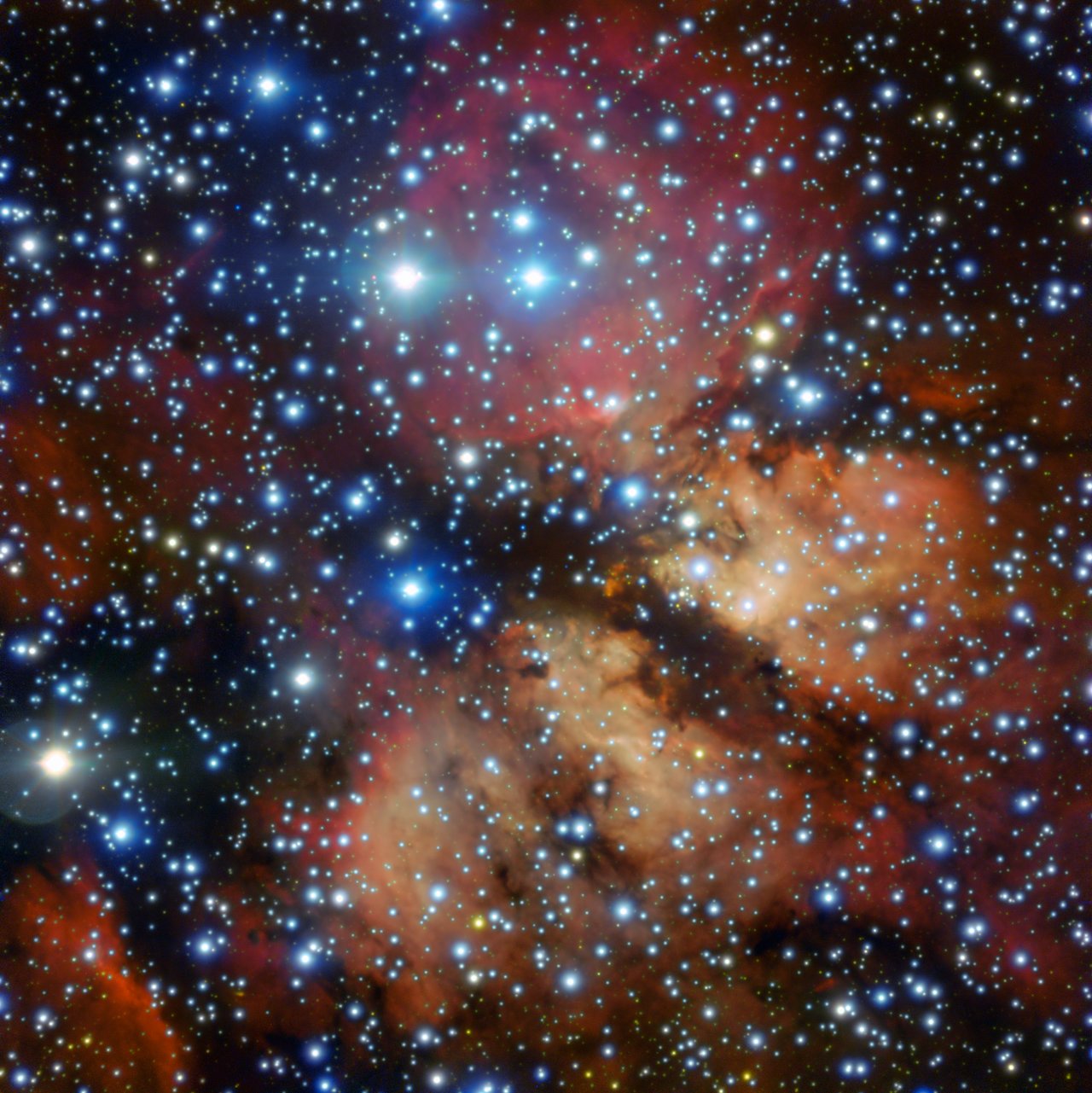
PR Image noirlab2529a
Ua ʻŌhiʻa Lani: An Image to Celebrate Gemini North’s 25th Anniversary

PR Image noirlab2529b
Project Hōkūlani Gemini Interns

PR Image noirlab2529c
Project Hōkūlani Gemini Interns visit Hilo Base Facility

PR Image noirlab2529d
Project Hōkūlani Gemini Intern Zoe Russo

PR Image noirlab2529e
Smoke and Mirrors


Videos

Pan across Ua ʻŌhiʻa Lani
PR Video noirlab2529a
Pan across Ua ʻŌhiʻa Lani

Zooming into Ua ʻŌhiʻa Lani
PR Video noirlab2529b
Zooming into Ua ʻŌhiʻa Lani

Cosmoview Ep. 103: Ua ʻŌhiʻa Lani: An Emission Nebula to Celebrate Gemini North’s 25th Anniversary
PR Video noirlab2529c (in English)
Cosmoview Ep. 103: Ua ʻŌhiʻa Lani: An Emission Nebula to Celebrate Gemini North’s 25th Anniversary

Cosmoview Ep. 103: Ua ʻŌhiʻa Lani: Una nebulosa de emisión paar celebrar el aniversario 25 de Gemini Norte
PR Video noirlab2529d (in Spanish)
Cosmoview Ep. 103: Ua ʻŌhiʻa Lani: Una nebulosa de emisión paar celebrar el aniversario 25 de Gemini Norte


Gaseous pillars and a sparkling star cluster, reminiscent of rain in ʻŌhiʻa forests, feature in this new image from the Gemini North telescope

To celebrate 25 years since the completion of the International Gemini Observatory, students in Hawai‘i voted for the Gemini North telescope to image NGC 6820 — a striking emission nebula and open star cluster. The image was named Ua ʻŌhiʻa Lani, which means the Heavenly ʻŌhiʻa Rains. The International Gemini Observatory is partly funded by the U.S. National Science Foundation (NSF) and operated by NSF NOIRLab.

In July 2025, four Hawaiʻi Island high school students participated in a summer internship during which they researched, selected, and named the image released today to celebrate the International Gemini Observatory’s 25th anniversary. Inspired by a traditional Hawaiian story, they chose the name Ua ʻŌhiʻa Lani, which means the Heavenly ʻŌhiʻa Rains. The image features the emission nebula NGC 6820, as well as its embedded open star cluster NGC 6823, captured in incredible detail by the Gemini North telescope on Maunakea. The Gemini North telescope celebrated First Light in June 1999, and the Observatory was completed 25 years ago when its Southern Hemisphere twin, the Gemini South telescope, saw First Light in November 2000.

“This image is crimson and red like lava because of the abundance of hydrogen gas present in the nebula,” explains Gemini intern Hope Arthur. “One of Pele’s most well-known stories is that of ʻŌhiʻa and Lehua. Their story is about regrowth after tragedy and the act of new beginnings, which we felt was evocative of the cycle of stellar life, death, and rebirth.”

The selection of this target for Gemini North’s anniversary image began with the Gemini First Light Anniversary Image Contest. This contest engaged students in Hawai‘i and Chile — the host locations of the Gemini telescopes — to choose which type of astronomical object each telescope should image. Before voting, students took part in educational activities that taught them about different astronomical phenomena.

The top contenders from the contest were then narrowed down by four students from Kamehameha Schools in Keaʻau and Parker School in Waimea who were participating in Gemini’s first-ever Project Hōkūlani summer internship, in partnership with CLD TEAMS at the University of Hawaiʻi at Mānoa. Interns Hope Arthur, Iolani Sanches, Zoe Russo, and Isabella Branco researched the top four contenders and presented their findings before reaching a group consensus on which astronomical object to image.

“It was so important to me that our interns gained a solid understanding of not just the astronomical science that takes place on Maunakea, but also the cultural and environmental significance of the mauna,” said Leinani Lozi, Hawaiʻi Education and Engagement Manager at Gemini North and internship mentor. “The depth of their learning is evident in the name they created, and I’m so impressed and proud of them.”

In addition to the research and presentation portions of their internship, the students also engaged in telescope operations, the astronomical imaging process, visits to the summit of Maunakea, Native Hawaiian protocol for entering wahi pana (sacred spaces), and stargazing at the Visitor Information Station and Liliʻuokalani Gardens. These experiences introduced the students to the variety of career options at observatories.

Russo had this to share about her experience: “I realized that we have so many science opportunities here, thanks to where we live. Project Hōkūlani has allowed us to dive deeper into our interests and make amazing connections. It's a great way to become established in a field or try something new for a little bit.”

The emission nebula NGC 6820 is located within the faint constellation Vulpecula, around 6000 light-years away from Earth. Vulpecula can be seen in the middle of the Summer Triangle: a famous asterism consisting of the bright stars Deneb, Vega, and Altair. In Hawaiʻi, this area of the sky is known as Mānaiakalani, the Great Fishhook of Maui.

Emission nebulae are clouds of interstellar gas and dust that glow from being energized by ultraviolet radiation emitted by nearby stars. The stars fueling NGC 6820’s emission are those of the open star cluster NGC 6823, seen in this image as scattered specks of blue-white light dotting the veil of red gas. The intense radiation emitted by these hot, massive stars is blowing away the gas in the nebula, creating the dark, pillar-like structures seen emerging from the interstellar medium.

“The baby blue stars in the image reminded us of rain and how, in the story of ʻŌhiʻa and Lehua, when you pick the lehua blossoms, it rains. The fact that these are all young stars and that we learned this story when we were children felt important,” says Sanches.

This image was taken as part of the NOIRLab Legacy Imaging Program — a continuation of the program started at the International Gemini Observatory in 2002, called the Gemini Legacy Imaging Program. Its aim is to use observing time on NOIRLab telescopes that is dedicated to acquiring data specifically for color images to share with the public. Stay tuned for the upcoming Photo Release featuring the image contest winner for the Gemini South telescope in Chile.


More information

NSF NOIRLab, the U.S. National Science Foundation center for ground-based optical-infrared astronomy, operates the International Gemini Observatory (a facility of NSF, NRC–Canada, ANID–Chile, MCTIC–Brazil, MINCyT–Argentina, and KASI–Republic of Korea), NSF Kitt Peak National Observatory (KPNO), NSF Cerro Tololo Inter-American Observatory (CTIO), the Community Science and Data Center (CSDC), and NSF–DOE Vera C. Rubin Observatory (in cooperation with DOE’s SLAC National Accelerator Laboratory). It is managed by the Association of Universities for Research in Astronomy (AURA) under a cooperative agreement with NSF and is headquartered in Tucson, Arizona.

The scientific community is honored to have the opportunity to conduct astronomical research on I’oligam Du’ag (Kitt Peak) in Arizona, on Maunakea in Hawai‘i, and on Cerro Tololo and Cerro Pachón in Chile. We recognize and acknowledge the very significant cultural role and reverence of I’oligam Du’ag to the Tohono O’odham Nation, and Maunakea to the Kanaka Maoli (Native Hawaiians) community.


Links


Contacts:

Leinani Lozi
Hawaiʻi Education & Engagement Manager
NSF NOIRLab
Email:
leinani.lozi@noirlab.edu

Josie Fenske
Public Information Officer
NSF NOIRLab
Email:
josie.fenske@noirlab.edu


Monday, March 11, 2024

Peering Into the Tendrils of NGC 604 with NASA's Webb

NGC 604 (NIRCam Image)
Credits: Image: NASA, ESA, CSA, STScI

NGC 604 (MIRI Image)
Credits: Image: NASA, ESA, CSA, STScI


The formation of stars and the chaotic environments they inhabit is one of the most well-studied, but also mystery-shrouded, areas of cosmic investigation. The intricacies of these processes are now being unveiled like never before by NASA’s James Webb Space Telescope.

Two new images from Webb’s NIRCam (Near-Infrared Camera) and MIRI (Mid-Infrared Instrument) showcase star-forming region NGC 604, located in the Triangulum galaxy (M33), 2.73 million light-years away from Earth. In these images, cavernous bubbles and stretched-out filaments of gas etch a more detailed and complete tapestry of star birth than seen in the past.

Sheltered among NGC 604’s dusty envelopes of gas are more than 200 of the hottest, most massive kinds of stars, all in the early stages of their lives. These types of stars are B-types and O-types, the latter of which can be more than 100 times the mass of our own Sun. It’s quite rare to find this concentration of them in the nearby universe. In fact, there’s no similar region within our own Milky Way galaxy.

This concentration of massive stars, combined with its relatively close distance, means NGC 604 gives astronomers an opportunity to study these objects at a fascinating time early in their life.

In Webb’s near-infrared NIRCam image, the most noticeable features are tendrils and clumps of emission that appear bright red, extending out from areas that look like clearings, or large bubbles in the nebula. Stellar winds from the brightest and hottest young stars have carved out these cavities, while ultraviolet radiation ionizes the surrounding gas. This ionized hydrogen appears as a white and blue ghostly glow.

The bright orange-colored streaks in the Webb near-infrared image signify the presence of carbon-based molecules known as polycyclic aromatic hydrocarbons, or PAHs. This material plays an important role in the interstellar medium and the formation of stars and planets, but its origin is a mystery. As you travel farther from the immediate clearings of dust, the deeper red signifies molecular hydrogen. This cooler gas is a prime environment for star formation.

Webb’s exquisite resolution also provides insights into features that previously appeared unrelated to the main cloud. For example, in Webb’s image, there are two bright, young stars carving out holes in dust above the central nebula, connected through diffuse red gas. In visible-light imaging from NASA’s Hubble Space Telescope, these appeared as separate splotches.

Webb’s view in mid-infrared wavelengths also illustrates a new perspective into the diverse and dynamic activity of this region. In the MIRI view of NGC 604, there are noticeably fewer stars. This is because hot stars emit much less light at these wavelengths, while the larger clouds of cooler gas and dust glow. Some of the stars seen in this image, belonging to the surrounding galaxy, are red supergiants – stars that are cool but very large, hundreds of times the diameter of our Sun. Additionally, some of the background galaxies that appeared in the NIRCam image also fade. In the MIRI image, the blue tendrils of material signify the presence of PAHs.

NGC 604 is estimated to be around 3.5 million years old. The cloud of glowing gases extends to some 1,300 light-years across.

The James Webb Space Telescope is the world's premier space science observatory. Webb is solving mysteries in our solar system, looking beyond to distant worlds around other stars, and probing the mysterious structures and origins of our universe and our place in it. Webb is an international program led by NASA with its partners, ESA (European Space Agency) and the Canadian Space Agency.


About This Release

Credits:

Media Contact:

Hannah Braun
Space Telescope Science Institute, Baltimore, Maryland

Christine Pulliam
Space Telescope Science Institute, Baltimore, Maryland

Permissions: Content Use Policy

Contact Us: Direct inquiries to the News Team.


Wednesday, December 13, 2023

NASA's Webb Stuns With New High-Definition Look at Exploded Star

Cassiopeia A (NIRCam Image)
Credits: Image: NASA, ESA, CSA, STScI, Danny Milisavljevic (Purdue University), Ilse De Looze (UGent), Tea Temim (Princeton University)

Cassiopeia A Close-ups (NIRCam Image)
Credits: Image: NASA, ESA, CSA, STScI, Danny Milisavljevic (Purdue University), Ilse De Looze (UGent), Tea Temim (Princeton University)

Cassiopeia A (NIRCam and MIRI side by side)
Credits: Image: NASA, ESA, CSA, STScI, Danny Milisavljevic (Purdue University), Ilse De Looze (UGent), Tea Temim (Princeton University)


Like a shiny, round ornament ready to be placed in the perfect spot on a holiday tree, supernova remnant Cassiopeia A (Cas A) gleams in a new image from NASA’s James Webb Space Telescope.

As part of the 2023 Holidays at the White House , First Lady of the United States Dr. Jill Biden debuted the first-ever White House Advent Calendar. To showcase the “Magic, Wonder, and Joy” of the holiday season, Dr. Biden and NASA are celebrating with this new image from Webb.

While all is bright, this scene is no proverbial silent night. Webb’s NIRCam (Near-Infrared Camera) view of Cas A displays this stellar explosion at a resolution previously unreachable at these wavelengths. This high-resolution look unveils intricate details of the expanding shell of material slamming into the gas shed by the star before it exploded.

Cas A is one of the most well-studied supernova remnants in all of the cosmos. Over the years, ground-based and space-based observatories, including NASA’s Chandra X-Ray Observatory , Hubble Space Telescope , and retired Spitzer Space Telescope have assembled a multiwavelength picture of the object’s remnant.

However, astronomers have now entered a new era in the study of Cas A. In April 2023, Webb’s MIRI (Mid-Infrared Instrument) started this chapter, revealing new and unexpected features within the inner shell of the supernova remnant. Many of those features are invisible in the new NIRCam image, and astronomers are investigating why.

‘Like Shards of Glass’

Infrared light is invisible to our eyes, so image processors and scientists translate these wavelengths of light to visible colors. In this newest image of Cas A, colors were assigned to different filters from NIRCam, and each of those colors hints at different activity occurring within the object.

At first glance, the NIRCam image may appear less colorful than the MIRI image. However, this simply comes down to the wavelengths in which the material from the object is emitting its light.

The most noticeable colors in Webb’s newest image are clumps represented in bright orange and light pink that make up the inner shell of the supernova remnant. Webb’s razor-sharp view can detect the tiniest knots of gas, comprised of sulfur, oxygen, argon, and neon from the star itself. Embedded in this gas is a mixture of dust and molecules, which will eventually become components of new stars and planetary systems. Some filaments of debris are too tiny to be resolved by even Webb, meaning they are comparable to or less than 10 billion miles across (around 100 astronomical units). In comparison, the entirety of Cas A spans 10 light-years across, or 60 trillion miles.

“With NIRCam’s resolution, we can now see how the dying star absolutely shattered when it exploded, leaving filaments akin to tiny shards of glass behind,” said Danny Milisavljevic of Purdue University, who leads the research team. “It’s really unbelievable after all these years studying Cas A to now resolve those details, which are providing us with transformational insight into how this star exploded.”

Hidden Green Monster

When comparing Webb’s new near-infrared view of Cas A with the mid-infrared view, its inner cavity and outermost shell are curiously devoid of color.

The outskirts of the main inner shell, which appeared as a deep orange and red in the MIRI image, now look like smoke from a campfire. This marks where the supernova blast wave is ramming into surrounding circumstellar material. The dust in the circumstellar material is too cool to be detected directly at near-infrared wavelengths, but lights up in the mid-infrared.

Researchers say the white color is light from synchrotron radiation, which is emitted across the electromagnetic spectrum, including the near-infrared. It’s generated by charged particles traveling at extremely high speeds spiraling around magnetic field lines. Synchrotron radiation is also visible in the bubble-like shells in the lower half of the inner cavity.

Also not seen in the near-infrared view is the loop of green light in the central cavity of Cas A that glowed in mid-infrared, nicknamed the Green Monster by the research team. This feature was described as “challenging to understand” by researchers at the time of their first look.

While the ‘green’ of the Green Monster is not visible in NIRCam, what’s left over in the near-infrared in that region can provide insight into the mysterious feature. The circular holes visible in the MIRI image are faintly outlined in white and purple emission in the NIRCam image – this represents ionized gas. Researchers believe this is due to the supernova debris pushing through and sculpting gas left behind by the star before it exploded.

Baby Cas A

Researchers were also absolutely stunned by one fascinating feature at the bottom right corner of NIRCam’s field of view. They’re calling that large, striated blob Baby Cas A – because it appears like an offspring of the main supernova.

This is a light echo, where light from the star’s long-ago explosion has reached and is warming distant dust, which is glowing as it cools down. The intricacy of the dust pattern, and Baby Cas A’s apparent proximity to Cas A itself, are particularly intriguing to researchers. In actuality, Baby Cas A is located about 170 light-years behind the supernova remnant.

There are also several other, smaller light echoes scattered throughout Webb’s new portrait.

The Cas A supernova remnant is located 11,000 light-years away in the constellation Cassiopeia. It’s estimated to have exploded about 340 years ago from our point of view.

The James Webb Space Telescope is the world's premier space science observatory. Webb is solving mysteries in our solar system, looking beyond to distant worlds around other stars, and probing the mysterious structures and origins of our universe and our place in it. Webb is an international program led by NASA with its partners, ESA (European Space Agency) and the Canadian Space Agency.


About This Release

Credits:

Media Contact:

Hannah Braun
Space Telescope Science Institute, Baltimore, Maryland

Christine Pulliam
Space Telescope Science Institute, Baltimore, Maryland

Science: Danny Milisavljevic (Purdue University), Ilse De Looze (UGent), Tea Temim (Princeton University)

Permissions: Content Use Policy

Contact Us: Direct inquiries to the News Team.


Friday, November 24, 2023

NASA's Webb Reveals New Features in Heart of Milky Way

Sagittarius C (NIRCam Image)
Credits: Image: NASA, ESA, CSA, STScI, Samuel Crowe (UVA)


Sagittarius C (Annotated NIRCam Image)
Credits: Image: NASA, ESA, CSA, STScI, Samuel Crowe (UVA)


The latest image from NASA’s James Webb Space Telescope shows a portion of the dense center of our galaxy in unprecedented detail, including never-before-seen features astronomers have yet to explain. The star-forming region, named Sagittarius C (Sgr C), is about 300 light-years from the Milky Way’s central supermassive black hole, Sagittarius A*.

“There's never been any infrared data on this region with the level of resolution and sensitivity we get with Webb, so we are seeing lots of features here for the first time,” said the observation team’s principal investigator Samuel Crowe, an undergraduate student at the University of Virginia in Charlottesville. “Webb reveals an incredible amount of detail, allowing us to study star formation in this sort of environment in a way that wasn’t possible previously.”

“The galactic center is the most extreme environment in our Milky Way galaxy, where current theories of star formation can be put to their most rigorous test,” added professor Jonathan Tan, one of Crowe’s advisors at the University of Virginia.

Amid the estimated 500,000 stars in the image is a cluster of protostars – stars that are still forming and gaining mass – producing outflows that glow like a bonfire in the midst of an infrared-dark cloud. At the heart of this young cluster is a previously known, massive protostar over 30 times the mass of our Sun. The cloud the protostars are emerging from is so dense that the light from stars behind it cannot reach Webb, making it appear less crowded when in fact it is one of the most densely packed areas of the image. Smaller infrared-dark clouds dot the image, looking like holes in the starfield. That’s where future stars are forming.

Webb’s NIRCam (Near-Infrared Camera) instrument also captured large-scale emission from ionized hydrogen surrounding the lower side of the dark cloud, shown cyan-colored in the image. Typically, Crowe says, this is the result of energetic photons being emitted by young massive stars, but the vast extent of the region shown by Webb is something of a surprise that bears further investigation. Another feature of the region that Crowe plans to examine further is the needle-like structures in the ionized hydrogen, which appear oriented chaotically in many directions.

“The galactic center is a crowded, tumultuous place. There are turbulent, magnetized gas clouds that are forming stars, which then impact the surrounding gas with their outflowing winds, jets, and radiation,” said Rubén Fedriani, a co-investigator of the project at the Instituto Astrofísica de Andalucía in Spain. “Webb has provided us with a ton of data on this extreme environment, and we are just starting to dig into it.”

Around 25,000 light-years from Earth, the galactic center is close enough to study individual stars with the Webb telescope, allowing astronomers to gather unprecedented information on how stars form, and how this process may depend on the cosmic environment, especially compared to other regions of the galaxy. For example, are more massive stars formed in the center of the Milky Way, as opposed to the edges of its spiral arms?

“The image from Webb is stunning, and the science we will get from it is even better,” Crowe said. “Massive stars are factories that produce heavy elements in their nuclear cores, so understanding them better is like learning the origin story of much of the universe.”

The James Webb Space Telescope is the world's premier space science observatory. Webb is solving mysteries in our solar system, looking beyond to distant worlds around other stars, and probing the mysterious structures and origins of our universe and our place in it. Webb is an international program led by NASA with its partners, ESA (European Space Agency) and the Canadian Space Agency.


About This Release Credits:

Media Contact:

Leah Ramsay
Space Telescope Science Institute, Baltimore, Maryland

Christine Pulliam
Space Telescope Science Institute, Baltimore, Maryland

Permissions: Content Use Policy

Contact Us: Direct inquiries to the News Team.


Thursday, October 12, 2023

NASA’s Webb Captures an Ethereal View of NGC 346

NGC 346 (MIRI Image)
Credits: Image: NASA, ESA, CSA, STScI, Nolan Habel (NASA-JPL)
Image Processing: Patrick Kavanagh (Maynooth University)


One of the greatest strengths of NASA’s James Webb Space Telescope is its ability to give astronomers detailed views of areas where new stars are being born. The latest example, showcased here in a new image from Webb’s Mid-Infrared Instrument (MIRI), is NGC 346 – the brightest and largest star-forming region in the Small Magellanic Cloud.

The Small Magellanic Cloud (SMC) is a satellite galaxy of the Milky Way, visible to the unaided eye in the southern constellation Tucana. This small companion galaxy is more primeval than the Milky Way in that it possesses fewer heavy elements, which are forged in stars through nuclear fusion and supernova explosions, compared to our own galaxy.

Since cosmic dust is formed from heavy elements like silicon and oxygen, scientists expected the SMC to lack significant amounts of dust. However the new MIRI image, as well as a previous image of NGC 346 from Webb’s Near-Infrared Camera released in January, show ample dust within this region.

In this representative-color image, blue tendrils trace emission from material that includes dusty silicates and sooty chemical molecules known as polycyclic aromatic hydrocarbons, or PAHs. More diffuse red emission shines from warm dust heated by the brightest and most massive stars in the heart of the region. An arc at the center left may be a reflection of light from the star near the arc’s center. (Similar, fainter arcs appear associated with stars at lower left and upper right.) Lastly, bright patches and filaments mark areas with abundant numbers of protostars. The research team looked for the reddest stars, and found 1,001 pinpoint sources of light, most of them young stars still embedded in their dusty cocoons.

By combining Webb data in both the near-infrared and mid-infrared, astronomers are able to take a fuller census of the stars and protostars within this dynamic region. The results have implications for our understanding of galaxies that existed billions of years ago, during an era in the universe known as “cosmic noon,” when star formation was at its peak and heavy element concentrations were lower, as seen in the SMC.

The James Webb Space Telescope is the world's premier space science observatory. Webb is solving mysteries in our solar system, looking beyond to distant worlds around other stars, and probing the mysterious structures and origins of our universe and our place in it. Webb is an international program led by NASA with its partners, ESA (European Space Agency) and the Canadian Space Agency.


About This Release

Credits:

Media Contact:

Christine Pulliam
Space Telescope Science Institute, Baltimore, Maryland

Permissions: Content Use Policy

Contact Us: Direct inquiries to the News Team.

Related Links and Documents


Tuesday, March 14, 2023

NASA’s Webb Telescope Captures Rarely Seen Prelude to Supernova

WR 124 (NIRCam and MIRI Composite Image)
Credit: Image: NASA, ESA, CSA, STScI, Webb ERO Production Team

WR 124 (MIRI Image)
Credit: Image: NASA, ESA, CSA, STScI, Webb ERO Production Team


The rare sight of a Wolf-Rayet star – among the most luminous, most massive, and most briefly-detectable stars known – was one of the first observations made by NASA’s James Webb Space Telescope in June 2022. Webb shows the star, WR 124, in unprecedented detail with its powerful infrared instruments. The star is 15,000 light-years away in the constellation Sagittarius.

Massive stars race through their lifecycles, and only some of them go through a brief Wolf-Rayet phase before going supernova, making Webb’s detailed observations of this rare phase valuable to astronomers. Wolf-Rayet stars are in the process of casting off their outer layers, resulting in their characteristic halos of gas and dust. The star WR 124 is 30 times the mass of the Sun and has shed 10 Suns’ worth of material—so far. As the ejected gas moves away from the star and cools, cosmic dust forms and glows in the infrared light detectable by Webb.

The origin of cosmic dust that can survive a supernova blast and contribute to the universe’s overall “dust budget” is of great interest to astronomers for multiple reasons. Dust is integral to the workings of the universe: It shelters forming stars, gathers together to help form planets, and serves as a platform for molecules to form and clump together—including the building blocks of life on Earth. Despite the many essential roles that dust plays, there is still more dust in the universe than astronomers’ current dust-formation theories can explain. The universe is operating with a dust budget surplus.

Webb opens up new possibilities for studying details in cosmic dust, which is best observed in infrared wavelengths of light. Webb’s Near-Infrared Camera (NIRCam) balances the brightness of WR 124’s stellar core and the knotty details in the fainter surrounding gas. The telescope’s Mid-Infrared Instrument (MIRI) reveals the clumpy structure of the gas and dust nebula of the ejected material now surrounding the star. Before Webb, dust-loving astronomers simply did not have enough detailed information to explore questions of dust production in environments like WR 124, and whether the dust grains were large and bountiful enough to survive the supernova and become a significant contribution to the overall dust budget. Now those questions can be investigated with real data.

Stars like WR 124 also serve as an analog to help astronomers understand a crucial period in the early history of the universe. Similar dying stars first seeded the young universe with heavy elements forged in their cores – elements that are now common in the current era, including on Earth.

Webb’s detailed image of WR 124 preserves forever a brief, turbulent time of transformation, and promises future discoveries that will reveal the long-shrouded mysteries of cosmic dust.

The James Webb Space Telescope is the world's premier space science observatory. Webb will solve mysteries in our solar system, look beyond to distant worlds around other stars, and probe the mysterious structures and origins of our universe and our place in it. Webb is an international program led by NASA with its partners, ESA (European Space Agency), and CSA (Canadian Space Agency).


About This Release

Credits:

Media Contact:

Leah Ramsay
Space Telescope Science Institute, Baltimore, Maryland
Christine Pulliam
Space Telescope Science Institute, Baltimore, Maryland

Permissions: Content Use Policy

Contact Us: Direct inquiries to the News Team.


Wednesday, July 13, 2022

NASA’s Webb Reveals Cosmic Cliffs, Glittering Landscape of Star Birth

“Cosmic Cliffs” in the Carina Nebula (NIRCam Image)
Credits: Image: NASA, ESA, CSA, STScI

Release Images


This landscape of “mountains” and “valleys” speckled with glittering stars is actually the edge of a nearby, young, star-forming region called NGC 3324 in the Carina Nebula. Captured in infrared light by NASA’s new James Webb Space Telescope, this image reveals for the first time previously invisible areas of star birth.

Called the Cosmic Cliffs, Webb’s seemingly three-dimensional picture looks like craggy mountains on a moonlit evening. In reality, it is the edge of the giant, gaseous cavity within NGC 3324, and the tallest “peaks” in this image are about 7 light-years high. The cavernous area has been carved from the nebula by the intense ultraviolet radiation and stellar winds from extremely massive, hot, young stars located in the center of the bubble, above the area shown in this image.

The blistering, ultraviolet radiation from the young stars is sculpting the nebula’s wall by slowly eroding it away. Dramatic pillars tower above the glowing wall of gas, resisting this radiation. The “steam” that appears to rise from the celestial “mountains” is actually hot, ionized gas and hot dust streaming away from the nebula due to the relentless radiation.

Webb reveals emerging stellar nurseries and individual stars that are completely hidden in visible-light pictures. Because of Webb’s sensitivity to infrared light, it can peer through cosmic dust to see these objects. Protostellar jets, which emerge clearly in this image, shoot out from some of these young stars. The youngest sources appear as red dots in the dark, dusty region of the cloud. Objects in the earliest, rapid phases of star formation are difficult to capture, but Webb’s extreme sensitivity, spatial resolution, and imaging capability can chronicle these elusive events.

These observations of NGC 3324 will shed light on the process of star formation. Star birth propagates over time, triggered by the expansion of the eroding cavity. As the bright, ionized rim moves into the nebula, it slowly pushes into the gas and dust. If the rim encounters any unstable material, the increased pressure will trigger the material to collapse and form new stars.

Conversely, this type of disturbance may also prevent star formation as the star-making material is eroded away. This is a very delicate balance between sparking star formation and stopping it. Webb will address some of the great, open questions of modern astrophysics: What determines the number of stars that form in a certain region? Why do stars form with a certain mass?

Webb will also reveal the impact of star formation on the evolution of gigantic clouds of gas and dust. While the effect of massive stars – with their violent winds and high energy – is often apparent, less is known about the influence of the more numerous low-mass stars. As they form, these smaller stars create narrow, opposing jets seen here, which can inject a lot of momentum and energy into the clouds. This reduces the fraction of nebular material that seeds new stars.

Up to this point, scientists have had very little data about the influence of the multitude of young and more energetic low-mass stars. With Webb, they will be able to obtain a full census of their number and impact throughout the nebula.

Located roughly 7,600 light-years away, NGC 3324 was imaged by Webb’s Near-Infrared Camera (NIRCam) and Mid-Infrared Instrument (MIRI).

NIRCam – with its crisp resolution and unparalleled sensitivity – unveils hundreds of previously hidden stars, and even numerous background galaxies.

In MIRI’s view, young stars and their dusty, planet-forming disks shine brightly in the mid-infrared, appearing pink and red. MIRI reveals structures that are embedded in the dust and uncovers the stellar sources of massive jets and outflows. With MIRI, the hot dust, hydrocarbons and other chemical compounds on the surface of the ridges glow, giving the appearance of jagged rocks.

NGC 3324 was first catalogued by James Dunlop in 1826. Visible from the Southern Hemisphere, it is located at the northwest corner of the Carina Nebula (NGC 3372), which resides in the constellation Carina. The Carina Nebula is home to the Keyhole Nebula and the active, unstable supergiant star called Eta Carinae.

The James Webb Space Telescope is the world's premier space science observatory. Webb will solve mysteries in our solar system, look beyond to distant worlds around other stars, and probe the mysterious structures and origins of our universe and our place in it. Webb is an international program led by NASA with its partners, ESA (Euro-pean Space Agency) and the Canadian Space Agency.

NASA Headquarters oversees the mission for the agency’s Science Mission Directorate. NASA’s Goddard Space Flight Center in Greenbelt, Maryland, manages Webb for the agency and oversees work on the mission performed by the Space Telescope Science Institute, Northrop Grumman, and other mission partners. In addition to Goddard, sev-eral NASA centers contributed to the project, including the agency’s Johnson Space Center in Houston, Jet Propulsion Laboratory in Southern California, Marshall Space Flight Center in Huntsville, Alabama, Ames Research Center in California’s Silicon Val-ley, and others.

NIRCam was built by a team at the University of Arizona and Lockheed Martin’s Advanced Technology Center.

MIRI was contributed by ESA and NASA, with the instrument designed and built by a consortium of nationally funded European Institutes (The MIRI European Consortium) in partnership with JPL and the University of Arizona.

For a full array of Webb’s first images and spectra, including downloadable files, please visit: https://webbtelescope.org/news/first-images


Credits:

Release: NASA, ESA, CSA, STScI

Permissions:
Content Use Policy

Contact Us: Direct inquiries to the News Team.


Monday, November 22, 2021

Hubble Catches Celestial Prawn Drifting Through the Cosmic Deep

Prawn Nebula
Main Image Credit: NASA, ESA, and J. Tan (Chalmers University of Technology); Processing; Gladys Kober (NASA/Catholic University of America)

The Prawn Nebula is a massive stellar nursery located in the constellation Scorpius, about 6,000 light years from Earth. Though the nebula stretches 250 light-years and covers a space four times the size of the full moon, it emits light primarily in wavelengths the human eye cannot detect, making it extremely faint to earthbound viewers. Hubble’s gaze, however, shows a small section of the nebula here in both visible and invisible infrared light, capturing dazzling detail of the nebula’s structure, including bright areas of glowing gas.

The Prawn Nebula, also known as IC 4628, is an emission nebula, which means its gas has been energized, or ionized, by the radiation of nearby stars. The radiation from these massive stars strips electrons from the nebula’s hydrogen atoms. As the energized electrons revert from their higher-energy state to a lower-energy state by recombining with hydrogen nuclei, they emit energy in the form of light, causing the nebula’s gas to glow. In this image, red indicates the presence of ionized iron (Fe II) emission.

This Hubble Space Telescope image was captured as part of a survey of massive- and intermediate-size “protostars,” or newly forming stars. Astronomers used the infrared sensitivity of Hubble’s Wide Field Camera 3 to look for hydrogen ionized by ultraviolet light ionized by the protostars, jets from the stars, and other features.


The Prawn Nebula lies south of the star Antares in the constellation Scorpius, the Scorpion. Hubble's focused view captures just a small portion of the vast star-forming region. Credits: NASA, ESA, J. Tan (Chalmers University of Technology), and ESO; Processing; Gladys Kober (NASA/Catholic University of America) Main Image Credit: NASA, ESA, and J. Tan (Chalmers University of Technology); Processing; Gladys Kober (NASA/Catholic University of America)


Media Contact:

Claire Andreoli
NASA's Goddard Space Flight Center
301-286-1940

Editor: Andrea Gianopoulos

Source: NASA/Hubble


Saturday, November 06, 2021

Mysterious “Superbubble” Hollows Out Nebula in New Hubble Image

N44
Image credit: NASA, ESA, V. Ksoll and D. Gouliermis (Universität Heidelberg), et al.;
Processing: Gladys Kober (NASA/Catholic University of America)


N44 is a complex nebula filled with glowing hydrogen gas, dark lanes of dust, massive stars, and many populations of stars of different ages. One of its most distinctive features, however, is the dark, starry gap called a “superbubble,” visible in this Hubble Space Telescope image in the upper central region.

The hole is about 250 light-years wide and its presence is still something of a mystery. Stellar winds expelled by massive stars in the bubble's interior may have driven away the gas, but this is inconsistent with measured wind velocities in the bubble. Another possibility, since the nebula is filled with massive stars that would expire in titanic explosions, is that the expanding shells of old supernovae sculpted the cosmic cavern..

Astronomers have found one supernova remnant in the vicinity of the superbubble and identified an approximately 5 million year difference in age between stars within and at the rim of the superbubble, indicating multiple, chain-reaction star-forming events. The deep blue area at about 5 o’clock around the superbubble is one of the hottest regions of the nebula and the area of the most intense star formation..

N44 is an emission nebula, which means its gas has been energized, or ionized, by the radiation of nearby stars. As the ionized gas begins to cool from its higher-energy state to a lower-energy state, it emits energy in the form of light, causing the nebula to glow. Located in the Large Magellanic Cloud, N44 spans about 1,000 light-years and is about 170,000 light-years away from Earth..


Media Contact:

Claire Andreoli
NASA's
Goddard Space Flight Center
301-286-1940

Editor: Andrea Gianopoulos

Source: NASA/Hubble


Thursday, January 23, 2020

Caught “Pink-Handed”

Credit: ESO

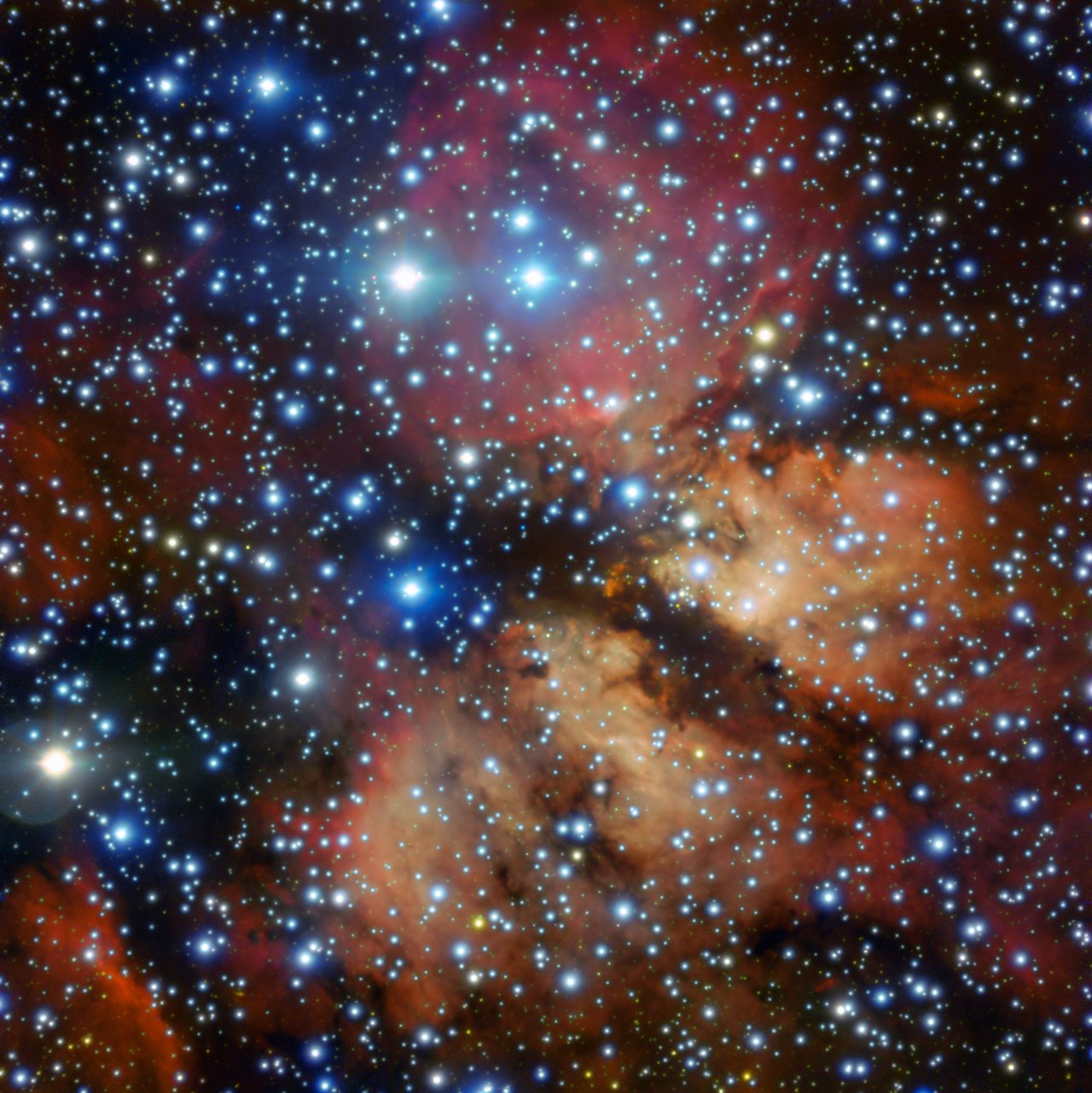
The Milky Way contains many regions of starbirth — areas where new stars are springing to life within collapsing clumps of gas and dust. One such region, named Gum 26, is shown here as imaged by the FORS instrument on ESO’s Very Large Telescope in Chile.

Gum 26 is located roughly 20,000 light-years away in the southern constellation of Vela (The Sails). It is something known as an HII region or  emission nebula, where the intense ultraviolet radiation streaming from newly-formed stars ionises the surrounding hydrogen gas, causing it to emit a faint pinkish glow. By catching new stars “pink-handed” in this manner, astronomers can learn more about the conditions under which stars arise, and study how they influence their cosmic environment. 

This image was created as part of the ESO Cosmic Gems programme, an outreach initiative to produce images of interesting, intriguing or visually attractive objects using ESO telescopes, for the purposes of education and public outreach. The programme makes use of telescope time that cannot be used for science observations. All data collected may also be suitable for scientific purposes, and are made available to astronomers through ESO’s science archive.

Source:  ESO/potw


Monday, December 09, 2019

Cloudy with a Chance of Dust

Credit: ESO

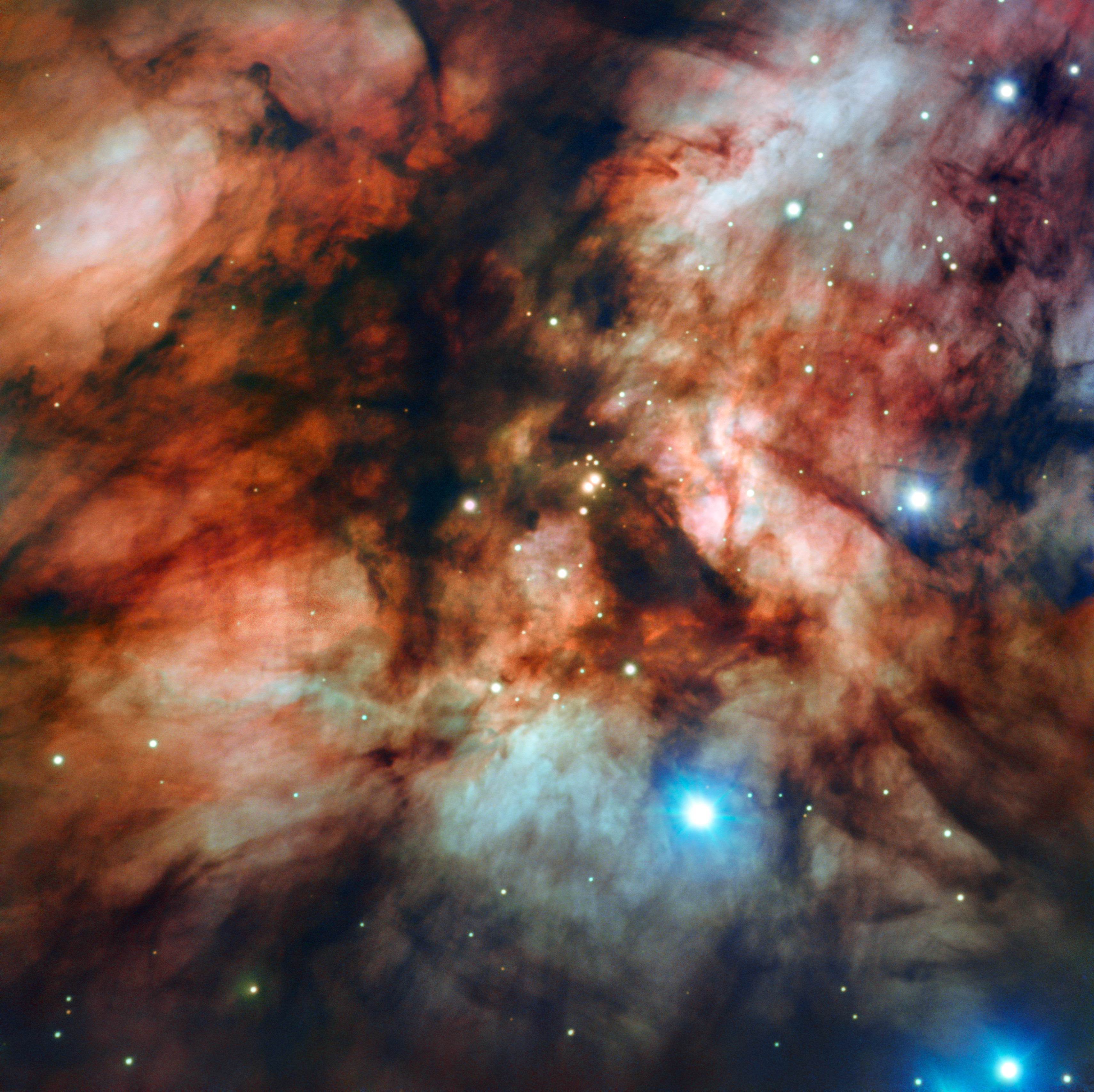
This cloud-strewn new image of RCW 36 (or Gum 20) was captured by ESO’s Focal Reducer and low dispersion Spectrograph (FORS). It shows one of the sites of massive-star formation closest to our Solar System, about 2300 light-years away. Located in the constellation of Vela (The Sails), the RCW 36 emission nebula is only part of an even larger star formation complex, known as the Vela Molecular Ridge.

Some areas in the clouds of RCW 36 are dense enough to block out background light, creating patches and wisps of inky black. Despite the dark appearance of these clouds, they are the only places in the Universe in which star formation occurs; clumps of molecular hydrogen and cosmic dust  collapse and come together to form stars encircled by small families of planets, as in our own Solar System.

FORS is mounted on ESO’s Very Large Telescope, one of the world's most advanced astronomical observatories. This image was selected as part of the ESO Cosmic Gems programme, an initiative that produces images of scientifically interesting and visually attractive objects using ESO telescopes for the purposes of education and public outreach. The programme makes use of telescope time that cannot be used for science observations. All data collected may also be suitable for scientific purposes, and are made available to astronomers through ESO’s science archive.

Source: ESO/potw


Wednesday, August 07, 2019

Anatomy of a Cosmic Seagull

The Rosy Glow of a Cosmic Seagull
 
The Seagull Nebula on the borders of the constellations of Monoceros and Canis Major
 
Wide-field view of the entire Seagull Nebula (IC 2177)


Videos

ESOcast 205 Light: The Rosy Glow of a Cosmic Seagull

Panning across the Cosmic Seagull

Zooming into the Cosmic Seagull

3D animation of the Seagull Nebula


ESO’s VST captures a celestial gull in flight

Colourful and wispy, this intriguing collection of objects is known as the Seagull Nebula, named for its resemblance to a gull in flight. Made up of dust, hydrogen, helium and traces of heavier elements, this region is the hot and energetic birthplace of new stars. The remarkable detail captured here by ESO’s VLT Survey Telescope (VST) reveals the individual astronomical objects that make up the celestial bird, as well as the finer features within them. The VST is one of the largest survey telescopes in the world observing the sky in visible light.

The main components of the Seagull are three large clouds of gas, the most distinctive being Sharpless 2-296, which forms the “wings”. Spanning about 100 light-years from one wingtip to the other, Sh2-296 displays glowing material and dark dust lanes weaving amid bright stars. It is a beautiful example of an emission nebula, in this case an HII region, indicating active formation of new stars, which can be seen peppering this image.

It is the radiation emanating from these young stars that gives the clouds their fantastical colours and makes them so eye-catching, by ionising the surrounding gas and causing it to glow. This radiation is also the main factor that determines the clouds’ shapes, by exerting pressure on the surrounding material and sculpting it into the whimsical morphologies we see. Since each nebula has a unique distribution of stars and may, like this one, be a composite of multiple clouds, they come in a variety of shapes, firing astronomers’ imaginations and evoking comparisons to animals or familiar objects.

This diversity of shapes is exemplified by the contrast between Sh2-296 and Sh2-292. The latter, seen here just below the “wings”, is a more compact cloud that forms the seagull’s “head”. Its most prominent feature is a huge, extremely luminous star called HD 53367 that is 20 times more massive than the Sun, and which we see as the seagull’s piercing “eye”. Sh2-292 is both an emission nebula and a reflection nebula; much of its light is emitted by ionised gas surrounding its nascent stars, but a significant amount is also reflected from stars outside it.

The dark swathes that interrupt the clouds’ homogeneity and give them texture are dust lanes – paths of much denser material that hide some of the luminous gas behind them. Nebulae like this one have densities of a few hundred atoms per cubic centimetre, much less than the best artificial vacuums on Earth. Nonetheless, nebulae are still much denser than the gas outside them, which has an average density of about 1 atom per cubic centimetre.

The Seagull lies along the border between the constellations of Canis Major (The Great Dog) and Monoceros (The Unicorn), at a distance of about 3700 light-years in one arm of the Milky Way. Spiral galaxies can contain thousands of these clouds, almost all of which are concentrated along their whirling arms.

Several smaller clouds are also counted as part of the Seagull Nebula, including Sh2-297, which is a small, knotty addition to the tip of the gull’s upper “wing”, Sh2-292 and Sh2-295. These objects are all included in the Sharpless Catalogue, a list of over 300 clouds of glowing gas compiled by American astronomer Stewart Sharpless.

This image was taken using the VLT Survey Telescope (VST), one of the largest survey telescopes in the world observing the sky in visible light. The VST is designed to photograph large areas of the sky quickly and deeply.

Can you spot the seagull in this photo? We challenge our readers to let their imagination run free and outline the bird in our photo as they see it. Share your photos with the outline of the bird using the hashtag #SpotTheSeagull.


More Information


ESO is the foremost intergovernmental astronomy organisation in Europe and the world’s most productive ground-based astronomical observatory by far. It has 16 Member States: Austria, Belgium, the Czech Republic, Denmark, France, Finland, Germany, Ireland, Italy, the Netherlands, Poland, Portugal, Spain, Sweden, Switzerland and the United Kingdom, along with the host state of Chile and with Australia as a Strategic Partner. ESO carries out an ambitious programme focused on the design, construction and operation of powerful ground-based observing facilities enabling astronomers to make important scientific discoveries. ESO also plays a leading role in promoting and organising cooperation in astronomical research. ESO operates three unique world-class observing sites in Chile: La Silla, Paranal and Chajnantor. At Paranal, ESO operates the Very Large Telescope and its world-leading Very Large Telescope Interferometer as well as two survey telescopes, VISTA working in the infrared and the visible-light VLT Survey Telescope. Also at Paranal ESO will host and operate the Cherenkov Telescope Array South, the world’s largest and most sensitive gamma-ray observatory. ESO is also a major partner in two facilities on Chajnantor, APEX and ALMA, the largestastronomical project in existence. And on Cerro Armazones, close to Paranal, ESO is building the 39-metre Extremely Large Telescope, the ELT, which will become “the world’s biggest eye on the sky”.


Contact:

Mariya Lyubenova
ESO Head of Media Relations Team
Garching bei München, Germany
Tel: +49 89 3200 6188
Email:
pio@eso.org

Source: ESO/News