Showing posts with label NGC 604. Show all posts

Monday, March 11, 2024

Peering Into the Tendrils of NGC 604 with NASA's Webb

NGC 604 (NIRCam Image)
Credits: Image: NASA, ESA, CSA, STScI

NGC 604 (MIRI Image)
Credits: Image: NASA, ESA, CSA, STScI


The formation of stars and the chaotic environments they inhabit is one of the most well-studied, but also mystery-shrouded, areas of cosmic investigation. The intricacies of these processes are now being unveiled like never before by NASA’s James Webb Space Telescope.

Two new images from Webb’s NIRCam (Near-Infrared Camera) and MIRI (Mid-Infrared Instrument) showcase star-forming region NGC 604, located in the Triangulum galaxy (M33), 2.73 million light-years away from Earth. In these images, cavernous bubbles and stretched-out filaments of gas etch a more detailed and complete tapestry of star birth than seen in the past.

Sheltered among NGC 604’s dusty envelopes of gas are more than 200 of the hottest, most massive kinds of stars, all in the early stages of their lives. These types of stars are B-types and O-types, the latter of which can be more than 100 times the mass of our own Sun. It’s quite rare to find this concentration of them in the nearby universe. In fact, there’s no similar region within our own Milky Way galaxy.

This concentration of massive stars, combined with its relatively close distance, means NGC 604 gives astronomers an opportunity to study these objects at a fascinating time early in their life.

In Webb’s near-infrared NIRCam image, the most noticeable features are tendrils and clumps of emission that appear bright red, extending out from areas that look like clearings, or large bubbles in the nebula. Stellar winds from the brightest and hottest young stars have carved out these cavities, while ultraviolet radiation ionizes the surrounding gas. This ionized hydrogen appears as a white and blue ghostly glow.

The bright orange-colored streaks in the Webb near-infrared image signify the presence of carbon-based molecules known as polycyclic aromatic hydrocarbons, or PAHs. This material plays an important role in the interstellar medium and the formation of stars and planets, but its origin is a mystery. As you travel farther from the immediate clearings of dust, the deeper red signifies molecular hydrogen. This cooler gas is a prime environment for star formation.

Webb’s exquisite resolution also provides insights into features that previously appeared unrelated to the main cloud. For example, in Webb’s image, there are two bright, young stars carving out holes in dust above the central nebula, connected through diffuse red gas. In visible-light imaging from NASA’s Hubble Space Telescope, these appeared as separate splotches.

Webb’s view in mid-infrared wavelengths also illustrates a new perspective into the diverse and dynamic activity of this region. In the MIRI view of NGC 604, there are noticeably fewer stars. This is because hot stars emit much less light at these wavelengths, while the larger clouds of cooler gas and dust glow. Some of the stars seen in this image, belonging to the surrounding galaxy, are red supergiants – stars that are cool but very large, hundreds of times the diameter of our Sun. Additionally, some of the background galaxies that appeared in the NIRCam image also fade. In the MIRI image, the blue tendrils of material signify the presence of PAHs.

NGC 604 is estimated to be around 3.5 million years old. The cloud of glowing gases extends to some 1,300 light-years across.

The James Webb Space Telescope is the world's premier space science observatory. Webb is solving mysteries in our solar system, looking beyond to distant worlds around other stars, and probing the mysterious structures and origins of our universe and our place in it. Webb is an international program led by NASA with its partners, ESA (European Space Agency) and the Canadian Space Agency.


About This Release

Credits:

Media Contact:

Hannah Braun
Space Telescope Science Institute, Baltimore, Maryland

Christine Pulliam
Space Telescope Science Institute, Baltimore, Maryland

Permissions: Content Use Policy

Contact Us: Direct inquiries to the News Team.


Wednesday, July 24, 2019

NASA's Chandra X-ray Observatory Celebrates Its 20th Anniversary


Credit:  X-ray: NASA/CXC/Univ of Waterloo/H. Russell et al.; Optical: NASA/STScI


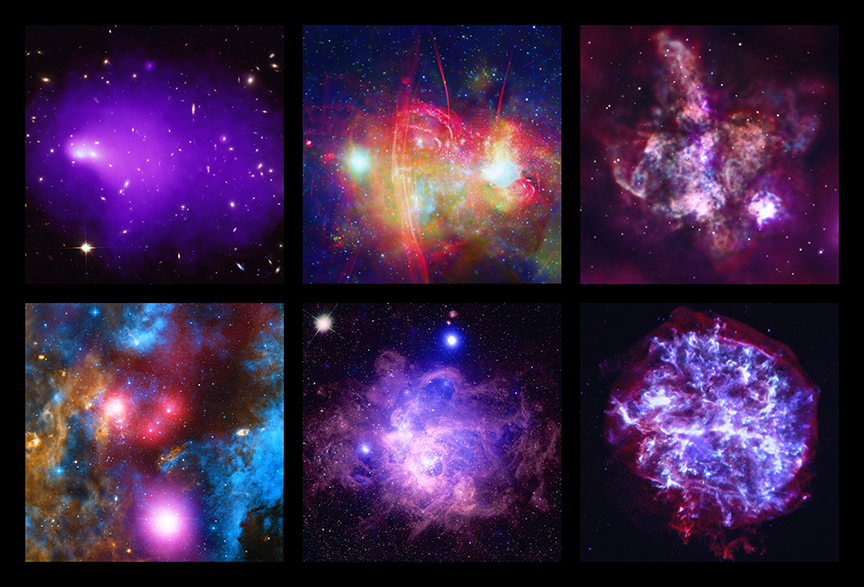
To commemorate the 20th anniversary of NASA's Chandra X-ray Observatory, an assembly of new images is being released. These images represent the breadth of Chandra's exploration, demonstrating the variety of objects it studies as well as how X-rays complement the data collected in other types of light. Some of these images contain Chandra data exclusively and the rest show how X-rays fit with the different types of light that other telescopes collect.

The 20th anniversary images are from left to right:

Top Row:

Abell 2146
  Credit: X-ray: NASA/CXC/Univ. of Waterloo/H. Russell et al.; Optical: NASA/STScI.

The colossal system Abell 2146 is the result of a collision and merger between two galaxy clusters. Astronomers think that galaxy clusters, the largest structures in the Universe held together by gravity, grow by colliding and merging with one another. Mergers of galaxy clusters are some of the most energetic events since the Big Bang. Chandra has observed many galaxy cluster mergers, giving scientists insight into how these mega-structures that dominate the Universe came to be.

In this image of Abell 2146, X-rays from Chandra (purple) show hot gas and optical data from the Hubble Space Telescope shows galaxies and stars. The bullet-shaped feature shows the hot gas from one cluster plowing through the hot gas in the other cluster.

Sagittarius A* (Galactic Center)
Credit: X-Ray:NASA/CXC/UMass/D. Wang et al.; Radio:NRF/SARAO/MeerKAT 

The central region of our galaxy, the Milky Way, contains an exotic collection of objects, including a supermassive black hole weighing about 4 million times the mass of the Sun (called Sagittarius A*), clouds of gas at temperatures of millions of degrees, neutron stars and white dwarf stars tearing material from companion stars and beautiful tendrils of radio emission.

The region around Sagittarius A* is shown in this new composite image with Chandra data (green and blue) combined with radio data (red) from the MeerKAT telescope in South Africa, which will eventually become part of the Square Kilometer Array (SKA).  

30 Doradus
Credit: NASA/CXC/Penn State Univ./L. Townsley et al.
At the center of 30 Doradus, one of the largest star-forming regions located close to the Milky Way, thousands of massive stars are blowing off material and producing intense radiation along with powerful winds. Chandra detects gas that has been heated to millions of degrees by these stellar winds and also by supernova explosions that mark the end of some giant stars' lives. These X-rays come from shock fronts, similar to sonic booms produced by supersonic airplanes, that rumble through the system.

This new Chandra image of 30 Doradus, which is nicknamed the "Tarantula Nebula," contains data from several long observations totaling almost 24 days of observing spread out over about 700 days. The colors in this Chandra image are red, green and purple to highlight low, medium and high X-ray energies respectively.

Astronomers used the long set of Chandra observations to discover that one of the bright X-ray sources shows regular variations in its X-ray output, with a period of 155 days. This variation originates from two massive stars orbiting each other, in a double-star system called Melnick 34. Follow-up observations with the European Southern Observatory's Very Large Telescope and the Gemini Observatory, both in Chile, measured the change in velocities of both stars during their orbit, leading to mass estimates of 139 and 127 times the mass of the sun. This makes Melnick 34 the most massive binary known, as reported in a paper published earlier this year, led by Katie Tehrani of the University of Sheffield in the UK. Within about two or three million years, both stars should implode to form black holes. If the binary survives these violent events, the black holes might eventually merge to produce a burst of gravitational waves.

The X-rays likely originate from shock waves generated by the collision of material blowing away from the surfaces of both stars, making Melnick 34 a "colliding-wind binary". Credit: NASA/CXC/Penn State Univ./L. Townsley et al.


Bottom row:

Cygnus OB2
Credit: X-ray: NASA/CXC/SAO/J. Drake et al; 
H-alpha: Univ. of Hertfordshire/INT/IPHAS; Infrared: NASA/JPL-Caltech/Spitzer

Stars come in different sizes and masses. Our Sun is an average-sized star that will have a lifespan of some 10 billion years. More massive stars, like those found in Cygnus OB2, only last a few million years. During their lifetimes, they blast large amounts of high-energy winds into their surroundings. These violent winds can collide or produce shocks in the gas and dust around the stars, depositing large amounts of energy that produce X-ray emission that Chandra can detect.

In this composite image of Cygnus OB2, X-rays from Chandra (red diffuse emission and blue point sources) are shown with optical data from the Isaac Newton Telescope (diffuse emission in light blue) and infrared data from the Spitzer Space Telescope (orange).

NGC 604
Credit: X-ray: NASA/CXC/CfA/R. Tuellmann et al.; Optical: NASA/AURA/STScI/J. Schmidt.

The nearby galaxy Messier 33 contains a star-forming region called NGC 604 where some 200 hot, young, massive stars reside. The cool dust and warmer gas in this stellar nursery appear as the wispy structures in an optical image from the Hubble Space Telescope. In between these filaments are giant voids that are filled with hot, X-ray-emitting gas. Astronomers think these bubbles are being blown off the surfaces of the young and massive stars throughout NGC 604.

NGC 604 also likely contains an extreme member of the class of colliding-wind binaries, as reported in a recent paper led by Kristen Garofali of the University of Arkansas in Fayetteville, Arkansas. It is the first candidate source in this class to be discovered in M33 and the most distant example known, and shares several properties with the famous, volatile system called Eta Carinae, located in our galaxy.

Chandra's X-ray data (blue) are combined in this image with optical data from Hubble (purple).

G292
Credit: NASA/CXC/SAO

Supernova remnants are the debris from exploded stars. G292.0+1.8 is a rare type of supernova remnant observed to contain large amounts of oxygen. Because they are one of the primary sources of the heavy elements (that is, everything other than hydrogen and helium) necessary to form planets and people, these oxygen-rich supernova remnants are important to study. The X-ray image of G292+1.8 from Chandra shows a rapidly expanding, intricately structured field left behind by the shattered star. The image is colored red, green, teal and purple in X-rays ranging from the lowest to highest energy levels.

Recently the first detection was made of iron debris from the exploded star, as reported in a paper led by Jayant Bhalerao of the University of Texas at Arlington in Texas. They constructed a map of this debris, along with that of silicon and sulphur, to understand more about the explosion. They found that these three elements are mainly located in the upper right of the remnant. This is in the opposite direction from the neutron star that was formed in the explosion, and was then kicked towards the lower left of the remnant. This suggests that the origin of this kick is gravitational and fluid forces from an asymmetric explosion. If more than half of the star's debris is ejected in one direction, then the neutron star is kicked in the other direction so that momentum is conserved. This finding argues against the idea that the copious amounts of neutrinos formed in the supernova explosion were emitted in a lop-sided direction, imparting a kick to the neutron star. 

For more information about Chandra's 20th anniversary, visit: http://chandra.si.edu/20th/

NASA's Marshall Space Flight Center in Huntsville, Alabama, manages the Chandra program for NASA's Science Mission Directorate in Washington. The Smithsonian Astrophysical Observatory in Cambridge, Massachusetts, controls Chandra's science and flight operations.


Tuesday, January 08, 2019

Hubble takes gigantic image of the Triangulum Galaxy

The sharpest view ever of the Triangulum Galaxy

NGC 604 — a gigantic gas cloud in the Triangulum Galaxy

NGC 595 — a diffuse nebula in the Triangulum Galaxy

Stellar association IC 142

Wide-field view of the Triangulum Galaxy showing the extent of the survey

Area around the Triangulum Galaxy (ground-based image)


Videos

Hubblecast 115 Light: Triangulum Galaxy in unrivalled detail

Zooming in on the Triangulum Galaxy

A close-up look at the Triangulum Galaxy


The NASA/ESA Hubble Space Telescope has captured the most detailed image yet of a close neighbour of the Milky Way — the Triangulum Galaxy, a spiral galaxy located at a distance of only three million light-years. This panoramic survey of the third-largest galaxy in our Local Group of galaxies provides a mesmerising view of the 40 billion stars that make up one of the most distant objects visible to the naked eye.

This new image of the Triangulum Galaxy — also known as Messier 33 or NGC 598 — has a staggering 665 million pixels and showcases the central region of the galaxy and its inner spiral arms. To stitch together this gigantic mosaic, Hubble’s Advanced Camera for Surveys needed to create 54 separate images.

Under excellent dark-sky conditions, the Triangulum Galaxy can be seen with the naked eye as a faint, blurry object in the constellation of Triangulum (the Triangle), where its ethereal glow is an exciting target for amateur astronomers.

At only three million light-years from Earth, the Triangulum Galaxy is a notable member of the Local Group — it is the group’s third-largest galaxy, but also the smallest spiral galaxy in the group [1]. It measures only about 60 000 light-years across, compared to the 200 000 light-years of the Andromeda Galaxy; the Milky Way lies between these extremes at about 100 000 light-years in diameter [2].

The Triangulum Galaxy is not only surpassed in size by the other two spirals, but by the multitude of stars they contain. The Triangulum Galaxy has at least an order of magnitude less stars than the Milky Way and two orders of magnitude less than Andromeda. These numbers are hard to grasp when already in this image 10 to 15 million individual stars are visible.

In contrast to the two larger spirals, the Triangulum Galaxy doesn’t have a bright bulge at its centre and it also lacks a bar connecting its spiral arms to the centre. It does, however, contain a huge amount of gas and dust, giving rise to rapid star formation. New stars form at a rate of approximately one solar mass every two years.

The abundance of gas clouds in the Triangulum Galaxy is precisely what drew astronomers to conduct this detailed survey. When stars are born, they use up material in these clouds of gas and dust, leaving less fuel for new stars to emerge. Hubble’s image shows two of the four brightest of these regions in the galaxy: NGC 595 and NGC 604. The latter is the second most luminous region of ionised hydrogen within the Local Group and it is also among the largest known star formation regions in the Local Group.

These detailed observations of the Triangulum Galaxy have tremendous legacy value — combined with those of the Milky Way, the Andromeda Galaxy and the irregular Magellanic Cloud galaxies, they will help astronomers to better understand star formation and stellar evolution.


Notes

[1] Our galaxy, the Milky Way, is part of the Local Group, an assembly of more than 50 galaxies bound together by gravity. Its largest member is the Andromeda Galaxy — also known as Messier 31 — followed by the Milky Way and the Triangulum Galaxy. The remaining members of the Local Group are dwarf galaxies, each orbiting one of the three larger ones. 


[2] The much bigger Andromeda Galaxy was mapped by Hubble in 2015, creating the sharpest and largest image of this galaxy and the largest Hubble image ever (heic1502).


Links


Contact 

Mathias Jäger
ESA/Hubble, Public Information Officer
Garching, Germany
Tel: +49 176 62397500
Email:
mjaeger@partner.eso.org

Source: ESA/Hubble/News