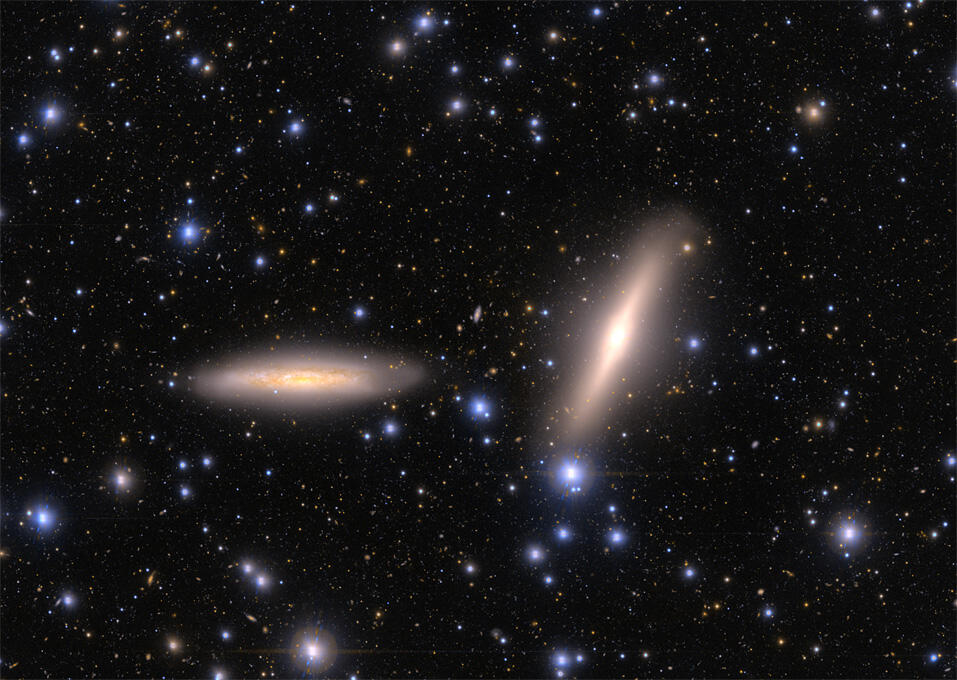
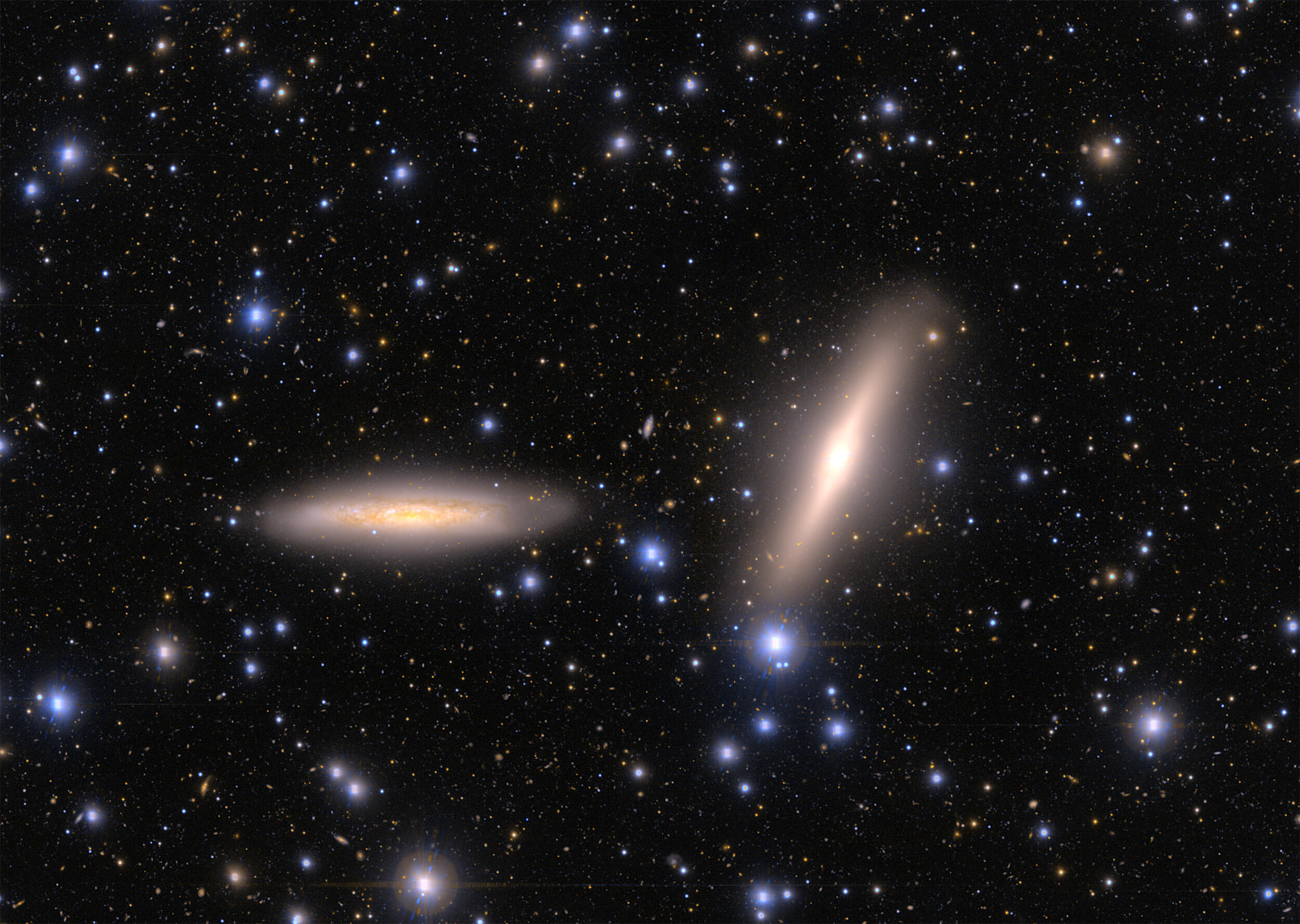
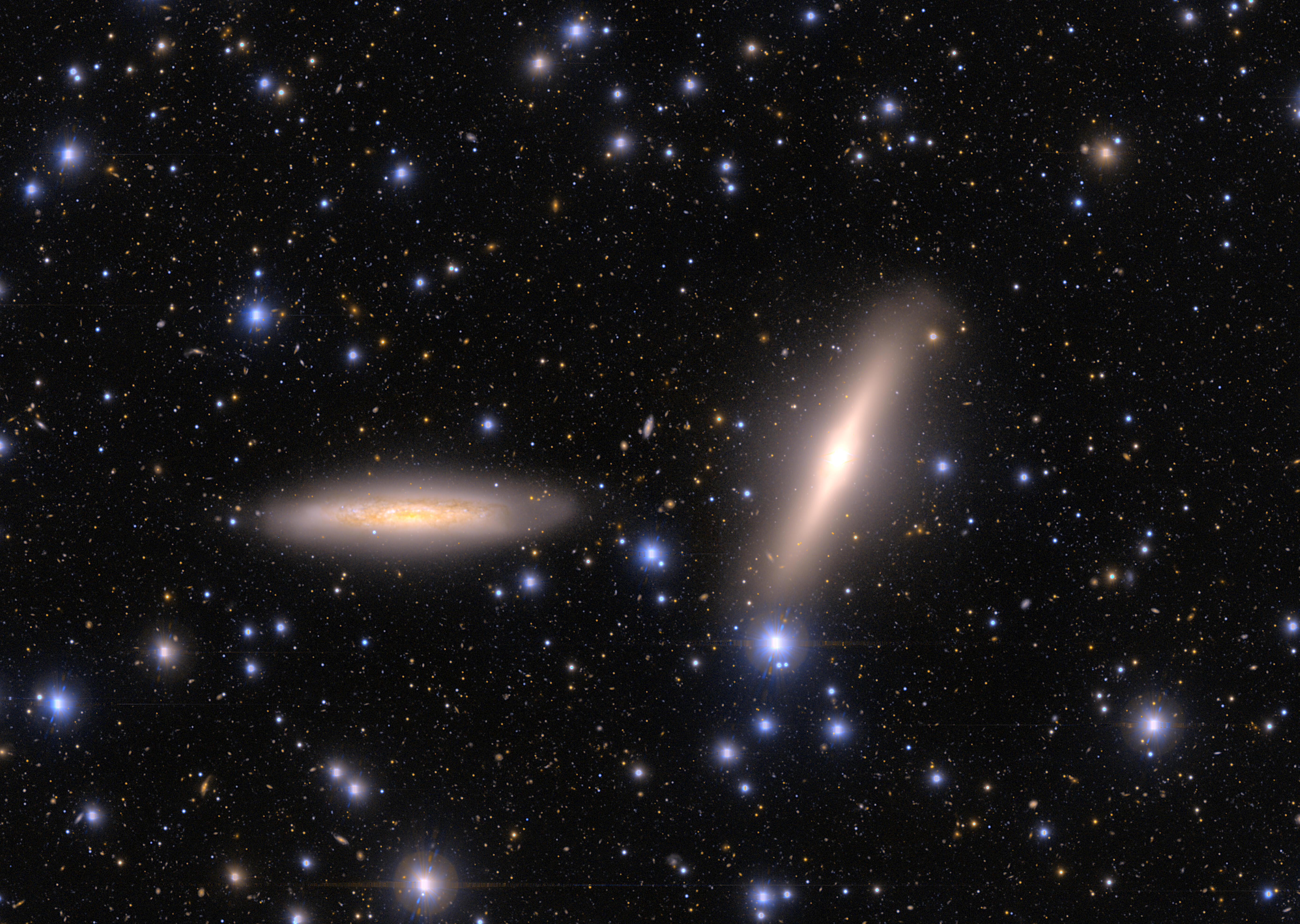
two edge-on galaxies in the Pegasus constellation are thought to form a gravitationally bound pair. An edge-on galaxy is one observed almost exactly from the side, so even if it is a spiral galaxy, its spiral structure is not visible. In contrast, when a galactic disk is viewed almost head-on, it is called a “face-on galaxy.”
A close look at the bulge, the bright central region of NGC 7332 on the right, reveals that it is not simply elliptical but appears somewhat boxy. This structure is known as a “peanut bulge” and is believed to be a bar-shaped bulge viewed edge-on.
In NGC 7339 on the left, a prominent dust lane, where interstellar dust is concentrated, extends across much of the galaxy's central disk. This indicates that large amounts of gas, material for star formation, are present in the galactic plane. By contrast, NGC 7332 on the right shows little obvious visual evidence of such dust, yet active star formation is observed.. (Credit: NAOJ; Image provided by Masayuki Tanaka)
A close look at the bulge, the bright central region of NGC 7332 on the right, reveals that it is not simply elliptical but appears somewhat boxy. This structure is known as a “peanut bulge” and is believed to be a bar-shaped bulge viewed edge-on.
In NGC 7339 on the left, a prominent dust lane, where interstellar dust is concentrated, extends across much of the galaxy's central disk. This indicates that large amounts of gas, material for star formation, are present in the galactic plane. By contrast, NGC 7332 on the right shows little obvious visual evidence of such dust, yet active star formation is observed.. (Credit: NAOJ; Image provided by Masayuki Tanaka)
Distance from Earth: 70 million light-years
Instrument: Hyper Suprime-Cam (HSC)
Source: ubaru Telescope