


Videos
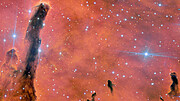
PR Video noirlab2529a
Pan across Ua ʻŌhiʻa Lani

PR Video noirlab2529b
Zooming into Ua ʻŌhiʻa Lani
PR Video noirlab2529c (in English)
Cosmoview Ep. 103: Ua ʻŌhiʻa Lani: An Emission Nebula to Celebrate Gemini North’s 25th Anniversary
PR Video noirlab2529d (in Spanish)
Cosmoview Ep. 103: Ua ʻŌhiʻa Lani: Una nebulosa de emisión paar celebrar el aniversario 25 de Gemini Norte
PR Video noirlab2529a
Pan across Ua ʻŌhiʻa Lani
PR Video noirlab2529b
Zooming into Ua ʻŌhiʻa Lani
PR Video noirlab2529c (in English)
Cosmoview Ep. 103: Ua ʻŌhiʻa Lani: An Emission Nebula to Celebrate Gemini North’s 25th Anniversary
PR Video noirlab2529d (in Spanish)
Cosmoview Ep. 103: Ua ʻŌhiʻa Lani: Una nebulosa de emisión paar celebrar el aniversario 25 de Gemini Norte
Gaseous pillars and a sparkling star cluster, reminiscent of rain in ʻŌhiʻa forests, feature in this new image from the Gemini North telescope
To celebrate 25 years since the completion of the International Gemini Observatory, students in Hawai‘i voted for the Gemini North telescope to image NGC 6820 — a striking emission nebula and open star cluster. The image was named Ua ʻŌhiʻa Lani, which means the Heavenly ʻŌhiʻa Rains. The International Gemini Observatory is partly funded by the U.S. National Science Foundation (NSF) and operated by NSF NOIRLab.
In July 2025, four Hawaiʻi Island high school students participated in a summer internship during which they researched, selected, and named the image released today to celebrate the International Gemini Observatory’s 25th anniversary. Inspired by a traditional Hawaiian story, they chose the name Ua ʻŌhiʻa Lani, which means the Heavenly ʻŌhiʻa Rains. The image features the emission nebula NGC 6820, as well as its embedded open star cluster NGC 6823, captured in incredible detail by the Gemini North telescope on Maunakea. The Gemini North telescope celebrated First Light in June 1999, and the Observatory was completed 25 years ago when its Southern Hemisphere twin, the Gemini South telescope, saw First Light in November 2000.
“This image is crimson and red like lava because of the abundance of hydrogen gas present in the nebula,” explains Gemini intern Hope Arthur. “One of Pele’s most well-known stories is that of ʻŌhiʻa and Lehua. Their story is about regrowth after tragedy and the act of new beginnings, which we felt was evocative of the cycle of stellar life, death, and rebirth.”
The selection of this target for Gemini North’s anniversary image began with the Gemini First Light Anniversary Image Contest. This contest engaged students in Hawai‘i and Chile — the host locations of the Gemini telescopes — to choose which type of astronomical object each telescope should image. Before voting, students took part in educational activities that taught them about different astronomical phenomena.
The top contenders from the contest were then narrowed down by four students from Kamehameha Schools in Keaʻau and Parker School in Waimea who were participating in Gemini’s first-ever Project Hōkūlani summer internship, in partnership with CLD TEAMS at the University of Hawaiʻi at Mānoa. Interns Hope Arthur, Iolani Sanches, Zoe Russo, and Isabella Branco researched the top four contenders and presented their findings before reaching a group consensus on which astronomical object to image.
“It was so important to me that our interns gained a solid understanding of not just the astronomical science that takes place on Maunakea, but also the cultural and environmental significance of the mauna,” said Leinani Lozi, Hawaiʻi Education and Engagement Manager at Gemini North and internship mentor. “The depth of their learning is evident in the name they created, and I’m so impressed and proud of them.”
In addition to the research and presentation portions of their internship, the students also engaged in telescope operations, the astronomical imaging process, visits to the summit of Maunakea, Native Hawaiian protocol for entering wahi pana (sacred spaces), and stargazing at the Visitor Information Station and Liliʻuokalani Gardens. These experiences introduced the students to the variety of career options at observatories.
Russo had this to share about her experience: “I realized that we have so many science opportunities here, thanks to where we live. Project Hōkūlani has allowed us to dive deeper into our interests and make amazing connections. It's a great way to become established in a field or try something new for a little bit.”
The emission nebula NGC 6820 is located within the faint constellation Vulpecula, around 6000 light-years away from Earth. Vulpecula can be seen in the middle of the Summer Triangle: a famous asterism consisting of the bright stars Deneb, Vega, and Altair. In Hawaiʻi, this area of the sky is known as Mānaiakalani, the Great Fishhook of Maui.
Emission nebulae are clouds of interstellar gas and dust that glow from being energized by ultraviolet radiation emitted by nearby stars. The stars fueling NGC 6820’s emission are those of the open star cluster NGC 6823, seen in this image as scattered specks of blue-white light dotting the veil of red gas. The intense radiation emitted by these hot, massive stars is blowing away the gas in the nebula, creating the dark, pillar-like structures seen emerging from the interstellar medium.
“The baby blue stars in the image reminded us of rain and how, in the story of ʻŌhiʻa and Lehua, when you pick the lehua blossoms, it rains. The fact that these are all young stars and that we learned this story when we were children felt important,” says Sanches.
This image was taken as part of the NOIRLab Legacy Imaging Program — a continuation of the program started at the International Gemini Observatory in 2002, called the Gemini Legacy Imaging Program. Its aim is to use observing time on NOIRLab telescopes that is dedicated to acquiring data specifically for color images to share with the public. Stay tuned for the upcoming Photo Release featuring the image contest winner for the Gemini South telescope in Chile.
More information
NSF NOIRLab, the U.S. National Science Foundation center for ground-based optical-infrared astronomy, operates the International Gemini Observatory (a facility of NSF, NRC–Canada, ANID–Chile, MCTIC–Brazil, MINCyT–Argentina, and KASI–Republic of Korea), NSF Kitt Peak National Observatory (KPNO), NSF Cerro Tololo Inter-American Observatory (CTIO), the Community Science and Data Center (CSDC), and NSF–DOE Vera C. Rubin Observatory (in cooperation with DOE’s SLAC National Accelerator Laboratory). It is managed by the Association of Universities for Research in Astronomy (AURA) under a cooperative agreement with NSF and is headquartered in Tucson, Arizona.
The scientific community is honored to have the opportunity to conduct astronomical research on I’oligam Du’ag (Kitt Peak) in Arizona, on Maunakea in Hawai‘i, and on Cerro Tololo and Cerro Pachón in Chile. We recognize and acknowledge the very significant cultural role and reverence of I’oligam Du’ag to the Tohono O’odham Nation, and Maunakea to the Kanaka Maoli (Native Hawaiians) community.
The scientific community is honored to have the opportunity to conduct astronomical research on I’oligam Du’ag (Kitt Peak) in Arizona, on Maunakea in Hawai‘i, and on Cerro Tololo and Cerro Pachón in Chile. We recognize and acknowledge the very significant cultural role and reverence of I’oligam Du’ag to the Tohono O’odham Nation, and Maunakea to the Kanaka Maoli (Native Hawaiians) community.
Links
- Explore Ua ʻŌhiʻa Lani in more detail
- Read about the formation of the International Gemini Observatory in Part I of NOIRLab’s Gemini Anniversary Blog series
- Photos of Gemini North
- Videos of Gemini North
- Check out other NOIRLab Photo Releases
Contacts:
Leinani Lozi
Hawaiʻi Education & Engagement Manager
NSF NOIRLab
Email: leinani.lozi@noirlab.edu
Josie Fenske
Public Information Officer
NSF NOIRLab
Email: josie.fenske@noirlab.edu


