Showing posts with label Wolf–Rayet star. Show all posts

Thursday, September 19, 2024

Evaporating Stars, Magnetars, and Bumpy Supernova Light Curves

The Wolf–Rayet star WR 140 as seen by JWST. This image shows the shells of dust created by the interaction of WR 140 with its binary companion. New research shows that the explosion of a Wolf–Rayet star with a binary companion can account for the bumpy light curves of certain supernovae. Credit: NASA, ESA, CSA, STScI, NASA-JPL, Caltech

Artist’s impression of a highly magnetized stellar remnant called a magnetar.
Credit:
ESO/L.Calçada; CC BY 4.0

Instead of fading smoothly, some supernova light curves take a bumpy road from brilliance to obscurity. Can unusual binary systems containing a rapidly spinning, wind-emitting magnetar and a stellar companion explain these light curves?

Light Curve Wiggles

When a star explodes, researchers record the light curve from its final moments and attempt to understand its life and death. Certain supernovae show bumps and wiggles in their light curves, the cause of which is not yet agreed upon. Researchers suspect that some of these light-curve bumps crop up when the expanding shock wave of the supernova slams into gas and dust surrounding the star. Other brightness increases might occur when the explosion leaves behind a magnetar — an extremely dense, city-size stellar remnant that spins rapidly and has a strong magnetic field — that injects energy into its surroundings.

In a recent research article, Jin-Ping Zhu (Monash University) and collaborators expanded on the latter possibility, pairing a powerful magnetar with an unlucky companion star to explain bumpy features in the light curves of certain supernovae.

A diagram illustrating the stages of the magnetar–star binary engine model.
Credit: Zhu et al. 2024


What Goes Bump in a Supernova Light Curve

The proposed theory starts with an ordinary star and a massive star in a close binary system. As the massive star evolves, it sheds its outer layers through rapid rotation and fierce winds, exposing its super-hot core and becoming a rare Wolf–Rayet star. As the Wolf–Rayet star continues to evolve, tidal interactions between the stars in the binary system spin the Wolf–Rayet star up to high speeds. It eventually explodes in a core-collapse supernova, leaving behind a rapidly spinning magnetar.

Other models have invoked magnetars to explain bumpy supernova light curves, but this theory goes a step further, giving the companion an important role to play. As the newborn magnetar and the companion star swing around each other on their tight orbits, the magnetar’s powerful particle wind collides with the other star, evaporating some of the unlucky companion. The evaporated stellar material is then heated and accelerated by the magnetar wind, producing a bump in the light curve.

Example of multi-band light curves for a supernova that is well fit by the authors’ model.
Adapted from Zhu et al. 2024


A Fitting Theory

That’s the theory — how does it compare to observations? Zhu and collaborators applied their magnetar–star binary engine model to the light curves of supernovae with a single bump after maximum brightness. They found that the model generally fits the observations well, with the best-fitting results implying that a significant chunk — about 25–60% — of the companion star gets evaporated.

Zhu and collaborators suspect that their model may apply to light curves with multiple bumps, as well. If the companion star remains bound to the magnetar after the supernova explosion but is kicked into a new, highly eccentric orbit, a bump could be created each time the stars draw close to one another on their orbits.

The team notes that there isn’t yet firm observational or theoretical evidence that rapidly rotating massive stars leave behind magnetars, and it’s not clear whether a magnetar embedded within a supernova remnant can sustain a magnetar wind, as is required here. Future work may shore up the needed evidence, and in the meantime, this work provides a new way to interpret bumpy light curves.

By Kerry Hensley

Citation

“Bumpy Superluminous Supernovae Powered by a Magnetar–Star Binary Engine,” Jin-Ping Zhu et al 2024 ApJL 970 L42.
doi:10.3847/2041-8213/ad63a8


Tuesday, March 14, 2023

NASA’s Webb Telescope Captures Rarely Seen Prelude to Supernova

WR 124 (NIRCam and MIRI Composite Image)
Credit: Image: NASA, ESA, CSA, STScI, Webb ERO Production Team

WR 124 (MIRI Image)
Credit: Image: NASA, ESA, CSA, STScI, Webb ERO Production Team


The rare sight of a Wolf-Rayet star – among the most luminous, most massive, and most briefly-detectable stars known – was one of the first observations made by NASA’s James Webb Space Telescope in June 2022. Webb shows the star, WR 124, in unprecedented detail with its powerful infrared instruments. The star is 15,000 light-years away in the constellation Sagittarius.

Massive stars race through their lifecycles, and only some of them go through a brief Wolf-Rayet phase before going supernova, making Webb’s detailed observations of this rare phase valuable to astronomers. Wolf-Rayet stars are in the process of casting off their outer layers, resulting in their characteristic halos of gas and dust. The star WR 124 is 30 times the mass of the Sun and has shed 10 Suns’ worth of material—so far. As the ejected gas moves away from the star and cools, cosmic dust forms and glows in the infrared light detectable by Webb.

The origin of cosmic dust that can survive a supernova blast and contribute to the universe’s overall “dust budget” is of great interest to astronomers for multiple reasons. Dust is integral to the workings of the universe: It shelters forming stars, gathers together to help form planets, and serves as a platform for molecules to form and clump together—including the building blocks of life on Earth. Despite the many essential roles that dust plays, there is still more dust in the universe than astronomers’ current dust-formation theories can explain. The universe is operating with a dust budget surplus.

Webb opens up new possibilities for studying details in cosmic dust, which is best observed in infrared wavelengths of light. Webb’s Near-Infrared Camera (NIRCam) balances the brightness of WR 124’s stellar core and the knotty details in the fainter surrounding gas. The telescope’s Mid-Infrared Instrument (MIRI) reveals the clumpy structure of the gas and dust nebula of the ejected material now surrounding the star. Before Webb, dust-loving astronomers simply did not have enough detailed information to explore questions of dust production in environments like WR 124, and whether the dust grains were large and bountiful enough to survive the supernova and become a significant contribution to the overall dust budget. Now those questions can be investigated with real data.

Stars like WR 124 also serve as an analog to help astronomers understand a crucial period in the early history of the universe. Similar dying stars first seeded the young universe with heavy elements forged in their cores – elements that are now common in the current era, including on Earth.

Webb’s detailed image of WR 124 preserves forever a brief, turbulent time of transformation, and promises future discoveries that will reveal the long-shrouded mysteries of cosmic dust.

The James Webb Space Telescope is the world's premier space science observatory. Webb will solve mysteries in our solar system, look beyond to distant worlds around other stars, and probe the mysterious structures and origins of our universe and our place in it. Webb is an international program led by NASA with its partners, ESA (European Space Agency), and CSA (Canadian Space Agency).


About This Release

Credits:

Media Contact:

Leah Ramsay
Space Telescope Science Institute, Baltimore, Maryland
Christine Pulliam
Space Telescope Science Institute, Baltimore, Maryland

Permissions: Content Use Policy

Contact Us: Direct inquiries to the News Team.


Monday, February 25, 2019

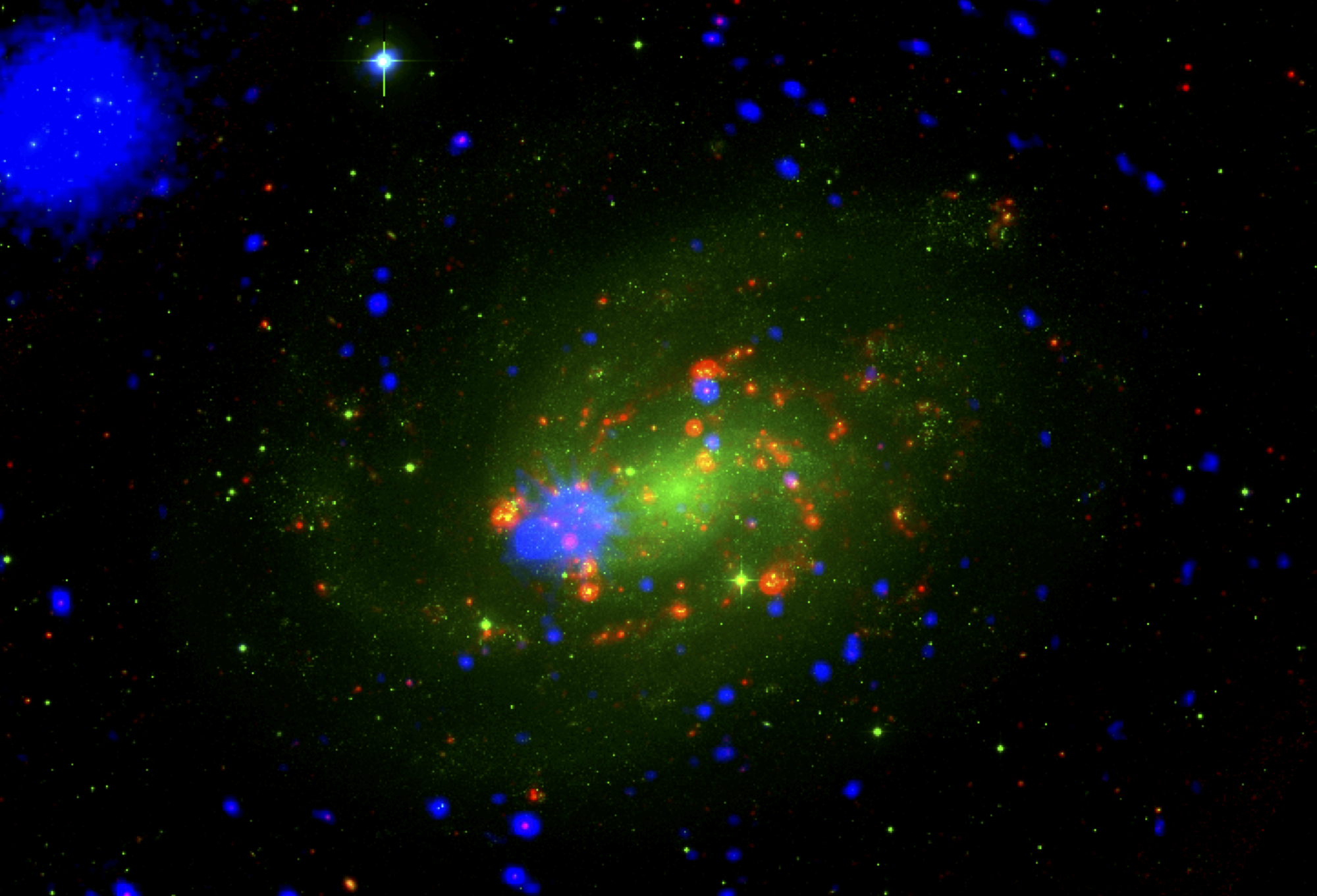
Past and future generations of stars in NGC 300

Past and future generations of stars in NGC 300
Copyright: ESA/XMM-Newton (X-rays); MPG/ESO (optical); NASA/Spitzer (infrared)
Acknowledgement: S. Carpano, Max-Planck Institute for Extraterrestrial Physics

JPG - (1.48 MB) / PNG - (7.99 MB)

This swirling palette of colours portrays the life cycle of stars in a spiral galaxy known as NGC 300.

Located some six million light-years away, NGC 300 is relatively nearby. It is one of the closest galaxies beyond the Local Group – the hub of galaxies to which our own Milky Way galaxy belongs. Due to its proximity, it is a favourite target for astronomers to study stellar processes in spiral galaxies.

The population of stars in their prime is shown in this image in green hues, based on optical observations performed with the Wide Field Imager (WFI) on the MPG/ESO 2.2-metre telescope at La Silla, Chile. Red colours indicate the glow of cosmic dust in the interstellar medium that pervades the galaxy: this information derives from infrared observations made with NASA’s Spitzer space telescope, and can be used to trace stellar nurseries and future stellar generations across NGC 300.

A complementary perspective on this galaxy’s composition comes from data collected in X-rays by ESA’s XMM-Newton space observatory, shown in blue. These represent the end points of the stellar life cycle, including massive stars on the verge of blasting out as supernovas, remnants of supernova explosions, neutron stars, and black holes. Many of these X-ray sources are located in NGC 300, while others – especially towards the edges of the image – are foreground objects in our own Galaxy, or background galaxies even farther away.

The sizeable blue blob immediately to the left of the galaxy’s centre is especially interesting, featuring two intriguing sources that are part of NGC 300 and shine brightly in X-rays.

One of them, known as NGC 300 X-1, is in fact a binary system, consisting of a Wolf-Rayet star – an ageing hot, massive and luminous type star that drives strong winds into its surroundings – and a black hole, the compact remains of what was once another massive, hot star. As matter from the star flows towards the black hole, it is heated up to temperatures of millions of degrees or more, causing it to shine in X-rays.

The other source, dubbed NGC 300 ULX1, was originally identified as a supernova explosion in 2010. However, later observations prompted astronomers to reconsider this interpretation, indicating that this source also conceals a binary system comprising a very massive star and a compact object – a neutron star or a black hole – feeding on material from its stellar companion.

Data obtained in 2016 with ESA’s XMM-Newton and NASA’s NuSTAR observatories revealed regular variations in the X-ray signal of NGC 300 ULX1, suggesting that the compact object in this binary system is a highly magnetized, rapidly spinning neutron star, or pulsar.

The large blue blob in the upper left corner is a much more distant object: a cluster of galaxies more than one billion light years away, whose X-ray glow is caused by the hot diffuse gas interspersed between the galaxies.

Explore NGC 300 in ESASky


Tuesday, November 20, 2018

Cosmic Serpent

Coils of Apep

Apep in the constellation of Norm
Digitized Sky Survey image around Apep


Videos

ESOcast 185 Light: Cosmic Serpent

Zooming in on Apep
Zooming in on Apep


ESO’s VLT captures details of an elaborate serpentine system sculpted by colliding stellar winds


The VISIR instrument on ESO’s Very Large Telescope has captured this stunning image of a newly discovered massive triple star system. Nicknamed Apep after an ancient Egyptian deity, this may be the first ever gamma-ray burst progenitor found.

This serpentine swirl, captured by the VISIR instrument on ESO’s Very Large Telescope (VLT), has an explosive future ahead of it; it is a Wolf-Rayet star system, and a likely source of one of the most energetic phenomena in the Universe — a long-duration gamma-ray burst (GRB).

“This is the first such system to be discovered in our own galaxy,” explains Joseph Callingham of the Netherlands Institute for Radio Astronomy (ASTRON), lead author of the study reporting this system. “We never expected to find such a system in our own backyard” [1].

The system, which comprises a nest of massive stars surrounded by a “pinwheel” of dust, is officially known only by unwieldy catalogue references like 2XMM J160050.7-514245. However, the astronomers chose to give this fascinating object a catchier moniker — “Apep”.

Apep got its nickname for its sinuous shape, reminiscent of a snake coiled around the central stars. Its namesake was an ancient Egyptian deity, a gargantuan serpent embodying chaos — fitting for such a violent system. It was believed that Ra, the Sun god, would battle with Apep every night; prayer and worship ensured Ra’s victory and the return of the Sun.

GRBs are among the most powerful explosions in the Universe. Lasting between a few thousandths of a second and a few hours, they can release as much energy as the Sun will output over its entire lifetime. Long-duration GRBs — those which last for longer than 2 seconds — are believed to be caused by the supernova explosions of rapidly-rotating Wolf-Rayet stars.

Some of the most massive stars evolve into Wolf-Rayet stars towards the end of their lives. This stage is short-lived, and Wolf-Rayets survive in this state for only a few hundred thousand years — the blink of an eye in cosmological terms. In that time, they throw out huge amounts of material in the form of a powerful stellar wind, hurling matter outwards at millions of kilometres per hour; Apep’s stellar winds were measured to travel at an astonishing 12 million km/h.

These stellar winds have created the elaborate plumes surrounding the triple star system — which consists of a binary star system and a companion single star bound together by gravity. Though only two star-like objects are visible in the image, the lower source is in fact an unresolved binary Wolf-Rayet star. This binary is responsible for sculpting the serpentine swirls surrounding Apep, which are formed in the wake of the colliding stellar winds from the two Wolf-Rayet stars.

Compared to the extraordinary speed of Apep’s winds, the dust pinwheel itself swirls outwards at a leisurely pace, “crawling” along at less than 2 million km/h. The wild discrepancy between the speed of Apep’s rapid stellar winds and that of the unhurried dust pinwheel is thought to result from one of the stars in the binary launching both a fast and a slow wind — in different directions.

This would imply that the star is undergoing near-critical rotation — that is, rotating so fast that it is nearly ripping itself apart. A Wolf-Rayet star with such rapid rotation is believed to produce a long-duration GRB when its core collapses at the end of its life.


Notes


[1] Callingham, now at the Netherlands Institute for Radio Astronomy (ASTRON), did part of this research while at the University of Sydney working with research team leader Peter Tuthill. In addition to observations from ESO telescopes, the team also used the Anglo-Australian Telescope at Siding Spring Observatory, Australia.


More information

This research was presented in a paper entitled “Anisotropic winds in Wolf-Rayet binary identify potential gamma-ray burst progenitor” which appeared in Nature Astronomy on 19 November 2018.

The team was composed of: J. R. Callingham (ASTRON, Dwingeloo, the Netherlands), P. G. Tuthill (Sydney Institute for Astronomy [SIfA], University of Sydney, Australia), B. J. S. Pope (SIfA; Center for Cosmology and Particle Physics, New York University, USA; NASA Sagan Fellow), P. M. Williams (Institute for Astronomy, University of Edinburgh, UK), P. A. Crowther (Department of Physics & Astronomy, University of Sheffield, UK), M. Edwards (SIfA), B. Norris (SIfA), and L. Kedziora-Chudczer (School of Physics, University of New South Wales, Australia).

ESO is the foremost intergovernmental astronomy organisation in Europe and the world’s most productive ground-based astronomical observatory by far. It has 16 Member States: Austria, Belgium, the Czech Republic, Denmark, France, Finland, Germany, Ireland, Italy, the Netherlands, Poland, Portugal, Spain, Sweden, Switzerland and the United Kingdom, along with the host state of Chile and with Australia as a Strategic Partner. ESO carries out an ambitious programme focused on the design, construction and operation of powerful ground-based observing facilities enabling astronomers to make important scientific discoveries. ESO also plays a leading role in promoting and organising cooperation in astronomical research. ESO operates three unique world-class observing sites in Chile: La Silla, Paranal and Chajnantor. At Paranal, ESO operates the Very Large Telescope and its world-leading Very Large Telescope Interferometer as well as two survey telescopes, VISTA working in the infrared and the visible-light VLT Survey Telescope. ESO is also a major partner in two facilities on Chajnantor, APEX and ALMA, the largest astronomical project in existence. And on Cerro Armazones, close to Paranal, ESO is building the 39-metre Extremely Large Telescope, the ELT, which will become “the world’s biggest eye on the sky”.


Links


Contacts

Joseph Callingham

Postdoctoral Research Fellow — Netherlands Institute for Radio Astronomy (ASTRON)
Dwingeloo, The Netherlands
Tel: +31 6 2929 7915

Calum Turner
ESO Public Information Officer
Garching bei München, Germany
Tel: +49 89 3200 6670
Email: pio@eso.org


Source: ESO/News