Showing posts with label Arp 299. Show all posts

Friday, September 03, 2021

Chemical clues to the death of massive stars


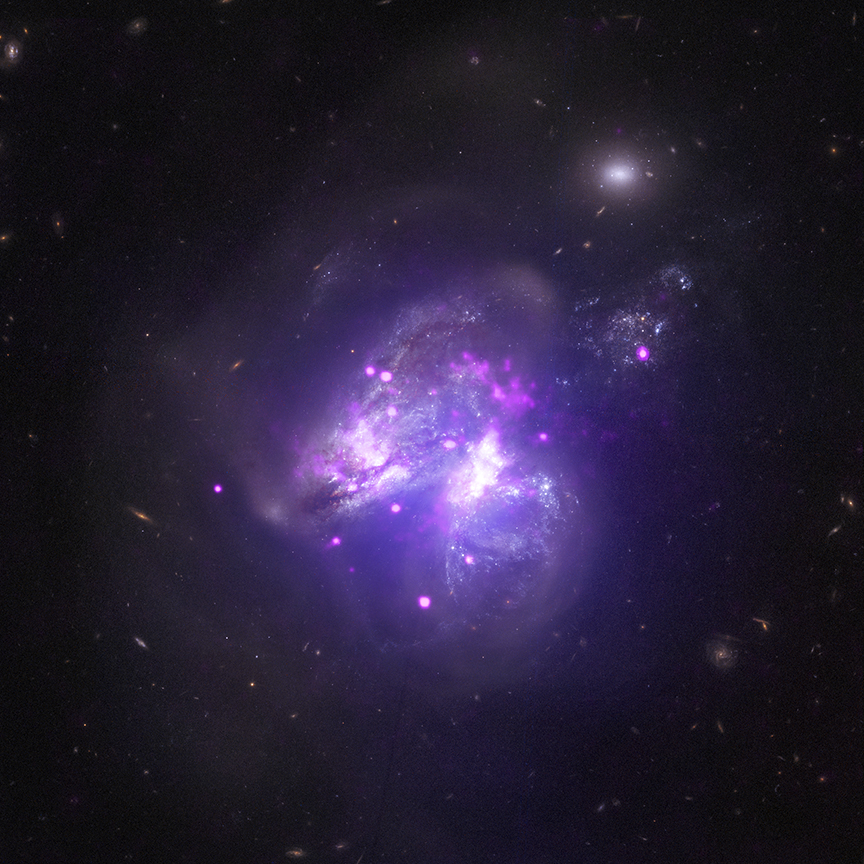
Multi-wavelength images of Arp 299 and its X-ray spectra

Upper left panel: XMM-Newton soft X-ray (0.3-2 keV) image with the RGS (rectangles) and EPIC/pn (circle) source regions. The three new observations in Cycle 19 have similar RGS roll angles so that one rectangular box appears thick. Upper right panel: A true color image of Arp 299 with soft X-ray in purple, optical (Hubble, F814W) in green, and infrared (Spitzer, 3.6 micron) in red. The bottom panel shows the XMM-Newton spectra of Arp 299. The RGS grating spectrum is shown in red, while the EPIC/pn spectrum is shown in purple. Vertical dashed lines in blue mark emission lines from various elements. Image credit: Junjie Mao

The Universe has countless stars, which come in different masses. The most common ones are the low-mass stars, including our Sun. Massive stars refer to those whose mass is more than eight times the mass of the Sun. The life of low-mass stars is quite long. For instance, our Sun can live for 10 billion years. However, massive stars can only live up to tens of millions of years. Some of these massive stars will have a splendid death. They can explode as core-collapse supernovae, which can outshine their entire galaxy. More than 2000 years ago (in the Han Dynasty), ancient Chinese astronomers kept records of the earliest supernovae observed with naked eyes by humankind.

Supernova events are rare in our galaxy due to the low star formation rate of the Milky Way. That is to say, there are not many baby stars born every year.

However, in starburst galaxies, the star formation rate can be boosted by a factor of 10 or 100! Accordingly, starburst galaxies can put on a “fireworks show” of supernovae when massive stars die. Arp 299 is a pair of colliding galaxies where numerous supernovae have exploded. In fact, it puts on at least a few “fireworks shows” of supernovae per decade.

Supernovae release not only a massive amount of photons (energy) but also a large number of elements (matter), such as oxygen, neon, magnesium, and iron. The relative amount of different elements is quite sensitive to the population of massive stars that die as core-collapse supernovae. 

Using ESA’s XMM-Newton space observatory, an international group of astronomers measured the chemical composition of the X-ray emitting “confetti” in Arp 299.

It is often assumed that massive stars from 10 to 40 times the mass of the Sun can explode successfully as core-collapse supernovae. However, the observed chemical composition in Arp 299 does not match the existing theoretical models unless we remove supernovae from massive stars heavier than 23 to 27 times the mass of the Sun. This is in accordance with the fact that astronomers have not clearly observed supernovae from stars heavier than 18 times the mass of the Sun.

What happens to those massive stars, then? They might end their life as black holes with no matter escaping from it or less energetic supernovae that release a little matter. The research team also points out that it is also possible that current theoretical predictions of the elements released through core-collapse supernovae are underestimated.

About the study

Journal:The Astrophysical Journal Letters
Title: Elemental Abundances of the Hot Atmosphere of Luminous Infrared Galaxy Arp 299
Authors: Junjie Mao, Ping Zhou, Aurora Simionescu, Yuanyuan Su, Yasushi Fukazawa, Liyi Gu, Hiroki Akamatsu, Zhenlin Zhu, Jelle de Plaa, François Mernier & Jelle S. Kaastra
 
 
Media Contact

Inquiries on the study

Junjie Mao 
E-mail:
jmao2018@hiroshima-u.ac.jp
Graduate School of Advanced Science and Engineering, Hiroshima University

Yasushi Fukazawa
Graduate School of Advanced Science and Engineering, Hiroshima University
E-mail:
fukazawa@astro.hiroshima-u.ac.jp

Inquiries on the story

Hiroshima University Department of Public Relations
TEL: 082-424-3701
E-mail:
koho@office.hiroshima-u.ac.jp

Source: Hiroshima University/News


Friday, June 15, 2018

Surprise discovery provides new insights into stellar deaths

Artist conception of a tidal disruption event (TDE) that happens when a star passes fatally close to a supermassive black hole, which reacts by launching a relativistic jet. Image credit: Sophia Dagnello, NRAO/AUI/NSF.  Hi-res image

Astronomers, working on a project to detect supernovas, made a surprise discovery when they found that one supernova explosion was actually a star being pulled apart by a supermassive black hole. ASTRON's Westerbork Synthesis Radio Telescope was involved in the observations.

This rare stellar death, known as a tidal disruption event, or TDE, occurs when the powerful gravity of a supermassive black hole rips apart a star that has wandered too close to the massive monster. 

Theorists have suggested that material pulled from the doomed star forms a rotating disk around the black hole, emitting intense X-rays and visible light, and launches jets of material outward from the poles of the disk close to the speed of light. 

"Never before have we been able to directly observe the formation and evolution of a jet from one of these events," said Miguel Perez-Torres, of the Astrophysical Institute of Andalucia in Granada, Spain. 

Originally, the researchers were monitoring a pair of colliding galaxies known as Arp 299, nearly 150 million light-years from Earth. This area of space is so rich in supernova explosions it has been dubbed the “supernova factory”. However, in January 2005 the researchers discovered a bright burst of infrared emission coming from the nucleus of one of these galaxies, and in July of the same year a new, distinct source of radio emission was witnessed from the same location. 

"As time passed, the new object stayed bright at infrared and radio wavelengths, but not in visible light and X-rays," said Seppo Mattila, of the University of Turku in Finland. "The most likely explanation is that thick interstellar gas and dust near the galaxy's centre absorbed the X-rays and visible light, then re-radiated it as infrared," he added. The researchers used the Nordic Optical Telescope on the Canary Islands and NASA's Spitzer space telescope to follow the object's infrared emission. 

Over the course of the next decade, the team continued to observe the radio emission using a technique known as Very Long Baseline Interferometry (VLBI). VLBI involves the remote coordination of multiple telescopes across the globe to focus on a single radio source at a given time. 

This technique provides extremely high resolution imaging when studying a radio source in space, providing the researchers with detailed data on the TDE. Telescopes in the European VLBI Network (EVN) and the Very Long Baseline Array (VLBA) were used for the observations, while the data collected was correlated at the Joint Institute for VLBI ERIC (JIVE), the Netherlands, and the Very Large Array (VLA), USA, respectively. 

This extensive monitoring revealed in 2011 that the radio-emitting portion was expanding in one direction, forming an elongation called a jet, as previously predicted by theorists. The measured expansion indicated that the material in the jet moved at an average of one-fourth the speed of light.

Most galaxies have supermassive black holes at their cores with masses that are millions to billions of times greater than the Sun. This mass is so concentrated that the resulting gravitational pull does not even allow light to escape. In this instance, the black hole is actively drawing material from its surroundings and ripping apart a star that is twice the Sun’s mass. This material forms a rotating disk around the black hole, and superfast jets of particles are launched outward – a phenomenon seen in radio galaxies and quasars. 

"Much of the time, however, supermassive black holes are not actively devouring anything, so they are in a quiet state," Perez-Torres explained. "Tidal disruption events can provide us with a unique opportunity to advance our understanding of the formation and evolution of jets in the vicinities of these powerful objects," he added. 

"Because of the dust that absorbed any visible light, this particular tidal disruption event may be just the tip of the iceberg of what until now has been a hidden population," Mattila said. "By looking for these events with infrared and radio telescopes, we may be able to discover many more, and learn from them," he said. 

Such events may have been more common in the distant Universe, so studying them could help scientists to better understand the environment in which galaxies developed billions of years ago.

Mattila and Perez-Torres led a team of 36 scientists from 26 institutions around the world in the observations of Arp 299. Their findings are published in the journal Science, which can be accessed here: http://science.sciencemag.org/lookup/doi/10.1126/science.aao4669. 

More information: 

The European VLBI Network (EVN) is a network of radio telescopes located primarily in Europe and Asia, with additional antennas in South Africa and Puerto Rico, which performs very high angular resolution observations of cosmic radio sources. 

Collectively the EVN forms the most sensitive radio telescope array at both centimetre wavelengths and millarcsecond resolution. The data collected at each of the individual stations is collated centrally at the correlator – a data processor housed at the Joint Institute for VLBI ERIC (JIVE) in Dwingeloo, the Netherlands.
 
The following EVN antennas observed at one or more epochs: Kunming, Seshan, Urumqi (China), Effelsberg, Wettzell (Germany), Medicina, Noto (Italy), Irbene (Latvia), Torun (Poland), Badary, Svetloe, Zelenchukskaya (Russia), Robledo, Yebes (Spain), Onsala (Sweden), Westerbork (The Netherlands), Cambridge and Jodrell Bank (The United Kingdom). 

Article: Mattila, S., Pérez-Torres, M., et al. 2018. A dust enshrouded tidal disruption event with a resolved radio jet in a galaxy merger. Science. DOI: 10.1126/science.aao4669 


Tuesday, June 27, 2017

Arp 299: Galactic Goulash

Arp 299 (composite)
Credit: X-ray: NASA/CXC/Univ of Crete/K. Anastasopoulou et al, NASA/NuSTAR/GSFC/A. Ptak et al; 
Optical: NASA/STScI


animation


What would happen if you took two galaxies and mixed them together over millions of years? A new image including data from NASA's Chandra X-ray Observatory reveals the cosmic culinary outcome.

Arp 299 is a system located about 140 million light years from Earth. It contains two galaxies that are merging, creating a partially blended mix of stars from each galaxy in the process.

However, this stellar mix is not the only ingredient. New data from Chandra reveals 25 bright X-ray sources sprinkled throughout the Arp 299 concoction. Fourteen of these sources are such strong emitters of X-rays that astronomers categorize them as "ultra-luminous X-ray sources," or ULXs.

These ULXs are found embedded in regions where stars are currently forming at a rapid rate. Most likely, the ULXs are binary systems where a neutron star or black hole is pulling matter away from a companion star that is much more massive than the Sun. These double star systems are called high-mass X-ray binaries.

Such a loaded buffet of high-mass X-ray binaries is rare, but Arp 299 is one of the most powerful star-forming galaxies in the nearby Universe. This is due at least in part to the merger of the two galaxies, which has triggered waves of star formation. The formation of high-mass X-ray binaries is a natural consequence of such blossoming star birth as some of the young massive stars, which often form in pairs, evolve into these systems.


This new composite image of Arp 299 contains X-ray data from Chandra (pink), higher-energy X-ray data from NuSTAR (purple), and optical data from the Hubble Space Telescope (white and faint brown). Arp 299 also emits copious amounts of infrared light that has been detected by observatories such as NASA's Spitzer Space Telescope, but those data are not included in this composite.

The infrared and X-ray emission of the galaxy is remarkably similar to that of galaxies found in the very distant Universe, offering an opportunity to study a relatively nearby analog of these distant objects. A higher rate of galaxy collisions occurred when the universe was young, but these objects are difficult to study directly because they are located at colossal distances.

The Chandra data also reveal diffuse X-ray emission from hot gas distributed throughout Arp 299. Scientists think the high rate of supernovas, another common trait of star-forming galaxies, has expelled much of this hot gas out of the center of the system.

A paper describing these results appeared in the August 21st, 2016 issue of the Monthly Notices of the Royal Astronomical Society and is available online. The lead author of the paper is Konstantina Anastasopoulou from the University of Crete in Greece. NASA's Marshall Space Flight Center in Huntsville, Alabama, manages the Chandra program for NASA's Science Mission Directorate in Washington. The Smithsonian Astrophysical Observatory in Cambridge, Massachusetts, controls Chandra's science and flight operations.


Fast Facts for Arp 299:

Scale: Image is 2.8 arcmin across (about 117,000 light years).
Category: Quasars & Active Galaxies, Black Holes
Coordinates (J2000): RA 11h 28m 31.33s | Dec 58° 33´ 41.80"
Constellation: Ursa Major
Observation Date: 13 Jul 2001, 14 Feb 2005, 12-13 Mar 2013
Observation Time: 34 hours 41 minutes
Obs. ID: 1641, 6227, 15077, 15619
Instrument: ACIS
References: Anastasopoulou, K. et al, 2016, MNRAS, 460, 3570; arXiv:1605.07001; Ptak, A. et al, 2014, ApJ, 800, 104; arXiv:1412.3120
Color Code: X-ray (Chandra: Pink; NuSTAR: Blue), Optical (Red, Green, Blue)
Distance Estimate: About 140 million light years


Monday, January 12, 2015

Tale of Two Black Holes

The real monster black hole is revealed in this new image from NASA's Nuclear Spectroscopic Telescope Array of colliding galaxies Arp 299
Image credit: NASA/JPL-Caltech/GSFC


A new high-energy X-ray image from NASA's Nuclear Spectroscopic Telescope Array, or NuSTAR, has pinpointed the true monster of a galactic mashup. The image shows two colliding galaxies, collectively called Arp 299, located 134 million light-years away. Each of the galaxies has a supermassive black hole at its heart.

NuSTAR has revealed that the black hole located at the right of the pair is actively gorging on gas, while its partner is either dormant or hidden under gas and dust. 

The findings are helping researchers understand how the merging of galaxies can trigger black holes to start feeding, an important step in the evolution of galaxies.

"When galaxies collide, gas is sloshed around and driven into their respective nuclei, fueling the growth of black holes and the formation of stars," said Andrew Ptak of NASA's Goddard Space Flight Center in Greenbelt, Maryland, lead author of a new study accepted for publication in the Astrophysical Journal. "We want to understand the mechanisms that trigger the black holes to turn on and start consuming the gas."

NuSTAR is the first telescope capable of pinpointing where high-energy X-rays are coming from in the tangled galaxies of Arp 299. Previous observations from other telescopes, including NASA's Chandra X-ray Observatory and the European Space Agency's XMM-Newton, which detect lower-energy X-rays, had indicated the presence of active supermassive black holes in Arp 299. However, it was not clear from those data alone if one or both of the black holes was feeding, or "accreting," a process in which a black hole bulks up in mass as its gravity drags gas onto it.

The new X-ray data from NuSTAR -- overlaid on a visible-light image from NASA's Hubble Space Telescope -- show that the black hole on the right is, in fact, the hungry one. As it feeds on gas, energetic processes close to the black hole heat electrons and protons to about hundreds of millions of degrees, creating a superhot plasma, or corona, that boosts the visible light up to high-energy X-rays. Meanwhile, the black hole on the left either is "snoozing away," in what is referred to as a quiescent, or dormant state, or is buried in so much gas and dust that the high-energy X-rays can't escape.

"Odds are low that both black holes are on at the same time in a merging pair of galaxies," said Ann Hornschemeier, a co-author of the study who presented the results Thursday at the annual American Astronomical Society meeting in Seattle. "When the cores of the galaxies get closer, however, tidal forces slosh the gas and stars around vigorously, and, at that point, both black holes may turn on."

NuSTAR is ideally suited to study heavily obscured black holes such as those in Arp 299. High-energy X-rays can penetrate the thick gas, whereas lower-energy X-rays and light get blocked.

Ptak said, "Before now, we couldn't pinpoint the real monster in the merger."

NuSTAR is a Small Explorer mission led by the California Institute of Technology in Pasadena and managed by NASA's Jet Propulsion Laboratory, also in Pasadena, for NASA's Science Mission Directorate in Washington. The spacecraft was built by Orbital Sciences Corporation, Dulles, Virginia. Its instrument was built by a consortium including Caltech; JPL; the University of California, Berkeley; Columbia University, New York; NASA's Goddard Space Flight Center, Greenbelt, Maryland; the Danish Technical University in Denmark; Lawrence Livermore National Laboratory, Livermore, California; ATK Aerospace Systems, Goleta, California, and with support from the Italian Space Agency (ASI) Science Data Center.

NuSTAR's mission operations center is at UC Berkeley, with the ASI providing its equatorial ground station located at Malindi, Kenya. The mission's outreach program is based at Sonoma State University, Rohnert Park, California. NASA's Explorer Program is managed by Goddard. JPL is managed by Caltech for NASA.

NASA is exploring our solar system and beyond to understand the universe and our place in it. The agency seeks to unravel the secrets of our universe, its origins and evolution, and search for life among the stars.

For more information, visit http://www.nasa.gov/nustar and http://www.nustar.caltech.edu/ .

Media Contact

Whitney Clavin
Jet Propulsion Laboratory, Pasadena, Calif.
818-354-4673

whitney.clavin@jpl.nasa.gov


Source: JPL-Caltech