Showing posts with label Whirlpool Galaxy. Show all posts

Sunday, January 16, 2022

Galaxies, Assemble!: MaNGA team releases largest-ever collection of 3-D maps of nearby galaxies


An image of the Whirlpool galaxy (M51); an iconic nearby galaxy, made using a Mosaic of images of one thousand galaxies, ten percent of the entire in the MaNGA sample. The top panel of the inset shows an SDSS image of galaxy MaNGA ID 1-37995; the bottom panel shows the MaNGA datacube for that galaxy, displaying just 9 of the over 30 different maps available in the MaNGA data. Explore an
interactive mosaic of this image! Image credit: Karen Masters and the SDSS collaboration


MaNGA measures spectra at multiple points in the same galaxy, using a newly created fiber bundle technology. The left-hand side shows the Sloan Foundation Telescope and a close-up of the tip of the fiber bundle. The bottom right illustrates how each fiber observes a different section of each galaxy. The image (from the Hubble Space Telescope) shows one of the first galaxies that that MaNGA measured.  The top right shows data gathered by two fibers observing two different part of the galaxy, showing how the spectrum of the central regions differs dramatically from outer regions. Click to download a larger version from Google Drive. Image credit: Dana Berry / SkyWorks Digital, Inc., David Law, SDSS Collaboration. Hubble Space Telescope image credit: NASA, ESA, the Hubble Heritage (STScI/AURA)-ESA/Hubble Collaboration, and A. Evans (University of Virginia, Charlottesville/NRAO/Stony Brook University)


The Hertzsprung-Russelll diagram for the nearly 12,000 stars observed by MaStar. Each little circle in the diagram represents a unique star. The vertical axis shows how luminous the stars are relative to the Sun. The horizontal axis shows how hot it is. The size of the circle indicates how strong gravity is on their surface. The bigger the circle, the smaller is the gravity on their surface, with the red giant stars in the upper right corner. The position of our Sun is indicated by the red dot in the middle. The color of the circles indicate the amount of heavy elements as compared to the Sun. Blue and purple colors mean the stars have less heavy elements, and yellow means the stars have more heavy elements than the Sun.
Click to download a larger version from Google Drive. Image credit:Renbin Yan and the SDSS collaboration

Just over a month ago, scientists from the Sloan Digital Sky Survey (SDSS) released the complete dataset of 10,000 galaxies observed by the Mapping Nearby Galaxies at Apache Point Observatory (MaNGA) project, making MaNGA the largest galaxy survey of its kind.

MaNGA is a special kind of galaxy survey, which makes use of an innovative fiber-bundling technology to make detailed spectral maps of thousands of nearby galaxies. Spectra are graphs that show the amount of light given off by a galaxy at different wavelengths, much like a rainbow shows the amount of sunlight in various colors. Most previous galaxy surveys have either taken detailed images in a handful or just one colour, or measured just a single spectrum for an entire galaxy, but MaNGA works differently.

MaNGA made use of an innovative technique for bundling sets of fiber-optic cables into tightly-packed hexagonal arrays. With these bundles the team measured spectra at tens to hundreds of separate points in each galaxy, resulting in a “datacube” containing full spectroscopic information at each point. Making use of the famous SDSS plug plates, which allow multiple such bundles to be precisely aligned over target galaxies, MaNGA was able to observe seventeen galaxies at once. Similar surveys could only observe one galaxy at a time, making MaNGA almost twenty times faster than previous efforts — and six years of observing in this mode created the largest ever sample size of this kind.

Kevin Bundy, from the University of California at Santa Cruz and MaNGA’s PI, explains the motivation behind the MaNGA survey. “Observing such a large sample with MaNGA allows us to see how the detailed internal properties of galaxies vary in systematic ways with other factors, like galaxy mass, or where galaxies live in the Universe. These patterns are the key to understanding the physical processes that shape galaxy evolution.”

Researchers study each data cube to reveal its galaxy’s detailed chemical composition, find the ages, chemical makeup and motions of the stars inside it and map ionized interstellar gas. MaNGA has created over 30 different maps for each galaxy. These maps can be used for lots of different applications, for example, to estimate how many baby stars are being formed at every position in the galaxy, or to find the influence of the central supermassive black hole. MaNGA dramatically increases the number of galaxies with this detailed information, and a sister project, the MaNGA Stellar Library (MaStar), helped it along.

Galaxies are made of stars, so understanding them in detail requires a detailed library of spectra of stars. Alongside the complete release of MaNGA, SDSS scientists are pleased to announce the completion of MaStar, which made use of otherwise unused time on the MaNGA instrument to observe over 24,000 stars, enabling the scientists to more accurately extract information from the MaNGA data. Renbin Yan of the Chinese University of Hong Kong, and the leader of the MaStar project explained “MaStar is a special kind of library that includes spectra for as many types of stars as possible. Using these data, we can figure out how many of each type of star add up to make each of the many spectra from a MaNGA galaxy, and reconstruct the most accurate view ever of when and where stars formed in that galaxy’s cosmic history.”

For example, MaNGA data have been used to make movies showing how the location where baby stars form moves around through spiral arms and other features in galaxies. Identifying which spectra came from which internal structure turns out to be tricky for computers, but with the help of citizen scientists, the MaNGA team have been able to do this, providing in this release maps showing where the structures are. And the kinematics of galaxies can reveal previously unknown galaxy interactions.

All of this MaNGA data has been made publicly available, for anyone to use, and the SDSS team have also created a specially designed tool dubbed “Marvin”, to help with data access. Marvin allows anyone to have a quick look at the data of each galaxy in an easy-to-use web interface, and is also available as a powerful set of python modules which allow anyone familiar with coding to access and visualize this complex data. Brian Cherinka, one of the lead developers of Marvin from Space Telescope Science Institute explains, “Marvin was designed specifically to access the complex MaNGA data and help researchers to avoid some of the common pitfalls in data visualization and access.”

Using MaNGA data and an early version of Marvin, scientists have already been discovering many new things about galaxies, with over 500 papers already published using the data. For example, MaNGA team members discovered a new class of galaxy, dubbed a red geyser, in which outflows from the supermassive black hole, revealed in MaNGA maps of ionized gas, are preventing new stars from forming. And to scientists’ surprise this happens even in the smallest galaxies.

Making MaNGA data both publicly available, and accessible will fuel science analyses for years to come, and puts the full power of MaNGA data into the hands of anyone who wants to use it. “It’s important to us that the data is not just available, but also accessible, so that anyone with an interest in galaxies can use MaNGA data for their research, education, or just for fun, can explore the cubes, spectra and maps to learn more these galaxies,” says Anne-Marie Weijmans of the University of St Andrews who led the part of the SDSS team in charge of data releases, “You don’t need to be a galaxy expert to work with MaNGA data: we have many tutorials on our website to get you started.”

The instrumentation innovations developed for MaNGA will reverberate into the future. The next generation of SDSS (SDSS-V) is expanding on the novel fiber-packing methods developed for MaNGA to construct even larger fiber bundles for its Local Volume Mapper program. This survey will also study gas and newly-formed stars, but in an environment much closer to home — our own Milky Way and its nearby smaller neighbors. By combining these data with what MaNGA has learned from thousands of more distant galaxies, astronomers will gain a much deeper understanding of how gas and stars coexist and interact throughout a galaxy’s lifetime.


Contacts:


Press Releases:

All prior SDSS press releases can be found in the press release archives of the various phases of the SDSS:


About the Sloan Digital Sky Survey

Funding for the Sloan Digital Sky Survey IV has been provided by the Alfred P. Sloan Foundation, the U.S. Department of Energy Office of Science, and the Participating Institutions. SDSS acknowledges support and resources from the Center for High-Performance Computing at the University of Utah.

The SDSS web site is
www.sdss.org.

SDSS is managed by the Astrophysical Research Consortium for the Participating Institutions of the SDSS Collaboration including the Brazilian Participation Group, the Carnegie Institution for Science, Carnegie Mellon University, Center for Astrophysics | Harvard & Smithsonian (CfA), the Chilean Participation Group, the French Participation Group, Instituto de Astrofísica de Canarias, The Johns Hopkins University, Kavli Institute for the Physics and Mathematics of the Universe (IPMU) / University of Tokyo, the Korean Participation Group, Lawrence Berkeley National Laboratory, Leibniz Institut für Astrophysik Potsdam (AIP), Max-Planck-Institut für Astronomie (MPIA Heidelberg), Max-Planck-Institut für Astrophysik (MPA Garching), Max-Planck-Institut für Extraterrestrische Physik (MPE), National Astronomical Observatories of China, New Mexico State University, New York University, University of Notre Dame, Observatório Nacional / MCTI, The Ohio State University, Pennsylvania State University, Shanghai Astronomical Observatory, United Kingdom Participation Group, Universidad Nacional Autónoma de México, University of Arizona, University of Colorado Boulder, University of Oxford, University of Portsmouth, University of Utah, University of Virginia, University of Washington, University of Wisconsin, Vanderbilt University, and Yale University.

SDSS / Press Releases / Galaxies, Assemble!: MaNGA team releases largest-ever collection of 3-D maps of nearby galaxies


Tuesday, October 26, 2021

Chandra Sees Evidence for Possible Planet in Another Galaxy


M51/Whirpool Galaxy
Credit X-ray: NASA/CXC/SAO/R. DiStefano, et al.; 
Optical: NASA/ESA/STScI/Grendler; 
Illustration: NASA/CXC/M.Weiss


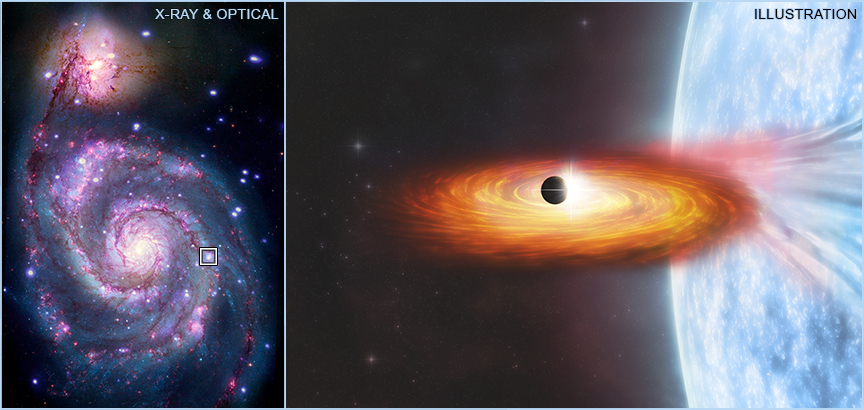
Astronomers have found evidence for a possible planet candidate in the M51 ("Whirlpool") galaxy, potentially representing what would be the first planet seen to transit a star outside of the Milky Way. As reported in our latest press release, researchers used NASA's Chandra X-ray Observatory to detect the dimming of X-rays from an "X-ray binary", a system where a Sun-like star is in orbit around a neutron star or black hole. The authors interpret this dimming as being a planet passing in front of the neutron star or black hole.

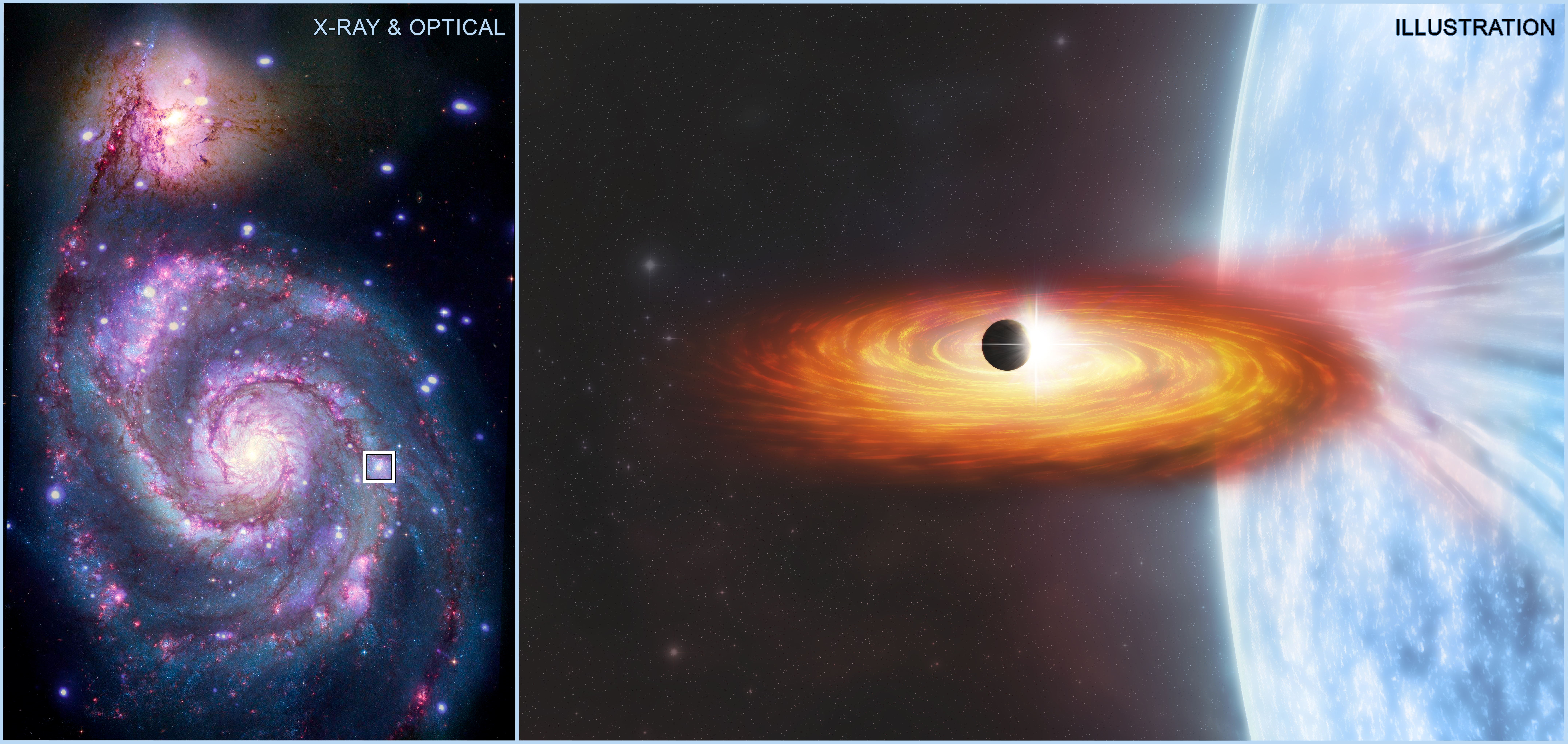
The left panel of this graphic shows M51 in X-rays from Chandra (purple and blue) and optical light from NASA's Hubble Space Telescope (red, green, and blue). A box marks the location of the possible planet candidate, an X-ray binary known as M51-ULS-1. An artist's illustration in the right panel depicts the X-ray binary and possible planet. Material from the companion star (white and blue in illustration) is pulled onto the neutron star or black hole, forming a disk around the dense object (illustrated as red and orange). The material near the dense object becomes superheated, causing it to glow in X-ray light (white). The planet is shown beginning to pass in front of this source of X-rays.

Looking for the dimming of a star's light as something passes in front of it is called the transit technique. For years, scientists have discovered exoplanets using transits with optical light telescopes, which detect the range of light humans can see with their eyes and more. This includes both ground-based telescopes and space-based ones like NASA's Kepler mission. These optical light transit detections require very high levels of sensitivity because the planet is much smaller than the star it passes in front of, and, therefore, only a tiny fraction of the light is blocked.


M51-ULS-1 Transit Only
Animation Credit: NASA/CXC/A.Jubett

The scenario of a transit in an X-ray binary is different. Because a potential planet is close in size to the X-ray source around the neutron star or black hole, a transiting planet passing along Earth's line of sight could temporarily block most or all of the X-rays. This makes it possible to spot transits at greater distances — including beyond the Milky Way — than current optical light studies using transits. A separate graphic shows how X-rays from M51-ULS-1 temporarily decrease to zero during the Chandra observations.

While this is a tantalizing study, the case of an exoplanet in M51 is not ironclad. One challenge is that the planet candidate's large orbit in M51-ULS-1 means it would not cross in front of its binary partner again for about 70 years, thwarting any attempts for a confirming observation for decades. There is also the possibility that the dimming of X-rays is due to a passing cloud of gas near the M51-ULS-1, though the researchers think the data strongly favor the planet explanation.

Illustration Credit: NASA/CXC/M. Weiss

The paper describing these results appears in the latest issue of Nature Astronomy and is available online. The authors are Rosanne DiStefano (CfA), Julia Berndtsson (Princeton), Ryan Urquhart (Michigan State University), Roberto Soria (University of the Chinese Science Academy), Vinay Kashap (CfA), Theron Carmichael (CfA), and Nia Imara (now at the University of California at Santa Cruz). NASA's Marshall Space Flight Center manages the Chandra program. The Smithsonian Astrophysical Observatory's Chandra X-ray Center controls science from Cambridge Massachusetts and flight operations from Burlington, Massachusetts.


Fast Facts for M51/Whirlpool Galaxy:

Scale: Image is about 6 arcmin (49,000 light years) across.
Category:
Normal Galaxies & Starburst Galaxies
Constellation: Canes Venatici
Observation Date: 11 pointings between March 2000 and October 2012
Observation Time: 232 hours 10 minutes (9 days 16 hours 10 min)
Obs. ID: 353, 354, 1622, 3932, 13812-13816, 15496, 15553
Instrument:
ACIS
Also Known As: NGC 5194, NGC 5195
References: DiStefano, R., et al., 2021, Nature Astronomy (Published);
PDF Document
Color Code: X-ray: purple and blue; Optical: red, green, and blue
Distance Estimate: About 28 million light years


Thursday, January 14, 2021

Magnetic Chaos Hidden Within the Whirlpool Galaxy

Magnetic field streamlines detected by SOFIA are shown over an image of the Whirlpool galaxy, M51, from NASA’s Hubble Space Telescope. For the first time, SOFIA’s infrared view shows that the magnetic fields in the outer arms do not follow the galaxy's spiral shape and are instead distorted. The intense star formation activity in these regions, shown in red, may be causing the chaos, along with the forces from the yellow neighboring galaxy, NGC 5195, tugging on one of the spiral arms. Credits: NASA, the SOFIA science team, A. Borlaff; NASA, ESA, S. Beckwith (STScI) and the Hubble Heritage Team (STScI/AURA). Hi-res image

Not all appears as it would seem in the Whirlpool galaxy. One of the best-studied spiral galaxies and a delight to amateur astronomers, Messier 51, as it’s officially named, is influenced by powerful, invisible forces.  

Located 31 million light-years away in the constellation Canes Venatici, the galaxy’s arms are strikingly visible as they reach out along the central spine structure, displaying swirling clouds of gas and dust that are massive star-making factories. But new observations by NASA’s Stratospheric Observatory for Infrared Astronomy, or SOFIA, presented at this week’s 237th meeting of the American Astronomical Society, shows  a more complicated picture.  

Radio telescopes previously detected neatly-drawn magnetic fields throughout the length of the galaxy’s massive arms. But under SOFIA’s infrared gaze for the first time those lines give way to a chaotic scene in the outer spiral arms. Using a far-infrared camera and imaging polarimeter instrument called the High-Resolution Airborne Wideband Camera, or HAWC+, researchers found that the magnetic fields in the outskirts of the galaxy no longer follow the spiral structure and are instead distorted. 

What’s causing all this magnetic pandemonium? The intense star formation in these areas creates chaos that can only be seen with infrared flight. A nearby, yellowish galaxy called NGC 5195 tugging at the outermost tip of one of the arms adds to the turmoil, possibly strengthening the magnetic fields. The research builds on SOFIA’s previous findings that show magnetic fields are important in shaping spiral galaxies and helps unravel the complex role magnetic fields play in the evolution of galaxies. 

Media Contact: 

Elizabeth Landau 
NASA Headquarters, Washington 
202-358-0845 

elizabeth.r.landau@nasa.gov 

Alison Hawkes 
NASA Ames Research Center, Silicon Valley, Calif. 
650-604-4789 

alison.hawkes@nasa.gov 

Editor: Kassandra Bell


Wednesday, February 20, 2019

In Colliding Galaxies, a Pipsqueak Shines Bright

Bright green sources of high-energy X-ray light captured by NASA's NuSTAR mission are overlaid on an optical-light image of the Whirlpool galaxy (in the center of the image) and its companion galaxy, M51b (the bright greenish-white spot above the Whirlpool), taken by the Sloan Digital Sky Survey.Credit: NASA/JPL-Caltech, IPAC.  › Larger view

In the nearby Whirlpool galaxy and its companion galaxy, M51b, two supermassive black holes heat up and devour surrounding material. These two monsters should be the most luminous X-ray sources in sight, but a new study using observations from NASA's NuSTAR (Nuclear Spectroscopic Telescope Array) mission shows that a much smaller object is competing with the two behemoths.

The most stunning features of the Whirlpool galaxy - officially known as M51a - are the two long, star-filled "arms" curling around the galactic center like ribbons. The much smaller M51b clings like a barnacle to the edge of the Whirlpool. Collectively known as M51, the two galaxies are merging. 

At the center of each galaxy is a supermassive black hole millions of times more massive than the Sun. The galactic merger should push huge amounts of gas and dust into those black holes and into orbit around them. In turn, the intense gravity of the black holes should cause that orbiting material to heat up and radiate, forming bright disks around each that can outshine all the stars in their galaxies. 

But neither black hole is radiating as brightly in the X-ray range as scientists would expect during a merger. Based on earlier observations from satellites that detect low-energy X-rays, such as NASA's Chandra X-ray Observatory, scientists believed that layers of gas and dust around the black hole in the larger galaxy were blocking extra emission. But the new study, published in the Astrophysical Journal, used NuSTAR's high-energy X-ray vision to peer below those layers and found that the black hole is still dimmer than expected. 

"I'm still surprised by this finding," said study lead author Murray Brightman, a researcher at Caltech in Pasadena, California. "Galactic mergers are supposed to generate black hole growth, and the evidence of that would be strong emission of high-energy X-rays. But we're not seeing that here."

Brightman thinks the most likely explanation is that black holes "flicker" during galactic mergers rather than radiate with a more or less constant brightness throughout the process. 

"The flickering hypothesis is a new idea in the field," said Daniel Stern, a research scientist at NASA's Jet Propulsion Laboratory in Pasadena and the project scientist for NuSTAR. "We used to think that the black hole variability occurred on timescales of millions of years, but now we're thinking those timescales could be much shorter. Figuring out how short is an area of active study."

Small but  Brilliant

Along with the two black holes radiating less than scientists anticipated in M51a and M51b, the former also hosts an object that is millions of times smaller than either black hole yet is shining with equal intensity. The two phenomena are not connected, but they do create a surprising X-ray landscape in M51. 

The small X-ray source is a neutron star, an incredibly dense nugget of material left over after a massive star explodes at the end of its life. A typical neutron star is hundreds of thousands of times smaller in diameter than the Sun - only as wide as a large city - yet has one to two times the mass. A teaspoon of neutron star material would weigh more than 1 billion tons. 

Despite their size, neutron stars often make themselves known through intense light emissions. The neutron star found in M51 is even brighter than average and belongs to a newly discovered class known as ultraluminous neutron stars. Brightman said some scientists have proposed that strong magnetic fields generated by the neutron star could be responsible for the luminous emission; a previous paper by Brightman and colleagues about this neutron star supports that hypothesis. Some of the other bright, high-energy X-ray sources seen in these two galaxies could also be neutron stars. 

NuSTAR is a Small Explorer mission led by Caltech and managed by JPL for NASA's Science Mission Directorate in Washington. NuSTAR was developed in partnership with the Danish Technical University and the Italian Space Agency (ASI). The spacecraft was built by Orbital Sciences Corporation in Dulles, Virginia (now part of Northrop Grumman). NuSTAR's mission operations center is at UC Berkeley, and the official data archive is at NASA's High Energy Astrophysics Science Archive Research Center. ASI provides the mission's ground station and a mirror archive. Caltech manages JPL for NASA

News Media Contact

Calla Cofield
Jet Propulsion Laboratory, Pasadena, Calif.
626-808-2469

calla.e.cofield@jpl.nasa.gov


Source: NuSTAR/News


Sunday, December 13, 2015

Imaging an Expanding Supernova Shell

An optical image of the galaxy Messier 51 with the insert showing the location of supernova SN2011dh. Using precise radio imaging techniques, astronomers have determined the size of the shock around this supernovae, and estimated its outward velocity. Credit: Rafael Ferrando, Observatory Pla D’arguines


Supernovae, the explosive deaths of massive stars, are among the most momentous events in the cosmos because they disburse into space all of the chemical elements that were produced inside their progenitor stars, including the elements essential for making planets and life. Their bright emission also enables them to be used as probes of the very distant universe. Not least, supernovae are astrophysical laboratories for the study of very high-velocity shocks and the physics of particles under extreme conditions.

On May 31, 2011, an amateur astronomer spotted a supernova in the relatively nearby Whirlpool Galaxy (Messier 51), about 257 million light-years away. An analysis of the spectrum of SN2011dh showed that the precursor object was a massive supergiant star, about thirteen times bigger than the Sun (there is also some evidence for the presence of a binary companion star). The explosion set off a shock wave whose bright optical emission comes primarily from the inner dense, slow-moving ejecta. In addition, astronomers see a fast-moving component to the shock that is bright at radio wavelengths. The size and expansion velocity of the shock are thought to be basic distinguishing characteristics of different kinds of supernova (for example, having different mass progenitors or different stellar properties). Astronomers have therefore been at work trying to study these shocks. Unfortunately, supernovae are relatively rare, and so far only five supernovae have gone off in galaxies close enough to us, and recently enough, to have had their detailed shock properties studied.

CfA astronomers Atish Kamble and Alicia Soderberg and their colleagues have now measured a sixth. They been following SN2011dh in the radio since the explosion took place using a variety of radio telescope facilities, including very long baseline techniques, to obtain very high spatial resolution images of the shock. Observations they took 453 days after the event have now been combined with more recent measurements, enabling the scientists to determine the basic geometry of the shock: It has swept out a nearly spherical shell of hot material about 120 times larger in radius than the average distance Pluto is from the Sun.

Since the scientists know how long the shock has been propagating, about 453 days, they can estimate its velocity as about 19,000 kilometers per second (over forty-two million miles per hour). Combined with other observations of its radio brightness, the result implies that for nearly all of that time the expansion proceeded without being slowed down significantly by intervening material in space. Only about one-thousandth of a solar-mass of material has been swept up. These measurements are key tests of the robustness of theoretical predictions about supernovae and the underlying assumptions, and the results provide confidence in supernova shock theories. The research is part of an ongoing, cradle-to-grave study of this supernova.


Reference(s):

"Imaging the Expanding Shell of SN 2011dh," A. de Witt, M. F. Bietenholz, A. Kamble, A. M. Soderberg, A. Brunthaler, B. Zauderer, N. Bartel and M. P. Rupen, MNRAS, 455, 511, 2015.


Thursday, August 21, 2014

Swirling Electrons in the Whirlpool Galaxy

LOFAR radio map of the whirlpool galaxy M51 and its neighbourhood at a frequency of 150 MHz. The field covers 4 by 2.6 degrees. The observations were performed with the Dutch LOFAR high-band antennas. The map shows the distribution of hot electrons in M51 and also a large number of background galaxies.The inlay shows an enlarged view of M51 at 150 MHz (white contour lines) overlayed onto an optical image of M51 from the Digital Sky Survey (DSS). © David Mulcahy et al., Astronomy & Astrophysics 

The whirlpool galaxy Messier 51 (M51) is seen from a distance of approximately 30 million light years. This galaxy appears almost face-on and displays a beautiful system of spiral arms.

A European team of astronomers was able to observe M51 with the International LOFAR Telescope in the frequency range 115-175 MHz, just above the normal commercial FM radio frequency band of 88-108 MHz. The team obtained the most sensitive image of any galaxy at frequencies below 1 GHz so far.

With LOFAR's high sensitivity, the disk of M51 in the radio regime could be traced much further out than before. The astronomers detected cosmic electrons and magnetic fields 40,000 light years away from the center of M51. With LOFAR's high angular resolution, the spiral arms are clearly visible. Magnetic fields and cosmic rays are densest in spiral arms. Compared to higher radio frequencies, spiral arms appear broader due to the diffusion of cosmic electrons away from the spiral arms where they have been formed. 

The view of galaxies in the radio regime is different to their optical appearance. Whereas optical images show predominantly the visible light from stars, the radio waves unravel two constituents of galaxies that are invisible to optical telescopes: electrons, almost as fast as light, and magnetic fields. Their role for the stability and evolution of galaxies is increasingly under discussion. The electrons are "cosmic ray" particles produced in the shock fronts of giant supernova explosions. Magnetic fields are generated by dynamo processes driven by gas motions. When the electrons spiral around the magnetic field lines, radio waves are emitted, a process called synchrotron emission. Its intensity increases with the number and energy of the electrons and with magnetic field strength. 

For many decades, radio astronomy has been unable to explore low frequencies below 300 MHz because the ionosphere acts as a barrier of low-frequency radio waves (which are completely blocked below about 10 MHz). Sophisticated methods of data processing and superfast computers are needed to recover the emission. Due to these technical challenges, spiral galaxies have hardly been studied before at these very low radio frequencies. The only observations were of poor resolution and no details could be made out.

The target of investigation in David Mulcahy's PhD project was the beautiful spiral galaxy Messier 51 at a distance of about 30 million light years which is visible already in a small telescope in the constellation "Canes Venatici", not far away from the famous Big Dipper (in German: "Großer Wagen") in the sky.  

"Low-frequency radio waves are important as they carry information about electrons of relatively low energies that are able to propagate further away from their places of origin in the star-forming spiral arms and are able to illuminate the magnetic fields in the outer parts of galaxies", says David Mulcahy. "We need to know whether magnetic fields are expelled from galaxies and what their strength is out there." 

"This beautiful image, coupled with the important scientific result it represents, illustrates the fantastic advances that can be made at low radio frequencies with the LOFAR telescope", continues Anna Scaife from Southampton University, co-author of the paper. "Unravelling the mysteries of magnetic fields is crucial to understanding how our Universe works. For too long, many of the big questions about magnetic fields have simply been untestable and this new era of radio astronomy is very exciting." 

The Low Frequency Array (LOFAR), designed and constructed by ASTRON in the Netherlands, is a brand new radio telescope giving access to very low radio frequencies. 

© ASTRON, The Netherlands 

LOFAR explores the relatively unexplored frequency range below 240 MHz and consists of a multitude of small and simple antennas without moving parts. LOFAR consists of 38 stations in the Netherlands, 6 stations in Germany and one station each in the UK, France and Sweden. The novelty is the online combination of the signals from all stations in a powerful computing cluster located at the University of Groningen (Netherlands). 

Observations of M51 with LOFAR below FM radio frequencies (at 30-80 MHz) have already taken place. „This opens a new window to the Universe where we do not know how galaxies will look like", concludes Rainer Beck, who supervised David Mulcahy's PhD project. „Maybe we will see how galaxies are magnetically connected to intergalactic space. This is a key experiment in preparation for the planned Square Kilometre Array (SKA) that should tell us how cosmic magnetic fields are generated." 

Original paper:
The nature of the low-frequency emission of M51: First observations of a nearby galaxy with LOFAR, by D.D. Mulcahy, A. Horneffer, R. Beck et al., 2014, Astronomy & Astrophysics  (DOI: 10.1051/0004-6361/201424187).


Thursday, June 05, 2014

M51: Chandra Captures Galaxy Sparkling in X-rays

M51
Credit X-ray: NASA/CXC/Wesleyan Univ./R.Kilgard, et al; 
Optical: NASA/STScI
 

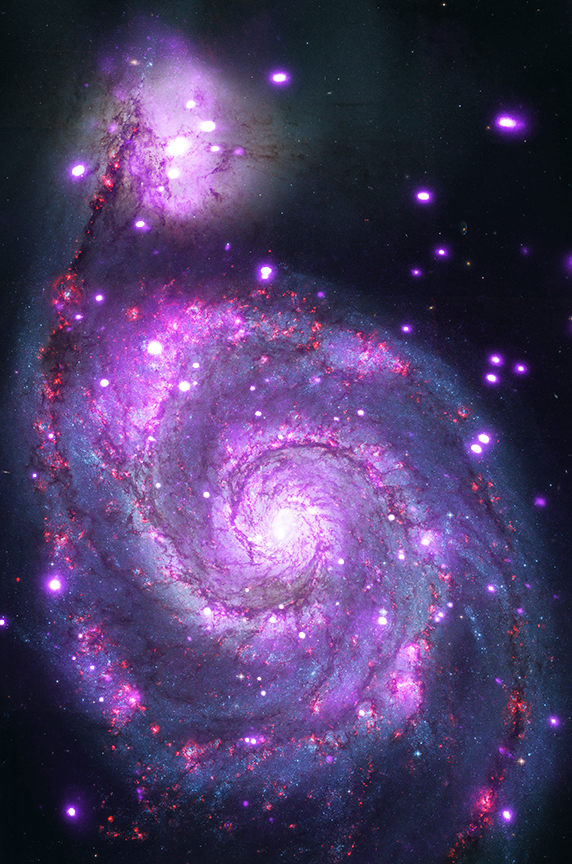
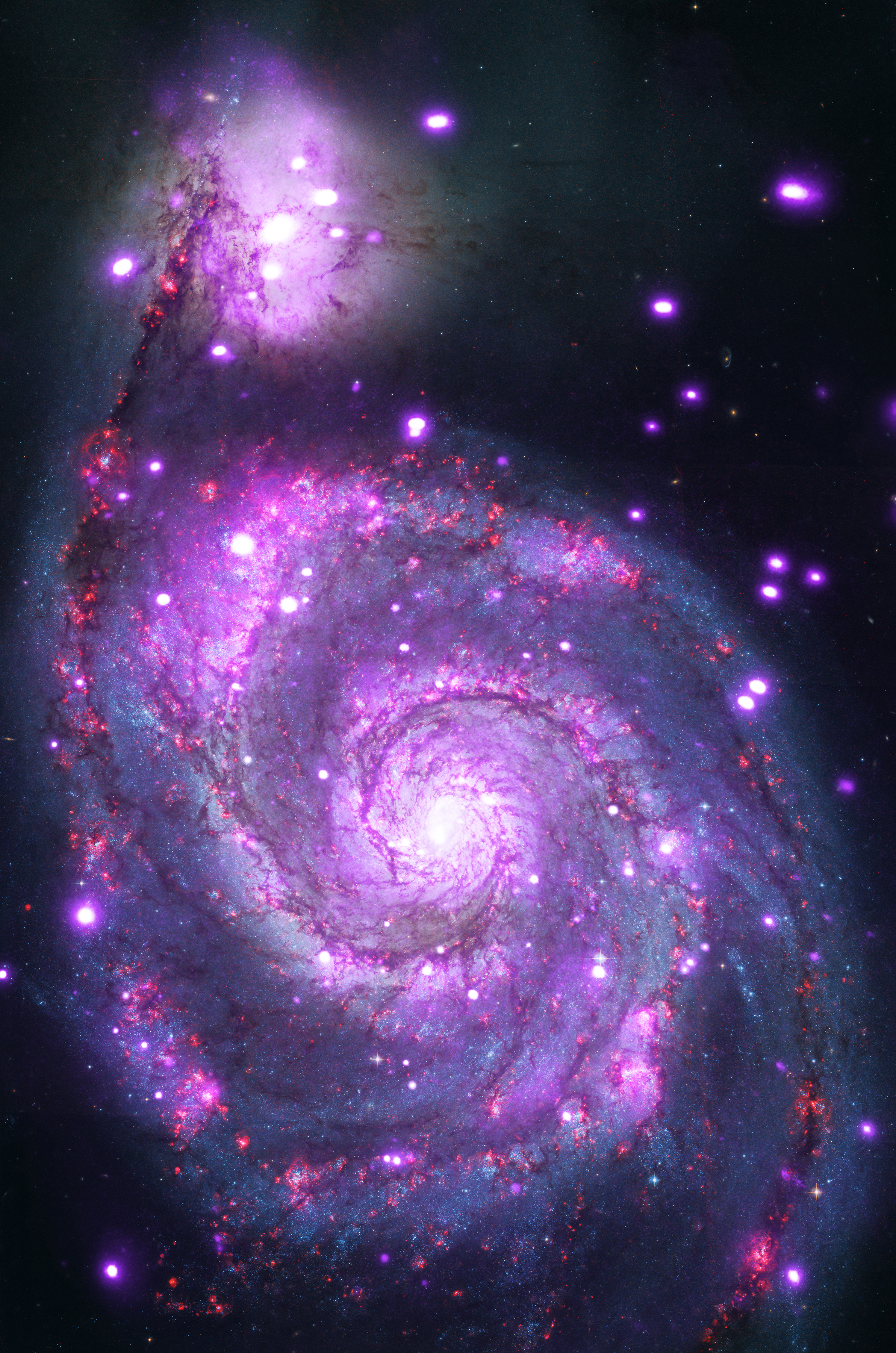
Nearly a million seconds of observing time with NASA's Chandra X-ray Observatory has revealed a spiral galaxy similar to the Milky Way glittering with hundreds of X-ray points of light.

The galaxy is officially named Messier 51 (M51) or NGC 5194, but often goes by its nickname of the "Whirlpool Galaxy." Like the Milky Way, the Whirlpool is a spiral galaxy with spectacular arms of stars and dust. M51 is located about 30 million light years from Earth, and its face-on orientation to Earth gives us a perspective that we can never get of our own spiral galactic home.

By using Chandra, astronomers can peer into the Whirlpool to uncover things that can only be detected in X-rays. In this new composite image, Chandra data are shown in purple. Optical data from the Hubble Space Telescope are red, green, and blue.

Most of the X-ray sources are X-ray binaries (XRBs). These systems consist of pairs of objects where a compact star, either a neutron star or, more rarely, a black hole, is capturing material from an orbiting companion star. The infalling material is accelerated by the intense gravitational field of the compact star and heated to millions of degrees, producing a luminous X-ray source. The Chandra observations reveal that at least ten of the XRBs in M51 are bright enough to contain black holes. In eight of these systems the black holes are likely capturing material from companion stars that are much more massive than the Sun.

Because astronomers have been observing M51 for about a decade with Chandra, they have critical information about how X-ray sources containing black holes behave over time. The black holes with massive stellar companions are consistently bright over the ten years of Chandra observations. These results suggest that the high-mass stars in these X-ray sources also have strong winds that allow for a steady stream of material to flow onto the black hole.

A difference between the Milky Way and the Whirlpool galaxy is that M51 is in the midst of merging with a smaller companion galaxy seen in the upper left of the image. Scientists think this galactic interaction is triggering waves of star formation. The most massive of the newly formed stars will race through their evolution in a few million years and collapse to form neutron stars or black holes. Most of the XRBs containing black holes in M51 are located close to regions where stars are forming, showing their connection to the oncoming galactic collision.

Previous studies of the Whirlpool Galaxy with Chandra revealed just over 100 X-ray sources. The new dataset, equivalent to about 900,000 seconds of Chandra observing time, reveals nearly 500 X-ray sources. About 400 of these sources are thought to be within M51, with the remaining either being in front of or behind the galaxy itself.

Much of the diffuse, or fuzzy, X-ray emission in M51 comes from gas that has been superheated by supernova explosions of massive stars.

The new Chandra observations were presented at the 224th meeting of the American Astronomical Society in Boston, Mass. by Roy Kilgard of Wesleyan University in Middletown, Conn. NASA's Marshall Space Flight Center in Huntsville, Ala., manages the Chandra program for NASA's Science Mission Directorate in Washington. The Smithsonian Astrophysical Observatory in Cambridge, Mass., controls Chandra's science and flight operations.


Fast Facts for Whirlpool Galaxy: 
 
Scale: Image is about 6 x 10 arcmin (About 52,000 x 87,000 light years) 
Category: Normal Galaxies & Starburst Galaxies
Coordinates (J2000): RA 13h 29m 55.7s | Dec +47° 13' 53" 
Constellation: Canes Venatici
Observation Date: 11 pointings between Mar 2000 and Oct 2012 
Observation Time: 232 hours 10 min (9 days 16 hours 10 min). 
Obs. ID: 353,354,1622,3932,13812-13816,15496,15553 
Instrument: ACIS
Also Known As: NGC 5194, NGC 5195 
References: Kilgard, R. et al, AAS 224, 1-5 June 2014 
Color Code: X-ray (Purple); Optical (Red, Green, Blue) 
Distance Estimate: About 30 million light years 


Tuesday, January 28, 2014

The whirl of stellar life

Copyright: ESA / Herschel / XMM-Newton. Acknowledgements: "Physical Processes in the Interstellar Medium of Very Nearby Galaxies" Key Programme, Christine Wilson

The Whirlpool Galaxy, also known as M51 or NGC 5194, is one of the most spectacular examples of a spiral galaxy. With two spiral arms curling into one another in a billowing swirl, this galaxy hosts over a hundred billion stars and is currently merging with its companion, the smaller galaxy NGC 5195.

Around 30 million light-years away, the Whirlpool Galaxy is close enough to be easily spotted even with binoculars. Using the best telescopes available both on the ground and in space, astronomers can scrutinise its population of stars in extraordinary detail.

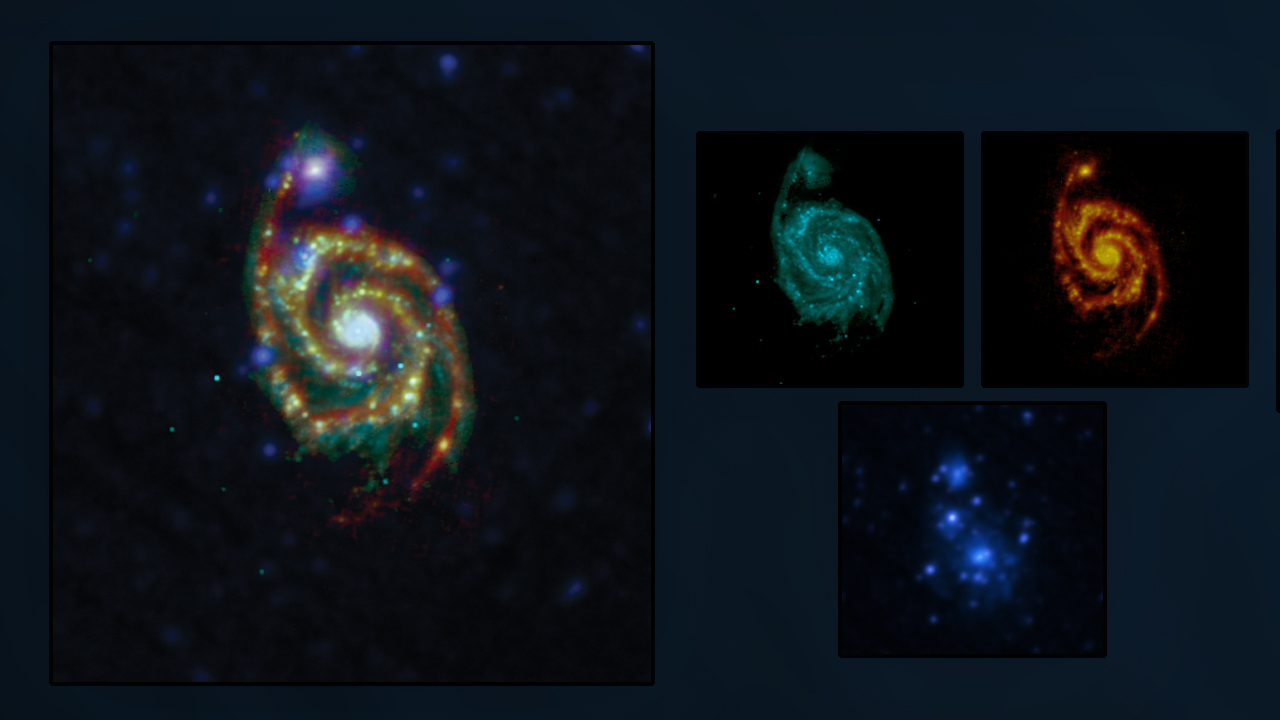
In this image, observations performed at three different wavelengths with ESA’s Herschel and XMM-Newton space telescopes are combined to reveal how three generations of stars coexist in the Whirlpool Galaxy.

The infrared light collected by Herschel – shown in red and yellow – reveals the glow of cosmic dust, which is a minor but crucial ingredient in the interstellar material in the galaxy’s spiral arms. This mixture of gas and dust provides the raw material from which the Whirlpool Galaxy’s future generations of stars will take shape.

Observing in visible and ultraviolet light, astronomers can see the current population of stars in the Whirlpool Galaxy, since stars in their prime shine most brightly at shorter wavelengths than infrared. Seen at ultraviolet wavelengths with XMM-Newton and portrayed in green in this composite image are the galaxy’s fiercest stellar inhabitants: young and massive stars pouring powerful winds and radiation into their surroundings.

The image also shows the remains of previous stellar generations, which shine brightly in X-rays and were detected by XMM-Newton. Shown in blue, these sources of X-rays are either the sites where massive stars exploded as supernovae in the past several thousand years, or binary systems that host neutron stars or black holes, the compact objects left behind by supernovae.