Showing posts with label XMM-Newton. Show all posts

Tuesday, January 29, 2019

Active galaxies point to new physics of cosmic expansion

Active galaxies to measure cosmic expansion
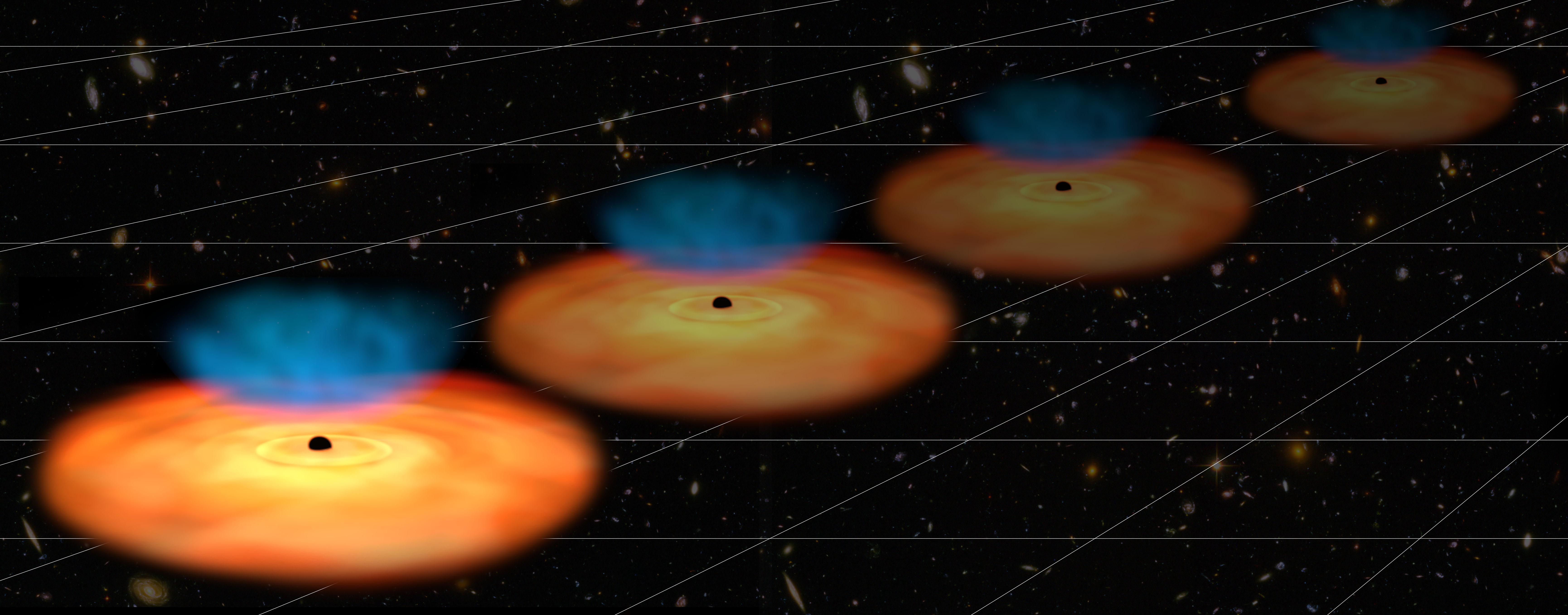
Copyright ESA (artist's impression and composition); 
NASA/ESA/Hubble (background galaxies); CC BY-SA 3.0 IGO

Investigating the history of our cosmos with a large sample of distant ‘active’ galaxies observed by ESA’s XMM-Newton, a team of astronomers found there might be more to the early expansion of the Universe than predicted by the standard model of cosmology. 

According to the leading scenario, our Universe contains only a few percent of ordinary matter. One quarter of the cosmos is made of the elusive dark matter, which we can feel gravitationally but not observe, and the rest consists of the even more mysterious dark energy that is driving the current acceleration of the Universe’s expansion. 

This model is based on a multitude of data collected over the last couple of decades, from the cosmic microwave background, or CMB – the first light in the history of the cosmos, released only 380 000 years after the big bang and observed in unprecedented detail by ESA’s Planck mission – to more ‘local’ observations. The latter include supernova explosions, galaxy clusters and the gravitational distortion imprinted by dark matter on distant galaxies, and can be used to trace cosmic expansion in recent epochs of cosmic history – across the past nine billion years.  

A new study, led by Guido Risaliti of Università di Firenze, Italy, and Elisabeta Lusso of Durham University, UK, points to another type of cosmic tracer – quasars – that would fill part of the gap between these observations, measuring the expansion of the Universe up to 12 billion years ago.

Quasars are the cores of galaxies where an active supermassive black hole is pulling in matter from its surroundings at very intense rates, shining brightly across the electromagnetic spectrum. As material falls onto the black hole, it forms a swirling disc that radiates in visible and ultraviolet light; this light, in turn, heats up nearby electrons, generating X-rays. 

Supermassive black hole
Copyright ESA–C. Carreau

Three years ago, Guido and Elisabeta realised that a well-known relation between the ultraviolet and X-ray brightness of quasars could be used to estimate the distance to these sources – something that is notoriously tricky in astronomy – and, ultimately, to probe the expansion history of the Universe. 

Astronomical sources whose properties allow us to gauge their distances are referred to as ‘standard candles’.

The most notable class, known as ‘type-Ia’ supernova, consists of the spectacular demise of white dwarf stars after they have over-filled on material from a companion star, generating explosions of predictable brightness that allows astronomers to pinpoint the distance. Observations of these supernovas in the late 1990s revealed the Universe’s accelerated expansion over the last few billion years.

“Using quasars as standard candles has great potential, since we can observe them out to much greater distances from us than type-Ia supernovas, and so use them to probe much earlier epochs in the history of the cosmos,” explains Elisabeta.

With a sizeable sample of quasars at hand, the astronomers have now put their method into practice, and the results are intriguing.

XMM-Newton
Copyright ESA-C. Carreau

Digging into the XMM-Newton archive, they collected X-ray data for over 7000 quasars, combining them with ultraviolet observations from the ground-based Sloan Digital Sky Survey. They also used a new set of data, specially obtained with XMM-Newton in 2017 to look at very distant quasars, observing them as they were when the Universe was only about two billion years old. Finally, they complemented the data with a small number of even more distant quasars and with some relatively nearby ones, observed with NASA’s Chandra and Swift X-ray observatories, respectively.

“Such a large sample enabled us to scrutinise the relation between X-ray and ultraviolet emission of quasars in painstaking detail, which greatly refined our technique to estimate their distance,” says Guido.

The new XMM-Newton observations of distant quasars are so good that the team even identified two different groups: 70 percent of the sources shine brightly in low-energy X-rays, while the remaining 30 percent emit lower amounts of X-rays that are characterised by higher energies. For the further analysis, they only kept the earlier group of sources, in which the relation between X-ray and ultraviolet emission appears clearer.

“It is quite remarkable that we can discern such level of detail in sources so distant from us that their light has been travelling for more than ten billion years before reaching us,” says Norbert Schartel, XMM-Newton project scientist at ESA.

After skimming through the data and bringing the sample down to about 1600 quasars, the astronomers were left with the very best observations, leading to robust estimates of the distance to these sources that they could use to investigate the Universe’s expansion.


Supernova and quasar data
Investigating the expansion of the Universe with type-Ia supernovas and quasars
Copyright Courtesy of Elisabeta Lusso & Guido Risaliti (2019) Description 

“When we combine the quasar sample, which spans almost 12 billion years of cosmic history, with the more local sample of type-Ia supernovas, covering only the past eight billion years or so, we find similar results in the overlapping epochs,” says Elisabeta.

“However, in the earlier phases that we can only probe with quasars, we find a discrepancy between the observed evolution of the Universe and what we would predict based on the standard cosmological model.”

Looking into this previously poorly explored period of cosmic history with the help of quasars, the astronomers have revealed a possible tension in the standard model of cosmology, which might require the addition of extra parameters to reconcile the data with theory.

“One of the possible solutions would be to invoke an evolving dark energy, with a density that increases as time goes by,” says Guido.

Incidentally, this particular model would also alleviate another tension that has kept cosmologists busy lately, concerning the Hubble constant – the current rate of cosmic expansion. This discrepancy was found between estimates of the Hubble constant in the local Universe, based on supernova data – and, independently, on galaxy clusters – and those based on Planck’s observations of the cosmic microwave background in the early Universe.

“This model is quite interesting because it might solve two puzzles at once, but the jury is definitely not out yet and we’ll have to look at many more models in great detail before we can solve this cosmic conundrum,” adds Guido.

The team is looking forward to observing even more quasars in the future to further refine their results. Additional clues will also come from ESA’s Euclid mission, scheduled for a 2022 launch to explore the past ten billion years of cosmic expansion and investigate the nature of dark energy.

“These are interesting times to investigate the history of our Universe, and it’s exciting that XMM-Newton can contribute by looking at a cosmic epoch that had remained largely unexplored so far,” concludes Norbert.


Notes for Editors

Cosmological constraints from the Hubble diagram of quasars at high redshifts” by G. Risaliti & E. Lusso is published in Nature Astronomy.


For further information, please contact:

Guido Risaliti
Università di Firenze
INAF – Osservatorio Astrofisico di Arcetri
Firenze, Italy
Email: risaliti@arcetri.inaf.it

Elisabeta Lusso
Centre for Extragalactic Astronomy
Durham University, UK
Email: elisabeta.lusso@durham.ac.uk

Norbert Schartel
XMM-Newton Project Scientist
European Space Agency
Email: norbert.schartel@sciops.esa.int

Markus Bauer


ESA Science Communication Officer


Tel: +31 71 565 6799


Mob: +31 61 594 3 954


Email: markus.bauer@esa.int


Friday, November 23, 2018

XMM-Newton's view of pulsar J1826-1256

XMM-Newton's view of pulsar J1826-1256
Credit: ESA/XMM-Newton/J. Li, DESY, Germany

Based on a new theoretical model, a team of scientists explored the rich data archive of ESA's XMM-Newton and NASA's Chandra space observatories to find pulsating X-ray emission from three sources. The discovery, relying on previous gamma-ray observations of the pulsars, provides a novel tool to investigate the mysterious mechanisms of pulsar emission, which will be important to understand these fascinating objects and use them for space navigation in the future. 

Lighthouses of the Universe, pulsars are fast-rotating neutron stars that emit beams of radiation. As pulsars rotate and the beams alternatively point towards and away from Earth, the source oscillates between brighter and dimmer states, resulting in a signal that appears to 'pulse' every few milliseconds to seconds, with a regularity rivalling even atomic clocks.

Pulsars are the incredibly dense, extremely magnetic, relics of massive stars, and are amongst the most extreme objects in the Universe. Understanding how particles behave in such a strong magnetic field is fundamental to understanding how matter and magnetic fields interact more generally.

Originally detected through their radio emission, pulsars are now known to also emit other types of radiation, though typically in smaller amounts. Some of this emission is standard thermal radiation – the type that everything with a temperature above absolute zero emits. Pulsars release thermal radiation when they accrete matter, for example from another star.

But pulsars also emit non-thermal radiation, as is often produced in the most extreme cosmic environments. In pulsars, non-thermal radiation can be created via two processes: synchrotron emission and curvature emission. Both processes involve charged particles being accelerated along magnetic field lines, causing them to radiate light that can vary in wavelength from radio waves to gamma-rays.

Non-thermal X-rays result mostly from synchrotron emission, while gamma-rays may come from so-called synchro-curvature emission – a combination of the two mechanisms. It is relatively easy to find pulsars that radiate gamma-rays – NASA's Fermi Gamma-Ray Space Telescope has detected more than 200 of them over the past decade, thanks to its ability to scan the whole sky. But only around 20 have been found to pulse in non-thermal X-rays.

"Unlike gamma-ray detecting survey instruments, X-ray telescopes must be told exactly where to point, so we need to provide them with some sort of guidance," says Diego Torres, from the Institute of Space Sciences in Barcelona, Spain.

Aware that there should be many pulsars emitting previously undetected non-thermal X-rays, Torres developed a model that combined synchrotron and curvature radiation to predict whether pulsars detected in gamma-rays could also be expected to appear in X-rays.

"Scientific models describe phenomena that can't be experienced directly," explains Torres.

"This model in particular helps explain the emission processes in pulsars and can be used to predict the X-ray emission that we should observe, based on the known gamma-ray emission.
"
The model describes the gamma-ray emission of pulsars detected by Fermi – specifically, the brightness observed at different wavelengths – and combines this information with three parameters that determine the pulsar emission. This allows a prediction of their brightness at other wavelengths, for instance in X-rays.

Torres partnered with a team of scientists, led by Jian Li from the Deutsches Elektronen Synchrotron in Zeuthen near Berlin, Germany, to select three known gamma-ray emitting pulsars that they expected, based on the model, to also shine brightly in X-rays. They dug into the data archives of ESA's XMM-Newton and NASA's Chandra X-ray observatories to search for evidence of non-thermal X-ray emission from each of them.

"Not only did we detect X-ray pulsations from all three of the pulsars, but we also found that the spectrum of X-rays was almost the same as predicted by the model," explains Li.
"This means that the model very accurately describes the emission processes within a pulsar."

Non-thermal X-ray emission from three pulsars
Credit: Adapted from J. Li et al. (2018)

In particular, XMM-Newton data showed clear X-ray emission from PSR J1826-1256 – a radio quiet gamma-ray pulsar with a period of 110.2 milliseconds. The spectrum of light received from this pulsar was very close to that predicted by the model. X-ray emission from the other two pulsars, which both rotate slightly more quickly, was revealed using Chandra data.

This discovery already represents a significant increase in the total number of pulsars known to emit non-thermal X-rays. The team expects that many more will be discovered over the next few years as the model can be used to work out where exactly to look for them.

Finding more X-ray pulsars is important for revealing their global properties, including population characteristics. A better understanding of pulsars is also essential for potentially taking advantage of their accurate timing signals for future space navigation endeavours.

The result is a step towards understanding the relationships between the emission by pulsars in different parts of the electromagnetic spectrum, enabling a robust way to predict the brightness of a pulsar at any given wavelength. This will help us better comprehend the interaction between particles and magnetic fields in pulsars and beyond.

"This model can make accurate predictions of pulsar X-ray emission, and it can also predict the emission at other wavelengths, for example visible and ultraviolet," Torres continues.
"In the future, we hope to find new pulsars leading to a better understanding of their global properties."

The study highlights the benefits of XMM-Newton's vast data archive to make new discoveries and showcases the impressive abilities of the mission to detect relatively dim sources. The team is also looking forward to using the next generation of X-ray space telescopes, including ESA's future Athena mission, to find even more pulsars emitting non-thermal X-rays.

"As the flagship of European X-ray astronomy, XMM-Newton is detecting more X-ray sources than any previous satellite. It is amazing to see that it is helping to solve so many cosmic mysteries," concludes Norbert Schartel, XMM-Newton Project Scientist at ESA.


Notes for Editors

DOI: 10.3847/2041-8213/aae92b

The prepint is available on the arXiv/astro-ph server (arXiv:1811.08339).


For more information, please contact:

Jian Li
Deutsches Elektronen Synchrotron DESY
Zeuthen, Germany
Email: jian.li@desy.de

Diego Torres
Institute of Space Sciences (ICE, CSIC)
Institut d'Estudis Espacials de Catalunya (IEEC)
Institució Catalana de Recerca i Estudis Avanc¸ats (ICREA)
Barcelona, Spain
Email: dtorres@ice.csic.es

Norbert Schartel
XMM-Newton Project Scientist
European Space Agency
Email: norbert.schartel@esa.int


Tuesday, February 21, 2017

The brightest furthest pulsar in the Universe

NGC 5907 X-1: record-breaking pulsar
The record-breaking pulsar, identified as NGC 5907 X-1, is in the spiral galaxy NGC 5907, which is also known as the Knife Edge Galaxy or Splinter Galaxy. The image comprises X-ray emission data (blue/white) from ESA’s XMM-Newton space telescope and NASA’s Chandra X-ray observatory, and optical data from the Sloan Digital Sky Survey (galaxy and foreground stars).

The inset shows the X-ray pulsation of the spinning neutron star, which has a period of 1.13 s, as determined by XMM-Newton’s European Photon Imaging Camera. Copyright: ESA/XMM-Newton; NASA/Chandra and SDSS.   Hi-res JPG


ESA’s XMM-Newton has found a pulsar – the spinning remains of a once-massive star – that is a thousand times brighter than previously thought possible.

The pulsar is also the most distant of its kind ever detected, with its light travelling 50 million light-years before being detected by XMM-Newton.

Pulsars are spinning, magnetised neutron stars that sweep regular pulses of radiation in two symmetrical beams across the cosmos. If suitably aligned with Earth these beams are like a lighthouse beacon appearing to flash on and off as it rotates. They were once massive stars that exploded as a powerful supernova at the end of their natural life, before becoming small and extraordinarily dense stellar corpses.

This X-ray source is the most luminous of its type detected to date: it is 10 times brighter than the previous record holder. In one second it emits the same amount of energy released by our Sun in 3.5 years.

XMM-Newton observed the object several times in the last 13 years, with the discovery a result of a systematic search for pulsars in the data archive – its 1.13 s periodic pulses giving it away.

The signal was also identified in NASA’s Nustar archive data, providing additional information.

“Before, it was believed that only black holes at least 10 times more massive than our Sun feeding off their stellar companions could achieve such extraordinary luminosities, but the rapid and regular pulsations of this source are the fingerprints of neutron stars and clearly distinguish them from black holes,” says Gian Luca Israel, from INAF-Osservatorio Astronomica di Roma, Italy, lead author of the paper describing the result published in Science this week.

The archival data also revealed that the pulsar’s spin rate has changed over time, from 1.43 s per rotation in 2003 to 1.13 s in 2014. The same relative acceleration in Earth’s rotation would shorten a day by five hours in the same time span.

“Only a neutron star is compact enough to keep itself together while rotating so fast,” adds Gian Luca.

Although it is not unusual for the rotation rate of a neutron star to change, the high rate of change in this case is likely linked to the object rapidly consuming mass from a companion.

“This object is really challenging our current understanding of the ‘accretion’ process for high-luminosity stars,” says Gian Luca. “It is 1000 times more luminous than the maximum thought possible for an accreting neutron star, so something else is needed in our models in order to account for the enormous amount of energy released by the object.”

The scientists think there must be a strong, complex magnetic field close to its surface, such that accretion onto the neutron star surface is still possible while still generating the high luminosity.

“The discovery of this very unusual object, by far the most extreme ever discovered in terms of distance, luminosity and rate of increase of its rotation frequency, sets a new record for XMM-Newton, and is changing our ideas of how such objects really ‘work’,” says Norbert Schartel, ESA’s XMM-Newton project scientist.


Notes for Editors

“An accreting pulsar with extreme properties drives an ultraluminous X-ray source in NGC 5907” by G.L. Israel is published in Science.

The discovery was made as a result of the “Exploring the X-ray Transient and variable Sky” (EXTraS) project.


For further information, please contact:

Markus Bauer


ESA Science and Robotic Exploration Communication Officer


Tel: +31 71 565 6799


Mob: +31 61 594 3 954


Email: markus.bauer@esa.int

Gian Luca Israel
INAF, Osservatorio Astronomico di Roma, Italy
Email: gianluca@oa-roma.inaf.it

Norbert Schartel
XMM-Newton project scientist
Email: Norbert.Schartel@esa.int


Thursday, October 06, 2016

XJ1417+52: X-ray Telescopes Find Evidence for Wandering Black Hole


XJ1417+52
Credit  X-ray: NASA/CXC/UNH/D.Lin et al; Optical: NASA/STScI


Astronomers have used NASA's Chandra X-ray Observatory and ESA's XMM-Newton X-ray observatory to discover an extremely luminous, variable X-ray source located outside the center of its parent galaxy. This peculiar object could be a wandering black hole that came from a small galaxy falling into a larger one.

Astronomers think that supermassive black holes, with some 100,000 to 10 billion times the Sun's mass, are in the centers of most galaxies. There is also evidence for the existence of so-called intermediate mass black holes, which have lower masses ranging between about 100 and 100,000 times that of the Sun.

Both of these types of objects may be found away from the center of a galaxy following a collision and merger with another galaxy containing a massive black hole. As the stars, gas and dust from the second galaxy move through the first one, its black hole would move with it.

A new study reports the discovery of one of these "wandering" black holes toward the edge of the lenticular galaxy SDSS J141711.07+522540.8 (or, GJ1417+52 for short), which is located about 4.5 billion light years from Earth. This object, referred to as XJ1417+52, was discovered during long observations of a special region, the so-called Extended Groth Strip, with XMM-Newton and Chandra data obtained between 2000 and 2002. Its extreme brightness makes it likely that it is a black hole with a mass estimated to be about 100,000 times that of the Sun, assuming that the radiation force on surrounding matter equals the gravitational force.

The main panel of this graphic has a wide-field, optical light image from the Hubble Space Telescope. The black hole and its host galaxy are located within the box in the upper left. The inset on the left contains Hubble's close-up view of GJ1417+52. Within this inset the circle shows a point-like source on the northern outskirts of the galaxy that may be associated with XJ1417+52.

The inset on the right is Chandra's X-ray image of XJ1417+52 in purple, covering the same region as the Hubble close-up. This is a point source, with no evidence seen for extended X-ray emission.
The Chandra and XMM-Newton observations show the X-ray output of XJ1417+52 is so high that astronomers classify this object as a "hyper-luminous X-ray source" (HLX). These are objects that are 10,000 to 100,000 times more luminous in X-rays than stellar black holes, and 10 to 100 times more powerful than ultraluminous X-ray sources, or ULXs.

At its peak XJ1417+52 is about ten times more luminous than the brightest X-ray source ever seen for a wandering black hole. It is also about 10 times more distant than the previous record holder for a wandering black hole.

The bright X-ray emission from this type of black hole comes from material falling toward it. The X-rays from XJ1417+52 reached peak brightness in X-rays between 2000 and 2002. The source was not detected in later Chandra and XMM observations obtained in 2005, 2014 and 2015. Overall, the X-ray brightness of the source has declined by at least a factor of 14 between 2000 and 2015.

The authors theorize that the X-ray outburst seen in 2000 and 2002 occurred when a star passed too close to the black hole and was torn apart by tidal forces. Some of the gaseous debris would have been heated and become bright in X-rays as it fell towards the black hole, causing the spike in emission.

The location and brightness of the optical source in the Hubble image that may be associated with XJ1417+52 suggest that the black hole could have originally belonged to a small galaxy that plowed into the larger GJ1417+52 galaxy, stripping away most of the galaxy's stars but leaving behind the black hole and its surrounding stars at the center of the small galaxy. If this idea is correct the surrounding stars are what is seen in the Hubble image.

A paper by Dacheng Lin (University of New Hampshire) and colleagues describing this result appears in The Astrophysical Journal and is available online. NASA's Marshall Space Flight Center in Huntsville, Alabama, manages the Chandra program for NASA's Science Mission Directorate in Washington. The Smithsonian Astrophysical Observatory in Cambridge, Massachusetts, controls Chandra's science and flight operations.


Fast Facts for XJ1417+52:

Scale: Image is about 2.9 arcmin across (about 3.13 million light years)
Category: Black Holes
Coordinates (J2000): RA 14h 17m 11.10s | Dec +52° 25' 42.30"
Constellation: Boötes
Observation Date: 7 pointings between Aug 2002 and Oct 2014
Observation Time: 85 hours 22 min (3 days 13 hours 22 min).
Obs. ID: 3305, 4357, 4365, 5851, 7181, 16027, 17487
Instrument: ACIS
References: Lin, D. et al, 2016, ApJ, 821, 25; arXiv:1603.00455
Color Code: X-ray (Purple); Optical (Red, Green, Blue)
Distance Estimate: About 4.47 billion light years (z=0.41827)


Monday, July 25, 2016

Astronomers Discover Dizzying Spin of the Milky Way Galaxy’s “Halo”

Astronomers at the University of Michigan’s College of Literature, Science, and the Arts (LSA) discovered for the first time that the hot gas in the halo of the Milky Way galaxy is spinning in the same direction and at comparable speed as the galaxy's disk, which contains our stars, planets, gas, and dust. This new knowledge sheds light on how individual atoms have assembled into stars, planets, and galaxies like our own, and what the future holds for these galaxies.

Our Milky Way galaxy and its small companions are surrounded by a giant halo of million-degree gas (seen in blue in this artists' rendition) that is only visible to X-ray telescopes in space. University of Michigan astronomers discovered that this massive hot halo spins in the same direction as the Milky Way disk and at a comparable speed. Credits: NASA/CXC/M.Weiss/Ohio State/A Gupta et al


“This flies in the face of expectations,” says Edmund Hodges-Kluck, assistant research scientist. 

“People just assumed that the disk of the Milky Way spins while this enormous reservoir of hot gas is stationary – but that is wrong. This hot gas reservoir is rotating as well, just not quite as fast as the disk.”

The new NASA-funded research using the archival data obtained by XMM-Newton, a European Space Agency telescope, was recently published in the Astrophysical Journal. The study focuses on our galaxy’s hot gaseous halo, which is several times larger than the Milky Way disk and composed of ionized plasma.

Because motion produces a shift in the wavelength of light, the U-M researchers measured such shifts around the sky using lines of very hot oxygen. What they found was groundbreaking: The line shifts measured by the researchers show that the galaxy’s  halo spins in the same direction as the disk of the Milky Way and at a similar speed—about 400,000 mph for the halo versus 540,000 mph for the disk.

“The rotation of the hot halo is an incredible clue to how the Milky Way formed,” said Hodges Kluck. “It tells us that this hot atmosphere is the original source of a lot of the matter in the disk.”

Scientists have long puzzled over why almost all galaxies, including the Milky Way, seem to lack most of the matter that they otherwise would expect to find. Astronomers believe that about 80% of the matter in the universe is the mysterious “dark matter” that, so far, can only be detected by its gravitational pull. But even most of the remaining 20% of “normal” matter is missing from galaxy disks. More recently, some of the “missing” matter has been discovered in the halo. The U-M researchers say that learning about the direction and speed of the spinning halo can help us learn both how the material got there in the first place, and the rate at which we expect the matter to settle into the galaxy.

“Now that we know about the rotation, theorists will begin to use this to learn how our Milky Way galaxy formed – and its eventual destiny,” says Joel Bregman, a U-M LSA professor of astronomy.

“We can use this discovery to learn so much more – the rotation of this hot halo will be a big topic of future X-ray spectrographs,” Bregman says.


For more information, please visit: http://heasarc.gsfc.nasa.gov/docs/xmm/xmmgof.html


By Felicia Chou
NASA Headquarters, Washington, D.C.

Editor: Ashley Morrow


Source: NASA/Galaxies

Monday, July 18, 2016

Black Hole Makes Material Wobble Around It News Media Contact

This artist's impression depicts the accretion disc surrounding a black hole, in which the inner region of the disc precesses.
› Full image and caption


The European Space Agency's orbiting X-ray observatory, XMM-Newton, has proved the existence of a "gravitational vortex" around a black hole. The discovery, aided by NASA's Nuclear Spectroscopic Telescope Array (NuSTAR) mission, solves a mystery that has eluded astronomers for more than 30 years, and will allow them to map the behavior of matter very close to black holes. It could also open the door to future investigations of Albert Einstein's general relativity.

Matter falling into a black hole heats up as it plunges to its doom. Before it passes into the black hole and is lost from view forever, it can reach millions of degrees. At that temperature it shines X-rays into space.

In the 1980s, pioneering astronomers using early X-ray telescopes discovered that the X-rays coming from stellar-mass black holes in our galaxy flicker. The changes follow a set pattern. When the flickering begins, the dimming and re-brightening can take 10 seconds to complete. As the days, weeks and then months progress, the period shortens until the oscillation takes place 10 times every second. Then, the flickering suddenly stops altogether.

The phenomenon was dubbed the Quasi Periodic Oscillation (QPO). "It was immediately recognized to be something fascinating because it is coming from something very close to a black hole," said Adam Ingram, University of Amsterdam, the Netherlands, who began working to understand QPOs for his doctoral thesis in 2009.

During the 1990s, astronomers had begun to suspect that the QPOs were associated with a gravitational effect predicted by Einstein's general relativity: that a spinning object will create a kind of gravitational vortex.
"It is a bit like twisting a spoon in honey. Imagine that the honey is space and anything embedded in the honey will be "dragged" around by the twisting spoon," explained Ingram.  "In reality, this means that anything orbiting a spinning object will have its motion affected." In the case of an inclined orbit, it will "precess." This means that the whole orbit will change orientation around the central object. The time for the orbit to return to its initial condition is known as a precession cycle.

In 2004, NASA launched Gravity Probe B to measure this so-called Lense-Thirring effect around Earth. After painstaking analysis, scientists confirmed that the spacecraft would turn through a complete precession cycle once every 33 million years.

Around a black hole, however, the effect would be much more noticeable because of the stronger gravitational field. The precession cycle would take just a matter of seconds or less to complete. This is so close to the periods of the QPOs that astronomers began to suspect a link.

Ingram began working on the problem by looking at what happened in the flat disc of matter surrounding a black hole. Known as an accretion disc, it is the place where material gradually spirals inwards towards the black hole. Scientists had already suggested that, close to the black hole, the flat accretion disc puffs up into a hot plasma, in which electrons are stripped from their host atoms. Termed the hot inner flow, it shrinks in size over weeks and months as it is eaten by the black hole. Together with colleagues, Ingram published a paper in 2009 suggesting that the QPO is driven by the Lense-Thirring precession of this hot flow. This is because the smaller the inner flow becomes, the closer to the black hole it would approach and so the faster its Lense-Thirring precession cycle would be. The question was: how to prove it?

"We have spent a lot of time trying to find smoking gun evidence for this behavior," said Ingram.

The answer is that the inner flow is releasing high-energy radiation that strikes the matter in the surrounding accretion disc, making the iron atoms in the disc shine like a fluorescent light tube. The iron releases X-rays of a single wavelength -- referred to as "a spectral line."

Because the accretion disc is rotating, the iron line has its wavelength distorted by the Doppler effect. Line emission from the approaching side of the disc is squashed -- blue shifted -- and line emission from the receding disc material is stretched -- red shifted. If the inner flow really is precessing, it will sometimes shine on the approaching disc material and sometimes on the receding material, making the line wobble back and forth over the course of a precession cycle.

Seeing this wobbling is where XMM-Newton came in. Ingram and colleagues from Amsterdam, Cambridge, Southampton and Tokyo applied for a long-duration observation that would allow them to watch the QPO repeatedly. They chose black hole H 1743-322, which was exhibiting a four-second QPO at the time. They watched it for 260,000 seconds with XMM-Newton. They also observed it for 70,000 seconds with NASA's NuSTAR X-ray observatory.

"The high-energy capability of NuSTAR was very important," Ingram said. "NuSTAR confirmed the wobbling of the iron line, and additionally saw a feature in the spectrum called a 'reflection hump' that added evidence for precession."

After a rigorous analysis process of adding all the observational data together, they saw that the iron line was wobbling in accordance with the predictions of general relativity. "We are directly measuring the motion of matter in a strong gravitational field near to a black hole," says Ingram.

This is the first time that the Lense-Thirring effect has been measured in a strong gravitational field. The technique will allow astronomers to map matter in the inner regions of accretion discs around black holes. It also hints at a powerful new tool with which to test general relativity.

Einstein's theory is largely untested in such strong gravitational fields. So if astronomers can understand the physics of the matter that is flowing into the black hole, they can use it to test the predictions of general relativity as never before - but only if the movement of the matter in the accretion disc can be completely understood.

"If you can get to the bottom of the astrophysics, then you can really test the general relativity," says Ingram. A deviation from the predictions of general relativity would be welcomed by a lot of astronomers and physicists. It would be a concrete signal that a deeper theory of gravity exists.

Larger X-ray telescopes in the future could help in the search because they are more powerful and could more efficiently collect X-rays. This would allow astronomers to investigate the QPO phenomenon in more detail. But for now, astronomers can be content with having seen Einstein's gravity at play around a black hole.

"This is a major breakthrough since the study combines information about the timing and energy of X-ray photons to settle the 30-year debate around the origin of QPOs. The photon-collecting capability of XMM-Newton was instrumental in this work," said Norbert Schartel, ESA Project Scientist for XMM-Newton.


More Information

The results reported in this article are published in the Monthly Notices of the Royal Astronomical Society.

The European Space Agency's X-ray Multi-Mirror Mission, XMM-Newton, was launched in December 1999. The largest scientific satellite to have been built in Europe, it is also one of the most sensitive X-ray observatories ever flown. More than 170 wafer-thin, cylindrical mirrors direct incoming radiation into three high-throughput X-ray telescopes. XMM-Newton's orbit takes it almost a third of the way to the moon, allowing for long, uninterrupted views of celestial objects.

NuSTAR is a Small Explorer mission led by Caltech in Pasadena and managed by NASA's Jet Propulsion Laboratory, also in Pasadena, for NASA's Science Mission Directorate in Washington.


For more information about NuSTAR, visit: http://www.nasa.gov/nustar -  http://www.nustar.caltech.edu


News Media Contact

Elizabeth Landau
Jet Propulsion Laboratory, Pasadena, Calif.
818-354-6425

elizabeth.landau@jpl.nasa.gov

Adam Ingram
Anton Pannekoek Institute for Astronomy
University of Amsterdam
The Netherlands

a.r.ingram@uva.nl

Norbert Schartel
ESA XMM-Newton Project Scientist
Directorate of Science
European Space Agency
+34-91-8131-184

Norbert.Schartel@esa.int


Written by Karen O'Flaherty
European Space Agency


Source: JPL- Caltech

Monday, June 27, 2016

X-ray Echoes of a Shredded Star Provide Close-up of 'Killer' Black Hole


Now astronomers using archival observations from Swift, the European Space Agency's (ESA) XMM-Newton observatory and the Japan-led Suzaku satellite have identified the reflections of X-ray flares erupting during the event. Led by Erin Kara, a postdoctoral researcher at NASA's Goddard Space Flight Center in Greenbelt, Maryland, and the University of Maryland, College Park (UMCP), the team has used these light echoes, or reverberations, to map the flow of gas near a newly awakened black hole for the first time.

"While we don't yet understand what causes X-ray flares near the black hole, we know that when one occurs we can detect its echo a couple of minutes later, once the light  has reached and illuminated parts of the flow," Kara explained. "This technique, called X-ray reverberation mapping, has been previously used to explore stable disks around black holes, but this is the first time we've applied it to a newly formed disk produced by a tidal disruption."

In this artist's rendering, a thick accretion disk has formed around a supermassive black hole following the tidal disruption of a star that wandered too close. Stellar debris has fallen toward the black hole and collected into a thick chaotic disk of hot gas. Flashes of X-ray light near the center of the disk result in light echoes that allow astronomers to map the structure of the funnel-like flow, revealing for the first time strong gravity effects around a normally quiescent black hole. Credits: NASA/Swift/Aurore Simonnet, Sonoma State University


Stellar debris falling toward a black hole collects into a rotating structure called an accretion disk. There the gas is compressed and heated to millions of degrees before it eventually spills over the black hole's event horizon, the point beyond which nothing can escape and astronomers cannot observe. The Swift J1644+57 accretion disk was thicker, more turbulent and more chaotic than stable disks, which have had time to settle down into an orderly routine. The researchers present the findings in a paper published online in the journal Nature on Wed., June 22.

One surprise from the study is that high-energy X-rays arise from the inner part of the disk. Astronomers had thought most of this emission originated from a narrow jet of particles accelerated to near the speed of light.

In blazars, the most luminous galaxy class powered by supermassive black holes, jets produce most of the highest-energy emission.

"We do see a jet from Swift J1644, but the X-rays are coming from a compact region near the black hole at the base of a steep funnel of inflowing gas we're looking down into," said co-author Lixin Dai, a postdoctoral researcher at UMCP. "The gas producing the echoes is itself flowing outward along the surface of the funnel at speeds up to half the speed of light."

X-rays originating near the black hole excite iron ions in the whirling gas, causing them to fluoresce with a distinctive high-energy glow called iron K-line emission. As an X-ray flare brightens and fades, the gas follows in turn after a brief delay depending on its distance from the source.

"Direct light from the flare has different properties than its echo, and we can detect reverberations by monitoring how the brightness changes across different X-ray energies," said co-author Jon Miller, a professor of astronomy at the University of Michigan in Ann Arbor.

Swift J1644+57 is one of only three tidal disruptions that have produced high-energy X-rays, and to date it remains the only event caught at the peak of this emission. These star shredding episodes briefly activate black holes astronomers wouldn't otherwise know about. For every black hole now actively accreting gas and producing light, astronomers think nine others are dormant and dark. These quiescent black holes were active when the universe was younger, and they played an important role in how galaxies evolved. Tidal disruptions therefore offer a glimpse of the silent majority of supersized black holes.

Images from Swift's Ultraviolet/Optical (white, purple) and X-Ray telescopes (yellow and red) were combined in this composite of Swift J1644+57, an X-ray outburst astronomers classify as a tidal disruption event. The event is seen only in the X-ray image, which is a 3.4-hour exposure taken on March 28, 2011. The outburst was triggered when a passing star came too close to a supermassive black hole. The star was torn apart, and much of the gas fell toward the black hole. To date, this is the only tidal disruption event emitting high-energy X-rays that astronomers have caught at peak luminosity. Credits: NASA/Swift/Stefan Immler.  Click here for an unlabeled version of this image.


"If we only look at active black holes, we might be getting a strongly biased sample," said team member Chris Reynolds, a professor of astronomy at UMCP. "It could be that these black holes all fit within some narrow range of spins and masses. So it’s important to study the entire population to make sure we’re not biased."

The researchers estimate the mass of the Swift J1644+57 black hole at about a million times that of the sun but did not measure its spin. With future improvements in understanding and modeling accretion flows, the team thinks it may be possible to do so.     

ESA's XMM-Newton satellite was launched in December 1999 from Kourou, French Guiana. NASA funded elements of the XMM-Newton instrument package and provides the NASA Guest Observer Facility at Goddard, which supports use of the observatory by U.S. astronomers. Suzaku operated from July 2005 to August 2015 and was developed at the Japanese Institute of Space and Astronautical Science, which is part of the Japan Aerospace Exploration Agency, in collaboration with NASA and other Japanese and U.S. institutions.

NASA's Swift satellite was launched in November 2004 and is managed by Goddard. It is operated in collaboration with Penn State University in University Park, the Los Alamos National Laboratory in New Mexico, and Orbital Sciences Corp. in Dulles, Virginia, with international collaborators in the U.K., Italy, Germany and Japan.


Editor: Ashley Morrow


Wednesday, June 22, 2016

Astronomers Find the First 'Wind Nebula' Around a Magnetar

Astronomers have discovered a vast cloud of high-energy particles called a wind nebula around a rare ultra-magnetic neutron star, or magnetar, for the first time. The find offers a unique window into the properties, environment and outburst history of magnetars, which are the strongest magnets in the universe.  
 

A neutron star is the crushed core of a massive star that ran out of fuel, collapsed under its own weight, and exploded as a supernova. Each one compresses the equivalent mass of half a million Earths into a ball just 12 miles (20 kilometers) across, or about the length of New York's Manhattan Island. Neutron stars are most commonly found as pulsars, which produce radio, visible light, X-rays and gamma rays at various locations in their surrounding magnetic fields. When a pulsar spins these regions in our direction, astronomers detect pulses of emission, hence the name.

This illustration compares the size of a neutron star to Manhattan Island in New York, which is about 13 miles long. A neutron star is the crushed core left behind when a massive star explodes as a supernova and is the densest object astronomers can directly observe. Credits: NASA's Goddard Space Flight Center

Typical pulsar magnetic fields can be 100 billion to 10 trillion times stronger than Earth's. Magnetar fields reach strengths a thousand times stronger still, and scientists don't know the details of how they are created. Of about 2,600 neutron stars known, to date only 29 are classified as magnetars.

The newfound nebula surrounds a magnetar known as Swift J1834.9-0846 -- J1834.9 for short -- which was discovered by NASA's Swift satellite on Aug. 7, 2011, during a brief X-ray outburst. Astronomers suspect the object is associated with the W41 supernova remnant, located about 13,000 light-years away in the constellation Scutum toward the central part of our galaxy. 

"Right now, we don't know how J1834.9 developed and continues to maintain a wind nebula, which until now was a structure only seen around young pulsars," said lead researcher George Younes, a postdoctoral researcher at George Washington University in Washington. "If the process here is similar, then about 10 percent of the magnetar's rotational energy loss is powering the nebula’s glow, which would be the highest efficiency ever measured in such a system."

A month after the Swift discovery, a team led by Younes took another look at J1834.9 using the European Space Agency's (ESA) XMM-Newton X-ray observatory, which revealed an unusual lopsided glow about 15 light-years across centered on the magnetar. New XMM-Newton observations in March and October 2014, coupled with archival data from XMM-Newton and Swift, confirm this extended glow as the first wind nebula ever identified around a magnetar. A paper describing the analysis will be published by The Astrophysical Journal.

"For me the most interesting question is, why is this the only magnetar with a nebula? Once we know the answer, we might be able to understand what makes a magnetar and what makes an ordinary pulsar," said co-author Chryssa Kouveliotou, a professor in the Department of Physics at George Washington University’s Columbian College of Arts and Sciences.

The most famous wind nebula, powered by a pulsar less than a thousand years old, lies at the heart of the Crab Nebula supernova remnant in the constellation Taurus. Young pulsars like this one rotate rapidly, often dozens of times a second. The pulsar's fast rotation and strong magnetic field work together to accelerate electrons and other particles to very high energies. This creates an outflow astronomers call a pulsar wind that serves as the source of particles making up in a wind nebula.

The best-known wind nebula is the Crab Nebula, located about 6,500 light-years away in the constellation Taurus. At the center is a rapidly spinning neutron star that accelerates charged particles like electrons to nearly the speed of light. As they whirl around magnetic field lines, the particles emit a bluish glow. This image is a composite of Hubble observations taken in late 1999 and early 2000. The Crab Nebula spans about 11 light-years. Credits: NASA, ESA, J. Hester and A. Loll (Arizona State University)

"Making a wind nebula requires large particle fluxes, as well as some way to bottle up the outflow so it doesn't just stream into space," said co-author Alice Harding, an astrophysicist at NASA's Goddard Space Flight Center in Greenbelt, Maryland. "We think the expanding shell of the supernova remnant serves as the bottle, confining the outflow for a few thousand years. When the shell has expanded enough, it becomes too weak to hold back the particles, which then leak out and the nebula fades away." This naturally explains why wind nebulae are not found among older pulsars, even those driving strong outflows.

A pulsar taps into its rotational energy to produce light and accelerate its pulsar wind. By contrast, a magnetar outburst is powered by energy stored in the super-strong magnetic field. When the field suddenly reconfigures to a lower-energy state, this energy is suddenly released in an outburst of X-rays and gamma rays. So while magnetars may not produce the steady breeze of a typical pulsar wind, during outbursts they are capable of generating brief gales of accelerated particles.

"The nebula around J1834.9 stores the magnetar's energetic outflows over its whole active history, starting many thousands of years ago," said team member Jonathan Granot, an associate professor in the Department of Natural Sciences at the Open University in Ra'anana, Israel. "It represents a unique opportunity to study the magnetar's historical activity, opening a whole new playground for theorists like me."

ESA's XMM-Newton satellite was launched on Dec. 10, 1999, from Kourou, French Guiana, and continues to make observations. NASA funded elements of the XMM-Newton instrument package and provides the NASA Guest Observer Facility at Goddard, which supports use of the observatory by U.S. astronomers.


Editor: Ashley Morrow


Thursday, April 28, 2016

Powerful winds spotted from mysterious X-ray binaries

Credit: ESA–C. Carreau

Credit: NASA, ESA & A. Pellerin (STScI)

Credit: ESA/Hubble & NASA. Acknowledgement: J. Schmidt (Geckzilla)


At X-ray wavelengths, the celestial sky is dominated by two types of astronomical objects: supermassive black holes, sitting at the centres of large galaxies and ferociously devouring the material around them, and binary systems, consisting of a stellar remnant – a white dwarf, neutron star or black hole – feeding on gas from a companion star.

In both cases, the gas forms a swirling disc around the compact and very dense central object: friction in the disc causes the gas to heat up and emit light at many wavelengths, with a peak in X-rays.

Not all of the gas is swallowed by the central object though, and some of it might even be pushed away by powerful winds and jets.

But an intermediate class of objects was discovered in the 1980s and is still not well understood. Ten to a hundred times brighter than ordinary X-ray binaries, these sources are nevertheless too faint to be linked to accreting supermassive black holes, and in any case, are usually found far from the centre of their host galaxy.

"We think these 'ultra-luminous X-ray sources' are somewhat special binary systems, sucking up gas at a much higher rate than an ordinary X-ray binary," explains Ciro Pinto from the Institute of Astronomy in Cambridge, UK.

"Some host highly magnetised neutron stars, while others might conceal the long-sought-after intermediate-mass black holes, which have masses around 1000 times the mass of the Sun. But in the majority of cases, the reason for their extreme behaviour is still unclear."

Ciro is the lead author of a new study, based on observations from ESA's XMM-Newton, revealing for the first time strong winds gusting at very high speed from two of these exotic objects. The discovery, published in this week's issue of the journal Nature, confirms that these sources conceal a compact object accreting matter at extraordinarily high rates.


Ciro and his colleagues delved into the XMM-Newton archives and collected several days' worth of observations of three ultra-luminous X-ray sources, all hosted in nearby galaxies located less than 22 million light-years from our Milky Way.

The data were obtained over several years with the Reflection Grating Spectrometer, a highly sensitive instrument that allowed them to spot very subtle features in the spectrum of the X-rays from the sources.

In all three sources, the scientists were able to identify X-ray emission from gas in the outer portions of the disc surrounding the central compact object, slowly flowing towards it.

But two of the three sources – known as NGC 1313 X-1 and NGC 5408 X-1 – also show clear signs of X-rays being absorbed by gas that is streaming away from the central source at an extremely rapid 70 000 km/s – almost a quarter of the speed of light.

"This is the first time we've seen winds streaming away from ultra-luminous X-ray sources," says Ciro.

And there's more, since the very high speed of these outflows is telling us something about the nature of the compact objects in these sources, which are frantically devouring matter."

While the hot gas is pulled inwards by the central object's gravity, it also shines brightly, and the pressure exerted by the radiation pushes it outwards. This is a balancing act: the greater the mass, the faster it draws the surrounding gas. But this also causes the gas to heat up faster, emitting more light and increasing the pressure that blows the gas away.

There is a theoretical limit to how much matter can be accreted by an object of a given mass, called the 'Eddington luminosity'. It was first calculated for stars by astronomer Arthur Eddington, but it can also be applied to compact objects like black holes and neutron stars.
Eddington's calculation refers to an ideal case in which both the matter being accreted onto the central object and the radiation being emitted by it do so equally in all directions.

But the sources studied by Ciro and his collaborators are being fed through an accretion disc that is likely being puffed up by internal pressure of the gas flowing at a fast pace towards the central object.

In such a configuration, the material in the disc can shine 10 times or more above the Eddington limit and, as part of the gas eludes the gravitational grasp from the central object, very high-speed winds can arise like the ones observed by XMM-Newton.

"By observing X-ray sources that are radiating beyond the Eddington limit, it is possible to study their accretion process in great detail, investigating by how much the limit can be exceeded and what exactly triggers the outflow of such powerful winds," says Norbert Schartel, ESA XMM-Newton Project Scientist.

The nature of the compact objects hosted at the core of the sources observed in this study is, however, still uncertain, although the scientists suspect it might be stellar-mass black holes, with masses of several to a few dozen times that of the Sun.

To investigate further, the team is still scrutinising the data archive of XMM-Newton, searching for more sources of this type, and are also planning future observations, in X-rays as well as at optical and radio wavelengths.

"With a broader sample of sources and multi-wavelength observations, we hope to finally uncover the physical nature of these powerful, peculiar objects," concludes Ciro.


Notes for Editors

"Resolved atomic lines reveal outflows in two ultraluminous X-ray sources, by C. Pinto et al., is published in the journal Nature, doi: 10.1038/nature17417.


For further information, please contact:

Ciro Pinto
Institute of Astronomy, University of Cambridge United Kingdom 
Tel: +44 1223 339281 
Email: cpinto@ast.cam.ac.uk

Norbert Schartel
ESA XMM-Newton Project Scientist
Email: Norbert.Schartel@esa.int

Markus Bauer
ESA Science Communication Officer
Tel: +31 71 565 6799
Mob: +31 61 594 3 954
Email: markus.bauer@esa.int


Monday, April 04, 2016

Is Dark Matter the Source of a Mysterious X-ray Emission Line?


The nature of dark matter is still unknown, but one potential candidate is a theoretical particle known as the “sterile neutrino”. In 2014, two independent groups of astronomers detected an unknown X-ray emission line around an energy of 3.5 keV in stacked X-ray spectra of galaxy clusters and in the centre of the Andromeda galaxy. The properties of this emission line are consistent with many of the expectations for the decay of sterile neutrino dark matter. However, if this hypothesis is correct, all massive objects in the Universe should exhibit this spectral feature. To test this intriguing possibility, scientists at MPA and the University of Michigan examined two large samples of galaxies, finding no evidence for the line in their stacked galaxy spectra. This strongly suggests that the mysterious 3.5 keV emission line does not originate from decaying dark matter. The nature of dark matter, and the origin of this emission line, both remain unknown.

Astronomers have known for decades that about 85% of the matter in the Universe is composed of invisible, non-Baryonic particles known as “dark matter”, which can generally only be studied via gravitational interactions on visible matter. While the nature of this exotic substance is still unclear, a number of potential particles have been proposed. One of the more popular candidates is known as the “sterile neutrino”.

This theoretical particle could have a mass of several keV (around 1/100 of the mass of the electron), which would potentially make these particles numerous enough and heavy enough to account for the dark matter in the Universe. Sterile neutrinos are occasionally supposed to spontaneously decay into ordinary neutrinos, a process which produces an X-ray photon with half the mass of the sterile neutrino. The best hope to find this line is to look towards very massive objects (galaxies or clusters of galaxies), which have the highest amounts of dark matter particles.

In February 2014, two independent groups of astronomers announced within a few days of each other that they had tentatively detected an unidentified X-ray emission line that could be interpreted as the spontaneous decay of sterile neutrinos. The first group (Bulbul et al. 2014) studied a sample of 73 galaxy clusters, while the second group (Boyarsky et al. 2014) studied the Perseus galaxy cluster as well as the central portion of the Andromeda galaxy. Both groups measured more photons with energies around 3.5 keV than predicted by their models of intracluster gas emission, and the residual emission profiles look similar to what astronomers would expect to see from an emission line.

The immediate question is whether this anomalous line must be due to sterile neutrinos, or whether it may have an astrophysical explanation. If this line indeed comes from decaying dark matter, it should be observed in other, less massive objects as well – and this is what Mike Anderson and Eugene Churazov at MPA, as well as their collaborator Joel Bregman, set out to test.

Galaxies are much less massive than galaxy clusters, and so their hot gaseous halos are also correspondingly less massive and cooler than in clusters. While galaxy clusters are able to retain enormous halos of hot gas in their gravitational potential which provides the vast majority of the total X-rays, galaxies have almost no diffuse emission at the ~3.5 keV energies corresponding to the location of the new line. The weaker signal from the decaying dark matter in galaxies is therefore balanced by a lower amount of background noise, and galaxies prove to be an excellent complement to galaxy clusters in the study of X-rays from sterile neutrinos.

Anderson and his collaborators assembled very large samples of galaxies for their study: 81 galaxies observed with the Chandra X-ray Observatory and 89 galaxies observed with the XMM-Newton telescope. The total amount of observation time for each sample was about half a year. The team cleaned each image, removed stray X-ray point sources, and added together the X-ray emission from each galaxy, weighting each pixel of every image by the expected dark matter content at that location based on simple models of galactic dark matter halos.

Fig 2: These figures show the stacked X-ray spectra of 81 galaxies observed with the Chandra X-ray Observatory (upper plot) and 89 galaxies observed with the XMM-Newton telescope (lower plot) alongside two different spectral models. The red curve is a model for the data, which includes the emission line at 3.57 keV from Figure 1 corresponding to the prediction of sterile neutrino dark matter. The black curve is a model for the data which makes no assumptions about the emission at 3.57 keV. In both cases, the latter model is heavily favoured, showing that the unidentified emission line seen in galaxy cluster spectra does not appear in galaxy spectra. If the line were indeed due to sterile neutrino dark matter, we should see it in both galaxies and galaxy clusters, so this is evidence against that interpretation of the line. © MPA


The result is shown in Figure 2, for both the XMM-Newton (top) and Chandra (bottom) datasets. As the analysis shows, in both cases the model including an emission line at 3.57 keV from the decay of sterile neutrinos is very strongly disfavoured by the data compared to no emission line; in fact, the XMM-Newton spectrum prefers to have a line with negative flux at that energy.
Fig 3: Summary of constraints on sterile neutrino dark matter from this work as well as a number of previous studies; the measurements from galaxy clusters are indicated by the green dots (with error bars). The x-axis shows possible neutrino masses, and the y-axis shows possible decay rates for sterile neutrinos (where higher values mean that spontaneous decay is more likely). Sterile neutrino dark matter is only possible in the white region, but the results of this study rule out the portion of the plot above the red and blue curves. It would still be theoretically possible for sterile neutrinos to exist below the red and blue curves (this study did not examine the space to the right or left of these curves), and future X-ray telescopes would be required in order to place constraints on this possibility. © MPA

This study therefore provides very strong statistical evidence against the hypothesis that the unidentified X-ray emission line in the spectra of galaxy clusters originates from sterile neutrino dark matter. Figure 3 illustrates the constraints from this work on the masses and decay probabilities of sterile neutrinos, along with a number of previous constraints from other studies. A large portion of the available parameter space is now ruled out, but there still remains a sizeable region below our constraints where sterile neutrino dark matter might still exist.

If the unidentified X-ray emission line at 3.57 keV is not caused by sterile neutrinos, what is its source? This question is not answered by the current study, and still remains the subject of active debate. One possibility is an atomic interaction such as charge exchange, which may be expected to produce 3.5 keV photons in intracluster plasma but not in the halos of galaxies. There are also several more exotic theories of dark matter, such as axionlike particles which require interactions with magnetic fields to produce X-ray emission and therefore might be likelier to be seen in magnetized intracluster plasma than in the halos of galaxies. New X-ray telescopes such as the Athena observatory will have significantly better spectral resolution, and this will hopefully shed additional light on this question.


References:

1.Anderson, M. E., Churazov, E., Bregman, J. N.

Non-detection of X-ray emission from sterile neutrinos in stacked galaxy spectra


2.Boyarsky A., Ruchayskiy O., Iakubovskyi D., Franse J.

Unidentified Line in X-Ray Spectra of the Andromeda Galaxy and Perseus Galaxy Cluster

3. Bulbul E., Markevitch M., Foster A., Smith R. K., Loewenstein M., Randall S. W.

Detection of an Unidentified Emission Line in the Stacked X-Ray Spectrum of Galaxy Clusters