Showing posts with label Chandra. Show all posts

Thursday, March 07, 2013

47 Tucanae: Probing Extreme Matter Through Observations of Neutron Stars

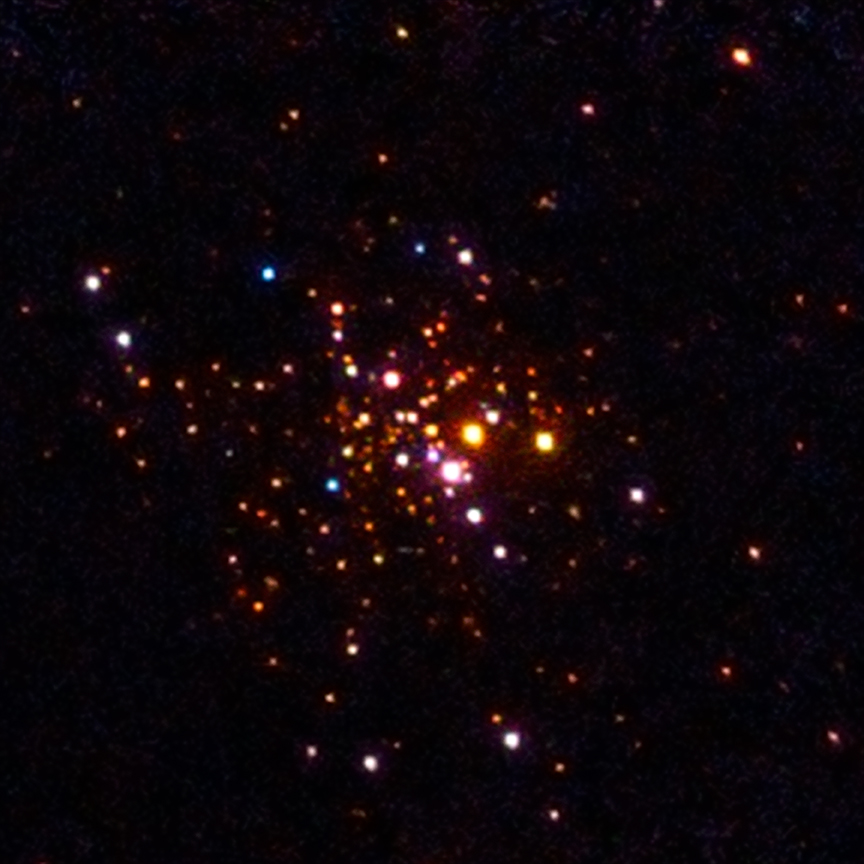
Neutron stars, the ultra-dense cores left behind after massive stars collapse, contain the densest matter known in the Universe outside of a black hole. New results from Chandra and other X-ray telescopes have provided one of the most reliable determinations yet of the relation between the radius of a neutron star and its mass. These results constrain how nuclear matter - protons and neutrons, and their constituent quarks - interact under the extreme conditions found in neutron stars.

Three telescopes - Chandra, ESA's XMM-Newton, and NASA's Rossi X-ray Timing Explorer (RXTE) - were used to observe 8 neutron stars, including one in 47 Tucanae, a globular cluster located about 15,000 light years away in the outskirts of the Milky Way. The image shown here was constructed from a long Chandra observation of 47 Tucanae. Lower-energy X-rays are red, X-rays with intermediate energies are green, and the highest-energy X-rays are shown in blue.

In the image, the double, or binary, star system labeled as X7 contains a neutron star slowly pulling gas away from a companion star with a mass much lower than the Sun. In 2006, researchers used observations of the amount of X-rays from X7 at different energies together with theoretical models to determine a relationship between the mass and the radius of the neutron star. A similar procedure was used for Chandra observations of a neutron star in another globular cluster, NGC 6397, and for two other neutron stars in clusters observed by ESA's XMM-Newton.

Credit NASA/CXC/Michigan State/A.Steiner et al
JPEG (345.4 kb)   -  Large JPEG (6.9 MB)  -   Tiff (18.4 MB)
View on the Sky (WWT)

Four other neutron stars were observed with RXTE to undergo bursts of X-rays that cause the atmosphere of the neutron star to expand. By following the cooling of the star, its surface area can be calculated. Then, by folding in independent estimates of the distance to the neutron star, scientists were able to gather more information on the relationships between the masses and radii of these neutron stars.

Because the mass and radius of a neutron star is directly related to interactions between the particles in the interior of the star, the latest results give scientists new information about the inner workings of neutron stars.

The researchers used a wide range of different models for the structure of these collapsed objects and determined that the radius of a neutron star with a mass that is 1.4 times the mass of the Sun is between 10.4 and 12.9 km (6.5 to 8.0 miles). They also estimated the density at the center of a neutron star was about 8 times that of nuclear matter found in Earth-like conditions. This translates into a pressure that is over ten trillion trillion times the pressure required for diamonds to form inside the Earth.

Neutron stars, the ultra-dense cores left behind after massive stars collapse, contain the densest matter known in the Universe outside of a black hole. New results from Chandra and other X-ray telescopes have provided one of the most reliable determinations yet of the relation between the radius of a neutron star and its mass. These results constrain how nuclear matter - protons and neutrons, and their constituent quarks - interact under the extreme conditions found in neutron stars.

Three telescopes - Chandra, ESA's XMM-Newton, and NASA's Rossi X-ray Timing Explorer (RXTE) - were used to observe 8 neutron stars, including one in 47 Tucanae, a globular cluster located about 15,000 light years away in the outskirts of the Milky Way. The image shown here was constructed from a long Chandra observation of 47 Tucanae. Lower-energy X-rays are red, X-rays with intermediate energies are green, and the highest-energy X-rays are shown in blue.

In the image, the double, or binary, star system labeled as X7 contains a neutron star slowly pulling gas away from a companion star with a mass much lower than the Sun. In 2006, researchers used observations of the amount of X-rays from X7 at different energies together with theoretical models to determine a relationship between the mass and the radius of the neutron star. A similar procedure was used for Chandra observations of a neutron star in another globular cluster, NGC 6397, and for two other neutron stars in clusters observed by ESA's XMM-Newton.

The results apply whether the entire set of bursting sources, or the most extreme of the other sources, are removed from the sample. Previous studies have used smaller samples of neutron stars or have not accounted for as many uncertainties in using the models.

The new values for the neutron star's structure should hold true even if matter composed of free quarks exists in the core of the star. Quarks are fundamental particles that combine to form protons and neutrons and are not usually found in isolation. It has been postulated that free quarks may exist inside the centers of neutron stars, but no firm evidence for this has ever been found. 

The researchers also made an estimate of the distances between neutrons and protons in atomic nuclei here on earth. A larger neutron star radius naturally implies that, on average, neutrons and protons in a heavy nucleus are farther apart. Their estimate is being compared with values from terrestrial experiments.

The neutron star observations also provided new information about the so-called "symmetry energy" for nuclear matter, which is the energy cost required to create a system with a different number of protons than neutrons. The symmetry energy is important for neutron stars because they contain almost ten times as many neutrons as protons. It is also important for heavy atoms on Earth, like Uranium, because they often have more neutrons than protons. The results show that the symmetry energy does not change much with density.

These results will be published in a paper in the March 1st, 2013 issue of The Astrophysical Journal Letters. The authors are Andrew Steiner, from the Institute for Nuclear Theory at the University of Washington, James Lattimer from Stony Brook University in New York and Edward Brown from Michigan State University.

NASA's Marshall Space Flight Center in Huntsville, Ala., manages the Chandra program for NASA's Science Mission Directorate in Washington. The Smithsonian Astrophysical Observatory controls Chandra's science and flight operations from Cambridge, Mass.


Fast Facts for 47 Tucanae: 

Release Date: March 6, 2013 
Scale: Image is 2.3 arcmin across (about 10 light years) 
Category: Neutron Stars/X-ray Binaries
Coordinates: (J2000) RA 00h 24m 42.0s | Dec -72° 00' 00" 
Constellation: Tucana
Observation Date: 13 pointings between March 16, 2000 and Oct 11, 2002 
Observation Time: 100 (4 days, 4 hours). 
Obs. ID: 78, 953-956, 2735-2738, 3384-3387 
Instrument: ACIS
References: Steiner, A. et al 2013, ApJ 765, L5; arXiv:1205.6871
Color Code: X-ray (Red, Green, Blue)

Thursday, February 14, 2013

W49B: Rare Explosion May Have Created Our Galaxy's Youngest Black Hole

 W49B
Credit X-ray: NASA/CXC/MIT/L.Lopez et al.; 
Infrared: Palomar; Radio: NSF/NRAO/VLA 


animation
 Tour of W49B

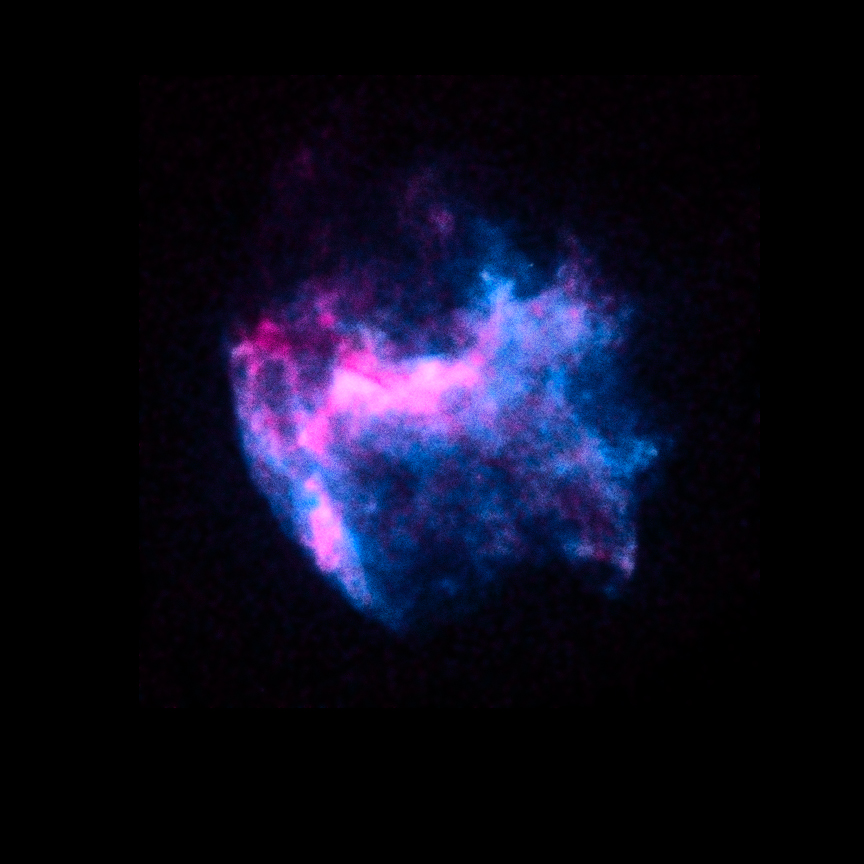
The highly distorted supernova remnant shown in this image may contain the most recent black hole formed in the Milky Way galaxy. The image combines X-rays from NASA's Chandra X-ray Observatory in blue and green, radio data from the NSF's Very Large Array in pink, and infrared data from Caltech's Palomar Observatory in yellow.

The remnant, called W49B, is about a thousand years old, as seen from Earth, and is at a distance of about 26,000 light years away.

The supernova explosions that destroy massive stars are generally symmetrical, with the stellar material blasting away more or less evenly in all directions. However, in the W49B supernova, material near the poles of the doomed rotating star was ejected at a much higher speed than material emanating from its equator. Jets shooting away from the star's poles mainly shaped the supernova explosion and its aftermath.

By tracing the distribution and amounts of different elements in the stellar debris field, researchers were able to compare the Chandra data to theoretical models of how a star explodes. For example, they found iron in only half of the remnant while other elements such as sulfur and silicon were spread throughout. This matches predictions for an asymmetric explosion. Also, W49B is much more barrel-shaped than most other remnants in X-rays and several other wavelengths, pointing to an unusual demise for this star.

W49B Elements
Chandra X-ray Image of W49B showing just the iron (purple) and silicon (blue).

The authors also examined what sort of compact object the supernova explosion left behind. Most of the time, massive stars that collapse into supernovas leave a dense spinning core called a neutron star

Astronomers can often detect these neutron stars through their X-ray or radio pulses, although sometimes an X-ray source is seen without pulsations. A careful search of the Chandra data revealed no evidence for a neutron star, implying an even more exotic object might have formed in the explosion, that is, a black hole.

This may be the youngest black hole formed in the Milky Way galaxy, with an age of only about a thousand years, as viewed from Earth (i.e., not including the light travel time). A well-known example of a supernova remnant in our Galaxy that likely contains a black hole is SS433. This remnant is thought to have an age between 17,000 and 21,000 years, as seen from Earth, making it much older than W49B.

The new results on W49B, which were based on about two-and-a-half days of Chandra observing time, appear in a paper in the February 10, 2013 issue of the Astrophysical Journal. The authors of the paper are Laura Lopez, from the Massachusetts Institute of Technology (MIT), Enrico Ramirez-Ruiz from the University of California at Santa Cruz, Daniel Castro, also of MIT, and Sarah Pearson from the University of Copenhagen in Denmark.

FAST FACTS FOR W49B:
Scale: Image is 8.5 arcmin across (60 light years)
Category: Supernovas & Supernova Remnants
Coordinates (J2000): RA 19h 11m 07s | Dec +09° 06' 00"
Constellation: Aquila
Observation Date: August 18-22, 2011
Observation Time: 61 hours 7 min (2 days 13 hours 7 min)
Obs. ID: 13440-13441
Instrument: ACIS
Also Known As: G043.3-00.2
References: Lopez, L et al 2013, ApJ 764, 50; arXiv:1301.0618
Color Code: X-ray (Green, Blue); Infrared (Yellow); Radio (Magenta)

Monday, January 28, 2013

DEM L50: Stellar Effervescence on Display

 The superbubble DEM L50 (Labeled)
Credit X-ray: NASA/CXC/Univ of Michigan/A.E.Jaskot,
Optical: NOAO/CTIO/MCELS 


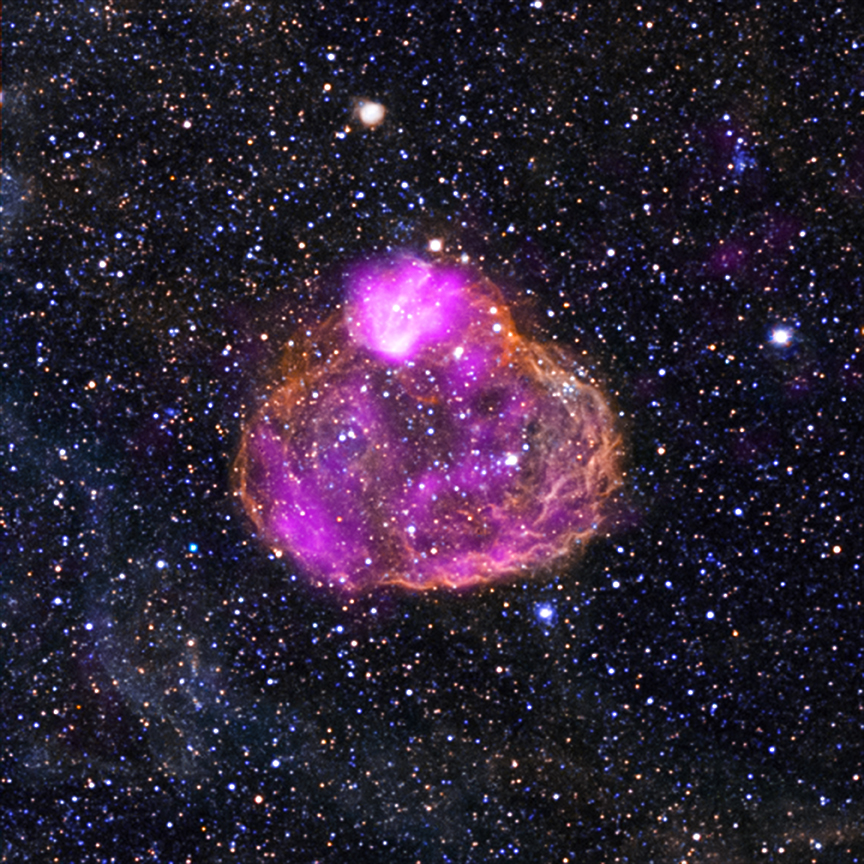
This composite image shows the superbubble DEM L50 (a.k.a. N186) located in the Large Magellanic Cloud about 160,000 light years from Earth. Superbubbles are found in regions where massive stars have formed in the last few million years. The massive stars produce intense radiation, expel matter at high speeds, and race through their evolution to explode as supernovas . The winds and supernova shock waves carve out huge cavities called superbubbles in the surrounding gas.

X-rays from NASA's Chandra X-ray Observatory are shown in pink and optical data from the Magellanic Cloud Emission Line Survey (MCELS) are colored in red, green and blue. The MCELS data were obtained with the University of Michigan's 0.9-meter Curtis Schmidt telescope at Cerro Tololo Inter-American Observatory (CTIO). The shape of DEM L50 is approximately an ellipse, with a supernova remnant named SNR N186 D located on its northern edge.

Like another superbubble in the LMC, N44 (see last year's press release), DEM L50 gives off about 20 times more X-rays than expected from standard models for the evolution of superbubbles. A Chandra study published in 2011 showed that there are two extra sources of the bright X-ray emission: supernova shock waves striking the walls of the cavities, and hot material evaporating from the cavity walls.

The Chandra study of DEM L50 was led by Anne Jaskot from the University of Michigan in Ann Arbor. The co-authors were Dave Strickland from Johns Hopkins University in Baltimore, MD, Sally Oey from University of Michigan, You-Hua Chu from University of Illinois and Guillermo Garcia-Segura from Instituto de Astronomia-UNAM in Ensenada, Mexico.

NASA's Marshall Space Flight Center in Huntsville, Ala., manages the Chandra program for NASA's Science Mission Directorate in Washington. The Smithsonian Astrophysical Observatory controls Chandra's science and flight operations from Cambridge, Mass.

Fast Facts for DEM L50: 

  • Scale: Image is 20.5 arcmin across (950 light years) 
  • Coordinates (J2000): RA 04h 59m 49.00s | Dec -70º 10' 28.00" 
  • Observation Date: Jan 1, 2003 
  • Observation Time: 10 hours 29 min 
  • Obs. ID: 3355 
  • Instrument: ACIS 
  • Color Code: X-ray (Magenta); Optical (Red, Green, Blue)

Wednesday, January 09, 2013

Vela Pulsar Jet: New Chandra Movie Features Neutron Star Action


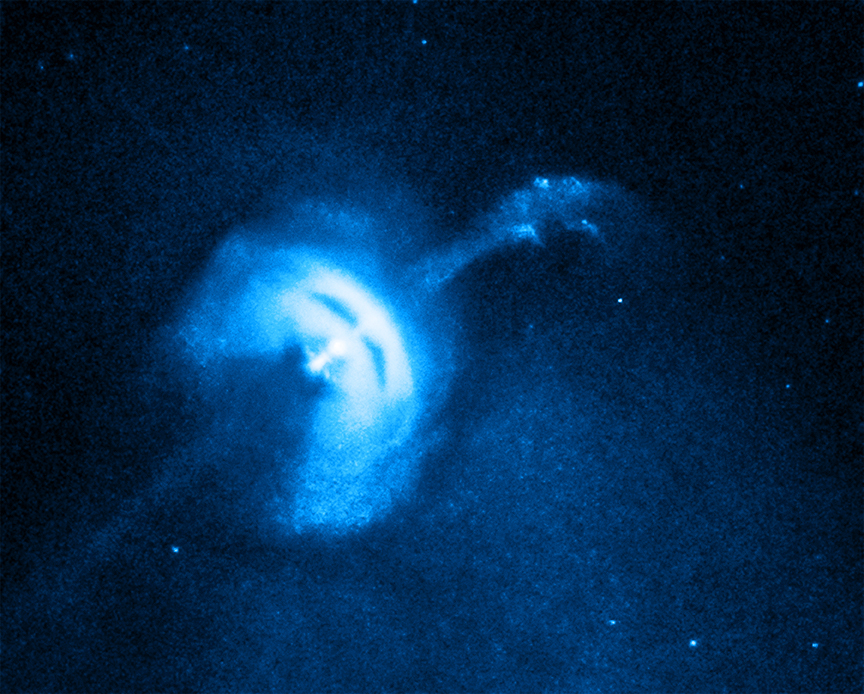
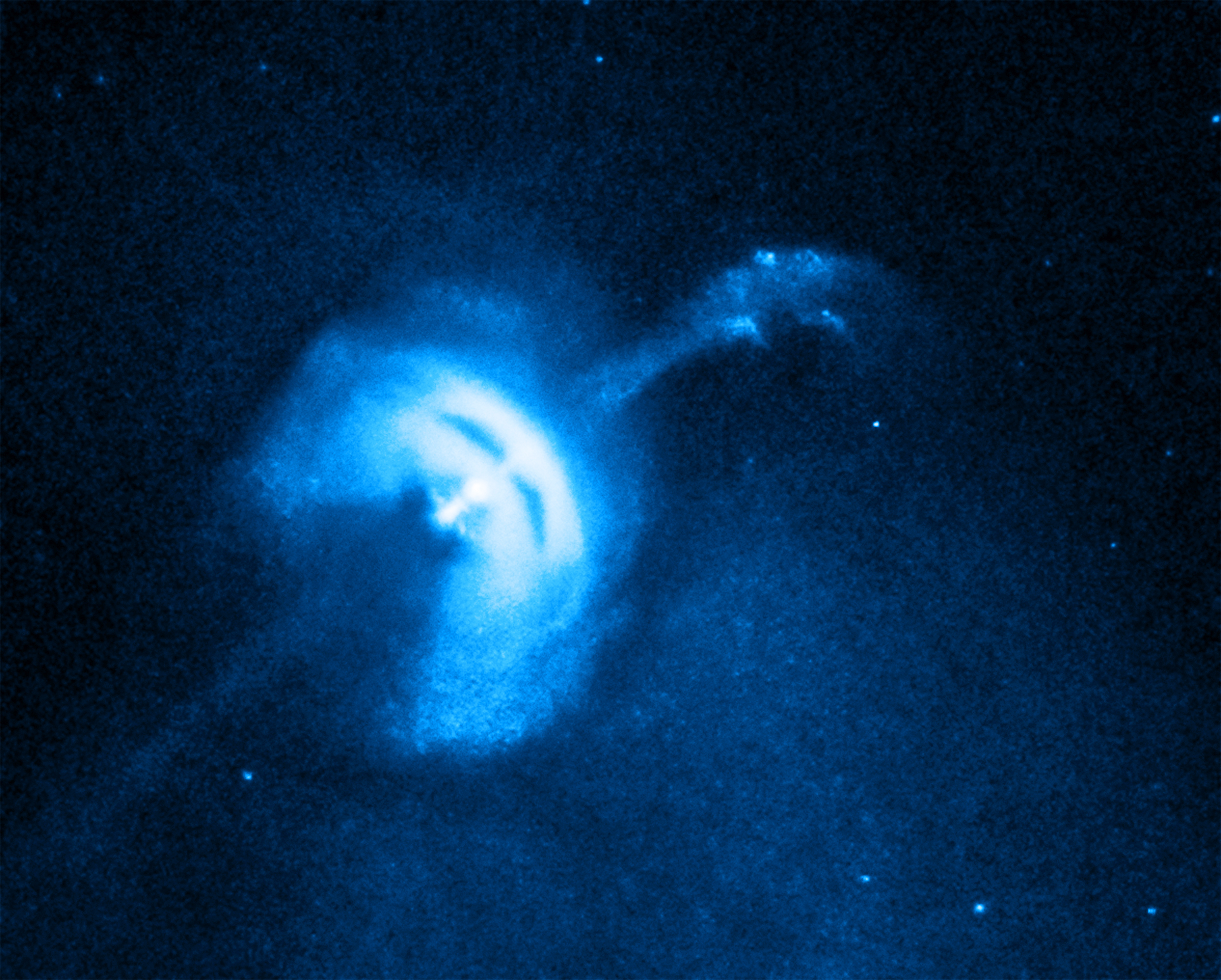
This movie from NASA's Chandra X-ray Observatory shows a fast moving jet of particles produced by a rapidly rotating neutron star , and may provide new insight into the nature of some of the densest matter in the universe.

The star of this movie is the Vela pulsar, a neutron star that was formed when a massive star collapsed. The Vela pulsar is about 1,000 light years from Earth, spans about 12 miles in diameter, and makes over 11 complete rotations every second, faster than a helicopter rotor. As the pulsar whips around, it spews out a jet of charged particles that race out along the pulsar's rotation axis at about 70% of the speed of light. In this still image from the movie, the location of the pulsar and the 0.7-light-year-long jet are labeled.


Labeled Vela Pulsar Jet
The Chandra data shown in the movie, containing 8 images obtained between June and September 2010, suggest that the pulsar may be slowly wobbling, or precessing, as it spins. The shape and the motion of the Vela jet look strikingly like a rotating helix, a shape that is naturally explained by precession, as shown in this animation. If the evidence for precession of the Vela pulsar is confirmed, it would be the first time that a jet from a neutron star has been found to be precessing in this way.

One possible cause of precession for a spinning neutron star is that it has become slightly distorted and is no longer a perfect sphere. This distortion might be caused by the combined action of the fast rotation and "glitches", sudden increases of the pulsar's rotational speed due to the interaction of the superfluid core of the neutron star with its crust.

A paper describing these results will be published in The Astrophysical Journal on January 10, 2013.  This is the second Chandra movie of the Vela pulsar, with the original having been released in 2003. The first Vela movie contained shorter, unevenly spaced observations so that the changes in the jet were less pronounced and the authors did not argue that precession was occurring. However, based on the same data, Avinash Deshpande of Arecibo Observatory in Puerto Rico and the Raman Research Institute in Bangalore, India, and the late Venkatraman Radhakrishnan, argued in a 2007 paper that the Vela pulsar might be precessing.

The Earth also precesses as it spins, with a period of about 26,000 years. In the future Polaris will no longer be the "north star" and other stars will take its place. The period of the Vela precession is much shorter and is estimated to be about 120 days.


Wide field Optical and X-ray

The supernova that formed the Vela pulsar exploded over 10,000 years ago. This optical image from the Anglo-Australian Observatory's UK Schmidt telescope shows the enormous apparent size of the supernova remnant formed by the explosion. The full size of the remnant is about eight degrees across, or about 16 times the angular size of the moon. The square near the center shows the Chandra image with a larger field-of-view than used for the movie, with the Vela pulsar in the middle.

Fast Facts for Vela Pulsar Jet:


Credit:
NASA/CXC/Univ of Toronto/M.Durant et al
Scale : Movie is 4.8 x 3.6 arcmin (1.4 x 1.0 light years)
Category : Neutron Stars/X-ray Binaries
Coordinates (J2000) : RA 08h 35m 20.60s | Dec -45° 10' 35.00"
Constellation : Vela
Observation Date : 8 pointings between Jul 2009 and Sep 2010
Observation Time : 89 hours (3 days, 17 hours)
Obs. ID : 10135-10139, 12073-12075
Instrument : ACIS
Color Code : X-ray (Blue)

Wednesday, December 19, 2012

PKS 0745: From Super to Ultra: Just How Big Can Black Holes Get?

 
 PKS 0745-19
Credit  X-ray: NASA/CXC/Stanford/Hlavacek-Larrondo, J. et al; 
Optical: NASA/STScI; Radio: NSF/NRAO/VLA


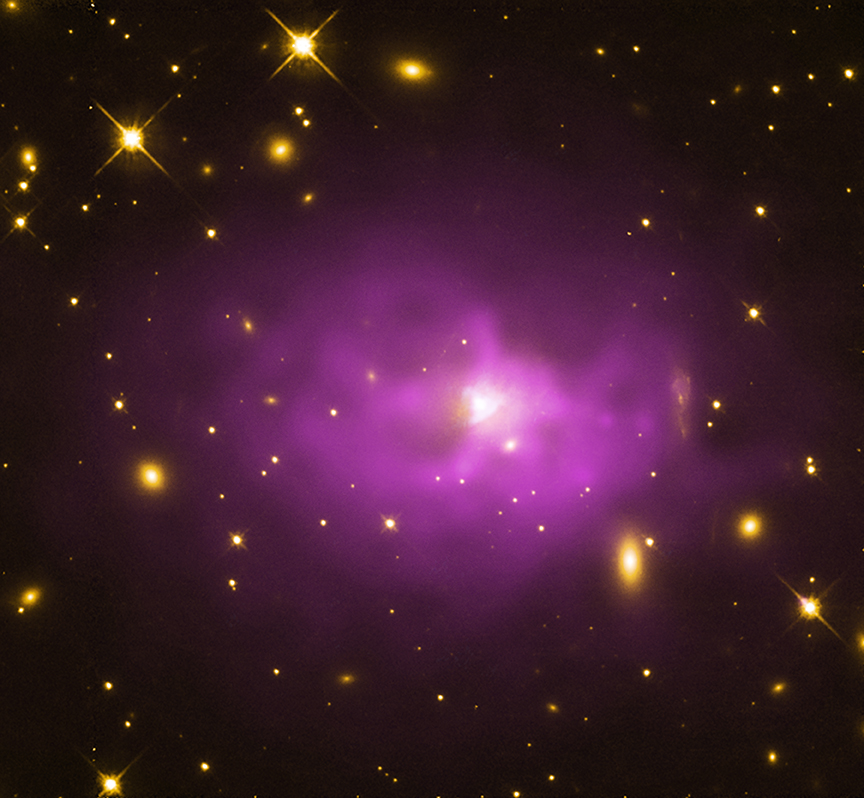
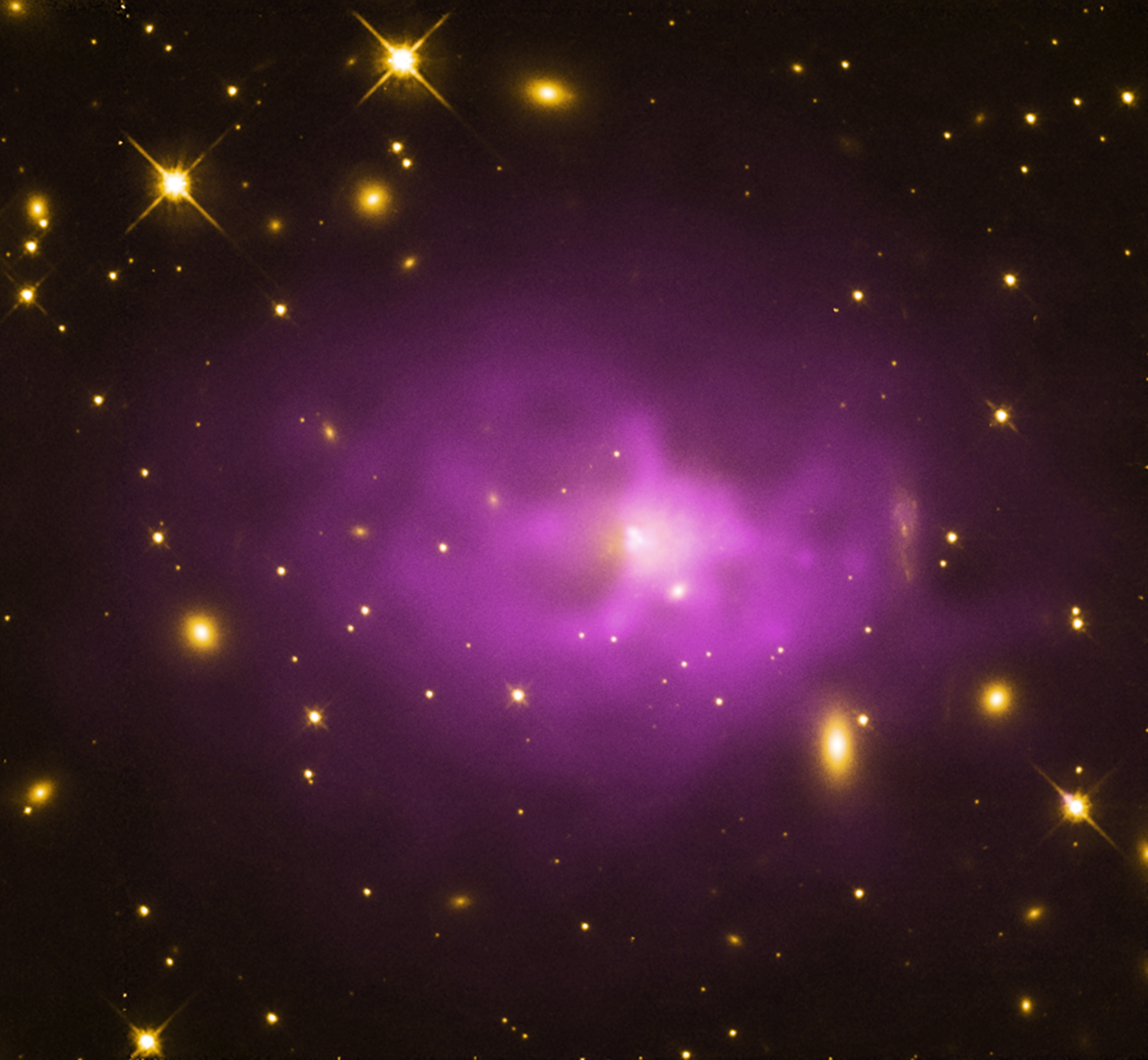
The black hole at the center of this galaxy is part of a survey of 18 of the biggest black holes in the universe. This large elliptical galaxy is in the center of the galaxy cluster PKS 0745-19, which is located about 1.3 billion light years from Earth. X-ray data from NASA's Chandra X-ray Observatory are shown in purple and optical data from the Hubble Space Telescope are in yellow.

The researchers found that these black holes may be about ten times more massive than previously thought, with at least ten of them weighing between 10 and 40 billion times the mass of the sun.

All of the potential "ultramassive" black holes found in this study lie in galaxies at the centers of galaxy clusters containing huge amounts of hot gas. This hot gas produces the diffuse X-ray emission seen in the image. Outbursts powered by the central black holes create cavities in the gas -- mouse-over for their location -- preventing it from cooling and forming enormous numbers of stars. To generate the outbursts, the black holes must swallow large amounts of mass. Because the largest black holes can swallow the most mass and power the biggest outbursts, ultramassive black holes had already been predicted to exist to explain some of the most powerful outbursts seen.

In addition to the X-rays from Chandra, the new study also uses radio data from the NSF's Karl G. Jansky Very Large Array (JVLA) and the Australia Telescope Compact Array (ATCA) and infrared data from the 2 Micron All-Sky Survey (2MASS).

These results were published in the July 2012 issue of The Monthly Notices of the Royal Astronomical Society.

Fast Facts for PKS 0745:


Release Date : December 18, 2012
Scale : Image is 1.4 arcmin across (about 511,000 light years)
Category : Black Holes, Groups & Clusters of Galaxies
Coordinates (J2000) : RA 07h 47m 31.30s | Dec -19° 17' 40.10"
Constellation : Puppis
Observation Date : 27 Jan 2011
Observation Time : 47 hours 20 min (1 day 23 hours 20 min)
Obs. ID : 12881
Instrument : ACIS
References :Hlavacek-Larrondo, J. et al, 2012, MNRAS, 424, 224; arXiv:1204.5759
Color Code : X-ray (Purple); Optical (Yellow); Radio (Blue)

Monday, December 17, 2012

NGC 3627: Revealing Hidden Black Holes

 NGC 3627
Credit :    NASA/CXC/Ohio State Univ./C.Grier et al.; 
Optical: NASA/STScI, ESO/WFI; I
nfrared: NASA/JPL-Caltech


Tour of NGC 3627

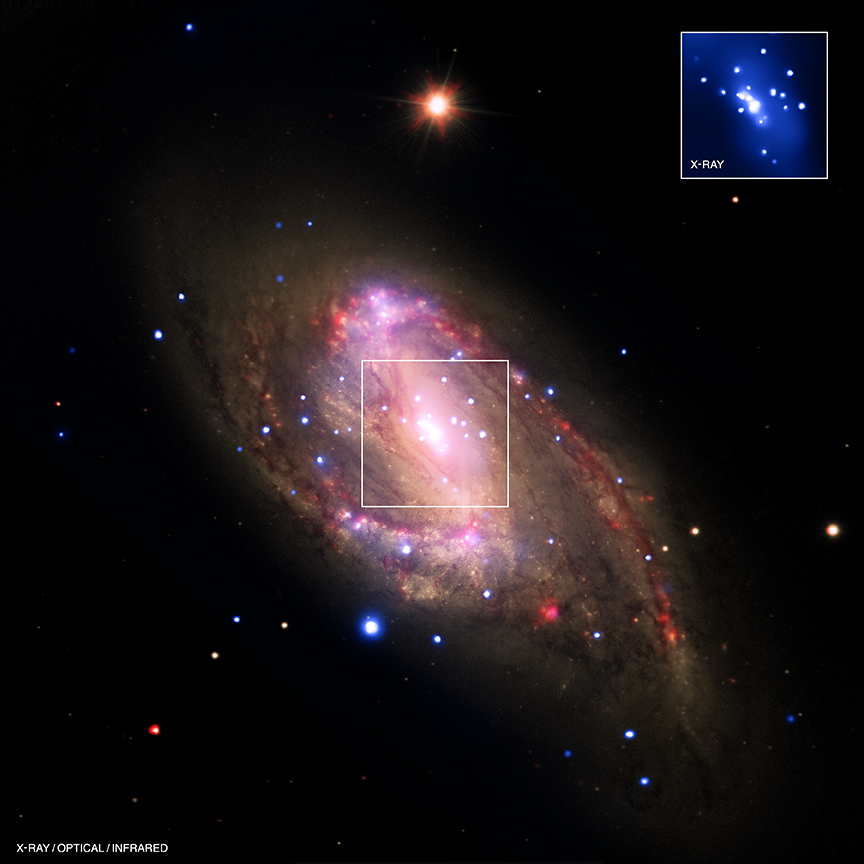
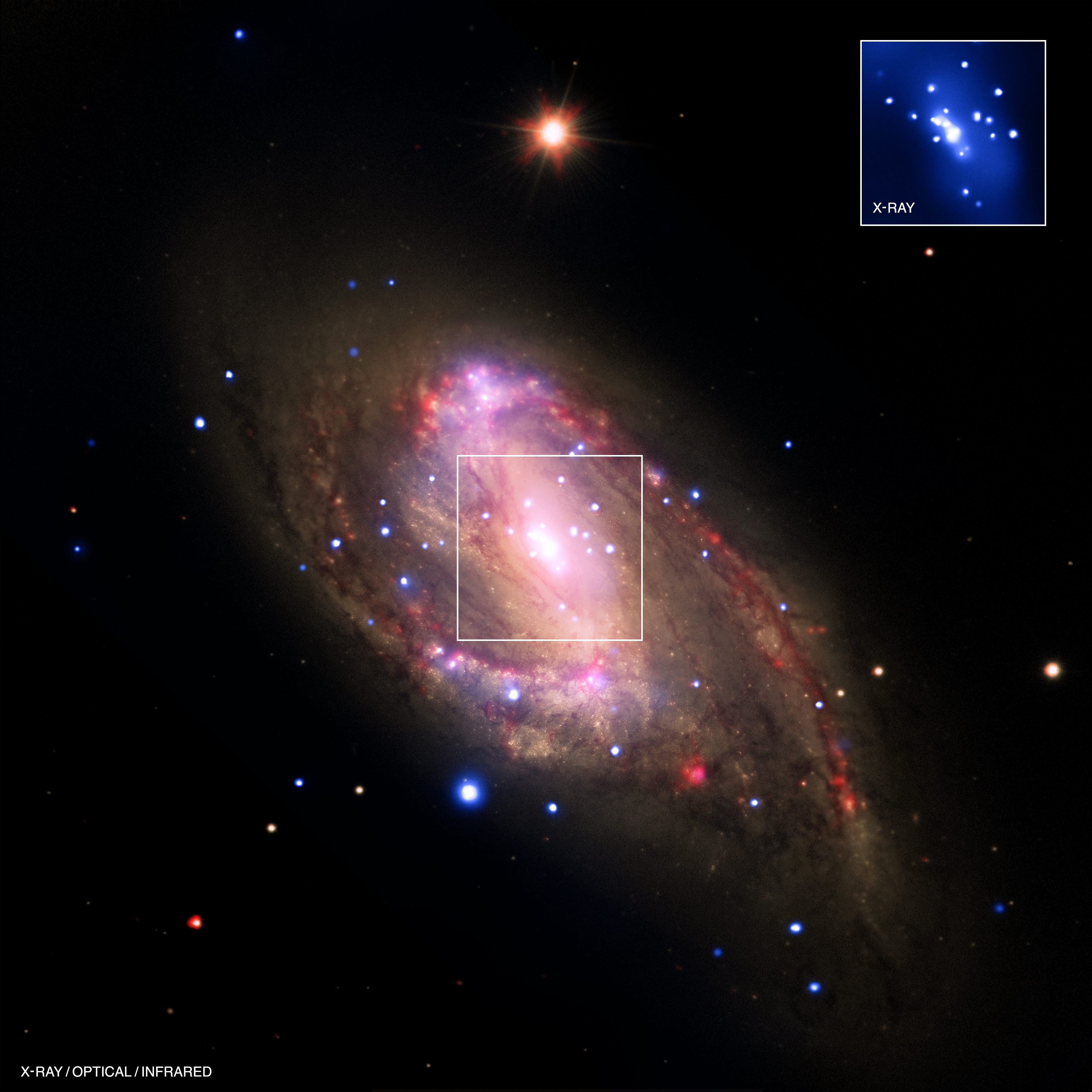
The spiral galaxy NGC 3627 is located about 30 million light years from Earth. This composite image includes X-ray data from NASA's Chandra X-ray Observatory (blue), infrared data from the Spitzer Space Telescope (red), and optical data from the Hubble Space Telescope and the Very Large Telescope (yellow). The inset shows the central region, which contains a bright X-ray source that is likely powered by material falling onto a supermassive black hole.

A search using archival data from previous Chandra observations of a sample of 62 nearby galaxies has shown that 37 of the galaxies, including NGC 3627, contain X-ray sources in their centers. Most of these sources are likely powered by central supermassive black holes. The survey, which also used data from the Spitzer Infrared Nearby Galaxy Survey, found that seven of the 37 sources are new supermassive black hole candidates.

Confirming previous Chandra results, this study finds the fraction of galaxies found to be hosting supermassive black holes is much higher than found with optical searches. This shows the ability of X-ray observations to find black holes in galaxies where relatively low-level black hole activity has either been hidden by obscuring material or washed out by the bright optical light of the galaxy.

The combined X-ray and infrared data suggest that the nuclear activity in a galaxy is not necessarily related to the amount of star-formation in the galaxy, contrary to some early claims. In contrast, these new results suggest that the mass of the supermassive black hole and the rate at which the black hole accretes matter are both greater for galaxies with greater total masses.

A paper describing these results was published in the April 10, 2011 issue of The Astrophysical Journal. The authors are Catherine Grier and Smita Mathur of The Ohio State University in Columbus, OH; Himel GHosh of CNRS/CEA-Saclay in Guf-sur-Yvette, France and Laura Ferrarese from Herzberg Institute of Astrophysics in Victoria, Canada.

NASA's Marshall Space Flight Center in Huntsville, Ala., manages the Chandra program for NASA's Science Mission Directorate in Washington. The Smithsonian Astrophysical Observatory controls Chandra's science and flight operations from Cambridge, Mass.

Fast Facts for NGC 3627:

Release Date:     December 13, 2012
Scale:     Image is 6.8 arcmin across (about 57,000 light years)
Category:
    Normal Galaxies & Starburst Galaxies
Coordinates (J2000):     RA 11h 20m 15.0s | Dec +12° 59' 30.00"
Constellation:      Leo
Observation Date:      March 31, 2008
Observation Time:      14 hours 10 min
Obs. ID:      9548
Instrument:
   ACIS
References:     Grier, C. et al, 2011, ApJ, 731, 60; arXiv:1011.4295
Color Code:     X-ray (Blue), Optical (Yellow), Infrared (Red)

Friday, December 07, 2012

NGC 922: Searching for the Best Black Hole Recipe

 NGC 922 - Composite
Credit:     X-ray (NASA/CXC/SAO/A.Prestwich et al); Optical (NASA/STScI)

In this holiday season of home cooking and carefully-honed recipes, some astronomers are asking: what is the best mix of ingredients for stars to make the largest number of plump black holes?


They are tackling this problem by studying the number of black holes in galaxies with different compositions. One of these galaxies, the ring galaxy NGC 922, is seen in this composite image containing X-rays from NASA's Chandra X-ray Observatory (red) and optical data from the Hubble Space Telescope (appearing as pink, yellow and blue).

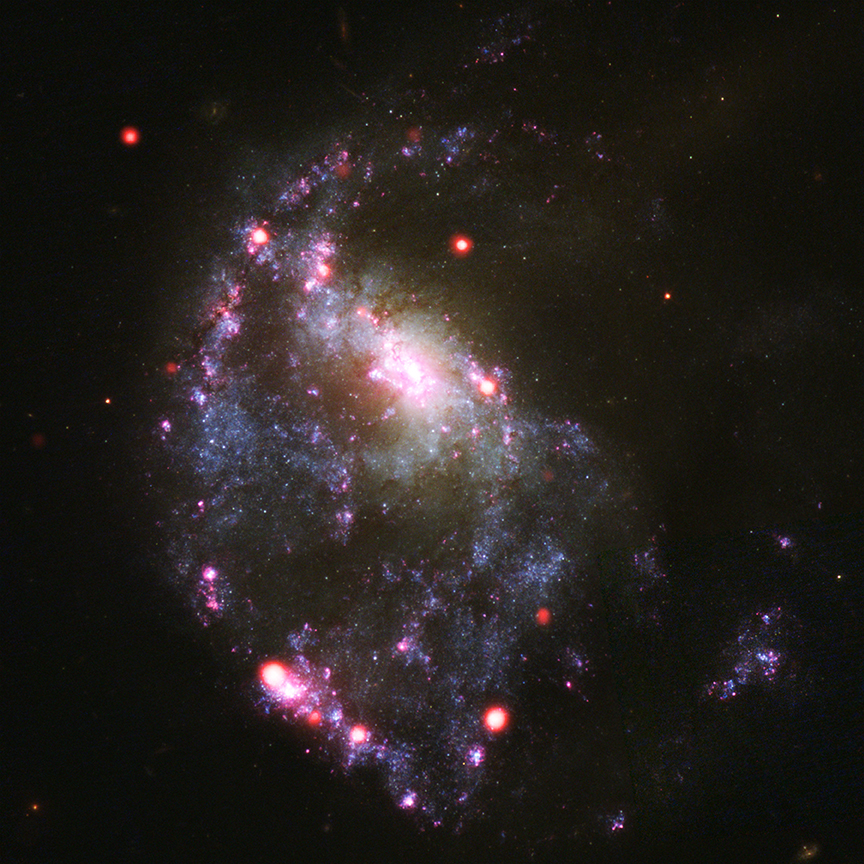
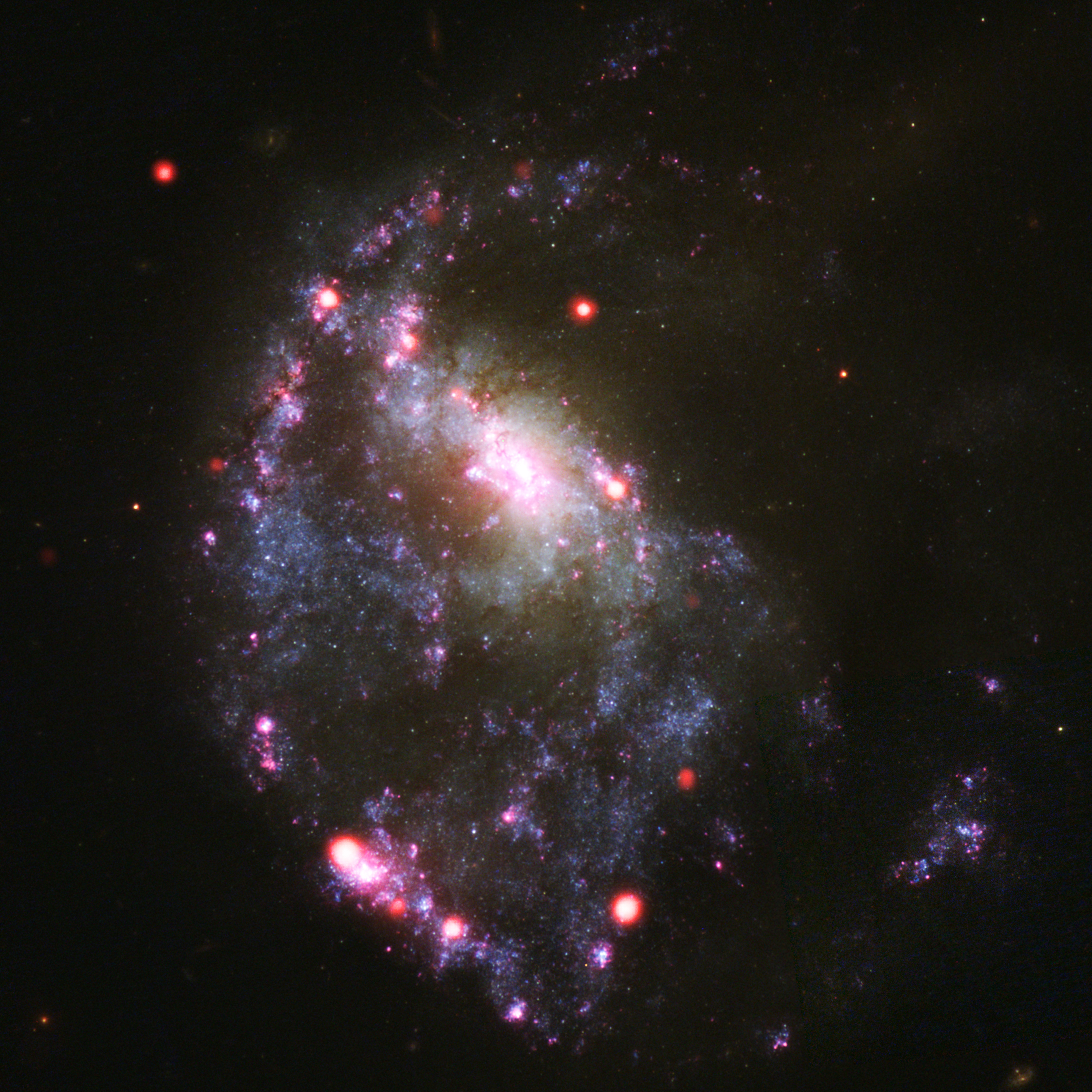
NGC 922 was formed by the collision between two galaxies - one seen in this image and another located outside the field of view. This collision triggered the formation of new stars in the shape of a ring. Some of these were massive stars that evolved and collapsed to form black holes.

Most of the bright X-ray sources in Chandra's image of NGC 922 are black holes pulling material in from the winds of massive companion stars. Seven of these are what astronomers classify as "ultraluminous X-ray sources" (ULXs). These are thought to contain stellar-mass black holes that are at least ten times more massive than the sun, which places them in the upper range for this class of black hole. They are a different class from the supermassive black holes found at the centers of galaxies, which are millions to billions of times the mass of the sun. 

Theoretical work suggests that the most massive stellar-mass black holes should form in environments containing a relatively small fraction of elements heavier than hydrogen and helium. In massive stars, the processes that drive matter away from the stars in stellar winds work less efficiently if the fraction of metals is smaller. Thus, stars with fewer of these metals among their ingredients should lose less of their mass through winds as they evolve. A consequence of this reduced mass loss is that a larger proportion of massive stars will collapse to form black holes when their nuclear fuel is exhausted. This theory appeared to be supported by the detection of a large number (12) of ULXs in the Cartwheel galaxy, where stars typically contain only about 30% of the metals found in the sun.

To test this theory, scientists studied NGC 922, which contains about the same fraction of metals as the sun, meaning that this galaxy is about three times richer in metals than the Cartwheel galaxy. Perhaps surprisingly, the number of ULXs found in NGC 922 is comparable to the number seen in the Cartwheel galaxy. Rather, the ULX tally appears to depend only on the rate at which stars are forming in the two galaxies, not on the fraction of metals they contain.
 
Credit: Composite: NASA/JPL/Caltech/P.Appleton et al. 
X-ray: NASA/CXC/A.Wolter & G.Trinchieri et al.

One explanation for these results is that the theory predicting the most massive stellar-mass black holes should form in metal poor conditions is incorrect. Another explanation is that the metal fraction in the Cartwheel galaxy is not low enough to have a clear effect on the production of unusually massive stellar-mass black holes, and therefore will not cause an enhancement in the number of ULXs. Recent models incorporating the evolution of stars  suggest that a clear enhancement in the number of ULXs might only be seen when the metal fraction falls below about 15% of the Sun's value. Astronomers are investigating this possibility by observing galaxies with extremely low metal fractions using Chandra. The number of ULXs is being compared with the number found in galaxies with higher metal content. The results of this work will be published in a future paper.

A paper describing the results for NGC 922 was published in the March 10, 2012 issue of the Astrophysical Journal. The authors were Andrea Prestwich and Jose Luis Galache of the Harvard-Smithsonian Center for Astrophysics (CfA) in Cambridge, MA; Tim Linden from University of Santa Cruz in Santa Cruz, CA; Vicky Kalogera from Northwestern University in Evanston, IL; Andreas Zezas from CfA and University of Crete in Crete, Greece; Tim Roberts from University of Durham in Durham, UK; Roy Kilgard from Wesleyan University in Middletown, CT; Anna Wolter and Ginevra Trinchieri from INAF in Milano, Italy.

NASA's Marshall Space Flight Center in Huntsville, Ala., manages the Chandra program for NASA's Science Mission Directorate in Washington. The Smithsonian Astrophysical Observatory controls Chandra's science and flight operations from Cambridge, Mass.

Fast Facts for NGC 922:

Credit:     X-ray (NASA/CXC/SAO/A.Prestwich et al); Optical (NASA/STScI)
Release Date:     December 6, 2012
Scale:     Image is 1.6 arcmin across (about 73,000 light years)
Coordinates (J2000):     RA 02h 25m 04.40s | Dec -24° 47' 17.00"
Constellation:
    Fornax
Observation Date:      March 5 and October 2, 2009
Observation Time:      11 hours 11 min
Obs. ID:      10563-10564
Instrument:
    ACIS
References:     Prestwich, A., et al, 2012, ApJ, 747, 150  http://xxx.lanl.gov/abs/1212.1124
Color Code:     X-ray (Red); Optical (Red, Green, Blue)
Saturday, December 01, 2012

GB 1428+4217: Record-Setting X-ray Jet Discovered

  GB 1428+4217
Credit:     X-ray: NASA/CXC/NRC/C.Cheung et al; 
Optical: NASA/STScI; Radio: NSF/NRAO/VLA


Tour of GB 1428+4217

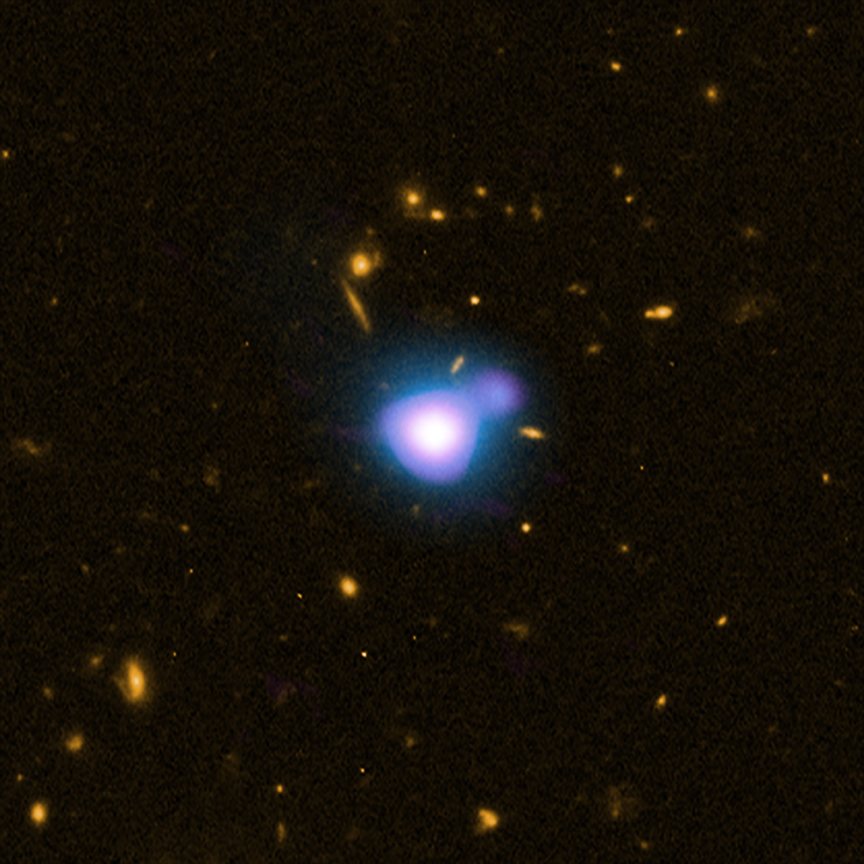
This composite image shows the most distant X-ray jet ever observed. X-ray data from NASA's Chandra X-ray Observatory are shown in blue, radio data from the NSF's Very Large Array are shown in purple and optical data from NASA's Hubble Space Telescope are shown in yellow. The jet was produced by a quasar named GB 1428+4217, or GB 1428 for short, and is located 12.4 billion light years from Earth. Labels for the quasar and jet can be seen by mousing over the image. The shape of the jet is very similar in the X-ray and radio data.

Giant black holes at the centers of galaxies can pull in matter at a rapid rate producing the quasar phenomenon. The energy released as particles fall toward the black hole generates intense radiation and powerful beams of high-energy particles that blast away from the black hole at nearly the speed of light. These particle beams can interact with magnetic fields or ambient photons to produce jets of radiation.

As the electrons in the jet fly away from the quasar, they move through a sea of background photons left behind after the Big Bang. When a fast-moving electron collides with one of these so-called cosmic microwave background photons, it can boost the photon's energy into the X-ray band. Because the quasar is seen when the universe is at an age of about 1.3 billion years, less than 10% of its current value, the cosmic background radiation is a thousand times more intense than it is now. This makes the jet much brighter, and compensates in part for the dimming due to distance.

While there is another possible source of X-rays for the jet - radiation from electrons spiraling around magnetic field lines in the jet - the authors favor the idea that the cosmic background radiation is being boosted because the jet is so bright.

The researchers think the length of the jet in GB 1428 is at least 230,000 light years, or about twice the diameter of the entire Milky Way galaxy. This jet is only seen on one side of the quasar in the Chandra and VLA data. When combined with previously obtained evidence, this suggests the jet is pointed almost directly toward us. This configuration would boost the X-ray and radio signals for the observed jet and diminish those for a jet presumably pointed in the opposite direction.

This result appeared in the September 1st, 2012 issue of The Astrophysical Journal Letters.


Fast Facts for GB 1428+4217:

Release Date:     November 28, 2012
Scale:     Image is 41 arcsec across (about 900,000 light years)
Category:
    Quasars & Active Galaxies
Coordinates (J2000):     RA 14h 30m 23.70s | Dec +42° 04' 36.50"
Constellation:
    Boötes
Observation Date :     26 Mar 2007
Observation Time :     3 hours 14 min
Obs. ID:      7874
Instrument :    ACIS
References:     Cheung, C. et al, 2012, ApJ, 756, L20;
arXiv:1208.0584
Color Code :    X-ray (Blue); Optical (Yellow); Radio (Purple)

Wednesday, November 07, 2012

Cygnus OB2: Probing a Nearby Stellar Cradle


Cygnus OB2 (Composite)
Credit X-ray: NASA/CXC/SAO/J.Drake et al, 
Optical: Univ. of Hertfordshire/INT/IPHAS, I
nfrared: NASA/JPL-Caltech


Videos


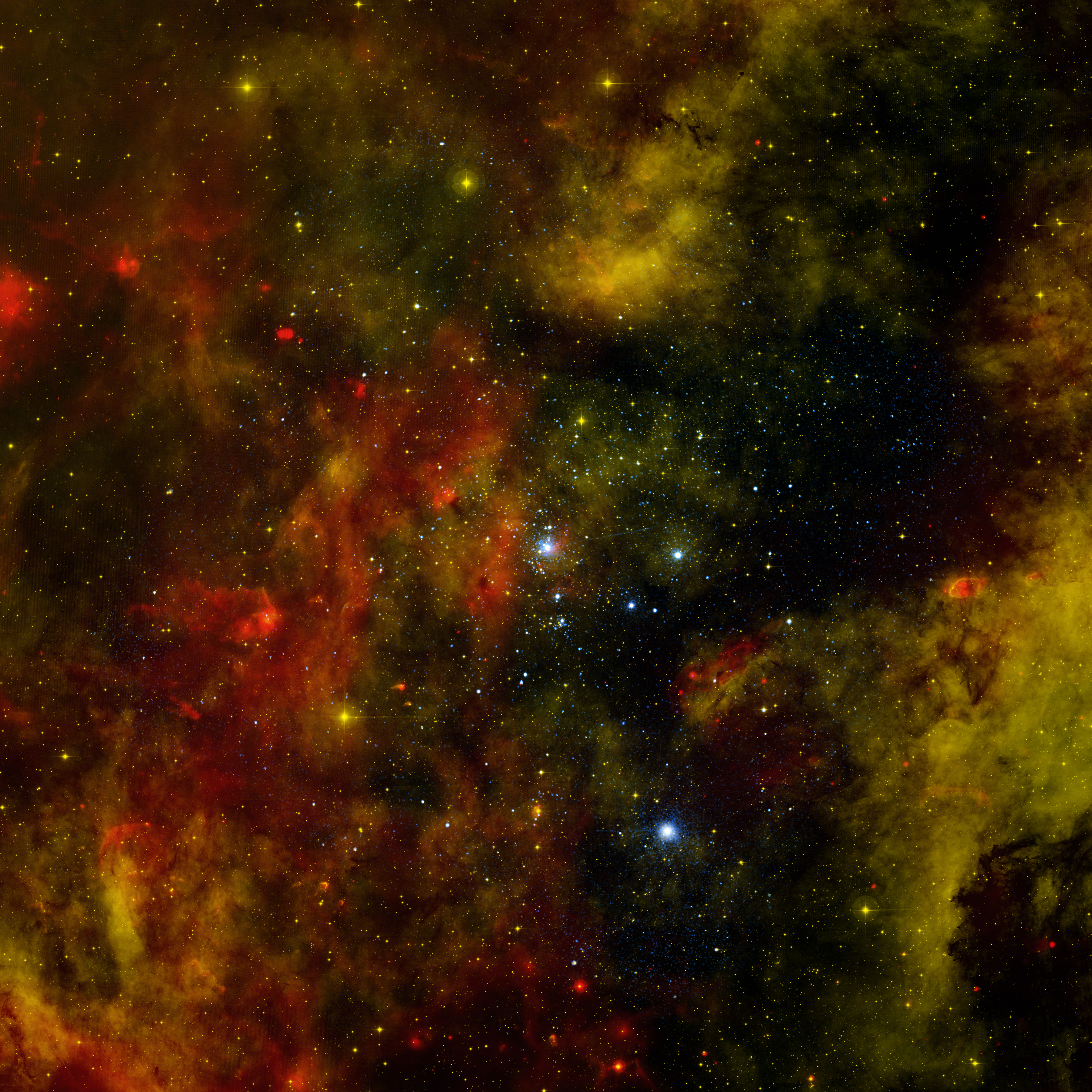
The Milky Way and other galaxies in the universe harbor many young star clusters and associations that each contain hundreds to thousands of hot, massive, young stars known as O and B stars. The star cluster Cygnus OB2 contains more than 60 O-type stars and about a thousand B-type stars. At a relatively nearby distance to Earth of about 5,000 light years, Cygnus OB2 is the closest massive cluster. Deep observations with NASA's Chandra X-ray Observatory of Cygnus OB2 have been used to detect the X-ray emission from the hot outer atmospheres, or coronas, of young stars in the cluster and to probe how these great star factories form and evolve. About 1,700 X-ray sources were detected, including about 1,450 thought to be stars in the cluster. In this image, X-rays from Chandra (blue) have been combined with infrared data from NASA's Spitzer Space Telescope (red) and optical data from the Isaac Newton Telescope (orange). 

Young stars ranging in age from one million to seven million years were detected. The infrared data indicates that a very low fraction of the stars have circumstellar disks of dust and gas. Even fewer disks were found close to the massive OB stars, betraying the corrosive power of their intense radiation that leads to early destruction of their disks. Evidence is also seen that the older population of stars has lost its most massive members because of supernova explosions. Finally, a total mass of about 30,000 times the mass of the sun is derived for Cygnus OB2, similar to that of the most massive star forming regions in our Galaxy

NASA's Marshall Space Flight Center in Huntsville, Ala., manages the Chandra program for NASA's Science Mission Directorate in Washington. The Smithsonian Astrophysical Observatory controls Chandra's science and flight operations from Cambridge, Mass.

Fast Facts for Cygnus OB2:

Credit X-ray: NASA/CXC/SAO/J.Drake et al, Optical: Univ. of Hertfordshire/INT/IPHAS, Infrared: NASA/JPL-Caltech
Release Date:  November 7, 2012
Scale:  Image is 11.8 arcmin across (16 light years)
Category:  Normal Stars & Star Clusters
Coordinates (J2000):  RA 20h 37m 11.00s | Dec +38° 41' 52.00"
Constellation:  Cygnus
Observation Date:  39 pointings between January 2004 and March 2010 
Observation Time:  341 hours 40 min (14 days 5 hours 40 min)
Obs. ID:  4501, 4511, 10939-10974, 12099 
Instrument: ACIS 
Color Code:  X-ray (Blue), Optical (Yellow), Infrared (Red)

Thursday, October 11, 2012

NGC 6543: A Planetary Nebula Gallery

 
Credit: X-ray: NASA/CXC/RIT/J.Kastner et al.; O
ptical: NASA/STScI


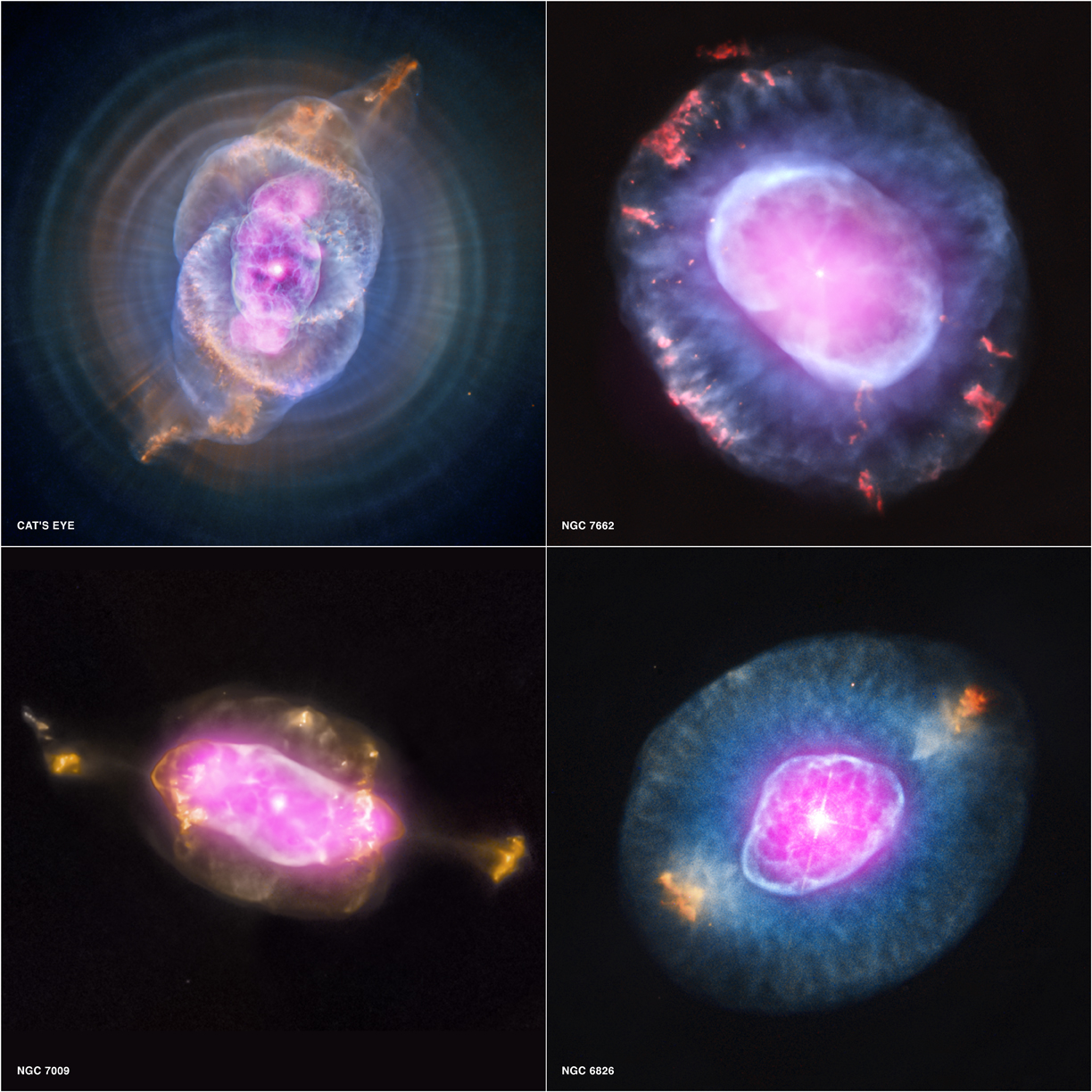
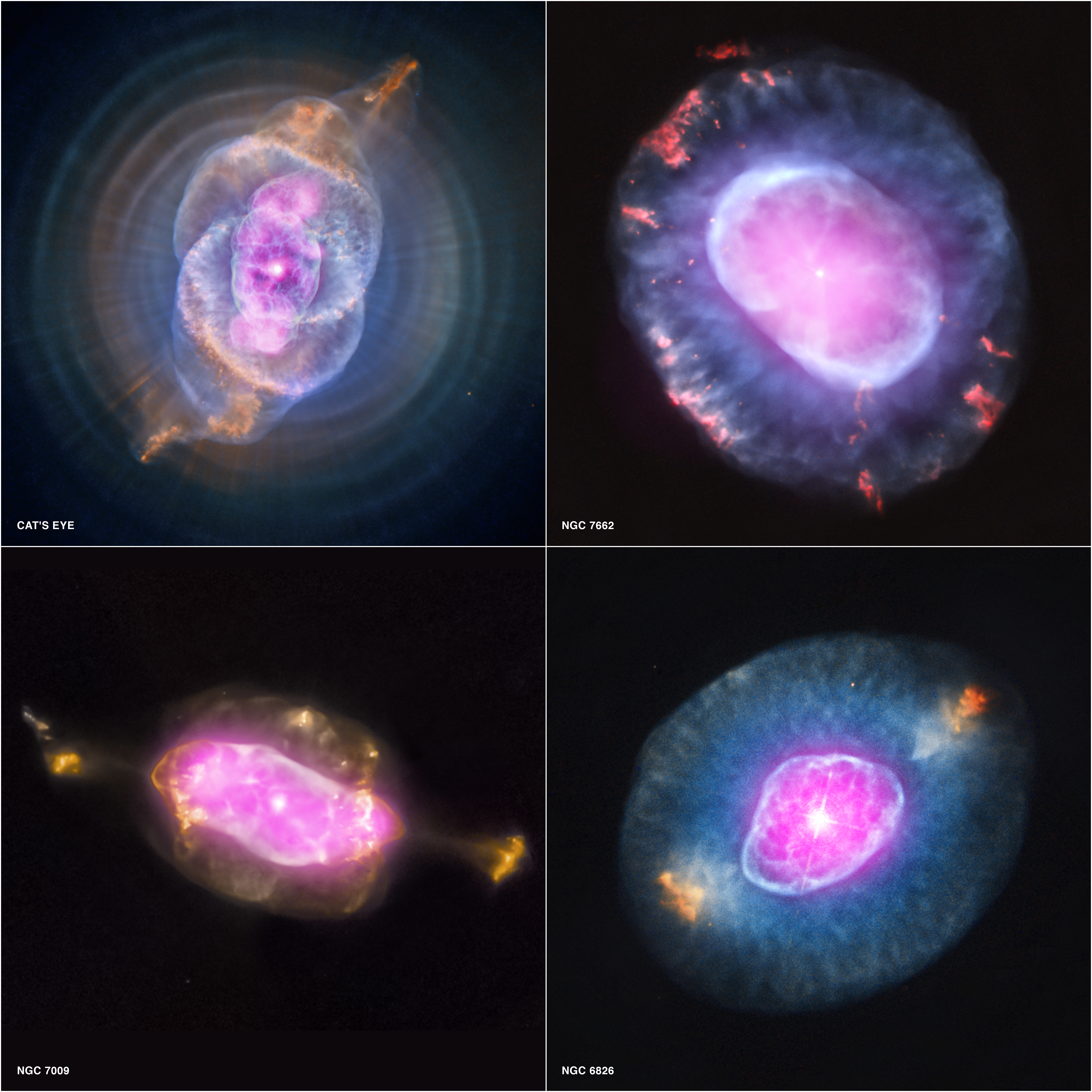
This gallery shows four planetary nebulas from the first systematic survey of such objects in the solar neighborhood made with NASA's Chandra X-ray Observatory. The planetary nebulas shown here are NGC 6543, also known as the Cat's Eye, NGC 7662, NGC 7009 and NGC 6826. In each case, X-ray emission from Chandra is colored purple and optical emission from the Hubble Space Telescope is colored red, green and blue.

In the first part of this survey, published in a new paper, twenty one planetary nebulas within about 5000 light years of the Earth have been observed. The paper also includes studies of fourteen other planetary nebulas, within the same distance range, that Chandra had already observed.

A planetary nebula represents a phase of stellar evolution that the Sun should experience several billion years from now. When a star like the Sun uses up all of the hydrogen in its core, it expands into a red giant, with a radius that increases by tens to hundreds of times. In this phase, a star sheds most of its outer layers, eventually leaving behind a hot core that will soon contract to form a dense white dwarf star. A fast wind emanating from the hot core rams into the ejected atmosphere, pushes it outward, and creates the graceful, shell-like filamentary structures seen with optical telescopes.

The diffuse X-ray emission seen in about 30% of the planetary nebulas in the new Chandra survey, and all members of the gallery, is caused by shock waves as the fast wind collides with the ejected atmosphere. The new survey data reveal that the optical images of most planetary nebulas with diffuse X-ray emission display compact shells with sharp rims, surrounded by fainter halos. All of these compact shells have observed ages that are less than about 5000 years, which therefore likely represents the timescale for the strong shock waves to occur.

About half of the planetary nebulas in the study show X-ray point sources in the center, and all but one of these point sources show high energy X-rays that may be caused by a companion star, suggesting that a high frequency of central stars responsible for ejecting planetary nebulas have companions. Future studies should help clarify the role of double stars in determining the structure and evolution of planetary nebulas.

These results were published in the August 2012 issue of The Astronomical Journal. The first two authors are Joel Kastner and Rodolfo Montez Jr. of the Rochester Institute of Technology in New York, accompanied by 23 co-authors.

NASA's Marshall Space Flight Center in Huntsville, Ala., manages the Chandra program for NASA's Science Mission Directorate in Washington. The Smithsonian Astrophysical Observatory controls Chandra's science and flight operations from Cambridge, Mass.

Fast Facts for NGC 6543:

Release Date:     October 10, 2012
Scale:     Image is 1.2 arcmin across. (about 1.7 light years)
Category:
    White Dwarfs & Planetary Nebulas
Coordinates: (J2000)     RA 17h 58m 33.30s | Dec +66'° 37' 59.20"
Constellation:  
   Draco
Observation Dates:      10 May, 2000
Observation Time :    13 hours
Obs. IDs:      630
Instrument:
    ACIS
References:     Kastner, J. et al, 2012, AJ, 144, 58; arXiv:1204.6055
Color Code:     X-ray (Purple), Optical (Red, Green, Blue)

Monday, September 24, 2012

NASA's Chandra Shows Milky Way is Surrounded by Halo of Hot Gas


Labeled Image of Galactic Halo
Credit: Illustration: NASA/CXC/M.Weiss; 
NASA/CXC/Ohio State/A Gupta et al 


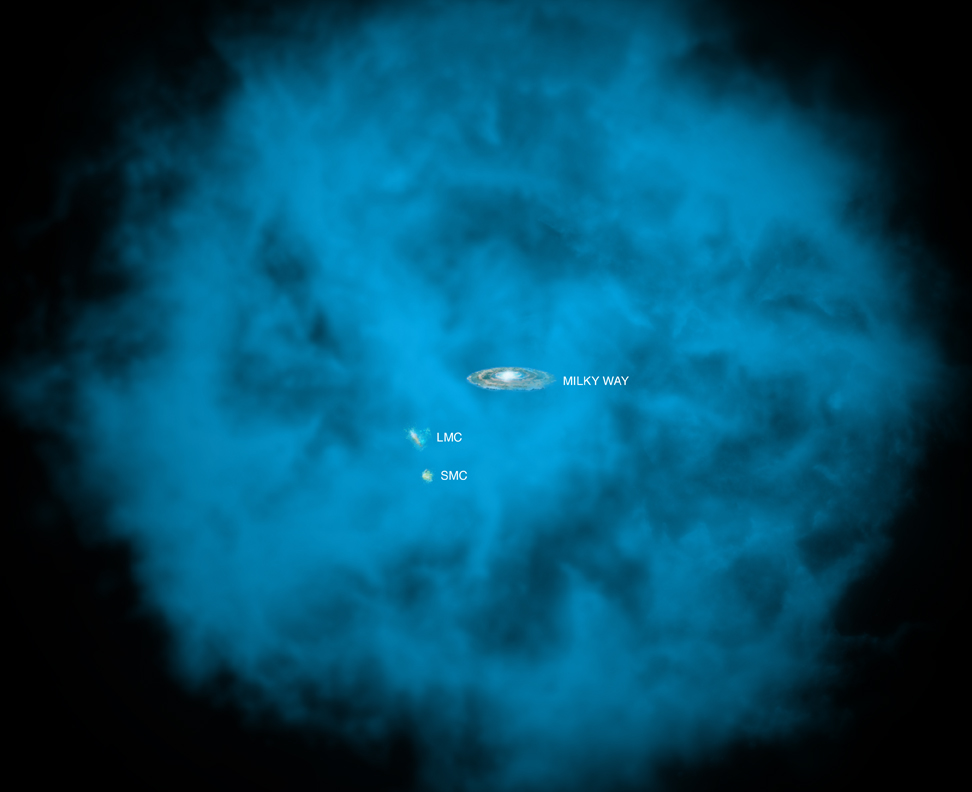
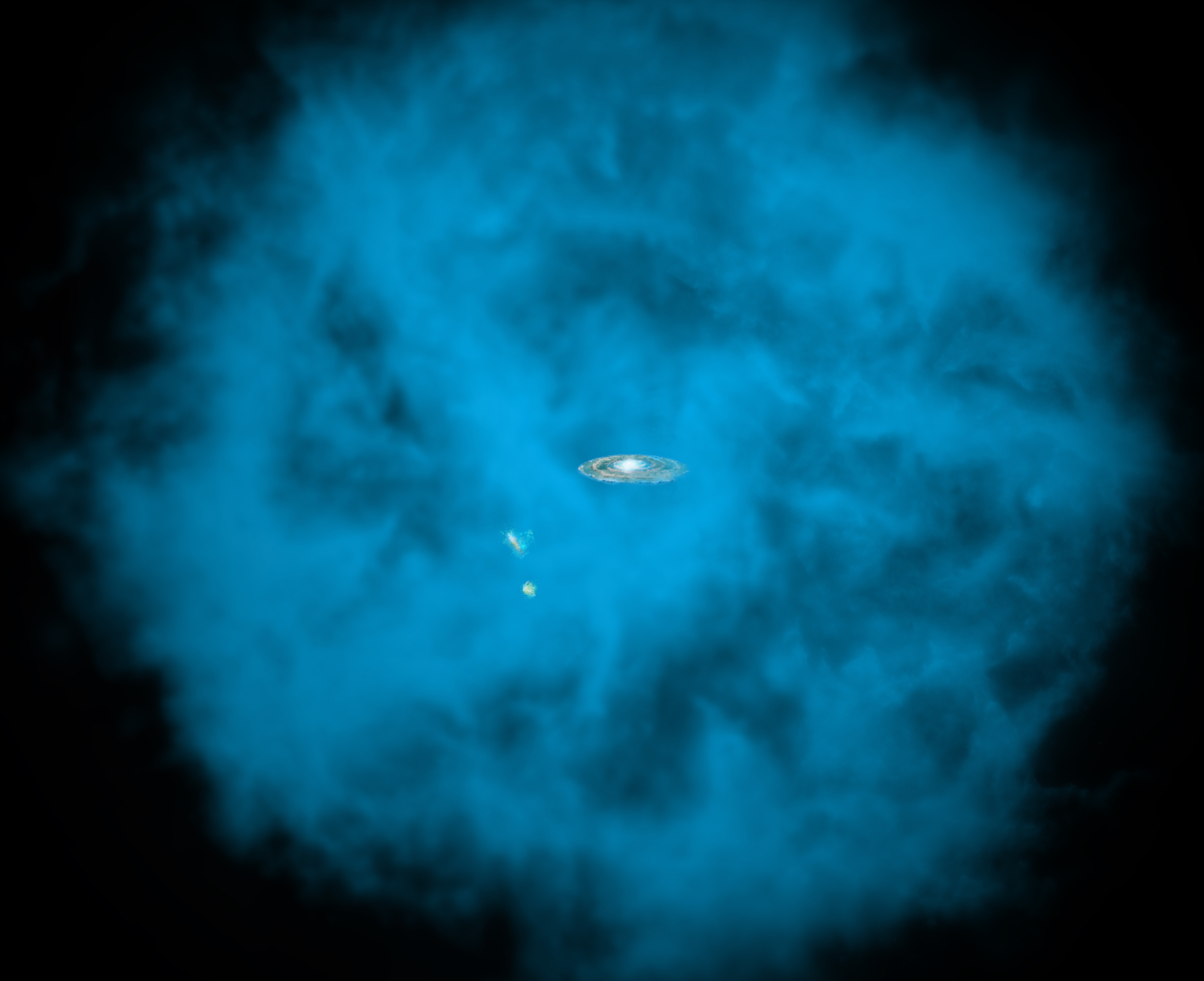
WASHINGTON -- Astronomers have used NASA's Chandra X-ray Observatory to find evidence our Milky Way Galaxy is embedded in an enormous halo of hot gas that extends for hundreds of thousands of light years. The estimated mass of the halo is comparable to the mass of all the stars in the galaxy. 

If the size and mass of this gas halo is confirmed, it also could be an explanation for what is known as the "missing baryon" problem for the galaxy. 

Baryons are particles, such as protons and neutrons, that make up more than 99.9 percent of the mass of atoms found in the cosmos. Measurements of extremely distant gas halos and galaxies indicate the baryonic matter present when the universe was only a few billion years old represented about one-sixth the mass and density of the existing unobservable, or dark, matter. In the current epoch, about 10 billion years later, a census of the baryons present in stars and gas in our galaxy and nearby galaxies shows at least half the baryons are unaccounted for. 

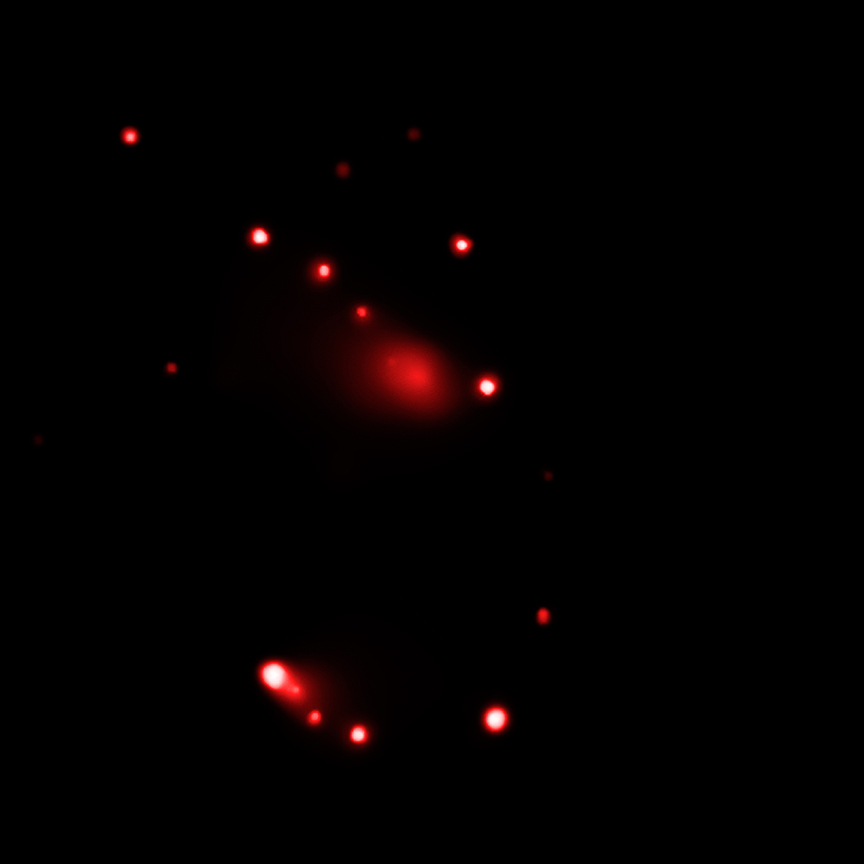
In a recent study, a team of five astronomers used data from Chandra, the European Space Agency's XMM-Newton space observatory and Japan's Suzaku satellite to set limits on the temperature, extent and mass of the hot gas halo. Chandra observed eight bright X-ray sources located far beyond the galaxy at distances of hundreds of millions of light-years. The data revealed X-rays from these distant sources are absorbed selectively by oxygen ions in the vicinity of the galaxy. The scientists determined the temperature of the absorbing halo is between 1 million and 2.5 million kelvins, or a few hundred times hotter than the surface of the sun. 

Other studies have shown that the Milky Way and other galaxies are embedded in warm gas with temperatures between 100,000 and 1 million kelvins. Studies have indicated the presence of a hotter gas with a temperature greater than 1 million kelvins. This new research provides evidence the hot gas halo enveloping the Milky Way is much more massive than the warm gas halo. 

 "We know the gas is around the galaxy, and we know how hot it is," said Anjali Gupta, lead author of The Astrophysical Journal Letters paper describing the research. "The big question is, how large is the halo, and how massive is it?" 

To begin to answer this question, the authors supplemented Chandra data on the amount of absorption produced by the oxygen ions with XMM-Newton and Suzaku data on the X-rays emitted by the gas halo. They concluded that the mass of the gas is equivalent to the mass in more than 10 billion suns, perhaps as large as 60 billion suns. 

"Our work shows that, for reasonable values of parameters and with reasonable assumptions, the Chandra observations imply a huge reservoir of hot gas around the Milky Way," said co-author Smita Mathur of Ohio State University in Columbus. "It may extend for a few hundred thousand light-years around the Milky Way or it may extend farther into the surrounding local group of galaxies. Either way, its mass appears to be very large."

The estimated mass depends on factors such as the amount of oxygen relative to hydrogen, which is the dominant element in the gas. Nevertheless, the estimation represents an important step in solving the case of the missing baryons, a mystery that has puzzled astronomers for more than a decade.

Although there are uncertainties, the work by Gupta and colleagues provides the best evidence yet that the galaxy's missing baryons have been hiding in a halo of million-kelvin gas that envelopes the galaxy. The estimated density of this halo is so low that similar halos around other galaxies would have escaped detection.

The paper describing these results was published in the Sept. 1 issue of The Astrophysical Journal. Other co-authors were Yair Krongold of Universidad Nacional Autonoma de Mexico in Mexico City; Fabrizio Nicastro of Harvard-Smithsonian Center for Astrophysics in Cambridge, Mass.; and Massimiliano Galeazzi of University of Miami in Coral Gables, Fla.

NASA's Marshall Space Flight Center in Huntsville, Ala., manages the Chandra program for NASA's Science Mission Directorate in Washington. The Smithsonian Astrophysical Observatory controls Chandra's science and flight operations from Cambridge.

For Chandra images, multimedia and related materials, visit: http://www.nasa.gov/chandra 

For an additional interactive image, podcast, and video on the finding, visit: http://chandra.si.edu 

Media contacts:
J.D. Harrington
Headquarters, Washington
202-358-5241
j.d.harrington@nasa.gov

Peter Edmonds
Chandra X-ray Center,
Cambridge, Mass.
617-571-7279
pedmonds@cfa.harvard.edu

Fast Facts for Galactic Halo:
Credit Illustration: NASA/CXC/M.Weiss; NASA/CXC/Ohio State/A Gupta et al
Release Date September 24, 2012
Category Normal Galaxies & Starburst Galaxies
Coordinates (J2000) 8 different targets were used
Observation Date 
38 pointings between 06 Dec 2000 and 07 April 2012
Observation Time 
764 hours 53 min. (31 days, 19 hours, 53 min)
Obs. ID 
2090-2094, 2335, 3168, 3567, 3669, 4148-4149, 4399, 4416, 4441-4442, 4901, 4910, 5151, 5318, 5331-5332, 6091, 6151, 6874, 8379, 8388, 9151, 9713, 9898-9899, 10575, 10662, 11387-11388, 11965-11966, 13097, 14266
Instrument ACIS/HETG, ACIS/LETG, HRC-S/LETG
References 
Gupta, A et al, 2012, ApJ, 756:L8; arXiv:1205.5037

Tuesday, September 11, 2012

Kepler's Supernova Remnant: Was Kepler's Supernova Unusually Powerful?

Kepler's Supernova Remnant
Credit X-ray: NASA/CXC/SAO/D.Patnaude, Optical: DSS

JPEG (434.9 kb) - Large JPEG (3 MB) - Tiff (8.9 MB)
More Images


Tour of Kepler's Supernova Remnant
More Animations

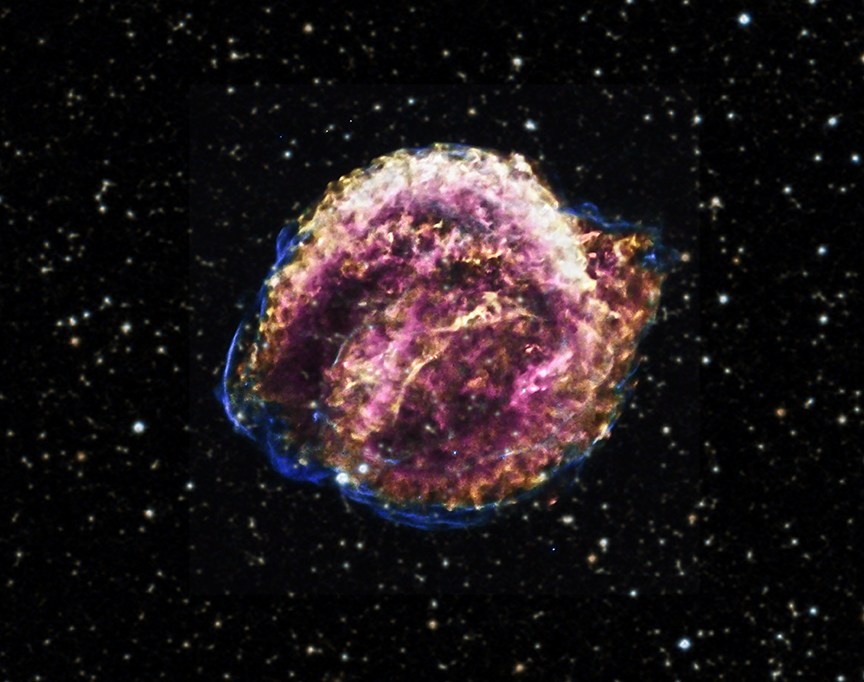
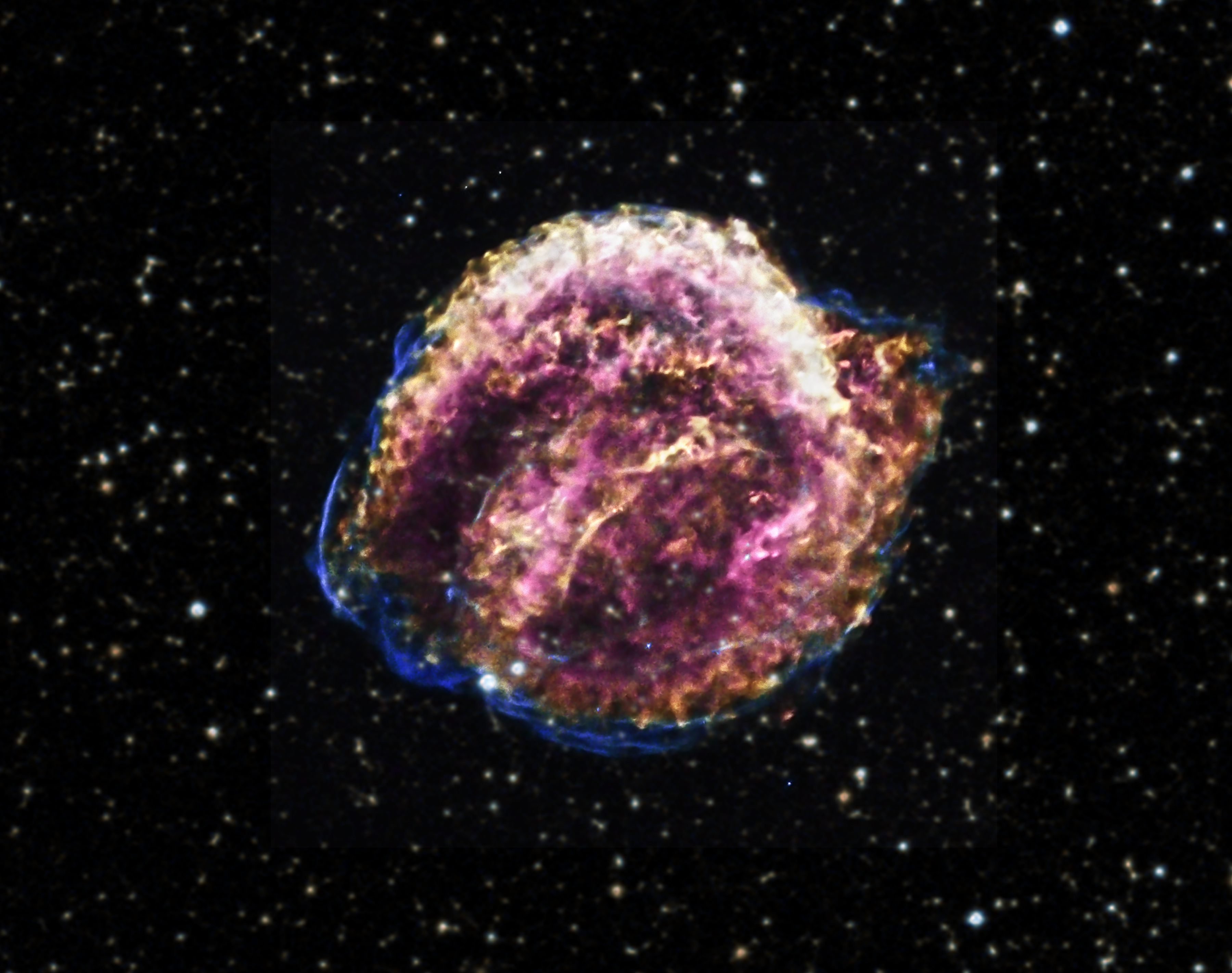
In 1604, a new star appeared in the night sky that was much brighter than Jupiter and dimmed over several weeks. This event was witnessed by sky watchers including the famous astronomer Johannes Kepler. Centuries later, the debris from this exploded star is known as the Kepler supernova remnant.

Astronomers have long studied the Kepler supernova remnant and tried to determine exactly what happened when the star exploded to create it. New analysis of a long observation from NASA's Chandra X-ray Observatory is providing more clues. This analysis suggests that the supernova explosion was not only more powerful, but might have also occurred at a greater distance, than previously thought.

This image shows the Chandra data derived from more than 8 days worth of observing time. The X-rays are shown in five colors from lower to higher energies: red, yellow, green, blue, and purple. These various X-ray slices were then combined with an optical image from the Digitized Sky Survey (light yellow and blue), showing stars in the field.

Previous analysis of this Chandra image has determined that the stellar explosion that created Kepler was what astronomers call a "Type Ia" supernova. This class of supernovas occurs when a white dwarf gains mass, either by pulling gas off a companion star or merging with another white dwarf, until it becomes unstable and is destroyed by a thermonuclear explosion.

Illustration: NASA/CXC/M.Weiss

Unlike other well-known Type Ia supernovas and their remnants, Kepler's debris field is being strongly shaped by what it is running into. More specifically, most Type Ia supernova remnants are very symmetrical, but the Kepler remnant is asymmetrical with a bright arc of X-ray emission in its northern region. This indicates the expanding ball of debris from the supernova explosion is plowing into the gas and dust around the now-dead star.

The bright X-ray arc can be explained in two ways. In one model, the pre-supernova star and its companion were moving through the interstellar gas and losing mass at a significant rate via a wind, creating a bow shock wave similar to that of a boat moving through water. Another possibility is that the X-ray arc is caused by debris from the supernova expanding into an interstellar cloud of gradually increasing density.

The wind and bow shock model described above requires that the Kepler supernova remnant is located at a distance of more than 23,000 light years. In the latter alternative, the gas into which the remnant is expanding has higher density than average, and the distance of the remnant from the earth is between about 16,000 and 20,000 light years. Both alternatives give greater distances than the commonly used value of 13,000 light years.

In either model, the X-ray spectrum - that is, the amount of X-rays produced at different energies – reveals the presence of a large amount of iron, and indicates an explosion more energetic than the average Type Ia supernova. Additionally, to explain the observed X-ray spectrum in this model, a small cavity must have been cleared out around the star before it exploded. Such a cavity, which would have a diameter less than a tenth that of the remnant's current size, might have been produced by a fast, dense outflow from the surface of the white dwarf before it exploded, as predicted by some models of Type Ia supernovas.

Additionally, to explain the observed X-ray spectrum in this model, a small cavity must have been cleared out around the star before it exploded. Such a cavity, which would have a diameter less than a tenth that of the remnant, might have been produced by a fast, dense outflow from the surface of the white dwarf before it exploded, as predicted by some models of Type Ia supernovas.

Evidence for an unusually powerful Type Ia supernova has previously been observed in another remnant with Chandra and an optical telescope. These results were independently verified by subsequent observations of light from the original supernova explosion that bounced off gas clouds, a phenomenon called light echoes. This other remnant is located in the Large Magellanic Cloud, a small galaxy about 160,000 light years from Earth, making it much farther away than Kepler and therefore more difficult to study.

These results were published in the September 1st, 2012 edition of The Astrophysical Journal. The authors of this study are Daniel Patnaude from the Smithsonian Astrophysical Observatory in Cambridge, MA; Carles Badenes from University of Pittsburgh in Pittsburgh, PA; Sangwook Park from the University of Texas at Arlington, TX, and Martin Laming from the Naval Research Laboratory in Washington DC.

NASA's Marshall Space Flight Center in Huntsville, Ala., manages the Chandra program for NASA's Science Mission Directorate in Washington. The Smithsonian Astrophysical Observatory controls Chandra's science and flight operations from Cambridge, Mass.

Fast Facts for Kepler's Supernova Remnant:

Scale: Image is about 5 arcmin across (19-33 light years)
Category:
Supernovas & Supernova Remnants
Coordinates: (J2000) RA 17h 30m 40.80s | Dec -21° 29' 11.00"
Constellation:
Ophiuchus
Observation Date: 6 observations between April - August 2006
Observation Time: 208 hours 48 min (8 days 16 hours 48 min)
Obs. ID: 6714-18, 7366
Instrument:
ACIS
Also Known As: SN 1604, G004.5+06.8, V 843 Ophiuchi
References: Patnaude, D. et al, 2012, ApJ, 756, 6;
arXiv:1206.6799
Color Code: X-ray: (Red=0.7-0.9 keV, Orange=1.6-2.1 keV, Green=2.7-3.4 keV, Blue=4-6 keV, Magenta=6-6.8 keV); Optical: light yellow, blue