Showing posts with label NGC 6397. Show all posts

Monday, June 08, 2026

STScI Scientists Surprised to Find Brightness ‘Gap’ in Ancient Star Cluster

This Euclid image of globular cluster NGC 6397 is speckled with hundreds of thousands of stars, which vary in size and color. Most stars are located at the cluster’s center, where they are bound together by gravity. Scientists studying NGC 6397 found that when they grouped the cluster’s stars by brightness and color they observed a thin brightness “gap” of expected but missing low-mass stars called red dwarfs. This gap is thought to be linked to changes occurring within some stars’ interiors. This is the first time the gap feature was discovered in a globular cluster.Credits Image: ESA, NASA, Euclid Consortium - Image Processing: Jean-Charles Cuillandre (CEA-Saclay), Giovanni Anselmi (ESA)

This graph shows the brightness gap that scientists found using Euclid when they grouped the globular cluster NGC 6397’s stars by brightness and color. What they observed was a thin “gap” of expected but missing low-mass stars called red dwarfs. The observations fit well with their model prediction. This gap is thought to be linked to changes occurring within some stars’ interiors, giving astronomers a glimpse at processes happening inside stars even from thousands of light-years away. This is the first time the gap feature was discovered in a globular cluster. Credits Illustration: Massimo Griggio (STScI), Leah Hustak (STScI)


Scientists from the Space Telescope Science Institute (STScI) in Baltimore, Maryland, sought to study one stellar subject and ended up finding something even more exciting.

Using data from the European Space Agency’s (ESA’s) Euclid space telescope and NASA’s Hubble Space Telescope, the team planned to analyze the motions of stars within an ancient collection of stars called a globular cluster. But what they found when they grouped the cluster’s stars by brightness and color as observed by Euclid was a thin “gap” of expected but missing low-mass stars called red dwarfs. This gap is thought to be linked to changes occurring within some stars’ interiors, giving astronomers a glimpse at processes happening inside stars even from thousands of light-years away.

This is the first time the gap feature was discovered in a globular cluster. “The discovery was serendipitous,” said STScI’s Andrea Bellini, one of the research paper’s primary authors. “We were not looking for the gap, but we found it.”

Understanding the Gap

The presence of this gap in relatively nearby stars was discovered in 2018 by scientists analyzing data from ESA’s Gaia observatory. That team plotted nearly 250,000 stars from the Gaia archive on a Hertzsprung-Russell (HR) diagram, one of the most important tools in stellar studies. This is the graph that astronomers use to classify stars and trace their life cycles.

On the HR diagram, stellar luminosities are plotted against their colors, which serve as a proxy for their temperatures. The positions of stars on the diagram reveal specific stellar evolutionary stages. Perhaps the most distinctive feature is the swath of main-sequence stars that cuts diagonally across the diagram.

As the precision and sensitivity of modern astronomy improves, astronomers can place stars more accurately on the plot. The Gaia data revealed a previously unknown feature — a narrow, diagonal slice of mostly missing stars through the main sequence in the middle of the red dwarf region.

So what causes this gap? It appears that in some red dwarf stars, fuel built up in their centers can trigger an energy burst that results in structural instability in a star’s interior. Between 0.34 and 0.36 times the mass of the Sun, red dwarfs undergo small variations that change their size, brightness, and temperature. Because only a small number of stars are undergoing these changes, there is a dearth of red dwarfs with these specific brightnesses. This is reflected in the HR diagram as a gap.

Enabling More Accurate Distance Estimates

In the Gaia case, stars were at a multitude of different distances and had varying ages, histories, and chemical compositions. In contrast, stars within a globular cluster share a common history, having formed in the same environment at roughly the same point in cosmic time.

“Globular clusters are the ideal laboratories to study stellar evolution and stellar populations,” said STScI’s Massimo Griggio, the principal author on the research paper. “In this globular cluster, the stars are basically at the same distance and have approximately the same age.”

The STScI team used Euclid to study NGC 6397, one of the closest globular clusters to Earth. Located approximately 8,000 light-years away in the southern constellation Ara, it contains hundreds of thousands of stars and is estimated to be 13.4 billion years old.

“Because we can determine the brightness where the gap is with very high precision and know for what stellar masses it occurs, we can use this information to estimate the cluster’s distance,” said STScI’s Russell Ryan, another of the primary researchers.

Gaia found the gap while viewing stars in the local neighborhood, which are typically younger than stars in globular clusters. Now, the Euclid team found the exact same process happening in more distant stellar interiors.

Hubble Tools Pave the Way for New Discoveries

This finding would not have been possible without the software and techniques originally developed at STScI for NASA’s Hubble Space Telescope over more than two decades. The team used these tools, which were pioneered primarily by STScI’s Jay Anderson, to make the high-precision measurements needed to detect this feature in the extremely crowded environment of a globular cluster. Though Hubble’s field of view is much, much smaller, when these tools were coupled with Euclid’s panoramic view, the gap clearly appeared.

“With these tools, we show that we can push the limits of Euclid, and in the future, the Roman Space Telescope, across a wide field of view,” said team member Mattia Libralato, formerly of STScI and currently with the Italian National Institute for Astrophysics (INAF) in Padova, Italy.  “Further investigations with Euclid and, in the future, Roman, will hopefully allow us to better characterize this feature also in other globular clusters.”

The team’s results published today in Astronomy & Astrophysics.

The Space Telescope Science Institute is expanding the frontiers of space astronomy by hosting the science operations center of the Hubble Space Telescope, the science and mission operations centers for the James Webb Space Telescope, and the science operations center for the Nancy Grace Roman Space Telescope. STScI also houses the Barbara A. Mikulski Archive for Space Telescopes (MAST) which is a NASA-funded project to support and provide to the astronomical community a variety of astronomical data archives, and is the data repository for the Hubble, Webb, Roman, Kepler, K2, TESS missions and more. STScI is operated by the Association of Universities for Research in Astronomy in Washington, D.C.


About This Release

Credits:

Media Contacts:

Ann Jenkins
Space Telescope Science Institute, Baltimore

Christine Pulliam
Space Telescope Science Institute, Baltimore

Permissions:
Content Use Policy

Related Links and Documents

Euclid: Early Release Observations – Internal kinematics and the convective-transition gap of NGC 6397


Monday, June 06, 2022

Two Stellar Evolution Roads Diverged at a Certain Mass…


A Hubble image of the globular cluster NGC 6397, which hosts numerous white dwarfs. The white dwarfs are incredibly faint and can be seen in a zoomed-in version of the right quadrant of the image. Credit: NASA, ESA, and H. Richer (University of British Columbia)

Just by knowing the mass of a star, can we predict if it will end its life in fire (a supernova) or ice (a white dwarf that eventually fades into a cool black dwarf)? A team led by astronomers at the University of British Columbia tries to answer that question by observing white dwarfs in order to find exactly where that dividing line is between a death of fire and ice.


Hubble Space Telescope image of the Crab Nebula, the remnant of a supernova that took place in the year 1054 AD. Credit: NASA, ESA, J. Hester and A. Loll

…But Which Road Leads to a White Dwarf?

When a star runs out of fuel, it can either eject its outer layers in an explosion so violent that it outputs more energy than the Sun will in its 10 billion years of life, or the star may simply expand and settle down into a stable star called a white dwarf about the size of our moon. What determines which route the star takes is its mass: lower masses die a death of ice, higher masses of fire. Though we believe the dividing line is somewhere around 8 solar masses, this number doesn’t always agree with what we observe.

T

he color–magnitude diagram of the Milky Way globular cluster 47 Tucanae. The x-axis shows the color, the left y-axis shows the apparent magnitude at 47 Tucanae’s distance, and the right y-axis shifts the cluster to the distance of the Large Magellanic Cloud. This diagram shows that even at the distance of the Large Magellanic Cloud, these massive WDs are detectable. Credit: Richer et al. 2022

In Two Words I Can Sum Up Everything I’ve Learned About Stars: They Evolve

If all stars greater than 8 solar masses end their lives in the fire of a supernova, we would see a lot more supernova explosions (specifically, Type II supernovae) than we actually do. This dearth of Type II supernovae could indicate that the maximum mass of a star that can end its life as a white dwarf is actually closer to 12 solar masses rather than 8. Constraining this mass limit of stars that can become white dwarfs could inform the formation rate of compact objects as well as the metal content of galaxies. The more massive a star is, the more massive its white dwarf remnant is. Therefore, by hunting for massive white dwarfs, we can effectively hunt for massive progenitor stars that weren’t heavy enough to end in a supernova. A team led by Harvey Richer at the University of British Columbia has looked deep into young open star clusters outside our own galaxy to try to identify massive white dwarfs.

Previous searches for massive white dwarfs in young Milky Way open clusters only found white dwarfs up to 1.1 solar masses, which come from stars no larger than 6.2 solar masses. To probe whether even more massive stars can become white dwarfs, Richer and coauthors searched young clusters in the Large Magellanic Clouds. The team looked at four Magellanic Cloud clusters in which stars of 5.7 to 10.2 solar masses were just about to enter the asymptotic giant phase (a late evolutionary stage in an intermediate–mass star’s life at which point the star has exhausted its main fuel source), which would mean the white dwarfs in these clusters must have come from stars more massive than that. They also chose these specific clusters because of their distance; the Magellanic Clouds are far enough away that there would be new clusters to search, but not so distant that Gaia parallaxes are unreliable and there is confusion with field white dwarfs.


Distributions of the various populations of stars in two of the clusters. The white dwarfs in the leftmost panel are the five potential white dwarf candidates. Credit: Richer et al. 2022

The Universe Is Lovely, Dark, and Deep, But We Need More Data To Put This Mystery To Sleep

The team found five potential candidates in the oldest of the four clusters they studied by looking at the ages and populations of the clusters. These stars represent the first extragalactic single white dwarfs ever discovered. This study demonstrated that it is possible to detect white dwarfs in nearby galaxies with only moderate exposure times with Hubble. However, to study them spectroscopically and determine their masses and ages, the team needs more resolution, which will come with future 30+ meter telescopes. Confirmation of these heavy white dwarfs may finally lead us to the point where the roads of stellar evolution diverged.

Citation

“When Do Stars Go Boom?” Harvey B. Richer et al 2022 ApJL 931 L20. doi:10.3847/2041-8213/ac6585

By Haley Wahl


Sunday, February 14, 2021

Hubble Uncovers Concentration of Small Black Holes

The amount of mass a black hole can pack away varies widely from less than twice the mass of our Sun to over a billion times our Sun's mass. Midway between are intermediate-mass black holes weighing roughly hundreds to tens of thousands of solar masses. So, black holes come small, medium, and large.   Image Credit: NASA, ESA, T. Brown, S. Casertano, and J. Anderson (STScI).  Science Credit: NASA, ESA, and E. Vitral and G. Mamon (Institut d'Astrophysique de Paris (IAP)).  Hi-res image

Astronomers found something they weren't expecting at the heart of the globular cluster NGC 6397: a concentration of smaller black holes lurking there instead of one massive black hole.

Globular clusters are extremely dense stellar systems, which host stars that are closely packed together. These systems are also typically very old — the globular cluster at the focus of this study, NGC 6397, is almost as old as the universe itself. This cluster resides 7,800 light-years away, making it one of the closest globular clusters to Earth. Due to its very dense nucleus, it is known as a core-collapsed cluster.

At first, astronomers thought the globular cluster hosted an intermediate-mass black hole. These are the long-sought "missing link" between supermassive black holes (many millions of times our Sun's mass) that lie at the cores of galaxies, and stellar-mass black holes (a few times our Sun's mass) that form following the collapse of a single massive star. Their mere existence is hotly debated. Only a few candidates have been identified to date.

"We found very strong evidence for an invisible mass in the dense core of the globular cluster, but we were surprised to find that this extra mass is not 'point-like' (that would be expected for a solitary massive black hole) but extended to a few percent of the size of the cluster," said Eduardo Vitral of the Paris Institute of Astrophysics (IAP) in Paris, France.

To detect the elusive hidden mass, Vitral and Gary Mamon, also of IAP, used the velocities of stars in the cluster to determine the distribution of its total mass, that is the mass in the visible stars, as well as in faint stars and black holes. The more mass at some location, the faster the stars travel around it.

The researchers used previous estimates of the stars' tiny proper motions (their apparent motions on the sky), which allow for determining their true velocities within the cluster. These precise measurements for stars in the cluster's core could only be made with Hubble over several years of observation. The Hubble data were added to well-calibrated proper motion measurements provided by the European Space Agency's Gaia space observatory which are less precise than Hubble's observations in the core.

"Our analysis indicated that the orbits of the stars are close to random throughout the globular cluster, rather than systematically circular or very elongated," explained Mamon. These moderate-elongation orbital shapes constrain what the inner mass must be.


Astronomers on the hunt for an intermediate-mass black hole at the heart of the globular cluster NGC 6397 found something they weren’t expecting: a concentration of smaller black holes lurking there instead of one massive black hole.
 
The researchers conclude that the invisible component can only be made of the remnants of massive stars (white dwarfs, neutron stars, and black holes) given its mass, extent, and location. These stellar corpses progressively sank to the cluster's center after gravitational interactions with nearby less massive stars. This game of stellar pinball is called "dynamical friction," where, through an exchange of momentum, heavier stars are segregated in the cluster's core and lower-mass stars migrate to the cluster's periphery.

"We used the theory of stellar evolution to conclude that most of the extra mass we found was in the form of black holes," said Mamon. Two other recent studies had also proposed that stellar remnants, in particular, stellar-mass black holes, could populate the inner regions of globular clusters. "Ours is the first study to provide both the mass and the extent of what appears to be a collection of mostly black holes in the center of a core-collapsed globular cluster," added Vitral.

The astronomers also note that this discovery raises the possibility that mergers of these tightly packed black holes in globular clusters may be an important source of gravitational waves, ripples through spacetime. Such phenomena could be detected by the Laser Interferometer Gravitational-Wave Observatory experiment, which is funded by the National Science Foundation and operated by Caltech in Pasadena, California and MIT in Cambridge, Massachusetts.

The Hubble Space Telescope is a project of international cooperation between NASA and ESA (European Space Agency). NASA's Goddard Space Flight Center in Greenbelt, Maryland, manages the telescope. The Space Telescope Science Institute (STScI) in Baltimore, Maryland, conducts Hubble science operations. STScI is operated for NASA by the Association of Universities for Research in Astronomy in Washington, D.C.


Media Contacts:

Claire Andreoli
NASA's Goddard Space Flight Center, Greenbelt, Md.
301-286-1940

claire.andreoli@nasa.gov

Ray Villard
Space Telescope Science Institute, Baltimore, Maryland
410-338-4514

villard@stsci.edu

Bethany Downer
ESA/Hubble Space Telescope

bethany.downer@esahubble.org

Science Contacts:

Eduardo Vitral
Institut d'Astrophysique de Paris (IAP), Paris, France

vitral@iap.fr

Dr. Gary A. Mamon
Institut d'Astrophysique de Paris (IAP), Paris, France

gam@iap.fr

Editor: Lynn Jenner


Thursday, April 05, 2018

Hubble Makes the First Precise Distance Measurement to an Ancient Globular Star Cluster Hubble’s View of Dazzling Globular Star Cluster NGC 6397

Hubble’s View of Dazzling Globular Star Cluster NGC 6397
Credit: NASA, ESA, and T. Brown and S. Casertano (STScI)
Acknowledgement: NASA, ESA, and J. Anderson (STScI)


Astronomers using NASA’s Hubble Space Telescope have for the first time precisely measured the distance to one of the oldest objects in the universe, a collection of stars born shortly after the big bang.

This new, refined distance yardstick provides an independent estimate for the age of the universe. The new measurement also will help astronomers improve models of stellar evolution. Star clusters are the key ingredient in stellar models because the stars in each grouping are at the same distance, have the same age, and have the same chemical composition. They therefore constitute a single stellar population to study.

This stellar assembly, a globular star cluster called NGC 6397, is one of the closest such clusters to Earth. The new measurement sets the cluster’s distance at 7,800 light-years away, with just a 3 percent margin of error.

Until now, astronomers have estimated the distances to our galaxy’s globular clusters by comparing the luminosities and colors of stars to theoretical models, and to the luminosities and colors of similar stars in the solar neighborhood. But the accuracy of these estimates varies, with uncertainties hovering between 10 percent and 20 percent.

However, the new measurement uses straightforward trigonometry, the same method used by surveyors, and as old as ancient Greek science. Using a novel observational technique to measure extraordinarily tiny angles on the sky, astronomers managed to stretch Hubble’s yardstick outside of the disk of our Milky Way galaxy.

The research team calculated NGC 6397’s age at 13.4 billion years old. “The globular clusters are so old that if their ages and distances deduced from models are off by a little bit, they seem to be older than the age of the universe,” said Tom Brown of the Space Telescope Science Institute (STScI) in Baltimore, Maryland, leader of the Hubble study.

Accurate distances to globular clusters are used as references in stellar models to study the characteristics of young and old stellar populations. “Any model that agrees with the measurements gives you more faith in applying that model to more distant stars,” Brown said. “The nearby star clusters serve as anchors for the stellar models. Until now, we only had accurate distances to the much younger open clusters inside our galaxy because they are closer to Earth.”

By contrast, about 150 globular clusters orbit outside of our galaxy’s comparatively younger starry disk. These spherical, densely packed swarms of hundreds of thousands of stars are the first homesteaders of the Milky Way.

The Hubble astronomers used trigonometric parallax to nail down the cluster’s distance. This technique measures the tiny, apparent shift of an object’s position due to a change in an observer’s point of view. Hubble measured the apparent tiny wobble of the cluster stars due to Earth’s motion around the Sun.

To obtain the precise distance to NGC 6397, Brown’s team employed a clever method developed by astronomers Adam Riess, a Nobel laureate, and Stefano Casertano of the STScI and Johns Hopkins University, also in Baltimore, to accurately measure distances to pulsating stars called Cepheid variables. These pulsating stars serve as reliable distance markers for astronomers to calculate an accurate expansion rate of the universe.

With this technique, called “spatial scanning,” Hubble’s Wide Field Camera 3 gauged the parallax of 40 NGC 6397 cluster stars, making measurements every 6 months for 2 years. The researchers then combined the results to obtain the precise distance measurement. “Because we are looking at a bunch of stars, we can get a better measurement than simply looking at individual Cepheid variable stars,” team member Casertano said.

The tiny wobbles of these cluster stars were only 1/100th of a pixel on the telescope’s camera, measured to a precision of 1/3000th of a pixel. This is the equivalent to measuring the size of an automobile tire on the moon to a precision of one inch.

The researchers say they could reach an accuracy of 1 percent if they combine the Hubble distance measurement of NGC 6397 with the upcoming results obtained from the European Space Agency’s Gaia space observatory, which is measuring the positions and distances of stars with unprecedented precision. The data release for the second batch of stars in the survey is in late April. “Getting to 1 percent accuracy will nail this distance measurement forever,” Brown said.

The team’s results appeared in the March 20, 2018, issue of The Astrophysical Journal Letters.
The research team consists of T. Brown, S. Casertano, and D. Soderblom (STScI); J. Strader (MSU); A. Riess and J. Kalirai (STScI, JHU); D. VandenBerg (UVic); and R. Salinas (Gemini).

The Hubble Space Telescope is a project of international cooperation between NASA and ESA (European Space Agency). NASA's Goddard Space Flight Center in Greenbelt, Maryland, manages the telescope. The Space Telescope Science Institute (STScI) in Baltimore, Maryland, conducts Hubble science operations. STScI is operated for NASA by the Association of Universities for Research in Astronomy, in Washington, D.C.


Related Links

This site is not responsible for content found on external links


Contact

Donna Weaver / Ray Villard
Space Telescope Science Institute, Baltimore, Maryland
410-338-4493 / 410-338-4514

dweaver@stsci.edu / villard@stsci.edu

Tom Brown
Space Telescope Science Institute, Baltimore, Maryland
410-338-4902

tbrown@stsci.edu

Source: HubbleSite/News

Thursday, March 07, 2013

47 Tucanae: Probing Extreme Matter Through Observations of Neutron Stars

Neutron stars, the ultra-dense cores left behind after massive stars collapse, contain the densest matter known in the Universe outside of a black hole. New results from Chandra and other X-ray telescopes have provided one of the most reliable determinations yet of the relation between the radius of a neutron star and its mass. These results constrain how nuclear matter - protons and neutrons, and their constituent quarks - interact under the extreme conditions found in neutron stars.

Three telescopes - Chandra, ESA's XMM-Newton, and NASA's Rossi X-ray Timing Explorer (RXTE) - were used to observe 8 neutron stars, including one in 47 Tucanae, a globular cluster located about 15,000 light years away in the outskirts of the Milky Way. The image shown here was constructed from a long Chandra observation of 47 Tucanae. Lower-energy X-rays are red, X-rays with intermediate energies are green, and the highest-energy X-rays are shown in blue.

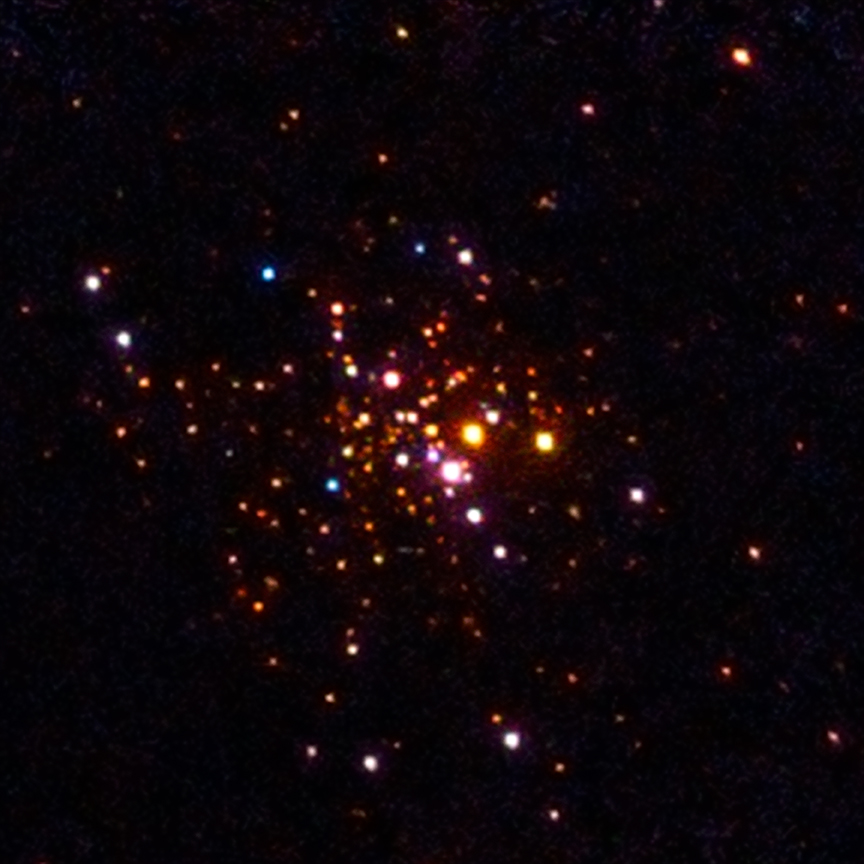
In the image, the double, or binary, star system labeled as X7 contains a neutron star slowly pulling gas away from a companion star with a mass much lower than the Sun. In 2006, researchers used observations of the amount of X-rays from X7 at different energies together with theoretical models to determine a relationship between the mass and the radius of the neutron star. A similar procedure was used for Chandra observations of a neutron star in another globular cluster, NGC 6397, and for two other neutron stars in clusters observed by ESA's XMM-Newton.

Credit NASA/CXC/Michigan State/A.Steiner et al
JPEG (345.4 kb)   -  Large JPEG (6.9 MB)  -   Tiff (18.4 MB)
View on the Sky (WWT)

Four other neutron stars were observed with RXTE to undergo bursts of X-rays that cause the atmosphere of the neutron star to expand. By following the cooling of the star, its surface area can be calculated. Then, by folding in independent estimates of the distance to the neutron star, scientists were able to gather more information on the relationships between the masses and radii of these neutron stars.

Because the mass and radius of a neutron star is directly related to interactions between the particles in the interior of the star, the latest results give scientists new information about the inner workings of neutron stars.

The researchers used a wide range of different models for the structure of these collapsed objects and determined that the radius of a neutron star with a mass that is 1.4 times the mass of the Sun is between 10.4 and 12.9 km (6.5 to 8.0 miles). They also estimated the density at the center of a neutron star was about 8 times that of nuclear matter found in Earth-like conditions. This translates into a pressure that is over ten trillion trillion times the pressure required for diamonds to form inside the Earth.

Neutron stars, the ultra-dense cores left behind after massive stars collapse, contain the densest matter known in the Universe outside of a black hole. New results from Chandra and other X-ray telescopes have provided one of the most reliable determinations yet of the relation between the radius of a neutron star and its mass. These results constrain how nuclear matter - protons and neutrons, and their constituent quarks - interact under the extreme conditions found in neutron stars.

Three telescopes - Chandra, ESA's XMM-Newton, and NASA's Rossi X-ray Timing Explorer (RXTE) - were used to observe 8 neutron stars, including one in 47 Tucanae, a globular cluster located about 15,000 light years away in the outskirts of the Milky Way. The image shown here was constructed from a long Chandra observation of 47 Tucanae. Lower-energy X-rays are red, X-rays with intermediate energies are green, and the highest-energy X-rays are shown in blue.

In the image, the double, or binary, star system labeled as X7 contains a neutron star slowly pulling gas away from a companion star with a mass much lower than the Sun. In 2006, researchers used observations of the amount of X-rays from X7 at different energies together with theoretical models to determine a relationship between the mass and the radius of the neutron star. A similar procedure was used for Chandra observations of a neutron star in another globular cluster, NGC 6397, and for two other neutron stars in clusters observed by ESA's XMM-Newton.

The results apply whether the entire set of bursting sources, or the most extreme of the other sources, are removed from the sample. Previous studies have used smaller samples of neutron stars or have not accounted for as many uncertainties in using the models.

The new values for the neutron star's structure should hold true even if matter composed of free quarks exists in the core of the star. Quarks are fundamental particles that combine to form protons and neutrons and are not usually found in isolation. It has been postulated that free quarks may exist inside the centers of neutron stars, but no firm evidence for this has ever been found. 

The researchers also made an estimate of the distances between neutrons and protons in atomic nuclei here on earth. A larger neutron star radius naturally implies that, on average, neutrons and protons in a heavy nucleus are farther apart. Their estimate is being compared with values from terrestrial experiments.

The neutron star observations also provided new information about the so-called "symmetry energy" for nuclear matter, which is the energy cost required to create a system with a different number of protons than neutrons. The symmetry energy is important for neutron stars because they contain almost ten times as many neutrons as protons. It is also important for heavy atoms on Earth, like Uranium, because they often have more neutrons than protons. The results show that the symmetry energy does not change much with density.

These results will be published in a paper in the March 1st, 2013 issue of The Astrophysical Journal Letters. The authors are Andrew Steiner, from the Institute for Nuclear Theory at the University of Washington, James Lattimer from Stony Brook University in New York and Edward Brown from Michigan State University.

NASA's Marshall Space Flight Center in Huntsville, Ala., manages the Chandra program for NASA's Science Mission Directorate in Washington. The Smithsonian Astrophysical Observatory controls Chandra's science and flight operations from Cambridge, Mass.


Fast Facts for 47 Tucanae: 

Release Date: March 6, 2013 
Scale: Image is 2.3 arcmin across (about 10 light years) 
Category: Neutron Stars/X-ray Binaries
Coordinates: (J2000) RA 00h 24m 42.0s | Dec -72° 00' 00" 
Constellation: Tucana
Observation Date: 13 pointings between March 16, 2000 and Oct 11, 2002 
Observation Time: 100 (4 days, 4 hours). 
Obs. ID: 78, 953-956, 2735-2738, 3384-3387 
Instrument: ACIS
References: Steiner, A. et al 2013, ApJ 765, L5; arXiv:1205.6871
Color Code: X-ray (Red, Green, Blue)