Showing posts with label Open cluster. Show all posts

Tuesday, April 21, 2026

NASA Finds Young Stars Dim in X-rays Surprisingly Quickly

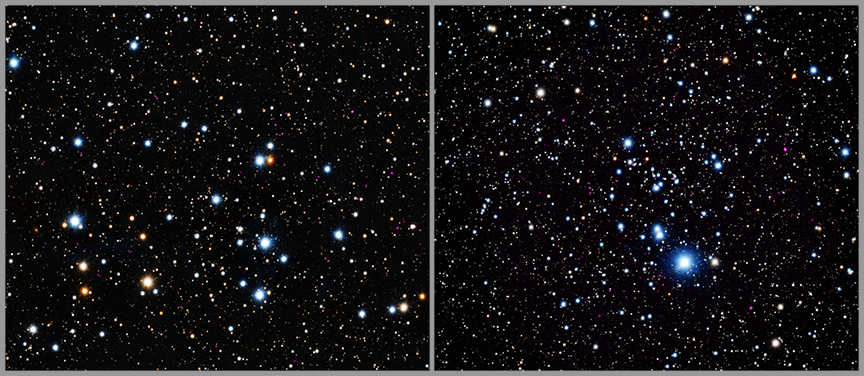
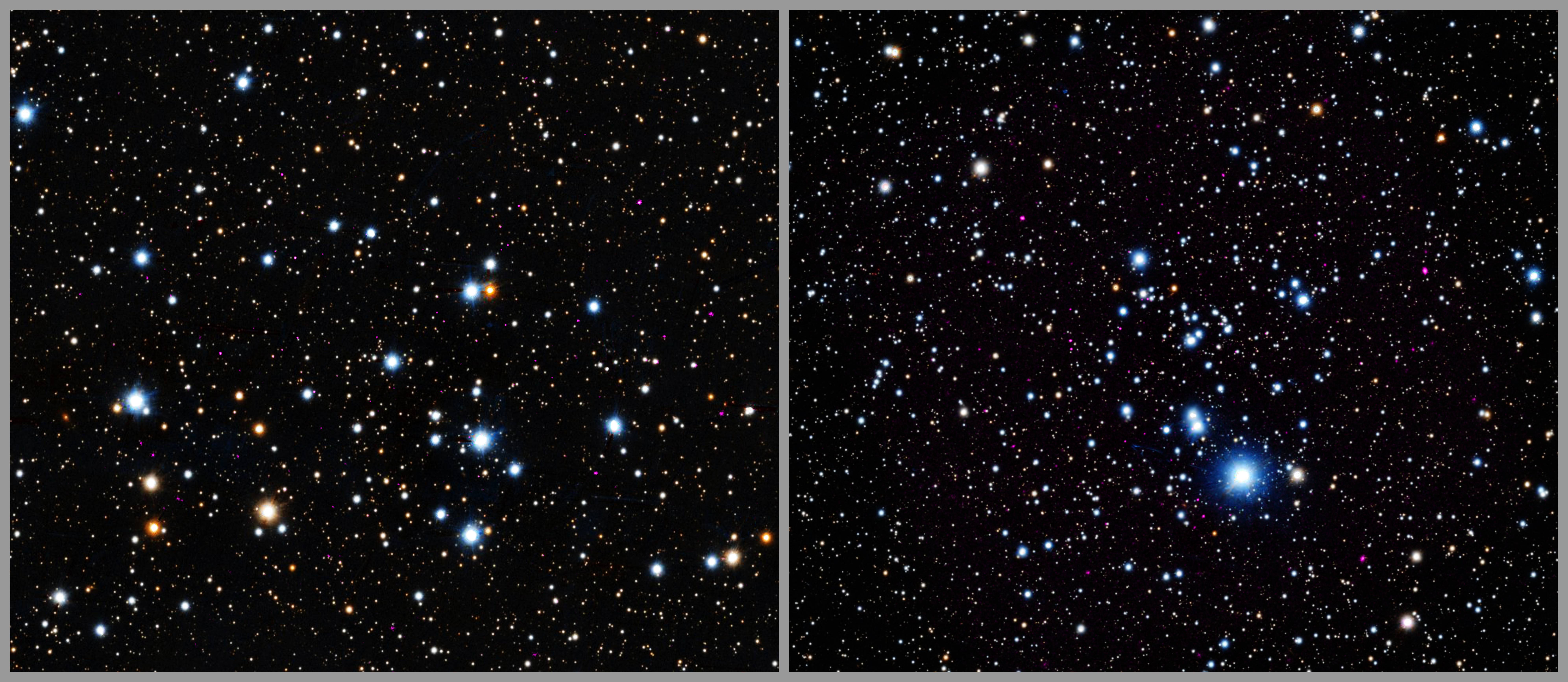
Trumpler 3, NGC 2353, and NGC 2301
Credit: X-ray: NASA/CXC/Penn State Univ/K. Getman; Optical/IR: PanSTARRS;
Image Processing: NASA/CXC/SAO/N. Wolk


JPEG (390.4 kb) - Large JPEG (7 MB) - Tiff (97 MB) - More Images

A Tour of NASA Finds Young Stars Dim in X-rays Surprisingly Quickly - More Videos


  • A new study using NASA’s Chandra X-ray Observatory has young Sun-like stars are dimming more significantly than previously thought.

  • This result has a parallel to the new ‘Project Hail Mary’ book and movie, though there are obvious clear differences.

  • The causes of the dimming in the Chandra study are completely natural, arising from the magnetic fields inside the stars are less efficient.

  • In fact, this quieting of these younger cousins to the Sun likely boosts the prospects of life on any planets orbiting these stars.


These images of star clusters represent a new study from NASA’s Chandra X-ray Observatory that shows how young Sun-like stars are dimmer in X-rays than previously thought. As described in our latest press release, this result has implications for the prospects of life developing and surviving on planets in orbit around these stars.

Trumpler 3 and NGC 2353 are so-called open clusters that contains hundreds of young stars. These stars are tied to each other through gravity, having been formed from the same clouds of gas. Many of these stars have masses that are similar to our Sun, but are much younger. In these new composite images of Trumpler 3 and NGC 2353, X-rays from Chandra (purple) have been combined with an optical image from the PanSTARRS telescope in Hawaii (red, green, and blue). Another star clusters from the new Chandra study, NGC 2301 is shown in the same color schemes with the X-ray and optical data.

In total, the new Chandra study looked at eight clusters of stars between the ages of 45 million and 750 million years old. (By comparison, our Sun has lived for about 4.6 billion years.) The researchers found that Sun-like stars older than about 100 million years in these clusters unleashed only about a quarter to a third of the X-rays that they expected.

This relative calm could be a boon to the formation of life on planets around stars that are younger versions of our own Sun. This is because large amounts of X-rays can erode a planet’s atmosphere and prevent formation of molecules necessary for organic life, as we know it. On average, three-million-year-old stars with a mass equal to the Sun produce about a thousand times more X-rays than today's Sun. Meanwhile, 100-million-year-old solar-mass stars are about 40 times brighter in X-rays than the present Sun.

An artist’s illustration depicts X-rays and other high energy radiation from a young Sun-like star eroding some of the atmosphere of an orbiting planet. Lower levels of X-rays will cause less erosion of planetary atmospheres.

Illustration of a young Sun-like star eroding some of the atmosphere of an orbiting planet.
Credit: NASA/SAO/CXC/M. Weiss

The researchers found that stars with about the same mass as the Sun quieted down relatively rapidly — after a few hundred million years — while ones with less mass kept up their high levels of X-ray emission for longer. Combined with a decrease in the energy of the X-rays and the disappearance of energetic particles, the Sun-sized stars are apparently better suited to host planets with robust atmospheres and possibly blossoming life than previously thought.

The team used data from ESA’s Gaia satellite and X-ray data from the ROSAT mission. This data allowed them to identify the stars that were members of the clusters (not foreground or background stars). To measure the X-ray output from the stars, they made new Chandra observations of five clusters with ages between 45 million and 100 million years and Chandra and ROSAT data from archives to study three older clusters with ages between 220 and 750 million years.

A new paper describing these results has been accepted and appears in The Astrophysical Journal. The authors of the paper are Konstantin Getman (Penn State University), Eric Feigelson (Penn State), Vladimir Airapetian (NASA Goddard Space Flight Center), and Gordon Garmire (Penn State).

NASA's Marshall Space Flight Center in Huntsville, Alabama, manages the Chandra program. The Smithsonian Astrophysical Observatory's Chandra X-ray Center controls science operations from Cambridge, Massachusetts, and flight operations from Burlington, Massachusetts.


Visual Description:

This release features three composite images and one artist's illustration. Each composite image depicts a different star cluster packed with countless glowing specks of light. The close-up artist's illustration depicts the effects of a young Sun-like star's high energy radiation on the atmosphere of an orbiting planet.

The three clusters depicted in today's release are Trumpler 3, NGC 2353, and NGC 2301. In each image, the blackness of space is blanketed in white, blue, orange, purple, and golden yellow dots. Some of the dots are in the foreground, while others are background stars. Many in the middle-ground are clustered Sun-like stars being observed in a new study by Chandra. Some of the stars in the cluster and foreground appear as gleaming dots with glowing halos and occasional diffraction spikes, while the background stars are generally smaller and fainter.

In these composite images, purple represents X-rays from Chandra, while reds, greens and blues are courtesy of optical images from the Pan-STARRS telescope in Hawaii.

Results from the new study reveal that many young Sun-like stars are dimmer in X-rays than previously thought. X-rays and other high energy radiation from a young Sun-like star can erode some of the atmosphere of an orbiting planet. This erosion is highlighted in the artist's illustration. Here, a massive ball of churning fire, the young Sun-like star, occupies our left half of the photorealistic graphic. At its right is an orbiting planet, a relatively small, pale sphere, shedding its atmosphere, depicted as a wake of faint blue mist.

Sun-like stars that emit lower levels of X-rays will cause less atmospheric erosion on orbiting planets. This impacts the prospects of life developing and surviving on planets orbiting these stars.


Fast Facts for Trumpler 3:


Credit: X-ray: NASA/CXC/Penn State Univ/K. Getman; Optical/IR: PanSTARRS; Image Processing: NASA/CXC/SAO/N. Wolk
Release Date: April 14, 2026
Scale: Image is about 20 arcmin (13 light-years) across.
Category: Normal Stars & Star Clusters and Exoplanets
Coordinates (J2000): RA: 3h 12m 00s | Dec: +63° 15' 00"
Constellation: Cassiopeia
Observation Date(s): 12 observations from Dec, 2022 to Apr, 2025
Observation Time: 52 hours and 52 minutes (2 days 4 hours 52 minutes)
Obs. IDs: 27348, 27413, 27414, 27587, 28762, 28829, 28830, 29078, 30791, 30792, 30897, 30898
Instrument: ACIS
References: Getman, K. et al. 2026, ApJ, accepted; arXiv:2512.12055
Color Code: X-ray: purple; Optical/IR: red, green, and blue
Distance Estimate: About 2,200 light-years from Earth


Fast Facts for NGC 2353:


Credit: X-ray: NASA/CXC/Penn State Univ/K. Getman; Optical/IR: PanSTARRS; Image Processing: NASA/CXC/SAO/N. Wolk
Release Date: April 14, 2026
Scale: Image is about 20 arcmin (23 light-years) across.
Category: Normal Stars & Star Clusters and Exoplanets
Coordinates (J2000): RA: 7h 14m 30s | Dec: -10° 16' 00"
Constellation: Monoceros
Observation Date(s): 16 observations from Nov, 2022 to Sep, 2024
Observation Time: 80 hours and 44 minutes (3 days 8 hours 44 minutes)
Obs. IDs: 26500, 27044-27049, 27349, 27415, 27416, 29003, 29030, 29042, 29053, 29091, 29224
Instrument: ACIS
References: Getman, K. et al. 2026, ApJ, accepted; arXiv:2512.12055
Color Code: X-ray: purple; Optical/IR: red, green, and blue
Distance Estimate: About 3,900 light-years from Earth


Thursday, January 16, 2025

NASA's Hubble Tracks Down a 'Blue Lurker' Among Stars

Evolution of "Blue Lurker" Star System (Artist's Concept)
Credits/Artwork: NASA, ESA, Leah Hustak (STScI)


The name "blue lurker" might sound like a villainous character from a superhero movie. But it is a rare class of star that NASA's Hubble Space Telescope explored by looking deeply into the open star cluster M67, roughly 2,800 light-years away.

Forensics with Hubble data show that the star has had a tumultuous life, mixing with two other stars gravitationally bound together in a remarkable triple-star system. The star has a kinship to so-called "blue stragglers," which are hotter, brighter, and bluer than expected because they are likely the result of mergers between stars.

The blue lurker is spinning much faster than expected, an unusual behavior that led to its identification. Otherwise it looks like a normal Sun-like star. The term "blue" is a bit of a misnomer because the star's color blends in with all the other solar-mass stars in the cluster. Hence it is sort of "lurking" among the common stellar population.

The spin rate is evidence that the lurker must have siphoned in material from a companion star, causing its rotation to speed up. The star's high spin rate was discovered with NASA's retired Kepler space telescope. While normal Sun-like stars typically take about 30 days to complete one rotation, the lurker takes only four days.

How the blue lurker got that way is a "super complicated evolutionary story," said Emily Leiner of Illinois Institute of Technology in Chicago. "This star is really exciting because it's an example of a star that has interacted in a triple-star system." The blue lurker originally rotated more slowly and orbited a binary system consisting of two Sun-like stars.

Around 500 million years ago, the two stars in that binary merged, creating a single, much more massive star. This behemoth soon swelled into a giant star, dumping some of its own material onto the blue lurker and spinning it up in the process. Today, we observe that the blue lurker is orbiting a white dwarf star — the burned out remains of the massive merger.

"We know these multiple star systems are fairly common and are going to lead to really interesting outcomes," Leiner explained. "We just don't yet have a model that can reliably connect through all of those stages of evolution. Triple-star systems are about 10 percent of the Sun-like star population. But being able to put together this evolutionary history is challenging."

Hubble observed the white dwarf companion star that the lurker orbits. Using ultraviolet spectroscopy, Hubble found the white dwarf is very hot (as high as 23,000 degrees Fahrenheit, or roughly three times the Sun's surface temperature) and a heavyweight at 0.72 solar masses. According to theory, hot white dwarfs in M67 should be only about 0.5 solar masses. This is evidence that the white dwarf is the byproduct of the merger of two stars that once were part of a triple-star system.

"This is one of the only triple systems where we can tell a story this detailed about how it evolved," said Leiner. "Triples are emerging as potentially very important to creating interesting, explosive end products. It's really unusual to be able to put constraints on such a system as we are exploring."


Leiner's results are being presented at the 245th meeting of the American Astronomical Society in Washington, D.C.

The Hubble Space Telescope has been operating for over three decades and continues to make ground-breaking discoveries that shape our fundamental understanding of the universe. Hubble is a project of international cooperation between NASA and ESA (European Space Agency). NASA's Goddard Space Flight Center in Greenbelt, Maryland, manages the telescope and mission operations. Lockheed Martin Space, based in Denver, also supports mission operations at Goddard. The Space Telescope Science Institute in Baltimore, which is operated by the Association of Universities for Research in Astronomy, conducts Hubble science operations for NASA.


About This Release

Credits:

Media Contact:

Ray Villard
Space Telescope Science Institute, Baltimore, Maryland

Science Contact:

Emily Leiner
Illinois Institute of Technology, Chicago, Illinois

Permissions: Content Use Policy

Contact Us: Direct inquiries to the News Team.

Related Links and Documents


Friday, June 28, 2024

Channelling light from starbursts

An oval-shaped galaxy, made up of many point-like stars. It is softly lit from the centre, brightest and slightly blue at the very centre and fading to darkness at the edges. Surrounding the galaxy’s core are reddish clouds of gas and dust, most around or behind the core, but a few wisps are in front of it and block some light. Some faraway galaxies and two foreground stars can be seen around the galaxyCredit: ESA/Hubble & NASA, A. Zezas, D. Calzetti

The focus of this week’s Hubble Picture of the Week is the blue compact dwarf galaxy NGC 5253, located in the constellation Centaurus around 11 million light-years from Earth. This new image combines data taken with Hubble’s Advanced Camera for Surveys (ACS), using its Wide Field Channel, and with the older Wide Field and Planetary Camera 2 (WFPC2). As a bonus for this Picture of the Week, there is also a second new image made using data from the High Resolution Channel (HRC) of ACS, a sub-instrument only operational for a few years that was optimised for detailed studies of environments dense with stars.

What has interested astronomers so much about this galaxy that three of Hubble’s instruments were used to study it in depth over ten years? It turns out to lie at the focus of a few areas of research where Hubble’s capabilities are essential. Dwarf galaxies are considered important for understanding the evolution of both stars and galaxies through time, since they resemble ancient, distant galaxies. NGC 5253 is called both a 'starburst galaxy' and a 'blue compact dwarf': these names mean it is forming clusters of bright, massive stars at an exceptional rate. This Hubble image clearly shows the dense nebula which is being consumed to birth these stars, and which makes NGC 5253 a laboratory in which to investigate stellar composition, star formation and star clusters, all at once.

A tremendously high rate of star formation is a recipe for star clusters, but NGC 5253 goes beyond that: in a small region of the core, the star formation is so intense that the galaxy contains no fewer than three 'super star clusters' (SSCs). SSCs are very bright, populous and massive open clusters which are believed to evolve into globular clusters. Globular clusters themselves offer unique insights into how stars form and evolve, but their origins are poorly understood. Astronomers were therefore eager to make use of the HRC sub-instrument, with its superb resolution, to home in on these small, very dense clusters of stars.

Links


Thursday, December 28, 2023

Young open cluster Messier 39 investigated in detail


Gaia color-magnitude diagram of M 39 displaying the members identified in the study. The color indicates the membership class, as defined in the text. Credit: arXiv (2023). DOI: 10.48550/arxiv.2312.08581

Italian astronomers have performed high-resolution spectroscopic observations of a young open cluster known as Messier 39. Results of the observational campaign, presented in a paper published Dec. 14 on the pre-print server arXiv, yield essential information about the cluster's chemical composition.

Open clusters (OCs), formed from the same giant molecular cloud, are groups of stars loosely gravitationally bound to each other. So far, more than 1,000 of them have been discovered in the Milky Way, and scientists are still looking for more, hoping to find a variety of these stellar groupings. Expanding the list of known galactic and studying them in detail could be crucial for improving our understanding of the formation and evolution of our galaxy.

Messier 39 (or M39 for short, also known as NGC 7092) is a young Galactic open cluster located some 1,000 light years away in the constellation Cygnus. The cluster has a linear tidal radius of 28 light years, a mass of about 232 , and its age is estimated to be approximately 280 million years.

However, although Messier 39 was discovered almost three centuries ago, it has not been observed with high-resolution spectroscopy yet and its chemical composition remains unknown. That is why a team of astronomers led by Javier Alonso-Santiago of the Catania Astrophysical Observatory in Italy, decided to conduct such observations of this cluster using the High Accuracy Radial velocity Planet Searcher for the Northern hemisphere spectrograph (HARPS-N) and the Fiber-fed Echelle Spectrograph (FIES).

"We focused on M 39, a nearby young open cluster little studied in recent years, whose chemical composition was so far unknown. We performed high-resolution spectroscopy with the HARPS-N and FIES spectrographs for 20 likely cluster members that were supplemented with archival photometry and Gaia DR3 data," the researchers explained.

First of all, the team identified 260 likely members of Messier 39 within a radius of 250 arcminutes around the nominal cluster center. It turned out that the three identified members are double-lined spectroscopic binary systems, and that there are no evolved stars in this sample. By examining the spatial distribution of these members, a distance to Messier 39 was inferred to be approximately 980 .

The astronomers managed to derive radial and projected rotational velocities of the stars in their sample. They found that most of the stars have rotational velocities ranging from −6 to −3 km/s, and a mean radial velocity for Messier 39 was calculated to be −5.46 km/s. They also estimated the extinction and the atmospheric parameters of these stars.

The authors of the study carried out the for the nine coolest stars in the sample (with effective temperatures below 7,100 K), determining abundances for 21 elements. They found that Messier 39 has a solar-like metallicity (0.04 dex) and that the investigated stars have a chemical composition similar to that of the sun.

The researchers noted that only sodium shows a lower abundance in the studied sample, while sulfur and the heaviest elements, especially barium, display higher values. Moreover, it was found that Messier 39 shows solar-like mean ratios for alpha elements and iron-peak elements to iron, while for the neutron-capture elements this ratio is slightly overabundant.

Based on these results, the scientists concluded that the of this is fully compatible with that of the Galactic thin disk.

by Tomasz Nowakowski (Phys.org)

Source: Phys.org/News


More information: J. Alonso-Santiago et al, High-resolution spectroscopy of the young open cluster M 39 (NGC 7092), arXiv (2023). DOI: 10.48550/arxiv.2312.08581

Journal information: arXiv


Saturday, May 30, 2020

Hubble Finds that "Distance" From the Brightest Stars is Key to Preserving Primordial Discs

The star cluster Westerlund 2
Westerlund 2 — Hubble’s 25th anniversary image

Wide-field image of Westerlund 2 (ground-based image)


Videos

Pan across Westerlund 2

Flight through star cluster Westerlund 2 - slow


The NASA/ESA Hubble Space Telescope was used to conduct a three-year study of the crowded, massive and young star cluster Westerlund 2. The research found that the material encircling stars near the cluster’s centre is mysteriously devoid of the large, dense clouds of dust that would be expected to become planets in a few million years. Their absence is caused by the cluster’s most massive and brightest stars that erode and disperse the discs of gas and dust of neighbouring stars. This is the first time that astronomers have analysed an extremely dense star cluster to study which environments are favourable to planet formation.

This time-domain study from 2016 to 2019 sought to investigate the properties of stars during their early evolutionary phases and to trace the evolution of their circumstellar environments [1]. Such studies had previously been confined to the nearest, low-density, star-forming regions. Astronomers have now used the Hubble Space Telescope to extend this research to the centre of one of the few young massive clusters in the Milky Way, Westerlund 2, for the first time.

Astronomers have now found that planets have a tough time forming in this central region of the cluster. The observations also reveal that stars on the cluster’s periphery do have immense planet-forming dust clouds embedded in their discs. To explain why some stars in Westerlund 2 have a difficult time forming planets while others do not, researchers suggest this is largely due to location. The most massive and brightest stars in the cluster congregate in the core. Westerlund 2 contains at least 37 extremely massive stars, some weighing up to 100 solar masses. Their blistering ultraviolet radiation and hurricane-like stellar winds act like blowtorches and erode the discs around neighbouring stars, dispersing the giant dust clouds.

“Basically, if you have monster stars, their energy is going to alter the properties of the discs,” explained lead researcher Elena Sabbi, of the Space Telescope Science Institute in Baltimore, USA. “You may still have a disc, but the stars change the composition of the dust in the discs, so it’s harder to create stable structures that will eventually lead to planets. We think the dust either evaporates away in 1 million years, or it changes in composition and size so dramatically that planets don’t have the building blocks to form.”

Westerlund 2 is a unique laboratory in which to study stellar evolutionary processes because it’s relatively nearby, is quite young, and contains a rich stellar population. The cluster resides in a stellar breeding ground known as Gum 29, located roughly 14 000 light-years away in the constellation of Carina (The Ship’s Keel). The stellar nursery is difficult to observe because it is surrounded by dust, but Hubble’s Wide Field Camera 3 can peer through the dusty veil in near-infrared light, giving astronomers a clear view of the cluster. Hubble’s sharp vision was used to resolve and study the dense concentration of stars in the central cluster.

“With an age of less than about two million years, Westerlund 2 harbours some of the most massive, and hottest, young stars in the Milky Way,” said team member Danny Lennon of the Instituto de Astrofísica de Canarias and the Universidad de La Laguna. “The ambient environment of this cluster is therefore constantly bombarded by strong stellar winds and ultraviolet radiation from these giants that have masses of up to 100 times that of the Sun.”

Sabbi and her team found that of the nearly 5000 stars in Westerlund 2 with masses between 0.1 and 5 times the Sun’s mass, 1500 of them show dramatic fluctuations in their luminosity, which is commonly accepted as being due to the presence of large dusty structures and planetesimals. Orbiting material would temporarily block some of the starlight, causing fluctuations in brightness. However, Hubble only detected the signature of dust particles around stars outside the central region. They did not detect these dips in brightness in stars residing within four light-years of the centre. 

“We think they are planetesimals or structures in formation,” Sabbi explained. “These could be the seeds that eventually lead to planets in more evolved systems. These are the systems we don’t see close to very  massive stars. We see them only in systems outside the centre.”

Thanks to Hubble, astronomers can now see how stars are accreting in environments that are like the early Universe, where clusters were dominated by monster stars. So far, the best known nearby stellar environment that contains massive stars is the starbirth region in the Orion Nebula. However, Westerlund 2 is a richer target because of its larger stellar population. 

“Westerlund 2 gives us much better statistics on how mass affects the evolution of  stars, how rapidly they evolve, and we see the evolution of stellar discs and the importance of stellar feedback in modifying the properties of these systems,” said Sabbi. “We can use all of this information to inform models of planet formation and stellar evolution.”

This cluster will also be an excellent target for follow-up observations with the upcoming NASA/ESA/CSA James Webb Space Telescope, an infrared observatory. Hubble has helped astronomers identify the stars that have possible planetary structures. With the Webb telescope, researchers will be able to study which discs around stars are not accreting material and which discs still have material that could build up into planets. Webb will also study the chemistry of the discs in different evolutionary phases and watch how they change, to help astronomers determine what role the environment plays in their evolution.

“A major conclusion of this work is that the powerful ultraviolet radiation of massive stars alters the discs around neighbouring stars,” said Lennon. “If this is confirmed with measurements by the James Webb Space Telescope, this result may also explain why planetary systems are rare in old massive globular clusters.”


Notes

[1] These observations were made under Hubble observing programs #14087, #15362, and #15514.


More Information

The Hubble Space Telescope is a project of international cooperation between ESA and NASA.

The international team of astronomers in this study consists of E. Sabbi, M. Gennaro, J. Anderson, V. Bajaj, N. Bastian, J. S. Gallagher, III, M. Gieles, D. J. Lennon, A. Nota, K. C. Sahu, and P. Zeidler.

Image credit: NASA, ESA, the Hubble Heritage Team (STScI/AURA), A. Nota (ESA/STScI), and the Westerlund 2 Science Team


Links

Elena Sabbi
Space Telescope Science Institute
Baltimore, MD, USA
Email:
sabbi@stsci.edu

Bethany Downer
ESA/Hubble, Public Information Officer
Garching, Germany
Email:
Bethany.Downer@partner.eso.org


Friday, October 21, 2016

The Toucan and the cluster

Credit: ESA/Hubble & NASA


It may be famous for hosting spectacular sights such as the Tucana Dwarf Galaxy and 47 Tucanae (heic1510), the second brightest globular cluster in the night sky, but the southern constellation of Tucana (The Toucan) also possesses a variety of unsung cosmic beauties.

One such beauty is NGC 299, an open star cluster located within the Small Magellanic Cloud just under 200 000 light-years away. Open clusters such as this are collections of stars weakly bound by the shackles of gravity, all of which formed from the same massive molecular cloud of gas and dust. Because of this, all the stars have the same age and composition, but vary in their mass because they formed at different positions within the cloud.

This unique property not only ensures a spectacular sight when viewed through a sophisticated instrument attached to a telescope such as Hubble’s Advanced Camera for Surveys, but gives astronomers a cosmic laboratory in which to study the formation and evolution of stars — a process that is thought to depend strongly on a star’s mass.


Wednesday, August 10, 2016

Stellar Lab in Sagittarius

 PR Image eso1628a
The star cluster Messier 18 and its surroundings 

PR Image eso1628b
The star cluster Messier 18 in the constellation of Sagittarius 

PR Image eso1628c
Wide-field view of the region around the star cluster Messier 18


Videos

Zooming in on the star cluster Messier 18

Close-up look at the region around the star cluster Messier 18


The small smattering of bright blue stars in the upper left of this vast new 615 megapixel ESO image is the perfect cosmic laboratory in which to study the life and death of stars. Known as Messier 18 this star cluster contains stars that formed together from the same massive cloud of gas and dust. This image, which also features red clouds of glowing hydrogen and dark filaments of dust, was captured by the VLT Survey Telescope (VST) located at ESO’s Paranal Observatory in Chile.

Messier 18 was discovered and catalogued in 1764 by Charles Messier — for whom the Messier Objects are named — during his search for comet-like objects [1]. It lies within the Milky Way, approximately 4600 light-years away in the constellation of Sagittarius, and consists of many sibling stars loosely bound together in what is known as an open cluster.

There are over 1000 known open star clusters within the Milky Way, with a wide range of properties, such as size and age, that provide astronomers with clues to how stars form, evolve and die. The main appeal of these clusters is that all of their stars are born together out of the same material.

In Messier 18 the blue and white colours of the stellar population indicate that the cluster’s stars are very young, probably only around 30 million years old. Being siblings means that any differences between the stars will only be due to their masses, and not their distance from Earth or the composition of the material they formed from. This makes clusters very useful in refining theories of star formation and evolution.

Astronomers now know that most stars do form in groups, forged from the same cloud of gas that collapsed in on itself due to the attractive force of gravity. The cloud of leftover gas and dust — or molecular cloud — that envelops the new stars is often blown away by their strong stellar winds, weakening the gravitational shackles that bind them. Over time, loosely bound stellar siblings like those pictured here will often go their separate ways as interactions with other neighbouring stars or massive gas clouds nudge, or pull, the stars apart. Our own star, the Sun, was most likely once part of a cluster very much like Messier 18 until its companions were gradually distributed across the Milky Way.

The dark lanes that snake through this image are murky filaments of cosmic dust, blocking out the light from distant stars. The contrasting faint reddish clouds that seem to weave between the stars are composed of ionised hydrogen gas. The gas glows because young, extremely hot stars like these are emitting intense ultraviolet light which strips the surrounding gas of its electrons and causes it to emit the faint glow seen in this image. Given the right conditions, this material could one day collapse in on itself and provide the Milky Way with yet another brood of stars — a star formation process that may continue indefinitely (eso1535).

This mammoth 30 577 x 20 108 pixel image was captured using the OmegaCAM camera, which is attached to the VLT Survey Telescope (VST) at ESO’s Paranal Observatory in Chile.


Notes

[1] Messier 18 is also listed in the New General Catalogue as NGC 6613.


More Information

ESO is the foremost intergovernmental astronomy organisation in Europe and the world’s most productive ground-based astronomical observatory by far. It is supported by 16 countries: Austria, Belgium, Brazil, the Czech Republic, Denmark, France, Finland, Germany, Italy, the Netherlands, Poland, Portugal, Spain, Sweden, Switzerland and the United Kingdom, along with the host state of Chile. ESO carries out an ambitious programme focused on the design, construction and operation of powerful ground-based observing facilities enabling astronomers to make important scientific discoveries. ESO also plays a leading role in promoting and organising cooperation in astronomical research. ESO operates three unique world-class observing sites in Chile: La Silla, Paranal and Chajnantor. At Paranal, ESO operates the Very Large Telescope, the world’s most advanced visible-light astronomical observatory and two survey telescopes. VISTA works in the infrared and is the world’s largest survey telescope and the VLT Survey Telescope is the largest telescope designed to exclusively survey the skies in visible light. ESO is a major partner in ALMA, the largest astronomical project in existence. And on Cerro Armazones, close to Paranal, ESO is building the 39-metre European Extremely Large Telescope, the E-ELT, which will become “the world’s biggest eye on the sky”.


Links


Contacts

Richard Hook
ESO Public Information Officer
Garching bei München, Germany
Tel: +49 89 3200 6655
Cell: +49 151 1537 3591
Email:
rhook@eso.org

Source: ESO