Saturday, October 15, 2022

Searching for Intermediate-Mass Black Holes Through Simulations of Tidal Disruption Events

A star being tidally disrupted by a black hole.
Credit: NASA/CXC/M. Weiss


Tucked away in the deep corners of the universe may lie intermediate-mass black holes: the missing link between supermassive black holes, which sit at the centers of most galaxies, and stellar-mass black holes, which result from supernovae. Could white dwarfs help us find these elusive enigmas?

Tidal Tale Signs of an Intermediate Black Hole
 
Though intermediate-mass black holes have been challenging to find, they may reveal themselves when they rip apart a white dwarf and cause a burst of nucleosynthesis, the process that transforms light elements into heavier elements. Modeling the interaction of intermediate-mass black holes with white dwarfs can give us clues to what the electromagnetic signature of these events looks like, which we can then search for with telescopes.

However, the 3D simulations we’d ideally use for this work are computationally expensive. Modeling these interactions requires looking at timescales from microseconds to hours to capture detailed nuclear physics and massive accretion flows. We also need to model length scales from tens of meters to thousands of kilometers to study hotspots of nuclear ignition as well as track the white dwarf throughout its orbit. Though 3D simulations might capture the physics most accurately, working in 2D reduces the computational cost and eliminates factors that may not be vital to understanding the system as a whole. A team led by Peter Anninos (Lawrence Livermore National Laboratory) simulated these tidally disrupted white dwarfs in 2D to test how well these simulations stack up against their 3D counterparts.


The gas density over time for the 0.15 solar mass helium white dwarf with a fairly strong tidal force. The top panel is at a time of 1.25 seconds, the middle at 1.36 seconds, and the bottom at 1.45 seconds. The color bar represents the density of the gas in g/cm-3. The x and y axes plot distances, which are given in terms of 104 km. Credit: Anninos et al. 2022


Only Time Will Tell

The team simulated the interaction of a 0.15-solar-mass helium white dwarf and a 0.6-solar-mass carbon–oxygen white dwarf with intermediate-mass black holes at various distances — which correspond to various tidal strengths — and observed the conditions that triggered nucleosynthesis in both helium and carbon–oxygen white dwarf encounters.

After setting the initial conditions at a wide range of spatial scales, the authors ran time forward to see when specific elements were formed and when detonation (the start of nucleosynthesis) occurred. In the various scenarios, helium burned to carbon before detonation occurred, and the rising gas temperature triggered a detonation wave that burned carbon, oxygen, and their byproducts into nickel and iron.


Line profiles of the density of the helium (black), carbon (magenta), oxygen (green), calcium (blue), and nickel (red). The top panel shows densities just before the detonation and the bottom shows after. Credit: Anninos et al. 2022


Compression Conclusion

Anninos and collaborators found slight differences between the processes that trigger nucleosynthesis in the different strength interactions. Overall, they concluded that detonation of nucleosynthesis is mainly triggered by adiabatic compression — compression without a change in heat. Their tests between helium and carbon–oxygen white dwarfs showed very little difference in their behavior.

The authors’ work reveals that 2D simulations are comparable to those in 3D, specifically for the modeled density and temperature profiles. Understanding the onset of nucleosynthesis in the tidal disruption events of white dwarfs allows us to predict the signature of an intermediate-mass black hole, which may finally lead to the detection of these mysterious objects.

Citation

“Resolution Study of Thermonuclear Initiation in White Dwarf Tidal Disruption Events,” Peter Anninos et al 2022 ApJ 934 157. doi:10.3847/1538-4357/ac7b87

By Haley Wahl


Friday, October 14, 2022

Heaviest element yet detected in an exoplanet atmosphere

PR Image eso2213a
Artist’s impression of an ultra-hot Jupiter transiting its star

PR Image eso2213b
Artist’s impression of the night side of WASP-76 b


Videos

Heaviest Element yet Detected in an Exoplanet Atmosphere (ESOcast 257 Light)
Heaviest Element yet Detected in an Exoplanet Atmosphere (ESOcast 257 Light) 
 
Detecting barium in an exoplanet atmosphere
Detecting barium in an exoplanet atmosphere 
 
A ‘fly to’ WASP-76, the star around which WASP-76 b orbits


Using the European Southern Observatory’s Very Large Telescope (ESO’s VLT), astronomers have discovered the heaviest element ever found in an exoplanet atmosphere — barium. They were surprised to discover barium at high altitudes in the atmospheres of the ultra-hot gas giants WASP-76 b and WASP-121 b — two exoplanets, planets which orbit stars outside our Solar System. This unexpected discovery raises questions about what these exotic atmospheres may be like.

The puzzling and counterintuitive part is: why is there such a heavy element in the upper layers of the atmosphere of these planets?” says Tomás Azevedo Silva, a PhD student at the University of Porto and the Instituto de Astrofísica e Ciências do Espaço (IA) in Portugal who led the study published today in Astronomy & Astrophysics.

WASP-76 b and WASP-121 b are no ordinary exoplanets. Both are known as ultra-hot Jupiters as they are comparable in size to Jupiter whilst having extremely high surface temperatures soaring above 1000°C. This is due to their close proximity to their host stars, which also means an orbit around each star takes only one to two days. This gives these planets rather exotic features; in WASP-76 b, for example, astronomers suspect it rains iron.

But even so, the scientists were surprised to find barium, which is 2.5 times heavier than iron, in the upper atmospheres of WASP-76 b and WASP-121 b. “Given the high gravity of the planets, we would expect heavy elements like barium to quickly fall into the lower layers of the atmosphere,” explains co-author Olivier Demangeon, a researcher also from the University of Porto and IA.

This was in a way an ‘accidental’ discovery,” says Azevedo Silva. “We were not expecting or looking for barium in particular and had to cross-check that this was actually coming from the planet since it had never been seen in any exoplanet before.

The fact that barium was detected in the atmospheres of both of these ultra-hot Jupiters suggests that this category of planets might be even stranger than previously thought. Although we do occasionally see barium in our own skies, as the brilliant green colour in fireworks, the question for scientists is what natural process could cause this heavy element to be at such high altitudes in these exoplanets. ​​“At the moment, we are not sure what the mechanisms are,” explains Demangeon.

In the study of exoplanet atmospheres ultra-hot Jupiters are extremely useful. As Demangeon explains: “Being gaseous and hot, their atmospheres are very extended and are thus easier to observe and study than those of smaller or cooler planets”.

Determining the composition of an exoplanet’s atmosphere requires very specialised equipment. The team used the ESPRESSO instrument on ESO’s VLT in Chile to analyse starlight that had been filtered through the atmospheres of WASP-76 b and WASP-121 b. This made it possible to clearly detect several elements in them, including barium.

These new results show that we have only scratched the surface of the mysteries of exoplanets. With future instruments such as the high-resolution ArmazoNes high Dispersion Echelle Spectrograph (ANDES), which will operate on ESO’s upcoming Extremely Large Telescope (ELT), astronomers will be able to study the atmospheres of exoplanets large and small, including those of rocky planets similar to Earth, in much greater depth and to gather more clues as to the nature of these strange worlds.


More Information

This research was presented in the paper “Detection of Barium in the atmospheres of ultra-hot gas giants WASP-76b & WASP-121b” to appear in Astronomy & Astrophysics (doi: 10.1051/0004-6361/202244489).

The team is composed of T. Azevedo Silva (Instituto de Astrofísica e Ciências do Espaço, Universidade do Porto, Portugal [IA/UPorto, CAUP] and Departamento de Física e Astronomia Faculdade de Ciências, Universidade do Porto, Portugal [FCUP]), O. D. S. Demangeon (IA/UPorto, CAUP and FCUP), N. C. Santos (IA/UPorto, CAUP and FCUP), R. Allart (Department of Physics, and Institute for Research on Exoplanets, Université de Montréal, Canada and Observatoire astronomique de l’Université de Genève, Switzerland [UNIGE]), F. Borsa (INAF – Osservatorio Astronomico di Brera, Italy), E. Cristo (IA/UPorto, CAUP and FCUP), E. Esparza-Borges (Instituto de Astrofísica de Canarias, Spain [IAC] and Departamento de Astrofísica, Universidad de La Laguna, Tenerife, Spain [IAC-ULL]), J. V. Seidel (European Southern Observatory, Chile [ESO Chile]), E. Palle (IAC), S. G. Sousa (IA/UPorto), H. M. Tabernero (Centro de Astrobiología, CSIC-INTA, Spain [CSIC-INTA]), M. R. Zapatero Osorio (CSIC-INTA), S. Cristiani (INAF – Osservatorio Astronomico di Trieste, Italy [INAF Trieste]), F. Pepe (UNIGE), R. Rebolo (IAC and IAC-ULL), V. Adibekyan (IA/UPorto and FCUP), Y. Alibert (Physikalisches Institut, University of Bern, Switzerland), S. C. C. Barros (IA/UPorto and FCUP), V. Bourrier (UNIGE), P. Di Marcantonio (INAF Trieste), V. D’Odorico (INAF Trieste, Scuola Normale Superiore, Italy and Institute for Fundamental Physics of the Universe, Trieste, Italy [IFPU]), D. Ehrenreich (UNIGE and Centre Vie dans l’Univers, Faculté des sciences de l’Université de Genève, Switzerland), P. Figueira (UNIGE and IA/UPorto), J. I. González Hernández (IAC and Universidad de La Laguna, Departamento de Astrofísica, Spain), C. J. A. P. Martins (UA/UPorto and Centro de Astrofísica da Universidade do Porto, Portugal), A. Mehner (ESO Chile), G. Micela (INAF – Osservatorio Astronomico di Palermo, Italy), P. Molaro (INAF Trieste and IFPU), D. Mounzer (UNIGE), N. J. Nunes (Instituto de Astrofísica e Ciências do Espaço, Faculdade de Ciências da Universidade de Lisboa and Departamento de Física, Faculdade de Ciências da Universidade de Lisboa, Portugal), A. Sozzetti (INAF - Osservatorio Astrofisico di Torino, Italy), A. Suárez Mascareño (IAC and IAC-ULL), and S. Udry (UNIGE).

The European Southern Observatory (ESO) enables scientists worldwide to discover the secrets of the Universe for the benefit of all. We design, build and operate world-class observatories on the ground — which astronomers use to tackle exciting questions and spread the fascination of astronomy — and promote international collaboration in astronomy. Established as an intergovernmental organisation in 1962, today ESO is supported by 16 Member States (Austria, Belgium, the Czech Republic, Denmark, France, Finland, Germany, Ireland, Italy, the Netherlands, Poland, Portugal, Spain, Sweden, Switzerland and the United Kingdom), along with the host state of Chile and with Australia as a Strategic Partner. ESO’s headquarters and its visitor centre and planetarium, the ESO Supernova, are located close to Munich in Germany, while the Chilean Atacama Desert, a marvellous place with unique conditions to observe the sky, hosts our telescopes. ESO operates three observing sites: La Silla, Paranal and Chajnantor. At Paranal, ESO operates the Very Large Telescope and its Very Large Telescope Interferometer, as well as survey telescopes such as VISTA. Also at Paranal ESO will host and operate the Cherenkov Telescope Array South, the world’s largest and most sensitive gamma-ray observatory. Together with international partners, ESO operates APEX and ALMA on Chajnantor, two facilities that observe the skies in the millimetre and submillimetre range. At Cerro Armazones, near Paranal, we are building “the world’s biggest eye on the sky” — ESO’s Extremely Large Telescope. From our offices in Santiago, Chile we support our operations in the country and engage with Chilean partners and society.


Links


Contacts:

Tomás Azevedo Silva
Instituto de Astrofisica e Ciências do Espaço, Faculdade de Ciências, Universidade do Porto
Porto, Portugal
Email:
Tomas.Silva@astro.up.pt

Olivier Demangeon
Instituto de Astrofisica e Ciências do Espaço, Faculdade de Ciências, Universidade do Porto
Porto, Portugal
Tel: +351 226 089 855
Email:
olivier.demangeon@astro.up.pt

Nuno Santos
Instituto de Astrofisica e Ciências do Espaço, Faculdade de Ciências, Universidade do Porto
Porto, Portugal
Email:
Nuno.Santos@astro.up.pt

María Rosa Zapatero Osorio
Centro de Astrobiología (CSIC-INTA)
Madrid, Spain
Email:
mosorio@cab.inta-csic.es

Hugo Tabernero
Centro de Astrobiología (CSIC-INTA)
Madrid, Spain
Email:
htabernero@cab.inta-csic.es

Jonay González Henández
Instituto de Astrofísica de Canarias
Tenerife, Spain
Email:
jonay@iac.es

Alejandro Suárez Mascareño
Instituto de Astrofísica de Canarias
Tenerife, Spain
Email:
alejandro.suarez.mascareno@iac.es

Paolo Molaro
INAF Osservatorio Astronomico di Trieste
Trieste, Italy
Email:
paolo.molaro@inaf.it

Baptiste Lavie
University of Geneva
Geneva, Switzerland
Email:
Baptiste.Lavie@unige.ch

Juan Carlos Muñoz Mateos
ESO Media Officer
Garching bei München, Germany
Tel: +49 89 3200 6176
Email:
press@eso.org

 Source: ESO/News


Thursday, October 13, 2022

Hubble Spots Ultra-Speedy Jet Blasting from Star Crash

Superluminal Motion Relativistic Jet
This is an artist's impression of two neutron stars colliding. The smashup between two dense stellar remnants unleashes the energy of 1,000 standard stellar nova explosions. In the aftermath of the collision a blowtorch jet of radiation is ejected at nearly the speed of light. The jet is directed along a narrow beam confined by powerful magnetic fields. The roaring jet plowed into and swept up material in the surrounding interstellar medium. Credits: Artwork: Elizabeth Wheatley (STScI). Release Images

Astronomers using NASA's Hubble Space Telescope have made a unique measurement that indicates a jet, plowing through space at speeds greater than 99.97% the speed of light, was propelled by the titanic collision between two neutron stars.

The explosive event, named GW170817, was observed in August 2017. The blast released the energy comparable to that of a supernova explosion. It was the first combined detection of gravitational waves and gamma radiation from a binary neutron star merger.

This was a major watershed in the ongoing investigation of these extraordinary collisions. The aftermath of this merger was collectively seen by 70 observatories around the globe and in space, across a broad swath of the electromagnetic spectrum in addition to the gravitational wave detection. This heralded a significant breakthrough for the emerging field of Time Domain and Multi-Messenger Astrophysics, the use of multiple "messengers" like light and gravitational waves to study the universe as it changes over time.

Scientists quickly aimed Hubble at the site of the explosion just two days later. The neutron stars collapsed into a black hole whose powerful gravity began pulling material toward it. That material formed a rapidly-spinning disk that generated jets moving outward from its poles. The roaring jet smashed into and swept up material in the expanding shell of explosion debris. This included a blob of material through which a jet emerged.

While the event took place in 2017, it has taken several years for scientists to come up with a way to analyze the Hubble data and data from other telescopes to paint this full picture.

The Hubble observation was combined with observations from multiple National Science Foundation radio telescopes working together for very long baseline interferometry (VLBI). The radio data were taken 75 days and 230 days after the explosion.

"I'm amazed that Hubble could give us such a precise measurement, which rivals the precision achieved by powerful radio VLBI telescopes spread across the globe," said Kunal P. Mooley of Caltech in Pasadena, California, lead author of a paper being published in the October 13 journal of Nature magazine.

The authors used Hubble data together with data from ESA's (the European Space Agency) Gaia satellite, in addition to VLBI, to achieve extreme precision. "It took months of careful analysis of the data to make this measurement," said Jay Anderson of the Space Telescope Science Institute in Baltimore, Maryland.

By combining the different observations, they were able to pinpoint the explosion site. The Hubble measurement showed the jet was moving at an apparent velocity of seven times the speed of light. The radio observations show the jet later had decelerated to an apparent speed of four times faster than the speed of light.

In reality, nothing can exceed the speed of light, so this "superluminal" motion is an illusion. Because the jet is approaching Earth at nearly the speed of light, the light it emits at a later time has a shorter distance to go. In essence the jet is chasing its own light. In actuality more time has passed between the jet's emission of the light than the observer thinks. This causes the object's velocity to be overestimated — in this case seemingly exceeding the speed of light.

"Our result indicates that the jet was moving at least at 99.97% the speed of light when it was launched," said Wenbin Lu of the University of California, Berkeley.

The Hubble measurements, combined with the VLBI measurements, announced in 2018 , greatly strengthen the long-presumed connection between neutron star mergers and short-duration gamma-ray bursts. That connection requires a fast-moving jet to emerge, which has now been measured in GW170817.

This work paves the way for more precision studies of neutron star mergers, detected by the LIGO, Virgo and KAGRA gravitational wave observatories. With a large enough sample over the coming years, relativistic jet observations might provide another line of inquiry into measuring the universe's expansion rate, associated with a number known as the Hubble constant.

At present there is a discrepancy between Hubble constant values as estimated for the early universe and nearby universe — one of the biggest mysteries in astrophysics today. The differing values are based on extremely precise measurements of Type Ia supernovae by Hubble and other observatories, and Cosmic Microwave Background measurements by ESA's Planck satellite. More views of relativistic jets could add information for astronomers trying to solve the puzzle.

The Hubble Space Telescope is a project of international cooperation between NASA and ESA. NASA's Goddard Space Flight Center in Greenbelt, Maryland, manages the telescope. The Space Telescope Science Institute (STScI) in Baltimore, Maryland, conducts Hubble science operations. STScI is operated for NASA by the Association of Universities for Research in Astronomy, in Washington, D.C.


Credits:

Release: NASA, ESA, STScI

Media Contact:

Ray Villard
Space Telescope Science Institute, Baltimore, Maryland

Science Contact:

Kunal P. Mooley
California Institute of Technology, Pasadena, California


Permissions: Content Use Policy

Contact Us: Direct inquiries to the News Team.

Related Links and Documents:


Wednesday, October 12, 2022

The Mouse That Roared: The Strange Tale of a Brown Dwarf

A brown dwarf was found in an unusual place
Credit: NRAO/AUI/NSF


Recently the Atacama Large Millimeter/Submillimeter Array (ALMA) found an unusual object during observations for the Ophiuchus Disk Survey Employing ALMA (ODISEA). It looked unusual since the data didn’t match the rotating protoplanetary disks the ODISEA project was designed to study, and the closer Dary Ruíz-Rodríguez and her team looked, the stranger the object became.

It began with the detection of an elliptical shell, or bubble of carbon monoxide within an interstellar molecular cloud. This type of gas shell is the type of thing scientists expect to see around AGB stars, which are medium-mass stars at the end of their lives. Such a spherical shell of gas is likely to be formed by our Sun in a few billion years. The Sun shines by fusing hydrogen in its core, which also creates the pressure needed to prevent the Sun from collapsing under its own weight. But in a few billion years the Sun will run out of hydrogen to burn. So it will start to fuse other elements such as helium, which burns much hotter. As a result, the Sun will swell into a red giant, and for a time cast off a bit of its outer layer to create a shell of gas surrounding the star.

When scientists see a shell of gas like this, they expect to see it centered around a red giant star. Sure enough, there was an object in the center of this carbon monoxide shell. The object has a surface temperature of about 3,000 K or less, just as scientists expect from a red giant, but it is very dim. Too dim to be a red giant. The object is so dim it looks like a brown dwarf. This didn’t make any sense. Brown dwarfs are too small to undergo hydrogen fusion in their core, and they don’t cast off an outer layer of gas at the end of their lives.

But looks can be deceiving, so the team looked for alternatives. Perhaps the dim object is a red giant, but much more distant than the shell of gas they observed. The Ophiuchus Molecular cloud, where the target was expected to be, is about 450 light-years from Earth, but given the observed brightness, the red giant would have to be 15,000 to 30,000 light-years away, behind the center of our Galaxy. When the team compared the proper motions and radial velocities of the Ophiuchus members and the target, it strongly suggested that the mysterious object was a member of the Ophiuchus Molecular Cloud and could not be a distant. This means it can’t be a red giant. Just to be sure, the team also looked at near-infrared observations of the object gathered from the European Southern Observatory’s Very Large Telescope (VLT), which further confirmed it isn’t a red giant star.

The behavior of a dying red giant or first hydrostatic core doesn’t fit the data
Credit: Ruíz-Rodríguez et al, 2022


Another idea is that it might be a very young star. Stars form when a region within a molecular cloud gravitationally collapses into a protostar. Early on there is a period where gravitational squeezing of the protostar collapses the central region into a dense core. This is known as the first hydrostatic core mass and is expected to be highly embedded in a dense environment and surrounded by a massive, optically thick disk. As material constantly feeds the central object, it can sometimes leave behind a thin shell of gas surrounding it. But if that were the case, then ALMA should see a dense carbon monoxide core collapsing inward as it falls toward the protostellar core. Surprisingly, ALMA showed a tenuous carbon monoxide shell expanding outward; and on top of that, did not detect any signs of circumstellar disk material. So this isn’t the answer either.

All of the observational data, both from ALMA and the VLT, lead to the same conclusion. This object is a brown dwarf surrounded by an expanding shell of gas. It’s a very strange thing, and Dary Ruíz-Rodríguez and her team think it could be the first observation of a phenomenon known as a deuterium flash.

Brown dwarfs lie in the middle ground between planets and stars. They are about the size of Jupiter, but about 30-70 times more massive. They aren’t stars because they don’t have enough mass to trigger the fusion of hydrogen to helium in the usual way. But they can massive enough to fuse an isotope of hydrogen known as deuterium. Elements are defined by the number of protons they have in their nucleus, but many elements have multiple varieties, or isotopes, that have different numbers of neutrons. The nucleus of regular hydrogen is just a single proton. Deuterium, also known as hydrogen-2 has one proton and one neutron. There is only about 1 deuterium atom for every 500 hydrogen atoms, but brown dwarfs are justmassive enough to fuse deuterium with hydrogen and harness it as a power source for a short while.

We still don’t understand all the details of deuterium fusion, but astronomers think that when brown dwarfs form the early onset of deuterium fusion triggers a rapid release of energy known as a deuterium flash. Such a flash could eject an outer layer of gas, just as we see with this particular brown dwarf.

The data can’t completely prove a deuterium flash as the cause, and the team is careful to note other possible solutions such as a collision between the brown dwarf and a small planet. But it’s clear that whatever the cause, this mousey brown dwarf has a very strange tale indeed.

Ruíz-Rodríguez, Dary A., et al. “Discovery of a brown dwarf with quasi-spherical mass-loss.” arXiv preprint arXiv:2209.00759 (2022), accepted for publication in The Astrophysical Journal.

By Brian Koberlein

About the Author:

Brian Koberlein is a science writer for NRAO. He has a Ph.D. in Physics from the University of Connecticut, and has published research in physics and astrophysics. Together with David Meisel, he is the author of Astrophysics Through Computation, published by Cambridge University Press.

Recent Articles


Tuesday, October 11, 2022

Terzan 1, Take 2

Terzan 1
Credit: ESA/Hubble & NASA, R. Cohen

Terzan 1 is a globular cluster that lies about 22,000 light-years from Earth in the constellation Scorpius. It is one of 11 globular clusters that were discovered by the Turkish-Armenian astronomer Agop Terzan between 1966 and 1971 when he was working in France, based mostly at Lyon Observatory.

Somewhat confusingly, the 11 Terzan globular clusters are numbered from Terzan 1 to Terzan 12. This is due to an error made by Terzan in 1971, when he rediscovered Terzan 5 — a cluster he had already discovered and reported back in 1968 — and named it Terzan 11. He published its discovery alongside those of Terzan 9, 10 and 12. He quickly realised his mistake, and attempted to have Terzan 12 renamed as Terzan 11. Unfortunately, he did not make it clear that Terzan 5 and Terzan 11 were one and the same, although another astronomer, Ivan Robert King, did publish a note to try and clear up the confusion. Nowadays, most papers recognise the original Terzan 5 and Terzan 12, and accept the oddity that there is no Terzan 11. There have, however, been instances of confusion in the scientific literature over the past few decades.

Terzan 1 is not a new target for Hubble — an image of the cluster was released back in 2015, taken by Hubble’s Wide Field Planetary Camera 2 (WFPC2). That instrument was replaced by the Wide Field Camera 3 (WFC3) during the 2009 Hubble servicing mission. WFC3 has both superior resolving power and a wider field of view than WFPC2, and the improvement is obvious in this fantastically detailed image.

Source: ESA/Hubble/potw


Monday, October 10, 2022

Insights from Misaligned Black Hole Pairs

This visualization shows the light-bending capabilities of two black holes locked in a binary system.
Credit: NASA’s Goddard Space Flight Center/Jeremy Schnittman and Brian P. Powell

Astronomers study gravitationally linked pairs of black holes to understand how stellar-mass black holes form. What can we learn from black holes that are off kilter from the binaries they belong to?


Top: The black hole spins are aligned with the system’s orbital angular momentum (positive χeff). Bottom: The black hole spins are misaligned with the system’s orbital angular momentum (negative χeff). Credit: Kerry Hensley


You Spin Your Way, and I’ll Spin Mine

Collecting the gravitational waves from merging stellar-mass black holes allows us get at one of the fundamental questions in high-energy astrophysics: how did the black holes that exist in the universe today come to be? A black hole’s mass and spin hint at whether it formed directly from the collapse of a massive star or through a process called hierarchical merging — the formation of large black holes through successive mergers of smaller ones.

One property we can use to probe the origins of black holes in merging binary systems is the effective inspiral spin parameter, denoted χeff, which is a measure of how aligned the spins of the black holes are with the orbit of the binary pair. In some systems, the black holes spin in the same direction as they orbit, giving the system positive χeff. In others, one or both black holes are tilted, and they spin in directions that are at odds with their orbital motion, giving the system negative χeff. A recent publication searches for the most misaligned black hole binaries to understand the origins of the black holes in the universe today.


Theoretical probability distribution functions (top) and cumulative distribution functions (bottom) for the effective inspiral spin parameters (χeff) of binary systems containing one (orange) or two (blue) black holes formed through hierarchical merging. The different lines in the top panel show the effect of different initial black hole spins. Credit: Fishbach et al. 2022


Monitoring Misalignment

Maya Fishbach (Northwestern University) and collaborators began their investigation by predicting the spins of black holes in binaries in which at least one member formed through hierarchical merging. The team’s calculations showed that hierarchical merging results in a substantial number of black holes with spins misaligned from their direction of orbital motion. Specifically, the team predicted that 16% of black hole binaries would have χeff less than −0.3, regardless of whether one or both members of the binary system arose through hierarchical merging.

With this prediction in hand, Fishbach and coauthors turned to the data, assessing the χeff values of 69 merging black hole pairs in the third Gravitational-wave Transient Catalog (GWTC-3), which is the most recent catalog of gravitational wave events detected by LIGO and Virgo. Depending on the model used to analyze the data, the team found that the maximum proportion of binary systems with χeff less than −0.3 is 4.2%.


The expected number of gravitational wave events for systems with χeff less than −0.3 that we expect to observe as a function of the hierarchical merger (HM) fraction and the total number of events observed. Credit: Fishbach et al. 2022


Evidence for Meager Mergers

Given the small fraction of strongly misaligned black hole systems, the team found that hierarchical mergers likely populate no more than 26% of black hole binaries. Intriguingly, only 69% of massive black holes (60 solar masses) are expected to be products of hierarchical merging, meaning that some of these high-mass black holes most likely result from enormous collapsing stars — a finding that has implications for our understanding of stellar interiors and nuclear physics.

Fishbach and collaborators note that if black hole binaries with χeff less than −0.3 aren’t detected in the future, that would point to hierarchical merging being even less common. If the LIGO, Virgo, and KAGRA gravitational wave detectors find no such systems during their next observing runs, the team limits the percentage of black holes formed through hierarchical merging to no more than 2.5%.

Citation

“Limits on Hierarchical Black Hole Mergers from the Most Negative χeff Systems,” Maya Fishbach et al 2022 ApJL 935 L26. doi:10.3847/2041-8213/ac86c4


Friday, October 07, 2022

Dozens of Newly Discovered Gravitational Lenses Could Reveal Ancient Galaxies and the Nature of Dark Matter


Pictures of gravitational lenses from the AGEL survey. The pictures are centered on the foreground galaxy and include the object name. Each panel includes the confirmed distance to the foreground galaxy (zdef) and distant background galaxy (zsrc).Credit: Kim-Vy H. Tran et al, 2022

Cambridge, MA – Earlier this year a machine learning algorithm identified up to 5,000 potential gravitational lenses that could transform our ability to chart the evolution of galaxies since the Big Bang.

Now astronomer Kim-Vy Tran and colleagues have assessed 77 of the lenses using the Keck Observatory in Hawai'i and Very Large Telescope in Chile. She and her international team, including Lisa Kewley of the Center for Astrophysics, confirmed that 68 out of the 77 are strong gravitational lenses spanning vast cosmic distances.

The success rate of 88 percent suggests that the algorithm is reliable and that there could be thousands of new gravitational lenses. To date, gravitational lenses have been hard to find and only about a hundred are routinely used.

Tran's paper, published today in the Astronomical Journal, presents spectroscopic confirmation of strong gravitational lenses previously identified using Convolutional Neural Networks, developed by data scientist Colin Jacobs at ASTRO 3D and Swinburne University.

The work is part of the ASTRO 3D Galaxy Evolution with Lenses (AGEL) survey.

"Our spectroscopy allowed us to map a 3D picture of the gravitational lenses to show they are genuine and not merely chance superposition," says Tran from the ARC Centre of Excellence for All Sky Astrophysics in 3-Dimensions (ASTRO3D) and the University of NSW (UNSW).

"Our goal with AGEL is to spectroscopically confirm around 100 strong gravitational lenses that can be observed from both the Northern and Southern hemispheres throughout the year,” she says.

The paper is the result of a collaboration spanning the globe with researchers from Australia, the United States, the United Kingdom, and Chile.

The work was made possible by the development of the algorithm to look for certain digital signatures.

"This research merges gravitational lensing, an effect predicted by Einstein, with modern machine learning techniques to dramatically increase our discoveries of galaxies in the distant universe,” says Kewley, a study co-author and director of the Center for Astrophysics | Harvard & Smithsonian. “This is the first peek at what will be an avalanche of data of lensed galaxies to help us understand how galaxies like our Milky Way formed and evolved across 13 billion years of cosmic time."

Gravitational lensing was first identified as a phenomenon by Einstein who predicted that light bends around massive objects in space in the same way that light bends going through a lens.

In doing so, it greatly magnifies images of galaxies that we would not otherwise be able to see.

While it has been used by astronomers to observe far away galaxies for a long time, finding these cosmic magnifying glasses in the first place has been hit and miss.

"These lenses are very small so if you have fuzzy images, you're not going to really be able to detect them," says Tran.

While these lenses let us see objects that are millions of light years away more clearly, it should also let us 'see' invisible dark matter that makes up most of the universe.

"We know that most of the mass is dark," says Tran. “We know that mass is bending light and so if we can measure how much light is bent, we can then infer how much mass must be there." Having many more gravitational lenses at various distances will also give us a more complete image of the timeline going back almost to the Big Bang.

"The more magnifying glasses you have, the better chance you can try to survey these more distant objects. Hopefully, we can better measure the demographics of very young galaxies,” says Tran.

Then somewhere between those really early first galaxies and Earth, there's a whole lot of evolution that's happening, with tiny star forming regions that convert pristine gas into the first stars to the sun, the Milky Way."

"And so, with these lenses at different distances, we can look at different points in the cosmic timeline to track essentially how things change over time, between the very first galaxies and now."

Tran's team spanned the globe, with each group providing different expertise.

"Being able to collaborate with people, at different universities, has been so crucial, both for setting the project up in the first place, and now continuing with all of the follow-up observations," she says.

Stuart Wyithe of the University of Melbourne and Director of ASTRO 3D says each gravitational lens is unique and tells us something new.

"Apart from being beautiful objects, gravitational lenses provide a window to studying how mass is distributed in very distant galaxies that are not observable via other techniques. By introducing ways to use these new large data sets of the sky to search for many new gravitational lenses, the team opens up the opportunity to see how galaxies get their mass," he says.

Karl Glazebrook of Swinburne University, and Tran's Co-Science Lead on the paper, paid tribute to the work that had gone before.

"This algorithm was pioneered by Colin Jacobs at Swinburne. He sifted through tens of millions of galaxy images to prune the sample down to 5,000. Never did we dream that the success rate would be so high," he says.

"Now we are getting images of these lenses with the Hubble Space Telescope, they range from jaw-droopingly beautiful to extremely strange images that will take us considerable effort to figure out."

Tucker Jones of UC Davis, another co-science lead on the paper, described the new sample as "a giant step forward in learning how galaxies form over the history of the universe."

"Thanks to the lensing effect we can learn what these primitive galaxies look like, what they are made of, and how they interact with their surroundings."

The study was conducted in collaboration with researchers from the University of New South Wales, Swinburne University of Technology, Australian National University, Curtin University, and the University of Queensland in Australia, the University of California, Davis, in the US, the University of Portsmouth, in the UK, and University of Chile.


Media Contact:

Nadia Whitehead
Public Affairs Officer
Center for Astrophysics | Harvard & Smithsonian

nadia.whitehead@cfa.harvard.edu


About the Center for Astrophysics | Harvard & Smithsonian

The Center for Astrophysics | Harvard & Smithsonian is a collaboration between Harvard and the Smithsonian designed to ask—and ultimately answer—humanity's greatest unresolved questions about the nature of the universe. The Center for Astrophysics is headquartered in Cambridge, MA, with research facilities across the U.S. and around the world.


Thursday, October 06, 2022

A Day at the Beach for Life on Other Worlds

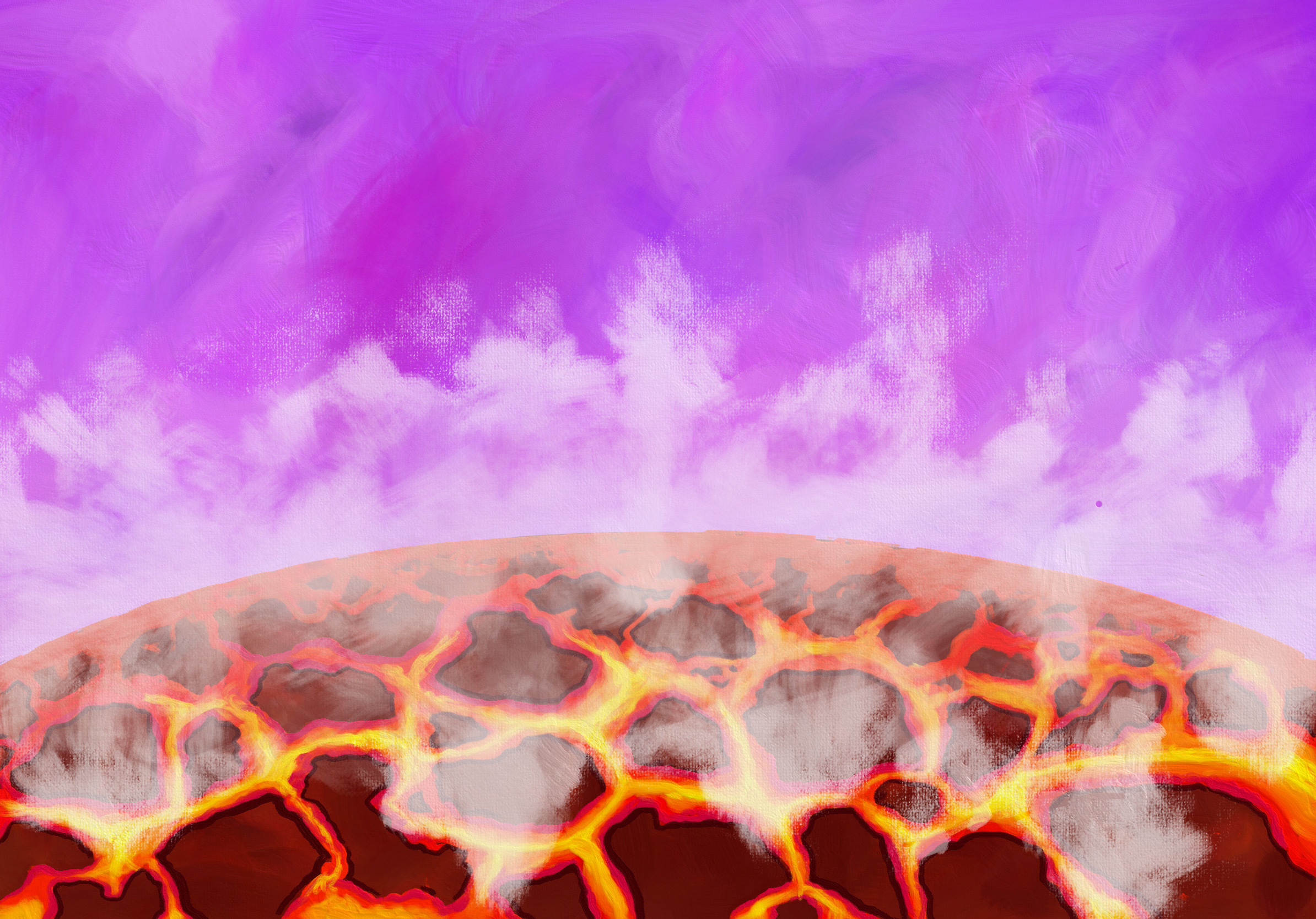
Artist’s impression of the molten surface of a young planet reacting with its atmosphere to form water vapor.
Credit: Tadahiro Kimura) Original size (1.2MB)

Science

New simulations show that truly Earth-like exoplanets with oceans and continents, and beaches along the boundaries, may be much more common around red dwarfs than previously expected. This means ongoing and future exoplanet survey missions can expect to find multiple Earth-analogs for further study before the end of the decade.

The “habitable zone” is defined as the range of orbits around a star where the temperature would be right for an exoplanet to have liquid water on its surface. This doesn’t necessarily mean that there is life or even water on the planet. In fact, for most exoplanets in the habitable zone, life on the planet would be “no day at the beach.” On Earth, both the oceans and the continents play vital roles in the geochemical carbon cycle which helps maintain a temperate climate where liquid water and life can exist. So to look for potentially habitable Earth-like planets, exactly what we need is “a day at the beach,” where the land and sea can coexist.

Previous research had warned that such beach-friendly planets could be extremely rare, even in the habitable zones around the most common types of stars (namely red dwarfs). This is because there is a distinct difference in the water content of rocky materials found in the inner and outer parts of a protoplanetary disk where planets form, leading to the formation of planets with either too much or too little water in most cases. But new numerical simulations conducted by Tadahiro Kimura from the University of Tokyo and Masahiro Ikoma from the National Astronomical Observatory of Japan provide a sunnier view. By taking into consideration water produced from interactions between the still molten surface of a young planet and its primordial atmosphere, the team found that a wide range in final water content is expected. And within that range, several percent of roughly-Earth-sized planets in habitable zones should have appropriate amounts of water for a temperate climate. This is a high enough percentage that ongoing and future exoplanet survey missions like TESS and PLATO can expect to find multiple examples of truly Earth-like exoplanets with beaches in the 2020s.

These results appeared as Kimura and Ikoma “Predicted diversity in water content of terrestrial exoplanets orbiting M dwarfs” in Nature Astronomy on September 29, 2022.

Related Links


Wednesday, October 05, 2022

A Snapshot of Interacting Galaxies

Arp-Madore 608-333
Credit: ESA/Hubble & NASA, Dark Energy Survey/DOE/FNAL/DECam/CTIO/NOIRLab/NSF/AURA, J. Dalcanton

The two interacting galaxies making up the pair known as Arp-Madore 608-333 seem to float side by side in this image from the NASA/ESA Hubble Space Telescope. Though they appear serene and unperturbed, the two are subtly warping one another through a mutual gravitational interaction that is disrupting and distorting both galaxies. This drawn-out galactic interaction was captured by Hubble’s Advanced Camera for Surveys.

The interacting galaxies in Arp-Madore 608-333 were captured as part of an effort to build up an archive of interesting targets for more detailed future study with Hubble, ground-based telescopes, and the NASA/ESA/CSA James Webb Space Telescope. To build up this archive, astronomers scoured existing astronomical catalogues for a list of targets spread throughout the night sky. By so doing, they hoped to include objects that had already been identified as interesting and that would be easy for Hubble to observe no matter which direction it was pointing.

Deciding how to award Hubble observing time is a drawn-out, competitive and difficult process, and the observations are allocated so as to use every last second of Hubble time available. However, there is a small but persistent fraction of time — around 2–3% — that goes unused as Hubble turns to point at new targets. Snapshot programmes, such as the one which captured Arp-Madore 608-333, exist to fill this gap and take advantage of the moments between longer observations. As well as creating beautiful images such as this, these snapshot programs enable astronomers to gather as much data as possible with Hubble.


Source: ESA/Hubble/potw


Tuesday, October 04, 2022

NASA's Chandra Adds X-ray Vision to Webb Images

Credit: X-ray: NASA/CXC/SAO; IR (Spitzer): NASA/JPL-Caltech; IR (Webb): NASA/ESA/CSA/STScI

JPEG (329 kb) - Large JPEG (9.3 MB) - Tiff (46.2 MB)  - More Images

 Tour: NASA's Chandra Adds X-ray Vision to Webb Images - More Animations


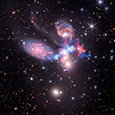
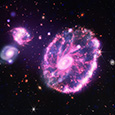
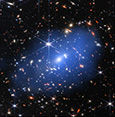
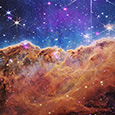
In the summer of 2022, NASA's James Webb Space Telescope released images from some of its earliest observations with the newly commissioned telescope. Almost instantaneously, these stunning images landed everywhere from the front pages of news outlets to larger-than-life displays in Times Square.
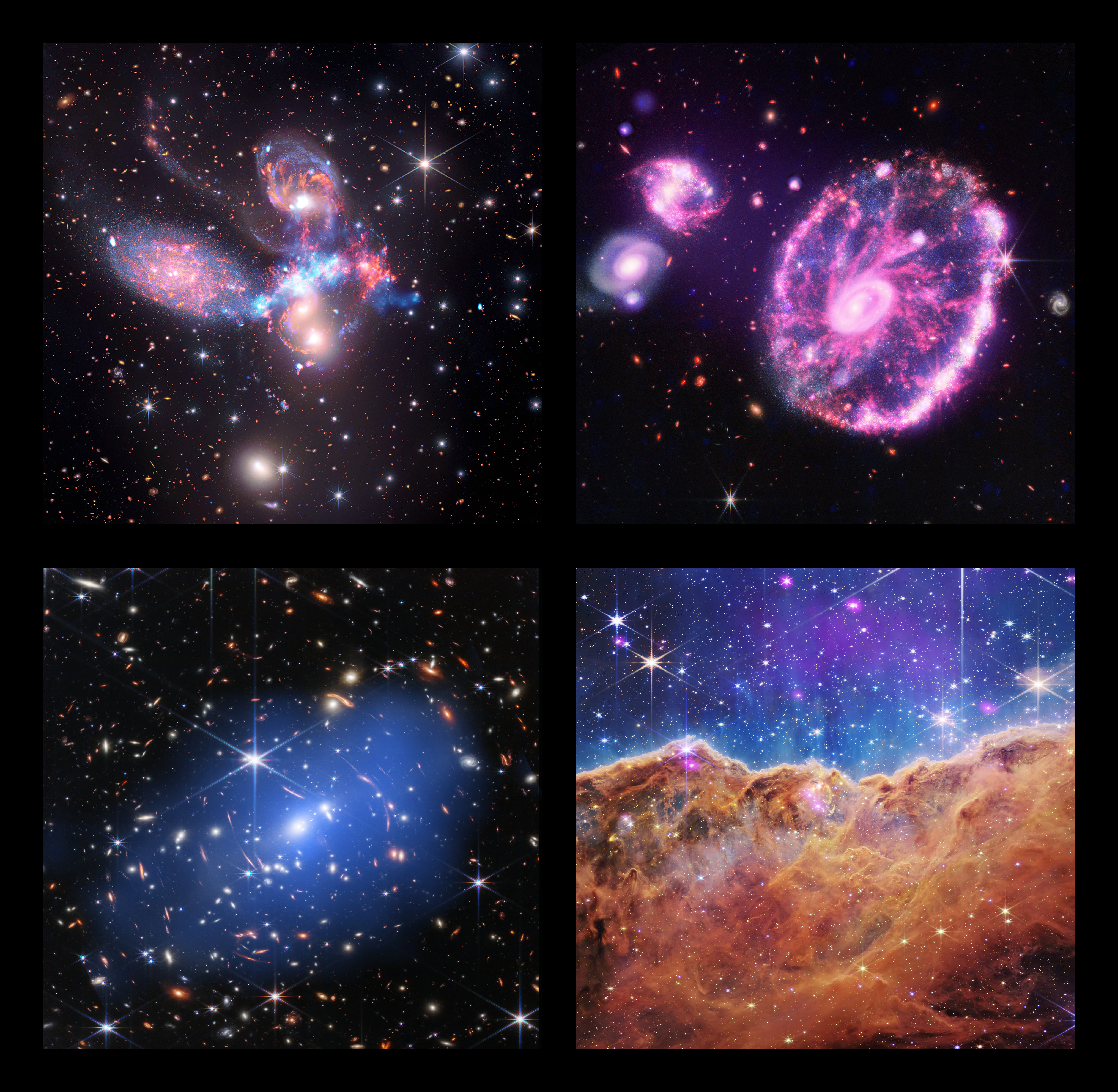
Webb, however, will not pursue its exploration of the universe on its own. It is designed to work in concert with NASA's many other telescopes as well as facilities both in space and on the ground. These new versions of Webb’s first images combine its infrared data with X-rays collected by NASA’s Chandra X-ray Observatory, underscoring how the power of any of these telescopes is only enhanced when joined with others.


Stephan's Quintet

Stephan's Quintet:
The four galaxies within Stephan’s Quintet are undergoing an intricate dance choreographed by gravity. (The fifth galaxy, on the left, is an interloping galaxy at a different distance.) The Webb image (red, orange, yellow, green, blue) of this object features never-seen-before details of the results of these interactions, including sweeping tails of gas and bursts of star formation. The Chandra data (light blue) of this system has uncovered a shock wave that heats gas to tens of millions of degrees, as one of the galaxies passes through the others at speeds of around 2 million miles per hour. This new composite also includes infrared data from NASA’s now-retired Spitzer Space Telescope (red, green, blue).

Catwheel Galaxy

Cartwheel Galaxy:
The Cartwheel galaxy gets its shape from a collision with another smaller galaxy — located outside the field of this image — about 100 million years ago. When this smaller galaxy punched through the Cartwheel, it triggered star formation that appears around an outer ring and elsewhere throughout the galaxy. X-rays seen by Chandra (blue and purple) come from superheated gas, individual exploded stars, and neutron stars and black holes pulling material from companion stars. Webb’s infrared view (red, orange, yellow, green, blue) shows the Cartwheel galaxy plus two smaller companion galaxies — not part of the collision — against a backdrop of many more distant galactic cousins.

SMACS 0723.3–7327

SMACS 0723.3–7327

Webb data shows how the galaxy cluster SMACS J0723, located about 4.2 billion light-years away, contains hundreds of individual galaxies. Galaxy clusters, however, contain far more than their galaxies alone. As some of the largest structures in the universe, they are filled with vast reservoirs of superheated gas that is seen only in X-ray light. In this image, the Chandra data (blue) reveals gas with temperatures of tens of millions of degrees, possessing a total mass of about 100 trillion times that of the Sun, several times higher than the mass of all the galaxies in the cluster. Invisible dark matter makes up an even larger fraction of the total mass in the cluster.

NGC 3324, The Cosmic Cliffs

NGC 3324, The Cosmic Cliffs of the Carina Nebula
Chandra’s data of the “Cosmic Cliffs” (pink) reveals over a dozen individual X-ray sources. These are mostly stars located in the outer region of a star cluster in the Carina Nebula with ages between 1 and 2 million years old, which is very young in stellar terms. Young stars are much brighter in X-rays than old stars, making X-ray studies an ideal way to distinguish stars in the Carina Nebula from the many stars of different ages from our Milky Way galaxy along our line of sight to the nebula. The diffuse X-ray emission in the top half of the image likely comes from hot gas from the three hottest, most massive stars in the star cluster. They are all outside the field of view of the Webb image. The Webb image uses the following colors: red, orange, yellow, green, cyan, and blue.

NASA's Marshall Space Flight Center manages the Chandra program. The Smithsonian Astrophysical Observatory's Chandra X-ray Center controls science operations from Cambridge, Massachusetts, and flight operations from Burlington, Massachusetts.


Fast Facts for Stephan's Quintet:

Credit:
X-ray: NASA/CXC/SAO; IR (Spitzer): NASA/JPL-Caltech; IR (Webb): NASA/ESA/CSA/STScI
Scale: Image is about 7.4 arcmin (620,000 light-years) across
Category:
Groups and Clusters of Galaxies
Coordinates (J2000): RA 22h 35m 57.5s | +33° 57' 36"
Constellation: Pegasus
Observation Dates: Jul 9, 2000 & Aug 17, 2007
Observation Time: 31 hours (1 day 7 hours)
Obs. IDs: 789, 7924
Instrument:
ACIS
Color Code: X-ray: cyan; IR (Spitzer): red, green, blue; Optical/IR (Webb): red, orange, yellow, green, blue
Distance Estimate: About 290 million light-years


Fast Facts for Cartwheel Galaxy:

Credit: X-ray: NASA/CXC; IR: NASA/ESA/CSA/STScI
Scale: Image is about 2.34 arcmin (340,000 light-years) across
Category: Groups and Clusters of Galaxies, Normal Galaxies & Starburst Galaxies
Coordinates (J2000): RA 00h 37m 41.1s | Dec -33° 42' 59"
Constellation:
Sculptor
Observation Dates: 3 observations: May, 2001; Jan 2008, Sept 2008
Observation Time: 49 hours 12 minutes (2 days 1 hour 12 minutes)
Obs. IDs: 2019, 9531, 9807
Instrument:
ACIS
Color Code: X-ray: blue and purple; IR: red, orange, yellow, green, blue
Distance Estimate: About 500 million light-years


Facts for SMACS 0723.3–7327:

Credit: X-ray: NASA/CXC/Durham Univ./G. Mahler; IR: NASA/ESA/CSA/STScI
Scale: Image is about 2.4 arcmin (2.5 million light-years) across
Category:
Groups and Clusters of Galaxies
Coordinates (J2000): RA 07h 23m 19.5s | Dec -73° 27' 15.6"
Constellation: Volans
Observation Dates: April 14, 2014
Observation Time: 5 hours 30 minutes
Obs. IDs: 15296
Instrument:
ACIS
Color Code: X-ray: blue; IR: red, orange, green, blue
Distance Estimate: About 4.2 billion light-years (z=0.39)


Facts for NGC 3324, The Cosmic Cliffs in the Carina Nebula:

Credit: X-ray: NASA/CXC/Univ. Observ. Munich/T. Preibisch et al.; IR: NASA/ESA/CSA/STScI
Scale: Image is about 7.3 arcmin (16 light-years) across
Category:
Normal Stars & Star Clusters
Coordinates (J2000): RA 10h 36m 48.0s | Dec -58° 37' 35.0"
Constellation:
Carina
Observation Dates: Oct 08, 2012
Observation Time: 19 hours 8 minutes
Obs. IDs: 13613
Instrument: ACIS
Color Code: X-ray: purple; IR: red, orange, yellow, green, cyan, blue
Distance Estimate: About 7,670 light-years.


Monday, October 03, 2022

Webb and Hubble Capture Detailed Views of DART Impact

PR Image heic2212a
Webb and Hubble Capture Detailed Views of DART Impact

PR Image heic2212b
Hubble Captures DART Impact

PR Image heic2212c
Webb Captures DART Impact


Videos

Hubble Captures DART Impact (Annotated)


Hubble Captures DART Impact Hubble Captures DART Impact

Webb Captures DART Impact


First Time Webb, Hubble Make Simultaneous Observations of the Same Target

Two of the great observatories, the NASA/ESA/CSA James Webb Space Telescope and the NASA/ESA Hubble Space Telescope, have captured views of a unique experiment to smash a spacecraft into a small asteroid. NASA’s Double Asteroid Redirection Test (DART) impact observations mark the first time that Webb and Hubble were used to simultaneously observe the same celestial target.

On 27 September 2022 at 01:14 CEST, DART intentionally crashed into Dimorphos, the asteroid moonlet in the double-asteroid system of Didymos. It was the world’s first test of the kinetic impact technique using a spacecraft to deflect an asteroid by modifying the object’s orbit. DART is a test for defending Earth against potential asteroid or comet hazards.

The observations are more than just an operational milestone for each telescope—there are also key science questions relating to the makeup and history of our solar system that researchers can explore when combining the capabilities of these observatories.

Observations from Webb and Hubble together will allow scientists to gain knowledge about the nature of the surface of Dimorphos, how much material was ejected by the collision, and how fast it was ejected. Additionally, observing the impact across a wide array of wavelengths between Webb and Hubble will reveal the distribution of particle sizes in the expanding dust cloud, helping to determine whether it threw off lots of big chunks or mostly fine dust. Combining this information will help scientists to understand how effectively a kinetic impact can modify an asteroid’s orbit.

Webb Captures Impact Site Befor and After Collision

Webb took one observation of the impact location before the collision took place, then several observations over the next few hours. Images from Webb’s Near-Infrared Camera (NIRCam) show a tight, compact core, with plumes of material appearing as wisps streaming away from  the centre of where the impact took place.

Observing the impact with Webb presented the flight operations, planning, and science teams with very unique challenges. Because of the asteroid’s speed of travel across the sky, the teams worked in the weeks leading up to the impact to enable and test a method of tracking asteroids moving over 3 times faster than the original speed limit set for Webb.

Scientists also plan to observe the asteroid in the coming months using Webb’s Mid-Infrared Instrument (MIRI) and Webb’s Near-Infrared Spectrograph (NIRSpec). Spectroscopic data will provide researchers with insight into the asteroid’s chemical composition.

Webb observed the impact over five hours total and captured 10 images. The data were collected as part of Webb’s Cycle 1 Guaranteed Time Observation Program 1245 led by Heidi Hammel of Association of Universities for Research in Astronomy (AURA).

Hubble Images Show Movement of Ejecta After Impact

Hubble also managed to capture observations of the moonlet ahead of the impact, then again 15 minutes after DART met the surface of Dimorphos. Images from Hubble’s Wide Field Camera 3 show the impact in visible light. Ejecta from the impact appear as rays stretching out from the body of the asteroid. The bolder, fanned-out spike of ejecta to the left of the asteroid is where DART impacted.

Some of the rays appear to be curved slightly, but astronomers need to take a closer look to determine what this could mean. In the Hubble images, astronomers estimate that the brightness of Didymos increased by 3 times after impact, and are also particularly intrigued by how that brightness then held steady, even eight hours after impact.

Hubble will monitor Dimorphos ten more times over the next three weeks. These regular, relatively long-term observations as the ejecta cloud expands and fades over time will paint a more complete picture of the cloud’s expansion from the ejection to its disappearance.

Hubble captured 45 images in the time immediately before and following DART’s impact with Dimorphos. The Hubble data was collected as part of Cycle 29 General Observers Program 16674.

Follow Up with ESA’s Hera Mission

Due to launch in October 2024, ESA’s Hera mission will perform a detailed post-impact survey of the target asteroid Dimorphos. Hera will turn the grand-scale experiment into a well-understood and repeatable planetary defence technique that might one day be carried out for real.

Just like Webb and Hubble, NASA’s DART and ESA’s Hera missions are a great example of what international collaboration can achieve: the two missions are supported by the same teams of scientists and astronomers, and take place through an international collaboration called AIDA – the Asteroid Impact and Deflection Assessment.

NASA and ESA worked together in the early 2000s to develop asteroid monitoring systems, but recognised there was a missing link in the chain from asteroid threat identification to ways of addressing that threat. In response NASA oversaw the DART mission while ESA developed the Hera mission to gather additional data on DART’s impact. With the Hera mission, ESA is assuming even greater responsibility for protecting our planet and ensuring that Europe plays a leading role in the common effort to tackle asteroid risks. As Europe’s flagship planetary defender, Hera is supported through the Agency’s Space Safety programme, part of the Operations Directorate. Read about future plans to be proposed at ESA’s Council at Ministerial Level this November.


More Information

The James Webb Space Telescope is an international partnership between NASA, ESA and the Canadian Space Agency (CSA).

The Hubble Space Telescope is a project of international cooperation between ESA and NASA.

Webb is the largest, most powerful telescope ever launched into space. Under an international collaboration agreement, ESA provided the telescope’s launch service, using the Ariane 5 launch vehicle. Working with partners, ESA was responsible for the development and qualification of Ariane 5 adaptations for the Webb mission and for the procurement of the launch service by Arianespace. ESA also provided the workhorse spectrograph NIRSpec and 50% of the mid-infrared instrument MIRI, which was designed and built by a consortium of nationally funded European Institutes (The MIRI European Consortium) in partnership with JPL and the University of Arizona.

Image Credit: NASA, ESA, CSA, and STScI


Links

Bethany Downer
ESA/Webb Chief Science Communications Officer
Email:
info@esahubble.org

Ninja Menning
ESA Newsroom and Media Relations Office
Email:
media@esa.int


Friday, September 30, 2022

Bright Galaxies Blowing Bubbles


An artist's impression of galaxies during the epoch of reionization, which occurred less than a billion years after the Big Bang. Credit: ESO/M. Kornmesser; CC BY 4.0

Title: CLEAR: Boosted Lyα Transmission of the Intergalactic Medium in UV-bright Galaxies
Authors: Intae Jung et al.
First Author’s Institution: The Catholic University of America and NASA’s Goddard Space Flight Center
Status: Published in ApJ

Sometimes the things we don’t see can still give us insight. This strategy of getting clues from both detections and non-detections is common in astronomy, and the non-detections studied in today’s article are used to understand the process of reionization. Sometime during the first billion or so years of the universe, a period of transition called the epoch of reionization took place. During this epoch, the first stars and galaxies formed and began emitting high-energy light that ionized the then mostly neutral hydrogen gas filling the universe. Ionizing radiation can kick off electrons from neutral hydrogen atoms, and in the epoch of reionization this occurred enough to ionize the universe’s gas nearly completely.

A Whodunit Mystery

Early galaxies are a major source of ionizing photons and perhaps the main drivers of this ionization process, so the properties of early galaxies and how they evolved over the first billion years of the universe have great implications for processes within the epoch of reionization. However, understanding how many photons were produced during this epoch and whether they escaped their galaxies and ionized the neutral gas around them is highly dependent on the physical conditions of each galaxy, and it’s therefore challenging to constrain and predict these factors. These challenges lead to more challenges in determining precisely when and where reionization occurred, as well as what kinds of galaxies were primarily responsible.

Tracing the strength of emission from the Lyman-α (n=2 to n=1) transition of hydrogen from early galaxies can give us a sense of the who and where: what sorts of galaxies produced more of the ionizing photons, and were they clustered together or spread out? This line of questioning corresponds to the spatial evolution of reionization. By tracking the fraction of gas that was ionized over time, we can also constrain the temporal evolution of reionization.

Today’s article seeks to get at the whodunit of reionization, focusing on galaxies in the epoch of reionization. More specifically, the authors of today’s article aim to distinguish between brighter and fainter galaxies, particularly within the ultraviolet (UV) range where photons have enough energy to ionize hydrogen. By determining trends between a galaxy’s capacity to emit ionizing photons and the reionization near that galaxy, the authors can test the idea that UV-bright galaxies sit within highly ionized bubbles of gas, and that reionization is accelerated in bubbles containing large numbers of galaxies (illustrated in Figure 1).


Figure 1: Representation of the varied processes during reionization, with the more UV-bright galaxies (larger symbols) sitting in larger ionized bubbles (black) within the neutral gas (white). The ionized bubbles create an environment for the Lyman-α photons to escape and ionize the surrounding gas more easily. More UV-faint galaxies likely exist in the galaxy overdensities within the bubbles but are too faint to be detected with the current dataset. Credit: Jung et al. 2022


Inequivalent Equivalent Widths

The article seeks to answer one main question: is there any evolution of Lyman-α emission in epoch of reionization galaxies with respect to the UV brightness of those galaxies? To help answer this, the authors measure the strength of Lyman-α emission with a quantity called equivalent width as function of both redshift and the intrinsic UV brightness of the galaxy. Their sample contained a few hundred galaxies with detailed spectroscopic observations as well as new data from the Hubble Space Telescope. With these data, the team searched for any signal (continuum) or Lyman-α emission lines, but they found no convincing Lyman-α emission or continuum-detected galaxies.

Still, these non-detections can help constrain the strength of Lyman-α emission coming from the galaxies. Given the sensitivity of the observations, the authors could (or even should) have detected galaxies if there is no redshift evolution of equivalent width before and after the end of the epoch of reionization (redshift z ~ 6). This basically rules out the existence of strong Lyman-α emission (in other words, high equivalent widths) in this sample, which included more UV-faint galaxies than the sample detected in previous work.

By comparing the detected and non-detected sources and running simulations of mock observations, the authors find some evidence that the Lyman-α emission line strength evolves differently for bright and faint galaxies through the epoch of reionzation. Their analysis is consistent with a picture where reionization is spatially inhomogeneous with large ionized bubbles made by bright galaxies with boosted Lyman-α transmission (Figure 1). The authors note that reionization is probably fairly complicated, with large spatial and temporal variations. Nonetheless, while we can learn something from what we don’t see, the now-operating JWST and other next-generation telescopes will be sensitive to fainter and more distant galaxies, allowing us to get a clearer picture of the epoch of reionization.

Original astrobite edited by Evan Lewis

By
Astrobites


About the author, Olivia Cooper:

I’m a third-year grad student at UT Austin studying the evolution of massive galaxies in the first two billion years. In undergrad at Smith College, I studied astrophysics and climate change communication. Besides doing science with pretty pictures of distant galaxies, I also like driving to the middle of nowhere to take pretty pictures of our own galaxy!