Showing posts with label Stephan's Quintet. Show all posts

Wednesday, November 27, 2024

2 MILLION mph galaxy smash-up seen in unprecedented detail

WEAVE data overlaid on a James Webb Space Telescope image of Stephan's Quintet, with green contours showing radio data from the Low Frequency Array (LOFAR) radio telescope. The orange and blue colours follow the brightness of Hydrogen-alpha obtained with the WEAVE LIFU, which trace where the intergalactic gas is ionised. The hexagon denotes the approximate coverage of the new WEAVE observations of the system, which is 36 kpc wide (similar in size to our own galaxy, the Milky Way).Credit: University of Hertfordshire
Licence type: Attribution (CC BY 4.0)

massive collision of galaxies sparked by one travelling at a scarcely-believable 2 million mph (3.2 million km/h) has been seen in unprecedented detail by one of Earth's most powerful telescopes.

The dramatic impact was observed in Stephan's Quintet, a nearby galaxy group made up of five galaxies first sighted almost 150 years ago.

It sparked an immensely powerful shock akin to a "sonic boom from a jet fighter" – the likes of which are among the most striking phenomena in the Universe.

Stephan's Quintet represents "a galactic crossroad where past collisions between galaxies have left behind a complex field of debris", which has now been reawakened by the passage of the galaxy, NGC 7318b.

The collision was spotted by a team of scientists using the first observations from the new 20-million Euro (£16.7million) William Herschel Telescope Enhanced Area Velocity Explorer (WEAVE) wide-field spectrograph in La Palma, Spain

This cutting-edge, next generation science facility will not only reveal how our Milky Way galaxy was built up over billions of years, but also offer new insights into millions of other galaxies across the Universe.

The discovery of NGC 7318b smashing through Stephan's Quintet was observed by a team of more than 60 astronomers and has been published today in Monthly Notices of the Royal Astronomical Society.

The system is an ideal laboratory to understand the chaotic and often violent relationship between galaxies, which is why it was the focus of the first-light observation by the WEAVE Large Integral Field Unit (LIFU).

Radio observations of Stephan’s Quintet at different frequencies, taken by the Low Frequency Array (LOFAR) and the Very Large Array (VLA). The red colours indicate strong radio emission coming from the shock front, as well as from some of the galaxies in the group and beyond. Credit: University of Hertfordshire
Licence type: Attribution (CC BY 4.0)

>
An image revealing the age of high-energy plasma in Stephan’s Quintet, as captured by radio observations with the VLA and LOFAR. The blue colours indicate older, low-energy plasma, while the orange and yellow areas mark regions that are being actively energised. The thin, dashed lines outline the location of the galaxies in the group, while the black solid lines trace the shock region identified with WEAVE data, which perfectly matches the areas where this plasma is being re-accelerated by the collision between NGC 7318b and the group. Credit: University of Hertfordshire
Licence type: Attribution (CC BY 4.0)

Lead researcher Dr Marina Arnaudova, of the University of Hertfordshire, said: "Since its discovery in 1877, Stephan's Quintet has captivated astronomers, because it represents a galactic crossroad where past collisions between galaxies have left behind a complex field of debris.

"Dynamical activity in this galaxy group has now been reawakened by a galaxy smashing through it at an incredible speed of over 2 million mph (3.2 million km/h), leading to an immensely powerful shock, much like a sonic boom from a jet fighter."

The international team has uncovered a dual nature behind the shock front, previously unknown to astronomers.

"As the shock moves through pockets of cold gas, it travels at hypersonic speeds – several times the speed of sound in the intergalactic medium of Stephan’s Quintet* – powerful enough to rip apart electrons from atoms, leaving behind a glowing trail of charged gas, as seen with WEAVE," Dr Arnaudova said.

However, when the shock passes through the surrounding hot gas, it becomes much weaker, according to PhD student Soumyadeep Das, of the University of Hertfordshire.

He added: "Instead of causing significant disruption, the weak shock compresses the hot gas, resulting in radio waves that are picked up by radio telescopes like the Low Frequency Array (LOFAR)."

The new insight and unprecedented detail came from WEAVE's LIFU, combining data with other cutting-edge instruments such as the LOFAR, the Very Large Array (VLA), and the James Webb Space Telescope (JWST).

WEAVE decomposition of gas in Stephan's Quintet, overlaid on a JWST image. The red highlights gas shocked by the collision, while green and blue shows star-forming regions. The purple areas represent bubbles with an unknown origin. The black contours show neutral Hydrogen, and its location relative to the shocked gas (in red) suggests that is where it comes from. Credit: University of Hertfordshire
Licence type: Attribution (CC BY 4.0)

The WEAVE prime-focus corrector and positioner at the William Herschel telescope in La Palma, Spain. Credit: ING

WEAVE is a state-of-the-art super-fast mapping device that has been connected to the William Herschel Telescope to analyse the composition of stars and gas both in the Milky Way and in distant galaxies.

This is done with the help of a spectroscope, which reveals the elements that stars are made of by generating a bar code-style pattern within a prism of colours that make up a source of light.

It was designed and built following a multi-lateral agreement by France, Italy and the countries of the Isaac Newton Group of Telescopes partnership (the UK, Spain and the Netherlands).

Astronomers hope that WEAVE will help reveal how our galaxy formed in unprecedented detail and revolutionise our understanding of the Universe.

Dr Daniel Smith, of the University of Hertfordshire, said: "It's really neat work that Marina has put together with this large team, but this first WEAVE science paper also represents just a taste of what is to come over the next five years now that WEAVE is becoming fully operational."

Professor Gavin Dalton, WEAVE principal investigator at RAL Space and the University of Oxford, said: "It's fantastic to see the level of detail uncovered here by WEAVE.

"As well as the details of the shock and the unfolding collision that we see in Stephan's Quintet, these observations provide a remarkable perspective on what may be happening in the formation and evolution of the barely resolved faint galaxies that we see at the limits of our current capabilities."

Dr Marc Balcells, director of the Isaac Newton Group of Telescopes, said: "I'm excited to see that the data gathered at the WEAVE first light already provide a high-impact result, and I'm sure this is just an early example of the types of discoveries that will be made possible with WEAVE on the William Herschel Telescope in the coming years."

Submitted Sam Tonkin


Media contacts:

Sam Tonkin
Royal Astronomical Society
Mob: +44 (0)7802 877700

press@ras.ac.uk

Robert Massey
Royal Astronomical Society
Mob: +44 (0)7802 877699

press@ras.ac.uk

Science contacts:

Dr Marina Arnaudova
University of Hertfordshire

m.i.arnaudova@gmail.com

Soumyadeep Das
University of Hertfordshire

soumyadeep.das.m44@gmail.com

Dr Daniel Smith
University of Hertfordshire

d.j.b.smith@herts.ac.uk


Further information

The paper 'WEAVE First Light observations: Origin and Dynamics of the Shock Front in Stephan's Quintet', by Dr Marina Arnaudova et al. has been published in Monthly Notices of the Royal Astronomical Society.

*This is estimated to be ~440km/s.


Notes for editors

About WEAVE

In 2016, a multi-lateral agreement to design and build WEAVE was signed by the countries of the Isaac Newton Group of Telescopes (ING) partnership (the UK, Spain and the Netherlands), joined by France and Italy, with each country contributing major components as listed below, and with the ING providing auxiliary systems and overall project management.

The consortium is led by Gavin Dalton from the University of Oxford and RALSpace as Principal Investigator, Scott Trager from University of Groningen as Project Scientist, Don Carlos Abrams from ING as Project Manager, and Chris Benn from ING as Instrument Scientist.

The main components of WEAVE are:
  • Fibre positioner, developed by the University of Oxford in the UK, with support from the Instituto de Astrofísica de Canarias (IAC) in Spain.
  • Prime-focus system, designed by ING, IAC and SENER, provided by the IAC and manufactured by SENER. Support from Konkoly Observatory (HU). Lenses were polished by KiwiStar in New Zealand, funded from STFC, NOVA, INAF, IAC and ING, and mounted at SENER Aeroespacial (ES) by SENER and ING.
  • Spectrograph, built by NOVA in the Netherlands with optical design by RAL Space in the UK, optics manufactured at INAOE (MX) and with support from INAF (IT) and the IAC.
  • Field rotator, provided by IAC and manufactured by IDOM (ES). Optical fibres, provided by the Observatoire de Paris in France, manufactured in France, Canada and USA.
  • LIFU, built by NOVA (NL).
  • CCD detectors system, provided by Liverpool John Moores University in the UK. Data processing, analysis and archiving led by the University of Cambridge (UK), IAC (ES) and FGG-INAF (IT) respectively.
  • Observatory control system, built by the ING.
WEAVE's construction has been funded by the Science and Technology Facilities Council (STFC, UK), the Netherlands Research School for Astronomy (NOVA, NL), the Dutch Research Council (NWO, NL), the Isaac Newton Group of Telescopes (ING, UK/NL/ES), the Instituto de Astrofísica de Canarias (IAC, ES), the Ministry of Economy and Competitiveness (MINECO, ES), the Ministry of Science and Innovation (MCI, ES), the European Regional Development Fund (ERDF), the National Institute for Astrophysics (INAF, IT), the French National Centre for Scientific Research (CNRS, FR), Paris Observatory – University of Paris Science and Letters (FR), Besançon Observatory (FR), Region île de France (FR), Region Franche-Comté (FR), Instituto Nacional de Astrofísica, Óptica y Electrónica (INAOE, MX), National Council for Science and Technology (CONACYT, MX), Lund Observatory (SE), Uppsala University (SE), the Leibniz Institute for Astrophysics (AIP, DE), Max-Planck Institute for Astronomy (MPIA, DE), University of Pennsylvania (US), and Konkoly Observatory (HU).

About the William Herschel Telescope

The William Herschel Telescope (WHT) is operated on the island of La Palma by the Isaac Newton Group of Telescopes (ING) in the Spanish Observatorio del Roque de los Muchachos of the Instituto de Astrofísica de Canarias (IAC). The ING is funded by the Science and Technology Facilities Council (STFC-UKRI) of the United Kingdom, the Nederlandse Organisatie voor Wetenschappelijk Onderzoek (NWO) of the Netherlands, and the IAC in Spain. IAC's contribution to the ING is funded by the Spanish Ministry of Science, Innovation and Universities.

About the Royal Astronomical Society


The Royal Astronomical Society (RAS), founded in 1820, encourages and promotes the study of astronomy, solar-system science, geophysics and closely related branches of science.

The RAS organises scientific meetings, publishes international research and review journals, recognises outstanding achievements by the award of medals and prizes, maintains an extensive library, supports education through grants and outreach activities and represents UK astronomy nationally and internationally. Its more than 4,000 members (Fellows), a third based overseas, include scientific researchers in universities, observatories and laboratories as well as historians of astronomy and others.

The RAS accepts papers for its journals based on the principle of peer review, in which fellow experts on the editorial boards accept the paper as worth considering. The Society issues press releases based on a similar principle, but the organisations and scientists concerned have overall responsibility for their content.

Keep up with the RAS on X, Facebook, LinkedIn and YouTube.


Tuesday, October 04, 2022

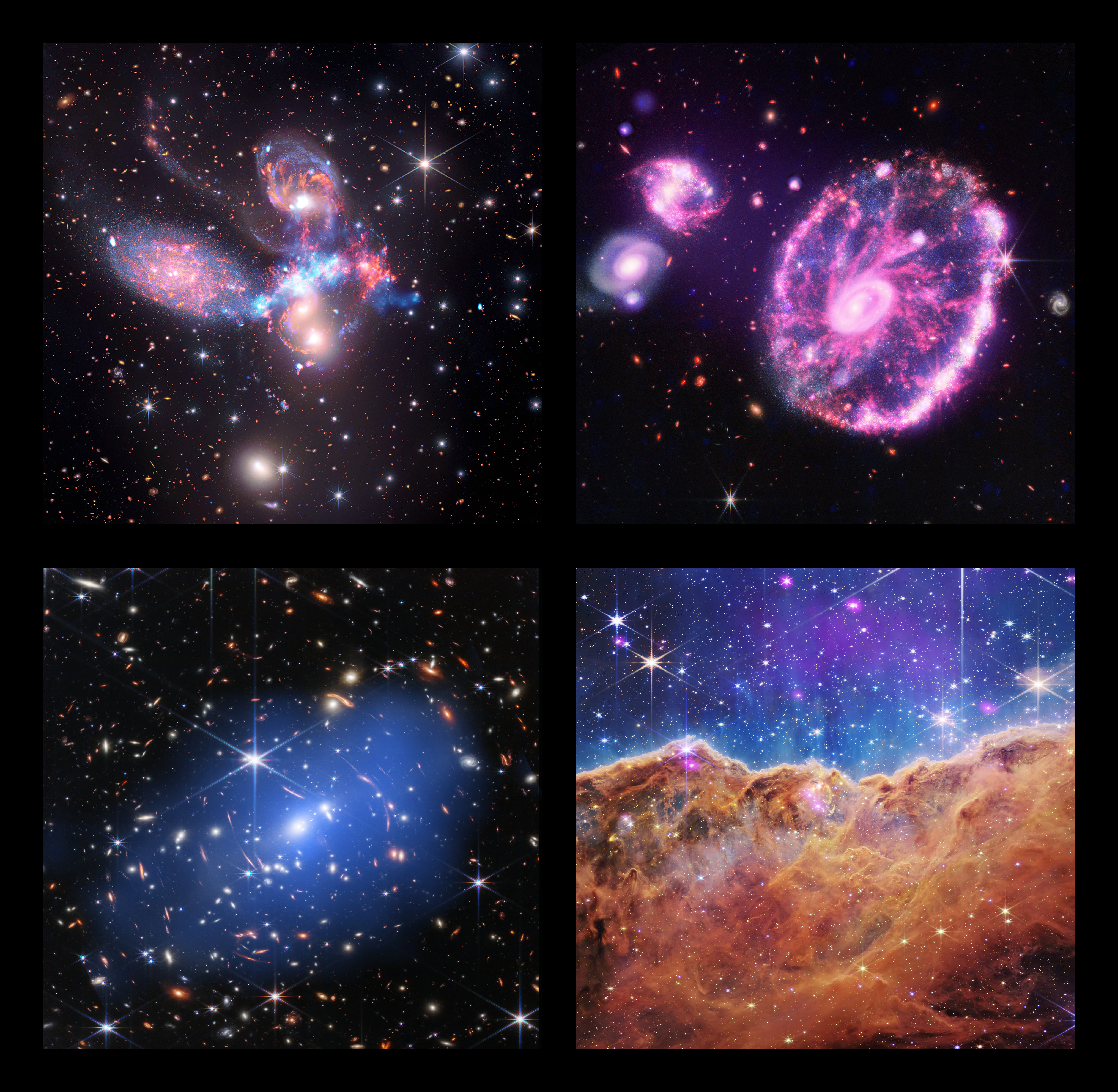
NASA's Chandra Adds X-ray Vision to Webb Images

Credit: X-ray: NASA/CXC/SAO; IR (Spitzer): NASA/JPL-Caltech; IR (Webb): NASA/ESA/CSA/STScI

JPEG (329 kb) - Large JPEG (9.3 MB) - Tiff (46.2 MB)  - More Images

 Tour: NASA's Chandra Adds X-ray Vision to Webb Images - More Animations


In the summer of 2022, NASA's James Webb Space Telescope released images from some of its earliest observations with the newly commissioned telescope. Almost instantaneously, these stunning images landed everywhere from the front pages of news outlets to larger-than-life displays in Times Square.

Webb, however, will not pursue its exploration of the universe on its own. It is designed to work in concert with NASA's many other telescopes as well as facilities both in space and on the ground. These new versions of Webb’s first images combine its infrared data with X-rays collected by NASA’s Chandra X-ray Observatory, underscoring how the power of any of these telescopes is only enhanced when joined with others.


Stephan's Quintet

Stephan's Quintet:
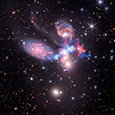
The four galaxies within Stephan’s Quintet are undergoing an intricate dance choreographed by gravity. (The fifth galaxy, on the left, is an interloping galaxy at a different distance.) The Webb image (red, orange, yellow, green, blue) of this object features never-seen-before details of the results of these interactions, including sweeping tails of gas and bursts of star formation. The Chandra data (light blue) of this system has uncovered a shock wave that heats gas to tens of millions of degrees, as one of the galaxies passes through the others at speeds of around 2 million miles per hour. This new composite also includes infrared data from NASA’s now-retired Spitzer Space Telescope (red, green, blue).

Catwheel Galaxy

Cartwheel Galaxy:
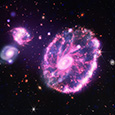
The Cartwheel galaxy gets its shape from a collision with another smaller galaxy — located outside the field of this image — about 100 million years ago. When this smaller galaxy punched through the Cartwheel, it triggered star formation that appears around an outer ring and elsewhere throughout the galaxy. X-rays seen by Chandra (blue and purple) come from superheated gas, individual exploded stars, and neutron stars and black holes pulling material from companion stars. Webb’s infrared view (red, orange, yellow, green, blue) shows the Cartwheel galaxy plus two smaller companion galaxies — not part of the collision — against a backdrop of many more distant galactic cousins.

SMACS 0723.3–7327

SMACS 0723.3–7327

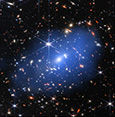
Webb data shows how the galaxy cluster SMACS J0723, located about 4.2 billion light-years away, contains hundreds of individual galaxies. Galaxy clusters, however, contain far more than their galaxies alone. As some of the largest structures in the universe, they are filled with vast reservoirs of superheated gas that is seen only in X-ray light. In this image, the Chandra data (blue) reveals gas with temperatures of tens of millions of degrees, possessing a total mass of about 100 trillion times that of the Sun, several times higher than the mass of all the galaxies in the cluster. Invisible dark matter makes up an even larger fraction of the total mass in the cluster.

NGC 3324, The Cosmic Cliffs

NGC 3324, The Cosmic Cliffs of the Carina Nebula
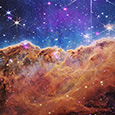
Chandra’s data of the “Cosmic Cliffs” (pink) reveals over a dozen individual X-ray sources. These are mostly stars located in the outer region of a star cluster in the Carina Nebula with ages between 1 and 2 million years old, which is very young in stellar terms. Young stars are much brighter in X-rays than old stars, making X-ray studies an ideal way to distinguish stars in the Carina Nebula from the many stars of different ages from our Milky Way galaxy along our line of sight to the nebula. The diffuse X-ray emission in the top half of the image likely comes from hot gas from the three hottest, most massive stars in the star cluster. They are all outside the field of view of the Webb image. The Webb image uses the following colors: red, orange, yellow, green, cyan, and blue.

NASA's Marshall Space Flight Center manages the Chandra program. The Smithsonian Astrophysical Observatory's Chandra X-ray Center controls science operations from Cambridge, Massachusetts, and flight operations from Burlington, Massachusetts.


Fast Facts for Stephan's Quintet:

Credit:
X-ray: NASA/CXC/SAO; IR (Spitzer): NASA/JPL-Caltech; IR (Webb): NASA/ESA/CSA/STScI
Scale: Image is about 7.4 arcmin (620,000 light-years) across
Category:
Groups and Clusters of Galaxies
Coordinates (J2000): RA 22h 35m 57.5s | +33° 57' 36"
Constellation: Pegasus
Observation Dates: Jul 9, 2000 & Aug 17, 2007
Observation Time: 31 hours (1 day 7 hours)
Obs. IDs: 789, 7924
Instrument:
ACIS
Color Code: X-ray: cyan; IR (Spitzer): red, green, blue; Optical/IR (Webb): red, orange, yellow, green, blue
Distance Estimate: About 290 million light-years


Fast Facts for Cartwheel Galaxy:

Credit: X-ray: NASA/CXC; IR: NASA/ESA/CSA/STScI
Scale: Image is about 2.34 arcmin (340,000 light-years) across
Category: Groups and Clusters of Galaxies, Normal Galaxies & Starburst Galaxies
Coordinates (J2000): RA 00h 37m 41.1s | Dec -33° 42' 59"
Constellation:
Sculptor
Observation Dates: 3 observations: May, 2001; Jan 2008, Sept 2008
Observation Time: 49 hours 12 minutes (2 days 1 hour 12 minutes)
Obs. IDs: 2019, 9531, 9807
Instrument:
ACIS
Color Code: X-ray: blue and purple; IR: red, orange, yellow, green, blue
Distance Estimate: About 500 million light-years


Facts for SMACS 0723.3–7327:

Credit: X-ray: NASA/CXC/Durham Univ./G. Mahler; IR: NASA/ESA/CSA/STScI
Scale: Image is about 2.4 arcmin (2.5 million light-years) across
Category:
Groups and Clusters of Galaxies
Coordinates (J2000): RA 07h 23m 19.5s | Dec -73° 27' 15.6"
Constellation: Volans
Observation Dates: April 14, 2014
Observation Time: 5 hours 30 minutes
Obs. IDs: 15296
Instrument:
ACIS
Color Code: X-ray: blue; IR: red, orange, green, blue
Distance Estimate: About 4.2 billion light-years (z=0.39)


Facts for NGC 3324, The Cosmic Cliffs in the Carina Nebula:

Credit: X-ray: NASA/CXC/Univ. Observ. Munich/T. Preibisch et al.; IR: NASA/ESA/CSA/STScI
Scale: Image is about 7.3 arcmin (16 light-years) across
Category:
Normal Stars & Star Clusters
Coordinates (J2000): RA 10h 36m 48.0s | Dec -58° 37' 35.0"
Constellation:
Carina
Observation Dates: Oct 08, 2012
Observation Time: 19 hours 8 minutes
Obs. IDs: 13613
Instrument: ACIS
Color Code: X-ray: purple; IR: red, orange, yellow, green, cyan, blue
Distance Estimate: About 7,670 light-years.


Friday, October 28, 2011

Subaru's 3-D View of Stephan's Quintet

Figure 1: Composite tricolor images of Stephan's Quintet using Hα filters with a recession velocity of 0 (left image) and a recession velocity of 4,200 miles per second (right image).

Figure 2: A diagram of the member galaxies of Stephan's Quintet. NGC7320 is a closer galaxy and has a recession velocity of 0. The remaining four are a group of more distant galaxies 300 million light years away. The researchers believe that the merging of NGC7318A/B and NGC7319's crashing into them are responsible for the active star formation regions in the Hα emitting region around NGC7318A/B.

Subaru Telescope has added another dimension of information about one of the most studied of all compact galaxy groups—Stephan's Quintet. Located within the borders of the constellation Pegasus, Stephan's Quintet consists of a visual grouping of five galaxies, four of which form an actual compact group of galaxies; one additional galaxy appears in images of the group but is much closer than the others. Refinements in observations of the quintet are revealing more about its members. A comparison of images (the left and right images in Figure 1) compiled by using a suite of specialized filters with Subaru's Prime Focus Camera (Suprime-Cam) have shown different types of star-formation activity between the closer galaxy NGC7320 and the more distant galaxies in Stephan's Quintet. They show the quintet in 3-D.

These new images are the product of Suprime-Cam's ability to capture images of objects in a wide field of view and to use specialized filters to focus observations according to particular research objectives. To learn about the star-forming regions in Stephan's Quintet and their structures, observers used special narrowband filters for Hα emissions, which let in a very specific wavelength of light to indicate distinctive hydrogen emissions during active star formation. They used two Hα filters, each with a different recession velocity, i.e. the speed at which the object is moving away from the observer. They used one Hα filter with a recession velocity of 0, which means that the speed at which the object is moving away from the observer is 0 and that it is not far distant. They used another Hα filter with a greater recession velocity of 4200 miles (6,700 km) per second, an indicator of distant objects. In addition to the red color attributed to the Hα emission, blue and green colors assigned to the images from the blue and red filters captured light so that the composite tricolor images aligned with human color perception in red, green, and blue.

Processing of the filtered images resulted in the two different views of Stephan's Quintet shown in Figure 1. The image on the left shows the galaxies when the observers used the Hα filter with a recession velocity of 0 while the one on the right shows them when they used the Hα filter with a recession velocity of 4,200 miles per second. The left image shows Hα emissions that indicate an active star-forming region in the spiral arms of NGC7320 in the lower left quadrant but not in the other galaxies. The right image contrasts with the left and shows a region of Hα emissions in the upper three galaxies but none from NGC7320. Two (NGC7318A and NGC7318B) of the four galaxies are shedding gas because of a collision while a third (NGC7319) is crashing in, creating shock waves that trigger vigorous star formation. Figure 2 depicts the relationship of the galaxies. Gas stripped from these three galaxies during galactic collisions is ionized by two mechanisms: shock waves and strong ultraviolet light emanating from the newborn stars. This ionized gas emits bright light, which the Hα filter reveals. Thus the researchers believe that NGC7319 as well as NGC7318A/B are driving the star-forming regions in the Hα emitting region around NGC7318A/B.

In addition to star-forming activity, the images indicate the distances of the galaxies. Different recession velocities help observers spot cases where objects located at different distances appear in proximity in the same image. The contrasting images show that NGC7320 is closer than the other galaxies, which show active star formation at a significantly higher recession velocity (4,200 miles per second) than NGC7320 (0). NGC7320 is about 50 million light years away while the other four galaxies are about 300 million light years away. This explains the intriguing arrangement of the galaxies in Stephan's Quintet.

Observation Parameters

Object Name: HCG92 (Stephan's Quintet)
Telescope Used: Subaru Telescope (8.2 m diameter primary mirror), prime focus
Instrument Used: Subaru Prime Focus Camera (Suprime-Cam)
Filters: B (0.45 μm), R (0.65 μm), NA656 (0.656 μm), NA671 (0.671 μm)
Composite Color
Schemes: blue (B), green (R), red (NA656; Figure 1 left) blue (B), green (R), red (NA671; Figure 1 right)
Observation Dates: 2009-05-25 (R), 2009-05-25 (NA671) 2009-05-26 (B), 2009-08-22 (NA656)
Exposure Times: 180s×4 (R), 900s×5 (NA671)
300s×4 (B), 240s×4 (NA656)
Picture Orientation: Up corresponds to North, left corresponds to East. The field of view is 6'44" x 6'44".
Coordinates: RA (J2000.0) 22h36m, Dec (J2000.0) +33o58' (constellation Pegasus)

Wednesday, September 09, 2009

Hubble Opens New Eyes on the Universe


Credit: NASA, ESA, and the Hubble SM4 ERO Team

These four images are among the first observations made by the new Wide Field Camera 3 aboard the upgraded NASA Hubble Space Telescope.

The image at top left shows NGC 6302, a butterfly-shaped nebula surrounding a dying star. At top right is a picture of a clash among members of a galactic grouping called Stephan's Quintet. The image at bottom left gives viewers a panoramic portrait of a colorful assortment of 100,000 stars residing in the crowded core of Omega Centauri, a giant globular cluster. At bottom right, an eerie pillar of star birth in the Carina Nebula rises from a sea of greenish-colored clouds.  Object Names: NGC 6302, Stephan's Quintet, Omega Centauri, Jet in Carina


WASHINGTON — Astronomers declared NASA's Hubble Space Telescope a fully rejuvenated observatory with the release Wednesday of observations from four of its six operating science instruments.

Topping the list of new views are colorful, multi-wavelength pictures of far-flung galaxies, a densely packed star cluster, an eerie "pillar of creation," and a "butterfly" nebula. Hubble's suite of new instruments allows it to study the universe across a wide swath of the light spectrum, from ultraviolet all the way to near-infrared. In addition, scientists released spectroscopic observations that slice across billions of light-years to probe the cosmic-web structure of the universe and map the distribution of elements that are fundamental to life as we know it.

"This marks a new beginning for Hubble," said Ed Weiler, associate administrator for NASA's Science Mission Directorate at NASA Headquarters in Washington. "The telescope was given an extreme makeover and now is significantly more powerful than ever, well-equipped to last into the next decade."

The new instruments are more sensitive to light and, therefore, will improve Hubble's observing efficiency significantly. It is able to complete observations in a fraction of the time that was needed with prior generations of Hubble instruments. The space observatory today is significantly more powerful than it ever has been.

"We couldn't be more thrilled with the quality of the images from the new Wide Field Camera 3 (WFC3) and repaired Advanced Camera for Surveys (ACS), and the spectra from the Cosmic Origins Spectrograph (COS) and the Space Telescope Imaging Spectrograph (STIS)," said Keith Noll, leader of a team at the Space Telescope Science Institute in Baltimore, which planned the early release observations. "The targets we've selected to showcase the telescope reveal the great range of capabilities in our newly upgraded Hubble."

These results are compelling evidence of the success of the STS-125 servicing mission in May, which has brought the space observatory to the apex of its scientific performance. Two new instruments, the WFC3 and COS, were installed, and two others, the ACS and STIS, were repaired at the circuit board level. Mission scientists also announced Wednesday that the Near Infrared Camera and Multi-Object Spectrometer was brought back into operation during the three months of calibration and testing.

"On this mission we wanted to replenish the 'tool kit' of Hubble instruments on which scientists around the world rely to carry out their cutting-edge research," said David Leckrone, senior project scientist for Hubble at NASA's Goddard Space Flight Center in Greenbelt, Md. "Prior to this servicing mission, we had only three unique instrument channels still working, and today we have 13. I'm very proud to be able to say, 'mission accomplished.' "

For the past three months, scientists and engineers at the Space Telescope Science Institute and Goddard have been focusing, testing, and calibrating the instruments. Hubble is one of the most complex space telescopes ever launched, and the Hubble servicing mission astronauts performed major surgery on the 19-year-old observatory's multiple systems. This orbital verification phase was interrupted briefly July 23 to observe Jupiter in the aftermath of a collision with a suspected comet.

Hubble now enters a phase of full science observations. The demand for observing time will be intense. Observations will range from studying the population of Kuiper Belt objects at the fringe of our solar system to surveying the birth of planets around other stars and probing the composition and structure of extrasolar planet atmospheres. There are ambitious plans to take the deepest-ever near-infrared portrait of the universe to reveal never-before-seen infant galaxies that existed when the universe was less than 500 million years old. Other planned observations will attempt to shed light on the behavior of dark energy, a repulsive force that is pushing the universe apart at an ever-faster rate.

The Hubble Space Telescope is a project of international cooperation between NASA and the European Space Agency. Goddard manages the telescope. The Space Telescope Science Institute conducts Hubble science operations. The institute is operated for NASA by the Association of Universities for Research in Astronomy, Inc. in Washington, and is an International Year of Astronomy 2009 program partner.

CONTACT

J.D. Harrington
Headquarters, Washington
202-358-5241
j.d.harrington@nasa.gov

Susan Hendrix
Goddard Space Flight Center, Greenbelt, Md.
301-286-7745
susan.m.hendrix@nasa.gov

Ray Villard
Space Telescope Science Institute, Baltimore, Md.
410-338-4514
villard@stsci.edu


For images and more information about the Hubble Space Telescope, visit:


Source: HubbleSite

Thursday, July 09, 2009

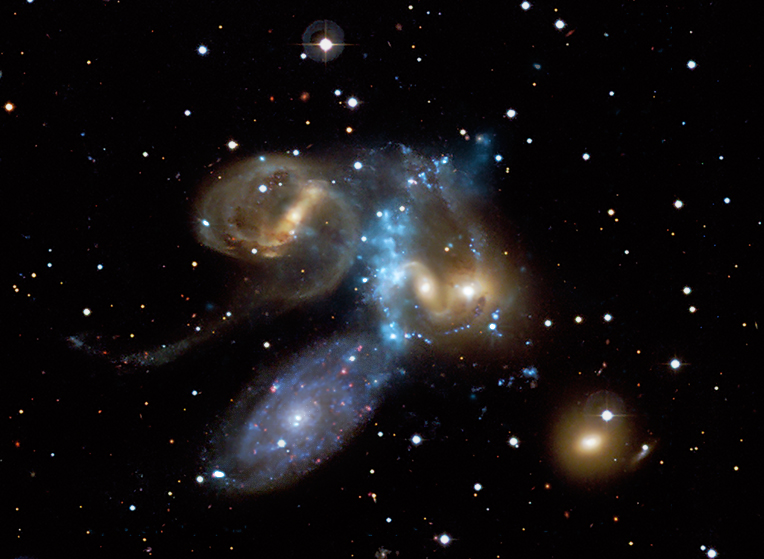
Stephan's Quintet: A Galaxy Collision in Action


Credit X-ray (NASA/CXC/CfA/E.O'Sullivan);
Optical (Canada-France-Hawaii-Telescope/Coelum)


This beautiful image gives a new look at Stephan's Quintet, a compact group of galaxies discovered about 130 years ago and located about 280 million light years from Earth. The curved, light blue ridge running down the center of the image shows X-ray data from the Chandra X-ray Observatory. Four of the galaxies in the group are visible in the optical image (yellow, red, white and blue) from the Canada-France-Hawaii Telescope. A labeled version identifies these galaxies (NGC 7317, NGC 7318a, NGC 7318b and NGC 7319) as well as a prominent foreground galaxy (NGC 7320) that is not a member of the group. The galaxy NGC 7318b is passing through the core of galaxies at almost 2 million miles per hour, and is thought to be causing the ridge of X-ray emission by generating a shock wave that heats the gas.

Additional heating by supernova explosions and stellar winds has also probably taken place in Stephan's Quintet. A larger halo of X-ray emission - not shown here - detected by ESA's XMM-Newton could be evidence of shock-heating by previous collisions between galaxies in this group. Some of the X-ray emission is likely also caused by binary systems containing massive stars that are losing material to neutron stars or black holes.

Stephan's Quintet provides a rare opportunity to observe a galaxy group in the process of evolving from an X-ray faint system dominated by spiral galaxies to a more developed system dominated by elliptical galaxies and bright X-ray emission. Being able to witness the dramatic effect of collisions in causing this evolution is important for increasing our understanding of the origins of the hot, X-ray bright halos of gas in groups of galaxies.

Stephan's Quintet shows an additional sign of complex interactions in the past, notably the long tails visible in the optical image. These features were probably caused by one or more passages through the galaxy group by NGC 7317.

Fast Facts for Stephan's Quintet:

Scale: Image is 6.3 arcmin across
Category: Groups & Clusters of Galaxies
Coordinates: (J2000) RA 22h 36m 00.00s | Dec +33° 59’ 00.00"
Constellation: Pegasus
Observation Date: 07/09/2000-08/17/2007
Observation Time: 31 hours
Obs. ID: 789, 7924
Color Code: X-ray (Cyan); Optical (Red, Yellow, Blue, White)
Instrument: ACIS
Also Known As: HCG 92
Distance Estimate: About 280 million light years (redshift z = 0.02)

Saturday, March 04, 2006

Stephan’s Quintet Galaxy Cluster - Credit: NASA/JPL-Caltech/Max Planck Institute


Stephan’s Quintet Galaxy Cluster
Credit: NASA/JPL-Caltech/Max Planck Institute


This false-color composite image of the Stephan’s Quintet galaxy cluster clearly shows one of the largest shock waves ever seen (green arc). The wave was produced by one galaxy falling toward another at speeds of more than one million miles per hour. The image is made up of data from NASA's Spitzer Space Telescope and a ground-based telescope in Spain.

Four of the five galaxies in this picture are involved in a violent collision, which has already stripped most of the hydrogen gas from the interiors of the galaxies. The centers of the galaxies appear as bright yellow-pink knots inside a blue haze of stars, and the galaxy producing all the turmoil, NGC7318b, is the left of two small bright regions in the middle right of the image. One galaxy, the large spiral at the bottom left of the image, is a foreground object and is not associated with the cluster.

The titanic shock wave, larger than our own Milky Way galaxy, was detected by the ground-based telescope using visible-light wavelengths. It consists of hot hydrogen gas. As NGC7318b collides with gas spread throughout the cluster, atoms of hydrogen are heated in the shock wave, producing the green glow.

Stephan's Quintet is located 300 million light-years away in the Pegasus constellation.