

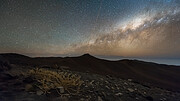


“The puzzling and counterintuitive part is: why is there such a heavy element in the upper layers of the atmosphere of these planets?” says Tomás Azevedo Silva, a PhD student at the University of Porto and the Instituto de Astrofísica e Ciências do Espaço (IA) in Portugal who led the study published today in Astronomy & Astrophysics.
WASP-76 b and WASP-121 b are no ordinary exoplanets. Both are known as ultra-hot Jupiters as they are comparable in size to Jupiter whilst having extremely high surface temperatures soaring above 1000°C. This is due to their close proximity to their host stars, which also means an orbit around each star takes only one to two days. This gives these planets rather exotic features; in WASP-76 b, for example, astronomers suspect it rains iron.
But even so, the scientists were surprised to find barium, which is 2.5 times heavier than iron, in the upper atmospheres of WASP-76 b and WASP-121 b. “Given the high gravity of the planets, we would expect heavy elements like barium to quickly fall into the lower layers of the atmosphere,” explains co-author Olivier Demangeon, a researcher also from the University of Porto and IA.
“This was in a way an ‘accidental’ discovery,” says Azevedo Silva. “We were not expecting or looking for barium in particular and had to cross-check that this was actually coming from the planet since it had never been seen in any exoplanet before.”
The fact that barium was detected in the atmospheres of both of these ultra-hot Jupiters suggests that this category of planets might be even stranger than previously thought. Although we do occasionally see barium in our own skies, as the brilliant green colour in fireworks, the question for scientists is what natural process could cause this heavy element to be at such high altitudes in these exoplanets. “At the moment, we are not sure what the mechanisms are,” explains Demangeon.
In the study of exoplanet atmospheres ultra-hot Jupiters are extremely useful. As Demangeon explains: “Being gaseous and hot, their atmospheres are very extended and are thus easier to observe and study than those of smaller or cooler planets”.
Determining the composition of an exoplanet’s atmosphere requires very specialised equipment. The team used the ESPRESSO instrument on ESO’s VLT in Chile to analyse starlight that had been filtered through the atmospheres of WASP-76 b and WASP-121 b. This made it possible to clearly detect several elements in them, including barium.
These new results show that we have only scratched the
surface of the mysteries of exoplanets. With future instruments such as
the high-resolution ArmazoNes high Dispersion Echelle Spectrograph (ANDES), which will operate on ESO’s upcoming Extremely Large Telescope (ELT),
astronomers will be able to study the atmospheres of exoplanets large
and small, including those of rocky planets similar to Earth, in much
greater depth and to gather more clues as to the nature of these strange
worlds.
More Information
This research was presented in the paper “Detection of Barium in the atmospheres of ultra-hot gas giants WASP-76b & WASP-121b” to appear in Astronomy & Astrophysics (doi: 10.1051/0004-6361/202244489).
The team is composed of T. Azevedo Silva (Instituto de Astrofísica e Ciências do Espaço, Universidade do Porto, Portugal [IA/UPorto, CAUP] and Departamento de Física e Astronomia Faculdade de Ciências, Universidade do Porto, Portugal [FCUP]), O. D. S. Demangeon (IA/UPorto, CAUP and FCUP), N. C. Santos (IA/UPorto, CAUP and FCUP), R. Allart (Department of Physics, and Institute for Research on Exoplanets, Université de Montréal, Canada and Observatoire astronomique de l’Université de Genève, Switzerland [UNIGE]), F. Borsa (INAF – Osservatorio Astronomico di Brera, Italy), E. Cristo (IA/UPorto, CAUP and FCUP), E. Esparza-Borges (Instituto de Astrofísica de Canarias, Spain [IAC] and Departamento de Astrofísica, Universidad de La Laguna, Tenerife, Spain [IAC-ULL]), J. V. Seidel (European Southern Observatory, Chile [ESO Chile]), E. Palle (IAC), S. G. Sousa (IA/UPorto), H. M. Tabernero (Centro de Astrobiología, CSIC-INTA, Spain [CSIC-INTA]), M. R. Zapatero Osorio (CSIC-INTA), S. Cristiani (INAF – Osservatorio Astronomico di Trieste, Italy [INAF Trieste]), F. Pepe (UNIGE), R. Rebolo (IAC and IAC-ULL), V. Adibekyan (IA/UPorto and FCUP), Y. Alibert (Physikalisches Institut, University of Bern, Switzerland), S. C. C. Barros (IA/UPorto and FCUP), V. Bourrier (UNIGE), P. Di Marcantonio (INAF Trieste), V. D’Odorico (INAF Trieste, Scuola Normale Superiore, Italy and Institute for Fundamental Physics of the Universe, Trieste, Italy [IFPU]), D. Ehrenreich (UNIGE and Centre Vie dans l’Univers, Faculté des sciences de l’Université de Genève, Switzerland), P. Figueira (UNIGE and IA/UPorto), J. I. González Hernández (IAC and Universidad de La Laguna, Departamento de Astrofísica, Spain), C. J. A. P. Martins (UA/UPorto and Centro de Astrofísica da Universidade do Porto, Portugal), A. Mehner (ESO Chile), G. Micela (INAF – Osservatorio Astronomico di Palermo, Italy), P. Molaro (INAF Trieste and IFPU), D. Mounzer (UNIGE), N. J. Nunes (Instituto de Astrofísica e Ciências do Espaço, Faculdade de Ciências da Universidade de Lisboa and Departamento de Física, Faculdade de Ciências da Universidade de Lisboa, Portugal), A. Sozzetti (INAF - Osservatorio Astrofisico di Torino, Italy), A. Suárez Mascareño (IAC and IAC-ULL), and S. Udry (UNIGE).
The European Southern Observatory (ESO) enables scientists
worldwide to discover the secrets of the Universe for the benefit of
all. We design, build and operate world-class observatories on the
ground — which astronomers use to tackle exciting questions and spread
the fascination of astronomy — and promote international collaboration
in astronomy. Established as an intergovernmental organisation in 1962,
today ESO is supported by 16 Member States (Austria, Belgium, the Czech
Republic, Denmark, France, Finland, Germany, Ireland, Italy, the
Netherlands, Poland, Portugal, Spain, Sweden, Switzerland and the United
Kingdom), along with the host state of Chile and with Australia as a
Strategic Partner. ESO’s headquarters and its visitor centre and
planetarium, the ESO Supernova, are located close to Munich in Germany,
while the Chilean Atacama Desert, a marvellous place with unique
conditions to observe the sky, hosts our telescopes. ESO operates three
observing sites: La Silla, Paranal and Chajnantor. At Paranal, ESO
operates the Very Large Telescope and its Very Large Telescope
Interferometer, as well as survey telescopes such as VISTA. Also at
Paranal ESO will host and operate the Cherenkov Telescope Array South,
the world’s largest and most sensitive gamma-ray observatory. Together
with international partners, ESO operates APEX and ALMA on Chajnantor,
two facilities that observe the skies in the millimetre and
submillimetre range. At Cerro Armazones, near Paranal, we are building
“the world’s biggest eye on the sky” — ESO’s Extremely Large Telescope.
From our offices in Santiago, Chile we support our operations in the
country and engage with Chilean partners and society.
Links
- Research paper
- Photos of the VLT
- Find out more about ESO's Extremely Large Telescope
- For journalists: subscribe to receive our releases under embargo in your language
- For scientists: got a story? Pitch your research
Contacts:
Tomás Azevedo Silva
Instituto de Astrofisica e Ciências do Espaço, Faculdade de Ciências, Universidade do Porto
Porto, Portugal
Email: Tomas.Silva@astro.up.pt
Olivier Demangeon
Instituto de Astrofisica e Ciências do Espaço, Faculdade de Ciências, Universidade do Porto
Porto, Portugal
Tel: +351 226 089 855
Email: olivier.demangeon@astro.up.pt
Nuno Santos
Instituto de Astrofisica e Ciências do Espaço, Faculdade de Ciências, Universidade do Porto
Porto, Portugal
Email: Nuno.Santos@astro.up.pt
María Rosa Zapatero Osorio
Centro de Astrobiología (CSIC-INTA)
Madrid, Spain
Email: mosorio@cab.inta-csic.es
Hugo Tabernero
Centro de Astrobiología (CSIC-INTA)
Madrid, Spain
Email: htabernero@cab.inta-csic.es
Jonay González Henández
Instituto de Astrofísica de Canarias
Tenerife, Spain
Email: jonay@iac.es
Alejandro Suárez Mascareño
Instituto de Astrofísica de Canarias
Tenerife, Spain
Email: alejandro.suarez.mascareno@iac.es
Paolo Molaro
INAF Osservatorio Astronomico di Trieste
Trieste, Italy
Email: paolo.molaro@inaf.it
Baptiste Lavie
University of Geneva
Geneva, Switzerland
Email: Baptiste.Lavie@unige.ch
Juan Carlos Muñoz Mateos
ESO Media Officer
Garching bei München, Germany
Tel: +49 89 3200 6176
Email: press@eso.org
Source: ESO/News


