Thursday, December 17, 2015

Caught in the act

Third appearance of the Refsdal supernova
Appearance of the the Refsdal supernova
PR Image heic1525a Third appearance of the Refsdal supernova
Illustration showing gravitational lensing producing supernova images


Video

Appearances of the Refsdal supernova
Appearances of the Refsdal supernova 


Hubble captures first-ever predicted exploding star 

The NASA/ESA Hubble Space Telescope has captured the image of the first-ever predicted supernova explosion. The reappearance of the Refsdal supernova was calculated from different models of the galaxy cluster whose immense gravity is warping the supernova’s light.

Many stars end their lives with a with a bang, but only a few of these stellar explosions have been caught in the act. When they are, spotting them successfully has been down to pure luck — until now. On 11 December 2015 astronomers not only imaged a supernova in action, but saw it when and where they had predicted it would be.

The supernova, nicknamed Refsdal [1], has been spotted in the galaxy cluster MACS J1149.5+2223. While the light from the cluster has taken about five billion years to reach us, the supernova itself exploded much earlier, nearly 10 billion years ago [2].

Refsdal’s story began in November 2014 when scientists spotted four separate images of the supernova in a rare arrangement known as an Einstein Cross around a  galaxy within MACS J1149.5+2223 (heic1505) [3]. The cosmic optical illusion was due to the mass of a single galaxy within the cluster warping and magnifying the light from the distant stellar explosion in a process known as gravitational lensing [4].

"While studying the supernova, we realised that the galaxy in which it exploded is already known to be a galaxy that is being lensed by the cluster,” explains Steve Rodney, co-author, from the University of South Carolina. “The supernova's host galaxy appears to us in at least three distinct images caused by the warping mass of the galaxy cluster.”

These multiple images of the galaxy presented a rare opportunity. As the matter in the cluster — both dark and visible — is distributed unevenly, the light creating each of these images takes a different path with a different length. Therefore the images of the host galaxy of the supernova are visible at different times.

Using other lensed galaxies within the cluster and combining them with the discovery of the Einstein Cross event in 2014, astronomers were able to make precise predictions for the reappearance of the supernova. Their calculations also indicated that the supernova appeared once before in a third image of the host galaxy in 1998 — an event not observed by any telescope. To make these predictions they had to use some very sophisticated modelling techniques.

“We used seven different models of the cluster to calculate when and where the supernova was going to appear in the future. It was a huge effort from the community to gather the necessary input data using Hubble, VLT-MUSE, and Keck and to construct the lens models,” explains Tommaso Treu, lead author of the modelling comparison paper, from the University of California at Los Angeles, USA. “And remarkably all seven models predicted approximately the same time frame for when the new image of the exploding star would appear”.

Since the end of October 2015 Hubble has been periodically peering at MACS J1149.5+2223, hoping to observe the unique rerun of the distant explosion and prove the models correct. On 11 December Refsdal finally made its predicted, but nonetheless showstopping, reappearance.

“Hubble has showcased the modern scientific method at its best,” comments Patrick Kelly, lead author of the discovery and re-appearance papers and co-author of the modelling comparison paper from the University of California Berkeley, USA. “Testing predictions through observations provides powerful means of improving our understanding of the cosmos.”

The detection of Refsdal’s reappearance served as a unique opportunity for astronomers to test their models of how mass — especially that of mysterious dark matter — is distributed within this galaxy cluster. Astronomers are now eager to see what other surprises the ongoing Hubble Frontier Fields programme will bring to light.


Notes

[1] The supernova has been nicknamed Refsdal in honour of the Norwegian astronomer  Sjur Refsdal, who, in 1964, first proposed using time-delayed images from a lensed supernova to study the expansion of the Universe.

[2] The W. M. Keck Observatory on Mauna Kea, in Hawaii, was used to measure the redshift of the supernova’s host galaxy (z = 1.491), which is a proxy to its distance.

[3] Hubble observed MACS J1149.5+2223 as part of the Grism Lens Amplified Survey from Space (GLASS) and the Frontier Fields programme. Both surveys are exploiting the lensing properties of galaxy clusters to examine the dark matter within them and some of the most distant galaxies beyond them.

[4] Gravitational lensing magnifies the light from fainter, background objects, allowing Hubble to spy galaxies it would otherwise not be able to detect. The process was first predicted by Albert Einstein and is now being exploited by the Frontier Fields programme in order to find some of the most distant galaxies in the Universe.


More Information

The Hubble Space Telescope is a project of international cooperation between ESA and NASA.
Image Credits: NASA, ESA


Links


Contacts

Patrick Kelly
University of California Berkeley
Berkeley, USA
Email:
pkelly@astro.berkeley.edu

Steve Rodney
University of South Carolina
Columbia, USA
Elimail:
srodney@sc.edu

Tommaso Treu
University of California Los Angeles
Los Angeles, USA
Email:
tt@astro.ucla.edu

Mathias Jäger
ESA/Hubble Public Information Officer
Garching , Germany
Cell: +49 176 62397500
Email:
mjaeger@partner.eso.org


Wednesday, December 16, 2015

Maunakea Observatories Put New Spin on Galaxy Formation

The massively star-forming galaxies analyzed in this study have clumpy, turbulent gas shown on the left (Hubble Telescope data). Through a unique combination of Gemini-GMOS and Keck-OSIRIS observations, the scientists were able to measure the velocity of these galaxies in each point, such as shown on the right in false colors. Credit: Gemini/W.M.Keck Observatory/Hubble.


MAUNAKEA, Hawaii – A team of Australian researchers used two Maunakea-based observatories – Gemini North and W. M. Keck Observatory – to discover why some galaxies are clumpy rather than spiral in shape and it appears that low spin is to blame. The finding challenges an earlier theory that high levels of gas cause clumpy galaxies, and sheds light on the conditions that brought about the birth of most of the stars in the Universe. The finding was published today in The Astrophysical Journal.

“This result was obtained by a unique and unusual combination of TWO large telescopes,”said Swinburne University astronomer Professor Karl Glazebrook, co-author and leader of the survey team “We used Keck adaptive optics to probe the fine details of galaxy rotation and Gemini to look at the large scale distribution. This made possible a result that was not before known about the spin of early primitive galaxies. It is one of the most exciting results of my career.”

A combination of integral field spectroscopy data from Keck Observatory and Gemini Observatory was the key to obtaining measurements for a galaxy’s spin. Keck Observatory’s OSIRIS instrument collected data high spatial resolution in the galaxy centers, and the Gemini Multi-Object Spectrograph (GMOS) collected data for high surface brightness sensitivity out to large radii.

Lead author Dr. Danail Obreschkow, from The University of Western Australia (UWA) node of the International Centre for Radio Astronomy Research (ICRAR), said that ten billion years ago the Universe was full of clumpy galaxies, but these developed into more regular objects as they evolved; the majority of stars in the sky today, including our five billion-year-old Sun, were probably born inside these clumpy galaxies.

“The clumpy galaxies produce stars at phenomenal rates,” Dr. Obreschkow said. “A new star pops up about once a week, whereas spiral galaxies, like our Milky Way, only form about one new star a year.”

The research team – a collaboration between ICRAR and Swinburne University of Technology – focused on a few rare galaxies known as the DYNAMO galaxies, which still look clumpy even though they’re seen “only” 500 million years in the past. Obreschkow said looking at galaxies 500 million years ago was like looking at a passport photo taken a year ago.

“We see that galaxy the way it probably looks now… something could have happened to it, but it’s very unlikely,” Obreschkow said. “The galaxies that are 10 billion light years away are comparable to a picture from when you were three or four years old; that’s very different.”

The team combined high-resolution and large-radius spectroscopic maps taken from the Keck Observatory and Gemini Observatory in Hawai‘i to measure the spin of the galaxies and millimeter and radio telescopes to measure the amount of gas they contained. Obreschkow said the DYNAMO galaxies had a low spin, which was the dominant cause of their clumpiness, rather than their high gas content as previously thought.

“While the Milky Way appears to have a lot of spin, the galaxies we studied here have a low spin, about three times lower,” he said.

Glazebrook said the finding was exciting because the first observation that galaxies rotate was made exactly 100 years ago.

“Today we are still revealing the important role that the spin of the initial cloud of gas plays in galaxy formation,” Glazebrook said. “This novel result suggests that spin is fundamental to explaining why early galaxies are gas-rich and lumpy while modern galaxies display beautiful symmetric patterns.”

The W. M. Keck Observatory operates the largest, most scientifically productive telescopes on Earth. The two, 10-meter optical/infrared telescopes near the summit of Maunakea on the Island of Hawaii feature a suite of advanced instruments including imagers, multi-object spectrographs, high-resolution spectrographs, integral-field spectrographs and world-leading laser guide star adaptive optics systems.

OSIRIS, the OH-Suppressing Infrared Imaging Spectrograph, is an "integral field spectrograph." The instrument works behind the adaptive optics system, and uses an array of lenslets to sample a small rectangular patch of the sky at resolutions approaching the diffraction limit of the 10-meter Keck Telescope. OSIRIS records an infrared spectrum at each point within the patch in a single exposure, greatly enhancing its efficiency and precision when observing small objects such as distant galaxies. It is used to characterize the dynamics and composition of early stages of galaxy formation.Keck Observatory is a private 501(c) 3 non-profit organization and a scientific partnership of the California Institute of Technology, the University of California and NASA.


Media

Steve Jefferson
Communication Officer
W. M. Keck Observatory
sjefferson@keck.hawaii.edu


XXL Hunt for Galaxy Clusters

X-ray image of the XXL-South Field

Composite of X-ray and visible light views of a distant cluster of galaxies

PR Image eso1548c
Visible light view of a distant galaxy cluster discovered in the XXL survey 


Image Comparisons
Comparison of a distant galaxy cluster in X-ray and visible light


Observations from ESO telescopes provide crucial third dimension in probe of Universe’s dark side

ESO telescopes have provided an international team of astronomers with the gift of the third dimension in a plus-sized hunt for the largest gravitationally bound structures in the Universe — galaxy clusters. Observations by the VLT and the NTT complement those from other observatories across the globe and in space as part of the XXL survey — one of the largest ever such quests for clusters.

Galaxy clusters are massive congregations of galaxies that host huge reservoirs of hot gas — the temperatures are so high that X-rays are produced. These structures are useful to astronomers because their construction is believed to be influenced by the Universe’s notoriously strange components — dark matter and dark energy. By studying their properties at different stages in the history of the Universe, galaxy clusters can shed light on the Universe’s poorly understood dark side. Image Comparisons

The team, consisting of over 100 astronomers from around the world, started a hunt for the cosmic monsters in 2011. Although the high-energy X-ray radiation that reveals their location is absorbed by the Earth’s atmosphere, it can be detected by X-ray observatories in space. Thus, they combined an ESA XMM-Newton survey — the largest time allocation ever granted for this orbiting telescope — with observations from ESO and other observatories. The result is a huge and growing collection of data across the electromagnetic spectrum [1], collectively called the XXL survey.

“The main goal of the XXL survey is to provide a well-defined sample of some 500 galaxy clusters out to a distance when the Universe was half its current age,” explains XXL principal investigator Marguerite Pierre of CEA, Saclay, France.

The XMM-Newton telescope imaged two patches of sky — each one hundred times the area of the full Moon — in an attempt to discover a huge number of previously unknown galaxy clusters. The XXL survey team have now released their findings in a series of papers using the 100 brightest clusters discovered [2].

Observations from the EFOSC2 instrument installed on the New Technology Telescope (NTT), along with the FORS instrument attached to ESO’s Very Large Telescope (VLT), also were used to carefully analyse the light coming from galaxies within these galaxy clusters. Crucially, this allowed the team to measure the precise distances to the galaxy clusters, providing the three-dimensional view of the cosmos required to perform precise measurements of dark matter and dark energy [3].

The XXL survey is expected to produce many exciting and unexpected results, but even with one fifth of the final expected data, some surprising and important findings have already appeared.

One paper reports the discovery of five new superclusters — clusters of galaxy clusters — adding to those already known, such as our own, the Laniakea Supercluster.

Another reports followup observations of one particular galaxy cluster (informally known as XLSSC-116), located over six billion light-years away [4]. In this cluster unusually bright diffuse light was observed using MUSE on the VLT.

“This is the first time that we are able to study in detail the diffuse light in a distant galaxy cluster, illustrating the power of MUSE for such valuable studies,” explained co-author Christoph Adami of the Laboratoire d'Astrophysique, Marseille, France.

The team have also used the data to confirm the idea that galaxy clusters in the past are scaled down versions of those we observe today — an important finding for the theoretical understanding of the evolution of clusters over the life of the Universe.

The simple act of counting galaxy clusters in the XXL data has also confirmed a strange earlier result — there are fewer distant clusters than expected based on predictions from the cosmological parameters measured by ESA’s Planck telescope. The reason for this discrepancy is unknown, however the team hope to get to the bottom of this cosmological curiosity with the full sample of clusters in 2017.

These four important results are just a foretaste of what is to come in this massive survey of some of the most massive objects in the Universe.


Notes 


[1] The XXL survey has combined archival data as well as new observations of galaxy clusters covering the wavelength range from 1 × 10—4 μm (X-ray, observed with XMM) to 492 μm (submillimetre range, observed with the Giant Metrewave Radio Telescope [GMRT]).

[2] The galaxy clusters reported in the thirteen papers are found at redshifts between z = 0.05 and z = 1.05, which correspond to when the Universe was approximately 13 and 5.7 billion years old, respectively.


[3] Probing the galaxy clusters required their precise distances to be known. While approximate distances — photometric redshifts — can be measured by analysing their colours at different wavelengths, more accurate spectroscopic redshifts are needed. Spectroscopic redshifts were also sourced from archival data, as part of the VIMOS Public Extragalactic Redshift Survey (VIPERS), the VIMOS-VLT Deep Survey (VVDS) and the GAMA survey.

[4] This galaxy cluster was found to be at a redshift of z = 0.543.


More Information

A description of the survey, and some of the early science results, will be presented in a series of papers to appear in the journal Astronomy & Astrophysics on 15 December 2015.

A full listing of the XXL team can be found here.

XXL is an international project based around an XMM Very Large Programme surveying two 25 square degrees extragalactic fields at a depth of ~5 × 10–15 erg cm—2 s—1 in the [0.5—2] keV band for point-like sources. The XXL website is found here. Multi-band information and spectroscopic follow-up of the X-ray sources are obtained through a number of survey programmes is summarised here.

ESO is the foremost intergovernmental astronomy organisation in Europe and the world’s most productive ground-based astronomical observatory by far. It is supported by 16 countries: Austria, Belgium, Brazil, the Czech Republic, Denmark, France, Finland, Germany, Italy, the Netherlands, Poland, Portugal, Spain, Sweden, Switzerland and the United Kingdom, along with the host state of Chile. ESO carries out an ambitious programme focused on the design, construction and operation of powerful ground-based observing facilities enabling astronomers to make important scientific discoveries. ESO also plays a leading role in promoting and organising cooperation in astronomical research. ESO operates three unique world-class observing sites in Chile: La Silla, Paranal and Chajnantor. At Paranal, ESO operates the Very Large Telescope, the world’s most advanced visible-light astronomical observatory and two survey telescopes. VISTA works in the infrared and is the world’s largest survey telescope and the VLT Survey Telescope is the largest telescope designed to exclusively survey the skies in visible light. ESO is a major partner in ALMA, the largest astronomical project in existence. And on Cerro Armazones, close to Paranal, ESO is building the 39-metre European Extremely Large Telescope, the E-ELT, which will become “the world’s biggest eye on the sky”.


Links


  • XXL Survey
  • Scientific Papers in Astronomy & Astrophysics


  • Contacts

    Marguerite Pierre
    CEA
    Saclay, France
    Email: marguerite.pierre@cea.fr

    Richard Hook
    ESO Public Information Officer
    Garching bei München, Germany
    Tel: +49 89 3200 6655
    Cell: +49 151 1537 3591
    Email: rhook@eso.org

    Source: ESO

    Tuesday, December 15, 2015

    Mystery Yellow Hypergiant HR 5171 solved

    The bright central star is the yellow hypergiant HR 5171A observed with Spitzer/NASA in infrared light. The Gum48d nebula is an active star formation region.


    An international team of astronomers, including Alex Lobel, astrophysicist of the Royal Observatory of Belgium, have discovered the origin of mysterious blue light near the Yellow Hypergiant HR 5171A. The light was accidentally observed in the early 1970ies by a team member, but without providing a good explanation for it. More than 40 years later the team’s research reveals the light was caused by Polycyclic Aromatic Hydrocarbon molecules, or PAHs. PAHs are ring-shaped molecules. They are observed in large gas clouds in specific conditions between and near stars. On Earth the molecules form by incomplete combustion of fossil fuels. In the Milky Way they are observed in dusty nebulae. 


    Read more (link NOVA press release)


    The article:


    The Lockman Hole in X-rays

    The Lockman Hole in X-rays
    Copyright: ESA/XMM-Newton/G. Hasinger (MPE Garching, Germany)

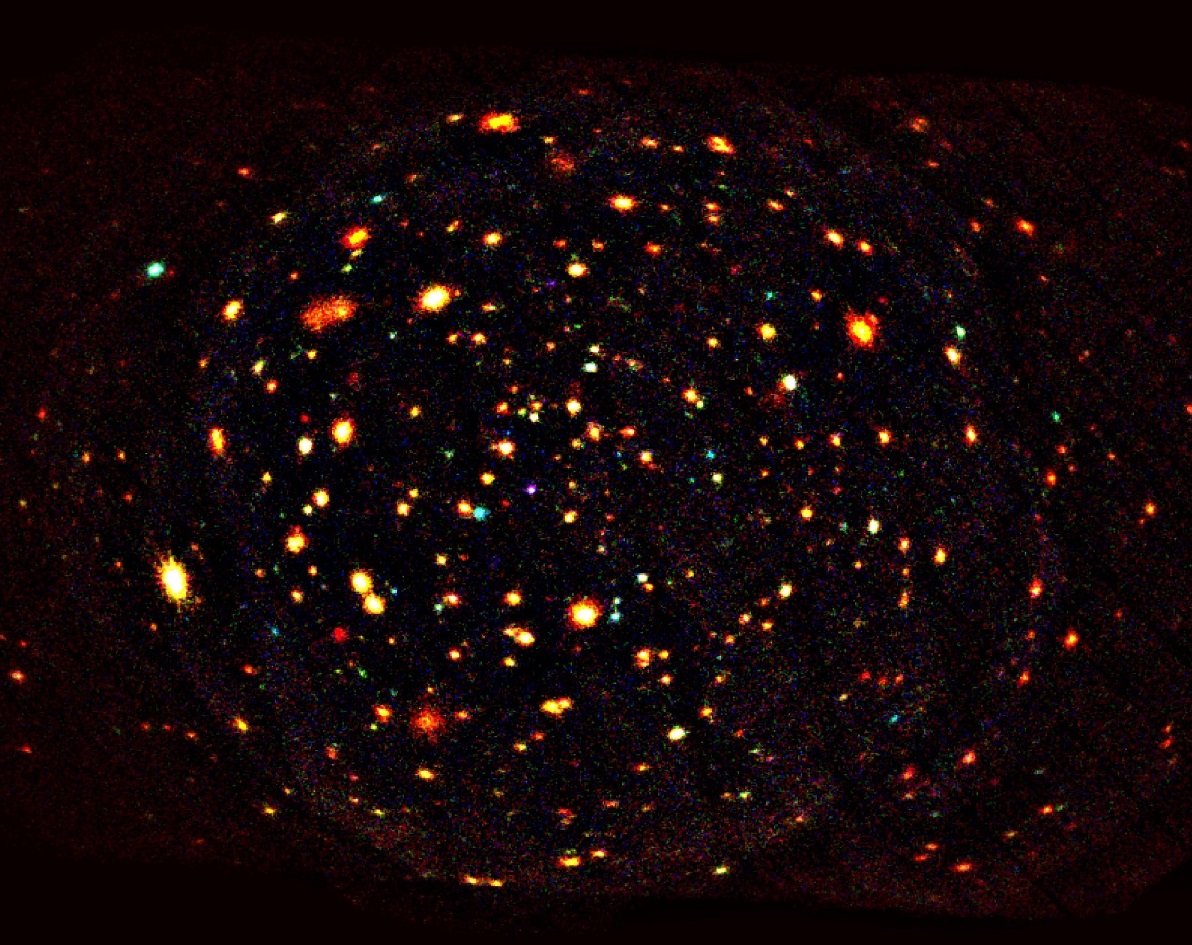
    A special patch of sky can be found close to the Big Dipper, in the northern constellation of Ursa Major, also known as the Great Bear. Appearing to contain no stars and hardly any gas clouds from our Milky Way galaxy, this region is called the Lockman Hole. A unique window into the distant Universe, it was discovered in 1986 by astronomer Felix J. Lockman.

    Since its discovery, astronomers have been surveying the Lockman Hole to study the evolution of galaxies throughout cosmic history. Shortly after the launch of ESA’s XMM-Newton X-ray observatory, which lifted off on 10 December 1999, various teams started looking at this patch of the sky with the new telescope. By 2003, they had accumulated over 200 hours of data.

    This image shows a portion of the Lockman Hole based on those observations. Hundreds of distant galaxies can be seen – their light has travelled billions of years before reaching Earth.

    At the core of each of these galaxies is a supermassive black hole, a huge concentration of matter millions to billions of times more massive than the Sun, whose powerful gravity draws large amounts of material from the surroundings. The majority of the black holes depicted here are accreting nearby matter at a very high rate, which results in the emission of light across the electromagnetic spectrum, including X-rays.

    Also portrayed in the image are a few galaxy clusters, gigantic assemblies of galaxies permeated by hot gas that shines brightly in X-rays. The double-lobed red object towards the upper left of the image is one such galaxy cluster: its light has taken over eight billion years to reach us.

    This colour view combines X-ray data collected at energies of 0.5–2 keV (shown in red), 2–4.5 keV (green) and 4.5–10 keV (blue). The image spans half a degree – about the diameter of the full Moon – on the short side; north is up and east to the left. It was first published in 2001, in a paper by G. Hasinger and colleagues.

    Source: ESA

    Monday, December 14, 2015

    NASA Space Telescopes Solve Missing Water Mystery in Comprehensive Survey of Exoplanets

    Illustration Credit: NASA and ESA
    Science Credit: NASA, ESA, and D. Sing (University of Exeter)
    This image shows an artist's impression of the 10 hot Jupiter exoplanets studied by astronomer David Sing and his colleagues using the Hubble and Spitzer space telescopes. From top left to lower left, these planets are WASP-12b, WASP-6b, WASP-31b, WASP-39b, HD 189733b, HAT-P-12b, WASP-17b, WASP-19b, HAT-P-1b and HD 209458b.   Highest-quality image


    A survey of 10 hot, Jupiter-sized exoplanets conducted with NASA's Hubble and Spitzer space telescopes has led a team to solve a long-standing mystery — why some of these worlds seem to have less water than expected. The findings offer new insights into the wide range of planetary atmospheres in our galaxy and how planets are assembled.

    Of the nearly 2,000 planets confirmed to be orbiting other stars, a subset are gaseous planets with characteristics similar to those of Jupiter but that orbit very close to their stars, making them blistering hot.

    Their close proximity to the star makes them difficult to observe in the glare of starlight. Due to this difficulty, Hubble has only explored a handful of hot Jupiters in the past. These initial studies have found several planets to hold less water than predicted by atmospheric models.

    The international team of astronomers has tackled the problem by making the largest-ever spectroscopic catalog of exoplanet atmospheres. All of the planets in the catalog follow orbits oriented so the planet passes in front of their parent star, as seen from Earth. During this so-called transit, some of the starlight travels through the planet's outer atmosphere. "The atmosphere leaves its unique fingerprint on the starlight, which we can study when the light reaches us," explained co-author Hannah Wakeford of NASA's Goddard Space Flight Center in Greenbelt, Maryland.

    By combining data from NASA's Hubble and Spitzer Space telescopes, the team was able to attain a broad spectrum of light covering wavelengths from the optical to infrared. The difference in planetary radius as measured between visible and infrared wavelengths was used to indicate the type of planetary atmosphere being observed for each planet in the sample, whether hazy or clear. A cloudy planet will appear larger in visible light than at infrared wavelengths, which penetrate deeper into the atmosphere. It was this comparison that allowed the team to find a correlation between hazy or cloudy atmospheres and faint water detection.

    "I'm really excited to finally see the data from this wide group of planets together, as this is the first time we've had sufficient wavelength coverage to compare multiple features from one planet to another," said David Sing of the University of Exeter, United Kingdom, lead author of the paper. "We found the planetary atmospheres to be much more diverse than we expected."

    "Our results suggest it's simply clouds hiding the water from prying eyes, and therefore rule out dry hot Jupiters," explained co-author Jonathan Fortney of the University of California, Santa Cruz. "The alternative theory to this is that planets form in an environment deprived of water, but this would require us to completely rethink our current theories of how planets are born."

    The results are being published in the Dec. 14, 2015, issue of the British science journal Nature.

    The study of exoplanetary atmospheres is currently in its infancy. Hubble's successor, the James Webb Space Telescope, will open a new infrared window on the study of exoplanets and their atmospheres.


    Contacts

    Ray Villard
    Space Telescope Science Institute, Baltimore, Maryland
    410-338-4514
    villard@stsci.edu

    Source: HubbleSite

    NASA Telescopes Detect Jupiter-Like Storm on Small Star

    This illustration shows a cool star, called W1906+40, marked by a raging storm near one of its poles. 
    Image credit: NASA/JPL-Caltech.  › Full image and caption


    Astronomers have discovered what appears to be a tiny star with a giant, cloudy storm, using data from NASA's Spitzer and Kepler space telescopes. The dark storm is akin to Jupiter's Great Red Spot: a persistent, raging storm larger than Earth.

    "The star is the size of Jupiter, and its storm is the size of Jupiter's Great Red Spot," said John Gizis of the University of Delaware, Newark. "We know this newfound storm has lasted at least two years, and probably longer." Gizis is the lead author of a new study appearing in The Astrophysical Journal.

    While planets have been known to have cloudy storms, this is the best evidence yet for a star that has one. The star, referred to as W1906+40, belongs to a thermally cool class of objects called L-dwarfs. Some L-dwarfs are considered stars because they fuse atoms and generate light, as our sun does, while others, called brown dwarfs, are known as "failed stars" for their lack of atomic fusion.

    The L-dwarf in the study, W1906+40, is thought to be a star based on estimates of its age (the older the L-dwarf, the more likely it is a star). Its temperature is about 3,500 degrees Fahrenheit (2,200 Kelvin). That may sound scorching hot, but as far as stars go, it is relatively cool. Cool enough, in fact, for clouds to form in its atmosphere.

    "The L-dwarf's clouds are made of tiny minerals," said Gizis.

    Spitzer has observed other cloudy brown dwarfs before, finding evidence for short-lived storms lasting hours and perhaps days.

    In the new study, the astronomers were able to study changes in the atmosphere of W1906+40 for two years. The L-dwarf had initially been discovered by NASA's Wide-field Infrared Survey Explorer in 2011. Later, Gizis and his team realized that this object happened to be located in the same area of the sky where NASA's Kepler mission had been staring at stars for years to hunt for planets.

    Kepler identifies planets by looking for dips in starlight as planets pass in front of their stars. In this case, astronomers knew observed dips in starlight weren't coming from planets, but they thought they might be looking at a star spot -- which, like our sun's "sunspots," are a result of concentrated magnetic fields. Star spots would also cause dips in starlight as they rotate around the star.

    Follow-up observations with Spitzer, which detects infrared light, revealed that the dark patch was not a magnetic star spot but a colossal, cloudy storm with a diameter that could hold three Earths. The storm rotates around the star about every 9 hours. Spitzer's infrared measurements at two infrared wavelengths probed different layers of the atmosphere and, together with the Kepler visible-light data, helped reveal the presence of the storm.

    While this storm looks different when viewed at various wavelengths, astronomers say that if we could somehow travel there in a starship, it would look like a dark mark near the polar top of the star.

    The researchers plan to look for other stormy stars and brown dwarfs using Spitzer and Kepler in the future.

    "We don't know if this kind of star storm is unique or common, and we don't why it persists for so long," said Gizis.

    Other authors of the study are: Adam Burgasser--University of California, San Diego; Kelle Cruz, Sara Camnasio and Munazza Alam--Hunter College, New York City, New York; Stanimir Metchev--University of Western Ontario, Canada; Edo Berger and Peter Williams--Harvard-Smithsonian Center for Astrophysics, Cambridge, Massachusetts; Kyle Dettman--University of Delaware, Newark; and Joseph Filippazzo--College of Staten Island, New York.

    NASA's Ames Research Center in Moffett Field, California, manages the Kepler and K2 missions for NASA's Science Mission Directorate. JPL managed Kepler mission development. Ball Aerospace & Technologies Corp. operates the flight system with support from the Laboratory for Atmospheric and Space Physics at the University of Colorado in Boulder.

    JPL manages the Spitzer Space Telescope mission for NASA. Science operations are conducted at the Spitzer Science Center at the California Institute of Technology in Pasadena. Spacecraft operations are based at Lockheed Martin Space Systems Company, Littleton, Colorado. Data are archived at the Infrared Science Archive housed at the Infrared Processing and Analysis Center at Caltech.
    Caltech manages JPL for NASA.

    For more information about Kepler and Spitzer visit: http://www.nasa.gov/kepler - http://www.nasa.gov/spitzer


    Media Contact

    Whitney Clavin
    Jet Propulsion Laboratory, Pasadena, California
    818-354-4673

    whitney.clavin@jpl.nasa.gov

    Michele Johnson
    Ames Research Center, Moffett Field, Calif.
    650-604-6982

    michele.johnson@nasa.gov


     Source: JPL-Caltech

    Sunday, December 13, 2015

    Imaging an Expanding Supernova Shell

    An optical image of the galaxy Messier 51 with the insert showing the location of supernova SN2011dh. Using precise radio imaging techniques, astronomers have determined the size of the shock around this supernovae, and estimated its outward velocity. Credit: Rafael Ferrando, Observatory Pla D’arguines


    Supernovae, the explosive deaths of massive stars, are among the most momentous events in the cosmos because they disburse into space all of the chemical elements that were produced inside their progenitor stars, including the elements essential for making planets and life. Their bright emission also enables them to be used as probes of the very distant universe. Not least, supernovae are astrophysical laboratories for the study of very high-velocity shocks and the physics of particles under extreme conditions.

    On May 31, 2011, an amateur astronomer spotted a supernova in the relatively nearby Whirlpool Galaxy (Messier 51), about 257 million light-years away. An analysis of the spectrum of SN2011dh showed that the precursor object was a massive supergiant star, about thirteen times bigger than the Sun (there is also some evidence for the presence of a binary companion star). The explosion set off a shock wave whose bright optical emission comes primarily from the inner dense, slow-moving ejecta. In addition, astronomers see a fast-moving component to the shock that is bright at radio wavelengths. The size and expansion velocity of the shock are thought to be basic distinguishing characteristics of different kinds of supernova (for example, having different mass progenitors or different stellar properties). Astronomers have therefore been at work trying to study these shocks. Unfortunately, supernovae are relatively rare, and so far only five supernovae have gone off in galaxies close enough to us, and recently enough, to have had their detailed shock properties studied.

    CfA astronomers Atish Kamble and Alicia Soderberg and their colleagues have now measured a sixth. They been following SN2011dh in the radio since the explosion took place using a variety of radio telescope facilities, including very long baseline techniques, to obtain very high spatial resolution images of the shock. Observations they took 453 days after the event have now been combined with more recent measurements, enabling the scientists to determine the basic geometry of the shock: It has swept out a nearly spherical shell of hot material about 120 times larger in radius than the average distance Pluto is from the Sun.

    Since the scientists know how long the shock has been propagating, about 453 days, they can estimate its velocity as about 19,000 kilometers per second (over forty-two million miles per hour). Combined with other observations of its radio brightness, the result implies that for nearly all of that time the expansion proceeded without being slowed down significantly by intervening material in space. Only about one-thousandth of a solar-mass of material has been swept up. These measurements are key tests of the robustness of theoretical predictions about supernovae and the underlying assumptions, and the results provide confidence in supernova shock theories. The research is part of an ongoing, cradle-to-grave study of this supernova.


    Reference(s):

    "Imaging the Expanding Shell of SN 2011dh," A. de Witt, M. F. Bietenholz, A. Kamble, A. M. Soderberg, A. Brunthaler, B. Zauderer, N. Bartel and M. P. Rupen, MNRAS, 455, 511, 2015.


    Saturday, December 12, 2015

    IC 443: What Spawned the Jellyfish Nebula?

    IC 443
    Credit Wide Field Optical: Focal Pointe Observatory/B.Franke, 
    Inset: X-ray: NASA/CXC/MSFC/D.Swartz et al, 
    Inset: Optical: DSS, SARA


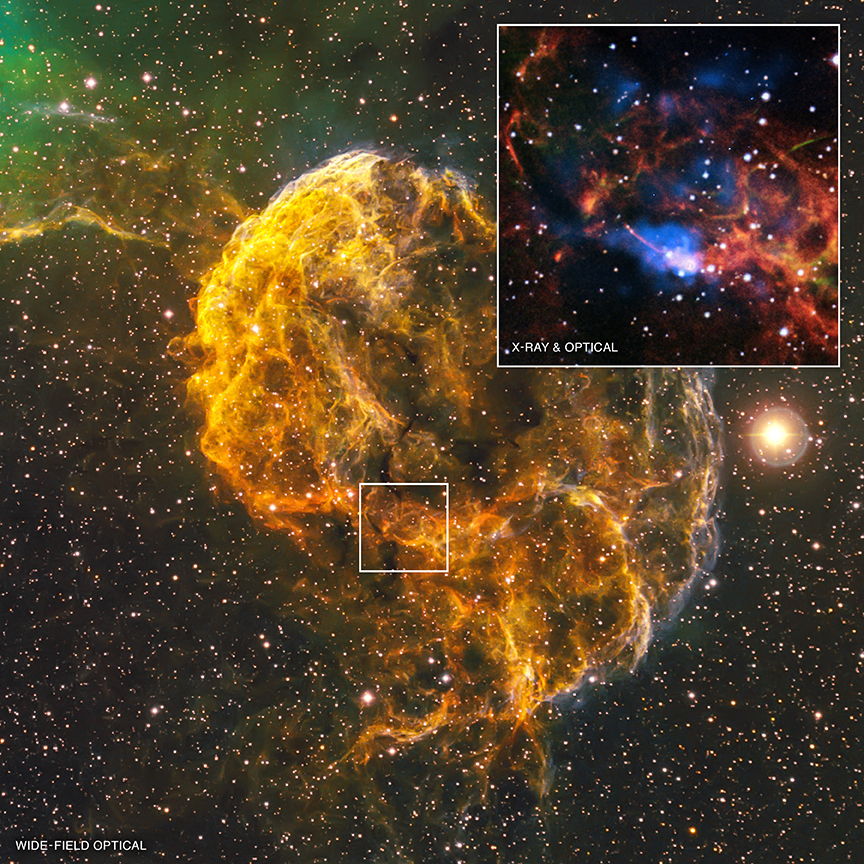
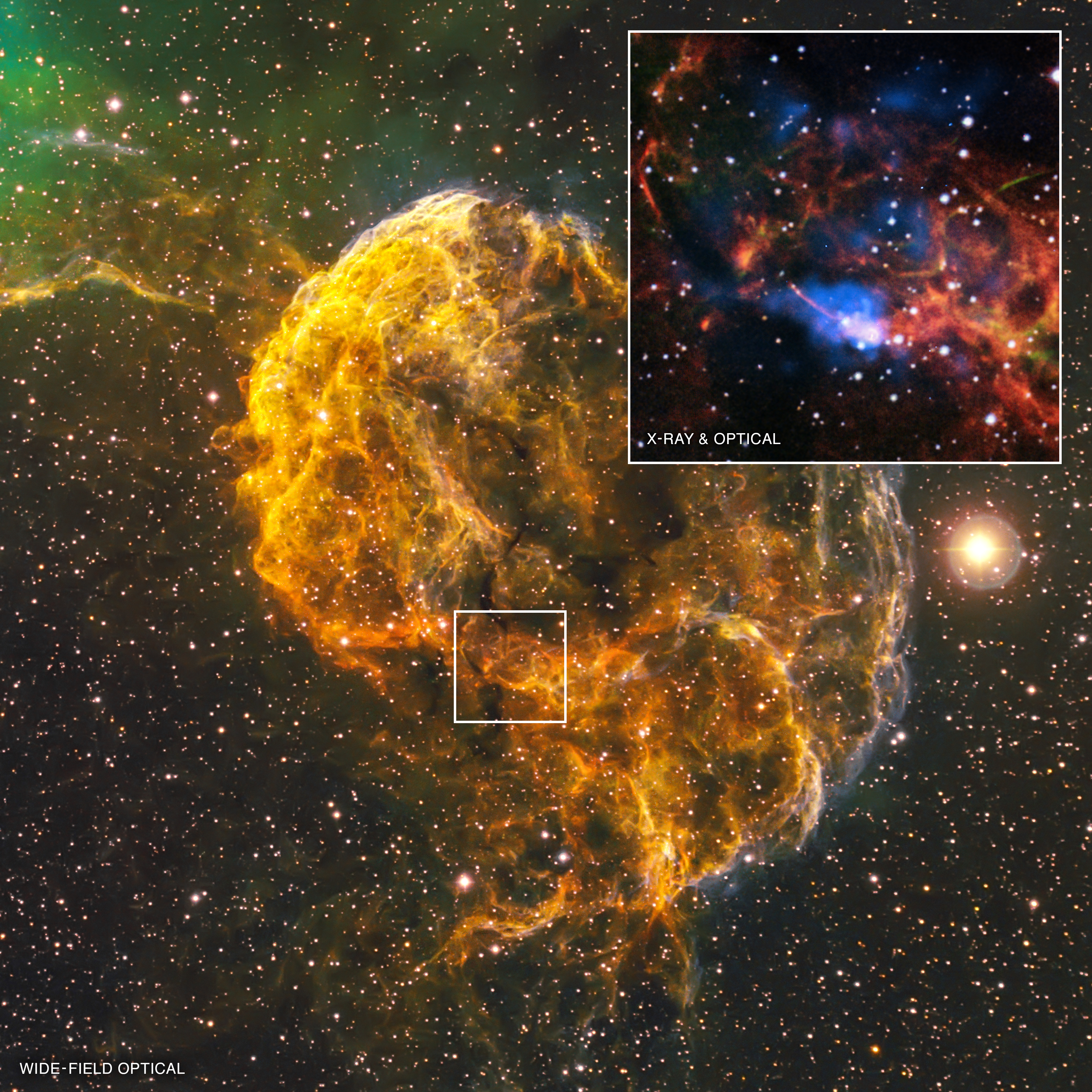
    The Jellyfish Nebula, also known by its official name IC 443, is the remnant of a supernova lying 5,000 light years from Earth. New Chandra observations show that the explosion that created the Jellyfish Nebula may have also formed a peculiar object located on the southern edge of the remnant, called CXOU J061705.3+222127, or J0617 for short. The object is likely a rapidly spinning neutron star, or pulsar.

    When a massive star runs out of thermonuclear fuel, it implodes, forming a dense stellar core called a neutron star. The outer layers of the star collapse toward the neutron star then bounce outward in a supernova explosion. A spinning neutron star that produces a beam of radiation is called a pulsar. The radiation sweeps by like a beacon of light from a lighthouse and can be detected as pulses of radio waves and other types of radiation.

    This new composite image includes a wide-field view from an astrophotographer that shows the spectacular filamentary structure of IC 443. Within the inset box, another optical image from the Digitized Sky Survey (red, green, orange, and cyan) has been combined with X-ray data from Chandra (blue). The inset shows a close-up view of the region around J0617.

    The Chandra image reveals a small, circular structure (or ring) surrounding the pulsar and a jet-like feature pointing roughly in an up-down direction that passes through the pulsar. It is unclear if the long, pink wisp of optical emission is related to the pulsar, as similar wisps found in IC 443 are unrelated to X-ray features from the pulsar. The ring may show a region where a high speed wind of particles flowing away from the pulsar, is slowing down abruptly. Alternately, the ring may represent a shock wave, similar to a sonic boom, ahead of the pulsar wind. The jet could be particles that are being fired away from the pulsar in a narrow beam at high speed.

    The X-ray brightness of J0617 and its X-ray spectrum, or the amount of X-rays at different wavelengths, are consistent with the profiles from known pulsars. The spectrum and shape of the diffuse, or spread out, X-ray emission surrounding J0617 and extending well beyond the ring also match with expectations for a wind flowing from a pulsar.

    X-ray close-up
    (Credit: Wide Field Optical: Focal Pointe Observatory/B.Franke, 
    Inset: X-ray: NASA/CXC/MSFC/D.Swartz et al, 
    Inset: Optical: DSS, SARA)
     

    The comet-like shape of the diffuse X-ray emission suggests motion towards the lower right of the image. As pointed out in previous studies, this orientation is about 50 degrees away from the direction expected if the pulsar was moving away from the center of the supernova remnant in a straight line. This misalignment has cast some doubt on the association of the pulsar with the supernova remnant. However, this misalignment could also be explained by movement towards the left of material in the supernova remnant pushing J0617's cometary tail aside.

    This latest research points to an estimate for the age of the supernova remnant to be tens of thousands of years. This agrees with previous work that pegged IC 443's age to be about 30,000 years. However, other scientists have inferred much younger ages of about 3,000 years for this supernova remnant, so its true age remains in question.

    These findings are available in a paper published in The Astrophysical Journal and is available online. The authors are Douglas Swartz (Marshall Space Flight Center), George Pavlov (Penn State University), Tracy Clarke (Naval Research Laboratory), Gabriela Castelletti (IAEF, Argentina), Vyacheslav Zavlin (MSFC), Niccolo Bucciantini (INAF, Italy), Margarita Karovska (Smithsonian Astrophysical Observatory), Alexander van der Horst (George Washington University), Mihoko Yukita (Goddard Space Flight Center), and Martin Weisskopf (MSFC).

    NASA's Marshall Space Flight Center in Huntsville, Alabama, manages the Chandra program for NASA's Science Mission Directorate in Washington. The Smithsonian Astrophysical Observatory in Cambridge, Massachusetts, controls Chandra's science and flight operations.


    Fast Facts for IC 443:

    Scale: Wide Field: 1.2 deg (about 100 light years); Inset: 7 arcmin (about 10 light years)
    Category: Neutron Stars/X-ray Binaries, Supernovas & Supernova Remnants
    Coordinates (J2000): RA 06h 17m 05.00s | Dec +22° 21' 30.00"
    Constellation: Gemini
    Observation Date: 06 and 08 Feb 2012
    Observation Time: 42 hours 13 min (1 day 18 hours 13 min).
    Obs. ID: 13736, 14385
    Instrument: ACIS
    References: Swartz, D. et al, 2015, ApJ, 808, 84; arXiv:1506.05507
    Color Code: Wide Field Optical (Red, Green, Blue); Inset: Optical (Red, Green, Orange, Cyan), Inset: X-ray (Blue)
    Distance Estimate: About 5,000 light years


    Friday, December 11, 2015

    Galactic politics

    Credit: NASA & ESA, Acknowledgements: Judy Schmidt (Geckzilla)


    Only rarely does an astronomical object have a political association. However, the spiral galaxy NGC 7252 acquired exactly that when it was given an unusual nickname.

    In December 1953, the US President Dwight D. Eisenhower gave a speech advocating the use of nuclear power for peaceful purposes. This  “Atoms for Peace” speech was significant for the scientific community, as it brought nuclear research into the public domain, and NGC 7252, which has a superficial resemblance to an atomic nucleus surrounded by the loops of electronic orbits, was dubbed the Atoms for Peace galaxy in honour of this. These loops are well visible in a wider field of view image.

    This nickname is quite ironic, as the galaxy’s past was anything but peaceful. Its peculiar appearance is the result of a collision between two galaxies that took place about a billion years ago, which ripped both galaxies apart. The loop-like outer structures, likely made up of dust and stars flung outwards by the crash, but recalling orbiting electrons in an atom, are partly responsible for the galaxy’s nickname.

    This NASA/ESA Hubble Space Telescope image shows the inner parts of the galaxy, revealing a pinwheel-shaped disc that is rotating in a direction opposite to the rest of the galaxy. This disc resembles a spiral galaxy like our own galaxy, the Milky Way, but is only about 10 000 light-years across — about a tenth of the size of the Milky Way. It is believed that this whirling structure is a remnant of the galactic collision. It will most likely have vanished in a few billion years’ time, when NGC 7252 will have completed its merging process.


    Thursday, December 10, 2015

    ALMA Spots Monstrous Baby Galaxies Cradled in Dark Matter

    Monstrous galaxies are thought to preferentially be born at the centers of the web-like structures of dark matter and are formed by young galaxies. 
    Credit: ALMA (ESO/NAOJ/NRAO)


    Astronomers using the Atacama Large Millimeter/submillimeter Array (ALMA) have discovered a nest of monstrous baby galaxies 11.5 billion light-years away. These young galaxies seem to reside at the junction of gigantic filaments in a web of dark matter. These findings are important for understanding how monstrous galaxies like these form and how they evolve into huge elliptical galaxies.

    A press release on these results was issued by The University of Tokyo in Japanese. The English version was translated by the National Astronomical Observatory of Japan. The full text is available here.

    # # #

    This observation result was published as Umehata et al. “ALMA Deep Field in SSA22: A concentration of dusty starbursts in a z=3.09 protocluster core” in the Astrophysical Journal Letters, issued on December 4, 2015.

    The Atacama Large Millimeter/submillimeter Array (ALMA), an international astronomy facility, is a partnership of the European Organisation for Astronomical Research in the Southern Hemisphere (ESO), the U.S. National Science Foundation (NSF) and the National Institutes of Natural Sciences (NINS) of Japan in cooperation with the Republic of Chile. ALMA is funded by ESO on behalf of its Member States, by NSF in cooperation with the National Research Council of Canada (NRC) and the National Science Council of Taiwan (NSC) and by NINS in cooperation with the Academia Sinica (AS) in Taiwan and the Korea Astronomy and Space Science Institute (KASI).

    ALMA construction and operations are led by ESO on behalf of its Member States; by the National Radio Astronomy Observatory (NRAO), managed by Associated Universities, Inc. (AUI), on behalf of North America; and by the National Astronomical Observatory of Japan (NAOJ) on behalf of East Asia. The Joint ALMA Observatory (JAO) provides the unified leadership and management of the construction, commissioning and operation of ALMA.


    Wednesday, December 09, 2015

    VLT Revisits a Curious Cosmic Collision

    The surroundings of the interacting galaxy NGC 5291

    The interacting galaxy NGC 5291 in the constellation of Centaurus

    Wide-field view of the sky around the interacting galaxy NGC 5291

    The surroundings of the interacting galaxy NGC 5291 (annotated)


    Videos

    Zooming in on the interacting galaxy system NGC 5291
    Zooming in on the interacting galaxy system NGC 5291

    Close-up view of the surroundings of the interacting galaxy NGC 5291
    Close-up view of the surroundings of the interacting galaxy NGC 5291


    The spectacular aftermath of a 360 million year old cosmic collision is revealed in great detail in new images from ESO’s Very Large Telescope at the Paranal Observatory. Among the debris is a rare and mysterious young dwarf galaxy. This galaxy is providing astronomers with an excellent opportunity to learn more about similar galaxies that are expected to be common in the early Universe, but are normally too faint and distant to be observed by current telescopes.

    NGC 5291, the hazy, golden oval dominating the centre of this image, is an elliptical galaxy located nearly 200 million light-years away in the constellation of Centaurus (The Centaur). Over 360 million years ago, NGC 5291 was involved in a dramatic and violent collision as another galaxy travelling at immense speeds barrelled into its core. The cosmic crash ejected huge streams of gas into nearby space, which later coalesced into a ring formation around NGC 5291 [1].

    Over time, material in this ring gathered and collapsed into dozens of star-forming regions and several dwarf galaxies, revealed as pale blue and white regions scattered around NGC 5291 in this new image from the FORS instrument, mounted on the VLT. The most massive and luminous clump of material, to the right of NGC 5291, is one of these dwarf galaxies and is known as NGC 5291N.

    The Milky Way, like all large galaxies, is believed to have formed through the build-up of smaller dwarf galaxies in the early years of the Universe. These small galaxies, if they have survived on their own up to the present day, now normally contain many extremely old stars.

    Yet NGC 5291N appears to contain no old stars. Detailed observations with the MUSE spectrograph [2] also found that the outer parts of the galaxy had properties typically associated with the formation of new stars, but what was observed is not predicted by current theoretical models. Astronomers suspect that these unusual aspects may be the result of massive collisions of gas in the region.

    NGC 5291N doesn’t look like a typical dwarf galaxy, but instead it shares a striking number of similarities with the clumpy structures present within many of the star-forming galaxies in the distant Universe. This makes it a unique system in our local Universe and an important laboratory for the study of early gas-rich galaxies, which are normally much too distant to be observed in detail by current telescopes.

    This unusual system has previously been observed by a wide range of ground-based facilities, including ESO’s 3.6-metre telescope at the La Silla Observatory [3]. However, the capabilities of MUSE, FORS and the Very Large Telescope have only now allowed some of the history and properties of NGC 5291N to be determined.

    Future observations, including those by ESO’s European Extremely Large Telescope (E-ELT), may allow astronomers to further unravel this dwarf galaxy’s remaining mysteries.


    Notes

    [1] NGC 5291 is currently also interacting more gently with MCG-05-33-005 — or the Seashell Galaxy — the unusual comma-shaped galaxy appearing to leech off NGC 5291’s luminous core.

    [2] NGC 5291N was observed using integral field spectrography during MUSE’s first Science Verification run. Integral field spectrography collects a spectrum at every point on the sky, providing a powerful three-dimensional view of the target. The MUSE observations revealed unexpected oxygen and hydrogen emission lines in the outskirts of NGC 5291N.

    [3] NGC 5291 was studied by astronomers using ESO’s 3.6-metre telescope at the La Silla Observatory back in 1978. These observations revealed large amounts of material in the intergalactic space around the galaxy, which we now know to be the star-forming regions and several dwarf galaxies created from the collapse of the galaxy’s gaseous ring.


    More Information

    This research was presented in a paper entitled “Ionization processes in a local analogue of distant clumpy galaxies: VLT MUSE IFU spectroscopy and FORS deep images of the TDG NGC 5291N”, by J. Fensch et al., to appear in the journal Astronomy & Astrophysics.

    The team is composed of J. Fensch (Laboratoire AIM Paris-Saclay, CEA/IRFU/SAp, Universite Paris Diderot, Gif-sur-Yvette, France [CEA]), P.-A. Duc (CEA) , P. M. Weilbacher (Leibniz-Institut für Astrophysik, Potsdam, Germany), M. Boquien (University of Cambridge, United Kingdom; Universidad de Antofagasta, Antofagasta, Chile) and E. Zackrisson (Uppsala University, Uppsala, Sweden).

    ESO is the foremost intergovernmental astronomy organisation in Europe and the world’s most productive ground-based astronomical observatory by far. It is supported by 16 countries: Austria, Belgium, Brazil, the Czech Republic, Denmark, France, Finland, Germany, Italy, the Netherlands, Poland, Portugal, Spain, Sweden, Switzerland and the United Kingdom, along with the host state of Chile. ESO carries out an ambitious programme focused on the design, construction and operation of powerful ground-based observing facilities enabling astronomers to make important scientific discoveries. ESO also plays a leading role in promoting and organising cooperation in astronomical research. ESO operates three unique world-class observing sites in Chile: La Silla, Paranal and Chajnantor. At Paranal, ESO operates the Very Large Telescope, the world’s most advanced visible-light astronomical observatory and two survey telescopes. VISTA works in the infrared and is the world’s largest survey telescope and the VLT Survey Telescope is the largest telescope designed to exclusively survey the skies in visible light. ESO is a major partner in ALMA, the largest astronomical project in existence. And on Cerro Armazones, close to Paranal, ESO is building the 39-metre European Extremely Large Telescope, the E-ELT, which will become “the world’s biggest eye on the sky”.


    Links

    Contacts

    Jérémy Fensch
    Laboratoire AIM Paris-Saclay, CEA/IRFU/SAp, Universite Paris Diderot
    Gif-sur-Yvette, France
    Email:
    jeremy.fensch@gmail.com

    Richard Hook
    ESO Public Information Officer
    Garching bei München, Germany
    Tel: +49 89 3200 6655
    Cell: +49 151 1537 3591
    Email:
    rhook@eso.org
     

    Source: ESO

    NASA Releases New Visualization of Space Environment at Pluto

    This video shows a simulation of the space environment all the way out to Pluto in the months surrounding New Horizons’ July 2015 flyby. At the time, scientists at NASA’s Goddard Space Flight Center in Greenbelt, Maryland, worked with the New Horizons team to test how well their models—and other models contributed by scientists around the world—predicted the space environment at Pluto. Understanding the environment through which our spacecraft travel can ultimately help protect them from radiation and other potentially damaging effects. Visualizers at Goddard recently updated the movie of the model, creating this new release. Credits: NASA's Goddard Space Flight Center Scientific Visualization Studio, the Space Weather Research Center (SWRC) and the Community-Coordinated Modeling Center (CCMC), Enlil and Dusan Odstrcil (GMU). Download this video in HD formats from NASA Goddard's Scientific Visualization Studio

    This artist's concept depicts the New Horizons spacecraft during its July 2015 encounter with Pluto and one of the dwarf planet's moons, Charon.  Credits: Johns Hopkins University Applied Physics Laboratory/Southwest Research Institute.


    Though the vacuum of space is about a thousand times emptier than a laboratory vacuum, it’s still not completely empty. The sun releases a constant stream of particles called the solar wind—as well as occasional denser clouds of particles known as coronal mass ejections, or CMEs—both containing embedded magnetic fields. The density, speed, and temperature of these particles, as well as the direction and strength of the embedded magnetic fields, make up the space environment.

    To map the space environment at Pluto, scientists combined the predictions of several models—and looked at events that had long since passed Earth.

    "We set the simulation to start in January of 2015, because the particles passing Pluto in July 2015 took some six months to make the journey from the sun," said Dusan Odstrcil, a space weather scientist at Goddard who created the Enlil model. The Enlil model, named for the Sumerian god of the wind, is one of the primary models used to simulate the space environment near Earth and is the basis for the New Horizons simulation.  

    The new, combined model tracks CMEs longer than ever before. Because particles must travel for many months before reaching Pluto, the CMEs eventually spread out and merge with other CMEs and the solar wind to form larger clouds of particles and magnetic field. These combined clouds stretch out as they travel away from the sun, forming thin ring shapes by the time they reach Pluto—quite different from the typical balloon shape of CMEs seen here at Earth.


    Related Links 


    Sarah Frazier
    NASA’s Goddard Space Flight Center, Greenbelt, Md.