Showing posts with label Cosmic Collisions. Show all posts

Saturday, March 07, 2020

Catastrophic Collisions in Protoplanetary Disks

Striking images of protoplanetary disks with unique arced and spiral features, captured by the SPHERE instrument on ESO’s Very Large Telescope. [ESO]

Some of the most spectacular images to come out of observatories like the Atacama Large Millimeter/submillimeter Array (ALMA) or the Very Large Telescope (VLT) are detailed views of protoplanetary disks. These disks of gas and dust around young stars aren’t just smooth and featureless; instead, they exhibit arcs, rings, gaps, and spirals. What causes this impressive array of structure? 

Scientists have primarily focused on two explanations:
  1. The structures are caused by the perturbations of massive baby planets interacting with the disk as they orbit.
  2. The structures are generated by various instabilities within the disk that cause the gas and dust to clump.
A new study has now put forward an alternative explanation: the structures are the result of catastrophic, destructive collisions of planetesimals within the disk. Scientists Tatiana Demidova (Crimean Astrophysical Observatory) and Vladimir Grinin (Pulkovo Observatory of the Russian Academy of Sciences; St. Petersburg University, Russia) lay out their scenario of destruction in a recent publication.

This ALMA image of the protoplanetary disk surrounding the star HL Tauri reveals the detailed substructure of the disk. [ALMA (ESO/NAOJ/NRAO)]

Outcome of a Crash

Collisions of large bodies — planetesimals and planetary embryos — are likely common during the formation of planetary systems around young stars. Some gentle collisions may help build up the mass of these bodies as they grow into planets. But objects that smash together at high enough velocities will be completely destroyed in the process, generating an expanding cloud of many smaller bodies and particles.

This cloud won’t remain stationary, however; instead, it will continue to orbit within the protoplanetary disk. Due to the different speeds of the various particles, the initial debris clump should be sheared out into arced structures that might persist for multiple disk orbits.

Could this process faithfully reproduce the disk structures that we’ve observed with ALMA or the VLT? Demidova and Grinin conduct simulations to find out.

Simulated 1.3-mm observations of the evolution of an expanding debris cloud over 40 orbital periods of the cloud center. Time steps advance from top left to bottom right panel. Click to enlarge. [Demidova & Grinin 2019]

Dragging Debris in a Disk

By modeling an expanding debris cloud within a disk that starts at a distance of 30 AU from its solar-mass star, the authors show how the dust and gas will evolve over several disk orbits. They then produce simulated observations of the results at a wavelength of 1.3 mm.

The result? Demidova and Grinin find that as the dust cloud stretches, it successively reproduces all three structures we’ve seen in protoplanetary disks — first, it shapes into an arc, then a tightly wound spiral, and eventually into a ring. The simulated observations at 1.3 mm look very similar to various disk images we’ve captured.

There are still many open questions about the structure of the disks around young stars, but this work shows that there are also many potential answers. As planetary systems form, collisions may both grow planetary embryos and destroy them, possibly causing some of the disk features that we’ve observed. One thing is for certain: the environment around young stars is certainly dramatic!

Citation

“Catastrophic Events in Protoplanetary Disks and Their Observational Manifestations,” Tatiana V. Demidova and Vladimir P. Grinin 2019 ApJL 887 L15. doi:10.3847/2041-8213/ab59e0

 Source:  American Astronomical Society (AAS)


Friday, October 25, 2019

First identification of a heavy element born from neutron star collision

Artist’s impression of strontium emerging from a neutron star merger

X-shooter spectra montage of kilonova in NGC 4993

The galaxy NGC 4993 in the constellation of Hydra

The sky around the galaxy NGC 4993


Videos

ESOcast 210 Light: First identification of a heavy element born from neutron star collision

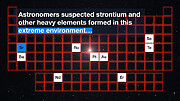
Neutron star merger animation and elements formed in these events

Animation of spectra of kilonova in NGC 4993


For the first time, a freshly made heavy element, strontium, has been detected in space, in the aftermath of a merger of two neutron stars. This finding was observed by ESO’s X-shooter spectrograph on the Very Large Telescope (VLT) and is published today in Nature. The detection confirms that the heavier elements in the Universe can form in neutron star mergers, providing a missing piece of the puzzle of chemical element formation.


In 2017, following the detection of gravitational waves passing the Earth, ESO pointed its telescopes in Chile, including the VLT, to the source: a neutron star merger named GW170817. Astronomers suspected that, if heavier elements did form in neutron star collisions, signatures of those elements could be detected in kilonovae, the explosive aftermaths of these mergers. This is what a team of European researchers has now done, using data from the X-shooter instrument on ESO’s VLT.


Following the GW170817 merger, ESO’s fleet of telescopes began monitoring the emerging kilonova explosion over a wide range of wavelengths. X-shooter in particular took a series of spectra from the ultraviolet to the near infrared. Initial analysis of these spectra suggested the presence of heavy elements in the kilonova, but astronomers could not pinpoint individual elements until now. 

“By reanalysing the 2017 data from the merger, we have now identified the signature of one heavy element in this fireball, strontium, proving that the collision of neutron stars creates this element in the Universe,” says the study’s lead author Darach Watson from the University of Copenhagen in Denmark. On Earth, strontium is found naturally in the soil and is concentrated in certain minerals. Its salts are used to give fireworks a brilliant red colour. 

Astronomers have known the physical processes that create the elements since the 1950s. Over the following decades they have uncovered the cosmic sites of each of these major nuclear forges, except one. “This is the final stage of a decades-long chase to pin down the origin of the elements,” says Watson. “We know now that the processes that created the elements happened mostly in ordinary stars, in supernova explosions, or in the outer layers of old stars. But, until now, we did not know the location of the final, undiscovered process, known as rapid neutron capture, that created the heavier elements in the periodic table.”

Rapid neutron capture is a process in which an atomic nucleus captures neutrons quickly enough to allow very heavy elements to be created. Although many elements are produced in the cores of stars, creating elements heavier than iron, such as strontium, requires even hotter environments with lots of free neutrons. Rapid neutron capture only occurs naturally in extreme environments where atoms are bombarded by vast numbers of neutrons.

“This is the first time that we can directly associate newly created material formed via neutron capture with a neutron star merger, confirming that neutron stars are made of neutrons and tying the long-debated rapid neutron capture process to such mergers,” says Camilla Juul Hansen from the Max Planck Institute for Astronomy in Heidelberg, who played a major role in the study.

Scientists are only now starting to better understand neutron star mergers and kilonovae. Because of the limited understanding of these new phenomena and other complexities in the spectra that the VLT’s X-shooter took of the explosion, astronomers had not been able to identify individual elements until now.

“We actually came up with the idea that we might be seeing strontium quite quickly after the event. However, showing that this was demonstrably the case turned out to be very difficult. This difficulty was due to our highly incomplete knowledge of the spectral appearance of the heavier elements in the periodic table,” says University of Copenhagen researcher Jonatan Selsing, who was a key author on the paper. 

The GW170817 merger was the fifth detection of gravitational waves, made possible thanks to the NSF's Laser Interferometer Gravitational-Wave Observatory (LIGO) in the US and the Virgo Interferometer in Italy. Located in the galaxy NGC 4993, the merger was the first, and so far the only, gravitational wave source to have its visible counterpart detected by telescopes on Earth. 


With the combined efforts of LIGO, Virgo and the VLT, we have the clearest understanding yet of the inner workings of neutron stars and their explosive mergers.


More Information

This research was presented in a paper to appear in Nature on 24 October 2019.

The team is composed of D. Watson (Niels Bohr Institute & Cosmic Dawn Center, University of Copenhagen, Denmark), C. J. Hansen (Max Planck Institute for Astronomy, Heidelberg, Germany), J. Selsing (Niels Bohr Institute & Cosmic Dawn Center, University of Copenhagen, Denmark), A. Koch (Center for Astronomy of Heidelberg University, Germany), D. B. Malesani (DTU Space, National Space Institute, Technical University of Denmark, & Niels Bohr Institute & Cosmic Dawn Center, University of Copenhagen, Denmark), A. C. Andersen (Niels Bohr Institute, University of Copenhagen, Denmark), J. P. U. Fynbo (Niels Bohr Institute & Cosmic Dawn Center, University of Copenhagen, Denmark), A. Arcones (Institute of Nuclear Physics, Technical University of Darmstadt, Germany & GSI Helmholtzzentrum für Schwerionenforschung, Darmstadt, Germany), A. Bauswein (GSI Helmholtzzentrum für Schwerionenforschung, Darmstadt, Germany & Heidelberg Institute for Theoretical Studies, Germany), S. Covino (Astronomical Observatory of Brera, INAF, Milan, Italy), A. Grado (Capodimonte Astronomical Observatory, INAF, Naples, Italy), K. E. Heintz (Centre for Astrophysics and Cosmology, Science Institute, University of Iceland, Reykjavík, Iceland & Niels Bohr Institute & Cosmic Dawn Center, University of Copenhagen, Denmark), L. Hunt (Arcetri Astrophysical Observatory, INAF, Florence, Italy), C. Kouveliotou (George Washington University, Physics Department, Washington DC, USA & Astronomy, Physics and Statistics Institute of Sciences), G. Leloudas (DTU Space, National Space Institute, Technical University of Denmark, & Niels Bohr Institute, University of Copenhagen, Denmark), A. Levan (Department of Physics, University of Warwick, UK), P. Mazzali (Astrophysics Research Institute, Liverpool John Moores University, UK & Max Planck Institute for Astrophysics, Garching, Germany), E. Pian (Astrophysics and Space Science Observatory of Bologna, INAF, Bologna, Italy).

ESO is the foremost intergovernmental astronomy organisation in Europe and the world’s most productive ground-based astronomical observatory by far. It has 16 Member States: Austria, Belgium, the Czech Republic, Denmark, France, Finland, Germany, Ireland, Italy, the Netherlands, Poland, Portugal, Spain, Sweden, Switzerland and the United Kingdom, along with the host state of Chile and with Australia as a Strategic Partner. ESO carries out an ambitious programme focused on the design, construction and operation of powerful ground-based observing facilities enabling astronomers to make important scientific discoveries. ESO also plays a leading role in promoting and organising cooperation in astronomical research. ESO operates three unique world-class observing sites in Chile: La Silla, Paranal and Chajnantor. At Paranal, ESO operates the Very Large Telescope and its world-leading Very Large Telescope Interferometer as well as two survey telescopes, VISTA working in the infrared and the visible-light VLT Survey Telescope. Also at Paranal ESO will host and operate the Cherenkov Telescope Array South, the world’s largest and most sensitive gamma-ray observatory. ESO is also a major partner in two facilities on Chajnantor, APEX and ALMA, the largest astronomical project in existence. And on Cerro Armazones, close to Paranal, ESO is building the 39-metre Extremely Large Telescope, the ELT, which will become “the world’s biggest eye on the sky”.


Links


Contacts

Darach Watson
Cosmic Dawn Center (DAWN), Niels Bohr Institute, University of Copenhagen
Copenhagen, Denmark
Cell: +45 24 80 38 25
Email: darach@nbi.ku.dk

Camilla J. Hansen
Max Planck Institute for Astronomy
Heidelberg, Germany
Tel: +49 6221 528-358
Email: hansen@mpia.de

Jonatan Selsing
Cosmic Dawn Center (DAWN), Niels Bohr Institute, University of Copenhagen
Copenhagen, Denmark
Cell: +45 61 71 43 46
Email: jselsing@nbi.ku.dk

Bárbara Ferreira
ESO Public Information Officer
Garching bei München, Germany
Tel: +49 89 3200 6670
Email: pio@eso.org


Wednesday, December 09, 2015

VLT Revisits a Curious Cosmic Collision

The surroundings of the interacting galaxy NGC 5291

The interacting galaxy NGC 5291 in the constellation of Centaurus

Wide-field view of the sky around the interacting galaxy NGC 5291

The surroundings of the interacting galaxy NGC 5291 (annotated)


Videos

Zooming in on the interacting galaxy system NGC 5291

Close-up view of the surroundings of the interacting galaxy NGC 5291


The spectacular aftermath of a 360 million year old cosmic collision is revealed in great detail in new images from ESO’s Very Large Telescope at the Paranal Observatory. Among the debris is a rare and mysterious young dwarf galaxy. This galaxy is providing astronomers with an excellent opportunity to learn more about similar galaxies that are expected to be common in the early Universe, but are normally too faint and distant to be observed by current telescopes.

NGC 5291, the hazy, golden oval dominating the centre of this image, is an elliptical galaxy located nearly 200 million light-years away in the constellation of Centaurus (The Centaur). Over 360 million years ago, NGC 5291 was involved in a dramatic and violent collision as another galaxy travelling at immense speeds barrelled into its core. The cosmic crash ejected huge streams of gas into nearby space, which later coalesced into a ring formation around NGC 5291 [1].

Over time, material in this ring gathered and collapsed into dozens of star-forming regions and several dwarf galaxies, revealed as pale blue and white regions scattered around NGC 5291 in this new image from the FORS instrument, mounted on the VLT. The most massive and luminous clump of material, to the right of NGC 5291, is one of these dwarf galaxies and is known as NGC 5291N.

The Milky Way, like all large galaxies, is believed to have formed through the build-up of smaller dwarf galaxies in the early years of the Universe. These small galaxies, if they have survived on their own up to the present day, now normally contain many extremely old stars.

Yet NGC 5291N appears to contain no old stars. Detailed observations with the MUSE spectrograph [2] also found that the outer parts of the galaxy had properties typically associated with the formation of new stars, but what was observed is not predicted by current theoretical models. Astronomers suspect that these unusual aspects may be the result of massive collisions of gas in the region.

NGC 5291N doesn’t look like a typical dwarf galaxy, but instead it shares a striking number of similarities with the clumpy structures present within many of the star-forming galaxies in the distant Universe. This makes it a unique system in our local Universe and an important laboratory for the study of early gas-rich galaxies, which are normally much too distant to be observed in detail by current telescopes.

This unusual system has previously been observed by a wide range of ground-based facilities, including ESO’s 3.6-metre telescope at the La Silla Observatory [3]. However, the capabilities of MUSE, FORS and the Very Large Telescope have only now allowed some of the history and properties of NGC 5291N to be determined.

Future observations, including those by ESO’s European Extremely Large Telescope (E-ELT), may allow astronomers to further unravel this dwarf galaxy’s remaining mysteries.


Notes

[1] NGC 5291 is currently also interacting more gently with MCG-05-33-005 — or the Seashell Galaxy — the unusual comma-shaped galaxy appearing to leech off NGC 5291’s luminous core.

[2] NGC 5291N was observed using integral field spectrography during MUSE’s first Science Verification run. Integral field spectrography collects a spectrum at every point on the sky, providing a powerful three-dimensional view of the target. The MUSE observations revealed unexpected oxygen and hydrogen emission lines in the outskirts of NGC 5291N.

[3] NGC 5291 was studied by astronomers using ESO’s 3.6-metre telescope at the La Silla Observatory back in 1978. These observations revealed large amounts of material in the intergalactic space around the galaxy, which we now know to be the star-forming regions and several dwarf galaxies created from the collapse of the galaxy’s gaseous ring.


More Information

This research was presented in a paper entitled “Ionization processes in a local analogue of distant clumpy galaxies: VLT MUSE IFU spectroscopy and FORS deep images of the TDG NGC 5291N”, by J. Fensch et al., to appear in the journal Astronomy & Astrophysics.

The team is composed of J. Fensch (Laboratoire AIM Paris-Saclay, CEA/IRFU/SAp, Universite Paris Diderot, Gif-sur-Yvette, France [CEA]), P.-A. Duc (CEA) , P. M. Weilbacher (Leibniz-Institut für Astrophysik, Potsdam, Germany), M. Boquien (University of Cambridge, United Kingdom; Universidad de Antofagasta, Antofagasta, Chile) and E. Zackrisson (Uppsala University, Uppsala, Sweden).

ESO is the foremost intergovernmental astronomy organisation in Europe and the world’s most productive ground-based astronomical observatory by far. It is supported by 16 countries: Austria, Belgium, Brazil, the Czech Republic, Denmark, France, Finland, Germany, Italy, the Netherlands, Poland, Portugal, Spain, Sweden, Switzerland and the United Kingdom, along with the host state of Chile. ESO carries out an ambitious programme focused on the design, construction and operation of powerful ground-based observing facilities enabling astronomers to make important scientific discoveries. ESO also plays a leading role in promoting and organising cooperation in astronomical research. ESO operates three unique world-class observing sites in Chile: La Silla, Paranal and Chajnantor. At Paranal, ESO operates the Very Large Telescope, the world’s most advanced visible-light astronomical observatory and two survey telescopes. VISTA works in the infrared and is the world’s largest survey telescope and the VLT Survey Telescope is the largest telescope designed to exclusively survey the skies in visible light. ESO is a major partner in ALMA, the largest astronomical project in existence. And on Cerro Armazones, close to Paranal, ESO is building the 39-metre European Extremely Large Telescope, the E-ELT, which will become “the world’s biggest eye on the sky”.


Links

Contacts

Jérémy Fensch
Laboratoire AIM Paris-Saclay, CEA/IRFU/SAp, Universite Paris Diderot
Gif-sur-Yvette, France
Email:
jeremy.fensch@gmail.com

Richard Hook
ESO Public Information Officer
Garching bei München, Germany
Tel: +49 89 3200 6655
Cell: +49 151 1537 3591
Email:
rhook@eso.org
 

Source: ESO

Monday, July 15, 2013

Disks Don't Need Planets to Make Patterns

Debris disks around stars naturally form complex structures without the presence of a planet. This image shows the dust density and the growth of structure in a simulated disk, which extends about 100 times farther from its star than Earth's orbit around the sun. At left, the disk is seen from 24-degree angle; at right, it's face-on. Lighter colors show greater dust concentrations. Image credit: NASA Goddard/JPL-Caltech.  › Larger image

Many young stars known to host planets also possess disks containing dust and icy grains, particles produced by collisions among asteroids and comets also orbiting the star. These debris disks often show sharply defined rings or spiral patterns, features that could signal the presence of orbiting planets. Astronomers study the disk features as a way to better understand the physical properties of known planets and possibly uncover new ones. 

But a new study by NASA scientists sounds a cautionary note in interpreting rings and spiral arms as signposts for new planets. Thanks to interactions between gas and dust, a debris disk may, under the right conditions, produce narrow rings on its own -- no planets needed. 

"When the mass of gas is roughly equal to the mass of dust, the two interact in a way that leads to clumping in the dust and the formation of patterns," said lead researcher Wladimir Lyra, a Sagan Fellow at NASA's Jet Propulsion Laboratory in Pasadena, Calif. "In essence, the gas shepherds the dust into the kinds of structures we would expect to be see if a planet were present." 

A paper describing the findings was published in the July 11 issue of Nature. 

The warm dust in debris disks is easy to detect at infrared wavelengths, but estimating the gas content of disks is a much greater challenge. As a result, theoretical studies tend to focus on the role of dust and ice particles, paying relatively little attention to the gas component. Yet icy grains evaporate and collisions produce both gas and dust, so at some level all debris disks must contain some amount of gas. 

"All we need to produce narrow rings and other structures in our models of debris disks is a bit of gas, too little for us to detect today in most actual systems," said co-author Marc Kuchner, an astrophysicist at NASA's Goddard Space Flight Center in Greenbelt, Md. 

Here's how it works. When high-energy ultraviolet light from the central star strikes a clump of dust and ice grains, it drives electrons off the particles. These high-speed electrons then collide with and heat nearby gas.
The rising gas pressure changes the drag force on the orbiting dust, causing the clump to grow and better heat the gas. This interaction, which the astronomers refer to as the photoelectric instability, continues to cascade. Clumps grow into arcs, rings and oval features in tens of thousands of years, a relatively short time compared to other forces at work in a young solar system. 

A model developed by Lyra and Kuchner shows the process at work. 

"We were fascinated to watch this structure form in the simulations," Lyra said. "Some of the rings begin to oscillate, and at any moment they have the offset appearance of dust rings we see around many stars, such as Fomalhaut." 

In addition, dense clumps with many times the dust density elsewhere in the disk also form during the simulation. When a clump in a ring grows too dense, the ring breaks into arcs and the arcs gradually shrink until only a single compact clump remains. In actual debris disks, some of these dense clumps could reflect enough light to be directly observable. 

"We would detect these clumps as bright moving sources of light, which is just what we're looking for when we search for planets," adds Kuchner.
The researchers conclude that the photoelectric instability provides a simple and plausible explanation for many of the features found in debris disks, making the job of planet-hunting astronomers just a little bit harder. 

An abstract for the Nature paper, titled "Sharp Eccentric Rings in Planetless Hydrodynamical Models of Debris Disks," is online at http://dx.doi.org/10.1038/nature12281

The Sagan Fellowship Program is administered by the NASA Exoplanet Science Institute at the California Institute of Technology in Pasadena. Its purpose is to advance the scientific and technical goals of NASA's Exoplanet Exploration Program, managed for NASA by JPL. Caltech manages JPL for NASA. 


Whitney Clavin 818-354-4673
Jet Propulsion Laboratory, Pasadena, Calif.

whitney.clavin@jpl.nasa.gov


Wednesday, January 05, 2011

Identity Parade Clears Cosmic Collisions of the Suspicion of Promoting Black Hole Growth

Selected galaxies from the COSMOS survey

Zoom on the COSMOS field

What happens when galaxies crash together? For years, these cosmic collisions have been blamed for triggering violent outbursts at the hearts of galaxies. Now, a remarkable piece of detective work has given a verdict: galactic mergers do not usually whet the appetite of the black holes that power these active galactic nuclei, meaning other, less dramatic phenomena are responsible.

Most galaxies, including our own, have a huge but well-behaved black hole at their heart, while some have messy eaters that suck in vast amounts of matter which then shines brightly as it falls towards oblivion. This causes the telltale bright spots at the centre of galaxies known as active galactic nuclei (AGN). Why are the two types so different? Until now, the leading theory has been that mergers between galaxies are instrumental in driving matter into the black holes, making them grow.

In a new study, the largest of its kind so far, astronomers set up an identity parade of galaxies to test this theory [1]. Comparing 140 active galaxies with a control group of over 1200 comparable inactive galaxies, they found that there has been no significant link between AGN activity and galactic mergers for at least the past eight billion years [2]. Therefore, other phenomena such as instabilities within galaxies, collisions of molecular clouds or tidal disruption by other galaxies flying by must instead be to blame.

The results will be published in the Astrophysical Journal on 10 January.

The emission of radiation from active galactic nuclei is driven by the behaviour of matter such as gas clouds and even stars as it heats up and falls into the galaxy's supermassive central black hole. But an open question in the physics of active galaxies is precisely how matter crosses the final few hundreds of light-years to reach the immediate neighbourhood of the black hole before being swallowed.

Team leader Mauricio Cisternas from Germany's Max Planck Institute for Astronomy explains: "A study of this scope has become possible only recently, as the large surveys undertaken using the Hubble Space Telescope have become available. These have given us a huge sample of galaxies, both active and inactive, meaning that we can now study many distant galaxies in exquisite detail. Before these surveys, we hadn't examined many active galaxies at large cosmic distances in sufficient detail."

Cisternas and his team chose 140 active galaxies from the COSMOS survey. The COSMOS field is an area of sky roughly 10 times the area covered by the Moon, in the constellation of Sextans (the Sextant), which has been comprehensively mapped by Hubble and other telescopes at different wavelengths. It contains several hundred thousand distant galaxies of all types. The team was able to identify active galaxies from among these using X-ray observations from ESA's XMM-Newton space telescope, and they then studied the more detailed optical images of them taken by the NASA/ESA Hubble Space Telescope.

For each of the active galaxies in the study, they selected nine non-active galaxies at roughly the same distances, and thus roughly in the same stage of cosmic evolution, from the same Hubble images. This gives a grand total of just over 1400 galaxies that the team could then test for the telltale signs of mergers.

"You can usually tell when galaxies have been involved in a merger," explains Knud Jahnke, co-author of the study. "Instead of the neat, geometric spiral or smooth elliptical shapes you usually see in Hubble images, colliding galaxies typically look distorted and warped. We planned to find out whether these misshapen galaxies were more likely than regular ones to host active nuclei."

Identifying whether or not a galaxy is distorted is a matter of judgement for which the expert eye of a trained astronomer is far better than any computerised assessment. To harness this human expertise without introducing the risk of unwitting bias, Cisternas set up a kind of identity parade of galaxies, in which he had modelled and removed the bright spot that reveals the AGN. Ten galaxy experts, based at eight different institutions, independently assessed whether each of the galaxies was distorted or not, without being told which had an AGN.

None of the experts found a significant correlation between a galaxy's activity and its distortion, that is, between its black hole being well-fed and its involvement in a major merger.

While mergers are a common phenomenon, and are thought to play a role at least for some AGN, the study shows that they provide neither a universal nor a dominant mechanism for feeding black holes. By the study's statistics, at least 75%, and possibly all, of AGN activity over the last eight billion years must have a different explanation. Possible ways of transporting matter towards a central black hole include instabilities of structures like a spiral galaxy's bar, the collisions of giant molecular clouds within the galaxy, or the fly-by of another galaxy that does not lead to a merger (known as galactic harassment).

Could there still be a causal connection between mergers and activity in the more distant past? That is the next question the group is gearing up to address. Suitable data is bound to come from two ongoing observational programmes (Multi-Cycle Treasury Programs) with the Hubble Space Telescope, as well as from observations by its successor, the James Webb Space Telescope, which is scheduled for launch after 2014.
Notes

The Hubble Space Telescope is a project of international cooperation between ESA and NASA.

[1] The international team of astronomers in this study consists of Mauricio Cisternas (Max Planck Institute for Astronomy and University of Heidelberg), Knud Jahnke (Max Planck Institute for Astronomy), Katherine J Inskip (Max Planck Institute for Astronomy), Jeyhan Kartaltepe (National Optical Astronomy Observatory), Anton M Koekemoer (Space Telescope Science Institute), Thorsten Lisker (University of Heidelberg), Aday R Robaina (Max Planck Institute for Astronomy), Marco Scodeggio (IASF-INAF), Kartik Sheth (California Institute of Technology and Spitzer Science Center), Jonathan R Trump (University of Arizona), René Andrae (Max Planck Institute for Astronomy), Takamitsu Miyaji (Universidad Nacional Autónoma de Mexico and University of California at San Diego), Elisabeta Lusso (INAF-Osservatorio Astronomico di Bologna), Marcella Brusa (Max Planck Institute for Extraterrestrial Physics), Peter Capak (California Institute of Technology), Nico Cappelluti (Max Planck Institute for Extraterrestrial Physics), Francesca Civano (Harvard Smithsonian Center for Astrophysics), Olivier Ilbert (Laboratoire d'Astrophysique de Marseille) Chris D Impey (Spitzer Science Center), Alexie Leauthaud (LBNL & Berkeley Center for Cosmological Physics), Simon J Lilly (ETH Zurich), Mara Salvato (Max Planck Institute for Plasma Physics), Nick Z Scoville (California Institute of Technology) and Yoshi Taniguchi (Ehime University).

[2] Current theories estimate that the Universe is 13.7 billion years old. The most remote galaxies (and hence the furthest back in time) that Hubble has been able to observe are seen as they were around thirteen billion years ago. The light from the galaxies used in this study has taken up to eight billion years to travel to us, which represents more than half of cosmic history.

Links

Images of Hubble
Paper from the Astrophysical Journal (PDF)
MPIA press release
Max-Planck Institute for Astronomy
Mauricio Cisternas homepage
Knud Jahnke homepage
MPIA research group on coevolution of galaxies and black holes
COSMOS survey

Contacts

Mauricio Cisternas
Max Planck Institute for Astronomy
Heidelberg, Germany
Tel: +49-6221-528-335
Email: cisternas@mpia.de

Knud Jahnke
Max Planck Institute for Astronomy
Heidelberg, Germany
Tel: +49-6221 528-398
Email: jahnke@mpia.de

Oli Usher
Hubble/ESA
Garching, Germany
Tel: +49-89-3200-6855
Email: ousher@eso.org

Markus Pössel
Max Planck Institute for Astronomy Press Office
Heidelberg, Germany
Tel: +49-6221-528-261
Email: poessel@mpia.de