Showing posts with label Lockman Hole. Show all posts

Tuesday, December 15, 2015

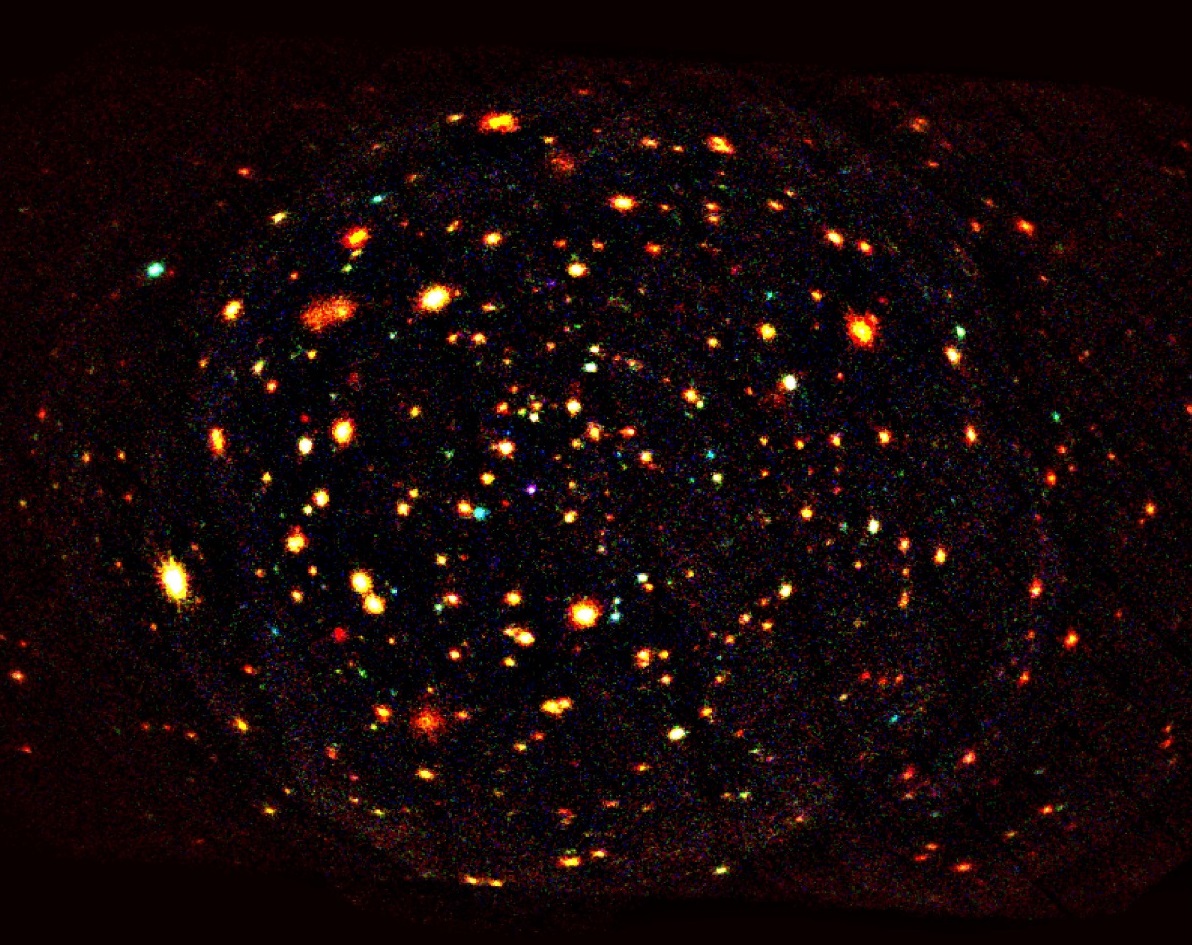
The Lockman Hole in X-rays

The Lockman Hole in X-rays
Copyright: ESA/XMM-Newton/G. Hasinger (MPE Garching, Germany)

A special patch of sky can be found close to the Big Dipper, in the northern constellation of Ursa Major, also known as the Great Bear. Appearing to contain no stars and hardly any gas clouds from our Milky Way galaxy, this region is called the Lockman Hole. A unique window into the distant Universe, it was discovered in 1986 by astronomer Felix J. Lockman.

Since its discovery, astronomers have been surveying the Lockman Hole to study the evolution of galaxies throughout cosmic history. Shortly after the launch of ESA’s XMM-Newton X-ray observatory, which lifted off on 10 December 1999, various teams started looking at this patch of the sky with the new telescope. By 2003, they had accumulated over 200 hours of data.

This image shows a portion of the Lockman Hole based on those observations. Hundreds of distant galaxies can be seen – their light has travelled billions of years before reaching Earth.

At the core of each of these galaxies is a supermassive black hole, a huge concentration of matter millions to billions of times more massive than the Sun, whose powerful gravity draws large amounts of material from the surroundings. The majority of the black holes depicted here are accreting nearby matter at a very high rate, which results in the emission of light across the electromagnetic spectrum, including X-rays.

Also portrayed in the image are a few galaxy clusters, gigantic assemblies of galaxies permeated by hot gas that shines brightly in X-rays. The double-lobed red object towards the upper left of the image is one such galaxy cluster: its light has taken over eight billion years to reach us.

This colour view combines X-ray data collected at energies of 0.5–2 keV (shown in red), 2–4.5 keV (green) and 4.5–10 keV (blue). The image spans half a degree – about the diameter of the full Moon – on the short side; north is up and east to the left. It was first published in 2001, in a paper by G. Hasinger and colleagues.

Source: ESA

Wednesday, February 16, 2011

Herschel finds less dark matter but more stars

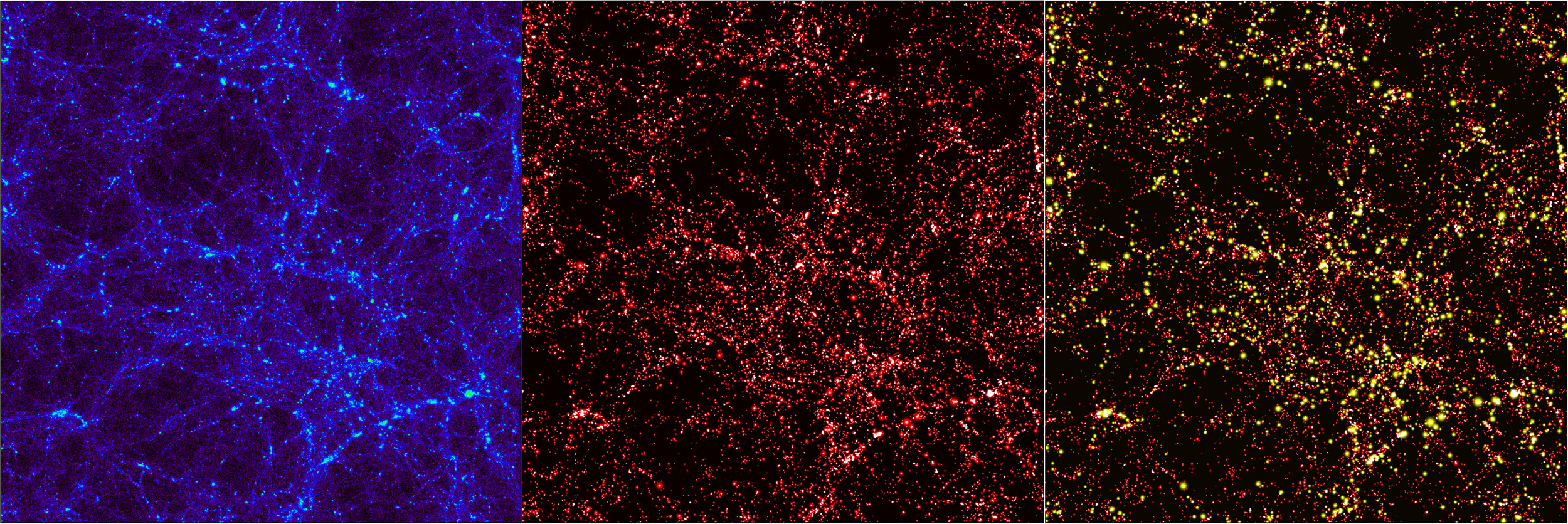
The calculated distribution of dark matter
Credits: The Virgo Consortium/Alexandre Amblard/ESA

Hi-Res Jpeg (Size: 363 kb)

ESA’s Herschel space observatory has discovered a population of dust-enshrouded galaxies that do not need as much dark matter as previously thought to collect gas and burst into star formation.

The galaxies are far away and each boasts some 300 billion times the mass of the Sun. The size challenges current theory that predicts a galaxy has to be more than ten times larger, 5000 billion solar masses, to be able form large numbers of stars.

The new result is published today in a paper by Alexandre Amblard, University of California, Irvine, and colleagues.

Most of the mass of any galaxy is expected to be dark matter, a hypothetical substance that has yet to be detected but which astronomers believe must exist to provide sufficient gravity to prevent galaxies ripping themselves apart as they rotate.

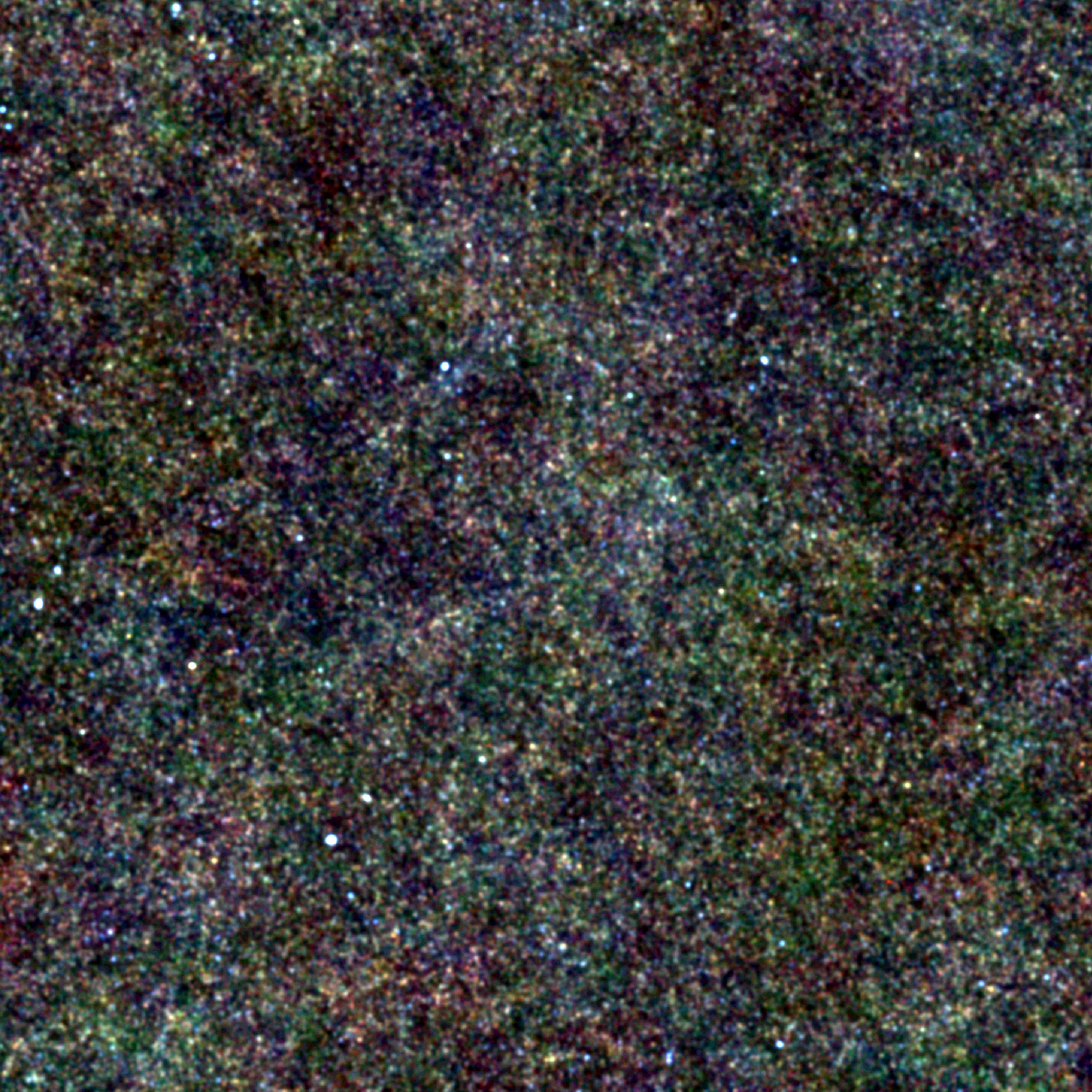
Herschel's target: the so-called Lockman Hole
Credits: ESA & SPIRE consortium & HerMES consortium
Hi-Res Jpeg (Size: 1666 kb)

Current models of the birth of galaxies start with the accumulation of large amounts of dark matter. Its gravitational attraction drags in ordinary atoms. If enough atoms accumulate, a ‘starburst’ is ignited, in which stars form at rates 100–1000 times faster than in our own galaxy does today.

“Herschel is showing us that we don’t need quite so much dark matter as we thought to trigger a starburst,” says Asantha Cooray, University of California, Irvine, a co-author on today’s paper.

This discovery was made by analysing infrared images taken by Herschel’s SPIRE (Spectral and Photometric Imaging Receiver) instrument at wavelengths of 250, 350, and 500 microns. These are roughly 1000 times longer than the wavelengths visible to the human eye and reveal galaxies that are deeply enshrouded in dust.

“With its very high sensitivity to the far-infrared light emitted by these young, enshrouded starburst galaxies, Herschel allows us to peer deep into the Universe and to understand how galaxies form and evolve,” says Göran Pilbratt, the ESA Herschel project scientist.

There are so many galaxies in Herschel’s images that they overlap, creating a fog of infrared radiation known as the cosmic infrared background. The galaxies are not distributed randomly but follow the underlying pattern of dark matter in the Universe, and so the fog has a distinctive pattern of light and dark patches.

The calculated distribution of dark matter
Credits: The Virgo Consortium/Alexandre Amblard/ESA
Hi-Res Jpeg (Size: 1792 kb)

Analysis of the brightness of the patches in the SPIRE images has shown that the star-formation rate in the distant infrared galaxies is 3–5 times higher than previously inferred from visible-wavelength observations of similar, very young galaxies by the Hubble Space Telescope and other telescopes.

Further analysis and simulations have shown that this smaller mass for the galaxies is a sweet spot for star formation. Less massive galaxies find it hard to form more than a first generation of stars before fizzling out. At the other end of the scale, more massive galaxies struggle because their gas cools rather slowly, preventing it from collapsing down to the high densities needed to ignite star formation.

But at this newly identified ‘just-right’ mass of a few hundred billion solar masses, galaxies can make stars at prodigious rates and thus grow rapidly.

“This is the first direct observation of the preferred mass scale for igniting a starburst,” says Dr Cooray.

Models of galaxy formation can now be adjusted to reflect these new results, and astronomers can take a step closer to understanding how galaxies – including our own –came into being.

Contact for further information