Showing posts with label HD 189733b. Show all posts

Wednesday, July 11, 2018

NASA's Webb Space Telescope to Inspect Atmospheres of Gas Giant Exoplanet

This is an artist's impression of the Jupiter-size extrasolar planet, HD 189733b, being eclipsed by its parent star. Astronomers using the Hubble Space Telescope have measured carbon dioxide and carbon monoxide in the planet's atmosphere. The planet is a "hot Jupiter," which is so close to its star that it completes an orbit in only 2.2 days. The planet is too hot for life as we know it. But under the right conditions, on a more Earth-like world, carbon dioxide can indicate the presence of extraterrestrial life. This observation demonstrates that chemical biotracers can be detected by space telescope observations. Credits: ESA, NASA, M. Kornmesser (ESA/Hubble), and STScI


In April 2018, NASA launched the Transiting Exoplanet Survey Satellite (TESS). Its main goal is to locate Earth-sized planets and larger “super-Earths” orbiting nearby stars for further study. One of the most powerful tools that will examine the atmospheres of some planets that TESS discovers will be NASA’s James Webb Space Telescope. Since observing small exoplanets with thin atmospheres like Earth will be challenging for Webb, astronomers will target easier, gas giant exoplanets first.

Some of Webb’s first observations of gas giant exoplanets will be conducted through the Director’s Discretionary Early Release Science program. The transiting exoplanet project team at Webb’s science operations center is planning to conduct three different types of observations that will provide both new scientific knowledge and a better understanding of the performance of Webb’s science instruments.

“We have two main goals. The first is to get transiting exoplanet datasets from Webb to the astronomical community as soon as possible. The second is to do some great science so that astronomers and the public can see how powerful this observatory is,” said Jacob Bean of the University of Chicago, a co-principal investigator on the transiting exoplanet project.

“Our team’s goal is to provide critical knowledge and insights to the astronomical community that will help to catalyze exoplanet research and make the best use of Webb in the limited time we have available,” added Natalie Batalha of NASA Ames Research Center, the project’s principal investigator.

Transit – An atmospheric spectrum

When a planet crosses in front of, or transits, its host star, the star’s light is filtered through the planet’s atmosphere. Molecules within the atmosphere absorb certain wavelengths, or colors, of light. By splitting the star’s light into a rainbow spectrum, astronomers can detect those sections of missing light and determine what molecules are in the planet’s atmosphere.

For these observations, the project team selected WASP-79b, a Jupiter-sized planet located about 780 light-years from Earth. The team expects to detect and measure the abundances of water, carbon monoxide, and carbon dioxide in WASP-79b. Webb also might detect new molecules not yet seen in exoplanet atmospheres.

Phase curve – A weather map

Planets that orbit very close to their stars tend to become tidally locked. One side of the planet permanently faces the star while the other side faces away, just as one side of the Moon always faces the Earth. When the planet is in front of the star, we see its cooler backside. But as it orbits the star, more and more of the hot day-side comes into view. By observing an entire orbit, astronomers can observe those variations (called a phase curve) and use the data to map the planet’s temperature, clouds, and chemistry as a function of longitude.

The team will observe a phase curve of the “hot Jupiter” known as WASP-43b, which orbits its star in less than 20 hours. By looking at different wavelengths of light, they can sample the atmosphere to different depths and obtain a more complete picture of its structure. “We have already seen dramatic and unexpected variations for this planet with Hubble and Spitzer. With Webb we will reveal these variations in significantly greater detail to understand the physical processes that are responsible,” said Bean.

Eclipse – A planet’s glow

The greatest challenge when observing an exoplanet is that the star’s light is much brighter, swamping the faint light of the planet. To get around this problem, one method is to observe a transiting planet when it disappears behind the star, not when it crosses in front of the star. By comparing the two measurements, one taken when both star and planet are visible, and the other when only the star is in view, astronomers can calculate how much light is coming from the planet alone.

This technique works best for very hot planets that glow brightly in infrared light. The team plans to study WASP-18b, a planet that is baked to a temperature of almost 4,800 degrees Fahrenheit (2,900 K). Among other questions, they hope to determine whether the planet’s stratosphere exists due to the presence of titanium oxide, vanadium oxide, or some other molecule.

Habitable planets

Ultimately, astronomers want to use Webb to study potentially habitable planets. In particular, Webb will target planets orbiting red dwarf stars since those stars are smaller and dimmer, making it easier to tease out the signal from an orbiting planet. Red dwarfs are also the most common stars in our galaxy.

“TESS should locate more than a dozen planets orbiting in the habitable zones of red dwarfs, a few of which might actually be habitable. We want to learn whether those planets have atmospheres and Webb will be the one to tell us,” said Kevin Stevenson of the Space Telescope Science Institute, a co-principal investigator on the project. “The results will go a long way towards answering the question of whether conditions favorable to life are common in our galaxy.”

The James Webb Space Telescope is the world’s premier infrared space observatory of the next decade. Webb will solve mysteries of our solar system, look beyond to distant worlds around other stars, and probe the mysterious structures and origins of our universe and our place in it. Webb is an international program led by NASA with its partners, the European Space Agency (ESA) and the Canadian Space Agency (CSA).


Contact:

Christine Pulliam
Space Telescope Science Institute, Baltimore, Maryland
410-338-4366
cpulliam@stsci.edu


Related Links

This site is not responsible for content found on external links


Monday, December 14, 2015

NASA Space Telescopes Solve Missing Water Mystery in Comprehensive Survey of Exoplanets

Illustration Credit: NASA and ESA
Science Credit: NASA, ESA, and D. Sing (University of Exeter)
This image shows an artist's impression of the 10 hot Jupiter exoplanets studied by astronomer David Sing and his colleagues using the Hubble and Spitzer space telescopes. From top left to lower left, these planets are WASP-12b, WASP-6b, WASP-31b, WASP-39b, HD 189733b, HAT-P-12b, WASP-17b, WASP-19b, HAT-P-1b and HD 209458b.   Highest-quality image


A survey of 10 hot, Jupiter-sized exoplanets conducted with NASA's Hubble and Spitzer space telescopes has led a team to solve a long-standing mystery — why some of these worlds seem to have less water than expected. The findings offer new insights into the wide range of planetary atmospheres in our galaxy and how planets are assembled.

Of the nearly 2,000 planets confirmed to be orbiting other stars, a subset are gaseous planets with characteristics similar to those of Jupiter but that orbit very close to their stars, making them blistering hot.

Their close proximity to the star makes them difficult to observe in the glare of starlight. Due to this difficulty, Hubble has only explored a handful of hot Jupiters in the past. These initial studies have found several planets to hold less water than predicted by atmospheric models.

The international team of astronomers has tackled the problem by making the largest-ever spectroscopic catalog of exoplanet atmospheres. All of the planets in the catalog follow orbits oriented so the planet passes in front of their parent star, as seen from Earth. During this so-called transit, some of the starlight travels through the planet's outer atmosphere. "The atmosphere leaves its unique fingerprint on the starlight, which we can study when the light reaches us," explained co-author Hannah Wakeford of NASA's Goddard Space Flight Center in Greenbelt, Maryland.

By combining data from NASA's Hubble and Spitzer Space telescopes, the team was able to attain a broad spectrum of light covering wavelengths from the optical to infrared. The difference in planetary radius as measured between visible and infrared wavelengths was used to indicate the type of planetary atmosphere being observed for each planet in the sample, whether hazy or clear. A cloudy planet will appear larger in visible light than at infrared wavelengths, which penetrate deeper into the atmosphere. It was this comparison that allowed the team to find a correlation between hazy or cloudy atmospheres and faint water detection.

"I'm really excited to finally see the data from this wide group of planets together, as this is the first time we've had sufficient wavelength coverage to compare multiple features from one planet to another," said David Sing of the University of Exeter, United Kingdom, lead author of the paper. "We found the planetary atmospheres to be much more diverse than we expected."

"Our results suggest it's simply clouds hiding the water from prying eyes, and therefore rule out dry hot Jupiters," explained co-author Jonathan Fortney of the University of California, Santa Cruz. "The alternative theory to this is that planets form in an environment deprived of water, but this would require us to completely rethink our current theories of how planets are born."

The results are being published in the Dec. 14, 2015, issue of the British science journal Nature.

The study of exoplanetary atmospheres is currently in its infancy. Hubble's successor, the James Webb Space Telescope, will open a new infrared window on the study of exoplanets and their atmospheres.


Contacts

Ray Villard
Space Telescope Science Institute, Baltimore, Maryland
410-338-4514
villard@stsci.edu

Source: HubbleSite

Thursday, July 24, 2014

Hubble Finds Three Surprisingly Dry Exoplanets

This is an artistic illustration of the gas giant planet HD 209458b (unofficially named Osiris) located 150 light-years away in the constellation Pegasus. This is a "hot Jupiter" class planet. Estimated to be 220 times the mass of Earth. The planet's atmosphere is a seething 2,150 degrees Fahrenheit. It orbits very closely to its bright sunlike star, and the orbit is tilted edge-on to Earth. This makes the planet an ideal candidate for the Hubble Space Telescope to be used to make precise measurements of the chemical composition of the giant's atmosphere as starlight filters though it. To the surprise of astronomers, they have found much less water vapor in the atmosphere than standard planet-formation models predict.  Credit: NASA, ESA, and G. Bacon (STScI)

This graph compares observations with modeled infrared spectra of three hot-Jupiter-class exoplanets that were spectroscopically observed with the Hubble Space Telescope. The red curve in each case is the best-fit model spectrum for the detection of water vapor absorption in the planetary atmosphere. The blue circles and error bars show the processed and analyzed data from Hubble's spectroscopic observations.  Credit: NASA, ESA, N. Madhusudhan (University of Cambridge), and A. Feild and G. Bacon (STScI)

Astronomers using NASA's Hubble Space Telescope have gone looking for water vapor in the atmospheres of three planets orbiting stars similar to the Sun — and have come up nearly dry.

The three planets, HD 189733b, HD 209458b, and WASP-12b, are between 60 and 900 light-years away. These giant gaseous worlds are so hot, with temperatures between 1,500 and 4,000 degrees Fahrenheit, that they are ideal candidates for detecting water vapor in their atmospheres.

However, to the surprise of the researchers, the planets surveyed have only one-tenth to one one-thousandth the amount of water predicted by standard planet-formation theories.

"Our water measurement in one of the planets, HD 209458b, is the highest-precision measurement of any chemical compound in a planet outside the solar system, and we can now say with much greater certainty than ever before that we've found water in an exoplanet," said Dr. Nikku Madhusudhan of the Institute of Astronomy at the University of Cambridge, United Kingdom, who led the research. "However, the low water abundance we are finding is quite astonishing."

Madhusudhan said that this finding presents a major challenge to exoplanet theory. "It basically opens a whole can of worms in planet formation. We expected all these planets to have lots of water in them. We have to revisit planet formation and migration models of giant planets, especially 'hot Jupiters', and investigate how they're formed."

He emphasizes that these results, though found in these large hot planets close to their parent stars, may have major implications for the search for water in potentially habitable Earth-sized exoplanets. Instruments on future space telescopes may need to be designed with a higher sensitivity if target planets are drier than predicted. "We should be prepared for much lower water abundances than predicted when looking at super-Earths (rocky planets that are several times the mass of Earth)," Madhusudhan said.

Using near-infrared spectra of the planets observed with Hubble, Madhusudhan and his collaborators from the Space Telescope Science Institute, Baltimore, Maryland; the University of Maryland, College Park, Maryland; the Johns Hopkins University, Baltimore, Maryland; and the Dunlap Institute at the University of Toronto, Ontario, Canada, estimated the amount of water vapor in the planetary atmospheres based on sophisticated computer models and statistical techniques to explain the data.

The planets were selected because they orbit relatively bright stars that provide enough radiation for an infrared-light spectrum to be taken. Absorption features from the water vapor in the planet's atmosphere are superimposed on the small amount of starlight that glances through the planet's atmosphere.

Detecting water is almost impossible for transiting planets from the ground because Earth's atmosphere has a lot of water in it that contaminates the observation. "We really need the Hubble Space Telescope to make such observations," said Nicolas Crouzet of the Dunlap Institute at the University of Toronto and co-author of the study.

The currently accepted theory on how giant planets in our solar system formed is known as core accretion, in which a planet is formed around the young star in a protoplanetary disk made primarily of hydrogen, helium, and particles of ices and dust composed of other chemical elements. The dust particles stick to each other, eventually forming larger and larger grains. The gravitational forces of the disk draw in these grains and larger particles until a solid core forms. This core then leads to runaway accretion of both solids and gas to eventually form a giant planet.

This theory predicts that the proportions of the different elements in the planet are enhanced relative to those in their star, especially oxygen that is supposed to be the most enhanced. Once the giant planet forms, its atmospheric oxygen is expected to be largely encompassed within water molecules. The very low levels of water vapor found by this research raises a number of questions about the chemical ingredients that lead to planet formation, say researchers.

"There are so many things we still don't know about exoplanets, so this opens up a new chapter in understanding how planets and solar systems form," said Drake Deming of the University of Maryland, who led one of the precursor studies. "The problem is that we are assuming the water to be as abundant as in our own solar system. What our study has shown is that water features could be a lot weaker than our expectations."
The findings are being published on July 24 in The Astrophysical Journal Letters.

CONTACT

Ray Villard
Space Telescope Science Institute, Baltimore, Md.
410-338-4514

villard@stsci.edu

Nikku Madhusudhan
Institute of Astronomy, University of Cambridge, United Kingdom
617-475-5112 (or 011-44-01223-766619)

nmadhu@ast.cam.ac.uk

Source: HubbleSite


Monday, August 19, 2013

The Strange Attraction of Hot Jupiters


A new ScienceCast video explores the unexpected and exotic characteristics of hot Jupiters
Play it

When the Space Age began, astronomers knew of exactly zero planets outside the solar system.  What a difference 50 years makes. 

Modern, ground-based telescopes and NASA's Kepler spacecraft have now confirmed more than 850 exoplanets, while thousands more await confirmation.   The pace of discovery suggests "there are at least 100 billion planets in our galaxy," says John Johnson of Caltech, who works with data from the Kepler mission. "That's mind-boggling." 

When the hunt for exoplanets began, the focus was on Earth-like worlds, planets like our own that might support alien life in distant solar systems. Yet planets as small as Earth are difficult to detect when they circle stars hundreds of light years away.  Indeed, only a handful have been found so far.

The real haul has been in gas giants, especially “hot Jupiters.”  These are behemoth worlds that orbit close to their parent stars, blocking a fraction of the star’s light when it transits in front. Observations of hot Jupiter “mini-eclipses” have yielded hundreds of discoveries. 

At first considered to be the "chaff" researchers would have to wade through to get to the fainter Earth-like worlds, hot Jupiters are now attracting their own attention.  

Consider the case of "HD189733b," discovered in 2005 by a team working at the Haute-Provence Observatory in France.  Because it is nearby, only 63 light years away, and because it blocks a whopping 3% of the light from its orange-dwarf parent star, astronomers are rapidly learning a great deal.

For one thing, it's blue.  Data obtained by the Hubble Space Telescope suggest that, seen from a distance, the azure disk of HD 189733b would look to the human eye much like Earth.  Indeed, some members of the media have taken to calling it "the other blue planet." 

It is, however, anything but Earthlike.  

In 2007, Heather Knutson of Caltech made a global temperature map of HD189733b using NASA’s infrared Spitzer Space Telescope. She knew it would be hot because HD189733b orbits its star 13 times closer than Mercury.  “Even so, we were impressed by the readings,” she recalls. Temperatures ranged from 1200 F on the nightside to 1700 F on the dayside.  Thermal gradients drive winds as fast as 6000 mph, carrying suffocating heat around the globe. 

The blue color may be caused by silicate particles in the planet’s atmosphere, which scatter blue wavelengths of light from the parent star.  The same physics plays out in Earth’s atmosphere, although the chemicals are different. Silicates are a component of glass, so some researchers have speculated that it is actually raining molten glass on HD189733b. 

The newest observations come from a pair of X-ray observatories. NASA’s Chandra and the ESA’s XMM Newton watched HD189733b transit its star and detected a drop in X-rays three times deeper than the corresponding decrease in optical light. This means the outer atmosphere is larger than anyone expected.
In fact, it is probably boiling away. Authors of the study estimate HD189733b is losing 100 million to 600 million kilograms of mass per second. 

"The extended atmosphere of this planet makes it a bigger target for high-energy radiation from its star, so more evaporation occurs," notes Scott Wolk of the Center for Astrophysics. 

Blasts of stellar radiation hitting the planet at point-blank range could have another effect: auroras that wrap around the planet from pole to pole, orders of magnitude brighter than any Northern Lights in our own solar system. This is speculative, though. 

While the search for Earth-like planets proceeds, hot Jupiters are a welcome albeit unexpected diversion. It makes you wonder, what will we be looking for 50 years from now…? 

Credits:
 Author: Dr. Tony Phillips  | Production editor: Dr. Tony Phillips | Credit: Science@NASA

More information:   Big Weather on Hot Jupiters  - ScienceCast video

Tuesday, July 30, 2013

HD 189733: NASA's Chandra Sees Eclipsing Planet in X-rays for First Time

HD 189733b
Credit  X-ray: NASA/CXC/SAO/K.Poppenhaeger et al;


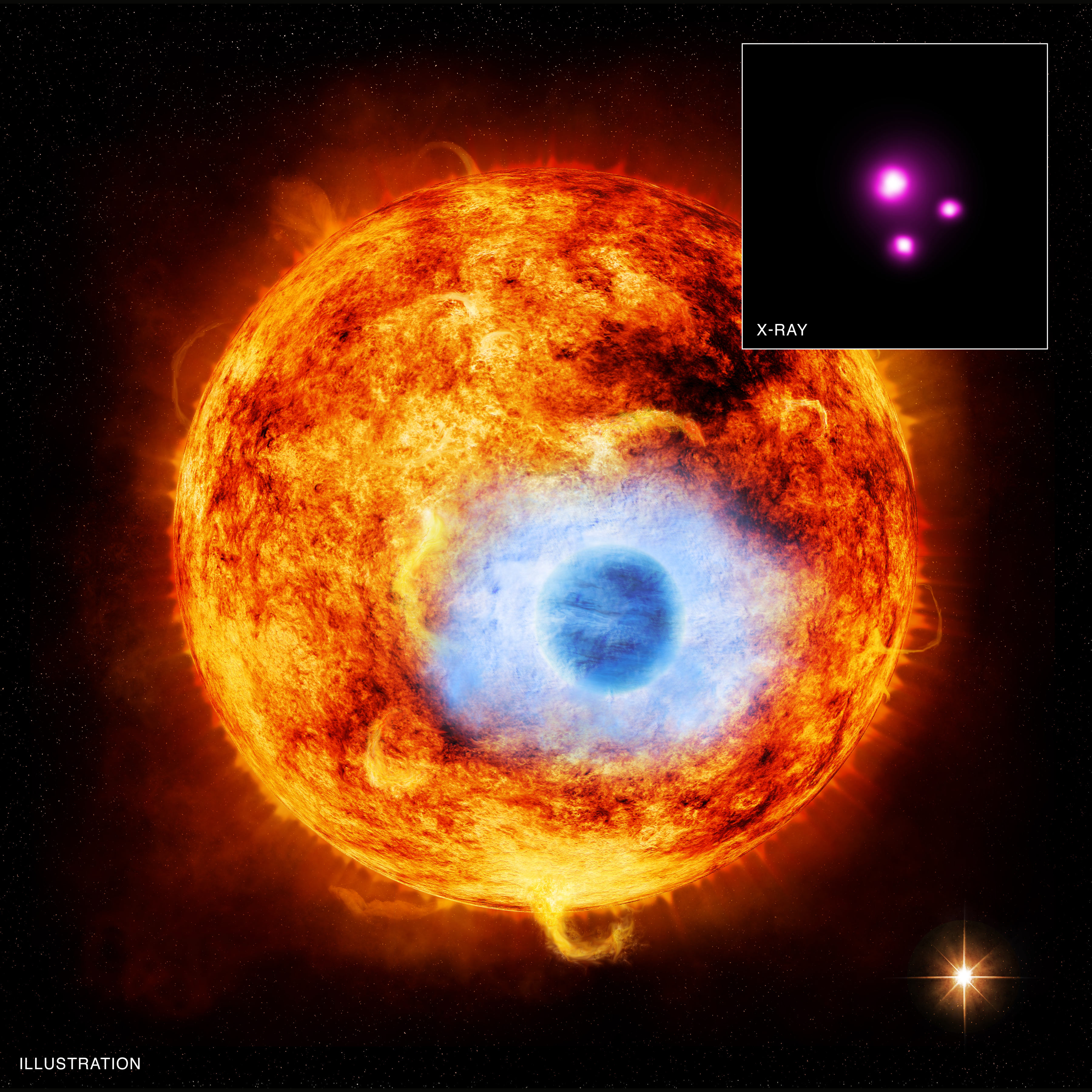
This graphic depicts HD 189733b, the first exoplanet caught passing in front of its parent star in X-rays. As described in our press release, NASA's Chandra X-ray Observatory and the European Space Agency's XMM Newton Observatory have been used to observe a dip in X-ray intensity as HD 189733b transits its parent star. 

The main figure is an artist’s impression showing the HD 189733 system, containing a Sun-like star orbited by HD 189733b, an exoplanet about the size of Jupiter . This "hot Jupiter" is over 30 times closer to its star than Earth is to the Sun and goes around the star once every 2.2 days, as determined from previous observations. Also in the illustration is a faint red companion star, which was detected for the first time in X-rays with these observations . This star orbits the main star about once every 3,200 years.

The inset contains the Chandra image of HD 189733. The source in the middle is the main star and the source in the lower right is the faint companion star. The source at the bottom of the image is a background object not contained in the HD 189733 system. 

The exoplanet itself cannot be seen in the Chandra image, as the transits involve measuring small decreases in X-ray emission from the main star. The authors estimate that the percentage decrease in X-ray light during the transits is about three times greater than the corresponding decrease in optical light. This tells them that the region blocking X-rays from the star is substantially larger than the region blocking optical light from the star, helping to determine the size of the planet's atmosphere. The extended atmosphere implied by these results is shown by the light blue color around the planet. Recent observations of HD 189733b with the Hubble Space Telescope have confirmed that the lower atmosphere of the planet has a deep blue color, due to the preferential scattering of blue light by silicate particles in its atmosphere. 

For about a decade astronomers have known that ultraviolet and X-ray radiation from the main star in HD 189733 are evaporating the atmosphere of its closely orbiting planet over time. The authors of the new study estimate that HD 189733b is losing between 100 million and 600 million kilograms per second. This rate is about 25% to 65% higher than it would be if the planet's atmosphere were not extended.

At a distance of just 63 light years, HD 189733b is the closest hot Jupiter to Earth, which makes it a prime target for astronomers who want to learn more about this type of exoplanet and the atmosphere around it.
Chandra was used to make observations of six transits by HD 189733b and the team also used archival data from XMM-Newton for one transit. These results are available online and will appear in a future issue of The Astrophysical Journal.


Fast Facts for HD 189733:


Scale:  Image is 1.5 arcmin across (about 0.02 light years)
Coordinates (J2000):  RA 20h 00m 43.70s | Dec +22 42 39.10
Constellation:  Vulpecula
Observation Date:  6 pointings between 5-23 July, 2011 
Observation Time:  33 hours 20 min Obs. ID:  12340-12345 
Instrument:  ACIS
References: Poppenhaeger, K. et al, 2013, ApJ (submitted); arXiv:1306.2311
Color Code:  X-ray (Purple)
Distance Estimate:  About 60 light years


Thursday, July 11, 2013

Hubble spots azure blue planet

Artist’s impression of the deep blue planet HD 189733b 

Wide-field view of HD 189733b and surroundings 
(DSS2 excerpt, ground-based image) 

Wide-field view of the Summer Triangle (ground-based image)

Exotic blue planet HD 189733b (artist’s impression) 

Exotic blue planet HD 189733b (labelled artist’s impression) 

The colour of HD 189733b compared to our Solar System 


Videos

Blue planet HD 189733b around its host star (artist’s impression)

A zoom to the star HD 189733

True colour of exoplanet measured for the first time

Astronomers using the NASA/ESA Hubble Space Telescope have, for the first time, determined the true colour of a planet orbiting another star. If seen up close this planet, known as HD 189733b, would be a deep azure blue, reminiscent of Earth’s colour as seen from space.

But that's where the similarities end. This "deep blue dot" is a huge gas giant orbiting very close to its host star. The planet's atmosphere is scorching with a temperature of over 1000 degrees Celsius, and it rains glass, sideways, in howling 7000 kilometre-per-hour winds [1].

At a distance of 63 light-years from us, this turbulent alien world is one of the nearest exoplanets to Earth that can be seen crossing the face of its star. It has been intensively studied by Hubble and other telescopes, and its atmosphere has been found to be dramatically changeable and exotic, with hazes and violent flares (heic0720, heic1209). Now, this planet is the subject of an important first: the first measurement of an exoplanet's visible colour.

"This planet has been studied well in the past, both by ourselves and other teams," says Frédéric Pont of the University of Exeter, UK, leader of the Hubble observing programme and an author of this new paper. "But measuring its colour is a real first — we can actually imagine what this planet would look like if we were able to look at it directly."

In order to measure what this planet would look like to our eyes, the astronomers measured how much light was reflected off the surface of HD 189733b — a property known as albedo [2].

HD 189733b is faint and close to its star. To isolate the planet's light from this starlight, the team used Hubble's Space Telescope Imaging Spectrograph (STIS) to peer at the system before, during, and after the planet passed behind its host star as it orbited. As it slipped behind its star, the light reflected from the planet was temporarily blocked from view, and the amount of light observed from the system dropped. But this technique also shows how the light changes in other ways — for example, its colour [3].

"We saw the brightness of the whole system drop in the blue part of the spectrum when the planet passed behind its star," explains Tom Evans of the University of Oxford, UK, first author of the paper. "From this, we can gather that the planet is blue, because the signal remained constant at the other colours we measured."

The planet's azure blue colour does not come from the reflection of a tropical ocean, but is due to a hazy, turbulent atmosphere thought to be laced with silicate particles, which scatter blue light [4]

Earlier observations using different methods have reported evidence for scattering of blue light on the planet, but these most recent Hubble observations give robust confirming evidence, say the researchers.

HD 189733b presented a favourable case for these kinds of measurements as it belongs to a class of planets known as "hot Jupiters". These massive planets are similar in size to the gas giants in the Solar System, but instead lie very close to their parent star — this size and proximity to their star make them perfect subjects for exoplanet hunting. We know that hot Jupiters are numerous throughout the Universe. As we do not have one close to home in our own Solar System, studies of planets like HD 189733b are important to help us understand these dramatic objects.

"It's difficult to know exactly what causes the colour of a planet's atmosphere, even for planets in the Solar System," says Pont [5]. "But these new observations add another piece to the puzzle over the nature and atmosphere of HD 189733b. We are slowly painting a more complete picture of this exotic planet."

Notes

[1] In 2007 NASA's Spitzer Space Telescope measured the infrared light from the planet, producing one of the first ever temperature maps for an exoplanet. The map shows that day- and night-side temperatures differ by about 260 degrees Celsius, causing fierce winds to roar across the planet. The condensation temperature of the silicates (over 1300 degrees Celsius) mean these particles could form very small grains of glass in the atmosphere.
[2] Albedo is a measure of how much incident radiation is reflected. The greater the albedo, the greater the amount of light reflected. This value ranges from 0 to 1, with 1 being perfect reflectivity and 0 being a completely black surface. The Earth has an albedo of around 0.4.

[3] This technique is possible because the planet's orbit is tilted edge-on as viewed from Earth, so that it routinely passes in front of and behind the star. When the planet passes behind its host star, the light received from the system drops by about one part in 10 000.

[4] The deep blue colour of HD 189733b is consistent with the "red sunset of HD 189733b" result from the transit spectrum (heic0720). If sodium absorbs red light and dust scatters red light, the atmosphere will redden light shining through it, but will appear blue in reflected light.

[5] The colours of Jupiter and Venus are both due to unknown particles within the atmospheres of the planets. Earth looks blue from space because the oceans absorb red and green wavelengths more strongly than blue ones, and reflect the blueish hue of our sky. The shorter blue wavelengths of sunlight are selectively scattered by oxygen and nitrogen molecules in our atmosphere via a process called Rayleigh scattering.

Notes for editors

The Hubble Space Telescope is a project of international cooperation between ESA and NASA.
The new paper, titled "The deep blue colour of HD 189733b: albedo measurements with HST/STIS at visible wavelengths", will appear in the 1 August issue of the journal Astrophysical Journal Letters.
[1] The international team of astronomers in this study consists of T. Evans (University of Oxford, UK), F. Pont (University of Exeter, UK), D. K. Sing (University of Exeter, UK), S. Aigrain (University of Oxford, UK), J. K. Barstow (University of Oxford, UK), J-M. Désert (California Institute of Technology, USA; Sagan Postdoctoral Fellow), N. Gibson (European Southern Observatory, Germany), K. Heng (University of Bern, Switzerland), H. A. Knutson (California Institute of Technology, USA) and A. Lecavelier des Etangs (Universite Pierre et Marie Curie, France).

More information

Image credit: NASA, ESA, M. Kornmesser

Links

Contacts

Frédéric Pont
University of Exeter
Exeter, United Kingdom
Tel: +41 77 4185812
Email: f.pont@exeter.ac.uk

Tom Evans
University of Oxford
Oxford, United Kingdom
Tel: +44 1865 273598
Email: tom.evans@astro.ox.ac.uk

Nicky Guttridge
ESA/Hubble
Garching, Germany
Tel: +49-89-3200-6855
Email: nguttrid@partner.eso.org


 Source: ESA/HUBBLE - Space Telescope


Monday, May 13, 2013

New Method of Finding Planets Scores its First Discovery

 
"Einstein's planet," formally known as Kepler-76b, is a "hot Jupiter" that orbits its star every 1.5 days. Its diameter is about 25 percent larger than Jupiter and it weighs twice as much. This artist's conception shows Kepler-76b orbiting its host star, which has been tidally distorted into a slight football shape (exaggerated here for effect). The planet was detected using the BEER algorithm, which looked for brightness changes in the star as the planet orbits due to relativistic BEaming, Ellipsoidal variations, and Reflected light from the planet. Credit: David A. Aguilar (CfA).  High Resolution Image (jpg)  -  Low Resolution Image (jpg)
 
This graphic shows Kepler-76b's orbit around a yellow-white, type F star located 2,000 light-years from Earth in the constellation Cygnus. Although Kepler-76b was identified using the BEER effect (see above), it was later found to exhibit a grazing transit, crossing the edge of the star's face as seen from Earth.
 
Cambridge, MA - Detecting alien worlds presents a significant challenge since they are small, faint, and close to their stars. The two most prolific techniques for finding exoplanets are radial velocity (looking for wobbling stars) and transits (looking for dimming stars). A team at Tel Aviv University and the Harvard-Smithsonian Center for Astrophysics (CfA) has just discovered an exoplanet using a new method that relies on Einstein's special theory of relativity. 

"We are looking for very subtle effects. We needed high quality measurements of stellar brightnesses, accurate to a few parts per million," said team member David Latham of the CfA.

"This was only possible because of the exquisite data NASA is collecting with the Kepler spacecraft," added lead author Simchon Faigler of Tel Aviv University, Israel. 

Although Kepler was designed to find transiting planets, this planet was not identified using the transit method. Instead, it was discovered using a technique first proposed by Avi Loeb of the CfA and his colleague Scott Gaudi (now at Ohio State University) in 2003. (Coincidentally, they developed their theory while visiting the Institute for Advanced Study in Princeton, where Einstein once worked.) 

The new method looks for three small effects that occur simultaneously as a planet orbits the star. Einstein's "beaming" effect causes the star to brighten as it moves toward us, tugged by the planet, and dim as it moves away. The brightening results from photons "piling up" in energy, as well as light getting focused in the direction of the star's motion due to relativistic effects. 

"This is the first time that this aspect of Einstein's theory of relativity has been used to discover a planet," said co-author Tsevi Mazeh of Tel Aviv University. 

The team also looked for signs that the star was stretched into a football shape by gravitational tides from the orbiting planet. The star would appear brighter when we observe the "football" from the side, due to more visible surface area, and fainter when viewed end-on. The third small effect was due to starlight reflected by the planet itself. 

Once the new planet was identified, it was confirmed by Latham using radial velocity observations gathered by the TRES spectrograph at Whipple Observatory in Arizona, and by Lev Tal-Or (Tel Aviv University) using the SOPHIE spectrograph at the Haute-Provence Observatory in France. A closer look at the Kepler data also showed that the planet transits its star, providing additional confirmation. 

"Einstein's planet," formally known as Kepler-76b, is a "hot Jupiter" that orbits its star every 1.5 days. Its diameter is about 25 percent larger than Jupiter and it weighs twice as much. It orbits a type F star located about 2,000 light-years from Earth in the constellation Cygnus. 

The planet is tidally locked to its star, always showing the same face to it, just as the Moon is tidally locked to Earth. As a result, Kepler-76b broils at a temperature of about 3,600 degrees Fahrenheit. 

Interestingly, the team found strong evidence that the planet has extremely fast jet-stream winds that carry the heat around it. As a result, the hottest point on Kepler-76b isn't the substellar point ("high noon") but a location offset by about 10,000 miles. This effect has only been observed once before, on HD 189733b, and only in infrared light with the Spitzer Space Telescope. This is the first time optical observations have shown evidence of alien jet stream winds at work. 

Although the new method can't find Earth-sized worlds using current technology, it offers astronomers a unique discovery opportunity. Unlike radial velocity searches, it doesn't require high-precision spectra. Unlike transits, it doesn't require a precise alignment of planet and star as seen from Earth. 

"Each planet-hunting technique has its strengths and weaknesses. And each novel technique we add to the arsenal allows us to probe planets in new regimes," said CfA's Avi Loeb. 

Kepler-76b was identified by the BEER algorithm, whose acronym stands for relativistic BEaming, Ellipsoidal, and Reflection/emission modulations. BEER was developed by Professor Tsevi Mazeh and his student, Simchon Faigler, at Tel Aviv University, Israel. 

The paper announcing this discovery has been accepted for publication in The Astrophysical Journal and is available online

Headquartered in Cambridge, Mass., the Harvard-Smithsonian Center for Astrophysics (CfA) is a joint collaboration between the Smithsonian Astrophysical Observatory and the Harvard College Observatory. CfA scientists, organized into six research divisions, study the origin, evolution and ultimate fate of the universe.

For more information, contact:

David A. Aguilar
Director of Public Affairs
Harvard-Smithsonian Center for Astrophysics
617-495-7462

daguilar@cfa.harvard.edu

 
Christine Pulliam
Public Affairs Specialist
Harvard-Smithsonian Center for Astrophysics
617-495-7463

cpulliam@cfa.harvard.edu


Thursday, June 28, 2012

Hubble, Swift Detect First-Ever Changes in an Exoplanet Atmosphere

Exoplanet HD 189733b (Artist's Illustration)
Science Credit:NASA,ESA, A. Lecavelier des Etangs (CNRS-UMPC, France), and P. Wheatley (University of Warwick)

WASHINGTON — An international team of astronomers using data from NASA's Hubble Space Telescope has made an unparalleled observation, detecting significant changes in the atmosphere of a planet located beyond our solar system.

The scientists conclude the atmospheric variations occurred in response to a powerful eruption on the planet's host star, an event observed by NASA's Swift satellite.

"The multiwavelength coverage by Hubble and Swift has given us an unprecedented view of the interaction between a flare on an active star and the atmosphere of a giant planet," said lead researcher Alain Lecavelier des Etangs at the Paris Institute of Astrophysics (IAP), part of the French National Scientific Research Center located at Pierre and Marie Curie University in Paris.

The exoplanet is HD 189733b, a gas giant similar to Jupiter, but about 14 percent larger and more massive. The planet circles its star at a distance of only 3 million miles, or about 30 times closer than Earth's distance from the Sun, and completes an orbit every 2.2 days. Its star, named HD 189733A, is about 80 percent the size and mass of our Sun.

Astronomers classify the planet as a "hot Jupiter." Previous Hubble observations show that the planet's deep atmosphere reaches a temperature of about 1,900 degrees Fahrenheit (1,030 degrees Celsius).

HD 189733b periodically passes across, or transits, its parent star, and these events give astronomers an opportunity to probe its atmosphere and environment. In a previous study, a group led by Lecavelier des Etangs used Hubble to show that hydrogen gas was escaping from the planet's upper atmosphere. The finding made HD 189733b only the second known "evaporating" exoplanet at the time.

The system is just 63 light-years away, so close that its star can be seen with binoculars near the famous Dumbbell Nebula. This makes HD 189733b an ideal target for studying the processes that drive atmospheric escape.

"Astronomers have been debating the details of atmospheric evaporation for years, and studying HD 189733b is our best opportunity for understanding the process," said Vincent Bourrier, a doctoral student at IAP and a team member on the new study.

When HD 189733b transits its star, some of the star's light passes through the planet's atmosphere. This interaction imprints information on the composition and motion of the planet's atmosphere into the star's light.

In April 2010, the researchers observed a single transit using Hubble's Space Telescope Imaging Spectrograph (STIS), but they detected no trace of the planet's atmosphere. Follow-up STIS observations in September 2011 showed a surprising reversal, with striking evidence that a plume of gas was streaming away from the exoplanet.

The researchers determined that at least 1,000 tons of gas was leaving the planet's atmosphere every second. The hydrogen atoms were racing away at speeds greater than 300,000 miles per hour. The findings will appear in an upcoming issue of the journal Astronomy & Astrophysics.

Because X-rays and extreme ultraviolet starlight heat the planet's atmosphere and likely drive its escape, the team also monitored the star with Swift's X-ray Telescope (XRT). On Sept. 7, 2011, just eight hours before Hubble was scheduled to observe the transit, Swift was monitoring the star when it unleashed a powerful flare. It brightened by 3.6 times in X-rays, a spike occurring atop emission levels that already were greater than the Sun's.

"The planet's close proximity to the star means it was struck by a blast of X-rays tens of thousands of times stronger than the Earth suffers even during an X-class solar flare, the strongest category," said co-author Peter Wheatley, a physicist at the University of Warwick in England.

After accounting for the planet's enormous size, the team notes that HD 189733b encountered about 3 million times as many X-rays as Earth receives from a solar flare at the threshold of the X class.

Hubble is a project of international cooperation between NASA and the European Space Agency. Swift is operated in collaboration with several U.S. institutions and partners in the United Kingdom, Italy, Germany, and Japan. NASA's Goddard Space Flight Center in Greenbelt, Md., manages both missions.

For images and video related to this finding, visit: http://go.nasa.gov/Osbvfi

For more information about Swift, visit: http://www.nasa.gov/swift

For more information about Hubble, visit: http://www.nasa.gov/hubble

CONTACT

J. D. Harrington
Headquarters, Washington
202-358-5241
j.d.harrington@nasa.gov

Lynn Chandler
NASA Goddard Space Flight Center, Greenbelt, Md.
301-286-2806
lynn.chandler-1@nasa.gov