
Artist’s impression of the exoplanet WASP-19b

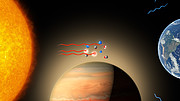
Infographic showing the path of stellar light through the atmosphere of WASP-19b

The star WASP-19 in the constellation of Vela (The Sails)
Videos


Flying from the Earth to the star WASP-19 in the constellation Vela
ESO’s VLT makes first detection of titanium oxide in an exoplanet
Astronomers using ESO’s Very Large
Telescope have detected titanium oxide in an exoplanet atmosphere for
the first time. This discovery around the hot-Jupiter planet WASP-19b
exploited the power of the FORS2 instrument. It provides unique
information about the chemical composition and the temperature and
pressure structure of the atmosphere of this unusual and very hot world.
The results appear today in the journal Nature.
A team of astronomers led by Elyar Sedaghati, an ESO fellow
and recent graduate of TU Berlin, has examined the atmosphere of the
exoplanet WASP-19b
in greater detail than ever before. This remarkable planet has about the
same mass as Jupiter, but is so close to its parent star that it
completes an orbit in just 19 hours and its atmosphere is estimated to
have a temperature of about 2000 degrees Celsius.
As WASP-19b passes in front of its parent star, some of the
starlight passes through the planet’s atmosphere and leaves subtle
fingerprints in the light that eventually reaches Earth. By using the FORS2 instrument on the Very Large Telescope
the team was able to carefully analyse this light and deduce that the
atmosphere contained small amounts of titanium oxide, water and traces
of sodium, alongside a strongly scattering global haze.
“Detecting such molecules is, however, no simple feat,” explains Elyar Sedaghati, who spent 2 years as ESO student to work on this project. “Not
only do we need data of exceptional quality, but we also need to
perform a sophisticated analysis. We used an algorithm that explores
many millions of spectra spanning a wide range of chemical compositions,
temperatures, and cloud or haze properties in order to draw our
conclusions.”
Titanium oxide is rarely seen on Earth. It is
known to exist in the atmospheres of cool stars. In the atmospheres of
hot planets like WASP-19b, it acts as a heat absorber. If present in
large enough quantities, these molecules prevent heat from entering or
escaping through the atmosphere, leading to a thermal
inversion — the temperature is higher in the upper atmosphere and lower
further down, the opposite of the normal situation. Ozone plays a
similar role in Earth’s atmosphere, where it causes inversion in the
stratosphere.
“The presence of titanium oxide in the atmosphere of
WASP-19b can have substantial effects on the atmospheric temperature
structure and circulation.” explains Ryan MacDonald, another team member and an astronomer at Cambridge University, United Kingdom. “To be able to examine exoplanets at this level of detail is promising and very exciting.” adds Nikku Madhusudhan from Cambridge University who oversaw the theoretical interpretation of the observations.
The astronomers collected observations of WASP-19b over a period of more than one year.
By measuring the relative variations in the planet’s radius at
different wavelengths of light that passed through the exoplanet’s
atmosphere and comparing the observations to atmospheric models, they
could extrapolate different properties, such as the chemical content, of
the exoplanet’s atmosphere.
This new information about the presence of metal oxides
like titanium oxide and other substances will allow much better modeling
of exoplanet atmospheres. Looking to the future, once astronomers are
able to observe atmospheres of possibly habitable planets, the improved
models will give them a much better idea of how to interpret those
observations.
More Information
“This important discovery is the outcome of a refurbishment of the FORS2 instrument that was done exactly for this purpose,” adds team member Henri Boffin, from ESO, who led the refurbishment project. “Since then, FORS2 has become the best instrument to perform this kind of study from the ground.”
More Information
This research was presented in the
paper entitled “Detection of titanium oxide in the atmosphere of a hot
Jupiter” by Elyar Sedaghati et. al. to appear in Nature.
The team is composed of Elyar Sedaghati (ESO; Deutsches
Zentrum für Luft- und Raumfahrt, Germany; and TU Berlin, Germany), Henri
M.J. Boffin (ESO), Ryan J. MacDonald (Cambridge University, UK),
Siddharth Gandhi (Cambridge University, UK), Nikku Madhusudhan
(Cambridge University, UK), Neale P. Gibson (Queen’s University Belfast,
UK), Mahmoudreza Oshagh (Georg-August-Universität Göttingen, Germany),
Antonio Claret (Instituto de Astrofísica de Andalucía - CSIC, Spain) and
Heike Rauer (Deutsches Zentrum für Luft- und Raumfahrt, Germany and TU
Berlin, Germany).
ESO is the foremost intergovernmental astronomy
organisation in Europe and the world’s most productive ground-based
astronomical observatory by far. It is supported by 16 countries:
Austria, Belgium, Brazil, the Czech Republic, Denmark, France, Finland,
Germany, Italy, the Netherlands, Poland, Portugal, Spain, Sweden,
Switzerland and the United Kingdom, along with the host state of Chile.
ESO carries out an ambitious programme focused on the design,
construction and operation of powerful ground-based observing facilities
enabling astronomers to make important scientific discoveries. ESO also
plays a leading role in promoting and organising cooperation in
astronomical research. ESO operates three unique world-class observing
sites in Chile: La Silla, Paranal and Chajnantor. At Paranal, ESO
operates the Very Large Telescope and its world-leading Very Large
Telescope Interferometer as well as two survey telescopes, VISTA working
in the infrared and the visible-light VLT Survey Telescope. ESO is also
a major partner in two facilities on Chajnantor, APEX and ALMA, the
largest astronomical project in existence. And on Cerro Armazones, close
to Paranal, ESO is building the 39-metre Extremely Large Telescope, the
ELT, which will become “the world’s biggest eye on the sky”.
Links
Contacts
Elyar Sedaghati
ESO Fellow
Vitacura, Santiago, Chile
Tel: +56 2 2463 6537
Email: esedagha@eso.org
Henri Boffin
ESO
Garching bei München, Germany
Tel: +49 89 3200 6542
Email: hboffin@eso.org
Richard Hook
ESO Public Information Officer
Garching bei München, Germany
Tel: +49 89 3200 6655
Cell: +49 151 1537 3591
Email: rhook@eso.org


