Tuesday, February 14, 2012

Globular star clusters: the survivors of a 13 billion year old massacre

The Galactic globular cluster M80 in the constellation Scorpius contains several hundred thousand stars. Credit: HST/NASA/ESA

Our Milky Way galaxy is surrounded by some 200 compact groups of stars, containing up to a million stars each. At 13 billion years of age, these globular clusters are almost as old as the universe itself and were born when the first generations of stars and galaxies formed. Now a team of astronomers from Germany and the Netherlands have conducted a novel type of computer simulation that looked at how they were born - and they find that these giant clusters of stars are the only survivors of a 13 billion year-old massacre that destroyed many of their smaller siblings. The new work, led by Dr Diederik Kruijssen of the Max Planck Institute for Astrophysics in Garching, Germany, appears in a paper in the journal Monthly Notices of the Royal Astronomical Society.

Globular star clusters have a remarkable characteristic: the typical number of stars they contain appears to be about the same throughout the Universe. This is in contrast to much younger stellar clusters, which can contain almost any number of stars, from fewer than 100 to many thousands. The team of scientists proposes that this difference can be explained by the conditions under which globular clusters formed early on in the evolution of their host galaxies.

The researchers ran simulations of isolated and colliding galaxies, in which they included a model for the formation and destruction of stellar clusters. When galaxies collide, they often generate spectacular bursts of star formation ("starbursts") and a wealth of bright, young stellar clusters of many different sizes. As a result it was always thought that the total number of star clusters increases during starbursts. But the Dutch-German team found the opposite result in their simulations.

While the very brightest and largest clusters were indeed capable of surviving the galaxy collision due to their own gravitational attraction, the numerous smaller clusters were effectively destroyed by the rapidly changing gravitational forces that typically occur during starbursts due to the movement of gas, dust and stars. The wave of starbursts came to an end after about 2 billion years and the researchers were surprised to see that only clusters with high numbers of stars had survived. These clusters had all the characteristics that should be expected for a young population of globular clusters as they would have looked about 11 billion years ago.

Dr Kruijssen comments: "It is ironic to see that starbursts may produce many young stellar clusters, but at the same time also destroy the majority of them. This occurs not only in galaxy collisions, but should be expected in any starburst environment. In the early Universe, starbursts were commonplace – it therefore makes perfect sense that all globular clusters have approximately the same large number of stars. Their smaller brothers and sisters that didn't contain as many stars were doomed to be destroyed."

According to the simulations, most of the star clusters were destroyed shortly after their formation, when the galactic environment was still very hostile to the young clusters. After this episode ended, the surviving globular clusters have lived quietly until the present day.

The researchers have further suggestions to test their ideas. Dr Kruijssen continues: "In the nearby Universe, there are several examples of galaxies that have recently undergone large bursts of star formation. It should therefore be possible to see the rapid destruction of small stellar clusters in action. If this is indeed found by new observations, it will confirm our theory for the origin of globular clusters."

The simulations suggest that most of a globular cluster's traits were established when it formed. The fact that globular clusters are comparable everywhere then indicates that the environments in which they formed were very similar, regardless of the galaxy they currently reside in. In that case, Dr Kruijssen believes, they can be used as fossils to shed more light on the conditions in which the first stars and galaxies were born.


SCIENCE CONTACT

Dr Diederik Kruijssen
Max-Planck Institute for Astrophysics
Garching, Germany
Tel: +49 (0)89 30000 2241
Email: kruijssen@mpa-garching.mpg.de


MEDIA CONTACTS

Dr Robert Massey
Royal Astronomical Society
Tel: +44 (0)20 7734 3307 x214
Mob: +44 (0)794 124 8035
Email: rm@ras.org.uk

Dr Hannelore Hämmerle
Press officer
Max-Planck Institute for Astrophysics
Garching, Germany
Tel: +49 (0)89 30000 3980
Email: hhaemmerle@mpa-garching.mpg.de


IMAGES AND MOVIES

A movie of two colliding galaxies based on the new simulation, covering 3.3 billion years. The galaxies eventually merge, destroying many of the stellar clusters (visible here as dots) in the process. Credit: D. Kruijssen, MPA

http://www.mpa-garching.mpg.de/~diederik/1m11clusters.html

This image of the Antennae galaxies shows a multitude of bright young star clusters, groups of stars associated with regions of intense star formation. Credit: NASA, ESA, and the Hubble Heritage Team (STScI/AURA)-ESA/Hubble Collaboration

http://www.nasa.gov/multimedia/imagegallery/image_feature_1086.html

The Galactic globular cluster M80 in the constellation Scorpius contains several hundred thousand stars. Credit: HST/NASA/ESA

http://grin.hq.nasa.gov/IMAGES/SMALL/GPN-2000-000930.jpg


FURTHER INFORMATION

The work will appear in the paper "Formation versus destruction: the evolution of the star cluster population in galaxy mergers", Kruijssen et al, Monthly Notices of the Royal Astronomical Society, in press. A preprint of the paper can be seen at http://arxiv.org/abs/1112.1065


NOTES FOR EDITORS

The Royal Astronomical Society

The Royal Astronomical Society (RAS, www.ras.org.uk), founded in 1820, encourages and promotes the study of astronomy, solar-system science, geophysics and closely related branches of science. The RAS organizes scientific meetings, publishes international research and review journals, recognizes outstanding achievements by the award of medals and prizes, maintains an extensive library, supports education through grants and outreach activities and represents UK astronomy nationally and internationally. Its more than 3500 members (Fellows), a third based overseas, include scientific researchers in universities, observatories and laboratories as well as historians of astronomy and others.

Follow the RAS on Twitter via @royalastrosoc

Monday, February 13, 2012

Planck All-Sky Images Show Cold Gas and Strange Haze

This all-sky image shows the distribution of carbon monoxide (CO), a molecule used by astronomers to trace molecular clouds across the sky, as seen by Planck. Full image and caption


This all-sky image shows the spatial distribution over the whole sky of the galactic haze at 30 and 44 GHz, extracted from the Planck observations. Credits: ESA/Planck Collaboration. Full image and caption - enlarge image

This all-sky image shows the distribution of the galactic haze seen by ESA's Planck mission at microwave frequencies superimposed over the high-energy sky, as seen by NASA's Fermi Gamma-ray Space Telescope. Credits: ESA/Planck Collaboration (microwave); NASA/DOE/Fermi LAT/D. Finkbeiner et al. (gamma rays) . Full image and caption - enlarge image

New images from the Planck mission show previously undiscovered islands of star formation and a mysterious haze of microwave emissions in our Milky Way galaxy. The views give scientists new treasures to mine and take them closer to understanding the secrets of our galaxy.

Planck is a European Space Agency mission with significant NASA participation.

"The images reveal two exciting aspects of the galaxy in which we live," said Planck scientist Krzysztof M. Gorski from NASA's Jet Propulsion Laboratory in Pasadena, Calif., and Warsaw University Observatory in Poland. "They show a haze around the center of the galaxy, and cold gas where we never saw it before."

The new images show the entire sky, dominated by the murky band of our Milky Way galaxy. One of them shows the unexplained haze of microwave light previously hinted at in measurements by NASA's Wilkinson Microwave Anisotropy Probe (WMAP).

"The haze comes from the region surrounding the center of our galaxy and looks like a form of light energy produced when electrons accelerate through magnetic fields," said Davide Pietrobon, another JPL Planck scientist.

"We're puzzled though, because this haze is brighter at shorter wavelengths than similar light emitted elsewhere in the galaxy," added Gorski.

Several explanations have been proposed for this unusual behaviour.

"Theories include higher numbers of supernovae, galactic winds and even the annihilation of dark-matter particles," said Greg Dobler, a Planck collaborator from the University of California in Santa Barbara, Calif. Dark matter makes up about a quarter of our universe, but scientists don't know exactly what it is.

The second all-sky image is the first map to show carbon monoxide over the whole sky. Cold clouds with forming stars are predominantly made of hydrogen molecules, difficult to detect because they do not readily emit radiation. Carbon monoxide forms under similar conditions, and though it is rarer, the gas emits more light. Astronomers can use carbon monoxide to identify the clouds of hydrogen where stars are born.

Surveys of carbon monoxide undertaken with radio telescopes on the ground are time-consuming, so they are limited to portions of the sky where clouds of molecules are already known or expected to exist. Planck scans the whole sky, allowing astronomers to detect the gas where they weren't expecting to find it.

Planck's primary goal is to observe the Cosmic Microwave Background, the relic radiation from the Big Bang, and to extract its encoded information about what our universe is made of, and the origin of its structure.

This relic radiation can only be reached once all sources of foreground emission, such as the galactic haze and the carbon monoxide signals, have been identified and removed.

"The lengthy and delicate task of foreground removal provides us with prime datasets that are shedding new light on hot topics in galactic and extragalactic astronomy alike," said Jan Tauber, Planck project scientist at the European Space Agency.

Planck's first findings on the Big Bang's relic radiation are expected to be released in 2013. The new results are being presented this week at an international astronomy conference in Bologna, Italy.

NASA's Planck Project Office is based at NASA's Jet Propulsion Laboratory, Pasadena, Calif. JPL contributed mission-enabling technology for both of Planck's science instruments. European, Canadian and U.S. Planck scientists will work together to analyze the Planck data. More information is online at http://www.nasa.gov/planck and http://www.esa.int/planck .

JPL is managed for NASA by the California Institute of Technology in Pasadena.

Whitney Clavin 818-354-4673
Jet Propulsion Laboratory, Pasadena, Calif.
whitney.clavin@jpl.nasa.gov

Markus Bauer +31 71 565 6799
European Space Agency
markus.bauer@esa.int

Wednesday, February 08, 2012

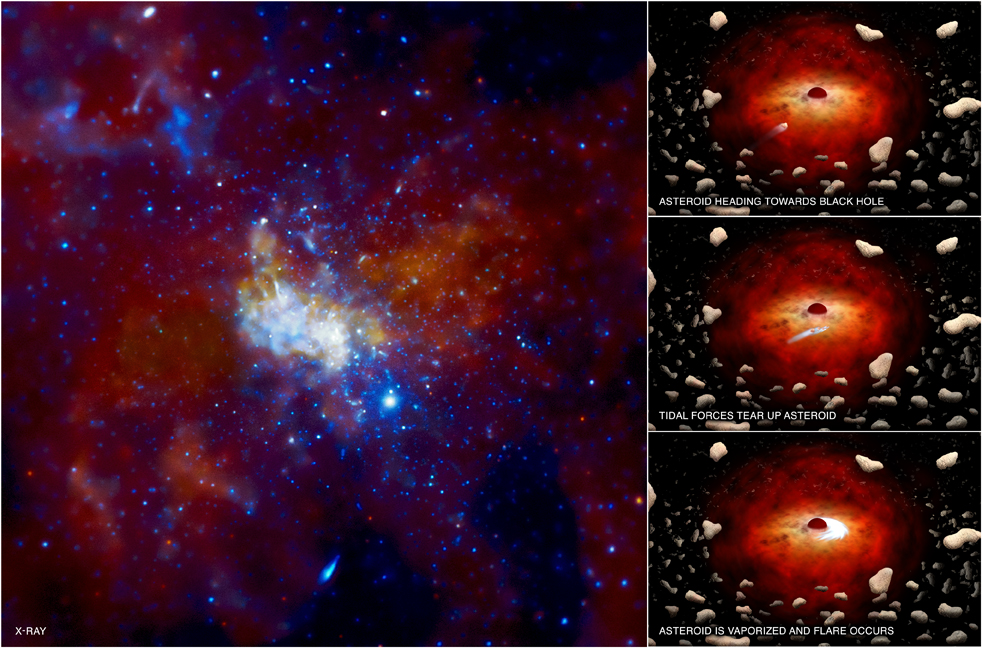
Sagittarius A*: NASA's Chandra Finds Milky Way's Black Hole May be Grazing on Asteroids

Mysterious X-ray flares caught by Chandra may be asteroids falling into the Milky Way's giant black hole. Credit: X-ray: NASA/CXC/MIT/F. Baganoff et al.; Illustrations: NASA/CXC/M.Weiss


(Runtime: 00:29)


This image from NASA's Chandra X-ray Observatory shows the center of our Galaxy, with a supermassive black hole known as Sagittarius A* (Sgr A* for short) in the center. Using intermittent observations over several years, Chandra has detected X-ray flares about once a day from Sgr A*. The flares have also been seen in infrared data from ESO's Very Large Telescope in Chile.

A new study provides a possible explanation for the mysterious flares. The suggestion is that there is a cloud around Sgr A* containing hundreds of trillions of asteroids and comets, which have been stripped from their parent stars. The panel on the left is an image containing nearly a million seconds of Chandra observing of the region around the black hole, with red representing low-energy X-rays, green as medium-energy X-rays, and blue being the highest.

An asteroid that undergoes a close encounter with another object, such as a star or planet, can be thrown into an orbit headed towards Sgr A*, as seen in a series of artist's illustrations beginning with the top-right panel. If the asteroid passes within about 100 million miles of the black hole, roughly the distance between the Earth and the Sun, it would be torn into pieces by the tidal forces from the black hole (middle-right panel).

These fragments would then be vaporized by friction as they pass through the hot, thin gas flowing onto Sgr A*, similar to a meteor heating up and glowing as it falls through Earth's atmosphere. A flare is produced (bottom-right panel) and eventually the remains of the asteroid are swallowed by the black hole.

Chandra Image of Environment Around Milky Way's Black Hole

Another solar system analogy for this type of event has recently been reported. About once every three days a comet is destroyed when it flies into the hot atmosphere of the Sun. So, despite the significant differences in the two environments, the destruction rate of comets and asteroids by the Sun and Sgr A* may be similar.

Very long observations of Sgr A* will be made with Chandra later in 2012 that will give valuable new information about the frequency and brightness of flares and should help to test the model proposed here to explain them. This work has the potential to understand the ability of asteroids and planets to form in the harsh environment of Sgr A*.

Fast Facts for Sagittarius A*:

Scale: Image is 15 arcmin across (20 light years)
Category:Black Holes, Milky Way Galaxy
Coordinates: (J2000) RA 17h 45m 40s | Dec -29° 00' 28.00"
Constellation: Sagittarius
Observation Dates: 43 pointings from September 21, 1999 to May 18, 2009
Observation Time; 278 hours (11 days 14 hours)
Obs. IDs: 242, 1561, 2943, 2951-2954, 3392, 3393, 3549, 3663, 3665, 4683, 4684, 5360, 5950-5954, 6113, 6363, 6639, 6640-6646, 7554-7759, 9169-9174, 10556
Color Code: X-ray: Energy: Red (2-3.3 keV), Green (3.3-4.7 keV), Blue (4.7-8 keV)
Instrument: ACIS
Also Known As: Galactic Center
References: K. Zubovas et al., 2012, MNRAS, in press; arXiv:1110.6872
Distance Estimate: About 26,000 light years

Subaru Telescope Captures Images of the "Stealth Merger" of Dwarf Galaxies

Figure 1: Suprime-Cam captured this image of the nearby dwarf galaxy NGC 4449 (lower left) and its companion (upper right), a dwarf galaxy that has been gravitationally pulled apart into a stellar stream. It shows individual stars composing the galaxies. R. Jay GaBany (Blackbird Observatory) produced the composite: blue hues in the center of the larger galaxy are brought about by a burst of recent star formation, while the red in its periphery and in its satellite indicates the presence of older, red-giant stars. (Hi-Res image)

An international team of scientists led by David Martinez-Delgado (Max Planck Institute for Astronomy, Germany) has conducted research that reveals a "stealth merger" of dwarf galaxies, where an in-falling satellite galaxy is nearly undetectable by conventional means yet has a substantial influence on its host galaxy. Aaron Romanowsky (University of California Observatories in Santa Cruz) along with graduate student Jacob Arnold (UCSC) used the Subaru Telescope to obtain high-resolution images of individual stars in a dense stream of stars in the outer regions of a nearby dwarf galaxy (NGC 4449); these outlying stars are the remains of an even smaller companion galaxy in the process of merging with its host (Figure 1). NGC 4449, the host galaxy, is the smallest primary galaxy in which a stellar stream from an ongoing merger has been identified and studied in detail. Romanowsky commented, "I don't think I'd ever seen a picture of a galaxy merger where you can see the individual stars. It's really an impressive image."

Martinez-Delgado organized a campaign to follow up on an initial report of the stellar stream in NGC 4449, first detected by Russian astronomers as a mysterious, faint smudge in digitized photographic plates from the Digitized Sky Survey project. Had the objects been slightly fainter, more diffuse, or farther from the host galaxy, the stellar stream could easily have been missed. NGC 4449 is located 12.5 million light years from Earth and is a member of a group of galaxies in the constellation Canes Venatici. Martinez-Delgado recruited astrophotographer R. Jay GaBany (recipient of the 2010 AAS Chambliss Amateur Achievement Award) to obtain deep, wide-field images with the half-meter telescope at Black Bird Observatory; these images confirmed the presence of a faint substructure in the galaxy's halo. Romanowsky and Arnold then took advantage of the wide field of view and light collecting power of Subaru Telescope's 8.2 meter mirror and its prime focus camera (Suprime-Cam) to capture high resolution images of the faint objects in the halo. These final observations at Subaru in 2011 clearly showed the stealth merger of two dwarf galaxies.

Modern cosmological theory posits that large galaxies were built up from smaller ones through an orderly succession of mergers. Although astronomers have observed many mergers involving massive galaxies, it has been difficult to find mergers of two dwarf galaxies. Theory suggests that similar processes of merging should occur on a smaller scale, with small galaxies eating even smaller ones; this is how galaxies grow. Romanowsky commented on the significance of the Subaru image: "Now we have this beautiful image of a dwarf galaxy consuming a smaller dwarf. You can see a smaller galaxy coming in and getting shredded, eventually leaving its stars scattered through the halo of the host galaxy. "

The new observations support the idea that the stellar halos around many dwarf galaxies are the remnants of smaller satellites that were shredded in past merger events. The ongoing merger in NGC 4449 may also be responsible for the intense burst of star formation seen in the galaxy. "This galaxy is famous for its starburst activity, and it seems we've found the reason for that. The gravitational interaction with the incoming galaxy has probably disturbed the gas in the main galaxy and caused it to start forming stars," Romanowsky said.


Notes:

This research was supported by the National Science Foundation (NSF, USA), National Aeronautics and Space Administration (NASA, USA) and the University of California at Santa Cruz-University Affiliated Research Center (UCSC-UARC) Aligned Research Program.


The paper describing the research, “Dwarfs gobbling dwarfs: A stellar tidal stream around NGC 4449 and hierarchical galaxy formation on small scales”, will be published in Astrophysical Journal Letters. Coauthors of this international study include:

D. Martinez-Delgado (Max Planck Institute for Astronomy, Germany)
A. Romanowsky (University of California Observatories at Santa Cruz, USA)
J. Arnold (University of California at Santa Cruz, USA)
R. J. GaBany (astrophotographer, amateur astronomer, USA)
J. Brodie (UC Santa Cruz, USA)
F. Annibali (Astronomical Observatory of Bologna, Italy)
J. Fliri (Observatory of Paris, France)
S. Zibetti (University of Copenhagen, Denmark)
R. van der Marel (Space Telescope Science Institute, USA)
A. Aloisi (Space Telescope Science Institute, USA)
H.-W. Rix (Max Planck Institute for Astronomy, Germany)
A. Macciò (Max Planck Institute for Astronomy, Germany)
T. Chonis (University of Texas at Austin, USA)
J. Carballo-Bello (Canary Astrophysics Institute, Spain)
J. Gallego-Laborda (Fosca Nit Observatory Spain)
M. Merrifield (University of Nottingham, UK)

VLT Takes Most Detailed Infrared Image of the Carina Nebula

PR Image eso1208a
ESO’s VLT reveals the Carina Nebula's hidden secrets

PR Image eso1208b
Excerpts from VLT image of the Carina Nebula in infrared light

Infrared/visible-light comparison of the Carina Nebula

PR Image eso1208d
The Carina Nebula in the constellation of Carina

PR Image eso1208e
Digitized Sky Survey Image of Eta Carinae Nebula

VIDEOS

PR Video eso1208a
Zooming in on a new infrared view of the Carina Nebula

Infrared/visible-light comparison view of the Carina Nebula

ESO’s Very Large Telescope has delivered the most detailed infrared image of the Carina Nebula stellar nursery taken so far. Many previously hidden features, scattered across a spectacular celestial landscape of gas, dust and young stars, have emerged. This is one of the most dramatic images ever created by the VLT.

Deep in the heart of the southern Milky Way lies a stellar nursery called the Carina Nebula. It is about 7500 light-years from Earth in the constellation of Carina (The Keel) [1]. This cloud of glowing gas and dust is one of the closest incubators of very massive stars to the Earth and includes several of the brightest and heaviest stars known. One of them, the mysterious and highly unstable star Eta Carinae, was the second brightest star in the entire night sky for several years in the 1840s and is likely to explode as a supernova in the near future, by astronomical standards. The Carina Nebula is a perfect laboratory for astronomers studying the violent births and early lives of stars.

Although this nebula is spectacular in normal visible-light pictures (eso0905), many of its secrets are hidden behind thick clouds of dust. To penetrate this veil a European team of astronomers, led by Thomas Preibisch (University Observatory, Munich, Germany) has used the power of ESO’s Very Large Telescope along with an infrared-sensitive camera called HAWK-I [2].

Hundreds of individual images have been combined to create this picture, which is the most detailed infrared mosaic of the nebula ever taken and one of the most dramatic images ever created by the VLT. It shows not just the brilliant massive stars, but hundreds of thousands of much fainter stars [3] that were previously invisible.

The dazzling star Eta Carinae itself appears at the lower left of the new picture. It is surrounded by clouds of gas that are glowing under the onslaught of fierce ultraviolet radiation. Across the image there are also many compact blobs of dark material that remain opaque even in the infrared. These are the dusty cocoons in which new stars are forming.

Over the last few million years this region of the sky has formed large numbers of stars both individually and in clusters. The bright star cluster close to the centre of the picture is called Trumpler 14. Although this object is seen well in visible light, many more fainter stars can be seen in this infrared view. And towards the left side of the image a small concentration of stars that appear yellow can be seen. This grouping was seen for the first time in this new data from the VLT: these stars cannot be seen in visible light at all. This is just one of many new objects revealed for the first time in this spectacular panorama.

Notes

[1] Carina is the keel of the mythological ship Argo, of Jason and the Argonauts fame.

[2] Dusty regions of space absorb and scatter short wavelength blue light more than the longer wavelength red. This effect also explains why sunsets on Earth are often red, particularly when the atmosphere is dusty. In some dusty parts of the sky, particularly in star formation regions such as the Carina Nebula, this effect is so strong that no visible light gets through at all. Astronomers overcome this problem by observing in infrared light using special cameras such as HAWK-I on ESO’s VLT or the VISTA infrared survey telescope.

[3] One of the main goals of the astronomers was to search for stars in this region that were much fainter and less massive than the Sun. The image is also deep enough to allow the detection of young brown dwarfs.

More information

The year 2012 marks the 50th anniversary of the founding of the European Southern Observatory (ESO). ESO is the foremost intergovernmental astronomy organisation in Europe and the world’s most productive astronomical observatory. It is supported by 15 countries: Austria, Belgium, Brazil, the Czech Republic, Denmark, France, Finland, Germany, Italy, the Netherlands, Portugal, Spain, Sweden, Switzerland and the United Kingdom. ESO carries out an ambitious programme focused on the design, construction and operation of powerful ground-based observing facilities enabling astronomers to make important scientific discoveries. ESO also plays a leading role in promoting and organising cooperation in astronomical research. ESO operates three unique world-class observing sites in Chile: La Silla, Paranal and Chajnantor. At Paranal, ESO operates the Very Large Telescope, the world’s most advanced visible-light astronomical observatory and two survey telescopes. VISTA works in the infrared and is the world’s largest survey telescope and the VLT Survey Telescope is the largest telescope designed to exclusively survey the skies in visible light. ESO is the European partner of a revolutionary astronomical telescope ALMA, the largest astronomical project in existence. ESO is currently planning a 40-metre-class European Extremely Large optical/near-infrared Telescope, the E-ELT, which will become “the world’s biggest eye on the sky”.

Links
Research paper describing the infrared observations of the Carina Nebula
Thomas Preibisch’s Carina web page
Observations of the Carina Nebula with APEX/LABOCA
X-ray observations of the same region from the Chandra Carina Project
Photos of the VLT

Contacts

Thomas Preibisch
University Observatory Munich/Ludwig-Maximilians-University
Munich, Germany
Tel: +49 89 2180 6016
Email: preibisch@usm.uni-muenchen.de

Richard Hook
ESO, La Silla, Paranal, E-ELT and Survey Telescopes Public Information Officer
Garching bei München, Germany
Tel: +49 89 3200 6655
Cell: +49 151 1537 3591
Email: rhook@eso.org

Tuesday, February 07, 2012

Transforming Galaxies

Credit: ESA/Hubble & NASA

Many of the Universe’s galaxies are like our own, displaying beautiful spiral arms wrapping around a bright nucleus. Examples in this stunning image, taken with the Wide Field Camera 3 on the NASA/ESA Hubble Space Telescope, include the tilted galaxy at the bottom of the frame, shining behind a Milky Way star, and the small spiral at the top centre.

Other galaxies are even odder in shape. Markarian 779, the galaxy at the top of this image, has a distorted appearance because it is likely the product of a recent galactic merger between two spirals. This collision destroyed the spiral arms of the galaxies and scattered much of their gas and dust, transforming them into a single peculiar galaxy with a unique shape.

This galaxy is part of the Markarian catalogue, a database of over 1500 galaxies named after B. E. Markarian, the Armenian astronomer who studied them in the 1960s. He surveyed the sky for bright objects with unusually strong emission in the ultraviolet.

Ultraviolet radiation can come from a range of sources, so the Markarian catalogue is quite diverse. An excess of ultraviolet emissions can be the result of the nucleus of an “active” galaxy, powered by a supermassive black hole at its centre. It can also be due to events of intense star formation, called starbursts, possibly triggered by galactic collisions. Markarian galaxies are, therefore, often the subject of studies aimed at understanding active galaxies, starburst activity, and galaxy interactions and mergers.

Source: ESA/Hubble - Space Telescope


Friday, February 03, 2012

Classic Portrait of a Barred Spiral Galaxy

Hubble image of NGC 1073

PR Image heic1202b
Labelled Hubble image of NGC 1073, showing quasars and IXO 5

PR Image heic1202c
Wide-field view of NGC 1073 and its surroundings (ground-based image)

VIDEOS

PR Video heic1202a
Zoom into NGC 1073

PR Video heic1202b
Pan across NGC 1073


Hubble Observes NGC 1073

The NASA/ESA Hubble Space Telescope has taken a picture of the barred spiral galaxy NGC 1073, which is found in the constellation of Cetus (The Sea Monster). Our own galaxy, the Milky Way, is a similar barred spiral, and the study of galaxies such as NGC 1073 helps astronomers learn more about our celestial home.

Most spiral galaxies in the Universe have a bar structure in their centre, and Hubble’s image of NGC 1073 offers a particularly clear view of one of these. Galaxies’ star-filled bars are thought to emerge as gravitational density waves funnel gas toward the galactic centre, supplying the material to create new stars. The transport of gas can also feed the supermassive black holes that lurk in the centres of almost every galaxy.

Some astronomers have suggested that the formation of a central bar-like structure might signal a spiral galaxy's passage from intense star-formation into adulthood, as the bars turn up more often in galaxies full of older, red stars than younger, blue stars. This storyline would also account for the observation that in the early Universe, only around a fifth of spiral galaxies contained bars, while more than two thirds do in the more modern cosmos.

While Hubble’s image of NGC 1073 is in some respects an archetypal portrait of a barred spiral, there are a couple of quirks worth pointing out.

One, ironically, is almost — but not quite — invisible to optical telescopes like Hubble. In the upper left part of the image, a rough ring-like structure of recent star formation hides a bright source of X-rays. Called IXO 5, this X-ray source is likely to be a binary system featuring a black hole and a star orbiting each other. Comparing X-ray observations from the Chandra spacecraft with this Hubble image, astronomers have narrowed the position of IXO 5 down to one of two faint stars visible here. However, X-ray observations with current instruments are not precise enough to conclusively determine which of the two it is.

Hubble’s image does not only tell us about a galaxy in our own cosmic neighbourhood, however. We can also discern glimpses of objects much further away, whose light tells us about earlier eras in cosmic history.

Right across Hubble’s field of view, more distant galaxies are peering through NGC 1073, with several reddish examples appearing clearly in the top left part of the frame.

More intriguing still, three of the bright points of light in this image are neither foreground stars from the Milky Way, nor even distant stars in NGC 1073. In fact they are not stars at all. They are quasars, incredibly bright sources of light caused by matter heating up and falling into supermassive black holes in galaxies literally billions of light-years from us. The chance alignment through NGC 1073, and their incredible brightness, might make them look like they are part of the galaxy, but they are in fact some of the most distant objects observable in the Universe.

Notes

The Hubble Space Telescope is a project of international cooperation between ESA and NASA.

Image credit: NASA & ESA

Links

Contacts

Oli Usher
Hubble/ESA
Garching, Germany
Tel: +49-89-3200-6855
Email: ousher@eso.org

The Art of Recycling Pulsars

Stellar Astrophysics helps to explain the behaviour of fast rotating neutron stars in binary systems


What happens to the spin of rapidly rotating neutron stars called millisecond pulsars when reaching the end of their mass-accretion phase? The formation of millisecond pulsars is the result of stellar cannibalism where matter flows from a donor star to an accreting pulsar in a binary system. During this process the pulsar emits X-rays while being spun up to amazingly high rotational speeds with periods of about 1 to 10 milliseconds. Astrophysicist Thomas Tauris has a joint appointment at both, Argelander-Institut für Astronomie and Max-Planck-Institut für Radioastronomie, based in Bonn, Germany. Through numerical calculations on the base of stellar evolution and accretion torques, he can show that millisecond pulsars loose about half of their rotational energy during the final stages of the mass-transfer process before the pulsar turns on its radio beam. This result is in agreement with current observations and the findings also explain why radio millisecond pulsars appear to be much older than the white dwarf remnants of their companion stars - and perhaps why no sub-millisecond radio pulsars exist at all.

The results are reported in the February 03 issue of the journal "Science".

Figure 1: An artist's impression of an accreting X-ray millisecond pulsar. The flowing material from the companion star forms a disk around the neutron star which is truncated at the edge of the pulsar magnetosphere. Credit: NASA / Goddard Space Flight Center / Dana Berry (Click here for higher resolution)

Millisecond pulsars are strongly magnetized, old neutron stars in binary systems which have been spun up to high rotational frequencies by accumulation of mass and angular momentum from a companion star. Today we know of about 200 such pulsars with spin periods between 1.4-10 milliseconds. These are located in both the Galactic Disk and in Globular Clusters.

Since the first millisecond pulsar was detected in 1982 is has remained a challenge for theorists to explain their spin periods, magnetic fields and ages. As an example, there is the "turn-off" problem, i.e. what happens to the spin of the pulsar when the donor star terminates its mass-transfer process?

"We have now, for the first time, combined detailed numerical stellar evolution models with calculations of the braking torque acting on the spinning pulsar", says Thomas Tauris, the author of the present study. "The result is that the millisecond pulsars loose about half of their rotational energy in the so-called Roche-lobe decoupling phase." This phase is describing the termination of the mass transfer in the binary system. Hence, radio-emitting millisecond pulsars should spin slightly slower than their progenitors, X-ray emitting millisecond pulsars which are still accreting material from their donor star. This is exactly what the observational data seem to suggest. Furthermore, these new findings can help explain why some millisecond pulsars appear to have characteristic ages exceeding the age of the Universe and perhaps why no sub-millisecond radio pulsars exist.

The key feature of the new results is that it has now been demonstrated how the spinning pulsar is able to brake out of its so-called equilibrium spin. At this epoch the mass-transfer rate decreases which causes the magnetospheric radius of the pulsar to expand and thereby expelling the infalling matter like a propeller. This causes the pulsar to loose additional rotational energy and thus slow down its spin rate.

"Actually, without a solution to the "turn-off" problem we would expect the pulsars to even slow down to spin periods of 50-100 milliseconds during the Roche-lobe decoupling phase", concludes Thomas Tauris. "That would be in clear contradiction with observational evidence for the existence of millisecond pulsars."


This work has profited from a recent effort to bridge the Stellar Physics group at the Argelander-Institut für Astronomie at University of Bonn (led by Norbert Langer) with the Fundamental Physics in Radio Astronomy group at the Max-Planck-Institut für Radioastronomie (led by Michael Kramer). The stellar evolution models used for this work were made using a state-of-the-art code developed by Norbert Langer. A significant part of the observational data was supplied by the pulsar group. Michael Kramer and his colleagues are using the 100-m Effelsberg Radio Telescope to participate in several ongoing searches and discoveries of millisecond pulsars.

Thomas Tauris has been working at the Argelander-Institut für Astronomie and the Max-Planck-Institut für Radioastronomie as a visiting research professor since 2010. Some of his recent work on the recycling of millisecond pulsars has been published in the journal "Monthly Notices of the Royal Astronomical Society" in joint publications with Norbert Langer and Michael Kramer. On February 27 they host an international one-day workshop in Bonn on the "Formation and Evolution of Neutron stars".


Original Paper:

Spin-Down of Radio Millisecond Pulsars at Genesis, Thomas M. Tauris, Science Bd. 335, S. 561. DOI 10.1126/science.1216355.


Further Information:

Max Planck Institute for Radio Astronomy (MPIfR).

Argelander-Institut für Astronomie (AIfA), University of Bonn.

Fundamental Physics in Radio Astronomy.

Bonn Stellar Physics Group.

Formation of millisecond pulsars with CO white dwarf companions, Thomas M. Tauris, Norbert Langer, Michael Kramer, Preprint MNRAS.

Formation and Evolution of Neutron Stars, Workshop Bonn Feb 27, 2012.


Parallel Press Releases:

The discovery of deceleration , Max Planck Society News Release, 02 February 2012.

Sternenkreisel entpuppt sich als Vampir , Press Release, University of Bonn, February 03, 2012 (in German).


Contact:

Dr. Thomas M. Tauris,
Argelander-Institut für Astronomie, Univ. of Bonn
& Max-Planck-Institut für Radioastronomie, Bonn.
Fon: +49-73-3660
E-mail: tauris (at) astro.uni-bonn.de

Prof. Dr. Michael Kramer,
Director and Head of Research Group "Fundamental Physics in Radio Astronomy",
Max-Planck-Institut für Radioastronomie, Bonn.
Fon: +49(0)228-525-278
E-mail: mkramer (at) mpifr-bonn.mpg.de

Dr. Norbert Junkes,
Press and Public Outreach,
Max-Planck-Institut für Radioastronomie, Bonn.
Fon: +49-228-525-399
E-mail: njunkes (at) mpifr.de


Thursday, February 02, 2012

New super-Earth detected within the habitable zone of a nearby star

The newly discovered planet is depicted in this artist's conception, showing the host star as part of a triple-star system. The diagram below shows the orbits of the detected planets around the host star in relation to the habitable zone. Images courtesy of Guillem Anglada-Escudé, Carnegie Institution.

Diagram of the planets orbiting the star GJ 667C
Credit: Guillem Anglada-Escudé

An international team of scientists has discovered a potentially habitable super-Earth orbiting a nearby star. With an orbital period of about 28 days and a minimum mass 4.5 times that of the Earth, the planet orbits within the star's "habitable zone," where temperatures are neither too hot nor too cold for liquid water to exist on the planet's surface. The researchers found evidence of at least one and possibly two or three additional planets orbiting the star, which is about 22 light years from Earth.

The team includes UC Santa Cruz astronomers Steven Vogt and Eugenio Rivera and was led by Guillem Anglada-Escudé and Paul Butler of the Carnegie Institution for Science. Their work will be published by Astrophysical Journal Letters, and the manuscript will be posted online at arxiv.org/archive/astro-ph.

The host star is a member of a triple-star system and has a different makeup than our sun, with a much lower abundance of elements heavier than helium, such as iron, carbon, and silicon. This discovery indicates that potentially habitable planets can occur in a greater variety of environments than previously believed.

The researchers used public data from the European Southern Observatory and analyzed it with a novel data-analysis method. They also incorporated new measurements from the W. M. Keck Observatory's High Resolution Echelle Spectrograph and the new Carnegie Planet Finder Spectrograph at the Magellan II Telescope. Their planet-finding technique involved measuring the small wobbles in a star's motion caused by the gravitational tug of a planet.

The host star, called GJ 667C, is an M-class dwarf star. The other two stars in the triple-star system (GJ 667AB) are a pair of orange K dwarfs, with a concentration of heavy elements only 25 percent that of our sun's. Such elements are the building blocks of terrestrial planets, so it was thought to be less likely for metal-depleted star systems to have an abundance of low-mass planets.

"This was expected to be a rather unlikely star to host planets. Yet there they are, around a very nearby, metal-poor example of the most common type of star in our galaxy," said Vogt, a professor of astronomy and astrophysics at UCSC. "The detection of this planet, this nearby and this soon, implies that our galaxy must be teeming with billions of potentially habitable rocky planets."

GJ 667C had previously been observed to have a super-Earth (GJ 667Cb) with a period of 7.2 days, although this finding was never published. This planet orbits so close to the star that it would be too hot for liquid water. The new study started with the aim of obtaining the orbital parameters of this super-Earth.

But in addition to this first candidate, the research team found the clear signal of a new planet (GJ 667Cc) with an orbital period of 28.15 days and a minimum mass of 4.5 times that of Earth. The new planet receives 90 percent of the light that Earth receives. However, because most of its incoming light is in the infrared, a higher percentage of this incoming energy should be absorbed by the planet. When both these effects are taken into account, the planet is expected to absorb about the same amount of energy from its star that the Earth absorbs from the sun.

"This planet is the new best candidate to support liquid water and, perhaps, life as we know it," Anglada-Escudé said.

The team found that the system might also contain a gas-giant planet and an additional super-Earth with an orbital period of 75 days. However, further observations are needed to confirm these two possibilities.

"With the advent of a new generation of instruments, researchers will be able to survey many M dwarf stars for similar planets and eventually look for spectroscopic signatures of life in one of these worlds," said Anglada-Escudé, who was with Carnegie when he conducted the research, but has since moved on to the University of Gottingen.

In addition to Anglada-Escudé, Butler, Vogt, and Rivera, the coauthors include Jeffrey Crane, Stephen Shectman, and Ian Thompson at Carnegie; Pamela Arriagada and Dante Minniti of Pontificia Universidad Catolica de Chile; Nader Haghighipour of the University of Hawaii-Monoa; Brad Carter of University of Southern Queensland; C. G. Tinney, Robert Wittenmyer, and Jeremy Bailey of the University of New South Wales; Simon J. O'Toole of the Australian Astronomical Observatory; Hugh Jones of the University of Hertfordshire; and James Jenkins of the Universidad de Chile, Camino El Observatorio.

Hubble Zooms in on a Magnified Galaxy

RCS2 032727-132623
Credit: NASA, ESA, J. Rigby (NASA Goddard pace Flight Center), K. Sharon (Kavli Institute for Cosmological Physics, University of Chicago), and M. Gladders and E. Wuyts (University of Chicago). More Images

Thanks to the presence of a natural "zoom lens" in space, NASA's Hubble Space Telescope got a uniquely close-up look at the brightest "magnified" galaxy yet discovered.

This observation provides a unique opportunity to study the physical properties of a galaxy vigorously forming stars when the universe was only one-third its present age.

A so-called gravitational lens is produced when space is warped by a massive foreground object, whether it is the Sun, a black hole, or an entire cluster of galaxies. The light from more-distant background objects is distorted, brightened, and magnified as it passes through this gravitationally disturbed region.

A team of astronomers led by Jane Rigby of NASA's Goddard Space Flight Center in Greenbelt, Md., aimed Hubble at one of the most striking examples of gravitational lensing, a nearly 90-degree arc of light in the galaxy cluster RCS2 032727-132623. Hubble's view of the distant background galaxy is significantly more detailed than could ever be achieved without the help of the gravitational lens.

The results have been accepted for publication in The Astrophysical Journal, in a paper led by Keren Sharon of the Kavli Institute for Cosmological Physics at the University of Chicago. Professor Michael Gladders and graduate student Eva Wuyts of the University of Chicago were also key team members.

The presence of the lens helps show how galaxies evolved from 10 billion years ago to today. While nearby galaxies are fully mature and are at the tail end of their star-formation histories, distant galaxies tell us about the universe's formative years. The light from those early events is just now arriving at Earth. Very distant galaxies are not only faint but also appear small on the sky. Astronomers would like to see how star formation progressed deep within these galaxies. Such details would be beyond the reach of Hubble's vision were it not for the magnification made possible by gravity in the intervening lens region.

In 2006 a team of astronomers using the Very Large Telescope in Chile measured the arc's distance and calculated that the galaxy appears more than three times brighter than previously discovered lensed galaxies. In 2011 astronomers used Hubble to image and analyze the lensed galaxy with the observatory's Wide Field Camera 3.

The distorted image of the galaxy is repeated several times in the foreground lensing cluster, as is typical of gravitational lenses. The challenge for astronomers was to reconstruct what the galaxy really looked like, were it not distorted by the cluster's funhouse-mirror effect.

Hubble's sharp vision allowed astronomers to remove the distortions and reconstruct the galaxy image as it would normally look. The reconstruction revealed regions of star formation glowing like bright Christmas tree bulbs. These are much brighter than any star-formation region in our Milky Way galaxy.

Through spectroscopy, the spreading out of light into its constituent colors, the team plans to analyze these star-forming regions from the inside out to better understand why they are forming so many stars.

CONTACT

Ray Villard
Space Telescope Science Institute, Baltimore, Md.
410-338-4514
villard@stsci.edu

Jane Rigby
NASA Goddard Space Flight Center, Greenbelt, Md.
301-286-1507
jane.r.rigby@nasa.gov

Do black holes help stars form?

An image of the ‘inner filament’ of the galaxy Centaurus A, made on 2 July 2010 with the Wide Field Camera 3 on the Hubble Space Telescope. The filament of ionized gas, seen here in green, begins near the newly formed stars on the right of the image, depicted here as blue-white dots. The unseen black hole is to the right of the image. The left to right distance across the image is three thousand light years. Credit: Mark Crockett

The centre of just about every galaxy is thought to host a black hole, some with masses of thousands of millions of Suns and consequently strong gravitational pulls that disrupt material around them. They had been thought to hinder the birth of stars, but now an international team of astronomers studying the nearby galaxy Centaurus A has found quite the opposite: a black hole that seems to be helping stars to form. The team, led by Dr Stanislav Shabala of the University of Tasmania, Dr Mark Crockett of the University of Oxford, and Dr Sugata Kaviraj of Imperial College, London, publish their results in the journal Monthly Notices of the Royal Astronomical Society.

Black holes at the centre of galaxies 'switch on' from time to time, driving material around them into outflows that can stretch for millions of light years. The flows plough through galactic gas, compressing, heating and pushing it out of the way. Much of this gas is the raw material from which stars are made, so the outflows significantly affect star formation in the galaxies that host them.

The astronomers used the Hubble Space Telescope's Wide Field Camera 3 (WFC3) to study the central regions of Centaurus A, catalogued as NGC 5128, a bright galaxy 13 million light years away in the direction of the southern constellation of Centaurus. In visible light, a prominent belt of dust can be seen running across the galaxy and when observed at X-ray and radio wavelengths it has jets extending for up to a million light years from a central black hole.

With WFC3, the scientists took a close look at the 'inner filament', a region located close to the outflow that is a source of ultraviolet and X-ray emission, as well as being bright in visible light. Using the Hubble images, the team were then able to map out the star formation history of the filament with unprecedented accuracy.

They found that the tip of the filament closest to the outflow contains young stars, the ages of which are similar to the time since the outflow 'switched on' but that there are no young stars further up the filament. This is exactly what is expected from an outflow overrunning a cloud of gas sitting in its path.

The densest central parts of the cloud are compressed and collapse to form stars, while the gas on the outskirts is swept away from the tip of the filament, like a pile of autumn leaves in the wind.

Dr Shabala comments: "This enhancement of star formation by outflows would have been even more important in a younger universe, where dense clumps of gas were much more common. Our study highlights the need to consider the role of 'positive' feedback from outflows in our current paradigm of galaxy formation. It adds an exciting new piece to a great puzzle – that of understanding how galaxies came to be the way they are today."


SCIENCE CONTACTS

Dr Stas Shabala
School of Mathematics & Physics
University of Tasmania
Hobart 7001
Australia
Tel: +61 (0)3 6226 8502
Mob: +61 (0)4 06 985 304
Email: stanislav.shabala@utas.edu.au

Dr Sugata Kaviraj
Blackett Laboratory
Imperial College
London SW7 2AZ
United Kingdom
Tel: +44 (0)20 759 47530
Email: s.kaviraj@imperial.ac.uk


MEDIA CONTACT

Dr Robert Massey
Royal Astronomical Society
Tel: +44 (0)20 7734 3307 x214
Mob: +44 (0)794 124 8035
Email: rm@ras.org.uk


IMAGES AND CAPTIONS

An image of the 'inner filament' of the galaxy Centaurus A, made on 2 July 2010 with the Wide Field Camera 3 on the Hubble Space Telescope. The filament of ionized gas, seen here in green, begins near the newly formed stars on the right of the image, depicted here as blue-white dots. The unseen black hole is to the right of the image. The left to right distance across the image is three thousand light years. Credit: Mark Crockett

http://astroweb1.physics.ox.ac.uk/~Kaviraj/CenA_press/regionsABCv5.jpg

The peculiar galaxy Centaurus A (NGC 5128) as seen by the Wide-Field Imager (WFI) camera of the ESO/MPG 2.2-m telescope at La Silla. The distinctive dust lane running across the galaxy is indicative of a galaxy collision. The inner filament is shown by the green box in the top left of the image. Credit: ESO/Vandame


FURTHER INFORMATION


The new work appears in a paper in the journal Monthly Notices of the Royal Astronomical Society. A preprint can be seen at http://arxiv.org/abs/1201.3369


NOTES FOR EDITORS

The Royal Astronomical Society

The Royal Astronomical Society (RAS, www.ras.org.uk), founded in 1820, encourages and promotes the study of astronomy, solar-system science, geophysics and closely related branches of science. The RAS organizes scientific meetings, publishes international research and review journals, recognizes outstanding achievements by the award of medals and prizes, maintains an extensive library, supports education through grants and outreach activities and represents UK astronomy nationally and internationally. Its more than 3500 members (Fellows), a third based overseas, include scientific researchers in universities, observatories and laboratories as well as historians of astronomy and others.

Follow the RAS on Twitter @royalastrosoc

Wednesday, February 01, 2012

G350.1-0.3: Remnant of an Explosion With a Powerful Kick?

G350.1+0.3


Vital clues about the devastating ends to the lives of massive stars can be found by studying the aftermath of their explosions. In its more than twelve years of science operations, NASA's Chandra X-ray Observatory has studied many of these supernova remnants sprinkled across the Galaxy.

The latest example of this important investigation is Chandra's new image of the supernova remnant known as G350.1+0.3. This stellar debris field is located some 14,700 light years from the Earth toward the center of the Milky Way .

Evidence from Chandra and from ESA's XMM-Newton telescope suggest that a compact object within G350.1+0.3 may be the dense core of the star that exploded. The position of this likely neutron star, seen by mousing over the image above, is well away from the center of the X-ray emission (mouse-over for this position). If the supernova explosion occurred near the center of the X-ray emission then the neutron star must have received a powerful kick in the supernova explosion.

Data from Chandra and other telescopes suggest this supernova remnant, as it appears in the image, is between 600 and 1,200 years old. If the estimated location of the explosion is correct, this means that the neutron star has been moving at a speed of at least 3 million miles per hour since the explosion This is comparable to the exceptionally high speed derived for the neutron star in Puppis A and provides new evidence that extremely powerful "kicks" can be imparted to neutron stars from supernova explosions.

Another intriguing aspect of G350.1+0.3 is its unusual shape. While many supernova remnants are nearly circular, G350.1+0.3 is strikingly asymmetrical as seen in the Chandra data in this image (gold). Infrared data from NASA's Spitzer Space Telescope (light blue) also trace the morphology found by Chandra. Astronomers think that this bizarre shape is due to the stellar debris field expanding into a nearby cloud of cold molecular gas.

The age of 600-1,200 years puts the explosion that created G350.1+0.3 in the same time frame as other famous supernovas that formed the Crab and SN 1006 supernova remnants. However, it is unlikely that anyone on Earth would have seen the explosion because of the obscuring gas and dust that lies along our line of sight to the remnant.

These results appeared in the April 10, 2011 issue of The Astrophysical Journal. The scientists on this paper were Igor Lovchinsky and Patrick Slane (Harvard-Smithsonian Center for Astrophysics), Bryan Gaensler (University of Sydney, Australia), Jack Hughes (Rutgers University), Jasmina Lazendic (Monash University Clayton, Australia), Joseph Gelfand (New York University, Abu Dhabi), and Crystal Brogan (National Radio Astronomy Observatory).

Fast Facts for G350.1-0.3:

Scale: 5.2 arcmin across (about 22 light years)
Category: Supernovas & Supernova Remnants, Neutron Stars/X-ray Binaries
Coordinates: (J2000) RA 17h 21m 03.00s | Dec -37° 26' 50.00"
Constellation: Scorpius
Observation Date: 5/24/2009
Observation Time: 23 hours 3 min.
Obs. ID: 10102
Color Code: X-ray (Gold); Infrared 24 micron (Cyan); Infrared 8 micron (Purple); Infrared: 3.6 micron (Green)
Instrument: ACIS
References: Lovchinsky, I. et al, 2011, ApJ, 731, 70
Distance Estimate: 14,700 light years

A Pocket of Star Formation

PR Image eso1207a
The star formation region NGC 3324

PR Image eso1207b
The star formation region NGC 3324 in the constellation of Carina (The Keel)

PR Image eso1207c
Digitized Sky Survey Image of Eta Carinae Nebula

PR Video eso1207a
Zooming in on the star formation region NGC 3324

This new view shows a stellar nursery called NGC 3324. It was taken using the Wide Field Imager on the MPG/ESO 2.2-metre telescope at the La Silla Observatory in Chile. The intense ultraviolet radiation from several of NGC 3324's hot young stars causes the gas cloud to glow with rich colours and has carved out a cavity in the surrounding gas and dust.

NGC 3324 is located in the southern constellation of Carina (The Keel, part of Jason’s ship the Argo) roughly 7500 light-years from Earth. It is on the northern outskirts of the chaotic environment of the Carina Nebula, which has been sculpted by many other pockets of star formation (eso0905). A rich deposit of gas and dust in the NGC 3324 region fuelled a burst of starbirth there several millions of years ago and led to the creation of several hefty and very hot stars that are prominent in the new picture.

Stellar winds and intense radiation from these young stars have blown open a hollow in the surrounding gas and dust. This is most in evidence as the wall of material seen to the centre right of this image. The ultraviolet radiation from the hot young stars knocks electrons out of hydrogen atoms, which are then recaptured, leading to a characteristic crimson-coloured glow as the electrons cascade through the energy levels, showing the extent of the local diffuse gas. Other colours come from other elements, with the characteristic glow from doubly ionised oxygen making the central parts appear greenish-yellow.

As with clouds in the Earth's sky, observers of nebulae can find likenesses within these cosmic clouds. One nickname for the NGC 3324 region is the Gabriela Mistral Nebula, after the Nobel Prize-winning Chilean poet [1]. The edge of the wall of gas and dust at the right bears a strong resemblance to a human face in profile, with the "bump" in the centre corresponding to a nose.

The power of the Wide Field Imager on the MPG/ESO 2.2-metre telescope at ESO's La Silla Observatory also reveals many dark features in NGC 3324. Dust grains in these regions block out the light from the background glowing gas, creating shadowy, filigree features that add another layer of evocative structure to the rich vista.

The sharp sight of the Hubble Space Telescope has also been trained on NGC 3324 in the past. Hubble can pick out finer details than the panoramic view of the Wide Field Imager, but only over a much smaller field of view. The two instruments when used in tandem can provide both "zoomed-in" and "zoomed-out" perspectives.

Notes

[1] Further explanation and comparison images can be found on the site of the amateur astronomer Daniel Verschatse: http://www.verschatse.cl/nebulae/ngc3324/medium.htm.

More information

The year 2012 marks the 50th anniversary of the founding of the European Southern Observatory (ESO). ESO is the foremost intergovernmental astronomy organisation in Europe and the world’s most productive astronomical observatory. It is supported by 15 countries: Austria, Belgium, Brazil, the Czech Republic, Denmark, France, Finland, Germany, Italy, the Netherlands, Portugal, Spain, Sweden, Switzerland and the United Kingdom. ESO carries out an ambitious programme focused on the design, construction and operation of powerful ground-based observing facilities enabling astronomers to make important scientific discoveries. ESO also plays a leading role in promoting and organising cooperation in astronomical research. ESO operates three unique world-class observing sites in Chile: La Silla, Paranal and Chajnantor. At Paranal, ESO operates the Very Large Telescope, the world’s most advanced visible-light astronomical observatory and two survey telescopes. VISTA works in the infrared and is the world’s largest survey telescope and the VLT Survey Telescope is the largest telescope designed to exclusively survey the skies in visible light. ESO is the European partner of a revolutionary astronomical telescope ALMA, the largest astronomical project in existence. ESO is currently planning a 40-metre-class European Extremely Large optical/near-infrared Telescope, the E-ELT, which will become “the world’s biggest eye on the sky”.

Links
Photos of La Silla

Contacts

Richard Hook
ESO, La Silla, Paranal, E-ELT and Survey Telescopes Public Information Officer
Garching bei München, Germany
Tel: +49 89 3200 6655
Cell: +49 151 1537 3591
Email: rhook@eso.org