Showing posts with label Gamma-rays. Show all posts

Tuesday, September 02, 2025

NuSTAR Observes a Gamma-ray Blazar

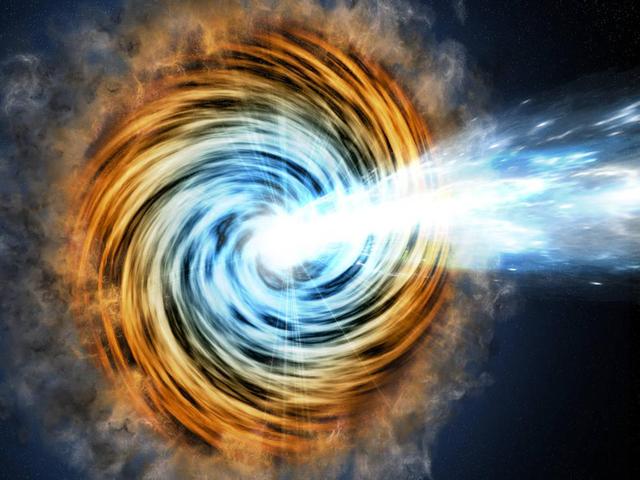
This artist's impression shows the accreting black hole at the center of a galaxy producing a bright and powerful jet. When these jets are aligned with Earth, they become blazars, sources so bright that we can see them at enormous distances far into the Universe's past. Image credit: NASA/JPL-Caltech/GSFC.
  Download Image

During the past week, NuSTAR performed a Target-of-Opportunity observation of an accreting supermassive black hole powering a relativistic jet, called PKS 1725+123, for more than two days of total exposure, together with a coordinated 11-hour XMM-Newton observation. Located at a cosmic epoch in which the universe was approximately half of its current age, PKS 1725+123 was the focus of a world-wide astrophysical observing campaign across the electromagnetic spectrum during the past two weeks after the Fermi gamma-ray telescope and numerous ground-based Very High Energy gamma-ray observatories confirmed the source to be flaring in gamma-rays. PKS 1725+123 belongs to a rare class of accreting supermassive black holes, known as Very High Energy gamma-ray blazars, which are believed to be emitting powerful relativistic jets pointed towards Earth. Despite being some of the brightest objects in the gamma-ray sky and viable sources of astrophysical neutrino emission, very little is currently known about the mechanisms responsible for the extreme radiation detected from such objects. A common prediction amongst competing models of particle acceleration and radiation is that a crucial region of the spectral energy distribution for distinguishing between models lies in the high-energy X-ray band covered by NuSTAR. The corresponding spectra and variability characteristics of the outburst of PKS1725+123 provided by NuSTAR will thus be crucial in understanding the origin of some of the most energetic astrophysical flares currently known.

Authors: Peter Boorman (Caltech), Lea Marcotulli (DESY, Germany)


Saturday, April 05, 2025

Monthly Roundup: News from the High-Energy Universe

The star-forming region 30 Doradus shines in this multiwavelength image from the Chandra X-ray Observatory, the Hubble Space Telescope, the Spitzer Space Telescope, and the Atacama Large Millimeter/submillimeter Array. This is the deepest X-ray image ever made of this region. Credit:
X-ray: NASA/CXC/Penn State Univ./L. Townsley et al.; Infrared: NASA/JPL-CalTech/SST; Optical: NASA/STScI/HST; Radio: ESO/NAOJ/NRAO/ALMA; Image Processing: NASA/CXC/SAO/J. Schmidt, N. Wolk, K. Arcand

Gamma-ray flux as a function of time since the neutrino’s arrival for different intergalactic magnetic field strengths. Stronger magnetic fields lead to lower flux and later arrival times. The gray lines show the five-sigma detection limits of different instruments. Credit: Fang et al. 2025

This Monthly Roundup covers three investigations of the high-energy universe, from a hunt for a cosmic particle accelerator in the Milky Way to an examination of a fading quasar in the distant past.

Investigating the Most Energetic Neutrino Ever Detected

In February 2023, the Cubic Kilometre Neutrino Telescope (KM3NeT) — a neutrino telescope at the bottom of the Mediterranean Sea — detected a particle called a muon with an energy of roughly 100 petaelectronvolts (a hundred quadrillion electronvolts). The muon was likely produced by an incoming neutrino with an energy of 220 petaelectronvolts — the highest-energy neutrino ever observed.

The orientation of the event suggests an astrophysical origin, but the source of this neutrino is unknown. One possibility is that the neutrino arose in a transient event that produced extremely high-energy cosmic rays: relativistic charged particles like protons, electrons, and atomic nuclei. Cosmic rays could produce neutrinos and gamma rays through interactions with photons of the cosmic microwave background. The neutrinos zip off into space, unhindered by intervening gas or magnetic fields, while the cosmic rays can be waylaid for thousands of years, caught up in the magnetic fields that lace the space between galaxies. Gamma rays fall in between the two extremes, slowed slightly by interactions with the photons of the extragalactic background. Repeated interactions between the gamma rays and background photons create a cascade of gamma rays across a range of energies.

Detecting this gamma-ray cascade would provide a valuable clue in the search for the origin of the ultra-high-energy neutrino detected in 2023. In a recent research article, Ke Fang (Wisconsin IceCube Particle Astrophysics Center) and collaborators estimated the flux of gamma rays that would be associated with this high-energy neutrino. The team’s estimates accounted for varying distances to the source as well as different strengths of the intergalactic magnetic field. The stronger the magnetic field, the weaker the gamma-ray flux when it arrives at Earth, and the later the arrival time at Earth.

For weak magnetic fields, the gamma-ray cascade should have arrived at Earth hours or days after the neutrino was detected in 2023. These gamma rays are potentially detectable as long as the magnetic field is weaker than 3 × 10-13 Gauss. For magnetic field strengths greater than 3 × 10-13 Gauss, the gamma rays wouldn’t arrive until more than a decade later, and they would likely be too faint to detect. If no gamma rays are detected, the non-detection could be used to place a lower limit on the strength of the intergalactic magnetic field.

LHAASO’s Water Cherenkov Detector Array (left) and Kilometer Square Array (right) observations of the region around the gamma-ray source HESS J1858+020. Black solid circles and black crosses represent extended and pointlike sources, respectively, resolved in this work. Dashed circles show sources resolved by LHAASO in previous work. The cyan symbols show the locations of gamma-ray sources identified by other facilities. Credit: LHAASO Collaboration 2025

The Hunt for a Galactic PeVatron

Across the universe, charged particles are being accelerated to near the speed of light, achieving energies in the petaelectronvolt, or PeV, range. The sources of these particles are called PeVatrons, and observations have revealed that these cosmic particle accelerators exist in the Milky Way. Supernovae, massive stars, pulsars, and pulsar wind nebulae are all candidate PeVatrons. To find out more, astronomers look to gamma rays, which can be produced when cosmic rays interact with dense matter.

Recently, the Large High Altitude Air Shower Observatory (LHAASO) collaboration investigated a possible galactic PeVatron called G35.6−0.4. G35.6−0.4 is a radio source that is thought to be associated with the gamma-ray source HESS J1858+020. Observations of this region show a supernova remnant and an H II region containing multiple X-ray point sources.

To learn more about the origins of the gamma rays from this complex region, the collaboration used data from LHAASO, a ground-based gamma-ray and cosmic-ray observatory. Data from two of LHAASO’s detectors show five gamma-ray sources throughout the region, one of which may be associated with the previously detected gamma-ray source HESS J1858+020. The team also amassed data from other sources, pulling together a picture of the molecular and atomic gas and massive stars present in the region.

Because of the crowded nature of this area, this investigation wasn’t able to clearly point to the source of the gamma rays. The authors outlined three possible sources for the gamma rays: 1) winds from hidden massive stars or outflows from protostars within the H II region, 2) particles escaping from the supernova remnant and interacting with nearby molecular clouds, and 3) an as-yet-undetected pulsar wind nebula. While none of these scenarios is a clear front-runner, neither could any of them be ruled out (though the supernova remnant scenario faces the greatest feasibility challenges). Future searches for massive stars or pulsar wind nebulae in this region may provide further clues.

JWST spectrum of the quasar HSC J2239+0207 (blue line)
Credit: Lyu et al. 2025

Fading Light from a Quasar at Cosmic Dawn

For the third and final article, we’re looking back into the distant past at one of the most powerful objects in the universe: a quasar. Quasars are extraordinarily luminous galactic centers in the early universe, powered by accretion of gas onto a growing black hole. Because of their extreme brightness, quasars are visible from billions of light-years away, giving researchers a glimpse into the early evolution of supermassive black holes.

Jianwei Lyu (吕建伟; University of Arizona) and collaborators investigated HSC J2239+0207, a quasar located at a redshift of z = 6.2498, when the universe was roughly 900 million years old. This redshift places the quasar near the end of the epoch of reionization, when the formation of the first stars and galaxies ionized the universe’s abundant neutral hydrogen gas. This quasar is an intriguing target because previous observations have shown that the black hole that powers it is roughly 15 times more massive than expected for the stellar mass of its host galaxy. The quasar’s accretion rate is low, indicating that the black hole may be nearing the end of its growth spurt.

Lyu’s team analyzed JWST spectra of this quasar, estimating the black hole’s mass to be roughly 300 million solar masses (about 75 times more massive than the Milky Way’s supermassive black hole) and its accretion rate to be just 40% of the theoretical limit. This is unusual, since quasars at this point in the universe’s history typically have accretion rates at or above the theoretical limit. The unexpectedly low accretion rate for HSC J2239+0207 could mean that the black hole’s growth is slowing down. However, the authors caution that it could be a temporary slowdown caused by a lack of fuel rather than a permanent shutdown.

The team also investigated a gas cloud located one arcsecond from the quasar. This object could be several things: an isolated high-redshift galaxy, a galaxy falling toward the quasar host galaxy, tidally disrupted material stripped from a galaxy passing nearby, or material blown out of the quasar host galaxy by the quasar itself. The authors favor this final scenario, which is indicative of black hole feedback at work.

Feedback may be the reason that this black hole is so massive compared to the stellar mass of its host galaxy. Powerful radiation and winds from the black hole could have suppressed the rate of star formation as the black hole grew. With the black hole’s activity winding down, star formation should have a chance to ramp up, bringing the galaxy into alignment with the expected stellar mass–black hole mass relation.

By Kerry Hensley

Citation

“Cascaded Gamma-Ray Emission Associated with the KM3NeT Ultrahigh-Energy Event KM3-230213A,” Ke Fang et al 2025 ApJL 982 L16. doi:10.3847/2041-8213/adbbec

“An Enigmatic PeVatron in an Area Around H II Region G35.6−0.5,” Zhen Cao et al 2025 ApJ 979 70. doi:10.3847/1538-4357/ad991d

“Fading Light, Fierce Winds: JWST Snapshot of a Sub-Eddington Quasar at Cosmic Dawn,” Jianwei Lyu et al 2025 ApJL 981 L20. doi:10.3847/2041-8213/adb613


Monday, October 11, 2021

The Blazing Sky: LAMOST Observations Reveal Nature of Unknown Gamma-ray Sources


Fig. 1 Artistic representation of an active galaxy jet
Image by M. Kornmesser/ESO


Fig. 2 Example of the completely featureless optical spectrum of the BL Lac known as J065046.49+250259.6
Image by Harold A. Peña Herazo

An international team of astronomers has unveiled the nature of hundreds of gamma-ray emitting sources, discovering that most of them belong to the class of active galaxies known as blazars. 

Their recent study was published in The Astronomical Journal.

One of the most intriguing challenges in modern gamma-ray astronomy is searching for low-energy counterparts of unidentified gamma-ray sources. Unidentified sources constitute about 1/3 of all celestial objects detected by the Fermi satellite to date, the most recent gamma-ray mission with unprecedented capabilities for observing the high energy sky.

Since the largest population of known gamma-ray sources are blazars, astronomers believe they can also classify most unidentified gamma-ray sources as blazars. However, they can completely understand their nature only by observing blazar candidates at visible frequencies.

Blazars are extremely rare, black hole-powered galaxies. They host a supermassive black hole in their central regions that sweep out matter at almost the speed of light in the form of a powerful jet pointing towards the Earth. Particles accelerated in these jets can emit light up to the most energetic gamma-rays, thus being visible by instruments onboard the Fermi satellite.

The team, led by Dr. Harold Peña Herazo from Mexico's National Institute of Astrophysics, Optics, and Electronics (INAOE), analyzed hundreds of optical spectra collected by the Large Sky Area Multi-Object Fabre Spectroscopic Telescope (LAMOST) at the Xinglong Station in China.

LAMOST is hosted by National Astronomical Observatories of Chinese Academy of Sciences. It provided a unique opportunity to unveil the nature of blazar-like sources that can potentially be counterparts of unidentified gamma-ray sources.

From the list of sources discovered by the Fermi satellite, the researchers selected a sample of Blazar Candidates of Uncertain type (BCUs), which share several properties in common with blazars. However, optical spectroscopic observations are necessary to determine their proper classification and confirm their nature.

Using spectroscopic data available in the LAMOST archive, the researchers were able to classify tens of BCUs as blazars. "LAMOST data also permitted verifying the nature of hundreds of additional blazars by searching for emission or absorption lines used to determine their cosmological distances," said Prof. GU Minfeng from Shanghai Astronomical Observatory of Chinese Academy of Sciences.

The vast majority of sources belong to the blazar class known as BL Lac objects and have a completely featureless optical spectrum. This makes measuring their cosmological distances an extremely challenging task. However, thanks to the LAMOST observations, a few more of them have luckily revealed visible signatures in their optical spectra.

"Our analysis showed great potential for the LAMOST survey and allowed us to discover a few changing-look blazars," said Dr. Peña Herazo, currently a postdoctoral fellow at the East Asian Observatory.

"It is worth noting that the possibility of using LAMOST observations to estimate blazar cosmological distances is critical to studying this population, its cosmological evolution, the imprint in the extragalactic gamma-ray background light in the gamma-ray spectra, and the blazar contribution to the extragalactic gamma-ray background," said Prof. Francesco Massaro from the University of Turin.

"I started working on this optical campaign and analyzing spectroscopic data in 2015, and nowadays, thanks to the observations available in LAMOST archive, we certainly made a significant step toward the identification of gamma-ray sources with blazars. Future perspectives achievable thanks to LAMOST datasets will definitively reveal the nature of hundreds of new blazars in the years to come," commented Dr. Federica Ricci at Bologna University and INAF-OAS.

The group’s previous study was also published in The Astronomical Journal


Contact:


Related Articles


Wednesday, April 15, 2020

NASA Missions Help Reveal the Power of Shock Waves in a Nova Explosion

A GIF cycles between an image of V906 Carinae taken on April 7, 2018, about 18 days after the nova's discovery and near its peak brightness, and one showing its faded appearance on May 4, 2019. Credit: Copyright 2018 by W. Paech + F. Hofmann, Team Chamaeleon, Chamaeleon and Onjala Observatory, Namibia, used with permission.​

Unprecedented observations of a nova outburst in 2018 by a trio of satellites, including two NASA missions, have captured the first direct evidence that most of the explosion’s visible light arose from shock waves — abrupt changes of pressure and temperature formed in the explosion debris.

A nova is a sudden, short-lived brightening of an otherwise inconspicuous star. It occurs when a stream of hydrogen from a companion star flows onto the surface of a white dwarf, a compact stellar cinder not much larger than Earth. NASA’s Fermi and NuSTAR space telescopes, together with the Canadian BRITE-Toronto satellite and several ground-based facilities, studied the nova.

NASA’s Fermi and NuSTAR space telescopes, together with another satellite named BRITE-Toronto, are providing new insights into a nova explosion that erupted in 2018. Detailed measurements of bright flares in the explosion clearly show that shock waves power most of the nova's visible light. Credits: NASA’s Goddard Space Flight Center.  Download high-resolution video and images from NASA’s Scientific Visualization Studio

“Thanks to an especially bright nova and a lucky break, we were able to gather the best-ever visible and gamma-ray observations of a nova to date,” said Elias Aydi, an astronomer at Michigan State University in East Lansing who led an international team from 40 institutions. “The exceptional quality of our data allowed us to distinguish simultaneous flares in both optical and gamma-ray light, which provides smoking-gun evidence that shock waves play a major role in powering some stellar explosions.”

The 2018 outburst originated from a star system later dubbed V906 Carinae, which lies about 13,000 light-years away in the constellation Carina. Over time — perhaps tens of thousands of years for a so-called classical nova like V906 Carinae — the white dwarf’s deepening hydrogen layer reaches critical temperatures and pressures. It then erupts in a runaway reaction that blows off all of the accumulated material.

Each nova explosion releases a total of 10,000 to 100,000 times the annual energy output of our Sun. Astronomers discover about 10 novae each year in our galaxy.

Fermi detected its first nova in 2010 and has observed 14 to date. Although X-ray and radio studies had shown the presence of shock waves in nova debris in the weeks after the explosions reached peak brightness, the Fermi discovery came as a surprise.

Gamma rays — the highest-energy form of light — require processes that accelerate subatomic particles to extreme energies. When these particles interact with each other and with other matter, they produce gamma rays. But astronomers hadn’t expected novae to be powerful enough to produce the required degree of acceleration.

Because the gamma rays appear at about the same time as the peak in visible light, astronomers concluded that shock waves play a more fundamental role in the explosion and its aftermath.

In 2015, a paper led by Brian Metzger at Columbia University in New York showed how comparing Fermi gamma-ray data with optical observations would allow scientists to learn more about nova shock waves. In 2017, a study led by Kwon-Lok Li at Michigan State found that the overall gamma-ray and visible emissions rose and fell in step in a nova known as V5856 Sagittarii. This implied shock waves produced more of the eruption’s light than the white dwarf itself.

The new observations from V906 Carinae, presented in a paper led by Aydi and published on Monday, April 13, in Nature Astronomy, spectacularly confirm this conclusion.

On March 20, 2018, the All-Sky Automated Survey for Supernovae, a set of two dozen robotic telescopes distributed around the globe and operated by Ohio State University, discovered the nova. 
By month’s end, V906 Carinae was dimly visible to the naked eye.

Fortuitously, a satellite called BRITE-Toronto was already studying the nova’s patch of sky. This miniature spacecraft is one of five 7.9-inch (20 centimeter) cubic nanosatellites comprising the Bright Target Explorer (BRITE) Constellation. Operated by a consortium of universities from Canada, Austria and Poland, the BRITE satellites study the structure and evolution of bright stars and observe how they interact with their environments.

BRITE-Toronto was monitoring a red giant star called HD 92063, whose image overlapped the nova’s location. The satellite observed the star for 16 minutes out of every 98-minute orbit, returning about 600 measurements each day and capturing the nova’s changing brightness in unparalleled detail.

“BRITE-Toronto revealed eight brief flares that fired up around the time the nova reached its peak, each one nearly doubling the nova’s brightness,” said Kirill Sokolovsky at Michigan State. “We’ve seen hints of this behavior in ground-based measurements, but never so clearly. Usually we monitor novae from the ground with many fewer observations and often with large gaps, which has the effect of hiding short-term changes.”

Fermi, on the other hand, almost missed the show. Normally its Large Area Telescope maps gamma rays across the entire sky every three hours. But when the nova appeared, the Fermi team was busy troubleshooting the spacecraft’s first hardware problem in nearly 10 years of orbital operations — a drive on one of its solar panels stopped moving in one direction. Fermi returned to work just in time to catch the nova’s last three flares.

In fact, V906 Carinae was at least twice as bright at billion-electron-volt, or GeV, energies as any other nova Fermi has observed. For comparison, the energy of visible light ranges from about 2 to 3 electron volts.

“When we compare the Fermi and BRITE data, we see flares in both at about the same time, so they must share the same source — shock waves in the fast-moving debris,” said Koji Mukai, an astrophysicist at the University of Maryland Baltimore County and NASA’s Goddard Space Flight Center in Greenbelt, Maryland. “When we look more closely, there is an indication that the flares in gamma rays may lead the flares in the visible. The natural interpretation is that the gamma-ray flares drove the optical changes.”

V906 Carinae (circled) shines near peak brightness in this image taken on March 23, 2018, three days after the nova was discovered. The beautiful cloud of gas and dust dominating the picture is part of the Carina Nebula. Credits: Copyright 2018 by A. Maury and J. Fabrega, used with permission

The team also observed the eruption’s final flare using NASA’s NuSTAR space telescope, which is only the second time the spacecraft has detected X-rays during a nova’s optical and gamma-ray emission. The nova’s GeV gamma-ray output far exceeded the NuSTAR X-ray emission, likely because the nova ejecta absorbed most of the X-rays. High-energy light from the shock waves was repeatedly absorbed and reradiated at lower energies within the nova debris, ultimately only escaping at visible wavelengths.

Putting all of the observations together, Aydi and his colleagues describe what they think happened when V906 Carinae erupted. During the outburst’s first few days, the orbital motion of the stars swept a thick debris cloud made of multiple shells of gas into a doughnut shape that appeared roughly edge-on from our perspective. The cloud expanded outward at less than about 1.3 million mph (2.2 million kph), comparable to the average speed of the solar wind flowing out from the Sun.

Next, an outflow moving about twice as fast slammed into denser structures within the doughnut, creating shock waves that emitted gamma rays and visible light, including the first four optical flares.

Finally, about 20 days after the explosion, an even faster outflow crashed into all of the slower debris at around 5.6 million mph (9 million kph). This collision created new shock waves and another round of gamma-ray and optical flares. The nova outflows likely arose from residual nuclear fusion reactions on the white dwarf’s surface.

Astronomers have proposed shock waves as a way to explain the power radiated by various kinds of short-lived events, such as stellar mergers, supernovae — the much bigger blasts associated with the destruction of stars — and tidal disruption events, where black holes shred passing stars. The BRITE, Fermi and NuSTAR observations of V906 Carinae provide a dramatic record of such a process.   Further studies of nearby novae will serve as laboratories for better understanding the roles shock waves play in other more powerful and more distant events.

The Fermi Gamma-ray Space Telescope is an astrophysics and particle physics partnership managed by NASA's Goddard Space Flight Center in Greenbelt, Maryland. Fermi was developed in collaboration with the U.S. Department of Energy, with important contributions from academic institutions and partners in France, Germany, Italy, Japan, Sweden and the United States.

NuSTAR is a Small Explorer mission led by Caltech and managed by JPL for NASA's Science Mission Directorate in Washington. NuSTAR was developed in partnership with the Danish Technical University and the Italian Space Agency (ASI). The spacecraft was built by Orbital Sciences Corp. in Dulles, Virginia. NuSTAR's mission operations center is at the University of California Berkeley, and the official data archive is at NASA's High Energy Astrophysics Science Archive Research Center. ASI provides the mission's ground station and a mirror archive. Caltech manages JPL for NASA.

By Francis Reddy
NASA’s Goddard Space Flight Center, Greenbelt, Md.

Media contact:

Claire Andreoli
NASA’s Goddard Space Flight Center, Greenbelt, Md.
(301) 286-1940

 Editor: Francis Reddy


Friday, August 16, 2019

Moon Glows Brighter Than Sun in Images From NASA's Fermi

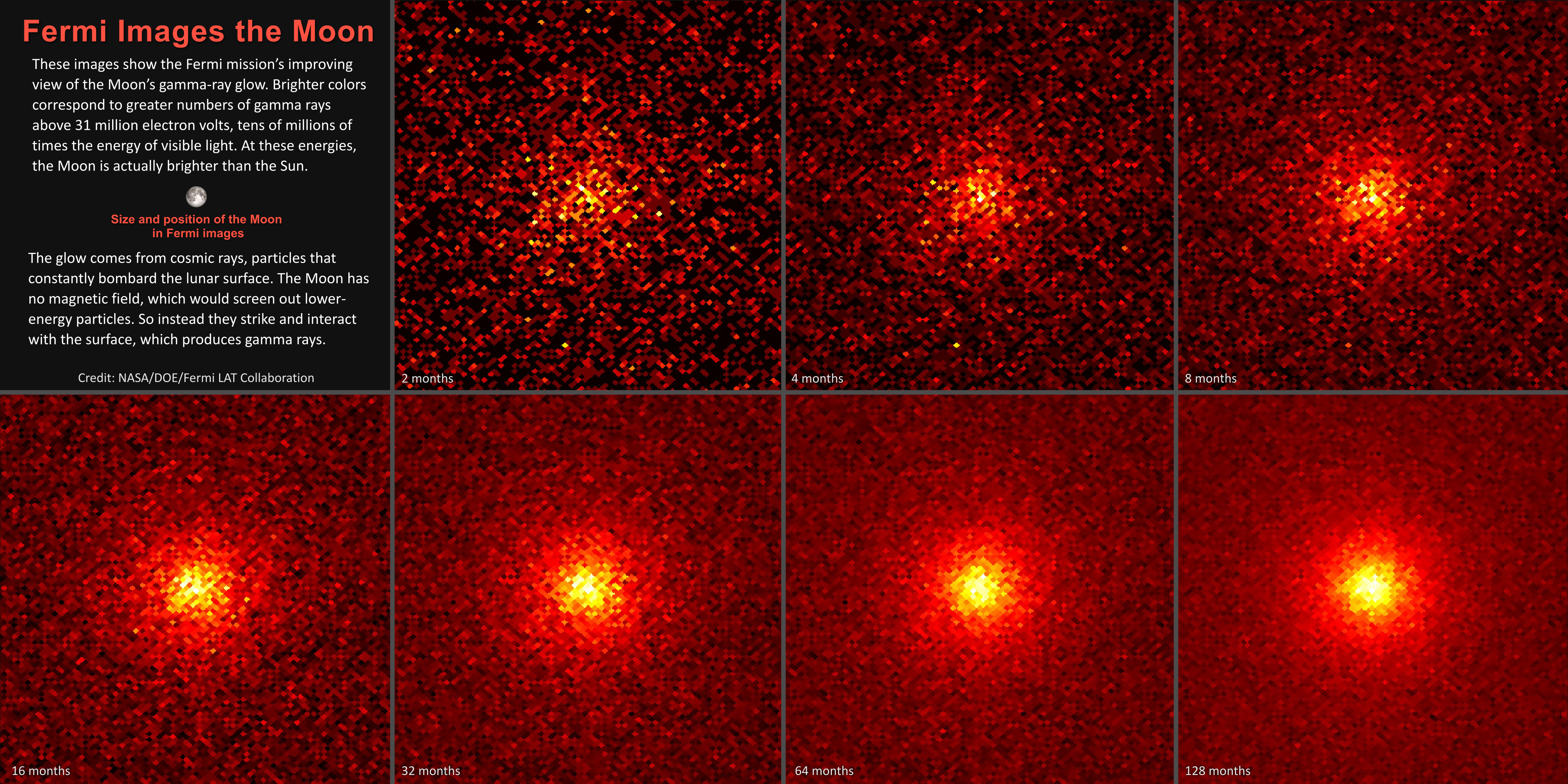
The Moon shines brightly in gamma rays as seen in this time sequence from NASA’s Fermi Gamma-ray Space Telescope. Each 5-by-5-degree image is centered on the Moon and shows gamma rays with energies above 31 million electron volts, or tens of millions of times that of visible light. At these energies, the Moon is actually brighter than the Sun. Brighter colors indicate greater numbers of gamma rays. This animation shows how longer exposure, ranging from two to 128 months (10.7 years), improved the view. Credit: NASA/DOE/Fermi LAT Collaboration. Download

If our eyes could see high-energy radiation called gamma rays, the Moon would appear brighter than the Sun! That’s how NASA’s Fermi Gamma-ray Space Telescope has seen our neighbor in space for the past decade.

Gamma-ray observations are not sensitive enough to clearly see the shape of the Moon’s disk or any surface features. Instead, Fermi’s Large Area Telescope (LAT) detects a prominent glow centered on the Moon’s position in the sky.

Mario Nicola Mazziotta and Francesco Loparco, both at Italy’s National Institute of Nuclear Physics in Bari, have been analyzing the Moon’s gamma-ray glow as a way of better understanding another type of radiation from space: fast-moving particles called cosmic rays.

“Cosmic rays are mostly protons accelerated by some of the most energetic phenomena in the universe, like the blast waves of exploding stars and jets produced when matter falls into black holes,” explained Mazziotta.

Because the particles are electrically charged, they’re strongly affected by magnetic fields, which the Moon lacks. As a result, even low-energy cosmic rays can reach the surface, turning the Moon into a handy space-based particle detector. When cosmic rays strike, they interact with the powdery surface of the Moon, called the regolith, to produce gamma-ray emission. The Moon absorbs most of these gamma rays, but some of them escape.

Mazziotta and Loparco analyzed Fermi LAT lunar observations to show how the view has improved during the mission. They rounded up data for gamma rays with energies above 31 million electron volts — more than 10 million times greater than the energy of visible light — and organized them over time, showing how longer exposures improve the view.

“Seen at these energies, the Moon would never go through its monthly cycle of phases and would always look full,” said Loparco.

These images show the steadily improving view of the Moon’s gamma-ray glow from NASA’s Fermi Gamma-ray Space Telescope. Each 5-by-5-degree image is centered on the Moon and shows gamma rays with energies above 31 million electron volts, or tens of millions of times that of visible light. At these energies, the Moon is actually brighter than the Sun. Brighter colors indicate greater numbers of gamma rays. This image sequence shows how longer exposure, ranging from two to 128 months (10.7 years), improved the view.  Credit: NASA/DOE/Fermi LAT Collaboration. Hi-res image


As NASA sets its sights on sending humans to the Moon by 2024 through the Artemis program, with the eventual goal of sending astronauts to Mars, understanding various aspects of the lunar environment take on new importance. These gamma-ray observations are a reminder that astronauts on the Moon will require protection from the same cosmic rays that produce this high-energy gamma radiation.

While the Moon’s gamma-ray glow is surprising and impressive, the Sun does shine brighter in gamma rays with energies higher than 1 billion electron volts. Cosmic rays with lower energies do not reach the Sun because its powerful magnetic field screens them out. But much more energetic cosmic rays can penetrate this magnetic shield and strike the Sun’s denser atmosphere, producing gamma rays that can reach Fermi.

Although the gamma-ray Moon doesn’t show a monthly cycle of phases, its brightness does change over time. Fermi LAT data show that the Moon’s brightness varies by about 20% over the Sun’s 11-year activity cycle. Variations in the intensity of the Sun’s magnetic field during the cycle change the rate of cosmic rays reaching the Moon, altering the production of gamma rays.

By Francis Reddy
NASA’s Goddard Space Flight Center, Greenbelt, Md.

Editor: Rob Garner


Saturday, August 03, 2019

NASA Scientist to Discuss “Cosmic Explosions and Cosmic Accelerators” at Library of Congress Lecture

Recently, astronomers have been able to coordinate observations of multiple “messengers” from the same event, such as merging neutron stars (background) that produced both gamma rays detected by NASA’s Fermi Gamma-ray Space Telescope (right) and gravitational waves detected by the Laser Interferometer Gravitational-Wave Observatory on Aug. 17, 2017. NASA Goddard’s Dr. Regina Caputo will discuss the burgeoning field of multimessenger astronomy. Credits: NASA/Frank Reddy

The public is invited to a free lecture called ‘Cosmic Explosions and Cosmic Accelerators: Gamma-rays and Multi-messenger Astronomy,' with Dr. Regina Caputo, NASA research scientist. The talk will occur in the Pickford Theater, third floor, Madison Building, 101 Independence Avenue SE, Library of Congress, Washington, D.C., on Thursday, August 8 from 11:30 a.m. to 12:30 p.m. EDT.

Dr. Caputo works at NASA’s Goddard Space Flight Center in Greenbelt, Md. on the NASA Fermi Gamma Ray Space Telescope team with data from the Fermi Large Area Telescope instrument to study. She is interested in dark matter searches, searches for new physics and all the astrophysics one must understand before discovering something new. She is also working on future gamma-ray instruments.

Astronomical processes, such as supernovae or gamma ray bursts, give off a variety of messenger signals. Astronomers observing these signals can get different information from different signals, and recently, by coordinating their observations of multiple messengers from the same event, they have begun to revolutionize our understanding of the extreme universe. Dr. Regina Caputo will discuss these jointly observed messengers and the contribution of the Fermi Gamma-ray Space Telescope at the forefront of this new era of astronomy.

She is a speaker in the 2019 NASA Goddard Lectures Series at the Library of Congress. Earlier talks in the NASA series included the topics of space weather, improved global water security and sustainability, how Mars has changed over time, NASA's Hubble Space Telescope and the upcoming James Webb Space Telescope.

The Library of Congress maintains one of the largest and most diverse collections of scientific and technical information in the world. The Library of Congress is the nation's oldest federal cultural institution and the largest library in the world and holds nearly 151.8 million items in various languages, disciplines and formats. The Library serves both Congress and the nation online and on-site in its reading rooms on Capitol Hill.

For inquiries about this or upcoming talks at the Library of Congress, the public can contact the library’s Science, Technology and Business Division at 202-707-5664. ADA accommodations should be requested five business days in advance at 202-707-6382 (voice/tty) or ada@loc.gov.

The lecture will be later broadcast on the library’s webcast page and YouTube channel “Topics in Science” playlist.

For directions, visit: http://www.loc.gov/visit/maps-and-floor-plans/ or www.loc.gov

For information about Dr. Caputo, visit: https://science.gsfc.nasa.gov/sed/bio/regina.caputo

For NASA’s Fermi website, visit: www.nasa.gov/fermi


Contact:

Rob Gutro
NASA’s Goddard Space Flight Center, Greenbelt, Md.
301-286-4044
Robert.j.gutro@nasa.gov

Stephanie Marcus
Library of Congress, Washington
202-707-1192
smar@loc.gov

Editor: Karl Hille


Monday, January 30, 2017

Radio Weak Blazars

Black-hole-powered galaxies called blazars have powerful jets that are thought to be fortuitously aimed directly toward Earth. Blazars emit at wavelengths from the radio to the gamma-rays, but astronomers have now found two objects that are blazar like in many ways but which are radio-quiet. Credit: NASA; M. Weiss/CfA


A blazar is a galaxy whose central nucleus is bright at wavelengths from the low energy radio band to high energy gamma rays (each gamma ray photon is over a hundred million times more energetic than the X-rays seen by the Chandra X-ray Observatory). Astronomers think that the blazar nucleus contains a supermassive black hole, similar to a quasar nucleus. The emission results when matter falls onto the vicinity of the black hole and erupts into powerful, narrow jets of radiating charged particles moving close to the speed of light. Two defining characteristics of blazars, strong radio emission and high variability, are results of the accretion and jets.

Although the nuclei of other galaxies also eject jets of particles, the class of blazars is thought to result from our unique viewing angle: staring directly down the throats of these jets. The orientation makes these objects unique probes of exotic physical activity, with the relative intensities of the radiation providing key diagnostics. In most other galaxies, for example, infrared radiation comes from heated dust, but in blazars the infrared colors indicate that it comes from jet emission. Because the jet emission is so bright the underlying galaxy light can be masked, with the result that in the class of BL Lac blazars emission and absorption lines are not detected, making their distances difficult to determine.

CfA astronomers Raffaele D'Abrusco and Howard Smith and their four colleagues report discovering blazars that challenge this general paradigm. They found two BL Lac blazars with no apparent radio emission: "radio weak" BL Lacs. The astronomers discovered them by using the Fermi catalog of very high energy sources to identify a set of possible new blazars, and the WISE infrared sky catalog to reinforce the categorization and to pinpoint the locations of the sources in the sky. After searching radio catalogs for counterparts to the sources, they discovered two that had no detected radio emission.

Since blazars are by definition highly variable, and since not all of the wavelengths were measured at the same time, the scientists review the possibility that the emission at one or more wavelengths varied enough to account for the peculiar observations; they also examine some other possibilities. In the end, they conclude that although variability might be a possible explanation, if these candidates behaved like other blazars, variability alone could not resolve the mystery of the radio silence. If confirmed, these new Radio Weak BL Lac objects challenge the basic explanation of blazars. How many radio weak BL Lacs exist, how far away they are, and how they are formed and evolve - indeed why they exist at all - are now pressing questions in extragalactic astronomy.


Reference(s): 

"Radio-weak BL Lac Objects in the Fermi Era," F. Massaro, E. J. Marchesini, R. D'Abrusco, N. Masetti, I. Andruchow & Howard A. Smith, ApJ 834, 113, 2017.


Tuesday, February 03, 2015

Galactic anatomy with gamma rays

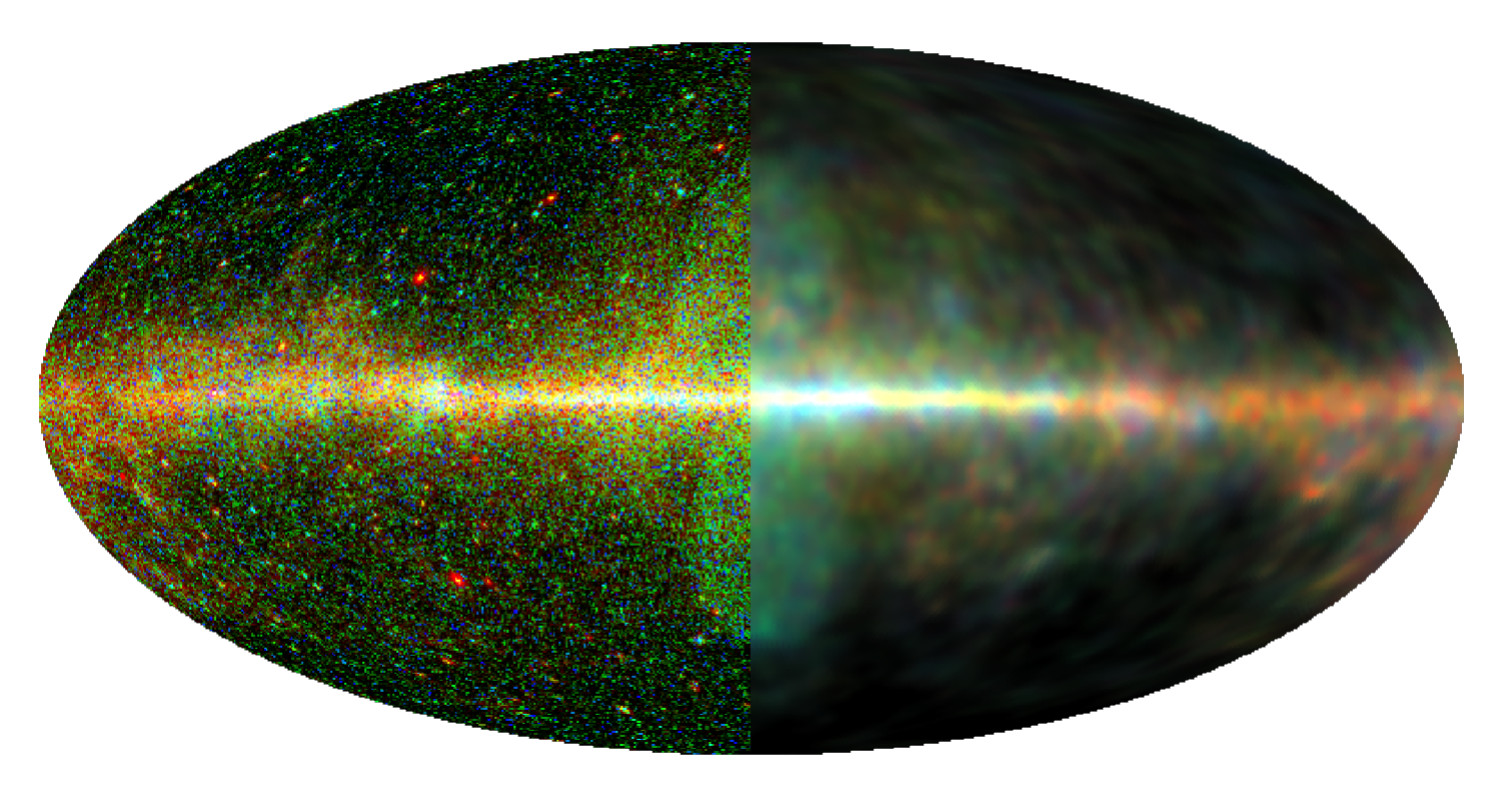
Fig 1: Gamma-ray data (left) and diffuse Galactic gamma-radiation calculated by D3PO (right). The Galactic disk is displayed horizontally, with the Galactic center in the middle of the image.  

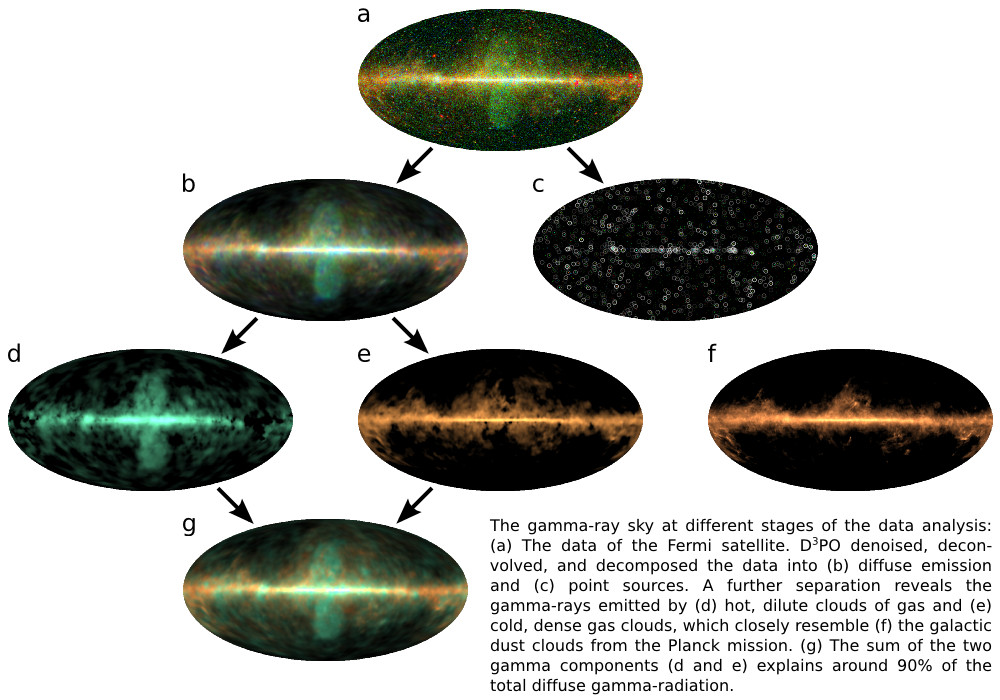
Fig 2: The gamma-ray sky at different stages of the data analysis: (a) The data of the Fermi satellite. D3PO denoised, deconvolved, and decomposed the data into (b) diffuse emission and (c) point sources. A further separation reveals the gamma-rays emitted by (d) hot, dilute clouds of gas and (e) cold, dense gas clouds, which closely resemble (f) the Galactic dust clouds from the Planck mission. (g) The sum of the two gamma components (d and e) explains around 90% of the total diffuse gamma-radiation. 

Fig 3: Marco Selig after his doctorate examination, which he passed with honors at the Ludwig-Maximilians-Universität München.

The anatomy of the Milky Way as seen in gamma light is full of mysteries. For example, there are gigantic bubbles of unknown origin above and below the center of the Milky Way that emit a lot of this high-energy radiation. A new method for imaging, developed at the Max Planck Institute for Astrophysics, now divided the Galactic gamma-radiation into three fundamental components: radiation from point sources, radiation from reactions of energetic protons with dense cold gas clouds, and radiation from electrons scattering light in the thin, hot, Galactic gas. The anatomic insights gained unravel some Galactic mysteries. Thus, it appears that the gamma-ray bubbles are simply outflows of ordinary, hot gas from the central region of the Milky Way. 

The sky in the light of gamma-radiation shows a variety of objects, structures, and astrophysical processes (Fig. 1). It is most prominently illuminated by the Milky Way, which contributes a great part of the point sources as well as the major part of the diffuse gamma-radiation in the sky. The various radiation sources appear superimposed, which complicates their identification and interpretation. Furthermore, our measurement instruments, such as the Fermi satellite, record only individual gamma photons, arriving at random times from random directions. These are highly energetic light particles, whose observation requires complex imaging algorithms in order to reconstruct sky maps. A new method for denoising, deconvolving, and decomposing photon observations, called linkPfeil.gifD3PO, developed at the Max Planck Institute for Astrophysics, has now created the by far most brilliant gamma-radiation map of the sky from the data of the Fermi satellite (Fig. 1). 

D3PO has decomposed the gamma-ray sky into point sources (Fig. 2c) and diffuse radiation at nine photon energies. From these, a colored image can be generated (Fig. 2b), which shows the diffuse sky as it would appear to an observer with gamma-eyes. The different astrophysical processes can be recognized therein via their different energy spectra, visible as different colors (Fig. 2b). The gamma-bubbles above (and below) the center of the Milky Way appear blue-greenish, which indicates particularly high-energy gamma-radiation. This should have been mainly generated by collisions of electrons that are moving almost with the speed of light with starlight and other photons. The orange-brown areas on the right and left side are primarily caused by collisions of super-fast protons with nuclei in dense, cold gas clouds. 

The big surprise was that the central bright Galactic disk, and virtually all other areas of the sky, show essentially just a superposition of these two processes: collisions of protons with nuclei and of electrons with photons. If we decompose the diffuse gamma-radiation into only these two processes (Fig. 2d and 2e), more than 90% of the radiation is explained – and this at all studied sky locations and energies (Fig. 2g). The total diffuse galactic gamma-radiation is thus produced almost exclusively by two typical media: dense, cold gas clouds and the thin, hot gas between them. In fact, gamma-radiation coming from the clouds shows almost the same spatial distribution as the Galactic dust clouds as measured by the Planck satellite in the microwave range (Fig. 2f). 

The gamma-radiation generated by electrons in the mysterious gamma-ray bubbles does not differ in color from the electron-generated radiation from the Galactic disk. This suggests that we see the same material in both places: hot gas that has been enriched with electrons moving almost at the speed of light by supernova explosions. The gamma-bubbles are therefore simply rising hot gas masses, leaving the center of our Milky Way. 

In addition to unraveling the gamma-ray bubbles, the D3PO analysis of the anatomy of Galactic gamma-radiation has delivered a number of other scientific results. It was shown that the cold gas clouds that are illuminated by the gamma-radiation extend up to larger heights above the Galactic plane than the dust clouds measured by the Planck satellite. While this could have been expected due to the higher mass of dust particles in comparison with the gas particles, it is a nice confirmation of the astrophysical correctness of these anatomical dissections of the Galaxy in gamma light. Furthermore, a comprehensive catalog of point sources was generated and searched for gamma-radiation from clusters of galaxies – unfortunately without success. 

The D³PO algorithm that has made all this possible is now linkPfeil.giffreely available and will in the future also provide astronomical images at other wavelengths of light. D³PO was developed by Marco Selig during his just-completed doctorate with honors at the Ludwig-Maximilians-Universität München (Fig. 3). The algorithm was derived within linkPfeil.gifinformation field theory) and implemented using the also freely available linkPfeil.gifNIFTY-software for numerical information field theory. Information field theory deals with the mathematics of imaging complex data sets and is a central focus of the research group of Torsten Ensslin at the Max Planck Institute for Astrophysics.

Marco Selig, Valentina Vacca, Niels Oppermann, Torsten Enßlin.


References:

Publication: The Denoised, Deconvolved, and Decomposed Fermi γ-ray Sky - An Application of the D3PO Algorithm. Marco Selig, Valentina Vacca, Niels Oppermann, Torsten A. Enßlin submitted to Astronomy & Astrophysics, preprint: arXiv:1410.4562, Bild & Daten

Instruments:  Fermi satellite and its gamma-ray data & Planck satellite and its dust emission map

D3PO: Description & software

NIFTY: Description & software

Information field theory


Tuesday, September 09, 2014

Looking into the heart of a supernova explosion

Fig. 1: Top: The decay chain 56Ni -> 56Co -> 56Fe releases large amounts of energy as gamma-ray photons and positrons. Bottom: Predicted spectrum of emerging gamma-rays. Initially, most of the energy from the nickel decay chain is re-processed in the expanding, ejected material of the supernova, giving rise to powerful optical emission. After some time, the ejected material becomes transparent enough that the majority of gamma-ray photons can escape to form characteristic spectral features (shown here 75 days after the explosion).

Fig. 2: Spectrum of type II supernova SN1987A in Large Magellanic Cloud, observed 27 years ago using X-Ray devices aboard of MIR space station (Sunyaev et al., 1987). A detailed analysis of the observed spectrum proved that the scientists were dealing with gamma-rays of radioactive cobalt decay down-scattered in the optically thick envelope to the 20-200 keV spectral band due to multiple Compton scatterings and recoil effect.

Fig. 3: Spectrum of type Ia SN2014J obtained by INTEGRAL, 50 to 100 days after the explosion (Churazov et al., 2014). Red and blue points show data from the two instruments SPI and ISGRI/IBIS respectively. The black curve shows a fiducial model of the supernova spectrum for day 75 after the explosion. The top row shows images obtained in three high-energy spectral bands by INTEGRAL. A gamma-ray source is clearly visible in all images at the (optical) position of SN2014J. 

Fig. 4: Gamma-ray lines from 56Co decay in the expanding ejecta, broadened by the Doppler effect. 

First detection of Cobalt gamma-ray lines from a type Ia supernova (SN2014J) with INTEGRAL


The exceptional brightness and regular light-curves in the optical band have made supernova explosions of Type Ia (SNIa) a valuable "standard candle" in modern Cosmology. However, SNIa’s have never been detected directly in gamma-rays, limiting the analysis to re-processed emission and the outer layers of the material ejected in the stellar explosion. This year, however, a new supernova exploded in the nearby spiral galaxy M82. SN2014J, as the supernova was called, was close enough to ensure the first ever detection of gamma-ray lines by scientists at the Max Planck Institute for Astrophysics (MPA) - providing an unambiguous proof of the theoretical concept of SNIa's

A Type Ia supernova (SNIa) is believed to be the thermonuclear explosion of a white dwarf star - the stellar remnant of a normal star, such as our Sun, after the star has exhausted its hydrogen fuel. Such a white dwarf consists mainly of carbon and oxygen - the ashes of hydrogen and helium burning - and during the supernova explosion large amounts of a radioactive nickel isotope (56Ni) are produced. The subsequent decay chain from nickel to cobalt and eventually iron (see Fig. 1) releases huge amounts of energy in the form of highly energetic gamma-ray photons. These are re-processed in the expanding material ejected by the explosion, giving rise to a powerful optical emission, which has become an invaluable tool in cosmological studies as a distance indicator. 

Despite a long history of observations and simulations, the detailed physics of a SNIa explosion and the evolutionary path, which the compact object has to follow towards the explosion, remain a matter of debate. The majority of models predict that during the first 10-20 days after the explosion the ejected material is opaque for gamma-ray lines due to Compton scattering. As the ejected material becomes progressively more transparent, a large fraction of gamma-rays can finally escape. 

However, gamma-ray emission from SNIa's has never been detected, primarily because the objects were too far away. More than 27 years ago, hard X-rays and direct gamma-rays were detected from the supernova SN1987A in the Large Magellanic Cloud; this was the nearest core collapse supernova (a Type II) in recent history. Even though Type Ia events are intrinsically brighter, they are more rare and have remained elusive in gamma-rays until now. 

"In August 1987 we were very lucky", remembers MPA Director Rashid Sunyaev, "when we - together with the group of Prof. Joachim Trümper at the Max Planck Institute for Extraterrestrial Physics - detected extremely unusual hard X-Ray radiation (Fig. 2) coming from the Type II supernova SN1987A. Back then, we were able to use X-Ray devices aboard the MIR space station for these observations. And we are lucky again this year: three million seconds of INTEGRAL spacecraft observations permitted us to detect a Type Ia supernova with huge luminosity in two narrow gamma-ray lines." 

On 15 January 2014, a SNIa exploded in the spiral galaxy M82 and was discovered by S.J. Fossey and a team of students from University College London a few days later. At a distance of just over 10 million light-years, this is the nearest SNIa in at least four decades. The proximity of this supernova, dubbed SN2014J, triggered many follow-up observations, including those by ESA's gamma-ray observatory INTEGRAL. The data, taken by INTEGRAL between 50 and 100 days after the explosion, clearly show the two brightest of the expected cobalt gamma-ray lines at 847 and 1238 keV (see Fig. 3). Additionally, the flux at lower energies (200-400 keV) agrees with theoretical predictions as well. 

"The line fluxes suggest that a large amount of radioactive nickel was synthesized during the explosion, more than half the mass of our Sun," explains Eugene Churazov, the lead author of this study. Both observed gamma-ray lines are strongly broadened due to Doppler effect. This suggests that the cloud of radioactive materials expands with velocities of about 10000 km/s. Initially, the material is so dense that the gamma-rays produced by the radioactive decay of nickel to cobalt (with a typical time scale of 9 days) loose most of their energy due to Compton scattering and recoil effect. The subsequent decay of cobalt to iron takes much longer, about 111 days. During this time the ejected material becomes increasingly transparent, ultimately allowing the gammy-rays to escape and making SNIa a long-lasting source of gamma-rays. 

Further comparisons with several popular theoretical models, based on detailed calculations of the nucleosynthesis processes during the explosion, reveal good agreement of the SN2014J data with "canonical" models of SNIa explosions, where a white dwarf reaches the critical Chandrasekhar-mass and detonates. Strongly sub-Chandrasekhar-mass models or pure detonation models can already be ruled out by these observations. 

The overall, good agreement with the "canonical" models shows that in gamma-rays SN2014J looks like a proto-typical SNIa, even if strong and complicated extinction in the optical band makes the analysis challenging. "The INTEGRAL data provide unambiguous proof that SN2014J and therefore Type Ia supernovae are a thermonuclear explosion," concludes Eugene Churazov. "The data are consistent with the explosion of a white dwarf just massive enough to be unstable to gravitational collapse, but do not exclude merger scenarios that fuse comparable amounts of nickel."

E.Churazov, R.Sunyaev, J.Isern, J.Knödlseder, P.Jean, F.Lebrun, N.Chugai, S.Grebenev, E.Bravo, S.Sazonov, M.Renaud
 
Contact:
 
Dr. Eugene Churazov
Max-Planck-Institut für Astrophysik, Garching
Telefon: +49 98 30000-2219
E-Mail:
echurazov@mpa-garching.mpg.de


Original publications:


E.Churazov, R.Sunyaev, J.Isern, J.Knödlseder, P.Jean, F.Lebrun, N.Chugai, S.Grebenev, E.Bravo, S.Sazonov, M.Renaud 56CO gamma-ray emission lines from the type Ia supernova SN 2014J, Nature, Aug 28th, 2014

R. Sunyaev, A. Kaniovsky, V. Efremov, M. Gilfanov, E. Churazov, S. Grebenev, A.  Kuznetsov, A. Melioranskiy, N. Yamburenko, S. Yunin, D. Stepanov, I. Chulkov, N.  Pappe, M. Boyarskiy, E. Gavrilova, V. Loznikov, A. Prudkoglyad, V. Rodin, C.  Reppin, W. Pietsch, J. Engelhauser, J. Trümper, W. Voges, E. Kendziorra, M.  Bezler, R. Staubert, A. C. Brinkman, J. Heise, W. A. Mels, R. Jager, G. K.  Skinner, O. Al-Emam, T. G. Patterson & A. P. Willmore.Discovery of hard X-ray emission from supernova 1987A, Nature 330, 227 - 229 (19 November 1987)


Monday, April 07, 2014

Fermi Data Tantalize With New Clues To Dark Matter

At left is a map of gamma rays with energies between 1 and 3.16 GeV detected in the galactic center by the Fermi Space Telescope; red indicates the greatest number. Prominent pulsars are labeled. Removing all known gamma-ray sources (right) reveals excess emission that may arise from dark matter annihilations. T. Linden, Univ. of Chicago. High Resolution (jpg) - Low Resolution (jpg)
At left is a map of gamma rays with energies between 1 and 3.16 GeV detected in the galactic center by the Fermi Space Telescope; red indicates the greatest number. Removing all known gamma-ray sources (right) reveals excess emission that may arise from dark matter annihilations. T. Linden, Univ. of Chicago High. High Resolution (jpg) - Low Resolution (jpg)

"The new maps allow us to analyze the excess and test whether more conventional explanations, such as the presence of undiscovered pulsars or cosmic-ray collisions on gas clouds, can account for it," said Dan Hooper, an astrophysicist at Fermilab and a co-author of the study. "The signal we find cannot be explained by currently proposed alternatives and is in close agreement with the predictions of very simple dark matter models."

"We're working hard to come up with ways to confirm whether or not this signal is indeed from dark matter," said co-author Douglas Finkbeiner, a Harvard professor of astronomy and physics at CfA.

The center of the Milky Way teems with gamma-ray sources, from interacting binary systems and isolated pulsars to supernova remnants and particles colliding with interstellar gas. It's also where astronomers expect to find the Galaxy's highest density of dark matter, which only affects normal matter and radiation through its gravity. Large amounts of dark matter attract normal matter, forming a foundation upon which visible structures, like galaxies, are built.

No one knows the true nature of dark matter, but WIMPs, or Weakly Interacting Massive Particles, represent a leading class of candidates. Theorists have envisioned a wide range of WIMP types, some of which may either mutually annihilate or produce an intermediate, quickly decaying particle when they collide. Both of these pathways end with the production of gamma rays -- the most energetic form of light -- at energies within the detection range of Fermi's Large Area Telescope (LAT).

When astronomers carefully subtract all known gamma-ray sources from LAT observations of the Galactic center, a patch of leftover emission remains. This excess appears most prominent at energies between 1 and 3 billion electron volts (GeV) -- roughly a billion times greater than that of visible light -- and extends outward at least 5,000 light-years from the Galactic center.

Hooper and his colleagues conclude that annihilations of dark matter particles with a mass between 31 and 40 GeV provide a remarkable fit for the excess based on its gamma-ray spectrum, its symmetry around the galactic center, and its overall brightness. Writing in a paper submitted to the journal Physical Review D, the researchers say that these features are difficult to reconcile with other explanations proposed so far, although they note that plausible alternatives not requiring dark matter may yet materialize.

"Dark matter in this mass range can be probed by direct detection and by the Large Hadron Collider (LHC), so if this is dark matter, we're already learning about its interactions from the lack of detection so far," said co-author Tracy Slatyer, a theoretical physicist at MIT. "This is a very exciting signal, and while the case is not yet closed, in the future we might well look back and say this was where we saw dark matter annihilation for the first time."

The researchers caution that it will take multiple sightings -- in other astronomical objects, the LHC or in some of the direct-detection experiments now being conducted around the world -- to validate their dark matter interpretation.

"Our case is very much a process-of-elimination argument. We made a list, scratched off things that didn't work, and ended up with dark matter," said Finkbeiner.

This release is being issued jointly with the NASA Goddard Space Flight Center.

Headquartered in Cambridge, Mass., the Harvard-Smithsonian Center for Astrophysics (CfA) is a joint collaboration between the Smithsonian Astrophysical Observatory and the Harvard College Observatory. CfA scientists, organized into six research divisions, study the origin, evolution and ultimate fate of the universe.

For more information, contact:

Francis Reddy
NASA/Goddard Space Flight Center
301-286-4453

francis.j.reddy@nasa.gov

David A. Aguilar
Director of Public Affairs
Harvard-Smithsonian Center for Astrophysics
617-495-7462

daguilar@cfa.harvard.edu

Christine Pulliam
Public Affairs Specialist
Harvard-Smithsonian Center for Astrophysics
617-495-7463

cpulliam@cfa.harvard.edu


Wednesday, January 01, 2014

Superfluid Effects in Neutron Star Oscillations

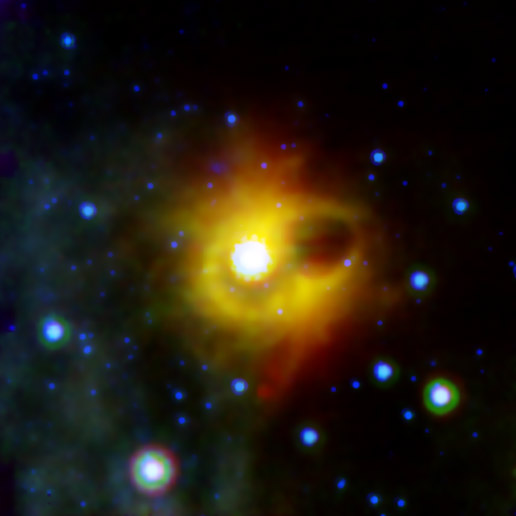
Fig. 1: The Soft Gamma-Ray Repeater SGR1900+14 is surrounded by a ring of material that was expelled in the stellar explosion leading to the collapsed star. Credit: NASA/JPL-Caltech 

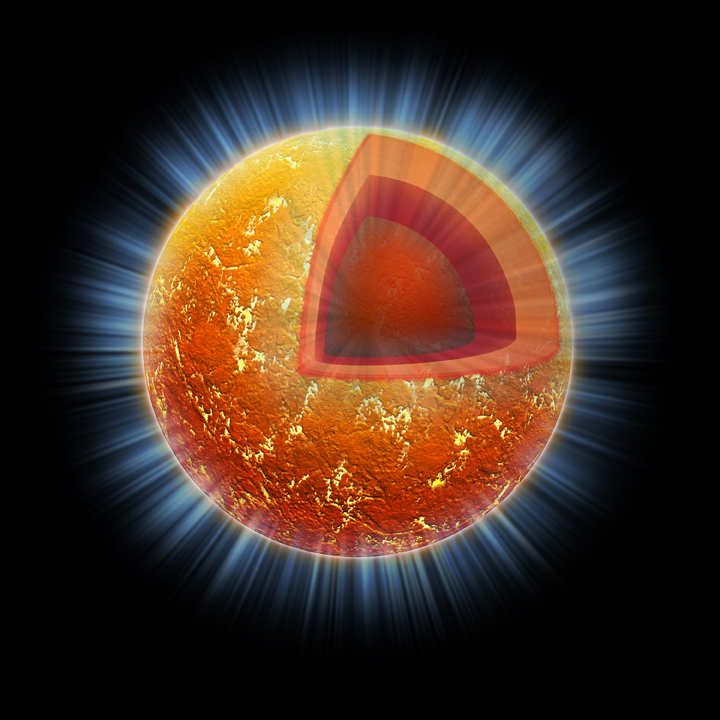
Fig. 2: Neutron star structure: A solid crust with a thickness of about 1km surrounds a liquid core of about 10km whose state of matter is largely unknown. Credit: Illustration of Cassiopeia A: NASA/CXC/M.Weiss

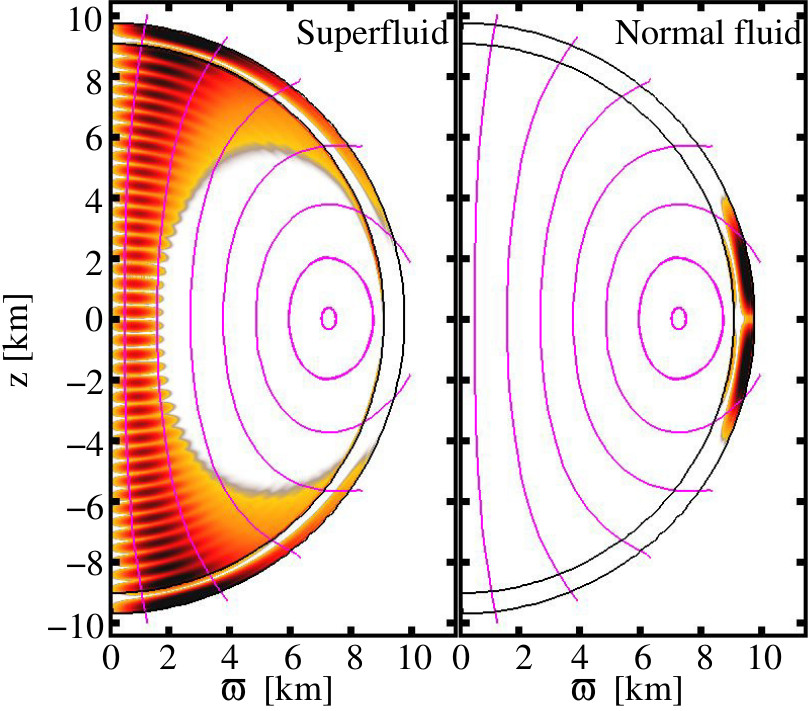
Fig. 3: These simulations show a new family of oscillations that is present in superfluid models (left panel) and absent in non-superfluid models (right panel). The new oscillations appear as resonances between a high-frequency shear mode in the crust and a high Alfvén oscillation overtone in the core. 

The state of matter of neutron stars is largely unknown. However, "starquakes" of neutron stars with extremely strong magnetic fields shed light into their exotic interior structure. Recent numerical simulations of the magneto-elastic oscillations of neutron stars strongly suggest that their liquid interior, which mainly consists of extremely compressed neutrons and some protons and electrons, is in a superfluid state. When including superfluidity in the models the predicted frequencies of the oscillations agree better with observations and the magnetic field strength estimates agree with alternative estimates. Moreover, the oscillations should live longer than in models without superfluidity. 

Neutron stars are a very particular class of stars: they are the most compact stars and they posses the strongest magnetic fields ever observed. They are the final state of the evolution of massive normal stars, i.e. once the fusion process ceases in the centre of such a star, it explodes as a supernova and leaves a neutron star as a compact remnant. But despite this fact, these stars cannot be considered to be “dead”. Instead, they show high activity related to their strong magnetic fields: emission of the most stable electromagnetic pulses (radio pulsars) and repeated flares in X- and gamma-rays (soft gamma-ray repeater/magnetars). Therefore, they are of major interest for astrophysicists. 

While the structure of the solid crust of neutron stars is well constrained from terrestrial experiments, little is known about the state of the matter in their interiors. Various theories predict a different behavior of the core matter. Because neutron stars are held together by very strong gravity their interior is so dense that these conditions cannot be reproduced in any laboratory on Earth. Therefore, observations of neutron stars provide the only opportunity to help us understand the complex nuclear physics of very dense matter, and in particular the interaction of fundamental particles under these conditions. 

"Starquakes" of neutron stars with extremely strong magnetic fields (magnetars) may shed light into their exotic interior structure (see Highlight). In past years, two giant flares were detected in the so-called soft gamma-ray repeaters SGR 1806-20 (2004) and SGR1900+14 (1998). During these events the emitted gamma-ray emission was modulated at different frequencies. Some of the lower oscillation frequencies discovered approximately match the frequencies of magneto-elastic oscillations of magnetars. These pulsations of neutron stars arise from the interaction of the magnetic field in the core with elastic shear oscillations in the solid crust that are similar to earthquakes. However, in this magneto-elastic model the observed high frequencies could not be explained. 

With recent numerical simulations, carried out by a collaboration between researchers from the MPA, the University of Valencia and the University of Thessaloniki, it is now possible to identify both low and high frequencies consistently as magneto-elastic oscillations or "starquakes". The crucial ingredient to match all observations at once is another exotic property of the core matter: superfluidity. In this state, there exists no viscosity in the fluid and it has infinite thermal conductivity. On Earth, superfluidity can only be observed at extremely low temperatures, and for just a few elements such as liquid helium.

If one includes superfluid effects in recent neutron star models, only a fraction of the matter (mainly the non-superfluid protons and electrons) is participating in the magneto-elastic oscillations that need to be matched to the observed frequencies. This decoupling leads to a better agreement of our estimates of the magnetic field strength of magnetars with alternative estimates. Moreover, a new family of oscillations appears that is crucial for a complete interpretation of the observed frequencies: a high-frequency shear mode in the crust (that was damped in previous models without superfluidity) resonates with a high overtone of the Alfvén oscillations in the core. (Alfvén oscillations are magnetohydrodynamic waves that are caused by the magnetic field acting as restoring force.) Additionally, superfluid magneto-elastic oscillations should live longer than the oscillations described by previous models, which is important for their detectability. 

In future studies the new model can be used to further constrain the state of the matter in neutron stars in general and its superfluid properties in particular.

M. Gabler (MPA, Valencia), E. Müller (MPA), P.Cerdá-Durán (Valencia), T. Font (Valencia) and N. Stergioulas (Thessaloniki)

Original Publication

Michael Gabler, Pablo Cerdá-Durán, Nikolaos Stergioulas, José A. Font, and Ewald Müller, "Imprints of Superfluidity on Magnetoelastic Quasiperiodic Oscillations of Soft Gamma-Ray Repeaters", Phys. Rev. Lett. 111, 211102 (2013).  http://de.arxiv.org/abs/1304.3566