Showing posts with label NGC 4449. Show all posts

Tuesday, June 17, 2025

Small but mighty

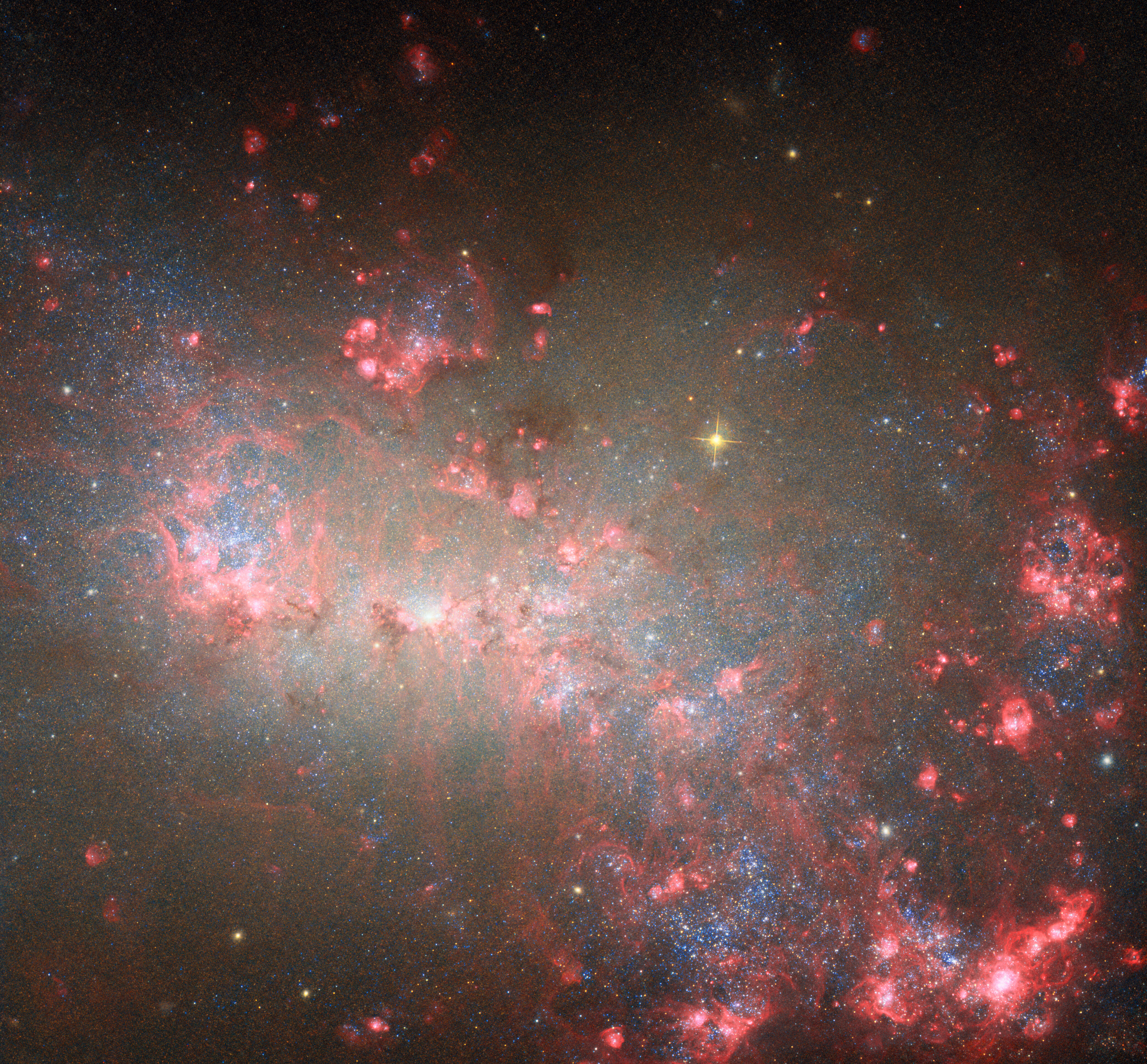
This Hubble image shows the galaxy
NGC 4449. The field is dominated by dust that appears in dark red, with scattered brighter regions of star formation as bright pink globules. The background shows countless blue stars peeking around the dusty regions. Credit: ESA/Hubble & NASA, E. Sabbi, D. Calzetti, A. Aloisi

This portrait from the NASA/ESA Hubble Space Telescope puts the nearby galaxy NGC 4449 in the spotlight. The galaxy is situated just 12.5 million light-years away in the constellation Canes Venatici (The Hunting Dogs). It is a member of the M94 galaxy group, which is near the Local Group of galaxies to which the Milky Way belongs.

NGC 4449 is a dwarf galaxy, which means that it is far smaller and contains fewer stars than the Milky Way. But don’t let its small size fool you — NGC 4449 packs a punch when it comes to making stars! This galaxy is currently forming new stars at a much faster rate than expected for its size, which makes it known as a starburst galaxy. Most starburst galaxies churn out stars mainly in their centres, but NGC 4449 is alight with brilliant young stars throughout. Researchers believe that this global burst of star formation came about because of NGC 4449’s interactions with its galactic neighbours. Because NGC 4449 is so close, it provides an excellent opportunity for Hubble to study how interactions between galaxies can influence the formation of new stars.

A Hubble image of NGC 4449 was previously released in 2007. This new version incorporates several additional wavelengths of light that Hubble collected for multiple observing programmes. These programmes encompass an incredible range of science, from a deep dive into NGC 4449’s star-formation history to the mapping of the brightest, hottest, and most massive stars in more than two dozen nearby galaxies.

The NASA/ESA/CSA James Webb Space Telescope has also observed NGC 4449, revealing in intricate detail the galaxy’s tendrils of dusty gas, glowing from the intense starlight radiated by the flourishing young stars.


Monday, July 01, 2024

Gemini North Captures Starburst Galaxy Blazing Bright With Newly Forming Stars

PR Image noirlab2416a
Starburst Galaxy NGC 4449

PR Image noirlab2416b
The Milky Way Over Gemini North

PR Image noirlab2416c
Gemini North Dedication Ceremony


Videos

Cosmoview Episode 83: Gemini North Captures Starburst Galaxy Blazing Bright With Newly Forming Stars
PR Video noirlab2416a
Cosmoview Episode 83: Gemini North Captures Starburst Galaxy Blazing Bright With Newly Forming Stars

Pan on NGC 4449
PR Video noirlab2416b
Pan on NGC 4449

Cosmoview Episodio 83: Telescopio de Gemini Norte celebra nuevo aniversario con el confeti cósmico de una devoradora galáctica


Irregular galaxy NGC 4449 exhibits explosive rate of star formation activity due in part to ongoing mergers with nearby dwarf galaxies

A festive array of bright pinks and blues makes for a remarkable sight in this image captured with the Gemini North telescope, one half of the International Gemini Observatory. Resembling a cloud of cosmic confetti, this image is being released in celebration of Gemini North’s 25th anniversary. NGC 4449 is a prime example of starburst activity caused by the interacting and mingling of galaxies as it slowly absorbs its smaller galactic neighbors.

Much of the visible matter in the Universe, the matter that makes up stars, planets — and us — is made inside stars as they complete their cycle of birth, life, and death. They are born from clouds of gas and dust, and when they die their remains are recycled back into the interstellar medium to be used as fuel for the next generation of stars. And in a not-so-distant corner of the Universe, 13 million light-years away in the constellation Canes Venatici, the beginning of this cycle is unfolding at an exceptional rate.

NGC 4449, also known as Caldwell 21, appears to be putting on a cosmic fireworks show in this image, captured with the Gemini North telescope, one half of the International Gemini Observatory, which is supported in part by the U.S. National Science Foundation and operated by NSF NOIRLab. The galaxy’s billowing red clouds and sparkling blue veil are lighting up the sky with the colors of newly forming stars. It’s classified as an irregular Magellanic-type galaxy, reflecting its loose spiral structure and close resemblance to the Large Magellanic Cloud — the prototype of Magellanic galaxies.

Stars have been actively forming within NGC 4449 for several billion years, but currently it is pumping out new stars at a much higher rate than in the past. This unusually explosive and intense star formation activity qualifies it as a starburst galaxy. While starbursts usually occur in the central regions of galaxies, NGC 4449’s star formation is more widespread, evidenced by the fact that the youngest stars are both in the nucleus and in streams surrounding the galaxy.

This ‘global’ starburst activity resembles the Universe’s earliest star-forming galaxies, which grew by merging with and accreting smaller stellar systems. And like its galactic predecessors, NGC 4449’s rapid star formation was likely ignited by interactions with neighboring galaxies. As a member of the M94 Group of galaxies — one of the closest galaxy groups to the Local Group, which hosts the Milky Way — NGC 4449 lies in close proximity to a handful of surrounding smaller galaxies. Astronomers have found evidence of interactions between NGC 4449 and at least two of these satellite galaxies.

One is a very dim dwarf galaxy that is actively being absorbed, as evidenced by a diffuse stream of stars extending to one side of NGC 4449. This ‘stealth’ merger is nearly undetectable by visual inspection owing to its diffuse nature and low stellar mass. However, it possesses a large amount of dark matter, meaning its presence can be detected by the substantial gravitational influence it has on NGC 4449. The other object that provides hints of a past merger is a massive globular star cluster embedded within the outer halo of NGC 4449. This cluster is thought by astronomers to be the surviving nucleus of a former gas-rich satellite galaxy now in the process of being absorbed by NGC 4449.

As NGC 4449 interacts with and absorbs its smaller galactic companions, the tidal interactions between the galaxies compress and shock the gas. The glowing red regions scattered across this image showcase this process, indicating an abundance of ionized hydrogen — a telltale sign of ongoing star formation. A plethora of hot, young blue star clusters are emerging from the galactic ovens, fueled by the dark filaments of cosmic dust lacing throughout the galaxy. At the current rate, the gas supply that feeds NGC 4449’s production of stars will only last for another billion years or so.

This image is being released today in celebration of the Gemini North telescope’s 25th anniversary. On 25 June 1999 a dedication ceremony was held on Maunakea, Hawai‘i, to unveil the new world-class 8.1-meter telescope and reveal its first-light images, which at the time were some of the sharpest infrared images ever obtained by a ground-based telescope. Over the past two and a half decades Gemini North’s large mirror, powerful suite of instruments and advanced adaptive optics have allowed astronomers to peer further and further into the cosmos. From capturing the first direct image of a multi-planet system to testing Einstein’s general theory of relativity — which helped astronomers earn the 2020 Nobel Prize — Gemini North has contributed greatly to humanity’s understanding of the Universe.


More information

NSF NOIRLab (U.S. National Science Foundation National Optical-Infrared Astronomy Research Laboratory), the U.S. center for ground-based optical-infrared astronomy, operates the International Gemini Observatory (a facility of NSF, NRC–Canada, ANID–Chile, MCTIC–Brazil, MINCyT–Argentina, and KASI–Republic of Korea), Kitt Peak National Observatory (KPNO), Cerro Tololo Inter-American Observatory (CTIO), the Community Science and Data Center (CSDC), and Vera C. Rubin Observatory (operated in cooperation with the Department of Energy’s SLAC National Accelerator Laboratory). It is managed by the Association of Universities for Research in Astronomy (AURA) under a cooperative agreement with NSF and is headquartered in Tucson, Arizona. The astronomical community is honored to have the opportunity to conduct astronomical research on I’oligam Du’ag (Kitt Peak) in Arizona, on Maunakea in Hawai‘i, and on Cerro Tololo and Cerro Pachón in Chile. We recognize and acknowledge the very significant cultural role and reverence that these sites have to the Tohono O’odham Nation, to the Native Hawaiian community, and to the local communities in Chile, respectively.


Links


Contacts:

Josie Fenske
NSF NOIRLab
Email:
josie.fenske@noirlab.edu


Wednesday, February 08, 2012

Subaru Telescope Captures Images of the "Stealth Merger" of Dwarf Galaxies

Figure 1: Suprime-Cam captured this image of the nearby dwarf galaxy NGC 4449 (lower left) and its companion (upper right), a dwarf galaxy that has been gravitationally pulled apart into a stellar stream. It shows individual stars composing the galaxies. R. Jay GaBany (Blackbird Observatory) produced the composite: blue hues in the center of the larger galaxy are brought about by a burst of recent star formation, while the red in its periphery and in its satellite indicates the presence of older, red-giant stars. (Hi-Res image)

An international team of scientists led by David Martinez-Delgado (Max Planck Institute for Astronomy, Germany) has conducted research that reveals a "stealth merger" of dwarf galaxies, where an in-falling satellite galaxy is nearly undetectable by conventional means yet has a substantial influence on its host galaxy. Aaron Romanowsky (University of California Observatories in Santa Cruz) along with graduate student Jacob Arnold (UCSC) used the Subaru Telescope to obtain high-resolution images of individual stars in a dense stream of stars in the outer regions of a nearby dwarf galaxy (NGC 4449); these outlying stars are the remains of an even smaller companion galaxy in the process of merging with its host (Figure 1). NGC 4449, the host galaxy, is the smallest primary galaxy in which a stellar stream from an ongoing merger has been identified and studied in detail. Romanowsky commented, "I don't think I'd ever seen a picture of a galaxy merger where you can see the individual stars. It's really an impressive image."

Martinez-Delgado organized a campaign to follow up on an initial report of the stellar stream in NGC 4449, first detected by Russian astronomers as a mysterious, faint smudge in digitized photographic plates from the Digitized Sky Survey project. Had the objects been slightly fainter, more diffuse, or farther from the host galaxy, the stellar stream could easily have been missed. NGC 4449 is located 12.5 million light years from Earth and is a member of a group of galaxies in the constellation Canes Venatici. Martinez-Delgado recruited astrophotographer R. Jay GaBany (recipient of the 2010 AAS Chambliss Amateur Achievement Award) to obtain deep, wide-field images with the half-meter telescope at Black Bird Observatory; these images confirmed the presence of a faint substructure in the galaxy's halo. Romanowsky and Arnold then took advantage of the wide field of view and light collecting power of Subaru Telescope's 8.2 meter mirror and its prime focus camera (Suprime-Cam) to capture high resolution images of the faint objects in the halo. These final observations at Subaru in 2011 clearly showed the stealth merger of two dwarf galaxies.

Modern cosmological theory posits that large galaxies were built up from smaller ones through an orderly succession of mergers. Although astronomers have observed many mergers involving massive galaxies, it has been difficult to find mergers of two dwarf galaxies. Theory suggests that similar processes of merging should occur on a smaller scale, with small galaxies eating even smaller ones; this is how galaxies grow. Romanowsky commented on the significance of the Subaru image: "Now we have this beautiful image of a dwarf galaxy consuming a smaller dwarf. You can see a smaller galaxy coming in and getting shredded, eventually leaving its stars scattered through the halo of the host galaxy. "

The new observations support the idea that the stellar halos around many dwarf galaxies are the remnants of smaller satellites that were shredded in past merger events. The ongoing merger in NGC 4449 may also be responsible for the intense burst of star formation seen in the galaxy. "This galaxy is famous for its starburst activity, and it seems we've found the reason for that. The gravitational interaction with the incoming galaxy has probably disturbed the gas in the main galaxy and caused it to start forming stars," Romanowsky said.


Notes:

This research was supported by the National Science Foundation (NSF, USA), National Aeronautics and Space Administration (NASA, USA) and the University of California at Santa Cruz-University Affiliated Research Center (UCSC-UARC) Aligned Research Program.


The paper describing the research, “Dwarfs gobbling dwarfs: A stellar tidal stream around NGC 4449 and hierarchical galaxy formation on small scales”, will be published in Astrophysical Journal Letters. Coauthors of this international study include:

D. Martinez-Delgado (Max Planck Institute for Astronomy, Germany)
A. Romanowsky (University of California Observatories at Santa Cruz, USA)
J. Arnold (University of California at Santa Cruz, USA)
R. J. GaBany (astrophotographer, amateur astronomer, USA)
J. Brodie (UC Santa Cruz, USA)
F. Annibali (Astronomical Observatory of Bologna, Italy)
J. Fliri (Observatory of Paris, France)
S. Zibetti (University of Copenhagen, Denmark)
R. van der Marel (Space Telescope Science Institute, USA)
A. Aloisi (Space Telescope Science Institute, USA)
H.-W. Rix (Max Planck Institute for Astronomy, Germany)
A. Macciò (Max Planck Institute for Astronomy, Germany)
T. Chonis (University of Texas at Austin, USA)
J. Carballo-Bello (Canary Astrophysics Institute, Spain)
J. Gallego-Laborda (Fosca Nit Observatory Spain)
M. Merrifield (University of Nottingham, UK)

Friday, December 30, 2011

Little Galaxies Are Big on Dark Matter

The stellar stream in the halo of the nearby dwarf starburst galaxy NGC 4449 is resolved into its individual starry constituents in this exquisite image taken with the 8.2-meter Subaru Telescope and Suprime-Cam. Image credit: R. Jay GaBany and Aaron J. Romanowsky (UCSC) in collaboration with David Martinez-Delgado (MPIA) and NAOJ. Image processed by R. Jay GaBany

Dark matter… It came into existence at the moment of the Big Bang. Within its confines, galaxies formed and evolved. If you add up all the parts contained within any given galaxy you derive its mass, yet its gravitational effects can only be explained by the presence of this mysterious subatomic particle. It would be easy to believe that the larger the galaxy, the larger the amount of dark matter should be present, but new research shows that isn’t so. Dwarf galaxies have even higher proportions of dark matter than their larger counterparts. Although the dwarfs are the most common of all, we know very little about them – even when they consume each other. Enter the star stream…

“Several of my previous images feature the fossil remnants of these ancient mergers as faint stellar rivers called tidal streams. These stellar streams are the table crumbs from small dwarf galaxies that were gravitationally dismembered as they were devoured by the larger galaxy they orbited.” says astrophotographer, R. Jay Gabany. “The theory implies dwarf galaxies also merged and are still merging with each other. But, there has never been clear photographic evidence or a close investigation of dwarf galactic mergers until now.”

The target is NGC 4449, a small, irregular dwarf galaxy much like the the Milky Way’s Large Magellanic Cloud. What makes it interesting to astronomers is the presence of thousands of hot blue stars and massive red regions interspaced with thick dust clouds. It isn’t just forming new stars… it’s experiencing an explosion of star birth! According to current theory, dwarf galaxies such as this one could be undergoing a merger event, but there hasn’t been photographic proof until now.

“The picture I am sharing is of a small, dwarf galaxy known as NGC 4449 that’s located about 12.5 million light years from Earth towards the northern constellation of Canes Venatici, the Hunting Dogs. This galaxy is about the size of our Milky Way’s largest satellite galaxy, the Magellanic Cloud. But, NGC 4449 is much farther away and it is experiencing a major star burst event- an episode characterized by the production of new stars at a furious rate.” says Gabany. “This image is unique because is it captures the first dwarf galaxy known to have its own tidal stream of stars. Therefore, it represents the first closely studied example of a dwarf galaxy merging with an even smaller dwarf star system! The professional astronomers with whom I work also suspect the merger may have contributed to the ferocious production rate of new stars inside NGC 4449.”

The research done by the team led by Dr. David Martinez-Delgado has some very interesting ramifications and their paper has been accepted for publication in the Astrophysical Journal Letters.. As so well put in Jay’s photographic explanation in his webpage; “Although the cold dark matter theory predicts mergers and interactions between dwarf galaxies, there is scant observational evidence that these types of mergers are still happening in the nearby local Universe. Interactions between dwarf galaxies invoke the possibility of exploring a very different merger regime. For example, research has shown that multiple dwarf galaxies with different stellar masses may exist in similar sized dark matter halos, hence what appears as a minor merger of stars could be a major dark matter merger. Studying interactions on a small scale, such as NGC 4449, provides unique insights on the role of stars versus dark matter in galactic merger events.”

Where once amateur astrophotographers painted beautiful portraits of what lay just beyond human perception in deep space, they are now crafting images capable of true science. The eyes of their telescopes are being combined with professional instruments and producing amazing results.

“We live in an age where science has become unfettered from examining the Universe with only our physical six senses.” concludes Gabany. “This has unlocked a profound new level of understanding, resolved ancient mysteries and unlatched a Pandora’s chest filled with new questions begging for answers. We still have much to learn.”

For Further Reading: Dwarfs Gobbling Dwarfs: A Stellar Tidal Stream Around NGC 4449 and Hierarchical Galaxy Formation On Small Scales and The Big Deal About Dwarf Galaxies.

by Tammy Plotner


Tammy is a professional astronomy author, President Emeritus of Warren Rupp Observatory and retired Astronomical League Executive Secretary. She’s received a vast number of astronomy achievement and observing awards, including the Great Lakes Astronomy Achievement Award, RG Wright Service Award and the first woman astronomer to achieve Comet Hunter's Gold Status.