Showing posts with label Eta Carinae. Show all posts

Saturday, October 04, 2025

New Instrument at SOAR Achieves First Light with Observations of Remarkable Binary Star System

PR Image noirlab2528a
STELES Spectrum of Eta Carinae

PR Image noirlab2528b
STELES Spectrum of Eta Carinae

PR Image noirlab2528c
Blue Spectrum of Eta Carinae

PR Image noirlab2528d
Red Spectrum of Eta Carinae

PR Image noirlab2528e
STELES on SOAR

PR Image noirlab2528f
The SOAR Telescope


The high-resolution SOAR Telescope Echelle Spectrograph brings a powerful new tool to explore the Southern Hemisphere sky

The SOAR Telescope, located on Cerro Pachón in Chile, has received a major upgrade with the installation of the SOAR Telescope Echelle Spectrograph (STELES). The long-awaited instrument achieved first light in August with observations of the binary star system Eta Carinae, along with 13 other targets. SOAR is part of U.S. National Science Foundation Cerro Tololo Inter-American Observatory (CTIO), a Program of NSF NOIRLab.

The SOAR Telescope Echelle Spectrograph (STELES), a new instrument on the 4.1-meter Southern Astrophysical Research (SOAR) Telescope, has achieved first light. STELES was installed on the SOAR Telescope on 30 July 2025 and on 6 August, from its perch on Cerro Pachón in Chile, it pointed toward the constellation Carina to observe one of the most fascinating pairs of stars in our Milky Way — Eta Carinae.

Eta Carinae is a binary star system — two stars orbiting each other — with a long and curious history of brightening and dimming. The system is best known for its ‘Great Eruption’ in 1837, during which it underwent a tremendous explosion and became one of the brightest objects in the night sky, before dimming again. In the centuries since, astronomers have watched Eta Carinae as it mysteriously fluctuates in brightness

Current estimates hold that Eta Carinae’s larger star is about 90 times the mass of the Sun, whereas the smaller star is around 30 times the mass of the Sun. And while the system is greater than five million times more luminous than the Sun, it appears faint in our sky due to being heavily obscured by the Homunculus Nebula — a cloud of material ejected from the larger star during the Great Eruption.

This fascinating object was chosen as a first light target for STELES in recognition of Brazilian astronomer Augusto Damineli, who was the first to propose that Eta Carinae was a binary system and who led the acquisition of most of the funding necessary for the construction and installation of STELES at SOAR.

STELES was designed in Brazil by the Laboratório Nacional de Astrofísica (LNA), part of the Ministério da Ciência, Tecnologia e Inovação (MCTI), and the Instituto de Astronomia, Geofísica e Ciências Atmosféricas from Universidade de São Paulo (IAG/USP). The optical design was done by Bernard Delabre from ESO. Components for the instrument’s CCD detectors were designed, fabricated, and tested at CTIO.

The instrument arrived at CTIO in May 2016 with a substantial amount of assembly and testing still needed. For the next nine years the teams worked diligently, overcoming logistical and technical challenges, delays due to the COVID-19 pandemic, and the need for multiple excursions from Brazil to Chile. On the night of first light, the teams felt a true sense of accomplishment as STELES successfully acquired the spectra of 14 stars, galaxies, and planetary nebulae.

“First light marks the achievement of a major milestone, and we celebrate it as a joint achievement of the LNA and the CTIO/SOAR teams,” says Felipe Navarete, researcher at LNA and STELES instrument scientist.

STELES works by dividing a beam of incoming light into two arms, one for the short wavelengths of blue light (300–550 nanometers) and one for longer wavelengths of red light (530–890 nanometers). Echelle gratings in each arm act similarly to a prism, further separating each section of light into its spectrum of constituent colors. The spectrum can tell scientists detailed information about an object’s chemical composition, motion, rotation, and distance.

STELES can see a wide range of visible light in a single shot, meaning it can capture most of the photons that reach it. This large light-collecting capability, combined with a sophisticated detector system and the excellent image quality of the SOAR Telescope, allows STELES to quickly take precise measurements of faint distant stars.

With the high-quality data provided by STELES, scientists will be able to study large numbers of metal-poor stars in and outside of our galaxy. Specifically, STELES will search for the theorized first generation of stars, known as Population III, which are the earliest born stars in the Universe’s history and contain virtually no metals — elements heavier than helium. These oldest stars have never been directly observed.

“STELES will undoubtedly enhance SOAR’s spectroscopic capabilities and will be a boon for researchers in the U.S. and Brazil,” says NSF Program Director Chris Davis. “STELES offers a unique combination of high spectral resolution and ultraviolet capability, making it a powerful tool for advancing our understanding of star and planet formation, the interstellar medium, and hot stars.”

Scientists anticipate that STELES data will provide insight into the chemical evolution of the Milky Way and unveil secrets of the early Universe. Following some additional on-sky engineering tests, STELES will begin its pioneering search for the Universe’s oldest stars in early 2026.


More information

The Southern Astrophysical Research (SOAR) Telescope is a joint project of the Ministério da Ciência, Tecnologia e Inovações do Brasil (MCTIC/LNA), NSF NOIRLab, the University of North Carolina at Chapel Hill (UNC), and Michigan State University (MSU).

NSF NOIRLab, the U.S. National Science Foundation center for ground-based optical-infrared astronomy, operates the International Gemini Observatory (a facility of NSF, NRC–Canada, ANID–Chile, MCTIC–Brazil, MINCyT–Argentina, and KASI–Republic of Korea), NSF Kitt Peak National Observatory (KPNO), NSF Cerro Tololo Inter-American Observatory (CTIO), the Community Science and Data Center (CSDC), and NSF–DOE Vera C. Rubin Observatory (in cooperation with DOE’s SLAC National Accelerator Laboratory). It is managed by the Association of Universities for Research in Astronomy (AURA) under a cooperative agreement with NSF and is headquartered in Tucson, Arizona.

The scientific community is honored to have the opportunity to conduct astronomical research on I’oligam Du’ag (Kitt Peak) in Arizona, on Maunakea in Hawai‘i, and on Cerro Tololo and Cerro Pachón in Chile. We recognize and acknowledge the very significant cultural role and reverence of I’oligam Du’ag to the Tohono O’odham Nation, and Maunakea to the Kanaka Maoli (Native Hawaiians) community.


Links


Contacts:

Josie Fenske
Public Information Officer
NSF NOIRLab
Email:
josie.fenske@noirlab.edu


Friday, September 29, 2023

Eta Carinae: Chandra Rewinds Story of Great Eruption of the 1840s

Eta Carinae Time-Lapse: 1999, 2003, 2009, 2014, and 2020
Credit: X-ray: NASA/SAO/GSFC/M. Corcoran et al; HST: NASA/ESA/STScI
Image Processing: NASA/CXC/SAO/L. Frattare, J. Major, N. Wolk


A new movie made from over two decades of data from NASA’s Chandra X-ray Observatory shows a famous star system changing with time, as described in our latest press release. Eta Carinae contains two massive stars (one is about 90 times the mass of the Sun and the other is believed to be about 30 times the Sun’s mass).

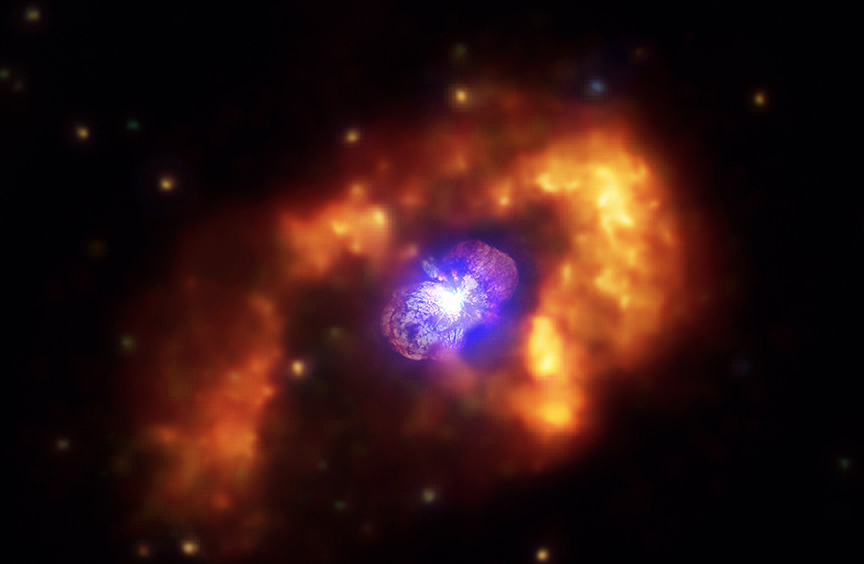
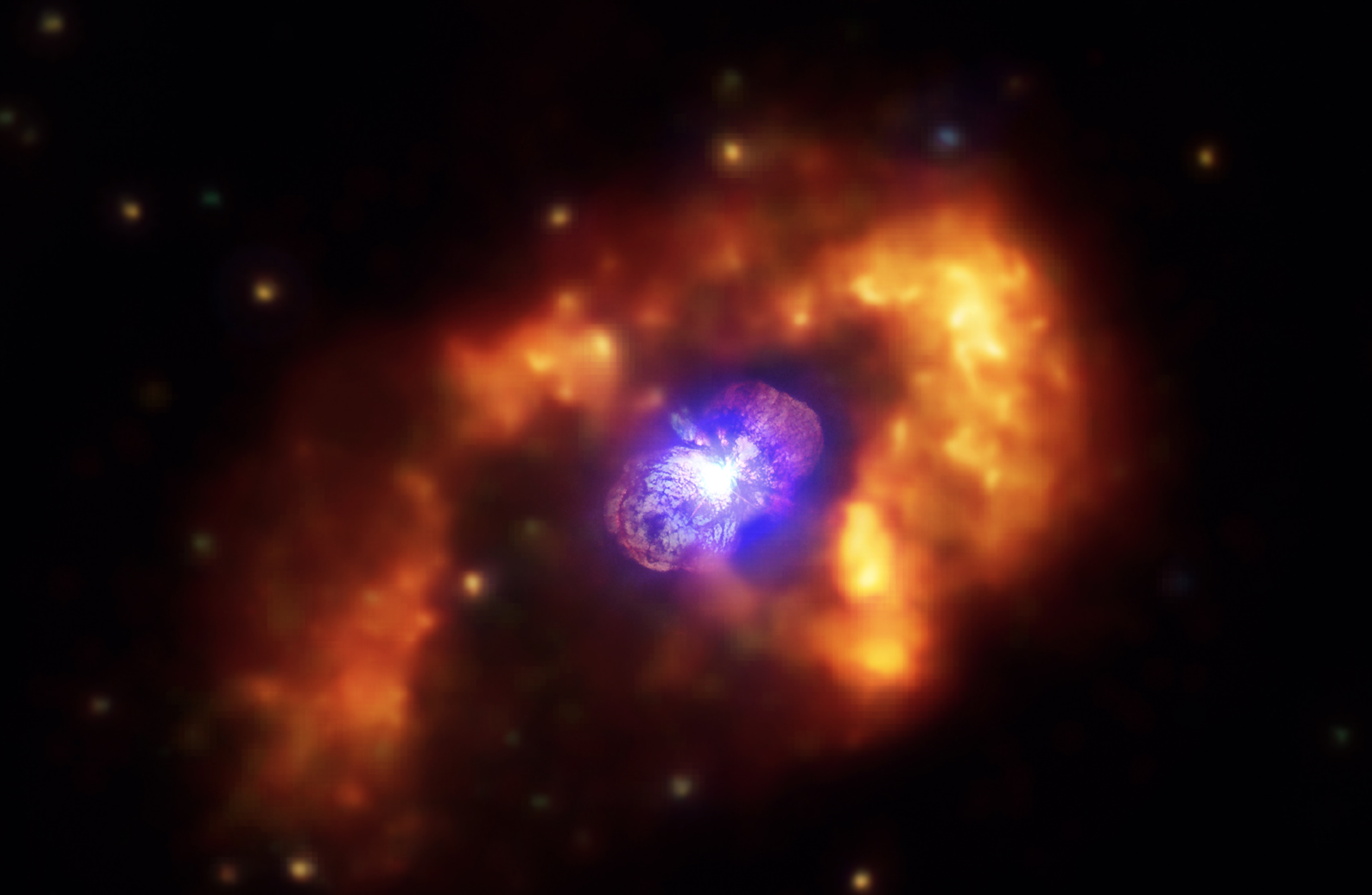
In the middle of the 19th century, skywatchers observed as Eta Carinae experienced a huge explosion that was dubbed the “Great Eruption.” During this event, Eta Carinae ejected between 10 and 45 times the mass of the Sun. This material became a dense pair of spherical clouds of gas, now called the Homunculus nebula, on opposite sides of the two stars. The Homunculus is clearly seen in a composite image of the Chandra data with optical light from the Hubble Space Telescope (blue, purple, and white).

Eta Carinae (Composite)
Credit: X-ray: NASA/SAO/GSFC/M. Corcoran et al; HST: NASA/ESA/STScI;
Image Processing: NASA/CXC/SAO/L. Frattare, J.Major, N. Wolk

A new time-lapse sequence contains frames of Eta Carinae taken with Chandra from 1999, 2003, 2009, 2014, and 2020. Astronomers used the Chandra observations along with data from ESA’s XMM-Newton to watch as the stellar eruption from about 180 years ago continues to expand into space at speeds up to 4.5 million miles per hour. The two massive stars produce the blue, relatively high energy X-ray source in the center of the ring. They are too close to each other to be seen individually.

A bright ring of X-rays (orange) around the Homunculus nebula was discovered about 50 years ago and studied in previous Chandra work. The new movie of Chandra, plus a deep, summed image generated by adding the data together, reveal important hints about Eta Carinae’s volatile history. This includes the rapid expansion of the ring, and a previously-unknown faint shell of X-rays outside it.

This faint X-ray shell is highlighted in an additional graphic showing the summed image. The image on the left emphasizes the bright X-ray ring, and the image on the right shows the same data but emphasizing the faintest X-rays. The shell is located in between the two contour levels, as labeled.

Eta Carinae (Summed)

Credit:NASA/SAO/GSFC/M. Corcoran et al.

Because the newly discovered outer X-ray shell has a similar shape and orientation to the Homunculus nebula, researchers concluded both structures have a common origin. The idea is that material was blasted away from Eta Carinae well before the 1843 Great Eruption — sometime between 1200 and 1800, based on the motion of clumps of gas previously seen in Hubble Space Telescope data. Later this slower material was lit up in X-rays when the fast blast wave from the Great Eruption tore through space, colliding with and heating the material to millions of degrees to create the bright X-ray ring. The blast wave has now traveled beyond the bright ring.

A paper describing these results appeared in The Astrophysical Journal and is available at https://iopscience.iop.org/article/10.3847/1538-4357/ac8f27

The authors of the paper are Michael Corcoran (NASA’s Goddard Space Flight Center), Kenji Hamaguchi (GSFC), Nathan Smith (University of Arizona), Ian Stevens (University of Birmingham, UK), Anthony Moffat (University of Montreal), Noel Richardson (Embry-Riddle Aeronautical University), Gerd Weigelt (Max Planck Institute for Radio Astronomy), David Espinoza-Galeas (The Catholic University of America), Augusto Damineli (University of Sao Paolo, Brazil), and Christopher Russell (Catholic University).

NASA's Marshall Space Flight Center manages the Chandra program. The Smithsonian Astrophysical Observatory's Chandra X-ray Center controls science operations from Cambridge, Massachusetts, and flight operations from Burlington, Massachusetts.


Visual Description:

This release features composite images and a time-lapse movie of a cosmic explosion that sky watchers have been observing since the middle of the 19th century. About 180 years ago, a huge explosion inside the Eta Carinae star system ejected massive amounts of material in an event dubbed the "Great Eruption". The resulting gas and debris cloud has been expanding ever since.

The time lapse sequence of Chandra observations begins with an image from 1999. Here, a hazy, neon blue ball with a brilliant white core is encircled by a patchy, oblong, orange ring. The blue and white ball shows X-rays from two massive stars, 30 and 90 times the mass of our sun. These stars are too close together to be seen individually. The oblong orange gas ring encircling them is tilted, stretching toward our upper right and lower left.

The time lapse movie progresses with four similar images, containing data from 2003, 2009, 2014, and 2020. As the images flit by, one after the other, the neon blue ball expands, but the white core appears stable. The patches forming the orange ring of gas shift and swell, moving away from the stars inside the blue and white ball.

An additional composite image features optical and X-ray observations of the explosion, inside the expanding orange ring of gas. Here, the explosion is shaped like an hourglass, or peanut shell, with bulbous ends and a narrow middle. The shell is a translucent mauve color, streaked with purple veins. Inside, at the narrow middle, a brilliant white light gleams brightly. The peanut shell shape is tilted, with one bulbous end pointing away from us, toward our upper right, and the other pointing toward us, down to our lower left. This is the same orientation as the orange ring of gas. That indicates that both structures have the same origin: the "Great Eruption", observed about 180 years ago.


Fast Facts for Eta Carinae (Time-lapse):

Credit: X-ray: NASA/SAO/GSFC/M. Corcoran et al.; Image Processing: L. Frattare, J. Major, N. Wolk (SAO/CXC)
Scale: Image is about 2.2 arcmin (4.8 light-years) across.
Category: Normal Stars & Star Clusters
Coordinates (J2000): RA 10h 45m 04s | Dec -59° 41´ 03"
Constellation: Carina
Observation Dates: 17 observations from Sept 1999 to March 2020
Observation Time: 79 hours 41 minutes (3 days 7 hours 41 minutes)
Obs. ID: 50, 51, 1249, 4455, 9933-9937, 16509, 15731, 15732, 16510, 15733, 16511, 22312, 22313
Instrument: ACIS
References: Corcoran, M. et al, ApJ, 2022, 937, 122. DOI 10.3847/1538-4357/ac8f27
Color Code: X-ray: red, green, and blue
Distance Estimate: About 7,500 light-years


Thursday, August 10, 2023

How We Lost a Gravitational Wave Source and Gained a Supernova


Before exploding as supernovae, many massive stars — like the famous Eta Carinae shown in this Hubble image — lose large amounts of mass. Today's article looks at a supernova that likely resulted from a star that underwent extreme mass loss. Credit:
J. Hester/Arizona State University, NASA/ESA;CC BY 4.0

What started as the search for the source of a potential gravitational wave signal ended with the discovery of an unusual supernova. The supernova, SN2019wxt, showed a double-peaked light curve similar to previous ultra-stripped supernova candidates.

Location of the newly discovered transient, labeled AT2019wxt, in the outskirts of its host galaxy.
Credit: Shivkumar et al. 2023


There and Gone

In December 2019, the LIGO and Virgo gravitational wave detectors distributed an alert for an event cataloged as S191213g, jump-starting a search for an electromagnetic counterpart to the possible gravitational wave signal. In the days following the alert, multiple telescopes turned toward the source region for the signal, homing in on a rapidly evolving object that was brightening the outskirts of a compact galaxy about half a billion light-years from Earth. Further analysis of S191213g downgraded its significance as a gravitational wave signal, ending the search for its source — but the newly discovered object got even more interesting.


Optical and near-infrared light curves of SN2019wxt over three weeks following the initial detection. The i and g bands show the intriguing double-peaked shape. Credit: SN2019wxt et al. 2023


“Just” a Supernova

In a recent research article, Hinna Shivkumar (University of Amsterdam) and collaborators outlined the follow-up observations of this intriguing target. As early data trickled in, the object remained hard to classify, though its mostly featureless spectrum with a broad emission line from helium marked it as an exploding star that had lost its outer layers of hydrogen, and it gained the label SN2019wxt.

Shivkumar and coauthors used X-ray data from the Chandra X-ray Observatory, radio data from the Very Large Array, and optical images and spectra from telescopes across several continents to study the explosion further. Rather than showing a single peak to its light curve like a typical supernova, SN2019wxt peaked twice in just three days, making it one of the fastest-evolving supernovae known. Modeling of SN2019wxt’s light curve suggested that the first peak is due to rapid cooling of an expanding bubble of plasma, and the second peak is due to radioactive decay of material ejected in the explosion.


Bolometric light curve of SN2019wxt (black circles) and best-fitting models of shock cooling (green dashed line) and radioactive decay (blue dashed line).  Credit: Shivkumar et al. 2023


Double Peaked and Ultra-stripped?

The unusual light curve, lack of hydrogen spectral lines, and modeled ejecta mass and explosion radius place SN2019wxt as a possible ultra-stripped-envelope core-collapse supernova. This rare class of supernovae contains only a few candidates, which are characterized by rapidly declining brightness, double-peaked light curves, and the presence of circumstellar material. These features point to stars that are stripped of much of their mass before exploding, leaving little material to be ejected in the explosion.

The serendipitous discovery of SN2019wxt makes for a great story, but to learn more about ultra-stripped supernovae in the future, we’ll need to catch them right when they happen. Luckily, the Vera C. Rubin Observatory’s long-awaited Legacy Survey of Space and Time draws ever closer, and after its anticipated start in 2025 will bring one million supernova detections each year — and thus millions of opportunities to study rare supernovae like SN2019wxt.

By Kerry Hensley

Citation

“SN2019wxt: An Ultrastripped Supernova Candidate Discovered in the Electromagnetic Follow-up of a Gravitational Wave Trigger,” Hinna Shivkumar et al 2023 ApJ 952 86. doi:10.3847/1538-4357/acd5d5


Wednesday, January 26, 2022

Visualization explores a massive star's great eruption Eta Carinae: The Great Eruption of a Massive Star

 Eta Carinae: The Great Eruption of a Massive Star


A new astronomical visualization from NASA's Universe of Learning showcases the multiwavelength emissions (from infrared light through X-rays) and three-dimensional structures surrounding Eta Carinae, one of the most massive and eruptive stars in our galaxy. The video, "Eta Carinae: The Great Eruption of a Massive Star," is being released today on hubblesite.org and universe-of-learning.org

Eta Carinae, or Eta Car, is famous for a brilliant and unusual outburst, called the "Great Eruption," observed in the 1840s. This briefly made it one of the brightest stars in the night sky, releasing almost as much visible light as a supernova explosion.

The star survived the outburst, and slowly faded away for the next five decades. The primary cause of this brightness change is a small nebula of gas and dust, called the Homunculus Nebula, that was expelled during the blast, and has blocked the light of the star.

Observations using NASA's Hubble Space Telescope and Chandra X-ray Observatory reveal the details in visible, ultraviolet, and X-ray light. Astronomers and artists at the Space Telescope Science Institute (STScI) in Baltimore, Maryland have developed three-dimensional models to represent the hourglass shape of the Homunculus and the clouds of glowing gas that encompass it. The result is a stunning tour of the nested emissions that brings the 2D images to 3D life.

"The team did such an amazing job representing the volumetric layers that viewers can immediately and intuitively comprehend the complex structure around Eta Car," said Frank Summers, principal visualization scientist at STScI and project lead. "We can not only tell the story of the Great Eruption, but also showcase the resulting nebula in 3D."

In addition, Eta Car is extremely bright at infrared wavelengths, and its radiation impacts the much larger Carina Nebula where it resides. Working with NASA's Spitzer Space Telescope observations, the team was able to place Eta Car in context of the dazzling infrared view of the star-forming region.

"Spitzer's infrared image lets us peer through the dust that obscures our view in visible light to reveal the intricate details and extent of the Carina Nebula around this brilliant star," commented Robert Hurt, lead visualization scientist at Caltech/IPAC and team member.

Extending the goals of NASA's Universe of Learning, the visualization assets promote learning beyond the video sequence. "We can take these models like the one for Eta Car and use them in 3D printing and augmented reality programs," noted Kim Arcand, visualization lead scientist at the Chandra X-ray Center in Cambridge, Massachusetts. "This means more people can put their hands on the data – literally and virtually – and this makes for better learning and engagement."

Eta Carinae is one of the most massive stars known. These exceptional stars are prone to outbursts during their lives. They will end their lives by collapsing into a black hole, probably accompanied by a supernova explosion. Eta Car is one of the nearest and best studied examples for learning about the energetic life and death of very massive stars.

Want to learn more? The visualization video and extensive related resources, which will include an upcoming Universe of Learning online live chat with Summers about the visualization, can be found at https://universeunplugged.ipac.caltech.edu/video/astroviz-eta-car .

NASA's Universe of Learning is part of the NASA Science Activation program. The Science Activation program connects NASA science experts, real content and experiences, and community leaders in a way that activates minds and promotes deeper understanding of our world and beyond. Using its direct connection to the science and the experts behind the science, NASA's Universe of Learning provides resources and experiences that enable youth, families, and lifelong learners to explore fundamental questions in science, experience how science is done, and discover the universe for themselves.

NASA's Universe of Learning materials are based upon work supported by NASA under cooperative agreement award number NNX16AC65A to the Space Telescope Science Institute, working in partnership with Caltech/IPAC, Center for Astrophysics | Harvard & Smithsonian, and Jet Propulsion Laboratory.

Credits:

Media Contact:

Ray Villard
Space Telescope Science Institute, Baltimore, Maryland

Science Contact:

Frank Summers
Space Telescope Science Institute, Baltimore, Maryland


Contact Us:

Direct inquiries to the
News Team.

Related Links and Documents:  NASA's Universe of Learning portal

Sunday, July 05, 2020

Binary star as a cosmic particle accelerator

In the shock region where the supersonic stellar winds of the two stars collide, subatomic particles are accelerated to such an extent that they produce very high-energy gamma radiation. Illustration: DESY, Science Communication Lab.
  Download [6.2 MB, 3840 x 2160]

Very high-energy (VHE) gamma radiation from Eta Carinae could be detected with H.E.S.S. around the time of the next encounter of the two giant stars. Illustration: DESY, Science Communication Lab.
  Download [6.5 MB, 3840 x 2160]

Specialised telescope provides evidence of very high-energy gamma radiation from Eta Carinae

With a specialised telescope in Namibia a DESY-led team of researchers has proven a certain type of binary star as a new kind of source for very high-energy cosmic gamma-radiation. Eta Carinae is located 7500 lightyears away in the constellation Carina (the ship’s keel) in the Southern Sky and, based on the data collected, emits gamma rays with energies all the way up to 400 gigaelectronvolts (GeV), some 100 billion times more than the energy of visible light. The team headed by DESY’s Stefan Ohm, Eva Leser and Matthias Füßling is presenting its findings, made at the gamma-ray observatory High Energy Stereoscopic System (H.E.S.S.), in the journal Astronomy & Astrophysics. A specially created multimedia animation explains the phenomenon. “With such visualizations we want to make the fascination of research tangible,” emphasises DESY's Director of Astroparticle Physics, Christian Stegmann.

Eta Carinae is a binary system of superlatives, consisting of two blue giants, one about 100 times, the other about 30 times the mass of our sun. The two stars orbit each other every 5.5 years in very eccentric elliptical orbits, their separation varying approximately between the distance from our Sun to Mars and from the Sun to Uranus. Both these gigantic stars fling dense, supersonic stellar winds of charged particles out into space. In the process, the larger of the two loses a mass equivalent to our entire Sun in just 5000 years or so. The smaller one produces a fast stellar wind travelling at speeds around eleven million kilometres per hour (about one percent of the speed of light).

A huge shock front is formed in the region where these two stellar winds collide, heating up the material in the wind to extremely high temperatures. At around 50 million degrees Celsius, this matter radiates brightly in the X-ray range. The particles in the stellar wind are not hot enough to emit gamma radiation, though. “However, shock regions like this are typically sites where subatomic particles are accelerated by strong prevailing electromagnetic fields,” explains Ohm, who is the head of the H.E.S.S. group at DESY. When particles are accelerated this rapidly, they can also emit gamma radiation. In fact, the satellites “Fermi”, operated by the US space agency NASA, and AGILE, belonging to the Italian space agency ASI, already detected high-energy gamma rays of up to about 10 GeV coming from Eta Carinae in 2009.

Subatomic hailstorm

“Different models have been proposed to explain how this gamma radiation is produced,” Füßling reports. “It could be generated by accelerated electrons or by high-energy atomic nuclei.” Determining which of these two scenarios is correct is crucial: very energetic atomic nuclei account for the bulk of the so-called Cosmic Rays, a subatomic cosmic hailstorm striking Earth constantly from all directions. Despite intense research for more than 100 years, the sources of the Cosmic Rays are still not exhaustively known. Since the electrically charged atomic nuclei are deflected by cosmic magnetic fields as they travel through the universe, the direction from which they arrive at Earth no longer points back to their origin. Cosmic gamma rays, on the other hand, are not deflected. So, if the gamma rays emitted by a specific source can be shown to originate from high-energy atomic nuclei, one of the long-sought accelerators of cosmic particle radiation will have been identified.


“In the case of Eta Carinae, electrons have a particularly hard time getting accelerated to high energies, because they are constantly being deflected by magnetic fields during their acceleration, which makes them lose energy again,” says Leser. “Very high-energy gamma radiation begins above the 100 GeV range, which is rather difficult to explain in Eta Carinae to stem from electron acceleration.” The satellite data already indicated that Eta Carinae also emits gamma radiation beyond 100 GeV, and H.E.S.S. has now succeeded in detecting such radiation up to energies of 400 GeV around the time of the close encounter of the two blue giants in 2014 and 2015. This makes the binary star the first known example of a source in which very high-energy gamma radiation is generated by colliding stellar winds.


“The analysis of the gamma radiation measurements taken by H.E.S.S. and the satellites shows that the radiation can best be interpreted as the product of rapidly accelerated atomic nuclei,” says DESY’s PhD student Ruslan Konno, who has published a companion study, together with scientists from the Max Planck Institute for Nuclear Physics in Heidelberg. “This would make the shock regions of colliding stellar winds a new type of natural particle accelerator for cosmic rays.” With H.E.S.S., which is named after the discoverer of Cosmic Rays, Victor Franz Hess, and the upcoming Cherenkov Telescope Array (CTA), the next-generation gamma-ray observatory currently being built in the Chilean highlands, the scientists hope to investigate this phenomenon in greater detail and discover more sources of this kind.

Cosmic roadtrip

Thanks to detailed observations of Eta Carinae at all wavelengths, the properties of the stars, their orbits and stellar winds have been determined relatively accurately. This has given astrophysicists a better picture of the binary star system and its history. To illustrate the new observations of Eta Carinae, the DESY astrophysicists have produced a video animation together with the animation specialists of the award-winning Science Communication Lab. The computer-generated images are close to reality because the measured orbital, stellar and wind parameters were used for this purpose. The internationally acclaimed multimedia artist Carsten Nicolai, who uses the pseudonym Alva Noto for his musical works, created the sound for the animation.

“I find science and scientific research extremely important,” says Nicolai, who sees close parallels in the creative work of artists and scientists. For him, the appeal of this work also lay in the artistic mediation of scientific research results: “particularly the fact that it is not a film soundtrack, but has a genuine reference to reality,” emphasizes the musician and artist. Together with the exclusively composed sound, this unique collaboration of scientists, animation artists and musician has resulted in a multimedia work that takes viewers on an extraordinary journey to a superlative double star some 7500 light years away.

Animation: DESY, Science Communication Lab; Sound by Alva Noto.. The animation is available in UHD and without annotations to media. Please contact the DESY press office at presse@desy.de


Reference:

Detection of very-high-energy γ-ray emission from the colliding wind binary η Car with H.E.S.S.; H.E.S.S. Collaboration (for DESY: Matthias Füßling, Eva Leser, Stefan Ohm); Astronomy & Astrophysics, 2020; DOI: 10.1051/0004-6361/201936761

Gamma-ray and X-ray constraints on non-thermal processes in η Carinae; R. White, M.Breuhaus, R. Konno, S. Ohm, B. Reville, and J.A. Hinton; Astronomy & Astrophysics, 2020; DOI:   10.1051/0004-6361/201937031

Interview

Carsten Nicolai aka Alva Noto talks about the sound of astroparticle physics


Tuesday, July 02, 2019

Hubble captures the galaxy's biggest ongoing stellar fireworks show

Eta Carinae (Observations in UV Light Uncover Magnesium Embedded in Warm Gas)
Credit: NASA, ESA, N. Smith (University of Arizona), and J. Morse (BoldlyGo Institute

Imagine slow-motion fireworks that started exploding 170 years ago and are still continuing. This type of firework is not launched into Earth's atmosphere, but rather into space by a doomed super-massive star, called Eta Carinae, the largest member of a double-star system. A new view from NASA's Hubble Space Telescope, which includes ultraviolet light, shows the star's hot, expanding gases glowing in red, white, and blue. Eta Carinae resides 7,500 light-years away.

The celestial outburst takes the shape of a pair of ballooning lobes of dust and gas and other filaments that were blown out from the petulant star. The star may have initially weighed more than 150 Suns. For decades, astronomers have speculated about whether it is on the brink of total destruction.

The fireworks started in the 1840s when Eta Carinae went through a titanic outburst, called the Great Eruption, making it the second-brightest star visible in the sky for over a decade. Eta Carinae, in fact, was so bright that for a time it became an important navigational star for mariners in the southern seas.

The star has faded since that eruption and is now barely visible to the unaided eye. But the fireworks aren't over yet because Eta Carinae still survives. Astronomers have used almost every instrument on Hubble over the past 25 years to study the rambunctious star.

Using Hubble's Wide Field Camera 3 to map the ultraviolet-light glow of magnesium embedded in warm gas (shown in blue), astronomers were surprised to discover the gas in places they had not seen it before.

Scientists have long known that the outer material thrown off in the 1840s eruption has been heated by shock waves after crashing into the doomed star's previously ejected material. In the new images, the team had expected to find light from magnesium coming from the same complicated array of filaments as seen in the glowing nitrogen (shown in red). Instead, a completely new luminous magnesium structure was found in the space between the dusty bipolar bubbles and the outer shock-heated nitrogen-rich filaments.

"We've discovered a large amount of warm gas that was ejected in the Great Eruption but hasn't yet collided with the other material surrounding Eta Carinae," explained Nathan Smith of Steward Observatory at the University of Arizona in Tucson, Arizona, lead investigator of the Hubble program. "Most of the emission is located where we expected to find an empty cavity. This extra material is fast, and it 'ups the ante' in terms of the total energy for an already powerful stellar blast."

The newly revealed gas is important for understanding how the eruption began, because it represents the fast and energetic ejection of material that may have been expelled by the star shortly before the expulsion of the bipolar lobes. Astronomers need more observations to measure exactly how fast the material is moving and when it was ejected.

The streaks visible in the blue region outside the lower-left lobe are a striking feature in the image. These streaks are created when the star's light rays poke through the dust clumps scattered along the bubble's surface. Wherever the ultraviolet light strikes the dense dust, it leaves a long, thin shadow that extends beyond the lobe into the surrounding gas. "The pattern of light and shadow is reminiscent of sunbeams that we see in our atmosphere when sunlight streams past the edge of a cloud, though the physical mechanism creating Eta Carinae's light is different," noted team member Jon Morse of BoldlyGo Institute in New York.

This technique of searching in ultraviolet light for warm gas could be used to study other stars and gaseous nebulas, the researchers say.

"We had used Hubble for decades to study Eta Carinae in visible and infrared light, and we thought we had a pretty full accounting of its ejected debris. But this new ultraviolet-light image looks astonishingly different, revealing gas we did not see in other visible-light or infrared images," Smith said. "We're excited by the prospect that this type of ultraviolet magnesium emission may also expose previously hidden gas in other types of objects that eject material, such as protostars or other dying stars. Only Hubble can take these kinds of pictures."

Eta Carinae has had a violent history, prone to chaotic eruptions that blast parts of itself into space like an interstellar geyser. One explanation for the monster star's antics is that the convulsions were caused by a complex interplay of as many as three stars, all gravitationally bound in one system. In this scenario, the most massive member would have swallowed one of the stars, igniting the massive Great Eruption of the mid-1800s. Evidence for that event lies in the huge, expanding bipolar lobes of hot gas surrounding the system.

A fortuitous trick of nature also allowed astronomers in a previous Hubble study to analyze the Great Eruption in detail. Some of the light from the eruption took an indirect path to Earth and is just arriving now. The wayward light was heading away from our planet when it bounced off dust clouds lingering far from the turbulent stars and was rerouted to Earth, an effect called a "light echo."

The stellar behemoth will eventually reach its fireworks show finale when it explodes as a supernova. This may have already happened, although the geyser of light from such a brilliant blast hasn't yet reached Earth.

The Hubble Space Telescope is a project of international cooperation between NASA and ESA (European Space Agency). NASA's Goddard Space Flight Center in Greenbelt, Maryland, manages the telescope. The Space Telescope Science Institute (STScI) in Baltimore, Maryland, conducts Hubble science operations. STScI is operated for NASA by the Association of Universities for Research in Astronomy in Washington, D.C.


Contact:

Donna Weaver / Ray Villard
Space Telescope Science Institute, Baltimore, Maryland
410-338-4493 / 410-338-4514

dweaver@stsci.edu / villard@stsci.edu

Nathan Smith
University of Arizona, Tucson, Arizona
520-621-4513

nathans@as.arizona.edu

Jon Morse
BoldlyGo Institute, New York, New York
646-380-1813

jamorse@boldlygo.org


Related links:


Wednesday, August 29, 2018

Stars v. Dust in the Carina Nebula

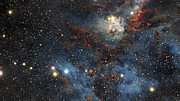
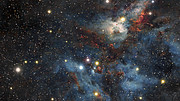
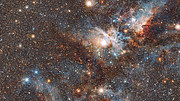
The Carina Nebula in infrared ligh
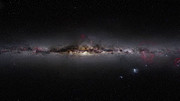
A wider view of the Carina Nebula

Digitized Sky Survey image of Eta Carinae Nebula

The Carina Nebula in the constellation of Carina


Videos
 
ESOcast 175 Light: Stars and Dust in the Carina Nebula (4K UHD)

3D view of the Carina Nebula

Zoom into the Carina Nebula

Pan across the Carina Nebula


VISTA gazes into one of the largest nebulae in the Milky Way in infrared

The Carina Nebula, one of the largest and brightest nebulae in the night sky, has been beautifully imaged by ESO’s VISTA telescope at the Paranal Observatory in Chile. By observing in infrared light, VISTA has peered through the hot gas and dark dust enshrouding the nebula to show us myriad stars, both newborn and in their death throes.

About 7500 light-years away, in the constellation of Carina, lies a nebula within which stars form and perish side-by-side. Shaped by these dramatic events, the Carina Nebula is a dynamic, evolving cloud of thinly spread interstellar gas and dust.

The massive stars in the interior of this cosmic bubble emit intense radiation that causes the surrounding gas to glow. By contrast, other regions of the nebula contain dark pillars of dust cloaking newborn stars. There’s a battle raging between stars and dust in the Carina Nebula, and the newly formed stars are winning — they produce high-energy radiation and stellar winds which evaporate and disperse the dusty stellar nurseries in which they formed.

Spanning over 300 light-years, the Carina Nebula is one of the Milky Way's largest star-forming regions and is easily visible to the unaided eye under dark skies. Unfortunately for those of us living in the north, it lies 60 degrees below the celestial equator, so is visible only from the Southern Hemisphere.

Within this intriguing nebula, Eta Carinae takes pride of place as the most peculiar star system. This stellar behemoth — a curious form of stellar binary— is the most energetic star system in this region and was one of the brightest objects in the sky in the 1830s. It has since faded dramatically and is reaching the end of its life, but remains one of the most massive and luminous star systems in the Milky Way.

Eta Carinae can be seen in this image as part of the bright patch of light just above the point of the “V” shape made by the dust clouds. Directly to the right of Eta Carinae is the relatively small Keyhole Nebula — a small, dense cloud of cold molecules and gas within the Carina Nebula — which hosts several massive stars, and whose appearance has also changed drastically over recent centuries.

The Carina Nebula was discovered from the Cape of Good Hope by Nicolas Louis de Lacaille in the 1750s and a huge number of images have been taken of it since then. But VISTA — the Visible and Infrared Survey Telescope for Astronomy — adds an unprecedentedly detailed view over a large area; its infrared vision is perfect for revealing the agglomerations of young stars hidden within the dusty material snaking through the Carina Nebula. In 2014, VISTA was used to pinpoint nearly five million individual sources of infrared light within this nebula, revealing the vast extent of this stellar breeding ground. VISTA is the world’s largest infrared telescope dedicated to surveys and its large mirror, wide field of view and exquisitely sensitive detectors enable astronomers [1] to unveil a completely new view of the southern sky.


Notes
[1] The Principal Investigator of the observing proposal which led to this spectacular image was Jim Emerson (School of Physics & Astronomy, Queen Mary University of London, UK). His collaborators were Simon Hodgkin and Mike Irwin (Cambridge Astronomical Survey Unit, Cambridge University, UK). The data reduction was performed by Mike Irwin and Jim Lewis (Cambridge Astronomical Survey Unit, Cambridge University, UK).


More Information

ESO is the foremost intergovernmental astronomy organisation in Europe and the world’s most productive ground-based astronomical observatory by far. It has 15 Member States: Austria, Belgium, the Czech Republic, Denmark, France, Finland, Germany, Italy, the Netherlands, Poland, Portugal, Spain, Sweden, Switzerland and the United Kingdom, along with the host state of Chile and with Australia as a strategic partner. ESO carries out an ambitious programme focused on the design, construction and operation of powerful ground-based observing facilities enabling astronomers to make important scientific discoveries. ESO also plays a leading role in promoting and organising cooperation in astronomical research. ESO operates three unique world-class observing sites in Chile: La Silla, Paranal and Chajnantor. At Paranal, ESO operates the Very Large Telescope and its world-leading Very Large Telescope Interferometer as well as two survey telescopes, VISTA working in the infrared and the visible-light VLT Survey Telescope. ESO is also a major partner in two facilities on Chajnantor, APEX and ALMA, the largest astronomical project in existence. And on Cerro Armazones, close to Paranal, ESO is building the 39-metre Extremely Large Telescope, the ELT, which will become “the world’s biggest eye on the sky”.


Links


Contacts

Jim Emerson
School of Physics & Astronomy, Queen Mary University of London
London, UK
Email: j.p.emerson@qmul.ac.uk

Calum Turner
Public Information Officer
Garching bei München, Germany
Tel: +49 89 3200 6670
Email: pio@eso.org


Source: ESO/News


Thursday, August 02, 2018

Astronomers Uncover New Clues to the Star that Wouldn’t Die

Credits: NASA, ESA, and A. Feild (STScI)

Credits: NASA, ESA, and G. Bacon (STScI)


What happens when a star behaves like it exploded, but it’s still there?

About 170 years ago, astronomers witnessed a major outburst by Eta Carinae, one of the brightest known stars in the Milky Way galaxy. The blast unleashed almost as much energy as a standard supernova explosion.

Yet Eta Carinae survived.

An explanation for the eruption has eluded astrophysicists. They can’t take a time machine back to the mid-1800s to observe the outburst with modern technology.

However, astronomers can use nature’s own “time machine,” courtesy of the fact that light travels at a finite speed through space. Rather than heading straight toward Earth, some of the light from the outburst rebounded or “echoed” off of interstellar dust, and is just now arriving at Earth. This effect is called a light echo. The light is behaving like a postcard that got lost in the mail and is only arriving 170 years later.

By performing modern astronomical forensics of the delayed light with ground-based telescopes, astronomers uncovered a surprise. The new measurements of the 1840s eruption reveal material expanding with record-breaking speeds up to 20 times faster than astronomers expected. The observed velocities are more like the fastest material ejected by the blast wave in a supernova explosion, rather than the relatively slow and gentle winds expected from massive stars before they die.

Based on this data, researchers suggest that the eruption may have been triggered by a prolonged stellar brawl among three rowdy sibling stars, which destroyed one star and left the other two in a binary system. This tussle may have culminated with a violent explosion when Eta Carinae devoured one of its two companions, rocketing more than 10 times the mass of our Sun into space. The ejected mass created gigantic bipolar lobes resembling the dumbbell shape seen in present-day images.

The results are reported in a pair of papers by a team led by Nathan Smith of the University of Arizona in Tucson, Arizona, and Armin Rest of the Space Telescope Science Institute in Baltimore, Maryland.

The light echoes were detected in visible-light images obtained since 2003 with moderate-sized telescopes at the Cerro Tololo Inter-American Observatory in Chile. Using larger Magellan telescopes at the Carnegie Institution for Science's Las Campanas Observatory and the Gemini South Observatory, both also located in Chile, the team then used spectroscopy to dissect the light, allowing them to measure theejecta’s expansion speeds. They clocked material zipping along at more than 20 million miles per hour (fast enough to travel from Earth to Pluto in a few days).

The observations offer new clues to the mystery surrounding the titanic convulsion that, at the time, made Eta Carinae the second-brightest nighttime star seen in the sky from Earth between 1837 and 1858. The data hint at how it may have come to be the most luminous and massive star in the Milky Way galaxy.

“We see these really high velocities in a star that seems to have had a powerful explosion, but somehow the star survived,” Smith explained. “The easiest way to do this is with a shock wave that exits the star and accelerates material to very high speeds.”

Massive stars normally meet their final demise in shock-driven events when their cores collapse to make a neutron star or black hole. Astronomers see this phenomenon in supernova explosions where the star is obliterated. So how do you have a star explode with a shock-driven event, but it isn’t enough to completely blow itself apart? Some violent event must have dumped just the right amount of energy onto the star, causing it to eject its outer layers. But the energy wasn’t enough to completely annihilate the star.

One possibility for just such an event is a merger between two stars, but it has been hard to find a scenario that could work and match all the data on Eta Carinae.

The researchers suggest that the most straightforward way to explain a wide range of observed facts surrounding the eruption is with an interaction of three stars, where the objects exchange mass.
If that’s the case, then the present-day remnant binary system must have started out as a triple system. “The reason why we suggest that members of a crazy triple system interact with each other is because this is the best explanation for how the present-day companion quickly lost its outer layers before its more massive sibling,” Smith said.

In the team’s proposed scenario, two hefty stars are orbiting closely and a third companion is orbiting farther away. When the most massive of the close binary stars nears the end of its life, it begins to expand and dumps most of its material onto its slightly smaller sibling.

The sibling has now bulked up to about 100 times the mass of our Sun and is extremely bright. The donor star, now only about 30 solar masses, has been stripped of its hydrogen layers, exposing its hot helium core.

Hot helium core stars are known to represent an advanced stage of evolution in the lives of massive stars. “From stellar evolution, there’s a pretty firm understanding that more massive stars live their lives more quickly and less massive stars have longer lifetimes,” Rest explained. “So the hot companion star seems to be further along in its evolution, even though it is now a much less massive star than the one it is orbiting. That doesn’t make sense without a transfer of mass.”

The mass transfer alters the gravitational balance of the system, and the helium-core star moves farther away from its monster sibling. The star travels so far away that it gravitationally interacts with the outermost third star, kicking it inward. After making a few close passes, the star merges with its heavyweight partner, producing an outflow of material.

In the merger’s initial stages, the ejecta is dense and expanding relatively slowly as the two stars spiral closer and closer. Later, an explosive event occurs when the two inner stars finally join together, blasting off material moving 100 times faster. This material eventually catches up with the slow ejecta and rams into it like a snowplow, heating the material and making it glow. This glowing material is the light source of the main historical eruption seen by astronomers a century and a half ago.

Meanwhile, the smaller helium-core star settles into an elliptical orbit, passing through the giant star’s outer layers every 5.5 years. This interaction generates X-ray emitting shock waves.
A better understanding of the physics of Eta Carinae’s eruption may help to shed light on the complicated interactions of binary and multiple stars, which are critical for understanding the evolution and death of massive stars.

The Eta Carinae system resides 7,500 light-years away inside the Carina nebula, a vast star-forming region seen in the southern sky.

The team published its findings in two papers, which appear online Aug. 2 in The Monthly Notices of the Royal Astronomical Society.

The Hubble Space Telescope is a project of international cooperation between NASA and ESA (European Space Agency). NASA's Goddard Space Flight Center in Greenbelt, Maryland, manages the telescope. The Space Telescope Science Institute (STScI) in Baltimore, Maryland, conducts Hubble science operations. STScI is operated for NASA by the Association of Universities for Research in Astronomy in Washington, D.C.


Credits:

Illustration: NASA, ESA, and A. Feild (STScI)
Science: NSF and AURA


Related Links

This site is not responsible for content found on external links


Contacts

Donna Weaver / Ray Villard
Space Telescope Science Institute, Baltimore, Maryland
410-338-4493 / 410-338-4514

dweaver@stsci.edu / villard@stsci.edu

Nathan Smith
University of Arizona, Tucson
520-621-4513

nathans@as.arizona.edu

Armin Rest
Space Telescope Science Institute, Baltimore, Maryland
410-338-4358

arest@stsci.edu

 Souce: HubbleSite/News


Wednesday, July 04, 2018

NASA's NuSTAR Mission Proves Superstar Eta Carinae Shoots Cosmic Rays

Eta Carinae's great eruption in the 1840s created the billowing Homunculus Nebula, imaged here by Hubble. Now about a light-year long, the expanding cloud contains enough material to make at least 10 copies of our Sun. Astronomers cannot yet explain what caused this eruption. Credit: NASA, ESA, and the Hubble SM4 ERO Team. Hi res image

A new study using data from NASA’s NuSTAR space telescope suggests that Eta Carinae, the most luminous and massive stellar system within 10,000 light-years, is accelerating particles to high energies — some of which may reach Earth as cosmic rays.

“We know the blast waves of exploded stars can accelerate cosmic ray particles to speeds comparable to that of light, an incredible energy boost,” said Kenji Hamaguchi, an astrophysicist at NASA’s Goddard Space Flight Center in Greenbelt, Maryland, and the lead author of the study. “Similar processes must occur in other extreme environments. Our analysis indicates Eta Carinae is one of them.”

Astronomers know that cosmic rays with energies greater than 1 billion electron volts (eV) come to us from beyond our solar system. But because these particles — electrons, protons and atomic nuclei — all carry an electrical charge, they veer off course whenever they encounter magnetic fields. This scrambles their paths and masks their origins.


Zoom into Eta Carinae, where the outflows of two massive stars collide and shoot accelerated particles — cosmic rays — into space. Credits: NASA's Goddard Space Flight Center. Download this video in HD formats from NASA Goddard's Scientific Visualization Studio

Eta Carinae, located about 7,500 light-years away in the southern constellation of Carina, is famous for a 19th century outburst that briefly made it the second-brightest star in the sky. This event also ejected a massive hourglass-shaped nebula, but the cause of the eruption remains poorly understood.
The system contains a pair of massive stars whose eccentric orbits bring them unusually close every 5.5 years. The stars contain 90 and 30 times the mass of our Sun and pass 140 million miles (225 million kilometers) apart at their closest approach — about the average distance separating Mars and the Sun.

“Both of Eta Carinae’s stars drive powerful outflows called stellar winds,” said team member Michael Corcoran, also at Goddard. “Where these winds clash changes during the orbital cycle, which produces a periodic signal in low-energy X-rays we’ve been tracking for more than two decades.”

NASA’s Fermi Gamma-ray Space Telescope also observes a change in gamma rays — light packing far more energy than X-rays — from a source in the direction of Eta Carinae. But Fermi’s vision isn’t as sharp as X-ray telescopes, so astronomers couldn’t confirm the connection.

Eta Carinae shines in X-rays in this image from NASA's Chandra X-ray Observatory. The colors indicate different energies. Red spans 300 to 1,000 electron volts (eV), green ranges from 1,000 to 3,000 eV and blue covers 3,000 to 10,000 eV. For comparison, the energy of visible light is about 2 to 3 eV. NuSTAR observations (green contours) reveal a source of X-rays with energies some three times higher than Chandra detects. X-rays seen from the central point source arise from the binary’s stellar wind collision. The NuSTAR detection shows that shock waves in the wind collision zone accelerate charged particles like electrons and protons to near the speed of light. Some of these may reach Earth, where they will be detected as cosmic ray particles. X-rays scattered by debris ejected in Eta Carinae's famous 1840 eruption may produce the broader red emission. Credits: NASA/CXC and NASA/JPL-Caltech. Hi-res image


To bridge the gap between low-energy X-ray monitoring and Fermi observations, Hamaguchi and his colleagues turned to NuSTAR. Launched in 2012, NuSTAR can focus X-rays of much greater energy than any previous telescope. Using both newly taken and archival data, the team examined NuSTAR observations acquired between March 2014 and June 2016, along with lower-energy X-ray observations from the European Space Agency’s XMM-Newton satellite over the same period.

Eta Carinae’s low-energy, or soft, X-rays come from gas at the interface of the colliding stellar winds, where temperatures exceed 70 million degrees Fahrenheit (40 million degrees Celsius). But NuSTAR detects a source emitting X-rays above 30,000 eV, some three times higher than can be explained by shock waves in the colliding winds. For comparison, the energy of visible light ranges from about 2 to 3 eV.

The team’s analysis, presented in a paper published on Monday, July 2, in Nature Astronomy, shows that these “hard” X-rays vary with the binary orbital period and show a similar pattern of energy output as the gamma rays observed by Fermi.

The researchers say that the best explanation for both the hard X-ray and the gamma-ray emission is electrons accelerated in violent shock waves along the boundary of the colliding stellar winds. The X-rays detected by NuSTAR and the gamma rays detected by Fermi arise from starlight given a huge energy boost by interactions with these electrons.

Some of the superfast electrons, as well as other accelerated particles, must escape the system and perhaps some eventually wander to Earth, where they may be detected as cosmic rays.

“We’ve known for some time that the region around Eta Carinae is the source of energetic emission in high-energy X-rays and gamma rays”, said Fiona Harrison, the principal investigator of NuSTAR and a professor of astronomy at Caltech in Pasadena, California. “But until NuSTAR was able to pinpoint the radiation, show it comes from the binary and study its properties in detail, the origin was mysterious.”

NuSTAR is a Small Explorer mission led by Caltech and managed by JPL for NASA's Science Mission Directorate in Washington. NuSTAR was developed in partnership with the Danish Technical University and the Italian Space Agency (ASI). The spacecraft was built by Orbital Sciences Corp., Dulles, Virginia. NuSTAR's mission operations center is at UC Berkeley, and the official data archive is at NASA's High Energy Astrophysics Science Archive Research Center. ASI provides the mission's ground station and a mirror archive. Caltech manages JPL for NASA.

For more information on NuSTAR, visit:  https://www.nasa.gov/nustar  - http://www.nustar.caltech.edu


By Francis Reddy
NASA's Goddard Space Flight Center, Greenbelt, Md.

Editor: Rob Garner

Source: NASA/NuSTAR