Wednesday, July 09, 2025

Supernova’s ‘Trapped’ Jet Reveals Source of Fast X-ray Transient

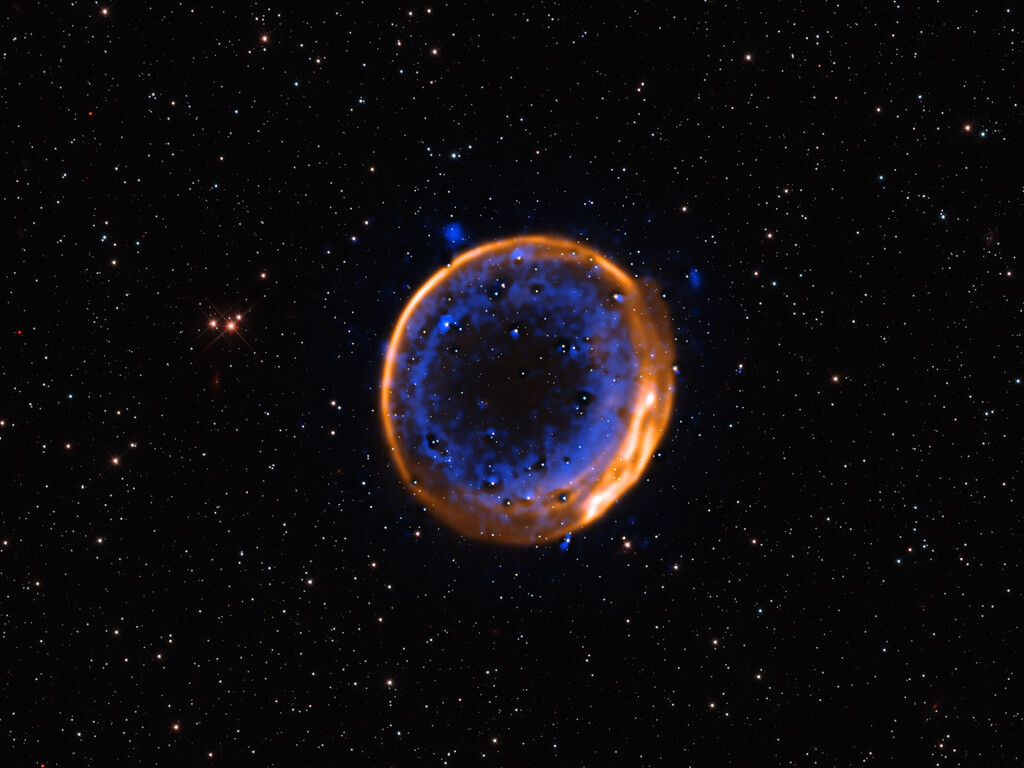
This image shows the cosmic field in which the fast X-ray transient EP 250108a, and the supernova that followed it, were detected by Einstein Probe (EP) in early 2025. Using a combination of telescopes, including the W. M. Keck Observatory, a team of astronomers studied the evolving signal of EP 250108a/SN 2025kg to uncover details about its origin. Their analysis reveals that fast X-ray transients can result from the ‘failed’ explosive death of a massive star. Credit: International Gemini Observatory/NOIRLab/NSF/AURA.


Maunakea, Hawaiʻi – An international team of astrophysicists using W. M. Keck Observatory on Maunakea, Hawaiʻi Island have uncovered a possible origin of fast X-ray transients (FXTs) — mysterious, fleeting bursts of X-rays that have long puzzled astronomers.

Using a combination of telescopes around the globe and in space, the team studied the closest FXT associated with the explosive death of a massive star, or supernova, ever observed. A geyser of high-energy particles, or jet, trapped inside a supernova produced the FXT, the scientists discovered.

When jets burst through a massive star’s onion-like layers, they generate gamma-ray bursts (GRBs), the most powerful and luminous explosions in the universe. When the jets are stifled, however, they emit lower levels of energy, which astronomers can detect only from X-ray signals. The new observations now point to these “failed” jets as a source of the emission, explaining the historically elusive phenomena.

This finding marks a significant step in understanding the diverse landscape of cosmic explosions — bridging the gap among FXTs, GRBs and supernovae.

A pair of studies, led by Northwestern University and the University of Leicester in England, has been accepted by The Astrophysical Journal Letters.

“Since the 1970s, astronomers have detected FXTs — blasts of X-rays from distant galaxies that can last from seconds to hours,” said Northwestern’s Jillian Rastinejad, lead author of one of the studies. “But their origin sources have remained a long-standing mystery. Our work definitively shows that FXTs can originate from the explosive death of a massive star. It also supports a causal link between GRB-supernovae and FXT-supernovae, in which GRBs are produced by successful jets, and FXTs are produced by trapped weak jets.”

The team utilized the various time zones and locations of its members to gather and analyze the data, passing it along to the next time zone to make decisions on the next night of observations.

“The result? A massive and beautiful stream of data collected from facilities large and small, on the ground and in space, chronicling this event’s first month. It takes really special events to motivate such a global effort, and this FXT was one,” said Northwestern’s Wen-fai Fong, a senior author on the study.

This sequence of images shows the fading light of the supernova SN 2025kg, which followed the fast X-ray transient EP 250108a, a powerful blast of X-rays that was detected by Einstein Probe (EP) in early 2025. Using a combination of telescopes, including the W. M. Keck Observatory, a team of astronomers studied the evolving signal of EP 250108a/SN 2025kg to uncover details about its origin. Their analysis reveals that fast X-ray transients can result from the ‘failed’ explosive death of a massive star. Credit: International Gemini Observatory/NOIRLab/NSF/AURA.

Spectroscopy obtained from Keck Observatory’s Low-Resolution Imaging Spectrometer (LRIS) revealed that SN 2025kg is a Type Ic-BL supernova—an especially fast and powerful kind of stellar explosion. By analyzing the light, scientists measured how quickly the star’s material was ejected (nearly 19,000 kilometers per second or about 11,800 miles per second) and gained insight into the immense energy released during the blast.

“The fact that Keck Observatory was able to respond quickly to a transient of interest was pivotal to understanding the composition and speed of the supernova ejecta, and how much material was shed,” said Fong. “Its nimble capabilities were particularly important at later times when the source was fainter and only detectable with the most sensitive ground-based spectrographs.”

“This result highlights the important role Keck Observatory plays with observatories across the globe and in space,” added John O’Meara, chief scientist and deputy director at the observatory. “The international team has really pulled out all the stops to characterize and understand this new type of transient.”

“The fact that Keck Observatory was able to respond quickly to a transient of interest was pivotal to understanding the composition and speed of the supernova ejecta, and how much material was shed,” said Fong. “Its nimble capabilities were particularly important at later times when the source was fainter and only detectable with the most sensitive ground-based spectrographs.”

“This result highlights the important role Keck Observatory plays with observatories across the globe and in space,” added John O’Meara, chief scientist and deputy director at the observatory. “The international team has really pulled out all the stops to characterize and understand this new type of transient.”

An explosive neighbor

Although astronomers have detected FXTs for decades, the limited number of discoveries prevented detailed studies. But now, scientists have a new space-based tool, called the Einstein Probe, which is dedicated to the search. Launched in January 2024 by the Chinese Academy of Sciences in partnership with the European Space Agency and the Max Planck Institute for Extraterrestrial Physics, the Einstein Probe carries two scientific instruments, specially designed to observe X-ray sources.

“FXTs have long fascinated us but their study has relied on a small number of events that were discovered in serendipitous ways,” Fong said. “The Einstein Probe has revolutionized this field by increasing the number of known events by ten-fold in just a year of operations. Thus, it is not only filling in the previously sparse landscape of FXTs, but also making our picture of that landscape crisper, bringing facets of these explosions into focus that we had not imagined before.

Shortly after its launch, the Einstein Probe captured the most nearby FXT, associated with a supernova, to date. Dubbed EP 250108a, the FXT was located 2.8 billion light-years away from Earth, within the river-like constellation Eridanus. Its close proximity to Earth gave astronomers an unprecedented opportunity to observe the event’s evolution.

To track this evolving behavior, the team captured the event’s signal across multiple wavelengths. The Gemini South telescope at the International Gemini Observatory provided near-infrared data, the Gemini North telescope atop Maunakea provided optical data, the MMT Observatory in Arizona provided the infrared images, and the James Webb Space Telescope provided highly sensitive infrared data.

Failed jet, big breakthrough

By analyzing the rapidly evolving signal of EP 250108a, the scientists concluded the object is likely a “failed” GRB. Although EP 250108a is similar to a jet-driven explosion, its jets did not break through the outer layer of the dying star. Instead, the jets remained trapped inside.

“Through decades of scientific study, we know that jets can successfully plow through a dying star’s outer layers, and we view them as GRBs,” Rastinejad said. “In our study, we found this ‘trapped’ jet outcome is more common in massive star explosions than jets that successfully emerge from the star.”

The researchers now plan to use datasets provided by the Vera C. Rubin Observatory that will show how stars and their explosive deaths change over time. These insights could help reveal the inner workings of FXTs and many other exotic cosmic events.

Related Links:


Tuesday, July 08, 2025

The birth of a solar system revealed by planet 'pebbles'

An artist’s impression of dust and tiny grains in a protoplanetary disc surrounding a young star (left) alongside an e-MERLIN map showing the tilted disc structure around the young star DG Tauri (top right) and the HL Tau disc captured by e-MERLIN is shown overlaid on an ALMA image, revealing both the compact emission from the central region of the disc and the larger scale dust rings (bottom right). Credit: NASA/JPL-Caltech/Hesterly, Drabek-Maunder, Greaves, Richards, et al./Greaves, Hesterly, Richards, and et al./ALMA partnership et al.
Licence type: Attribution (CC BY 4.0)

An e-MERLIN map showing the tilted disc structure around the young star DG Tauri where pebble-sized clumps are beginning to form. Its long axis is southeast to northwest (lower left to upper right). Emission from an outflow of material from the central star is also seen in the northeast and southwest directions. Credit: Hesterly, Drabek-Maunder, Greaves, Richards, et al.
Licence type: Attribution (CC BY 4.0)

The HL Tau disc captured by e-MERLIN is shown overlaid on an ALMA image, revealing both the compact emission from the central region of the disc and the larger scale dust rings. Credit: Greaves, Hesterly, Richards, and et al./ALMA partnership et al.
Licence type: Attribution (CC BY 4.0)

An artist’s impression of dust and tiny grains in a protoplanetary disc surrounding a young star. Credit: NASA/JPL-Caltech
Licence type: Attribution (CC BY 4.0)

e‑MERLIN is an interferometer array of seven radio telescopes spanning 217 km (135 miles) across the UK, connected by a superfast optical fibre network to its headquarters at Jodrell Bank. Observatory in Cheshire. Credit: e‑MERLIN
Licence type: Attribution (CC BY 4.0)


A fascinating glimpse into how a solar system like our own is born has been revealed with the detection of planet-forming 'pebbles' around two young stars.

These seeds to make new worlds are thought to gradually clump together over time, in much the same way Jupiter was first created 4.5 billion years ago, followed by Saturn, Uranus, Neptune, Mercury, Venus, Earth and Mars.
The planet-forming discs, known as protoplanetary discs, were spotted out to at least Neptune-like orbits around the young stars DG Tau and HL Tau, both around 450 light-years from Earth.

The new observations, revealed at the Royal Astronomical Society’s National Astronomy Meeting 2025 in Durham, are helping to fill in a missing piece of the planet formation puzzle.

"These observations show that discs like DG Tau and HL Tau already contain large reservoirs of planet-forming pebbles out to at least Neptune-like orbits," said researcher Dr Katie Hesterly, of the SKA Observatory.

"This is potentially enough to build planetary systems larger than our own solar system."

The latest research is part of the PEBBLeS project (Planet Earth Building-Blocks – a Legacy eMERLIN Survey), led by Professor Jane Greaves, of Cardiff University.

By imaging the rocky belts of many stars, the team are looking for clues to how often planets form, and where, around stars that will evolve into future suns like our own.

The survey uses e‑MERLIN, an interferometer array of seven radio telescopes spanning 217 km (135 miles) across the UK and connected by a superfast optical fibre network to its headquarters at Jodrell Bank Observatory in Cheshire.

It is currently the only radio telescope able to study protoplanetary discs – the cosmic nurseries where planets are formed – at the required resolution and sensitivity for this science.

"Through these observations, we’re now able to investigate where solid material gathers in these discs, providing insight into one of the earliest stages of planet formation," said Professor Greaves.

Since the 1990s, astronomers have found both disks of gas and dust, and nearly 2,000 fully-formed planets, but the intermediate stages of formation are harder to detect. 

"Decades ago, young stars were found to be surrounded by orbiting discs of gas and tiny grains like dust or sand," said Dr Anita Richards, of the Jodrell Bank Centre for Astrophysics at the University of Manchester, who has also been involved in the research.

"Enough grains to make Jupiter could be spread over roughly the same area as the entire orbit of Jupiter, making this easy to detect with optical and infra-red telescopes, or the ALMA submillimeter radio interferometer.

"But as the grains clump together to make planets, the surface area of a given mass gets smaller and harder to see."

For that reason, because centimetre-sized pebbles emit best at wavelengths similar to their size, the UK interferometer e-MERLIN is ideal to look for these because it can observe at around 4 cm wavelength.

In one new e‑MERLIN image of DG Tau’s disc, it reveals that centimetre-sized pebbles have already formed out to Neptune-like orbits, while a similar collection of planetary seeds has also been detected encircling HL Tau.

These discoveries offer an early glimpse of what the Square Kilometre Array (SKA) telescopes in South Africa and Australia will uncover in the coming decade with its improved sensitivity and scale, paving the way to study protoplanetary discs across the galaxy in unprecedented detail.

"e-MERLIN is showing what’s possible, and the SKA telescopes will take it further," said Dr Hesterly.

"When science verification with the SKA-Mid telescope begins in 2031, we’ll be ready to study hundreds of planetary systems to help understand how planets are formed."


Media contacts:

Sam Tonkin
Royal Astronomical Society
Mob: +44 (0)7802 877 700

press@ras.ac.uk

Dr Robert Massey
Royal Astronomical Society
Mob: +44 (0)7802 877 699

press@ras.ac.uk

Megan Eaves
Royal Astronomical Society

press@ras.ac.uk


Science contacts:

Dr Katie Hesterly
SKA Observatory

katie.hesterly@skao.int

Professor Jane Greaves
Cardiff University

greavesj1@cardiff.ac.uk

Dr Anita Richards
Jodrell Bank Centre for Astrophysics at the University of Manchester

a.m.s.richards@manchester.ac.uk


Further information

The talk 'PEBBLeS in Protoplanetary Discs' will take place at NAM at 09:00 BST on Monday 7 July 2025 in room TLC033. Find out more at: https://conference.astro.dur.ac.uk/event/7/contributions/867/

PEBBLES is an ultra-deep continuum survey of the circumstellar disks that are predicted to be the most conducive to planet formation. Imaging the thermal emission from pebble-sized dust grains shows where and when planet-core growth is proceeding, helping to identify actual accreting proto-planets. The survey sample comprises a mass-limited cut from all known northern disks with long-millimetre wavelength dust emission, above a threshold of 2.5 times the minimum-mass Solar-nebula, at the theoretical boundary for forming the Sun's planets.

The survey results will show how planet growth proceeds - where, when, and with what outcomes - for comparison to inferred histories of the Sun and extrasolar planetary systems. The scientific legacy will also include measuring quantities vital to theoretical progress - particle sizes, disk surface densities and radial distributions, for the first time on few-AU scales - and providing a database of proto-planet targets for future followup with EVLA, ALMA and SKA.


Notes for editors

The NAM 2025 conference is principally sponsored by the Royal Astronomical Society and Durham University.

About the Royal Astronomical Society

The Royal Astronomical Society (RAS), founded in 1820, encourages and promotes the study of astronomy, solar-system science, geophysics and closely related branches of science.

The RAS organises scientific meetings, publishes international research and review journals, recognises outstanding achievements by the award of medals and prizes, maintains an extensive library, supports education through grants and outreach activities and represents UK astronomy nationally and internationally. Its more than 4,000 members (Fellows), a third based overseas, include scientific researchers in universities, observatories and laboratories as well as historians of astronomy and others.

The RAS accepts papers for its journals based on the principle of peer review, in which fellow experts on the editorial boards accept the paper as worth considering. The Society issues press releases based on a similar principle, but the organisations and scientists concerned have overall responsibility for their content.


Keep up with the RAS on Instagram, Bluesky, LinkedInFacebook and YouTube.

Download the RAS Supermassive podcast

About the Science and Technology Facilities Council

The Science and Technology Facilities Council (STFC), part of UK Research and Innovation (UKRI), is the UK’s largest public funder of research into astronomy and astrophysics, particle and nuclear physics, and space science. We operate five national laboratories across the UK which, supported by a network of additional research facilities, increase our understanding of the world around us and develop innovative technologies in response to pressing scientific and societal issues. We also facilitate UK involvement in a number of international research activities including the ELT, CERN, the James Webb Space Telescope and the Square Kilometre Array Observatory.

linkedin.com/company/stfc

ukri.org/councils/stfc

About Durham University

Durham University is a globally outstanding centre of teaching and research based in historic Durham City in the UK. 

We are a collegiate university committed to inspiring our people to do outstanding things at Durham and in the world.

We conduct research that improves lives globally and we are ranked as a world top 100 university with an international reputation in research and education (QS World University Rankings 2026).

We are a member of the Russell Group of leading research-intensive UK universities and we are consistently ranked as a top five university in national league tables (Times and Sunday Times Good University Guide and The Complete University Guide).

For more information about Durham University visit:
www.durham.ac.uk/about/

Submitted by Sam Tonkin


Monday, July 07, 2025

Portrait of a galaxy cluster

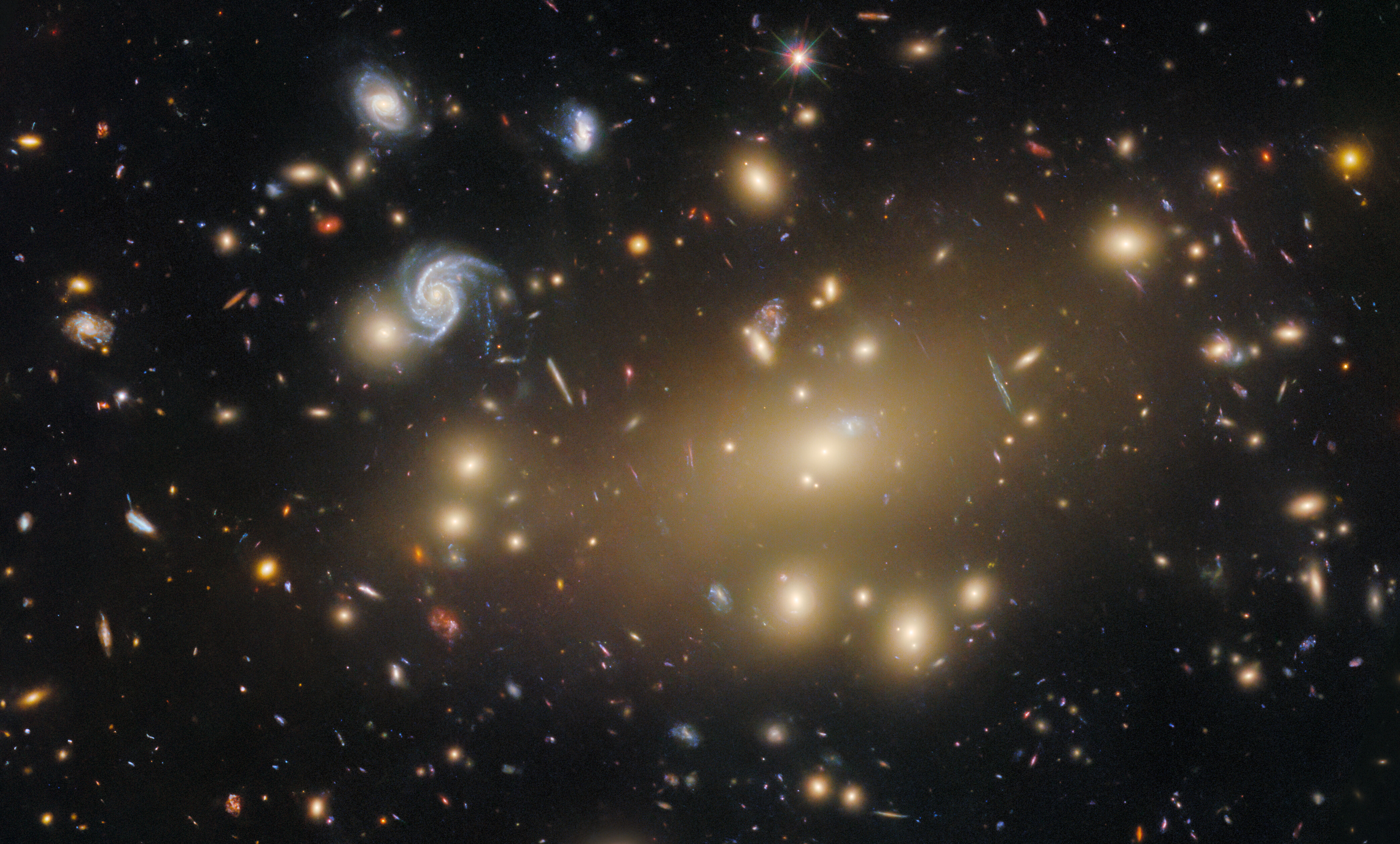
A cluster of distant, mainly elliptical galaxies. They appear as brightly shining points radiating golden light that each take the shape of a smooth, featureless oval. They crowd around one that is extremely large and bright. A few spiral galaxies of comparable size appear too, bluer in colour and with unique shapes. Of the other, more small and distant galaxies covering the scene, a few are warped into long lines. Credit: ESA/Hubble & NASA, M. Postman, P. Kelly

A massive, spacetime-warping cluster of galaxies is the setting of today’s NASA/ESA Hubble Space Telescope Picture of the Week. The galaxy cluster in question is Abell 209, which is located 2.8 billion light-years away in the constellation Cetus (The Whale).

This Hubble image of Abell 209 shows more than a hundred galaxies, but there’s more to this cluster than even Hubble’s discerning eye can see. Abell 209’s galaxies are separated by millions of light-years, and the seemingly empty space between the galaxies is actually filled with hot, diffuse gas that can be spotted only at X-ray wavelengths. An even more elusive occupant of this galaxy cluster is dark matter: a form of matter that does not interact with light. The Universe is understood to be comprised of 5% normal matter, 25% dark matter, and 70% dark energy

Hubble observations like the ones used to create this image can help astronomers answer fundamental questions about our Universe, including mysteries surrounding dark matter and dark energy. These investigations leverage the immense mass of a galaxy cluster, which can bend the fabric of spacetime itself and create warped and magnified images of background galaxies and stars in a process called gravitational lensing.

While this image lacks the dramatic rings that gravitational lensing can sometimes create, Abell 209 still shows subtle signs of lensing at work, in the form of streaky, slightly curved galaxies within the cluster’s golden glow. By measuring the distortion of these galaxies, astronomers can map the distribution of mass within the cluster, illuminating the underlying cloud of dark matter. This information, which Hubble’s fine resolution and sensitive instruments help to provide, is critical for testing theories of how our Universe has evolved.


The young stars of Taurus

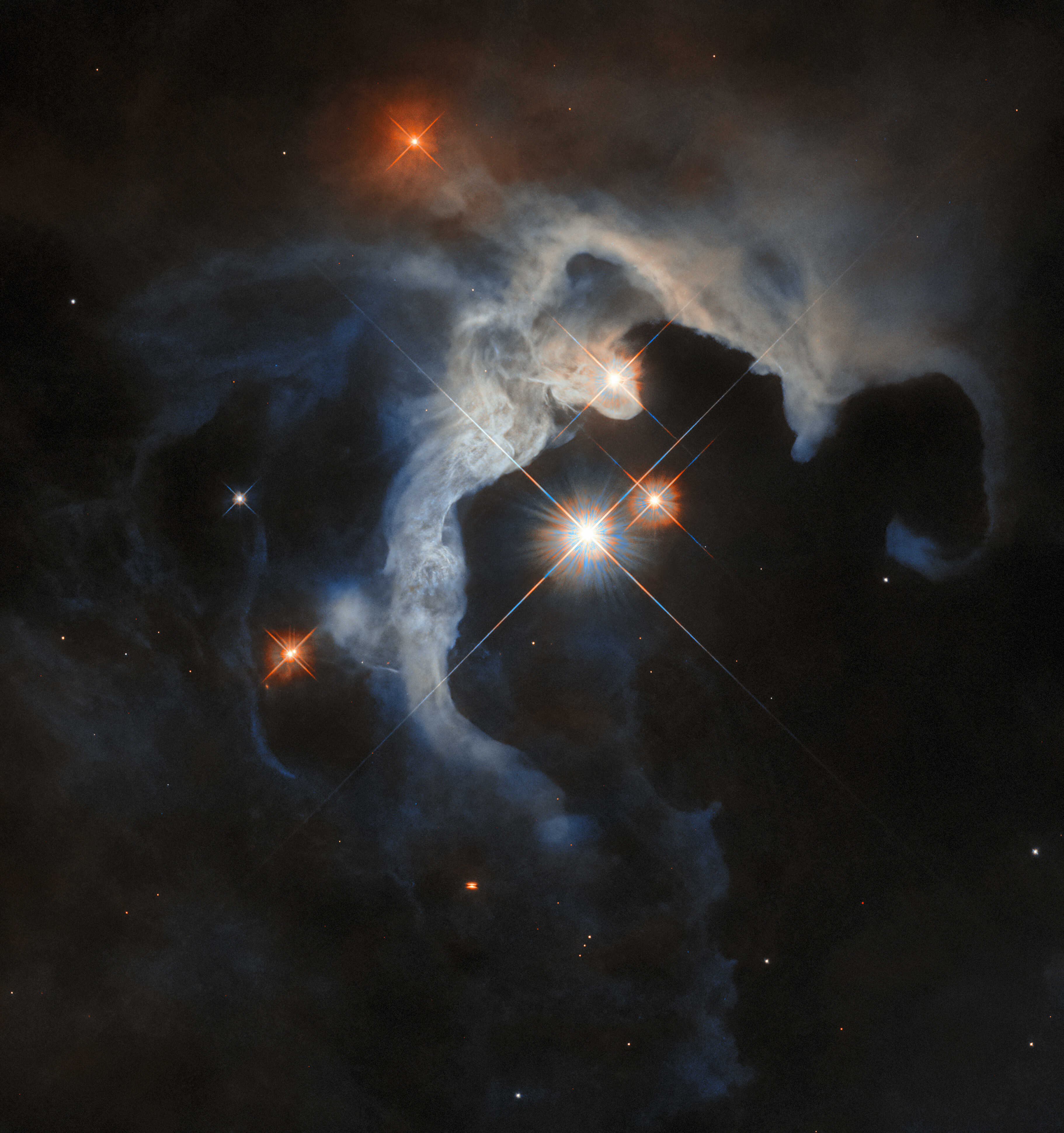
A long, smoky, greyish-blue cloud in the centre of the image curves in an arc around three bright stars, each with long cross-shaped diffraction spikes. The cloud is lit more brightly on the inner side facing the stars, and fades into the dark background on the outer side. A few other stars and points of light surround the cloud: one small star below it has a dark band crossing its centre. Credit: ESA/Hubble & NASA, G. Duchêne

The subject of this week's Hubble Picture of the Week is a reflection nebula, identified as GN 04.32.8. Reflection nebulae are clouds of dust in space that don't emit their own light, as other nebulae do. Instead, the light from nearby stars hits and scatters off their dust, lighting them up. Because of the way the light scatters, many reflection nebulae tend to appear blue, GN 04.32.8 included.

GN 04.32.8 is a small part of the stellar nursery known as the Taurus Molecular Cloud. At only roughly 480 light-years from Earth in the constellation Taurus, it's one of the best locations for studying newly forming stars. This reflection nebula is illuminated by the system of three bright stars in the centre of this image, mainly the variable star V1025 Tauri in the very centre. One of those stars overlaps with part of the nebula: this is another variable star that is named HP Tauri, but is classified as a T Tauri star, for its similarity to yet another variable star elsewhere in the Taurus Molecular Complex. T Tauri stars are very active, chaotic stars at an early stage of their evolution, so it's no surprise that they appear in a prolific stellar nursery like this one! The three stars are also named HP Tau, HP Tau G2 and HP Tau G3; they’re believed to be gravitationally bound to each other, forming a triple system.

Eagle-eyed viewers might notice the small, squashed, orange spot, just left of centre below the clouds of the nebula, that’s crossed by a dark line. This is a newly-formed protostar, hidden in a protoplanetary disc that obstructs some of its light. Because the disc is edge-on to us, it’s an ideal candidate for study. Astronomers are using Hubble here to examine it closely, seeking to learn about the kinds of exoplanets that might be formed in discs like it.

Link


Sunday, July 06, 2025

Citizen Science Born in the Pandemic: The Hubble Image Similarity Project

A handful of images used in the Hubble Image Similarity Project
Adapted from White & Peek 2025

Motivated by a desire to support community members financially during the coronavirus pandemic, researchers employed 30 local citizen scientists in the Hubble Image Similarity Project. This project quantified the similarities between astronomical images, providing a way to test the results of image-search algorithms.

The Eagle Nebula, pictured here in an image from Kitt Peak National Observatory, is a star-forming region in the Milky Way. Credit:
  T.A.Rector (NRAO/AUI/NSF and NOIRLab/NSF/AURA) and B.A.Wolpa Credit: NOIRLab/NSF/AURA); CC BY 4.0

Seeking Similarities

Say you have an image of a star-forming region, featuring eye-catching gas clouds, dense and dusty knots, and newborn stars. How would you go about finding other images that resemble yours?

You might start your search with an astronomical image database, using filters for object type or instrument to sift through thousands and thousands of options. But even filtering out everything but star-forming regions might yield vastly different results, given the widely varying shapes, colors, and sizes of these regions.

Or maybe you’ll feed your image into a neural network that has been trained to spot similar images. The results may seem promising, but how can you tell whether the algorithm has found the images that are the most similar? Would another algorithm do better?

An example of individual test images (green squares) extracted from a Hubble Legacy Archive image (red square). Low-contrast areas have been excluded, leaving the galaxy’s spiral arms for analysis. Credit: White & Peek 2025

The Hubble Image Similarity Project

Astronomical image collections rarely contain information about similarities between images in their metadata, and while neural networks appear to excel at gathering similar images, the results of these models are generally unverified. The Hubble Image Similarity Project, led by Richard White (Space Telescope Science Institute) and Josh Peek (Space Telescope Science Institute and Johns Hopkins University), addressed these issues with a team of citizen scientists who generated similarity information for astronomical images, providing a quantitative means to test the results of neural networks.

White and Peek began by amassing a sample of images from the Hubble Legacy Archive. This sample included many different object types, such as galaxies, planetary nebulae, star-forming regions, and star clusters. After trimming and binning the images, converting them to 8-bit grayscale, filtering out low-contrast images, and eliminating satellite trails, image artifacts, and repeated observations of the same patch of sky, 2,098 images of 666 objects remained.

Examples of similar images according to the image similarity matrix. In the lower-right corner is a visualization of the similarity data. The semicircle of data points in the bottom half of this visualization represents galaxies, while star clusters occupy the small arc near the top and nebulae sit in the island in the center of the plot. Credit: Adapted from White & Peek 2025

Citizen Scientists, Assemble

White and Peek recruited 30 members of the community within walking distance of the Space Telescope Science Institute to identify similar astronomical images, and the reviewers were paid for their work. In the three phases of the project, reviewers considered test images one at a time and 1) selected all similar images from a set of 15 comparison images, 2) selected the most similar image from a narrowed-down set of 6 comparison images, and finally 3) selected the most similar image from a set of 3 comparison images.

The citizen science team ultimately compared 5.4 million pairs of images, and White and Peek used these comparisons to produce an image similarity matrix. The matrix describes the metaphorical “distance” between the images, with the most similar images being the smallest distance apart.

Similar images resemble one another in terms of structure, texture, and other factors that White and Peek say are “difficult even to describe in words” — for example, the diffuse glow of a galaxy interrupted by a bright star with diffraction spikes, or a nebula speckled with stars and dense dusty clumps. The similarity data from this study are available online and can be used to test the performance of image-search algorithms. In future work, the authors plan to carry out a similar project using images of the Martian landscape.

By
Kerry Hensley

Citation

“The Hubble Image Similarity Project,” Richard L. White and J. E. G. Peek 2025 AJ 169 306.
doi:10.3847/1538-3881/adcb43


Saturday, July 05, 2025

Double detonation: new image shows remains of star destroyed by pair of explosions

PR Image eso2511a
VLT image of a double-detonation supernova

PR Image eso2511b
Distribution of calcium around the supernova remnant SNR 0509-67.5

PR Image eso2511c
Artist’s impression of a double-detonation supernova

PR Image eso2511d
Location of the supernova remnant SNR 0509-67.5


Videos

First visual proof of a star destroyed by pair of explosions | ESO News
PR Video eso2511a
First visual proof of a star destroyed by pair of explosions | ESO News

Zooming into a star that detonated twice
PR Video eso2511b
Zooming into a star that detonated twice

Animation of a double-detonation supernova
PR Video eso2511c
Animation of a double-detonation supernova


For the first time, astronomers have obtained visual evidence that a star met its end by detonating twice. By studying the centuries-old remains of supernova SNR 0509-67.5 with the European Southern Observatory’s Very Large Telescope (ESO’s VLT), they have found patterns that confirm its star suffered a pair of explosive blasts. Published today, this discovery shows some of the most important explosions in the Universe in a new light.

Most supernovae are the explosive deaths of massive stars, but one important variety comes from an unassuming source. White dwarfs, the small, inactive cores left over after stars like our Sun burn out their nuclear fuel, can produce what astronomers call a Type Ia supernova.

"The explosions of white dwarfs play a crucial role in astronomy,” says Priyam Das, a PhD student at the University of New South Wales Canberra, Australia, who led the study on SNR 0509-67.5 published today in Nature Astronomy. Much of our knowledge of how the Universe expands rests on Type Ia supernovae, and they are also the primary source of iron on our planet, including the iron in our blood. “Yet, despite their importance, the long-standing puzzle of the exact mechanism triggering their explosion remains unsolved," he adds.

All models that explain Type Ia supernovae begin with a white dwarf in a pair of stars. If it orbits close enough to the other star in this pair, the dwarf can steal material from its partner. In the most established theory behind Type Ia supernovae, the white dwarf accumulates matter from its companion until it reaches a critical mass, at which point it undergoes a single explosion. However, recent studies have hinted that at least some Type Ia supernovae could be better explained by a double explosion triggered before the star reached this critical mass.

Now, astronomers have captured a new image that proves their hunch was right: at least some Type Ia supernovae explode through a ‘double-detonation’ mechanism instead. In this alternative model, the white dwarf forms a blanket of stolen helium around itself, which can become unstable and ignite. This first explosion generates a shockwave that travels around the white dwarf and inwards, triggering a second detonation in the core of the star — ultimately creating the supernova.

Until now, there had been no clear, visual evidence of a white dwarf undergoing a double detonation. Recently, astronomers have predicted that this process would create a distinctive pattern or fingerprint in the supernova’s still-glowing remains, visible long after the initial explosion. Research suggests that remnants of such a supernova would contain two separate shells of calcium.

Astronomers have now found this fingerprint in a supernova’s remains. Ivo Seitenzahl, who led the observations and was at Germany’s Heidelberg Institute for Theoretical Studies when the study was conducted, says these results show “a clear indication that white dwarfs can explode well before they reach the famous Chandrasekhar mass limit, and that the ‘double-detonation’ mechanism does indeed occur in nature.” The team were able to detect these calcium layers (in blue in the image) in the supernova remnant SNR 0509-67.5 by observing it with the Multi Unit Spectroscopic Explorer (MUSE) on ESO’s VLT. This provides strong evidence that a Type Ia supernova can occur before its parent white dwarf reaches a critical mass.

Type Ia supernovae are key to our understanding of the Universe. They behave in very consistent ways, and their predictable brightness — no matter how far away they are — helps astronomers to measure distances in space. Using them as a cosmic measuring tape, astronomers discovered the accelerating expansion of the Universe, a discovery that won the Physics Nobel Prize in 2011. Studying how they explode helps us to understand why they have such a predictable brightness.

Das also has another motivation to study these explosions. “This tangible evidence of a double-detonation not only contributes towards solving a long-standing mystery, but also offers a visual spectacle,” he says, describing the “beautifully layered structure” that a supernova creates. For him, “revealing the inner workings of such a spectacular cosmic explosion is incredibly rewarding.”

Source: ESO/News


More information

This research was presented in a paper titled “Calcium in a supernova remnant shows the fingerprint of a sub-Chandrasekhar mass explosion” to appear in Nature Astronomy at https://www.nature.com/articles/s41550-025-02589-5 (doi: 10.1038/s41550-025-02589-5).

The team is composed of P. Das (University of New South Wales, Australia [UNSW] & Heidelberger Institut für Theoretische Studien, Heidelberg, Germany [HITS]), I. R. Seitenzahl (HITS), A. J. Ruiter (UNSW & HITS & OzGrav: The ARC Centre of Excellence for Gravitational Wave Discovery, Hawthorn, Australia & ARC Centre of Excellence for All-Sky Astrophysics in 3 Dimensions), F. K. Röpke (HITS & Institut für Theoretische Astrophysik, Heidelberg, Germany & Astronomisches Recheninstitut, Heidelberg, Germany), R. Pakmor (Max-Planck-Institut für Astrophysik, Garching, Germany [MPA]), F. P. A. Vogt (Federal Office of Meteorology and Climatology – MeteoSwiss, Payerne, Switzerland), C. E. Collins (The University of Dublin, Dublin, Ireland & GSI Helmholtzzentrum für Schwerionenforschung, Darmstadt, Germany), P. Ghavamian (Towson University, Towson, USA), S. A. Sim (Queen’s University Belfast, Belfast, UK), B. J. Williams (X-ray Astrophysics Laboratory NASA/GSFC, Greenbelt, USA), S. Taubenberger (MPA & Technical University Munich, Garching, Germany), J. M. Laming (Naval Research Laboratory, Washington, USA), J. Suherli (University of Manitoba, Winnipeg, Canada), R. Sutherland (Australian National University, Weston Creek, Australia), and N. Rodríguez-Segovia (UNSW).
The European Southern Observatory (ESO) enables scientists worldwide to discover the secrets of the Universe for the benefit of all. We design, build and operate world-class observatories on the ground — which astronomers use to tackle exciting questions and spread the fascination of astronomy — and promote international collaboration for astronomy. Established as an intergovernmental organisation in 1962, today ESO is supported by 16 Member States (Austria, Belgium, Czechia, Denmark, France, Finland, Germany, Ireland, Italy, the Netherlands, Poland, Portugal, Spain, Sweden, Switzerland and the United Kingdom), along with the host state of Chile and with Australia as a Strategic Partner. ESO’s headquarters and its visitor centre and planetarium, the ESO Supernova, are located close to Munich in Germany, while the Chilean Atacama Desert, a marvellous place with unique conditions to observe the sky, hosts our telescopes. ESO operates three observing sites: La Silla, Paranal and Chajnantor. At Paranal, ESO operates the Very Large Telescope and its Very Large Telescope Interferometer, as well as survey telescopes such as VISTA. Also at Paranal ESO will host and operate the Cherenkov Telescope Array South, the world’s largest and most sensitive gamma-ray observatory. Together with international partners, ESO operates ALMA on Chajnantor, a facility that observes the skies in the millimetre and submillimetre range. At Cerro Armazones, near Paranal, we are building “the world’s biggest eye on the sky” — ESO’s Extremely Large Telescope. From our offices in Santiago, Chile we support our operations in the country and engage with Chilean partners and society.


Links


Contacts:

Priyam Das
School of Science (Astrophysics), University of New South Wales at the Australian Defence Force Academy
Canberra, Australia
Email:
priyam.das@unsw.edu.au

Ashley Ruiter
School of Science (Astrophysics), University of New South Wales at the Australian Defence Force Academy
Canberra, Australia
Email:
ashley.ruiter@unsw.edu.au

Ivo Seitenzahl
Heidelberg Institute for Theoretical Studies
Heidelberg, Germany (currently in Canberra, Australia)
Email:
ivoseitenzahl@gmail.com

Friedrich Röpke
Heidelberg Institute for Theoretical Studies
Heidelberg, Germany
Email:
friedrich.roepke@h-its.org
Bárbara Ferreira
ESO Media Manager
Garching bei München, Germany
Tel: +49 89 3200 6670
Cell: +49 151 241 664 00
Email:
press@eso.org


Friday, July 04, 2025

JWST's sharp view unveils intricate details in galaxies' gas halo

Fig. 1 Composite JWST image of the galaxy group SMM J02399-0136, which includes a quasar (circle), a dusty galaxy forming stars at very high rates (star sign) and an irregular satellite galaxy ("x" mark). The strong emission lines from doubly ionized oxygen (red) fall in one filter, and it is isolated by subtracting the image of stellar light (white) made from images of neighboring filters. It is compared to the hydrogen (blue) "nebula" obtained from Lyman alpha observations. © MPA

Fig. 2 Composite image and zoom-in view of the CGM gas. The main figure shows the star (white), oxygen (red), and radio jet (blue) emission around the galaxy group. Two scale bars denote 30,000 light-years, which is the distance between the Sun and the Milky Way center. The difference in the two directions is due to gravitational lensing. Zoomed views are shown of interesting regions, in a color scheme highlighting the oxygen emission. (a) Enlarged image of the disrupted satellite galaxy to the left of the quasar. The relativistic jet from the quasar (in blue) disrupts and strips the gas. The brightened region indicates where the jet interacts with the gas in the galaxy, whereas gas previously blown away from the satellite galaxy is seen as filaments further out. (b) A strong plume-like feature indicates a strong outflow from the quasar, and patchy remnant of previous outflows extends far to the right. (c) A long gas stream with a possible origin of inflow. (d) The "wave"-like structure, consisting of three parallel stripes, suggests episodic black hole activities and their feedback effects in the past. © MPA


Galaxies are surrounded by a large reservoir of gas called the circumgalactic medium (CGM), where they refuel and recycle the gas for forming stars and growing in mass. This gas is extremely dim, with current observations being limited to spectral lines that are hard to interpret. It is therefore challenging to understand the mass, distribution, and physical conditions prevalent in the CGM. Recently, a group of researchers at MPA serendipitously discovered bright oxygen emission around a massive galaxy group in the distant universe using the James Webb Space Telescope (JWST). In collaboration with other international scientists and by combining various observations, the study provides a detailed and unprecedented view of the CGM, showing how galaxies influence the gas and their environment.

The well-known galaxy group SMM J02399-0136 includes a galaxy dominated by an active supermassive black hole, a dusty galaxy forming stars at very high rates, which is colliding with the quasar, and an irregular satellite galaxy (see Fig. 1). It is located at redshift 2.8 (when the universe was about 2.3 Gyr) and the galaxies appear gravitationally lensed in an east-west direction. Initially discovered due to its high star formation activity, later studies suggested a large reservoir of cool gas in atomic or molecular form in its CGM.

The new JWST observations offer the sharpest and one of the deepest views of the CGM gas. In particular there is strong oxygen emission ([O III]λ4959,5007Å), which extends at least 100 kpc (300,000 light-years) across its CGM. The oxygen distribution matches well with the hydrogen distribution revealed by previous Lyman alpha observations. Besides its vast extent, the image also uncovers a detailed filamentary structure of the CGM gas, resolved only by JWST (see zoomed images in Fig. 2).

The emission line of doubly ionized oxygen provides critical information. The bright emission indicates the presence of denser and warmer gas in the CGM than previously expected. Each of these long and narrow filaments contains a substantial gas mass, about a billion times the mass of the Sun, all in ionized form. Additionally, the large quantities of oxygen—produced only in stars and supernovae—compared to hydrogen in the CGM suggest that the CGM is chemically enriched by gas ejected from galaxies.

The bright filaments significantly contrast the "nebula" picture from previous studies. The high-resolution images show that the gas in the CGM is not distributed more or less uniformly, but rather resides in long and narrow filaments. The morphology, distribution, and oxygen abundance all point to past feedback from galaxy activities, which have fed mass, energy, and heavy elements into the CGM gas. Furthermore, the interaction between the quasar jet and the neighbouring galaxy is a striking example of how massive galaxies can impact their environments. These high-resolution images also challenge numerical simulations, which need to explain and reproduce the exquisitely complex structures revealed in this galaxy group.

The study demonstrates how CGM research can leverage the unprecedented resolution and sensitivity of the JWST, as well as the usefulness of oxygen lines in interpreting the gas's physical conditions. The research group is currently working on additional multi-wavelength data to construct a comprehensive understanding of various forms of gas in the CGM.


Authors:

Bo Peng
Postdoc

Fabrizio Arrigoni Battaia
Scientific Staff

2288
arrigoni@mpa-garching.mpg.de


Original publication

Direct high-resolution observation of feedback and chemical enrichment in the circumgalactic medium at redshift z ∼ 2.8
A&A, 694, L1 (2025)


Source | DOI


Thursday, July 03, 2025

ALMA Reveals Hidden Structures in the First Galaxies of the Universe

A family portrait of galaxies from the CRISTAL survey. The image shows the gas traced by ALMA’s [CII] observations. Blue and green represent starlight captured by the Hubble and James Webb Space Telescopes. Credit: ALMA (ESO/NAOJ/NRAO) / HST / JWST / R. Herrera-Camus

A family portrait of galaxies from the CRISTAL survey. Red shows cold gas traced by ALMA’s [CII] observations. Blue and green represent starlight captured by the Hubble and James Webb Space Telescopes. Credit: ALMA (ESO/NAOJ/NRAO) / HST / JWST / R. Herrera-Camus

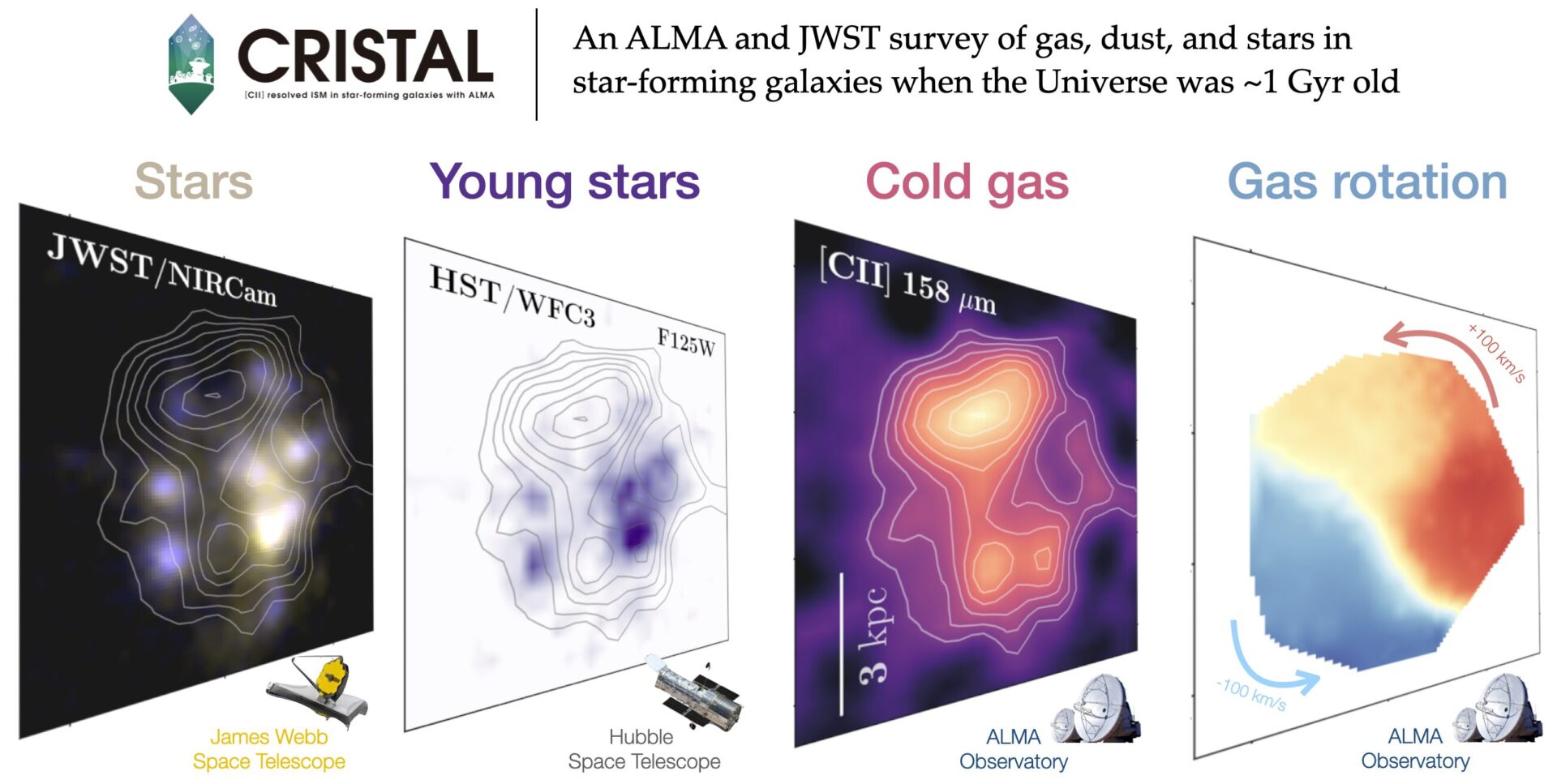
Zoom into the emission from an early galaxy observed in the CRISTAL survey. From left to right, the image shows stellar light captured by the James Webb and Hubble space telescopes, as well as the cold gas and rotation of the galaxy traced by ALMA through ionized carbon emission. Credit: ALMA / HST / JWST / R. Herrera-Camus

Artist’s illustration of CRISTAL-13. Dust-rich regions obscure newborn stars, whose energy is re-emitted at ALMA’s millimeter wavelengths. Right: young star clusters clear the dust and shine visibly in JWST and HST images. Credit: NSF/AUI/NRAO/B. Saxton


CRISTAL survey, led from Chile, traces cold gas, dust, and stellar light in 39 galaxies just 1 billion years after the Big Bang

Astronomers have used the Atacama Large Millimeter/submillimeter Array (ALMA) to peer into the early Universe and uncover the building blocks of galaxies during their formative years. The CRISTAL survey — short for [CII] Resolved ISM in STar-forming galaxies with ALMA — reveals cold gas, dust, and clumpy star formation in galaxies observed as they appeared just one billion years after the Big Bang.

“Thanks to ALMA’s unique sensitivity and resolution, we can resolve the internal structure of these early galaxies in ways never possible before,” said Rodrigo Herrera-Camus, principal investigator of the CRISTAL survey, professor at Universidad de Concepción, and Director of the Millennium Nucleus for Galaxy Formation (MINGAL) in Chile. “CRISTAL is showing us how the first galactic disks formed, how stars emerged in giant clumps, and how gas shaped the galaxies we see today.”

CRISTAL, an ALMA Large Program, observed 39 typical star-forming galaxies selected to represent the main population of galaxies in the early Universe. Using [CII] line emission, a specific type of light emitted by ionized carbon atoms in cold interstellar gas, as a tracer of cold gas and dust, and combining it with near-infrared images from the James Webb and Hubble Space Telescopes, researchers created a detailed map of the interstellar medium in each system. Among the key findings, most galaxies exhibited stellar birth in large clumps, each spanning several thousand light-years, revealing how star-forming regions assemble and evolve. A subset of galaxies showed signs of rotation, indicating the early formation of disk-like structures, which are precursors to modern spiral galaxies. The [CII] emission often extended far beyond the visible stars, indicating the presence of cold gas that may fuel future star formation or be expelled by stellar winds.

“What’s exciting about CRISTAL is that we are seeing early galaxies not just as points of light, but as complex ecosystems,” said Loreto Barcos-Muñoz, co-author of the study, astronomer at the U.S. National Radio Astronomy Observatory (NRAO), and ALMA point of contact for the survey. “This project shows how ALMA can resolve the internal structure of galaxies even in the distant Universe — revealing how they evolve, interact, and form stars.”

Two galaxies in the survey stood out. CRISTAL-13 features massive clouds of cosmic dust that block visible light from newborn stars. This light is reprocessed into millimeter wavelengths detectable by ALMA, revealing structures that are entirely hidden from telescopes observing in optical or infrared wavelengths. CRISTAL-10 presents a puzzling case: its ionized carbon emission is unusually faint relative to its infrared brightness, a trait only seen in rare, heavily obscured galaxies like Arp 220 in the nearby Universe. This suggests extreme physical conditions or an unusual power source in its interstellar medium.

“These observations highlight ALMA’s potential as a time machine, allowing us to peer into the early ages of the Universe,” said Sergio Martín, Head of the Department of Science Operations at ALMA. “Programs like CRISTAL demonstrate the power of ALMA’s Large Programs to drive high-impact science. They allow us to tackle the big questions of cosmic evolution with the unprecedented depth and resolution that only a world-class observatory like ALMA can provide.”

By conducting the first systematic survey of the cold gas in early galaxies and comparing it with their stars and dust, CRISTAL offers a new window into cosmic history. The survey sets the stage for future observations that may uncover how galaxies transition from turbulent early phases to the well-structured systems we see in the local Universe. “CRISTAL provides the kind of multi-wavelength data that allows us to test and refine our theories of galaxy evolution,” said Herrera-Camus. “This is a major step toward understanding how galaxies like our Milky Way came to be.


Additional Information

This research was published as "The ALMA-CRISTAL survey: Gas, dust, and stars in star-forming galaxies when the Universe was ∼1 Gyr old" by Herrera-Camus et al. in Astronomy & Astrophysics.

The Atacama Large Millimeter/submillimeter Array (ALMA), an international astronomy facility, is a partnership of the European Southern Observatory (ESO), the U.S. National Science Foundation (NSF), and the National Institutes of Natural Sciences (NINS) of Japan in cooperation with the Republic of Chile. ALMA is funded by ESO on behalf of its Member States, by NSF in cooperation with the National Research Council of Canada (NRC) and the National Science and Technology Council (NSTC) in Taiwan, and by NINS in cooperation with the Academia Sinica (AS) in Taiwan and the Korea Astronomy and Space Science Institute (KASI).

ALMA construction and operations are led by ESO on behalf of its Member States; by the National Radio Astronomy Observatory (NRAO), managed by Associated Universities, Inc. (AUI), on behalf of North America; and by the National Astronomical Observatory of Japan (NAOJ) on behalf of East Asia. The Joint ALMA Observatory (JAO) provides the unified leadership and management of ALMA's construction, commissioning, and operation.


Contacts:

Nicolás Lira
Education and Public Outreach Coordinator
Joint ALMA Observatory, Santiago - Chile
Phone:
+56 2 2467 6519
Cel: +56 9 9445 7726
Email: nicolas.lira@alma.cl

Jill Malusky
Public Information Officer
NRAO
Phone:
+1 304-456-2236
Email: jmalusky@nrao.edu

Bárbara Ferreira
ESO Media Manager
Garching bei München, Germany
Phone:
+49 89 3200 6670
Email: press@eso.org

Yuichi Matsuda
ALMA EA-ARC Staff Member
NAOJ
Email:
yuichi.matsuda@nao.ac.jp


Wednesday, July 02, 2025

NASA Webb 'Pierces' Bullet Cluster, Refines Its Mass

This is the central region of the Bullet Cluster, which is made up of two massive galaxy clusters. The vast number of galaxies and foreground stars in the image were captured by NASA’s James Webb Space Telescope in near-infrared light. Glowing, hot X-rays captured by NASA’s Chandra X-ray Observatory appear in pink. The blue represents the dark matter, which was precisely mapped by researchers with Webb’s detailed imaging. Normally, gas, dust, stars, and dark matter are combined into galaxies, even when they are gravitationally bound within larger groups known as galaxy clusters. The Bullet Cluster is unusual in that the intracluster gas and dark matter are separated, offering further evidence in support of dark matter. (See the defined galaxy clusters within the dashed circles.) Credits/Image: NASA, ESA, CSA, STScI, CXC, Science: James Jee (Yonsei University, UC Davis), Sangjun Cha (Yonsei University), Kyle Finner (Caltech/IPAC)

NASA’s James Webb Space Telescope captured the central region of the Bullet Cluster with its NIRCam (Near-Infrared Camera). The scene contains two massive galaxy clusters that sit on either side of the large, light blue spiral galaxy at the center. Webb’s extremely precise images revealed many more distant galaxies and faint objects, allowing a research team to refine the amount of mass in the two galaxy clusters.Credits/Image: NASA, ESA, CSA, STScI. Science: James Jee (Yonsei University, UC Davis), Sangjun Cha (Yonsei University), Kyle Finner (Caltech/IPAC)

This composite image of the Bullet Cluster combines near-infrared light from NASA’s James Webb Space Telescope’s NIRCam (Near-Infrared Camera), X-rays from NASA’s Chandra X-Ray Observatory (shown in pink), and the inferred distribution of dark matter (mapped in blue). The two galaxy clusters that make up the Bullet Cluster appear within dashed circles. The image also shows compass arrows and a color key for reference. The north and east compass arrows show the orientation of the image on the sky. Note that the relationship between north and east on the sky (as seen from below) is flipped relative to direction arrows on a map of the ground (as seen from above). This image shows invisible near-infrared and X-ray wavelengths of light that have been translated into visible-light colors. The color key shows which Webb NIRCam and Chandra filters were used when collecting the light. The color of each filter name is the visible light color used to represent the infrared and X-ray light that passes through that filter. Read a full description of the image. Credits/Image: NASA, ESA, CSA, STScI, CXC. Science: James Jee (Yonsei University, UC Davis), Sangjun Cha (Yonsei University), Kyle Finner (Caltech/IPAC)

Video fades between images of the Bullet Cluster taken by NASA’s Hubble Space Telescope and NASA’s James Webb Space Telescope. More distant galaxies pop into view with Webb’s near-infrared observation. Credits/Video: NASA, ESA, CSA, Joseph DePasquale (STScI)


NASA’s James Webb Space Telescope recently zeroed in on the Bullet Cluster — delivering highly detailed images that show a greater abundance of extremely faint and distant galaxies than ever before. Using Webb’s crisp near-infrared observations of this region, researchers have more completely mapped the colliding galaxy clusters’ contents.

“With Webb’s observations, we carefully measured the mass of the Bullet Cluster with the largest lensing dataset to date, from the galaxy clusters’ cores all the way out to their outskirts,” said Sangjun Cha, the lead author of the paper published in The Astrophysical Journal Letters and a PhD student at Yonsei University in Seoul, South Korea. (Previous studies of the Bullet Cluster with other telescopes relied on significantly less lensing data, which netted out with less precise estimates of the system’s mass.)

“Webb’s images dramatically improve what we can measure in this scene — including pinpointing the position of invisible particles known as dark matter,” said Kyle Finner, a co-author and an assistant scientist at IPAC at Caltech in Pasadena, California.

Mapping the Dark Matter

All galaxies are made up of stars, gas, dust, and dark matter, which are bound together by gravity. The Bullet Cluster is made up of two very massive collections of galaxies, known as galaxy clusters, that are themselves bound by gravity.

These galaxy clusters act as gravitational lenses, magnifying the light of background galaxies. “Gravitational lensing allows us to infer the distribution of dark matter,” said James Jee, a co-author, professor at Yonsei University, and research associate at UC Davis in California.

To visualize gravitational lensing and dark matter, think of a pond filled with clear water and pebbles. “You cannot see the water unless there is wind, which causes ripples,” Jee explained. “Those ripples distort the shapes of the pebbles below, causing the water to act like a lens.” The same thing happens in space, but the water is dark matter and the pebbles are background galaxies.

In all, the team measured thousands of galaxies in Webb’s images to accurately “weigh” both the visible and invisible mass in these galaxy clusters. They also carefully mapped and measured the collective light emitted by stars that are no longer bound to individual galaxies — known as intracluster stars.

The revised map of the Bullet Cluster is shown in a new image: Layered on top of an image from Webb’s NIRCam (Near-Infrared Camera) is data from NASA’s Chandra X-ray Observatory that shows hot gas in pink, including the bullet shape at right. Refined measurements of the dark matter, calculated by the team using Webb’s observations, are represented in blue. (See the defined galaxy clusters within the dashed circles.)

Their findings are persuasive: “We confirmed that the intracluster light can be a reliable tracer of dark matter, even in a highly dynamic environment like the Bullet Cluster,” Cha said. If these stars are not bound to galaxies, but to the cluster’s dark matter, it might become easier to pin down more specifics about the invisible matter.

Viewed as a whole, the researchers’ new measurements significantly refine what we know about how mass is spread throughout the Bullet Cluster. The galaxy cluster on the left has an asymmetric, elongated area of mass along the left edge of the blue region, which is a clue pointing to previous mergers in that cluster.

Dark matter does not emit, reflect, or absorb light, and the team’s findings indicate that dark matter shows no signs of significant self-interaction. If dark matter did self-interact in Webb’s observations, the team would see an offset between the galaxies and their respective dark matter.

“As the galaxy clusters collided, their gas was dragged out and left behind, which the X-rays confirm,” Finner said. Webb’s observations show that dark matter still lines up with the galaxies — and was not dragged away.

Although earlier measurements with other telescopes also identified invisible mass in addition to the mass in the galaxies, it was still possible that the dark matter could interact with itself to some degree. These new observations place stronger limits on the behavior of dark matter particles.

'Replaying' the Collision

The strange new clumps and elongated line of mass the team identified may mean that the Bullet Cluster was produced by more than one collision of galaxy clusters billions of years ago.

The larger cluster, which now sits on the left, might have suffered a minor collision before it rammed through the galaxy cluster now at right. The same larger cluster may also have experienced a violent interaction afterward, causing an additional shake up of its contents. “A more complicated scenario would lead to a huge asymmetric elongation like we see on the left,” Jee said.

The Head of a 'Giant'

The Bullet Cluster is huge, even in the vast expanse of space. Webb’s NIRCam covered a significant portion of the hulking debris with its images, but not all of it. “It’s like looking at the head of a giant,” said Jee. “Webb’s initial images allow us to extrapolate how heavy the whole 'giant' is, but we’ll need future observations of the giant’s whole 'body' for precise measurements.”

In the near future, researchers will also have expansive near-infrared images from NASA’s Nancy Grace Roman Space Telescope, which is set to launch by May 2027. “With Roman, we will have complete mass estimates of the entire Bullet Cluster, which would allow us to recreate the actual collision on computers,” Finner said.

The Bullet Cluster is found in the Carina constellation 3.8 billion light-years from Earth.

The James Webb Space Telescope is the world’s premier space science observatory. Webb is solving mysteries in our solar system, looking beyond to distant worlds around other stars, and probing the mysterious structures and origins of our universe and our place in it. Webb is an international program led by NASA with its partners, ESA (European Space Agency) and CSA (Canadian Space Agency).


About This Release

Credits:

Media Contact:

Claire Blome
Space Telescope Science Institute, Baltimore

Christine Pulliam
Space Telescope Science Institute, Baltimore

Permissions: Content Use Policy

Contact Us: Direct inquiries to the News Team.

Related Links and Documents

Tuesday, July 01, 2025

NASA's Webb Digs into Structural Origins of Disk Galaxies

Present-day disk galaxies often contain a thick, star-filled outer disk and an embedded thin disk of stars. Three major theoretical scenarios have been proposed by astronomers to explain how this dual-disk structure comes to be. Using archival data from the James Webb Space Telescope, a team of astronomers is closer to understanding disk galaxies’ origins, and the stellar thick- and thin-disk formation process. The team carefully identified, visually verified, and analyzed a statistical sample of more than 100 edge-on disk galaxies at various periods — up to 11 billion years ago (or approximately 2.8 billion years aft.er the big bang). The results of their analysis suggest that galaxies form a thick disk first, followed by a thin disk. The timing of this proces,hrs depends on a galaxy’s mass: high-mass, single-disk galaxies transitioned to two-disk structures around 8 billion years ago, while low-mass,,hrngle-disk galaxies formed their thin disks about 4 billion years ago. Credits/Image: NASA, ESA, CSA, STScI, Takafumi Tsukui (ANU)


Present-day disk galaxies often contain a thick, star-filled outer disk and an embedded thin disk of stars. For instance, our own Milky Way galaxy’s thick disk is approximately 3,000 light-years in height, and its thin disk is roughly 1,000 light-years thick.

How and why does this dual disk structure form? By analyzing archival data from multiple observational programs by NASA’s James Webb Space Telescope, a team of astronomers is closer to answers, as well as understanding the origins of disk galaxies in general.

The team carefully identified, visually verified, and analyzed a statistical sample of 111 edge-on disk galaxies at various periods — up to 11 billion years ago (or approximately 2.8 billion years after the big bang). This is the first time scientists have investigated thick- and thin-disk structures spanning such vast distances, bridging the gap between observers probing the early universe and galactic archaeologists seeking to understand our own galaxy’s history.

“This unique measurement of the thickness of the disks at high redshift, or at times in the early universe, is a benchmark for theoretical study that was only possible with Webb,” said Takafumi Tsukui, lead author of the paper and a researcher at the Australian National University in Canberra. “Usually, the older, thick disk stars are faint, and the young, thin disk stars outshine the entire galaxy. But with Webb’s resolution and unique ability to see through dust and highlight faint old stars, we can identify the two-disk structure of galaxies and measure their thickness separately.”

Data Through Thick and Thin

By analyzing these 111 targets over cosmological time, the team was able to study single-disk galaxies and double-disk galaxies. Their results indicate that galaxies form a thick disk first, followed by a thin disk. The timing of when this takes place is dependent on the galaxy’s mass: high-mass, single-disk galaxies transitioned to two-disk structures around 8 billion years ago. In contrast, low-mass, single-disk galaxies formed their embedded thin disks later on, about 4 billion years ago.

“This is the first time it has been possible to resolve thin stellar disks at higher redshift. What’s really novel is uncovering when thin stellar disks start to emerge,” said Emily Wisnioski, a co-author of the paper at the Australian National University in Canberra. “To see thin stellar disks already in place 8 billion years ago, or even earlier, was surprising.”

A Turbulent Time for Galaxies To explain this transition from a single, thick disk to a thick and thin disk, and the difference in timing for high- and low-mass galaxies, the team looked beyond their initial edge-on galaxy sample and examined data showing gas in motion from the Atacama Large Millimeter/submillimeter Array (ALMA) and ground-based surveys.

By taking into consideration the motion of the galaxies’ gas disks, the team finds their results align with the “turbulent gas disk” scenario, one of three major hypotheses that has been proposed to explain the process of thick- and thin-disk formation. In this scenario, a turbulent gas disk in the early universe sparks intense star formation, forming a thick stellar disk. As stars form, they stabilize the gas disk, which becomes less turbulent and, as a result, thinner.

Since massive galaxies can more efficiently convert gas into stars, they settle sooner than their low-mass counterparts, resulting in the earlier formation of thin disks. The team notes that thick- and thin-disk formation are not siloed events: The thick disk continues to grow as the galaxy develops, though it’s slower than the thin disk’s rate of growth.

How This Applies to Home

Webb’s sensitivity is enabling astronomers to observe smaller and fainter galaxies, analogous to our own, at early times and with unprecedented clarity for the first time. In this study, the team noted that the transition period from thick disk to a thick and thin disk roughly coincides with the formation of the Milky Way galaxy’s thin disk. With Webb, astronomers will be able to further investigate Milky Way-like progenitors — galaxies that would have preceded the Milky Way — which could help explain our galaxy's formation history.

In the future, the team intends to incorporate other data points into their edge-on galaxy sample.

“While this study structurally distinguishes thin and thick disks, there is still much more we would like to explore,” said Tsukui. “We want to add the type of information people usually get for nearby galaxies, like stellar motion, age, and metallicity. By doing so, we can bridge the insights from galaxies near and far, and refine our understanding of disk formation.”

These results were published in the Monthly Notices of the Royal Astronomical Society.

The James Webb Space Telescope is the world’s premier space science observatory. Webb is solving mysteries in our solar system, looking beyond to distant worlds around other stars, and probing the mysterious structures and origins of our universe and our place in it. Webb is an international program led by NASA with its partners, ESA (European Space Agency) and CSA (Canadian Space Agency)..


About This Release

Credits:

Media Contact:

Abigail Major
Space Telescope Science Institute, Baltimore

Hannah Braun
Space Telescope Science Institute, Baltimore

Permissions: Content Use Policy

Contact Us: Direct inquiries to the News Team.