Showing posts with label Bullet Cluster. Show all posts

Wednesday, July 02, 2025

NASA Webb 'Pierces' Bullet Cluster, Refines Its Mass

This is the central region of the Bullet Cluster, which is made up of two massive galaxy clusters. The vast number of galaxies and foreground stars in the image were captured by NASA’s James Webb Space Telescope in near-infrared light. Glowing, hot X-rays captured by NASA’s Chandra X-ray Observatory appear in pink. The blue represents the dark matter, which was precisely mapped by researchers with Webb’s detailed imaging. Normally, gas, dust, stars, and dark matter are combined into galaxies, even when they are gravitationally bound within larger groups known as galaxy clusters. The Bullet Cluster is unusual in that the intracluster gas and dark matter are separated, offering further evidence in support of dark matter. (See the defined galaxy clusters within the dashed circles.) Credits/Image: NASA, ESA, CSA, STScI, CXC, Science: James Jee (Yonsei University, UC Davis), Sangjun Cha (Yonsei University), Kyle Finner (Caltech/IPAC)

NASA’s James Webb Space Telescope captured the central region of the Bullet Cluster with its NIRCam (Near-Infrared Camera). The scene contains two massive galaxy clusters that sit on either side of the large, light blue spiral galaxy at the center. Webb’s extremely precise images revealed many more distant galaxies and faint objects, allowing a research team to refine the amount of mass in the two galaxy clusters.Credits/Image: NASA, ESA, CSA, STScI. Science: James Jee (Yonsei University, UC Davis), Sangjun Cha (Yonsei University), Kyle Finner (Caltech/IPAC)

This composite image of the Bullet Cluster combines near-infrared light from NASA’s James Webb Space Telescope’s NIRCam (Near-Infrared Camera), X-rays from NASA’s Chandra X-Ray Observatory (shown in pink), and the inferred distribution of dark matter (mapped in blue). The two galaxy clusters that make up the Bullet Cluster appear within dashed circles. The image also shows compass arrows and a color key for reference. The north and east compass arrows show the orientation of the image on the sky. Note that the relationship between north and east on the sky (as seen from below) is flipped relative to direction arrows on a map of the ground (as seen from above). This image shows invisible near-infrared and X-ray wavelengths of light that have been translated into visible-light colors. The color key shows which Webb NIRCam and Chandra filters were used when collecting the light. The color of each filter name is the visible light color used to represent the infrared and X-ray light that passes through that filter. Read a full description of the image. Credits/Image: NASA, ESA, CSA, STScI, CXC. Science: James Jee (Yonsei University, UC Davis), Sangjun Cha (Yonsei University), Kyle Finner (Caltech/IPAC)

Video fades between images of the Bullet Cluster taken by NASA’s Hubble Space Telescope and NASA’s James Webb Space Telescope. More distant galaxies pop into view with Webb’s near-infrared observation. Credits/Video: NASA, ESA, CSA, Joseph DePasquale (STScI)


NASA’s James Webb Space Telescope recently zeroed in on the Bullet Cluster — delivering highly detailed images that show a greater abundance of extremely faint and distant galaxies than ever before. Using Webb’s crisp near-infrared observations of this region, researchers have more completely mapped the colliding galaxy clusters’ contents.

“With Webb’s observations, we carefully measured the mass of the Bullet Cluster with the largest lensing dataset to date, from the galaxy clusters’ cores all the way out to their outskirts,” said Sangjun Cha, the lead author of the paper published in The Astrophysical Journal Letters and a PhD student at Yonsei University in Seoul, South Korea. (Previous studies of the Bullet Cluster with other telescopes relied on significantly less lensing data, which netted out with less precise estimates of the system’s mass.)

“Webb’s images dramatically improve what we can measure in this scene — including pinpointing the position of invisible particles known as dark matter,” said Kyle Finner, a co-author and an assistant scientist at IPAC at Caltech in Pasadena, California.

Mapping the Dark Matter

All galaxies are made up of stars, gas, dust, and dark matter, which are bound together by gravity. The Bullet Cluster is made up of two very massive collections of galaxies, known as galaxy clusters, that are themselves bound by gravity.

These galaxy clusters act as gravitational lenses, magnifying the light of background galaxies. “Gravitational lensing allows us to infer the distribution of dark matter,” said James Jee, a co-author, professor at Yonsei University, and research associate at UC Davis in California.

To visualize gravitational lensing and dark matter, think of a pond filled with clear water and pebbles. “You cannot see the water unless there is wind, which causes ripples,” Jee explained. “Those ripples distort the shapes of the pebbles below, causing the water to act like a lens.” The same thing happens in space, but the water is dark matter and the pebbles are background galaxies.

In all, the team measured thousands of galaxies in Webb’s images to accurately “weigh” both the visible and invisible mass in these galaxy clusters. They also carefully mapped and measured the collective light emitted by stars that are no longer bound to individual galaxies — known as intracluster stars.

The revised map of the Bullet Cluster is shown in a new image: Layered on top of an image from Webb’s NIRCam (Near-Infrared Camera) is data from NASA’s Chandra X-ray Observatory that shows hot gas in pink, including the bullet shape at right. Refined measurements of the dark matter, calculated by the team using Webb’s observations, are represented in blue. (See the defined galaxy clusters within the dashed circles.)

Their findings are persuasive: “We confirmed that the intracluster light can be a reliable tracer of dark matter, even in a highly dynamic environment like the Bullet Cluster,” Cha said. If these stars are not bound to galaxies, but to the cluster’s dark matter, it might become easier to pin down more specifics about the invisible matter.

Viewed as a whole, the researchers’ new measurements significantly refine what we know about how mass is spread throughout the Bullet Cluster. The galaxy cluster on the left has an asymmetric, elongated area of mass along the left edge of the blue region, which is a clue pointing to previous mergers in that cluster.

Dark matter does not emit, reflect, or absorb light, and the team’s findings indicate that dark matter shows no signs of significant self-interaction. If dark matter did self-interact in Webb’s observations, the team would see an offset between the galaxies and their respective dark matter.

“As the galaxy clusters collided, their gas was dragged out and left behind, which the X-rays confirm,” Finner said. Webb’s observations show that dark matter still lines up with the galaxies — and was not dragged away.

Although earlier measurements with other telescopes also identified invisible mass in addition to the mass in the galaxies, it was still possible that the dark matter could interact with itself to some degree. These new observations place stronger limits on the behavior of dark matter particles.

'Replaying' the Collision

The strange new clumps and elongated line of mass the team identified may mean that the Bullet Cluster was produced by more than one collision of galaxy clusters billions of years ago.

The larger cluster, which now sits on the left, might have suffered a minor collision before it rammed through the galaxy cluster now at right. The same larger cluster may also have experienced a violent interaction afterward, causing an additional shake up of its contents. “A more complicated scenario would lead to a huge asymmetric elongation like we see on the left,” Jee said.

The Head of a 'Giant'

The Bullet Cluster is huge, even in the vast expanse of space. Webb’s NIRCam covered a significant portion of the hulking debris with its images, but not all of it. “It’s like looking at the head of a giant,” said Jee. “Webb’s initial images allow us to extrapolate how heavy the whole 'giant' is, but we’ll need future observations of the giant’s whole 'body' for precise measurements.”

In the near future, researchers will also have expansive near-infrared images from NASA’s Nancy Grace Roman Space Telescope, which is set to launch by May 2027. “With Roman, we will have complete mass estimates of the entire Bullet Cluster, which would allow us to recreate the actual collision on computers,” Finner said.

The Bullet Cluster is found in the Carina constellation 3.8 billion light-years from Earth.

The James Webb Space Telescope is the world’s premier space science observatory. Webb is solving mysteries in our solar system, looking beyond to distant worlds around other stars, and probing the mysterious structures and origins of our universe and our place in it. Webb is an international program led by NASA with its partners, ESA (European Space Agency) and CSA (Canadian Space Agency).


About This Release

Credits:

Media Contact:

Claire Blome
Space Telescope Science Institute, Baltimore

Christine Pulliam
Space Telescope Science Institute, Baltimore

Permissions: Content Use Policy

Contact Us: Direct inquiries to the News Team.

Related Links and Documents

Wednesday, July 31, 2024

Dark Matter Flies Ahead of Normal Matter in Mega Galaxy Cluster Collision

This artist's concept shows what happened when two massive clusters of galaxies, collectively known as MACS J0018.5, collided: The dark matter in the galaxy clusters (blue) sailed ahead of the associated clouds of hot gas, or normal matter (orange). Both dark matter and normal matter feel the pull of gravity, but only the normal matter experiences additional effects like shocks and turbulence that slow it down during collisions. Credit: W.M. Keck Observatory/Adam Makarenko

Maunakea, Hawaiʻi – Astronomers have untangled a messy collision between two massive clusters of galaxies in which the clusters’ vast clouds of dark matter have decoupled from the so-called normal matter. The two clusters each contain thousands of galaxies and are located billions of light-years away from Earth. As they plowed through each other, the dark matter—an invisible substance that feels the force of gravity but emits no light—sped ahead of the normal matter. The new observations are the first to directly probe the decoupling of the dark and normal matter velocities.

The discovery was made using data from space- and ground-based telescopes, including two Maunakea Observatories on Hawaiʻi Island: W. M. Keck Observatory and the Caltech Submillimeter Observatory, or CSO (which was recently removed from its site on Maunakea and will be relocated to Chile). Some of the observations were made decades ago, while the full analysis using all the datasets took place over the past couple of years. The findings are detailed in a new study published in The Astrophysical Journal.

Galaxy clusters are among the largest structures in the universe, glued together by the force of gravity. Only 15 percent of the mass in such clusters is normal matter, the same matter that makes up planets, people, and everything you see around you. Of this normal matter, the vast majority is hot gas, while the rest is stars and planets. The remaining 85 percent of the cluster mass is dark matter.

During the tussle that took place between the clusters, known collectivity as MACS J0018.5+1626, the individual galaxies themselves largely went unscathed because so much space exists between them. But when the enormous stores of gas between the galaxies (the normal matter) collided, the gas became turbulent and superheated. While all matter, including both normal matter and dark matter, interacts via gravity, the normal matter also interacts via electromagnetism, which slows it down during a collision. So, while the normal matter became bogged down, the pools of dark matter within each cluster sailed on through.

Think of a massive collision between multiple dump trucks carrying sand, suggests Emily Silich, lead author of the new study. “The dark matter is like the sand and flies ahead.” Silich is a graduate student working with Jack Sayers, research professor of physics at Caltech and principal investigator of the study.

This artist’s animation depicts a collision between two massive clusters of galaxies. As the collision progresses, the dark matter in the galaxy clusters (blue) moves ahead of the associated clouds of hot gas, or normal matter (orange). This happens because, while both dark matter and normal matter feel the pull of gravity, only the normal matter experiences additional effects like shocks and turbulence, which slow it down during the collision. In this animation, the clusters are pictured in an orientation similar to that of the well-known Bullet Cluster collision, where the separation of dark matter and normal matter is observed as a spatial offset. From our view on Earth, MACS J0018.5 is in fact rotated nearly 90 degrees relative to the Bullet cluster and from what is depicted here. In other words, the two massive clusters in MACS J0018.5 are positioned such that one is flying toward us, and the other is flying away. This unique perspective allowed researchers to measure velocity differences between the dark matter and normal matter in a cluster collision for the first time. Animation Credit: W. M. Keck Observatory/Adam Makarenko

Such decoupling of dark and normal matter has been seen before, most famously in the Bullet Cluster. In that collision, the hot gas can be seen clearly lagging behind the dark matter after the two galaxy clusters shot through each other.

The situation that took place in MACS J0018.5+1626 (referred to subsequently as MACS J0018.5) is similar, but the orientation of the merger is rotated, roughly 90 degrees relative to that of the Bullet Cluster. In other words, one of the massive clusters in MACS J0018.5 is flying nearly straight toward Earth while the other one is rushing away. That orientation gave researchers a unique vantage point from which to measure the speed at which the hot gas was traveling.

“With the Bullet Cluster, it’s like we are sitting in a grandstand watching a car race and are able to capture beautiful snapshots of the cars moving from left to right on the straightway,” says Jack Sayers, a research professor at Caltech and principal investigator of the study. “In our case, it’s more like we are on the straightway with a radar gun, standing in front of a car as it comes at us and are able to obtain its speed.”

Methodology

The team used Keck Observatory’s Deep Imaging Multi-Object Spectrograph (DEIMOS) to learn the speed of the galaxies in the cluster, which told them by proxy the speed of the dark matter (because the dark matter and galaxies behave similarly during the collision). To measure the speed of the normal matter, or gas, in the cluster, researchers used CSO to perform an observational method known as the kinetic Sunyaev-Zel’dovich (SZ) effect.

“The Sunyaev-Zeldovich effects were still a very new observational tool when Jack and I first turned a new camera at the CSO on galaxy clusters in 2006, and we had no idea there would be discoveries like this,” says Sunil Golwala, professor of physics and Silich’s faculty PhD advisor. “We look forward to a slew of new surprises when we put next-generation instruments on the telescope at its new home in Chile.”

The team also gathered data from the European Space Agency’s now-retired Herschel Space Observatory and Planck observatory, as well as the Atacama Submillimeter Telescope Experiment in Chile.

MACS J0018.5 showed signs of something strange going on—the hot gas, or normal matter, was traveling in the opposite direction to the dark matter.

“We had this complete oddball with velocities in opposite directions, and at first we thought it could be a problem with our data. Even our colleagues who simulate galaxy clusters didn’t know what was going on,” Sayers says. “And then Emily got involved and untangled everything.”

For part of her PhD thesis, Silich turned to data from NASA’s Chandra X-ray Observatory to reveal the temperature and location of the gas in the clusters as well as the degree to which the gas was being shocked.

“These cluster collisions are the most energetic phenomena since the Big Bang,” Silich says. “Chandra measures the extreme temperatures of the gas and tells us about the age of the merger and how recently the clusters collided.”

The team also worked with Adi Zitrin of the Ben-Gurion University of the Negev in Israel to use NASA’s Hubble Space Telescope to map the dark matter using a method known as gravitational lensing.

Additionally, John ZuHone of the Center for Astrophysics at Harvard & Smithsonian helped the team simulate the cluster smashup. The scientists found that, prior to colliding, the clusters were moving toward each other at approximately 3000 kilometers/second, equal to roughly one percent of the speed of light.

With a more complete picture of what was going on, the researchers were able to figure out why the dark matter and normal matter appeared to be traveling in opposite directions. The orientation of the collision, coupled with the fact that dark matter and normal matter had separated from each other, explains the oddball velocity measurements.

Next Steps

In the future, the researchers hope that more studies like this one will lead to new clues about the mysterious nature of dark matter. “This study is a starting point to more detailed studies into the nature of dark matter,” Silich says. “We have a new type of direct probe that shows how dark matter behaves differently from normal matter.”

Sayers, who recalls first collecting the CSO data on this object almost 20 years ago, says, “It took us a long time to put all the puzzle pieces together, but now we finally know what’s going on. We hope this leads to a whole new way to study dark matter in clusters.”

Learn more:


About DEIMOS
The DEep Imaging and Multi-Object Spectrograph (DEIMOS) boasts the largest field of view (16.7arcmin by 5 arcmin) of any of the Keck Observatory instruments, and the largest number of pixels (64 Mpix). It is used primarily in its multi-object mode, obtaining simultaneous spectra of up to 130 galaxies or stars. Astronomers study fields of distant galaxies with DEIMOS, efficiently probing the most distant corners of the universe with high sensitivity.

About W.M. Keck Observatory

The W. M. Keck Observatory telescopes are among the most scientifically productive on Earth. The two 10-meter optical/infrared telescopes atop Maunakea on the Island of Hawaii feature a suite of advanced instruments including imagers, multi-object spectrographs, high-resolution spectrographs, integral-field spectrometers, and world-leading laser guide star adaptive optics systems. Some of the data presented herein were obtained at Keck Observatory, which is a private 501(c) 3 non-profit organization operated as a scientific partnership among the California Institute of Technology, the University of California, and the National Aeronautics and Space Administration. The Observatory was made possible by the generous financial support of the W. M. Keck Foundation. The authors wish to recognize and acknowledge the very significant cultural role and reverence that the summit of Maunakea has always had within the Native Hawaiian community. We are most fortunate to have the opportunity to conduct observations from this mountain.


Saturday, October 26, 2019

Chandra Spots a Mega-Cluster of Galaxies in the Making


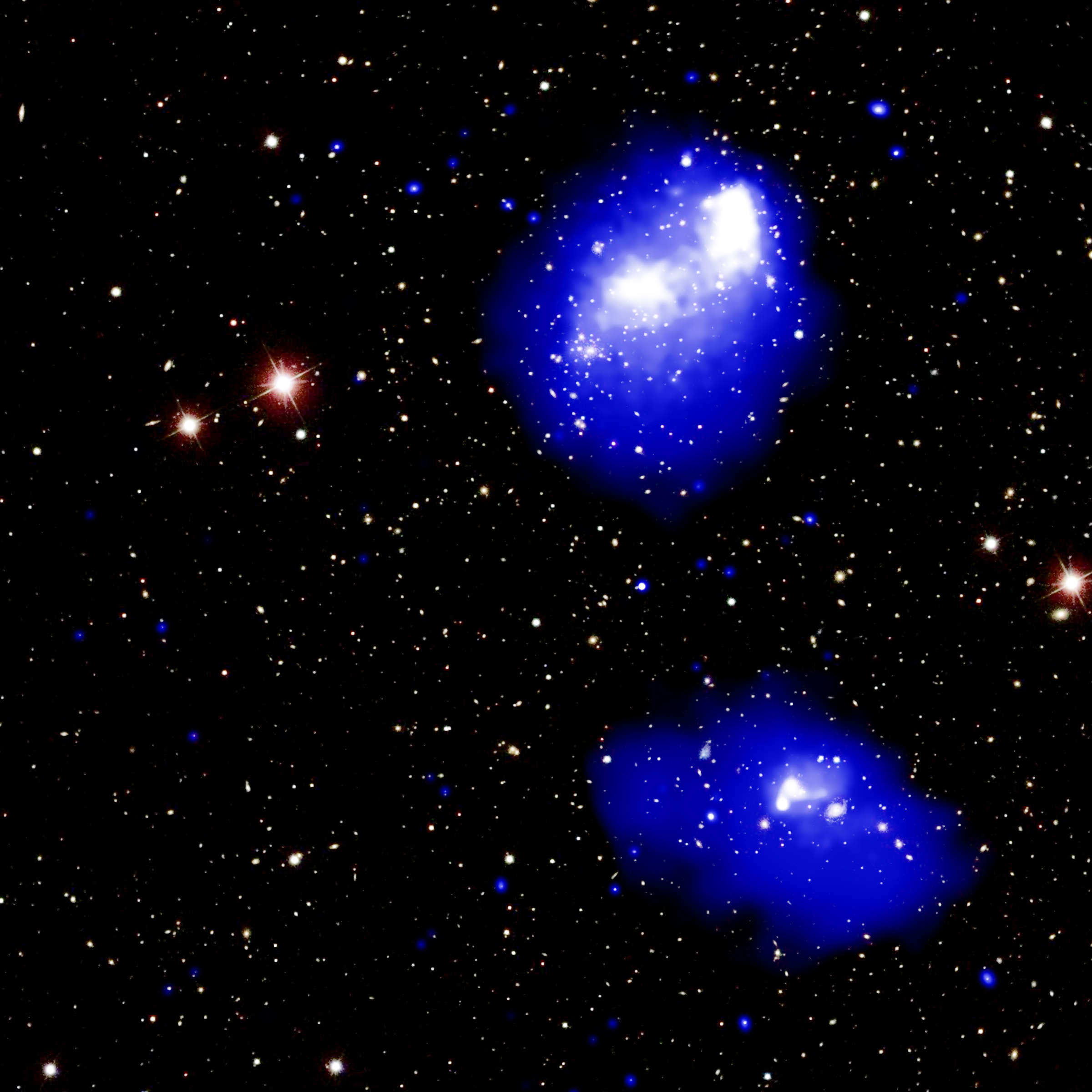
Labeled image of Abell 1758 system
Credit: X-ray: NASA/CXC/SAO/G.Schellenberger et al.; Optical:SDSS 


Astronomers using data from NASA's Chandra X-ray Observatory and other telescopes have put together a detailed map of a rare collision between four galaxy clusters. Eventually all four clusters — each with a mass of at least several hundred trillion times that of the Sun — will merge to form one of the most massive objects in the universe.

Galaxy clusters are the largest structures in the cosmos that are held together by gravity. Clusters consist of hundreds or even thousands of galaxies embedded in hot gas, and contain an even larger amount of invisible dark matter. Sometimes two galaxy clusters collide, as in the case of the Bullet Cluster, and occasionally more than two will collide at the same time.

The new observations show a mega-structure being assembled in a system called Abell 1758, located about 3 billion light-years from Earth. It contains two pairs of colliding galaxy clusters that are heading toward one another. Scientists first recognized Abell 1758 as a quadruple galaxy cluster system in 2004 using data from Chandra and XMM-Newton, a satellite operated by the European Space Agency (ESA).

Each pair in the system contains two galaxy clusters that are well on their way to merging. In the northern (top) pair seen in the composite image, the centers of each cluster have already passed by each other once, about 300 to 400 million years ago, and will eventually swing back around. The southern pair at the bottom of the image has two clusters that are close to approaching each other for the first time.

X-rays from Chandra are shown as blue and white, depicting fainter and brighter diffuse emission, respectively. This new composite image also includes an optical image from the Sloan Digital Sky Survey. The Chandra data revealed for the first time a shock wave — similar to the sonic boom from a supersonic aircraft — in hot gas visible with Chandra in the northern pair's collision. From this shock wave, researchers estimate two clusters are moving about 2 million to 3 million miles per hour (3 million to 5 million kilometers per hour), relative to each other.

Chandra data also provide information about how elements heavier than helium, the "heavy elements," in galaxy clusters get mixed up and redistributed after the clusters collide and merge. Because this process depends on how far a merger has progressed, Abell 1758 offers a valuable case study, since the northern and the southern pairs of clusters are at different stages of merging.

In the southern pair, the heavy elements are most abundant in the centers of the two colliding clusters, showing that the original location of the elements has not been strongly impacted by the ongoing collision. By contrast, in the northern pair, where the collision and merger has progressed further, the location of the heavy elements has been strongly influenced by the collision. The highest abundances are found between the two cluster centers and to the left side of the cluster pair, while the lowest abundances are in the center of the cluster on the left side of the image.

Collisions between clusters affect their component galaxies as well as the hot gas that surrounds them. Data from the 6.5-meter MMT telescope in Arizona, obtained as part of the Arizona Cluster Redshift Survey, show that some galaxies are moving much faster than others, probably because they have been thrown away from the other galaxies in their cluster by gravitational forces imparted by the collision.

The team also used radio data from the Giant Metrewave Radio Telescope (GMRT), and X-ray data from ESA's XMM-Newton mission.

A paper describing these latest results by Gerrit Schellenberger, Larry David, Ewan O'Sullivan, Jan Vrtilek (all from Center for Astrophysics | Harvard & Smithsonian) and Christopher Haines (Universidad de Atacama, Chile) was published in the September 1st, 2019 issue of The Astrophysical Journal, and is available online.

NASA's Marshall Space Flight Center manages the Chandra program. The Smithsonian Astrophysical Observatory's Chandra X-ray Center controls science and flight operations from Cambridge, Massachusetts.


Fast Facts for Abell 1758

Scale: Image is about 16.7 arcmin (14 million light years) across.
Category: Groups & Clusters of Galaxies, Cosmology/Deep Fields/X-ray Background
Coordinates (J2000): RA 13h 32m 43.02s | Dec +50° 32´ 25.70"
Constellation: Canes Venatici
Observation Date: Aug 28, 2001
Observation Time: 56 hours 40 minutes (2 days 8 hours 40 minutes)
Obs. ID: 2213, 13997, 15538, 15540
Instrument: ACIS
References: Schellenberger G., et al, 2019, ApJ, 882, 59; arXiv:1907.10581
Color Code: X-ray: blue and white; Optical: yellow and pink
Distance Estimate: About 3.2 billion light years (z=0.28)


Saturday, June 14, 2014

Catching a 'Wave' of Galaxies Ending the Dark Ages

Credit: NASA/JPL-Caltech /R.E.Ryan, Jr.(STScl)

Through a project dubbed SURFS UP, NASA's Spitzer Space Telescope and Hubble Space Telescope are catching sight of a "wave" of galaxies that emerged in the early universe. Starlight from these primordial galaxies is reckoned to have cleared a fog of hydrogen gas that shrouded the cosmos during a mysterious period known as the Dark Ages.
Spitzer has revealed that the stars shining in two of the young SURFS UP galaxies, discovered by Hubble, look surprisingly mature. The finding suggests these stars formed earlier than expected, and thus began lifting the cosmic fog sooner than previously thought.
"We have discovered galaxies that are among the most distant ever spotted, having formed a mere 500 million years after the Big Bang," said Maru?a Brada?, a physicist at the University of California, Davis and lead author of one of two papers describing the findings. "The stars within these relatively young galaxies already appear mature, pushing back the time when the first stars and galaxies arose and began illuminating the Dark Ages."
Spitzer teamed up with Hubble to gather the results as part of the Spitzer UltRaFaint Survey, or SURFS UP. The joint project will image 10 massive, foreground galaxy clusters, whose strong gravity magnifies the light of background objects. This so-called cosmic lensing causes objects such as the distant, dim, young galaxies that SURFS UP is investigating, to appear more than 10 times brighter than they normally would, allowing the team to study the stars within them.
The Spitzer observations, in infrared, reveal key characteristics, such as mass and ages, about older populations of stars in the far-off galaxies. Besides finding the galaxies in the first place, Hubble's observations, in visible light, speak to the formation rate of young stars. Taken together, the data paint a richly detailed portrait of galactic evolution and its effect on the wider cosmos.
SURFS UP is one of several new observing programs taking advantage of cosmic lensing to probe deeper into the universe than ever before. The project will complement Frontier Fields, another such program using Spitzer and Hubble data, by looking at eight additional clusters not covered by Frontier Fields. Overall, SURFS UP will look for traces of cosmically lensed background galaxies representing typical, "normal" galaxies from just several hundred millions years after the Big Bang.
The universe was a very different place at the time the first stars and galaxies began lighting up an otherwise dark cosmos. Neutral hydrogen gas, which is a very good absorber of ultraviolet light, still filled the cosmos like a fog, making the universe partially opaque to that part of the spectrum. Rather like how the warmth of the sun "burns away" fog, the first stars and galaxies likely ionized, or knocked an electron loose from, the neutral hydrogen. This ionization prevented the hydrogen from absorbing ultraviolet light, clearing the "fog." In this way, the rise of stars and galaxies that brought the Dark Ages to a close also rendered the universe transparent to some of these objects' light.
  
To understand definitively how and when this process occurred, scientists need an accurate picture of star formation rates and history. In a paper accepted for publication in the Astrophysical Journal, Brada? and colleagues used Spitzer and Hubble to measure the properties of stars in a 13.2 billion-light-year-distant galaxy, made possible thanks to the cosmic zoom lens provided by the galaxy cluster MACS J1149.5+2223. The overall reddish hue of starlight visible to Spitzer in the distant galaxy indicates the presence of an older population of stars than was expected in this relatively young galaxy.
A second paper generated by the SURFS UP team involves the magnification of a galaxy by the massive Bullet Cluster of galaxies. The paper, in The Astrophysical Journal Letters, describes an extremely distant galaxy, 12.9 billion light years away, which is so faint that Spitzer could only detect it using the extra boost of a foreground gravitational lens. Careful analysis of the stellar properties of this galaxy suggests it also harbors stars of an already reasonably advanced age.
"These are among the first direct detections of mature stars in young galaxies seen at the time when the universe was only a few percent of its present age," said lead author Russell Ryan, a postdoctoral fellow at the Space Telescope Science Institute. "When SURFS UP completes, we will have a census of stars in early galaxies that will help us determine what exactly ended the Dark Ages."
NASA's Jet Propulsion Laboratory, Pasadena, Calif., manages the Spitzer Space Telescope mission for NASA's Science Mission Directorate, Washington. Science operations are conducted at the Spitzer Science Center at the California Institute of Technology in Pasadena. Spacecraft operations are based at Lockheed Martin Space Systems Company, Littleton, Colo. Data are archived at the Infrared Science Archive housed at the Infrared Processing and Analysis Center at Caltech. Caltech manages JPL for NASA.


Thursday, April 12, 2012

DLSCL J0916.2+2951: Discovery of the Musket Ball Cluster

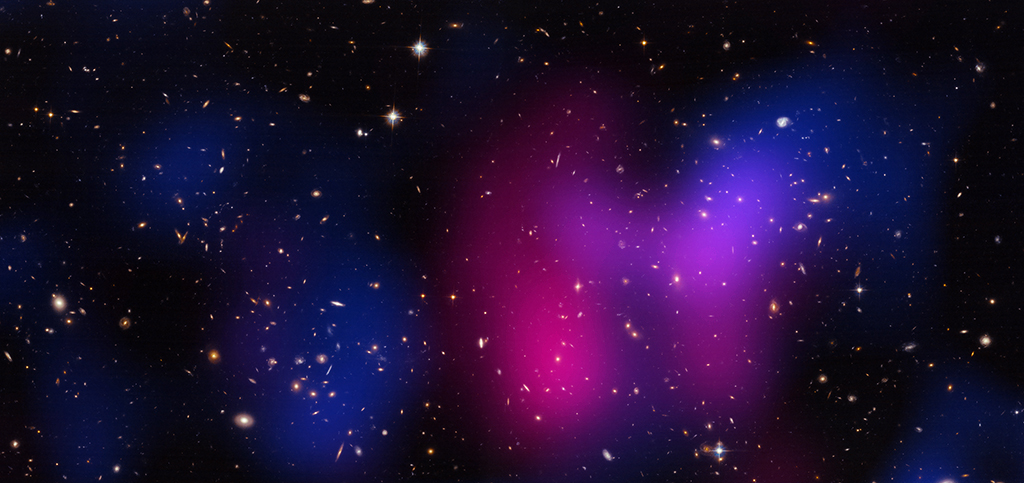
Musket Ball Cluster
Credit X-ray: NASA/CXC/UCDavis/W.Dawson et al;


Using a combination of powerful observatories in space and on the ground, astronomers have observed a violent collision between two galaxy clusters in which so-called normal matter has been wrenched apart from dark matter through a violent collision between two galaxy clusters.


The newly discovered galaxy cluster is called DLSCL J0916.2+2951. It is similar to the Bullet Cluster, the first system in which the separation of dark and normal matter was observed, but with some important differences. The newly discovered system has been nicknamed the "Musket Ball Cluster" because the cluster collision is older and slower than the Bullet Cluster.

Finding another system that is further along in its evolution than the Bullet Cluster gives scientists valuable insight into a different phase of how galaxy clusters - the largest known objects held together by gravity - grow and change after major collisions. Researchers used observations from NASA's Chandra X-ray Observatory and Hubble Space Telescope as well as the Keck, Subaru and Kitt Peak Mayall telescopes to show that hot, X-ray bright gas in the Musket Ball Cluster has been clearly separated from dark matter and galaxies.

In this composite image, the hot gas observed with Chandra is colored red, and the galaxies in the optical image from Hubble appear as mostly white and yellow. The location of the majority of the matter in the cluster (dominated by dark matter) is colored blue. When the red and the blue regions overlap, the result is purple as seen in the image. The matter distribution is determined by using data from Subaru, Hubble and the Mayall telescope that reveal the effects of gravitational lensing, an effect predicted by Einstein where large masses can distort the light from distant objects.

In addition to the Bullet Cluster, five other similar examples of merging clusters with separation between normal and dark matter and varying levels of complexity, have previously been found. In these six systems, the collision is estimated to have occurred between 170 million and 250 million years

Credit X-ray: NASA/CXC/CfA/M.Markevitch et al.;
Optical: NASA/STScI; Magellan/U.Arizona/D.Clowe et al.;
Lensing Map: NASA/STScI; ESO WFI; Magellan/U.Arizona/D.Clowe et al.

In the Musket Ball Cluster, the system is observed about 700 million years after the collision. Taking into account the uncertainties in the age estimate, the merger that has formed the Musket Ball Cluster is two to five times further along than in previously observed systems. Also, the relative speed of the two clusters that collided to form the Musket Ball cluster was lower than most of the other Bullet Cluster-like objects.

The special environment of galaxy clusters, including the effects of frequent collisions with other clusters or groups of galaxies and the presence of large amounts of hot, intergalactic gas, is likely to play an important role in the evolution of their member galaxies. However, it is still unclear whether cluster mergers trigger star formation, suppress it, or have little immediate effect. The Musket Ball Cluster holds promise for deciding between these alternatives.

The Musket Ball Cluster also allows an independent study of whether dark matter can interact with itself. This information is important for narrowing down the type of particle that may be responsible for dark matter. No evidence is reported for self-interaction in the Musket Ball Cluster, consistent with the results for the Bullet Cluster and the other similar clusters.

The Musket Ball Cluster is located about 5.2 billion light years away from Earth. A paper describing these results was led by Will Dawson from University of California, Davis and was published in the March 10, 2012 issue of The Astrophysical Journal Letters. The other co-authors were David Wittman, M. James Jee and Perry Gee from UC Davis, Jack Hughes from Rutgers University in NJ, J. Anthony Tyson, Samuel Schmidt, Paul Thorman and Marusa Bradac from UC Davis, Satoshi Miyazaki from the Graduate University for Advanced Studies (GUAS) in Tokyo, Japan, Brian Lemaux from UC Davis, Yousuke Utsumi from GUAS and Vera Margoniner from California State University, Sacramento.

NASA's Marshall Space Flight Center in Huntsville, Ala., manages the Chandra program for NASA's Science Mission Directorate in Washington. The Smithsonian Astrophysical Observatory controls Chandra's science and flight operations from Cambridge, Mass.

Fast Facts for DLSCL J0916.2+2951:

Scale: 6.4 arcmin across (about 8 million light years)
Category: Groups & Clusters of Galaxies
Coordinates (J2000): RA 09h 16m 14.64s | Dec +29° 54' 24.00"
Constellation: Cancer
Observation Date: Jan 2, 2011
Observation Time: 11 hours 6 min.
Obs. ID: 12913
Color Code: Optical (Red, Green, Blue); X-ray (Red-Purple); Mass Map (Blue)
Instrument: ACIS
References: Dawson, W. et al, 2012, ApJ 747, 42; arXiv:1110.4391
Distance Estimate: 5.23 billion light years (z=0.53)

Tuesday, January 10, 2012

El Gordo (ACT-CL J0102-4915): NASA's Chandra Finds Largest Galaxy Cluster in Early Universe

Credit X-ray: NASA/CXC/Rutgers/J.Hughes et al, Optical: ESO/VLT/Pontificia Universidad. Catolica de Chile/L.Infante & SOAR (MSU/NOAO/UNC/CNPq-Brazil)/Rutgers/F.Menanteau, IR: NASA/JPL/Rutgers/F.Menanteau


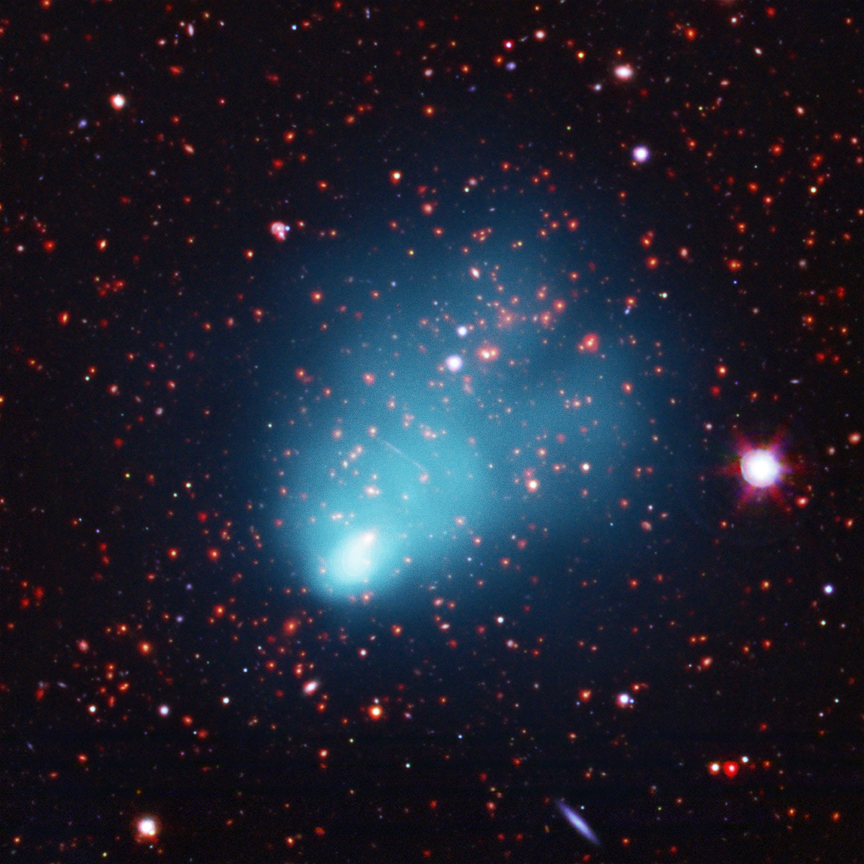
A composite image shows El Gordo in X-ray light from NASA's Chandra X-ray Observatory in blue, along with optical data from the European Southern Observatory's Very Large Telescope (VLT) in red, green, and blue, and infrared emission from the NASA's Spitzer Space Telescope in red and orange.

X-ray data from Chandra reveal a distinct cometary appearance of El Gordo, including two "tails" extending to the upper right of the image. Along with the VLT's optical data, this shows that El Gordo is, in fact, the site of two galaxy clusters running into one another at several million miles per hour. This and other characteristics make El Gordo akin to the well-known object called the Bullet Cluster, which is located almost 4 billion light years closer to Earth.

As with the Bullet Cluster, there is evidence that normal matter, mainly composed of hot, X-ray bright gas, has been wrenched apart from the dark matter in El Gordo. The hot gas in each cluster was slowed down by the collision, but the dark matter was not.

El Gordo is located over 7 billion light years from Earth, meaning that it is being observed at a young age. According to the scientists involved in this study, this cluster of galaxies is the most massive, the hottest, and gives off the most X-rays of any known cluster at this distance or beyond.

The central galaxy in the middle of El Gordo is unusually bright and has surprisingly blue colors in optical wavelengths. The authors speculate that this extreme galaxy resulted from a collision and merger between the two galaxies at the center of each cluster.

Using Spitzer data and optical imaging it is estimated that about 1% of the total mass of the cluster is in stars, while the rest is found in the hot gas that fills the space between the stars and is detected by Chandra. This ratio of stars to gas is similar with results from other massive clusters.

Fast Facts for El Gordo:

Scale Image is 5.3 arcmin across
Category: Groups & Clusters of Galaxies
Coordinates: (J2000) RA 01h 02m 52.50s | Dec -49° 14' 58.00"
Constellation: Phoenix
Observation Date: 01/26/2011
Observation Time: 16 hours 40 min.
Obs. ID: 12258
Color Code: X-ray (Blue); Optical (Red, Green, Blue); Infrared (Red)
Instrument: ACIS
Also Known As: ACT-CL J0102-4915
References: Menanteau, F. et al, 2011 ApJ (submitted); arXiv:1109.0953
Distance Estimate: 7.166 billion light years