Showing posts with label T Tauri stars. Show all posts

Thursday, September 24, 2026

Youngest Exoplanet Yet Discovered Found Hiding in Keck Observatory Data

Elias 2-24 b


Astronomers confirm a giant planet still forming around its young star, offering a rare glimpse into how planetary systems take shape

Maunakea, Hawaiʻi -Astronomers have confirmed the youngest exoplanet detected so far, offering a rare glimpse into the earliest stages of planetary formation. The planet, known as Elias 2-24 b, is still actively gathering material from the disk of gas and dust surrounding its young host star, allowing scientists to study a giant planet while it is still growing.

The study, led by Diego Portales University in Chile and published in The Astrophysical Journal Letters, combines observations from W. M. Keck Observatory, the Atacama Large Millimeter/submillimeter Array (ALMA), and the European Southern Observatory’s Very Large Telescope (VLT). The findings support the core accretion model of giant planet formation and provide strong evidence linking gaps in protoplanetary disks to planets forming within them.

“What makes Elias 2-24 b so remarkable is its age,” said Andrea Bernardi, a doctoral student at Diego Portales University and lead author of the study. “This is the youngest planet detected so far, and because it is still actively accreting material from its surroundings, we’re able to observe a stage of planet formation that is rarely seen directly.”

Seeing a Planet in the Making

Young stars are often surrounded by rotating disks of gas and dust known as protoplanetary disks. Over time, material within these disks collects and grows into planets.

In recent years, ALMA has produced striking images of these disks, revealing rings and dark gaps in the surrounding material. Many astronomers suspected that emerging planets were carving those gaps as they formed, but direct evidence remained limited.

Elias 2-24 b provides one of the clearest examples yet of a planet occupying one of these gaps.


“We can now connect the presence of gaps in protoplanetary disks to the presence of planets with much greater confidence,” Bernardi said. “This discovery provides direct evidence that these structures can be produced by planets forming within the disk.”

The finding also supports a specific stage of the core accretion model, the leading theory of giant planet formation. According to the team’s analysis, the planet is currently undergoing a brief but critical growth phase during which it rapidly accumulates gas from the surrounding disk and builds its atmosphere.

“In a way, we’re observing a much younger version of a planetary system like our own,” said Lucas Cieza, co-author of the study and professor at Universidad Diego Portales. “Because our solar system is billions of years old, we can only reconstruct how it formed. Systems like Elias 2-24 b allow us to study that process while it is still underway.”

Alice Zurlo, a professor at Universidad Diego Portales and one of the study’s authors, conducted the initial research on the system in 2018. “This planet is a rare gem, as it is currently undergoing a stage of its evolution for which theoretical models still struggle to reliably predict its mass, entropy, and, consequently, its expected luminosity,” said Zurlo. “This system will therefore provide key insights once we are able to further constrain its dynamical mass, helping us refine and recalibrate evolutionary models for young planets.”

A Decade-Long Search and a Discovery in the Archive

The discovery began with observations conducted at Keck Observatory in 2018.

That year, Alice Zurlo, then part of the research team studying young stars with structured protoplanetary disks, observed Elias 2-24 with Keck’s Near Infrared Camera 2 (NIRC2). At the time, the observations revealed a faint signal, but not enough evidence to identify it as a planet.

Years later, Bernardi returned to the data through the Keck Observatory Archive (KOA), a NASA-funded partnership between Keck Observatory and the NASA Exoplanet Science Institute (NExScI) at Caltech/IPAC. The archive serves all data taken at Keck Observatory, making it available for new scientific research long after the observations were originally obtained.

By reanalyzing the 2018 observations with new data-processing techniques, Bernardi identified a signal consistent with a forming planet. Additional archival Keck observations obtained in 2020, together with independent observations from the VLT and supporting evidence from ALMA, helped confirm the discovery.

“This object sits right at the limit of what current technology can detect,” said Cieza. “It was the combination of observations from multiple observatories that allowed us to show the planet is really there.”

The discovery also highlights the scientific value of preserving astronomical observations for future researchers.

“Astronomical data can have a remarkably long shelf life,” said Keck Observatory Chief Scientist John O’Meara. “The observations existed for years, but new techniques, improved models, and a fresh look at the data revealed something extraordinary. KOA allows scientists to return to those observations and ask new questions, sometimes uncovering discoveries that weren’t possible when the data were first collected.”

Looking Ahead

The research team continues to study the planet and hopes to obtain spectroscopy and other measurements that could reveal more about its atmosphere, temperature, mass, and ongoing accretion.

For now, Elias 2-24 b offers a rare opportunity to witness a giant planet in the midst of formation.

“This system has become a laboratory for understanding how planets form,” Cieza said. “Every new observation helps us piece together one of the most complex puzzles in modern astrophysics, the origin of planetary systems like our own.”


Related Link:

Science Paper | NASA Release


Science Contact:

Andrea Bernardi

andrea.bernardi@mail.udp.cl

Media Contact:

Meagan O’Shea

moshea@keck.hawaii.edu


Monday, July 07, 2025

The young stars of Taurus

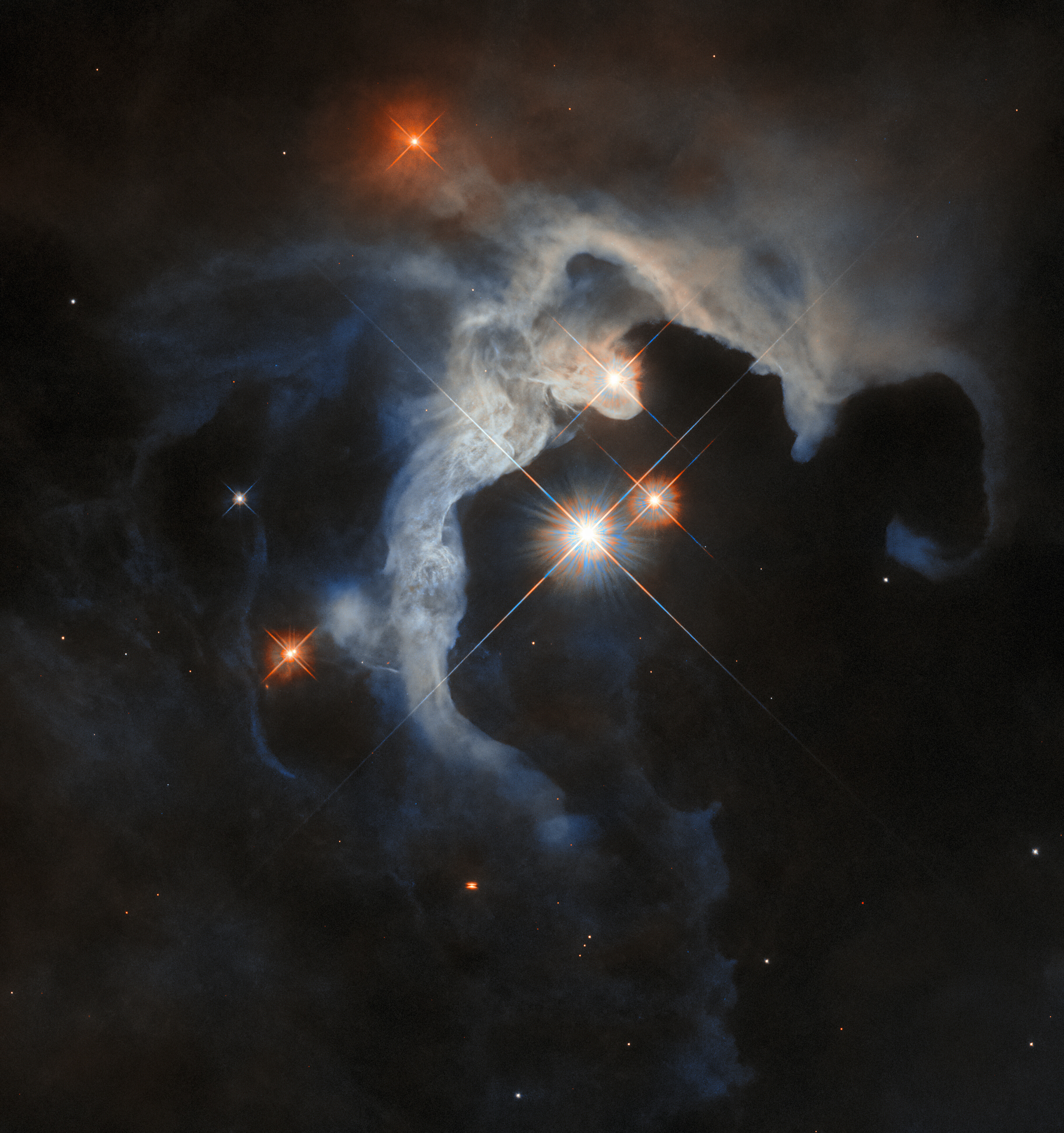
A long, smoky, greyish-blue cloud in the centre of the image curves in an arc around three bright stars, each with long cross-shaped diffraction spikes. The cloud is lit more brightly on the inner side facing the stars, and fades into the dark background on the outer side. A few other stars and points of light surround the cloud: one small star below it has a dark band crossing its centre. Credit: ESA/Hubble & NASA, G. Duchêne

The subject of this week's Hubble Picture of the Week is a reflection nebula, identified as GN 04.32.8. Reflection nebulae are clouds of dust in space that don't emit their own light, as other nebulae do. Instead, the light from nearby stars hits and scatters off their dust, lighting them up. Because of the way the light scatters, many reflection nebulae tend to appear blue, GN 04.32.8 included.

GN 04.32.8 is a small part of the stellar nursery known as the Taurus Molecular Cloud. At only roughly 480 light-years from Earth in the constellation Taurus, it's one of the best locations for studying newly forming stars. This reflection nebula is illuminated by the system of three bright stars in the centre of this image, mainly the variable star V1025 Tauri in the very centre. One of those stars overlaps with part of the nebula: this is another variable star that is named HP Tauri, but is classified as a T Tauri star, for its similarity to yet another variable star elsewhere in the Taurus Molecular Complex. T Tauri stars are very active, chaotic stars at an early stage of their evolution, so it's no surprise that they appear in a prolific stellar nursery like this one! The three stars are also named HP Tau, HP Tau G2 and HP Tau G3; they’re believed to be gravitationally bound to each other, forming a triple system.

Eagle-eyed viewers might notice the small, squashed, orange spot, just left of centre below the clouds of the nebula, that’s crossed by a dark line. This is a newly-formed protostar, hidden in a protoplanetary disc that obstructs some of its light. Because the disc is edge-on to us, it’s an ideal candidate for study. Astronomers are using Hubble here to examine it closely, seeking to learn about the kinds of exoplanets that might be formed in discs like it.

Link


Tuesday, March 26, 2024

Hubble sees new star proclaiming its presence with cosmic light show


Videos

PR Video heic2406a
Pan: FS Tau


Jets emerge from the cocoon of a newly forming star to blast across space, slicing through the gas and dust of a shining nebula, in this new image from the NASA/ESA Hubble Space Telescope.

FS Tau is a multi-star system made up of FS Tau A, the bright star-like object near the middle of the image, and FS Tau B (Haro 6-5B), the bright object to the far right that is partially obscured by a dark, vertical lane of dust. These young objects are surrounded by the softly illuminated gas and dust of this stellar nursery. The system is only about 2.8 million years old, very young for a star system. Our Sun, by contrast, is about 4.6 billion years old.

FS Tau B is a newly forming star, or protostar, and is surrounded by a protoplanetary disc, a pancake-shaped collection of dust and gas left over from the formation of the star that will eventually coalesce into planets. The thick dust lane, seen nearly edge-on, separates what are thought to be the illuminated surfaces of the disc.

FS Tau B is likely in the process of becoming a T Tauri star, a type of young variable star that hasn’t begun nuclear fusion yet but is beginning to evolve into a hydrogen-fueled star similar to our Sun. Protostars shine with the heat energy released as the gas clouds from which they are forming collapse, and from the accretion of material from nearby gas and dust. Variable stars are a class of star whose brightness changes noticeably over time.

FS Tau A is itself a T Tauri binary system, consisting of two stars orbiting each other.

Protostars are known to eject fast-moving, column-like streams of energised material called jets, and FS Tau B provides a striking example of this phenomenon. The protostar is the source of an unusual asymmetric, double-sided jet, visible here in blue. Its asymmetrical structure may be because mass is being expelled from the object at different rates.

FS Tau B is also classified as a Herbig-Haro object. Herbig–Haro objects form when jets of ionised gas ejected by a young star collide with nearby clouds of gas and dust at high speeds, creating bright patches of nebulosity.

FS Tau is part of the Taurus-Auriga region, a collection of dark molecular clouds that are home to numerous newly forming and young stars, roughly 450 light-years away in the constellations of Taurus and Auriga. Hubble has previously observed this region, whose star-forming activity makes it a compelling target for astronomers. Hubble made these observations as part of an investigation of edge-on dust discs around young stellar objects.


More information

The Hubble Space Telescope is a project of international cooperation between ESA and NASA.

Image credit: NASA, ESA, and K. Stapelfeldt (NASA JPL), G. Kober (NASA/Catholic University of America)


Links


Contacts

Bethany Downer
ESA/Hubble Chief Science Communications Officer
Email:
Bethany.Downer@esahubble.org


Saturday, September 09, 2023

First observational evidence of gamma-ray emission in young Sun-like stars


Artist's impression of a T Tauri star: system formed by a central star and a circumstellar disk. This is what our Solar System looked like 4.5 billion years ago. The gamma-ray emission would be produced in the star's most violent and energetic flares. Credit: INAF-OAPa/S. Orlando.
Licence type: Attribution (CC BY 4.0)

A team of scientists from Argentina and Spain have reported the first observational evidence that a type of young low-mass star, known as T Tauri stars, are capable of emitting gamma radiation. The study is published in Monthly Notices of the Royal Astronomical Society.

Very energetic radiation from the sky cannot be easily observed from Earth. The high sensitivity of the Fermi satellite helps to solve this issue by observing the universe in gamma-rays, the most energetic region of the electromagnetic spectrum. The Fermi satellite has been continuously observing the sky since its launch in 2008, and from these observations it is known that about 30% of gamma-ray sources detected throughout the entire night sky remain unidentified – the origins of these gamma-ray detections are unknown.

Some of these mysterious sources were studied by PhD student Agostina Filócomo and a team of researchers in order to determine their origin. Several of the gamma-ray sources appear to originate from star forming regions, but the team had no explanation as to why – so they decided to investigate. The study focusses on star-forming region NGC 2071, which lies in the northern part of the molecular cloud Orion B.

To try and pinpoint the cause of these mysterious gamma-ray bursts, the team decided to look to objects known as “T Tauri stars”, which are low-mass stars in formation. T Tauri stars consist of a central star and a disk of gas and dust orbiting around it, where planets could form. T Tauri stars are known for their fluctuating brightness, and are typically found near regions of active star formation.

The team noted that three unidentified gamma sources observed at different time intervals were coming from the part of the sky that the young star-forming region NGC 2071 is located. At least 58 stars classified as T Tauri stars are known to be forming here. There are no other objects in this region that can be a source of gamma-ray emission.

A possible explanation is that sporadic gamma-ray radiation is produced by T Tauri stars during powerful flare episodes known as “megaflares”, in which electromagnetic bursts are produced by magnetic energy stored in the atmospheres of the stars. Megaflares can span several stellar radii and last a few hours. Although there is flare activity on the Sun at present, it is not on the same scale as a megaflare. Megaflares are far more powerful, and if they were to take place on the Sun, would be detrimental to life on planet Earth.

This might explain the origin of multiple previously unknown gamma-ray sources. Understanding the physical processes in T Tauri stars also provides information on the early conditions that led to the genesis of the Sun and our Solar System.

Ph.D. student Agostina Filócomo claims “This observational evidence is essential for understanding the origin of sources that have previously remained unknown for more than a decade, which is unquestionably a step forward in astronomy. It is also critical to comprehend the processes that occur during the early phases of star formation: if a T Tauri star produces gamma-ray radiation, it will affect the gas conditions of the protoplanetary disk and, consequently, the evolution of planet formation. The discovery of this phenomenon serves to understand how not only the Sun but also our home planet, Earth, were formed and evolved.”


Media contacts:

Ms Gurjeet Kahlon
Royal Astronomical Society
Mob: +44 (0)7802 877 700

press@ras.ac.uk

Dr Robert Massey
Royal Astronomical Society
Mob: +44 (0)7802 877 699

press@ras.ac.uk

Science contacts:

Agostina Filócomo
Universidad Nacional de Río Negro and Facultad de Ciencias Atronómicas y Geofísicas (Universidad Nacional de La Plata)

afilocomo@unrn.edu.ar

Juan Facundo Albacete Colombo
Universidad Nacional de Río Negro

jfalbacetecolombo@unrn.edu.ar


Further information:

The research appears in "γ-ray detection from occasional flares of T Tauri stars in NGC 2071. I: Observational connection  "Filócomo et al., published in Monthly Notices of the Royal Astronomical Society, in press.

Notes for editors:

About the Royal Astronomical Society

The Royal Astronomical Society (RAS,https://ras.ac.uk), founded in 1820, encourages and promotes the study of astronomy, solar-system science, geophysics and closely related branches of science. The RAS organises scientific meetings, publishes international research and review journals, recognises outstanding achievements by the award of medals and prizes, maintains an extensive library, supports education through grants and outreach activities and represents UK astronomy nationally and internationally. Its more than 4,000 members (Fellows), a third based overseas, include scientific researchers in universities, observatories and laboratories as well as historians of astronomy and others.


Thursday, September 03, 2020

New Observations Show Planet-forming Disc Torn Apart by its Three Central Stars

 
The inner ring of GW Orionis: model and SPHERE observations 
 
The inner ring of GW Orionis: model and SPHERE observations 
 
ALMA and SPHERE view of GW Orionis (superimposed) 
 
GW Orionis in the constellation of Orion 
 

 Videos

ESOcast 229 Light: Planet-forming Disc Torn Apart by its Three Central Stars
ESOcast 229 Light: Planet-forming Disc Torn Apart by its Three Central Stars 
 
Artistic animation of the warped and torn apart disc of GW Orionis
Artistic animation of the warped and torn apart disc of GW Orionis 
 
Artistic animation of the stellar movements in GW Orionis
Artistic animation of the stellar movements in GW Orionis 
 
How GW Orionis got its ring (computer simulation)


A team of astronomers have identified the first direct evidence that groups of stars can tear apart their planet-forming disc, leaving it warped and with tilted rings. This new research suggests exotic planets, not unlike Tatooine in Star Wars, may form in inclined rings in bent discs around multiple stars. The results were made possible thanks to observations with the European Southern Observatory’s Very Large Telescope (ESO’s VLT) and the Atacama Large Millimeter/submillimeter Array (ALMA).

Our Solar System is remarkably flat, with the planets all orbiting in the same plane. But this is not always the case, especially for planet-forming discs around multiple stars, like the object of the new study: GW Orionis. This system, located just over 1300 light-years away in the constellation of Orion, has three stars and a deformed, broken-apart disc surrounding them.

“Our images reveal an extreme case where the disc is not flat at all, but is warped and has a misaligned ring that has broken away from the disc,” says Stefan Kraus, a professor of astrophysics at the University of Exeter in the UK who led the research published today in the journal Science. The misaligned ring is located in the inner part of the disc, close to the three stars.

The new research also reveals that this inner ring contains 30 Earth-masses of dust, which could be enough to form planets. “Any planets formed within the misaligned ring will orbit the star on highly oblique orbits and we predict that many planets on oblique, wide-separation orbits will be discovered in future planet imaging campaigns, for instance with the ELT,” says team member Alexander Kreplin of the University of Exeter, referring to ESO’s Extremely Large Telescope, which is planned to start operating later this decade. Since more than half the stars in the sky are born with one or more companions, this raises an exciting prospect: there could be an unknown population of exoplanets that orbit their stars on very inclined and distant orbits.

To reach these conclusions, the team observed GW Orionis for over 11 years. Starting in 2008, they used the AMBER and later the GRAVITY instruments on ESO’s VLT Interferometer in Chile, which combines the light from different VLT telescopes, to study the gravitational dance of the three stars in the system and map their orbits. “We found that the three stars do not orbit in the same plane, but their orbits are misaligned with respect to each other and with respect to the disc,” says Alison Young of the Universities of Exeter and Leicester and a member of the team.

They also observed the system with the SPHERE instrument on ESO’s VLT and with ALMA, in which ESO is a partner, and were able to image the inner ring and confirm its misalignment. ESO’s SPHERE also allowed them to see, for the first time, the shadow that this ring casts on the rest of the disc. This helped them figure out the 3D shape of the ring and the overall disc.

The international team, which includes researchers from the UK, Belgium, Chile, France and the US, then combined their exhaustive observations with computer simulations to understand what had happened to the system. For the first time, they were able to clearly link the observed misalignments to the theoretical “disc-tearing effect”, which suggests that the conflicting gravitational pull of stars in different planes can warp and break their discs.

Their simulations showed that the misalignment in the orbits of the three stars could cause the disc around them to break into distinct rings, which is exactly what they see in their observations. The observed shape of the inner ring also matches predictions from numerical simulations on how the disc would tear.

Interestingly, another team who studied the same system using ALMA believe another ingredient is needed to understand the system. “We think that the presence of a planet between these rings is needed to explain why the disc tore apart,” says Jiaqing Bi of the University of Victoria in Canada who led a study of GW Orionis published in The Astrophysical Journal Letters in May this year. His team identified three dust rings in the ALMA observations, with the outermost ring being the largest ever observed in planet-forming discs.

Future observations with ESO’s ELT and other telescopes may help astronomers fully unravel the nature of GW Orionis and reveal young planets forming around its three stars.


More Information

This research was presented in the paper “A triple star system with a misaligned and warped circumstellar disk shaped by disk tearing” to appear in Science (doi: 10.1126/science.aba4633).

The team is composed of Stefan Kraus (University of Exeter, School of Physics & Astronomy, UK [Exeter]) Alexander Kreplin (Exeter), Alison K. Young (Exeter and School of Physics and Astronomy, University of Leicester, UK), Matthew R. Bate (Exeter), John D. Monnier (University of Michigan, USA [Michigan]), Tim J. Harries (Exeter), Henning Avenhaus (Max Planck Institute for Astronomy, Heidelberg, Germany), Jacques Kluska (Exeter and Instituut voor Sterrenkunde, KU Leuven, Belgium [KU Leuven]), Anna S. E. Laws (Exeter), Evan A. Rich (Michigan), Matthew Willson (Exeter and Georgia State University, USA), Alicia N. Aarnio (University of North Carolina Greensboro, USA), Fred C. Adams (Michigan), Sean M. Andrews (Center for Astrophysics | Harvard & Smithsonian, USA [CfA]), Narsireddy Anugu (Exeter, Michigan and Steward Observatory, University of Arizona, USA), Jaehan Bae (Michigan and Carnegie Institution for Science, Washington, USA), Theo ten Brummelaar (The CHARA Array of Georgia State University, California, USA), Nuria Calvet (Michigan), Michel Cure (Instituto de Fisica y Astronomia, Universidad de Valparaiso, Chile), Claire L. Davies (Exeter), Jacob Ennis (Michigan), Catherine Espaillat (Michigan and Boston University, USA), Tyler Gardner (Michigan), Lee Hartmann (Michigan), Sasha Hinkley (Exeter), Aaron Labdon (Exeter), Cyprien Lanthermann (KU Leuven), Jean-Baptiste LeBouquin (Michigan and Universite Grenoble Alpes, CNRS, IPAG, France), Gail H. Schaefer (CHARA), Benjamin R. Setterholm (Michigan), David Wilner (CfA), and Zhaohuan Zhu (University of Nevada, USA).

ESO is the foremost intergovernmental astronomy organisation in Europe and the world’s most productive ground-based astronomical observatory by far. It has 16 Member States: Austria, Belgium, the Czech Republic, Denmark, France, Finland, Germany, Ireland, Italy, the Netherlands, Poland, Portugal, Spain, Sweden, Switzerland and the United Kingdom, along with the host state of Chile and with Australia as a Strategic Partner. ESO carries out an ambitious programme focused on the design, construction and operation of powerful ground-based observing facilities enabling astronomers to make important scientific discoveries. ESO also plays a leading role in promoting and organising cooperation in astronomical research. ESO operates three unique world-class observing sites in Chile: La Silla, Paranal and Chajnantor. At Paranal, ESO operates the Very Large Telescope and its world-leading Very Large Telescope Interferometer as well as two survey telescopes, VISTA working in the infrared and the visible-light VLT Survey Telescope. Also at Paranal ESO will host and operate the Cherenkov Telescope Array South, the world’s largest and most sensitive gamma-ray observatory. ESO is also a major partner in two facilities on Chajnantor, APEX and ALMA, the largest astronomical project in existence. And on Cerro Armazones, close to Paranal, ESO is building the 39-metre Extremely Large Telescope, the ELT, which will become “the world’s biggest eye on the sky”. 

The Atacama Large Millimeter/submillimeter Array (ALMA), an international astronomy facility, is a partnership of ESO, the U.S. National Science Foundation (NSF) and the National Institutes of Natural Sciences (NINS) of Japan in cooperation with the Republic of Chile. ALMA is funded by ESO on behalf of its Member States, by NSF in cooperation with the National Research Council of Canada (NRC) and the National Science Council of Taiwan (NSC) and by NINS in cooperation with the Academia Sinica (AS) in Taiwan and the Korea Astronomy and Space Science Institute (KASI). ALMA construction and operations are led by ESO on behalf of its Member States; by the National Radio Astronomy Observatory (NRAO), managed by Associated Universities, Inc. (AUI), on behalf of North America; and by the National Astronomical Observatory of Japan (NAOJ) on behalf of East Asia. The Joint ALMA Observatory (JAO) provides the unified leadership and management of the construction, commissioning and operation of ALMA.


Links


Contacts

Stefan Kraus
Associate Professor in Astrophysics, University of Exeter
Exeter, UK
Tel: +44 1392 724125
Email: S.Kraus@exeter.ac.uk

Alexander Kreplin
Postdoctoral Research Fellow, University of Exeter
Exeter, UK
Tel: +44 1392 725571
Email: A.Kreplin@exeter.ac.uk

Alison Young
Postdoctoral Research Associate, University of Leicester
Leicester, UK
Tel: +44 116 3736281
Email: alison.young@leicester.ac.uk

Bárbara Ferreira
ESO Public Information Officer
Garching bei München, Germany
Tel: +49 89 3200 6670
Cell: +49 151 241 664 00
Email: pio@eso.org 

Source: ESO/News


Thursday, August 27, 2020

How to feed a baby star


Artistic impression of the hot gas streams that help young stars grow. Magnetic fields guide matter from the surrounding circumstellar disk, the birthplace of the planets, to the surface of the star, where they produce intense bursts of radiation. Image: A. Mark Garlick

Gas reaches young stars along magnetic field lines

Astronomers have used the GRAVITY instrument to study the immediate vicinity of a young star in more detail than ever before. Their observations confirm a thirty-year-old theory about the growth of young stars: the magnetic field produced by the star itself directs material from a surrounding accretion disk of gas and dust onto its surface. The results, published today in the journal Nature, help astronomers to better understand how stars like our Sun are formed and how Earth-like planets are produced from the disks surrounding these stellar babies

When stars form, they start out comparatively small and are located deep inside a cloud of gas. Over the course of the next hundreds of thousands of years, they draw more and more of the surrounding gas onto themselves, increasing their mass in the process. Using the GRAVITY instrument, a group of researchers that includes astronomers and engineers from the Max Planck Institute for Astronomy (MPIA), has now found the most direct evidence yet for how that gas is funnelled onto young stars: it is guided by the star's magnetic field onto the surface in a narrow column.

The relevant length scales are so small that even with the best telescopes currently available no detailed images of the process are possible. Still, using the latest observation technology, astronomers can at least glean some information. For the new study, the researchers made use of the superbly high resolving power of the instrument called GRAVITY. It combines four 8-meter VLT telescopes of the European Southern Observatory (ESO) at Paranal observatory in Chile into a virtual telescope that can distinguish small details as well as a telescope with a 100-meter-mirror could.

Using GRAVITY, the researchers were able to observe the inner part of the gas disk surrounding the star TW Hydrae. “This star is special because it is very close to Earth at only 196 light years away, and the disk of matter surrounding the star is directly facing us,” says Rebeca García López (Max Planck Institute for Astronomy, Dublin Institute for Advanced Studies and University College Dublin), main author and leading scientist of this study. “This makes it an ideal candidate to probe how matter from a planet forming disk is channelled on to the stellar surface.”

The observation allowed the astronomers to show that near-infrared radiation emitted by the entire system indeed originates in the innermost region, where hydrogen gas is falling onto the star's surface. The results point clearly towards a process known as magnetospheric accretion, that is, infalling matter guided by the star's magnetic field.

Stellar birth and stellar growth

A star is born when a dense region within a cloud of molecular gas collapses under its own gravity, becomes considerably denser, heats up in the process, until eventually density and temperature in the resulting protostar are so high that nuclear fusion of hydrogen to helium starts. For protostars up to about two times the mass of the Sun, the ten or so million years directly before the ignition of proton-proton nuclear fusion constitute the so-called T Tauri phase (named after the first observed star of this kind, T Tauri in the constellation Taurus).

Stars that we see in that phase of their development, known as T Tauri stars, shine quite brightly, in particular in infrared light. These so-called “young stellar objects” (YSOs) have not yet reached their final mass: they are surrounded by the remnants of the cloud from which they were born, in particular by gas that has contracted into a circumstellar disk surrounding the star. In the outer regions of that disk, dust and gas clump together and form ever-larger bodies, which will eventually become planets. Large amounts of gas and dust from the inner disk region, on the other hand, are drawn onto the star, increasing its mass. Last but not least, the star's intense radiation drives out a considerable portion of the gas as a stellar wind.

Guidelines to the surface: the star's magnetic field

Naively, one might think that transporting gas or dust onto a massive, gravitating body is easy. Instead, it turns out to be not that simple at all. Due to what physicists call the conservation of angular momentum, it is much more natural for any object – whether planet or gas cloud – to orbit a mass than to drop straight onto its surface. One reason why some matter nonetheless manages to reach the surface is a so-called accretion disk, in which gas orbits the central mass. There is plenty of internal friction inside that continually allows some of the gas to transfer its angular momentum to other portions of gas and move further inward. Yet, at a distance from the star of less than 10 times the stellar radius, the accretion process gets more complex. Traversing that last distance is tricky.

Thirty years ago, Max Camenzind, at the Landessternwarte Königstuhl (which has since become a part of the University of Heidelberg), proposed a solution to this problem. Stars typically have magnetic fields – those of our Sun, for instance, regularly accelerate electrically charged particles in our direction, leading to the phenomenon of Northern or Southern lights. In what has become known as magnetospheric accretion, the magnetic fields of the young stellar object guide gas from the inner rim of the circumstellar disk to the surface in distinct column-like flows, helping them to shed angular momentum in a way that allows the gas to flow onto the star.

In the simplest scenario, the magnetic field looks similar to that of the Earth. Gas from the inner rim of the disk would be funneled to the magnetic North and to the magnetic South pole of the star.

Checking up on magnetospheric accretion

Having a model that explains certain physical processes is one thing. However, it is important to be able to test that model using observations. But the length scales in question are of the order of stellar radii, very small on astronomical scales. Until recently, such length scales were too small, even around the nearest young stars, for astronomers to be able to take a picture showing all relevant details.

First indication that magnetospheric accretion is indeed present came from examining the spectra of some T Tauri stars. Spectra of gas clouds contain information about the motion of the gas. For some T Tauri stars, spectra revealed disk material falling onto the stellar surface with velocities as high as several hundred kilometers per second, providing indirect evidence for the presence of accretion flows along magnetic field lines. In a few cases, the strength of the magnetic field close to a T Tauri star could be directly measured by a combining high-resolution spectra and polarimetry, which records the orientation of the electromagnetic waves we receive from an object.

More recently, instruments have become sufficiently advanced – more specifically: have reached sufficiently high resolution, a sufficiently good capability to discern small details – so as to allow direct observations that provide insights into magnetospheric accretion.

The instrument GRAVITY plays a key role here. It was developed by a consortium that includes the Max Planck Institute for Astronomy, led by the Max Planck Institute for Extraterrestrial Physics. In operation since 2016, GRAVITY links the four 8-meter-telescopes of the VLT, located at the Paranal observatory of the European Southern Observatory (ESO). The instrument uses a special technique known as interferometry. The result is that GRAVITY can distinguish details so small as if the observations were made by a single telescope with a 100-m mirror.

Catching magnetic funnels in the act

In the Summer of 2019, a team of astronomers led by Jerome Bouvier of the University of Grenobles Alpes used GRAVITY to probe the inner regions of the T Tauri Star with the designation DoAr 44. It denotes the 44th T Tauri star in a nearby star forming region in the constellation Ophiuchus, catalogued in the late 1950s by the Georgian astronomer Madona Dolidze and the Armenian astronomer Marat Arakelyan. The system in question emits considerable light at a wavelength that is characteristic for highly excited hydrogen. Energetic ultraviolet radiation from the star ionizes individual hydrogen atoms in the accretion disk orbiting the star.

The magnetic field then influences the electrically charged hydrogen nuclei (each a single proton). The details of the physical processes that heat the hydrogen gas as it moves along the accretion current towards the star are not yet understood. The observed greatly broadened spectral lines show that heating occurs.

For the GRAVITY observations, the angular resolution was sufficiently high to show that the light was not produced in the circumstellar disk, but closer to the star's surface. Moreover, the source of that particular light was shifted slightly relative to the centre of the star itself. Both properties are consistent with the light being emitted near one end of a magnetic funnel, where the infalling hydrogen gas collides with the surface of the star. Those results have been published in an article in the journal Astronomy & Astrophysics.

The new results, which have now been published in the journal Nature, go one step further. In this case, the GRAVITY observations targeted the T Tauri star TW Hydrae, a young star in the constellation Hydra. They are based on GRAVITY observations of the T Tauri star TW Hydrae, a young star in the constellation Hydra. It is probably the best-studied system of its kind.

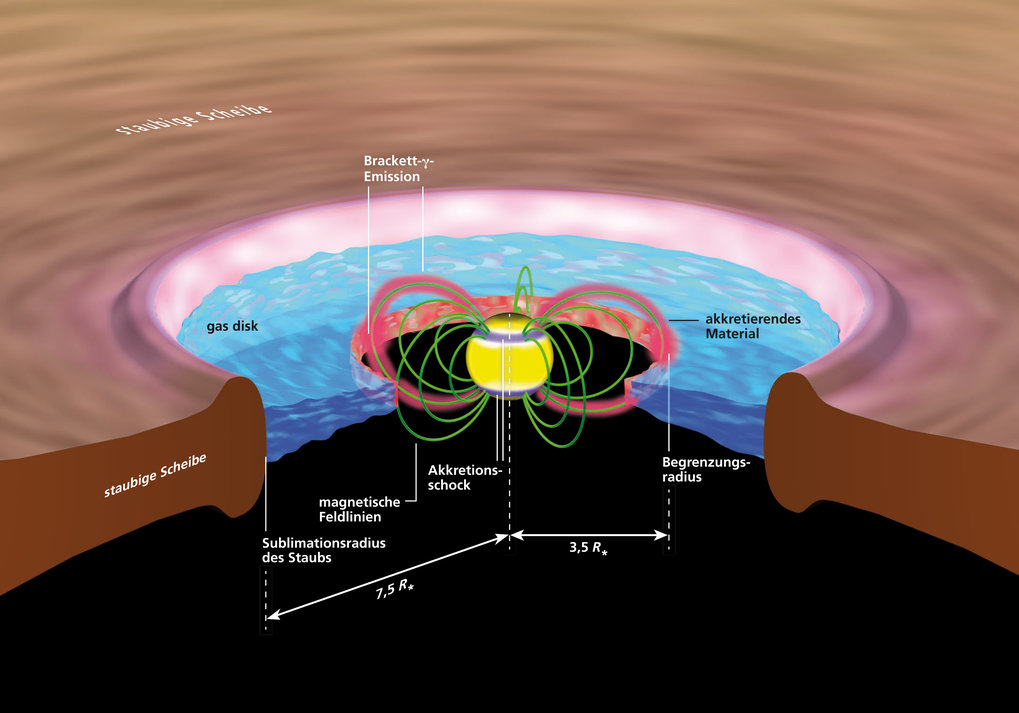
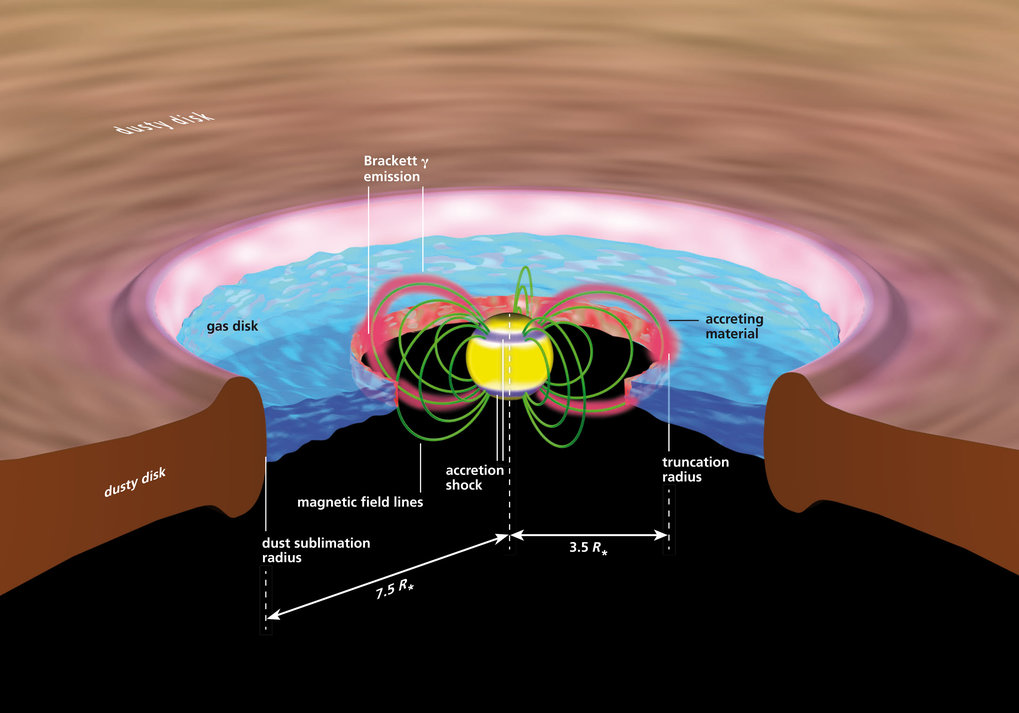
Schematic representation of the process of magnetospheric accretion of material onto a young star.


Magnetic fields produced by the young star carry gas through flow channels from the disk to the polar regions of the star. The ionized hydrogen gas emits . Image: MPIA graphics department

Too small to be part of the disk

With those observations, Rebeca García López and her colleagues have pushed the boundaries even further inwards. GRAVITY could see the emissions corresponding to the line associated with highly excited hydrogen (Brackett-γ, Brγ) and demonstrate that they stem from a region no more than 3.5 times the radius of the star across (about 3 million km, or 8 times the distance the distance between the Earth and the Moon).

This is a significant difference. According to all physics-based models, the inner rim of a circumstellar disk cannot possibly be that close to the star. If the light originates from that region, it cannot be emitted from any section of the disk. At that distance, the light also cannot be due to a stellar wind blown away by the young stellar object – the only other realistic possibility. Taken together, what is left as a plausible explanation is the magnetospheric accretion model.

What’s next?

In future observations, again using GRAVITY, the researchers will try to get data that allows them a more detailed reconstruction of physical processes close to the star. “By observing the location of the funnel's lower endpoint over time, we hope to pick up clues as to how distant the magnetic North and South poles are from the star’s axis of rotation,” explains Wolfgang Brandner, co-author and scientist at MPIA. If North and South Pole directly aligned with the rotation axis, their position over time would not change at all.

They also hope to pick up clues as to whether the star’s magnetic field is really as simple as a North Pole–South Pole configuration. “Magnetic fields can be much more complicated and have additional poles,” explains Thomas Henning, Director at MPIA. “The fields can also change over time, which is part of a presumed explanation for the brightness variations of T Tauri stars.”

All in all, this is an example of how observational techniques can drive progress in astronomy. In this case, the new observational techniques embody in GRAVITY were able to confirm ideas about the growth of young stellar objects that were proposed as long as 30 years ago. And future observations are set to help us understand even better how baby stars are being fed.

Background information

The MPIA researchers involved are Rebeca García López (also Dublin Institute for Advanced Studies [DIAS] and University College Dublin), Alessio Caratti o Garatti (also DIAS), Lucia Klarmann, Joel Sanchez-Bermudez, Wolfgang Brandner, Thomas Henning, Stefan Hippler and Silvia Scheithauer, as part of the GRAVITY Collaboration.

Source: Max Planck Institute for Astronomy


Contacts

Rebeca García López

Phone:+353 1 716-2223

Max Planck Institute for Astronomy, Heidelberg


Wolfgang Brandner

Phone:+49 6221 528-289

Max Planck Institute for Astronomy, Heidelberg


Markus Pössel

Head of press and public relations

Phone:+49 6221 528-261

Max Planck Institute for Astronomy, Heidelberg


Markus Nielbock

Press and public relations officer

Phone:+49 6221 528-134

Max Planck Institute for Astronomy, Heidelberg


Original publications

1. GRAVITY Collaboration: R. Garcia Lopez et al. A measure of the size of the magnetospheric accretion region in TW Hydrae

Nature (2020), DOI: 10.1038/s41586-020-2613-1 - Source

2. J. Bouvier et al.

Probing the magnetospheric accretion region of the young pre-transitional disk system DoAr 44 using VLTI/GRAVITY Astronomy & Astrophysics, 636, A108 (2020) .  Source / DOI 


Downloads

Images in high resolution

tw_hya-schematic-de_hires 1.21 MB

tw_hya-schematic-en_hires 1.18 MB

tw_hya-ttauristar_teaser_hires 7.0 MB


Press releases of our partners

GRAVITY observes young star feeding from its surrounding disk

Max Planck Institute for extraterrestrial Physics


Links

GRAVITY webpages at MPIA


Wednesday, April 11, 2018

SPHERE Reveals Fascinating Zoo of Discs Around Young Stars

SPHERE images a zoo of dusty discs around young stars

PR Image eso1811b
SPHERE images the edge-on disc around the star GSC 07396-00759

PR Image eso1811c
SPHERE image of the dusty disc around IM Lupi


Videos
 
ESOcast 156 Light: Weird and Wonderful Dusty Discs (4K UHD)


New images from the SPHERE instrument on ESO’s Very Large Telescope are revealing the dusty discs surrounding nearby young stars in greater detail than previously achieved. They show a bizarre variety of shapes, sizes and structures, including the likely effects of planets still in the process of forming.

The SPHERE instrument on ESO’s Very Large Telescope (VLT) in Chile allows astronomers to suppress the brilliant light of nearby stars in order to obtain a better view of the regions surrounding them. This collection of new SPHERE images is just a sample of the wide variety of dusty discs being found around young stars.

These discs are wildly different in size and shape — some contain bright rings, some dark rings, and some even resemble hamburgers. They also differ dramatically in appearance depending on their orientation in the sky — from circular face-on discs to narrow discs seen almost edge-on.

SPHERE’s primary task is to discover and study giant exoplanets orbiting nearby stars using direct imaging. But the instrument is also one of the best tools in existence to obtain images of the discs around young stars — regions where planets may be forming. Studying such discs is critical to investigating the link between disc properties and the formation and presence of planets.

Many of the young stars shown here come from a new study of T Tauri stars, a class of stars that are very young (less than 10 million years old) and vary in brightness. The discs around these stars contain gas, dust, and planetesimals — the building blocks of planets and the progenitors of planetary systems.

These images also show what our own Solar System may have looked like in the early stages of its formation, more than four billion years ago.

Most of the images presented were obtained as part of the DARTTS-S (Discs ARound T Tauri Stars with SPHERE) survey. The distances of the targets ranged from 230 to 550 light-years away from Earth. For comparison, the Milky Way is roughly 100 000 light-years across, so these stars are, relatively speaking, very close to Earth. But even at this distance, it is very challenging to obtain good images of the faint reflected light from discs, since they are outshone by the dazzling light of their parent stars.

Another new SPHERE observation is the discovery of an edge-on disc around the star GSC 07396-00759, found by the SHINE (SpHere INfrared survey for Exoplanets) survey. This red star is a member of a multiple star system also included in the DARTTS-S sample but, oddly, this new disc appears to be more evolved than the gas-rich disc around the T Tauri star in the same system, although they are the same age.This puzzling difference in the evolutionary timescales of discs around two stars of the same age is another reason why astronomers are keen to find out more about discs and their characteristics.

Astronomers have used SPHERE to obtain many other impressive images, as well as for other studies including the interaction of a planet with a disc, the orbital motions within a system, and the time evolution of a disc.

The new results from SPHERE, along with data from other telescopes such as ALMA, are revolutionising astronomers’ understanding of the environments around young stars and the complex mechanisms of planetary formation.


More Information


The images of T Tauri star discs were presented in a paper entitled “Disks Around T Tauri Stars With SPHERE (DARTTS-S) I: SPHERE / IRDIS Polarimetric Imaging of 8 Prominent T Tauri Disks”, by H. Avenhaus et al., to appear in in the Astrophysical Journal. The discovery of the edge-on disc is reported in a paper entitled “A new disk discovered with VLT/SPHERE around the M star GSC 07396-00759”, by E. Sissa et al., to appear in the journal Astronomy & Astrophysics.

The first team is composed of Henning Avenhaus (Max Planck Institute for Astronomy, Heidelberg, Germany; ETH Zurich, Institute for Particle Physics and Astrophysics, Zurich, Switzerland; Universidad de Chile, Santiago, Chile), Sascha P. Quanz (ETH Zurich, Institute for Particle Physics and Astrophysics, Zurich, Switzerland; National Center of Competence in Research “PlanetS”), Antonio Garufi (Universidad Autonónoma de Madrid, Madrid, Spain), Sebastian Perez (Universidad de Chile, Santiago, Chile; Millennium Nucleus Protoplanetary Disks Santiago, Chile), Simon Casassus (Universidad de Chile, Santiago, Chile; Millennium Nucleus Protoplanetary Disks Santiago, Chile), Christophe Pinte (Monash University, Clayton, Australia; Univ. Grenoble Alpes, CNRS, IPAG, Grenoble, France), Gesa H.-M. Bertrang (Universidad de Chile, Santiago, Chile), Claudio Caceres (Universidad Andrés Bello, Santiago, Chile), Myriam Benisty (Unidad Mixta Internacional Franco-Chilena de Astronomía, CNRS/INSU; Universidad de Chile, Santiago, Chile; Univ. Grenoble Alpes, CNRS, IPAG, Grenoble, France) and Carsten Dominik (Anton Pannekoek Institute for Astronomy, University of Amsterdam, The Netherlands).

The second team is composed of: E. Sissa (INAF-Osservatorio Astronomico di Padova, Padova, Italy), J. Olofsson (Max Planck Institute for Astronomy, Heidelberg, Germany; Universidad de Valparaíso, Valparaíso, Chile), A. Vigan (Aix-Marseille Université, CNRS, Laboratoire d’Astrophysique de Marseille, Marseille, France), J.C. Augereau (Université Grenoble Alpes, CNRS, IPAG, Grenoble, France) , V. D’Orazi (INAF-Osservatorio Astronomico di Padova, Padova, Italy), S. Desidera (INAF-Osservatorio Astronomico di Padova, Padova, Italy), R. Gratton (INAF-Osservatorio Astronomico di Padova, Padova, Italy), M. Langlois (Aix-Marseille Université, CNRS, Laboratoire d’Astrophysique de Marseille Marseille, France; CRAL, CNRS, Université de Lyon, Ecole Normale Suprieure de Lyon, France), E. Rigliaco (INAF-Osservatorio Astronomico di Padova, Padova, Italy), A. Boccaletti (LESIA, Observatoire de Paris-Meudon, CNRS, Université Pierre et Marie Curie, Université Paris Diderot, Meudon, France), Q. Kral (LESIA, Observatoire de Paris-Meudon, CNRS, Université Pierre et Marie Curie, Université Paris Diderot, Meudon, France; Institute of Astronomy, University of Cambridge, Cambridge, UK), C. Lazzoni (INAF-Osservatorio Astronomico di Padova, Padova, Italy; Universitá di Padova, Padova, Italy), D. Mesa (INAF-Osservatorio Astronomico di Padova, Padova, Italy; University of Atacama, Copiapo, Chile), S. Messina (INAF-Osservatorio Astrofisico di Catania, Catania, Italy), E. Sezestre (Université Grenoble Alpes, CNRS, IPAG, Grenoble, France), P. Thébault (LESIA, Observatoire de Paris-Meudon, CNRS, Université Pierre et Marie Curie, Université Paris Diderot, Meudon, France), A. Zurlo (Universidad Diego Portales, Santiago, Chile; Unidad Mixta Internacional Franco-Chilena de Astronomia, CNRS/INSU; Universidad de Chile, Santiago, Chile; INAF-Osservatorio Astronomico di Padova, Padova, Italy), T. Bhowmik (Université Grenoble Alpes, CNRS, IPAG, Grenoble, France), M. Bonnefoy (Université Grenoble Alpes, CNRS, IPAG, Grenoble, France), G. Chauvin (Université Grenoble Alpes, CNRS, IPAG, Grenoble, France; Universidad Diego Portales, Santiago, Chile), M. Feldt (Max Planck Institute for Astronomy, Heidelberg, Germany), J. Hagelberg (Université Grenoble Alpes, CNRS, IPAG, Grenoble, France), A.-M. Lagrange (Université Grenoble Alpes, CNRS, IPAG, Grenoble, France), M. Janson (Stockholm University, Stockholm, Sweden; Max Planck Institute for Astronomy, Heidelberg, Germany), A.-L. Maire (Max Planck Institute for Astronomy, Heidelberg, Germany), F. Ménard (Université Grenoble Alpes, CNRS, IPAG, Grenoble, France), J. Schlieder (NASA Goddard Space Flight Center, Greenbelt, Maryland, USA; Max Planck Institute for Astronomy, Heidelberg, Germany), T. Schmidt (Université Grenoble Alpes, CNRS, IPAG, Grenoble, France), J. Szulági (Institute for Particle Physics and Astrophysics, ETH Zurich, Zurich, Switzerland; Institute for Computational Science, University of Zurich, Zurich, Switzerland), E. Stadler (Université Grenoble Alpes, CNRS, IPAG, Grenoble, France), D. Maurel (Université Grenoble Alpes, CNRS, IPAG, Grenoble, France), A. Deboulbé (Université Grenoble Alpes, CNRS, IPAG, Grenoble, France), P. Feautrier (Université Grenoble Alpes, CNRS, IPAG, Grenoble, France), J. Ramos (Max Planck Institute for Astronomy, Heidelberg, Germany) and R. Rigal (Anton Pannekoek Institute for Astronomy, Amsterdam, The Netherlands).

ESO is the foremost intergovernmental astronomy organisation in Europe and the world’s most productive ground-based astronomical observatory by far. It has 15 Member States: Austria, Belgium, the Czech Republic, Denmark, France, Finland, Germany, Italy, the Netherlands, Poland, Portugal, Spain, Sweden, Switzerland and the United Kingdom, along with the host state of Chile and with Australia as a strategic partner. ESO carries out an ambitious programme focused on the design, construction and operation of powerful ground-based observing facilities enabling astronomers to make important scientific discoveries. ESO also plays a leading role in promoting and organising cooperation in astronomical research. ESO operates three unique world-class observing sites in Chile: La Silla, Paranal and Chajnantor. At Paranal, ESO operates the Very Large Telescope and its world-leading Very Large Telescope Interferometer as well as two survey telescopes, VISTA working in the infrared and the visible-light VLT Survey Telescope. ESO is also a major partner in two facilities on Chajnantor, APEX and ALMA, the largest astronomical project in existence. And on Cerro Armazones, close to Paranal, ESO is building the 39-metre Extremely Large Telescope, the ELT, which will become “the world’s biggest eye on the sky”.


Links


Contacts

Henning Avenhaus
Max Planck Institute for Astronomy
Heidelberg, Germany
Email:
havenhaus@gmail.com

Elena Sissa
INAF - Astronomical Observatory of Padova
Padova, Italy
Email:
elena.sissa@inaf.it

Richard Hook
ESO Public Information Officer
Garching bei München, Germany
Tel: +49 89 3200 6655
Cell: +49 151 1537 3591
Email:
rhook@eso.org

Source: ESO/News

Wednesday, June 15, 2016

VLT Snaps An Exotic Exoplanet “First”

 Credit:  ESO/Schmidt et al.


Astronomers hunt for planets orbiting other stars (exoplanets) using a variety of methods. One successful method is direct imaging; this is particularly effective for planets on wide orbits around young stars, because the light from the planet is not overwhelmed by light from the host star and is thus easier to spot.

This image demonstrates this technique. It shows a T-Tauri star named CVSO 30, located approximately 1200 light-years away from Earth in the 25 Orionis group (slightly northwest of Orion’s famous Belt). In 2012, astronomers found that CVSO 30 hosted one exoplanet (CVSO 30b) using a detection method known as transit photometry, where the light from a star observably dips as a planet travels in front of it. Now, astronomers have gone back to look at the system using a number of telescopes. The study combines observations obtained with the ESO’s Very Large Telescope (VLT) in Chile, the W. M. Keck Observatory in Hawaii, and the Calar Alto Observatory facilities in Spain.

Using the data astronomers have imaged what is likely to be a second planet! To produce the image, astronomers exploited the astrometry provided by VLT’s NACO and SINFONI instruments.

This new exoplanet, named CVSO 30c, is the small dot to the upper left of the frame (the large blob is the star itself). While the previously-detected planet, CVSO 30b, orbits very close to the star, whirling around CVSO 30 in just under 11 hours at an orbital distance of 0.008 au, CVSO 30c orbits significantly further out, at a distance of 660 au, taking a staggering 27 000 years to complete a single orbit. (For reference, the planet Mercury orbits the Sun at an average distance of 0.39 au, while Neptune sits at just over 30 au.)

If it is confirmed that CVSO 30c orbits CVSO 30, this would be the first star system to host both a close-in exoplanet detected by the transit method and a far-out exoplanet detected by direct imaging. Astronomers are still exploring how such an exotic system came to form in such a short timeframe, as the star is only 2.5 million years old; it is possible that the two planets interacted at some point in the past, scattering off one another and settling in their current extreme orbits.

Link
 Source: ESO/Images

Tuesday, June 14, 2016

Young star offers a glimpse of the Sun’s past

Young star offers a glimpse of the Sun’s past
Copyright: ESA/Hubble, NASA, K. Stapelfeldt (GSFC), B. Stecklum & A. Choudhary (Thüringer Landessternwarte Tautenburg, Germany) 


It may look like a star, it may be called a star, but it does not yet generate energy like a normal star. This is because this star is still being formed.

It offers a fascinating glimpse into our own past because our Sun began its life as such a ‘T Tauri’ star some 4.6 billion years ago.

Located 1800 light-years away in the constellation Cygnus, V1331 Cyg was originally nothing but a diffuse cloud of gas in space. Slowly over time, gravity has pulled it together, but the process is not yet over. V1331 is not yet fully formed and so is still larger than it will eventually be once gravity has done its job. It is shining because of the energy being released as it shrinks.

Eventually, it will be compact enough that the temperature in its centre will ignite nuclear fusion. Hydrogen will then be transformed into helium and this will release the torrents of energy that will make V1331 Cyg shine for billions of years as a bona fide star.

The swathes of dust that surround the star are the remnants of the cloud from which it condensed. Often, this circumstellar disc obscures our view of the young stellar object but, by chance, we happen be looking down on the rotational pole of the star, so it appears as a dazzling ‘searchlight’ beam.

This circumstellar disc is the site where planets may be forming, and in the case of V1331 Cyg time is running out. A T Tauri star produces a strong ‘wind’ of atomic particles that dissipates the disc, bringing planet formation to an end.

The image was taken by the NASA/ESA Hubble Space Telescope and is a combination of three exposures taken at different wavelengths. These almost correspond to human eyesight: blue, green and, instead of red light that our eyes would see, Hubble used near-infrared.


Tuesday, September 23, 2014

NOAO/NRAO: Infant Solar System Shows Signs of Windy Weather

Artist’s rendition of AS 205 N, a T Tauri star that is part of a multiple star system.

Image Credit: P. Marenfeld & NOAO/AURA/NSF

Astronomers using the Atacama Large Millimeter/submillimeter Array (ALMA) have observed what may be the first-ever signs of windy weather around a T Tauri star, an infant analog of our own Sun. This may help explain why some T Tauri stars have disks that glow weirdly in infrared light while others shine in a more expected fashion.

T Tauri stars are the infant versions of stars like our Sun. They are relatively normal, medium-size stars that are surrounded by the raw materials to build both rocky and gaseous planets. Though nearly invisible in optical light, these disks shine in both infrared and millimeter-wavelength light.

“The material in the disk of a T Tauri star usually, but not always, emits infrared radiation with a predictable energy distribution,” said Colette Salyk, an astronomer with the National Optical Astronomical Observatory (NOAO) in Tucson, Ariz., and lead author on a paper published in the Astrophysical Journal. “Some T Tauri stars, however, like to act up by emitting infrared radiation in unexpected ways.”

To account for the different infrared signature around such similar stars, astronomers propose that winds may be emanating from within some T Tauri stars’ protoplanetary disks. These winds could have important implications for planet formation, potentially robbing the disk of some of the gas required for the formation of giant Jupiter-like planets, or stirring up the disk and causing the building blocks of planets to change location entirely. These winds have been predicted by astronomers, but have never been clearly detected.

Using ALMA, Salyk and her colleagues looked for evidence of a possible wind in AS 205 N – a T Tauri star located 407 light-years away at the edge of a star-forming region in the constellation Ophiuchus, the Snake Bearer. This star seems to exhibit the strange infrared signature that has intrigued astronomers.

With ALMA’s exceptional resolution and sensitivity, the researchers were able to study the distribution of carbon monoxide around the star. Carbon monoxide is an excellent tracer for the molecular gas that makes up stars and their planet-forming disks. These studies confirmed that there was indeed gas leaving the disk’s surface, as would be expected if a wind were present. The properties of the wind, however, did not exactly match expectations.

This difference between observations and expectations could be due to the fact that AS 205 N is actually part of a multiple star system – with a companion, dubbed AS 205 S, that is itself a binary star.

This multiple star arrangement may suggest that the gas is leaving the disk’s surface because it’s being pulled away by the binary companion star rather than ejected by a wind.

“We are hoping these new ALMA observations help us better understand winds, but they have also left us with a new mystery,” said Salyk. “Are we seeing winds, or interactions with the companion star?”

The study’s authors are not pessimistic, however. They plan to continue their research with more ALMA observations, targeting other unusual T Tauri stars, with and without companions, to see whether they show these same features.

T Tauri stars are named after their prototype star, discovered in 1852 – the third star in the constellation Taurus whose brightness was found to vary erratically. At one point, some 4.5 billion years ago, our Sun was a T Tauri star.

Other authors include Klaus Pontoppidan, Space Telescope Science Institute; Stuartt Corder, Joint ALMA Observatory; Diego Muñoz, Center for Space Research, Department of Astronomy, Cornell University; and Ke Zhang and Geoffrey Blake, Division of Geological & Planetary Sciences, California Institute of Technology,

The National Optical Astronomy Observatory is operated by Association of Universities for Research in Astronomy Inc. under a cooperative agreement with the National Science Foundation.

The National Radio Astronomy Observatory is a facility of the National Science Foundation, operated under cooperative agreement by Associated Universities, Inc. NRAO, together with its international partners, operates ALMA – the world’s most powerful observatory operating at millimeter and submillimeter wavelengths. 

ALMA, an international astronomy facility, is a partnership of Europe, North America and East Asia in cooperation with the Republic of Chile. ALMA construction and operations are led on behalf of Europe by ESO, on behalf of North America by the National Radio Astronomy Observatory (NRAO), and on behalf of East Asia by the National Astronomical Observatory of Japan (NAOJ). The Joint ALMA Observatory (JAO) provides the unified leadership and management of the construction, commissioning and operation of ALMA.

Media Contact:

Dr. Katy Garmany
Deputy Press Officer
National Optical Astronomy Observatory
950 N Cherry Ave
Tucson AZ 85719 USA
+1 520-318-8526
E-mail:
kgarmany@noao.edu


Science Contact

Dr. Colette Salyk
National Optical Astronomy Observatory
950 N Cherry Ave
Tucson AZ 85719 USA
e-mail:
csalyk@noao.edu

NRAO Media Contact

Charles Blue
Public Information Officer
National Radio Astronomy Observatory
520 Edgemont Road
Charlottesville, VA 22904
+1 434-296-0314
E-mail:
cblue@nrao.edu