Showing posts with label NGC 6357. Show all posts

Sunday, December 28, 2025

Holiday Collection: Cosmic Holiday Greetings From NASA's Chandra X-ray Observatory

NGC 4782/NGC 4783,NGC 2264, The Christmas Tree Nebula,NGC 6357/Pismis 24 and M78
Four images with Chandra data that are connected to the winter season, labeled.
Credit: NASA/CXC/SAO


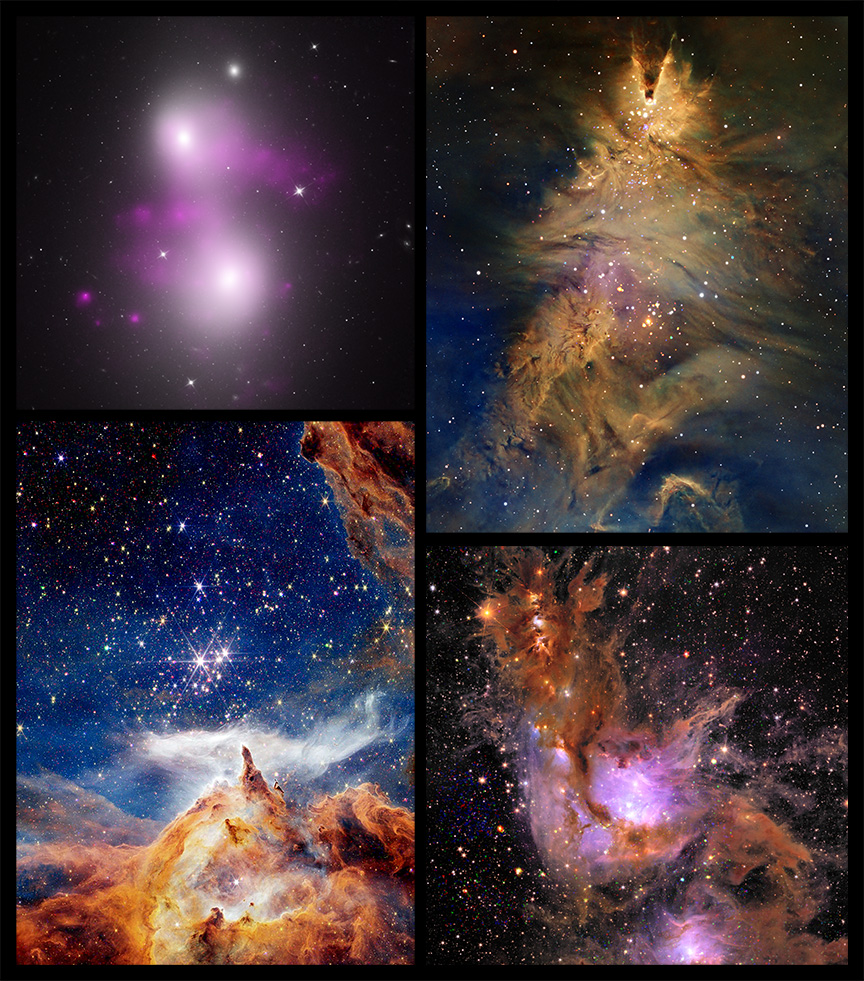
NASA’s Chandra X-ray Observatory is sending out a holiday card with four new images of cosmic wonders. Each of the quartet of objects evokes the winter season or one of its celebratory days either in its name or shape.

Chandra’s seasonal greetings begin with NGC 4782 and NGC 4783, a pair of colliding galaxies when oriented in a certain way resembles a snowman. The top and bottom of the snowman are each elliptical galaxies, separated by a distance of about 170 million light-years. The galaxies, seen in an image from NASA’s Hubble Space Telescope (gray), are bound together through gravity. X-rays from Chandra (purple) show a bridge of hot gas between the two galaxies, like a winter scarf.

Four images with Chandra data that are connected to the winter season, labeled.
Credit: NASA/CXC/SAOTo the right of the cosmic snowman is one of the most iconic symbols of the season, a Christmas tree. This celestial version takes an optical light image (red, gold, blue, and white) from an astrophotographer that shows the “branches” of NGC 2264, a relatively young nebula where new stars are forming. Within this cloud of gas and dust, baby stars appear as high-energy baubles in X-ray light from Chandra (red, green, and blue) plus some additional X-ray data from ESA’s XMM-Newton.

To the right of the cosmic snowman is one of the most iconic symbols of the season, a Christmas tree. This celestial version takes an optical light image (red, gold, blue, and white) from an astrophotographer that shows the “branches” of NGC 2264, a relatively young nebula where new stars are forming. Within this cloud of gas and dust, baby stars appear as high-energy baubles in X-ray light from Chandra (red, green, and blue) plus some additional X-ray data from ESA’s XMM-Newton.

NGC 2264, The Christmas Tree Nebula, in "twinkling" light.
Credit: X-ray: NASA/CXC/SAO and ESA/XMM-Newton; Optical: B. Vuk;
Image Processing: NASA/CXC/SAO/L. Frattare and K. Arcand
 
On the bottom left is the nebula NGC 6357 that contains Pismis 24, a young cluster of stars about 5,500 light-years from Earth. This stellar landscape is reminiscent of a winter vista in a view from NASA’s James Webb Space Telescope (red, green, and blue). Chandra data (red, green and blue) punctuate the scene with bursts of colored lights representing high-energy activity from the active stars.

The final image in this holiday card display is M78, a striking nebula in the Orion constellation that may also bring a partridge in the proverbial pear tree to mind. M78 is a reflection nebula, which is cloud interstellar dust that glows from the scattered light embedded within it. The bird-like structure is seen in infrared and optical light by Euclid (red, green and blue) while Chandra data provide speckled lights across the nebula (red, green, and blue).

NASA's Marshall Space Flight Center in Huntsville, Alabama, manages the Chandra program. The Smithsonian Astrophysical Observatory's Chandra X-ray Center controls science operations from Cambridge, Massachusetts, and flight operations from Burlington, Massachusetts.


Visual Description:

This release features four colorful composite images presented in an irregular grid, each evoking an aspect of winter and the holiday season.

The first image, at our upper left, features a pair of colliding galaxies that resembles a snowman in optical light from Hubble when oriented vertically. The two galaxies, NGC 4782 and NGC 4783, appear as hazy white balls with solid white cores, one stacked above the other. Linking the two galaxies is a bridge of hot gas in X-ray light from Chandra depicted here as a string of fuzzy neon purple balls. The string of gas loosely zigzags back and forth between the two galaxies, like a cozy scarf worn by a snowman.

The second holiday image, at the upper right of the irregular grid, strongly resembles a golden Christmas tree bedecked with twinkling lights. The tree is actually NGC 2264, a relatively young nebula where new stars are forming. The tree's branches, which sweep back and forth in a roughly conical shape, are golden clouds of dust and gas, all from optical light captured by an astrophotographer. Tucked into these branches are colorful lights and glowing baubles in X-rays from Chandra and XMM-Newton, colored in green, blue, purple, and orange; baby stars growing inside the nebula.

At the lower lefthand corner of the grid is a winter scene fit for a holiday greeting card. Above what appears to be a fantastical snowy mountainscape, is a brilliant blue sky packed with colorful lights. The golden mountainscape is in fact part of the nebula NGC 6357, as captured by NASA's James Webb Space Telescope. The green, red, and golden lights in the blue sky above are bursts of high-energy X-rays from active stars, detected by Chandra.

The final holiday image, at the lower right of the grid, is a nebula which calls to mind the first gift in the Christmas carol 'The Twelve Days of Christmas'. Here, the wispy burnt orange nebula, M78, forms a tree, with a vertical trunk near the center of the image in infrared and optical light from the European Space Agency's Euclid mission. The tree's bushy branches reach toward our upper left, and its tail of roots drifts toward our lower right. The tree of interstellar dust is offset by a pink c,brloud, which resembles cotton candy, and is backed by a black sky packed with speckled lights. At the top of the tree, near the upper lefthand corner of the image, is a dusty orange cloud shape which strongly resembles a bird in profile; the proverbial pa,hrrtridge in the pear tree. Sprinkled across are tiny dots of colorful lights,showcasing X-rays captured by Chandra.


Fast Facts for NGC 4782/NGC 4783, The Snowman Galaxies:

Credit: X-ray: NASA/CXC/SAO; Optical: NASA/ESA/STScI/HST; Image Processing: NASA/CXC/SAO/J. Schmidt
Release Date: December 22, 2025
Scale: Image is about 1.4 arcmin (87,000 light-years) across.
Category: Groups and Clusters of Galaxies
Coordinates (J2000): RA: 12h 54m 35.6s | Dec: -12° 34' 07.4"
Constellation: Corvus
Observation Date(s): 1 observation June 16, 2002
Observation Time: 13 hours and 47 minutes
Obs. IDs: 3220
Instrument: ACIS
References: Machacek, M., et al., 2007, ApJ, 664, 804
Color Code: X-ray: purple; Optical: grayscale
Distance Estimate: About 210 million light-years from Earth


Fast Facts for NGC 2264, The Christmas Tree Nebula:

Credit: X-ray: NASA/CXC/SAO and ESA/XMM-Newton; Optical: B. Vuk; Image Processing: NASA/CXC/SAO/L. Frattare and K. Arcand
Release Date: December 22, 2025
Scale: Image is about 77 arcmin (56 light-years) across.
Category: Normal Stars & Star Clusters
Coordinates (J2000): RA: 06h 40m 42.8s | Dec: +09° 49' 03.6"
Constellation: Monoceros
Observation Date(s): 8 observations from February 2002 to December 2011
Observation Time: 137 hours 26 minutes (5 days 17 hours 26 minutes)
Obs. IDs: 2540, 2550, 9768, 9769, 13610, 13611, 14368, 14369
Instrument: ACIS
References: Ramirez, S., et al., 2004, AJ, 127, 2659
Instrument: ACIS
Color Code: X-ray: red, green, and blue; Optical: red, gold, blue, and white
Distance Estimate: About 2,500 light-years from Earth


Fast Facts for NGC 6357/Pismis 24:

Credit: X-ray: NASA/CXC/Penn State/G.Garmire; Infrared: NASA, ESA, CSA, and STScI; Image Processing: NASA/CXC/SAO/L. Frattare and NSA/ESA/CSA/STScI/A. Pagan
Release Date: December 22, 2025
Scale: Image is about 4.2 arcmin (6.7 light-years) across.
Category: Normal Stars and Star Clusters
Coordinates (J2000): RA: 17h 24m 44.4s | Dec: -34° 11' 35.9"
Constellation: Scorpius
Observation Date(s): 3 observations from July 2004 to Aug 2022
Observation Time: 30 hours 15 minutes (1 day 6 hours 15 minutes)
Obs. IDs: 4477, 18453, 26003
Instrument: ACIS
References: Townsley, L., et al., 2019, ApJS, 244, 28
Color Code: X-ray: red, green, and blue; Infrared: red, green, and blue
Distance Estimate: About 5,500 light-years from Earth


Fast Facts for M78:

Credit: X-ray: NASA/CXC/SAO; Infrared/Optical: ESA/Euclid/Euclid Consortium/NASA; Image Processing: NASA/CXC/SAO/L. Frattare
Release Date: December 22, 2025
Scale: Image is about 41 arcmin (19 light-years) across.
Category: Normal Stars and Star Clusters
Coordinates (J2000): RA: 5h 46m 45.8s | Dec: +0° 0′ 08.1"
Constellation: Orion
Observation Date(s): 2 observations: Oct 2000 and Aug 2021
Observation Time: 28 hours 56 minutes (1 day 4 hours 56 minutes)
Obs. IDs: 1872, 25686
Instrument: ACIS
References: Grosso, N et al., 2004, A&A, 419, 653
Color Code: X-ray: red, green, and blue; Infrared/Optical: red, green, and blue
Distance Estimate: About 1,600 light-years from Earth


Sunday, July 06, 2025

Citizen Science Born in the Pandemic: The Hubble Image Similarity Project

A handful of images used in the Hubble Image Similarity Project
Adapted from White & Peek 2025

Motivated by a desire to support community members financially during the coronavirus pandemic, researchers employed 30 local citizen scientists in the Hubble Image Similarity Project. This project quantified the similarities between astronomical images, providing a way to test the results of image-search algorithms.

The Eagle Nebula, pictured here in an image from Kitt Peak National Observatory, is a star-forming region in the Milky Way. Credit:
  T.A.Rector (NRAO/AUI/NSF and NOIRLab/NSF/AURA) and B.A.Wolpa Credit: NOIRLab/NSF/AURA); CC BY 4.0

Seeking Similarities

Say you have an image of a star-forming region, featuring eye-catching gas clouds, dense and dusty knots, and newborn stars. How would you go about finding other images that resemble yours?

You might start your search with an astronomical image database, using filters for object type or instrument to sift through thousands and thousands of options. But even filtering out everything but star-forming regions might yield vastly different results, given the widely varying shapes, colors, and sizes of these regions.

Or maybe you’ll feed your image into a neural network that has been trained to spot similar images. The results may seem promising, but how can you tell whether the algorithm has found the images that are the most similar? Would another algorithm do better?

An example of individual test images (green squares) extracted from a Hubble Legacy Archive image (red square). Low-contrast areas have been excluded, leaving the galaxy’s spiral arms for analysis. Credit: White & Peek 2025

The Hubble Image Similarity Project

Astronomical image collections rarely contain information about similarities between images in their metadata, and while neural networks appear to excel at gathering similar images, the results of these models are generally unverified. The Hubble Image Similarity Project, led by Richard White (Space Telescope Science Institute) and Josh Peek (Space Telescope Science Institute and Johns Hopkins University), addressed these issues with a team of citizen scientists who generated similarity information for astronomical images, providing a quantitative means to test the results of neural networks.

White and Peek began by amassing a sample of images from the Hubble Legacy Archive. This sample included many different object types, such as galaxies, planetary nebulae, star-forming regions, and star clusters. After trimming and binning the images, converting them to 8-bit grayscale, filtering out low-contrast images, and eliminating satellite trails, image artifacts, and repeated observations of the same patch of sky, 2,098 images of 666 objects remained.

Examples of similar images according to the image similarity matrix. In the lower-right corner is a visualization of the similarity data. The semicircle of data points in the bottom half of this visualization represents galaxies, while star clusters occupy the small arc near the top and nebulae sit in the island in the center of the plot. Credit: Adapted from White & Peek 2025

Citizen Scientists, Assemble

White and Peek recruited 30 members of the community within walking distance of the Space Telescope Science Institute to identify similar astronomical images, and the reviewers were paid for their work. In the three phases of the project, reviewers considered test images one at a time and 1) selected all similar images from a set of 15 comparison images, 2) selected the most similar image from a narrowed-down set of 6 comparison images, and finally 3) selected the most similar image from a set of 3 comparison images.

The citizen science team ultimately compared 5.4 million pairs of images, and White and Peek used these comparisons to produce an image similarity matrix. The matrix describes the metaphorical “distance” between the images, with the most similar images being the smallest distance apart.

Similar images resemble one another in terms of structure, texture, and other factors that White and Peek say are “difficult even to describe in words” — for example, the diffuse glow of a galaxy interrupted by a bright star with diffraction spikes, or a nebula speckled with stars and dense dusty clumps. The similarity data from this study are available online and can be used to test the performance of image-search algorithms. In future work, the authors plan to carry out a similar project using images of the Martian landscape.

By
Kerry Hensley

Citation

“The Hubble Image Similarity Project,” Richard L. White and J. E. G. Peek 2025 AJ 169 306.
doi:10.3847/1538-3881/adcb43


Saturday, December 02, 2023

Webb Study Reveals Rocky Planets Can Form in Extreme Environments

Protoplanetary Disk XUE 1 (Artist Concept)
Credits: Illustration: ESO

Protoplanetary Disk XUE 1 (MIRI Emission Spectrum: 13.3–15.5 microns)
Credits: Illustration: NASA, ESA, CSA, María Claudia Ramírez-Tannus (MPIA), Joseph Olmsted (STScI)

Protoplanetary Disk XUE 1 (MIRI Emission Spectrum: 4.95–5.15 microns)
Credits: Illustration: NASA, ESA, CSA, María Claudia Ramírez-Tannus (MPIA), Joseph Olmsted (STScI)


An international team of astronomers has used NASA’s James Webb Space Telescope to provide the first observation of water and other molecules in the highly irradiated inner, rocky-planet-forming regions of a disk in one of the most extreme environments in our galaxy. These results suggest that the conditions for rocky planet formation can occur in a possible broader range of environments than previously thought.

These are the first results from the eXtreme Ultraviolet Environments (XUE) James Webb Space Telescope program, which focuses on the characterization of planet-forming disks (vast, spinning clouds of gas, dust, and chunks of rock where planets form and evolve) in massive star-forming regions. These regions are likely representative of the environment in which most planetary systems formed. Understanding the impact of environment on planet formation is important for scientists to gain insights into the diversity of the different types of exoplanets.

The XUE program targets a total of 15 disks in three areas of the Lobster Nebula (also known as NGC 6357), a large emission nebula roughly 5,500 light-years away from Earth in the constellation Scorpius. The Lobster Nebula is one of the youngest and closest massive star-formation complexes, and is host to some of the most massive stars in our galaxy. Massive stars are hotter, and therefore emit more ultraviolet (UV) radiation. This can disperse the gas, making the expected lifetime of the disk as short as a million years. Thanks to Webb, astronomers can now study the effect of UV radiation on the inner terrestrial-planet forming regions of protoplanetary disks around stars like our Sun.

“Webb is the only telescope with the spatial resolution and sensitivity to study planet-forming disks in massive star-forming regions,” said team lead María Claudia Ramírez-Tannus of the Max Planck Institute for Astronomy in Germany.

Astronomers aim to characterize the physical properties and chemical composition of the rocky-planet-forming regions of disks in the Lobster Nebula using the Medium Resolution Spectrometer on Webb’s Mid-Infrared Instrument (MIRI). This first result focuses on the protoplanetary disk termed XUE 1, which is located in the star cluster Pismis 24.

“Only the MIRI wavelength range and spectral resolution allow us to probe the molecular inventory and physical conditions of the warm gas and dust where rocky planets form,” added team member Arjan Bik of Stockholm University in Sweden.

Due to its location near several massive stars in NGC 6357, scientists expect XUE 1 to have been constantly exposed to high amounts of ultraviolet radiation throughout its life. However, in this extreme environment the team still detected a range of molecules that are the building blocks for terrestrial planets.

“We find that the inner disk around XUE 1 is remarkably similar to those in nearby star-forming regions,” said team member Rens Waters of Radboud University in the Netherlands. “We’ve detected water and other molecules like carbon monoxide, carbon dioxide, hydrogen cyanide and acetylene. However, the emission found was weaker than some models predicted. This might imply a small outer disk radius.”

“We were surprised and excited because this is the first time that these molecules have been detected under these extreme conditions,” added Lars Cuijpers of Radboud University. The team also found small, partially crystalline silicate dust at the disk’s surface. This is considered to be the building blocks of rocky planets.

These results are good news for rocky planet formation, as the science team finds that the conditions in the inner disk resemble those found in the well-studied disks located in nearby star-forming regions, where only low-mass stars form. This suggests that rocky planets can form in a much broader range of environments than previously believed.

The team notes that the remaining observations from the XUE program are crucial to establish the commonality of these conditions.

“XUE 1 shows us that the conditions to form rocky planets are there, so the next step is to check how common that is,” says Ramírez-Tannus. “We will observe other disks in the same region to determine the frequency with which these conditions can be observed.”

These results have been published in The Astrophysical Journal.

The James Webb Space Telescope is the world’s premier space science observatory. Webb is solving mysteries in our solar system, looking beyond to distant worlds around other stars, and probing the mysterious structures and origins of our universe and our place in it. Webb is an international program led by NASA with its partners, ESA (European Space Agency) and the Canadian Space Agency.


About This Release:

Credits:

Media Contact:

Bethany Downer
ESA/Webb, Baltimore, Maryland

Ninja Menning
European Space Agency, Paris, France

Christine Pulliam
Space Telescope Science Institute, Baltimore, Maryland

Science: María Claudia Ramírez-Tannus (MPIA), Arjan Bik (Stockholm University)

Permissions: Content Use Policy

Contact Us: Direct inquiries to the News Team.

Related Links and Documents


Wednesday, October 24, 2018

Newborn Stars Blow Bubbles in the Cat's Paw Nebula

The Cat's Paw Nebula, imaged here by NASA's Spitzer Space Telescope using the MIPS and IRAC instruments, is a star-forming region that lies inside the Milky Way Galaxy. New stars may heat up the surrounding gas, which can expand to form "bubbles."  Credit: NASA/JPL-Caltech

The Cat's Paw Nebula, imaged here by NASA's Spitzer Space Telescope using the IRAC instrument, is a star-forming region inside the Milky Way Galaxy. The dark filament running through the middle of the nebula is a particularly dense region of gas and dust. Credit: NASA/JPL-Caltech

This image from NASA's Spitzer Space Telescope shows the Cat's Paw Nebula, so named for the large, round features that create the impression of a feline footprint. The nebula is a star-forming region in the Milky Way galaxy, located in the constellation Scorpius. Estimates of its distance from Earth range from about 4,200 to about 5,500 light-years.

Framed by green clouds, the bright red bubbles are the dominant feature in the image, which was created using data from two of Spitzer's instruments. After gas and dust inside the nebula collapse to form stars, the stars may in turn heat up the pressurized gas surrounding them, causing it to expand into space and create bubbles.

The green areas show places where radiation from hot stars collided with large molecules called "polycyclic aromatic hydrocarbons," causing them to fluoresce.

In some cases, the bubbles may eventually "burst," creating the U-shaped features that are particularly visible in the image below, which was created using data from just one of Spitzer's instruments.

Spitzer is an infrared telescope, and infrared light is useful to astronomers because it can penetrate thick clouds of gas and dust better than optical light (the kind visible to the human eye). The black filaments running horizontally through the nebula are regions of gas and dust so dense, not even infrared light can pass through them. These dense regions may soon be sites where another generation of stars will form.

The Cat's Paw star-forming region is estimated to be between 24 and 27 parsecs (80 and 90 light years) across. It extends beyond the left side of these images and intersects with a similar-sized star-forming region, NGC 6357. That region is also known as the Lobster Nebula - an unlikely companion for a cat.

The top image was compiled using data from the Infrared Array Camera (IRAC) and the Multiband Imaging Photometer (MIPS) aboard Spitzer. MIPS collects an additional "color" of light in the infrared range, which reveals the red-colored features, created by dust that has been warmed by the hot gas and the light from nearby stars. The second image is based on data from IRAC alone, so this dust is not visible.

The images were pulled from data collected for the Galactic Legacy Mid-Plane Survey Extraordinaire project (GLIMPSE). Using data from Spitzer, GLIMPSE created the most accurate map ever of the large central bar of the galaxy and showed that the galaxy is riddled with gas bubbles like those seen here.


News Media Contact

Calla Cofield
Jet Propulsion Laboratory, Pasadena, Calif.
626-808-2469
calla.e.cofield@jpl.nasa.gov


Thursday, February 02, 2017

Celestial Cat Meets Cosmic Lobster

The Cat’s Paw and Lobster Nebulae

PR Image eso1705b
Highlights from VST image of Cat’s Paw and Lobster Nebulae

PR Image eso1705c
The star formation regions NGC 6334 and NGC 6357 in the constellation of Scorpius


Videos
 
ESOcast 94 Light: Celestial Cat Meets Cosmic Lobster 4K UHD

Zooming in on the Cat’s Paw and Lobster Nebulae

Panning across the Cat’s Paw and Lobster Nebulae


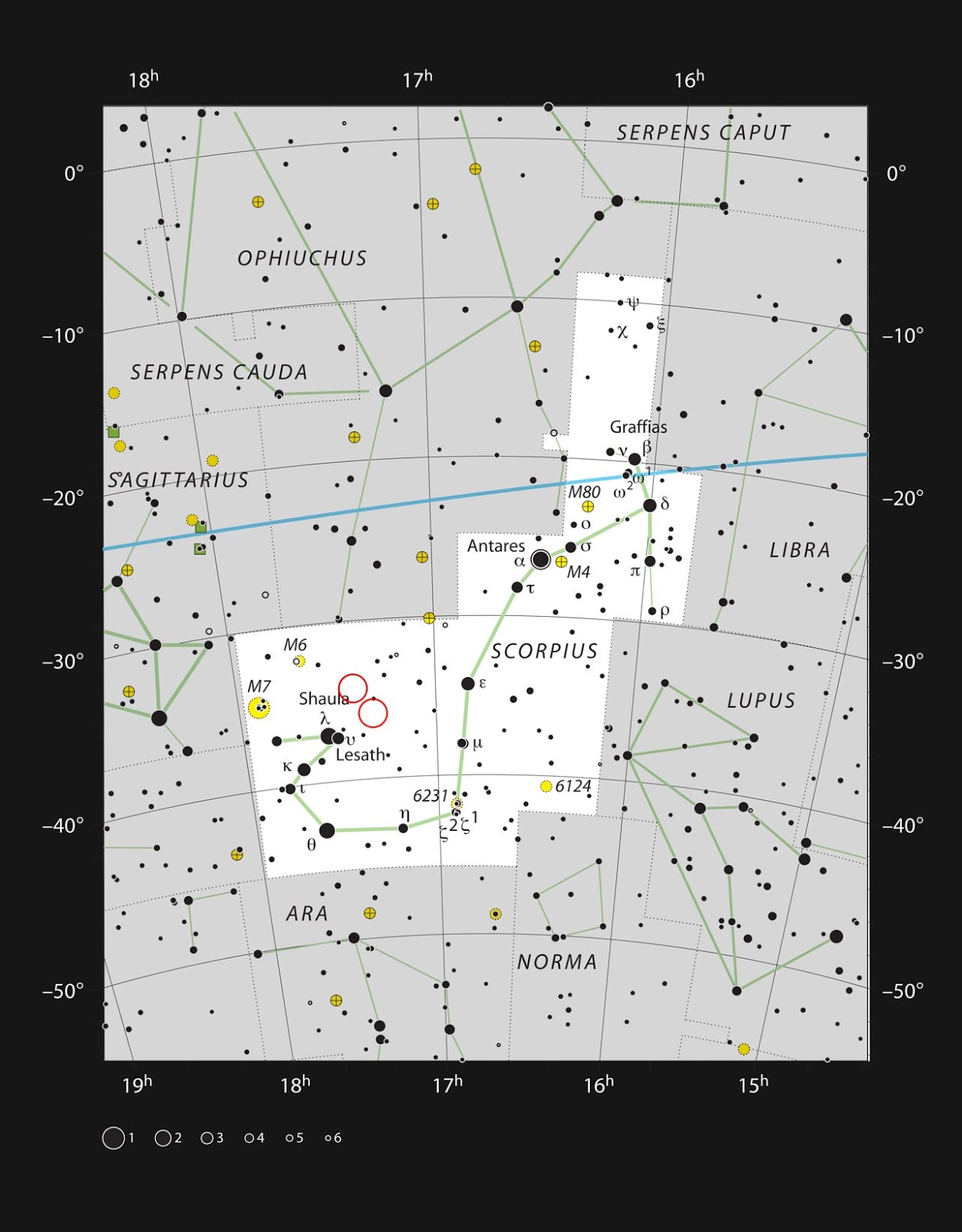
Astronomers have for a long time studied the glowing, cosmic clouds of gas and dust catalogued as NGC 6334 and NGC 6357, this gigantic new image from ESO’s Very Large Telescope Survey Telescope being only the most recent one. With around two billion pixels this is one of the largest images ever released by ESO. The evocative shapes of the clouds have led to their memorable names: the Cat’s Paw Nebula and the Lobster Nebula, respectively. 

NGC 6334 is located about 5500 light-years away from Earth, while NGC 6357 is more remote, at a distance of 8000 light-years. Both are in the constellation of Scorpius (The Scorpion), near the tip of its stinging tail.

The British scientist John Herschel first saw traces of the two objects, on consecutive nights in June 1837, during his three-year expedition to the Cape of Good Hope in South Africa. At the time, the limited telescopic power available to Herschel, who was observing visually, only allowed him to document the brightest “toepad” of the Cat’s Paw Nebula. It was to be many decades before the true shapes of the nebulae became apparent in photographs — and their popular names coined.

The three toepads visible to modern telescopes, as well as the claw-like regions in the nearby Lobster Nebula, are actually regions of gas — predominantly hydrogen — energised by the light of brilliant newborn stars. With masses around 10 times that of the Sun, these hot stars radiate intense ultraviolet light. When this light encounters hydrogen atoms still lingering in the stellar nursery that produced the stars, the atoms become ionised. Accordingly, the vast, cloud-like objects that glow with this light from hydrogen (and other) atoms are known as emission nebulae.

Thanks to the power of the 256-megapixel OmegaCAM camera, this new Very Large Telescope Survey Telescope (VST) image reveals tendrils of light-obscuring dust rippling throughout the two nebulae. At 49511 x 39136 pixels this is one of the largest images ever released by ESO.

OmegaCAM is a successor to ESO’s celebrated Wide Field Imager (WFI), currently installed at the MPG/ESO 2.2-metre telescope on La Silla. The WFI was used to photograph the Cat’s Paw Nebula in 2010, also in visible light but with a filter that allowed the glow of hydrogen to shine through more clearly (eso1003). Meanwhile, ESO’s Very Large Telescope has taken a deep look into the Lobster Nebula, capturing the many hot, bright stars that influence the object’s colour and shape (eso1226).

Despite the cutting-edge instruments used to observe these phenomena, the dust in these nebulae is so thick that much of their content remains hidden to us. The Cat’s Paw Nebula is one of the most active stellar nurseries in the night sky, nurturing thousands of young, hot stars whose visible light is unable to reach us. However, by observing at infrared wavelengths, telescopes such as ESO’s VISTA can peer through the dust and reveal the star formation activity within.

Viewing nebulae in different wavelengths (colours) of light gives rise to different visual comparisons on the part of human observers. When seen in longer wavelength infrared light, for example, one portion of NGC 6357 resembles a dove, and the other a skull; it has therefore acquired the additional name of the War and Peace Nebula.


More Information

ESO is the foremost intergovernmental astronomy organisation in Europe and the world’s most productive ground-based astronomical observatory by far. It is supported by 16 countries: Austria, Belgium, Brazil, the Czech Republic, Denmark, France, Finland, Germany, Italy, the Netherlands, Poland, Portugal, Spain, Sweden, Switzerland and the United Kingdom, along with the host state of Chile. ESO carries out an ambitious programme focused on the design, construction and operation of powerful ground-based observing facilities enabling astronomers to make important scientific discoveries. ESO also plays a leading role in promoting and organising cooperation in astronomical research. ESO operates three unique world-class observing sites in Chile: La Silla, Paranal and Chajnantor. At Paranal, ESO operates the Very Large Telescope, the world’s most advanced visible-light astronomical observatory and two survey telescopes. VISTA works in the infrared and is the world’s largest survey telescope and the VLT Survey Telescope is the largest telescope designed to exclusively survey the skies in visible light. ESO is a major partner in ALMA, the largest astronomical project in existence. And on Cerro Armazones, close to Paranal, ESO is building the 39-metre European Extremely Large Telescope, the E-ELT, which will become “the world’s biggest eye on the sky”.


Links


Contacts

Richard Hook
ESO Public Information Officer
Garching bei München, Germany
Tel: +49 89 3200 6655
Cell: +49 151 1537 3591
Email: rhook@eso.org


Source: ESO

Tuesday, December 27, 2016

NGC 6357: Cosmic 'Winter' Wonderland

NGC 6357
Credit X-ray: NASA/CXC/PSU/L.Townsley et al;
 Optical: UKIRT; Infrared: NASA/JPL-Caltech 


Although there are no seasons in space, this cosmic vista invokes thoughts of a frosty winter landscape. It is, in fact, a region called NGC 6357 where radiation from hot, young stars is energizing the cooler gas in the cloud that surrounds them.

This composite image contains X-ray data from NASA's Chandra X-ray Observatory and the ROSAT telescope (purple), infrared data from NASA's Spitzer Space Telescope (orange), and optical data from the SuperCosmos Sky Survey (blue) made by the United Kingdom Infrared Telescope.

Located in our galaxy about 5,500 light years from Earth, NGC 6357 is actually a "cluster of clusters," containing at least three clusters of young stars, including many hot, massive, luminous stars. The X-rays from Chandra and ROSAT reveal hundreds of point sources, which are the young stars in NGC 6357, as well as diffuse X-ray emission from hot gas. There are bubbles, or cavities, that have been created by radiation and material blowing away from the surfaces of massive stars, plus supernova explosions.

Astronomers call NGC 6357 and other objects like it "HII" (pronounced "H-two") regions. An HII region is created when the radiation from hot, young stars strips away the electrons from neutral hydrogen atoms in the surrounding gas to form clouds of ionized hydrogen, which is denoted scientifically as "HII".

Researchers use Chandra to study NGC 6357 and similar objects because young stars are bright in X-rays. Also, X-rays can penetrate the shrouds of gas and dust surrounding these infant stars, allowing astronomers to see details of star birth that would be otherwise missed.

A recent paper on Chandra observations of NGC 6357 by Leisa Townsley of Pennsylvania State University appeared in The Astrophysical Journal Supplement Series and is available online.

NASA's Marshall Space Flight Center in Huntsville, Alabama, manages the Chandra program for NASA's Science Mission Directorate in Washington. The Smithsonian Astrophysical Observatory in Cambridge, Massachusetts, controls Chandra's science and flight operations.


Fast Facts for NGC 6357:

Scale: Image is about 44 arcmin across (70 light years)
Category: Normal Stars & Star Clusters
Coordinates (J2000): RA 17h 25m 34.2s | Dec -34° 23' 12"
Constellation: Scorpius
Observation Date: 7 pointings between July 2004 and July 2016
Observation Time: 72 hours 13 min. (3 days 13 min)
Obs. ID: 4477, 10987, 10988, 13267, 13622, 18453
Instrument: ACIS
References: Townsley, L. et al, 2014, ApJS, 213, 1; arXiv:1403.2576
Color Code: X-ray (Purple); Optical (Blue); Infrared (Orange)
Distance Estimate: About 5,500 light years


Wednesday, August 28, 2013

Credit: ESO

This image, captured by ESO’s Very Large Telescope (VLT) at Paranal, shows a small part of the well-known emission nebula, NGC 6357, located some 8000 light-years away, in the tail of the southern constellation of Scorpius (The Scorpion). The image glows with the characteristic red of an H II region, and contains a large amount of ionised and excited hydrogen gas.

The cloud is bathed in intense ultraviolet radiation — mainly from the open star cluster Pismis 24, home to some massive, young, blue stars — which it re-emits as visible light, in this distinctive red hue.

The cluster itself is out of the field of view of this picture, its diffuse light seen illuminating the cloud on the centre-right of the image. We are looking at a close-up of the surrounding nebula, showing a mesh of gas, dark dust, and newly born and still forming stars.


Source: ESO


Wednesday, February 20, 2013

Sweeping the Dust from a Cosmic Lobster

The Lobster Nebula seen with ESO’s VISTA telescope

 PR Image eso1309b
The stellar nursery NGC 6357 in the constellation of Scorpius

Wide-field view of the area of NGC 6357

Comparison of VISTA image of NGC 6357 with a visible light image

Videos

Zooming in on a VISTA infrared image of NGC 6357

Comparison of VISTA image of NGC 6357 with a visible light image

New infrared VISTA image of NGC 6357

A new image from ESO’s VISTA telescope captures a celestial landscape of glowing clouds of gas and tendrils of dust surrounding hot young stars. This infrared view reveals the stellar nursery known as NGC 6357 in a surprising new light. It was taken as part of a VISTA survey that is currently scanning the Milky Way in a bid to map our galaxy’s structure and explain how it formed.

Located around 8000 light-years away in the constellation of Scorpius (The Scorpion), NGC 6357 — sometimes nicknamed the Lobster Nebula [1] due to its appearance in visible-light images — is a region filled with vast clouds of gas and tendrils of dark dust. These clouds are forming stars, including massive hot stars which glow a brilliant blue-white in visible light.

This image uses infrared data from ESO’s Visible and Infrared Survey Telescope for Astronomy (VISTA) at the Paranal Observatory in Chile. It is just a small part of a huge survey called VISTA Variables in the Vía Láctea (VVV) that is imaging the central parts of the Galaxy (eso1242). The new picture presents a drastically different view to that seen in visible-light images — such as the image taken with the 1.5-metre Danish telescope at La Silla — as infrared radiation can penetrate much of the covering of dust that shrouds the object [2].

One of the bright young stars in NGC 6357, known as Pismis 24-1, was thought to be the most massive star known — until it was found to actually be made up of at least three huge bright stars, each with a mass of under 100 times that of our Sun. Even so, these stars are still heavyweights — some of the most massive in our Milky Way. Pismis 24-1 is the brightest object in the Pismis 24 star cluster, a bunch of stars that are all thought to have formed at the same time within NGC 6357.

VISTA is the largest and most powerful survey telescope ever built, and is dedicated to surveying the sky in infrared light. The VVV survey is scanning the central bulge and some of the plane of our galaxy to create a huge dataset that will help astronomers to discover more about the origin, early life, and structure of the Milky Way.

Parts of NGC 6357 have also been observed by the NASA/ESA Hubble Space Telescope (heic0619a) and ESO’s Very Large Telescope (eso1226a). Both telescopes have produced visible-light images of various parts of this region — comparing these images with this new infrared image above shows some striking differences. In the infrared the large plumes of red-hued material are much reduced, with tendrils of pale, purple gas stretching out from the nebula in different areas.

Notes

[1] The informal name of Lobster Nebula is also sometimes given to the spectacular star-forming region Messier 17 (eso0925), although that object is more often called the Omega Nebula.

[2] Infrared observations can reveal features that cannot be seen in visible-light pictures, for example because an object is too cold, obscured by thick dust, or is very distant, meaning that its light has been stretched towards the red end of the spectrum by the expansion of the Universe.

More information

ESO is the foremost intergovernmental astronomy organisation in Europe and the world’s most productive ground-based astronomical observatory by far. It is supported by 15 countries: Austria, Belgium, Brazil, the Czech Republic, Denmark, France, Finland, Germany, Italy, the Netherlands, Portugal, Spain, Sweden, Switzerland and the United Kingdom. ESO carries out an ambitious programme focused on the design, construction and operation of powerful ground-based observing facilities enabling astronomers to make important scientific discoveries. ESO also plays a leading role in promoting and organising cooperation in astronomical research. ESO operates three unique world-class observing sites in Chile: La Silla, Paranal and Chajnantor. At Paranal, ESO operates the Very Large Telescope, the world’s most advanced visible-light astronomical observatory and two survey telescopes. VISTA works in the infrared and is the world’s largest survey telescope and the VLT Survey Telescope is the largest telescope designed to exclusively survey the skies in visible light. ESO is the European partner of a revolutionary astronomical telescope ALMA, the largest astronomical project in existence. ESO is currently planning the 39-metre European Extremely Large optical/near-infrared Telescope, the E-ELT, which will become “the world’s biggest eye on the sky”.

Links

Contacts

Richard Hook
ESO, La Silla, Paranal, E-ELT & Survey Telescopes Press Officer
Garching bei München, Germany
Tel: +49 89 3200 6655
Cell: +49 151 1537 3591
Email:
rhook@eso.org

Wednesday, June 20, 2012

VLT Takes a Close Look at NGC 6357

PR Image eso1226a
Close-up view of NGC 6357

PR Image eso1226b
The stellar nursery NGC 6357 in the constellation of Scorpius

PR Image eso1226c
Wide-field view of the area of NGC 6357

Videos

PR Video eso1226a
Zooming in on NGC 6357

PR Video eso1226b
Panning across the stellar nursery NGC 6357

ESO’s Very Large Telescope (VLT) has taken the most detailed image so far of a spectacular part of the stellar nursery called NGC 6357. The view shows many hot young stars, glowing clouds of gas and weird dust formations sculpted by ultraviolet radiation and stellar winds.

Deep in the Milky Way in the constellation of Scorpius (The Scorpion) lies NGC 6357 [1], a region of space where new stars are being born in of chaotic clouds of gas and dust [2]. The outer parts of this vast nebula have now been imaged by ESO’s Very Large Telescope, producing the best picture of this region taken so far [3].

The new picture shows a broad river of dust across the centre that absorbs the light from more distant objects. To the right there is a small cluster of brilliant blue-white young stars that have formed from the gas. These are probably only a few million years old, very young by stellar standards. The intense ultraviolet radiation streaming out from these stars is hollowing out a cavity in the surrounding gas and dust and sculpting it in strange ways.

The whole image is covered with dark trails of cosmic dust, but some of the most fascinating dark features appear at the lower right and on the right hand edge of the picture. Here the radiation from the bright young stars has created curious elephant trunk columns, similar to the famous “pillars of creation” in the Eagle Nebula (opo9544a). Cosmic dust is much finer than the more familiar domestic variety. It more closely resembles smoke and consists mostly of tiny particles of silicates, graphite, and water ice that were produced and expelled into space by earlier generations of stars.

The bright central part of NGC 6357 contains a cluster of high-mass stars whose inhabitants are among the brightest in our galaxy. This inner region, not seen in this new picture, has been much studied and imaged by the NASA/ESA Hubble Space Telescope (heic0619). But this new picture shows that even the less well known outer parts of this nursery contain fascinating structures that can be revealed by the power of the VLT.

This image was produced as part of the ESO Cosmic Gems programme [4].

Notes

[1] This object also bears the curious name War and Peace Nebula, which has no link to Tolstoy’s great novel, but was given to this object by scientists working on the Midcourse Space Experiment. They noted that the bright, western part of the nebula resembled a dove, while the eastern part looked like a skull in their infrared images. Unfortunately this effect cannot be seen in the visible-light image presented here. The object is also occasionally nicknamed the Lobster Nebula.

[2] NGC 6357 was first recorded visually by John Herschel from South Africa in 1837. He only recorded the brightest central parts and the full scale of this huge nebula was only seen in photographs much later.

[3] The part of NGC 6357 shown in the new VLT image has not been targeted by the NASA/ESA Hubble Space Telescope.

[4] The ESO Cosmic Gems programme is an outreach initiative to produce images of interesting, intriguing or visually attractive objects using ESO telescopes, for the purposes of education and public outreach. The programme makes use of small amounts of observing time, combined with otherwise unused time on the telescopes’ schedules so as to minimise the impact on science observations. All data collected may also be suitable for scientific purposes, and are made available to astronomers through ESO’s science archive.

More information

The year 2012 marks the 50th anniversary of the founding of the European Southern Observatory (ESO). ESO is the foremost intergovernmental astronomy organisation in Europe and the world’s most productive astronomical observatory. It is supported by 15 countries: Austria, Belgium, Brazil, the Czech Republic, Denmark, France, Finland, Germany, Italy, the Netherlands, Portugal, Spain, Sweden, Switzerland and the United Kingdom. ESO carries out an ambitious programme focused on the design, construction and operation of powerful ground-based observing facilities enabling astronomers to make important scientific discoveries. ESO also plays a leading role in promoting and organising cooperation in astronomical research. ESO operates three unique world-class observing sites in Chile: La Silla, Paranal and Chajnantor. At Paranal, ESO operates the Very Large Telescope, the world’s most advanced visible-light astronomical observatory and two survey telescopes. VISTA works in the infrared and is the world’s largest survey telescope and the VLT Survey Telescope is the largest telescope designed to exclusively survey the skies in visible light. ESO is the European partner of a revolutionary astronomical telescope ALMA, the largest astronomical project in existence. ESO is currently planning a 40-metre-class European Extremely Large optical/near-infrared Telescope, the E-ELT, which will become “the world’s biggest eye on the sky”.

Links
Photos of the VLT
Other images taken with the VLT

Contats

Richard Hook
ESO, La Silla, Paranal, E-ELT and Survey Telescopes Public Information Officer
Garching bei München, Germany
Tel: +49 89 3200 6655
Cell: +49 151 1537 3591
Email: rhook@eso.org