Showing posts with label NGC 3603. Show all posts

Friday, July 10, 2026

NASA's Chandra Releases 'Red, White, and Blue' Universe for US 250th

Cassiopeia A - NGC 3603 - NGC 4736 (M94) - ZwCl 0024+1652
Credit: NASA/CXC/SAO


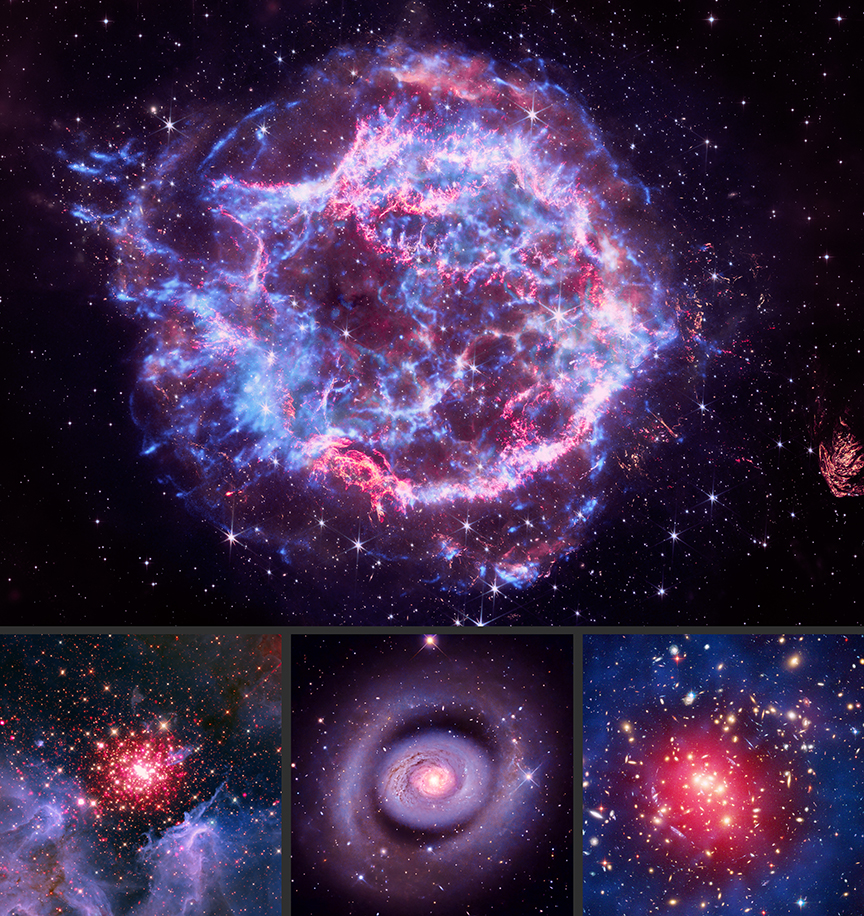
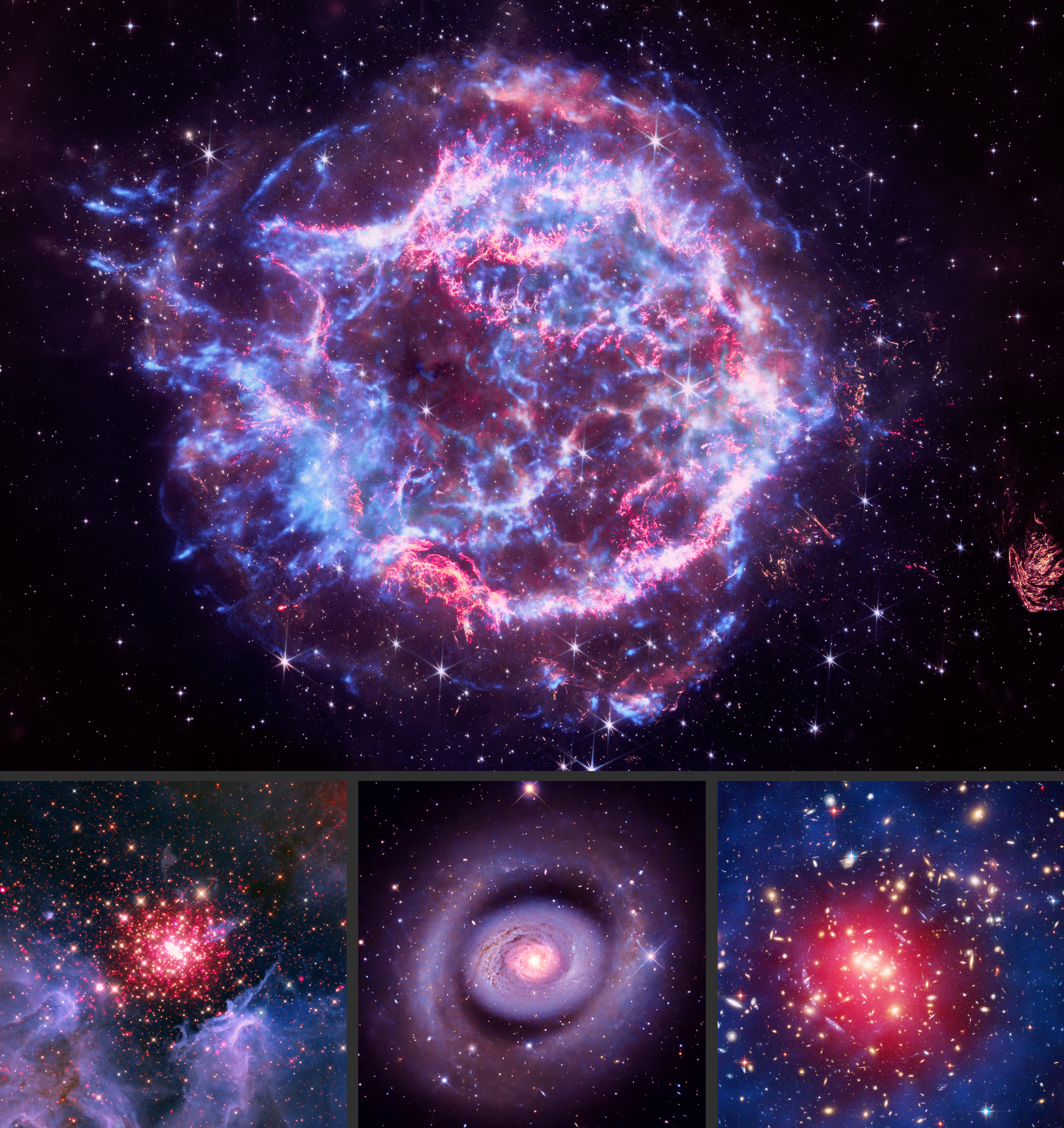
In celebration of the 250th birthday of the United States, NASA has unveiled four cosmic images from its Chandra X-ray Observatory rendered in red, white, and blue that represent the wonders of the universe the agency explores. The images are accompanied by a trio of new sonifications — a technique that translates astronomical data into sounds.

The image set begins with Cassiopeia A in the top panel, where X-rays from Chandra (represented in blue and purple) have been combined with an infrared image from NASA’s James Webb Space Telescope (red and white). Chandra’s X-ray vision reveals the blast wave that tore through the star, as well as elements in the debris field like iron, calcium, and oxygen. Webb’s infrared data also shows the expanding shell of material from the explosion and cosmic dust throughout the remnant.

In the bottom row, the first image on the left is the nebula NGC 3603, which contains a massive cluster of stars and is located in the Milky Way galaxy. This new composite image contains Chandra’s X-ray data (red and white) and shows diffuse emission near the galaxy’s center along with point-like X-ray sources throughout the middle of the image. Optical, infrared, and ultraviolet light from NASA’s Hubble Space Telescope (red-orange, green, blue, and yellow) reveal stars in the center of the image and dust and gas toward the bottom. The combined layering of the colors makes this nebula and the stars forming within it appear primarily red, white, and blue, with X-rays showing the sparkling lights of young stars.

The middle panel of the bottom row is a new look at the galaxy NGC 4736, also known as Messier 94. In this image, X-rays of different wavelengths from Chandra (red, orange, and blue) are layered with a visible light image from astrophotographers using their telescopes on the ground (red, green, and blue). Messier 94 is a spiral galaxy with a bright inner ring around it, called a starburst ring, where new stars are forming, perhaps fueled by gas driven in the unique oval-shaped structure seen here.

The final image in this red, white, and blue quartet features ZwCl 0024+1652. This is a distant galaxy cluster in which astronomers have found evidence for dark matter by using specially processed data from Hubble (blue). Another image from Hubble reveals the individual galaxies in the cluster (appearing as yellow and white). X-ray data from Chandra shows the enormous reservoir of superheated gas that pervades this galaxy cluster (red) with much more mass than all the galaxies taken together.

New sonifications of the three images along the bottom row of this mosaic are also available, allowing listeners to experience data through sound.

The translation of NGC 3603 into sound begins with a left to right scan, where the brightnesses of the sources once again dictate volume. Chandra’s observations of compact sources sprinkled throughout the galaxy are heard as piano notes, while the diffuse X-ray emission is mapped to a range of audio frequencies. The Hubble optical data is played as sustained tones and acoustic guitar harmonics.


In the sonification of NGC 4736, the radar-like scan moves clockwise, and the brightness of the sources dictates the volume of the sounds. X-rays from Chandra have been turned into wind-like sounds that follow the shape of the X-ray emission. Neutron stars and stellar-mass black holes (known as “compact sources”) detected by Chandra are mapped to pitched tones on a glass marimba. Optical data from ground-based observations is mapped to musically pitched tones, creating a low drone, while stars and background galaxies are heard as a soft piano.


For ZwCl 0024+1652, the sonification begins as a circle on the outside of the image and moves inward. The volume is linked to the brightness of the data, reaching one peak as the circle passes over the dark matter detected by inference from Hubble optical observations and another as it reaches the core. The background stars are heard as a swelling glockenspiel-like sound, and the galaxies are played on a piano. Chandra’s X-rays, which dominate the center of the galaxy cluster and reveal superheated gas, are represented by airy synthesizer notes.


The sonification program is led by the Chandra X-ray Center (CXC) and included as part of NASA's Universe of Learning program. The collaboration was driven by visualization scientist Kimberly Arcand (CXC), Matt Russo, astrophysicist; and Andrew Santaguida, musician, SYSTEM Sounds project; along with Christine Malec, consultant. Previously released sonifications of data from from Cassiopeia A can be found at chandra.si.edu/sound.

NASA's Marshall Space Flight Center in Huntsville, Alabama, manages the Chandra program. The Smithsonian Astrophysical Observatory's Chandra X-ray Center controls science operations from Cambridge, Massachusetts, and flight operations from Burlington, Massachusetts.


Visual Description:

In celebration of the 250th birthday of the United States, this release includes a series of images featuring four wonders of the universe, rendered in red, white, and blue. The images contain X-ray data from the Chandra X-ray Observatory, optical and infrared data from the Hubble Space Telescope and the James Webb Space Telescope, as well as ground-based telescopes.

The main image set features composite images of the four individual objects; Cassiopeia A, NGC 3603, M94/NGC 4736, and ZwCl 0024+1652.

Cassiopeia A occupies the top panel of the frame, significantly larger than the other images in the set. The cloudy blast-wave of the supernova remnant is ring-like in shape, streaked with veins of iron, calcium, and oxygen. Here, presented in red, white, and blue, the remnant resembles an electrified donut, crackling with marbled veins of strawberry and blueberry icing.

At our lower left of the image set is the nebula NCG 3603, which contains a massive cluster of stars on the other side of the Milky Way galaxy. Here, a tight cluster of neon red and white stars packs the center of the image, dissipating as it reaches the outer edges of the panel. Sweeping in at the lower corners of the image are hazy blue clouds resembling sheets of gauze.

Centered at the bottom of the image set is the galaxy NGC 4736, also known as Messier 94 (M94). Here, the spiral galaxy is seen face on, with concentric pale violet cloud rings flecked with scores of stars in white, pale blue, soft red, and golden yellow. The inner ring of the galaxy is bright, and rosy yellow in color. This is a starburst ring, where new stars are forming.

At our bottom right of the image set is the distant galaxy cluster ZwCl 0024+1652. The image is packed with streaks and specks in golden yellow and brilliant white. Upon close inspection, each streak and speck is revealed to be an individual galaxy, some with discernible spiral shapes. At the center of the image is a round pool of bright red light, surrounded by royal blue haze. The red light represents X-ray observations by Chandra, which reveal an enormous reservoir of superheated gas pervading the cluster. The blue haze represents specially-processed data from Hubble, suggesting evidence of dark matter.

This release also includes new sonifications of the three images presented in the bottom row of this data set, allowing listeners to experience the data through sound.


Fast Facts for Cassiopeia A:

Credit: X-ray: NASA/CXC/SAO; IR: NASA/ESA/CSA/STScI; Image Processing: NASA/CXC/SAO/L. Frattare and K. Arcand
Release Date: June 30, 2026
Scale: Image is about 8 arcmin (25.5 light-years) across.
Category:
  Supernovas & Supernova Remnants
Coordinates (J2000): RA: 23h 23m 26.7s | Dec: +58° 49' 03.00"
Constellation:
Cassiopeia
Observation Date(s): Nine observations in 2004: Feb 8, Apr 14, 18, 20, 22, 25 28, May 1, 5
Observation Time: 277 hours and 58 minutes (11 days 13 hours 58 minutes)
Obs. IDs: 4634-4639, 5196, 5319-5320
Instrument:
ACIS
Color Code: X-ray: blue and red; Infrared: red and white
Distance Estimate: About 11,000 light-years from Earth


Fast Facts for NGC 3603:

Credit: X-ray: NASA/CXC/SAO; Optical/IR/UV (Hubble): NASA/ESA/CSA/STScI/AURA; Image Processing: NASA/CXC/SAO/L. Frattare and K. Arcand
Release Date: June 30, 2026
Scale: Image is about 3 arcmin (17 light-years) across.
Category:
Normal Stars & Star Clusters
Coordinates (J2000): RA: 11h 15m 9.09s | Dec: -61° 16' 17.0"
Constellation:
Carina
Observation Date(s): Five observations from May 2000 to October 2011
Observation Time: 138 hours 8 minutes (5 days 18 hours 8 minutes)
Obs. IDs: 633, 12328-12330, 13162
Instrument:
ACIS
Color Code: X-ray: red and white ; Infrared: red and yellow; Ultraviolet: green, blue, and white
Distance Estimate: About 20,000 light-years from Earth


Fast Facts for NGC 4736 (M94):

Credit: X-ray: NASA/CXC/SAO; Optical:Brian Brennan and Remi Lacasse; Image Processing: NASA/CXC/SAO/L. Frattare and K. Arcand
Release Date: June 30, 2026
Scale: Image is about 17 arcmin (94,000 light-years) across.
Category:
Normal Galaxies & Starburst Galaxies
Coordinates (J2000): RA: 12h 50m 53.1s | Dec: +41° 07' 13.7"
Constellation: Canes Venatici
Observation Date(s): May 13, 2000
Observation Time: 13 hours 50 minutes
Obs. IDs: 808
Instrument:
ACIS
Color Code: X-ray: red, green, and blue; Optical: red, green, and blue
Distance Estimate: About 19 million light-years from Earth


Fast Facts for ZwCl 0024+1652:

Credit: X-ray: NASA/CXC/SAO; Optical and Dark Matter: NASA/ESA/M.J. Jee; Image Processing: NASA/CXC/SAO/L. Frattare
Release Date: June 30, 2026
Scale: Image is about 3.3 arcmin (9,100 light-years) across.
Category:
Groups & Clusters of Galaxies
Coordinates (J2000): RA: 00h 26m 34.5s | Dec: +17° 09′ 44.0"
Constellation:
Pisces
Observation Date(s): 3 Observations from Sep, 2000 to Aug, 2016
Observation Time: 29 hours 30 minutes (1 day 5 hours 30 minutes)
Obs. IDs: 929, 7717, 18458
Instrument:
ACIS
Color Code: X-ray: red; Optical: red, green, and blue; Dark Matter: blue
Distance Estimate: About 9.5 million light-years from Earth


Sunday, July 06, 2025

Citizen Science Born in the Pandemic: The Hubble Image Similarity Project

A handful of images used in the Hubble Image Similarity Project
Adapted from White & Peek 2025

Motivated by a desire to support community members financially during the coronavirus pandemic, researchers employed 30 local citizen scientists in the Hubble Image Similarity Project. This project quantified the similarities between astronomical images, providing a way to test the results of image-search algorithms.

The Eagle Nebula, pictured here in an image from Kitt Peak National Observatory, is a star-forming region in the Milky Way. Credit:
  T.A.Rector (NRAO/AUI/NSF and NOIRLab/NSF/AURA) and B.A.Wolpa Credit: NOIRLab/NSF/AURA); CC BY 4.0

Seeking Similarities

Say you have an image of a star-forming region, featuring eye-catching gas clouds, dense and dusty knots, and newborn stars. How would you go about finding other images that resemble yours?

You might start your search with an astronomical image database, using filters for object type or instrument to sift through thousands and thousands of options. But even filtering out everything but star-forming regions might yield vastly different results, given the widely varying shapes, colors, and sizes of these regions.

Or maybe you’ll feed your image into a neural network that has been trained to spot similar images. The results may seem promising, but how can you tell whether the algorithm has found the images that are the most similar? Would another algorithm do better?

An example of individual test images (green squares) extracted from a Hubble Legacy Archive image (red square). Low-contrast areas have been excluded, leaving the galaxy’s spiral arms for analysis. Credit: White & Peek 2025

The Hubble Image Similarity Project

Astronomical image collections rarely contain information about similarities between images in their metadata, and while neural networks appear to excel at gathering similar images, the results of these models are generally unverified. The Hubble Image Similarity Project, led by Richard White (Space Telescope Science Institute) and Josh Peek (Space Telescope Science Institute and Johns Hopkins University), addressed these issues with a team of citizen scientists who generated similarity information for astronomical images, providing a quantitative means to test the results of neural networks.

White and Peek began by amassing a sample of images from the Hubble Legacy Archive. This sample included many different object types, such as galaxies, planetary nebulae, star-forming regions, and star clusters. After trimming and binning the images, converting them to 8-bit grayscale, filtering out low-contrast images, and eliminating satellite trails, image artifacts, and repeated observations of the same patch of sky, 2,098 images of 666 objects remained.

Examples of similar images according to the image similarity matrix. In the lower-right corner is a visualization of the similarity data. The semicircle of data points in the bottom half of this visualization represents galaxies, while star clusters occupy the small arc near the top and nebulae sit in the island in the center of the plot. Credit: Adapted from White & Peek 2025

Citizen Scientists, Assemble

White and Peek recruited 30 members of the community within walking distance of the Space Telescope Science Institute to identify similar astronomical images, and the reviewers were paid for their work. In the three phases of the project, reviewers considered test images one at a time and 1) selected all similar images from a set of 15 comparison images, 2) selected the most similar image from a narrowed-down set of 6 comparison images, and finally 3) selected the most similar image from a set of 3 comparison images.

The citizen science team ultimately compared 5.4 million pairs of images, and White and Peek used these comparisons to produce an image similarity matrix. The matrix describes the metaphorical “distance” between the images, with the most similar images being the smallest distance apart.

Similar images resemble one another in terms of structure, texture, and other factors that White and Peek say are “difficult even to describe in words” — for example, the diffuse glow of a galaxy interrupted by a bright star with diffraction spikes, or a nebula speckled with stars and dense dusty clumps. The similarity data from this study are available online and can be used to test the performance of image-search algorithms. In future work, the authors plan to carry out a similar project using images of the Martian landscape.

By
Kerry Hensley

Citation

“The Hubble Image Similarity Project,” Richard L. White and J. E. G. Peek 2025 AJ 169 306.
doi:10.3847/1538-3881/adcb43


Saturday, January 26, 2019

As clouds fall apart, a new star is born

Image of the massive star cluster NGC 3603, obtained with the Very Large Telescope. It probably has evolved in the same way as the one just forming in G351.77-0.54, the object depicted in this work. © Image: ESO

New observations reveal the physics behind the formation of a massive star cluster

Using the ALMA observatory in Chile, a group of astronomers led by MPIA’s Henrik Beuther has made the most detailed observation yet of the way that a giant gas cloud fragments into dense cores, which then act as the birthplaces of stars. The astronomers found that the mechanisms for fragmentation are fairly straightforward, resulting from the combination of the cloud’s pressure and gravity. More complex features, such as magnetic lines or turbulence, play a smaller role than previously thought.


Stars are born when giant clouds of gas and dust collapse. Whenever one of the collapsing regions becomes hot and dense enough for nuclear fusion to set in, a star is born. For massive stars, i.e. those stars that exhibit more than eight times the mass of the Sun, that is only part of the picture, though. The biggest stars in the Universe are not born singly. They are born from massive clouds of molecular gas, which then form a cascade of fragments, with many of the fragments giving birth to a star.

Astronomers have long wondered whether this fragmentation-mode of forming stars requires different physical mechanisms than for lower-mass stars. Proposals include turbulent gas motion, which could destabilize a region and lead to quicker collapse, or magnetic fields that could stabilize and thus delay collapse.

The different mechanisms should leave tell-tale traces in regions where multiple stars are forming. The collapse that leads to the formation of high-mass stars takes place on a hierarchy of different levels. On the largest scales, star formation involves giant molecular clouds, which consist mostly of hydrogen gas and can reach sizes between a few dozen and more than a hundred light-years across. Within those clouds are slightly denser clumps, typically a few light-years across. Each clump contains one or more dense cores, less than a fifth of a light-year in diameter. Within each core, collapse leads to the formation of either a single star or multiple stars. Together, the stars produced in the cores of a single clump will form a star cluster.

Tell-tale scales of fragmentation

The scales of this fragmentation at multiple levels depend on the mechanisms involved. The simplest model can be written down using no more than high school physics: An ideal gas has a pressure that depends on its temperature and density. In a simplified gas cloud, assumed to have constant density, that pressure must be strong enough everywhere to balance the force of gravity (given by Newton’s law of gravity) – even in the center of the cloud, where the inward gravitation-induced push of all the surrounding matter is strongest. Write this condition down, and you will find that any such constant-density cloud can only have a maximum size. If a cloud is larger than this maximum, which is called the Jeans length, the cloud will fragment and collapse.

Is the fragmentation of young massive clusters really dominated by these comparatively straightforward processes? It doesn’t need to be, and some astronomers have constructed much more complex scenarios, which include the influence of turbulent gas motion and magnetic field lines. These additional mechanisms change the conditions for cloud stability, and typically increase the scales of the different types of fragment.

Different predictions for cloud sizes offer a way of testing the simple physics scenario against its more complex competitors. That is what Henrik Beuther and his colleagues set out to do when they observed the star formation region G351.77-0.54 in the Southern constellation Scorpius (The Scorpion). Previous observations had indicated that in this region, fragmentation could be caught in the act. But none of these observations had been powerful enough to show the smallest scale of interest for answering the question of fragmentation scales: the protostellar cores, let alone their sub-structure.

ALMA takes the most detailed look yet

Beuther and his colleagues were able to do more. They used the ALMA Observatory in the Atacama Desert in Chile. ALMA combines the simultaneous observations of up to 66 radio telescopes to achieve a resolution of down to 20 milli-arcseconds, which allows astronomers to discern details more than ten times smaller than with any previous radio telescope, and at unrivalled sensitivity – a combination that has already led to a number of breakthrough observations also in other fields.

Beuther and his colleagues used ALMA to study the high-mass star-forming region G351.77-0.54 down to sub-core scales smaller than 50 astronomical units (in other words, less than 50 times the average distance between the Earth and the Sun). As Beuther says: “This is a prime example of how technology drives astronomical progress. We could not have obtained our results without the unprecedented spatial resolution and sensitivity of ALMA.”

Their results, together with earlier studies of the same cloud at larger scales, indicate that thermal gas physics is winning the day, even when it comes to very massive stars: Both the sizes of clumps within the cloud and, as the new observations show, of cores within the clumps and even of some core substructures are as predicted by Jeans length calculations, with no need for additional ingredients. Beuther comments: “In our case, the same physics provides a uniform description. Fragmentation from the largest to the smallest scales seems to be governed by the same physical processes.”

Small accretion disks: a new challenge

Simplicity is always a boon for scientific descriptions. However, the same observations also provided a discovery that will keep astronomers on their collective toes. In addition to studying fragmentation, Beuther et al. had been looking to unravel the structure of nascent stars (“protostars”) within the cloud. Astronomers expect such a protostar to be surrounded by a swirling disk of gas, called the accretion disk. From the inner disk of the rim, gas falls onto the growing star, increasing its mass. In addition, magnetic fields produced by the motion of ionized gas and the gas itself interact to produce tightly focused streams called jets, which shoot out some of the matter into space perpendicular to that disk. Submillimeter light from those regions carries tell-tale signs (“Doppler-broadening of spectral lines”) of the motion of dust, which in turn traces the motion of gas. But where Beuther and his collaborators had hoped for a clear signature from an accretion disk, instead, he found mainly the signature of jets, cutting a comparatively smooth path through the surrounding gas. Evidently, the accretion disks are even smaller than astronomers had expected – a challenge for future observations at even greater spatial resolution.

The research described here was undertaken by Henrik Beuther, Aida Ahmadi, Joseph Mottram, Hendrik Linz, Thomas K. Henning and Rolf Kuiper (also University of Tübingen) in collaboration with Luke T. Maud (Leiden University and ESO), Andrew J. Walsh (Macquarie University), Katharine G. Johnston (University of Leeds) and Steve N. Longmore (Liverpool John Moores University).


Contacts

Dr. Henrik Beuther
Max Planck Institute for Astronomy, Heidelberg
Phone:+49 6221 528-447
Email:beuther@mpia.de

Dr. Markus Pössel
Press & Public Relations
Max Planck Institute for Astronomy, Heidelberg
Phone:+49 6221 528-261  
Email:pr@mpia.de


Original publicantion

Beuther, H.; Ahmadi, A.; Mottram, J. C.; Linz, H.; Maud, L. T.; Henning, Th.; Kuiper, R.; Walsh, A. J.; Johnston, K. G.; Longmore, S. N.

High-mass star formation at sub-50 au scales

2019, Astronomy & Astrophysics, 621, A122
Source DOI


Related articles 


May 14, 2016

The interplay of magnetic fields and gravitation in the gas cloud lead to the birth of new stars. 


Further information

ALMA – the Atacama Large Millimetre Array


Thursday, November 03, 2016

Pillars of Destruction

 PR Image eso1639a
Region R44 in the Carina Nebula 

Pillars of destruction
 
Region R18 in the Carina Nebula
 
Region R37 in the Carina Nebula
 
Region R45 in the Carina Nebula
 
Star cluster Trumpler 14
 
Bok Globule in the Carina Nebula
 
Mystic Mountain 


Videos

3D Animation of the Carina Nebula

Zooming in on the Carina Nebula


Colourful Carina Nebula blasted by brilliant nearby stars


Spectacular new observations of vast pillar-like structures within the Carina Nebula have been made using the MUSE instrument on ESO’s Very Large Telescope. The different pillars analysed by an international team seem to be pillars of destruction — in contrast to the name of the iconic Pillars of Creation in the Eagle Nebula, which are of similar nature.

The spires and pillars in the new images of the Carina Nebula are vast clouds of dust and gas within a hub of star formation about 7500 light-years away. The pillars in the nebula were observed by a team led by Anna McLeod, a PhD student at ESO, using the MUSE instrument on ESO’s Very Large Telescope.

The great power of MUSE is that it creates thousands of images of the nebula at the same time, each at a different wavelength of light. This allows astronomers to map out the chemical and physical properties of the material at different points in the nebula.

Images of similar structures, the famous Pillars of Creation [1] in the Eagle Nebula and formations in NGC 3603, were combined with the ones displayed here. In total ten pillars have been observed, and in so doing a clear link was observed between the radiation emitted by nearby massive stars and the features of the pillars themselves.

In an ironic twist, one of the first consequences of the formation of a massive star is that it starts to destroy the cloud from which it was born. The idea that massive stars will have a considerable effect on their surroundings is not new: such stars are known to blast out vast quantities of powerful, ionising radiation — emission with enough energy to strip atoms of their orbiting electrons. However, it is very difficult to obtain observational evidence of the interplay between such stars and their surroundings. <

The team analysed the effect of this energetic radiation on the pillars: a process known as photoevaporation, when gas is ionised and then disperses away. By observing the results of photoevaporation — which included the loss of mass from the pillars — they were able to deduce the culprits. There was a clear correlation between the amount of ionising radiation being emitted by nearby stars, and the dissipation of the pillars.

This might seem like a cosmic calamity, with massive stars turning on their own creators. However the complexities of the feedback mechanisms between the stars and the pillars are poorly understood. These pillars might look dense, but the clouds of dust and gas which make up nebulae are actually very diffuse. It is possible that the radiation and stellar winds from massive stars actually help create denser spots within the pillars, which can then form stars.

These breathtaking celestial structures have more to tell us, and MUSE is an ideal instrument to probe them with. 


Notes


[1] The Pillars of Creation are an iconic image, taken with the NASA/ESA Hubble Space Telescope, making them the most famous of these structures. Also known as elephant trunks, they can be several light-years in length.


More Information

This research was presented in a paper entitled “Connecting the dots: a correlation between ionising radiation and cloud mass-loss rate traced by optical integral field spectroscopy“, by A. F. McLeod et al., published in the Monthly Notices of the Royal Astronomical Society.

The team is composed of A. F. McLeod (ESO, Garching, Germany), M. Gritschneder (Universitäts-Sternwarte, Ludwig-Maximilians-Universität, Munich, Germany), J. E. Dale (Universitäts-Sternwarte, Ludwig-Maximilians-Universität, Munich, Germany), A. Ginsburg (ESO, Garching, Germany), P. D.Klaassen (UK Astronomy Technology Centre, Royal Observatory Edinburgh, UK), J. C. Mottram (Max Planck Institute for Astronomy, Heidelberg, Germany), T. Preibisch (Universitäts-Sternwarte, Ludwig-Maximilians-Universität, Munich, Germany), S. Ramsay (ESO, Garching, Germany), M. Reiter (University of Michigan Department of Astronomy, Ann Arbor, Michigan, USA) and L. Testi (ESO, Garching, Germany).

ESO is the foremost intergovernmental astronomy organisation in Europe and the world’s most productive ground-based astronomical observatory by far. It is supported by 16 countries: Austria, Belgium, Brazil, the Czech Republic, Denmark, France, Finland, Germany, Italy, the Netherlands, Poland, Portugal, Spain, Sweden, Switzerland and the United Kingdom, along with the host state of Chile. ESO carries out an ambitious programme focused on the design, construction and operation of powerful ground-based observing facilities enabling astronomers to make important scientific discoveries. ESO also plays a leading role in promoting and organising cooperation in astronomical research. ESO operates three unique world-class observing sites in Chile: La Silla, Paranal and Chajnantor. At Paranal, ESO operates the Very Large Telescope, the world’s most advanced visible-light astronomical observatory and two survey telescopes. VISTA works in the infrared and is the world’s largest survey telescope and the VLT Survey Telescope is the largest telescope designed to exclusively survey the skies in visible light. ESO is a major partner in ALMA, the largest astronomical project in existence. And on Cerro Armazones, close to Paranal, ESO is building the 39-metre European Extremely Large Telescope, the E-ELT, which will become “the world’s biggest eye on the sky”.


Link


Contacts

Anna Faye McLeod
ESO
Garching bei München, Germany
Tel: +49 89 3200 6321
Email:
amcleod@eso.org

Mathias Jäger
Public Information Officer
Garching bei München, Germany
Tel: +49 176 62397500

Source: ESO

Saturday, April 23, 2016

Microscopic "Timers" Reveal Likely Source of Galactic Space Radiation

A cluster of massive stars seen with the Hubble Space Telescope. The cluster is surrounded by clouds of interstellar gas and dust called a nebula. The nebula, located 20,000 light-years away in the constellation Carina, contains the central cluster of huge, hot stars, called NGC 3603. Credits: NASA/U. Virginia/INAF, Bologna, Italy/USRA/Ames/STScI/AURA.  Full caption


Most of the cosmic rays that we detect at Earth originated relatively recently in nearby clusters of massive stars, according to new results from NASA's Advanced Composition Explorer (ACE) spacecraft. ACE allowed the research team to determine the source of these cosmic rays by making the first observations of a very rare type of cosmic ray that acts like a tiny timer, limiting the distance the source can be from Earth.

"Before the ACE observations, we didn't know if this radiation was created a long time ago and far, far away, or relatively recently and nearby," said Eric Christian of NASA's Goddard Space Flight Center in Greenbelt, Maryland. Christian is co-author of a paper on this research published April 21 in Science.

Cosmic rays are high-speed atomic nuclei with a wide range of energy -- the most powerful race at almost the speed of light. Earth's atmosphere and magnetic field shield us from less-energetic cosmic rays, which are the most common. However, cosmic rays will present a hazard to unprotected astronauts traveling beyond Earth's magnetic field because they can act like microscopic bullets, damaging structures and breaking apart molecules in living cells. NASA is currently researching ways to reduce or mitigate the effects of cosmic radiation to protect astronauts traveling to Mars.

Cosmic rays are produced by a variety of violent events in space. Most cosmic rays originating within our solar system have relatively low energy and come from explosive events on the Sun, like flares and coronal mass ejections. The highest-energy cosmic rays are extremely rare and are thought to be powered by massive black holes gorging on matter at the center of other galaxies. The cosmic rays that are the subject of this study come from outside our solar system but within our Galaxy and are called galactic cosmic rays. They are thought to be generated by shock waves from exploding stars called supernovae.

The galactic cosmic rays detected by ACE that allowed the team to estimate the age of the cosmic rays, and the distance to their source, contain a radioactive form of iron called Iron-60 (60Fe). It is created inside massive stars when they explode and then blasted into space by the shock waves from the supernova. Some 60Fe in the debris from the destroyed star is accelerated to cosmic-ray speed when another nearby massive star in the cluster explodes and its shock wave collides with the remnants of the earlier stellar explosion.

60Fe galactic cosmic rays zip through space at half the speed of light or more, about 90,000 miles per second. This seems very fast, but the 60Fe cosmic rays won't travel far on a galactic scale for two reasons. First, they can't travel in straight lines because they are electrically charged and respond to magnetic forces. Therefore they are forced to take convoluted paths along the tangled magnetic fields in our Galaxy. Second, 60Fe is radioactive and over a period of about 2.6 million years, half of it will self-destruct, decaying into other elements (Cobalt-60 and then Nickel-60). If the 60Fe cosmic rays were created hundreds of millions of years or more ago, or very far away, eventually there would be too little left for the ACE spacecraft to detect.

"Our detection of radioactive cosmic-ray iron nuclei is a smoking gun indicating that there has likely been more than one supernova in the last few million years in our neighborhood of the Galaxy," said Robert Binns of Washington University, St. Louis, Missouri, lead author of the paper.

"In 17 years of observing, ACE detected about 300,000 galactic cosmic rays of ordinary iron, but just 15 of the radioactive Iron-60," said Christian. "The fact that we see any Iron-60 at all means these cosmic ray nuclei must have been created fairly recently (within the last few million years) and that the source must be relatively nearby, within about 3,000 light years, or approximately the width of the local spiral arm in our Galaxy." A light year is the distance light travels in a year, almost six trillion miles. A few thousand light years is relatively nearby because the vast swarm of hundreds of billions of stars that make up our Galaxy is about 100,000 light years wide.

There are more than 20 clusters of massive stars within a few thousand light years, including Upper Scorpius (83 stars), Upper Centaurus Lupus (134 stars), and Lower Centaurus Crux (97 stars). These are very likely major contributors to the 60Fe that ACE detected, owing to their size and proximity, according to the research team.

ACE was launched on August 25, 1997 to a point 900,000 miles away between Earth and the Sun where it has acted as a sentinel, detecting space radiation from solar storms, the Galaxy, and beyond. This research was funded by NASA's ACE program.

Additional co-authors on this paper were: Martin Israel and Kelly Lave at Washington University, St. Louis, Missouri; Alan Cummings, Rick Leske, Richard Mewaldt and Ed Stone at Caltech in Pasadena, California; Georgia de Nolfo and Tycho von Rosenvinge at Goddard; and Mark Wiedenbeck at NASA's Jet Propulsion Laboratory in Pasadena, California.


Karen C. Fox
NASA Goddard Space Flight Center, Greenbelt, Maryland
301-286-6284
karen.c.fox@nasa.gov

 Source: NASA/Supernova

Tuesday, November 04, 2014

Water on Earth

An image of the stellar nursery in NGC 3603 where stars are actively forming from the nebula’s extended clouds of gas and dust. Astronomers have found that water in our solar system almost certainly derives in large part from interstellar water, rather than forming locally, and that consequently other stellar systems would be expected to contain water as well.Credit: ESO

Water, the key ingredient for life, is not only abundant on Earth, it is also ubiquitous across the solar system. Either as ice or sometimes as liquid, water has been spotted in comets, the icy moons of the giant planets, and even in the shadowed basins of Mercury. Water has left its mark in hydrated minerals in meteorites that penetrated our atmosphere, in lunar basalts retrieved by the astronauts, and in Martian melt inclusions recovered from rock samples ejected from Mars that found their way to Earth. Comets and asteroids (as traced by meteorites) remain the oldest, most primitive objects with water. They provide a natural time capsule of the conditions present during the Sun’s epoch of planet formation.

No one knows for sure when and where these ices formed. Water might have been present in the dense interstellar medium from which Sun formed or it might have been made somehow within the solar nebula after it developed. Astronomers are trying to determine which applies because the former suggests that all planet-forming systems will have abundant water ices, whereas the latter presumably means that the abundance of water can vary dramatically from stellar system to system.

Water is usually made with two atoms of hydrogen and one of oxygen, as H2O, but it can also come in deuterated form in which a deuterium atom replaces one hydrogen atom. The fraction of deuterated water in a sample is a powerful measure of the age and origin of the sample: Interstellar ices are highly enriched in the deuterated species because the chemistry of interstellar space – ionizing radiation in particular - preferentially destroys normal H2O water. Ice in interstellar space can have a two to thirty times higher fraction of deuterated water than is found on Earth.

CfA astronomer Karin Oberg and her colleagues did comprehensive modeling of the proto-planetary disk that forms around new stars, including the effects of ultraviolet ionization and the influence of radioactive elements in the material. In the latest issue of Science, the team reports a number of key results, including that the young solar nebula must have contained some pristine interstellar ice. A considerable fraction of the solar system’s water therefore predates the Sun. If the solar system is typical, the scientists conclude, then interstellar ices in a stellar birth cloud should be widely available to all young protoplanetary systems.

Reference(s): 
 
"The Ancient Heritage of Water Ice in the Solar System," L. Ilsedore Cleeves, Edwin A. Bergin, Conel M. O'D. Alexander, Fujun Du, Dawn Graninger, Karin I. Öberg, Tim J. Harries, Science, 345, 1590, 2014.


Wednesday, July 21, 2010

Stars Just Got Bigger

The young cluster RMC 136a

The sizes of stars (annotated)

The young cluster RMC 136a

Zooming in on the young cluster RMC 136a

Using a combination of instruments on ESO’s Very Large Telescope, astronomers have discovered the most massive stars to date, one weighing at birth more than 300 times the mass of the Sun, or twice as much as the currently accepted limit of 150 solar masses. The existence of these monsters — millions of times more luminous than the Sun, losing weight through very powerful winds — may provide an answer to the question “how massive can stars be?”

A team of astronomers led by Paul Crowther, Professor of Astrophysics at the University of Sheffield, has used ESO’s Very Large Telescope (VLT), as well as archival data from the NASA/ESA Hubble Space Telescope, to study two young clusters of stars, NGC 3603 and RMC 136a in detail. NGC 3603 is a cosmic factory where stars form frantically from the nebula’s extended clouds of gas and dust, located 22 000 light-years away from the Sun (eso1005). RMC 136a (more often known as R136) is another cluster of young, massive and hot stars, which is located inside the Tarantula Nebula, in one of our neighbouring galaxies, the Large Magellanic Cloud, 165 000 light-years away (eso0613).

The team found several stars with surface temperatures over 40 000 degrees, more than seven times hotter than our Sun, and a few tens of times larger and several million times brighter. Comparisons with models imply that several of these stars were born with masses in excess of 150 solar masses. The star R136a1, found in the R136 cluster, is the most massive star ever found, with a current mass of about 265 solar masses and with a birthweight of as much as 320 times that of the Sun.

In NGC 3603, the astronomers could also directly measure the masses of two stars that belong to a double star system [1], as a validation of the models used. The stars A1, B and C in this cluster have estimated masses at birth above or close to 150 solar masses.

Very massive stars produce very powerful outflows. “Unlike humans, these stars are born heavy and lose weight as they age,” says Paul Crowther. “Being a little over a million years old, the most extreme star R136a1 is already ‘middle-aged’ and has undergone an intense weight loss programme, shedding a fifth of its initial mass over that time, or more than fifty solar masses.”

If R136a1 replaced the Sun in our Solar System, it would outshine the Sun by as much as the Sun currently outshines the full Moon. “Its high mass would reduce the length of the Earth's year to three weeks, and it would bathe the Earth in incredibly intense ultraviolet radiation, rendering life on our planet impossible,” says Raphael Hirschi from Keele University, who belongs to the team.

These super heavyweight stars are extremely rare, forming solely within the densest star clusters. Distinguishing the individual stars — which has now been achieved for the first time — requires the exquisite resolving power of the VLT’s infrared instruments [2].

The team also estimated the maximum possible mass for the stars within these clusters and the relative number of the most massive ones. “The smallest stars are limited to more than about eighty times more than Jupiter, below which they are ‘failed stars’ or brown dwarfs,” says team member Olivier Schnurr from the Astrophysikalisches Institut Potsdam. “Our new finding supports the previous view that there is also an upper limit to how big stars can get, although it raises the limit by a factor of two, to about 300 solar masses.”

Within R136, only four stars weighed more than 150 solar masses at birth, yet they account for nearly half of the wind and radiation power of the entire cluster, comprising approximately 100 000 stars in total. R136a1 alone energises its surroundings by more than a factor of fifty compared to the Orion Nebula cluster, the closest region of massive star formation to Earth.

Understanding how high mass stars form is puzzling enough, due to their very short lives and powerful winds, so that the identification of such extreme cases as R136a1 raises the challenge to theorists still further. “Either they were born so big or smaller stars merged together to produce them,” explains Crowther.

Stars between about 8 and 150 solar masses explode at the end of their short lives as supernovae, leaving behind exotic remnants, either neutron stars or black holes. Having now established the existence of stars weighing between 150 and 300 solar masses, the astronomers’ findings raise the prospect of the existence of exceptionally bright, “pair instability supernovae” that completely blow themselves apart, failing to leave behind any remnant and dispersing up to ten solar masses of iron into their surroundings. A few candidates for such explosions have already been proposed in recent years.

Not only is R136a1 the most massive star ever found, but it also has the highest luminosity too, close to 10 million times greater than the Sun. “Owing to the rarity of these monsters, I think it is unlikely that this new record will be broken any time soon,” concludes Crowther.

Notes

[1] The star A1 in NGC 3603 is a double star, with an orbital period of 3.77 days. The two stars in the system have, respectively, 120 and 92 times the mass of the Sun, which means that they have formed as stars weighing, respectively, 148 and 106 solar masses.

[2] The team used the SINFONI, ISAAC and MAD instruments, all attached to ESO’s Very Large Telescope at Paranal, Chile.

More information
This work is presented in an article published in the Monthly Notices of the Royal Astronomical Society (“The R136 star cluster hosts several stars whose individual masses greatly exceed the accepted 150 Msun stellar mass limit”, by P. Crowther et al.).

The team is composed of Paul A. Crowther, Richard J. Parker, and Simon P. Goodwin (University of Sheffield, UK), Olivier Schnurr (University of Sheffield and Astrophysikalisches Institut Potsdam, Germany), Raphael Hirschi (Keele University, UK), and Norhasliza Yusof and Hasan Abu Kassim (University of Malaya, Malaysia).

ESO, the European Southern Observatory, is the foremost intergovernmental astronomy organisation in Europe and the world’s most productive astronomical observatory. It is supported by 14 countries: Austria, Belgium, the Czech Republic, Denmark, France, Finland, Germany, Italy, the Netherlands, Portugal, Spain, Sweden, Switzerland and the United Kingdom. ESO carries out an ambitious programme focused on the design, construction and operation of powerful ground-based observing facilities enabling astronomers to make important scientific discoveries. ESO also plays a leading role in promoting and organising cooperation in astronomical research. ESO operates three unique world-class observing sites in Chile: La Silla, Paranal and Chajnantor. At Paranal, ESO operates the Very Large Telescope, the world’s most advanced visible-light astronomical observatory and VISTA, the world’s largest survey telescope. ESO is the European partner of a revolutionary astronomical telescope ALMA, the largest astronomical project in existence. ESO is currently planning a 42-metre European Extremely Large optical/near-infrared Telescope, the E-ELT, which will become “the world’s biggest eye on the sky”.

Links
Research paper

Contacts

Paul Crowther
University of Sheffield
UK
Tel: +44 114 222 4291
Cell: +44 7946 638 474
Email:
Paul.Crowther@sheffield.ac.uk

Olivier Schnurr
Astrophysikalisches Institut Potsdam
Potsdam, Germany
Tel: +49 331 7499 353
Email:
oschnurr@aip.de

Henri Boffin
ESO, La Silla, Paranal and E-ELT Press Officer
Garching, Germany
Tel: +49 89 3200 6222
Cell: +49 174 515 43 24
Email
: hboffin@eso.org


Tuesday, July 06, 2010

Starburst Cluster Shows Celestial Fireworks

Credit: NASA, ESA, R. O'Connell (University of Virginia), F. Paresce (National Institute for Astrophysics, Bologna, Italy), E. Young (Universities Space Research Association/Ames Research Center), the WFC3 Science Oversight Committee, and the Hubble Heritage Team (STScI/AURA). Larger image - Labeled image - Fast Facts

Like a July 4 fireworks display a young, glittering collection of stars looks like an aerial burst. The cluster is surrounded by clouds of interstellar gas and dust - the raw material for new star formation. The nebula, located 20,000 light-years away in the constellation Carina, contains a central cluster of huge, hot stars, called NGC 3603.

This environment is not as peaceful as it looks. Ultraviolet radiation and violent stellar winds have blown out an enormous cavity in the gas and dust enveloping the cluster, providing an unobstructed view of the cluster.

Most of the stars in the cluster were born around the same time but differ in size, mass, temperature, and color. The course of a star's life is determined by its mass, so a cluster of a given age will contain stars in various stages of their lives, giving an opportunity for detailed analyses of stellar life cycles. NGC 3603 also contains some of the most massive stars known. These huge stars live fast and die young, burning through their hydrogen fuel quickly and ultimately ending their lives in supernova explosions.

Star clusters like NGC 3603 provide important clues to understanding the origin of massive star formation in the early, distant universe. Astronomers also use massive clusters to study distant starbursts that occur when galaxies collide, igniting a flurry of star formation. The proximity of NGC 3603 makes it an excellent lab for studying such distant and momentous events.

This Hubble Space Telescope image was captured in August 2009 and December 2009 with the Wide Field Camera 3 in both visible and infrared light, which trace the glow of sulfur, hydrogen, and iron.

The Hubble Space Telescope is a project of international cooperation between NASA and the European Space Agency. NASA’s Goddard Space Flight Center manages the telescope. The Space Telescope Science Institute (STScI) conducts Hubble science operations. STScI is operated for NASA by the Association of Universities for Research in Astronomy, Inc. in Washington, D.C.

Wednesday, June 02, 2010

Hubble catches stars on the move

The core of the massive compact star cluster in NGC 3603

Comparison of Hubble observations of the massive compact star cluster
in NGC 3603 in 1997 and 2007

The massive compact star cluster in NGC 3603
and its surroundings

Comparison of Hubble observations of the massive star cluster
in NGC 3603 in 1997 and 2007

Zooming in on the massive compact star cluster in NGC 3603

Surprising signs of unrest in massive star cluster

By exploiting the exquisite image quality of the NASA/ESA Hubble Space Telescope and comparing two observations made ten years apart astronomers have, for the first time, managed to measure the tiny motions of several hundred young stars within the central cluster of the star-forming region NGC 3603. The team was surprised to find that the stars are moving in ways that are at odds with the current understanding of how such clusters evolve. The stars in the cluster have not “settled down” as expected.

With a mass of more than 10 000 suns packed into a volume with a diameter of a mere three light-years, the massive young star cluster in the nebula NGC 3603 is one of the most compact stellar clusters in the Milky Way [1] and an ideal place to test theories for their formation.

A team of astronomers from the Max-Planck Institute for Astronomy in Heidelberg and the University of Cologne led by Wolfgang Brandner (MPIA) wanted to track the movement of the cluster’s many stars. Such a study could reveal whether the stars were in the process of drifting apart, or about to settle down.

The cluster, formally known as the NGC 3603 Young Cluster, is about 20 000 light-years from the Sun which makes these measurements extraordinarily difficult. It is necessary to compare images that were made years or even decades apart. The telescope and camera used must give very sharp images and be extremely stable over long periods.

Brandner and his colleagues realised that the Hubble Space Telescope was the best for the job. They found good data in the archives for the NGC 3603 cluster from a July 1997 observing run with the Wide Field Planetary Camera 2 (WFPC2), and then made their own follow-up observations in September 2007, using the same camera and the same set of filters as in the original observations. It then took the team two years of very careful analysis to extract reliable estimates for the motions of stars in the images.

Boyke Rochau (MPIA), the paper’s lead author, who performed this analysis as part of his PhD work, explains: ”Our measurements have a precision of 27 millionths of an arcsecond per year. This tiny angle corresponds to the apparent thickness of a human hair seen from a distance of 800 km.”

In this laborious way, they were able to measure the precise speeds of more than 800 stars. About 50 were identified as foreground stars that are unrelated to the cluster, but more than 700 cluster stars of different masses and surface temperatures remained. The results for the motion of these cluster stars were surprising: this very massive star cluster has not yet settled down. Instead, the stars’ velocities were independent of their mass and thus still reflect conditions from the time the cluster was formed, approximately one million years ago.

Stars are born when a gigantic cloud of gas and dust collapses. In cases such as the star forming region NGC 3603, where the cloud is unusually massive and compact, the process is particularly quick and intense. Most of the cloud’s matter ends up concentrated inside hot young stars and the cluster keeps much of its initial gravitational attraction [2]. In the long term such massive compact star clusters may lead to the development of the huge balls of stars known as globular clusters, whose tightly packed stars remain held together by gravity for billions of years.

Wolfgang Brandner adds: ”This is the first time we have been able to measure precise stellar motions in such a compact young star cluster.” Team member Andrea Stolte from the University of Cologne adds: “This is key information for astronomers trying to understand how such clusters are formed, and how they evolve.”
Notes

[1] For comparison: in our own immediate stellar neighbourhood, the same volume contains no more than a single star, namely the Sun. The NGC 3603 nebula is located in the central plane of our home galaxy's main disc, in a region called the Carina spiral arm.

[2] More usually the gas cloud is bigger and less massive and only about 10% of this mass ends up inside stars. The remaining gas is then blown away by the fierce ultraviolet light and stellar winds from the hot young stars. Once the interstellar matter is dispersed, the young star cluster has lost nearly 90% of its initial mass and has insufficient gravitational attraction to keep together. The stars in such typical clusters gradually drift apart.
More information

The Hubble Space Telescope is a project of international cooperation between ESA and NASA.

The international team of astronomers in this study consists of Boyke Rochau, Wolfgang Brandner, Andrea Stolte, Mario Gennaro, Dimitrios Gouliermis, Nicola Da Rio, Natalia Dzyurkevich and Thomas Henning.

Links

Hubble ACS image of NGC 3603: http://www.spacetelescope.org/news/heic0715/
Recent VLT image of NGC 3603: http://www.eso.org/public/news/eso1005/
Science paper: http://www.mpia.de/~brandner/ngc3603_astrometry.html

Contacts

Dr. Wolfgang Brandner
Max Planck Institute for Astronomy
Heidelberg, Germany
Tel: +49-6221-528-289
Email:
brandner@mpia.de

Dr. Andrea Stolte
I. Physikalisches Institut, University of Cologne
Germany
Tel: +49-221–470-5933
Email:
astolte@ph1.uni-koeln.de

Boyke Rochau
Max-Planck-Institut für Astronomie
Heidelberg, Germany
Tel: +49-6221–528-400
Email:
rochau@mpia.de

Richard Hook
ESO
Garching, Germany
Tel: +49-89-3200-6655
Email:
rhook@eso.org