Showing posts with label protoplanetary discs. Show all posts

Friday, April 10, 2026

A pair of planet-forming discs

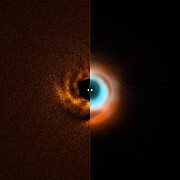
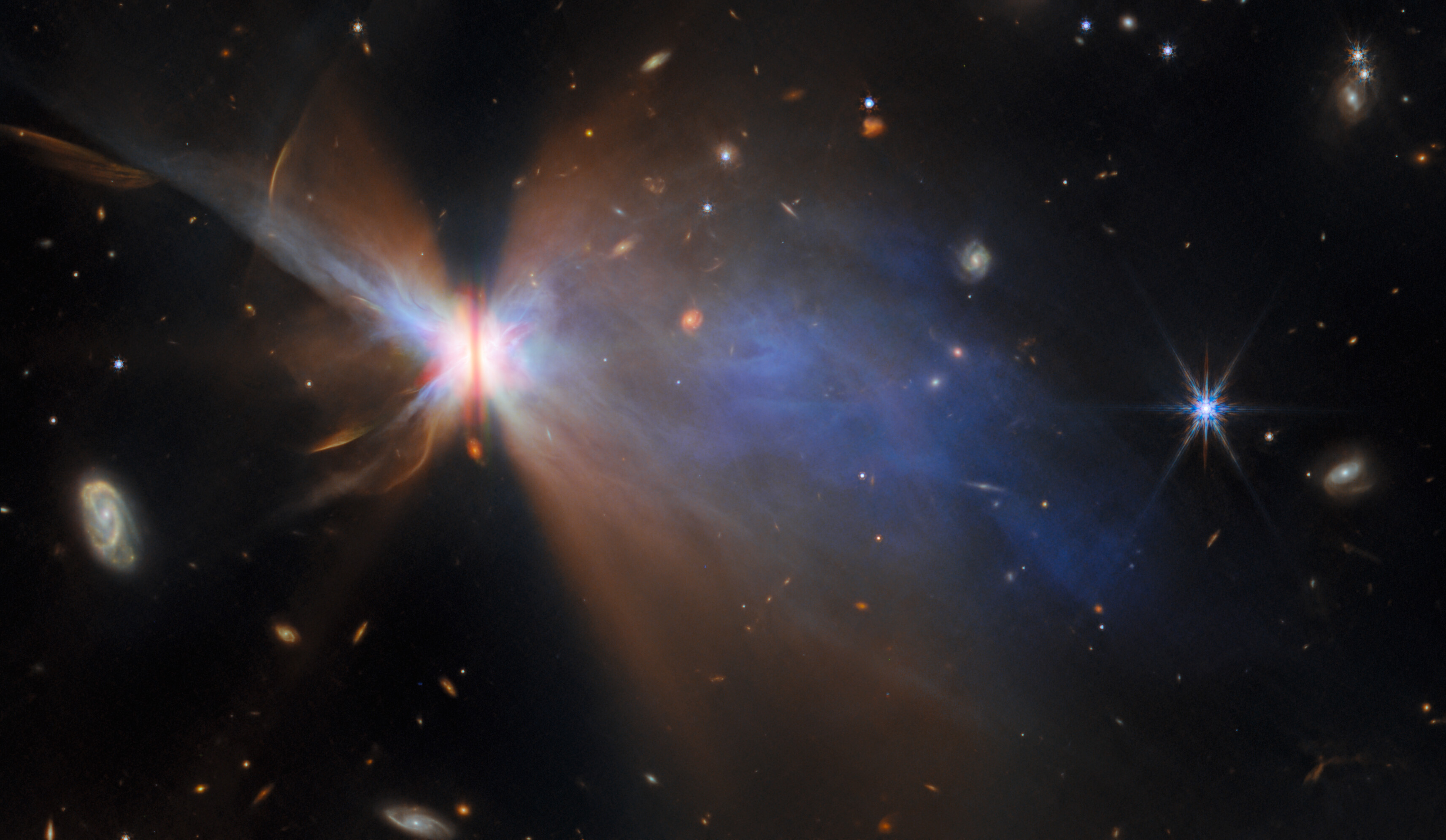
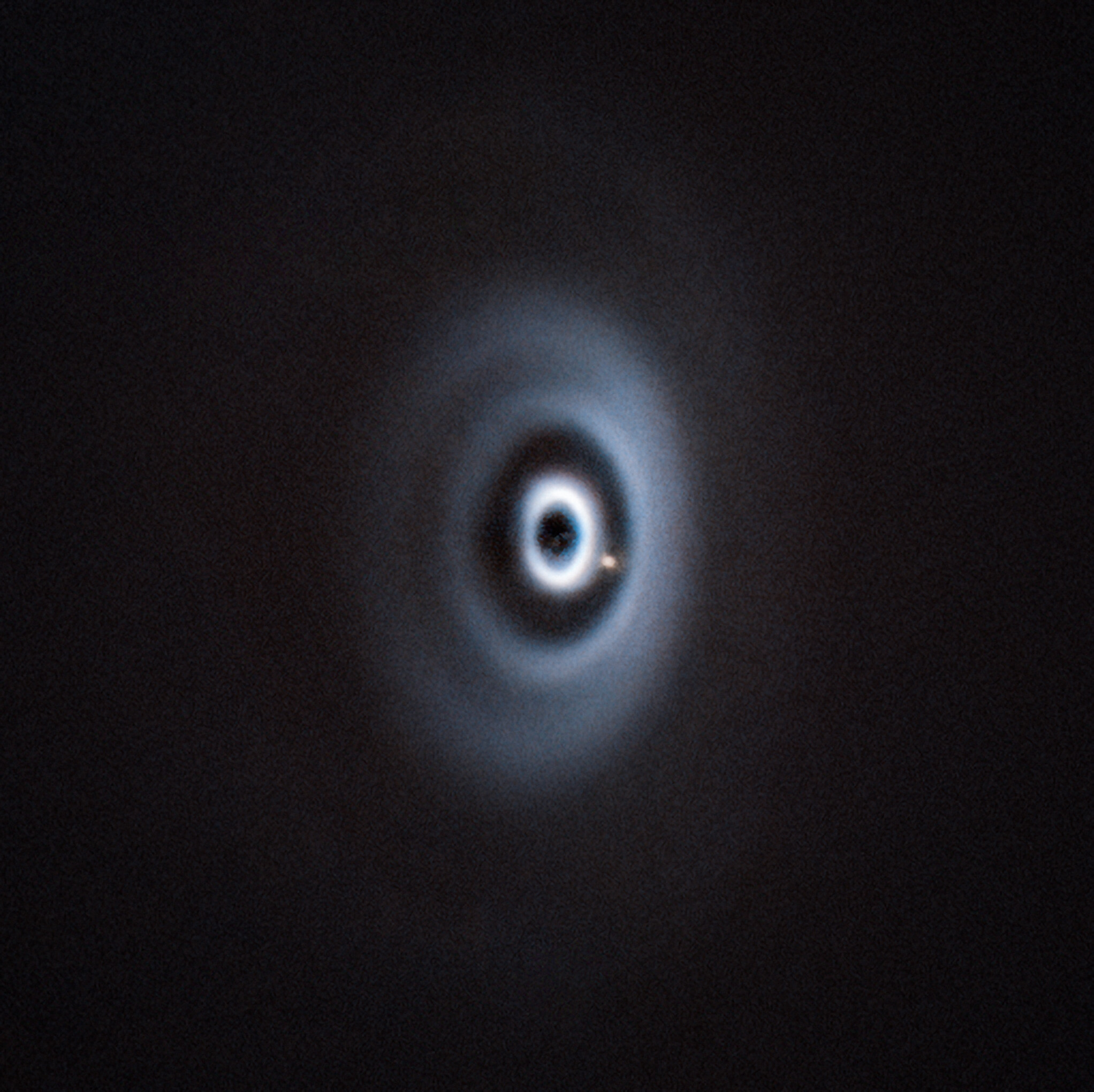
Image Description: Two images of protoplanetary discs side-by-side. The left image shows a dark horizontal band covering the star, with broad, colourful, conical outflows above and below it, and a narrow jet pointing directly up and down from the star. The right image shows the star within a yellow dusty disc, with scattered dust creating purple lobes above and below the disc. Each is on a black background with several galaxies or stars around it. Credit: ESA/Webb, NASA & CSA, ESA/Hubble, ALMA (ESO/NAOJ/NRAO), G. Duchêne, M. Villenave Hi-res Tif

This month’s NASA/ESA/CSA James Webb Space Telescope Picture of the Month offers us a two-for-one on brand new stars – with some potential planets thrown in as well!

This visual highlights Webb's views of the protoplanetary discs Tau 042021 (left) and Oph 163131 (right), otherwise known by the catalogue numbers 2MASS J04202144+2813491 and 2MASS J16313124-2426281, respectively. Tau 042021 is situated around 450 light-years from Earth in the constellation Taurus, while Oph 163131 lies about 480 light-years away in Ophiuchus.

Protoplanetary discs like these appear around stars that have recently been born. When a clump of gas inside a larger molecular cloud collapses to form a star, unused gas and dust is left orbiting the star in a thick disc. Over time, this dust too collides and collapses, slowly forming planetesimals which can, in turn, develop into planets. The planetesimals which can’t make the jump to being a fully-fledged planet are left behind as asteroids and comets orbiting the star. Gas that isn’t consumed by this process is blown away by the new star’s radiation over the course of tens of millions of years, ending the protoplanetary disc. This is how our own Solar System formed in the distant past, creating the asteroids, comets, gas giants and terrestrial planets we know today. By observing other protoplanetary discs at a much earlier age, we can work out how this process worked for our own Solar System, and how the different kinds of planets we see across the galaxy could have formed.

The unique feature these two objects have in common is that, as we see them from our vantage point with Webb, they are oriented with the edge of the disc facing us. This means that the bright light from the young star in the centre is mostly blocked, and we see the fine dust that has risen out of the disc as a nebula above and below the disc, lit by reflected light from the star. Not only is this a beautiful sight, producing these images that resemble rainbow-coloured spinning tops in space, it’s essential for studying how these planet-forming discs are composed. The distribution of dust in the disc, both within it and above or below it, strongly affects where and how planets can form.

These images were created using data from Webb’s NIRCam and MIRI instruments, as part of Webb programme #2562 (PI F. Ménard, K. Stapelfeldt). With the broad infrared sensitivity of these two cameras, Webb can track dust grains of different sizes across the disc. The red, orange and green colours of the discs in these images indicate various sizes of dust grains as well as molecules such as hydrogen (H2), carbon monoxide (CO) and polycyclic aromatic hydrocarbons (PAHs).

Both images also feature data from the NASA/ESA Hubble Space Telescope, which shows visible light, mainly from the central star reflected off the fine, floating dust. The image of Oph 163131 also includes observations from the Atacama Large Millimeter/submillimeter Array (ALMA). Where Hubble and Webb each image tiny dust grains only micrometres across, ALMA sees larger dust grains that are about a milimetre in size, which are concentrated in the central plane of the disc. This can create the right conditions for the grains to continue to grow and potentially form planets. Indeed, the ALMA data for Oph 163131 shows a gap in the inner disc, which may already be evidence of a planet forming and clearing out the dust around it.


Links


Licence:

CC BY 4.0 INT or ESA Standard Licence (content can be used under either licence)


Monday, February 16, 2026

Cheops discovers late bloomer from another era

The four planets of LHS 1903
Artist impression of the planetary system around the star LHS 1903
Credit: ESA | Acknowledgements: ATG Europe

Licence: CC BY-SA 3.0 IGO or ESA Standard Licence (content can be used under either licence)

In brief

Scientists used the European Space Agency's Cheops satellite to discover that the planetary system around the star LHS 1903 challenges current planet formation theories with the unusual order of its planets. Surprisingly, the most distant outer planet might be rocky and seems to have formed later – in a different environment than the other planets around the star.

In-depth

Many Vile Earthlings Munch Jam Sandwiches Under Newspapers and My Very Educated Mother Just Served Us Nachos. What sounds like gibberish half-sentences are memory aids taught to children to help remember the order of the planets in our Solar System: Mercury, Venus, Earth, Mars, Jupiter, Saturn, Uranus and Neptune.

The eight familiar planets can be sorted into two different types: rocky and gaseous. The inner planets that are closest to the Sun – Mercury to Mars – are rocky, and the outer planets – Jupiter to Neptune – are gaseous.

This general pattern, that planetary systems form with rocky planets closer to their star, followed by gaseous planets as the outer bodies, has been commonly observed across the Universe. It is what our current planet formation theories predict and what observations have widely confirmed to be true.

That was until scientists took a closer look at the planetary system around a star called LHS 1903 with ESA’s CHaracterising ExOPlanet Satellite (Cheops). What they have just discovered might flip our understanding of how planets form upside down.

LHS 1903 is a small red M-dwarf star that is cooler and shines less brightly than our Sun. Thomas Wilson from the University of Warwick in the UK and his international team combined the efforts of various telescopes in space and on Earth to classify three planets that they had spotted orbiting LHS 1903. They were able to conclude that the innermost planet seemed to be rocky, and the two that followed it gaseous.

So far, so normal. It wasn’t until Thomas and his colleagues were analysing observations made by ESA’s Cheops, that they discovered something strange: the data showed a small fourth planet, furthest from LHS 1903. And upon closer inspection, the scientists were surprised to discover that this planet seems to be rocky!

“That makes this an inside-out system, with a planet order of rocky-gaseous-gaseous-and then rocky again. Rocky planets don’t usually form so far away from their home star,” says Thomas.

Cheops open questions: How do planets form?
Credit: ESA
Licence: ESA Standard Licence

Current planet formation theories predict that the inner planets in a system are small and rocky, because close to the star the radiation is so powerful that it sweeps away most of the gas around the planets’ rocky core. Further away from the star, in the outer part of a planetary system, the conditions are cool enough for a thick atmosphere to gather into a gaseous planet.

ESA’s Cheops project scientist Maximilian Günther is enthusiastic: “Much about how planets form and evolve is still a mystery. Finding clues like this one for solving this puzzle is precisely what Cheops set out to do.”

Cheops open questions: How do planets evolve?
Credit: ESA 

Born to be weird?

Scientists are not quick to say that an established theory needs to be reconsidered, based on a single contradictory observation. So, Thomas and his colleagues set out to explore various explanations for why this strange rocky planet breaks the familiar pattern.

Was the planet, for example, at some point in its past hit by a giant asteroid, comet, or another big object, that blew away its atmosphere? Or had the planets around LHS 1903 swapped places at some point during their evolution? After testing these scenarios through simulations and calculations of the planets’ orbital times, the team of scientists ruled them out.

Instead, their investigation led them to a more intriguing explanation: the planets may have formed one after the other, instead of at the same time. According to our current understanding, planets form from discs of gas and dust (protoplanetary discs) by clumping into planetary embryos at roughly the same time. These clumps then evolve into planets of different sizes and compositions over millions of years.

In contrast, here Thomas and his team discovered a planetary system where the star might have given birth to its four planets one after the other, instead of bearing quadruplets at once. This idea – known as inside-out planet formation – was proposed by scientists as a theory about a decade ago, but until now, never has the evidence been so strong.

A late bloomer defying expectations

This conclusion comes with an additional catch: Much like how our younger siblings are growing up in a world that is different from the one of our childhoods, this small rocky planet seems to have evolved and formed in a very different environment than its older sibling-planets.

“By the time this outer planet formed, the system may have already run out of gas, which is considered vital for planet formation. Yet here is a small, rocky world, defying expectations. It seems that we have found first evidence for a planet which formed in what we call a gas-depleted environment”, says Thomas.

The small rocky world is either an odd outlier, or the first evidence for a trend we hadn’t known about yet. Either way, its discovery begs for an explanation that lies beyond our usual planet formation theories.

Our Solar System as a one-size-fits-all

“Historically, our planet formation theories are based on what we see and know about our Solar System,” Isabel Rebollido who is currently a Research Fellow at ESA points out. “As we are seeing more and more different exoplanet systems, we are starting to revisit these theories.”

As our instruments improve, we continue to discover more and more ‘weird’ planetary systems in the vastness of space. They force us to question our understanding and make us reconsider established theories of planet formation. Ultimately, these discoveries are helping us learn about how our Solar System fits into the big family of diverse planetary systems. They make us wonder how special the order of the planets is that we teach our children, and if maybe it is our home Solar System that is the weird one after all.


Notes for editors

'Gas-depleted planet formation occurred in the four-planet system around the red dwarf LHS 1903' by T. Wilson et al. is published in Science on 12 February 2026. DOI:10.1126/science.adl2348

For more information, please contact:

ESA Media relations
media@esa.int

More about Cheops

Cheops is an ESA mission developed in partnership with Switzerland, with a dedicated consortium led by the University of Bern, and with important contributions from Austria, Belgium, France, Germany, Hungary, Italy, Portugal, Spain, Sweden and the UK.

ESA is the Cheops mission architect, responsible for procurement and testing of the satellite, the launch and early operations phase, and in-orbit commissioning, as well as the Guest Observers’ Programme through which scientists world-wide can apply to observe with Cheops. The consortium of 11 ESA Member States led by Switzerland provided essential elements of the mission. The prime contractor for the design and construction of the spacecraft is Airbus Defence and Space in Madrid, Spain.

The Cheops mission consortium runs the Mission Operations Centre located at INTA, in Torrejón de Ardoz near Madrid, Spain, and the Science Operations Centre, located at the University of Geneva, Switzerland.

For more information, visit: https://www.esa.int/Cheops


Friday, September 12, 2025

You can’t judge a star by its protoplanetary disc

Credit: ALMA(ESO/NAOJ/NRAO)/A. Ribas et al.
 
This image tells a story of redemption for a lonely star. The young star MP Mus (PDS 66) was once thought to be all alone in the universe, surrounded by nothing but a featureless band of gas and dust known as a protoplanetary disc. In most cases, the material inside a protoplanetary disc condenses to form new planets around the star, leaving large gaps where the gas and dust used to be. These features are seen in almost every disc — but not in MP Mus’.

When astronomers first observed it with the Atacama Large Millimeter/submillimeter Array (ALMA), they saw a smooth, planet-free disc, shown here in the right image. The team, led by Álvaro Ribas, an astronomer at the University of Cambridge, UK, gave this star another chance and re-observed it with ALMA at longer wavelengths that probe even deeper into the protoplanetary disc than before. These new observations, shown in the left image, revealed a gap and a ring that had been obscured in previous observations, suggesting that MP Mus might have company after all.

Meanwhile, another piece of the puzzle was being revealed in Germany as Miguel Vioque, an astronomer at ESO, studied this same star with the European Space Agency’s (ESA’s) Gaia mission. Vioque noticed something suspicious — the star was wobbling. A bit of gravitational detective work, together with insights from the new disc structures revealed by ALMA, showed that this motion could be explained by the presence of a gas giant exoplanet.

Both teams presented their joint results in a new paper published in Nature Astronomy. In what they describe as “a beautiful merging of two groups approaching the same object from different angles”, they show that MP Mus isn’t so boring after all.

Scientific Paper


Additional information

This text was adapted from a Picture of the Week published by the European Southern Observatory (ESO), an ALMA partner on behalf of Europe.

The Atacama Large Millimeter/submillimeter Array (ALMA), an international astronomy facility, is a partnership of the European Southern Observatory (ESO), the U.S. National Science Foundation (NSF), and the National Institutes of Natural Sciences (NINS) of Japan in cooperation with the Republic of Chile. ALMA is funded by ESO on behalf of its Member States, by NSF in cooperation with the National Research Council of Canada (NRC) and the National Science and Technology Council (NSTC) in Taiwan, and by NINS in cooperation with the Academia Sinica (AS) in Taiwan and the Korea Astronomy and Space Science Institute (KASI).

ALMA construction and operations are led by ESO on behalf of its Member States; by the National Radio Astronomy Observatory (NRAO), managed by Associated Universities, Inc. (AUI), on behalf of North America; and by the National Astronomical Observatory of Japan (NAOJ) on behalf of East Asia. The Joint ALMA Observatory (JAO) provides the unified leadership and management of ALMA's construction, commissioning, and operation.


Contacts:

Nicolás Lira
Education and Public Outreach Officer
Joint ALMA Observatory, Santiago - Chile
Phone:
+56 2 2467 6519
Cel: +56 9 9445 7726
Email: nicolas.lira@alma.cl


Tuesday, September 09, 2025

Dusty wisps round a dusty disc

A wide-field image of IRAS 16594-4656 taken by the James Webb Space Telescope. The nebula’s bright core is split by a narrow dark band, with expansive rainbow lobes of light and colour radiating outward. Numerous background galaxies and stars are visible across the field. redit: ESA/Webb, NASA & CSA, M. Villenave et al.
Hi-rs image


For this new Picture of the Month feature, the NASA/ESA/CSA James Webb Space Telescope has provided a fantastic new view of IRAS 04302+2247, a planet-forming disc located about 525 light-years away in a dark cloud within the Taurus star-forming region. With Webb, researchers can study the properties and growth of dust grains within protoplanetary discs like this one, shedding light on the earliest stages of planet formation.

In stellar nurseries across the galaxy, baby stars are forming in giant clouds of cold gas. As young stars grow, the gas surrounding them collects in narrow, dusty protoplanetary discs. This sets the scene for the formation of planets, and observations of distant protoplanetary discs can help researchers understand what took place roughly 4.5 billion years ago in our own Solar System, when the Sun, Earth, and the other planets formed.

IRAS 04302+2247, or IRAS 04302 for short, is a beautiful example of a protostar - a young star that is still gathering mass from its environment - surrounded by a protoplanetary disc in which baby planets might be forming. Webb is able to measure the disc at 65 billion kilometres across - several times the diameter of our Solar System. From Webb’s vantage point, IRAS 04302’s disc is oriented edge-on, so we see it as a narrow, dark line of dusty gas that blocks the light from the budding protostar at its centre. This dusty gas is fuel for planet formation, providing an environment within which young planets can bulk up and pack on mass.

When seen face-on, protoplanetary discs can have a variety of structures like rings, gaps and spirals. These structures can be signs of baby planets that are burrowing through the dusty disc, or they can point to phenomena unrelated to planets, like gravitational instabilities or regions where dust grains are trapped. The edge-on view of IRAS 04302’s disc shows instead the vertical structure, including how thick the dusty disk is. Dust grains migrate to the midplane of the disc, settle there and form a thin, dense layer that is conducive to planet formation; the thickness of the disc is a measure of how efficient this process has been.

The dense streak of dusty gas that runs vertically across this image cocoons IRAS 04302, blotting out its bright light such that Webb can more easily image the delicate structures around it. As a result, we’re treated to the sight of two gauzy nebulae on either side of the disc. These are reflection nebulae, illuminated by light from the central protostar reflecting off of the nebular material. Given the appearance of the two reflection nebulae, IRAS 04302 has been nicknamed the “Butterfly Star”.

This view of IRAS 04302 features observations from Webb's Near-InfraRed Camera (NIRCam) and its Mid-InfraRed Instrument (MIRI), combined with optical data from the NASA/ESA Hubble Space Telescope. Together, these powerful facilities paint a fascinating multiwavelength portrait of a planetary birthplace. Webb reveals the distribution of tiny dust grains as well as the reflection of near-infrared light off of dusty material that extends a large distance from the disc, while Hubble focuses on the dust lane as well as clumps and streaks surrounding the dust that suggest the star is still collecting mass from its surroundings as well as shooting out jets and outflows.

The Webb observations of IRAS 04302 were taken as part of the Webb GO programme #2562 (PI F. Ménard, K. Stapelfeldt). This programme investigates four protoplanetary discs that are oriented edge-on from our point of view, aiming to understand how dust evolves within these discs. The growth of dust grains in protoplanetary discs is believed to be an important step toward planet formation.


Links:


Saturday, August 30, 2025

A very hungry planet

WISPIT 2b
Credit: SO/R. F. van Capelleveen et al.

What appears to be a ripple in space, is today’s Picture of the Week depicting a newborn planet eating its way through its dusty cradle as it orbits its host star. This image, taken with ESO’s Very Large Telescope (VLT) in Chile, is the first clear detection of a baby planet in a disc with multiple rings.

These so-called protoplanetary discs surround young stars and appear as disc-shaped structures of gas and dust, often with rings like the one in this image. They are the birthplace of planets, and the rings are thought to indicate the presence of (hungry) planets in the disc. Initially, little particles in the spinning disc begin to accumulate and grow as gravity takes over, stealing more material from the native disc until they evolve into embryo planets.

The clear detection of the planet WISPIT 2b in this image is an important step forward in our understanding of how planets form. It’s about 5 times the mass of Jupiter, and its host star is a younger version of our Sun. It also reinforces the idea that gaps can be created by newly formed planets — a prediction only made in theory that has now been verified observationally.

While looking for stars hosting young planets, the team of researchers were lucky enough to find a planet so young that is still embedded in its birth disc. This discovery was published in a paper led by Richelle van Capelleveen at the University of Leiden, Netherlands, in collaboration with an international team of astronomers from the University of Galway and the University of Arizona. It was made possible through the precise observations of the planet-hunting SPHERE instrument on the VLT. SPHERE blocks the light of the central star and corrects atmospheric turbulence with adaptive optics, delivering crisp images of the surroundings of the star. The Universit of Arizona's MagAO-X AO system on the 6.5m Magellan telescope in Chile detected hydrogen gas falling onto the planet, confirming that it is accreting matter from its surroundings. Further observations of this system might reveal new insights about how our own Solar System may have looked in its early days.

Links
Source: ESO/potw


Saturday, July 26, 2025

The evolution of life may have its origins in outer space

This artist’s impression shows the planet-forming disc around the star V883 Orionis. In the outermost part of the disc volatile gases are frozen out as ice, which contains complex organic molecules. An outburst of energy from the star heats the inner disc to a temperature that evaporates the ice and releases the complex molecules, enabling astronomers to detect it. The inset image shows the chemical structure of complex organic molecules detected and presumed in the protoplanetary disc (from left to right): propionitrile (ethyl cyanide), glycolonitrile, alanine, glycine, ethylene glycol, acetonitrile (methyl cyanide). © Credit: ESO/L. Calçada/T. Müller (MPIA/HdA) (CC BY 4.0)


Astronomers find signs of complex organic molecules – precursors to sugars and amino acids – in a planet-forming disc.

the point:
  • First tentative detection of prebiotic molecules in a planet-forming disc: In the young V883 Orionis system, ALMA observations have revealed signatures of complex organic compounds such as ethylene glycol and glycolonitrile – potential precursors to sugars and amino acids.
  • Chemical evolution begins before planets are formed: The findings suggest that protoplanetary discs inherit and further develop complex molecules from earlier evolutionary stages, rather than forming them anew.
  • Evidence for universal processes in the origin of biological molecules: The building blocks of life may not be limited to local conditions but could form widely throughout the Universe under suitable circumstances.
Using the Atacama Large Millimeter/submillimeter Array (ALMA), a team of astronomers led by Abubakar Fadul from the Max Planck Institute for Astronomy (MPIA) has discovered complex organic molecules – including the first tentative detection of ethylene glycol and glycolonitrile – in the protoplanetary disc of the outbursting protostar V883 Orionis. These compounds are considered precursors to the building blocks of life. Comparing different cosmic environments reveals that the abundance and complexity of such molecules increase from star-forming regions to fully evolved planetary systems. This suggests that the seeds of life are assembled in space and widespread.

Astronomers have discovered complex organic molecules (COMs) in various locations associated with planet and star formation before. COMs are molecules with more than five atoms, at least one of which is carbon. Many of them are considered building blocks of life, such as amino acids and nucleic acids or their precursors. The discovery of 17 COMs in the protoplanetary disc of V883 Orionis, including ethylene glycol and glycolonitrile, provides a long-sought puzzle piece in the evolution of such molecules between the stages preceding and following the formation of stars and their planet-forming discs. Glycolonitrile is a precursor of the amino acids glycine and alanine, as well as the nucleobase adenine. The findings were published in the Astrophysical Journal Letters today. The assembly of prebiotic molecules begins in interstellar space

The transition from a cold protostar to a young star surrounded by a disc of dust and gas is accompanied by a violent phase of shocked gas, intense radiation and rapid gas ejection. Such energetic processes might destroy most of the complex chemistry assembled during the previous stages. Therefore, scientists had laid out a so-called ‘reset’ scenario, in which most of the chemical compounds required to evolve into life would have to be reproduced in circumstellar discs while forming comets, asteroids, and planets.

"Our finding points to a straight line of chemical enrichment and increasing complexity between interstellar clouds and fully evolved planetary systems." Abubakar Fadul

“Now it appears the opposite is true,” MPIA scientist and co-author Kamber Schwarz points out. “Our results suggest that protoplanetary discs inherit complex molecules from earlier stages, and the formation of complex molecules can continue during the protoplanetary disc stage.” Indeed, the period between the energetic protostellar phase and the establishment of a protoplanetary disk would, on its own, be too short for COMs to form in detectable amounts.

As a result, the conditions that predefine biological processes may be widespread rather than being restricted to individual planetary systems.

Astronomers have found the simplest organic molecules, such as methanol, in dense regions of dust and gas that predate the formation of stars. Under favourable conditions, they may even contain complex compounds comprising ethylene glycol, one of the species now discovered in V883 Orionis. “We recently found ethylene glycol could form by UV irradiation of ethanolamine, a molecule that was recently discovered in space,” adds Tushar Suhasaria, a co-author and the head of MPIA’s Origins of Life Lab. “This finding supports the idea that ethylene glycol could form in those environments but also in later stages of molecular evolution, where UV irradiation is dominant.”

More evolved agents crucial to biology, such as amino acids, sugars, and nucleobases that make up DNA and RNA, are present in asteroids, meteorites, and comets within the Solar System.

Buried in ice – resurfaced by stars

The chemical reactions that synthesize those COMs occur under cold conditions, preferably on icy dust grains that later coagulate to form larger objects. Hidden in those mixtures of rock, dust, and ice, they usually remain undetected. Accessing those molecules is only possible either by digging for them with space probes or external heating, which evaporates the ice.

In the Solar System, the Sun heats comets, resulting in impressive tails of gas and dust, or comas, essentially gaseous envelopes that surround the cometary nuclei. This way, spectroscopy – the rainbow-like dissection of light – may pick up the emissions of freed molecules. Those spectral fingerprints help astronomers to identify the molecules previously buried in ice.

A similar heating process is occurring in the V883 Orionis system. The central star is still growing by accumulating gas from the surrounding disc until it eventually ignites the fusion fire in its core. During those growth periods, the infalling gas heats up and produces intense outbursts of radiation. “These outbursts are strong enough to heat the surrounding disc as far as otherwise icy environments, releasing the chemicals we have detected,” explains Fadul.

“Complex molecules, including ethylene glycol and glycolonitrile, radiate at radio frequencies. ALMA is perfectly suited to detect those signals,” says Schwarz. The MPIA astronomers were awarded access to this radio interferometer through the European Southern Observatory (ESO), which operates it in the Chilean Atacama Desert at an altitude of 5,000 metres. ALMA enabled the astronomers to pinpoint the V883 Orionis system and search for faint spectral signatures, which ultimately led to the detections.

Further challenges ahead

“While this result is exciting, we still haven't disentangled all the signatures we found in our spectra,” says Schwarz. “Higher resolution data will confirm the detections of ethylene glycol and glycolonitril and maybe even reveal more complex chemicals we simply haven't identified yet.”

“Perhaps we also need to look at other regions of the electromagnetic spectrum to find even more evolved molecules,” Fadul points out. “Who knows what else we might discover?”

Additional information

The MPIA team involved in this study consisted of Abubakar Fadul (now at the University of Duisburg-Essen), Kamber Schwarz, and Tushar Suhasaria.

Other researchers were Jenny K. Calahan (Center for Astrophysics — Harvard & Smithsonian, Cambridge, USA), Jane Huang (Department of Astronomy, Columbia University, New York, USA), and Merel L. R. van ’t Hoff (Department of Physics and Astronomy, Purdue University, West Lafayette, USA).

The Atacama Large Millimeter/submillimeter Array (ALMA), an international astronomy facility, is a partnership of the European Southern Observatory (ESO), the U.S. National Science Foundation (NSF) and the National Institutes of Natural Sciences (NINS) of Japan in cooperation with the Republic of Chile. ALMA is funded by ESO on behalf of its Member States, by NSF in cooperation with the National Research Council of Canada (NRC) and the National Science and Technology Council (NSTC) in Taiwan and by NINS in cooperation with the Academia Sinica (AS) in Taiwan and the Korea Astronomy and Space Science Institute (KASI). ALMA construction and op;erations are led by ESO on behalf of its Member States; by the National Radio Astronomy Observatory (NRAO), managed by Associated Universities, Inc. (AUI), on behalf of North America; and by the National Astronomical Observatory of Japan (NAOJ) on behalf of East Asia. The Joint ALMA Observatory (JAO) provides the unified leadership and management of the construction, commissioning and operation of ALMA.


Contact:

Dr. Markus Nielbock
Press and outreach officer

+49 6221 528-134
pr@mpia.de
MPIA press department
Max Planck Institute for Astronomy, Heidelberg, Germany

Abubakar Fadul

+49 203 379-2208
abubakar.fadul@uni-due.de
University of Duisburg-Essen, Duisburg, Germany

Dr. Kamber Schwarz

+49 6221 528-292
schwarz@mpia.de
Kamber Schwarz / MPIA
class="company">Max Planck Institute for Astronomy, Heidelberg, Germany

Dr. Tushar Suhasaria

+49 6221 528-202
suhasaria@mpia.de
Max Planck Institute for Astronomy, Heidelberg, Germany


Original publication

Abubakar M. A. Fadul, Kamber R. Schwarz, Tushar Suhasaria, et al.
A deep search for Ethylene Glycol and Glycolonitrile in V883 Ori Protoplanetary Disk
The Astrophysical Journal Letters, Vol 988, L44 (2025)


Source | DOI

T. Suhasaria, S. M. Wee, R. Basalgète, S. Krasnokutski, C. Jäger, K. Schwarz, and Th. Henning
Lyα Processing of Solid-state Ethanolamine: Potential Precursors to Sugar and Peptide Derivatives
The Astrophysical Journal, Vol. 982, id. 48, p. 14 (2025)


Source | DOI

Download

mpia-pm_v883ori_prebiotics_2025_teaser 7.68 MB


Tuesday, July 22, 2025

Astronomers witness newborn planet sculpting the dust around it

PR Image eso2513a
A planet candidate around the star HD 135344B

PR Image eso2513b
Disc and a candidate planet around the star HD 135344B as seen with ERIS

PR Image eso2513c
The disc around the star HD 135344B as seen with SPHERE

PR Image eso2513d
The disc around the star HD 135344B as seen with ALMA

PR Image eso2513e
A joint VLT and ALMA view of the disc around the star HD 135344B

PR Image eso2513f
Wide-field view of the area of the sky around the star HD 135344B

PR Image eso2513g
A possible companion in the disc of the star V960 Mon

PR Image eso2513h
ERIS view of a companion candidate around the star V960 Mon


Videos

Zooming into the young star HD 135344B and its planet candidate
PR Video eso2513a
Zooming into the young star HD 135344B and its planet candidate


Image Comparisons

A disc and a planet candidate around the star HD 135344B

A disc and a possible companion around the star V960 Mon


Astronomers may have caught a still-forming planet in action, carving out an intricate pattern in the gas and dust that surrounds its young host star. Using ESO’s Very Large Telescope (VLT), they observed a planetary disc with prominent spiral arms, finding clear signs of a planet nestled in its inner regions. This is the first time astronomers have detected a planet candidate embedded inside a disc spiral.

We will never witness the formation of Earth, but here, around a young star 440 light-years away, we may be watching a planet come into existence in real time,” says Francesco Maio, a doctoral researcher at the University of Florence, Italy, and lead author of this study, published today in Astronomy & Astrophysics.

The potential planet-in-the-making was detected around the star HD 135344B, within a disc of gas and dust around it called a protoplanetary disc. The budding planet is estimated to be twice the size of Jupiter and as far from its host star as Neptune is from the Sun. It has been observed shaping its surroundings within the protoplanetary disc as it grows into a fully formed planet.

Protoplanetary discs have been observed around other young stars, and they often display intricate patterns, such as rings, gaps or spirals. Astronomers have long predicted that these structures are caused by baby planets, which sweep up material as they orbit around their parent star. But, until now, they had not caught one of these planetary sculptors in the act.

In the case of HD 135344B’s disc, swirling spiral arms had previously been detected by another team of astronomers using SPHERE (Spectro-Polarimetric High-contrast Exoplanet REsearch), an instrument on ESO’s VLT. However, none of the previous observations of this system found proof of a planet forming within the disc.

Now, with observations from the new VLT’s Enhanced Resolution Imager and Spectrograph (ERIS) instrument, the researchers say they may have found their prime suspect. The team spotted the planet candidate right at the base of one of the disc’s spiral arms, exactly where theory had predicted they might find the planet responsible for carving such a pattern.

What makes this detection potentially a turning point is that, unlike many previous observations, we are able to directly detect the signal of the protoplanet, which is still highly embedded in the disc,” says Maio, who is based at the Arcetri Astrophysical Observatory, a centre of Italy’s National Institute for Astrophysics (INAF). “This gives us a much higher level of confidence in the planet’s existence, as we’re observing the planet’s own light.”

Source: ESO/News


A star’s companion is born 

A different team of astronomers have also recently used the ERIS instrument to observe another star, V960 Mon, one that is still in the very early stages of its life. In a study published on 18 July in The Astrophysical Journal Letters, the team report that they have found a companion object to this young star. The exact nature of this object remains a mystery.

The new study, led by Anuroop Dasgupta, a doctoral researcher at ESO and at the Diego Portales University in Chile,
follows up observations of V960 Mon made a couple of years ago. Those observations, made with both SPHERE and the Atacama Large Millimeter/submillimeter Array (ALMA), revealed that the material orbiting V960 Mon is shaped into a series of intricate spiral arms. They also showed that the material is fragmenting, in a process known as ‘gravitational instability’, when large clumps of the material around a star contract and collapse, each with the potential to form a planet or a larger object.

That work revealed unstable material but left open the question of what happens next. With ERIS, we set out to find any compact, luminous fragments signalling the presence of a companion in the disc — and we did,” says Dasgupta. The team found a potential companion object very near to one of the spiral arms observed with SPHERE and ALMA. The team say that this object could either be a planet in formation, or a ‘brown dwarf’ — an object bigger than a planet that didn’t gain enough mass to shine as a star.

If confirmed, this companion object may be the first clear detection of a planet or brown dwarf forming by gravitational instability.


More information

This research highlighted in the first part of this release was presented in the paper “Unveiling a protoplanet candidate embedded in the HD 135344B disk with VLT/ERIS” to appear in Astronomy & Astrophysics (doi: 10.1051/0004-6361/202554472). The second part of the release highlights the study "VLT/ERIS observations of the V960 Mon system: a dust-embedded substellar object formed by gravitational instability?” published in The Astrophysical Journal Letters (doi: 10.3847/2041-8213/ade996).

The team who conducted the first study (on HD 135344B) is composed of F. Maio (University of Firenze, Italy, and INAF-Osservatorio Astrofisico Arcetri, Firenze, Italy [OAA]), D. Fedele (OAA), V. Roccatagliata (University of Bologna, Italy [UBologna] and OAA), S. Facchini (University of Milan, Italy [UNIMI]), G. Lodato (UNIMI), S. Desidera (INAF-Osservatorio Astronomico di Padova, Italy [OAP]), A. Garufi (INAF - Istituto di Radioastronomia, Bologna, Italy [INAP-Bologna], and Max-Planck-Institut für Astronomie, Heidelberg, Germany [MPA]), D. Mesa (OAP), A. Ruzza (UNIMI), C. Toci (European Southern Observatory [ESO], Garching bei Munchen, Germany, and OAA), L. Testi (OAA, and UBologna), A. Zurlo (Diego Portales University [UDP], Santiago, Chile, and Millennium Nucleus on Young Exoplanets and their Moons [YEMS], Santiago, Chile), and G. Rosotti (UNIMI).

The team behind the second study (on V960 Mon) is primarily composed of members of the Millennium Nucleus on Young Exoplanets and their Moons (YEMS), a collaborative research initiative based in Chile. Core YEMS contributors include A. Dasgupta (ESO, Santiago, Chile, UDP, and YEMS), A. Zurlo (UDP and YEMS), P. Weber (University of Santiago [Usach], Chile, and YEMS, and Center for Interdisciplinary Research in Astrophysics and Space Exploration [CIRAS], Santiago, Chile), F. Maio (OAA, and University of Firenze, Italy), Lucas A. Cieza (UDP and YEMS), D. Fedele (OAA), A. Garufi (INAF Bologna and MPA), J. Miley (Usach, YEMS, and CIRAS), P. Pathak (Indian Institute of Technology, Kanpur, India), S. Pérez (Usach and YEMS, and CIRAS), and V. Roccatagliata (UBologna and OAA).

The Atacama Large Millimeter/submillimeter Array (ALMA), an international astronomy facility, is a partnership of ESO, the U.S. National Science Foundation (NSF) and the National Institutes of Natural Sciences (NINS) of Japan in cooperation with the Republic of Chile. ALMA is funded by ESO on behalf of its Member States, by NSF in cooperation with the National Research Council of Canada (NRC) and the National Science and Technology Council (NSTC) in Taiwan and by NINS in cooperation with the Academia Sinica (AS) in Taiwan and the Korea Astronomy and Space Science Institute (KASI). ALMA construction and operations are led by ESO on behalf of its Member States; by the National Radio Astronomy Observatory (NRAO), managed by Associated Universities, Inc. (AUI), on behalf of North America; and by the National Astronomical Observatory of Japan (NAOJ) on behalf of East Asia. The Joint ALMA Observatory (JAO) provides the unified leadership and management of the construction, commissioning and operation of ALMA.

The European Southern Observatory (ESO) enables scientists worldwide to discover the secrets of the Universe for the benefit of all. We design, build and operate world-class observatories on the ground — which astronomers use to tackle exciting questions and spread the fascination of astronomy — and promote international collaboration for astronomy. Established as an intergovernmental organisation in 1962, today ESO is supported by 16 Member States (Austria, Belgium, Czechia, Denmark, France, Finland, Germany, Ireland, Italy, the Netherlands, Poland, Portugal, Spain, Sweden, Switzerland and the United Kingdom), along with the host state of Chile and with Australia as a Strategic Partner. ESO’s headquarters and its visitor centre and planetarium, the ESO Supernova, are located close to Munich in Germany, while the Chilean Atacama Desert, a marvellous place with unique conditions to observe the sky, hosts our telescopes. ESO operates three observing sites: La Silla, Paranal and Chajnantor. At Paranal, ESO operates the Very Large Telescope and its Very Large Telescope Interferometer, as well as survey telescopes such as VISTA. Also at Paranal ESO will host and operate the Cherenkov Telescope Array South, the world’s largest and most sensitive gamma-ray observatory. Together with international partners, ESO operates ALMA on Chajnantor, a facility that observes the skies in the millimetre and submillimetre range. At Cerro Armazones, near Paranal, we are building “the world’s biggest eye on the sky” — ESO’s Extremely Large Telescope. From our offices in Santiago, Chile we support our operations in the country and engage with Chilean partners and society.


Links


Contacts:

Francesco Maio (for questions on the HD 135344B study)
INAF Osservatorio Astrofisico di Arcetri
Florence, Italy
Email:
francesco.maio@inaf.it

Davide Fedele (for questions on the HD 135344B study)
INAF Osservatorio Astrofisico di Arcetri
Florence, Italy
Tel: (+39) 055-2752-242
Email:
davide.fedele@inaf.it

Anuroop Dasgupta (for questions on the V960 Mon study)
European Southern Observatory
Santiago, Chile
Email:
Anuroop.Dasgupta@eso.org

Bárbara Ferreira
ESO Media Manager
Garching bei München, Germany
Tel: +49 89 3200 6670
Cell: +49 151 241 664 00
Email:
press@eso.org


Friday, July 18, 2025

For the first time, astronomers witness the dawn of a new solar system

PR Image eso2512a
ALMA image of HOPS-315, a still-forming planetary system

PR Image eso2512b
Formation of silicates around the baby star HOPS-315

PR Image eso2512c
Jets of silicon monoxide in the baby star HOPS-315

PR Image eso2512d
The baby star HOPS-315 in the constellation Orion


Videos

Witnessing the dawn of a new solar system | Chasing Starlight
PR Video eso2512a
Witnessing the dawn of a new solar system | Chasing Starlight

Zoom into the baby star HOPS-315
PR Video eso2512b
Zoom into the baby star HOPS-315

Animation of the formation of minerals around the baby star HOPS-315
PR Video eso2512c
Animation of the formation of minerals around the baby star HOPS-315


International researchers have, for the first time, pinpointed the moment when planets began to form around a star beyond the Sun. Using the ALMA telescope, in which the European Southern Observatory (ESO) is a partner, and the James Webb Space Telescope, they have observed the creation of the first specks of planet-forming material — hot minerals just beginning to solidify. This finding marks the first time a planetary system has been identified at such an early stage in its formation and opens a window to the past of our own Solar System.

"For the first time, we have identified the earliest moment when planet formation is initiated around a star other than our Sun,” says Melissa McClure, a professor at Leiden University in the Netherlands and lead author of the new study, published today in Nature.

Co-author Merel van ‘t Hoff, a professor at Purdue University, USA, compares their findings to "a picture of the baby Solar System", saying that “we're seeing a system that looks like what our Solar System looked like when it was just beginning to form.”

This newborn planetary system is emerging around HOPS-315, a ‘proto’ or baby star that sits some 1300 light-years away from us and is an analogue of the nascent Sun. Around such baby stars, astronomers often see discs of gas and dust known as ‘protoplanetary discs’, which are the birthplaces of new planets. While astronomers have previously seen young discs that contain newborn, massive, Jupiter-like planets, McClure says, “we've always known that the first solid parts of planets, or ‘planetesimals’, must form further back in time, at earlier stages.”

In our Solar System, the very first solid material to condense near Earth’s present location around the Sun is found trapped within ancient meteorites. Astronomers age-date these primordial rocks to determine when the clock started on our Solar System’s formation. Such meteorites are packed full of crystalline minerals that contain silicon monoxide (SiO) and can condense at the extremely high temperatures present in young planetary discs. Over time, these newly condensed solids bind together, sowing the seeds for planet formation as they gain both size and mass. The first kilometre-sized planetesimals in the Solar System, which grew to become planets such as Earth or Jupiter’s core, formed just after the condensation of these crystalline minerals.

With their new discovery, astronomers have found evidence of these hot minerals beginning to condense in the disc around HOPS-315. Their results show that SiO is present around the baby star in its gaseous state, as well as within these crystalline minerals, suggesting it is only just beginning to solidify. "This process has never been seen before in a protoplanetary disc — or anywhere outside our Solar System," says co-author Edwin Bergin, a professor at the University of Michigan, USA.

These minerals were first identified using the James Webb Space Telescope, a joint project of the US, European and Canadian space agencies. To find out where exactly the signals were coming from, the team observed the system with ALMA, the Atacama Large Millimeter/submillimeter Array, which is operated by ESO together with international partners in Chile’s Atacama Desert.

With these data, the team determined that the chemical signals were coming from a small region of the disc around the star equivalent to the orbit of the asteroid belt around the Sun. “We're really seeing these minerals at the same location in this extrasolar system as where we see them in asteroids in the Solar System,“ says co-author Logan Francis, a postdoctoral researcher at Leiden University.

Because of this, the disc of HOPS-315 provides a wonderful analogue for studying our own cosmic history. As van ‘t Hoff says, “this system is one of the best that we know to actually probe some of the processes that happened in our Solar System." It also provides astronomers with a new opportunity to study early planet formation, by standing in as a substitute for newborn solar systems across the galaxy.

ESO astronomer and European ALMA Programme Manager Elizabeth Humphreys, who did not take part in the study, says: “I was really impressed by this study, which reveals a very early stage of planet formation. It suggests that HOPS-315 can be used to understand how our own Solar System formed. This result highlights the combined strength of JWST and ALMA for exploring protoplanetary discs.”

Source: ESO/News


More information

This research was presented in the paper “Refractory solid condensation detected in an embedded protoplanetary disk” (doi:10.1038/s41586-025-09163-z) to appear in Nature.

The team is composed of M. K. McClure (Leiden Observatory, Leiden University, The Netherlands [Leiden]), M. van ’t Hoff (Department of Astronomy, The University of Michigan, Michigan, USA [Michigan] and Purdue University, Department of Physics and Astronomy, Indiana, USA), L. Francis (Leiden), Edwin Bergin (Michigan), W.R. M. Rocha (Leiden), J. A. Sturm (Leiden), D. Harsono (Institute of Astronomy, Department of Physics, National Tsing Hua University, Taiwan), E. F. van Dishoeck (Leiden), J. H. Black (Chalmers University of Technology, Department of Space, Earth and Environment, Onsala Space Observatory, Sweden), J. A. Noble (Physique des Interactions Ioniques et Moléculaires, CNRS, Aix Marseille Université, France), D. Qasim (Southwest Research Institute, Texas, USA), E. Dartois (Institut des Sciences Moléculaires d’Orsay, CNRS, Université Paris-Saclay, France.)

The Atacama Large Millimeter/submillimeter Array (ALMA), an international astronomy facility, is a partnership of ESO, the U.S. National Science Foundation (NSF) and the National Institutes of Natural Sciences (NINS) of Japan in cooperation with the Republic of Chile. ALMA is funded by ESO on behalf of its Member States, by NSF in cooperation with the National Research Council of Canada (NRC) and the National Science and Technology Council (NSTC) in Taiwan and by NINS in cooperation with the Academia Sinica (AS) in Taiwan and the Korea Astronomy and Space Science Institute (KASI). ALMA construction and operations are led by ESO on behalf of its Member States; by the National Radio Astronomy Observatory (NRAO), managed by Associated Universities, Inc. (AUI), on behalf of North America; and by the National Astronomical Observatory of Japan (NAOJ) on behalf of East Asia. The Joint ALMA Observatory (JAO) provides the unified leadership and management of the construction, commissioning and operation of ALMA.

The European Southern Observatory (ESO) enables scientists worldwide to discover the secrets of the Universe for the benefit of all. We design, build and operate world-class observatories on the ground — which astronomers use to tackle exciting questions and spread the fascination of astronomy — and promote international collaboration for astronomy. Established as an intergovernmental organisation in 1962, today ESO is supported by 16 Member States (Austria, Belgium, Czechia, Denmark, France, Finland, Germany, Ireland, Italy, the Netherlands, Poland, Portugal, Spain, Sweden, Switzerland and the United Kingdom), along with the host state of Chile and with Australia as a Strategic Partner. ESO’s headquarters and its visitor centre and planetarium, the ESO Supernova, are located close to Munich in Germany, while the Chilean Atacama Desert, a marvellous place with unique conditions to observe the sky, hosts our telescopes. ESO operates three observing sites: La Silla, Paranal and Chajnantor. At Paranal, ESO operates the Very Large Telescope and its Very Large Telescope Interferometer, as well as survey telescopes such as VISTA. Also at Paranal ESO will host and operate the Cherenkov Telescope Array South, the world’s largest and most sensitive gamma-ray observatory. Together with international partners, ESO operates ALMA on Chajnantor, a facility that observes the skies in the millimetre and submillimetre range. At Cerro Armazones, near Paranal, we are building “the world’s biggest eye on the sky” — ESO’s Extremely Large Telescope. From our offices in Santiago, Chile we support our operations in the country and engage with Chilean partners and society.


Links


Contacts

Melissa McClure
Leiden Observatory, Leiden University
Leiden, The Netherlands
Cell: on request
Email:
mcclure@strw.leidenuniv.nl

Merel van ‘t Hoff
Department of Physics and Astronomy, Purdue University
West Lafayette, Indiana, United States
Tel: +1-734-882-0270
Email:
vanthoff@purdue.edu

Logan Francis
Leiden Observatory, Leiden University
Leiden, The Netherlands
Tel: +31 71 527 2727
Email:
francis@strw.leidenuniv.nl

Edwin Bergin
Department of Astronomy, University of Michigan
Ann Arbor, Michigan, United States
Tel: +1 734 764 3441
Email:
ebergin@umich.edu

Elizabeth Humphreys
European Southern Observatory
Garching bei München, Germany
Tel: +49 89 3200 6541
Email:
ehumphre@eso.org

Bárbara Ferreira
ESO Media Manager
Garching bei München, Germany
Tel: +49 89 3200 6670
Cell: +49 151 241 664 00
Email:
press@eso.org


Tuesday, July 08, 2025

The birth of a solar system revealed by planet 'pebbles'

An artist’s impression of dust and tiny grains in a protoplanetary disc surrounding a young star (left) alongside an e-MERLIN map showing the tilted disc structure around the young star DG Tauri (top right) and the HL Tau disc captured by e-MERLIN is shown overlaid on an ALMA image, revealing both the compact emission from the central region of the disc and the larger scale dust rings (bottom right). Credit: NASA/JPL-Caltech/Hesterly, Drabek-Maunder, Greaves, Richards, et al./Greaves, Hesterly, Richards, and et al./ALMA partnership et al.
Licence type: Attribution (CC BY 4.0)

An e-MERLIN map showing the tilted disc structure around the young star DG Tauri where pebble-sized clumps are beginning to form. Its long axis is southeast to northwest (lower left to upper right). Emission from an outflow of material from the central star is also seen in the northeast and southwest directions. Credit: Hesterly, Drabek-Maunder, Greaves, Richards, et al.
Licence type: Attribution (CC BY 4.0)

The HL Tau disc captured by e-MERLIN is shown overlaid on an ALMA image, revealing both the compact emission from the central region of the disc and the larger scale dust rings. Credit: Greaves, Hesterly, Richards, and et al./ALMA partnership et al.
Licence type: Attribution (CC BY 4.0)

An artist’s impression of dust and tiny grains in a protoplanetary disc surrounding a young star. Credit: NASA/JPL-Caltech
Licence type: Attribution (CC BY 4.0)

e‑MERLIN is an interferometer array of seven radio telescopes spanning 217 km (135 miles) across the UK, connected by a superfast optical fibre network to its headquarters at Jodrell Bank. Observatory in Cheshire. Credit: e‑MERLIN
Licence type: Attribution (CC BY 4.0)


A fascinating glimpse into how a solar system like our own is born has been revealed with the detection of planet-forming 'pebbles' around two young stars.

These seeds to make new worlds are thought to gradually clump together over time, in much the same way Jupiter was first created 4.5 billion years ago, followed by Saturn, Uranus, Neptune, Mercury, Venus, Earth and Mars.
The planet-forming discs, known as protoplanetary discs, were spotted out to at least Neptune-like orbits around the young stars DG Tau and HL Tau, both around 450 light-years from Earth.

The new observations, revealed at the Royal Astronomical Society’s National Astronomy Meeting 2025 in Durham, are helping to fill in a missing piece of the planet formation puzzle.

"These observations show that discs like DG Tau and HL Tau already contain large reservoirs of planet-forming pebbles out to at least Neptune-like orbits," said researcher Dr Katie Hesterly, of the SKA Observatory.

"This is potentially enough to build planetary systems larger than our own solar system."

The latest research is part of the PEBBLeS project (Planet Earth Building-Blocks – a Legacy eMERLIN Survey), led by Professor Jane Greaves, of Cardiff University.

By imaging the rocky belts of many stars, the team are looking for clues to how often planets form, and where, around stars that will evolve into future suns like our own.

The survey uses e‑MERLIN, an interferometer array of seven radio telescopes spanning 217 km (135 miles) across the UK and connected by a superfast optical fibre network to its headquarters at Jodrell Bank Observatory in Cheshire.

It is currently the only radio telescope able to study protoplanetary discs – the cosmic nurseries where planets are formed – at the required resolution and sensitivity for this science.

"Through these observations, we’re now able to investigate where solid material gathers in these discs, providing insight into one of the earliest stages of planet formation," said Professor Greaves.

Since the 1990s, astronomers have found both disks of gas and dust, and nearly 2,000 fully-formed planets, but the intermediate stages of formation are harder to detect. 

"Decades ago, young stars were found to be surrounded by orbiting discs of gas and tiny grains like dust or sand," said Dr Anita Richards, of the Jodrell Bank Centre for Astrophysics at the University of Manchester, who has also been involved in the research.

"Enough grains to make Jupiter could be spread over roughly the same area as the entire orbit of Jupiter, making this easy to detect with optical and infra-red telescopes, or the ALMA submillimeter radio interferometer.

"But as the grains clump together to make planets, the surface area of a given mass gets smaller and harder to see."

For that reason, because centimetre-sized pebbles emit best at wavelengths similar to their size, the UK interferometer e-MERLIN is ideal to look for these because it can observe at around 4 cm wavelength.

In one new e‑MERLIN image of DG Tau’s disc, it reveals that centimetre-sized pebbles have already formed out to Neptune-like orbits, while a similar collection of planetary seeds has also been detected encircling HL Tau.

These discoveries offer an early glimpse of what the Square Kilometre Array (SKA) telescopes in South Africa and Australia will uncover in the coming decade with its improved sensitivity and scale, paving the way to study protoplanetary discs across the galaxy in unprecedented detail.

"e-MERLIN is showing what’s possible, and the SKA telescopes will take it further," said Dr Hesterly.

"When science verification with the SKA-Mid telescope begins in 2031, we’ll be ready to study hundreds of planetary systems to help understand how planets are formed."


Media contacts:

Sam Tonkin
Royal Astronomical Society
Mob: +44 (0)7802 877 700

press@ras.ac.uk

Dr Robert Massey
Royal Astronomical Society
Mob: +44 (0)7802 877 699

press@ras.ac.uk

Megan Eaves
Royal Astronomical Society

press@ras.ac.uk


Science contacts:

Dr Katie Hesterly
SKA Observatory

katie.hesterly@skao.int

Professor Jane Greaves
Cardiff University

greavesj1@cardiff.ac.uk

Dr Anita Richards
Jodrell Bank Centre for Astrophysics at the University of Manchester

a.m.s.richards@manchester.ac.uk


Further information

The talk 'PEBBLeS in Protoplanetary Discs' will take place at NAM at 09:00 BST on Monday 7 July 2025 in room TLC033. Find out more at: https://conference.astro.dur.ac.uk/event/7/contributions/867/

PEBBLES is an ultra-deep continuum survey of the circumstellar disks that are predicted to be the most conducive to planet formation. Imaging the thermal emission from pebble-sized dust grains shows where and when planet-core growth is proceeding, helping to identify actual accreting proto-planets. The survey sample comprises a mass-limited cut from all known northern disks with long-millimetre wavelength dust emission, above a threshold of 2.5 times the minimum-mass Solar-nebula, at the theoretical boundary for forming the Sun's planets.

The survey results will show how planet growth proceeds - where, when, and with what outcomes - for comparison to inferred histories of the Sun and extrasolar planetary systems. The scientific legacy will also include measuring quantities vital to theoretical progress - particle sizes, disk surface densities and radial distributions, for the first time on few-AU scales - and providing a database of proto-planet targets for future followup with EVLA, ALMA and SKA.


Notes for editors

The NAM 2025 conference is principally sponsored by the Royal Astronomical Society and Durham University.

About the Royal Astronomical Society

The Royal Astronomical Society (RAS), founded in 1820, encourages and promotes the study of astronomy, solar-system science, geophysics and closely related branches of science.

The RAS organises scientific meetings, publishes international research and review journals, recognises outstanding achievements by the award of medals and prizes, maintains an extensive library, supports education through grants and outreach activities and represents UK astronomy nationally and internationally. Its more than 4,000 members (Fellows), a third based overseas, include scientific researchers in universities, observatories and laboratories as well as historians of astronomy and others.

The RAS accepts papers for its journals based on the principle of peer review, in which fellow experts on the editorial boards accept the paper as worth considering. The Society issues press releases based on a similar principle, but the organisations and scientists concerned have overall responsibility for their content.


Keep up with the RAS on Instagram, Bluesky, LinkedInFacebook and YouTube.

Download the RAS Supermassive podcast

About the Science and Technology Facilities Council

The Science and Technology Facilities Council (STFC), part of UK Research and Innovation (UKRI), is the UK’s largest public funder of research into astronomy and astrophysics, particle and nuclear physics, and space science. We operate five national laboratories across the UK which, supported by a network of additional research facilities, increase our understanding of the world around us and develop innovative technologies in response to pressing scientific and societal issues. We also facilitate UK involvement in a number of international research activities including the ELT, CERN, the James Webb Space Telescope and the Square Kilometre Array Observatory.

linkedin.com/company/stfc

ukri.org/councils/stfc

About Durham University

Durham University is a globally outstanding centre of teaching and research based in historic Durham City in the UK. 

We are a collegiate university committed to inspiring our people to do outstanding things at Durham and in the world.

We conduct research that improves lives globally and we are ranked as a world top 100 university with an international reputation in research and education (QS World University Rankings 2026).

We are a member of the Russell Group of leading research-intensive UK universities and we are consistently ranked as a top five university in national league tables (Times and Sunday Times Good University Guide and The Complete University Guide).

For more information about Durham University visit:
www.durham.ac.uk/about/

Submitted by Sam Tonkin