Friday, May 15, 2020

Polarime-trying to Map Magnetic Fields in the Orion Nebula

The OMC-1 region of the Orion nebula, with overlaid magnetic field lines as measured by SOFIA. Credit: [NASA/SOFIA/D. Chuss et al. & ESO/M. McCaughrean et al.]


OMC-What?

The Orion Molecular Cloud 1 (OMC-1) is part of the Orion Nebula, and one of the most massive star-forming regions in the solar neighborhood. The gas and dust within OMC-1 act as a nursery for young stars, providing them with the necessary materials to develop. As such a close and large stellar nursery, OMC-1 is an easily accessible and important laboratory for studying the still-mysterious conditions that surround and encourage star formation. Today’s paper contributes to our understanding of star formation by determining OMC-1’s magnetic field and dust properties using polarimetry (more on this technique later!).

OMC-1 is a particularly interesting target for magnetic field and dust measurements because of the variation in structure across the cloud, which is shown in Figure 1. In front of OMC-1, there is an HII region ionized by a relatively young group of stars, the Trapezium cluster. The west side of OMC-1 hosts the Kleinman-Low (KL) Nebula and the Becklin-Neugebauer (BN) object. The KL Nebula is a clump of molecular gas and dust with a bunch of massive stars inside, of which the BN object is the brightest. In the infrared, the KL Nebula appears to be exploding because stellar winds from the massive stars heat up the surrounding gas. The southeast region of OMC-1 contains the Orion Bar, a photodissociation region that is cold, neutral, and creates the divide between HII and molecular gas. These features contribute to a complex magnetic field structure within OMC-1 that today’s authors map with polarimetry measurements.

Figure 1: The OMC-1 region, with overlaid magnetic field lines. Blue shows the KL Nebula and BN object, gray shows the HII region ionized by the Trapezium cluster, and purple shows the Orion bar.  Credit: [NASA/SOFIA/D. Chuss et al. & ESO/M. McCaughrean et al.]

So What Is This Polarimetry I Speak Of?

We’ve all heard of polarized sunglasses, which block sunlight and reduce glare. Thinking of light as a wave, it travels in one direction and oscillates in the two planes perpendicular to that direction of travel. Polarized sunglasses block out one of these planes of vibration, and allow only half of the light to travel through the lenses.

Polarization measurements in astronomy work much the same way. For today’s paper, we are looking at the infrared light that is emitted from dust, but stars and other sources can emit polarized light too. For dust, the primary concepts of polarization remain the same as the case of blocking light with sunglasses. However, instead of blocking the light, dust actually emits light that has one plane of vibration brighter than the other from the start. To understand the reason behind this, assume that the dust has an egg shape. Because there is more surface area along the long axis of the egg than the short axis, we get more emission traveling in the direction of the long axis. This creates a net polarization of the signal: we get more infrared light in the direction that is parallel to the long axis of the dust. Lots of theories suggest that dust aligns its long axis perpendicular to the magnetic field, so by measuring the direction of the polarization, we can infer the direction of the magnetic field!

Flying High

Today’s authors used the HAWC+ instrument onboard NASA’s airborne observatory (the Stratospheric Observatory for Infrared Astronomy, or SOFIA)  to look at the infrared emission of the dust in OMC-1. They measured the total flux and polarization at four different wavelengths, and the results of their measurements can be seen in Figure 2. Interestingly, they found that at the smaller wavelengths (upper two panels), the magnetic field direction near the BN/KL objects, represented by the white star, is radically different than the surrounding region. The authors also discovered that the magnetic field direction in the Orion Bar differs significantly from elsewhere in OMC-1, and the magnetic field strength and dust temperature are highest near the BN/KL explosion location.

Figure 2: Polarimetry measurements at 53, 89, 154, and 214 microns. The star symbol represents the location of the BN object, while the Orion Bar can be seen at the lower left. Colors represent total intensity, with red the highest and blue the lowest. Lines represent magnetic field direction. Click and zoom in to notice the change in the magnetic field with wavelength near the BN object!  Credit:  [Chuss et al. 2019]

Sweeping (Up the Dust) Conclusions

So why the change in magnetic field direction and strength across the OMC-1 region? The authors propose some interesting explanations. Remember how the KL nebula appears to be exploding from stellar winds? Well, it’s possible that this explosion has compressed the magnetic field opposite the material that it spits out, creating the distinctly different direction of the magnetic field that we see at shorter wavelengths. And the reason we don’t see the same compression at longer wavelengths? Longer wavelengths are emitted by the colder dust (Wein’s Law) that is likely to be outside of the explosion range! The authors also provide an explanation for the change in magnetic field direction that is present in the Orion Bar: the magnetic field of the bar may run parallel to its long side. When the vector of the magnetic field along the bar is added to the vector of the magnetic field in the surrounding region, it is likely to cancel itself out.

These insights on the magnetic field structure of OMC-1 demonstrate the power of polarimetry in astronomy, and the HAWC+ instrument on SOFIA will continue to make similar measurements more prevalent for molecular clouds. Because molecular clouds act as stellar nurseries, learning about their properties (like the direction and strength of their magnetic field) provides us with a better understanding of star formation processes. 

By Astrobites

Source: American Astronomical Society (AAS)


Editor’s note: 

Astrobites is a graduate-student-run organization that digests astrophysical literature for undergraduate students. As part of the partnership between the AAS and astrobites, we occasionally repost astrobites content here at AAS Nova. We hope you enjoy this post from astrobites; the original can be viewed at astrobites.org.


Title: HAWC+/SOFIA Multiwavelength Polarimetric Observations of OMC-1
Authors: David T. Chuss et al.
First Author’s Institution: Villanova University
Status:
Published in ApJ


About the author, Ashley Piccone:

I am a second year PhD student at the University of Wyoming, where I use polarimetry and spectroscopy to study the magnetic field and dust around bowshock nebulae. I love science communication and finding new ways to introduce people to astronomy and physics. In addition to stargazing at the clear Wyoming skies, I also enjoy backpacking, hiking, running and skiing.


Thursday, May 14, 2020

VLA Makes First Direct Image of Key Feature of Powerful Radio Galaxies

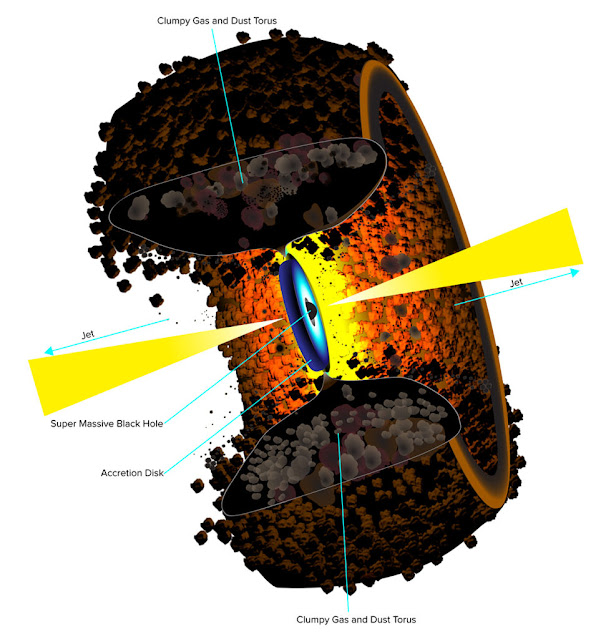
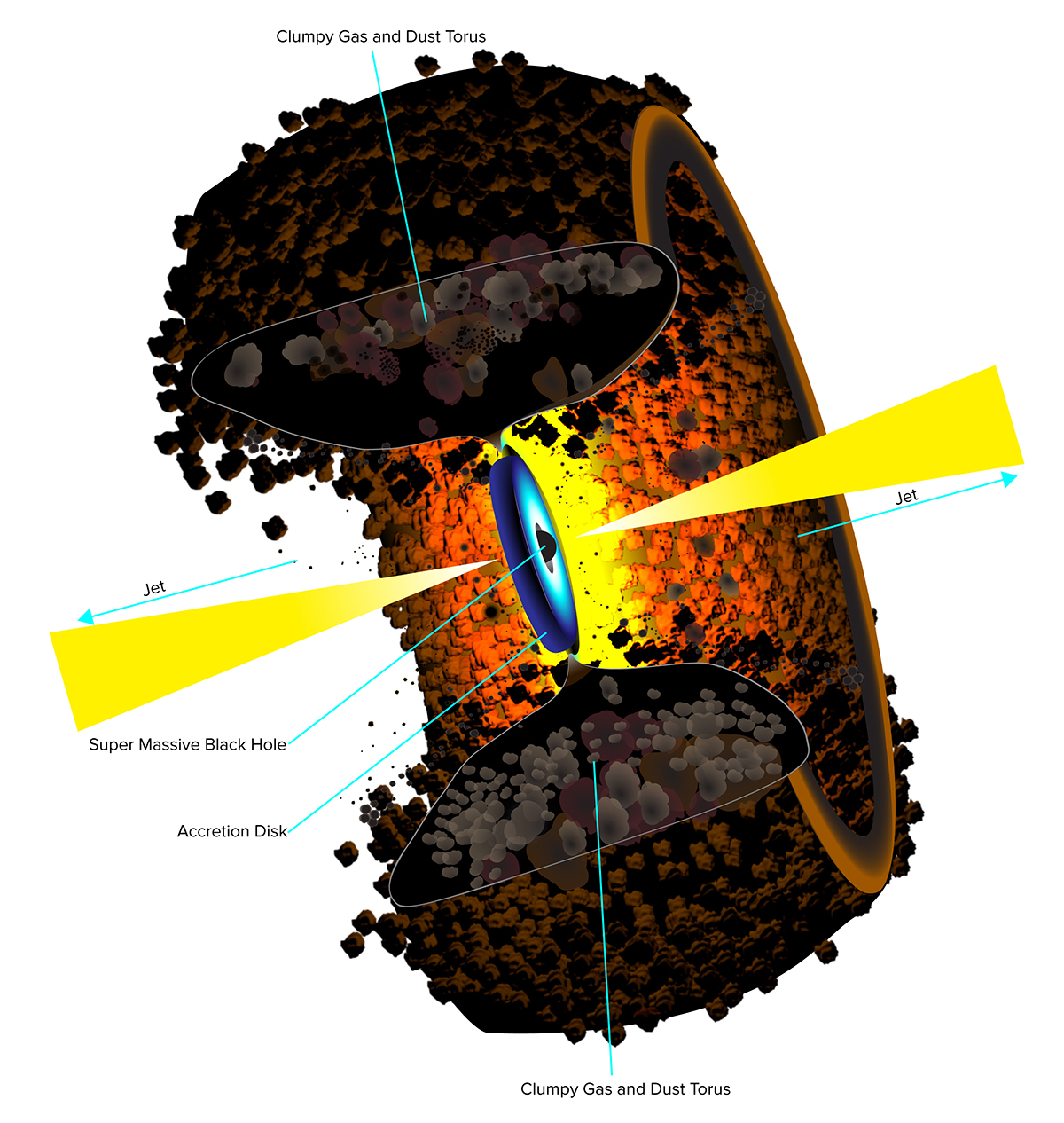
Artist's conception of the dusty, doughnut-shaped object surrounding the supermassive black hole, disk of material orbiting the black holNDF.
  Hi-Res File

Artist's conception of active galactic nucleus, with labels.
Credit: Bill Saxton, NRAO/AUI/NSF. Hi-Res File

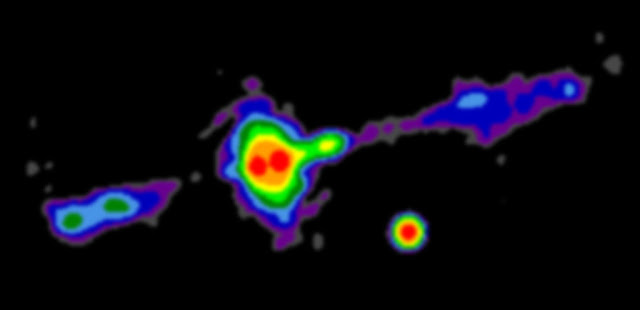
VLA image of the central region of the powerful radio galaxy Cygnus A, showing the doughnut-shaped torus surrounding the black hole and accretion disk. Credit: Carilli et al., NRAO/AUI/NSF.
Hi-Res File

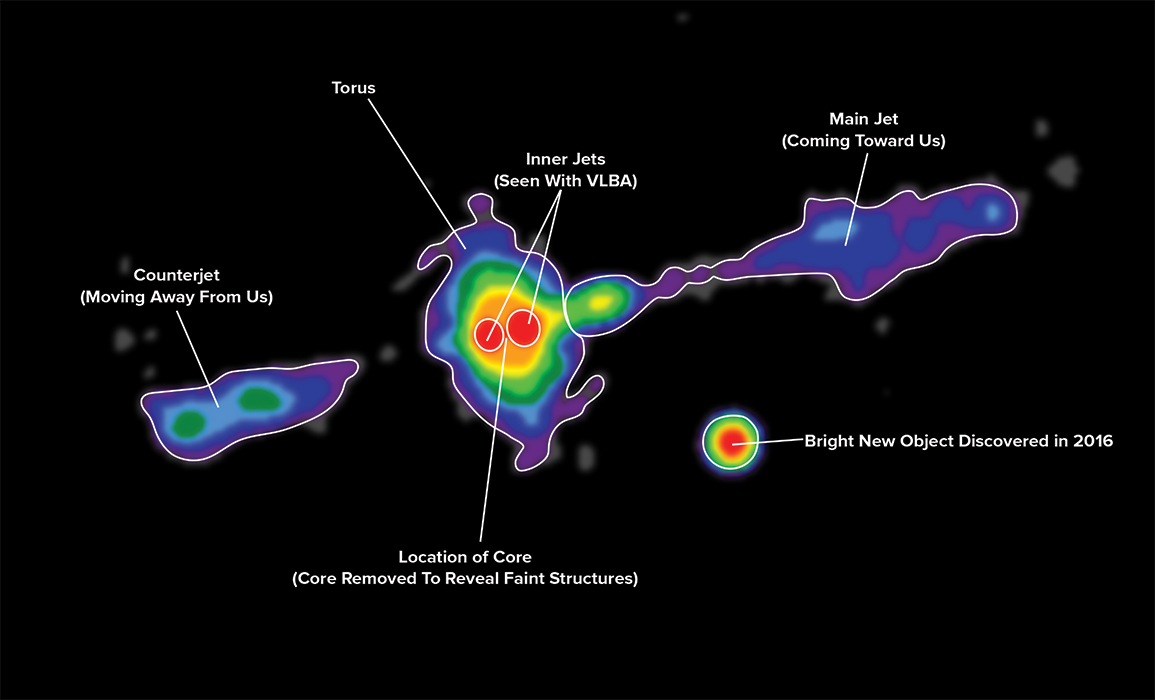
VLA image of Cygnus A's central region, with labels.
Credit: Carilli et al., NRAO/AUI/NSF. Hi-Res File


Video illustrates how the dusty, doughnut-shaped torus surrounding the black hole and accretion disk at the center of a powerful radio galaxy can obscure different features when viewed from different angles. This explains how the same type of "central engine" can appear different, leading to different names for objects seen from different angles. Credit: Bill Saxton, Sophia Dagnello, NRAO/AUI/NSF


Structure suggested by theorists decades ago

Astronomers used the National Science Foundation’s Karl G. Jansky Very Large Array (VLA) to make the first direct image of a dusty, doughnut-shaped feature surrounding the supermassive black hole at the core of one of the most powerful radio galaxies in the Universe — a feature first postulated by theorists nearly four decades ago as an essential part of such objects.

The scientists studied Cygnus A, a galaxy some 760 million light-years from Earth. The galaxy harbors a black hole at its core that is 2.5 billion times more massive than the Sun. As the black hole’s powerful gravitational pull draws in surrounding material, it also propels superfast jets of material traveling outward at nearly the speed of light, producing spectacular “lobes” of bright radio emission.

Black hole-powered “central engines” producing bright emission at various wavelengths, and jets extending far beyond the galaxy are common to many galaxies, but show different properties when observed. Those differences led to a variety of names, such as quasars, blazars, or Seyfert galaxies. To explain the differences, theorists constructed a “unified model” with a common set of features that would show different properties depending on the angle from which they are viewed.

The unified model includes the central black hole, a rotating disk of infalling material surrounding the black hole, and the jets speeding outward from the poles of the disk. In addition, to explain why the same type of object looks different when viewed from different angles, a thick, dusty, doughnut-shaped “torus” is included, surrounding the inner parts. The torus obscures some features when viewed from the side, leading to apparent differences to the observer, even for intrinsically similar objects. Astronomers generically call this common set of features an active galactic nucleus (AGN).

“The torus is an essential part of the AGN phenomenon, and evidence exists for such structures in nearby AGN of lower luminosity, but we’ve never before directly seen one in such a brightly-emitting radio galaxy,” said Chris Carilli, of the National Radio Astronomy Observatory (NRAO). “The torus helps explain why objects known by different names actually are the same thing, just observed from a different perspective,” he added.

In the 1950s, astronomers discovered objects that strongly emitted radio waves, but appeared point-like, similar to distant stars, when later observed with visible-light telescopes. In 1963, Maarten Schmidt of Caltech discovered that one of these objects was extremely distant, and more such discoveries quickly followed. To explain how these objects, dubbed quasars, could be so bright, theorists suggested that they must be tapping the tremendous gravitational energy of supermassive black holes. The combination of black hole, the rotating disk, called an accretion disk, and the jets was termed the “central engine” responsible for the objects’ prolific outpourings of energy.

The same type of central engine also appeared to explain the output of other types of objects, including radio galaxies, blazars, and Seyfert Galaxies. However, each showed a different set of properties. Theorists worked to develop a “unification scheme” to explain how the same thing could appear differently. In 1977, obscuration by dust was suggested as one element of that scheme. In a 1982 paper, Robert Antonucci, of the University of California, Santa Barbara, presented a drawing of an opaque torus — a doughnut-shaped object — surrounding the central engine. From that point on, an obscuring torus has been a common feature of astronomers’ unified view of all types of active galactic nuclei.

“Cygnus A is the closest example of a powerful radio-emitting galaxy — 10 times closer than any other with comparably powerful radio emission. That proximity allowed us to find the torus in a high-resolution VLA image of the galaxy’s core,” said Rick Perley, also of NRAO. “Doing more work of this type on weaker and more distant objects will almost certainly need the order-of-magnitude improvement in sensitivity and resolution that the proposed Next Generation Very Large Array (ngVLA) would bring,” he added.

The VLA observations directly revealed the gas in Cygnus A’s torus, which has a radius of nearly 900 light-years. Longstanding models for the torus suggest that the dust is in clouds embedded in the somewhat-clumpy gas.

“It’s really great to finally see direct evidence of something that we’ve long presumed should be there,” Carilli said. “To more accurately determine the shape and composition of this torus, we need to do further observing. For example, the Atacama Large Millimeter/submillimeter Array (ALMA) can observe at the wavelengths that will directly reveal the dust,” he added.

Carilli and Perley, with their colleagues Vivek Dhawan, also of NRAO, and Daniel Perley of Liverpool John Moores University in the UK, discovered the torus when following up their surprising discovery in 2016 of a new, bright object near the center of Cygnus A. That new object, they said, is most likely a second supermassive black hole that only recently encountered new material it could devour, causing it to produce bright emission the same way the central black hole does. The existence of the second black hole, they said, suggests that Cygnus A merged with another galaxy in the astronomically recent past.

Cygnus A, so named because it is the most powerful radio-emitting object in the constellation Cygnus, was discovered in 1946 by English physicist and radio astronomer J.S. Hey. It was matched to a visible-light, giant galaxy by Walter Baade and Rudolf Minkowski in 1951. It became an early target for the VLA soon after its completion in the early 1980s. Detailed VLA images of Cygnus A published in 1984 produced major advances in astronomers’ understanding of such galaxies.

The scientists are reporting their findings in the Astrophysical Journal Letters.

The National Radio Astronomy Observatory is a facility of the National Science Foundation, operated under cooperative agreement by Associated Universities, Inc.


Media Contact:

Dave Finley, Public Information Officer
(575) 835-7302


Wednesday, May 13, 2020

NASA’s TESS Enables Breakthrough Study of Perplexing Stellar Pulsations


Sound waves bouncing around inside a star cause it to expand and contract, which results in detectable brightness changes. This animation depicts one type of Delta Scuti pulsation — called a radial mode — that is driven by waves (blue arrows) traveling between the star’s core and surface. In reality, a star may pulsate in many different modes, creating complicated patterns that enable scientists to learn about its interior.  Credits: NASA's Goddard Space Flight Center


Tuesday, May 12, 2020

Signs of Collisions to Come

Artist’s impression of a neutron star threaded with a dipole magnetic field.
Credit:[ESO/L.Calçada].
Hi-res Image

Artist’s impression of the collision and merger of two neutron stars.
Credit:[NSF/LIGO/Sonoma State University/A. Simonnet].
Hi-res Image

We know that when two neutron stars — the dense, compact cores of evolved stars — collide, they produce signals that span the electromagnetic spectrum. But could these binaries also flare before they merge, as well?

A Broad Range of Signals

The discovery and follow-up of the gravitational-wave event GW170817, a collision of two neutron stars, provided the first direct evidence of the many forms of light that are emitted in these mergers. Between the instant of collision and the months that followed, observatories around the world recorded everything from high-energy gamma rays to late-time radio emission.

But emission might not be restricted to during and after the merger! A new study conducted by two researchers from the Flatiron Institute, Elias R. Most (also of Goethe University Frankfurt, Germany) and Alexander Philippov, explores the possibility that neutron star binaries may also produce flares of emission in the time leading up to their final impact.

This plot of the out-of-plane magnetic field density indicates the twist in flux tubes connecting the two neutron stars seen at the center of the plot. Here, an electromagnetic flare is launched from the binary after a significant twist has built up due to relative rotation of the right star. [Most & Philippov 2020].
Hi-res Image

What About Magnetic Fields?

In particular, Most and Philippov focus on how the magnetospheres of the two neutron stars — the magnetized environment surrounding each body — interact shortly before the objects collide.

The authors conduct special-relativistic force-free simulations of orbiting pairs of neutron stars in which each star is threaded with the strong dipole magnetic field expected for these bodies. The simulations then track how the stars’ magnetic fields evolve, twist, and interact as the bodies orbit each other.

A Twisted Fate


Most and Philippov find that dramatic releases of magnetic energy are a common outcome if the neutron stars orbit close enough to one another that their magnetospheres interact.

The authors show that the brightness of the flare luminosity depends only on how far apart the neutron stars are in the simulation: the smaller the separation, the brighter the flare. This dependence demonstrates that the flaring events are driven primarily by the energy stored in the twisted tube of magnetic flux that forms connecting the two neutron stars.

When the two neutron stars spin at different speeds, the magnetic field loop that forms between the stars becomes progressively more twisted — until this stored rotational energy is abruptly ejected. And even if neither neutron star is spinning, the authors show that magnetic flux twist still builds up and releases as a result of the binary’s orbital motion, assuming that the magnetic fields of the two stars are not aligned.

Here, the twisted flux tube and resultant flaring is caused by orbital motion of 45° misaligned magnetic fields, rather than by one star spinning. The bottom panel shows a 3D visualization of the field line configuration at the time of flaring. [Most & Philippov 2020].
Hi-res Image

Look for Radio Clues


So can we observe these sudden releases of energy? Most and Philippov argue that we should be able to spot the drama in radio emission: a radio afterglow will be produced behind the magnetized bubble that’s ejected from the twisted loop, and additional radio emission can be produced when the bubble collides with surrounding plasma.

Future work on this topic will explore the impacts of the neutron stars’ inspiral, and how the interactions of the magnetospheres change when the neutron stars carry unequal charge. The current study, however, indicates it’s worth keeping a radio eye out to see if we can spot signs of collisions to come!

Citation

“Electromagnetic Precursors to Gravitational-wave Events: Numerical Simulations of Flaring in Pre-merger Binary Neutron Star Magnetospheres,” Elias R. Most and Alexander A. Philippov 2020 ApJL 893 L6. doi:10.3847/2041-8213/ab8196

Monday, May 11, 2020

Abell 2384: Bending the Bridge Between Two Galaxy Clusters

Abell 2384
Credit: X-ray: NASA/CXC/SAO/V.Parekh, et al. & ESA/XMM-Newton; Radio: NCRA/GMRT


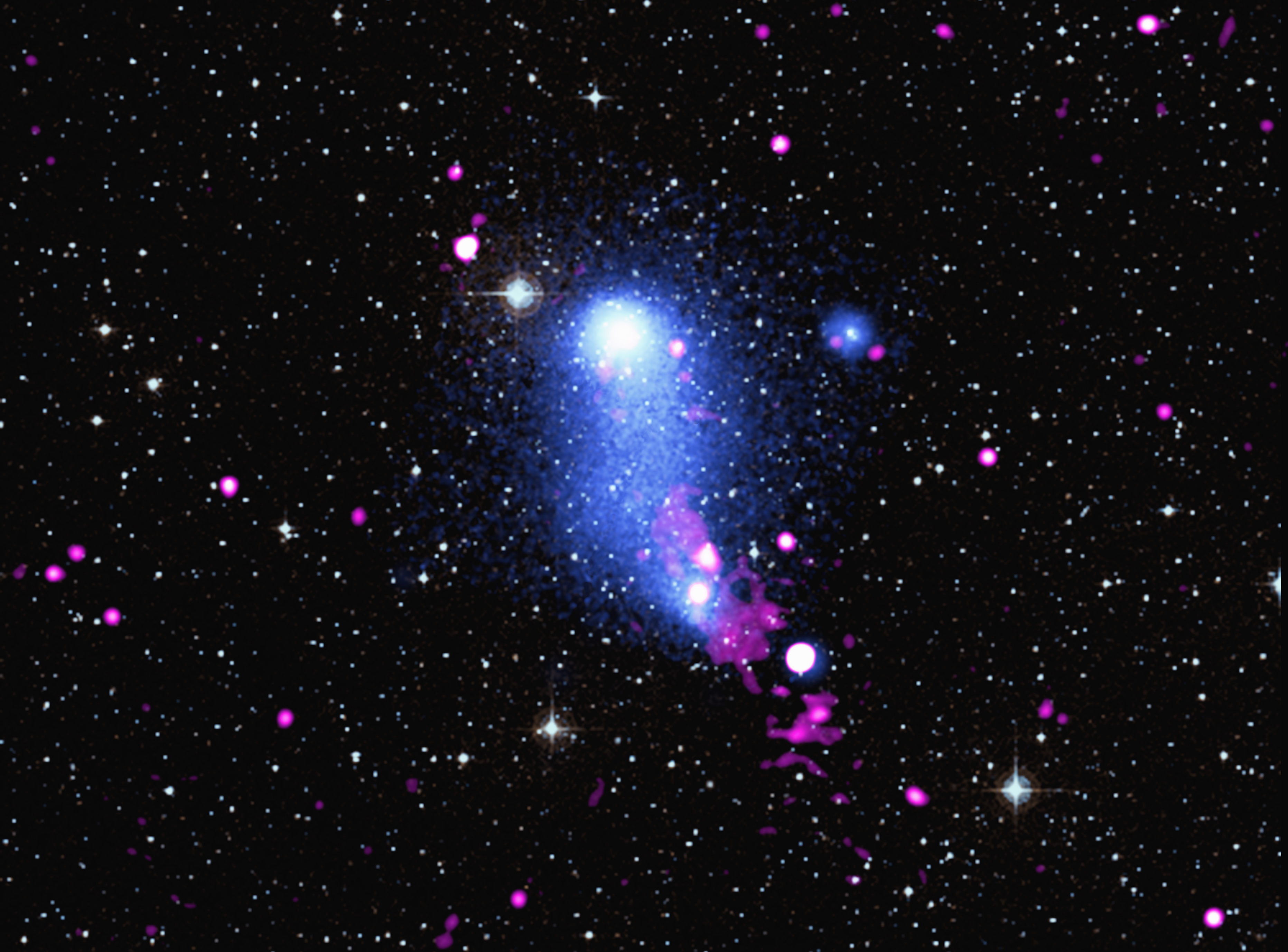
Several hundred million years ago, two galaxy clusters collided and then passed through each other. This mighty event released a flood of hot gas from each galaxy cluster that formed an unusual bridge between the two objects. This bridge is now being pummeled by particles driven away from a supermassive black hole.

Galaxy clusters are the largest objects in the universe held together by gravity. They contain hundreds or thousands of galaxies, vast amounts of multi-million-degree gas that glow in X-rays, and enormous reservoirs of unseen dark matter.

The system known as Abell 2384 shows the giant structures that can result when two galaxy clusters collide. A superheated gas bridge in Abell 2384 is shown in this composite image of X-rays from NASA's Chandra X-ray Observatory and ESA's XMM-Newton (blue), as well as the Giant Metrewave Radio Telescope in India (red). This new multi-wavelength view reveals the effects of a jet shooting away from a supermassive black hole in the center of a galaxy in one of the clusters. The jet is so powerful that it is bending the shape of the gas bridge, which extends for over 3 million light years and has the mass of about 6 trillion Suns.

Abell 2384
Credit: Radio Image, Labeled (Credit: NASA/CXC/NCRA/GMRT)

A labeled version of the image traces the shape of the bridge, marks the position of the supermassive black hole, and shows where the jet is pushing the hot gas in the bridge sideways at the collision site. The lobe of radio emission marking the end of each jet is also shown. At the collision site, astronomers found evidence for a shock front, similar to a sonic boom from a supersonic aircraft, which can keep the gas hot and prevent it from cooling to form new stars.

The radio emission extends about 1.2 million light years from the black hole to the north and about 1.7 million light years to the south. The northern radio emission is also fainter than the southern emission. These differences might be explained by the radio emission to the north being slowed down by the jet's impact with the hot gas in the bridge.

Chandra has often observed cavities in hot gas created by jets in the centers of galaxy clusters, such as the Perseus cluster, MS 0735 and the Ophiuchus Cluster. However, Abell 2384 offers a rare case of such an interaction occurring in the outer region of a cluster. It is also unusual that the supermassive black hole driving the jet is not in the largest galaxy located in the center of the cluster.

Astronomers consider objects like Abell 2384 to be important for understanding the growth of galaxy clusters. Based on computer simulations, it has been shown that after a collision between two galaxy clusters, they oscillate like a pendulum and pass through each other several times before merging to form a larger cluster. Based on these simulations, astronomers think that the two clusters in Abell 2384 will eventually merge.

Abell 2384 is located 1.2 billion light years from Earth. Based on previous work, scientists estimate the total mass of Abell 2384 is 260 trillion times the mass of the Sun. This includes the dark matter, hot gas and the individual galaxies.

A paper describing this work was published in the January 2020 issue of the Monthly Notices of the Royal Astronomical Society, and is available online. The authors are Viral Parekh (South African Radio Astronomy Observatory and Rhodes University, South Africa); Tatiana Lagana (Universidade Cruzeiro do Sul/Universidade Cidade de São Paulo, Brazil); Kshitij Thorat (Rhodes University); Kurt van der Heyden (University of Cape Town, South Africa); Asif Iqbal Ahanger (Raman Research Institute, India); and Florence Durret (Institut d'Astrophysique de Paris and Sorbonne Université, France).

NASA's Marshall Space Flight Center manages the Chandra program. The Smithsonian Astrophysical Observatory's Chandra X-ray Center controls science and flight operations from Cambridge and Burlington, bf9000 Massachusetts.


Fast Facts for Abell 2384:


Scale: Image is about 50 arcmin (17 million light years) across.
Category:
Groups & Clusters of Galaxies
Coordinates (J2000): RA 21h 52m 18.9s | Dec -19° 34´ 42"
Constellation:
Capricornus
Observation Date: November 18, 2002
Observation Time: 8 hours 4 min
Obs. ID: 4202
Instrument: ACIS
References:
Parekh et al., 2020, MNRAS, 491, 2605. arXiv:1910.12955
Color Code: X-ray: Blue/white; Radio: Magenta; Optical: yellow
Distance Estimate: About 1.2 billion light years (z=0.0943)


Thursday, May 07, 2020

Stellar clues reveal properties of significant merger in the young Milky Way’s history

Fig. 1: Thumbnail gallery of the stellar light (top panels) and gas density (bottom panels) of a simulated Milky Way analogue immediately before (first panel), during (second panel), immediately after (third panel) the Gaia-Enceladus merger, and at present day (fourth panel). The merging galaxy brings a lot of gas that fuels a burst in star formation beginning along a bridge of gas connecting it to the Milky Way. © MPA

About 10 billion years ago, a galaxy smashed into our cosmic home, the Milky Way, in a violent “merger” event that changed the way the Galaxy looks. Researchers from MPA together with international collaborators from the UK, Chile and Italy, have managed to piece together the impact of this event using the largest and most sophisticated simulations of the Milky Way to date. In particular, they found that the damage inflicted on the Galaxy in its youth is commensurate with a satellite that weights about a billion Suns.

The chronicle of the Milky Way is written in starlight: the history of our Galaxy can be deciphered from observing its stars and characterising their properties. For example, stars tend to be born on circular orbits around the Galactic centre, but over time they can begin to orbit on more oval, elongated trajectories, especially under the gravitational strains imposed during a galaxy merger, which may itself provide its own stars on near-radial orbits. In 2018, astronomers analysed the positions and velocities of stars observed by the Gaia satellite and discovered that the Milky Way had experienced a significant merger (Gaia-Enceladus) in its distant past. Stars that belonged to this merger were clearly identified to be on very radial (eccentric) orbits and make up a significant portion of the stellar halo - the faint light surrounding galaxies that constitutes the stellar garbage of debris from previously destroyed galaxies.

Fig. 2: Left: Edge-on images of the simulated Milky Way’s proto-disc stars just before the merger event around 10 billion years ago (top) and at present day (bottom), depicting how disc stars are being scattered into the stellar halo as a result of the merger. Right: Images of stars formed during the merger-induced starburst immediately after the merger (top) and at present day (bottom), illustrating that these stars are flatter and “diskier” compared to the proto-disc.  © MPA

What was the Milky Way like before this cataclysmic event and how did it change?

This question can only be answered with the help of simulations. Researchers at MPA have played a leading role in developing the Auriga simulations - the largest suite of simulations for the formation of the Milky Way in our Universe that model physical processes such as star formation, supernovae, black holes and magnetic fields. These tools provide powerful insights by offering a realtime look at the formation and evolution of galaxies, akin to watching a film that starts just after the Big Bang and ends at present day.

MPA scientists analysed these sophisticated simulations and found that about a third of the “Milky Way analogues” produced the Gaia-Enceladus feature in their stellar halo (see also the January Highlight for how MPA researchers revealed how this event shaped the Milky Way’s central stellar bar). In each case, this was linked to a significant merger in the Galaxy’s youth (Fig. 1). They found that the mergers had 2 significant effects: i) the merging galaxies were always “gas-rich”, bringing in a lot of fresh, star-forming material that instigated a powerful burst of star formation; and ii) the Milky Way’s “proto disc” - the dominant component of its adolescence - suffered serious damage from the impact, losing a hefty fraction of its mass as stellar orbits were “splashed” out of the disc toward the edges of the visible stellar halo (Fig. 2). Nevertheless, some of the proto-disc survived, and, together with the stars formed during the burst of star formation, constitute what astronomers call the “thick disc” - one of the Galaxy’s most significant components today.

Fig. 3: Left: the fraction of counter-rotating “splash” stars as a function of stellar mass of the Gaia-Encaladus analogues; a more massive merger leads to a greater fraction of splash stars. Right: the age of splash stars divided by the actual merger time as a function of merger time; most of the data points lie within 10% of the true merger time. This demonstrates that astronomers should be able to date the merger event from careful analysis of these splash stars.© MPA

Dating and weighing the Gaia-Enceladus merger

Thanks to the large suite of simulations, it was possible for the researchers to measure the impact of many “analogue mergers” with a range of masses and merger times. A key diagnostic is the fraction of stars orbiting the Galaxy in the direction opposite to the bulk rotation - stars that have been “splashed out” of the proto-disc because of the strong gravitational perturbation of the merger. Scientists found that more massive mergers lead to a higher fraction of these counter-rotating “splash” stars and that the ages of these stars are an accurate predictor for the time of the merger (Fig. 3).

Importantly, these results highlight that with an accurate census of counter-rotating stars and precise stellar ages in the real Milky Way, astronomers can place tight limits on key properties of this event. Comparing with recent Milky Way observations, these latest results point to a Gaia-Enceladus merger with a mass of about a billions Suns that merged roughly 10 billion years ago. In the future, more expansive observations and simulations will help us understand one of the biggest chapters in our cosmic history in tantalising detail.


Author

Postdoc
Tel: 2316

Original publication

1. Grand, Robert J. J.; Kawata, Daisuke; Belokurov, Vasily; et. al Sausage & Mash: the dual origin of the Galactic thick disc and halo from the gas-rich Gaia-Enceladus-Sausage merger submitted to MNRAS


Hubble and Gemini watch from afar, capturing high-resolution global views of Jupiter that are key to interpreting Juno's close-up observations of the planet

These images of Jupiter's Great Red Spot were made using data collected by the Hubble Space Telescope and the Gemini Observatory on April 1, 2018. By combining observations captured at almost the same time from the two different observatories, astronomers were able to determine that dark features on the Great Red Spot are holes in the clouds rather than masses of dark material. Credit: NASA, ESA, and M.H. Wong (UC Berkeley) and team. Release image

NASA's Hubble Space Telescope and the ground-based Gemini Observatory in Hawaii have teamed up with the Juno spacecraft to probe the mightiest storms in the solar system, taking place more than 500 million miles away on the giant planet Jupiter.

A team of researchers led by Michael Wong at the University of California, Berkeley, and including Amy Simon of NASA's Goddard Space Flight Center in Greenbelt, Maryland, and Imke de Pater also of UC Berkeley, are combining multiwavelength observations from Hubble and Gemini with close-up views from Juno's orbit about the monster planet, gaining new insights into turbulent weather on this distant world.

"We want to know how Jupiter's atmosphere works," said Wong. This is where the teamwork of Juno, Hubble, and Gemini comes into play.

Radio "Light Show"

Jupiter's constant storms are gigantic compared to those on Earth, with thunderheads reaching 40 miles from base to top—five times taller than typical thunderheads on Earth—and powerful lightning flashes up to three times more energetic than Earth's largest "superbolts."

Like lightning on Earth, Jupiter's lightning bolts act like radio transmitters, sending out radio waves as well as visible light when they flash across the sky.

Every 53 days, Juno races low over the storm systems detecting radio signals known as "sferics" and "whistlers," which can then be used to map lightning even on the day side of the planet or from deep clouds where flashes are not otherwise visible.

Coinciding with each pass, Hubble and Gemini watch from afar, capturing high-resolution global views of the planet that are key to interpreting Juno's close-up observations. "Juno's microwave radiometer probes deep into the planet's atmosphere by detecting high-frequency radio waves that can penetrate through the thick cloud layers. The data from Hubble and Gemini can tell us how thick the clouds are and how deep we are seeing into the clouds," Amy Simon explained.

By mapping lightning flashes detected by Juno onto optical images captured of the planet by Hubble and thermal infrared images captured at the same time by Gemini, the research team has been able to show that lightning outbreaks are associated with a three-way combination of cloud structures: deep clouds made of water, large convective towers caused by upwelling of moist air—essentially Jovian thunderheads—and clear regions presumably caused by downwelling of drier air outside the convective towers.

The Hubble data show the height of the thick clouds in the convective towers, as well as the depth of deep water clouds. The Gemini data clearly reveal the clearings in the high-level clouds where it is possible to get a glimpse down to the deep water clouds.

Wong thinks that lightning is common in a type of turbulent area known as folded filamentary regions, which suggests that moist convection is occurring in them. "These cyclonic vortices could be internal energy smokestacks, helping release internal energy through convection. It doesn't happen everywhere, but something about these cyclones seems to facilitate convection."

The ability to correlate lightning with deep water clouds also gives researchers another tool for estimating the amount of water in Jupiter's atmosphere, which is important for understanding how Jupiter and the other gas and ice giants formed, and therefore how the solar system as a whole formed.

While much has been gleaned about Jupiter from previous space missions, many of the details—including how much water is in the deep atmosphere, exactly how heat flows from the interior, and what causes certain colors and patterns in the clouds—remain a mystery. The combined result provides insight into the dynamics and three-dimensional structure of the atmosphere.

Seeing a "Jack-O-Lantern" Red Spot

With Hubble and Gemini observing Jupiter more frequently during the Juno mission, scientists are also able to study short-term changes and short-lived features like those in the Great Red Spot.

Images from Juno as well as previous missions to Jupiter revealed dark features within the Great Red Spot that appear, disappear, and change shape over time. It was not clear from individual images whether these are caused by some mysterious dark-colored material within the high cloud layer, or if they are instead holes in the high clouds—windows into a deeper, darker layer below.

Now, with the ability to compare visible-light images from Hubble with thermal infrared images from Gemini captured within hours of each other, it is possible to answer the question. Regions that are dark in visible light are very bright in infrared, indicating that they are, in fact, holes in the cloud layer. In cloud-free regions, heat from Jupiter's interior that is emitted in the form of infrared light—otherwise blocked by high-level clouds—is free to escape into space and therefore appears bright in Gemini images.

"It's kind of like a jack-o-lantern," said Wong. "You see bright infrared light coming from cloud-free areas, but where there are clouds, it's really dark in the infrared."

Hubble and Gemini as Jovian Weather Trackers

The regular imaging of Jupiter by Hubble and Gemini in support of the Juno mission is proving valuable in studies of many other weather phenomena as well, including changes in wind patterns, characteristics of atmospheric waves, and the circulation of various gases in the atmosphere.

Hubble and Gemini can monitor the planet as a whole, providing real-time base maps in multiple wavelengths for reference for Juno's measurements in the same way that Earth-observing weather satellites provide context for NOAA's high-flying Hurricane Hunters.

"Because we now routinely have these high-resolution views from a couple of different observatories and wavelengths, we are learning so much more about Jupiter's weather," explained Simon. "This is our equivalent of a weather satellite. We can finally start looking at weather cycles."

Because the Hubble and Gemini observations are so important for interpreting Juno data, Wong and his colleagues Simon and de Pater are making all of the processed data easily accessible to other researchers through the Mikulski Archives for Space Telescopes (MAST) at the Space Telescope Science Institute in Baltimore, Maryland.

"What's important is that we've managed to collect this huge dataset that supports the Juno mission. There are so many applications of the data set that we may not even anticipate. So, we're going to enable other people to do science without that barrier of having to figure out on their own how to process the data," Wong said.

The results were published in April 2020 in The Astrophysical Journal Supplement Series.

The Hubble Space Telescope is a project of international cooperation between NASA and the European Space Agency (ESA). NASA's Goddard Space Flight Center in Greenbelt, Maryland, manages the telescope. The Space Telescope Science Institute (STScI) in Baltimore, Maryland, conducts Hubble science operations. STScI is operated for NASA by the Association of Universities for Research in Astronomy (AURA) in Washington, D.C. AURA operates the Gemini Observatory for the international Gemini partnership including the US, Canada, Chile, Argentina, Brazil, and the Republic of Korea. NASA's Jet Propulsion Laboratory in Pasadena, California, manages the Juno mission for the Southwest Research Institute in San Antonio, Texas. Juno is part of NASA's New Frontiers Program, which is managed at NASA's Marshall Space Flight Center in Huntsville, Alabama for NASA's Science Mission Directorate.


Contact

Margaret W. Carruthers / Ray Villard
Space Telescope Science Institute, Baltimore, Maryland
667-218-6427 / 410-338-4514

mcarruthers@stsci.edu / villard@stsci.edu

Michael H. Wong
UC Berkeley, Berkeley, California

mikewong@astro.berkeley.edu

Amy Simon
Goddard Space Flight Center, Greenbelt, Maryland

amy.simon@nasa.gov


Related Links


Wednesday, May 06, 2020

ESO Instrument Finds Closest Black Hole to Earth

Artist’s impression of the triple system with the closest black hole

Location of the HR 6819 in the constellation of Telescopium

Wide-field view of the region of the sky where HR 6819 is located


Videos

ESOcast 220 Light: Closest Black Hole to Earth Found

Artist’s animation of the triple system with the closest black hole

Zooming into HR 6819


 Invisible object has two companion stars visible to the naked eye

A team of astronomers from the European Southern Observatory (ESO) and other institutes has discovered a black hole lying just 1000 light-years from Earth. The black hole is closer to our Solar System than any other found to date and forms part of a triple system that can be seen with the naked eye. The team found evidence for the invisible object by tracking its two companion stars using the MPG/ESO 2.2-metre telescope at ESO’s La Silla Observatory in Chile. They say this system could just be the tip of the iceberg, as many more similar black holes could be found in the future.

"We were totally surprised when we realised that this is the first stellar system with a black hole that can be seen with the unaided eye,” says Petr Hadrava, Emeritus Scientist at the Academy of Sciences of the Czech Republic in Prague and co-author of the research. Located in the constellation of Telescopium, the system is so close to us that its stars can be viewed from the southern hemisphere on a dark, clear night without binoculars or a telescope. “This system contains the nearest black hole to Earth that we know of,” says ESO scientist Thomas Rivinius, who led the study published today in Astronomy & Astrophysics.

The team originally observed the system, called HR 6819, as part of a study of double-star systems. However, as they analysed their observations, they were stunned when they revealed a third, previously undiscovered body in HR 6819: a black hole. The observations with the FEROS spectrograph on the MPG/ESO 2.2-metre telescope at La Silla showed that one of the two visible stars orbits an unseen object every 40 days, while the second star is at a large distance from this inner pair.

Dietrich Baade, Emeritus Astronomer at ESO in Garching and co-author of the study, says: “The observations needed to determine the period of 40 days had to be spread over several months. This was only possible thanks to ESO’s pioneering service-observing scheme under which observations are made by ESO staff on behalf of the scientists needing them.”

The hidden black hole in HR 6819 is one of the very first stellar-mass black holes found that do not interact violently with their environment and, therefore, appear truly black. But the team could spot its presence and calculate its mass by studying the orbit of the star in the inner pair. “An invisible object with a mass at least 4 times that of the Sun can only be a black hole,” concludes Rivinius, who is based in Chile.

Astronomers have spotted only a couple of dozen black holes in our galaxy to date, nearly all of which strongly interact with their environment and make their presence known by releasing powerful X-rays in this interaction. But scientists estimate that, over the Milky Way’s lifetime, many more stars collapsed into black holes as they ended their lives. The discovery of a silent, invisible black hole in HR 6819 provides clues about where the many hidden black holes in the Milky Way might be. “There must be hundreds of millions of black holes out there, but we know about only very few. Knowing what to look for should put us in a better position to find them,” says Rivinius. Baade adds that finding a black hole in a triple system so close by indicates that we are seeing just “the tip of an exciting iceberg.”

Already, astronomers believe their discovery could shine some light on a second system. “We realised that another system, called LB-1, may also be such a triple, though we'd need more observations to say for sure,” says Marianne Heida, a postdoctoral fellow at ESO and co-author of the paper. "LB-1 is a bit further away from Earth but still pretty close in astronomical terms, so that means that probably many more of these systems exist. By finding and studying them we can learn a lot about the formation and evolution of those rare stars that begin their lives with more than about 8 times the mass of the Sun and end them in a supernova explosion that leaves behind a black hole."

The discoveries of these triple systems with an inner pair and a distant star could also provide clues about the violent cosmic mergers that release gravitational waves powerful enough to be detected on Earth. Some astronomers believe that the mergers can happen in systems with a similar configuration to HR 6819 or LB-1, but where the inner pair is made up of two black holes or of a black hole and a neutron star. The distant outer object can gravitationally impact the inner pair in such a way that it triggers a merger and the release of gravitational waves. Although HR 6819 and LB-1 have only one black hole and no neutron stars, these systems could help scientists understand how stellar collisions can happen in triple star systems.


More information

This research was presented in the paper “A naked-eye triple system with a nonaccreting black hole in the inner binary”, published today in Astronomy & Astrophysics (doi: 10.1051/0004-6361/202038020).

The team is composed of Th. Rivinius (European Southern Observatory, Santiago, Chile), D. Baade (European Southern Observatory, Garching, Germany [ESO Germany]), P. Hadrava (Astronomical Institute, Academy of Science of the Czech Republic, Prague, Czech Republic), M. Heida (ESO Germany), and R. Klement (The CHARA Array of Georgia State University, Mount Wilson Observatory, Mount Wilson, USA).

ESO is the foremost intergovernmental astronomy organisation in Europe and the world’s most productive ground-based astronomical observatory by far. It has 16 Member States: Austria, Belgium, the Czech Republic, Denmark, France, Finland, Germany, Ireland, Italy, the Netherlands, Poland, Portugal, Spain, Sweden, Switzerland and the United Kingdom, along with the host state of Chile and with Australia as a Strategic Partner. ESO carries out an ambitious programme focused on the design, construction and operation of powerful ground-based observing facilities enabling astronomers to make important scientific discoveries. ESO also plays a leading role in promoting and organising cooperation in astronomical research. ESO operates three unique world-class observing sites in Chile: La Silla, Paranal and Chajnantor. At Paranal, ESO operates the Very Large Telescope and its world-leading Very Large Telescope Interferometer as well as two survey telescopes, VISTA working in the infrared and the visible-light VLT Survey Telescope. Also at Paranal ESO will host and operate the Cherenkov Telescope Array South, the world’s largest and most sensitive gamma-ray observatory. ESO is also a major partner in two facilities on Chajnantor, APEX and ALMA, the largest astronomical project in existence. And on Cerro Armazones, close to Paranal, ESO is building the 39-metre Extremely Large Telescope, the ELT, which will become “the world’s biggest eye on the sky”.


Links


Contacts

Dietrich Baade
European Southern Observatory
Garching bei München, Germany
Tel: +49-89-6096295
Email: dbaade@eso.org

Petr Hadrava
Academy of Sciences of the Czech Republic
Prague, Czech Republic
Email:
petr.hadrava@asu.cas.cz

Marianne Heida
European Southern Observatory
Garching bei München, Germany
Tel: +49-157-37744840
Email:
mheida@eso.org

Thomas Rivinius
European Southern Observatory
Santiago, Chile
Tel: +56 9 8288 4950
Email:
triviniu@eso.org

Bárbara Ferreira
ESO Public Information Officer
Garching bei München, Germany
Cell: +49 151 241 664 00
Email:
pio@eso.org


Source: ESO/News


Tuesday, May 05, 2020

Astronomer find Jupiter-like cloud bands on closest brown dwarf

Luhman 16A
Credit: Caltech/R. Hurt (IPAC)

A team of astronomers has discovered that the closest known brown dwarf, Luhman 16A, shows signs of cloud bands similar to those seen on Jupiter and Saturn. This is the first time scientists have used the technique of polarimetry to determine the properties of atmospheric clouds outside of the solar system, or exoclouds.

Brown dwarfs are objects heavier than planets but lighter than stars, and typically have 13 to 80 times the mass of Jupiter. Luhman 16A is part of a binary system containing a second brown dwarf, Luhman 16B. At a distance of 6.5 light-years, it’s the third closest system to our Sun after Alpha Centauri and Barnard’s Star. Both brown dwarfs weigh about 30 times as much as Jupiter.

Despite the fact that Luhman 16A and 16B have similar masses and temperatures (about 1,900° F or 1,000° C), and presumably formed at the same time, they show markedly different weather. Luhman 16B shows no sign of stationary cloud bands, instead exhibiting evidence of more irregular, patchy clouds. Luhman 16B therefore has noticeable brightness variations as a result of its cloudy features, unlike Luhman 16A.

“Like Earth and Venus, these objects are twins with very different weather,” said Julien Girard of the Space Telescope Science Institute in Baltimore, Maryland, a member of the discovery team. “It can rain things like silicates or ammonia. It’s pretty awful weather, actually.”

The researchers used an instrument on the Very Large Telescope in Chile to study polarized light from the Luhman 16 system. Polarization is a property of light that represents the direction that the light wave oscillates. Polarized sunglasses block out one direction of polarization to reduce glare and improve contrast.

“Instead of trying to block out that glare, we’re trying to measure it,” explained lead author Max Millar-Blanchaer of the California Institute of Technology (Caltech) in Pasadena, California.

When light is reflected off of particles, such as cloud droplets, it can favor a certain angle of polarization. By measuring the preferred polarization of light from a distant system, astronomers can deduce the presence of clouds without directly resolving either brown dwarf’s cloud structure.

“Even from light-years away, we can use polarization to determine what the light encountered along its path,” added Girard.

“To determine what the light encountered on its way we compared observations against models with different properties: brown dwarf atmospheres with solid cloud decks, striped cloud bands, and even brown dwarfs that are oblate due to their fast rotation. We found that only models of atmospheres with cloud bands could match our observations of Luhman 16A,” explained Theodora Karalidi of the University of Central Florida in Orlando, Florida, a member of the discovery team.

The polarimetry technique isn’t limited to brown dwarfs. It can also be applied to exoplanets orbiting distant stars. The atmospheres of hot, gas giant exoplanets are similar to those of brown dwarfs. Although measuring a polarization signal from exoplanets will be more challenging, due to their relative faintness and proximity to their star, the information gained from brown dwarfs can potentially inform those future studies.

NASA’s upcoming James Webb Space Telescope would be able to study systems like Luhman 16 to look for signs of brightness variations in infrared light that are indicative of cloud features. NASA’s Wide Field Infrared Survey Telescope (WFIRST) will be equipped with a coronagraph instrument that can conduct polarimetry, and may be able to detect giant exoplanets in reflected light and eventual signs of clouds in their atmospheres.

This study has been accepted for publication in The Astrophysical Journal.

The Space Telescope Science Institute is expanding the frontiers of space astronomy by hosting the science operations center of the Hubble Space Telescope, the science and operations center for the James Webb Space Telescope, and the science operations center for the future Wide Field Infrared Survey Telescope (WFIRST). STScI also houses the Mikulski Archive for Space Telescopes (MAST) which is a NASA-funded project to support and provide to the astronomical community a variety of astronomical data archives, and is the data repository for the Hubble, Webb, Kepler, K2, TESS missions and more.


Contact:

Media Contact:
Christine Pulliam
Space Telescope Science Institute, Baltimore, Maryland
410-338-4366
cpulliam@stsci.edu

Science Contact:

Julien Girard
Space Telescope Science Institute, Baltimore, Md.
jgirard@stsci.edu


Links 


Friday, May 01, 2020

No Blue Skies for Super-Hot Planet WASP-79b

WASP-79b
Artist's Illustration:
NASA, ESA, and L. Hustak (STScI)
Science: NASA, ESA, and K. Sotzen (JHU/APL) Release Images

The weather forecast for the giant, super-hot Jupiter-size planet WASP-79b is steamy humidity, scattered clouds, iron rain, and yellow skies.

NASA's Hubble Space Telescope teamed up with the Magellan Consortium's Magellan II Telescope in Chile to analyze the atmosphere of this planet, which orbits a star that is hotter and brighter than our Sun, and is located at a distance of 780 light-years from Earth in the constellation Eridanus. Among exoplanets, planets that encircle stars beyond our Sun, WASP-79b is among the largest ever observed.

The surprise in recently published results, is that the planet's sky doesn't have any evidence for an atmospheric phenomenon called Rayleigh scattering, where certain colors of light are dispersed by very fine dust particles in the upper atmosphere. Rayleigh scattering is what makes Earth's skies blue by scattering the shorter (bluer) wavelengths of sunlight.

Because WASP-79b doesn't seem to have this phenomenon, the daytime sky would likely be yellowish, researchers say.

"This is a strong indication of an unknown atmospheric process that we're just not accounting for in our physical models. I've shown the WASP-79b spectrum to a number of colleagues, and their consensus is 'that's weird,'" said Kristin Showalter Sotzen of the Johns Hopkins University Applied Physics Laboratory in Laurel, Maryland.

The team would like to find other planets with a similar condition to learn more.

"Because this is the first time we've see this, we're really not sure what the cause is," Sotzen said. "We need to keep an eye out for other planets like this because it could be indicative of unknown atmospheric processes that we don't currently understand. Because we only have one planet as an example we don't know if it's an atmospheric phenomenon linked to the evolution of the planet."

Hot Jupiters orbit so close to their stars that the conventional wisdom is that they migrated inward toward a tight orbit about their star, after bulking up on cold gas in the frigid outer reaches of a planetary system. WASP-79b completes an orbit in just 3-1/2 days. But this planet is in an unusual polar orbit about the star, which goes against scientists' theories about how planets form — especially for hot Jupiters.

The new results might potentially give additional clues to the history of similar planets. Some hot Jupiters appear to have hazy or cloudy atmospheres while others appear to have clear atmospheres. If it's like other hot Jupiters, WASP-79b may have scattered clouds, and iron lifted to high altitudes could precipitate as rain.

WASP-79b is twice the mass of Jupiter and is so hot it has an extended atmosphere, which is ideal for studying starlight that is filtered through and grazes the atmosphere on its way toward Earth.

To study the planet, the team used a spectrograph — an instrument that analyzes wavelengths of light in order to look at chemical compositions — on the Magellan II Telescope at Las Campanas Observatory in Chile. They expected to see a decrease in the amount of blue starlight due to Rayleigh scattering. Instead, they saw the opposite trend. The shorter, bluer wavelengths of light appear to be more transparent, indicating less absorption and scattering by the atmosphere. This result was consistent among independent observations of WASP-79b made with NASA's Transiting Exoplanet Survey Satellite (TESS).

WASP-79b also was observed as part of the Hubble Space Telescope's Panchromatic Comparative Exoplanet Treasury (PanCET) program, and those observations showed that there is water vapor in WASP-79b's atmosphere. Based on this finding, the giant planet was selected as an Early Release Science target for NASA's upcoming James Webb Space Telescope. Webb is expected to provide much more spectral data over longer infrared wavelengths. These observations may reveal more evidence for water vapor in the planet's atmosphere, and will provide a detailed view of the planet's chemical makeup, which could help reveal the underlying source of the peculiar spectrum.

The results were published in January 2020 in The Astronomical Journal.

The Hubble Space Telescope is a project of international cooperation between NASA and ESA (European Space Agency). NASA's Goddard Space Flight Center in Greenbelt, Maryland, manages the telescope. The Space Telescope Science Institute (STScI) in Baltimore, Maryland, conducts Hubble science operations. STScI is operated for NASA by the Association of Universities for Research in Astronomy in Washington, D.C.


Contact:

Ray Villard
Space Telescope Science Institute, Baltimore, Maryland
410-338-4514
villard@stsci.edu

Kristin Sotzen
Johns Hopkins University/Applied Physics Laboratory, Laurel, Maryland
kristin.sotzen@jhuapl.edu


Related Links: