Showing posts with label Cygnus A. Show all posts

Tuesday, December 16, 2025

Painting Galaxy Clusters by Numbers (and Physics)

MS 0735.6+7421 - Perseus Cluster - M87 - Abell 2052 - Cygnus A
Credit: X-ray: NASA/CXC/Univ. of Chicago/H. McCall


JPEG (168.9 kb) - Large JPEG (10.5 MB) - Tiff (34.6 MB) - More Images

MS 0735.6+7421 - Perseus Cluster - M87 - Abell 2052 - Cygnus A
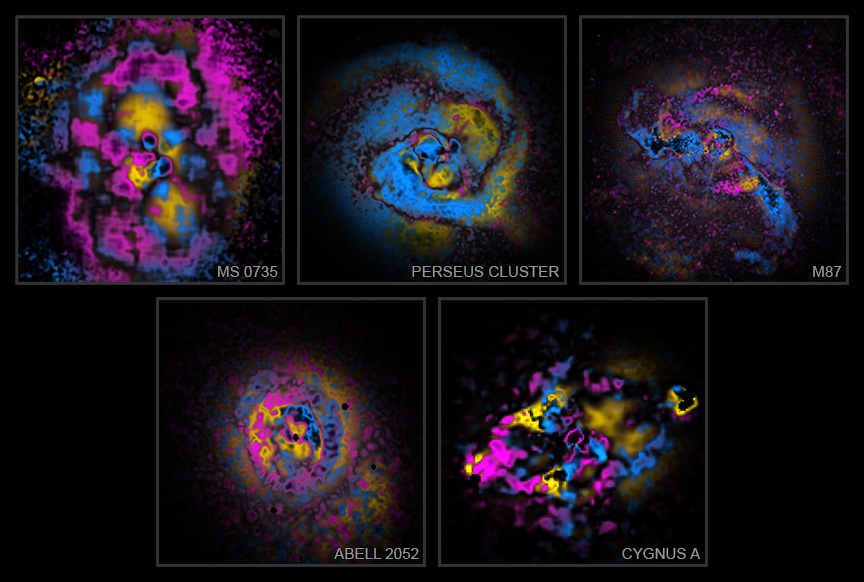
Astronomical Images of Objects Processed Using X-arithmetic Technique (Labeled) Credit: X-ray: NASA/CXC/Univ. of Chicago/H. McCall; Image processing: NASA/CXC/SAO/N. Wolk

A Tour of X-arithmetic - More Videos


Galaxy clusters are the most massive objects in the universe held together by gravity, containing up to several thousand individual galaxies and huge reservoirs of superheated, X-ray-emitting gas. The mass of this hot gas is typically about five times higher than the total mass of all the galaxies in galaxy clusters. In addition to these visible components, 80% of the mass of galaxy clusters is supplied by dark matter. These cosmic giants are bellwethers not only for the galaxies, stars and black holes within them, but also for the evolution and growth of the universe itself.

It is no surprise then that NASA’s Chandra X-ray Observatory has observed many galaxy clusters over the lifetime of the mission. Chandra’s X-ray vision allows it to see the enormous stockpiles of hot cluster gas, with temperatures as high as 100 million degrees, with exquisite clarity. This blazing gas tells stories about past and present activity within galaxy clusters.

Many of these galaxy clusters host supermassive black holes at their centers, which periodically erupt in powerful outbursts. These explosions generate jets that are visible in radio wavelengths, which inflate bubbles full of energetic particles; these bubbles carry energy out into the surrounding gas. Chandra’s images have revealed a wealth of other structures formed during these black hole outbursts, including hooks, rings, arcs, and wings. However, appearances alone don’t tell us what these structures are or how they formed.

To tackle this problem, a team of astronomers developed a novel image-processing technique to analyze X-ray data, allowing them to identify features in the gas of galaxy clusters like never before, classifying them by their nature rather than just their appearance. Prior to this technique, which they call “X-arithmetic,” scientists could only identify the nature of some of the features and in a much less efficient way, via studies of the amounts of X-ray energy dispersed at different wavelengths. The authors applied X-arithmetic to 15 galaxy clusters and galaxy groups (these are similar to galaxy clusters but with fewer member galaxies). By comparing the outcome from the X-arithmetic technique to computer simulations, researchers now have a new tool that will help in understanding the physical processes inside these important titans of the universe.

A new paper looks at how these structures appear in different parts of the X-ray spectrum. By splitting Chandra data into lower-energy and higher-energy X-rays and comparing the strengths of each structure in both, researchers can classify them into three distinct types, which they have colored differently. A pink color is given to sound waves and weak shock fronts, which arise from pressure disturbances traveling at close to the speed of sound, compressing the hot gas into thin layers. The bubbles inflated by jets are colored yellow, and cooling or slower-moving gas is blue. The resulting images, “painted” to reflect the nature of each structure, offer a new way to interpret the complex aftermath of black hole activity using only X-ray imaging data. This method works not only on Chandra (and other X-ray) observations, but also on simulations of galaxy clusters, providing a tool to bridge data and theory.

The images in this new collection show the central regions of five galaxy clusters in the sample: Abell 2052 and Cygnus A in the top row and MS 0735+7421, the Perseus Cluster, and M87 in the Virgo Cluster on the bottom row. All of these objects have been released to the public before by the Chandra X-ray Center, but this is the first time this special technique has been applied. The new treatment highlights important differences between the galaxy clusters and galaxy groups in the study.

The galaxy clusters in the study often have large regions of cooling or slow-moving gas near their centers, and only some show evidence for shock fronts. The galaxy groups, on the other hand, are different. They show multiple shock fronts in their central regions and smaller amounts of cooling and slow-moving gas compared to the sample of galaxy clusters.

This contrast between galaxy clusters and galaxy groups suggests that black hole feedback — that is, the interdependent relationship between outbursts from a black hole and its environment — appears stronger in galaxy groups. This may be because feedback is more violent in the groups than in the clusters, or because a galaxy group has weaker gravity holding the structure together than a galaxy cluster. The same outburst from a black hole, with the same power level, can therefore more easily affect a galaxy group than a galaxy cluster.

There are still many open questions about these black hole outbursts. For example, scientists would like to know how much energy they put into the gas around them and how often they occur. These violent events play a key role in regulating the cooling of the hot gas and controlling the formation of stars in clusters. By revealing the physics underlying the structures they leave behind, the X-arithmetic technique brings us closer to understanding the influence of black holes on the largest scales.

A paper describing this new technique and its results has been published in The Astrophysical Journal and is led by Hannah McCall from the University of Chicago. The other authors are Irina Zhuravleva (University of Chicago), Eugene Churazov (Max Planck Institute for Astrophysics, Germany), Congyao Zhang (University of Chicago), Bill Forman and Christine Jones (Center for Astrophysics | Harvard & Smithsonian), and Yuan Li (University of Massachusetts at Amherst).

NASA's Marshall Space Flight Center in Huntsville, Alabama, manages the Chandra program. The Smithsonian Astrophysical Observatory's Chandra X-ray Center controls science operations from Cambridge, Massachusetts, and flight operations from Burlington, Massachusetts.


Visual Description:

This release includes two sets of images featuring galaxy clusters. The first set of five images are traditional composite renderings. The second set of images features the same galaxy clusters rendered with a new image-processing technique called "X-arithmetic".

The traditional composite renderings share many visual similarities with digital photography; the images are relatively crisp, and feature cloud-like objects with blended colors, set against black backgrounds, dotted with distant specks of light. The X-arithmetic images are more visually similar to color MRI scans; they feature pixelated objects with distinct patches of vibrant color, set against neutral black backgrounds.

The first image in the two sets features the seemingly spherical galaxy cluster Abell 2052. In the composite rendering, the cluster resembles a pink rose in a cloud of powder blue haze. In the X-arithmetic rendering, interwoven pockets of hot pink, neon blue, and golden yellow appear brighter near the center, and somewhat muted near the outer edges.

The second image in the two sets features Cygnus A, a galaxy cluster with jets blasting in opposite directions out of a central black hole. In the composite image, the black hole appears as bright white light, the cluster resembles a neon blue cloud, and the jets exiting the cluster are surrounded by plumes resembling red smoke. In the X-arithmetic rendering, Cygnus A is depicted as a marbled ball of pixelated pockets in neon pink, blue, and golden yellow.

The third image in the sets features the galaxy cluster MS 0735. In the composite rendering, a vertical red cloud squiggle with a bright yellow dot in the center, is surrounded by a faint blue haze. In the X-arithmetic rendering, large pockets of yellow are surrounded by irregular hot pink shapes and dappled pockets of blue, which grow more granular near the outer edges.

The fourth pair of images feature the Perseus Cluster. The composite rendering resembles the view down a swirling cone of pink cotton candy, with a collection of dark blue filaments at the distant center. In the X-arithmetic rendering, the cluster resembles a corkscrew swirl of neon blue water, dotted with pink flecks, and blobs of golden yellow.

The fifth and final pair of images feature the galaxy cluster M87. In the composite rendering, the cluster is presented as ethereal overlapping clouds in purple, red, and white, with a golden orange embryonic shape at the core. The X-arithmetic rendering of the same cluster resembles a faint yellow cloud, digitally spattered with blue and pink pixels.


Fast Facts for MS 0735.6+7421:

Credit: X-ray: NASA/CXC/Univ. of Chicago/H. McCall
Release Date: December 9, 2025
Scale: Image is about 4.0 arcmin (2.8 million light-years) across.
Category: Groups and Clusters of Galaxies
Coordinates (J2000): RA 07h 41m 50.20s | Dec +74° 14´ 51.00"
Constellation: Camelopardalis
Observation Dates: 9 observations from Nov 2003 to Jan 2015
Observation Time: 149 hours 27 minute (6 days 5 hours 27 minutes)
Obs. ID: 4197, 10468-10471, 10822, 10918, 10922, 16275
Instrument:
ACIS
References: McCall, H. et al, 2025, ApJ, 989,159; DOI 10.3847/1538-4357/adea67
Color Code: X-ray: pink, yellow, blue
Distance Estimate: About 2.6 billion light-years from Earth


Fast Facts for Perseus Cluster:

Credit: X-ray: NASA/CXC/Univ. of Chicago/H. McCall
Release Date: December 9, 2025
Scale: Image is about 6 arcmin (410,000 light-years) across.
Category: Groups and Clusters of Galaxies
Coordinates (J2000): RA 3h 19m 47.60 | Dec +41° 30´ 37.00"
Constellation: Perseus
Observation Dates: 16 observations from Aug 2002 to Dec 2009
Observation Time: 330 hours 14 minutes (13 days 18 hours 14 minutes)
Obs. ID: 3209, 4289, 4946-4949, 6139, 4951-4953, 6139, 6145, 6146, 11713-11716
Instrument: ACIS
References: McCall, H. et al, 2025, ApJ, 989,159; DOI 10.3847/1538-4357/adea67
Color Code: X-ray: pink, yellow, blue
Distance Estimate: About 240 million light-years from Earth


Fast Facts for M87:

Credit: X-ray: NASA/CXC/Univ. of Chicago/H. McCall
Release Date: December 9, 2025v Scale: Image is about 15 arcmin (230,000 light-years) across.
Category: Groups and Clusters of Galaxies
Coordinates (J2000): RA 12h 30m 49.19s | Dec +12° 22´ 47.86"
Constellation: Virgo
Observation Dates: 10 observations from Jul 2003 to Apr 2010
Observation Time: 174 hours 26 minutes (7 days 6 hours 26 minutes)
Obs. ID: 2707, 3717, 5826-5828, 6186, 7210-7212, 11783
Instrument: ACIS
References: McCall, H. et al, 2025, ApJ, 989,159; DOI 10.3847/1538-4357/adea67
Color Code: X-ray: pink, yellow, blue
Distance Estimate: About 54 million light-years from Earth


Fast Facts for Abell 2052:

Credit: X-ray: NASA/CXC/Univ. of Chicago/H. McCall
Release Date: December 9, 2025
Scale: Image is about 4.4 arcmin (600,000 light-years) across.
Category: Groups and Clusters of Galaxies
Coordinates (J2000): RA 15h 16m 44.40s | Dec +07° 01´ 20.00"
Constellation: Serpens
Observation Dates: 10 observations from Mar, 2006 to Jun, 2009
Observation Time: 171 hours 28 minutes (7 days 3 hours 28 minutes)
Obs. ID: 5807, 10477-10480, 10879, 10914-10917
Instrument: ACIS
References: McCall, H. et al, 2025, ApJ, 989,159; DOI 10.3847/1538-4357/adea67
Color Code: X-ray: pink, yellow, blue
Distance Estimate: About 480 million light-years from Earth


Fast Facts for Cygnus A:

Credit: X-ray: NASA/CXC/Univ. of Chicago/H. McCall
Release Date: December 9, 2025
Scale: Image is about 3.4 arcmin (740,000 light-years) across.
Category: Groups and Clusters of Galaxies
Coordinates (J2000): RA 19h 59m 28.3s | Dec +44° 44´ 02"
Constellation: Cygnus
Observation Dates: 26 observations from Feb 2005 to May 2017
Observation Time: 221 hours 5 minutes (9 days 5 hours 5 minutes)
Obs. ID: 5830, 5831, 6225, 6226, 6228, 6229, 6250, 6252, 17133-17136, 17507-17514, 18688, 18871, 19989, 19996, 20077, 20079
Instrument: ACIS
References: McCall, H. et al, 2025, ApJ, 989,159; DOI 10.3847/1538-4357/adea67
Color Code: X-ray: pink, yellow, blue
Distance Estimate: About 760 million light-years from Earth


Wednesday, May 20, 2020

Top Ten Discoveries from SOFIA

Ten years ago, NASA’s telescope on an airplane, the Stratospheric Observatory for Infrared Astronomy, or SOFIA, first peered into the cosmos. Since the night of May 26, 2010, SOFIA’s observations of infrared light, invisible to the human eye, have made many scientific discoveries about the hidden universe.

SOFIA’s maiden flight, known as “first light,” observed heat pouring out of Jupiter’s interior through holes in the clouds and peered through the dense dust clouds of the Messier 82 galaxy to catch a glimpse of tens of thousands of stars forming. The observatory was declared fully operational in 2014 — the equivalent to the launch of a space telescope — but it began making discoveries even while completing the testing of its instruments and telescope.

The modified Boeing 747SP flies a nearly 9-foot diameter telescope up to 45,000 feet in altitude, above 99% of the Earth's water vapor to get a clear view of the infrared universe not observable by ground-based telescopes. Its mobility also allows it to capture transitory events in astronomy over remote locations like the open ocean. Because SOFIA lands after each flight, it can be upgraded with the latest technology to respond to some of most pressing questions in science.

Using SOFIA, scientists detected the universe’s first type of molecule in space, unveiled new details about the birth and death of stars and planets, and explained what’s powering supermassive black holes, and how galaxies evolve and take shape, among other discoveries. Here are some of SOFIA’s top discoveries of the last decade:

The Universe’s First Type of Molecule Found at Last 

SOFIA found the first type of molecule to form in the universe, called helium hydride. It was first formed only 100,000 years after the Big Bang as the first step in cosmic evolution that eventually led to the complex universe we know today. The same kind of molecule should be present in parts of the modern universe, but it had never been detected outside of a laboratory until SOFIA found it in a planetary nebula called NGC 7027. Finding it in the modern universe confirms a key part of our basic understanding of the early universe.​

The powerful wind from the newly formed star at the heart of the Orion Nebula is creating the bubble (black) and preventing new stars from forming in its neighborhood. At the same time, the wind is pushing molecular gas (color) to the edges, creating a dense shell around the bubble where future generations of stars can form. Credits: NASA/SOFIA/Pabst et. al. Hi-res image

Weighing a Galactic Wind Provides Clues to the Evolution of Galaxies 

SOFIA found that the wind flowing from the center of the Cigar Galaxy (M82) is aligned along a magnetic field and transports a huge amount of material. Magnetic fields are usually parallel to the plane of the galaxy, but the wind is dragging it so it’s perpendicular. The powerful wind, driven by the galaxy's high rate of star birth, could be one of the mechanisms for material to escape the galaxy. Similar processes in the early universe would have affected the fundamental evolution of the first galaxies.

Composite image of the Cigar Galaxy (also called M82), a starburst galaxy about 12 million light-years away in the constellation Ursa Major. The magnetic field detected by SOFIA, shown as streamlines, appears to follow the bipolar outflows (red) generated by the intense nuclear starburst. The image combines visible starlight (gray) and a tracing of hydrogen gas (red) from the Kitt Peak Observatory, with near-infrared and mid-infrared starlight and dust (yellow) from SOFIA and the Spitzer Space Telescope. Credits: NASA/SOFIA; NASA/JPL-Caltech. Hi-res image

Nearby Planetary System Similar to Our Own 

The planetary system around the star Epsilon Eridani, or eps Eri for short, is the closest planetary system around a star similar to the early Sun. SOFIA studied the infrared glow from the warm dust, confirming that the system has an architecture remarkably similar to our solar system. Its material is arranged in at least one narrow belt near a Jupiter-sized planet.​

Artist's illustration of the Epsilon Eridani system showing Epsilon Eridani b. In the right foreground, a Jupiter-mass planet is shown orbiting its parent star at the outside edge of an asteroid belt. In the background can be seen another narrow asteroid or comet belt plus an outermost belt similar in size to our solar system's Kuiper Belt. The similarity of the structure of the Epsilon Eridani system to our solar system is remarkable, although Epsilon Eridani is much younger than our sun. SOFIA observations confirmed the existence of the asteroid belt adjacent to the orbit of the Jovian planet. Credits: NASA/SOFIA/Lynette Cook.
Hi-res image

Magnetic Fields May Be Feeding Active Black Holes 

Magnetic fields in the Cygnus A galaxy are feeding material into the galaxy’s central black hole. SOFIA revealed that the invisible forces, shown as streamlines in this illustration, are trapping material close to the center of the galaxy where it is close enough the be devoured by the hungry black hole. However, magnetic fields in other galaxies may be preventing black holes from consuming material.

Artist’s conception of the core of Cygnus A, including the dusty donut-shaped surroundings, called a torus, and jets launching from its center. Magnetic fields are illustrated trapping the dust in the torus. These magnetic fields could be helping power the black hole hidden in the galaxy’s core by confining the dust in the torus and keeping it close enough to be gobbled up by the hungry black hole. Credits: NASA/SOFIA/Lynette Cook.Hi-res image

Magnetic Fields May Be Keeping Milky Way’s Black Hole Quiet

This image shows the ring of material around the black hole at the center of our Milky Way galaxy. SOFIA detected magnetic fields, shown as streamlines, that may be channeling the gas into an orbit around the black hole, rather than directly into it. This may explain why our galaxy’s black hole is relatively quiet, while those in other galaxies are actively consuming material.

Streamlines showing magnetic fields layered over a color image of the dusty ring around the Milky Way’s massive black hole. The Y-shaped structure is warm material falling toward the black hole, which is located near where the two arms of the Y-shape intersect. The streamlines reveal that the magnetic field closely follows the shape of the dusty structure. Each of the blue arms has its own field that is totally distinct from the rest of the ring, shown in pink. Credits: Dust and magnetic fields: NASA/SOFIA; Star field image: NASA/Hubble Space Telescope.
Hi-res imge

“Kitchen Smoke” Molecules in Nebula Offer Clues to Building Blocks of Life

SOFIA found that the organic, complex molecules in the nebula NGC 7023 evolve into larger, more complex molecules when hit with radiation from nearby stars. Researchers were surprised to find that the radiation helped these molecules grow instead of destroying them. The growth of these molecules is one of the steps that could lead to the emergence of life under the right circumstances.

Combination of three color images of NGC 7023 from SOFIA (red & green) and Spitzer (blue) show different populations of PAH molecules. . Credit: NASA/DLR/SOFIA/B. Croiset, Leiden Observatory, and O. Berné, CNRS; NASA/JPL-Caltech/Spitzer.
Hi-res image

Dust Survives Obliteration in Supernova 

SOFIA discovered that a supernova explosion can produce a substantial amount of the material from which planets like Earth can form. Infrared observations of a cloud produced by a supernova 10,000 years ago contains enough dust to make 7,000 Earths. Scientists now know that material created by the first outward shock wave can survive the subsequent inward “rebound” wave generated when the first collides with surrounding interstellar gas and dust.

Illustration of a supernova as the powerful blast wave passes through its outer ring before a subsequent inward shock rebounds. SOFIA found the material produced from first outward wave can survive the second inward wave and can become seed material for new stars and planets. Credits: NASA/SOFIA/Symbolic Pictures/The Casadonte Group. Hi-res image

New View of Milky Way’s Center Reveals Birth of Massive Stars 

SOFIA captured an extremely crisp infrared image of the center of our Milky Way galaxy. Spanning a distance of more than 600 light-years, this panorama reveals details within the dense swirls of gas and dust in high resolution, opening the door to future research into how massive stars are forming and what’s feeding the supermassive black hole at our galaxy’s core.

Composite infrared image of the center of our Milky way Galaxy. It spans 600+ lightyears across and is helping scientists learn how many massive stars are forming in our galaxy’s center. New data from SOFIA taken at 25 and 37 microns, shown in blue and green, is combined with data from the Herschel Space Observatory, shown in red (70 microns), and the Spitzer Space Telescope, shown in white (8 microns). SOFIA’s view reveals features that have never been seen before. Credits: NASA/SOFIA/JPL-Caltech/ESA/Herschel.
Hi-res image

What Happens When Exoplanets Collide 

Known as BD +20 307, this double-star system is more than 300 light years from Earth likely had an extreme collision between rocky exoplanets. A decade ago, observations of this system gave the first hints of a collision when they found debris that was warmer than expected to be around mature stars that are at least one billion years old. SOFIA’s observations discovered the infrared brightness from the debris has increased by more than 10%,  a sign that there is now even more warm dust and that a collision occurred relatively recently. A similar event in our own solar system may have formed our Moon.

Artist’s concept illustrating a catastrophic collision between two rocky exoplanets in the planetary system BD +20 307, turning both into dusty debris. Ten years ago, scientists speculated that the warm dust in this system was a result of a planet-to-planet collision. Now, SOFIA found even more warm dust, further supporting that two rocky exoplanets collided. This helps build a more complete picture of our own solar system’s history. Such a collision could be similar to the type of catastrophic event that ultimately created our Moon. Credits: NASA/SOFIA/Lynette Cook.
  Hi-res image

SOFIA, the Stratospheric Observatory for Infrared Astronomy, is a Boeing 747SP jetliner modified to carry a 106-inch diameter telescope. It is a joint project of NASA and the German Aerospace Center, DLR. NASA’s Ames Research Center in California’s Silicon Valley manages the SOFIA program, science and mission operations in cooperation with the Universities Space Research Association headquartered in Columbia, Maryland, and the German SOFIA Institute (DSI) at the University of Stuttgart. The aircraft is maintained and operated from NASA’s Armstrong Flight Research Center Building 703, in Palmdale, California.

Media Contact

Members of the news media interested in covering this topic should reach out to the NASA Ames newsroom.

Felicia Chou
NASA Headquarters, Washington 
202-358-0257

felicia.chou@nasa.gov


Editor: Kassandra Bell


Thursday, May 14, 2020

VLA Makes First Direct Image of Key Feature of Powerful Radio Galaxies

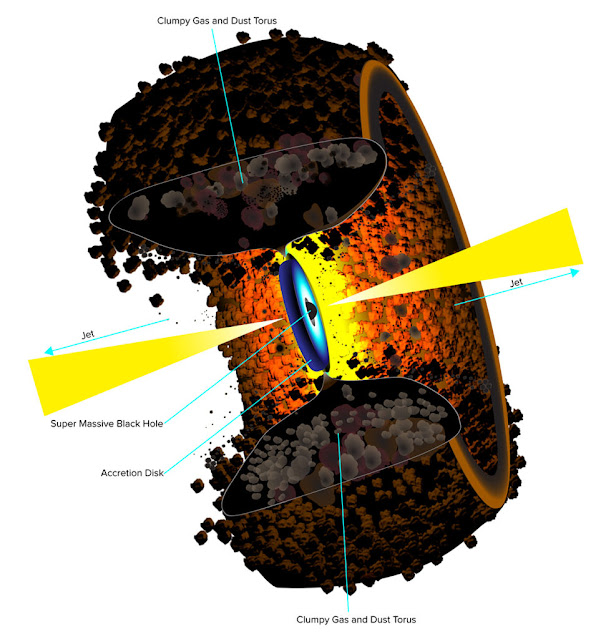
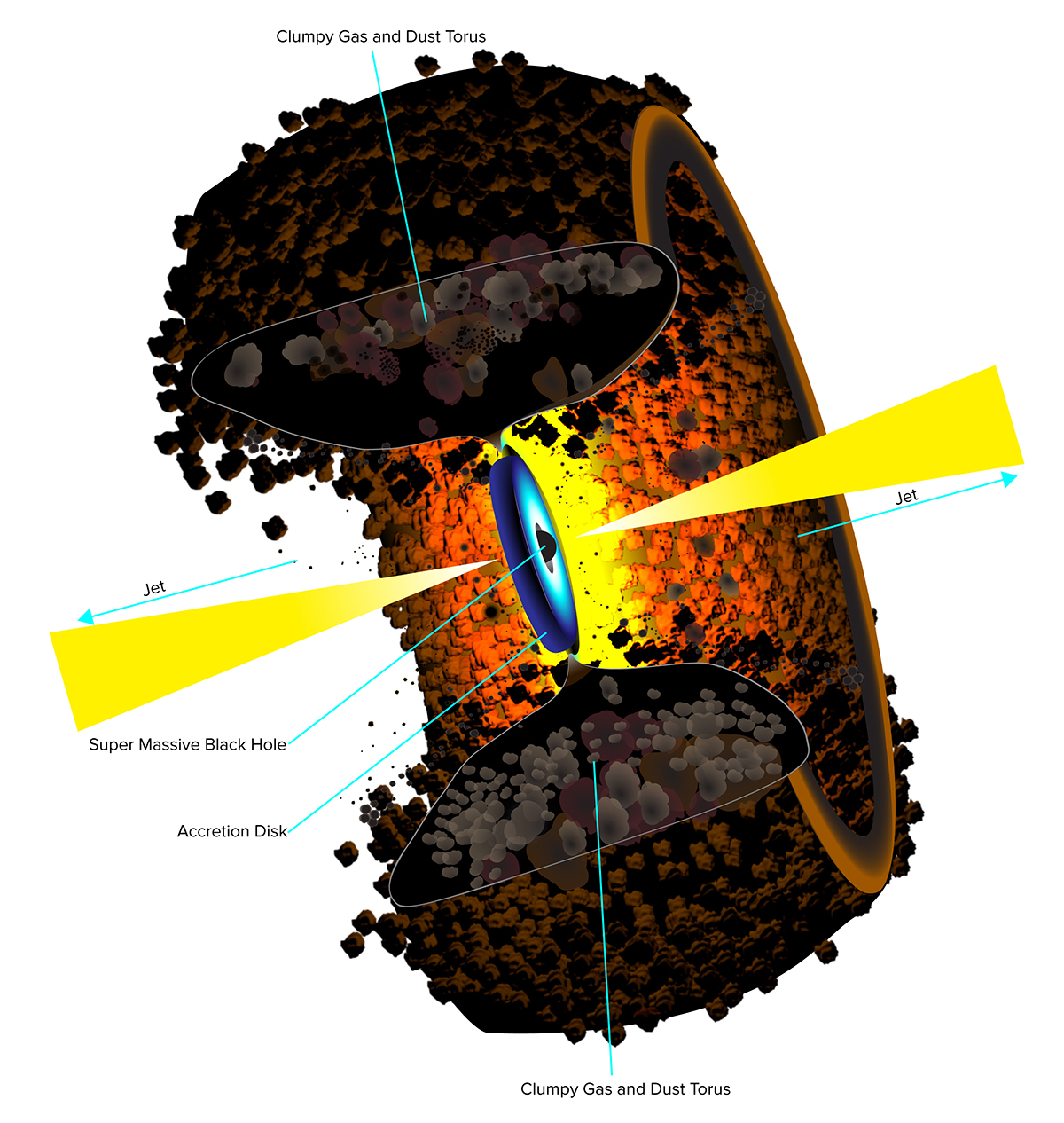
Artist's conception of the dusty, doughnut-shaped object surrounding the supermassive black hole, disk of material orbiting the black holNDF.
  Hi-Res File

Artist's conception of active galactic nucleus, with labels.
Credit: Bill Saxton, NRAO/AUI/NSF. Hi-Res File

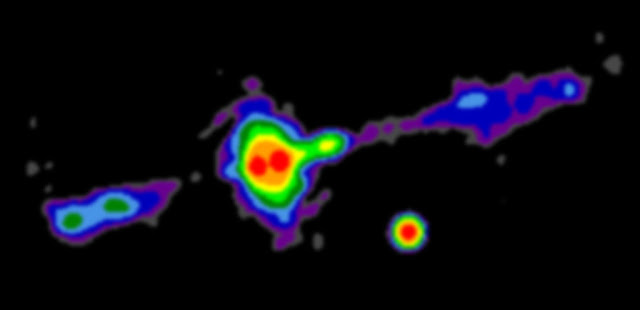
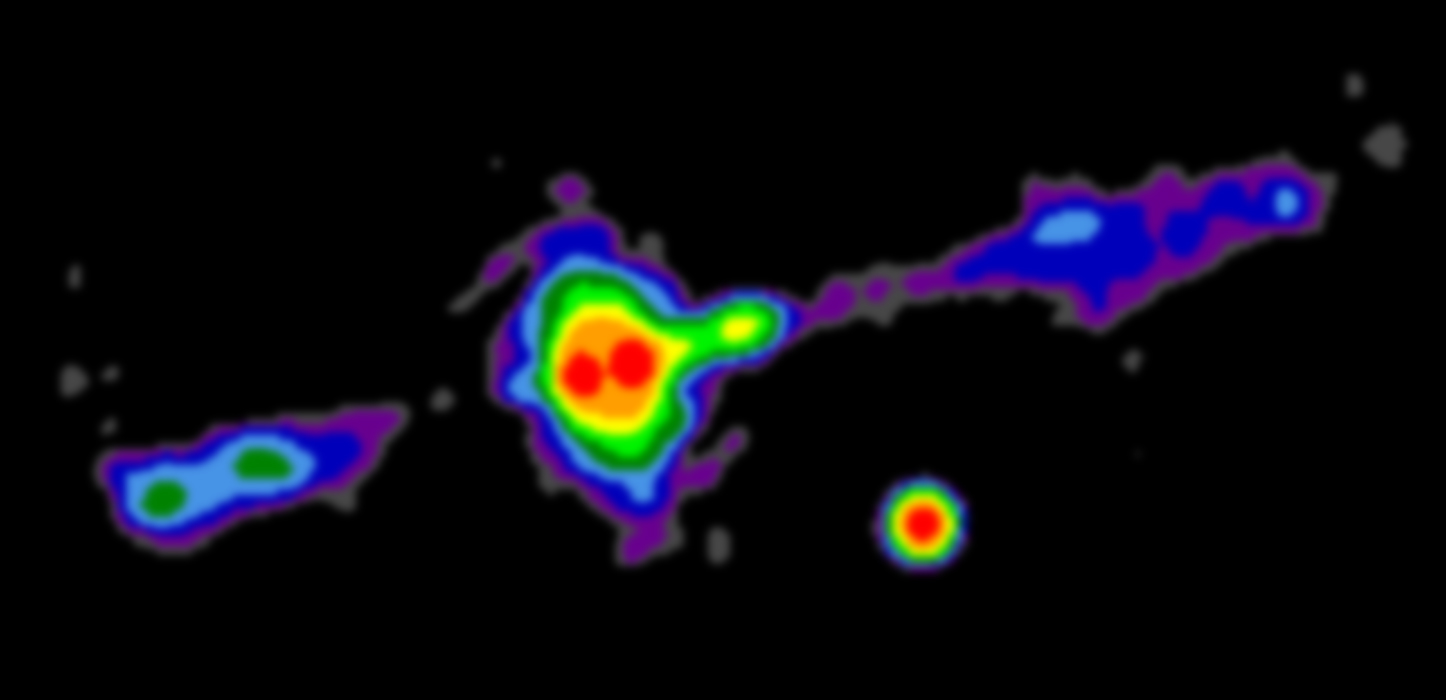
VLA image of the central region of the powerful radio galaxy Cygnus A, showing the doughnut-shaped torus surrounding the black hole and accretion disk. Credit: Carilli et al., NRAO/AUI/NSF.
Hi-Res File

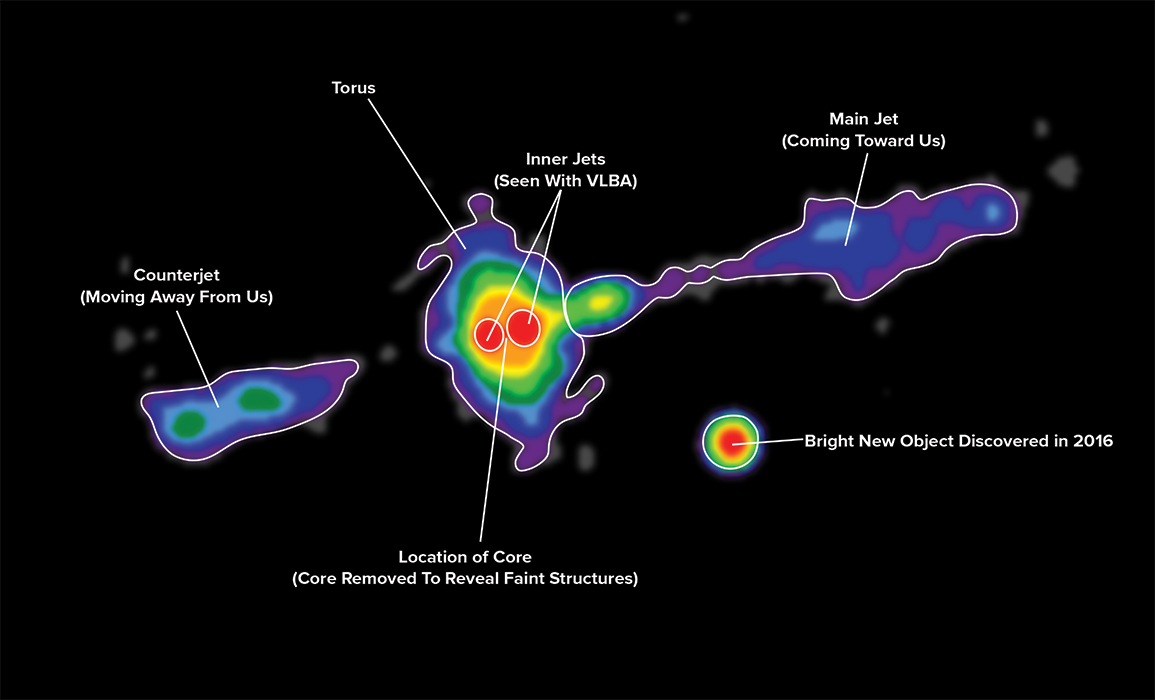
VLA image of Cygnus A's central region, with labels.
Credit: Carilli et al., NRAO/AUI/NSF. Hi-Res File


Video illustrates how the dusty, doughnut-shaped torus surrounding the black hole and accretion disk at the center of a powerful radio galaxy can obscure different features when viewed from different angles. This explains how the same type of "central engine" can appear different, leading to different names for objects seen from different angles. Credit: Bill Saxton, Sophia Dagnello, NRAO/AUI/NSF


Structure suggested by theorists decades ago

Astronomers used the National Science Foundation’s Karl G. Jansky Very Large Array (VLA) to make the first direct image of a dusty, doughnut-shaped feature surrounding the supermassive black hole at the core of one of the most powerful radio galaxies in the Universe — a feature first postulated by theorists nearly four decades ago as an essential part of such objects.

The scientists studied Cygnus A, a galaxy some 760 million light-years from Earth. The galaxy harbors a black hole at its core that is 2.5 billion times more massive than the Sun. As the black hole’s powerful gravitational pull draws in surrounding material, it also propels superfast jets of material traveling outward at nearly the speed of light, producing spectacular “lobes” of bright radio emission.

Black hole-powered “central engines” producing bright emission at various wavelengths, and jets extending far beyond the galaxy are common to many galaxies, but show different properties when observed. Those differences led to a variety of names, such as quasars, blazars, or Seyfert galaxies. To explain the differences, theorists constructed a “unified model” with a common set of features that would show different properties depending on the angle from which they are viewed.

The unified model includes the central black hole, a rotating disk of infalling material surrounding the black hole, and the jets speeding outward from the poles of the disk. In addition, to explain why the same type of object looks different when viewed from different angles, a thick, dusty, doughnut-shaped “torus” is included, surrounding the inner parts. The torus obscures some features when viewed from the side, leading to apparent differences to the observer, even for intrinsically similar objects. Astronomers generically call this common set of features an active galactic nucleus (AGN).

“The torus is an essential part of the AGN phenomenon, and evidence exists for such structures in nearby AGN of lower luminosity, but we’ve never before directly seen one in such a brightly-emitting radio galaxy,” said Chris Carilli, of the National Radio Astronomy Observatory (NRAO). “The torus helps explain why objects known by different names actually are the same thing, just observed from a different perspective,” he added.

In the 1950s, astronomers discovered objects that strongly emitted radio waves, but appeared point-like, similar to distant stars, when later observed with visible-light telescopes. In 1963, Maarten Schmidt of Caltech discovered that one of these objects was extremely distant, and more such discoveries quickly followed. To explain how these objects, dubbed quasars, could be so bright, theorists suggested that they must be tapping the tremendous gravitational energy of supermassive black holes. The combination of black hole, the rotating disk, called an accretion disk, and the jets was termed the “central engine” responsible for the objects’ prolific outpourings of energy.

The same type of central engine also appeared to explain the output of other types of objects, including radio galaxies, blazars, and Seyfert Galaxies. However, each showed a different set of properties. Theorists worked to develop a “unification scheme” to explain how the same thing could appear differently. In 1977, obscuration by dust was suggested as one element of that scheme. In a 1982 paper, Robert Antonucci, of the University of California, Santa Barbara, presented a drawing of an opaque torus — a doughnut-shaped object — surrounding the central engine. From that point on, an obscuring torus has been a common feature of astronomers’ unified view of all types of active galactic nuclei.

“Cygnus A is the closest example of a powerful radio-emitting galaxy — 10 times closer than any other with comparably powerful radio emission. That proximity allowed us to find the torus in a high-resolution VLA image of the galaxy’s core,” said Rick Perley, also of NRAO. “Doing more work of this type on weaker and more distant objects will almost certainly need the order-of-magnitude improvement in sensitivity and resolution that the proposed Next Generation Very Large Array (ngVLA) would bring,” he added.

The VLA observations directly revealed the gas in Cygnus A’s torus, which has a radius of nearly 900 light-years. Longstanding models for the torus suggest that the dust is in clouds embedded in the somewhat-clumpy gas.

“It’s really great to finally see direct evidence of something that we’ve long presumed should be there,” Carilli said. “To more accurately determine the shape and composition of this torus, we need to do further observing. For example, the Atacama Large Millimeter/submillimeter Array (ALMA) can observe at the wavelengths that will directly reveal the dust,” he added.

Carilli and Perley, with their colleagues Vivek Dhawan, also of NRAO, and Daniel Perley of Liverpool John Moores University in the UK, discovered the torus when following up their surprising discovery in 2016 of a new, bright object near the center of Cygnus A. That new object, they said, is most likely a second supermassive black hole that only recently encountered new material it could devour, causing it to produce bright emission the same way the central black hole does. The existence of the second black hole, they said, suggests that Cygnus A merged with another galaxy in the astronomically recent past.

Cygnus A, so named because it is the most powerful radio-emitting object in the constellation Cygnus, was discovered in 1946 by English physicist and radio astronomer J.S. Hey. It was matched to a visible-light, giant galaxy by Walter Baade and Rudolf Minkowski in 1951. It became an early target for the VLA soon after its completion in the early 1980s. Detailed VLA images of Cygnus A published in 1984 produced major advances in astronomers’ understanding of such galaxies.

The scientists are reporting their findings in the Astrophysical Journal Letters.

The National Radio Astronomy Observatory is a facility of the National Science Foundation, operated under cooperative agreement by Associated Universities, Inc.


Media Contact:

Dave Finley, Public Information Officer
(575) 835-7302


Wednesday, April 03, 2019

VLA Makes First Direct Image of Key Feature of Powerful Radio Galaxies

Artist's conception of the dusty, doughnut-shaped object surrounding the supermassive black hole, disk of material orbiting the black hole, and jets of material ejected by the disk, at the center of a galaxy.Credit: Bill Saxton, NRAO/AUI/NSF. Hi-Res image
 
Artist's conception of active galactic nucleus, with labels.
Credit: Bill Saxton, NRAO/AUI/NSF. Hi-Res image

VLA image of the central region of the powerful radio galaxy Cygnus A, showing the doughnut-shaped torus surrounding the black hole and accretion disk. Credit: Carilli et al., NRAO/AUI/NSF. Hi-Res image

VLA image of Cygnus A's central region, with labels.
Credit: Carilli et al., NRAO/AUI/NSF. Hi-Res image

Viewing a Galaxy's "Central Engine" From Different Angles 
Video illustrates how the dusty, doughnut-shaped torus surrounding the black hole and accretion disk at the center of a powerful radio galaxy can obscure different features when viewed from different angles. This explains how the same type of "central engine" can appear different, leading to different names for objects seen from different angles. Credit: Bill Saxton, Sophia Dagnello, NRAO/AUI/NSF. Vimeo


Astronomers used the National Science Foundation’s Karl G. Jansky Very Large Array (VLA) to make the first direct image of a dusty, doughnut-shaped feature surrounding the supermassive black hole at the core of one of the most powerful radio galaxies in the Universe — a feature first postulated by theorists nearly four decades ago as an essential part of such objects.

The scientists studied Cygnus A, a galaxy some 760 million light-years from Earth. The galaxy harbors a black hole at its core that is 2.5 billion times more massive then the Sun. As the black hole’s powerful gravitational pull draws in surrounding material, it also propels superfast jets of material traveling outward at nearly the speed of light, producing spectacular “lobes” of bright radio emission.

Black hole-powered “central engines” producing bright emission at various wavelengths, and jets extending far beyond the galaxy are common to many galaxies, but show different properties when observed. Those differences led to a variety of names, such as quasars, blazars, or Seyfert galaxies. To explain the differences, theorists constructed a “unified model” with a common set of features that would show different properties depending on the angle from which they are viewed.

The unified model includes the central black hole, a rotating disk of infalling material surrounding the black hole, and the jets speeding outward from the poles of the disk. In addition, to explain why the same type of object looks different when viewed from different angles, a thick, dusty, doughnut-shaped “torus” is included, surrounding the inner parts. The torus obscures some features when viewed from the side, leading to apparent differences to the observer, even for intrinsically similar objects. Astronomers generically call this common set of features an active galactic nucleus (AGN).

“The torus is an essential part of the AGN phenomenon, and evidence exists for such structures in nearby AGN of lower luminosity, but we’ve never before directly seen one in such a brightly-emitting radio galaxy,” said Chris Carilli, of the National Radio Astronomy Observatory (NRAO). “The torus helps explain why objects known by different names actually are the same thing, just observed from a different perspective,” he added.

In the 1950s, astronomers discovered objects that strongly emitted radio waves, but appeared point-like, similar to distant stars, when later observed with visible-light telescopes. In 1963, Maarten Schmidt of Caltech discovered that one of these objects was extremely distant, and more such discoveries quickly followed. To explain how these objects, dubbed quasars, could be so bright, theorists suggested that they must be tapping the tremendous gravitational energy of supermassive black holes. The combination of black hole, the rotating disk, called an accretion disk, and the jets was termed the “central engine” responsible for the objects’ prolific outpourings of energy.

The same type of central engine also appeared to explain the output of other types of objects, including radio galaxies, blazars, and Seyfert Galaxies. However, each showed a different set of properties. Theorists worked to develop a “unification scheme” to explain how the same thing could appear differently. In 1977, obscuration by dust was suggested as one element of that scheme. In a 1982 paper, Robert Antonucci, of the University of California, Santa Barbara, presented a drawing of an opaque torus — a doughnut-shaped object — surrounding the central engine. From that point on, an obscuring torus has been a common feature of astronomers’ unified view of all types of active galactic nuclei.

“Cygnus A is the closest example of a powerful radio-emitting galaxy — 10 times closer than any other with comparably bright radio emission. That proximity allowed us to find the torus in a high-resolution VLA image of the galaxy’s core,” said Rick Perley, also of NRAO. “Doing more work of this type on weaker and more distant objects will almost certainly need the order-of-magnitude improvement in sensitivity and resolution that the proposed Next Generation Very Large Array (ngVLA) would bring,” he added.

The VLA observations directly revealed the gas in Cygnus A’s torus, which has a radius of nearly 900 light-years. Longstanding models for the torus suggest that the dust is in clouds embedded in the somewhat-clumpy gas.

“It’s really great to finally see direct evidence of something that we’ve long presumed should be there,” Carilli said. “To more accurately determine the shape and composition of this torus, we need to do further observing. For example, the Atacama Large Millimeter/submillimeter Array (ALMA) can observe at the wavelengths that will directly reveal the dust,” he added.

Carilli and Perley, with their colleagues Vivek Dhawan, also of NRAO, and Daniel Perley of Liverpool John Moores University in the UK, discovered the torus when following up their surprising discovery in 2016 of a new, bright object near the center of Cygnus A. That new object, they said, is most likely a second supermassive black hole that only recently encountered new material it could devour, causing it to produce bright emission the same way the central black hole does. The existence of the second black hole, they said, suggests that Cygnus A merged with another galaxy in the astronomically recent past.

Cygnus A, so named because it is the most powerful radio-emitting object in the constellation Cygnus, was discovered in 1946 by English physicist and radio astronomer J.S. Hey. It was matched to a visible-light, giant galaxy by Walter Baade and Rudolf Minkowski in 1951. It became an early target for the VLA soon after its completion in the early 1980s. Detailed VLA images of Cygnus A published in 1984 produced major advances in astronomers’ understanding of such galaxies.

The scientists are reporting their findings in the Astrophysical Journal Letters.

The National Radio Astronomy Observatory is a facility of the National Science Foundation, operated under cooperative agreement by Associated Universities, Inc.


Media Contact:

Dave Finley, Public Information Officer
(575) 835-7302


Friday, January 11, 2019

Cygnus A: Ricocheting Black Hole Jet Discovered by Chandra

Cygnus A
Credit: X-ray: NASA/CXC/Columbia Univ./A. Johnson et al.; Optical: NASA/STScI


A ricocheting jet blasting from a giant black hole has been captured by NASA's Chandra X-ray Observatory, as reported in our latest press release. In this composite image of Cygnus A, X-rays from Chandra (red, green, and blue that represent low, medium and high energy X-rays) are combined with an optical view from the Hubble Space Telescope of the galaxies and stars in the same field of view. Chandra's data reveal the presence of powerful jets of particles and electromagnetic energy that have shot out from the black hole. The jet on the left has slammed into a wall of hot gas, then ricocheted to punch a hole in a cloud of energetic particles, before it collides with another part of the gas wall.

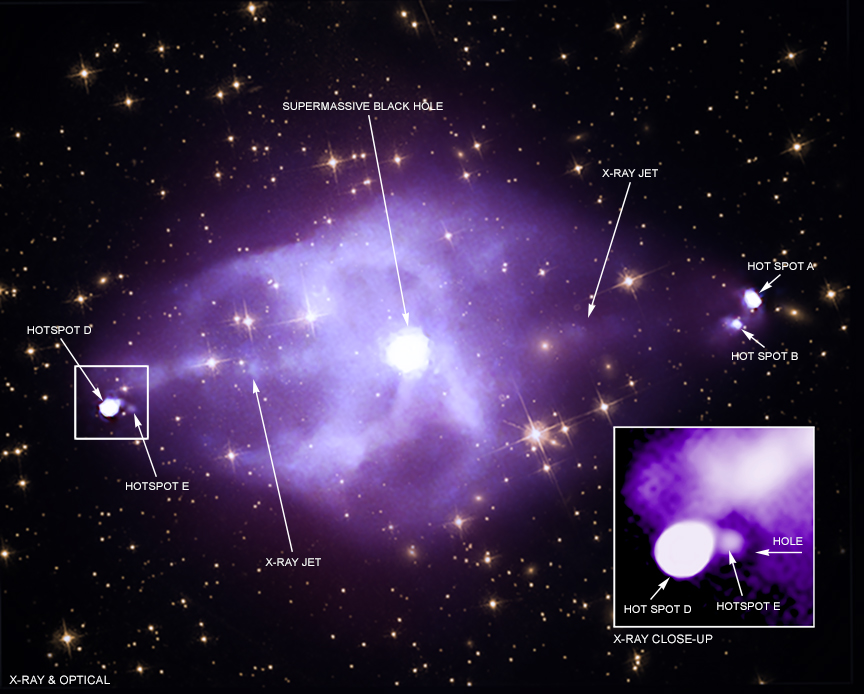
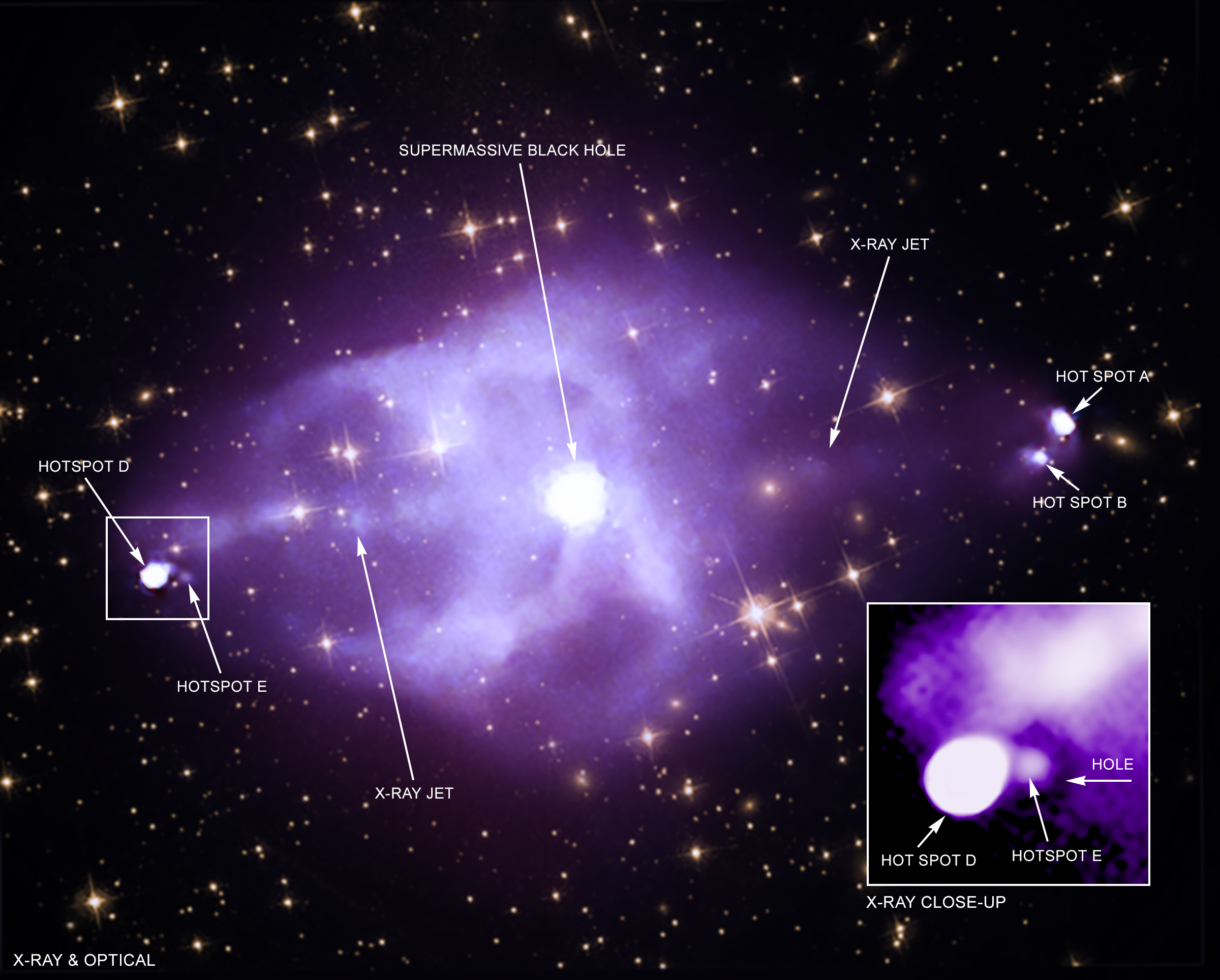
A labeled version outlines the key features described above. The main figure shows the location of the supermassive black hole, the jets, the point that the jet on the left ricocheted off a wall of intergalactic gas ("hotspot E"), and the point where the jet then struck the intergalactic gas a second time ("hotspot D"). The inset contains a close-up view of the hotspots on the left and the hole punched by the rebounding jet, which surrounds hotspot E. The image in the inset combines X-rays from all three energy ranges to give the greatest sensitivity to show fine structures such as the hole.

The hole is visible because the path of the rebounding jet between hotspots E and D is almost directly along the line of sight to Earth, as shown by the schematic figure depicting the view of Cygnus A from above. A similar rebounding of the jet likely occurred between hotspots A and B but the hole is not visible because the path is not along the Earth's line of sight.


Schematic Views of Cygnus A
The hole is visible because the path of the rebounding jet between hotspots E and D is almost directly along the line of sight to Earth, as shown by the schematic figure depicting the view of Cygnus A from above. A similar rebounding of the jet likely occurred between hotspots A and B but the hole is not visible because the path is not along the Earth's line of sight.
(Credit: NASA/CXC/M.Weiss)

Cygnus A is a large galaxy that sits in the middle of a cluster of galaxies about 760 million light years from Earth. A supermassive black hole at the center of Cygnus A is rapidly growing as it pulls material swirling around it into its gravitational grasp. During this process, some of this material is redirected away from the black hole in the form of narrow beams, or jets. Such jets can significantly affect how the galaxy and its surroundings evolve. 

In a deep observation that lasted 23 days, scientists used Chandra to create a highly detailed map of both the jets and the intergalactic gas, which they used to track the path of the jets from the black hole. The jet on the left expanded after ricocheting and created a hole in the surrounding cloud of particles that is between 50,000 and 100,000 light years deep and only 26,000 light years wide. For context, the Earth is located about 26,000 light years away from the center of the Milky Way galaxy. 

The scientists are working to determine what forms of energy — kinetic energy, heat or radiation — the jet carries. The composition of the jet and the types of energy determine how the jet behaves when it ricochets, such as the size of the hole it creates. Theoretical models of the jet and its interactions with surrounding gas are needed to make conclusions about the jet's properties. 

Energy produced by jets from black holes can heat intergalactic gas in galaxy clusters and prevent it from cooling and forming large numbers of stars in a central galaxy like Cygnus A. Thus, studying Cygnus A can tell scientists more about how jets from black holes interact with their surroundings.

These results were presented at the 233rd meeting of the American Astronomical Society meeting in Seattle, WA, in a study led by Amalya Johnson of Columbia University in New York. NASA's Marshall Space Flight Center in Huntsville, Alabama, manages the Chandra program for NASA's Science Mission Directorate in Washington. The Smithsonian Astrophysical Observatory in Cambridge, Massachusetts, controls Chandra's science and flight operations.


Fast Facts for Cygnus A:

Scale: Image is 2.5 arcmin across. (About 540,000 light years across.)
Category: Quasars & Active Galaxies
Coordinates (J2000): RA 19h 59m 28.30s | Dec +40° 44' 02.00"
Constellation: Cygnus
Observation Date: July 16, 2016 - May 21, 2017
Observation Time: 541 hours 11 min (22 days, 13 hours, 11 minutes)
Obs. ID: 5830,5831,6225,6226,6228,6229,6250,6252,17133-17144,17507-17517
Instrument: ACIS
References: Johnson, A. et al, AAS, 233, 6-9 January 2019
Color Code: X-ray: purple. Optical: red, green, and blue
Distance Estimate: About 760 million light years


Wednesday, October 17, 2018

Magnetic Fields May Be the Key to Black Hole Activity

Artist’s conception of the core of Cygnus A, including the dusty donut-shaped surroundings, called a torus, and jets launching from its center. Magnetic fields are illustrated trapping the dust in the torus. These magnetic fields could be helping power the black hole hidden in the galaxy’s core by confining the dust in the torus and keeping it close enough to be gobbled up by the hungry black hole. Credits: NASA/SOFIA/Lynette Cook

Two images of Cygnus A layered over each other to show the galaxy’s jets glowing with radio radiation (shown in red). Quiescent galaxies, like our own Milky Way, do not have jets like this, which may be related to magnetic fields. The yellow image shows background stars and the center of the galaxy shrouded in dust when observed with visible light. The area SOFIA observed is inside the small red dot in the center.  Credits: Optical Image: NASA/STSiC Radio Image: NSF/NRAO/AUI/VLA

Collimated jets provide astronomers with some of the most powerful evidence that a supermassive black hole lurks in the heart of most galaxies. Some of these black holes appear to be active, gobbling up material from their surroundings and launching jets at ultra-high speeds, while others are quiescent, even dormant. Why are some black holes feasting and others starving? Recent observations from the Stratospheric Observatory for Infrared Astronomy, or SOFIA, are shedding light on this question.

SOFIA data indicate that magnetic fields are trapping and confining dust near the center of the active galaxy, Cygnus A, and feeding material onto the supermassive black hole at its center.

The unified model, which attempts to explain the different properties ­of active galaxies, states that the core is surrounded by a donut-shaped dust cloud, called a torus. How this obscuring structure is created and sustained has never been clear, but these new results from SOFIA indicate that magnetic fields may be responsible for keeping the dust close enough to be devoured by the hungry black hole. In fact, one of the fundamental differences between active galaxies like Cygnus A and their less active cousins, like our own Milky Way, may be the presence or absence of a strong magnetic field around the black hole.

Although celestial magnetic fields are notoriously difficult to observe, astronomers have used polarized light — optical light from scattering and radio light from accelerating electrons — to study magnetic fields in galaxies. But optical wavelengths are too short and the radio wavelengths are too long to observe the torus directly. The infrared wavelengths observed by SOFIA are just right, allowing scientists, for the first time, to target and isolate the dusty torus.

SOFIA’s new instrument, the High-resolution Airborne Wideband Camera-plus (HAWC+), is especially sensitive to the infrared emission from aligned dust grains. This has proven to be a powerful technique to study magnetic fields and test a fundamental prediction of the unified model: the role of the dusty torus in the active-galaxy phenomena.

“It’s always exciting to discover something completely new,” noted Enrique Lopez-Rodriguez, a scientist at the SOFIA Science Center, and the lead author on the report of this new discovery. “These observations from HAWC+ are unique. They show us how infrared polarization can contribute to the study of galaxies.”

Recent observations of the heart of Cygnus A made with HAWC+ show infrared radiation dominated by a well-aligned dusty structure. Combining these results with archival data from the Herschel Space Observatory, the Hubble Space Telescope and the Gran Telescopio Canarias, the research team found that this powerful active galaxy, with its iconic large-scale jets, is able to confine the obscuring torus that feeds the supermassive black hole using a strong magnetic field.

The results of this study were published in the July 10th issue of The Astrophysical Journal Letters.

Cygnus A is in the perfect location to learn about the role magnetic fields play in confining the dusty torus and channeling material onto the supermassive black hole because it is the closest and most powerful active galaxy. More observations of different types of galaxies are necessary to get the full picture of how magnetic fields affect the evolution of the environment surrounding supermassive black holes. If, for example, HAWC+ reveals highly polarized infrared emission from the centers of active galaxies but not from quiescent galaxies, it would support the idea that magnetic fields regulate black hole feeding and reinforce astronomers’ confidence in the unified model of active galaxies.

SOFIA is a Boeing 747SP jetliner modified to carry a 106-inch diameter telescope. It is a joint project of NASA and the German Aerospace Center, DLR. NASA’s Ames Research Center in California’s Silicon Valley manages the SOFIA program, science and mission operations in cooperation with the Universities Space Research Association headquartered in Columbia, Maryland, and the German SOFIA Institute (DSI) at the University of Stuttgart. The aircraft is maintained and operated from NASA’s Armstrong Flight Research Center Hangar 703, in Palmdale, California.


Editor: Kassandra Bell


Thursday, May 25, 2017

VLA Reveals New Object Near Supermassive Black Hole in Famous Galaxy

Artist's conception of newly-discovered secondary supermassive black hole orbiting the main, 
central supermassive black hole of galaxy Cygnus A. 
Credit: Bill Saxton, NRAO/AUI/NSF

VLA radio images (orange) of central region of Cygnus A, overlaid on Hubble Space Telescope image, from 1989 and 2015. 
Animated GIF. Credit: Perley, et al., NRAO/AUI/NSF, NASA

VLA radio image (orange) of central region of Cygnus A, overlaid on Hubble Space Telescope image, from 1989. 
Credit: Perley, et al., NRAO/AUI/NSF, NASA

2015 VLA radio image (orange) of Cygnus A, overlaid on Hubble Space Telescope image. 
Credit: Perley, et al., NRAO/AUI/NSF, NASA

1989 VLA radio image of the central region of Cygnus 
A. Credit: Perley, et al., NRAO/AUI/NSF

2015 VLA radio image of the central region of Cygnus A. 
Credit: Perley, et al., NRAO/AUI/NSF


Pointing the National Science Foundation’s Very Large Array (VLA) at a famous galaxy for the first time in two decades, a team of astronomers got a big surprise, finding that a bright new object had appeared near the galaxy’s core. The object, the scientists concluded, is either a very rare type of supernova explosion or, more likely, an outburst from a second supermassive black hole closely orbiting the galaxy’s primary, central supermassive black hole.

The astronomers observed Cygnus A, a well-known and often-studied galaxy discovered by radio-astronomy pioneer Grote Reber in 1939. The radio discovery was matched to a visible-light image in 1951, and the galaxy, some 800 million light-years from Earth, was an early target of the VLA after its completion in the early 1980s. Detailed images from the VLA published in 1984 produced major advances in scientists’ understanding of the superfast “jets” of subatomic particles propelled into intergalactic space by the gravitational energy of supermassive black holes at the cores of galaxies.

“This new object may have much to tell us about the history of this galaxy,” said Daniel Perley, of the Astrophysics Research Institute of Liverpool John Moores University in the U.K., lead author of a paper in the Astrophysical Journal announcing the discovery.

“The VLA images of Cygnus A from the 1980s marked the state of the observational capability at that time,” said Rick Perley, of the National Radio Astronomy Observatory (NRAO). “Because of that, we didn’t look at Cygnus A again until 1996, when new VLA electronics had provided a new range of radio frequencies for our observations.” The new object does not appear in the images made then.

“However, the VLA’s upgrade that was completed in 2012 made it a much more powerful telescope, so we wanted to have a look at Cygnus A using the VLA’s new capabilities,” Perley said.

Daniel and Rick Perley, along with Vivek Dhawan, and Chris Carilli, both of NRAO, began the new observations in 2015, and continued them in 2016.

“To our surprise, we found a prominent new feature near the galaxy’s nucleus that did not appear in any previous published images. This new feature is bright enough that we definitely would have seen it in the earlier images if nothing had changed,” said Rick Perley. “That means it must have turned on sometime between 1996 and now,” he added.

The scientists then observed Cygnus A with the Very Long Baseline Array (VLBA) in November of 2016, clearly detecting the new object. A faint infrared object also is seen at the same location in Hubble Space Telescope and Keck observations, originally made between 1994 and 2002. The infrared astronomers, from Lawrence Livermore National Laboratory, had attributed the object to a dense group of stars, but the dramatic radio brightening is forcing a new analysis.

What is the new object? Based on its characteristics, the astronomers concluded it must be either a supernova explosion or an outburst from a second supermassive black hole near the galaxy’s center. While they want to watch the object’s future behavior to make sure, they pointed out that the object has remained too bright for too long to be consistent with any known type of supernova.

“Because of this extraordinary brightness, we consider the supernova explanation unlikely,” Dhawan said.

While the new object definitely is separate from Cygnus A’s central supermassive black hole, by about 1500 light-years, it has many of the characteristics of a supermassive black hole that is rapidly feeding on surrounding material.

“We think we’ve found a second supermassive black hole in this galaxy, indicating that it has merged with another galaxy in the astronomically-recent past,” Carilli said. “These two would be one of the closest pairs of supermassive black holes ever discovered, likely themselves to merge in the future.”

The astronomers suggested that the second black hole has become visible to the VLA in recent years because it has encountered a new source of material to devour. That material, they said, could either be gas disrupted by the galaxies’ merger or a star that passed close enough to the secondary black hole to be shredded by its powerful gravity.

“Further observations will help us resolve some of these questions. In addition, if this is a secondary black hole, we may be able to find others in similar galaxies,” Daniel Perley said.

Rick Perley was one of the astronomers who made the original Cygnus A observations with the VLA in the 1980s. Daniel Perley is his son, now also a research astronomer.

“Daniel was only two years old when I first observed Cygnus A with the VLA,” Rick said. As a high school student in Socorro, New Mexico, Daniel used VLA data for an award-winning science fair project that took him to the international level of competition, then went on to earn a doctoral degree in astronomy.

Also at the time of those first VLA observations of Cygnus A, Carilli and Dhawan were office mates as graduate students at MIT.

Carilli, now NRAO’s Chief Scientist, was Rick’s graduate student while working as a predoctoral fellow at NRAO. His doctoral dissertation was on detailed analysis of 1980s VLA images of Cygnus A.

The National Radio Astronomy Observatory is a facility of the National Science Foundation, operated under cooperative agreement by Associated Universities, Inc.


Media Contact:

Dave Finley, Public Information Officer
(575) 835-7302
dfinley@nrao.edu