Wednesday, October 14, 2015

Comet Encke: A Solar Windsock Observed by NASA’s STEREO

A visualization of the constant outflow of material from the sun, known as the solar wind. There is no consensus on what powers the solar wind’s acceleration, its extreme variability, or its remarkably high temperatures. Credits: ESA/NASA/SOHO


Much like the flapping of a windsock displays the quick changes in wind’s speed and direction, called turbulence, comet tails can be used as probes of the solar wind – the constant flowing stream of material that leaves the sun in all directions. According to new studies of a comet tail observed by NASA’s Solar and Terrestrial Relations Observatory, or STEREO, the vacuum of interplanetary space is filled with turbulence and swirling vortices similar to gusts of wind on Earth. Such turbulence can help explain two of the wind's most curious features: its variable nature and unexpectedly high temperatures. A paper on this work was published in “The Astrophysical Journal” on Oct. 13, 2015.

“The solar wind at Earth is about 70 times hotter than one might expect from the temperature of the solar corona and how much it expands as it crosses the void,” said Craig DeForest, a solar physicist at the Southwest Research Institute in Boulder, Colorado, and lead author on the study. “The source of this extra heat has been a mystery of solar wind physics for several decades.”

There is much that is conclusively known about the solar wind: It is made of a sea of electrically-charged electrons and ions and also carries the interplanetary magnetic field along for the ride, forging a magnetic connection between the sun and Earth and the other planets in the solar system. There is no consensus, however, on what powers the wind's acceleration, especially when it is traveling at its fastest speeds.

Complicating the search for such understanding are two of its most distinctive characteristics: The solar wind can be highly variable, meaning that measurements just short times or distances apart can yield quite different results. It is also very, very hot—remarkably so.

The new study helped explain these characteristics using the heliospheric imager onboard STEREO. The scientists studied the movements of hundreds of dense chunks of glowing ionized gas within the ribbon of Comet Encke’s tail, which passed within STEREO’s field of view in 2007. Fluctuations in the solar wind are mirrored in what is seen in the tail, so by tracking these clumps, scientists were able to reconstruct the motion of the solar wind, catching an unprecedented look at the turbulence.

Identifying this turbulence in the solar wind has the potential to solve the mystery of how the solar wind gets so hot. Based on the intensity of the turbulence researchers saw, they calculated that the energy available from turbulence is more than ten times what would be required to heat the solar wind to observed temperatures.

What's more, it also helps to solve the variability problem, which other theories have not yet done successfully.

“This turbulent motion mixes up the solar wind, leading to the rapid variation that we see at Earth,” said DeForest.

For years, scientists have taken direct measurements of the solar wind—known as in situ measurements, which are captured as the solar wind passes over one of the dozens of satellites carrying the appropriate instruments. Most of these satellites observe the sun from a vantage point similar to that of Earth.

STEREO-A, however, orbits the sun in a slightly smaller and faster orbit than Earth, meaning it moves around the sun farther and farther from Earth over time. So, in addition to the images of Comet Encke as it streamed past in April 2007, STEREO-A also provides us with in situ solar wind measurements from a unique perspective.

On the other hand, the solar wind is notoriously hard to study remotely—that is, with measurements from afar. Its particles flow at 250 miles per second, and they are so dispersed that interplanetary space at Earth’s orbit has about a thousand times fewer particles in one cubic inch of space than the best laboratory vacuum on Earth.

This solar wind dominates the space environment within our solar system and travels well past Pluto, creating a huge bubble known as the heliosphere. Closer to home, the solar wind also interacts with Earth’s magnetic field, sometimes initiating changes in near-Earth space that can disrupt our space technology or cause auroras. So scientists needed to come up with a way to look at something that’s invisible—and that’s where Comet Encke came in. 

Comet Encke’s ion tail can be seen stretching away from the sun towards the top of the image, captured by NASA’s MESSENGER spacecraft on Nov. 17, 2013, when the comet was about 33 million miles from the sun. The tail is created when the solar wind sweeps over the comet, capturing vaporized material and causing it to trail out behind the comet. The tail follows the lines of the magnetic field ingrained in the solar wind and reveals its motion. Credits: NASA/Johns Hopkins University Applied Physics Laboratory/Carnegie Institution of Washington/Southwest Research Institute


All comets, if they get close enough to the sun, will form what’s called an ion tail. One of the most recognizable features of these hunks of ice and rock, the ion tail is created when the solar wind—made of hot, charged gas, called plasma—sweeps over the comet, capturing the material that has been vaporized into plasma by sunlight, causing it to trail out behind the comet. This tail follows the lines of the magnetic field embedded in the solar wind and reveals its motion.

Comet Encke has some unusual characteristics that scientists were able to leverage to study the solar wind. Unlike most comets, Comet Encke has what is called a compact tail. Rather than feathering out loosely, creating a wide spray of ions, Comet Encke’s ion tail streams out in a tight, bright ribbon of glowing gas with compact features.

This video, captured by NASA’s STEREO mission, shows the motion of Comet Encke and its tail as it approached the sun in April 2007. Scientists studied the movements of hundreds of dense chunks of glowing ionized gas within the comet's tail, finding evidence of turbulence that may explain both the solar wind’s variability and its unexpectedly high temperatures. Credits: NASA/STEREO


"In situ measurements are limited because they don't follow the turbulence along its path,” said William Matthaeus, a professor of physics and astronomy at the University of Delaware and co-author on the study. “Now, for the first time, we observed the turbulent motions along their complex paths and quantified the mixing. We actually see the turbulence.”

Using the images from STEREO-A, scientists tracked 230 different features as they weaved through Comet Encke’s tail over the course of about 9.3 million miles of its journey around the sun. They then compared these motions to how they would expect solid objects to orbit around the sun, finding evidence that these gas clumps were being picked up by drag against the solar wind. They found that, though the gas clumps moved more or less randomly on smaller scales, they exhibited clear patterns on the scale of about 300,000 miles, indicating large-scale swirling eddies are mixing the solar wind—and possibly heating it as well.

“Turbulent motion cascades down into motion on smaller and smaller scales until it hits the level of the fundamental gyrations of the particles about the magnetic field, where it becomes heat,” said Aaron Roberts, a heliophysicist at NASA’s Goddard Space Flight Center in Greenbelt, Maryland. “This study estimates that there is enough energy contained in these swirling eddies to explain the extra heat several times over.”

These observations of the solar wind provide a preview of what NASA plans to observe more directly with the Solar Probe Plus, or SPP, mission in 2018. SPP will travel to within nine solar radii of the sun, which is nine times the radius of the Sun, or about 3.9 million miles. Since it’s possible to remotely observe comets closer to the sun than any spacecraft can travel, studying them does provide unique information about the solar wind and our sun’s atmosphere.

STEREO is the third mission in the NASA Heliophysics Division’s Solar Terrestrial Probes program, which is managed by NASA Goddard for NASA’s Science Mission Directorate, in Washington.


Related:


Editor: Ashley Morrow

Source: NASA/Sun

Tuesday, October 13, 2015

Hubble’s Planetary Portrait Captures New Changes in Jupiter’s Great Red Spot

This new portrait of Jupiter was produced from observations made using NASA’s Hubble Space Telescope.


Scientists using NASA’s Hubble Space Telescope have produced new maps of Jupiter – the first in a series of annual portraits of the solar system’s outer planets.

Collecting these yearly images – essentially the planetary version of annual school picture days for children – will help current and future scientists see how these giant worlds change over time. The observations are designed to capture a broad range of features, including winds, clouds, storms and atmospheric chemistry.

Already, the Jupiter images have revealed a rare wave just north of the planet’s equator and a unique filamentary feature in the core of the Great Red Spot not seen previously.

“Every time we look at Jupiter, we get tantalizing hints that something really exciting is going on,” said Amy Simon, a planetary scientist at NASA’s Goddard Space Flight Center in Greenbelt, Maryland. “This time is no exception.”

Simon and her colleagues produced two global maps of Jupiter from observations made using Hubble’s high-performance Wide Field Camera 3. The two maps represent nearly back-to-back rotations of the planet, making it possible to determine the speeds of Jupiter’s winds. The findings are described in an Astrophysical Journal paper, available online.

The new images confirm that the Great Red Spot continues to shrink and become more circular, as it has been doing for years. The long axis of this characteristic storm is about 150 miles (240 kilometers) shorter now than it was in 2014. Recently, the storm had been shrinking at a faster-than-usual rate, but the latest change is consistent with the long-term trend.

The Great Red Spot remains more orange than red these days, and its core, which typically has more intense color, is less distinct than it used to be. An unusual wispy filament is seen, spanning almost the entire width of the vortex. This filamentary streamer rotates and twists throughout the 10-hour span of the Great Red Spot image sequence, getting distorted by winds blowing at 330 miles per hour (150 meters per second) or even greater speeds.

In Jupiter’s North Equatorial Belt, the researchers found an elusive wave that had been spotted on the planet only once before, decades earlier, by Voyager 2. In those images, the wave is barely visible, and nothing like it was seen again, until the current wave was found traveling at about 16 degrees north latitude, in a region dotted with cyclones and anticyclones. Similar waves – called baroclinic waves – sometimes appear in Earth’s atmosphere where cyclones are forming.


In Jupiter’s North Equatorial Belt, scientists spotted a rare wave that had been seen there only once before. It is similar to a wave that sometimes occurs in Earth’s atmosphere when cyclones are forming. This false-color close-up of Jupiter shows cyclones (arrows) and the wave (vertical lines). Credits: NASA/ESA/Goddard/UCBerkeley/JPL-Caltech/STScI


“Until now, we thought the wave seen by Voyager 2 might have been a fluke,” said co-author Glenn Orton of NASA’s Jet Propulsion Laboratory in Pasadena, California. “As it turns out, it’s just rare!”

The wave may originate in a clear layer beneath the clouds, only becoming visible when it propagates up into the cloud deck, according to the researchers. That idea is supported by the spacing between the wave crests.

In addition to Jupiter, the researchers have observed Neptune and Uranus, and maps of those planets also will be placed in the public archive. Saturn will be added to the series later. Hubble will dedicate time each year to this special set of observations, called the Outer Planet Atmospheres Legacy program.

The movement of Jupiter’s clouds can be seen by comparing the first map to the second one. Zooming in on the Great Red Spot at blue (left) and red (right) wavelengths reveals a unique filamentary feature not previously seen.   Credits: NASA/ESA/Goddard/UCBerkeley/JPL-Caltech/STScI


“The long-term value of the Outer Planet Atmospheres Legacy program is really exciting,” said co-author Michael H. Wong of the University of California, Berkeley. “The collection of maps that we will build up over time will not only help scientists understand the atmospheres of our giant planets, but also the atmospheres of planets being discovered around other stars, and Earth’s atmosphere and oceans, too.”


Please direct inquiries for the University of California, Berkeley, to Robert Sanders at rlsanders@berkeley.edu.

To access the Outer Planet Atmospheres Legacy program images and data, visit: https://archive.stsci.edu/prepds/opal/

For images and more information about Hubble, visit: http://www.nasa.gov/hubble  and  http://hubblesite.org/news/2015/37

Related multimedia is available at:  http://svs.gsfc.nasa.gov/goto?12021


Nancy Neal-Jones/Elizabeth Zubritsky
NASA’s Goddard Space Flight Center, Greenbelt, Md.
301-286-0039/301-614-5438
nancy.n.jones@nasa.gov/elizabeth.a.zubritsky@nasa.gov

Ray Villard
Space Telescope Science Institute, Baltimore
410-338-4514
villard@stsci.edu

Preston Dyches
NASA’s Jet Propulsion Laboratory, Pasadena, Calif.
818-354-7013
preston.dyches@jpl.nasa.gov

Editor: Rob Garner

Source:  NASA/Jupiter

Listening to the Extragalactic Radio


CHANG-ES, the “Continuum Halos in Nearby Galaxies, an EVLA Survey” project, brings together scientists from all over the globe in order to investigate the occurrence and origin of radio halos, to probe the disk-halo interface, and to study in-disk emission as well as their magnetic fields and the cosmic rays illuminating these fields. The goal is to understand connections between radio halos and the host disk and its environment.

A number of scientists from two Max Planck Institutes and Ruhr-University Bochum in Germany are co-authors in a recent study reporting observations of a sample of 35 nearby edge-on galaxies with the compact D-configuration of the Karl G. Jansky Very Large Array (VLA) in a number of spectral windows within two frequency ranges, L-band around 1.5 GHz and C-band around 6 GHz.

A median image constructed from stacking 30 CHANG-ES observations of galaxies at C-band reveals the extent of the galaxy that is otherwise invisible in optical wavelengths.

A study of spiral galaxies seen edge-on has revealed that "halos" of cosmic rays and magnetic fields above and below the galaxies' disks are much more common than previously thought.

An international team of astronomers used the Karl G. Jansky Very Large Array (VLA) to study 35 edge-on spiral galaxies at distances from 11 million to 137 million light-years from Earth. The study took advantage of the ability of the VLA, following completion of a decade-long upgrade project, to detect radio emission much fainter than previously possible.

"We knew before that some halos existed, but, using the full power of the upgraded VLA and the full power of some advanced image-processing techniques, we found that these halos are much more common among spiral galaxies than we had realized," says Judith Irwin, of Queen's University in Canada, leader of the project.

Spiral galaxies, like our own Milky Way, have the vast majority of their stars, gas, and dust in a flat, rotating disk with spiral arms. Most of the light and radio waves seen with telescopes come from objects in that disk. Learning about the environment above and below such disks has been difficult.

"Studying these halos with radio telescopes can give us valuable information about a wide range of phenomena, including the rate of star formation within the disk, the winds from exploding stars, and the nature and origin of the galaxies' magnetic fields," says Theresa Wiegert, also of Queen's University, lead author of a paper in the Astronomical Journal reporting the team's findings. The paper provides the first analysis of data from all 35 galaxies in the study.

“We have studied the extended halos of individual galaxies for quite some time”, explains Ralf-Jürgen Dettmar from Ruhr-University in Bochum, Germany. “The CHANG-ES sample will provide an additional statistical access to the important question of galactic feedback.” One of his prime research targets, NGC 5775, was used as template in order to represent the inner star forming region of spiral galaxies (see Fig.).

To see how extensive a "typical" halo is, the astronomers scaled their images of 30 of the galaxies to the same diameter, then another of the authors, Jayanne English, of the University of Manitoba in Canada, combined them into a single image. The result, says Irwin, is "a spectactular image showing that cosmic rays and magnetic fields not only permeate the galaxy disk itself, but extend far above and below the disk."

The combined image, the scientists said, confirms a prediction of such halos made in 1961.

Along with the report on their findings, the astronomers also are making their first batch of specialized VLA images available to other researchers. In previous publications, the team described the details of their project and its goals. The team has completed a series of VLA observations and their latest paper is based on analysis of their first set of images. They now are analyzing additional datasets, and also will make those additional images available to other scientists when they publish the results of the later analyses.

"The results from this survey will help answer many unsolved questions in galactic evolution and star formation", concludes Marita Krause of the Max-Planck Institute für Radioastronomie in Bonn, Germany.


The research team comprises Philip Schmidt, Silvia Carolina Mora, Ancor Damas-Segovia, Marita Krause & Rainer Beck (all Max-Planck-Institut für Radioastronomie, Bonn, Germany), Theresa Wiegert, the lead author, Judith Irwin, Stephen MacGregor & Amanda DeSouza (all Dept. of Physics, Engineering Physics & Astronomy, Queen’s University, Kingston, Canada),  Arpad Miskolczi, Yelena Stein, Ralf-Jürgen Dettmar, Marek Wezgowiec (all Astronomisches Institut, Ruhr-Universität Bochum, Germany), Jayanne English (Department of Physics and Astronomy, University of Manitoba, Winnipeg, Canada), Richard J. Rand, Isaiah Santistevan (Dept. of Physics and Astronomy, University of New Mexico, Albuquerque, USA), Rene Walterbos (Dept. of Astronomy, New Mexico State University, Las Cruces, USA), Amanda Kepley (NRAO, Charlottesville, USA) , Q. Daniel Wang (Dept. of Astronomy, University of Massachusetts, Amherst, USA), George Heald (ASTRON, Dwingeloo, The Netherlands), Jiangtao Li (Dept. of Astronomy, University of Michigan, Ann Arbor, USA), Megan Johnson (CSIRO, Epping, Australia), Andrew W. Strong (Max-Planck-Institut für extraterrestrische Physik, Garching, Germany), Troy A. Porter (Hansen Experimental Physics Laboratory, Stanford University, USA).

This work was supported by the Natural Sciences and Engineering Research Council of Canada, and the National Radio Astronomy Observatory (NRAO), which is run by the National Science Foundation (NSF).

The work at Ruhr-University Bochum, Germany, has been supported by DFG through FOR1048. The support of the Computer Center of the Max Planck Institute (RZG) in Garching, Germany, for the use of archiving facilities is acknowledged.


Local Contact

Dr. Marita Krause
Phone:+49 228 525-312
Email: mkrause@mpifr-bonn.mpg.de
Max-Planck-Institut für Radioastronomie, Bonn

Dr. Rainer Beck
Phone:+49 228 525-323
Email: rbeck@mpifr-bonn.mpg.de
Max-Planck-Institut für Radioastronomie, Bonn

Dr. Norbert Junkes
Presse- und Öffentlichkeitsarbeit
Phone:+49 228 525-399
Email: njunkes@mpifr-bonn.mpg.de
Max-Planck-Institut für Radioastronomie, Bonn


Monday, October 12, 2015

Outbursts from a newborn star

Credit: ESO/M. McCaughrean


A pair of jets protrude outwards in near-perfect symmetry in this image of Herbig-Haro object (HH) 212, taken by ESO’s already decommissioned Infrared Spectrometer And Array Camera (ISAAC).

The object lies in the constellation of Orion (The Hunter) in a dense molecular star-forming region, not far from the famous Horsehead Nebula. In regions like this, clouds of dust and gas collapse under the force of gravity, spinning faster and faster and becoming hotter and hotter until a young star ignites at the cloud’s centre. Any leftover material swirling around the newborn protostar comes together to form an accretion disc that will, under the right circumstances, eventually evolve to form the base material for the creation of planets, asteroids and comets.

Although this process is still not fully understood, it is common that a protostar and its accretion disc, as seen here edge-on, are the cause of the jets in this image. The star at the centre of HH 212 is indeed a very young star, at only a few thousand years old. Its jets are remarkably symmetric, with several knots appearing at relatively stable intervals. This stability suggests that the jet pulses vary quite regularly, and over a short timescale — maybe even as short as 30 years! Further out from the centre, large bow shocks spread out into interstellar space, caused by ejected gas colliding with dust and gas at speeds of several hundred kilometres per second.


Source: ESO

Sunday, October 11, 2015

Dead Comets and Near-Earth Encounters

An image of the asteroid Tempel 1 taken during the Deep Impact visit. Tempel 1 is about five kilometers across. CfA astronomers report that there are about one hundred large NEOs that are dormant, short-period comets, and about .3 - 3% of the fainter ones are too. Credit: NASA/JPL-Caltech/UMd


Near Earth Objects (NEOs) are asteroids or comets whose orbits sometimes bring them close to the Earth, thereby posing a potentially threat. The asteroid that struck Chelyabinsk last year was an NEO about 40 meters in diameter. While it is relatively easy to detect an NEO in visible light by watching its movement across the sky from night to night, determining its size and its potential hazard is more difficult because its optical brightness results from both its size and its reflectivity. CfA astronomers have for several years been using the IRAC infrared camera on Spitzer to measure the infrared light emitted by NEOs and, combined with optical measurements, to deduce their probable dimensions.

NEOs are thought to originate from collisional fragments of objects in the asteroid belt beyond the orbit of Mars, with over 10,000 known today. Short–period comets can also be NEOs, but unlike asteroids they most likely originated in the Kuiper belt, a reservoir of icy bodies outside the orbit of Neptune. The orbits of these bodies are disturbed as a result of gravitational perturbations with the giant planets, and some end up as NEOs, developing cometary tails when they approach the Sun and become active. After a while, their volatiles evaporate and these comets become dormant. As a result, it is very likely that the NEO population being studied includes a significant number of extinct comets.
CfA astronomers Joe Hora, Giovanni Fazio and Howard Smith and their colleagues reported two years ago on the discovery that the NEO Don Quixote is actually an extinct comet - they were able to find its faint cometary tail in infrared images. Now they and their colleagues have completed a statistical analysis of the full near infrared catalog of NEOs, searching for possible short-period comets by using a combination of their orbital parameters and their surface albedos as inferred from their near infrared properties. The scientists found that between about 0.3 and 3% of the moderately bright NEOs are actually likely to be dormant, short-term period comets. They identify twenty-three specific ones as dormant comets. They also conclude that about one hundred large NEOs, with diameters larger than a kilometer. are probably also dormant short-period comets.

Reference(s):


"Explore NEOs VIII: Dormant Short-Period Comets in the Near-Earth Asteroid Population," M. Mommert, A.W. Harris, M. Mueller, J.L. Hora, D.E. Trilling, W.F. Bottke, C.A. Thomas, M. Delbo, J.P. Emery, G. Fazio, and, H.A. Smith.


Friday, October 09, 2015

Waving goodbye

Credit: ESA/Hubble & NASA
Acknowledgement: Serge Meunier

  
This planetary nebula is called PK 329-02.2 and is located in the constellation of Norma in the southern sky. 

It is also sometimes referred to as Menzel 2, or Mz 2, named after the astronomer Donald Menzel who discovered the nebula in 1922.

When stars that are around the mass of the Sun reach their final stages of life, they shed their outer layers into space, which appear as glowing clouds of gas called planetary nebulae. The ejection of mass in stellar burnout is irregular and not symmetrical, so that planetary nebulae can have very complex shapes. In the case of Menzel 2 the nebula forms a winding blue cloud that perfectly aligns with two stars at its centre. In 1999 astronomers discovered that the star at the upper right is in fact the central star of the nebula, and the star to the lower left is probably a true physical companion of the central star.

For tens of thousands of years the stellar core will be cocooned in spectacular clouds of gas and then, over a period of a few thousand years, the gas will fade away into the depths of the Universe. The curving structure of Menzel 2 resembles a last goodbye before the star reaches its final stage of retirement as a white dwarf.

A version of this image was entered into the Hubble's Hidden Treasures image processing competition by contestant Serge Meunier.


Thursday, October 08, 2015

Banking X-Ray Data for the Future


Cambridge, MA - Archives, in their many forms, save information from today that people will want to access and study in the future. This is a critical function of all archives, but it is especially important when it comes to storing data from today’s modern telescopes.

NASA's Chandra X-ray Observatory has collected data for over sixteen years on thousands of different objects throughout the Universe. Once the data is processed, all of the data goes into an archive and is available to the public.

To celebrate American Archive Month, we are releasing a collection of new images from the Chandra archive.

By combining data from different observation dates, new perspectives of cosmic objects can be created. With archives like those from Chandra and other major observatories, such vistas will be available for future exploration.

The objects in this year's archive release are:

W44: Also known as G34.7-0.4, W44 is an expanding supernova remnant that is interacting with dense interstellar material that surrounds it. X-rays from Chandra (blue) show that hot gas fills the shell of the supernova remnant as it moves outward. Infrared observations from the Spitzer Space Telescope reveal the shell of the supernova remnant (green) as well as the molecular cloud (red) into which the supernova remnant is moving and the stars in the field of view.

SN 1987A: First seen in 1987, this supernova (dubbed SN 1987A) was the brightest supernova and nearest one to Earth in the last century. In a supernova explosion, a massive star runs out of fuel then collapses onto their core, flinging the outer layers of the star into space. By combining X-ray data from Chandra (blue) with optical data from the Hubble Space Telescope (appearing orange and red), astronomers can observe the evolution of the expanding shell of hot gas generated by the explosion and watch as a shock wave from the blast heats gas that once surrounded the doomed star. The two bright stars near SN 1987A are not associated with the supernova.

Kesteven 79: Like SN 1987A, this object, known as Kesteven 79, is the remnant of a supernova explosion, but one that went off thousands of years ago. When massive stars run out of fuel, their cores collapse, generating a shock wave that flings the outer layers of the star into space. An expanding shell of debris and the surviving dense central core are often heated to millions of degrees, and give off X-rays. In this image of Kesteven 79, X-rays detected by Chandra (red, green, and blue) have been combined with an optical image from the Digitized Sky Survey of the field of view that reveals the stars (appearing as white).

MS 0735.6+7421: The galaxy cluster MS 0735.6+7421 is home to one of the most powerful eruptions ever observed. X-rays detected by Chandra (blue) show the hot gas that comprises much of the mass of this enormous object. Within the Chandra data, holes, or cavities, can be seen. These cavities were created by an outburst from a supermassive black hole at the center of the cluster, which ejected the enormous jets detected in radio waves (pink) detected the Very Large Array. These data have been combined with optical data from Hubble of galaxies in the cluster and stars in the field of view (orange).

3C295: The vast cloud of 50-million-degree gas that pervades the galaxy cluster 3C295 is only visible with an X-ray telescope like Chandra. This composite image shows the superheated gas, detected by Chandra (pink), which has a mass equal to that of a thousand galaxies. Hubble's optical data (yellow) reveal some of the individual galaxies in the cluster. Galaxy clusters like 3C295 also contain large amounts of dark matter, which holds the hot gas and galaxies together. The total mass of the dark matter needed is typically five times as great as the gas and galaxies combined.

Guitar Nebula: The pulsar B2224+65 is moving through space very rapidly. Because of its high speed, the pulsar is creating a bow shock in its wake. This structure is known as the Guitar Nebula and the likeness of the musical instrument can be seen in the optical data (blue) of this composite image taken by Hubble and the Palomar Observatory. X-ray data from Chandra (pink) reveal a long jet that is coincident with the location of the pulsar at the tip of the "guitar," but is not aligned with its direction of motion. Astronomers will continue to study this system to determine the nature of this X-ray jet.

Headquartered in Cambridge, Mass., the Harvard-Smithsonian Center for Astrophysics (CfA) is a joint collaboration between the Smithsonian Astrophysical Observatory and the Harvard College Observatory. CfA scientists, organized into six research divisions, study the origin, evolution and ultimate fate of the universe.


For more information, contact:

Megan Watzke
Chandra X-ray Center, Cambridge, Mass.
617-496-7998
mwatzke@cfa.harvard.edu


Wednesday, October 07, 2015

Mysterious Ripples Found Racing Through Planet-Forming Disk

AU Microscopii
Credit for Top Panel: NASA, ESA, G. Schneider (Steward Observatory), and the HST GO 12228 team
Credit for Bottom Panels: NASA, ESA, ESO, and A. Boccaletti (Paris Observatory)


Astronomers using NASA's Hubble Space Telescope and the European Southern Observatory's (ESO) Very Large Telescope in Chile have discovered never-before-seen moving features within the dusty disk surrounding the young, nearby star AU Microscopii (AU Mic). The fast-moving, wave-like structures are unlike anything ever observed in a circumstellar disk, said researchers of a new analysis. This new, unexplained phenomenon may provide valuable clues about how planets form inside these star-surrounding disks.

AU Mic is located 32 light-years away in the southern constellation Microscopium. It is an optimal star to observe because its circumstellar disk is tilted edge on to our view from Earth. This allows for certain details in the disk to be better seen.

Astronomers have been searching AU Mic's disk for any signs of clumpy or warped features that might offer evidence for planet formation. They discovered some very unusual, apparently outward-moving features near the star by using ESO's SPHERE (Spectro-Polarimetric High-contrast Exoplanet Research) instrument, mounted on the Very Large Telescope.

"The images from SPHERE show a set of unexplained features in the disk, which have an arc-like, or wave-like structure, unlike anything that has ever been observed before," said Anthony Boccaletti of the Paris Observatory, the paper's lead author.

The images reveal a train of wave-like arches, resembling ripples in water. After spotting the features in the SPHERE data the team turned to earlier Hubble images of the disk, taken in 2010 and 2011. The wave-like nature of some of these features were not recognized in the initial Hubble observations. But once astronomers reprocessed the Hubble images they not only identified the features but realized that they had changed over time. The researchers report that these ripples are moving — and they are moving very fast.

"We ended up with enough information to track the movement of these strange features over a 3- to 4-year period," explained team member Christian Thalmann of the Swiss Federal Institute of Technology in Zurich, Switzerland. "By doing this, we found that the arches are racing away from the star at speeds of up to 10 kilometers per second (22,000 miles per hour)!" Co-investigator Carol Grady of Eureka Scientific in Oakland, California, added, "Because nothing like this has been observed or predicted in theory we can only hypothesize when it comes to what we are seeing and how it came about."

The ripples farther away from the star seem to be moving faster than those closer to it. At least three of the features are moving so fast that they are likely escaping from the gravitational attraction of the star. Such high speeds rule out the possibility that these features are caused by objects, like planets, gravitationally disturbing material in the disk. The team has also ruled out a series of phenomena as explanations, including the collision of two massive and rare asteroid-like objects releasing large quantities of dust and spiral waves triggered by instabilities in the system's gravity.

"One explanation for the strange structure links them to the star's flares. AU Mic is a star with high flaring activity. This is typical for such young, relatively cool, low-mass stars. AU Mic often lets off huge and sudden bursts of energy from on or near its surface,” said co-author and leader of the Hubble team Glenn Schneider of Steward Observatory in Tucson, Arizona. "One of these flares could perhaps have triggered something on one of the planets — if there are planets — like a violent stripping of material, which could now be propagating through the disk, propelled by the flare's force."

The team plans to continue to observe the AU Mic system to try to understand what is happening. But, for now, these curious features remain an unsolved mystery.

The results will be published Oct. 8 in the British science journal Nature.


Contacts

Ray Villard
Space Telescope Science Institute, Baltimore, Maryland
410-338-4514
villard@stsci.edu

Felicia Chou
NASA Headquarters, Washington, D.C.
202-358-0257
felicia.chou@nasa.gov

Mathias Jäger
ESA/Hubble, Garching, Germany
011-49-176-6239-7500
mjaeger@partner.eso.org

Anthony Boccaletti
Paris Observatory, CNRS, Paris, France
011-33-1-4507-7721
anthony.boccaletti@obspm.fr

Glenn Schneider
Steward Observatory, University of Arizona, Tucson, Arizona
520-621-5865
gschneider@as.arizona.edu

Source: HubbleSite

The Deepest Ground-based Photometry in a Crowded Field

Left: (Ks, F606W-Ks) color–magnitude diagram of NGC 1851; the detail of the double SGB is shown in the inset. Right: same as the left panel with average photometric (random) uncertainties indicated. Overlaid is the fiducial line with the approximate locations of the main sequence turnoff and main sequence knee highlighted by red dots.

Ultraviolet image of the globular cluster NGC 1851 in the southern constellation Columba.
Credit: NASA/JPL-Caltech/SSC/Ricardo Schiavo (UVA)


Expecting to resolve stars deep into the crowded field of a globular cluster is a tall order for ground-based telescopes. However, Paolo Turri (University of Victoria, Canada) and colleagues have used the Gemini Multi-conjugate adaptive optics System (GeMS) with the Gemini South Adaptive Optics Imager (GSAOI) to do just that. Their data present the most accurate and deepest near-infrared photometry from the ground of a crowded field. It also illustrates the remarkable potential of MCAO-equipped Extremely Large Telescopes of the future.

Their Ks measurements of the Galactic globular cluster NGC 1851 are combined with HST photometry and the resulting color-magnitude diagram demonstrates that the ground-based data is of an unprecedented depth and precision for crowded field observations. The delivered image quality approaches Gemini’s diffraction limit, with an average measured full-width at half-maximum (FHWM) of 0.09 arcsecond. The work is published in The Astrophysical Journal Letters.


Abstract: 
 
The Extremely Large Telescopes currently under construction have a collecting area that is an order of magnitude larger than the present largest optical telescopes. For seeing-limited observations the performance will scale as the collecting area, but with the successful use of adaptive optics (AO), for many applications it will scale as D4 (where D is the diameter of the primary mirror). Central to the success of the ELTs, therefore, is the successful use of multi-conjugate adaptive optics (MCAO) which applies a high degree of correction over a field of view larger than the few arcseconds that limits classical AO systems. In this Letter, we report on the analysis of crowded field images taken on the central region of the galactic globular cluster NGC 1851 in the Ks band using the Gemini Multi-conjugate Adaptive Optics System (GeMS) at the Gemini South Telescope, the only science-grade MCAO system in operation. We use this cluster as a benchmark to verify the ability to achieve precise near-infrared photometry by presenting the deepest Ks photometry in crowded fields ever obtained from the ground. We construct a color–magnitude diagram in combination with the F606W band from the Hubble Space Telescope/Advanced Camera for Surveys. As well as detecting the “knee” in the lower main sequence at Ks '20.5, we also detect the double subgiant branch of NGC 1851, which demonstrates the high photometric accuracy of GeMS in crowded fields. 


Tuesday, October 06, 2015

Searching for Orphan Stars Amid Starbirth Fireworks

The HH 24 jet complex emanates from a dense cloud core that hosts a small multiple protostellar system known as SSV63. The nebulous star to the south is the visible T Tauri star SSV59. Color image based on the following filters with composite image color assignments in parenthesis: g (blue), r (cyan), I (orange), hydrogen-alpha (red), sulfur II (blue)) images obtained with GMOS on Gemini North in 0.5 arcsecond seeing, and NIRI. Field of view is 4.2x5.1 arcminutes, orientation: north up, east left. Image produced by Travis Rector.  Credit: Gemini Observatory/AURA/B. Reipurth, C. Aspin, T. Rector.  Download JPG 945KB | TIFF 7.8MB 


A new Gemini Observatory image reveals the remarkable “fireworks” that accompany the birth of stars. The image captures in unprecedented clarity the fascinating structures of a gas jet complex emanating from a stellar nursery at supersonic speeds. The striking new image hints at the dynamic (and messy) process of star birth. Researchers believe they have also found a collection of runaway (orphan) stars that result from all this activity.

Gemini Observatory has released one of the most detailed images ever obtained of emerging gas jets streaming from a region of newborn stars. The region, known as the Herbig-Haro 24 (HH 24) Complex, contains no less than six jets streaming from a small cluster of young stars embedded in a molecular cloud in the direction of the constellation of Orion.

"This is the highest concentration of jets known anywhere," says Principal Investigator Bo Reipurth of the University of Hawaii’s Institute for Astronomy (IfA), who adds, "We also think the very dynamic environment causes some of the lowest mass stars in the area to be expelled, and our Gemini data are supporting that idea."

Reipurth along with co-researcher, Colin Aspin, also at the IfA, are using the Gemini North data from the Gemini Multi-Object Spectrograph (GMOS), as well as the Gemini Near-Infrared Imager, to study the region which was discovered in 1963 by George Herbig and Len Kuhi. Located in the Orion B cloud, at a distance of about 400 parsecs, or about 1,300 light-years from our Solar System, this region is rich in young stars and has been extensively studied in all types of light, from radio waves to X-rays.

"The Gemini data are the best ever obtained from the ground of this remarkable jet complex and are showing us striking new detail," says Aspin. Reipurth and Aspin add that they are particularly interested in the fine structure and "excitation distribution" of these jets.

"One jet is highly disturbed, suggesting that the source may be a close binary whose orbit perturbs the jet body," says Reipurth.

The researchers report that the jet complex emanates from what is called a Class~I protostar, SSV63, which high-resolution infrared imaging reveals to have at least five components. More sources are found in this region, but only at longer, submillimeter wavelengths of light, suggesting that there are even younger, and more deeply embedded sources in the region. All of these embedded sources are located within the dense molecular cloud core.

A search for dim optical and infrared young stars has revealed several faint optical stars located well outside the star-forming core. In particular, a halo of five faint Hydrogen-alpha emission stars (which emit large amounts of red light) has been found with GMOS surrounding the HH 24 Complex well outside the dense cloud core. Gemini spectroscopy of the hydrogen alpha emission stars show that they are early or mid-M dwarfs (very low-mass stars), with at least one of which being a borderline brown dwarf.

The presence of these five very low-mass stars well outside the star-forming cloud core is puzzling, because in their present location the gas is far too tenuous for the stars to have formed there. Instead they are likely orphaned protostars ejected shortly after birth from the nearby star-forming core. Such ejections occur when many stars are formed closely together within the same cloud core. The crowded stars start moving around each other in a chaotic dance, ultimately leading to the ejection of the smallest ones.

A consequence of such ejections is that pairs of the remaining stars bind together gravitationally. The dense gas that surrounds the newly formed pairs brakes their motion, so they gradually spiral together to form tight binary systems with highly eccentric orbits. Each time the two components are closest in their orbits they disturb each other, leading to accretion of gas, and an outflow event that we see as supersonic jets. The many knots in the jets thus represent a series of such perturbations.


Monday, October 05, 2015

The Environments of Radio-Bright Active Galaxies

A Chandra X-ray Observatory image of the galaxy cluster Abell 2125, showing its complex of galaxies and very hot gas clouds in the process of merging. Some galaxies in clusters host active black-hole nuclei that are ejecting jets of particles and emitting at radio wavelengths. A new study finds evidence that the cluster environment plays an important role in determining the nature of accretion onto the black hole. Credit: NASA/CXC/UMass/Q.D.Wang et al.


The nucleus of an active galaxy contains a massive black hole that is vigorously accreting material. In the process, the nucleus typically ejects jets of rapidly moving charged particles that radiate brightly at many wavelengths, in particular radio wavelengths. Active galaxies display a range of dramatically different properties and one categorization uses the radio emission, finding one class that is bright in the radio and a second group that is comparatively faint. Astronomers suspect that the reason for the difference is a different rate of accretion onto the central black hole, but there are other activities that also seem to correlate with the radio emission including nearby star formation, for example, or the age of the galaxy. Astronomers are therefore trying to identify the ones that might be causal.

Feedback from the intergalactic medium onto a galaxy's nucleus has recently been identified as an important driver of galaxy evolution, and the question naturally arises about the role of such feedback in a galaxy’s radio activity and the accompanying effects. CfA astronomers Ralph Kraft and Dan Evans and their colleagues used the Chandra X-Ray Telescope in the first systematic X-ray study of the cluster environment of radio galaxies all dating from the same epoch. The X-ray emission is the key to understanding how the gas accretes onto the black hole.

The team observed fifty-five radio emitting sources spanning a factor of a thousand in radio luminosity, twenty-five of them classified as bright. They found that the bright radio sources show evidence of high accretion from a circumnuclear disk. The faint sources, on the other hand, have a more uncertain mechanism, perhaps the chaotic accretion of cool gas clouds; significantly, their radio emission strength is strongly correlated with the cluster richness and central density, while no such correlations were found for the bright sources. The scientists conclude that there are strong environmental differences between these two classes consistent with thinking that the cluster environment supports the fueling of emission. This evidence has prompted the team to study next the relationships between the gas in the intracluster medium and the other phenomena associated with the two classes.


Reference(s):

"The Link between Accretion Mode and Environment in Radio-Loud Active Galaxies," J. Ineson, J. H. Croston, M. J. Hardcastle, R. P. Kraft, D. A. Evans, and M. Jarvis, MNRAS 453, 2682, 2015.


Friday, October 02, 2015

The Mountain

El Teide

This was filmed between 4th and 11th April 2011. I had the pleasure of visiting El Teide.

Spain´s highest mountain @(3718m) is one of the best places in the world to photograph the stars and is also the location of Teide Observatories, considered to be one of the world´s best observatories.

The goal was to capture the beautiful Milky Way galaxy along with one of the most amazing mountains I know El Teide. I have to say this was one of the most exhausting trips I have done. There was a lot of hiking at high altitudes and probably less than 10 hours of sleep in total for the whole week. Having been here 10-11 times before I had a long list of must-see locations I wanted to capture for this movie, but I am still not 100% used to carrying around so much gear required for time-lapse movies.

A large sandstorm hit the Sahara Desert on the 9th April (bit.ly/g3tsDW) and at approx 3am in the night the sandstorm hit me, making it nearly impossible to see the sky with my own eyes.

Interestingly enough my camera was set for a 5 hour sequence of the milky way during this time and I was sure my whole scene was ruined. To my surprise, my camera had managed to capture the sandstorm which was backlit by Grand Canary Island making it look like golden clouds. The Milky Way was shining through the clouds, making the stars sparkle in an interesting way. So if you ever wondered how the Milky Way would look through a Sahara sandstorm, look at 00:32.


Available in Digital Cinema 4k.

Follow Facebook: facebook.com/TSOPhotography  for more photos, videos and updates.
 
Follow Twitter: twitter.com/TSOPhotography

Follow Google+:  plus.google.com/107543460658107759808

Press/licensing/projects contact: tsophotography@gmail.com

Music by my friend: Ludovico Einaudi - "Nuvole bianche" with permission.

Please support the artist here: itunes.apple.com/us/album/una-mattina/id217799399


Source: Vimeo/Terjes

Credit: ESA/Hubble & NASA and S. Smartt (Queen's University Belfast)
Acknowledgement: Robert Gendler


Ribbons of dust festoon the galaxy NGC 613 in this new image from the NASA/ESA Hubble Space Telescope. NGC 613 is classified as a barred spiral galaxy for the bar-shaped band of stars and dust crossing its intensely glowing centre.

About two thirds of spiral galaxies show a characteristic bar shape like NGC 613 — our own galaxy appears to have one of these bars through its midline as well.

NGC 613 lies 65 million light-years away in the constellation of Sculptor (The Sculptor). It was first noted by the English astronomer William Herschel in 1798 and later by John Louis Emil Dreyer, a Danish–Irish astronomer, who recorded the object in his 1888 New General Catalogue of Nebulae and Clusters of Stars — hence the letters "NGC".

NGC 613's core looks bright and uniformly white in this image as a result of the combined light shining from the high concentration of stars packed into the core, but lurking at the centre of this brilliance lies a dark secret. As with nearly all spiral galaxies, a monstrous black hole resides at the heart of NGC 613. Its mass is estimated at about ten times that of the Milky Way's supermassive black hole and it is consuming stars, gas and dust. As this matter descends into the black hole's maw it radiates away energy and spews out radio waves. However, when looking at the the galaxy in the optical and infrared wavelengths used to take this image, there is no trace of the dark heart.

A version of this image was entered into the Hubble's Hidden Treasures image processing competition by contestant Robert Gendler.


Thursday, October 01, 2015

Solving the hydrostatic mass bias problem in cosmology with galaxy clusters


Fig 2: This plot shows the hydrostatic mass bias for galaxy clusters, i.e. the difference between the true mass and the estimated mass (with different models). Open symbols give the estimated mass without correction, the filled symbols the results when applying the new method. The three areas of the figure show simulated clusters in different dynamical stages, namely, the top 20% (rather relaxed), 50% (less disturbed) and 100% (all) clusters according how dynamically relaxed they are. The new method works well for all types of clusters and irrespective of the detailed procedures used in estimating the masses (indicated by different colors).  © MPA

Different methods are used to determine the mass of a galaxy cluster depending on both the dynamical relaxation state of the cluster (relaxed/ disturbed, evident from its X-ray image) and the spatial resolution of the observed image (well-resolved or not). With our solution to the hydrostatic mass bias problem, we can improve the accuracy of mass estimation for clusters belonging to all these categories. We will also be able to take advantage of the spatial information in the observations for the well-resolved, dynamically disturbed clusters. © MPA


Booming observations of galaxy clusters provide great opportunities for exploring the nature of Dark Energy. At the same time, they post great challenges to scientists. The "hydrostatic mass bias" problem, which leads to a systematic error in estimating the mass of galaxy clusters, is one big limitation when doing precision cosmology with galaxy clusters. Now researchers at MPA have developed a method to correct for it. 

Dark Energy is the most dominant energy component in the present-day universe, but its physical nature remains unknown. Dark Energy leaves unique signatures in the universe: it accelerates the expansion of the universe and slows down the growth of structure. As the largest gravitationally-bound structures in the universe, galaxy clusters are a sensitive tracer to these signatures. Thus, researchers can constrain the properties of Dark Energy by counting the numbers of clusters as a function of their masses at various cosmic times.

An accurate measurement of the masses of galaxy clusters is crucial for the success of this method. Although galaxy clusters get their name from observations of galaxies in optical light, the most precise way to estimate their masses - the so-called "hydrostatic mass estimation method" - comes from observations at X-ray wavelengths. X-ray images of galaxy clusters reveal the diffuse hot gas in galaxy clusters that accounts for 90% of their ordinary matter (see mock X-ray images in Fig. 1). In spite of its high temperature - which means high thermal velocities - this hot gas is trapped deep inside the galaxy cluster. This is because of the enormous gravitational attraction from the dark matter component, which makes up about 85% of the total mass of a cluster. (Ordinary matter accounts for only about 15% of the mass.)

The hydrostatic mass estimation method assumes that the hot gas is in hydrostatic equilibrium, i.e. its thermal pressure balances the gravitational pull. However, the hot gas in a galaxy cluster is never fully thermalized because it is continuously fed by mass accretion. The residue motions of the infalling gas leads to a non-thermal pressure support, together with possible contributions from magnetic fields and cosmic rays. This breaks the assumption of hydrostatic equilibrium and causes a bias of typically 5-30% to the mass estimation.

This hydrostatic mass bias problem calls for a better description of the underlying physics in galaxy clusters. Researchers at MPA have therefore developed a new analytical model for the non-thermal pressure, which captures the growth and dissipation of the random motions in the hot gas. Adding this contribution to the hydrostatic balance, they were able to correct for the mass estimations when testing with state-of-the-art cosmological hydrodynamics simulations (see Fig. 2), where the random motions are the dominating contribution to the hydrostatic mass bias. Remarkably, this correction method works for samples of galaxy clusters with various dynamical states (horizontal axis of Fig. 2).

Aided by this correction, the application of the precise hydrostatic mass estimation method can be extended to dynamically disturbed galaxy clusters as long as spatially well-resolved observations are available. With advances in the observation of the Sunyaev-Zeldovich (SZ) effect which directly probes the thermal pressure of the hot gas, spatially well-resolved data will be much easier to obtain, as researchers will no longer rely on the time-consuming X-ray temperature measurements. Already in the last few years, the Planck satellite, the South Pole Telescope and the Atacama Cosmology Telescope have detected more than a thousand galaxy clusters, most of them dynamically disturbed, via their SZ signal. Some of the data already have good spatial resolution.

Still, much more galaxy clusters will be detected without immediate spatially-resolved data. However the newly developed method is also useful for them. For example, the eROSITA survey will measure the X-ray emission of more than 50,000 galaxy clusters and their progenitors. Most of them will not be spatially well-resolved. Masses for these objects will be obtained by scaling relations between the mass and spatially-averaged observables, such as the mean X-ray luminosity, temperature, or their combination. Correcting the hydrostatic mass bias will lead to a more accurate calibration of the scaling relations, and thus allow researchers to better exploit the huge number of galaxy clusters to explore the nature of Dark Energy.


Authors


Shi, Xun  
Postdoc
Phone: 2253

Managing director
Phone: 2208


Phoenix Cluster: A Fresh Perspective on an Extraordinary Cluster of Galaxies

SPT-CLJ2344-4243 - Phoenix Cluster
Credit:  X-ray: NASA/CXC/MIT/M.McDonald et al; 
Optical: NASA/STScI; Radio: TIFR/GMRT


animation


Galaxy clusters are often described by superlatives. After all, they are huge conglomerations of galaxies, hot gas, and dark matter and represent the largest structures in the Universe held together by gravity.

Galaxy clusters tend to be poor at producing new stars in their centers. They generally have one giant galaxy in their middle that forms stars at a rate significantly slower than most galaxies - including our Milky Way. The central galaxy contains a supermassive black holeroughly a thousand times more massive than the one at the center of our galaxy. Without heating by outbursts from this black hole, the copious amounts of hot gas found in the central galaxy should cool, allowing stars to form at a high clip. It is thought that the central black hole acts as a thermostat, preventing rapid cooling of surrounding hot gas and impeding star formation.

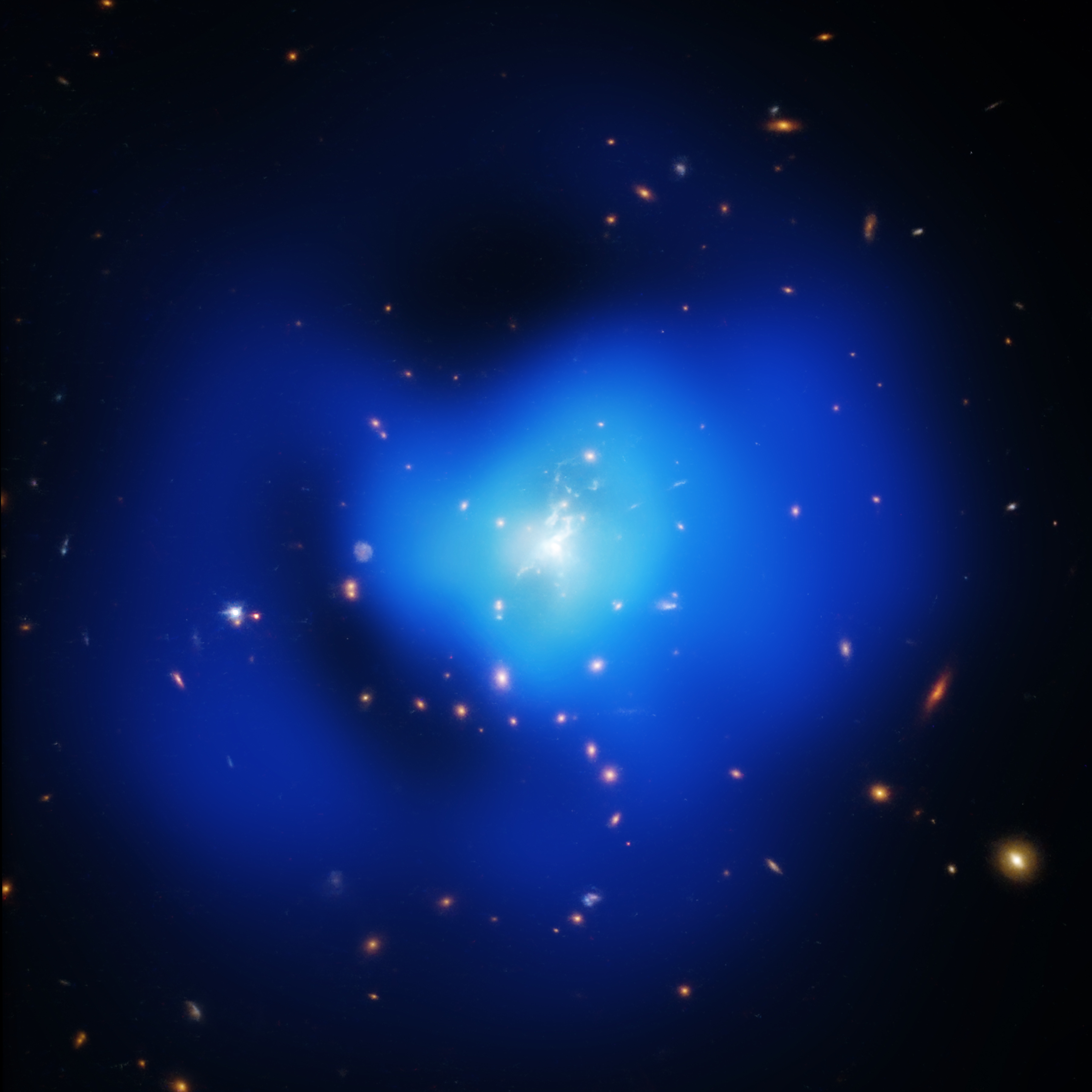
New data provide more details on how the galaxy cluster SPT-CLJ2344-4243, nicknamed the Phoenix Cluster for the constellation in which it is found, challenges this trend. The cluster has shattered multiple records in the past: In 2012, scientists announced that the Phoenix cluster featured the highest rate of cooling hot gas and star formation ever seen in the center of a galaxy cluster, and is the most powerful producer of X-rays of all known clusters. The rate at which hot gas is cooling in the center of the cluster is also the largest ever observed.

New observations of this galaxy cluster at X-ray, ultraviolet, and optical wavelengths by NASA's Chandra X-ray Observatory, the Hubble Space Telescope, and the Clay-Magellan telescope located in Chile, are helping astronomers better understand this remarkable object. Clay-Magellan's optical data reveal narrow filaments from the center of the cluster where stars are forming. These massive cosmic threads of gas and dust, most of which had never been detected before, extend for 160,000 to 330,000 lights years. This is longer than the entire breadth of the Milky Way galaxy, making them the most extensive filaments ever seen in a galaxy cluster.

These filaments surround large cavities - regions with greatly reduced X-ray emission - in the hot gas. The X-ray cavities can be seen in this composite image that shows the Chandra X-ray data in blue and optical data from the Hubble Space Telescope (red, green, and blue). For the location of these "inner cavities", mouse over the image. Astronomers think that the X-ray cavities were carved out of the surrounding gas by powerful jets of high-energy particles emanating from near a supermassive black hole in the central galaxy of the cluster. As matter swirls toward a black hole, an enormous amount of gravitational energy is released. 

Combined radio and X-ray observations of supermassive black holes in other galaxy clusters have shown that a significant fraction of this energy is released as jets of outbursts that can last millions of years. The observed size of the X-ray cavities indicates that the outburst that produced the cavities in SPT- CLJ2344-4243 was one of the most energetic such events ever recorded.

 Radio & Optical Image of Phoenix Cluster
Credit  X-ray: NASA/CXC/MIT/M.McDonald et al; 
Optical: NASA/STScI; Radio: TIFR/GMRT

However, the central black hole in the Phoenix cluster is suffering from somewhat of an identity crisis, sharing properties with both "quasars", very bright objects powered by material falling onto a supermassive black hole, and "radio galaxies" containing jets of energetic particles that glow in radio waves, and are also powered by giant black holes. Half of the energy output from this black hole comes via jets mechanically pushing on the surrounding gas (radio-mode), and the other half from optical, UV and X-radiation originating in an accretion disk (quasar-mode). Astronomers suggest that the black hole may be in the process of flipping between these two states.

X-ray cavities located farther away from the center of the cluster, labeled as "outer cavities", provide evidence for strong outbursts from the central black hole about a hundred million years ago (neglecting the light travel time to the cluster). This implies that the black hole may have been in a radio mode, with outbursts, about a hundred million years ago, then changed into a quasar mode, and then changed back into a radio mode.

It is thought that rapid cooling may have occurred in between these outbursts, triggering star formation in clumps and filaments throughout the central galaxy at a rate of about 610 solar masses per year. By comparison, only a couple new stars form every year in our Milky Way galaxy. The extreme properties of the Phoenix cluster system are providing new insights into various astrophysical problems, including the formation of stars, the growth of galaxies and black holes, and the co-evolution of black holes and their environment.

A paper describing these results, led by Michael McDonald (Massachusetts Institute of Technology), has been accepted for publication in The Astrophysical Journal and is available online. NASA's Marshall Space Flight Center in Huntsville, Alabama, manages the Chandra program for NASA's Science Mission Directorate in Washington. The Smithsonian Astrophysical Observatory in Cambridge, Massachusetts, controls Chandra's science and flight operations.


Fast Facts for Phoenix Cluster:

Scale: Image is about 1.2 arcmin across (about 1.5 million light years)
Category: Groups & Clusters of Galaxies
Coordinates (J2000): RA 23h 44m 42.00s | Dec -42 42 52.60
Constellation: Phoenix
Observation Date: 3 pointings between Sep 2011 and Aug 2014
Observation Time: 36 hours 23 min (1 days 12 hours 23 min).
Obs. ID: 13401, 16135, 16545
Instrument: ACIS
Also Known As: SPT-CLJ2344-4243
References: arXiv:1508.05941
Color Code: X-ray (Blue); Optical (Red, Green, Blue)
Distance Estimate: About 5.7 billion light years; z=0.596