Friday, March 06, 2015

Hubble Sees Supernova Split into Four Images by Cosmic Lens Hubble Sees Distant Supernova Multiply Imaged by Foreground Galaxy Cluster

SN Refsdal, MACS J1149.6+2223
Credit: NASA, ESA, and S. Rodney (JHU) and the FrontierSN team; T. Treu (UCLA), P. Kelly (UC Berkeley), and the GLASS team; J. Lotz (STScI) and the Frontier Fields team; M. Postman (STScI) and the CLASH team; and Z. Levay (STScI) Release Images


Hubble Sees Distant Supernova Multiply Imaged by Foreground Galaxy Cluster
Illustration Credit: NASA, ESA, and A. Feild (STScI)


Astronomers using NASA's Hubble Space Telescope have spotted for the first time a distant supernova split into four images. The multiple images of the exploding star are caused by the powerful gravity of a foreground elliptical galaxy embedded in a massive cluster of galaxies.

This unique observation will help astronomers refine their estimates of the amount and distribution of dark matter in the lensing galaxy and cluster. Dark matter cannot be seen directly but is believed to make up most of the universe's mass.

The gravity from both the elliptical galaxy and the galaxy cluster distorts and magnifies the light from the supernova behind them, an effect called gravitational lensing. First predicted by Albert Einstein, this effect is similar to a glass lens bending light to magnify and distort the image of an object behind it. The multiple images are arranged around the elliptical galaxy in a cross-shaped pattern called an Einstein Cross, a name originally given to a particular multiply imaged quasar, the bright core of an active galaxy.

The elliptical galaxy and its cluster, MACS J1149.6+2223, are 5 billion light-years from Earth. The supernova behind it is 9.3 billion light-years away.

Although astronomers have discovered dozens of multiply imaged galaxies and quasars, they have never seen a stellar explosion resolved into several images. "It really threw me for a loop when I spotted the four images surrounding the galaxy — it was a complete surprise," said Patrick Kelly of the University of California, Berkeley, a member of the Grism Lens Amplified Survey from Space (GLASS) collaboration. The GLASS group is working with the Frontier Field Supernova (FrontierSN) team to analyze the exploding star. Kelly is also the lead author on the science paper, which will appear on March 6 in a special issue of the journal Science celebrating the centenary of Albert Einstein's Theory of General Relativity.

When the four images fade away, astronomers predict they will have a rare opportunity to catch a rerun of the supernova. This is because the current four-image pattern is only one part of the lensing display. The supernova may have appeared as a single image some 20 years ago elsewhere in the cluster field, and it is expected to reappear once more within the next five years.

This prediction is based on computer models of the cluster, which describe the various paths the supernova light is taking through the maze of clumpy dark matter in the galactic grouping. Each image takes a different route through the cluster and arrives at a different time, due, in part, to differences in the length of the pathways the light follows to reach Earth. The four supernova images captured by Hubble, for example, appeared within a few days or weeks of each other.

The supernova's various light paths are analogous to several trains that leave a station at the same time, all traveling at the same speed and bound for the same location. Each train, however, takes a different route, and the distance for each route is not the same. Some trains travel over hills. Others go through valleys, and still others chug around mountains. Because the trains travel over different track lengths across different terrain, they do not arrive at their destination at the same time. Similarly, the supernova images do not appear at the same time because some of the light is delayed by traveling around bends created by the gravity of dense dark matter in the intervening galaxy cluster.

"Our model for the dark matter in the cluster gives us the prediction of when the next image will appear because it tells us how long each train track is, which correlates with time," said Steve Rodney of the Johns Hopkins University in Baltimore, Maryland, leader of the FrontierSN team. "We already missed one that we think appeared about 20 years ago, and we found these four images after they had already appeared. The prediction of this future image is the one that is most exciting because we might be able to catch it. We hope to come back to this field with Hubble, and we'll keep looking to see when that expected next image appears."

Measuring the time delays between images offers clues to the type of warped-space terrain the supernova's light had to cover and will help the astronomers fine-tune the models that map out the cluster's mass. "We will measure the time delays, and we'll go back to the models and compare them to the model predictions of the light paths," Kelly said. "The lens modelers, such as Adi Zitrin (California Institute of Technology) from our team, will then be able to adjust their models to more accurately recreate the landscape of dark matter, which dictates the light travel time."

While making a routine search of the GLASS team's data, Kelly spotted the four images of the exploding star on Nov. 11, 2014. The FrontierSN and GLASS teams have been searching for such highly magnified explosions since 2013, and this object is their most spectacular discovery. The supernova appears about 20 times brighter than its natural brightness, due to the combined effects of two overlapping lenses. The dominant lensing effect is from the massive galaxy cluster, which focuses the supernova light along at least three separate paths. A secondary lensing effect occurs when one of those light paths happens to be precisely aligned with a specific elliptical galaxy within the cluster. "The dark matter of that individual galaxy then bends and refocuses the light into four more paths," Rodney explained, "generating the rare Einstein Cross pattern we are currently observing."

The two teams spent a week analyzing the object's light, confirming it was the signature of a supernova. They then turned to the W.M. Keck Observatory on Mauna Kea, in Hawaii, to measure the distance to the supernova's host galaxy.

The astronomers nicknamed the supernova Refsdal in honor of Norwegian astronomer Sjur Refsdal, who, in 1964, first proposed using time-delayed images from a lensed supernova to study the expansion of the universe. "Astronomers have been looking to find one ever since," said Tommaso Treu of the University of California, Los Angeles, the GLASS project's principal investigator. "The long wait is over!"

The Frontier Fields survey is a three-year program that uses Hubble and the gravitational-lensing effects of six massive galaxy clusters to probe not only what is inside the clusters but also what is beyond them. The three-year FrontierSN program studies supernovae that appear in and around the galaxy clusters of the Frontier Fields and GLASS surveys. The GLASS survey is using Hubble's spectroscopic capabilities to study remote galaxies through the cosmic telescopes of 10 massive galaxy clusters, including the six in the Frontier Fields.  


Contact:


Donna Weaver / Ray Villard
Space Telescope Science Institute, Baltimore, Md.
410-338-4493 / 410-338-4514

dweaver@stsci.edu / villard@stsci.edu

Patrick Kelly
University of California, Berkeley, Calif.
510-859-8370

pkelly@astro.berkeley.edu

Steve Rodney
Johns Hopkins University, Baltimore, Md.
410-516-4926

rodney@jhu.edu

Source: HubbleSite

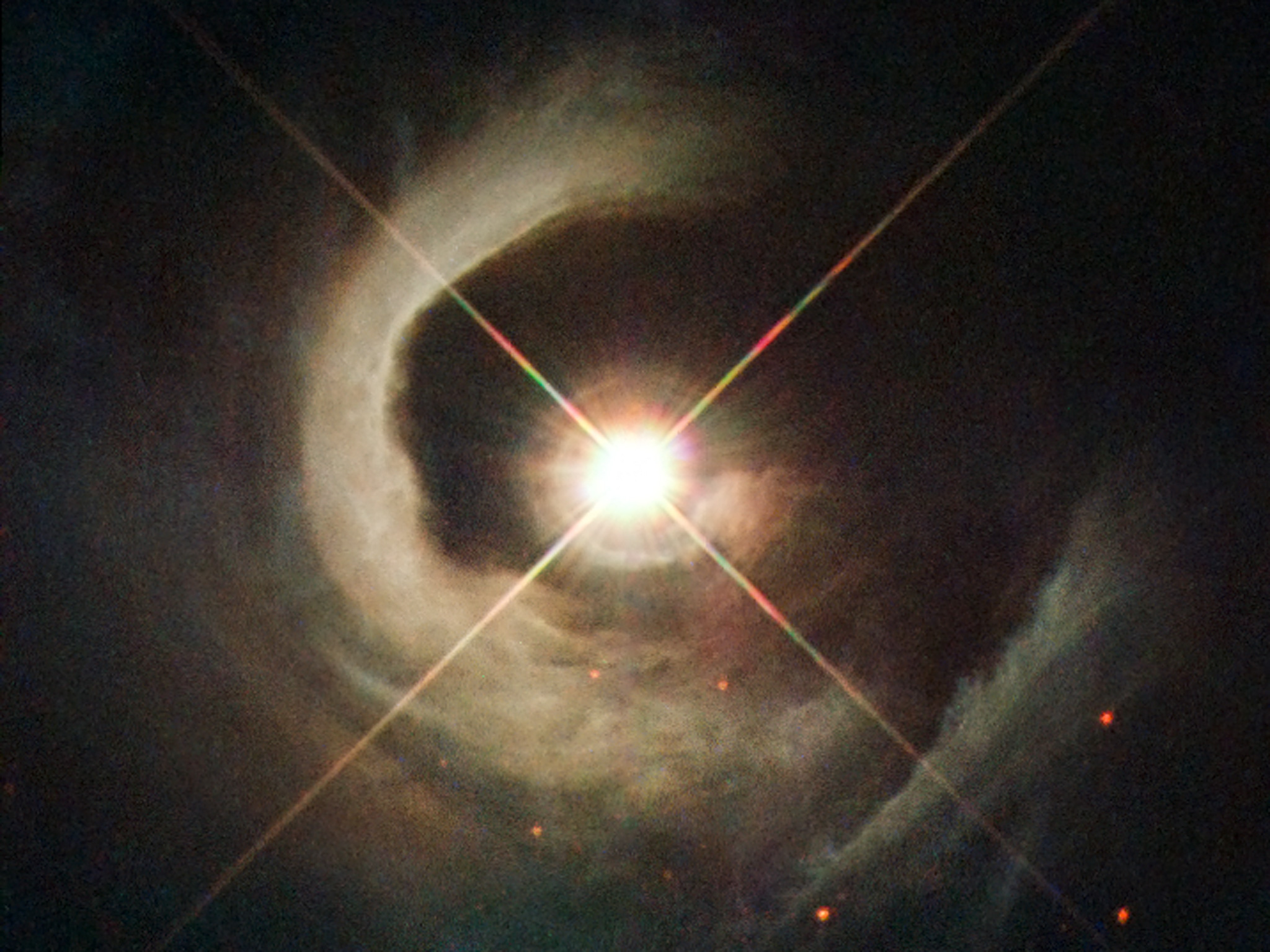
A young star takes centre stage

Credit: ESA/Hubble, NASA, Karl Stapelfeldt (GSFC), B. Stecklum and A. Choudhary (Thüringer Landessternwarte Tautenburg, Germany)


With its helical appearance resembling a snail’s shell, this reflection nebula seems to spiral out from a luminous central star in this new NASA/ESA Hubble Space Telescope image.

The star in the centre, known as V1331 Cyg and located in the dark cloud LDN 981 — or, more commonly, Lynds 981 — had previously been defined as a T Tauri star. A T Tauri is a young star — or Young Stellar Object — that is starting to contract to become a main sequence star similar to the Sun.

What makes V1331Cyg special is the fact that we look almost exactly at one of its poles. Usually, the view of a young star is obscured by the dust from the circumstellar disc and the envelope that surround it. However, with V1331Cyg we are actually looking in the exact direction of a jet driven by the star that is clearing the dust and giving us this magnificent view.

This view provides an almost undisturbed view of the star and its immediate surroundings allowing astronomers to study it in greater detail and look for features that might suggest the formation of a very
low-mass object in the outer circumstellar disc.


Source: ESA/Hubble - Space Telescope

Thursday, March 05, 2015

Why isn’t the universe as bright as it should be?

This Hubble Space Telescope image of galaxy NGC 1275 reveals the fine, thread-like filamentary structures in the gas surrounding the galaxy. The red filaments are composed of cool gas being suspended by a magnetic field, and are surrounded by the 100-million-degree Fahrenheit gas in the center of the Perseus galaxy cluster. The filaments are dramatic markers of the feedback process through which energy is transferred from the central massive black hole to the surrounding gas. Courtesy of NASA (edited by Jose-Luis Olivares/MIT)


Study explains why galaxies don’t churn out as many stars as they should

A handful of new stars are born each year in the Milky Way, while many more blink on across the universe. But astronomers have observed that galaxies should be churning out millions more stars, based on the amount of interstellar gas available.

Now researchers from MIT, Columbia University, and Michigan State University have pieced together a theory describing how clusters of galaxies may regulate star formation. They describe their framework this week in the journal Nature.

When intracluster gas cools rapidly, it condenses, then collapses to form new stars. Scientists have long thought that something must be keeping the gas from cooling enough to generate more stars — but exactly what has remained a mystery.

For some galaxy clusters, the researchers say, the intracluster gas may simply be too hot — on the order of hundreds of millions of degrees Celsius. Even if one region experiences some cooling, the intensity of the surrounding heat would keep that region from cooling further — an effect known as conduction.

“It would be like putting an ice cube in a boiling pot of water — the average temperature is pretty much still boiling,” says Michael McDonald, a Hubble Fellow in MIT’s Kavli Institute for Astrophysics and Space Research. “At super-high temperatures, conduction smooths out the temperature distribution so you don’t get any of these cold clouds that should form stars.”

For so-called “cool core” galaxy clusters, the gas near the center may be cool enough to form some stars. However, a portion of this cooled gas may rain down into a central black hole, which then spews out hot material that serves to reheat the surroundings, preventing many stars from forming — an effect the team terms “precipitation-driven feedback.”

“Some stars will form, but before it gets too out of hand, the black hole will heat everything back up — it’s like a thermostat for the cluster,” McDonald says. “The combination of conduction and precipitation-driven feedback provides a simple, clear picture of how star formation is governed in galaxy clusters.”

Crossing a galactic threshold

Throughout the universe, there exist two main classes of galaxy clusters: cool core clusters — those that are rapidly cooling and forming stars — and non-cool core clusters — those have not had sufficient time to cool.

The Coma cluster, a non-cool cluster, is filled with gas at a scorching 100 million degrees Celsius. To form any stars, this gas would have to cool for several billion years. In contrast, the nearby Perseus cluster is a cool core cluster whose intracluster gas is a relatively mild several million degrees Celsius. New stars occasionally emerge from the cooling of this gas in the Perseus cluster, though not as many as scientists would predict.

“The amount of fuel for star formation outpaces the amount of stars 10 times, so these clusters should be really star-rich,” McDonald says. “You really need some mechanism to prevent gas from cooling, otherwise the universe would have 10 times as many stars.”

McDonald and his colleagues worked out a theoretical framework that relies on two anti-cooling mechanisms.

The group calculated the behavior of intracluster gas based on a galaxy cluster’s radius, mass, density, and temperature. The researchers found that there is a critical temperature threshold below which the cooling of gas accelerates significantly, causing gas to cool rapidly enough to form stars.

According to the group’s theory, two different mechanisms regulate star formation, depending on whether a galaxy cluster is above or below the temperature threshold. For clusters that are significantly above the threshold, conduction puts a damper on star formation: The surrounding hot gas overwhelms any pockets of cold gas that may form, keeping everything in the cluster at high temperatures.

“For these hotter clusters, they’re stuck in this hot state, and will never cool and form stars,” McDonald says. “Once you get into this very high-temperature regime, cooling is really inefficient, and they’re stuck there forever.”

For gas at temperatures closer to the lower threshold, it’s much easier to cool to form stars. However, in these clusters, precipitation-driven feedback starts to kick in to regulate star formation: While cooling gas can quickly condense into clouds of droplets that can form stars, these droplets can also rain down into a central black hole — in which case the black hole may emit hot jets of material back into the cluster, heating the surrounding gas back up to prevent further stars from forming.

“In the Perseus cluster, we see these jets acting on hot gas, with all these bubbles and ripples and shockwaves,” McDonald says. “Now we have a good sense of what triggered those jets, which was precipitating gas falling onto the black hole.”

On track

McDonald and his colleagues compared their theoretical framework to observations of distant galaxy clusters, and found that their theory matched the observed differences between clusters. The team collected data from the Chandra X-ray Observatory and the South Pole Telescope — an observatory in Antarctica that searches for far-off massive galaxy clusters.

The researchers compared their theoretical framework with the gas cooling times of every known galaxy cluster, and found that clusters filtered into two populations — very slowly cooling clusters, and clusters that are cooling rapidly, closer to the rate predicted by the group as a critical threshold.

By using the theoretical framework, McDonald says researchers may be able to predict the evolution of galaxy clusters, and the stars they produce.

“We’ve built a track that clusters follow,” McDonald says. “The nice, simple thing about this framework is that you’re stuck in one of two modes, for a very long time, until something very catastrophic bumps you out, like a head-on collision with another cluster.”

The researchers hope to look deeper into the theory to see whether the mechanisms regulating star formation in clusters also apply to individual galaxies. Preliminary evidence, he says, suggests that is the case.

“If we can use all this information to understand why or why not stars form around us, then we’ve made a big step forward,” McDonald says.

“[These results] look very promising,” says Paul Nulsen, an astronomer at the Harvard-Smithsonian Center for Astrophysics who was not involved in this research. “More work will be needed to show conclusively that precipitation is the main source of the gas that powers feedback. Other processes in the feedback cycle also need to be understood. For example, there is still no consensus on how the gas falling into a massive black hole produces energetic jets, or how they inhibit cooling in the remaining gas. This is not the end of the story, but it is an important insight into a problem that has proved a lot more difficult than anyone ever anticipated.”

This research was funded in part by the National Science Foundation and NASA.

Jennifer Chu | MIT News Office


Far from Home: Wayward Cluster is both tiny and distant

GMOS image of Kim 2, in g band
(The image is 4 arcminutes acros)


Like the lost little puppy that wanders too far from home, astronomers have found an unusually small and distant group of stars that seems oddly out of place. The cluster, made of only a handful of stars, is located far away, in the Milky Way’s “suburbs.” It is located where astronomers have never spotted such a small cluster of stars before. 

The new star cluster was discovered by Dongwon Kim, a PhD student at the Australian National University (ANU), together with a team of astronomers (Helmut Jerjen, Antonino Milone, Dougal Mackey, and Gary Da Costa) who are conducting the Stromlo Milky Way Satellite Survey* at ANU. 

“This cluster is faint, very faint, and truly in the suburbs of our Milky Way,” said Kim. “In fact, this group of stars is about ten times more distant than the average globular star cluster in the halo of our galaxy -- it's a lost puppy,” Mackey adds. Globular clusters are spherical cities of stars that form a vast, extended halo around the core of our galaxy, the brightest of which are easily seen in amateur telescopes or even binoculars. However, this new discovery required one of the world’s largest telescopes to confirm, “it’s definitely a diminutive oddball,” says Milone. 

The oddly small, far-flung, cluster was discovered using the Dark Energy Camera (DECam) on the 4-meter Blanco Telescope at the Cerro Tololo Inter-American Observatory (CTIO) in Chile. “This discovery sheds new light on the formation and evolution of the Milky Way,” said Daniel Evans, National Science Foundation program director for Gemini Observatory. “It's great to see so many telescopes come together to produce this result, not the least being Gemini Observatory with its incredible light-gathering power.” 

The team’s first evidence of the unusually remote star cluster came when they ran detection algorithms on a 500 square-degree imaging data field obtained with DECam. “Such objects are too faint and optically elusive to be seen by eye. The cluster stars are sprinkled so thinly over the image, you look right through them without noticing (see image on electronic release, URL above). They are hiding in the sea of stars from the Milky Way. Sophisticated computer programs are our tools to find them,” said Jerjen. 

Because it is so faint, ultra-deep follow-up observations using the Gemini Multi-Object Spectrograph (in imaging mode) confirmed that the new globular cluster is among the faintest Milky Way globular clusters ever found. Seven out of 150 known Milky Way globular clusters are comparably faint but none are located as far out toward the edge of the Milky Way. This new globular cluster has 10-20 times fewer stars than any of the other outer halo globular clusters. Also, its star density is less than half of that of other Milky Way globular clusters in the same luminosity (brightness) range. 

The new star cluster, named Kim 2, also shows evidence of significant mass loss over its history. Computer simulations predict that, as a consequence of their evolution over many billions of years, including the slow loss of member stars due to the gravitational pull of the Milky Way, star clusters ought to be arranged such that their more massive stars are concentrated toward their centers. “This ‘mass segregation’ has been difficult to observe, particularly in low mass clusters, but the excellent Gemini data reveal that Kim 2 appears to be mass segregated and has therefore likely lost much of its original mass,” said Da Costa. The finding suggests that a substantial number of low-luminosity globular clusters must have existed in the halo when the Milky Way was younger, but most of them might have evaporated due to internal dynamical processes. 

The observed properties of the new star cluster also raise the question about how such a low luminosity system could have survived until today. One possible scenario is that Kim 2 is not actually a genuine member of the Milky Way globular cluster family, but a star cluster originally located in a satellite dwarf galaxy and was accreted into the Milky Way’s halo. This picture is also supported by the fact that the stars in Kim 2 appear to be more chemically enriched with heavier elements than the other outer halo globular clusters and are young relative to the oldest globular clusters in the Milky Way. As a consequence of spending much of its life in a dwarf galaxy Kim 2 could have largely escaped the destructive influence of tidal forces, thus helping it to survive until the present epoch. 

There are many Milky Way globular clusters formerly and currently associated with satellite dwarf galaxies. It is possible that a significant fraction of the ancient satellite dwarf galaxies were completely disrupted by the tidal field of the Milky Way while the high density of the globular clusters allowed them to survive in our galaxy’s halo. Indeed, Kim 2 is found close to the vast polar structure of Milky Way satellite galaxies, a disc-like region surrounding the Milky Way where satellite galaxies and young halo clusters preferentially congregate. A similar distribution of satellite galaxies is also found in the neighbouring Andromeda Galaxy

A large fraction of the Milky Way’s halo is thought to be populated with optically elusive satellite galaxies and star clusters. New discoveries of satellite galaxies and globular clusters will therefore provide valuable information about the formation and the structure of the Milky Way. Previous surveys like the Sloan Digital Sky Survey have contributed to many new discoveries in the northern sky. However, most of the southern sky still remains unexplored to date. The detection of Kim 2 suggests that there are a substantial number of interesting astronomical objects waiting to be discovered in the southern hemisphere and the Stromlo Milky Way Satellite Survey team plans to continue searching for them. 

The team's paper, accepted for publication in the Astrophysical Journal, is available as a preprint at http://arxiv.org/abs/1502.03952. 

* The Stromlo Milky Way Satellite Survey is led by Australian National University’s Associate Professor Helmut Jerjen. The research team includes Dongwon Kim, Antonino Milone, Dougal Mackey, and Gary Da Costa (all from the Australian National University). See project website at: http://www.mso.anu.edu.au/~jerjen/SMS_Survey.html


Media Contacts:

  • Peter Michaud
    Public Information and Outreach
    Gemini Observatory, Hilo, HI
    Email: pmichaud@gemini.edu
    Cell: (808) 936-6643

Science Contacts:


Wednesday, March 04, 2015

Abell 2597: NASA's Chandra Observatory Finds Cosmic Showers Halt Galaxy Growth

Abell 2597
Credit: X-ray: NASA/CXC/Michigan State Univ/G.Voit et al; 
Optical: NASA/STScI & DSS; H-alpha: Carnegie Obs./Magellan/W.Baade Telescope


This galaxy cluster comes from a sample of over 200 that were studied to determine how giant black holes at their centers affect the growth and evolution of their host galaxy, as reported in our latest press release. This study revealed that an unusual form of cosmic precipitation enables a feedback loop of cooling and heating, stifling star formation in the middle of these galaxy clusters.

Abell 2597, shown here, is a galaxy cluster located about one billion light years from Earth. This image contains X-rays from NASA's Chandra X-ray Observatory (blue), optical data from the Hubble Space Telescope and the Digitized Sky Survey (yellow) and emission from hydrogen atoms (red) from the Walter Baade Telescope in Chile.

According to this new study, the regulation of the largest black hole and their host galaxies works as follows: in some galaxies, such as NGC 2597, hot gas is able to quickly cool through radiation and energy loss, in a process called precipitation. The clouds of cool gas that result then fall into the central supermassive black hole, producing jets that heat the gas and prevent further cooling.

The researchers used Chandra data to estimate how long it should take for the gas to cool at different distances from the black holes in the study. Using that information, they were able to accurately predict the "weather" around each of the black holes.

They found that the precipitation feedback loop driven by energy produced by the black hole jets prevents the showers of cold clouds from getting too strong. The Chandra data indicate that the regulation of this precipitation has been going on for the last 7 billion years or more.

While a rain of cool clouds appears to play a key role in regulating the growth of some galaxies, the researchers have found other galaxies where the cosmic precipitation had shut off. The intense heat in these central galaxies, possibly from colliding with another galaxy cluster, likely "dried up" the precipitation around the black hole.

Evidence was also found, in a few galaxy clusters, that strong bursts of outflows from regions near the black hole may have temporarily shut down precipitation, but the heating is not strong enough to result in conduction. In these cases, further cooling of gas should occur and active precipitation should resume in a few hundred million years.

A pre-print of the Nature study by Mark Voit (Michigan State University), Megan Donahue (Michigan State), Greg Bryan (Columbia University), and Michael McDonald (Massachusetts Institute of Technology) is available online; the study builds on work by Voit and Donahue that was published in the January 20th, 2015 issue of The Astrophysical Journal Letters and is available online.

NASA's Marshall Space Flight Center in Huntsville, Alabama, manages the Chandra program for NASA's Science Mission Directorate in Washington. The Smithsonian Astrophysical Observatory in Cambridge, Massachusetts, controls Chandra's science and flight operations. 


Fast Facts for Abell 2597:

Scale: Image is 2 arcmin on a side (about 600,000 light years)
Category: Groups & Clusters of Galaxies
Coordinates (J2000): RA 23h 25m 19.6s | Dec -12° 07' 27.4"
Constellation: Aquarius
Observation Date: 28 Jul 2000, 01 and 04 May 2006
Observation Time: 42 hours 7 min (1 day 18 hours 7 min).
Obs. ID: 922, 6934, 7329
Instrument: ACIS
References: Voit, G. et al, 2015, Nature (accepted); Voit, G. et al, 2015, ApJL, 799; arXiv:1409.1601
Color Code: X-ray (Blue); Optical (Yellow); H-alpha (Red)
Distance Estimate: About 1 billion light years


New technique allows analysis of clouds around exoplanets

Analysis of data from the Kepler space telescope has shown that roughly half of the dayside of the exoplanet Kepler-7b is covered by a large cloud mass. Statistical comparison of more than 1,000 atmospheric models show that these clouds are most likely made of Enstatite, a common Earth mineral that is in vapor form at the extreme temperature on Kepler-7b. These models varied the altitude, condensation, particle size, and chemical composition of the clouds to find the right reflectivity and color properties to match the observed signal from the exoplanet. Courtesy of NASA (edited by Jose-Luis Olivares/MIT)


Team describes use of method to determine properties of clouds surrounding the exoplanet Kepler-7b.

Meteorologists sometimes struggle to accurately predict the weather here on Earth, but now we can find out how cloudy it is on planets outside our solar system, thanks to researchers at MIT.

In a paper to be published in the Astrophysical Journal, researchers in the Department of Earth, Atmospheric, and Planetary Sciences (EAPS) at MIT describe a technique that analyzes data from NASA’s Kepler space observatory to determine the types of clouds on planets that orbit other stars, known as exoplanets.

The team, led by Kerri Cahoy, an assistant professor of aeronautics and astronautics at MIT, has already used the method to determine the properties of clouds on the exoplanet Kepler-7b. The planet, a gas giant more than 5.5 million miles from Earth, is known as a “hot Jupiter,” as temperatures in its atmosphere hover at around 1,700 kelvins.

NASA’s Kepler spacecraft was designed to search for Earth-like planets orbiting other stars. It was pointed at a fixed patch of space, constantly monitoring the brightness of 145,000 stars. An orbiting exoplanet crossing in front of one of these stars causes a temporary dimming of this brightness, allowing researchers to detect its presence. Researchers have previously shown that by studying the variations in the amount of light coming from these star systems as a planet transits, or crosses in front or behind them, they can detect the presence of clouds in that planet’s atmosphere. That is because particles within the clouds will scatter different wavelengths of light.

Modeling cloud formation

To find out if this data could be used to determine the composition of these clouds, the MIT researchers studied the light signal from Kepler-7b. They used models of the temperature and pressure of the planet’s atmosphere to determine how different types of clouds would form within it, says lead author Matthew Webber, a graduate student in Cahoy’s group at MIT. “We then used those cloud models to determine how light would reflect off the atmosphere of the planet [for each type of cloud], and tried to match these possibilities to the actual observations from the Kepler mission itself,” Webber says. “So we ran a large set of models, to see which models fit best statistically to the observations.”

By working backward in this way, they were able to match the Kepler spacecraft data to a type of cloud made out of vaporized silicates and magnesium. The extremely high temperatures in the Kepler-7b atmosphere mean that some minerals that commonly exist as rocks on Earth’s surface instead exist as vapors high up in the planet’s atmosphere. These mineral vapors form small cloud particles as they cool and condense.

Kepler-7b is a tidally locked planet, meaning it always shows the same face to its star — just as the moon does to Earth. As a result, around half of the planet’s day side — that which constantly faces the star — is covered by these magnesium silicate clouds, the team found.

“We are really doing nothing more complicated than putting a telescope into space and staring at a star with a camera,” Cahoy says. “Then we can use what we know about the universe, in terms of temperatures and pressures, how things mix, how they stratify in an atmosphere, to try to figure out what mix of things would be causing the observations that we’re seeing from these very basic instruments,” she says.

A clue on exoplanet atmospheres

Understanding the properties of the clouds on Kepler-7b, such as their mineral composition and average particle size, tells us a lot about the underlying physical nature of the planet’s atmosphere, says team member Nikole Lewis, a postdoc in EAPS. What’s more, the method could be used to study the properties of clouds on different types of planet, Lewis says: “It’s one of the few methods out there that can help you determine if a planet even has an atmosphere, for example.”

A planet’s cloud coverage and composition also has a significant impact on how much of the energy from its star it will reflect, which in turn affects its climate and ultimately its habitability, Lewis says. “So right now we are looking at these big gas-giant planets because they give us a stronger signal,” she says. “But the same methodology could be applied to smaller planets, to help us determine if a planet is habitable or not.”

The researchers hope to use the method to analyze data from NASA’s follow-up to the Kepler mission, known as K2, which began studying different patches of space last June. They also hope to use it on data from MIT’s planned Transiting Exoplanet Survey Satellite (TESS) mission, says Cahoy.

“TESS is the follow-up to Kepler, led by principal investigator George Ricker, a senior research scientist in the MIT Kavli Institute for Astrophysics and Space Research. It will essentially be taking similar measurements to Kepler, but of different types of stars,” Cahoy says. “Kepler was tasked with staring at one group of stars, but there are a lot of stars, and TESS is going to be sampling the brightest stars across the whole sky,” she says

This paper is the first to take circulation models including clouds and compare them with the observed distribution of clouds on Kepler-7b, says Heather Knutson, an assistant professor of planetary science at Caltech who was not involved in the research. “Their models indicate that the clouds on this planet are most likely made from liquid rock,” Knutson says. “This may sound exotic, but this planet is a roasting hot gas-giant planet orbiting very close to its host star, and we should expect that it might look quite different than our own Jupiter.”


Helen Knight | MIT News correspondent

Tuesday, March 03, 2015

The huge “Y” in the atmosphere of Venus due to a wave distorted by the wind

Venus is covered by a dense layer of clouds which does not display any noteworthy characteristic. However, when looked in the ultraviolet wavelength, it presents conspicuous dark structures. The biggest one, which practically covers the entire planet, is shaped like a “Y” and it has been a mystery since its discovery more than half a century ago. Recently, a study led by astronomers from the Institute of Astrophysics of Andalusia (IAA-CSIC), in collaboration with the university of the Basque Country and the Institute of Astrophysics and Space Sciences of Portugal, has described the mechanism that sustains this structure and has for the first time succeeded in reproducing its evolution in the course of one month.

When first discovered, astronomers thought the “Y” was simply a group of clouds blown by the wind, but data from mission Mariner 10 (NASA) in 1973 revealed that the structure not only spread like a single entity but also moved at a speed different from its environment. "The conclusion was that it could only be a wave or a periodic alteration of atmospheric variables, but we didn’t know which one,” says Javier Peralta, IAA-CSIC researcher in charge of this study which has made the cover in the journal Geophysical Research Letters and has been highlighted in Science magazine.


Venus in different wavelenghts (IR: infrared; NIR: near infrarred; VIS: visible; UV: ultraviolet
Credit: Javier Peralta (IAA)

These dark structures revealed the massive presence of a still unknown compound that absorbs ultraviolet radiation and obscures the region where they get concentrated. Tracking them allowed to discover the “super-rotating” nature of Venus’ atmosphere: while the planet takes 243 days to rotate around its axis, the atmosphere spins around the planet in only four days. "A wave with the size of the Y must play a key role in explaining why the atmosphere rotates sixty times faster than the surface, so it was crucial to understand it,” says Peralta (IAA-CSIC).

The study by Peralta et al has invalidated the hypothesis – accepted for decades - which assumed that this wave should be one of the types of equatorial waves present on planet Earth. The researchers have deduced a new type of atmospheric wave compatible with Venus’ extremely slow rotation which explains with striking simplicity the numerous enigmas posed by the “Y”. Its dark color, for example, is due to the fact that the wave pushes upward and concentrates the mysterious ultraviolet absorber.


Reference: 

J. Peralta et al. "Venus´s major cloud feature as a equatorially trapped wave distorted by the wind". Geophysical Research Letters, 42. DOI:10.1002/2014GL062280.


Contact:

Instituto de Astrofísica de Andalucía (IAA-CSIC)
Unidad de Divulgación y Comunicación
Silbia López de Lacalle
 Email:  sll@iaa.es - 958230532


Pockets of Calm Protect Molecules around a Supermassive Black Hole

The central part of the galaxy M77, also known as NGC 1068, observed by ALMA and the NASA/ESA Hubble Space Telescope. Yellow: cyanoacetylene (HC3N), Red: carbon monosulfide (CS), Blue: carbon monoxide (CO), which are observed with ALMA. While HC3N is abundant in the central part of the galaxy (CND), CO is mainly distributed in the starburst ring. CS is distributed both in the CND and the starburst ring. Credit: ALMA(ESO/NAOJ/NRAO), S. Takano et al., NASA/ESA Hubble Space Telescope and A. van der Hoeven


Researchers using the Atacama Large Millimeter/submillimeter Array (ALMA) have discovered regions where certain organic molecules somehow endure the intense radiation near the supermassive black hole at the center of galaxy NGC 1068, also known to amateur stargazers as M77.

Such complex carbon-based molecules are thought to be easily obliterated by the strong X-rays and ultraviolet (UV) photons that permeate the environment surrounding supermassive black holes. The new ALMA data indicate, however, that pockets of calm exist even in this tumultuous region, most likely due to dense areas of dust and gas that shield molecules from otherwise lethal radiation.

Molecules Reveal Clues to Galactic Environments

Interstellar gas contains a wide variety of molecules, which differ wildly depending on the environment. For example, high-temperature, active star forming regions produce different molecules than would be found in colder interstellar regions. This enables scientists to probe the temperature and density of certain regions by studying their chemical composition.

Astronomers have long been studying the molecular signatures around supermassive black holes: both nearby starburst regions and surrounding rings of dust and gas known as a circumnuclear disks (CND) that spiral-in to feed an active black hole. These regions are important for understanding the evolution of galaxies. However, weak radio emission from the molecules there often makes observations difficult. 

ALMA Observations Trace Molecules

To better understand the complex and energetic environs around a supermassive black hole, the research team -- led by Shuro Takano at the National Astronomical Observatory of Japan (NAOJ) and Taku Nakajima at Nagoya University -- observed the spiral galaxy M77, which is located about 47 million light-years from Earth in the direction of the constellation Cetus (the Whale).

This galaxy is known to have an actively feeding central black hole, which indicates it has a substantial circumnuclear disk. That disk, in turn, is surrounded by a 3,500 light-year wide starburst ring. To probe these areas, the research team added ALMA’s extreme sensitivity and high-fidelity imaging capabilities to earlier observations conducted by the 45-meter radio telescope at the Nobeyama Radio Observatory of the National Astronomical Observatory of Japan (NAOJ).

The new ALMA observations clearly reveal the distributions of nine types of molecules in the surrounding disk and starburst ring.

“In this observation, we used only 16 antennas, which are about one-fourth of the complete number of ALMA antennas, but it was really surprising that we could get so many molecular distribution maps in less than two hours. We have never obtained such a quantity of maps in one observation,” said Takano, the leader of the research team.

The results clearly show that the molecular distribution varies according to the type of molecule. While carbon monoxide (CO) is distributed mainly in the starburst ring, five types of molecules, including complex organic molecules such as cyanoacetylene (HC3N) and acetonitrile (CH3CN), are concentrated primarily in the CND. In addition, carbon monosulfide (CS) and methanol (CH3OH) are distributed both in the starburst ring and the CND.

Shielding Complex Organics around a Black Hole

As the supermassive black hole devours the surrounding material, this disk is heated to such extreme temperatures that it emits intense X-rays and UV photons. When complex organic molecules are exposed to these photons, their atomic bonds are broken and the molecules are destroyed. Astronomers assumed that such regions would therefore be devoid of such complex organics. The ALMA observations, however, proved the contrary: Complex organic molecules are abundant in the CND, though not so in the broader starburst region. 

"It was quite unexpected that complex molecules with a large number of atoms like acetonitrile and cyanoacetylene are concentrated around the black hole's disk," said Nakajima.

The research team speculates that organic molecules remain intact in the CND due to the large amount of gas there, which acts as a barrier for the X-rays and UV photons, while organic molecules cannot survive the exposure to the strong UV photons in the starburst region where the gas density is comparatively lower.

The researchers point out that these results are a significant first step in understanding the structure, temperature, and density of gas surrounding the active black hole in M77. “We expect that future observations with wider bandwidth and higher resolution will show us the whole picture of this region," said Takano.

“ALMA has launched an entirely new era in astrochemistry,” said Eric Herbst of the University of Virginia in Charlottesville and a member of the research team. “Detecting and tracing molecules throughout the cosmos enables us to learn so much more about otherwise hidden areas, like the regions surrounding the black hole in M77.”

These results were published by Takano et al. as “Distributions of molecules in the circumnuclear disk and surrounding starburst ring in the Seyfert galaxy NGC 1068 observed with ALMA” (in the astronomical journal Publications of the Astronomical Society of Japan (PASJ), issued in August 2014) and by Nakajima et al. “A Multi-Transition Study of Molecules toward NGC 1068 based on High-Resolution Imaging Observations with ALMA” (in PASJ issued in February 2015).

# # # # # # # # # # # # # # # # # # # # 

Contacts:

Charles Blue, 
NRAO Public Information Officer
(434) 296-0314;
cblue@nrao.edu

Masaaki Hiramatsu, 
PhD, Public Outreach Officer at NAOJ
+81-422-34-3630;
hiramatsu.masaaki@nao.ac.jp
 

This research was conducted by: 

• Shuro TAKANO (NAOJ Nobeyama Radio Observatory/SOKENDAI)
• Taku NAKAJIMA (Solar-Terrestrial Environment Laboratory, Nagoya University)
• Kotaro KOHNO (Institute of Astronomy/Research Center for the Early Universe, The University of Tokyo)
• Nanase HARADA (Academia Sinica Institute of Astronomy and Astrophysics [At the time of writing: Max Planck Institute for Radio Astronomy])
• Eric HERBST (University of Virginia)
• Yoichi TAMURA (Institute of Astronomy, The University of Tokyo)
• Takuma IZUMI (Institute of Astronomy, The University of Tokyo)
• Akio TANIGUCHI (Institute of Astronomy, The University of Tokyo)
• Tomoka TOSAKI (Joetsu University of Education)

Eric Herbst gratefully acknowledges the support of the National Science Foundation for his astrochemistry program. He also acknowledges support from the NASA Exo-biology and Evolutionary Biology program through a subcontract from Rensselaer Polytechnic Institute.

The Atacama Large Millimeter/submillimeter Array (ALMA), an international astronomy facility, is a partnership of the European Organisation for Astronomical Research in the Southern Hemisphere (ESO), the U.S. National Science Foundation (NSF) and the National Institutes of Natural Sciences (NINS) of Japan in cooperation with the Republic of Chile. ALMA is funded by ESO on behalf of its Member States, by NSF in cooperation with the National Research Council of Canada (NRC) and the National Science Council of Taiwan (NSC) and by NINS in cooperation with the Academia Sinica (AS) in Taiwan and the Korea Astronomy and Space Science Institute (KASI). ALMA construction and operations are led by ESO on behalf of its Member States; by the National Radio Astronomy Observatory (NRAO), managed by Associated Universities, Inc. (AUI), on behalf of North America; and by the National Astronomical Observatory of Japan (NAOJ) on behalf of East Asia. The Joint ALMA Observatory (JAO) provides the unified leadership and management of the construction, commissioning and operation of ALMA.


Monday, March 02, 2015

An Old-looking Galaxy in a Young Universe

Location of the distant dusty galaxy A1689-zD1 behind the galaxy cluster Abell 1689 (annotated)

Infrared/visible-light view of the distant dusty galaxy A1689-zD1 behind the galaxy cluster Abell 1689

The distant dusty galaxy A1689-zD1 behind the galaxy cluster Abell 1689

Wide-field view of the sky around the rich galaxy cluster Abell 1689


# # # # # # # # # # # # # # # # # # # # # # # # # # # # # # # # # # # # # #

Video

A zoom into Abell 1689 and a very remote dusty galaxy


ALMA and VLT probe surprisingly dusty and evolved galaxy

One of the most distant galaxies ever observed has provided astronomers with the first detection of dust in such a remote star-forming system and tantalising evidence for the rapid evolution of galaxies after the Big Bang. The new observations have used ALMA to pick up the faint glow from cold dust in the galaxy A1689-zD1 and used ESO’s Very Large Telescope to measure its distance.

A team of astronomers, led by Darach Watson from the University of Copenhagen, used the Very Large Telescope’s X-shooter instrument along with the Atacama Large Millimeter/submillimeter Array (ALMA) to observe one of the youngest and most remote galaxies ever found. They were surprised to discover a far more evolved system than expected. It had a fraction of dust similar to a very mature galaxy, such as the Milky Way. Such dust is vital to life, because it helps form planets, complex molecules and normal stars.

The target of their observations is called A1689-zD1 [1]. It is observable only by virtue of its brightness being amplified more than nine times by a gravitational lens in the form of the spectacular galaxy cluster, Abell 1689, which lies between the young galaxy and the Earth. Without the gravitational boost, the glow from this very faint galaxy would have been too weak to detect.

We are seeing A1689-zD1 when the Universe was only about 700 million years old — five percent of its present age [2]. It is a relatively modest system — much less massive and luminous than many other objects that have been studied before at this stage in the early Universe and hence a more typical example of a galaxy at that time.

A1689-zD1 is being observed as it was during the period of reionisation, when the earliest stars brought with them a cosmic dawn, illuminating for the first time an immense and transparent Universe and ending the extended stagnation of the Dark Ages. Expected to look like a newly formed system, the galaxy surprised the observers with its rich chemical complexity and abundance of interstellar dust.

“After confirming the galaxy’s distance using the VLT,” said Darach Watson, “we realised it had previously been observed with ALMA. We didn’t expect to find much, but I can tell you we were all quite excited when we realised that not only had ALMA observed it, but that there was a clear detection. One of the main goals of the ALMA Observatory was to find galaxies in the early Universe from their cold gas and dust emissions — and here we had it!”

This galaxy was a cosmic infant — but it proved to be precocious. At this age it would be expected to display a lack of heavier chemical elements — anything heavier than hydrogen and helium, defined in astronomy as metals. These are produced in the bellies of stars and scattered far and wide once the stars explode or otherwise perish. This process needs to be repeated for many stellar generations to produce a significant abundance of the heavier elements such as carbon, oxygen and nitrogen.

Surprisingly, the galaxy A1689-zD1 seemed to be emitting a lot of radiation in the far infrared [3], indicating that it had already produced many of its stars and significant quantities of metals, and revealed that it not only contained dust, but had a dust-to-gas ratio that was similar to that of  much more mature galaxies.

“Although the exact origin of galactic dust remains obscure,” explains Darach Watson, “our findings indicate that its production occurs very rapidly, within only 500 million years of the beginning of star formation in the Universe — a very short cosmological time frame, given that most stars live for billions of years.”

The findings suggest A1689-zD1 to have been consistently forming stars at a moderate rate since 560 million years after the Big Bang, or else to have passed through its period of extreme starburst very rapidly before entering a declining state of star formation.

Prior to this result, there had been concerns among astronomers that such distant galaxies would not be detectable in this way, but A1689-zD1 was detected using only brief observations with ALMA.

Kirsten Knudsen (Chalmers University of Technology, Sweden), co-author of the paper, added, “This amazingly dusty galaxy seems to have been in a rush to make its first generations of stars. In the future, ALMA will be able to help us to find more galaxies like this, and learn just what makes them so keen to grow up.”


Notes

[1] This galaxy was noticed earlier in the Hubble images, and suspected to be very distant, but the distance could not be confirmed at that time.

[2] This corresponds to a redshift of 7.5.

[3] This radiation is stretched by the expansion of the Universe into the millimetre wavelength range by the time it gets to Earth and hence can be detected with ALMA.  


More Information


This research was presented in a paper entitled “A dusty, normal galaxy in the epoch of reionization” by D. Watson et al., to appear online in the journal Nature on 2 March 2015.

The team is composed of D. Watson (Niels Bohr Institute, University of Copenhagen, Denmark), L. Christensen (University of Copenhagen), K. K. Knudsen (Chalmers University of Technology, Sweden), J. Richard (CRAL, Observatoire de Lyon, Saint Genis Laval, France), A. Gallazzi (INAF-Osservatorio Astrofisico di Arcetri, Firenze, Italy) and M. J. Michalowski (SUPA, Institute for Astronomy, University of Edinburgh, Royal Observatory, Edinburgh, UK).

ESO is the foremost intergovernmental astronomy organisation in Europe and the world’s most productive ground-based astronomical observatory by far. It is supported by 16 countries: Austria, Belgium, Brazil, the Czech Republic, Denmark, France, Finland, Germany, Italy, the Netherlands, Poland, Portugal, Spain, Sweden, Switzerland and the United Kingdom, along with the host state of Chile. ESO carries out an ambitious programme focused on the design, construction and operation of powerful ground-based observing facilities enabling astronomers to make important scientific discoveries. ESO also plays a leading role in promoting and organising cooperation in astronomical research. ESO operates three unique world-class observing sites in Chile: La Silla, Paranal and Chajnantor. At Paranal, ESO operates the Very Large Telescope, the world’s most advanced visible-light astronomical observatory and two survey telescopes. VISTA works in the infrared and is the world’s largest survey telescope and the VLT Survey Telescope is the largest telescope designed to exclusively survey the skies in visible light. ESO is a major partner in ALMA, the largest astronomical project in existence. And on Cerro Armazones, close to Paranal, ESO is building the 39-metre European Extremely Large Telescope, the E-ELT, which will become “the world’s biggest eye on the sky”.  


Links

Contacts

Darach Watson
Niels Bohr Institute
University of Copenhagen, Denmark
Tel: +45 2480 3825
Email: darach@dark-cosmology.dk

Kirsten K. Knudsen
Chalmers University of Technology
Onsala, Sweden
Tel: +46 31 772 5526
Cell: +46 709 750 956
Email: kirsten.knudsen@chalmers.se

Richard Hook
ESO education and Public Outreach Department
Garching bei München, Germany
Tel: +49 89 3200 6655
Cell: +49 151 1537 3591
Email: rhook@eso.org

Source: ESO


Measuring gas velocities in galaxy clusters with X-ray images

Fig 1: Schematic illustration of gas density distribution in a spherically symmetric cluster in perfect hydrostatic equilibrium (v=0, top) and in a slightly disturbed cluster (v ≠ 0, middle). Slow large-scale perturbations in a stratified cluster atmosphere can be interpreted as internal waves (as illustrated in the bottom panel), similar to waves in the ocean, where the velocity of water and the amplitude of waves are linked. In clusters, similar perturbations are caused by a variety of reasons, including minor mergers or the activity of the central supermassive black holes.

Fig 2: X-ray image of the Coma cluster as seen with Chandra observatory.
The substructure seen in the image implies that the X-ray emitting gas is not at rest. 


X-ray observations provide us with detailed information on the density and temperature of the hot gas inside galaxy clusters. The other major gas characteristic that still needs to be measured is the gas velocity. While current generation X-ray observatories lack the required energy resolution to measure velocities directly, future observatories such as ASTRO-H and ATHENA will address this limitation.

An international team including MPA scientists has shown that the power spectrum of the velocity field can inferred indirectly from existing X-ray images of relaxed clusters. Numerical simulations confirm this simple theoretical idea, opening a way of probing gas velocities using already existing X-ray data. 

Galaxy clusters are the largest gravitationally bound structures in the present Universe. Hot gas (with temperatures of 10 to 100 million Kelvin) fills their gravitational potential wells and shines in the X-ray band, making the clusters an easy target for orbital X-ray observatories. Both the density and the temperature of the gas in clusters is routinely measured using X-ray data, while it is notoriously difficult to directly measure the turbulent motion of the gas via the Doppler shift of X-ray lines. Since the information on the turbulent gas velocities would have profound implications for the mass determination of clusters and for determining the plasma microphysics, new approaches have been developed to indirectly measure the gas velocities using existing X-ray data. One of these approaches is based on the analysis of small-scale fluctuations in X-ray images as described below. 

In relaxed clusters the gas approaches the state of hydrostatic equilibrium, when all thermodynamic properties are aligned along surfaces with equal gravitational potential, making X-ray images smooth and round (see Fig.1). These stratified and stable atmospheres of cluster gas bear much similarity to the Earth's atmosphere or to water in the oceans where cold and dense material tends to be below hotter and lighter material due to the combined action of gravity and buoyancy. Slow subsonic perturbations of such atmospheres can be represented as a combination of internal (gravity) waves, very much like waves in the ocean (bottom panel of Fig.1). In oceans there is a simple relation: the larger the amplitude of the waves, the higher the velocity of water. Is the same true for gas in galaxy clusters? Both theoretical analysis and numerical simulations have shown that this is indeed the case.

The main idea is that gas is disturbed on large scales and that this results in a cascade of waves. In clusters these waves are creating perturbations in the gas density that are visible in X-ray images as small-scale fluctuations of the surface brightness relative to a smooth global model. Our analysis shows that there is a simple linear relation between the gas velocities and density perturbations. Moreover, this relation holds for a broad range of scales: on large scales, where buoyancy effects dominate (internal waves), as well as on small scales where the isotropic turbulent cascade usually develops. At these small scales, the entropy of the gas acts as a passive scalar advected by the velocity field and makes the gas displacement visible in X-rays. 

Based on these arguments one can expect that in relaxed clusters (i.e. clusters which are only slightly disturbed) the power spectrum of the velocity field can simply be recovered from the power spectrum of density fluctuations. The latter can be straightforwardly estimated from X-ray images. 

Numerical simulations (cosmological simulations of cluster formation and pure hydrodynamic simulations with turbulence) confirm this conclusion and open an interesting possibility to use gas density power spectra as a proxy for the velocity power spectra in relaxed clusters. 

Once the gas velocities can be measured directly with future X-ray observatories, it will be possible to push this analysis further and search for differences between the density and velocity power spectra. Strong departures of the two power spectra from the universal behavior described above can then be used to constrain physical effects such as conductivity or viscosity in the gas.

Eugene Churazov (MPA), Massimo Gaspari (MPA), Irina Zhuravleva (Stanford), Alex Schekochihin (Oxford), Rashid Sunyaev (MPA)


References:
 
Zhuravleva I., Churazov E., Schekochihin A. A., Lau E. T., Nagai D., Gaspari  M., Allen S. W., Nelson K., Parrish I. J., The Relation between Gas Density and Velocity Power Spectra in Galaxy Clusters: Qualitative Treatment and Cosmological Simulations, 2014, ApJL, 788, 13
 
Gaspari M., Churazov E., Nagai D., Lau E. T., Zhuravleva, I., The relation between gas density and velocity power spectra in galaxy clusters: high-resolution hydrodynamic simulations and the role of conduction,2014, A&A, 569A, 67
 
Gaspari M., Churazov E., Constraining turbulence and conduction in the hot ICM through density perturbations, 2013, A&A, 559A, 78
 
Churazov E.; Vikhlinin A.; Zhuravleva I.; Schekochihin A.; Parrish I.; Sunyaev R.; Forman W.; Böhringer H.; Randall S., X-ray surface brightness and gas density fluctuations in the Coma cluster, 2012, MNRAS, 421,1123


Sunday, March 01, 2015

Astronomers find newborn stars at the edge of the Galaxy

Negative WISE W1 image of the newly found cluster Camargo 438 and 439. The cluster is about 16,000 light years away, so the image is about 24 light years across. The black dots in the image are individual stars. Credit: D. Camargo/NASA/WISE


Brazilian astronomers have made a remarkable discovery: a cluster of stars forming on the very edge of the Galaxy. The team, led by Denilso Camargo of the Federal University of Rio Grande do Sul in Porto Alegre, Brazil, publish their results in the journal Monthly Notices of the Royal Astronomical Society.

The Milky Way, the Galaxy we live in, has a barred spiral shape, with arms of stars, gas and dust winding out from a central bar. Viewed from the side, the Galaxy would appear relatively flat, with most of the material in a disc and the central regions.

Stars form inside massive and dense clumps of gas in so-called giant molecular clouds (GMCs) that are mainly located in the inner part of the galactic disc. With many clumps in a single GMC, most (if not all) stars are born together in clusters.

Denilso’s team looked at data from NASA’s orbiting Wide-Field Infrared Survey Explorer (WISE) observatory. They not only found GMCs thousands of light years above and below the galactic disc, but that one of them unexpectedly contained two clusters of stars. This is the first time astronomers have found stars being born in such a remote location.

The new clusters, named Camargo 438 and 439, are within the molecular cloud HRK 81.4-77.8. This cloud is thought to be about 2 million years old and is around 16000 light years beneath the galactic disk, an enormous distance away from the usual regions of star formation, in the direction of the constellation of Cetus.

Denilso believes there are two possible explanations. In the first case, the 'chimney model', violent events such as supernova explosions eject dust and gas out of the galactic disk. The material then falls back, in the process merging to form GMCs.

The other idea is that the interaction between our Galaxy and its satellites, the Magellanic Clouds, may have disturbed gas that falls into the Galaxy, again leading to the creation of GMCs and stars.
Denilso commented: "Our work shows that the space around the Galaxy is a lot less empty that we thought. The new clusters of stars are truly exotic. In a few million years, any inhabitants of planets around the stars will have a grand view of the outside of the Milky Way, something no human being will probably ever experience.

"Now we want to understand how the ingredients for making stars made it to such a distant spot. We need more data and some serious work on computer models to try to answer this question."

The chimney model would need several hundred massive stars to have exploded as supernovae over several generations, creating a 'superwind' that threw HRK 81.4-77.8 into its present position. Over millions of years, the bubbles created by the explosions may then themselves compress material, forming more stars and fuelling the ejection of material in a 'galactic fountain', where the dust and gas eventually rains back on to the disk.

Media contact
Robert Massey
Royal Astronomical Society
Tel: +44 (0)20 7734 3307 x214
Mob: +44 (0)794 124 8035

rm@ras.org.uk

Science contact
Denilso Camargo
Federal University of Rio Grande do Sul
Porto Alegre
Brazil
Tel: +55 51 3308-6513

denilso.camargo@ufrgs.br

Images and captions

Further information
The research was carried out by Dr Denilso Camargo, Dr Eduardo Bica, Dr Charles Bonatto and Gustavo Bonatto (MSc Gustavo SALERNO), of the Federal University of Rio Grande do Sul and Colégio Militar de Porto Alegre - Exército Brasileiro.

It appears in the paper D. Camargo et al., "Discovery of two embedded clusters with WISE in the high Galactic latitude cloud HRK 81.4-77.8", Monthly Notices of the Royal Astronomical Society, vol. 448, pp. 1930-1936, 2015, published by Oxford University Press.

Notes for editors
The Royal Astronomical Society (RAS), founded in 1820, encourages and promotes the study of astronomy, solar-system science, geophysics and closely related branches of science. The RAS organizes scientific meetings, publishes international research and review journals, recognizes outstanding achievements by the award of medals and prizes, maintains an extensive library, supports education through grants and outreach activities and represents UK astronomy nationally and internationally. Its more than 3800 members (Fellows), a third based overseas, include scientific researchers in universities, observatories and laboratories as well as historians of astronomy and others.

Follow the RAS on Twitter