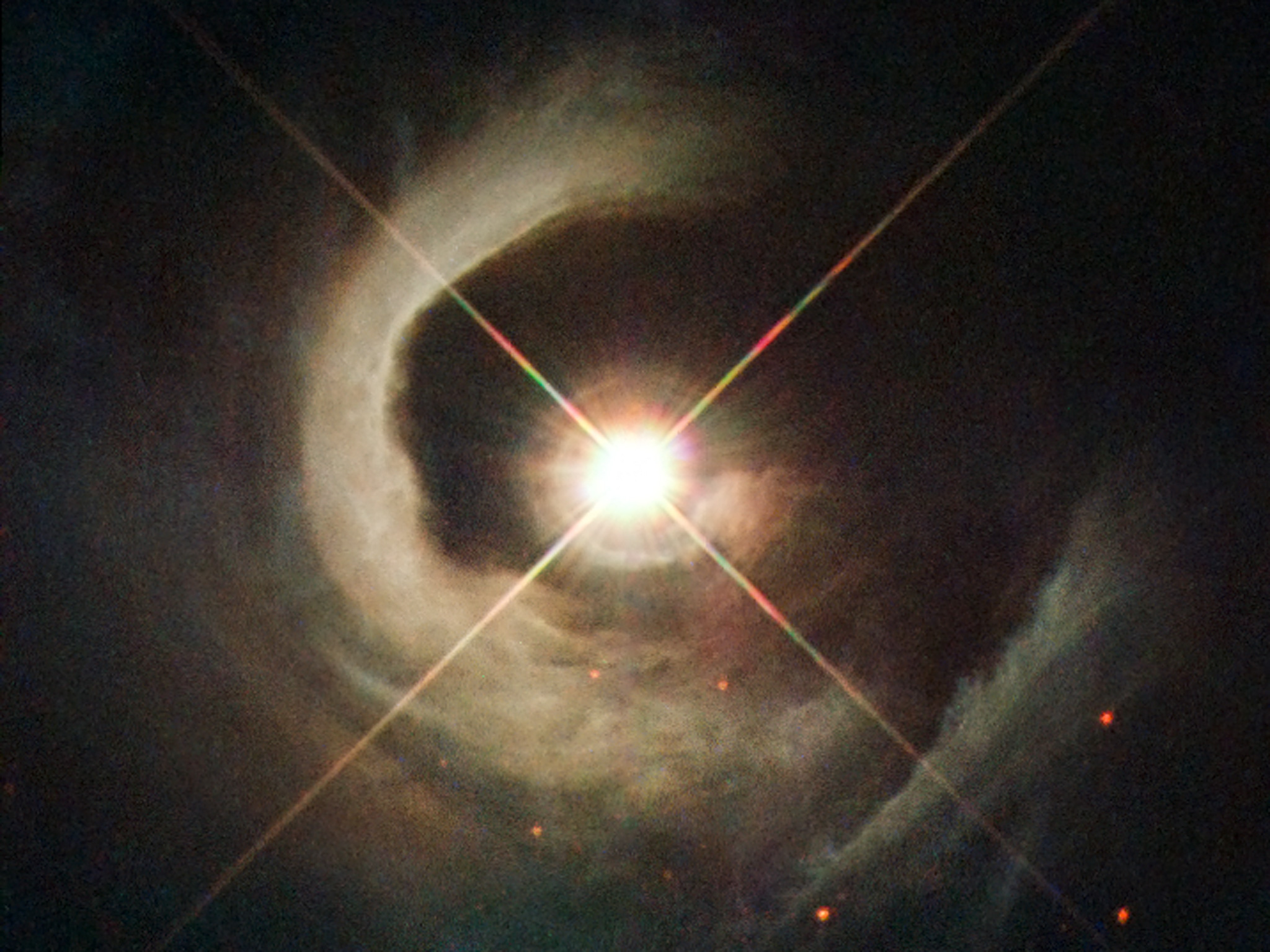
Young star offers a glimpse of the Sun’s past
Copyright: ESA/Hubble, NASA, K. Stapelfeldt (GSFC), B. Stecklum & A. Choudhary (Thüringer Landessternwarte Tautenburg, Germany)
It may look like a star, it may be called a star, but it does not yet
generate energy like a normal star. This is because this star is still
being formed.
It offers a fascinating glimpse into our own past
because our Sun began its life as such a ‘T Tauri’ star some 4.6 billion
years ago.
Located 1800 light-years away in the constellation
Cygnus, V1331 Cyg was originally nothing but a diffuse cloud of gas in
space. Slowly over time, gravity has pulled it together, but the process
is not yet over. V1331 is not yet fully formed and so is still larger
than it will eventually be once gravity has done its job. It is shining
because of the energy being released as it shrinks.
Eventually, it
will be compact enough that the temperature in its centre will ignite
nuclear fusion. Hydrogen will then be transformed into helium and this
will release the torrents of energy that will make V1331 Cyg shine for
billions of years as a bona fide star.
The swathes of dust that
surround the star are the remnants of the cloud from which it condensed.
Often, this circumstellar disc obscures our view of the young stellar
object but, by chance, we happen be looking down on the rotational pole
of the star, so it appears as a dazzling ‘searchlight’ beam.
This
circumstellar disc is the site where planets may be forming, and in the
case of V1331 Cyg time is running out. A T Tauri star produces a strong
‘wind’ of atomic particles that dissipates the disc, bringing planet
formation to an end.
The image was taken by the NASA/ESA Hubble Space Telescope
and is a combination of three exposures taken at different wavelengths.
These almost correspond to human eyesight: blue, green and, instead of
red light that our eyes would see, Hubble used near-infrared.
Source: ESA/Space Images