Showing posts with label Venus. Show all posts

Monday, September 14, 2020

Possible Marker of Life Spotted on Venus

Phosphine detected in Venus's atmosphere 
 
PR Image eso2015b
Venus as seen by ALMA 
 
PR Image eso2015c
Artistic impression of Venus 
 
PR Image eso2015d
Artistic impression of the Venusian surface and atmosphere 
 
PR Image eso2015e
Artistic impression of the Venusian surface and atmosphere (without annotations) 
 
PR Image eso2015f
Phosphine signature in Venus’s spectrum


Videos
 
ESOcast 230 Light: Possible Marker of Life Spotted on Venus
ESOcast 230 Light: Possible Marker of Life Spotted on Venus 
 
Animation: zooming in on Venus
Animation: zooming in on Venus 
 
Animation: a fly-to Venus
 

An international team of astronomers today announced the discovery of a rare molecule — phosphine — in the clouds of Venus. On Earth, this gas is only made industrially or by microbes that thrive in oxygen-free environments. Astronomers have speculated for decades that high clouds on Venus could offer a home for microbes — floating free of the scorching surface but needing to tolerate very high acidity. The detection of phosphine could point to such extra-terrestrial “aerial” life.

When we got the first hints of phosphine in Venus’s spectrum, it was a shock!”, says team leader Jane Greaves of Cardiff University in the UK, who first spotted signs of phosphine in observations from the James Clerk Maxwell Telescope (JCMT), operated by the East Asian Observatory, in Hawaiʻi. Confirming their discovery required using 45 antennas of the Atacama Large Millimeter/submillimeter Array (ALMA) in Chile, a more sensitive telescope in which the European Southern Observatory (ESO) is a partner. Both facilities observed Venus at a wavelength of about 1 millimetre, much longer than the human eye can see — only telescopes at high altitude can detect it effectively. 

The international team, which includes researchers from the UK, US and Japan, estimates that phosphine exists in Venus’s clouds at a small concentration, only about twenty molecules in every billion. Following their observations, they ran calculations to see whether these amounts could come from natural non-biological processes on the planet. Some ideas included sunlight, minerals blown upwards from the surface, volcanoes, or lightning, but none of these could make anywhere near enough of it. These non-biological sources were found to make at most one ten thousandth of the amount of phosphine that the telescopes saw.

To create the observed quantity of phosphine (which consists of hydrogen and phosphorus) on Venus, terrestrial organisms would only need to work at about 10% of their maximum productivity, according to the team. Earth bacteria are known to make phosphine: they take up phosphate from minerals or biological material, add hydrogen, and ultimately expel phosphine. Any organisms on Venus will probably be very different to their Earth cousins, but they too could be the source of phosphine in the atmosphere.

While the discovery of phosphine in Venus’s clouds came as a surprise, the researchers are confident in their detection. “To our great relief, the conditions were good at ALMA for follow-up observations while Venus was at a suitable angle to Earth. Processing the data was tricky, though, as ALMA isn’t usually looking for very subtle effects in very bright objects like Venus,” says team member Anita Richards of the UK ALMA Regional Centre and the University of Manchester. “In the end, we found that both observatories had seen the same thing — faint absorption at the right wavelength to be phosphine gas, where the molecules are backlit by the warmer clouds below,” adds Greaves, who led the study published today in Nature Astronomy.

Another team member, Clara Sousa Silva of the Massachusetts Institute of Technology in the US, has investigated phosphine as a “biosignature” gas of non-oxygen-using life on planets around other stars, because normal chemistry makes so little of it. She comments: “Finding phosphine on Venus was an unexpected bonus! The discovery raises many questions, such as how any organisms could survive. On Earth, some microbes can cope with up to about 5% of acid in their environment — but the clouds of Venus are almost entirely made of acid.

The team believes their discovery is significant because they can rule out many alternative ways to make phosphine, but they acknowledge that confirming the presence of “life” needs a lot more work. Although the high clouds of Venus have temperatures up to a pleasant 30 degrees Celsius, they are incredibly acidic — around 90% sulphuric acid — posing major issues for any microbes trying to survive there.

ESO astronomer and ALMA European Operations Manager Leonardo Testi, who did not participate in the new study, says: “The non-biological production of phosphine on Venus is excluded by our current understanding of phosphine chemistry in rocky planets' atmospheres. Confirming the existence of life on Venus's atmosphere would be a major breakthrough for astrobiology; thus, it is essential to follow-up on this exciting result with theoretical and observational studies to exclude the possibility that phosphine on rocky planets may also have a chemical origin different than on Earth.” 

More observations of Venus and of rocky planets outside our Solar System, including with ESO’s forthcoming Extremely Large Telescope, may help gather clues on how phosphine can originate on them and contribute to the search for signs of life beyond Earth.


More Information

This research was presented in the paper “Phosphine Gas in the Cloud Decks of Venus” to appear in Nature Astronomy.

The team is composed of Jane S. Greaves (School of Physics & Astronomy, Cardiff University, UK [Cardiff]), Anita M. S. Richards (Jodrell Bank Centre for Astrophysics, The University of Manchester, UK), William Bains (Department of Earth, Atmospheric, and Planetary Sciences, Massachusetts Institute of Technology, USA [MIT]), Paul Rimmer (Department of Earth Sciences and Cavendish Astrophysics, University of Cambridge and MRC Laboratory of Molecular Biology, Cambridge, UK), Hideo Sagawa (Department of Astrophysics and Atmospheric Science, Kyoto Sangyo University, Japan), David L. Clements (Department of Physics, Imperial College London, UK [Imperial]), Sara Seager (MIT), Janusz J. Petkowski (MIT), Clara Sousa-Silva (MIT), Sukrit Ranjan (MIT), Emily Drabek-Maunder (Cardiff and Royal Observatory Greenwich, London, UK), Helen J. Fraser (School of Physical Sciences, The Open University, Milton Keynes, UK), Annabel Cartwright (Cardiff), Ingo Mueller-Wodarg (Imperial), Zhuchang Zhan (MIT), Per Friberg (EAO/JCMT), Iain Coulson (EAO/JCMT), E’lisa Lee (EAO/JCMT) and Jim Hoge (EAO/JCMT).

An accompanying paper by some of team members, titled “The Venusian Lower Atmosphere Haze as a Depot for Desiccated Microbial Life: A Proposed Life Cycle for Persistence of the Venusian Aerial Biosphere”, was published in Astrobiology in August 2020. Another related study by some of the same authors, "Phosphine as a Biosignature Gas in Exoplanet Atmospheres", was published in Astrobiology in January 2020.

The European Southern Observatory (ESO) is the foremost intergovernmental astronomy organisation in Europe and the world’s most productive ground-based astronomical observatory by far. It has 16 Member States: Austria, Belgium, the Czech Republic, Denmark, France, Finland, Germany, Ireland, Italy, the Netherlands, Poland, Portugal, Spain, Sweden, Switzerland and the United Kingdom, along with the host state of Chile and with Australia as a Strategic Partner. ESO carries out an ambitious programme focused on the design, construction and operation of powerful ground-based observing facilities enabling astronomers to make important scientific discoveries. ESO also plays a leading role in promoting and organising cooperation in astronomical research. ESO operates three unique world-class observing sites in Chile: La Silla, Paranal and Chajnantor. At Paranal, ESO operates the Very Large Telescope and its world-leading Very Large Telescope Interferometer as well as two survey telescopes, VISTA working in the infrared and the visible-light VLT Survey Telescope. Also at Paranal ESO will host and operate the Cherenkov Telescope Array South, the world’s largest and most sensitive gamma-ray observatory. ESO is also a major partner in two facilities on Chajnantor, APEX and ALMA, the largest astronomical project in existence. And on Cerro Armazones, close to Paranal, ESO is building the 39-metre Extremely Large Telescope, the ELT, which will become “the world’s biggest eye on the sky”. 

The Atacama Large Millimeter/submillimeter Array (ALMA), an international astronomy facility, is a partnership of ESO, the U.S. National Science Foundation (NSF) and the National Institutes of Natural Sciences (NINS) of Japan in cooperation with the Republic of Chile. ALMA is funded by ESO on behalf of its Member States, by NSF in cooperation with the National Research Council of Canada (NRC) and the Ministry of Science and Technology (MOST) and by NINS in cooperation with the Academia Sinica (AS) in Taiwan and the Korea Astronomy and Space Science Institute (KASI). ALMA construction and operations are led by ESO on behalf of its Member States; by the National Radio Astronomy Observatory (NRAO), managed by Associated Universities, Inc. (AUI), on behalf of North America; and by the National Astronomical Observatory of Japan (NAOJ) on behalf of East Asia. The Joint ALMA Observatory (JAO) provides the unified leadership and management of the construction, commissioning and operation of ALMA. 

With a diameter of 15m (50 feet) the James Clerk Maxwell Telescope (JCMT) is the largest single dish astronomical telescope in the world designed specifically to operate in the submillimetre wavelength region of the electromagnetic spectrum. The JCMT is used to study our Solar System, interstellar and circumstellar dust and gas, evolved stars, and distant galaxies. It is situated in the science reserve of Maunakea, Hawaiʻi, at an altitude of 4092m (13 425 feet). The JCMT is operated by the East Asian Observatory on behalf of NAOJ; ASIAA; KASI; CAMS as well as the National Key R&D Program of China. Additional funding support is provided by the STFC and participating universities in the UK and Canada.


Links


Contacts

Jane Greaves (study author)
Cardiff University
Cardiff, UK
Email:
GreavesJ1@cardiff.ac.uk

Anita Richards (study author)
UK ALMA Regional Centre and University of Manchester
Manchester, UK
Email:
a.m.s.richards@manchester.ac.uk

Clara Sousa Silva (study author)
Massachusetts Institute of Technology
Cambridge, USA
Tel: +1 617 253 6283
Email:
cssilva@mit.edu

Leonardo Testi (contact for independent comment on the study)
European Southern Observatory
Garching bei München, Germany
Tel: +49 89 3200 6541
Email:
ltesti@eso.org

Dave Clements (study author)
Imperial College
London, UK
Email:
d.clements@imperial.ac.uk

Paul Rimmer (study author)
University of Cambridge
Cambridge, UK
Email:
pbr27@cam.ac.uk

William Bains (study author)
Massachusetts Institute of Technology
Cambridge, USA
Email:
bains@mit.edu

Bárbara Ferreira
ESO Public Information Officer
Garching bei München, Germany
Tel: +49 89 3200 6670
Cell: +49 151 241 664 00
Email:
pio@eso.org

Source: ESO/News


Monday, April 09, 2018

Cloudy Venus

Copyright ESA, NASA, J. Peralta & R. Hueso


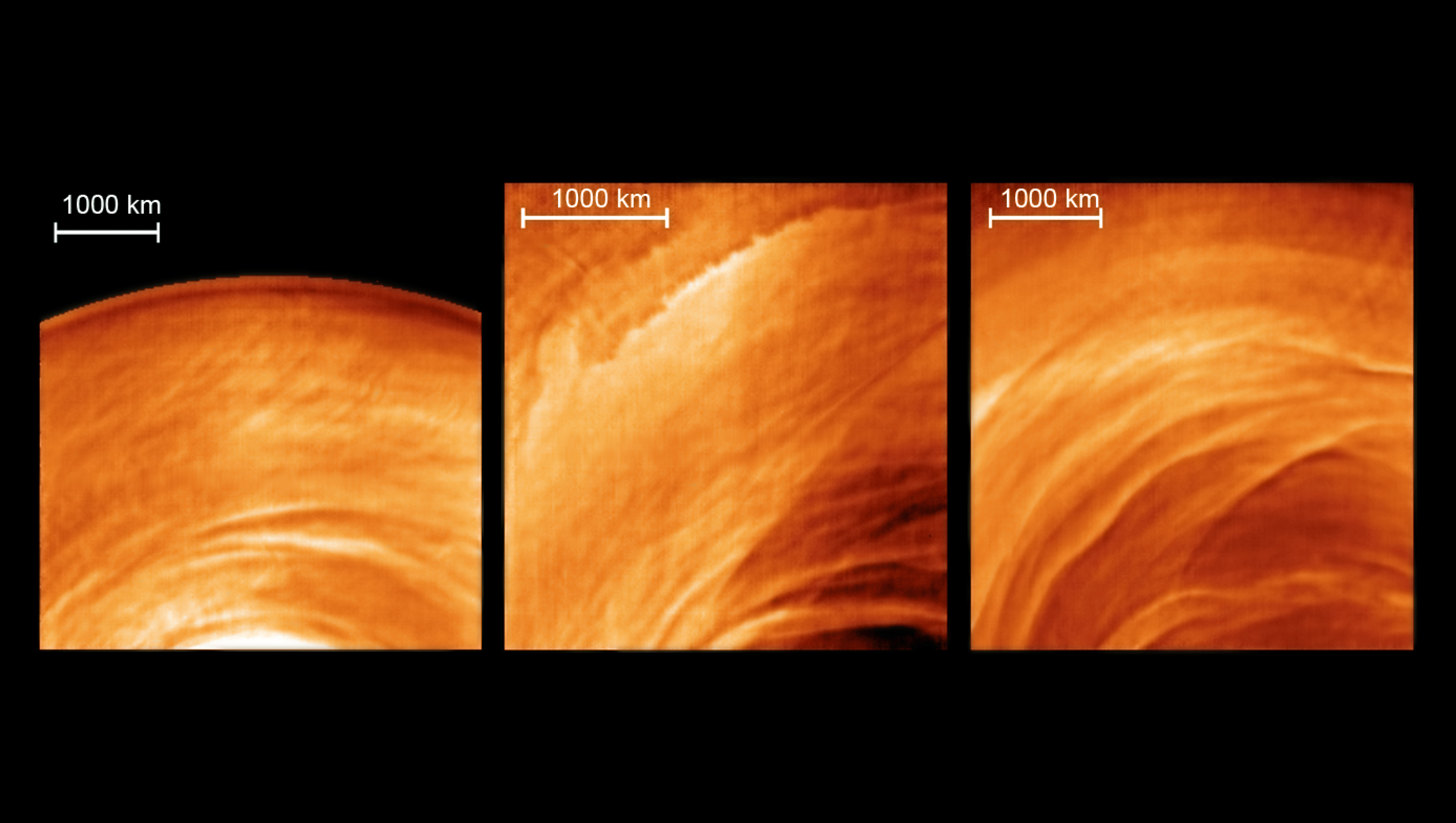
Our sister planet Venus is a dynamic and unusual place. Strong winds swirl around the planet, dragging thick layers of cloud with them as they go. These fierce winds move so speedily that they display ‘super-rotation’: Earth’s can move at up to a fifth of our planet’s rotation speed, but winds on Venus can travel up to 60 times faster than the planet.

Observations from ESA’s Venus Express, which orbited Venus from 2006 to 2014, and other international spacecraft have probed deeper into this wind and cloud in past years, and uncovered some peculiar behaviour.

The side of the planet facing away from the Sun is somewhat more mysterious than the other side, but what we do know shows it to be quite different, with never-before-seen cloud types, shapes and dynamics – some of which appear to be connected to features on the surface below.

Super-rotation appears to behave more chaotically on the night side than the day side, but climate modellers remain unsure why. Night-side clouds also create different patterns and shapes than those found elsewhere – large, wavy, patchy irregular and filament-like patterns – and are dominated by mysterious ‘stationary waves’. These waves rise up within the atmosphere, do not move with the planet’s rotation, and appear to be concentrated above steep and higher-altitude regions of the surface, suggesting that Venus’ topography may well affect what happens in the cloud layers way up above.

These three images from the visible and infrared camera on Venus Express show these cloud features in detail: stationary waves (left), dynamical instabilities (middle) and mysterious filaments (right).

Venus Express was launched in 2005 and began orbiting Venus in 2006; the mission ended in December 2014. This image is based on the news item Venus' mysterious night side revealed, published in 2017.


Tuesday, October 18, 2016

Recently active lava flows on the eastern flank of Idunn Mons on Venus

Figure 1 – The figure displays an elevation model of Idunn Mons (46 S; 146 W), a volcano with a diameter of 200 km located at Imdr Regio on Venus. NASA/JPL-Caltech/ESA

Figure 2 – The figure displays an elevation model of Idunn Mons (46S; 146 W), overlain on VIRTIS emissivity anomaly. In red, the areas characterized by recent volcanic activity. NASA/JPL-Caltech/ESA

Figure 3 – Geologic map of the eastern flank of Idunn Mons (46 S; 146 W), displaying the five lava flow units (lfu) identified during the mapping process. Lfu are classified from a to e. Lfu-a represents the summit composite unit of Idunn Mons, while the lfu-b, lfu-c, lfu-d and lfu-e are flank units of the volcanic edifice. ESA/DLR


Press release issued by the German Aerospace Center (Deutsches Zentrum für Luft- und Raumfahrt, DLR) and the joint 48th annual meeting of the Division for Planetary Sciences (DPS) of the American Astronomical Society (AAS) and 11th annual European Planetary Science Congress (EPSC).

The European Space Agency’s Venus Express mission has provided a great amount of data from the surface and atmosphere of Earth’s inner twin planet. Among these observations was the mapping of the southern hemisphere of Venus in the near infrared spectral range using the VIRTIS (Visible and InfraRed Thermal Imaging Spectrometer) instrument. However the thick and permanent cloud cover of Venus limits the achievable resolution, similar to observing a scene through fog. Using a numerical model, planetary researchers at the German Aerospace Center (Deutsches Zentrum für Luft- und Raumfahrt, DLR) pushed the limits of the data resolution. With this new technique the emissivity anomalies were analyzed on the top and eastern flank of Idunn Mons, a volcano with a diameter of 200 kilometers at its base situated in the southern hemisphere of Venus. These anomalies provide an indication of geologically recent volcanism in this area.

“We could identify and map distinctive lava flows from the top and eastern flank of the volcano, which might have been recently active in terms of geologic time,” says Piero D’Incecco, planetary researcher at the DLR who is presenting these results today at the joint 48th meeting of the American Astronomical Society’s Division for Planetary Sciences (DPS) and 11th European Planetary Science Congress in Pasadena, California.

“With our new technique we could combine the infrared data with much higher-resolution radar images from the NASA Magellan mission, having been in orbit about Venus from 1990 until 1992. It is the first time that — combining the datasets from two different missions — we can perform a high resolution geologic mapping of a recently active volcanic structure from the surface of a planet other than Earth.” This study will also provide motivation for future projects focused on the exploration of Venus, as for example the NASA Discovery VERITAS mission proposal or the ESA EnVision M5 mission proposal that — in combining high-resolution radar and near-infrared mapping — will extend the frontiers of our current knowledge of the geology of Venus.

Search for Location and Extent of the Lava Flows

From 2006 until 2014 the ESA Venus Express probe was analyzing the atmosphere and surface of Earth’s twin planet. The Visible and InfraRed Thermal Imaging Spectrometer (VIRTIS) has provided data that indicate the occurrence of recent volcanic activity on Venus. DLR scientists Piero D’Incecco, Nils Mueller, Joern Helbert and Mario D’Amore selected the eastern flank of Idunn Mons — Imdr Regio’s single large volcano — as the study area, since it was identified in VIRTIS data as one of the regions with relatively high values of thermal emissivity at 1 micron wavelength.

Using the capabilities of specific techniques developed in the Planetary Spectroscopy Laboratory group at DLR in Berlin, the study intends to identify location and extent of the sources of such anomalies, thus the lava flows responsible for the relatively high emissivity observed by VIRTIS over the eastern flank of Idunn Mons. Therefore the lava flow units on the top and eastern flank of Idunn Mons are mapped, varying the values of simulated 1 micron emissivity assigned to the mapped units. For each configuration the total mismatch as root mean square error in comparison with the VIRTIS observations is calculated. In the best-fit configuration, the flank lava flows are characterized by high values of 1 micron simulated emissivity. Hence, the lava flow units on the eastern flank on Idunn Mons are likely responsible for the relatively high 1 micron emissivity anomalies observed by VIRTIS. This result is supported by the reconstructed post-eruption stratigraphy, displaying the relative dating of the mapped lava flows, that is independent of the 1 micron emissivity modeling. Values of average microwave emissivity extracted from the lava flow units range around the global mean, which is consistent with dry basalts.


Press Contacts:

Manuela Braun
German Aerospace Center (DLR)
Corporate Communications, Editor, Human Space Flight, Space Science, Engineering
+49 2203 601-3882
manuela.braun@dlr.de

Anita Heward
European Planetary Science Congress (EPSC) Press Officer
+44 (0)77 5603 4243
anita.heward@europlanet-eu.org

Science Contact:

Dr. Jörn Helbert
German Aerospace Center (DLR)
Institute of Planetary Research, Co-Investigator VIRTIS Venus Express
+49 30 67055-319
joern.helbert@dlr.de

Further information:


The joint 48th meeting of the Division for Planetary Sciences (DPS) and 11th European Planetary Science Congress (EPSC) in Pasadena, California, is second time DPS and EPSC have been joined into one meeting. The goal of the joint meeting is to strengthen international scientific collaboration in all areas of planetary science. This is the first time that EPSC, which provides the dissemination platform for the Europlanet 2020 Research Infrastructure, is held outside Europe. Follow: #dpsepsc, @DPSMeeting, @europlanetmedia, and @AAS_Press on Twitter.


Source: EuroPlanet

Monday, June 20, 2016

Venus has potential but not for water


Electric field at Venus
Copyright: ESA–C. Carreau


ESA’s Venus Express may have helped to explain the puzzling lack of water on Venus. The planet has a surprisingly strong electric field – the first time this has been measured at any planet – that is sufficient to deplete its upper atmosphere of oxygen, one of the components of water. 

Venus is often called Earth’s twin, since the second planet from the Sun is only slightly smaller than our own. 

But its atmosphere is quite different, consisting mainly of carbon dioxide, with a little nitrogen and trace amounts of sulphur dioxide and other gases. It is much thicker than Earth’s, reaching pressures of over 90 times that of Earth at sea level, and incredibly dry, with a relative abundance of water about 100 times lower than in Earth’s gaseous shroud. 

In addition, Venus now has a runaway greenhouse effect and a surface temperature high enough to melt lead. Also, unlike our home planet, it has no significant magnetic field of its own. 

Scientists think Venus did once host large amounts of water on its surface over 4 billion years ago. But as it heated up, much of this water evaporated into the atmosphere, where it could then be ripped apart by sunlight and subsequently lost to space. 

The solar wind – a powerful stream of charged subatomic particles blowing from the Sun – is one of the culprits, stripping hydrogen ions (protons) and oxygen ions from the planet’s atmosphere and so depriving it of the raw materials that make water.  

Now, scientists using Venus Express have identified another difference between the two planets: Venus has a substantial electric field, with a potential around 10 V. 

This is at least five times larger than expected. Previous observations in search of electric fields at Earth and Mars have failed to make a decisive detection, but they indicate that, if one exists, it is less than 2 V. 

“We think that all planets with atmospheres have a weak electric field, but this is the first time we have actually been able to detect one,” says Glyn Collinson from NASA’s Goddard Flight Space Center, lead author of the study. 

In any planetary atmosphere, protons and other ions feel a pull from the planet’s gravity. Electrons are much lighter and thus feel a smaller pull – they are able to escape the gravitational tug more easily. 

As the negative electrons drift upwards in the atmosphere and away into space, they are nevertheless still connected to the positive protons and ions via the electromagnetic force, and this results in an overall vertical electric field being created above the planet’s atmosphere. 

The electric field detected by Venus Express is much stronger than expected, and it can provide enough energy to oxygen ions to accelerate them upwards fast enough to escape the gravitational pull of the planet.

The discovery thus reveals another process, in addition to the solar wind stripping, that could contribute to the very low water content at Venus.

The electric field detected by Venus Express is much stronger than expected, and it can provide enough energy to oxygen ions to accelerate them upwards fast enough to escape the gravitational pull of the planet.

The discovery thus reveals another process, in addition to the solar wind stripping, that could contribute to the very low water content at Venus.

“The electric field of Venus is much stronger than we ever dreamed it could be, and really powerful if you’re as tiny as an oxygen ion,” adds Glyn.

“However, in real terms, the total power is only roughly the same as a single wind turbine, and it’s spread out over hundreds of kilometers of altitude, so as you can imagine, it’s incredibly hard to measure.”

The scientists patiently scrutinised two years’ data collected with an electron spectrometer, part of the ASPERA-4 instrument on Venus Express. They found 14 brief one-minute windows when the spacecraft was in just the right place with all the right conditions to measure an electric field. On every such occasion, the field was observed.

The reason why Venus has a much higher electric field than Earth is still under investigation. Glyn and his colleagues suspect that the planet’s closer position to the Sun might play a role.

“As it’s closer to the Sun than Earth, Venus receives twice as much ultraviolet light, which results in a higher number of free electrons in its atmosphere and, as a consequence, may cause a stronger electric field above the planet,” says Andrew Coates from Mullard Space Science Laboratory, UK, lead investigator of the ASPERA-4 electron spectrometer.

The presence of such a field at Venus suggests that particles and ions necessary to form water are leaving the planet’s atmosphere faster than was expected. In turn, this means that Venus might have hosted even larger amounts of water in the past, before being almost entirely stripped away.

“Water has a key role for life as we know it on Earth and possibly elsewhere in the Universe,” says Håkan Svedhem, Venus Express Project Scientist at ESA.

“By suggesting a mechanism able to deprive a planet close to its parent star of most of its water, this discovery calls for a rethink of how we define a ‘habitable’ planet, not only in our Solar System, but also in the context of exoplanets.”


Notes for Editors

“The electric wind of Venus: A global and persistent “polar wind”-like ambipolar electric field sufficient for the direct escape of heavy ionospheric ions,” by G.A. Collinson et al. is published in Geophysical Research Letters

The study is based on data from the electron spectrometer, part of the ASPERA-4 instrument on Venus Express, which is led by Y. Futaana at the Swedish Institute of Space Physics in Kiruna, Sweden. 

ESA’s Venus Express was launched in 2005, arrived at Venus in 2006, and spent eight years exploring the planet from orbit. The mission ended in December 2014 after the spacecraft ran out of orbit-raising propellant and entered the atmosphere. 


For further information, please contact:

Glyn A. Collinson
NASA Goddard Space Flight Center
Greenbelt, Maryland, USA
Phone: +1 301 286 2511
Email:
glyn.a.collinson@nasa.gov

Andrew J. Coates
Mullard Space Science Laboratory
University College London, UK
Email:
a.coates@ucl.ac.uk

Håkan Svedhem
Venus Express Project Scientist
European Space Agency

Email: Hakan.Svedhem@esa.int

Markus Bauer


ESA Science Communication Officer


Tel: +31 71 565 6799


Mob: +31 61 594 3 954


Email:
markus.bauer@esa.int


Sunday, July 12, 2015

Scientists Study Atmosphere of Venus through Transit Images

Image of Venus taken by Hinode’s Solar Optical Telescope. In this image, Venus is just beginning its journey across the face of the sun. Its atmosphere is visible as a thin, glowing border on the upper left of the planet. Credits: JAXA/NASA/Hinod. Hi-res image

Composite of images of the Venus transit taken by NASA’s Solar Dynamics Observatory on June 5, 2012. The image, taken in 171 angstroms, shows a timelapse of Venus’s path across the sun in 2012. Credits: NASA/Goddard/SDO. Hi-res image


Two of NASA’s heliophysics missions can now claim planetary science on their list of scientific findings. A group of scientists used the Venus transit - a very rare event where a planet passes between Earth and the sun, appearing to us as a dark dot steadily making its way across the sun’s bright face - to make measurements of how the Venusian atmosphere absorbs different kinds of light. This, in turn, gives scientists clues to exactly what elements are layered above Venus’s surface. Gathering such information not only teaches us more about this planet so close to our own, but it also paves the way for techniques to better understand planets outside our solar system.

Transits of Venus are so rare that they only happen twice in a lifetime. About every 115 years, Venus will appear to cross over the face of our home star twice, with eight years passing between the pair of transits. This stunning phenomenon is not only incredible to watch, but it provides a unique opportunity for scientific observations of one of our nearest neighboring planets.

NASA’S Solar Dynamics Observatory, or SDO, and the joint Japanese Aerospace Exploration Agency and NASA’s Hinode mission took pictures of the entire event in several wavelengths of light. A team of scientists led by Fabio Reale of the University of Palermo used these pictures to watch the backlit planet as it crossed in front of the sun. By observing the planet's atmosphere in different wavelengths of light during its journey, they learned more about what kinds of atoms and molecules are actually in its atmosphere. This work was published in Nature Communications on June 23, 2015.

Just as on Earth, each of the layers of Venus’ atmosphere absorb light differently from one another. Some layers may completely absorb a certain wavelength of light, while that same wavelength can pass right through another layer. As Venus passes across the face of the sun -- which emits light in almost every wavelength of the electromagnetic spectrum -- scientists get a rare chance to see how all different types of light filter through Venus’s atmosphere.

A layer in the upper atmosphere around Venus--called the thermosphere--absorbs certain high-energy wavelengths of light. When looking at the planet against the sun in one of these high-energy wavelengths, the thermosphere will appear opaque, rather than transparent as it does in visible light.

“Radiation goes into the atmosphere and is absorbed, creating ions and a layer of the atmosphere called the ionosphere,” said Dean Pesnell, SDO project scientist at NASA's Goddard Space Flight Center in Greenbelt, Maryland. Because the energy in this light is captured by the ions, it is not re-emitted on the other side. In certain wavelengths, Venus’s atmosphere is as solid as a wall, blocking light from traveling to our eyes. To our telescopes, the atmosphere is as dark as the planet itself -- so, Venus will appear to have a different size, depending on the wavelength of the telescope’s pictures.

Reale and his team chose images of the Venus transit taken in several X-ray and ultraviolet wavelengths and measured the apparent size of the planet to within several miles. For each set of pictures, the team calculated just how large the atmospheric blocking was--a measure of how high in Venus’ atmosphere that particular wavelength of light is completely absorbed.

Because the various types of atoms absorb light slightly differently, the height of this light absorption lets scientists know how many and what types of molecules make up Venus’s atmosphere. This information is important for planning missions to Venus, as those ions and molecules can change the amount of course-altering drag a spacecraft feels.

“Learning more about the composition of the atmosphere is very important for understanding the braking process for spacecraft when they enter the upper atmosphere of the planet, a process called aerobraking,” said Reale.

The shape of Venus’ atmosphere also gave scientists important clues to how the sun impacts the atmosphere. “If the atmosphere observed were asymmetric, that could tell us more about how the star is impacting the planet,” said Sabrina Savage, NASA project scientist for Hinode.

During the transit, only the sides of the atmosphere could be seen, but they were particularly interesting areas. From the perspective of Venus, these were the areas where day turns into night and night turns into day--on Earth, these transition areas can host interesting effects in the ionosphere. The data from the Venus transit showed that these two transition areas are virtually the same.

“The planet appeared very round in all wavelengths,” said Pesnell. “If the transition from day to night were different from the transition from night to day, you would expect a bulge in the atmosphere on one side of the planet.”

Studying the Venus transit can also help improve studies of planets around other stars. Such exoplanets are often discovered by transits just like this, as we can detect the very small amount of light the planets block as they pass across their home star. The more we can observe transiting planets close to home the more it will teach us about how to study distant exoplanets that we can't currently see in as much detail. When instrument technology advances, we may be able to gather better information about the atmospheres of such exoplanets as well.

“In the future, there might be missions that have enough sensitivity to detect the difference in radius in different wavelengths,” said Reale. “In particular, if there are exoplanets with an extremely thick thermosphere, the size difference in different wavelengths will be larger and there will be a better chance of detecting the change.”


Related Links


Sarah Frazier
NASA’s Goddard Space Flight Center, Greenbelt, Md.


Source: NASA/Venus

Saturday, March 21, 2015

Image Release: Venus, If You Will, as Seen in Radar with the GBT

A projection of the radar data of Venus collected in 2012. Striking surface features -- like mountains and ridges -- are easily seen. The black diagonal band at the center represents areas too close to the Doppler “equator” to obtain well-resolved image data. Credit: B. Campbell, Smithsonian, et al., NRAO/AUI/NSF, Arecibo

From earthbound optical telescopes, the surface of Venus is shrouded beneath thick clouds made mostly of carbon dioxide. To penetrate this veil, probes like NASA’s Magellan spacecraft use radar to reveal remarkable features of this planet, like mountains, craters, and volcanoes.

Recently, by combining the highly sensitive receiving capabilities of the National Science Foundation’s (NSF) Green Bank Telescope (GBT) and the powerful radar transmitter at the NSF’s Arecibo Observatory, astronomers were able to make remarkably detailed images of the surface of this planet without ever leaving Earth.

The radar signals from Arecibo passed through both our planet’s atmosphere and the atmosphere of Venus, where they hit the surface and bounced back to be received by the GBT in a process known as bistatic radar.

This capability is essential to study not only the surface as it appears now, but also to monitor it for changes. By comparing images taken at different periods in time, scientists hope to eventually detect signs of active volcanism or other dynamic geologic processes that could reveal clues to Venus's geologic history and subsurface conditions.

High-resolution radar images of Venus were first obtained by Arecibo in 1988 and most recently by Arecibo and GBT in 2012, with additional coverage in the early 2000s by Lynn Carter of NASA's Goddard Spaceflight Center in Greenbelt, Md. The first of those observations was an early science commissioning experiment for the GBT.

“It is painstaking to compare radar images to search for evidence of change, but the work is ongoing. In the meantime, combining images from this and an earlier observing period is yielding a wealth of insight about other processes that alter the surface of Venus,” said Bruce Campbell, Senior Scientist with the Center for Earth and Planetary Studies at the Smithsonian’s National Air and Space Museum in Washington, D.C. A paper discussing the comparison between these two observations was accepted for publication in the journal Icarus

The 100-meter Green Bank Telescope is the world's largest fully steerable radio telescope. Its location in the National Radio Quiet Zone and the West Virginia Radio Astronomy Zone protects the incredibly sensitive telescope from unwanted radio interference, enabling it to perform unique observations.

The National Radio Astronomy Observatory is a facility of the National Science Foundation, operated under cooperative agreement by Associated Universities, Inc.

#  #  # 

Contact: Charles Blue
NRAO Public Information Officer
(434) 296-0314;
cblue@nrao.edu


Tuesday, March 03, 2015

The huge “Y” in the atmosphere of Venus due to a wave distorted by the wind

Venus is covered by a dense layer of clouds which does not display any noteworthy characteristic. However, when looked in the ultraviolet wavelength, it presents conspicuous dark structures. The biggest one, which practically covers the entire planet, is shaped like a “Y” and it has been a mystery since its discovery more than half a century ago. Recently, a study led by astronomers from the Institute of Astrophysics of Andalusia (IAA-CSIC), in collaboration with the university of the Basque Country and the Institute of Astrophysics and Space Sciences of Portugal, has described the mechanism that sustains this structure and has for the first time succeeded in reproducing its evolution in the course of one month.

When first discovered, astronomers thought the “Y” was simply a group of clouds blown by the wind, but data from mission Mariner 10 (NASA) in 1973 revealed that the structure not only spread like a single entity but also moved at a speed different from its environment. "The conclusion was that it could only be a wave or a periodic alteration of atmospheric variables, but we didn’t know which one,” says Javier Peralta, IAA-CSIC researcher in charge of this study which has made the cover in the journal Geophysical Research Letters and has been highlighted in Science magazine.


Venus in different wavelenghts (IR: infrared; NIR: near infrarred; VIS: visible; UV: ultraviolet
Credit: Javier Peralta (IAA)

These dark structures revealed the massive presence of a still unknown compound that absorbs ultraviolet radiation and obscures the region where they get concentrated. Tracking them allowed to discover the “super-rotating” nature of Venus’ atmosphere: while the planet takes 243 days to rotate around its axis, the atmosphere spins around the planet in only four days. "A wave with the size of the Y must play a key role in explaining why the atmosphere rotates sixty times faster than the surface, so it was crucial to understand it,” says Peralta (IAA-CSIC).

The study by Peralta et al has invalidated the hypothesis – accepted for decades - which assumed that this wave should be one of the types of equatorial waves present on planet Earth. The researchers have deduced a new type of atmospheric wave compatible with Venus’ extremely slow rotation which explains with striking simplicity the numerous enigmas posed by the “Y”. Its dark color, for example, is due to the fact that the wave pushes upward and concentrates the mysterious ultraviolet absorber.


Reference: 

J. Peralta et al. "Venus´s major cloud feature as a equatorially trapped wave distorted by the wind". Geophysical Research Letters, 42. DOI:10.1002/2014GL062280.


Contact:

Instituto de Astrofísica de Andalucía (IAA-CSIC)
Unidad de Divulgación y Comunicación
Silbia López de Lacalle
 Email:  sll@iaa.es - 958230532


Monday, January 19, 2015

Venus Express snaps swirling vortex

Venus Express snaps swirling vortex 
Copyright ESA/VIRTIS/INAF-IASF/Obs. de Paris-LESIA/Univ. Oxford

Close-up view of south polar vortex (video)
Copyright: ESA/VIRTIS/INAF-IASF/Obs. de Paris-LESIA


This ghostly puff of smoke is actually a mass of swirling gas and cloud at Venus’ south pole, as seen by the Visible and Infrared Thermal Imaging Spectrometer (VIRTIS) aboard ESA’s Venus Express spacecraft.

Venus has a very choppy and fast-moving atmosphere – although wind speeds are sluggish at the surface, they reach dizzying speeds of around 400 km/h at the altitude of the cloud tops, some 70 km above the surface. At this altitude, Venus’ atmosphere spins round some 60 times faster than the planet itself. This is very rapid; even Earth’s fastest winds move at most about 30% of our planet’s rotation speed. Quick-moving Venusian winds can complete a full lap of the planet in just four Earth days.

Polar vortices form because heated air from equatorial latitudes rises and spirals towards the poles, carried by the fast winds. As the air converges on the pole and then sinks, it creates a vortex much like that found above the plughole of a bath. In 1979, the Pioneer Venus orbiter spotted a huge hourglass-shaped depression in the clouds, some 2000 km across, at the centre of the north polar vortex.

However, other than brief glimpses from the Pioneer Venus and Mariner 10 missions in the 1970s, Venus’ south pole had not been seen in detail until ESA’s Venus Express first entered orbit in April 2006.

One of Venus Express’ first discoveries, made during its very first orbit, was confirming the existence of a huge atmospheric vortex circulation at the south pole with a shape matching the one glimpsed at the north pole.

This south polar vortex is a turbulent mix of warming and cooling gases, all surrounded by a ‘collar’ of cool air. Follow-up Venus Express observations in 2007, including this image, showed that the core of the vortex changes shape on a daily basis. Just four hours after this image the vortex looked very different and a day later it had morphed into a squashed shape unrecognisable from the eye-like structure here.

A video of the vortex, made from 10 images taken over a period of five hours, can be seen here. The vortex rotates with a period of around 44 hours.

The swirling region shown in this VIRTIS image is about 60 km above the planet’s surface. Venus’ south pole is located just up and to the left of the image centre, slightly above the wispy ‘eye’ itself.

This image was obtained on 7 April 2007 at a wavelength of 5.02 micrometres. It shows thermal-infrared emission from the cloud tops; brighter regions like the ‘eye’ of the vortex are at lower altitude and therefore hotter.


Links


Source: ESA


Saturday, May 17, 2014

Views of Venus day and night side

Views of Venus day and night side
Copyright: ESA/VIRTIS/INAF-IASF/Obs. de Paris-LESIA

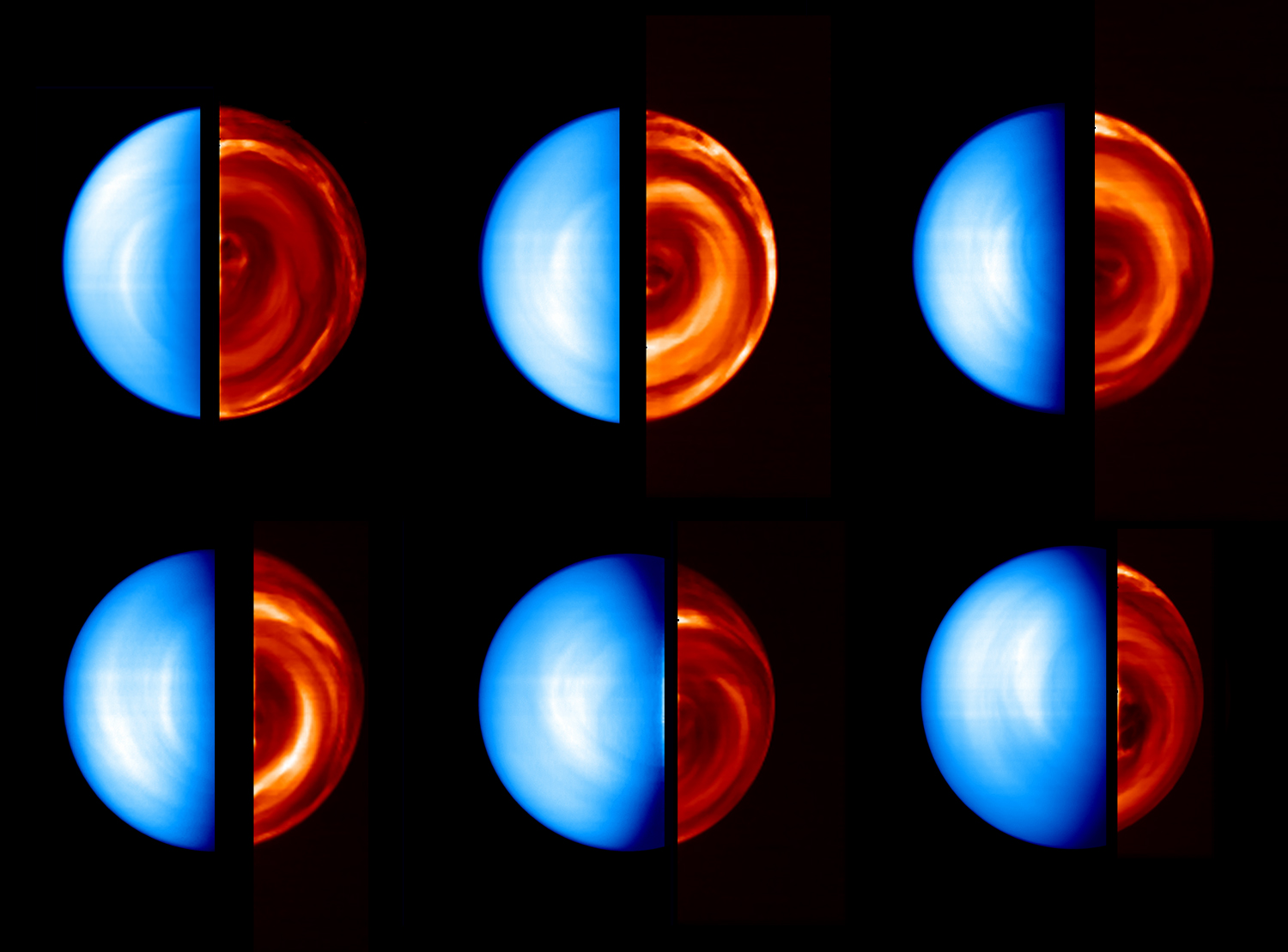
This sequence of images was taken by the Ultraviolet/Visible/Near-Infrared spectrometer (VIRTIS) on board ESA’s Venus Express spacecraft between 12 and 19 April 2006, during the first orbit (capture orbit) around the planet.

The images were obtained at six different time slots and different distances from the planet (top left: 12 April, from 210 000 kilometres; top centre: 13 April, from 280 000 kilometres; top right: 14 April, from 315 000 kilometres; bottom left:16 April, from 315 000 kilometres; bottom centre: 17 April, from 270 000 kilometres; bottom right: 19 April, from 190 000 kilometres), while the spacecraft moved along a long ellipse around Venus. The separate images can be downloaded here [ VOI_1_12_04_2006_b,  VOI_2_13_04_2006_b,  VOI_3_14_04_2006_b,  VOI_4_16_04_2006_b,  VOI_5_17_04_2006_b,  VOI_6_19_04_2006].

Each image is the composite of the day side of Venus (left, in blue, taken in visible light at 380 nanometres) and the night side (right, in a red colour scheme, taken in infrared light at 1.7 microns).

The visible part shows solar radiation reflected by the atmosphere. The infrared part shows complex cloud structures, revealed by the thermal radiation coming up from different atmospheric depths. Venus Express can resolve these structures by use (for the first time from orbit) of the so so-called ‘infrared windows’ present in the atmosphere of Venus. In fact, if observed at certain wavelengths, it is possible to detect thermal radiation leaking from the deepest atmospheric layers, revealing what lies beneath the dense cloud curtain situated at about 60 kilometres altitude.

In the colour scheme of the presented infrared images, the brighter the colour, the more radiation comes up from the lower layers.

Source: ESA

Tuesday, March 11, 2014

Venus Glory

Venus glory
Copyright: ESA/MPS/DLR/IDA

A rainbow-like feature known as a ‘glory’ has been seen by ESA’s Venus Express orbiter in the atmosphere of our nearest neighbour – the first time one has been fully imaged on another planet.

Rainbows and glories occur when sunlight shines on cloud droplets – water particles in the case of Earth. While rainbows arch across wide swathes of the sky, glories are typically much smaller and comprise a series of coloured concentric rings centred on a bright core.

Glories are only seen when the observer is situated directly between the Sun and the cloud particles that are reflecting sunlight. On Earth, they are often seen from aeroplanes, surrounding the shadow of the aircraft on the clouds below, or around the shadow of climbers atop misty mountain peaks.

 Venus glory details
Copyright: ESA/MPS/DLR/IDA

A glory requires two characteristics: the cloud particles are spherical, and therefore most likely liquid droplets, and they are all of a similar size.

The atmosphere of Venus is thought to contain droplets rich in sulphuric acid. By imaging the clouds with the Sun directly behind the Venus Express spacecraft, scientists hoped to spot a glory in order to determine important characteristics of the cloud droplets. 

They were successful. The glory in the images here was seen at the Venus cloud tops, 70 km above the planet’s surface, on 24 July 2011. It is 1200 km wide as seen from the spacecraft, 6000 km away.

Simulated views of glory on Venus and Earth
Copyright: C. Wilson/P. Laven

From these observations, the cloud particles are estimated to be 1.2 micrometres across, roughly a fiftieth of the width of a human hair. 

The fact that the glory is 1200 km wide means that the particles at the cloud tops are uniform on this scale at least. 

The variations of brightness of the rings of the observed glory is different than that expected from clouds of only sulphuric acid mixed with water, suggesting that other chemistry may be at play. 

One idea is that the cause is the “UV-absorber”, an unknown atmospheric component responsible for mysterious dark markings seen in the cloud tops of Venus at ultraviolet wavelengths. More investigation is needed to draw a firm conclusion.

“Glory on Venus Cloud Tops and the Unknown UV Absorber,” by W.J. Markiewicz et al, is accepted for publication in Icarus. http://dx.doi.org/10.1016/j.icarus.2014.01.030
 

For further information, please contact:
 
Markus Bauer 


ESA Science and Robotic Exploration Communication Officer


Tel: +31 71 565 6799 


Mob: +31 61 594 3 954 


Email:
markus.bauer@esa.int


Wojciech Markiewicz
Max Planck Institute for Solar System Research, Germany
markiewicz@mps.mpg.de

Håkan Svedhem 


ESA Venus Express project scientist 


Email:
hakan.svedhem@esa.int


Saturday, February 22, 2014

NASA Researcher Finds Planet-Sized Space Weather Explosions at Venus

 
Giant perturbations called hot flow anomalies in the solar wind near Venus can pull the upper layers of its atmosphere, the ionosphere, up and away from the surface of the planet. Image Credit: NASA. Large Image

Researchers recently discovered that a common space weather phenomenon on the outskirts of Earth’s magnetic bubble, the magnetosphere, has much larger repercussions for Venus. The giant explosions, called hot flow anomalies, can be so large at Venus that they’re bigger than the entire planet and they can happen multiple times a day.

"Not only are they gigantic," said Glyn Collinson, a space scientist at NASA’s Goddard Space Flight Center in Greenbelt, Md. "But as Venus doesn’t have a magnetic field to protect itself, the hot flow anomalies happen right on top of the planet. They could swallow the planet whole."

Collinson is the first author of a paper on these results that appeared online in the Journal of Geophysical Research in February 2014. The work is based on observations from the European Space Agency's Venus Express. The results show just how large and how frequent this kind of space weather is at Venus.

Earth is protected from the constant streaming solar wind of radiation by its magnetosphere. Venus, however, has no such luck. A barren, inhospitable planet, with an atmosphere so dense that spacecraft landing there are crushed within hours, Venus has no magnetic protection.

Scientists like to compare the two: What happened differently at Earth to make it into the life-supporting planet it is today? What would Earth be like without its magnetic field?

At Earth, hot flow anomalies do not make it inside the magnetosphere, but they release so much energy just outside that the solar wind is deflected, and can be forced to move back toward the sun. Without a magnetosphere, what happens at Venus is very different.

Venus's only protection from the solar wind is the charged outer layer of its atmosphere called the ionosphere. A sensitive pressure balance exists between the ionosphere and the solar wind, a balance easily disrupted by the giant energy rush of a hot flow anomaly. The hot flow anomalies may create dramatic, planet-scale disruptions, possibly sucking the ionosphere up and away from the surface of the planet.

Karen C. Fox
NASA's Goddard Space Flight Center, Greenbelt, Md.


Wednesday, January 30, 2013

When a planet behaves like a comet

 Comet-like ionosphere at Venus
Copyright ESA/Wei et al. (2012)

ESA’s Venus Express has made unique observations of Venus during a period of reduced solar wind pressure, discovering that the planet’s ionosphere balloons out like a comet’s tail on its nightside.   

The ionosphere is a region of weakly electrically charged gas high above the main body of a planet’s atmosphere. Its shape and density are partly controlled by the internal magnetic field of the planet. 

For Earth, which has a strong magnetic field, the ionosphere is relatively stable under a range of solar wind conditions. By comparison, Venus does not have its own internal magnetic field and relies instead on interactions with the solar wind to shape its ionosphere. 

The extent to which this shaping depends on the strength of the solar wind has been controversial, but new results from Venus Express reveal for the first time the effect of a very low solar wind pressure on the ionosphere of an unmagnetised planet. 

The observations were made in August 2010 when NASA’s Stereo-B spacecraft measured a drop in solar wind density to 0.1 particles per cubic centimetre, around 50 times lower than normally observed; this persisted for about 18 hours.  

As this significantly reduced solar wind hit Venus, Venus Express saw the planet’s ionosphere balloon outwards on the planet’s ‘downwind’ nightside, much like the shape of the ion tail seen streaming from a comet under similar conditions. 

“The teardrop-shaped ionosphere began forming within 30–60 minutes after the normal high pressure solar wind diminished. Over two Earth days, it had stretched to at least two Venus radii into space,” says Yong Wei of the Max Planck Institute for Solar System Research in Germany, lead author of the new findings.
The new observations settle a debate about how the strength of the solar wind affects the way in which ionospheric plasma is transported from the dayside to the nightside of Venus.
Usually, this material flows along a thin channel in the ionosphere, but scientists were unsure what happens under low solar wind conditions. Does the flow of plasma particles increase as the channel widens due to the reduced confining pressure, or does it decrease because less force is available to push plasma through the channel?
“We now finally know that the first effect outweighs the second, and that the ionosphere expands significantly during low solar wind density conditions,” says Markus Fraenz, also of the Max Planck Institute and co-author on the paper. 

A similar effect is also expected to occur around Mars, the other non-magnetised planet in our inner Solar System. 

“We often talk about the effects of solar wind interaction with planetary atmospheres during periods of intense solar activity, but Venus Express has shown us that even when there is a reduced solar wind, the Sun can still significantly influence the environment of our planetary neighbours,” adds Håkan Svedhem, ESA’s Venus Express project scientist. 


 “A teardrop-shaped ionosphere at Venus in tenuous solar wind” by Y. Wei et al is published in Planetary and Space Science 73, 2012. 

For further information, please contact:
 
Markus Bauer 


ESA Science and Robotic Exploration Communication Officer


Tel: +31 71 565 6799 


Mob: +31 61 594 3 954 


Email: markus.bauer@esa.int


Yong Wei
Max Planck Institute for Solar System Research
E-mail: wei@mps.mpg.de

Markus Fraenz
Max Planck Institute for Solar System Research
E-mail: fraenz@mps.mpg.de
Tel: +49 555 6979 441


Håkan Svedhem
Venus Express Project Scientist
Email: H.Svedhem@esa.int
Tel: +31 71 565 3370

Tuesday, June 05, 2012

The Mysterious Arc of Venus

Three photos from the Arc of Venus observed during the planet's 2004 transit by amateur astronomer near Toulouse, France. Image Courtesy of André Rondi. View more from the photo series


The arc of Venus photographed in 2004 by Riccardo Robitschek and Giovanni Maria Caglieris of Milan, Italy. View larger

The arc of Venus as seen by NASA's TRACE spacecraft in 2004. Credit: NASA/Trace/LMSAL. View larger

When Venus transits the sun on June 5th and 6th, an armada of spacecraft and ground-based telescopes will be on the lookout for something elusive and, until recently, unexpected: The Arc of Venus.

"I was flabbergasted when I first saw it during the 2004 transit," recalls astronomy professor Jay Pasachoff of Williams College. "A bright, glowing rim appeared around the edge of Venus soon after it began to move into the sun."

For a brief instant, the planet had turned into a "ring of fire."

Researchers now understand what happened. Backlit by the sun, Venus's atmosphere refracted sunlight passing through layers of air above the planet's cloudtops, creating an arc of light that was visible in backyard telescopes and spacecraft alike.

It turns out, researchers can learn a lot about Venus by observing the arc. Indeed, it touches on some of the deepest mysteries of the second planet.

"We do not understand why our sister planet's atmosphere evolved to be so different than Earth's," explains planetary scientist Thomas Widemann of the Observatoire de Paris.

Earth and Venus are similar distances from the sun, are made of the same basic materials, and are almost perfect twins in terms of size. Yet the two planets are wrapped in stunningly dissimilar blankets of air. Venus's atmosphere is almost 100 times more massive than Earth's and consists mainly of CO2, a greenhouse gas that raises the surface temperature to almost 900°F. Clouds of sulfuric acid tower 14 miles high and whip around the planet as fast as 220 mph. A human being transported to this hellish environment would be crushed, suffocate, desiccate, and possibly ignite.

For the most part, planetary scientists have no idea how Venus turned out this way.

"Our models and tools cannot fully explain Venus, which means we lack the tools for understanding our own planet," points out Widemann. "Caring about Venus is caring about ourselves."

One of the biggest mysteries of Venus is super-rotation. The whole atmosphere circles the planet in just four Earth days, much faster than the planet's spin period of 243 days. "The dynamics of super-rotation are still a puzzle despite a wealth of data from landmark missions such as NASA's Pioneer Venus, Russia's Venera and VEGA missions, NASA's Magellan and more recently ESA's Venus Express."

This is where the Arc of Venus comes in. The brightness of the arc reveals the temperature and density structure of Venus's middle atmosphere, or "mesosphere," where the sunlight is refracted. According to some models, the mesosphere is key to the physics of super-rotation. By analyzing the lightcurve of the arc, researchers can figure out the temperature and density of this critical layer from pole to pole.

When the arc appeared in 2004, the apparition took astronomers by surprise; as a result, their observations were not optimized to capture and analyze the fast-changing ring of light.

This time, however, they are ready. Together, Pasachoff and Widemann have organized a worldwide effort to monitor the phenomenon on June 5th, 2012. "We're going to observe the arc using 9 coronagraphs spaced around the world," says Pasachoff. "Observing sites include Haleakala, Big Bear, and Sacramento Peak. Japan's Hinode spacecraft and NASA's Solar Dynamics Observatory will also be gathering data."

Pasachoff has some advice for amateur astronomers who wish to observe the arc. "The best times to look are ingress and egress--that is, when the disk of Venus is entering and exiting the sun. Ingress is between 22:09 and 22:27 UT on June 5th; egress occurs between 04:32 and 04:50 UT. Be sure your telescope is safely filtered. Both white light and H-alpha filters might possibly show the arc."

Related Links

NASA 2012 Venus Transit site

Dr. Tony Phillips
Science at NASA