Showing posts with label X-rays. Show all posts

Thursday, December 21, 2023

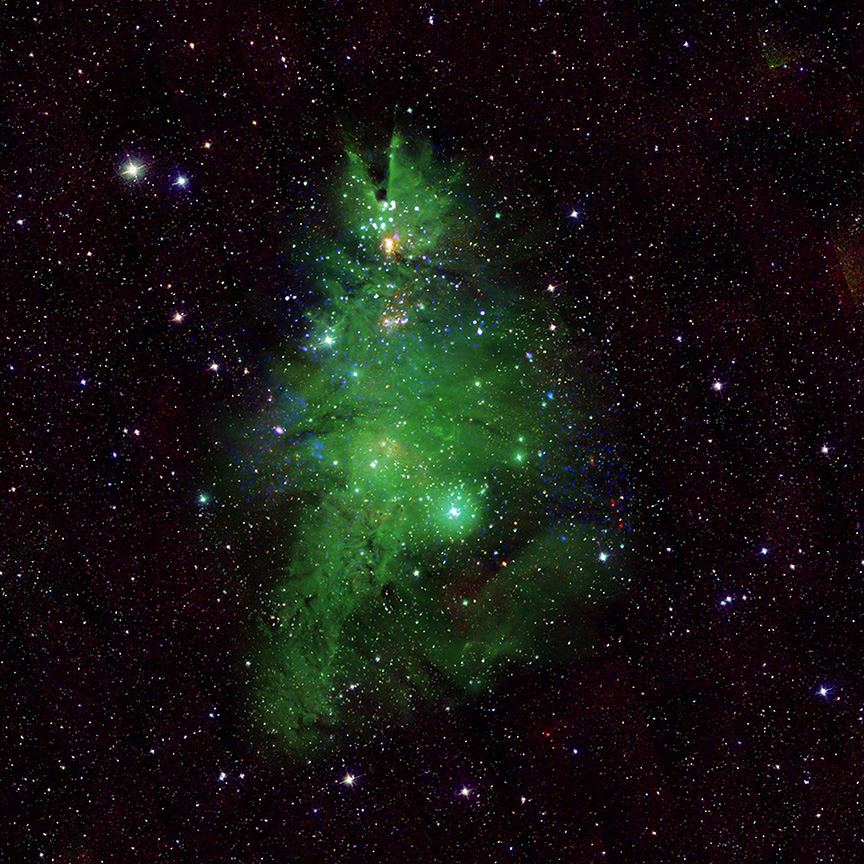
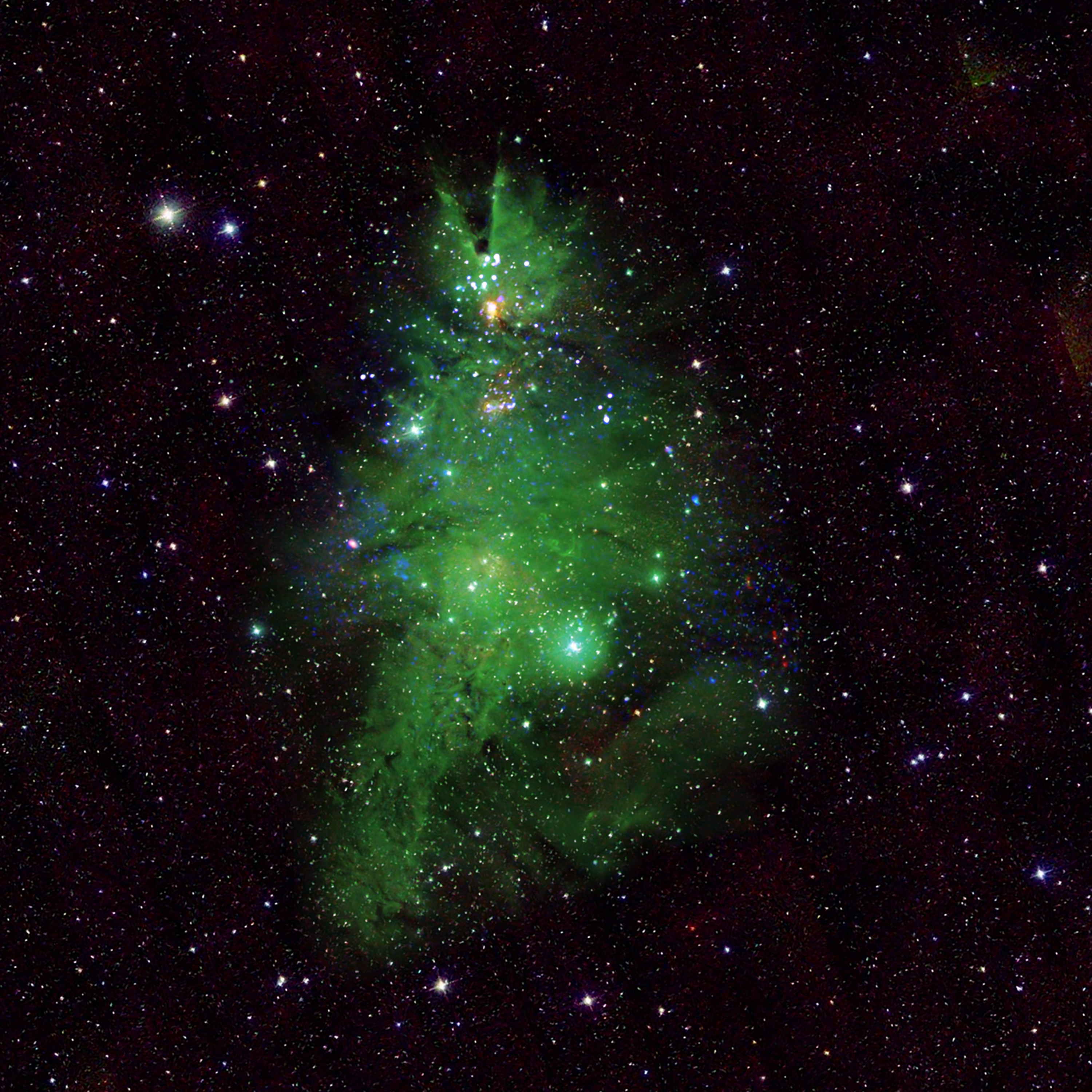
NGC 2264: Sprightly Stars Illuminate 'Christmas Tree Cluster'

NGC 2264 (Video)
Credit: X-ray: NASA/CXC/SAO; Optical: T.A. Rector (NRAO/AUI/NSF and NOIRLab/NSF/AURA) and B.A. Wolpa (NOIRLab/NSF/AURA); Infrared: NASA/NSF/IPAC/CalTech/Univ. of Massachusetts; Image Processing: NASA/CXC/SAO/L. Frattare & J.Major


This new image of NGC 2264, also known as the “Christmas Tree Cluster,” shows the shape of a cosmic tree with the glow of stellar lights. NGC 2264 is, in fact, a cluster of young stars — with ages between about one and five million years old — in our Milky Way about 2,500 light-years away from Earth. The stars in NGC 2264 are both smaller and larger than the Sun, ranging from some with less than a tenth the mass of the Sun to others containing about seven solar masses.

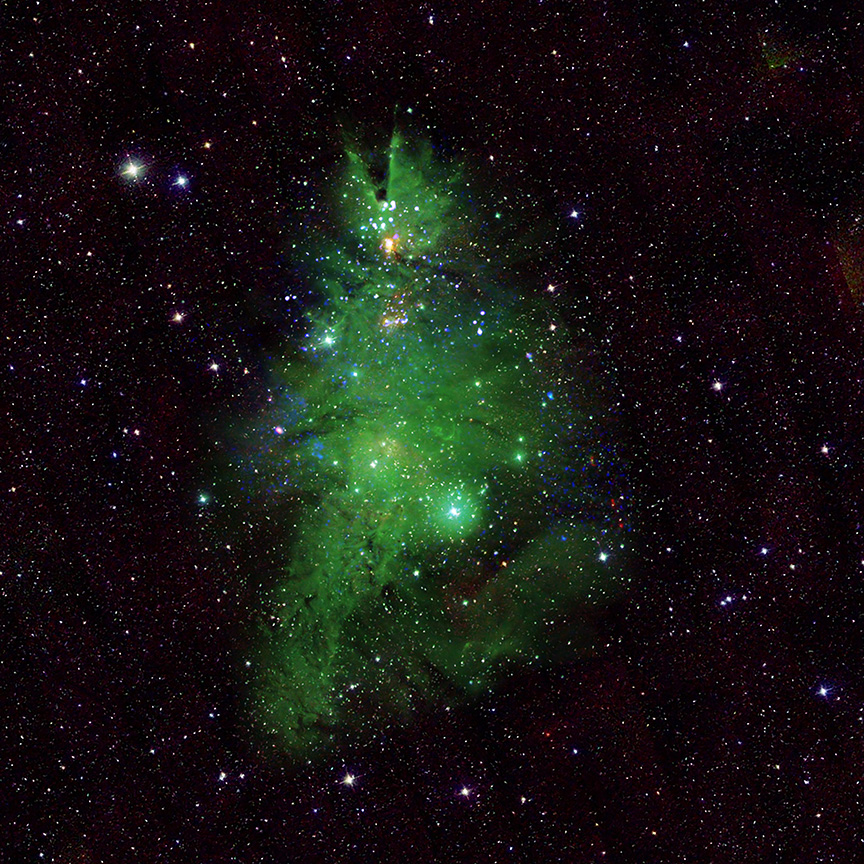
This new composite image enhances the resemblance to a Christmas tree through choices of color and rotation. The blue and white lights (which blink in the animated version of this image) are young stars that give off X-rays detected by NASA’s Chandra X-ray Observatory. Optical data from the National Science Foundation-supported WIYN 0.9-meter telescope on Kitt Peak shows a nebula of gas in the cluster in green, corresponding to the “pine needles” of the tree. Finally infrared data from the Two Micron All Sky Survey shows foreground and background stars in white. This image has been rotated clockwise by 160 degrees from the astronomer’s standard of North pointing upward, so that it appears like the top of the tree is toward the top of the image.
NGC 2264 (Video)
Credit: X-ray: NASA/CXC/SAO; Optical: T.A. Rector (NRAO/AUI/NSF and NOIRLab/NSF/AURA) and B.A. Wolpa (NOIRLab/NSF/AURA); Infrared: NASA/NSF/IPAC/CalTech/Univ. of Massachusetts; Image Processing: NASA/CXC/SAO/L. Frattare & J.Major
 
Young stars, like those in NGC 2264, are volatile and produce strong flares in X-rays and other types of variations seen at different wavelengths of light. The coordinated, blinking variations shown in this animation, however, are artificial, to emphasize the locations of the stars seen in X-rays and highlight the similarity of this object to a Christmas tree. In reality the variations of the stars are not synchronized.

The variations observed by Chandra and other telescopes are caused by several different processes. Some of these are related to activity involving magnetic fields, including flares like those undergone by the Sun — but much more powerful — and hot spots and dark regions on the surfaces of the stars that go in and out of view as the stars rotate. There can also be changes in the thickness of gas obscuring the stars, and changes in the amount of material still falling onto the stars from disks of surrounding gas.

NASA's Marshall Space Flight Center manages the Chandra program. The Smithsonian Astrophysical Observatory's Chandra X-ray Center controls science operations from Cambridge, Massachusetts, and flight operations from Burlington, Massachusetts.


Visual Description:

This release features a composite image of a cluster of young stars looking decidedly like a cosmic Christmas tree! The cluster, known as NGC 2264, is in our Milky Way Galaxy, about 2,500 light-years from Earth. Some of the stars in the cluster are relatively small, and some are relatively large, ranging from one tenth to seven times the mass of our Sun.

In this composite image, the cluster's resemblance to a Christmas tree has been enhanced through image rotation and color choices. Optical data is represented by wispy green lines and shapes, which creates the boughs and needles of the tree shape. X-rays detected by Chandra are presented as blue and white lights and resemble glowing dots of light on the tree. Infrared data show foreground and background stars as gleaming specks of white against the blackness of space. The image has been rotated by 160 degrees from the astronomer's standard of North pointing upwards. This puts the peak of the roughly conical tree shape near the top of the image, though it doesn't address the slight bare patch in the tree's branches, at our lower right, which in a living room should probably be turned to the corner!

In this release, the festive cluster is presented as both a static image, and as a short animation. In the animation, blue and white X-ray dots from Chandra flicker and twinkle on the tree, like the lights on a Christmas tree.


Fast Facts for (NGC 2264):

Scale: Image is about 77 arcmin (56 light-years) across.
Category: Normal Stars & Star Clusters
Coordinates (J2000): RA 06h 40m 52s | Dec +09° 52´ 37"
Constellation: Monoceros
Observation Dates: 8 observations from February 2002 to December 2011
Observation Time: 137 hours 26 minutes (5 days, 17 hours, 26 mintues)
Obs. ID: 2540, 2550, 9768, 9769, 13610, 13611, 14368, 14369
Instrument: ACIS
Color Code: X-ray: blue, purple, white; Optical: green; Infrared: red, green, blue
Distance Estimate: About 2,500 light-years


Wednesday, December 06, 2023

The X-Rays That Shouldn't Be There

A plasma jet created in the lab.
Image credit: Paul Bellan et al., Caltech

For around 20 years, Caltech Professor of Applied Physics Paul Bellan and his group have been creating magnetically accelerated jets of plasma, an electrically conducting gas composed of ions and electrons, in a vacuum chamber big enough to hold a person. (Neon signs and lightning are everyday examples of plasma).

In that vacuum chamber, wisps of gas are ionized by several thousand volts. One hundred-thousand amps then flow through the plasma, producing strong magnetic fields that mold the plasma into a jet traveling around 10 miles per second. High-speed recordings show that the jet transitions through several distinct stages in a few tens of microseconds.

Bellan says the plasma jet looks like an umbrella growing in length. Once the length reaches one or two feet, the jet undergoes an instability that causes it to transform into a rapidly expanding corkscrew. This rapid expansion triggers a different, faster instability that creates ripples.

"The ripples choke the jet's 100-kiloamp electric current, much like putting your thumb over a water hose restricts the flow and creates a pressure gradient that accelerates water," Bellan says. "Choking the jet current creates an electric field strong enough to accelerate electrons to high energy."

Those high-energy electrons were previously identified in the jet experiment by the X-rays they generate, and Bellan says their presence was a surprise. That's because conventional understanding says the jet plasma was too cold for electrons to be accelerated to high energy. Note that "cold" is a relative term: Although this plasma had a temperature of about 20,000 Kelvin (35,500 degrees Fahrenheit)—far hotter than anything humans normally encounter—it is nowhere near the temperature of the Sun's corona, which is over a million Kelvin (1.8 million degrees F.)

"So, the question is, 'Why are we seeing X-rays?'" he says.

Cold plasmas were thought to be incapable of generating high-energy electrons because they are too "collisional," meaning an electron cannot travel very far before colliding with another particle. It is like a driver trying to drag race through freeway gridlock. The driver might hit the accelerator but would travel only a few feet before smashing into another car. In the case of a cold plasma, an electron would accelerate only about one micron before colliding and slowing down.

The Bellan group's first attempt at explaining this phenomenon was a model suggesting that some fraction of the electrons manages to avoid colliding with other particles during the first micron of travel. According to the theory, that allowed the electrons to accelerate to slightly higher velocity, and once going faster, they could travel just a little bit farther before encountering another particle with which they might collide. Some fraction of those now-faster electrons would again avoid a collision for a time, allowing them to attain an even higher speed, which would allow them to travel even farther, creating a positive feedback loop that would allow a few lucky electrons to go farther and faster, attaining high speeds and high energies.

But while compelling, the theory was wrong, Bellan says.

"It was realized that this argument has a flaw," he says, "because electrons don't really collide in the sense of hitting something or not hitting something. They are all actually deflecting a little bit all the time. So, there's no such thing as an electron that's colliding or not colliding."

Yet, high-energy electrons do appear in the cold plasma of the jet experiment. To find out why, Bellan developed a computer code that calculated the actions of 5,000 electrons and 5,000 ions continuously deflecting off each other in an electric field. To suss out how a few electrons were managing to reach high energies, he tweaked the parameters and watched how the electrons' behavior changed.

As electrons accelerate in the electric field, they pass near ions but never actually touch them. Occasionally, an electron whizzes so closely past an ion that it transfers energy to an electron attached to the ion and slows down, with the now "excited" ion radiating visible light. Because electrons only occasionally pass so closely, they usually just deflect slightly from the ion without exciting it. This occasional energy leakage occurs in most electrons, which means they never attain high energies.

When Bellan tweaked his simulation, a few high-energy electrons capable of creating X-rays appeared. "The lucky few that never come close enough to an ion to excite it never lose energy," he adds. "These electrons are continuously accelerated in the electric field and ultimately attain sufficient energy to produce the X-rays."

Bellan says that if this behavior occurs in the plasma jet in his Caltech lab, it probably happens in solar flares and astrophysical situations as well. This may also explain why unexpectedly high-energy X-rays are sometimes seen during fusion-energy experiments.

"There's a long history of people seeing things that they thought were useful fusion," he says. "It turns out it was fusion, but it wasn't really useful. It was intense transient electric fields produced by instabilities accelerating a few particles to extremely high energy. This might be explaining what was going on. That's not what people want, but it is probably what happens."

The paper describing the work, "Energetic electron tail production from binary encounters of discrete electrons and ions in a sub-Dreicer electric field," appeared in the October 20 issue of Physics of Plasmas and was presented on November 3 at the 65th Annual Meeting of the American Physical Society Division of Plasma Physics in Denver, Colorado.

Funding for the research was provided by the National Science Foundation and the Air Force Office of Scientific Research.

Written by
Emily Velasco


Source: Caltech/News


Monday, August 01, 2016

Chorus of Black Holes Sings in X-Rays

The blue dots in this field of galaxies, known as the COSMOS field, show galaxies that contain supermassive black holes emitting high-energy X-rays.Credit: NASA/JPL-Caltech


Supermassive black holes in the universe are like a raucous choir singing in the language of X-rays. When black holes pull in surrounding matter, they let out powerful X-ray bursts. This song of X-rays, coming from a chorus of millions of black holes, fills the entire sky -- a phenomenon astronomers call the cosmic X-ray background.

NASA's Chandra mission has managed to pinpoint many of the so-called active black holes contributing to this X-ray background, but the ones that let out high-energy X-rays -- those with the highest-pitched "voices" -- have remained elusive.

New data from NASA's Nuclear Spectroscopic Telescope Array, or NuSTAR, have, for the first time, begun to pinpoint large numbers of the black holes belting out the high-energy X-rays. Or, in astronomer-speak, NuSTAR has made significant progress in resolving the high-energy X-ray background.

"We've gone from resolving just two percent of the high-energy X-ray background to 35 percent," said Fiona Harrison, the principal investigator of NuSTAR at Caltech in Pasadena and lead author of a new study describing the findings in an upcoming issue of The Astrophysical Journal.  "We can see the most obscured black holes, hidden in thick gas and dust."

The results will ultimately help astronomers understand how the feeding patterns of supermassive black holes change over time. This is a key factor in the growth of not only black holes, but also the galaxies that host them. The supermassive black hole at the center of our Milky Way galaxy is dormant now, but at some point in the past, it too would have siphoned gas and bulked up in size.

As black holes grow, their intense gravity pulls matter toward them. The matter heats up to scorching temperatures, and particles get boosted to close to the speed of light. Together, these processes make the black hole surroundings glow with X-rays. A supermassive black hole with a copious supply of fuel, or gas, will give off more high-energy X-rays.

NuSTAR is the first telescope capable of focusing these high-energy X-rays into sharp pictures.

"Before NuSTAR, the X-ray background in high energies was just one blur with no resolved sources," said Harrison. "To untangle what's going on, you have to pinpoint and count up the individual sources of the X-rays."

"We knew this cosmic choir had a strong high-pitched component, but we still don't know if it comes from a lot of smaller, quiet singers, or a few with loud voices," said co-author Daniel Stern, the project scientist for NuSTAR at NASA's Jet Propulsion Laboratory in Pasadena, California. "Now, thanks to NuSTAR, we're gaining a better understanding of the black holes and starting to address these questions."

High-energy X-rays can reveal what lies around the most buried supermassive black holes, which are otherwise hard to see. In the same way that medical X-rays can travel through your skin to reveal pictures of bones, NuSTAR can see through the gas and dust around black holes, to get a deeper view of what's going on inside.

With NuSTAR's more complete picture of the supermassive black hole populations, astronomers can begin to puzzle together how they evolve and change over time. When did they start and stop feeding? What is the distribution of the gas and dust that both feed and hide the black holes?

The team expects to resolve more of the high-energy X-ray background over time with NuSTAR -- and better decipher the X-ray voices of our universe's rowdiest choir.

NuSTAR is a Small Explorer mission led by Caltech and managed by JPL for NASA's Science Mission Directorate in Washington. NuSTAR was developed in partnership with the Danish Technical University and the Italian Space Agency (ASI). The spacecraft was built by Orbital Sciences Corp., Dulles, Virginia. NuSTAR's mission operations center is at UC Berkeley, and the official data archive is at NASA's High Energy Astrophysics Science Archive Research Center. ASI provides the mission's ground station and a mirror archive. JPL is managed by Caltech for NASA.


Monday, June 29, 2015

Unexpectedly Little Black-hole Monsters Rapidly Suck up Surrounding Matter

Using the Subaru Telescope, researchers at the Special Astrophysical Observatory in Russia and Kyoto University in Japan have found evidence that enigmatic objects in nearby galaxies – called ultra-luminous X-ray sources (ULXs) – exhibit strong outflows that are created as matter falls onto their black holes at unexpectedly high rates. The strong outflows suggest that the black holes in these ULXs must be much smaller than expected. Curiously, these objects appear to be "cousins" of SS 433, one of the most exotic objects in our own Milky Way Galaxy. The team's observations help shed light on the nature of ULXs, and impact our understanding of how supermassive black holes in galactic centers are formed and how matter rapidly falls onto those black holes (Figure 1).

Figure 1: Multi-color optical image around the ULX "X-1" (indicated by the arrow) in the dwarf galaxy Holmberg II, located in the direction of the constellation Ursa Major, at a distance of 11 million light-years. The image size corresponds to 1,100 × 900 light-years at the galaxy. The red color represents spectral line emission from hydrogen atoms. (Credit: Special Astrophysical Observatory/Hubble Space Telescope)


X-ray observations of nearby galaxies have revealed these exceptionally luminous sources at off-nuclear positions that radiate about million times higher power than the Sun. The origins of ULXs have been a subject of heated debate for a long time. The basic idea is that a ULX is a close binary system consisting of a black hole and a star. As matter from the star falls onto the black hole, an accretion disk forms around the black hole. As the gravitational energy of the material is released, the innermost part of the disk is heated up to a temperature higher than 10 million degrees, which causes it to emit strong X-rays.

The unsolved key question about these objects asks: what is the mass of the black hole in these bright objects? ULXs are typically more than a hundred times more luminous than known black hole binaries in the Milky Way, whose black hole masses are at most 20 times the mass of the Sun.

There are two different black hole scenarios proposed to explain these objects: (1) they contain very "big" black holes that could be more than a thousand times more massive than the Sun (Note 1), or (2) they are relatively small black holes, "little monsters" with masses no more than a hundred times that of the Sun, that shine at luminosities exceeding theoretical limits for standard accretion (called "supercritical (or super-Eddington) accretion," Note 2). Such supercritical accretion is expected to produce powerful outflow in a form of a dense disk wind.

To understand which scenario explains the observed ULXs researchers observed four objects: Holmberg II X-1, Holmberg IX X-1, NGC 4559 X-7, NGC 5204 X-1, and took high-quality spectra with the FOCAS instrument on Subaru Telescope for four nights. Figure 1 shows an optical multi-color image toward Holmberg II X-1 as observed with Hubble Space Telescope. The object X-1, indicated by the arrow, is surrounded by a nebula (colored in red), which is most likely the gas heated by strong radiation from the ULX.

The team discovered a prominent feature in the optical spectra of all the ULXs observed (Figure 2). It is a broad emission line from helium ions, which indicates the presence of gas heated to temperatures of several tens of thousands of degrees in the system. In addition, they found that the width of the hydrogen line, which is emitted from cooler gas (with a temperature of about 10,000 K), is broader than the helium line. The width of a spectral line reflects velocity dispersion of the gas and shows up due to the Doppler effect caused by a distribution of the velocities of gas molecules. These findings suggest that the gas must be accelerated outward as a wind from either the disk or the companion star and that it is cooling down as it escapes.

Figure 2: Optical spectra of the four ULXs observed with the Subaru Telescope (from upper to lower, Holmberg II X-1, Holmberg IX X-1, NGC 4559 X-7, NGC 5204 X-1). He II and Hα denote the spectral lines from helium ions and from hydrogen atoms, respectively. (Credit: Kyoto University)


Distant ULXs and a Similar Mysterious Object in the Milky Way

The activity of these ULXs in distant galaxies is very similar to a mysterious object in our own Milky Way. The team noticed that the same line features are also observed at SS 433, a close binary consisting of an A-type star and most probably a black hole with a mass less than 10 times that of the Sun. SS 433 is famous for its persistent jets with a velocity of 0.26 times the speed of light. It is the only confirmed system that shows supercritical accretion (that is, an excessive amount of accretion that results in a very powerful outflow). By contrast, such features have not been observed from "normal" black hole X-ray binaries in the Milky Way where sub-critical accretion takes place.

After carefully examining several possibilities, the team concluded that huge amounts of gas are rapidly falling onto "little monster" black holes in each of these ULXs, which produces a dense disk wind flowing away from the supercritical accretion disk. They suggest that "bona-fide" ULXs with luminosities of about million times that of the Sun must belong to a homogeneous class of objects, and SS 433 is an extreme case of the same population. In these, even though the black hole is small, very luminous X-ray radiation is emitted as the surrounding gas falls onto the disk at a huge rate.

Figure 3 is a schematic view of the ULXs (upper side) and SS 433 (lower side). If the system is observed from a vertical direction, it's clear that the central part of the accretion disk emits intense X-rays. If SS 433 were observed in the same direction, it would be recognized as the brightest X-ray source in the Milky Way. In reality, since we are looking at SS 433 almost along the disk plane, our line-of-sight view towards the inner disk is blocked by the outer disk. The accretion rate is inferred to be much larger in SS 433 than in the ULXs, which could explain the presence of persistent jets in SS 433.

Figure 3: Schematic view of ULXs (looking from upper side) and SS 433 (looking from left side). Strong X-rays are emitted from the inner region of the supercritical accretion disk. Powerful winds are launched from the disk, which eventually emit spectral lines of helium ions and hydrogen atoms. (Credit: Kyoto University)


Such "supercritical accretion" is thought to be a possible mechanism in the formation of supermassive black holes at galactic centers in very short time periods (which are observed very early in cosmic time). The discovery of these phenomena in the nearby universe has significant impacts on our understanding of how supermassive black holes are formed and how matter rapidly falls onto them.

There are still some remaining questions: What are the typical mass ranges of the black holes in ULXs? In what conditions can steady baryonic jets as observed in SS 433 be produced? Dr. Yoshihiro Ueda, a core member of the team, expresses his enthusiasm for future research in this area. "We would like to tackle these unresolved problems by using the new X-ray observations by ASTRO-H, planned to be launched early next year, and by more sensitive future X-ray satellites, together with multi-wavelength observations of ULXs and SS 433," he said.


This work has been published online in Nature Physics on 2015 June 1 (Fabrika et al. 2015, "Supercritical Accretion Discs in Ultraluminous X-ray Sources and SS 433", 10.1038/nphys3348). The research was supported by the Japan Society for the Promotion of Science's KAKENHI Grant number 26400228. 

Authors:

  • Sergei Fabrika (Special Astrophysical Observatory, Russia; Kazan Federal University, Russia)
  • Yoshihiro Ueda (Department of Astronomy, Kyoto University, Japan)
  • Alexander Vinokurov (Special Astrophysical Observatory, Russia)
  • Olga Sholukhova (Special Astrophysical Observatory, Russia)
  • Megumi Shidatsu (Department of Astronomy, Kyoto University, Japan)


Notes:
  1. Generally, black holes with masses between about 100 and about 100,000 times that of the Sun are called "intermediate-mass black holes," although there is no strict definition for the mass range.
  2. In a spherically symmetric case, matter cannot fall onto a central object when the radiation pressure exceeds the gravity. This luminosity is called the Eddington limit, which is proportional to the mass of the central object. When matter is accreted at rates higher than that corresponding to the Eddington limit, it is called "supercritical (or super-Eddington) accretion." In the case of non-spherical geometry, such as disk accretion, supercritical accretion may happen.


Monday, March 02, 2015

Measuring gas velocities in galaxy clusters with X-ray images

Fig 1: Schematic illustration of gas density distribution in a spherically symmetric cluster in perfect hydrostatic equilibrium (v=0, top) and in a slightly disturbed cluster (v ≠ 0, middle). Slow large-scale perturbations in a stratified cluster atmosphere can be interpreted as internal waves (as illustrated in the bottom panel), similar to waves in the ocean, where the velocity of water and the amplitude of waves are linked. In clusters, similar perturbations are caused by a variety of reasons, including minor mergers or the activity of the central supermassive black holes.

Fig 2: X-ray image of the Coma cluster as seen with Chandra observatory.
The substructure seen in the image implies that the X-ray emitting gas is not at rest. 


X-ray observations provide us with detailed information on the density and temperature of the hot gas inside galaxy clusters. The other major gas characteristic that still needs to be measured is the gas velocity. While current generation X-ray observatories lack the required energy resolution to measure velocities directly, future observatories such as ASTRO-H and ATHENA will address this limitation.

An international team including MPA scientists has shown that the power spectrum of the velocity field can inferred indirectly from existing X-ray images of relaxed clusters. Numerical simulations confirm this simple theoretical idea, opening a way of probing gas velocities using already existing X-ray data. 

Galaxy clusters are the largest gravitationally bound structures in the present Universe. Hot gas (with temperatures of 10 to 100 million Kelvin) fills their gravitational potential wells and shines in the X-ray band, making the clusters an easy target for orbital X-ray observatories. Both the density and the temperature of the gas in clusters is routinely measured using X-ray data, while it is notoriously difficult to directly measure the turbulent motion of the gas via the Doppler shift of X-ray lines. Since the information on the turbulent gas velocities would have profound implications for the mass determination of clusters and for determining the plasma microphysics, new approaches have been developed to indirectly measure the gas velocities using existing X-ray data. One of these approaches is based on the analysis of small-scale fluctuations in X-ray images as described below. 

In relaxed clusters the gas approaches the state of hydrostatic equilibrium, when all thermodynamic properties are aligned along surfaces with equal gravitational potential, making X-ray images smooth and round (see Fig.1). These stratified and stable atmospheres of cluster gas bear much similarity to the Earth's atmosphere or to water in the oceans where cold and dense material tends to be below hotter and lighter material due to the combined action of gravity and buoyancy. Slow subsonic perturbations of such atmospheres can be represented as a combination of internal (gravity) waves, very much like waves in the ocean (bottom panel of Fig.1). In oceans there is a simple relation: the larger the amplitude of the waves, the higher the velocity of water. Is the same true for gas in galaxy clusters? Both theoretical analysis and numerical simulations have shown that this is indeed the case.

The main idea is that gas is disturbed on large scales and that this results in a cascade of waves. In clusters these waves are creating perturbations in the gas density that are visible in X-ray images as small-scale fluctuations of the surface brightness relative to a smooth global model. Our analysis shows that there is a simple linear relation between the gas velocities and density perturbations. Moreover, this relation holds for a broad range of scales: on large scales, where buoyancy effects dominate (internal waves), as well as on small scales where the isotropic turbulent cascade usually develops. At these small scales, the entropy of the gas acts as a passive scalar advected by the velocity field and makes the gas displacement visible in X-rays. 

Based on these arguments one can expect that in relaxed clusters (i.e. clusters which are only slightly disturbed) the power spectrum of the velocity field can simply be recovered from the power spectrum of density fluctuations. The latter can be straightforwardly estimated from X-ray images. 

Numerical simulations (cosmological simulations of cluster formation and pure hydrodynamic simulations with turbulence) confirm this conclusion and open an interesting possibility to use gas density power spectra as a proxy for the velocity power spectra in relaxed clusters. 

Once the gas velocities can be measured directly with future X-ray observatories, it will be possible to push this analysis further and search for differences between the density and velocity power spectra. Strong departures of the two power spectra from the universal behavior described above can then be used to constrain physical effects such as conductivity or viscosity in the gas.

Eugene Churazov (MPA), Massimo Gaspari (MPA), Irina Zhuravleva (Stanford), Alex Schekochihin (Oxford), Rashid Sunyaev (MPA)


References:
 
Zhuravleva I., Churazov E., Schekochihin A. A., Lau E. T., Nagai D., Gaspari  M., Allen S. W., Nelson K., Parrish I. J., The Relation between Gas Density and Velocity Power Spectra in Galaxy Clusters: Qualitative Treatment and Cosmological Simulations, 2014, ApJL, 788, 13
 
Gaspari M., Churazov E., Nagai D., Lau E. T., Zhuravleva, I., The relation between gas density and velocity power spectra in galaxy clusters: high-resolution hydrodynamic simulations and the role of conduction,2014, A&A, 569A, 67
 
Gaspari M., Churazov E., Constraining turbulence and conduction in the hot ICM through density perturbations, 2013, A&A, 559A, 78
 
Churazov E.; Vikhlinin A.; Zhuravleva I.; Schekochihin A.; Parrish I.; Sunyaev R.; Forman W.; Böhringer H.; Randall S., X-ray surface brightness and gas density fluctuations in the Coma cluster, 2012, MNRAS, 421,1123


Tuesday, July 29, 2014

NASA-funded X-ray Instrument Settles Interstellar Debate

Colors indicate the density of interstellar helium near Earth and its enhancement in a downstream cone as the neutral atoms respond to the sun's gravity (blue is low density, red is high). Also shown are the observing angles for DXL and ROSAT. Image Credit: NASA's Goddard Space Flight Center. Hi-Res Image

New findings from a NASA-funded instrument have resolved a decades-old puzzle about a fog of low-energy X-rays observed over the entire sky. Thanks to refurbished detectors first flown on a NASA sounding rocket in the 1970s, astronomers have now confirmed the long-held suspicion that much of this glow stems from a region of million-degree interstellar plasma known as the local hot bubble, or LHB.

At the same time, the study also establishes upper limits on the amount of low-energy, or soft, X-rays produced within our planetary system by the solar wind, a gusty outflow of charged particles emanating from the sun.

"Interactions between the solar wind and neutral atoms in comets, the outer atmospheres of planets, and even interstellar gas produce soft X-rays," explained team member Steve Snowden, an astrophysicist at NASA's Goddard Space Flight Center in Greenbelt, Maryland. "We need to account for these processes because the X-rays they produce complicate our observations of the wider universe."

Decades of mapping the sky in X-rays with energies around 250 electron volts -- about 100 times the energy of visible light -- revealed strong emission precisely where it shouldn't be. This glow, known as the soft X-ray diffuse background, is surprisingly bright in the gas-rich central plane of our galaxy, where it should be strongly absorbed. This suggested the background was a local phenomenon, arising from a bubble of hot gas extending out a few hundred light-years from the solar system in all directions. Improved measurements also made it increasingly clear that the sun resides in a region where interstellar gas is unusually sparse. Taken together, the evidence suggests our solar system is moving through a region that may have been blasted clear by one or more supernova explosions during the past 20 million years.

In the 1990s, a six-month all-sky survey by the German X-ray observatory ROSAT provided improved maps of the diffuse background, but it also revealed that comets were an unexpected source of soft X-rays. As scientists began to understand this process, called solar wind charge exchange, they realized it could occur anywhere neutral atoms interacted with solar wind ions.

This animation illustrates solar wind charge exchange in action. An atom of interstellar helium (blue) collides with a solar wind ion (red), losing one of its electrons (yellow) to the other particle. As it settles into a lower-energy state, the electron emits a soft X-ray. Image Credit: NASA's Goddard Space Flight Center. Download this video in HD formats from NASA Goddard's Scientific Visualization Studio

Within the last decade, some scientists have been challenging the LHB interpretation, suggesting that much of the soft X-ray diffuse background is a result of charge exchange," said F. Scott Porter, a Goddard astrophysicist also participating in the study. "The only way to check is to design an instrument and make measurements."

Led by Massimiliano Galeazzi, a professor of physics at the University of Miami in Coral Gables, Florida, an international collaboration developed a mission to do just that. The team includes scientists from NASA, the University of Wisconsin -- Madison, the University of Michigan at Ann Arbor, the University of Kansas at Lawrence, Johns Hopkins University in Baltimore, Maryland, the French National Center for Scientific Research (CNRS), headquartered in Paris, and other institutions.

Galeazzi and his colleagues rebuilt, tested, calibrated, and adapted X-ray detectors originally designed by the University of Wisconsin and flown on sounding rockets in the 1970s. Components from another instrument flown on space shuttle Endeavour in 1993 also were given new life. The mission was named DXL, for Diffuse X-ray emission from the Local Galaxy. 

On Dec. 12, 2012, DXL launched from White Sands Missile Range in New Mexico atop a NASA Black Brant IX sounding rocket, reaching a peak altitude of 160 miles (258 km) and spending five minutes above Earth's atmosphere. The mission design allowed the instrument to observe a worst-case scenario involving charge exchange with interstellar gas.

The solar system is currently passing through a small cloud of cold interstellar gas as it moves through the galaxy. The cloud’s neutral hydrogen and helium atoms stream through the planetary system at about 56,000 mph (90,000 km/h). While hydrogen atoms quickly ionize and respond to numerous forces, the helium atoms travel paths largely governed by the sun's gravity. This creates a "helium focusing cone" downstream from the sun that crosses Earth's orbit and is located high in the sky near midnight in early December.

"This helium focusing creates a region with a much greater density of neutral atoms and a correspondingly enhanced charge exchange rate," Snowden said.

The solar wind is accelerated in the sun's corona, the hottest part of its atmosphere, so its atoms have been ionized -- stripped of many of their electrons. When a neutral atom collides with a solar wind ion, one of its electrons often jumps to the charged particle. Once captured by the ion, the electron briefly remains in an excited state, then emits a soft X-ray and settles down at a lower energy. This is solar wind charge exchange in action.

To establish a baseline for the soft X-ray background, the researchers used data captured by the ROSAT mission in September 1990 in a direction looking along, rather than into, the helium focusing cone. The results, published online in the journal Nature on July 27, indicate that only about 40 percent of the soft X-ray background originates within the solar system.

"We now know that the emission comes from both sources but is dominated by the local hot bubble,” said Galeazzi. "This is a significant discovery. Specifically, the existence or nonexistence of the local bubble affects our understanding of the area of the galaxy close to the sun, and can, therefore, be used as a foundation for future models of the galaxy structure."

Galeazzi and his collaborators are already planning the next flight of DXL, which will include additional instruments to better characterize the emission. The launch is currently planned for December 2015.

"The DXL team is an extraordinary example of cross-disciplinary science, bringing together astrophysicists, planetary scientists, and heliophysicists," added Porter. "It’s unusual but very rewarding when scientists with such diverse interests come together to produce such groundbreaking results."

Related Links:

Francis Reddy
NASA's Goddard Space Flight Center, Greenbelt, Maryland