Monday, November 10, 2014

MUSE Reveals True Story Behind Galactic Crash

MUSE view of the ram-pressure stripped galaxy ESO 137-001
 
MUSE view of the ram-pressure stripped galaxy ESO 137-001
 
The galaxy ESO 137-001 in the constellation of Triangulum Australe
 
Wide-field view of the sky around the galaxy ESO 137-001
 
Hubble and Chandra composite of ESO 137-001

************************************************
 
Videos

Zooming in on ESO 137-001

MUSE shows ESO 137-001 in three dimensions
MUSE shows ESO 137-001 in three dimensions 


The new MUSE instrument on ESO’s Very Large Telescope (VLT) has provided researchers with the best view yet of a spectacular cosmic crash. The new observations reveal for the first time the motion of gas as it is ripped out of the galaxy ESO 137-001 as it ploughs at high speed into a vast galaxy cluster. The results are the key to the solution of a long-standing mystery — why star formation switches off in galaxy clusters.

A team of researchers led by Michele Fumagalli from the Extragalactic Astronomy Group and the Institute for Computational Cosmology at Durham University, were among the first to use ESO’s Multi Unit Spectroscopic Explorer (MUSE) instrument on the VLT. Observing ESO 137-001 — a spiral galaxy 200 million light-years away in the southern constellation of Triangulum Australe (The Southern Triangle) — they were able to get the best view so far of exactly what is happening to the galaxy as it hurtles into the Norma Cluster.

MUSE gives astronomers not just a picture, but provides a spectrum — or a band of colours — for each pixel in the frame. With this instrument researchers collect about 90 000 spectra every time they look at an object, and thereby record a staggeringly detailed map of the motions and other properties of the observed objects [1].

ESO 137-001 is being robbed of its raw materials by a process called ram-pressure stripping, which happens when an object moves at high speed through a liquid or gas. This is similar to how air blows a dog’s hair back when it sticks its head out of the window of a moving car. In this case the gas is part of the vast cloud of very thin hot gas that is enveloping the galaxy cluster into which ESO 137-001 is falling at several million kilometres per hour [2].

The galaxy is being stripped of most of its gas — the fuel needed to make the next generations of young blue stars. ESO 137-001 is in the midst of this galactic makeover, and is being transformed from a blue gas-rich galaxy to a gas-poor red one. Scientists propose that the observed process will help to solve a long-standing scientific riddle.

It is one of the major tasks of modern astronomy to find out how and why galaxies in clusters evolve from blue to red over a very short period of time,” says Fumagalli. “Catching a galaxy right when it switches from one to the other allows us to investigate how this happens.”

Observing this cosmic spectacle, however, is no mean feat. The Norma Cluster lies close to the plane of our own galaxy, the Milky Way, so it is hidden behind copious amounts of galactic dust and gas.

With the help of MUSE, which is mounted on one of the VLT’s 8-metre Unit Telescopes at the Paranal Observatory in Chile, scientists could not only detect the gas in and around the galaxy, but were able to see how it moves. The new instrument is so efficient that a single hour of observing time was sufficient to obtain a high resolution image of the galaxy as well as the distribution and motion of its gas.

The observations show that the outskirts of ESO 137-001 are already completely devoid of gas. This is a result of the cluster gas — heated to millions of degrees — pushing the cooler gas out of ESO 137-001 as this drives towards the centre of the cluster. This happens first in the spiral arms where the stars and matter are more thinly spread than at the centre, and gravity has only a relatively weak hold over the gas. In the centre of the galaxy, however, the gravitational pull is strong enough to hold out longer in this cosmic tug-of-war and gas is still observed.

Eventually, all of the galactic gas will be swept away into bright streaks behind ESO 137-001 — telltale remnants of this dramatic robbery. The gas that is torn away from the galaxy is mixed with the hot cluster gas to form magnificent tails extending to a distance of over 200 000 light-years. The team had a closer look at these streams of gas to better understand the turbulence created by the interaction.

Surprisingly the new MUSE observations of this gas plume show that the gas continues to rotate in same way the galaxy does, even after being swept out into space. Furthermore, researchers were able to determine that the rotation of stars in ESO 137-001 remains unchanged. This provides further evidence for the cluster gas, not gravity, being responsible for stripping the galaxy [3].

Matteo Fossati (Universitäts-Sternwarte München and Max-Planck-Institut für extraterrestrische Physik, Garching, Germany) and a co-author of the paper concludes: “With the details revealed by MUSE we are getting closer to fully understanding the processes that go on in such collisions. We see the motions of the galaxy and the gas in detail — something that wouldn’t be possible without the new and unique MUSE instrument. These and future observations will help us develop a better idea of what is driving the evolution of galaxies.” 


Notes

[1] MUSE is the first large integral field spectrograph ever installed at an 8-metre telescope. As a comparison, previous studies of ESO 137-001 collected no more than 50 spectra.

[2] The NASA/ESA Hubble Space Telescope has provided a spectacular image of this object — but, unlike MUSE, cannot reveal the motions of the material.

[3] If gravity were to play a role in the stripping process, the researchers would have expected to see disruptions within the galaxy.

 
More Information

This research was presented in a paper entitled “MUSE sneaks a peek at extreme ram-pressure stripping events. I. A kinematic study of the archetypal galaxy ESO137-001” to appear in Monthly Notices of the Royal Astronomical Society on 10 November 2014.

The team is composed of Michele Fumagalli (Extragalactic Astronomy Group and Institute for Computational Cosmology, Durham University, United Kingdom), Matteo Fossati (Universitäts-Sternwarte München and Max-Planck-Institut für extraterrestrische Physik, Garching, Germany), George K. T. Hau (ESO, Santiago, Chile), Giuseppe Gavazzi (Università di Milano-Bicocca, Italy), Richard Bower (Extragalactic Astronomy Group and Institute for Computational Cosmology, Durham University, United Kingdom), Alessandro Boselli (Laboratoire d'Astrophysique de Marseille, France) and Ming Sun (Department of Physics, University of Alabama, USA).

ESO is the foremost intergovernmental astronomy organisation in Europe and the world’s most productive ground-based astronomical observatory by far. It is supported by 15 countries: Austria, Belgium, Brazil, the Czech Republic, Denmark, France, Finland, Germany, Italy, the Netherlands, Portugal, Spain, Sweden, Switzerland and the United Kingdom. ESO carries out an ambitious programme focused on the design, construction and operation of powerful ground-based observing facilities enabling astronomers to make important scientific discoveries. ESO also plays a leading role in promoting and organising cooperation in astronomical research. ESO operates three unique world-class observing sites in Chile: La Silla, Paranal and Chajnantor. At Paranal, ESO operates the Very Large Telescope, the world’s most advanced visible-light astronomical observatory and two survey telescopes. VISTA works in the infrared and is the world’s largest survey telescope and the VLT Survey Telescope is the largest telescope designed to exclusively survey the skies in visible light. ESO is the European partner of a revolutionary astronomical telescope ALMA, the largest astronomical project in existence. ESO is currently planning the 39-metre European Extremely Large optical/near-infrared Telescope, the E-ELT, which will become “the world’s biggest eye on the sky”.  


Links


Contacts

Michele Fumagalli
Institute for Computational Cosmology, Durham University
Durham, United Kingdom
Tel: +44 191 334 3789
Email:
michele.fumagalli@durham.ac.uk

Matteo Fossati
Universitäts-Sternwarte München and Max-Planck-Institut für extraterrestrische Physik
Munich, Germany
Tel: +49 89 30000 3890
Email:
mfossati@mpe.mpg.de

Richard Hook
ESO education and Public Outreach Department
Garching bei München, Germany
Tel: +49 89 3200 6655
Cell: +49 151 1537 3591
Email:
rhook@eso.org

Source: ESO

NASA Rocket Redefines What Astronomers Think of as Galaxies

This is a time-lapse photograph of the Cosmic Infrared Background Experiment (CIBER) rocket launch, taken from NASA's Wallops Flight Facility in Virginia in 2013. The image is from the last of four launches. Image Credit: T. Arai/University of Tokyo.

CIBER measurements favor a model in which the IR glow between distant galaxies is caused by orphan stars. More

A NASA sounding rocket experiment has detected a surprising surplus of infrared light in the dark space between galaxies, a diffuse cosmic glow as bright as all known galaxies combined. The glow is thought to be from orphaned stars flung out of galaxies.

The findings redefine what scientists think of as galaxies. Galaxies may not have a set boundary of stars, but instead stretch out to great distances, forming a vast, interconnected sea of stars. 

Observations from the Cosmic Infrared Background Experiment, or CIBER, are helping settle a debate on whether this background infrared light in the universe, previously detected by NASA’s Spitzer Space Telescope, comes from these streams of stripped stars too distant to be seen individually, or alternatively from the first galaxies to form in the universe. 

"We think stars are being scattered out into space during galaxy collisions," said Michael Zemcov, lead author of a new paper describing the results from the rocket project and an astronomer at the California Institute of Technology (Caltech) and NASA's Jet Propulsion Laboratory (JPL) in Pasadena, California. "While we have previously observed cases where stars are flung from galaxies in a tidal stream, our new measurement implies this process is widespread."

Using suborbital sounding rockets, which are smaller than those that carry satellites to space and are ideal for short experiments, CIBER captured wide-field pictures of the cosmic infrared background at two infrared wavelengths shorter than those seen by Spitzer. Because our atmosphere itself glows brightly at these particular wavelengths of light, the measurements can only be done from space.

"It is wonderfully exciting for such a small NASA rocket to make such a huge discovery," said Mike Garcia, program scientist from NASA Headquarters. “Sounding rockets are an important element in our balanced toolbox of missions from small to large.” 

During the CIBER flights, the cameras launch into space, then snap pictures for about seven minutes before transmitting the data back to Earth. Scientists masked out bright stars and galaxies from the pictures and carefully ruled out any light coming from more local sources, such as our own Milky Way galaxy. What's left is a map showing fluctuations in the remaining infrared background light, with splotches that are much bigger than individual galaxies. The brightness of these fluctuations allows scientists to measure the total amount of background light.

To the surprise of the CIBER team, the maps revealed a dramatic excess of light beyond what comes from the galaxies.  The data showed that this infrared background light has a blue spectrum, which means it increases in brightness at shorter wavelengths. This is evidence the light comes from a previously undetected population of stars between galaxies. Light from the first galaxies would give a spectrum of colors that is redder than what was seen.

"The light looks too bright and too blue to be coming from the first generation of galaxies," said James Bock, principal investigator of the CIBER project from Caltech and JPL. "The simplest explanation, which best explains the measurements, is that many stars have been ripped from their galactic birthplace, and that the stripped stars emit on average about as much light as the galaxies themselves."

Future experiments can test whether stray stars are indeed the source of the infrared cosmic glow. If the stars were tossed out from their parent galaxies, they should still be located in the same vicinity. The CIBER team is working on better measurements using more infrared colors to learn how stripping of stars happened over cosmic history.

Results from two of four CIBER flights, both of which launched from White Sands Missile Range in New Mexico in 2010 and 2012, appear Friday, Nov. 7 in the journal Science

Credits:
Production editor: Dr. Tony Phillips | Credit: Science@NASA

More information:

For more information on NASA’s sounding rocket experiments, visit: http://www.nasa.gov/mission_pages/sounding-rockets/

For more information about CIBER, visit: http://ciber.caltech.edu/rocket.html

Caltech manages JPL for NASA. The work was supported by NASA, with initial support provided by JPL's Director's Research and Development Fund. Japanese participation in CIBER was supported by the Japan Society for the Promotion of Science and the Ministry of Education, Culture, Sports, Science and Technology. Korean participation in CIBER was supported by the Korean Astronomy and Space Science Institute." 

Friday, November 07, 2014

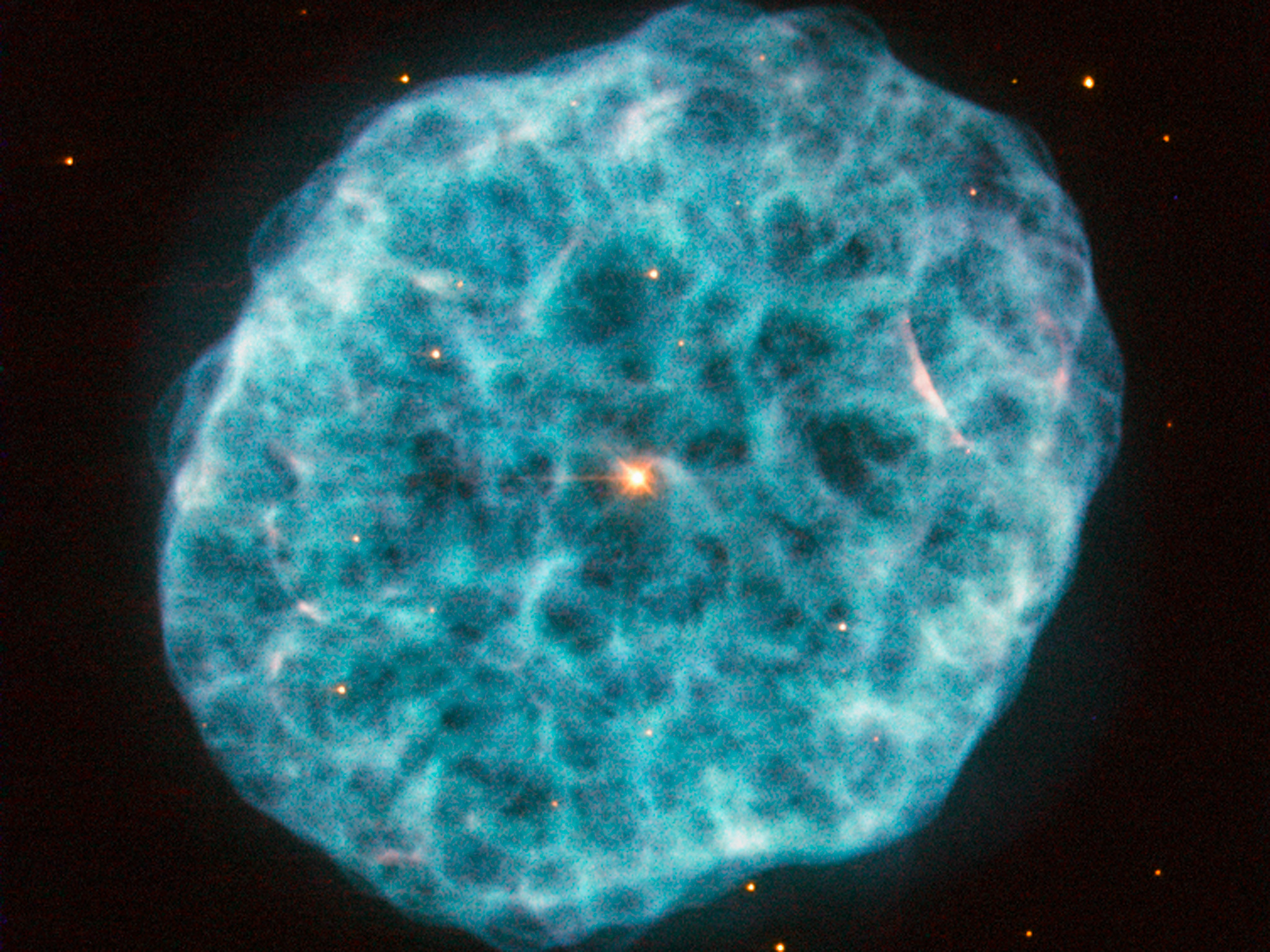
A hazy nebula

Credit:  ESA/Hubble & NASA
Acknowledgement: Marc Canale

This new image from Hubble’s Wide Field Planetary Camera 2 showcases NGC 1501, a complex planetary nebula located in the large but faint constellation of Camelopardalis (The Giraffe).

Discovered by William Herschel in 1787, NGC 1501 is a planetary nebula that is just under 5000 light-years away from us. Astronomers have modelled the three-dimensional structure of the nebula, finding it to be a cloud shaped as an irregular ellipsoid filled with bumpy and bubbly regions. It has a bright central star that can be seen easily in this image, shining brightly from within the nebula’s cloud. This bright pearl embedded within its glowing shell inspired the nebula’s popular nickname: the Oyster Nebula.

While NGC 1501's central star blasted off its outer shell long ago, it still remains very hot and luminous, although it is quite tricky for observers to spot through modest telescopes. This star has actually been the subject of many studies by astronomers due to one very unusual feature: it seems to be pulsating, varying quite significantly in brightness over a typical timescale of just half an hour. While variable stars are not unusual, it is uncommon to find one at the heart of a planetary nebula.

It is important to note that the colours in this image are arbitrary.

A version of this image was entered into the Hubble’s Hidden Treasures image processing competition by contestant Marc Canale.  


Links

Source:  ESA/Hubble - Space Telescope


Thursday, November 06, 2014

Hubble Surveys Debris-Strewn Exoplanetary Construction Yards

HD 15115, HD 32297, HD 61005, HD 181327, MP Mus
Credit: NASA, ESA, G. Schneider (University of Arizona), and the HST/GO 12228 Team

 Hubble GO/12228 Program Debris Disk Sample
Credit: NASA, ESA, G. Schneider (University of Arizona), and the HST/GO 12228 Team

Astronomers using NASA's Hubble Space Telescope have completed the largest and most sensitive visible-light imaging survey of dusty debris disks around other stars. These dusty disks, likely created by collisions between leftover objects from planet formation, were imaged around stars as young as 10 million years old and as mature as more than 1 billion years old.

"It's like looking back in time to see the kinds of destructive events that once routinely happened in our solar system after the planets formed," said survey leader Glenn Schneider of the University of Arizona's Steward Observatory. The survey's results appeared in the Oct. 1, 2014, issue of The Astronomical Journal.

Once thought to be simply pancake-like structures, the unexpected diversity and complexity of these dusty debris structures strongly suggest they are being gravitationally affected by unseen planets orbiting the star. Alternatively, these effects could result from the stars' passing through interstellar space.

The researchers discovered that no two "disks" of material surrounding stars look the same. "We find that the systems are not simply flat with uniform surfaces," Schneider said. "These are actually pretty complicated three-dimensional debris systems, often with embedded smaller structures. Some of the substructures could be signposts of unseen planets." The astronomers used Hubble's Space Telescope Imaging Spectrograph to study 10 previously discovered circumstellar debris systems, plus MP Mus, a mature protoplanetary disk of age comparable to the youngest of the debris disks.

Irregularities observed in one ring-like system in particular, around a star called HD 181327, resemble the ejection of a huge spray of debris into the outer part of the system from the recent collision of two bodies.

"This spray of material is fairly distant from its host star — roughly twice the distance that Pluto is from the Sun," said co-investigator Christopher Stark of NASA's Goddard Space Flight Center, Greenbelt, Maryland. "Catastrophically destroying an object that massive at such a large distance is difficult to explain, and it should be very rare. If we are in fact seeing the recent aftermath of a massive collision, the unseen planetary system may be quite chaotic."

Another interpretation for the irregularities is that the disk has been mysteriously warped by the star's passage through interstellar space, directly interacting with unseen interstellar material. "Either way, the answer is exciting," Schneider said. "Our team is currently analyzing follow-up observations that will help reveal the true cause of the irregularity."

Over the past few years astronomers have found an incredible diversity in the architecture of exoplanetary systems — planets are arranged in orbits that are markedly different than found in our solar system. "We are now seeing a similar diversity in the architecture of accompanying debris systems," Schneider said. "How are the planets affecting the disks, and how are the disks affecting the planets? There is some sort of interdependence between a planet and the accompanying debris that might affect the evolution of these exoplanetary debris systems."

From this small sample, the most important message to take away is one of diversity, Schneider said. He added that astronomers really need to understand the internal and external influences on these systems, such as stellar winds and interactions with clouds of interstellar material, and how they are influenced by the mass and age of the parent star, and the abundance of heavier elements needed to build planets.

Though astronomers have found nearly 4,000 exoplanet candidates since 1995, mostly by indirect detection methods, only about two dozen light-scattering, circumstellar debris systems have been imaged over that same time period. That's because the disks are typically 100,000 times fainter than, and often very close to, their bright parent stars. The majority have been seen because of Hubble's ability to perform high-contrast imaging, in which the overwhelming light from the star is blocked to reveal the faint disk that surrounds the star.

The new imaging survey also yields insight into how our solar system formed and evolved 4.6 billion years ago. In particular, the suspected planet collision seen in the disk around HD 181327 may be similar to how the Earth-Moon system formed, as well as the Pluto-Charon system over 4 billion years ago. In those cases, collisions between planet-sized bodies cast debris that then coalesced into a companion moon.

CONTACT:

Ray Villard
Space Telescope Science Institute, Baltimore, Md.
410-338-4514
villard@stsci.edu

Glenn Schneider
University of Arizona, Tucson, Ariz.
520-621-5865
gschneider@as.arizona.edu

Source: HubbleSite


Revolutionary ALMA Image Reveals Planetary Genesis

ALMA image of the protoplanetary disc around HL Tauri
 
ALMA/Hubble composite image of the region around the young star HL Tauri
 
ALMA image of the young star HL Tauri (annotated)
 
Hubble image of the surroundings of the young star HL Tauri
 
Comparison of HL Tauri with the Solar System
 
Artist’s impression of a young star surrounded by a protoplanetary disc
 
Wide-field view of the sky around the young star HL Tauri
 
HL Tauri in the constellation of Taurus


************************************************

Videos

ESOcast 69: Revolutionary ALMA Image Reveals Planetary Genesis

Zooming in on the location of HL Tauri

Artist's impression of the disc around a young star

Artist's 3d impression of the disc around the young star HL Tauri


This new image from ALMA, the Atacama Large Millimeter/submillimeter Array, reveals extraordinarily fine detail that has never been seen before in the planet-forming disc around a young star. These are the first observations that have used ALMA in its near-final configuration and the sharpest pictures ever made at submillimetre wavelengths. The new results are an enormous step forward in the observation of how protoplanetary discs develop and how planets form.

For ALMA’s first observations in its new and most powerful mode, researchers pointed the antennas at HL Tauri — a young star, about 450 light-years away, which is surrounded by a dusty disc [1]. The resulting image exceeds all expectations and reveals unexpectedly fine detail in the disc of material left over from star birth. It shows a series of concentric bright rings, separated by gaps [2].

"These features are almost certainly the result of young planet-like bodies that are being formed in the disc. This is surprising since such young stars are not expected to have large planetary bodies capable of producing the structures we see in this image," said Stuartt Corder, ALMA Deputy Director.

When we first saw this image we were astounded at the spectacular level of detail. HL Tauri is no more than a million years old, yet already its disc appears to be full of forming planets. This one image alone will revolutionise theories of planet formation,” explained Catherine Vlahakis, ALMA Deputy Program Scientist and Lead Program Scientist for the ALMA Long Baseline Campaign.

HL Tauri’s disc appears much more developed than would be expected from the age of the system. Thus, the ALMA image also suggests that the planet-formation process may be faster than previously thought.

Such high resolution can only be achieved with the long baseline capabilities of ALMA and provides astronomers with new information that is impossible to collect with any other facility, even the NASA/ESA Hubble Space Telescope. “The logistics and infrastructure required to place antennas at such distant locations required an unprecedented coordinated effort by an expert international team of engineers and scientists,” said ALMA Director, Pierre Cox. “These long baselines fulfill one of ALMA’s major objectives and mark an impressive technological, scientific and engineering milestone.”

Young stars like HL Tauri are born in clouds of gas and fine dust, in regions which have collapsed under the effects of gravitation, forming dense hot cores that eventually ignite to become young stars. These young stars are initially cocooned in the remaining gas and dust, which eventually settles into a disc, known as a protoplanetary disc.

Through many collisions the dust particles will stick together, growing into clumps the size of sand grains and pebbles. Ultimately, asteroids, comets and even planets can form in the disc. Young planets will disrupt the disc and create rings, gaps and holes such as those seen in the structures now observed by ALMA [3].

The investigation of these protoplanetary discs is essential to our understanding of how Earth formed in the Solar System. Observing the first stages of planet formation around HL Tauri may show us how our own planetary system may have looked more than four billion years ago, when it formed.

Most of what we know about planet formation today is based on theory. Images with this level of detail have up to now been relegated to computer simulations or artist’s impressions. This high resolution image of HL Tauri demonstrates what ALMA can achieve when it operates in its largest configuration and starts a new era in our exploration of the formation of stars and planets,” says Tim de Zeeuw, Director General of ESO.  

Notes

[1] Since September 2014 ALMA has been observing the Universe using its longest ever baselines, with antennas separated by up to 15 kilometres. This Long Baseline Campaign will continue until 1 December 2014. The baseline is the distance between two of the antennas in the array. As a comparison, other facilities operating at millimetre wavelengths provide antennas separated by no more than two kilometres. The maximum possible ALMA baseline is 16 kilometres. Future observations at shorter wavelengths will achieve even higher image sharpness.

[2] The structures are seen with a resolution of just five times the distance from the Sun to the Earth. This corresponds to an angular resolution of about 35 milliarcseconds — better than what is routinely achieved with the NASA/ESA Hubble Space Telescope.

[3] In visible light, HL Tauri is hidden behind a massive envelope of dust and gas. ALMA observes at much longer wavelengths, which allows it to study the processes right at the core of this cloud.


More Information: 

The Atacama Large Millimeter/submillimeter Array (ALMA), an international astronomy facility, is a partnership of Europe, North America and East Asia in cooperation with the Republic of Chile. ALMA is funded in Europe by the European Southern Observatory (ESO), in North America by the U.S. National Science Foundation (NSF) in cooperation with the National Research Council of Canada (NRC) and the National Science Council of Taiwan (NSC) and in East Asia by the National Institutes of Natural Sciences (NINS) of Japan in cooperation with the Academia Sinica (AS) in Taiwan. ALMA construction and operations are led on behalf of Europe by ESO, on behalf of North America by the National Radio Astronomy Observatory (NRAO), which is managed by Associated Universities, Inc. (AUI) and on behalf of East Asia by the National Astronomical Observatory of Japan (NAOJ). The Joint ALMA Observatory (JAO) provides the unified leadership and management of the construction, commissioning and operation of ALMA.

ESO is the foremost intergovernmental astronomy organisation in Europe and the world’s most productive ground-based astronomical observatory by far. It is supported by 15 countries: Austria, Belgium, Brazil, the Czech Republic, Denmark, France, Finland, Germany, Italy, the Netherlands, Portugal, Spain, Sweden, Switzerland and the United Kingdom. ESO carries out an ambitious programme focused on the design, construction and operation of powerful ground-based observing facilities enabling astronomers to make important scientific discoveries. ESO also plays a leading role in promoting and organising cooperation in astronomical research. ESO operates three unique world-class observing sites in Chile: La Silla, Paranal and Chajnantor. At Paranal, ESO operates the Very Large Telescope, the world’s most advanced visible-light astronomical observatory and two survey telescopes. VISTA works in the infrared and is the world’s largest survey telescope and the VLT Survey Telescope is the largest telescope designed to exclusively survey the skies in visible light. ESO is the European partner of a revolutionary astronomical telescope ALMA, the largest astronomical project in existence. ESO is currently planning the 39-metre European Extremely Large optical/near-infrared Telescope, the E-ELT, which will become “the world’s biggest eye on the sky”. 

Links


Contacts:

Catherine Vlahakis
Joint ALMA Observatory
Santiago, Chile
Tel: +56 9 75515736
Email:
cvlahaki@alma.cl

Valeria Foncea Rubens
Joint ALMA Observatory
Santiago, Chile
Tel: +56 2 24676258
Email:
vfoncea@alma.cl

Richard Hook
ESO education and Public Outreach Department
Garching bei München, Germany
Tel: +49 89 3200 6655
Cell: +49 151 1537 3591
Email:
rhook@eso.org

Source: ESO 

Wednesday, November 05, 2014

Mysterious G2 Cloud Near Black Hole Identified

An image from W. M. Keck Observatory near infrared data shows that G2 survived its closest approach to the black hole and continues happily on its orbit. The green circle just to its right depicts the location of the invisible supermassive black hole. Credit: Andrea Ghez, Gunther Witzel/UCLA Galactic Center Group/W. M. Keck Observatory


Telescopes from Hawaii’s W.M. Keck Observatory use a powerful technology called adaptive optics, which enabled UCLA astronomers to discover that G2 is a pair of binary stars that merged together, cloaked in gas and dust. Credit: Ethan Tweedie Photography

MAUNA KEA, Hawaii – The mystery about a thin, bizarre object in the center of the Milky Way headed toward our galaxy’s enormous black hole has been solved by UCLA astronomers using the W. M. Keck Observatory, home of the two largest telescopes on Earth. The scientists studied the object, known as G2, during its closest approach to the black hole this summer, and found the black hole did not dine on it. The research is published today in the journal Astrophysical Journal Letters.

While some scientists believed the object was a cloud of hydrogen gas that would be torn apart in a fiery show, Ghez and her team proved it was much more interesting. 

“G2 survived and continues happily on its orbit; a gas cloud would not do that,” said Andrea Ghez, UCLA professor of physics and astronomy who holds the Lauren B. Leichtman and Arthur E. Levine Chair in Astrophysics, and directs the UCLA Galactic Center Group. “G2 was completely unaffected by the black hole; no fireworks.”

Instead, the team has demonstrated it is a pair of binary stars that had been orbiting the black hole in tandem and merged together into an extremely large star, cloaked in gas and dust, and choreographed by the black hole’s powerful gravitational field. 

“G2 is not alone,” said Ghez, who uses Keck Observatory to study thousands of stars in the neighborhood of the supermassive black hole. “We’re seeing a new class of stars near the black hole, and as a consequence of the black hole.” 

Ghez and her colleagues — who include lead author Gunther Witzel, a UCLA postdoctoral scholar in Ghez’s research group, and Mark Morris, a UCLA professor of physics and astronomy — studied the event with both of the 10-meter telescopes at Keck Observatory.

Keck Observatory employs a powerful technology called adaptive optics, which Ghez helped to pioneer, to correct the distorting effects of the Earth's atmosphere in real time, and to reveal the region of space around the black hole. With adaptive optics, Ghez and her colleagues have revealed many surprises about the environments surrounding supermassive black holes, discovering, for example, young stars where none were expected and seeing a lack of old stars where many were anticipated.

“The Keck Observatory has been the leader in adaptive optics for more than a decade and has enabled us to achieve tremendous progress in correcting the distorting effects of the Earth’s atmosphere using high–angular resolution imaging techniques,” Ghez said.

The researchers wouldn’t have been able to arrive at their conclusions without the Keck’s advanced technology. “It is a result that in its precision was possible only with these incredible tools, the Keck Observatory’s 10-meter telescopes,” Witzel said.

“We are seeing phenomena about black holes that you can’t watch anywhere else in the universe,” Ghez added. “We are starting to understand the physics of black holes in a way that has never been possible before, and is possible only at the center of the galaxy.”

Massive stars in our galaxy, she noted, primarily come in pairs. When the two stars merge into one, the star expands for more than one million years “before it settles back down,” Ghez said. “This may be happening more than we thought; the stars at the center of the galaxy are massive and mostly binaries. It’s possible that many of the stars we’ve been watching and not understanding may be the end product of a merger that are calm now.”

G2, in that explosive stage now, has been an object of fascination. “Its closest approach to the black hole was one of the most watched events in astronomy in my career,” Ghez said.

G2 makes an unusual, 300-year elliptical orbit around the black hole and Ghez’s group calculated its closest approach occurred this summer — later than other astronomers believed —and they were in place at Keck Observatory to gather the data. 

Black holes, which form out of the collapse of matter, have such high density that nothing can escape their gravitational pull, not even light. They cannot be seen directly, but their influence on nearby stars is visible and provides a signature, said Ghez, a 2008 MacArthur Fellow.

The W. M. Keck Observatory operates the largest, most scientifically productive telescopes on Earth. The two, 10-meter optical/infrared telescopes near the summit of Mauna Kea on the Island of Hawaii feature a suite of advanced instruments including imagers, multi-object spectrographs, high-resolution spectrographs, integral-field spectographs and world-leading laser guide star adaptive optics systems. 

NIRC2 (the Near-Infrared Camera, second generation) works in combination with the Keck II adaptive optics system to obtain very sharp images at near-infrared wavelengths, achieving spatial resolutions comparable to or better than those achieved by the Hubble Space Telescope at optical wavelengths. NIRC2 is probably best known for helping to provide definitive proof of a central massive black hole at the center of our galaxy. Astronomers also use NIRC2 to map surface features of solar system bodies, detect planets orbiting other stars, and study detailed morphology of distant galaxies.

Keck Observatory is a private 501(c) 3 non-profit organization and a scientific partnership of the California Institute of Technology, the University of California and NASA.


Media Contact

Steve Jefferson
Communications Officer
W. M. Keck Observatory
808.881.3827

sjefferson@keck.hawaii.edu


Tuesday, November 04, 2014

Water on Earth

An image of the stellar nursery in NGC 3603 where stars are actively forming from the nebula’s extended clouds of gas and dust. Astronomers have found that water in our solar system almost certainly derives in large part from interstellar water, rather than forming locally, and that consequently other stellar systems would be expected to contain water as well.Credit: ESO

Water, the key ingredient for life, is not only abundant on Earth, it is also ubiquitous across the solar system. Either as ice or sometimes as liquid, water has been spotted in comets, the icy moons of the giant planets, and even in the shadowed basins of Mercury. Water has left its mark in hydrated minerals in meteorites that penetrated our atmosphere, in lunar basalts retrieved by the astronauts, and in Martian melt inclusions recovered from rock samples ejected from Mars that found their way to Earth. Comets and asteroids (as traced by meteorites) remain the oldest, most primitive objects with water. They provide a natural time capsule of the conditions present during the Sun’s epoch of planet formation.

No one knows for sure when and where these ices formed. Water might have been present in the dense interstellar medium from which Sun formed or it might have been made somehow within the solar nebula after it developed. Astronomers are trying to determine which applies because the former suggests that all planet-forming systems will have abundant water ices, whereas the latter presumably means that the abundance of water can vary dramatically from stellar system to system.

Water is usually made with two atoms of hydrogen and one of oxygen, as H2O, but it can also come in deuterated form in which a deuterium atom replaces one hydrogen atom. The fraction of deuterated water in a sample is a powerful measure of the age and origin of the sample: Interstellar ices are highly enriched in the deuterated species because the chemistry of interstellar space – ionizing radiation in particular - preferentially destroys normal H2O water. Ice in interstellar space can have a two to thirty times higher fraction of deuterated water than is found on Earth.

CfA astronomer Karin Oberg and her colleagues did comprehensive modeling of the proto-planetary disk that forms around new stars, including the effects of ultraviolet ionization and the influence of radioactive elements in the material. In the latest issue of Science, the team reports a number of key results, including that the young solar nebula must have contained some pristine interstellar ice. A considerable fraction of the solar system’s water therefore predates the Sun. If the solar system is typical, the scientists conclude, then interstellar ices in a stellar birth cloud should be widely available to all young protoplanetary systems.

Reference(s): 
 
"The Ancient Heritage of Water Ice in the Solar System," L. Ilsedore Cleeves, Edwin A. Bergin, Conel M. O'D. Alexander, Fujun Du, Dawn Graninger, Karin I. Öberg, Tim J. Harries, Science, 345, 1590, 2014.


Stars influence the central distribution of dark matter in galaxy clusters

Figure 1: A composite optical and X-ray image of Abell 383, one of the 7 relaxed rich clusters considered in the study by Newman et al. 2013a,b. This image shows the X-ray emission of the hot electron gas in the cluster (in purple), its member galaxies and its central Brightest Cluster Galaxy which exhibits an extended diffuse envelope of stars around it.  Credits: X-ray: NASA/CXC/Caltech/A.Newman et al/Tel Aviv/A.Morandi & M.Limousin; Optical: NASA/STScI, ESO/VLT, SDSS

Figure 2: A zoom on the BCG in Abell 383 taken with the Hubble Space Telescope. The central BCG is surrounded by an extended envelope of stars and the numerous distorted images around it are background galaxies which are getting lensed by the cluster. Because of their high masses, galaxy clusters can act as gravitational lenses: the background galaxies close to the line of sight of the cluster get multiply imaged or distorted into large arcs like the one visible south of the BCG. Some of the cluster galaxies (e.g. the bright elliptical galaxy one on the south-east of the BCG) act as additional lenses which further distort some of the multiple images. Credits: NASA

Figure 3: Density profiles of simulated and real clusters. Left Panel: Density profile for one of the re-simulated galaxy cluster. The black, red and blue lines represent the distribution of total (stars+dark matter), dark matter and stellar mass. The magenta line corresponds to the distribution of matter in a dark-matter-only run of the cluster (where the contribution of stars in galaxies was completely neglected). The total mass profile as a whole is very similar to the dark-matter-only run except where the density of stars overtakes that of the dark matter. The final dark matter profile on the other hand is shallower than the original dark-matter-only run already at the half-light radius of the BCG marked by the red arrow. The black arrow shows the radius where effects from black hole mergers would significantly affect the distribution of stars and dark matter in the BCG core. Right Panel: Density profile for one of the clusters in the Newman et al. (2013) sample, Abell 611. Black, red and blue lines represent the contributions from total, stellar and dark matter respectively. The dashed lines mark the 1-sigma error on the modelling. The mass distribution in this cluster is quite similar to one of the simulated clusters in the left panel.  Credits: Laporte & White 2014

Dark matter is at the centre of our understanding of the physics of the early Universe, of cosmic large-scale structure and of galaxy formation. In its simplest form, "cold dark matter" consists of non-relativistic weakly interacting particles of a kind not included in the standard model of particle physics. On astrophysical scales the dark matter only interacts with baryons (ordinary matter) through the force of gravity. Because of the simple physics this entails, its dynamics and clustering can be followed through N-body simulations. Recently, scientists at the MPA have performed cosmological N-body simulations showing that the mergers of galaxies (containing both stars and dark matter) at the centre of galaxy clusters can alter the central distribution of dark matter in a way that alleviates recent discrepancies found between observations and simulations.

The Cosmic Microwave Background provides important information on how dark matter was distributed in the early Universe. Cosmological N-body simulations can be used to follow this distribution as it evolves forward in time, ultimately giving rise to today's cosmic web, made up of voids, filaments and the halos in which the galaxies live. It is an important task to characterise, both theoretically and observationally, the internal structure of these halos, since this constrains both the nature of the dark matter particle and the way galaxies form and evolve. Already in the 1990s, cosmological N-body simulations were able to characterise the density profiles of dark matter halos, showing that, to a good approximation, these have a universal shape from the scales of dwarf galaxies to those of galaxy clusters. The physical origin of this universal profile remains a mystery to this day. An important task in modern astronomy is to infer the distribution of dark matter in galaxies in order to test this prediction of the standard LCDM paradigm for halo structure. 

Galaxy clusters are objects of prime interest to study dark matter because they give astronomers the largest number of independent probes of halo structure (stellar kinematics, strong gravitational lensing, weak gravitational lensing, X-ray emission from hot gas, galaxy motions). This helps considerably in obtaining robust and precise results which can put firm constraints on total mass profiles. Recent observations of galaxy clusters and of their central galaxies (Brightest Cluster Galaxies or BCGs) have combined a number of probes, revealing that the clusters' total density profiles are well described by the "universal" profile found in cosmological dark-matter-only simulations. However, their dark matter profiles are systematically shallower in the innermost regions (well inside the visible BCG). 

As gas cools and condenses near the centre of a dark matter halo and begins to form stars, simple arguments suggest the dark matter should be pulled inwards, thus steepening its density profile. While this appears to contradict the observations, this is not the full story for BCGs because their growth can be more complicated than that of more typical galaxies. It was proposed in the 1970s that BCGs may grow through multiple mergers of preformed galaxies which will occur preferentially at the centres of clusters. This suggestion seems to hold up according to current detailed simulations of the formation of galaxies and clusters in the LCDM paradigm. However, previous work did not investigate whether this picture could explain the observed structural evolution of BCGs in detail (e.g. their stellar masses, sizes, shapes, surface brightness profiles and dark matter content, all as a function of redshift). A year ago, a team of scientists at the MPA and the National Astronomical Observatories in China have provided further support for this formation channel by comparing observations at low and high redshift with sophisticated methods for ?painting" the stars onto cosmological dark matter N-body simulations of galaxy cluster formation. 

More recently, MPA scientists conducted N-body simulations which explicitly and self-consistently followed the evolution of both stars and dark matter in clusters. These high-resolution simulations began with a dark matter distribution consistent with LCDM expectations and a galaxy population consistent with that observed in the z~2 universe (about 3 billion years after the Big Bang) and they followed evolution down to the present day. This required a new scheme to insert equilibrium galaxies of a prescribed structure into dark matter halos that had already formed in a cosmological simulation, while mimicking the contraction of the dark-matter halos induced by baryon condensation at their centres. 

While the earlier conclusions on BCG evolution held up, the new simulations showed that the central mass re-distributes itself significantly as mergers proceed. By the present day, the mixture of dark and stellar matter in the BCGs had the same total mass density profiles as in test simulations which included dark matter alone. This demonstrated that evolution tends to drive the total mass density profile (stars and dark matter) towards the "universal" shape. Since the stars contribute most of the mass near the middle of the final BCGs, this meant that their dark matter density profiles were actually less centrally concentrated than in the dark-matter-only simulations, even though they started out more concentrated in the initial galaxies. As a result, the simulated BCGs appear to have dark matter profiles consistent with those inferred observationally.
The simulated BCGs typically experienced 6 or 7 mergers which, in real galaxies, would be accompanied by a merger of the central supermassive black holes. Such mergers pump energy into the innermost regions, causing the stars and dark matter to move outwards. Estimates of the size of this effect based on the simulations suggest that it might explain the large stellar cores often observed in BCGs. So far, the effects of supermassive black holes in BCGs cannot be directly simulated in a full cosmological context, so the current simulations offer realistic initial conditions for simplified numerical studies of supermassive black hole merging in the central regions of BCGs. 

This study suggests that observations of the mass distribution in the centres of galaxy clusters can be understood if BCG evolution is primarily driven by dissipationless mergers. Within the standard LCDM paradigm, such an evolutionary path naturally explains a total density profile similar to those found in dark-matter-only simulations, together with a shallower dark matter density profile. There seems no need to appeal to the more radical explanations proposed in some recent papers such as new physics in the dark matter sector or dynamical effects driven by star and black hole formation which are much more violent than any observed.

Chervin Laporte and Simon White


References:

Laporte C. F. P., White S. D. M., Naab T., Gao L. 2013, MNRAS, 435, 901
Laporte & White 2014, http://arxiv.org/abs/1409.1924
Newman 2013a, ApJ, 765, 24
Newman 2013b, ApJ, 765, 25

Monday, November 03, 2014

VLTI Detects Exozodiacal Light

Artist’s impression of bright exozodiacal light
 
Zodiacal light seen from Paranal
 
Zodiacal Light over La Silla


*********************

Videos


Artist’s impression of bright exozodiacal light


New challenge for direct imaging of exo-Earths


By using the full power of the Very Large Telescope Interferometer an international team of astronomers has discovered exozodiacal light close to the habitable zones around nine nearby stars. This light is starlight reflected from dust created as the result of collisions between asteroids, and the evaporation of comets. The presence of such large amounts of dust in the inner regions around some stars may pose an obstacle to the direct imaging of Earth-like planets in the future.

Using the Very Large Telescope Interferometer (VLTI) in near-infrared light [1], the team of astronomers observed 92 nearby stars to probe exozodiacal light from hot dust close to their habitable zones and combined the new data with earlier observations [2]. Bright exozodiacal light, created by the glowing grains of hot exozodiacal dust, or the reflection of starlight off these grains, was observed around nine of the targeted stars. 

From dark clear sites on Earth, zodiacal light looks like a faint diffuse white glow seen in the night sky after the end of twilight, or before dawn. It is created by sunlight reflected off tiny particles and appears to extend up from the vicinity of the Sun. This reflected light is not just observed from Earth but can be observed from everywhere in the Solar System. 

The glow being observed in this new study is a much more extreme version of the same phenomenon. While this exozodiacal light — zodiacal light around other star systems — had been previously detected, this is the first large systematic study of this phenomenon around nearby stars. 

In contrast to earlier observations the team did not observe dust that will later form into planets, but dust created in collisions between small planets of a few kilometres in size — objects called planetesimals that are similar to the asteroids and comets of the Solar System. Dust of this kind is also the origin of the zodiacal light in the Solar System.

If we want to study the evolution of Earth-like planets close to the habitable zone, we need to observe the zodiacal dust in this region around other stars,” said Steve Ertel, lead author of the paper, from ESO and the University of Grenoble in France. “Detecting and characterising this kind of dust around other stars is a way to study the architecture and evolution of planetary systems.”

Detecting faint dust close to the dazzling central star requires high resolution observations with high contrast. Interferometry — combining light collected at the exact same time at several different telescopes — performed in infrared light is, so far, the only technique that allows this kind of system to be discovered and studied. 

By using the power of the VLTI and pushing the instrument to its limits in terms of accuracy and efficiency, the team was able to reach a performance level about ten times better than other available instruments in the world.

For each of the stars the team used the 1.8-metre Auxiliary Telescopes to feed light to the VLTI. Where strong exozodiacal light was present they were able to fully resolve the extended discs of dust, and separate their faint glow from the dominant light of the star [3]

By analysing the properties of the stars surrounded by a disc of exozodiacal dust, the team found that most of the dust was detected around older stars. This result was very surprising and raises some questions for our understanding of planetary systems. Any known dust production caused by collisions of planetesimals should diminish over time, as the number of planetesimals is reduced as they are destroyed.

The sample of observed objects also included 14 stars for which the detection of exoplanets has been reported. All of these planets are in the same region of the system as the dust in the systems showing exozodiacal light. The presence of exozodiacal light in systems with planets may create a problem for further astronomical studies of exoplanets.

Exozodiacal dust emission, even at low levels, makes it significantly harder to detect Earth-like planets with direct imaging. The exozodiacal light detected in this survey is a factor of 1000 times brighter than the zodiacal light seen around the Sun. The number of stars containing zodiacal light at the level of the Solar System is most likely much higher than the numbers found in the survey. These observations are therefore only a first step towards more detailed studies of exozodiacal light.

“The high detection rate found at this bright level suggests that there must be a significant number of systems containing fainter dust, undetectable in our survey, but still much brighter than the Solar System’s zodiacal dust,” explains Olivier Absil, co-author of the paper, from the University of Liège. “The presence of such dust in so many systems could therefore become an obstacle for future observations, which aim to make direct images of Earth-like exoplanets.


Notes


[1] The team used the VLTI visitor instrument PIONIER, which is able to interferometrically connect all four Auxiliary Telescopes or all four Unit Telescopes of the VLT at the Paranal Observatory. This led to not only extremely high resolution of the targets but also allowed for a high observing efficiency. 

[2] Previous observations were made with the CHARA array — an optical astronomical interferometer operated by the Center for High Angular Resolution Astronomy (CHARA) of the Georgia State University, and its fibred beam combiner FLUOR.  

[3] As a by-product, these observations have also led to the discovery of new, unexpected stellar companions orbiting around some of the most massive stars in the sample. "These new companions suggest that we should revise our current understanding of how many of this type of star are actually double," says Lindsay Marion, lead author of an additional paper dedicated to this complementary work using the same data.


More information


This research was presented in a paper “A near-infrared interferometric survey of debris-disc stars. IV. An unbiased sample of 92 southern stars observed in H-band with VLTI/PIONIER”, by S. Ertel et al., to appear in the journal Astronomy & Astrophysics. The complementary paper on companion stars found in the survey is "Searching for faint companions with VLTI/PIONIER. II. 92 main sequence stars from the Exozodi survey", by L. Marion et al., in the same edition of the journal.

The team is composed of S. Ertel (Université Grenoble Alpes, France; ESO, Chile), O. Absil (University of Liège, Belgium), D. Defrère (University of Arizona, USA), J.-B. Le Bouquin (Université Grenoble Alpes), J.-C. Augereau (Université Grenoble Alpes), L. Marion (University of Liège), N. Blind (Max-Planck Institute for Extraterrestrial Physics, Garching, Germany), A. Bonsor (University of Bristol, United Kingdom), G. Bryden (California Institute of Technology, Pasadena, USA), J. Lebreton (California Institute of Technology), and J. Milli (Université Grenoble Alpes)

ESO is the foremost intergovernmental astronomy organisation in Europe and the world’s most productive ground-based astronomical observatory by far. It is supported by 15 countries: Austria, Belgium, Brazil, the Czech Republic, Denmark, France, Finland, Germany, Italy, the Netherlands, Portugal, Spain, Sweden, Switzerland and the United Kingdom. ESO carries out an ambitious programme focused on the design, construction and operation of powerful ground-based observing facilities enabling astronomers to make important scientific discoveries. ESO also plays a leading role in promoting and organising cooperation in astronomical research. ESO operates three unique world-class observing sites in Chile: La Silla, Paranal and Chajnantor. At Paranal, ESO operates the Very Large Telescope, the world’s most advanced visible-light astronomical observatory and two survey telescopes. VISTA works in the infrared and is the world’s largest survey telescope and the VLT Survey Telescope is the largest telescope designed to exclusively survey the skies in visible light. ESO is the European partner of a revolutionary astronomical telescope ALMA, the largest astronomical project in existence. ESO is currently planning the 39-metre European Extremely Large optical/near-infrared Telescope, the E-ELT, which will become “the world’s biggest eye on the sky”.


Links


Contacts


Steve Ertel
European Southern Observatory
Santiago, Chile
Email: sertel@eso.org

Lindsay Marion
University of Liège
Liège, Belgium
Tel: +32 4 366 97 58
Cell: +32 472 347 742
Email: lindsay.marion@ulg.ac.be

Jean-Charles Augereau
Institut de Planétologie et d'Astrophysique de Grenoble (IPAG)
Grenoble, France
Tel: +33 (0)4 76 51 47 86
Email:
Jean-Charles.Augereau@obs.ujf-grenoble.fr


Richard Hook
ESO education and Public Outreach Department
Garching bei München, Germany
Tel: +49 89 3200 6655
Cell: +49 151 1537 3591
Email: rhook@eso.org

Source: ESO

When did galaxies settle down?

A Hubble Space Telescope image of a spiral galaxy seen when the Universe was less than a third of its current age, yet showing the same barred feature as much older, settled disk galaxies. Credit: NASA, ESA, J. Kartaltepe (NOAO), C. Lintott (Oxford), H. Ferguson (STScI), S. Faber (UCO).

A European Southern Observatory image of the barred spiral galaxy NGC 1365, rotated to match the orientation of the first image. NGC 1365 is about 56 million light years away, so we see it as it appears 56 million years ago, or 10 billion years later than the galaxy in the HST image. Credit: ESO/IDA/Danish 1.5 m/ R. Gendler, J-E. Ovaldsen, C. Thöne, and C. Feron.

Astronomers have long sought to understand exactly how the universe evolved from its earliest history to the cosmos we see around us in the present day. In particular, the way that galaxies form and develop is still a matter for debate. Now a group of researchers have used the collective efforts of the hundreds of thousands of people that volunteer for the Galaxy Zoo project to shed some light on this problem. They find that galaxies may have settled into their current form some two billion years earlier than previously thought.

Dr Brooke Simmons of the University of Oxford and her collaborators describe the work in a paper in Monthly Notices of the Royal Astronomical Society. The team set Zoo volunteers the task of classifying the shapes of tens of thousands of galaxies observed by the Hubble Space Telescope. These objects are typically very distant, so we see them as they appeared more than 10 billion years ago, when the universe was about 3 billion years old, less than a quarter of its present age.

The newly classified galaxies are striking in that they look a lot like those in today’s universe, with disks, bars and spiral arms. But theorists predict that these should have taken another 2 billion years to begin to form, so things seem to have been settling down a lot earlier than expected.

Brooke comments: “When we started looking for these galaxies, we didn't really know what we'd find. We had predictions from galaxy simulations that we shouldn't find any of the barred features that we see in nearby, evolved galaxies, because very young galaxies might be too agitated for them to form.”

‘But we now know that isn't the case. With the public helping us search through many thousands of images of distant galaxies, we discovered that some galaxies settle very early on in the Universe.”


Media contact

Dr Robert Massey
Royal Astronomical Society
Tel: +44 (0)20 7734 3307 / 4582
Mob: +44 (0)794 124 8035

rm@ras.org.uk

Science contact

Dr Brooke Simmons
University of Oxford
Tel: +44 (0)1865 273637

brooke.simmons@astro.ox.ac.uk
 

Further information

The new work appears in “Galaxy Zoo: CANDELS Barred Disks and Bar Fractions, B. D. Simmons et al, Monthly Notices of the Royal Astronomical Society, Oxford University Press, 445, pp. 3466-3474.
A preprint of the paper is available on the arXivv

Notes for editors

The Royal Astronomical Society (RAS), founded in 1820, encourages and promotes the study of astronomy, solar-system science, geophysics and closely related branches of science. The RAS organizes scientific meetings, publishes international research and review journals, recognizes outstanding achievements by the award of medals and prizes, maintains an extensive library, supports education through grants and outreach activities and represents UK astronomy nationally and internationally. Its more than 3800 members (Fellows), a third based overseas, include scientific researchers in universities, observatories and laboratories as well as historians of astronomy and others.

Follow the RAS on Twitter