Showing posts with label HD 181327. Show all posts

Monday, June 16, 2025

Another First: NASA Webb Identifies Frozen Water in Young Star System

For the first time, researchers confirmed the presence of crystalline water ice in a dusty debris disk that orbits a Sun-like star, using NASA’s James Webb Space Telescope. All the frozen water detected by Webb is paired with fine dust particles throughout the disk. The majority of the water ice observed is found where it’s coldest and farthest from the star. The closer to the star the researchers looked, the less water ice they found. Credits/Artwork: NASA, ESA, CSA, STScI, Ralf Crawford (STScI)


Is frozen water scattered in systems around other stars? Astronomers have long expected it is, partially based on previous detections of its gaseous form, water vapor, and its presence in our own solar system.

Now there is definitive evidence: Researchers confirmed the presence of crystalline water ice in a dusty debris disk that orbits a Sun-like star 155 light-years away using detailed data known as spectra from NASA’s James Webb Space Telescope. (The term water ice specifies its makeup, since many other frozen molecules are also observed in space, such as carbon dioxide ice, or “dry ice.”) In 2008, data from NASA’s retired Spitzer Space Telescope hinted at the possibility of frozen water in this system.

“Webb unambiguously detected not just water ice, but crystalline water ice, which is also found in locations like Saturn’s rings and icy bodies in our solar system’s Kuiper Belt,” said Chen Xie, the lead author of the new paper and an assistant research scientist at Johns Hopkins University in Baltimore, Maryland.

All the frozen water Webb detected is paired with fine dust particles throughout the disk — like itsy-bitsy “dirty snowballs.” The results published Wednesday in the journal Nature.

Astronomers have been waiting for this definitive data for decades. “When I was a graduate student 25 years ago, my advisor told me there should be ice in debris disks, but prior to Webb, we didn’t have instruments sensitive enough to make these observations,” said Christine Chen, a co-author and an astronomer at the Space Telescope Science Institute in Baltimore. “What’s most striking is that this data looks similar to the telescope’s other recent observations of Kuiper Belt objects in our own solar system.”

Water ice is a vital ingredient in disks around young stars — it heavily influences the formation of giant planets and may also be delivered by small bodies like comets and asteroids to fully formed rocky planets. Now that researchers have detected water ice with Webb, they have opened the door for all researchers to study how these processes play out in new ways in many other planetary systems.

Rocks, Dust, Ice Rushing Around

The star, cataloged HD 181327, is significantly younger than our Sun. It’s estimated to be 23 million years old, compared to the Sun’s more mature 4.6 billion years. The star is slightly more massive than the Sun, and it’s hotter, which led to the formation of a slightly larger system around it.

Webb’s observations confirm a significant gap between the star and its debris disk — a wide area that is free of dust. Farther out, its debris disk is similar to our solar system’s Kuiper Belt, where dwarf planets, comets, and other bits of ice and rock are found (and sometimes collide with one another). Billions of years ago, our Kuiper Belt was likely similar to this star’s debris disk.

“HD 181327 is a very active system,” Chen said. “There are regular, ongoing collisions in its debris disk. When those icy bodies collide, they release tiny particles of dusty water ice that are perfectly sized for Webb to detect.”

Frozen Water — Almost Everywhere

Water ice isn’t spread evenly throughout this system. The majority is found where it’s coldest and farthest from the star. “The outer area of the debris disk consists of over 20% water ice,” Xie said.

The closer in the researchers looked, the less water ice they found. Toward the middle of the debris disk, Webb detected about 8% water ice. Here, it’s likely that frozen water particles are produced slightly faster than they are destroyed. In the area of the debris disk closest to the star, Webb detected almost none. It’s likely that the star’s ultraviolet light vaporizes the closest specks of water ice. It’s also possible that rocks known as planetesimals have “locked up” frozen water in their interiors, which Webb can’t detect.

This team and many more researchers will continue to search for — and study — water ice in debris disks and actively forming planetary systems throughout our Milky Way galaxy. “The presence of water ice helps facilitate planet formation,” Xie said. “Icy materials may also ultimately be ‘delivered’ to terrestrial planets that may form over a couple hundred million years in systems like this.”

The researchers observed HD 181327 with Webb’s NIRSpec (Near-Infrared Spectrograph), which is super-sensitive to extremely faint dust particles that can only be detected from space.

The James Webb Space Telescope is the world’s premier space science observatory. Webb is solving mysteries in our solar system, looking beyond to distant worlds around other stars, and probing the mysterious structures and origins of our universe and our place in it. Webb is an international program led by NASA with its partners, ESA (European Space Agency) and CSA (Canadian Space Agency).

To learn more about Webb, visit: https://science.nasa.gov/webb


About This Release

Credits:

Media Contact:

Claire Blome
Space Telescope Science Institute, Baltimore

Christine Pulliam
Space Telescope Science Institute, Baltimore

Permissions: Content Use Policy

Contact Us: Direct inquiries to the News Team.

Related Links and Documents


Thursday, May 15, 2025

Another First: NASA Webb Identifies Frozen Water in Young Star System

For the first time, researchers confirmed the presence of crystalline water ice in a dusty debris disk that orbits a Sun-like star, using NASA’s James Webb Space Telescope. All the frozen water detected by Webb is paired with fine dust particles throughout the disk. The majority of the water ice observed is found where it’s coldest and farthest from the star. The closer to the star the researchers looked, the less water ice they found. Credits/Artwork: NASA, ESA, CSA, STScI, Ralf Crawford (STScI)


Is frozen water scattered in systems around other stars? Astronomers have long expected it is, partially based on previous detections of its gaseous form, water vapor, and its presence in our own solar system.

Now there is definitive evidence: Researchers confirmed the presence of crystalline water ice in a dusty debris disk that orbits a Sun-like star 155 light-years away using detailed data known as spectra from NASA’s James Webb Space Telescope. (The term water ice specifies its makeup, since many other frozen molecules are also observed in space, such as carbon dioxide ice, or “dry ice.”) In 2008, data from NASA’s retired Spitzer Space Telescope hinted at the possibility of frozen water in this system.

“Webb unambiguously detected not just water ice, but crystalline water ice, which is also found in locations like Saturn’s rings and icy bodies in our solar system’s Kuiper Belt,” said Chen Xie, the lead author of the new paper and an assistant research scientist at Johns Hopkins University in Baltimore, Maryland.

All the frozen water Webb detected is paired with fine dust particles throughout the disk — like itsy-bitsy “dirty snowballs.” The results published Wednesday in the journal Nature.

Astronomers have been waiting for this definitive data for decades. “When I was a graduate student 25 years ago, my advisor told me there should be ice in debris disks, but prior to Webb, we didn’t have instruments sensitive enough to make these observations,” said Christine Chen, a co-author and associate astronomer at the Space Telescope Science Institute in Baltimore. “What’s most striking is that this data looks similar to the telescope’s other recent observations of Kuiper Belt objects in our own solar system.”

Water ice is a vital ingredient in disks around young stars — it heavily influences the formation of giant planets and may also be delivered by small bodies like comets and asteroids to fully formed rocky planets. Now that researchers have detected water ice with Webb, they have opened the door for all researchers to study how these processes play out in new ways in many other planetary systems.

Rocks, Dust, Ice Rushing Around

The star, cataloged HD 181327, is significantly younger than our Sun. It’s estimated to be 23 million years old, compared to the Sun’s more mature 4.6 billion years. The star is slightly more massive than the Sun, and it’s hotter, which led to the formation of a slightly larger system around it.

Webb’s observations confirm a significant gap between the star and its debris disk — a wide area that is free of dust. Farther out, its debris disk is similar to our solar system’s Kuiper Belt, where dwarf planets, comets, and other bits of ice and rock are found (and sometimes collide with one another). Billions of years ago, our Kuiper Belt was likely similar to this star’s debris disk.

“HD 181327 is a very active system,” Chen said. “There are regular, ongoing collisions in its debris disk. When those icy bodies collide, they release tiny particles of dusty water ice that are perfectly sized for Webb to detect.”

Frozen Water — Almost Everywhere

Water ice isn’t spread evenly throughout this system. The majority is found where it’s coldest and farthest from the star. “The outer area of the debris disk consists of over 20% water ice,” Xie said.

The closer in the researchers looked, the less water ice they found. Toward the middle of the debris disk, Webb detected about 8% water ice. Here, it’s likely that frozen water particles are produced slightly faster than they are destroyed. In the area of the debris disk closest to the star, Webb detected almost none. It’s likely that the star’s ultraviolet light vaporizes the closest specks of water ice. It’s also possible that rocks known as planetesimals have “locked up” frozen water in their interiors, which Webb can’t detect.

This team and many more researchers will continue to search for — and study — water ice in debris disks and actively forming planetary systems throughout our Milky Way galaxy. “The presence of water ice helps facilitate planet formation,” Xie said. “Icy materials may also ultimately be ‘delivered’ to terrestrial planets that may form over a couple hundred million years in systems like this.”

The researchers observed HD 181327 with Webb’s NIRSpec (Near-Infrared Spectrograph), which is super-sensitive to extremely faint dust particles that can only be detected from space.

The James Webb Space Telescope is the world’s premier space science observatory. Webb is solving mysteries in our solar system, looking beyond to distant worlds around other stars, and probing the mysterious structures and origins of our universe and our place in it. Webb is an international program led by NASA with its partners, ESA (European Space Agency) and CSA (Canadian Space Agency).

To learn more about Webb, visit: https://science.nasa.gov/webb


About This Release

Credits:

Media Contact Claire Blome
Space Telescope Science Institute, Baltimore

Christine Pulliam
Space Telescope Science Institute, Baltimore

Permissions: Content Use Policy

Contact Us: Direct inquiries to the News Team.

Related Links and Documents


Saturday, May 28, 2016

New Insights into Debris Discs

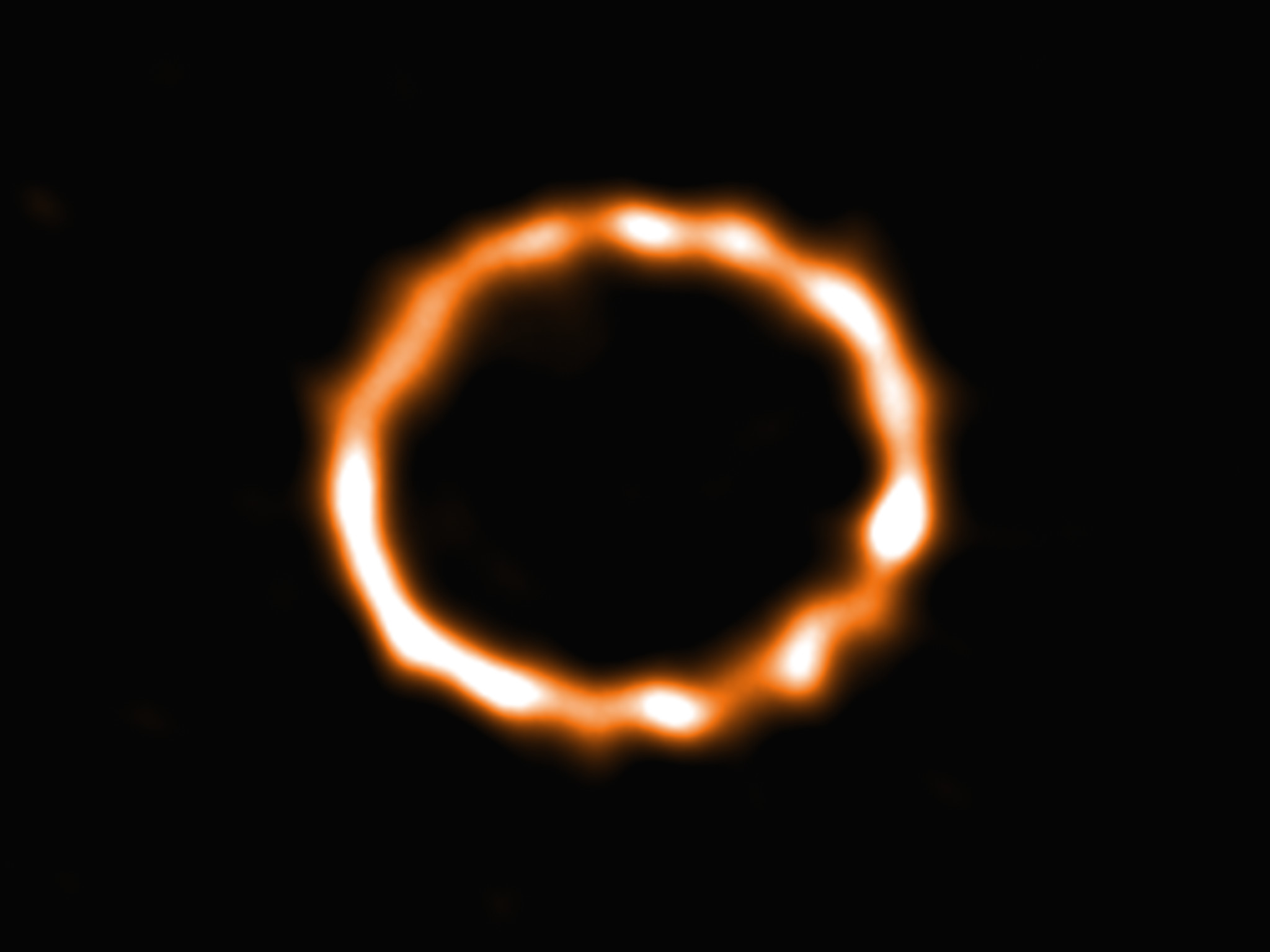
Credit: ESO/Marino et al.


Using 39 of the 66 antennas of the Atacama Large Millimeter/submillimeter Array (ALMA), located 5000 metres up on the Chajnantor plateau in the Chilean Andes, astronomers have been able to detect carbon monoxide (CO) in the disc of debris around an F-type star. Although carbon monoxide is the second most common molecule in the interstellar medium, after molecular hydrogen, this is the first time that CO has been detected around a star of this type. The star, named HD 181327, is a member of the Beta Pictoris moving group, located almost 170 light-years from Earth.

Until now, the presence of CO has been detected only around a few A-type stars, substantially more massive and luminous than HD 181327. Using the superb spatial resolution and sensitivity offered by the ALMA observatory astronomers were now able to capture this stunning ring of smoke and map the density of the CO within the disc.

The study of debris discs is one way to characterise planetary systems and the results of planet formation. The CO gas is found to be co-located with the dust grains in the ring of debris and to have been produced recently. Destructive collisions of icy planetesimals in the disc are possible sources for the continuous replenishment of the CO gas. Collisions in debris discs typically require the icy bodies to be gravitationally perturbed by larger objects in order to reach sufficient collisional velocities. Moreover, the derived CO composition of the icy planetesimals in the disc is consistent with the comets in our Solar System. This possible secondary origin for the CO gas suggests that icy comets could be common around stars similar to our Sun which has strong implications for life suitability in terrestrial exoplanets.

The results were published in the journal Monthly Notices of the Royal Astronomical Society under the title “Exocometary gas in the HD 181327 debris ring” by S. Marino et al.

Link

Source: ESO/images

Saturday, January 10, 2015

Volunteer 'Disk Detectives' Top 1 Million Classifications of Possible Planetary Habitats

A NASA-sponsored website designed to crowdsource analysis of data from the agency's Wide-field Infrared Survey Explorer (WISE) mission has reached an impressive milestone. In less than a year, citizen scientists using DiskDetective.org have logged 1 million classifications of potential debris disks and disks surrounding young stellar objects (YSO). This data will help provide a crucial set of targets for future planet-hunting missions.

"This is absolutely mind-boggling," said Marc Kuchner, an astrophysicist at NASA's Goddard Space Flight Center in Greenbelt, Maryland, and the project's principal investigator. "We've already broken new ground with the data, and we are hugely grateful to everyone who has contributed to Disk Detective so far."

Volunteers using DiskDetective.org, a NASA-sponsored citizen science website to find potential planetary nurseries, have made 1 million classifications in less than a year. Goddard astrophysicist Marc Kuchner, the project's principal investigator, explains how it works.Image Credit: NASA's Goddard Space Flight Center/S. Wiessinger. Download this video in HD formats from NASA Goddard's Scientific Visualization Studio

The marked asymmetry of the debris disk around the star HD 181327 (shown here in a Hubble image) suggests it may have formed as a result of the collision of two small bodies. Disk Detective aims to discover many other stellar disks using volunteer classifications of data from NASA's WISE mission.Image Credit:  NASA, ESA, G. Schneider (U. of Arizona), HST/GO 12228 Team


Combing through objects identified by WISE during its infrared survey of the entire sky, Disk Detective aims to find two types of developing planetary environments. The first, known as a YSO disk, typically is less than 5 million years old, contains large quantities of gas, and often is found in or near young star clusters. The second planetary habitat, known as a debris disk, tends to be older than 5 million years, holds little or no gas, and possesses belts of rocky or icy debris that resemble the asteroid and Kuiper belts found in our own solar system. Vega and Fomalhaut, two of the brightest stars in the sky, host debris disks.

Planets form and grow within disks of gas, dust and icy grains surrounding young stars. The particles absorb the star's light and reradiate it as heat, which makes the stars brighter at infrared wavelengths -- in this case, 22 microns -- than they would be without a disk.

Computer searches already have identified some objects seen by the WISE survey as potential dust-rich disks. But software can't distinguish them from other infrared-bright sources, such as galaxies, interstellar dust clouds and asteroids. There may be thousands of potential planetary systems in the WISE data, but the only way to know for sure is to inspect each source by eye.

Kuchner recognized that searching the WISE database for dusty disks was a perfect opportunity for crowdsourcing. He worked with NASA to team up with the Zooniverse, a collaboration of scientists, software developers and educators who collectively develop and manage citizen science projects on the Internet.

At DiskDetective.org, volunteers watch a 10-second "flip book" of a disk candidate shown at several different wavelengths as observed from three different telescopes, including WISE. They then click one or more buttons that best describe the object's appearance. Each classification helps astronomers decide which images may be contaminated by background galaxies, interstellar matter or image artifacts, and which may be real disks that should be studied in more detail.

In March 2014, just two months after Disk Detective launched, Kuchner was amazed to find just how invested in the project some users had become. Volunteers complained about seeing the same object over and over. "We thought at first it was a bug in the system," Kuchner explained, "but it turned out they were seeing repeats because they had already classified every single object that was online at the time."

Some 28,000 visitors around the world have participated in the project to date. What's more, volunteers have translated the site into eight foreign languages, including Romanian, Mandarin and Bahasa, and have produced their own video tutorials on using it.

Many of the project's most active volunteers are now joining in science team discussions, and the researchers encourage all users who have performed more than 300 classifications to contact them and take part.
One of these volunteers is Tadeáš Černohous, a postgraduate student in geodesy and cartography at Brno University of Technology in the Czech Republic. "I barely understood what scientists were looking for when I started participating in Disk Detective, but over the past year I have developed a basic sense of which stars are worthy of further exploration," he said.

Alissa Bans, a postdoctoral fellow at Adler Planetarium in Chicago and a member of the Disk Detective science team, recalls mentioning that she was searching for candidate YSOs and presented examples of what they might look like on Disk Detective. "In less than 24 hours," she said, "Tadeáš had compiled a list of nearly 100 objects he thought could be YSOs, and he even included notes on each one."

Speaking at a press conference at the American Astronomical Society meeting in Seattle on Tuesday, Kuchner said the project has so far netted 478 objects of interest, which the team is investigating with a variety of ground-based telescopes in Arizona, California, New Mexico, Argentina and Chile. "We now have at least 37 solid new disk candidates, and we haven't even looked at all the new telescope data yet," he said.
Disk Detective currently includes about 278,000 WISE sources. The team expects to wrap up the current project sometime in 2018, with a total of about 3 million classifications and perhaps 1,000 disk candidates. The researchers then plan to add an additional 140,000 targets to the site.

“We’ve come a long way, but there’s still lots and lots more work to do -- so please drop by the site and do a little science with us!” added Kuchner.

WISE has made infrared measurements of more than 745 million objects, compiling the most comprehensive survey of the sky at mid-infrared wavelengths currently available. With its primary mission complete, the satellite was placed in hibernation in 2011. WISE was awoken in September 2013, renamed the Near-Earth Object Wide-field Infrared Survey Explorer (NEOWISE), and given a new mission to assist NASA's efforts in identifying the population of potentially hazardous near-Earth objects (NEOs).

Facilities involved in follow-up studies of objects found with Disk Detective include Apache Point Observatory in Sunspot, New Mexico; Palomar Observatory on Palomar Mountain, California; the Fred Lawrence Whipple Observatory on Mount Hopkins, Arizona; the Leoncito Astronomical Complex in El Leoncito National Park, Argentina; and Las Campanas Observatory, located in the Atacama Desert of Chile.

NASA is exploring our solar system and beyond to understand the universe and our place in it. We seek to unravel the secrets of our universe, its origins and evolution, and search for life among the stars. Today’s announcement shares the discovery of our ever-changing cosmos, and brings us closer to learning whether we are alone in the universe.


Related Links


Francis Reddy
NASA's Goddard Space Flight Center, Greenbelt, Maryland


Thursday, November 06, 2014

Hubble Surveys Debris-Strewn Exoplanetary Construction Yards

HD 15115, HD 32297, HD 61005, HD 181327, MP Mus
Credit: NASA, ESA, G. Schneider (University of Arizona), and the HST/GO 12228 Team

 Hubble GO/12228 Program Debris Disk Sample
Credit: NASA, ESA, G. Schneider (University of Arizona), and the HST/GO 12228 Team

Astronomers using NASA's Hubble Space Telescope have completed the largest and most sensitive visible-light imaging survey of dusty debris disks around other stars. These dusty disks, likely created by collisions between leftover objects from planet formation, were imaged around stars as young as 10 million years old and as mature as more than 1 billion years old.

"It's like looking back in time to see the kinds of destructive events that once routinely happened in our solar system after the planets formed," said survey leader Glenn Schneider of the University of Arizona's Steward Observatory. The survey's results appeared in the Oct. 1, 2014, issue of The Astronomical Journal.

Once thought to be simply pancake-like structures, the unexpected diversity and complexity of these dusty debris structures strongly suggest they are being gravitationally affected by unseen planets orbiting the star. Alternatively, these effects could result from the stars' passing through interstellar space.

The researchers discovered that no two "disks" of material surrounding stars look the same. "We find that the systems are not simply flat with uniform surfaces," Schneider said. "These are actually pretty complicated three-dimensional debris systems, often with embedded smaller structures. Some of the substructures could be signposts of unseen planets." The astronomers used Hubble's Space Telescope Imaging Spectrograph to study 10 previously discovered circumstellar debris systems, plus MP Mus, a mature protoplanetary disk of age comparable to the youngest of the debris disks.

Irregularities observed in one ring-like system in particular, around a star called HD 181327, resemble the ejection of a huge spray of debris into the outer part of the system from the recent collision of two bodies.

"This spray of material is fairly distant from its host star — roughly twice the distance that Pluto is from the Sun," said co-investigator Christopher Stark of NASA's Goddard Space Flight Center, Greenbelt, Maryland. "Catastrophically destroying an object that massive at such a large distance is difficult to explain, and it should be very rare. If we are in fact seeing the recent aftermath of a massive collision, the unseen planetary system may be quite chaotic."

Another interpretation for the irregularities is that the disk has been mysteriously warped by the star's passage through interstellar space, directly interacting with unseen interstellar material. "Either way, the answer is exciting," Schneider said. "Our team is currently analyzing follow-up observations that will help reveal the true cause of the irregularity."

Over the past few years astronomers have found an incredible diversity in the architecture of exoplanetary systems — planets are arranged in orbits that are markedly different than found in our solar system. "We are now seeing a similar diversity in the architecture of accompanying debris systems," Schneider said. "How are the planets affecting the disks, and how are the disks affecting the planets? There is some sort of interdependence between a planet and the accompanying debris that might affect the evolution of these exoplanetary debris systems."

From this small sample, the most important message to take away is one of diversity, Schneider said. He added that astronomers really need to understand the internal and external influences on these systems, such as stellar winds and interactions with clouds of interstellar material, and how they are influenced by the mass and age of the parent star, and the abundance of heavier elements needed to build planets.

Though astronomers have found nearly 4,000 exoplanet candidates since 1995, mostly by indirect detection methods, only about two dozen light-scattering, circumstellar debris systems have been imaged over that same time period. That's because the disks are typically 100,000 times fainter than, and often very close to, their bright parent stars. The majority have been seen because of Hubble's ability to perform high-contrast imaging, in which the overwhelming light from the star is blocked to reveal the faint disk that surrounds the star.

The new imaging survey also yields insight into how our solar system formed and evolved 4.6 billion years ago. In particular, the suspected planet collision seen in the disk around HD 181327 may be similar to how the Earth-Moon system formed, as well as the Pluto-Charon system over 4 billion years ago. In those cases, collisions between planet-sized bodies cast debris that then coalesced into a companion moon.

CONTACT:

Ray Villard
Space Telescope Science Institute, Baltimore, Md.
410-338-4514
villard@stsci.edu

Glenn Schneider
University of Arizona, Tucson, Ariz.
520-621-5865
gschneider@as.arizona.edu

Source: HubbleSite